
 CRITICAL-COLLABORATIVE HYBRID LEARNING: A DISCUSSION BASED ON THE SOCIAL-HISTORICAL-CULTURAL THEORY
ABSTRACT:
Different conceptions about hybrid teaching, hybrid education, and hybrid learning have been disseminated since the pandemic period, without an effective discussion about which theoretical bases guide this hybrid work format. The objective of this paper is to discuss a teaching proposal carried out as part of a graduate program in Applied Linguistics and Language Studies (PUC-SP), focusing on hybrid teaching-learning in the light of the socio-historical-cultural theory and guided by critical-creative methodologies. More specifically, the study was anchored on the theoretical-methodological approach of Critical Collaborative Research (PCCol). It sought support in the concept of critical collaboration (Magalhães, 2010; 2011); in the studies of Vygotsky ([1930] 1991), Gutierrez et al. (1999); and in concepts that are the foundations of the discussion on hybridism (Canclini, [2001] 2008, Nørgård (2021). As a result, it was possible to highlight characteristics of hybrid teaching-learning from the socio-historical-cultural perspective: the development of autonomy, the interdependence between the proposed tasks aiming to expand spaces for critical-collaborative exchanges, the possibility of generating potential zones of development articulated with the real contexts of students' lives. Such results corroborate the need for new studies on hybrid teaching in postgraduate programs.
KEYWORDS:
Hybridism; Hybrid teaching-learning; Socio-historical-cultural perspective of hybrid teaching-learning; Learning stations; Critical-creative methodologies
RESUMO:
Concepções diversas sobre ensino híbrido, educação híbrida, aprendizagem híbrida vêm se propagando desde o período pandêmico até o momento, sem uma efetiva discussão sobre quais bases teóricas orientam essa aprendizagem de caráter híbrido. Objetiva-se, neste artigo, discutir uma proposta de ensino realizada em disciplina do curso de pós-graduação em Linguística Aplicada e Estudos da Linguagem (PUC-SP), com foco no ensino-aprendizagem híbrido à luz da teoria sócio-histórico-cultural e orientada por metodologias crítico-criativas. O estudo ancorou-se na abordagem teórico-metodológica da Pesquisa Crítica de Colaboração (PCCol). Buscou apoio no conceito de colaboração crítica (Magalhães, 2010; 2011); nos estudos de Vygotsky ([1930] 1991), Gutierrez et al. (1999); e em conceitos que sustentam a discussão sobre hibridismo (Canclini, [2001] 2008, Nørgård (2021). Como resultado, foi possível ressaltar características do ensino-aprendizagem híbrido na perspectiva sócio-histórico-cultural: o desenvolvimento da autonomia, a interdependência entre as tarefas propostas visando expandir espaços de trocas crítico-colaborativas, a possibilidade de geração de zonas potenciais de desenvolvimento articuladas aos contextos reais de vida dos educandos. Tais resultados corroboram a necessidade de novos estudos sobre ensino híbrido em programas de pós-graduação.
PALAVRAS-CHAVE:
Hibridismo; Ensino-aprendizagem híbrido; Perspectiva sócio-histórico-cultural de ensino-aprendizagem híbrido; Estações de aprendizagem; Metodologias crítico-criativas
INTRODUCTION
Educational practices in both basic and higher education have increasingly focused on incorporating Digital Information and Communication Technologies (DICT). The COVID-19 pandemic has underscored this issue, revealing significant disparities within educational institutions regarding the availability of digital equipment and the training of professionals to effectively use these tools, as well as the approaches taken in planning and implementation.
In 2020 and 2021, we witnessed an unwavering effort by educational administrators to equip their institutions with various technological tools, driven by the belief that these resources would address the challenges of remote teaching. The concept of “hybrid learning”3 became a central focus in discussions within educator training contexts; however, the true meaning of this term often overlooked the theoretical foundations of the proposed educational practices and the necessary training for educators to effectively engage with their students.
In the eagerness to find methodologies suitable for the remote system, hybrid learning was chosen. Still, its characteristics indicated transmissive proposals, much more so than those considered before the pandemic, when digital technologies were used. There was a significant concern with combining strategies and methodologies, which could undermine the meaning of learning—the concept itself—and the theory that supports it. During the pandemic, we saw the use of so-called hybrid models, which often blended teaching and learning, simulating a context of knowledge production when what was perceived was its reproduction.
The lack of a consensual definition for hybrid learning causes teachers to understand this teaching “in different ways and then design their courses according to their understanding of the concept” (Alammary; Sheard; Carbone, 2014, p.440).
Thinking about hybrid learning based on Socio-Historical-Cultural Theory, our proposal in this article highlights the need to question the ontological, epistemological, and theoretical-methodological foundations of this teaching organization. This approach is usually based on what Freire (1970) calls a banking-based view of education, focusing only on the individual without considering the collective. It uses a linear and hierarchical approach that moves from the teacher to the student, organized through transmissive relationships. Supported by a blended curriculum of the appropriation-return of school concepts, this banking-based view obscures socio-political and colonial values and issues inherent in the reality of students, societies, and the contemporary world, hindering the critical development of the school community and the development of citizenship.
What we question is the effectiveness of these teaching models, called hybrids, in developing reflection, critical thinking, collaboration, and creativity in students who use them, in any educational setting. In what sense does this teaching emphasize the development of practices not centered on the individual student, but rather on the development of relationships that involve them, the blended and expanded learning? What are the roles of teachers, students, parents, administrators, and technology in hybrid teaching? What theoretical and methodological foundations support and/or could support this type of teaching? How can we create critical-collaborative spaces in this context? How can we redesign hybrid teaching-learning practices, basing them on a critical-collaborative approach? These rhetorical questions have been on the minds of teachers, teacher educators, and educators, regardless of their educational context, since remote learning has assumed a prominent role in this post-pandemic period. Although presented rhetorically here, these questions relate directly to the discussions developed throughout the article.
Discussing the diverse educational contexts in our country still requires us to consider how many students remain marginalized by technological advances and, consequently, far removed from the possibilities of this hybrid approach that has dominated educational practices, with access to both in-person and distance learning through digital technologies. It is therefore necessary to define hybrid teaching-learning as an educational practice that utilizes diverse methodologies and tools, but not necessarily digital technologies; that is supported by learning theories that emphasize the production of critical knowledge by students; that decolonializes knowledge production in schools.
Thus, this article aims to discuss hybrid teaching-learning (in the expansion of face-to-face and online educational practices) in contexts of critical-collaborative training of educators, in a questioning way, focusing on the current needs of the school; and to discuss epistemological, theoretical-methodological and political challenges in which the dialectical organization of language has key importance in questioning and transforming concepts regarding the production of knowledge.
In this context, we chose to discuss a teacher training proposal implemented at the height of the COVID-19 pandemic (first semester of 2021) in a graduate course in the Graduate Program in Applied Linguistics and Language Studies at the Pontifical Catholic University of São Paulo. The objective of the course was to discuss hybrid learning through the experience of educational practices, also organized in a hybrid mode4. In this article, we will discuss the theoretical assumptions that underpinned the hybrid practices implemented, to redefine “hybrid teaching” based on Socio-Historical-Cultural Theory, calling it hybrid teaching-learning.
Our research proposal follows the Final Report of the Activities of the Working Group designated by CAPES Ordinance number 89, of May 15, 2023, which highlights the new demands to which educational contexts are exposed and points out:
[It] must be recognized that the speed at which graduate education has been impacted by changes in technologies and demands creates uncertainty. On the other hand, this changing scenario contains instruments and tools that, if used well, enhance teaching and learning methodologies, contributing to the quality of graduate education in the country (Report, 2024, p. 8).
Based on Moran's studies (2021), “hybrid learning can signal a more flexible curriculum, one that plans what is fundamental for everyone and that allows, at the same time, personalized paths to meet the needs of each student” (Report, 2024, p. 15). The discussions that guided the classroom dynamics in the postgraduate course aimed, among other aspects, at this discussion on the flexibility of curricula in primary and higher education schools, through the analysis of pedagogical practices indicated by postgraduate students.
This article is organized, starting from this Introduction, as follows: a theoretical section in which we will address concepts that underpin teaching and learning from a socio-historical-cultural perspective, and then define hybrid teaching-learning. This is followed by a subsection that highlights recent studies in Brazilian academic and scientific literature on hybrid learning; a theoretical-methodological section, focused on describing and discussing the activities carried out throughout the course taught in the graduate program; a section in which we will present and discuss a proposed activity developed from the discussions that took place in that course, seeking to redefine hybrid learning and conceptualize what we have called critical-creative learning methodologies; and, finally, our final, but never final, conclusive considerations!
THEORETICAL ASSUMPTIONS
The literature on hybrid learning has consistently considered it a mixed pedagogical approach, combining face-to-face sessions mediated by some digital information and communication technology (Valente, 2015; Neumier, 2005). Many authors who have studied the topic also discuss the emphasis on placing the focus of learning on the student rather than on the transmission of knowledge. Therefore, these are recurring statements in documents5 supporting hybrid learning: students will be able to be more participatory, solve problems, access information even before class…; they will be encouraged to exercise their autonomy and share knowledge.
These aspects are relevant when considering educational practices; however, they are not sufficient to support the idea that learning and development occur (Vygotsky, [1934] 2004). Expanding on this discussion, Valente (2015, p. 17) alerts us that one of the most important aspects related to hybrid learning is the development of student autonomy and responsibility in the production of knowledge, and “the chance of trivialization [of hybrid learning] is great,” since there is a concern with what is done rather than how this education is given. In other words, an in-depth discussion regarding which theoretical and methodological bases should support these hybrid learning proposals seems distant. Therefore, it lacks an explanation of how broader contexts impact teaching-learning activities and how interactions should occur throughout them, to create a collaborative space for students to participate in socioculturally heterogeneous groups.
Studies dating back to the 1990s already highlighted discussions focusing on hybridism and hybrid learning, pointing out what could be problematic about this approach:
Although hybridity in learning contexts is ubiquitous, few scholars and professionals discuss it or consciously utilize it as a resource for enhancing joint activity and productive learning. For us, hybrid literacy practices are not simply code-switching, like alternating between two linguistic codes. They are rather a systematic, strategic, affiliative, and meaningful process among those who share the code, as they strive to achieve mutual understanding. [...] It is important that learning in this context requires participants to negotiate their roles and understandings as they co-participate in various activities [...] (Gutiérrez et al., 1999, p. 6).
When discussing hybrid cultures in times of globalization, Canclini ([2001] 2008, p. XIX; [1996] 2003) already emphasized: “I understand hybridization as sociocultural processes in which discrete structures or practices, which existed separately, combine to generate new structures, objects, and practices.” Completing this idea, he emphasized that the relevant object of study was not hybridity but rather the processes of hybridization. When discussing this in education, we emphasize the need to consider teaching-learning processes from a hybrid perspective: how do teaching-learning activities develop that take place in the interweaving of different dimensions—physical and digital spaces/environments; real/virtual presences; synchronous/asynchronous times; methodologies; diverse languages?... Also, how do these teaching-learning activities transcend the meaning of hybrid (as a mix of paths/instruments)? Once again, rhetorical questions are populating our minds!
Hybridity, hybrid learning, and hybrid learning contexts cannot be reduced to what is done or used—whether technological instruments, face-to-face moments, a combination of both…, or merely to the organizational methodologies of pedagogical practices. Such choices need to be supported by theoretical concepts that truly define how teaching-learning should occur and what it should achieve in terms of students' critical development. According to Nørgård (2021, p. 1714), “in hybrid learning, students work to think 'in another way' about time, space, materials, structures, contexts, and roles; to break down traditional dichotomies and create new forms.” The author also emphasizes that the concept of hybrid learning is an expansion of learning in terms of environments, materials, strategies, and, above all, relationships with real social situations in students' lives.
In this sense, a hybrid teaching-learning space focuses on the processes and relationships between participants; on interactions and shared experiences; on the transcendence of the “results”6 of this learning beyond the school walls and, therefore, into real life. It is a space that “tries to be simultaneously physical and digital, online and offline, process and product, for the individual and the collective, for the university and the world, formal and informal, synchronous and asynchronous, and so on” (Nørgård, 2021, p. 1715). In this discussion and expanding on the aforementioned author's point of view, we emphasize the importance of hybrid teaching-learning not as an instrument-for-results, but as an instrument-and-result (Vygotsky, [1930] 1991), capable of breaking with environments that simulate collaborative teaching-learning spaces but, at their core, merely reproduce learning.
In this sense, we seek support in Vygotsky's ([1930] 1991) discussions to argue about the meaning of hybrid teaching-learning: education plays a central role in the transformation of human beings, through a conscious humanist socio-political formation, focused on the individual and the collective, and radically alters relationships between people in social interactions. In Vygotskian thoughts, hybrid teaching-learning must enhance new ways of thinking, knowing, feeling, acting, and being in the world, through a critical-collaborative organization of language, supported by the construction of dialectical relationships between all participants, as pointed out in Freire's seminal works: “Pedagogy of the Oppressed” (1970) and “Pedagogy of Hope: A Reencounter with the Pedagogy of the Oppressed” (1992).
A hybrid teaching-learning environment would never be stable because it would be constantly in flux, seeking something new. It would still be constructed from the relationships established between participants and the complex and authentic real-life challenges they would encounter, with the purpose of “bridging the gap between education, professional life, and society” (Nørgård, 2021, p. 1717). A hybrid teaching-learning environment would be characterized by its provisionality, since, at each moment, collectively produced knowledge would reverberate within it, always dependent on the historicity of the participating individuals.
When we examine methodological proposals identified as hybrid, we often encounter group work focused on the individual student and on task-solving. Thus, learning does not explicitly focus on how the real context influences the production and organization of that student's knowledge. A socio-historical-cultural view of teaching-learning would emphasize co-participation, co-organization, and co-problem-solving “within linguistically, culturally, and academically heterogeneous groups throughout completing a task” (Gutierrez et al., 1999, p. 3).
Therefore, we consider collaboration to be one of the central characteristics of the so-called hybrid activity system. From a Vygotskian perspective, collaboration
[...] involves an intentionality in acting and speaking to listen to others and be heard, to show interest and respect for the statements made by everyone, to ask and/or respond to a participant to clarify or resume something that was said, to ask for clarification, to deepen a discussion, to relate practices to theoretical questions, to relate needs, actions-discourses, objectives [...] to point out contradictions regarding historically produced senses and meanings (Magalhães, 2010, p.29).
A hybrid teaching and learning approach seeks to establish enriching developmental environments for participants, allowing them to engage in activities where they share material, sociocultural, linguistic, and cognitive resources. This approach emphasizes real-life situations within society, moving beyond traditional school content and giving it new significance. It is crucial to reflect on how individuals utilize social processes and diverse cultural resources to construct potential zones of proximal development (Vygotsky, [1930] 1991). This perspective highlights how knowledge construction can break free from conventional teaching and learning paradigms, steering away from colonial legacies that still influence educational processes. In this context, the mere use of digital technologies does not inherently determine the success of a hybrid teaching-learning approach; rather, the organization of the approach is of paramount importance. The following aspects should guide the implementation of a hybrid teaching-learning strategy (Ninin, 2018):
-
Proposed tasks foster interculturality;
-
Relationships between students are built critically and collaboratively;
-
There are spaces for negotiating the meanings inferred from the tasks;
-
Students develop responsiveness skills and commitment to their development and other participants;
-
There are spaces for students to deliberately seek to argue and construct/create solutions to the proposed problems;
-
When constructing points of view, students establish connections with the points of view of other participants;
-
Everyone is guaranteed a space to express themselves, without prejudgment;
-
Proposed tasks are organized interdependently, generating a network of meanings that impacts the learning of all participants;
-
Proposed tasks transcend the classroom context, reaching the students' realities and driving transformations within this context;
-
There are a variety of mediational instruments capable of guiding students' actions toward research;
-
Students assume different roles in conducting the activity.
As we observe, the proposed topics emphasize student development processes based on constant interactions mediated by language, as well as the use of various instruments available in the social environment, aspects that are preponderant from a socio-historical-cultural perspective. An activity guided in this way creates possibilities for transgressing traditional teaching-learning contexts. It allows hybrid teaching-learning environments to traverse, transform, or even transgress traditional contexts through practices that foster dialogue, creating spaces in which all participants interact with peers and/or teachers in a critical-collaborative manner, enabling the construction of new shared meanings. Gutiérrez et al. (1999, p. 7) point out that “hybridity increases the possibility of dialogue—and thus, the possibility of collaboration and learning.”
A critical-collaborative process, the emphasis of our proposal,
[is] permeated by conflicts that assume the role of provoking cognitive changes in those involved, towards development. Such changes will only assume the character of transformation and will only occur if the relationship between human beings is sustained by the acceptance of questions, by argumentation and by a critically informed understanding of different points of view, which allow them to reconsider personal positions and then project the resignified and the new (Ninin, 2011, p.104).
Critical knowledge involves “the confrontation between prior knowledge, embedded in our worldviews, and reality, which propels us toward new insights that drive us toward specific objectives. It is the systematic process of understanding reality by clarifying the interconnections that constitute a totality” (Loureiro, 2020, p. 136). Based on the author's perspective, we assert that critical-collaborative thinking is fundamentally characterized by collective actions where individuals critically examine every truth presented and legitimized by society. It rejects any form of reasoning that separates society, culture, history, and, consequently, real life from the institutionalized processes of learning.
Considering recent developments in Vygotskian discussions, critical and collaborative engagement through dialectical language allows all participants to co-construct knowledge and critically examine values, as well as challenge colonial and unjust practices that often stem from underlying power dynamics among students, educators, and administrators within schools and classrooms. By adopting a hybrid teaching-learning approach grounded in socio-historical and cultural theory, we can move away from silencing pedagogical practices and create opportunities for students to develop critical perspectives that disrupt conventional educational frameworks.
The following subsection presents a synthesis of recent studies on hybrid learning, highlighting the theoretical foundations that support them and comparing them, in a certain way, to the emerging reflections of the postgraduate discipline, the locus of this work.
HYBRID LEARNING AND ACTIVE METHODOLOGIES: RELATED STUDIES
Considering that the method allows us to identify the type of teaching in a given context, it is reasonable to think that a simple articulation between virtual and in-person environments would not be sufficient to define hybrid learning. As we said in the Introduction of this article, our purpose is to characterize, from a socio-historical and cultural perspective, the actions that support what we call hybrid teaching-learning. Thus, examining the academic and scientific literature related to hybrid learning, we can understand the theoretical concepts underlying these practices.
Furletti and Costa (2018) analyzed theses and dissertations focusing on hybrid learning, revealing a diverse array of interpretations and definitions about this educational approach. This variable understanding was also evident within the graduate program in question: students engaged in various contexts of basic education, not only in São Paulo but across other Brazilian states, expressed their views on hybrid learning and the ways it has been implemented in their institutions. There remains a lack of consensus among educators regarding what constitutes an effective hybrid learning proposal. When the examples provided by professionals were examined within the context of the graduate program, many were found to be primarily transmissive, despite incorporating a mix of digital technology and in-person activities.
A work published by Allammary, Sheard and Carbone (2014, p. 441) highlights the presence of four concepts for hybrid learning: (1) different web-based technology modes combined to achieve a given educational objective (live virtual classroom, individualized instruction, collaborative learning, streaming video, audio, and text); (2) different pedagogical approaches combined to produce an ideal learning outcome, with or without instructional technology (constructivism, behaviorism, cognitivism); (3) different forms of instructional technology (e.g., videos, CD-Room, web-based training, films) with face-to-face training delivered by an instructor; (4) instructional technology mixed/combined with real work tasks to create a harmonious learning and work effect.
Bliuc et al. (2007, p.234, apud Allammary; Sheard; Carbone, 2014, p.442) define “hybrid learning” as follows: it “describes learning activities that involve a systematic combination of co-present (face-to-face) interactions and technologically mediated interactions between students, teachers and learning resources”.
These concepts/modes of defining hybrid learning can be seen in recent works discussing this type of teaching in the Brazilian educational context (Brito, 2020; Arruda; Siqueira, 2020; Lima, 2021; Oliveira, M. et al., 2021; Melo; Florêncio; Mercado, 2022; Classe; Castro; Oliveira, 2023; among others). However, there is little emphasis on teaching-learning modes; little is said about the teaching-learning concept that underpins proposals, the roles of students and teachers, the role of the context and situations selected for teaching, power and leadership relations between students and teachers, and the predicted impacts on learning. It highlights the presence of digital technology and the possibilities of blending it into various teaching-learning situations. It focuses much more on what is done and less on how a teaching-learning activity is carried out, from its planning, which goes beyond the choice of materials, to how students will relate to such materials and in what sense these materials dialogue with their needs.
Hybrid learning can be distinguished by its pedagogical uniqueness, “converging the in-person and virtual environments inseparably, based on pedagogical actions that, to be completed, require activities in both environments” (Brito, 2020, p. 1). Comparing this consideration to our assumptions, we highlight the positive aspect pointed out by Brito regarding the pedagogical uniqueness of so-called hybrid models, particularly because we believe that it is precisely this pedagogical uniqueness that proves confusing in educational contexts. However, this inseparability lies not only in the virtual-in-person environment relationship, but in any and all articulations between activities, materials, and interactions present in a hybrid teaching-learning proposal. From a socio-historical-cultural perspective, hybrid teaching-learning situations carry different instruments, means, and roles aimed at provoking, in the contexts of use, some type of transformation that breaks with coloniality, with the segregation of students and their silencing, with the passive actions of students in the face of knowledge production.
A gap in the definitions/concepts found lies in the essential redesigning of teaching and learning from a hybrid perspective, explaining teaching methods and their consequences for student development. During the COVID-19 pandemic, pedagogical practices in which teachers used applications completely preconfigured with predictable responses to be given/indicated by students became evident. These practices were called hybrid learning, even though their cognitive nature was quite evident.
Associated with the discussion of hybrid learning, we find active methodologies. Many of the works cited above and others refer to these methodologies when describing learning experiences (Marquese; Aguiar, 2021; Thé, 2022; Parreira et al., 2023; Silva; Vanini; Rossetto, 2023; Santos; Castaman, 2023, among others). In the Critical Dictionary of Education and Technologies and Distance Education, Chaquime and Mill (2018, n.p.) point out active methodologies as those that
[combine] individual and collective time in personal and group projects and, in doing so, seek to develop cognitive, personal, and social skills, requiring characteristics such as proactivity and collaboration from students. They are based on activities […] that allow students to experience different situations and contexts.
This definition is consistent with the theoretical assumptions of a socio-historical-cultural reference. However, many activities presented to students under the label active methodology often fail to meet the authors' intended objectives. Additionally, as previously noted, the COVID-19 pandemic has contributed to the trivialization of this term. For this reason, we have opted to refer to the methodologies addressed in this postgraduate course as critical-creative methodologies.
In the following section, we chose to present the postgraduate discipline, the locus of this work, and the discussions that emerged from the interactions between postgraduate students and professors, and how the activities were planned/executed.
THEORETICAL-METHODOLOGICAL ASSUMPTIONS
The subject “Hybrid teaching-learning and collaborative-critical training of educators in the school context: epistemological, theoretical-methodological and political challenges”7, offered in the Postgraduate program in Applied Linguistics and Language Studies, at the Pontifical Catholic University of São Paulo, during the first semester of 2021, aimed to redirect discussions on hybrid learning from a socio-historical-cultural perspective. The reason was that, at that pandemic moment, a ferment of discussion about how and under what conditions remote teaching should occur in schools.
The research proposal is characterized as critical collaborative research (PCCol) (Magalhães, 2011), a practical-theoretical approach focused primarily on transforming the contexts in which participants operate. Concepts such as collaboration, critique, reflection, and participation are at the core of the PCCol approach, as are the formative interventions that support the participants' actions and their reflections on the reality in which they are inserted.
In this regard, discussions with graduate students brought to light practices implemented in several public and private elementary schools in the city of São Paulo, as well as in schools in other Brazilian states, where some graduate students work. These practices focused on the use of digital media (computers and the internet, for example), whether or not combined with face-to-face sessions with students. In the graduate program environment, classes were also held remotely. However, the goal was to understand the context in which these classes took place.
The graduate students' experiences ranged from those in their professional environments where classes were taught via video lectures, with remote and asynchronous access, to those in which students participated synchronously in classes, but from their homes and simply accompanied their teachers remotely. A large number of specific teaching applications (educational software) took over teachers' planning sessions in schools, which, in many contexts, transformed them into “app practitioners.” All of these practices, however, were called “hybrid learning.” The main characteristic of this teaching was, therefore, the use of some type of digital technological instrument to replace in-person classroom instruction, without discussing the transmissive and reproductive nature of many of these proposals.
The graduate students' experiences at the time created a tense atmosphere, given the lack of clarity regarding the meaning of “hybrid learning” and the theoretical foundations that supported it. “Active learning methodologies” were discussed as if they were a new concept, created to solve the problem of remote learning during the pandemic. Previous discussions about such methodologies (derived from studies by Dewey (1959), Freire (1970), among others), which generated what were called “active methodologies,” have been largely ignored in basic education contexts. Terms such as “hybrid learning” and “active methodologies” climbed a few notches on the scale of relevance, becoming fads in the educational field. Both - in our view and based on the undue interpretations they had been receiving as a result of the pressure suffered during the pandemic - are strongly anchored in cognitivism, with proposals of a transmissive nature, but with a “dressing” that simulates an active process of knowledge production.
In light of this, the graduate course opted to engage in a discussion about these methodologies, framing them as hybrid proposals from a socio-historical and cultural perspective on teaching and learning. The first step for the graduate students involved examining theoretical texts that included the phrase “hybrid teaching” in their titles, which described learning experiences within traditional education contexts. This exploration aimed to extract theoretical foundations for such teaching and to identify how the authors defined “hybrid learning.”
From this survey of meanings, it became clear that most authors' concerns were much more related to the description of practices called “active methodologies” and “hybrid learning” than to the theoretical foundation underlying such practices and teaching-learning. Manuals focused on describing practices to be adopted by schools to address current teaching deficiencies, identifying and describing the step-by-step process to be followed by teachers—truly prescriptive manuals. On the one hand, the role of the teacher is responsible for class choices, conducting, and guiding assignments; on the other, the role of the passive student have been previously instructed to be a content researcher before class. This context triggered, in the graduate course, the need to define and theorize about hybrid learning.
Taking as a reference the studies by Horn and Staker (2015), which gave rise to other studies by Brazilian researchers regarding hybrid teaching (such as Bacich, Tanzi Neto, and Trevisani (2015), for example), we highlight the authors' point of view, to then propose a reconstruction of the concept. Horn and Staker (2015, p.34) say:
Hybrid learning is fundamentally different from the much broader trend of equipping classrooms with devices and computer programs, but it is easily confused with it. The common use of the term “hybrid learning” in educational circles and the media suffers from a problem of “emphasis on extremes.” People use the term too broadly, to refer to all uses of technology in education (“edtech”) that accumulate in a classroom, or too narrowly, to refer only to the types of learning that combine online and in-person and with which they have the most affinity. [emphasis added]
The authors developed and theorized about this understanding of “hybrid learning,” but given the COVID-19 emergency and the eagerness for solutions, the focus of this literature focused more on the strategies and methodological practices than on understanding the concepts that support them. In the activities developed in the graduate course, the students then began to seek theoretical explanations to support pedagogical practices based on so-called active learning methodologies, which, due to their emerging appeal in the pandemic context, began to indiscriminately guide teaching in basic education settings. At this point in the course, and response to the graduate students' questions, we opted for the term critical-creative methodologies (defined in detail in the following section) and began using them to guide activities and discussions during classes.
Thus, once the traditionally suggested paths for “hybrid learning”—in-person and online—were revisited, the framework proposed by Bacich, Tanzi Neto, and Trevisani (2015, p. 24) was used as a reference for postgraduate classroom discussions. This framework is anchored in the discussions of Horn and Staker (2015). The authors present a set of mechanisms indicating a synchronized movement among the following elements: school culture, space, assessment, technology, student autonomy, management, and the role of the teacher. At the center of the framework is the student (in the singular, but represented by a male and a female figure).
Discussions regarding this scheme led the postgraduate group to some questions, such as the following:
-
What place do relationships between students occupy in this scheme?
-
How is the sociopolitical and cultural context considered?
-
How does the students' reality impact/is impacted by the relationships between learners and the practices used?
-
How can the development of the student's critical thinking be guaranteed based on the relationships established and defined in the scheme?
-
What does autonomy mean in this proposal?
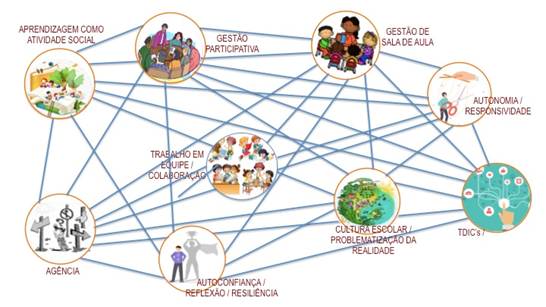
Based on a reconstruction of Bacich, Tanzi Neto, and Trevisani's (2015, p. 24) representational scheme, Figure 1 below was created to characterize a hybrid teaching-learning environment from a socio-historical-cultural perspective. The figure shows the results of conceptual discussions based on a theoretical-methodological framework, supported by Vygotsky's discussions. Vygotsky is based on Marxist dialogism and dialectics, which centrally focus on the construction of diverse social practices—thus hybrid from the perspective of this discussion—based on the language of critical collaboration, focusing on collectives for learning and developing new ways of acting with others, aiming to transform contexts by problematizing the reality of participants and society.
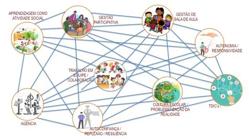
Based on this framework, how does this proposal differ from that of Bacich, Tanzi Neto, and Trevisani? The first aspect pertains to the relationships among the elements that constitute the environment: due to their interconnected nature, they exhibit a higher degree of interdependence and interaction. By adopting the concept of agency to describe the profiles of participants, we propose that teaching-learning initiatives should be actively pursued by students. This engagement should occur through processes of “social engagement, informed by the past and guided by an assessment of the present toward future possibilities” (Virkkunen, 2006, p. 63). In essence, teaching and learning are situated within social and historical contexts, and no proposed activity can overlook this crucial aspect.
Opting for responsiveness implies developing attitudes of commitment in students toward their participation and that of others, engaging in the production of knowledge. It means considering a student capable of agreeing, disagreeing, negotiating understandings, and seeking consensus.
Considering learning as a social activity (Liberali, 2009) highlights the importance of incorporating real-life situations into teaching. It emphasizes the organization of student activity mediated by instruments, focused on an object, based on rules, division of labor, and always embedded within a community (Engeström, 1999).
Considering the center of this teaching as filled not individually by a student, but rather by a collective and by the relationships they establish with each other and with the entire environment, expands the possibilities of critical collaboration, of negotiations of meanings; it expands the zones of proximal development (Vygotsky, [1930] 1991).
The network representation seeks to characterize the non-linear and sequential movements that guide hybrid teaching-learning activities. Given the dynamic nature of the proposed activities and recognizing the possibilities for articulation between the different components, the network representation indicates a reduction in the hierarchical and vertical nature of the activity, emphasizing a more horizontal relationship based on the interdependence between participants, contexts, and roles of responsibility.
From a socio-historical-cultural perspective, hybrid teaching-learning can be defined as follows: a socio-historically situated teaching-learning process, organized through a combination of diverse materials (digital or otherwise), procedures, and relationships; based on critical-collaborative interactions; capable of providing students with ample space to experience different roles of responsibility. A teaching and learning process that, through its proposed diversity, expands the networks of meaning in which students participate, enhancing their social and cognitive development.
The tension generated by activities that promote student participation in negotiating meanings, assuming roles, and collaborating with peers fosters zones of proximal development, which may not always be achievable in traditional linear learning environments. In the context of this postgraduate program, the hybrid environment was defined by the implementation of critical-creative methodologies. We adapted various proposals from traditional methods, such as station rotation, and tailored our approach based on the interdependence of tasks. This design encourages students to engage with and negotiate the meanings produced by their peers throughout the activity. The following section will elaborate on this, detailing the development of an activity organized through learning stations.
DETAILING AND DISCUSSING AN ACTIVITY PROPOSAL
Conventional literature on hybrid learning has highlighted certain educational practices, such as station rotation, lab rotation, flipped classroom, individual rotation, à la carte, and enriched virtual models, advocated by Horn and Staker (2015) and their followers. These so-called active methodologies continue to be discussed and anchor hybrid learning proposals, with the following characteristics:
-
Students engaged more than passive listeners;
-
Students engaged in activities (e.g., reading, discussing, writing);
-
Less emphasis on transmitting information and more emphasis on developing students' skills;
-
Greater emphasis on exploring attitudes and values;
-
Greater student motivation (especially adults);
-
Presence of immediate instructor feedback;
-
Students engaged in higher-order thinking (analysis, synthesis, evaluation).
While these characteristics are important for developing classroom activities, we do not consider them sufficient for critical-collaborative learning. There is no emphasis on the joint production of knowledge; there is no emphasis on conflicts that could generate potential areas of development; there is no priority given to topics/situations that relate to the real contexts of students' lives; nor are there specific moments in which students assume leadership roles, making decisions and choices for their learning. The proposals continue to place students in the role of task executors.
The graduate classes, which are the focus of this discussion, were structured using methodologies such as Learning Stations, Flipped Classroom, Problem-Solving, and Fishbowl, all adapted according to theoretical concepts rooted in socio-historical and cultural foundations. The graduate students were organized into small groups to develop teaching proposals informed by their expertise as elementary school teachers. These proposals were subsequently reviewed and refined during class sessions by both the graduate students and the course instructors, with a focus on reimagining them from the perspective of hybrid teaching and learning, as desired by the group.
As the graduate students reviewed these proposals, they began to critically engage with them through inquiries related to the quality of interaction, student agency, the selection of discussion topics, the contextualization of intended knowledge, and pertinent elements from a critical-collaborative perspective. Consequently, we opted to revisit our methodologies to ensure they effectively fostered the development of students' critical thinking skills. We termed these approaches critical-creative methodologies, a deliberate choice influenced by active methodologies. However, we also scrutinized the rigid nature these methodologies adopted during the pandemic, which often relied on mechanical and, at times, uncreative processes.
By critical-creative methodologies, we understand those that:
-
- combine individual and collective time in personal and group projects;
-
- are oriented toward real-life situations, seeking to ground them theoretically;
-
- are oriented toward questions in the pragmatic, argumentative, and epistemic dimensions (Ninin, 2018), aiming to develop the student's critical thinking in facing conflicts;
-
- encourage student proactivity;
-
- foster experiences of different roles of responsibility in different situations and contexts;
-
- are organized by provisionality rather than stability in terms of results;
-
- emphasize creative solutions that transcend those already crystallized in school processes.
In this article, we chose to discuss one of the activities developed in postgraduate classes, called Learning Stations (initially based on the active methodology Rotation by Stations), as this is the critical-creative methodology most chosen by groups of postgraduate students when developing their proposals.
Bacich, Tanzi Neto, and Travisani (2015, p.55) describe the Station Rotation model as follows:
[...] students are organized into groups, each performing a task according to the teacher's objectives for the class in question. Written activities, readings, and other tasks may be included. One group will be involved in online activities that, to a certain extent, are independent of the teacher's direct supervision. It is important to prioritize moments when students can work collaboratively and those when they can do so individually. [...] the rotation continues until everyone has completed all the groups. [...] the tasks performed in the groups are, to a certain extent, independent, but they work together so that, at the end of the class, everyone has had access to the same content.
When describing the Station Rotation model, Horn and Staker (2015) highlight the alternation of students, based on a fixed sequence or at the teacher's discretion, between learning modalities, at least one of which is online. They emphasize teacher-led teaching in small groups, individual learning moments, and modeled and independent individual reading.
However, such descriptions appear to reveal practices that emphasize learning outcomes—the completion of tasks, for example—rather than student development processes. The independence of tasks can diminish the possibilities for negotiating the meanings that emerge from the outcomes of different groups of students as they move through each learning station. With this in mind, we redesigned this model—then called Learning Stations:
-
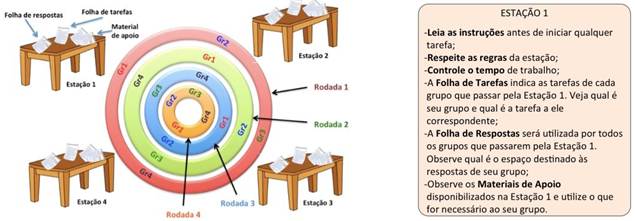
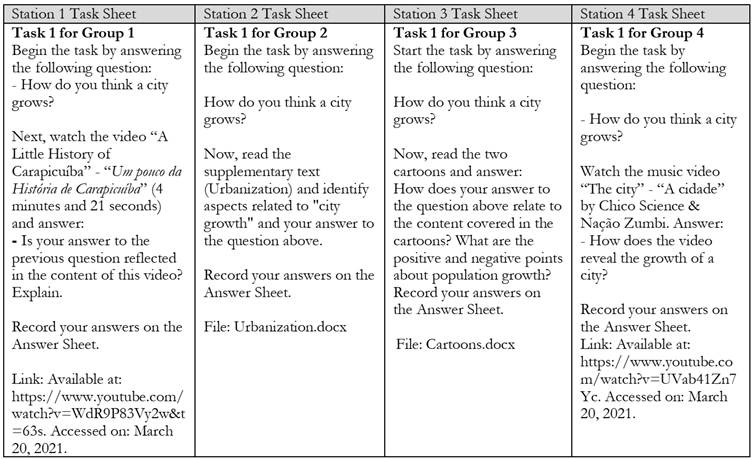
Learning Stations are organized to provide students with support materials related to the learning objective: texts, images, graphs, books, videos, etc., and may also include materials collected by the students from previous assignments. They also provide texts containing all the instructions for completing the assignments, as well as specific sheets for each group of students to record their responses to the proposed tasks. This organization aims to develop student autonomy, since, when they begin their journey through the stations, it is always up to them to reach a consensus on which paths they intend to take to complete the assignments.
-
All stations are organized around a common task related to the learning object. This initial task aims to assess students' prior knowledge about the object and should be recorded on a response sheet that will remain at the station throughout the activity and can be accessed/referenced by all participants. Thus, even though they may be at different stations, all students begin their work with a common point—a trigger for discussions that will be triggered throughout the experience at the stations.
-
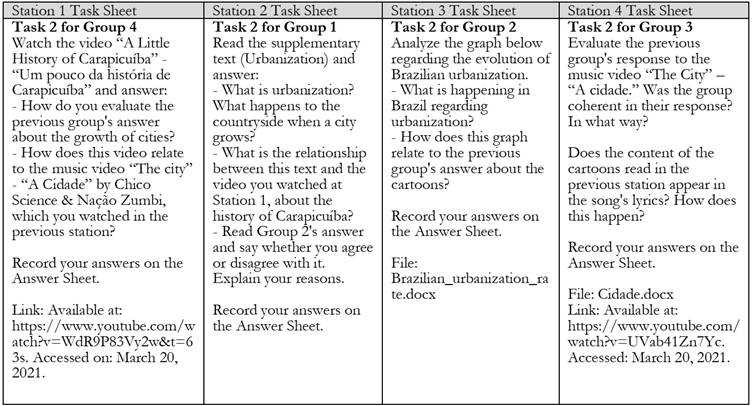
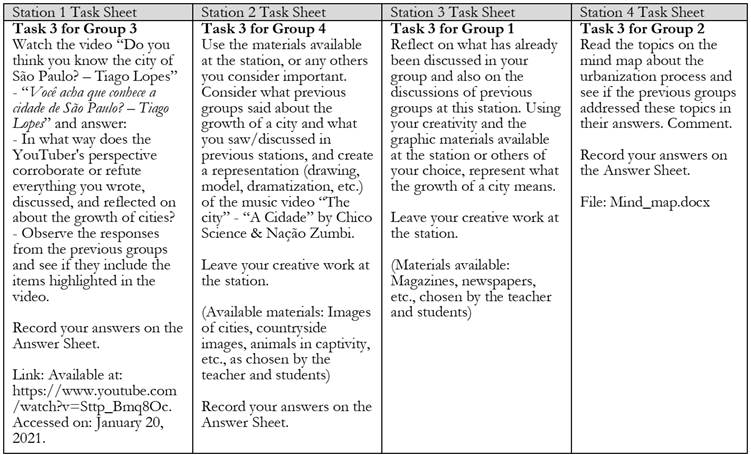
When students rotate to a second station, they are guided to a second task that may involve a variety of materials (videos, texts, images, short excursions outside the classroom, production of materials, research, etc.) and that maintains an interdependent relationship with the previous task performed by both the group and the group that experienced the first task at that station. In other words, based on the questions and the task statement, students are guided to compare their initial responses with those of their classmates and, from there, produce some kind of argument to complete the task at that station. This intensifies the students' argumentative activity.
-
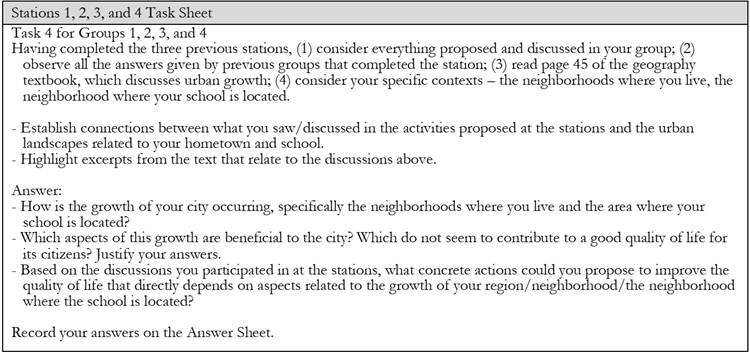
This interdependence among tasks continues throughout all stations, aiming of creating spaces for critical and collaborative exchanges among students. This dynamic movement produces potential areas of development. It is important to note that the activity begins with the investigation of prior knowledge and ends by asking students to relate their discoveries (from prior knowledge to the materials observed/analyzed) to the theoretical concepts proposed in the support materials provided at each station and to their real-life contexts. Also, the tasks emphasize moments of discussion, investigation, and confrontation based on students' positions regarding the proposed topic and the interactions among the proposed topic that emerge from the groups at each station. If we consider that the teacher will be circulating among the groups during the activity, we can say that their role is to observe what occurs at the stations at each stage and ask questions to guide the discussions and encourage students to confront their lack of knowledge and/or doubts. The teacher leaves the center of the activity and allows student groups to take this role. By focusing on the students' learning processes, the teacher can make critical and collaborative interventions that stimulate reflection among the students.
-
This organization was designed to create opportunities for students to make decisions collaboratively and deliberately, based on dialectical movements that drive their development.
Having briefly described the development process of the Learning Stations, we now present an example of an activity in which these characteristics can be identified.
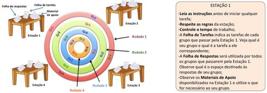
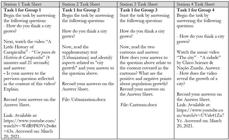
The activity was designed for 9th-grade elementary school students at a state school in Greater São Paulo, in the municipality of Carapicuíba. Taking the growth of cities as the content of the teaching materials used in the geography course, the proposal aims to connect this theoretical content to the real-life context of the students. It initially presents a video about the history of the municipality. We expect that by connecting the prescribed learning content with the real-life context of the students, the discussion will develop toward revisiting the spaces in which these students live, as well as their socioeconomic and cultural realities, fostering the presence of reasoning in the face of conflicts related to the periphery of a city like São Paulo8.
In this first round of Learning Stations, it is possible to highlight the guidelines for the activity as an element that contributes to the development of the student's autonomy: making decisions about how to begin the task, how to use support materials, how to discuss; taking positions before the group, factors that are at the core of the concept of hybrid teaching-learning.
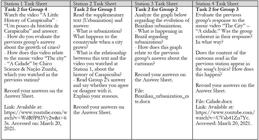
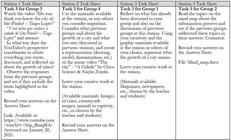
In our observations of the second and third rounds of Learning Stations, we noted the significant interdependence among the proposed tasks. To successfully complete a task, students must draw upon the thoughts, ideas, and reflections shared by their peers during earlier activities. This characteristic is particularly important, as it allows students to engage with diverse perspectives on the same subject, critically examining these viewpoints. They are encouraged to expand on their peers' ideas, transforming them into objects of their own reflection. Furthermore, this interdependence is evident in the students' ability to select materials relevant to their real-life contexts to support their tasks. In Round 4 of Learning Stations, all four groups encounter tasks that are common, yet each task remains dependent on the assignments completed by the groups in the previous stations.
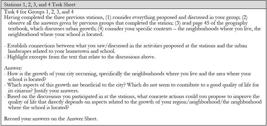
In this final round of Learning Stations, the focus is on the impact that the topic discussed has on the real-life context of students. If we analyze the learning stations based on the diagram presented in Figure 1, which shows a “hybrid learning environment,” we can find elements in the proposal that refer to each of the network's points, some already highlighted in the discussions above.
Learning as a Social Activity is included in the proposal as the focus is triggered by discussions about the real-life context of students. The proposed theme does not ignore programmatic content provided in the school curriculum, but relates it to the immediate context of life, problematizing what is being constructed by students. By problematizing the growth of the city, bringing the discussions closer to the student, their neighborhood, the neighborhood of their school, the proposal emphasizes a teaching approach that aims to be decolonial because it addresses a contemporary problem, caused by the very logic of coloniality.
In this proposal classroom management, although guided by the teacher's planning, becomes the responsibility of the students, as it offers them the opportunity to make decisions about how to discuss, how to use materials, how to prepare their records, how to articulate knowledge produced by others, in addition to being able to express points of view regarding the relationship between theoretical content prescribed in the teaching material and their real life.
(IN)CONCLUSIVE CONSIDERATIONS!
Since the beginning of the COVID-19 pandemic, hybrid learning has been a “solution” to teaching problems. It has become a key component in most educational contexts, imposed on many educators who were unprepared to handle it. In this wave, we have seen a relentless movement by schools, both public and private, toward digital technology tools, claiming that hybrid learning would not be possible without the technology. The rush for immediate solutions has shown us a cooling of the theoretical discussions necessary for hybrid learning, making it, in many cases, merely a practice of repeating strategies and content.
This context sparked the interest of a group of graduate students at PUC-SP, in the Graduate Program in Applied Linguistics and Language Studies, in developing reflections on hybrid learning, characterizing it from a socio-historical-cultural perspective. In this article, we aim to problematize hybrid learning and show theoretical approaches that can explain the hybrid teaching-learning process.
We highlight how such teaching has been defined and implemented in different educational contexts; we compare current discussions with socio-historical and cultural perspectives on teaching-learning, to characterize hybrid teaching-learning proposals based on critical collaboration. We emphasize the need to theorize these so-called hybrid educational practices so that they do not become a fad in classrooms, with a transmissive and reproductive nature of knowledge.
Finally, based on the example of a hybrid activity, we redefine hybrid learning as sociohistorically situated learning, organized through a combination of diverse materials (digital or otherwise), procedures, and relationships; capable of providing students with ample space to experience different roles of responsibility. This kind of learning, through its proposed diversity, broadens the networks of meaning in which students participate, enhancing their social and cognitive development.
Throughout the graduate course, we observed the importance of establishing effective connections between theoretical studies developed in this field and practices in real professional contexts, outside of academia, for example, the difficulty graduate students had between theorizing about a given topic—in our case, hybrid learning—and revisiting their pedagogical activities.
As a result of discussions with postgraduate students, and, at the end of the course, observing their pedagogical practices revisited from a socio-historical-cultural perspective, we verified relevant aspects pointed out since the beginning of the article, in our rhetorical questions: focus on interculturality and possible contextual transformations; focus on the possibility of developing critical-collaborative relationships, of an ethical-responsive nature; emphasis on argumentative language, of a decolonial nature; interdependence between theory and practice; exchange of roles of responsibility in conducting activities.
These results corroborate the need for research on hybrid teaching-learning oriented towards the effective relationship between professional education environments and postgraduate academic environments aimed at the training of educators to establish ethical-political commitments in which programmatic contents proposed in school curricula are emphatically worked on from a critical perspective, never separated from the reality of students.
References
-
ALAMMARY, A.; SHEARD, J.; CARBONE, A. Blended learning in higher education: three different design approaches. Australasian Journal of Educational Technology, Gold Coast, v.30, n.4, p.440-54, 2014. Disponível em: Disponível em: https://ajet.org.au/index.php/AJET/article/view/693 Acesso em: 8 jan. 2024.
» https://ajet.org.au/index.php/AJET/article/view/693 -
ARRUDA, J. S.; SIQUEIRA, L. M. R. de C. Metodologias ativas, ensino híbrido e os artefatos digitais. Práticas educativas, Memórias e Oralidade, v.3, n.1, e314292, 2020. Disponível em: Disponível em: https://revistas.uece.br/index.php/revpemo/article/view/4292 Acesso em: 06 fev. 2024.
» https://revistas.uece.br/index.php/revpemo/article/view/4292 - BACICH, L.; MORAN, J. (Orgs.). Metodologias ativas para uma educação inovadora. Uma abordagem teórico-prática. Porto Alegre: Penso, 2018.
- BACICH, L.; TANZI NETO, A.; TREVISANI, F. de M. Ensino híbrido. Personalização e tecnologia na educação. Porto Alegre: Penso, 2015.
-
BARCELOS, G. T.; BATISTA, S. C. F. Ensino Híbrido: aspectos teóricos e análise de duas experiências pedagógicas com sala de aula invertida. RENOTE - Revista Novas Tecnologias na Educação, v.17, n.2, p.60-75, 2019. Disponível em: Disponível em: https://seer.ufrgs.br/index.php/renote/article/view/96587/54187 Acesso em: 7 jan. 2024.
» https://seer.ufrgs.br/index.php/renote/article/view/96587/54187 -
BRITO, J. M. da S. A singularidade pedagógica do ensino híbrido. EaD em Foco, v.10, e948, 2020. Disponível em: Disponível em: https://eademfoco.cecierj.edu.br/index.php/Revista/article/view/948 Acesso em: 20 fev. 2024.
» https://eademfoco.cecierj.edu.br/index.php/Revista/article/view/948 - CAMARGO, F.; DAROS, T. A sala de aula inovadora. Estratégias pedagógicas para fomentar o aprendizado ativo. Porto Alegre: Penso, 2018.
- CANCLINI, N. G. Culturas Híbridas. Introdução à Edição de 2001. As Culturas Híbridas em Tempos de Globalização (p.XVII-XL). São Paulo: EDUSP, 2008.
- CANCLINI, N. G. Culturas híbridas: estratégias para entrar e sair da modernidade. 4a ed. São Paulo: EDUSP, [1996] 2003.
- CHAQUIME, L. P.; MILL, D. Metodologias ativas (verbete). In: MILL, D. (Org.). Dicionário crítico de educação e tecnologias e de educação a distância. Campinas, SP: Papirus, 2018.
-
CLASSE, T. M. de; CASTRO, R. M. de; OLIVEIRA, E. G. de. Metaverso como um ambiente de aprendizado para o ensino híbrido. RIED - Revista Iberoamericana de Educación a Distancia, v.26, n.2, 2023. Disponível em: Disponível em: https://revistas.uned.es/index.php/ried/article/view/36097 Acesso em: 28 jan. 2024.
» https://revistas.uned.es/index.php/ried/article/view/36097 - CORTELAZZO, A. L.; FIALA, D. A. de S.; PIVA-JR, D.; PANISSON, L.; JUNQUEIRA, M. R.; RODRIGUES, B. Metodologias ativas e personalizadas de aprendizagem. Para refinar seu cardápio metodológico. Rio de Janeiro: Alta Books, 2018.
- DEWEY, J. Como Pensamos. São Paulo: Companhia Editora Nacional, 1959.
- ENGESTRÖM, Y. Activity Theory and Individual and Social Transformation. In: ENGESTRÖM, Y.; MIETTINEN, R.; PUCAMAKI, R. (Eds.). Perspectives on Activity Theory. Cambridge: Cambridge University Press, 1999.
- FILATRO, A.; CAVALCANTI, C. C. Metodologias inov-ativas na educação presencial, a distância e corporativa. São Paulo: Saraiva Educação, 2018.
- FREIRE, P. Pedagogia da Esperança: um reencontro com a pedagogia do oprimido. Rio de Janeiro: Paz e Terra, 1992.
- FREIRE, P. Pedagogia do Oprimido. Rio de Janeiro: Paz e Terra, 1970.
-
FURLETI, S.; COSTA, J. W. da. O blended learning nos repositórios brasileiros. Imagens da Educação, Maringá, v.8, n.1, e39886, p.1-17, 2018. Disponível em: Disponível em: https://periodicos.uem.br/ojs/index.php/ImagensEduc/article/view/39886 Acesso em: 9 set. 2019.
» https://periodicos.uem.br/ojs/index.php/ImagensEduc/article/view/39886 -
GUTIÉRREZ, K. D.; BAQUEDANO-LÓPEZ, P.; ALVAREZ, H. H.; CHIU, M. M. Building a Culture of Collaboration through Hybrid Language Practices. Taylor Francis Online, v.38, 1999 - Issue 2: Building Community Through Cooperative Learning. Disponível em: https://www.tandfonline.com/doi/abs/10.1080/00405849909543837. Acesso em: 20 ago. 2023.
» https://doi.org/10.1080/00405849909543837 - HORN, M. B.; STAKER, H. Blended: usando a inovação disruptiva para aprimorar a educação. 1a ed. Trad. Maria Cristina Gularte Monteiro. Porto Alegre: Penso , 2015.
- LIBERALI, F. C. Atividade social nas aulas de língua estrangeira. São Paulo: Moderna, 2009.
-
LIMA, J. R. R. Amplementação do ensino híbrido no período pós-pandemia. Revista Ibero-Americana de Humanidades, Ciências e Educação, v.7, n.2, p.710-9, fev. 2021. Disponível em: Disponível em: https://periodicorease.pro.br/rease/article/view/667/339 Acesso em: 04 fev. 2024.
» https://periodicorease.pro.br/rease/article/view/667/339 -
LOUREIRO, C. F. B. Contribuições teórico-metodológicas para a educação ambiental com povos tradicionais. Ensibno, Saúde e Ambiente, n. esp., p.133-46, jun. 2020. Disponível em: Disponível em: https://periodicos.uff.br/ensinosaudeambiente/article/view/40188 Acesso em: 20 fev. 2024.
» https://periodicos.uff.br/ensinosaudeambiente/article/view/40188 -
MAGALHÃES, M. C. C. A formação contínua de professores: a organização crítico-colaborativa para transformação. Linguagem: Estudos e Pesquisa, Catalão, GO, v.22, n.2, p.17-35, jul./dez. 2018. Disponível em: Disponível em: https://periodicos.ufcat.edu.br/lep/article/view/57502 Acesso em: 14 fev. 2024.
» https://periodicos.ufcat.edu.br/lep/article/view/57502 - MAGALHÃES, M. C. C. Pesquisa crítica de colaboração: escolhas epistemo-metodológicas na organização e condução de pesquisas de intervenção no contexto escolar. In: MAGALHÃES, M. C. C.; FIDALGO, S. S. (Orgs.). Questões de método e de linguagem na formação docente. Campinas, SP: Mercado de Letras, 2011. p.13-39.
- MAGALHÃES, M. C. C. Pesquisa Crítica de Colaboração: uma pesquisa de intervenção no contexto escolar. In: SILVA, L. S. P.; LOPES, J. J. M. (Orgs.). Diálogos de pesquisas sobre crianças e infâncias. Niterói, RJ: Editora da UFF, 2010. p.20-40.
-
MARQUESI, S. C.; AGUIAR, A. P. S. A revisão de texto por pares como metodologia ativa para o aprimoramento da escrita acadêmica. Linha D’Água, v.34, n.1, p.137-58, jan./abr. 2021. Disponível em: Disponível em: https://www.revistas.usp.br/linhadagua/article/view/180821 Acesso em: 02 fev. 2024.
» https://www.revistas.usp.br/linhadagua/article/view/180821 -
MELO, A. L. C. D.; FLORÊNCIO, P. C. de S.; MERCADO, L. P. L. Aprendizagem baseada em problemas no ensino híbrido: perspectivas para o ensino superior. ReDoC - Revista Docência e Cibercultura, v.6, n.5, p.267-87, 2022. Disponível em: Disponível em: https://www.e-publicacoes.uerj.br/index.php/re-doc/article/view/63576 Acesso em: 04 fev. 2024.
» https://www.e-publicacoes.uerj.br/index.php/re-doc/article/view/63576 - NEUMEIER, P. A closer look at blended learning - Parameters for designing a blended learning environment for language, teaching and learning. ReCALL, v.17, p.163-78, 2005.
- NININ, M. O. G. Da pergunta como ato monológico avaliativo à pergunta como espaço para expansão dialógica: Uma investigação à luz da linguística aplicada sobre os modos e perguntar. Campinas, SP: Pontes Editores, 2018.
- NININ, M. O. G. Pesquisa e formação na perspectiva critic-colaborativa. In: MAGALHÃES, M. C. C.; FIDALGO, S. S. Questões de método e de linguagem na formação docente. Campinas, SP: Mercado de Letras, 2011. p.95-118.
-
NØRGÅRD, R. T. Theorising hybrid lifelong learning. British Journal of Educational Technology, v.52, n.4, 2021, p.1709-23. Disponível em: Disponível em: https://bera-journals.onlinelibrary.wiley.com/doi/10.1111/bjet.13121#:~:text=Through%20hybrid%20learning%20environments%2C%20lifelong,well%20(Amoroso%2C%202014) . Acesso em: 16 ago. 2023.
» https://bera-journals.onlinelibrary.wiley.com/doi/10.1111/bjet.13121#:~:text=Through%20hybrid%20learning%20environments%2C%20lifelong,well%20(Amoroso%2C%202014) -
OLIVEIRA, M. B. de et al O ensino híbrido no Brasil após pandema do covid-19. Brasilian Journal of Development, Curitiba, v.7, n.1, p.918-32, jan. 2021. Disponível em: Disponível em: https://ojs.brazilianjournals.com.br/ojs/index.php/BRJD/article/view/22597/18090 Acesso em: 14 fev. 2024.
» https://ojs.brazilianjournals.com.br/ojs/index.php/BRJD/article/view/22597/18090 -
PARREIRA, D. C. et al A metodologia ativa, a aprendizagem significativa e sala de aula invertida. Ilustração, v.4, n.2, p.9-14, 2023. Disponivel em: Disponivel em: https://journal.editorailustracao.com.br/index.php/ilustracao/article/view/148 Acesso em: 03 jan. 2024.
» https://journal.editorailustracao.com.br/index.php/ilustracao/article/view/148 - RELATÓRIO do Grupo de Trabalho sobre Processo Híbrido de Ensino e Aprendizagem. Coordenação de Aperfeiçoamento de Pessoal de Nível Superior (CAPES). Brasília, 2024.
-
SANTOS, D. F. M. dos; CASTAMAN, A. S. Metodologia ativa no ensino superior: um estudo sobre as dificuldades de implementação do método. Debates em Educação Científica e Tecnológica, v.13, n.1, p.26-45, 2023. Disponível em: Disponível em: https://ojs.ifes.edu.br/index.php/dect/article/view/2009/1058 Acesso em: 28 fev. 2024.
» https://ojs.ifes.edu.br/index.php/dect/article/view/2009/1058 -
SILVA, S. L. D. da; VANINI, L.; ROSSETTO, A. G. de M. Snack learning: metodologia ativa na aprendizagem remota. RBECM - Revista Brasileira de Ensino de Ciências e Matemática, v.6, n.1, p.09-22, 2023. Disponível em: Disponível em: https://seer.upf.br/index.php/rbecm/article/download/13134/114117632/15314599 Acesso em: 03 jan. 2024.
» https://seer.upf.br/index.php/rbecm/article/download/13134/114117632/15314599 -
THÉ, R. da F. S. Ensinando através de vidas: construções biográfico-narrativas pensadas como metodologia ativa e significativa. Educação & Pesquisa, São Paulo, v.48, e246118, 2022. Disponível em: Disponível em: https://www.scielo.br/j/ep/a/NzfpYPw3W9j9n4NhXQnwsHR/ Acesso em: 14 fev. 2024.
» https://www.scielo.br/j/ep/a/NzfpYPw3W9j9n4NhXQnwsHR/ - VALENTE, J. A. Prefácio. In: BACICH, L.; TANZI- NETO, A.; TREVISANI, F. de M. Ensino híbrido: personalização e tecnologia na educação. Porto Alegre: Penso, 2015.
- VIRKKUNEN, J. Dilemmas in building shared transformative agency. Activités Revue Électronique, [S.I], v.3, n.1, p.43-66, 2006.
- VYGOTSKY, L. S. The Essential Vygotsky. The Collected Works of L.S. Vygotsky. RIEBER, R. W.; ROBINSON, D. K. (Eds.). New York: Plenum, [1934] 2004.
- VYGOTSKI, L. S. A formação social da mente. São Paulo: Martins Fontes, [1930] 1991.
-
1
Article published with funding from theConselho Nacional de Desenvolvimento Científico e Tecnológico- CNPq/Brazil for editing, layout and XML conversion services.
-
2
The Editor-in-Chief participating in the open peer review process: Suzana dos Santos Gomes.
-
3
Although the option, in the title of this text, is to maintain the term “Hybrid Learning,” as it is already relatively stable in educational contexts, we emphasize that from a Vygotskian theoretical perspective—and therefore based on socio-historical-cultural theory—there is no way to separate teaching from learning. Throughout the text, we opt for “hybrid teaching-learning,” since the terms teaching and learning are dialectically related. However, we will maintain the term hybrid learning in italics whenever we refer to the stable term we wish to question.
-
4
Hybrid mode, at that time of the course, carried the connotation of teaching that used face-to-face moments and distance moments, mediated by digital technology, although the purpose of the course was to question and redefine this “hybrid mode” of teaching.
-
5
See Camargo and Daros (2018), Bacich and Moran (2018), Filatro and Cavalcanti (2018), Cortelazzo et al. (2018), who highlight theoretical characteristics of learning and point out innovative learning strategies.
-
6
We chose to use the word results in quotation marks, indicating our intention to oppose teaching evaluated based on finalized, conclusive results obtained by students.
-
7
The course was taught by the full professor at PUC-SP, Maria Cecília Camargo Magalhães, and the visiting professors Maria Otilia Guimarães Ninin (UNICAP, Continuing Education at PUC-SP) and Adolfo Tanzi Neto (UFRJ).
-
8
Carapicuíba is a municipality in Greater São Paulo with: a population density of 11,201.99 inhabitants/km2; 35% of the population with a nominal monthly per capita income of up to ½ minimum wage. Data from the 2022 census, available at: https://cidades.ibge.gov.br/brasil/sp/carapicuiba/panorama. Acesso em: 04 fev. 2025.)
-
DATA AVAILABILITY DECLARATION
The content underlying the research text is contained in the manuscript
The content underlying the research text is contained in the manuscript
History
-
Received
09 Jan 2025 -
Preprint posted on
04 Sept 2024
10.1590/SciELOPreprints.9751 -
Accepted
01 June 2025

 Source: created by the authorsLearning through social activityParticipative managementClassroom managementAutonomy/responsivenessTDICsSchool culture/probloematization of realitySelf-confidence/reflection/resililenceAgencyTeamwork/Collaboration
 Source: created by the authorsSTATION 1- Read the instructions before beginning any task;- Respect the station rules;- Track the work time;- The Task Sheet indicates the tasks for each group that passes through Station 1. Determine which group is yours and what task is assigned to it;- The Answer Sheet will be used by all groups that pass through Station 1. Note the space designated for your group's answers;- Review the Support Materials available at Station 1 and use whatever is necessary for your group.
 Source: created by the authors
 Source: created by the authors
 Source: created by the authors
 Source: created by the authors