 SOLID WASTE IN BRAZILIAN BASIC EDUCATION IN THE LIGHT OF CRITICAL ENVIRONMENTAL EDUCATION: AN INTEGRATIVE REVIEW
ABSTRACT:
We analyzed academic production on the teaching of solid waste in Brazilian basic education based on an integrative review of publications between 2018 and 2022. The CAPES Journal Portal, the CAPES Theses and Dissertations Catalog, the Brazilian Digital Library of Theses and Dissertations, Google Scholar, and the annals of ENPEC and CONEDU were consulted. The keywords used for the search were: “garbage”, “solid waste”, “education”, “teaching”, “school”. The themes were categorized by Braun and Clarke's thematic analysis (2006), and the teaching modalities followed Krasilchik's classification (2004). Of the 931 studies identified, 109 addressed teaching experiences about solid waste in Brazilian schools. A third of the studies were published in 2019 (33%), 42% were carried out in the northeast, 60% involved initiatives in Elementary Education, and public schools were the location of most of the work (84%). The teaching experiences were diverse, most of which were developed through lectures, practical classes, and projects in different disciplines. Waste management and consumption reduction were the main thematic categories identified. Most of the educational practices addressed the teaching of solid waste in a technical way; Few studies have discussed the socioeconomic and cultural causes, as well as the collective responsibility for waste management. A contextualized approach to each reality, involving the school community and its surroundings, can contribute to promoting more critical and integrative practices regarding solid waste at school.
Keywords:
critical environmental education; solid waste; trash; school; integrative review
RESUMO:
Analisou-se a produção acadêmica sobre o ensino de resíduos sólidos na educação básica brasileira a partir de uma revisão integrativa das publicações entre 2018 e 2022. Foram consultados o Portal de Periódicos da CAPES, o Catálogo de Teses e Dissertações da CAPES, a Biblioteca Digital Brasileira de Teses e Dissertações, o Google Acadêmico e os anais do Encontro Nacional de Pesquisa em Educação em Ciências e do Congresso Nacional de Educação. As palavras-chave utilizadas para a busca foram: “lixo”, “resíduos sólidos”, “educação”, “ensino” e “escola”. Os temas foram categorizados pela análise temática de Braun e Clarke (2006) e as modalidades didáticas seguiram a classificação de Krasilchik (2004). Dos 931 estudos identificados, 109 abordaram experiências de ensino sobre resíduos sólidos nas escolas brasileiras. Um terço dos estudos foi publicado em 2019 (33%), 42% foram realizados no Nordeste, 60% envolveram iniciativas no ensino fundamental, e a escola pública foi o local da maioria dos trabalhos (84%). As experiências de ensino foram diversas, sendo, a maioria, desenvolvidas por meio de aulas expositivas, aulas práticas e projetos em diferentes disciplinas. Gestão de resíduos e redução do consumo foram as principais categorias temáticas identificadas. Grande parte das práticas educativas abordou o ensino de resíduos sólidos de forma técnica; poucos trabalhos discutiram as causas socioeconômicas e culturais, bem como a responsabilidade coletiva da gestão dos resíduos. Uma abordagem contextualizada a cada realidade, envolvendo a comunidade escolar e o seu entorno, pode contribuir para promoção de práticas mais críticas e integradoras sobre os resíduos sólidos na escola.
Palavras-chave:
educação ambiental crítica; resíduos sólidos; lixo; escola; revisão integrativa
RESUMEN:
Analizamos la producción académica sobre la enseñanza de los residuos sólidos en la educación básica brasileña a partir de una revisión integradora de publicaciones entre 2018 y 2022. Se consultaron el Portal de Revistas CAPES, el Catálogo de Tesis y Disertaciones de la CAPES, la Biblioteca Digital Brasileña de Tesis y Disertaciones, Google Scholar y los anales de ENPEC y CONEDU. Las palabras clave fueron: “basura”, “residuos sólidos”, “educación”, “enseñanza”, “escuela”. Los temas fueron categorizados según el análisis temático de Braun y Clarke (2006) y las modalidades de enseñanza siguieron la clasificación de Krasilchik (2004). De los 931 estudios identificados, 109 abordaron experiencias de enseñanza sobre residuos sólidos en las escuelas brasileñas. Un tercio fueron publicados en 2019 (33%), 42% fueron realizados en el nordeste, el 60% involucró iniciativas en la Educación Primaria y las escuelas públicas fueron la ubicación de la mayor parte de los trabajos (84%). Las experiencias docentes fueron diversas, la mayoría se desarrollaron a través de conferencias, clases prácticas y proyectos en diferentes disciplinas. La gestión de residuos y la reducción del consumo fueron las principales categorías temáticas identificadas. La mayoría de las prácticas educativas abordaron de manera técnica la enseñanza de los residuos sólidos; pocos estudios han discutido las causas socioeconómicas y culturales, así como la responsabilidad colectiva en la gestión de residuos. Un abordaje contextualizado de cada realidad, involucrando a la comunidad escolar y su entorno, puede contribuir a promover prácticas más críticas e integradoras respecto de los residuos sólidos en la escuela.
Palabras clave:
educación ambiental crítica; residuos sólidos; basura; escuela; revisión integradora
INTRODUCTION
In recent years, environmental issues intensified by globalization have given global attention and emerged as prominent topics on international agendas (UNPD, 2015). Within this context, a key focus of the debate has been the production and management of solid waste, which is defined as the byproducts of human activities that can be reintegrated into the production cycle through methods such as reuse, recycling, or composting (Brasil, 2010; Logarezzi, 2004; Rocha, 2018).
According to data from the World Bank (2018), in 2016, 2.01 billion tons of waste were produced worldwide, and this production is expected to increase by 60% by 2030. Of this total, an estimated one-third is dumped directly into the environment (World Bank, 2021), losing its treatment and recovery potential through currently available economic and technological processes (Brazil, 2010). In Brazil, solid waste management also represents a major challenge. In 2022, 81.8 million tons of waste were produced, of which 39% was dumped in inappropriate places (Abrelpe, 2022), impacting the lives of 77.5 million people and resulting in environmental and health costs of billions of dollars per year (Abrelpe, 2021).
In this scenario, improper waste disposal is a key issue, resulting in soil, air, and water contamination, in addition to increasing the risk of vector-borne diseases (PAHO, 2018). Waste burning, another of these factors, releases toxic gases, accounting for 5% of annual greenhouse gas emissions (World Bank, 2018). According to Loureiro (2004), Oliveira, and Sánchez (2018), the hegemonic discourse disseminates the idea that people, in general, are equally responsible for the exploitation and destruction of natural resources, as well as for the production of waste.
However, according to the National Solid Waste Policy (PNRS), the responsibility for waste management in cities lies with the public authorities (Brasil, 2010). Although 75.1% of municipalities have some type of selective collection system, unfortunately, it does not reach the entire population (Abrelpe, 2022). Due to their lower organizational power and political participation, the poorest populations are those who suffer most directly from the consequences of inadequate solid waste management and environmental degradation (Acselrad, 2010; Oliveira; Sánchez, 2018; Pacheco, 2007).
Faced with a broad and complex socio-environmental issue like waste production and management, it is necessary to invest in scientific research and promote effective awareness on the topic. It is crucial to understand that the solid waste problem will not be solved simply by “throwing trash in the trash can” (Brasil, 2022a). Solid waste management involves sociocultural, economic, and environmental factors, which demand multisectoral solutions and a new perspective on how we relate to the means of production and the exploitation of nature, going beyond capitalist logic.
In addition to defining the boundaries of waste production and management, collective responsibility for this issue must also be considered, involving schools, businesses, mass media, and society as a whole in the debate on environmental education, as recommended by the National Environmental Education Policy (Brazil, 1999). Furthermore, the discussion on the importance of waste production and management in local areas is embedded in the discourse of regulatory agencies, such as the United Nations (UN), and in the Sustainable Development Goals (SDGs), which address the issue of waste in 9 of their 17 goals.
At the educational level, the development of environmental education practices in schools is increasingly necessary. This approach contributes to a collective and organized search for understanding and overcoming the structural causes of environmental challenges, contributing to an integrated view of socio-environmental problems (Guimarães, 2004; Guimarães, 2011; Layrargues, 2002; Reis, 2019). The diversity of approaches to environmental education reflects different conceptions of the relationship between humans and nature, ranging from more pragmatic and individualistic perspectives to more critical and systemic practices (Layrargues, Lima, 2014). Therefore, the objective of this study was to identify, through an integrative review of the scientific literature, experiences related to teaching about solid waste in Brazilian basic education, aiming to provide elements for reflection and future promotion of teaching initiatives based on the critical environmental education.
CRITICAL ENVIRONMENTAL EDUCATION
Throughout the 20th and 21st centuries, different pedagogical approaches emerged to discuss how to construct an education that embraces social reality and the possibilities for action in the development of students. Environmental education is one of these approaches (Layrargues; Lima, 2011), which emerged at the end of the 20th century from the demand for an education that would contribute to minimizing the environmental impacts observed globally. Throughout the development of this field, distinct approaches emerged from different political-pedagogical currents, called macrotrends (Layrargues; Lima, 2011). Initially, environmental education developed from a conservationist perspective, based on the logic of “knowing to love, loving to preserve,” an approach that tends to adopt a strictly ecological perspective, unconcerned with the social context.
During the evolution of the field, the social dimension began to be considered in educational practices, giving rise to two main approaches: pragmatic and critical. Pragmatic environmental education is considered a variation of conservationism, stemming from the logic that “everyone must do their job” as a solution to the socio-environmental crisis, toward sustainable development (Layrargues; Lima, 2011). Critical environmental education, on the other hand, aims to understand reality, considering the political dimension of the environmental crisis in favor of societal transformation (Guimarães, 2011). In this sense, Loureiro and Layrargues (2013) understand that environmental education seeks three primary pedagogical situations:
To conduct a consistent analysis of the complex context of reality to have the necessary foundations to question the historically produced social conditions that imply social reproduction and generate inequality and environmental conflicts;
To develop the autonomy and freedom of social agents in the face of the relations of expropriation, oppression, and domination inherent in capitalist modernity;
To implement the most radical transformation possible of the dominant societal pattern, which defines the situation of intensive degradation of nature and, within it, of the human condition (Loureiro; Layrargues, 2013, p. 64).
Both Guimarães (2011) and Loureiro and Layrargues (2013) contend that for genuine progress to occur, environmental education must transcend a superficial understanding of problems that oversimplifies complex issues, and instead engage with their political, historical, and cultural dimensions. This narrow perspective deepens the divide between people and nature, which lessens our capacity to recognize the interconnectedness of life and obstructs the development of effective solutions to socio-environmental injustices. When discussing solid waste from the viewpoint of critical environmental education, several authors observe that the subject is often approached in a practical and overly simplified manner, neglecting the systems that contribute to the current environmental crisis (Logarezzi, 2004; Reis, 2019).
Layrargues and Torres (2022) point out that the discussion about waste often boils down to a technical approach, blaming individuals for improper disposal without critically questioning how production and consumption generate this waste. In this regard, Leonard (2011) argues that the problem lies not with the consumer, but with an economic model based on limitless growth, the production of disposable goods, and planned obsolescence.
By treating the waste issue as a matter of individual behavior change, environmental education ends up reproducing market logic. This approach reinforces the idea of a “generic and abstract individual,” separated from their social context, held responsible for problems that are, in fact, structural. Thus, the responsibility of companies and political agents is minimized, concealing socio-environmental conflicts and maintaining social inequality (Layrargues, 2009).
Guimarães (2011, 2020) emphasizes that environmental education that overlooks the social context lacks political strength, which hampers civic engagement. Teachers, despite their genuine concern for the environment, frequently resort to non-transformative practices. This is often due to insufficient training or the pressures of an educational system that does not adequately prioritize the complexities of socio-environmental issues.
METHODOLOGICAL APPROACH
The integrative review, chosen for its breadth and comprehensiveness, aims to systematically synthesize and analyze scientific knowledge on a given topic, contributing to a deeper understanding of the issue under investigation and providing new insights and reflections (Botelho; Cunha; Macedo, 2011; Cooper, 1982). This methodological approach consists of five stages: formulation of the research problem, data collection, evaluation of the collected results, analysis and interpretation of the data, and presentation of the results (Cooper, 1982).
To formulate the research question, the “PCC” strategy (Araújo, 2020) was used, in which “P” refers to the population to be studied (students); the first “C” refers to the concept—what is the central issue to be examined (teaching about solid waste); and the second “C” refers to the context—what are the characteristics of this population (basic education students). Thus, the research question was: How has the topic of solid waste been addressed in Brazilian basic education over the last five years?
For data collection, five search sources were consulted: the CAPES Journal Portal, the CAPES Theses and Dissertations Catalog (T&D), the Brazilian Digital Library of T&D, and the proceedings of the National Meeting on Research in Science Education (ENPEC) and the National Education Congress (CONEDU). The following keywords were used: “garbage,” “solid waste,” “education,” “teaching,” and “school.” The search strategy was constructed using Boolean operators as follows: (garbage OR solid waste) AND (education OR teaching OR school). To broaden the scope of the search and include articles presented at scientific events or published in non-indexed journals, searches using the same terms were conducted on Google Scholar. However, after analyzing the first ten pages of results, a low level of accuracy and a lack of new relevant studies were found, resulting in the decision not to continue using this database.
Publications in Portuguese, including articles, theses, dissertations, and complete papers published electronically in conference proceedings related to solid waste education, were deemed eligible for inclusion in this review. The selection encompassed various segments of basic education, including early childhood education, elementary education, high school, youth and adult education (EJA), as well as technical and vocational education, across both public and private institutions. This review was conducted in 2023 and covered the period from 2018 to 2022 in order to incorporate papers published on the topic over the preceding five years. Documents not pertaining to the acronym "PCC," meaning those outside the scope of the research proposal, were excluded. Additionally, publications that were not available for online access were also omitted from this review.
From the selected studies, information regarding type and year of publication, geographic distribution, basic education segment, type of school, and practices developed were classified, categorized by teaching modalities and themes. To classify teaching modalities, the categories proposed by Krasilchik (2004) for biology teaching were adopted: lecture, discussion, practical class, demonstration, excursion, individualized instruction, simulation, and project. To categorize the themes, the thematic analysis proposed by Braun and Clarke (2006) was used as a basis.
RESULTS AND DISCUSSION
A total of 931 potentially eligible studies were identified and, from reading the abstract and full text, 109 publications were included in this integrative review (Figure 1).
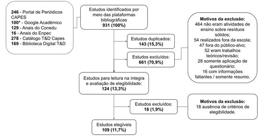
- Eligibility flowchart of studies evaluated in the integrative review on teaching about solid waste.
The selected works, as well as information on authorship, year, region, type of publication, and study participants, are presented in chronological order in Table 1.
Characterization of studies
Regarding the type of publication, 41% of the studies were published in journals, 34% in conference annals, and 25% were master's dissertations. No doctoral theses on teaching solid waste in basic education were identified. Regarding geographic distribution, almost half of the studies (42%) were concentrated in the Northeast region of the country, followed by the South (27%). The Central-West region presented only two publications (2%). Most conference annals (73%) were published in the Northeast.
The studies were carried out across various segments of basic education, with a significant majority occurring in elementary schools (60%). This is consistent with Amaral's (2022) state-of-the-art research, which found that 74% of the identified studies also took place within this segment. In contrast, studies focusing on early childhood education and youth and adult education were notably underrepresented, comprising only 4% (5 out of 109) in each area. The scarcity of research addressing environmental education, particularly regarding solid waste in early childhood settings, was also highlighted in international studies (Davis, 2009; Jørgensen, Madsen, Læssø, 2017). Concerning secondary education, 44% of the studies were conducted at this level, with 18% occurring in technical or vocational programs.
Most of the schools where these teaching experiences took place were public (84%). Among those that reported the type of school (78/92), 50% were state, 37% municipal, 10% federal, and 3% took place in military or civic-military schools.
Development of teaching activities on solid waste
In terms of teaching activities, the majority (90%) were one-time events, averaging 3.13 months in duration, and involved students from one or more classes (74%). Ongoing activities were present in 24 studies, particularly those that engaged the school community, with 8 out of 10 studies exhibiting this characteristic. Only 10% of the studies referenced previous environmental education or selective waste collection initiatives. According to the PNRS (Brasil, 2010), state plans should establish integrated solutions for selective waste collection and proper waste disposal across various areas of the city, including schools; however, this is still not the case in most of the institutions examined. The lack of essential infrastructure for waste management highlights a situation of neglect, especially noticeable in socially vulnerable areas, which further contributes to the persistence of socio-environmental injustices (G1 Globo, 2022; Rodrigues, 2021).
In terms of authorship of educational initiatives, a significant majority (88%) were carried out by researchers external to the school, with only five studies conducted in collaboration with a teacher from the institution. While the data does not provide specific statistical analyses, the dominance of ad hoc practices and research conducted by outsiders often leads to fragmented approaches that may not align with the realities of the school. Therefore, it is recommended that research in educational settings actively involve teachers and coordinators, promoting the development of contextualized practices that can be effectively integrated into the school’s daily operations.
More than half of the activities (55%) were carried out through workshops held outside the classroom, including two during recess. Among the activities, 45% were developed across school subjects, both disciplinary and interdisciplinary, covering the following areas: science (21 studies); chemistry (14); geography (8); mathematics (5); arts (5); Portuguese (4); physics (2); history (1); sociology (1); English (1); life project and entrepreneurship (1); environmental health (1); and environmental analysis (1). Historically, environmental education has generally been related to the disciplines of geography and science, as it is an area that began through the confluence of the environmental and educational fields, and which developed a predominantly conservationist and naturalist character during its initial phase in Brazil (Kawasaki; Carvalho, 2009; Layrargues; Lima, 2014). Despite this, this review highlights the effort to introduce new approaches to environmental education into educational spaces.
Only 32 of the 109 studies conducted some form of evaluation after educational activities, and none assessed the impact of these actions. Impact assessment can provide important data and evidence for critical reflection on adopted practices, fostering continuous adjustments and improvements (IDIS, 2023) and thus ensuring that education is relevant and capable of generating positive changes in the school environment in the medium and long term.
Didactic modalities
The teaching experiences on solid waste developed in the analyzed studies were diverse, mostly involving lectures (79 works), practical classes (49 works), and projects (46 works), which occurred in isolation or in combination. Lectures, workshops, and group work were also strategies adopted in teaching about solid waste in the systematic review by Lutif, Oliveira, and Gonçalves (2023) and in the multicenter study in European schools by Lee et al. (2022).
Lectures were combined with one or more teaching methods. The most common approaches in practical classes were the reuse of waste to create objects and toys, and the holding of selective waste collection workshops. In Amaral's (2022) review, more than half of the researchers (55.5%) proposed activities involving the reuse of various solid waste to create objects. However, these practices had a technical bias, without deepening the discussion and questioning the socioeconomic and cultural causes of the problem, nor the collective responsibility for waste management.
The projects focused on textual and visual creations, as well as the development of prototypes and photographic records. Among these, 19 investigative practices were developed based on the collection and analysis of household, school, and compost waste, in addition to interviews with the school community and the development of a junior enterprise.
Field trips represented a minority of activities, appearing in only nine studies. They involved visits to improper waste disposal sites, environmental protection areas, and museums. The lower incidence of field trips compared to other educational activities was also observed in the review by Lutif, Oliveira, and Gonçalves (2023), in which only 7% of activities were extracurricular. This contrasts with international studies, in which field trips were more frequent (Lee et al., 2022).
From the perspective of critical environmental education, fieldwork allows students to leave the school environment and experience socio-environmental problems in their real-world contexts. By visiting different areas of a city, for example, it is possible to observe differences in environmental impacts, encouraging students to question and analyze the underlying causes of the problems encountered and seek possible solutions. Therefore, fieldwork can contribute to a contextualized discussion of environmental issues experienced by the school community and how to solve these problems (Freire, 2021).
Main topics covered
Braun and Clarke (2006) used thematic analysis as a reference to categorize the themes. The central themes identified were solid waste management and consumption. The distribution of these publications according to these themes, as well as the frequency of each of them and their respective subthemes, is found in Table 2.
Theme 1: Solid waste management
Waste management was addressed in the majority (75%) of the studies analyzed in this review. In assessments before educational activities, students lacked knowledge of appropriate waste management practices. In Andrade's (2018) study of 142 elementary, middle, and high school students, only 25% of participants reported frequently using school trash cans to dispose of waste, with much of this waste discarded on the floor. Furthermore, 74% of students reported not separating waste at home. In Bravo et al.'s (2018) study, most 297 students (90%) reported being unaware of selective waste collection and not separating waste for recycling (78%), even though there was a voluntary waste drop-off point in the city.
The limited knowledge of children and adolescents regarding waste management practices can largely be attributed to insufficient discussion and daily engagement with the topic. This gap may stem from difficulties in comprehending how to address such issues, or simply a lack of interest in them. To foster active citizenship among students, it is essential to develop practices that are contextualized within their realities. Guimarães (2011) and Loureiro and Layrargues (2013) emphasize that for environmental education to be deemed “critical,” it must promote discussions on complex issues and explore their political, historical, and cultural dimensions, thereby enhancing students' engagement with the subject matter. Additionally, employing active methodologies, such as inquiry-based learning (Sasseron, 2015) and problem-based learning (Lopes et al., 2019), can effectively encourage students' active participation in educational practices.
Selective collection
The 47 selective collection practices were developed through lectures, practical classes, and projects in different segments of basic education (Table 2). The approaches varied from more technical classes focused on creating selective collectors for waste identification to approaches that involved the school community.
Among the practices related to selective waste collection, 41% were approached predominantly technically. Bitencourte and Rodriguez (2019), for example, developed practical classes with early childhood education, in which children painted selective waste collection bins and identified where to dispose of each type of waste based on the bins' colors. The authors believe that acquiring knowledge about proper waste disposal by students, even at a young age, has the potential to spread within the family environment. On the other hand, Cembranel, Francischett, and Rodrigues (2019) conducted lectures on selective waste collection and reuse with 147 students from grades 1 to 5. The researchers found that, even after the educational practices, no changes in waste separation were observed in these students' homes. The tendency to approach waste management from a technical perspective has also been identified in international studies, such as the multicenter study in European schools by Lee et al. (2022), in which the authors emphasize the need for adequate school infrastructure to engage students in selective collection practices.
In Brazil, this challenge is even more acute. As noted by Guimarães et al. (2012), environmental education in Brazilian schools still faces structural challenges that may limit its potential for social transformation. In general, projects are developed through ad hoc activities, with little systematization or teacher participation. This fragmentation is related to a lack of support from school administration and a shortage of material and human resources. Despite this, initiatives such as the “Zero Waste Schools” project have stood out for their potential to integrate waste management into the school environment, aiming to transform students and staff into agents of change in their homes and communities, promoting citizenship education (Mendonça, Schmitz, Andrade et al., 2018; Barros, 2024).
Studies involving selective collection initiatives within the school community were scarce, as noted by Lutif, Oliveira, and Gonçalves (2023). On the other hand, a significant example is the work of Larsen, Weinschutz, and Kolicheski (2019), who created a voluntary oil drop-off point through the initiative of third-year technical high school students. In nine months, 550 liters of oil were collected, 60 of which were used to produce handmade soap, which was donated to the participating community. The authors observed that the students guided their learning and promoted good oil management practices within the school community. Rosini et al. (2019) organized an oil and electronic waste collection event with 219 high school students, with support from the local government. During this event, 903.5 kilos of cooking oil and 10,355 kilos of waste were collected, which helped students understand how to contribute to waste management in their own reality and collectively.
The government's negligence in providing infrastructure for selective waste collection in municipalities hinders proper waste management, even when the population is willing to separate their waste. This can contribute to the occurrence of educational practices with a pragmatic bias, focused on technical issues of waste management. Much of the selective waste collection and recycling in Brazil is carried out by waste pickers or groups of waste pickers who often lack employment benefits (Layrargues, 2002). According to the PNRS (Brasil, 2010), the government must provide infrastructure, establish partnerships, and compensate waste pickers for their services. Furthermore, it is important that the government, in partnership with schools, businesses, and the media, promote ongoing actions focused on environmental education and teaching about solid waste, addressing both waste disposal and the socio-environmental implications of negligent disposal, as recommended by the National Environmental Education Policy (Brasil, 1999).
Environmental educators must advocate for educational practices related to solid waste management that address political, social, cultural, and economic dimensions. They should also propose contextualized strategies to challenge the perception that waste is solely an individual issue (Guimarães, 2004; Layrargues, 2002). Tackling waste production presents a structural challenge that requires collective recognition and discourse to press for short- and medium-term solutions from the government. It is essential for professionals in this field to realize that socio-environmental issues cannot be resolved merely by imparting ecologically sound knowledge, as suggested by traditional conservationist and pragmatic approaches. Instead, a collective responsibility for addressing these socio-environmental challenges must be acknowledged, as emphasized by critical environmental education (Guimarães 2004; Layrargues; Torres, 2022; Logarezzi, 2004; Reis, 2019). Active social participation and the promotion of citizenship are vital for the successful implementation of any public policy, including the effective execution of the PNRS (Reis; Matos; Silva, 2018).
Reuse
Among the teaching experiences on waste management, 29% of the studies addressed the reuse of materials through lectures and practical lessons, especially in elementary school (Table 2). This topic was explored through the creation of objects and practices related to entrepreneurship.
Waste reuse activities were developed as the core activity. Costa et al. (2021) performed a play about selective waste collection and best practices, as well as a workshop on making toys such as checkers and table football, activities that, according to the authors, stimulated students' imagination and critical thinking. In workshops on creating games with waste collected by fifth-grade students, Raupp and Cunha (2019) found that practices like these contribute to a playful and fun reflection on environmental protection.
Entrepreneurial practices were also developed, such as the reuse workshops discussed in the work of Mendonça, Schmitz, and Andrade (2018). Resulting in the production of wallets and pencil cases made from milk cartons, eco-friendly notebooks, earrings, and necklaces to be sold at a fair, the initiative raised R$80 and, according to the researchers, engaged students in reducing material waste. Similarly, Martins (2019) held annual fairs with high school students to reuse objects, collecting books, clothes, shoes, furniture, and appliances to be sold affordably to the community. The students raised R$5,000, which they used to finance travel and studies. The author noted the development of the students' critical thinking, as they recognized that waste could have different values for people, encouraging the problematization of disposal and the identification of new possibilities for reuse.
Addressing the redefinition of waste in schools can foster a more thoughtful approach to the production and disposal of materials. In the study by Jørgensen et al. (2018), conducted in Danish early childhood education settings, it was found that reusing waste materials associated with the arts enhances curiosity, ingenuity, and creativity among children, while also promoting their autonomy through active participation in toy creation. However, pursuing waste reuse practices without taking into account the broader issues of resource extraction and product manufacturing is a simplistic and pragmatic approach to this conversation. Engaging with the capitalist economic system, exploring the conflicts surrounding resource extraction, and reflecting on significant socio-environmental disasters, such as Chernobyl and the Cesium disaster in Goiânia, provide a more nuanced understanding of the topic. This, in turn, contributes to the development of critical environmental education initiatives (Guimarães, 2004; Layrargues; Lima, 2014).
Therefore, understanding waste as valuable helps us understand that goods are part of a production chain that involves the extraction of natural resources, such as water, oil, and other metals, to transform them into products. These resources are finite, and their extraction causes socio-environmental injustices (Leonard, 2011). For example, the production of aluminum cans depends on bauxite extraction, which can lead to disasters like those in Mariana and Brumadinho in the state of Minas Gerais (Brasil, 2017; G1 Globo, 2023). Leonard (2011) notes that new industries are being built in preserved areas in Mozambique, Chile, and along the Amazon River in Brazil. To utilize these plants, more roads must be built, and once the plants are operational, more waste and greenhouse gases will be emitted (Leonard, 2011). Therefore, it is important that governments, industries, and companies work together to mitigate the impacts of new construction and not further compromise the health of the planet and the future of future generations.
Recycling of dry and organic waste
Unlike reuse, recycling involves the physical, chemical, or biological alteration of solid waste to transform it into inputs or new products (Brasil, 2010). Both dry and organic waste can be recycled.
The topic of recycling was addressed in 26% of studies (Table 2), across different segments of basic education, through discussions and practical classes. The materials most frequently discussed in recycling studies were paper, oil, and organic waste. Paper recycling was developed through practical classes. Oil recycling involved the creation of voluntary collection points, collection competitions, and discussions.
According to Layrargues (2002), integrating recycling into educational practices creates an illusory and comforting effect on individuals, which can encourage excessive consumption of disposable items. Because these items are recyclable, they are often mistakenly viewed as environmentally friendly. In this scenario, recycling serves as a form of risk compensation, leading to the belief that it is a comprehensive solution to solid waste issues when, in reality, it is not. By presenting recycling as a viable answer, it can obscure criticism of consumerism and reinforce strategies for wealth accumulation, promoting the misguided notion that consumption is acceptable as long as products are environmentally friendly. As Leonard (2011) articulately states in *The Story of Stuff*: "[...] is recycling an illusion that leads us to believe we are helping the planet, while simultaneously leaving industry free to continue spewing toxic and poorly designed things?" (p. 230). Consequently, it is crucial to reconsider the system of commodity production and to design products with responsibility in mind. Alongside efficient selective collection systems, this approach can help make recycling an effective practice in addressing these challenges.
Nine studies involved practices with organic waste through lectures and the creation of compost bins from a contextualized perspective. Rodrigues and Kindel (2019) conducted a study on waste degradation with 7th-grade middle school students, encouraging the understanding that organic waste and soil are not dirt, but promoters of life. In a chemical and biological analysis of compost bins with 19 6th-grade elementary school students, De Sousa and Moreno (2020) observed greater connection and engagement with organic waste management. This management prevents dry waste from spoiling in contact with organic waste, protects organic materials, and generates fertilizer for the soil. Promoting composting in different spaces can increase recycling rates in Brazil, where almost half of the waste produced (45%) is organic. Waste is often disposed of mixed, which impacts selective collection (Abrelpe, 2022).
Theme 2: Consumption
Less frequently discussed than waste management, consumption was addressed in 28% of the studies analyzed in this review, primarily from the perspectives of conscious consumption and consumerism.
Among the educational initiatives focused on this topic, conscious consumption was examined in 26 out of the 31 identified studies (see Table 2), primarily through discussions and lectures. Rodrigues (2022) conducted discussion groups with 10 high school and adult education students, emphasizing the significance of transforming individual consumption habits to improve waste management. Additionally, in an educational program centered on responsible consumption with 73 eighth-grade students, Freitas (2021) underscored the importance of developing awareness campaigns aimed at reducing waste in schools.
On the other hand, studies addressing consumerism were scarce, with only seven articles addressing it. From the discussion of consumerism and its relationship to economic and housing issues, Fontes (2021) observed that technical high school students were able to critically reflect on how waste management depends on a change in societal attitudes. In the simulation of a school assembly conducted by Diniz and Calefi (2022), students represented various institutional actors, such as the campus administration, the solid waste committee, and the students' parents. The authors observed that the simulation helped students understand the problem in an integrated manner, encouraging the creation of solutions based on their school reality.
Conscious consumption is encouraged by official ecological discourse both in the SDGs—such as Goal 12 “Sustainable Consumption and Production” (UNPD, 2015) and by the United Nations Environment Programme (UNEP) and the Ministry of the Environment (UNEP, 2011; MMA, 2020). Conscious consumption implies giving preference to less toxic, exploitative, and polluting products (Layrargues, 2018; Leonard, 2011).
At the educational level, the National Common Curricular Base (BNCC) includes conscious consumption as a contemporary, cross-cutting theme, asserting that education “[...] is an effective means of developing the tools for conscious consumption at the individual level” (Brasil, 2022b, p. 27). However, an exclusive focus on individual consumption is insufficient to resolve the socio-environmental challenges associated with solid waste. The ongoing promotion of consumption, which is inherently unequal due to economic and resource disparities, constrains our choices. To effectively tackle the issue of waste within capitalist societies, educational practices must encompass the social, economic, and cultural dimensions of consumption (Guimarães, 2004; Silva; Loureiro, 2019). This necessitates a critical and comprehensive approach that underscores the responsibilities of all social agents involved in the production of goods and waste management, particularly industries and public authorities (Layrargues, 2011).
Study limitations
Regarding the limitations of this integrative review, we observed that, despite the broad search for relevant data sources and the use of a clear and comprehensive strategy, not all studies on solid waste education conducted in Brazil between 2018 and 2022 may have been identified. Among the selected sources, Google Scholar presented the least standardized search strategy. Being a very comprehensive and sometimes imprecise repository, the search scope was limited to increase the specificity of the search. Therefore, we chose to read the first 10 pages of results, as the most relevant results are typically concentrated on these first pages. However, through this strategy, we cannot exclude the possibility that some publications relevant to the scope of the review were missed.
Regarding the annals of scientific events, those with published full articles were chosen to understand in more detail how the solid waste teaching strategy was developed. However, in this case, we may have missed some relevant studies published in abstract form, or even as full papers, at another event not selected for this review. Furthermore, it is known that many educational initiatives carried out in schools are not systematized in academic publications, which prevents their inclusion in publications such as this article. Final coursework (TCCs) was not included in the data sources, as no platforms were found that present these works in an organized format.
FINAL CONSIDERATIONS
This integrative review sought to provide an overview of educational experiences on solid waste in Brazilian basic education published in recent years, using critical environmental education as a reference. The results revealed that, although the topic is present in schools, the most common approaches focused on how to properly separate waste for selective collection, how to recycle, and how to reuse materials for making games and toys.
Despite the significance of these initiatives, educational practices have often been perceived as isolated actions, focused solely on themselves, without fostering a broader discussion about the socioeconomic and political structures that drive waste production and disposal. These findings underscore the necessity of studies that integrate environmental education with other subjects within the basic education curriculum. Topics such as waste economics, environmental justice, consumerism, and urban governance are relevant and can be incorporated into future teaching strategies regarding solid waste in schools.
We found that students generally lacked prior knowledge of waste management. This gap may be attributed to students' lack of interest in the topic or the impact of fragmented teaching. Furthermore, most studies conducted environmental education practices in a targeted manner, with one or more classes at the school, through presentations and practical lessons. Specific practices can contribute to the development of pragmatic environmental education, generally addressing technical and operational aspects, as discussed in this review.
Therefore, further research is recommended to evaluate improvements in the teaching and learning process on the topic of waste using active methodologies, such as inquiry-based learning and problem-based learning. These teaching approaches show promise because they allow students to actively participate, enabling them to build new knowledge by investigating real-life situations.
The limited number of studies concentrating on early childhood education and adult education (EJA) aligns with findings from international research. This emphasizes the necessity for environmental educators to design educational practices tailored to these groups. It is crucial to develop pedagogical strategies for environmental education related to solid waste in early childhood settings, fostering attitudes and values of respect for both the environment and individuals. This approach can help raise children’s awareness about the significance of environmental issues from a young age. In the context of adult education (EJA), such strategies can facilitate the collective development of values, attitudes, and behaviors, encouraging the discussion of socio-environmental issues encountered in daily life.
This review revealed that the schools analyzed lack adequate infrastructure for waste management, demonstrating a failure to comply with the National Waste Management Guidelines (PNRS) in the school context. The results highlight the need for research to identify the main obstacles to implementing efficient waste management systems in educational institutions. Initiatives such as the “Zero Waste Schools” project can be examples of contributions in this field. Among the various challenges faced, the scarcity of financial resources to maintain the necessary infrastructure, the lack of support from city governments, the lack of technical training for education professionals, and the absence of a staff member or team responsible for coordinating these actions in the school environment stand out.
Based on the findings of this study, we aim to contribute to a broader dialogue on environmental education and the teaching of solid waste management in schools, while also encouraging research initiatives on this subject within educational institutions. By adopting a contextualized approach that reflects each community's unique circumstances and engaging the entire school community and its environment, we can foster equitable collaboration in decision-making processes related to waste management. This underscores the necessity of training education professionals to cultivate more critical and inclusive practices in schools, thereby advancing environmental justice. A critical approach to environmental education can serve as a strong foundation for transforming the teaching of solid waste management in educational settings.
References
- ABRELPE - ASSOCIAÇÃO BRASILEIRA DE EMPRESAS DE LIMPEZA PÚBLICA E RESÍDUOS ESPECIAIS. Panorama dos Resíduos Sólidos no Brasil 2021 São Paulo, 54 p., 2021.
- ABRELPE - ASSOCIAÇÃO BRASILEIR DE EMPRESAS DE LIMPEZA PÚBLICA E RESÍDUOS ESPECIAIS. Panorama dos Resíduos Sólidos no Brasil 2022 São Paulo, 64 p., 2022.
-
ACSELRAD, Henri. Ambientalização das lutas sociais - o caso do movimento por justiça ambiental. Estudos avançados, v. 24, n. 68, p. 103-119, 2010. <https://doi.org/10.1590/S0103-40142010000100010 >
» https://doi.org/10.1590/S0103-40142010000100010 -
ALMEIDA, Nadiny Martins; DUARTE, Amanda Carrasco; HIDALGO, Maycon Raul. Lixo eletrônico na escola: gestão sustentável, responsabilidade social e ambiental. Educação Básica Revista, v. 5, n. 2, p. 155-164, 2019. Disponível em: <Disponível em: https://repositorio.jesuita.org.br/handle/UNISINOS/8285?locale-attribute=en >. Acesso em: 04/07/2024.
» https://repositorio.jesuita.org.br/handle/UNISINOS/8285?locale-attribute=en -
ALVES, Bruno Kaik; ARAÚJO, Waldirene Pereira. Educação ambiental: a importância do descarte adequado de resíduos a fim de se evitar o desenvolvimento do aedes aegypti. In: VCONGRESSO NACIONAL DE EDUCAÇÃO - CONEDU, 2018, Pernambuco. Anais. Campina Grande: Editora Realize, 2018. <https://mail.editorarealize.com.br/editora/anais/conedu/2018/TRABALHO_EV117_MD4_SA14_ID7835_17092018235811.pdf>. Acesso em: 13/08/2023.
» https://mail.editorarealize.com.br/editora/anais/conedu/2018/TRABALHO_EV117_MD4_SA14_ID7835_17092018235811.pdf -
ALVES, Cláudia Thamires da Silva; CAVALCANTI, Josinaide Guerra de Santana; NETO, José Euzebio Simões. Uma sequência didática para abordagem do tema lixo eletrônico no ensino de química. Educação Química en Punto de Vista, v. 2, n. 1, p. 125-143, 2018. <https://doi.org/10.30705/eqpv.v2i1.1101>
» https://doi.org/10.30705/eqpv.v2i1.1101 -
ALVES, Josilany Coelho da Silva. Educação ambiental na prática: uma aula de reciclagem no 5.º ano do Ensino Fundamental em tempos de pandemia. In: VIIICONGRESSO NACIONAL DE EDUCAÇÃO - CONEDU, 2021, on-line. Anais. Campina Grande: Editora Realize, 2021. Disponível em:<https://editorarealize.com.br/editora/anais/conedu/2021/TRABALHO_EV150_MD4_SA114_ID6626_30092021144242.pdf>. Acesso em: 07/08/22023.
» https://editorarealize.com.br/editora/anais/conedu/2021/TRABALHO_EV150_MD4_SA114_ID6626_30092021144242.pdf -
AMARAL, Letícia da Silva. Educação Ambiental e resíduos sólidos: um estudo sobre teses e dissertações desenvolvidas no contexto escolar. Dissertação (Mestrado em Educação). Rio Claro: Universidade Estadual Paulista, 2022. <https://repositorio.unesp.br/server/api/core/bitstreams/5a87cfcb-2756-4d9a-9a52-15c1a0b80594/content>. Acesso em: 07/07/2023.
» https://repositorio.unesp.br/server/api/core/bitstreams/5a87cfcb-2756-4d9a-9a52-15c1a0b80594/content -
ANDRADE, Areli da Silva. Gincana sobre Resíduos Sólidos: a interação entre a geografia e a educação ambiental. Dissertação (Mestrado Profissional em Rede Nacional para Ensino das Ciências Ambientais). São Carlos: Universidade Federal do Pernambuco, 2020. Disponível em:<Disponível em:https://repositorio.ufpe.br/handle/123456789/39009 >. Acesso em: 04/08/2023.
» https://repositorio.ufpe.br/handle/123456789/39009 -
ANDRADE, Marilia Zulmira Sena de Souza. Educação ambiental e gestão integrada de resíduos sólidos: uma proposta de um plano de gerenciamento de resíduos em uma instituição de ensino na cidade de Esperança/PB. Dissertação (Mestrado em Engenharia e Gestão de Recursos Naturais). Campina Grande: Universidade Federal de Campina Grande, 2018. <http://dspace.sti.ufcg.edu.br:8080/jspui/handle/riufcg/5063>.Acesso em: 15/07/2024.
» http://dspace.sti.ufcg.edu.br:8080/jspui/handle/riufcg/5063 -
ANGELIS, Joslaine Aparecida Regioli de. Arte e educação em prol do meio ambiente: uma estratégia pedagógica. Dissertação (Mestrado Profissional em Ciências Ambientais). Fernandópolis: Universidade do Brasil, 2020. Disponível em:<Disponível em:http://repositorioacademico.universidadebrasil.edu.br:8080/ xmlui/handle/123456789/329 >. Acesso em: 03/08/2023.
» http://repositorioacademico.universidadebrasil.edu.br:8080/ xmlui/handle/123456789/329 -
ANGIESKI, Alessandra Assad et al O ensino da matemática em conjunto com educação ambiental: uma proposta de ensino integrada com resíduos sólidos. Brazilian Journal of Development, v. 6, n. 5, p. 27515-27530, 2020. <https://doi.org/10.34117/bjdv6n5-267>
» https://doi.org/10.34117/bjdv6n5-267 -
ARAÚJO, Fabiana da Cruz. O recreio interativo envolvendo as temáticas: lixo, drogas e saúde em uma escola pública no Piauí. In: VICONGRESSO NACIONAL DE EDUCAÇÃO - CONEDU, 2019, João Pessoa. Anais. Campina Grande: Editora Realize , 2019. Disponível em:<Disponível em:https://editorarealize.com.br/editora/anais/conedu/2019/TRABALHO_EV127_MD4_SA1_ID2931_14082019172030.pdf >. Acesso em04/07/2024.
» https://editorarealize.com.br/editora/anais/conedu/2019/TRABALHO_EV127_MD4_SA1_ID2931_14082019172030.pdf -
ARAÚJO, Wánderson Cássio Oliveira. Recuperação da informação em saúde: construção, modelos e estratégias. Convergências em Ciência da Informação, v. 3, n. 2, p. 100-134, 2020. <http://www.repositorio.ufc.br/handle/riufc/52993>. Acesso em: 03/07/2024.
» http://www.repositorio.ufc.br/handle/riufc/52993 - BANCO MUNDIAL. Bridging the gap in solid waste management: governance requirements for results. International Bank for Reconstruction and Development, Washington DC, 216 p., 2021.
- BANCO MUNDIAL. What a Waste 2.0: A Global Snapshot of Solid Waste Management to 2050. Urban Development, Washington, DC, 295 p., 2018.
-
BARBOSA, Ana Paula Ferreira; SOUZA, Rakelyne Costa; DIAS, João Felipe Maia; ALMEIDA, José Felipe Tavares de; BORGES, Fernando José; FREITAS, Idelfonso Colares de. Reaproveitamento de resíduos sólidos orgânicos oriundo da merenda escolar por meio da compostagem. Brazilian Applied Science Review, v. 3, n. 2, p. 1161-1168, 2019. <https://doi.org/10.34115/basr.v3i2.1163>
» https://doi.org/10.34115/basr.v3i2.1163 -
BARCELLOS, Fabiana Nunes; COPETTI, André Carlos Cruz; PASTORIO, Eduardo. Gestão dos resíduos sólidos em Escola do Campo: experiência de educação ambiental na EMCEF de São Gabriel/RS. Revista Monografias Ambientais, v. 19, ed. esp., e9, p. 1-16, 2020. <https://doi.org/10.5902/2236130843415>
» https://doi.org/10.5902/2236130843415 -
BARROS, Sandra. Professores da rede estadual apresentam projeto Lixo Zero durante congresso em Brasília Consead. 2024. Disponível em: <Disponível em: https://www.consed.org.br/noticia/professores-da-rede-estadual-apresentam-projeto-lixo-zero-durante-congresso-em-brasilia >. Acesso em: 16/05/2025.
» https://www.consed.org.br/noticia/professores-da-rede-estadual-apresentam-projeto-lixo-zero-durante-congresso-em-brasilia -
BEHLING, Greici Maia; CORRÊA, Luciara Bilhalva; DOBKE, Denise; GOMES, Atila Martins Gomes; GONÇALVES, Carolina da Silva; KRÜGER, Márcio Francisco Denzer et al Extensão e educação ambiental: Relato de experiência de uma turma do curso de pós-graduação em ciências ambientais em escolas nas cidades de Pelotas e Capão do Leão. Revista Conexão UEPG, v. 16, p. 1-17, 2020. <https://doi.org/10.5212/Rev.Conexao.v.16.14257.029>
» https://doi.org/10.5212/Rev.Conexao.v.16.14257.029 -
BELLINI, Elizabete Maria. Proposta de uma sequência didática para o ensino de eletroquímica e a sensibilização ambiental quanto aos impactos do descarte de pilhas e baterias. Dissertação (Mestrado em Formação Científica, Educacional e Tecnológica). Curitiba: Universidade Tecnológica Federal do Paraná, 2018. <https://portaldeinformacao.utfpr.edu.br/Record/riut-1-3205/Details>. Acesso em: 08/07/2023.
» https://portaldeinformacao.utfpr.edu.br/Record/riut-1-3205/Details -
BEZERRA, Maria Eduarda de Santana; OLIVEIRA, Larissa Kênia Silva; NASCIMENTO, Cleoneide de Moura. Educação ambiental: as concepções dos alunos das turmas de 9.º e 3.º ano da escola CAIC sobre a problemática do lixo nos centros urbanos. In: VICONGRESSO NACIONAL DE EDUCAÇÃO - CONEDU, 2019, João Pessoa. Anais. Campina Grande: Editora Realize , 2019. Disponível em: <Disponível em: https://www.editorarealize.com.br/editora/anais/conedu/2019/TRABALHO_EV127_MD1_SA_ID2822_30102019173200.pdf >. Acesso em: 04/07/2024.
» https://www.editorarealize.com.br/editora/anais/conedu/2019/TRABALHO_EV127_MD1_SA_ID2822_30102019173200.pdf -
BITENCOURTE, Andreia Domingues; RODRIGUEZ, Rita de Cássia Morem Cóssio. Construindo saberes sobre a separação dos resíduos sólidos na Educação Infantil. RELACult-Revista Latino-Americana de Estudos em Cultura e Sociedade, v. 5, ed. esp., p. 1-12, 2019. Disponível em:<https://doi.org/10.23899/relacult.v5i4.1292>
» https://doi.org/10.23899/relacult.v5i4.1292 -
BORGES, Luiza Alexandre; DA SILVA, Marinalva Aprígio; SILVA, Elizângela de Oliveira. O lixo e seu impacto ambiental e social no Município de Vicência - PE: relato de uma experiência vivenciada na Educação Infantil. In: VIIICONGRESSO NACIONAL DE EDUCAÇÃO - CONEDU, 2022, Maceió. Anais. Campina Grande: Editora Realize, 2022. Disponível em:<Disponível em:https://editorarealize.com.br/artigo/visualizar/88620 >. Acesso em: 05/07/2023.
» https://editorarealize.com.br/artigo/visualizar/88620 -
BOTELHO, Louise Lira Roedel; CUNHA, Cristiano Castro de Almeida; MACEDO, Marcelo. O método da revisão integrativa nos estudos organizacionais. Gestão e sociedade, v. 5, n. 11, p. 121-136, 2011. <https://doi.org/10.21171/ges.v5i11.1220>
» https://doi.org/10.21171/ges.v5i11.1220 - BRASIL. Lei n.º 9.795, de 27 de abril de 1999 Dispõe sobre a Educação. Ambiental, institui a Política da Educação Ambiental e dá outras providências. Brasília, 1999.
- BRASIL. Lei n.º 12.305, de 2 de agosto de 2010 Institui a Política Nacional de Resíduos Sólidos, altera a Lei nº 9.605, de 12 de fevereiro de 1998; e dá outras providências. Brasília, 2010.
-
BRASIL. Ministério do Meio Ambiente. Secretaria de Qualidade Ambiental. Plano Nacional de Resíduos Sólidos Brasília, DF: MMA, 209 p., 2022a. Disponível em: <Disponível em: https://www.gov.br/mma/pt-br/acesso-a-informacao/acoes-e-programas/programa-projetos-acoes-obras-atividades/agendaambientalurbana/lixao-zero/plano_nacional_de_residuos_solidos-1.pdf >. Acesso em: 07/07/2024.
» https://www.gov.br/mma/pt-br/acesso-a-informacao/acoes-e-programas/programa-projetos-acoes-obras-atividades/agendaambientalurbana/lixao-zero/plano_nacional_de_residuos_solidos-1.pdf -
BRASIL. Relatório sobre o rompimento da barragem de rejeitos da mineradora Samarco e seus efeitos sobre o vale do rio Doce Brasília, 2017. Disponível em:<Disponível em:https://www.gov.br/mdh/pt-br/acesso-a-informacao/participacao-social/old/cndh/relatorios/RelatriodaBarragemdoRioDoce_FINAL_APROVADO.pdf >. Acesso em: 07/07/2024.
» https://www.gov.br/mdh/pt-br/acesso-a-informacao/participacao-social/old/cndh/relatorios/RelatriodaBarragemdoRioDoce_FINAL_APROVADO.pdf -
BRASIL. Série temas contemporâneos transversais da Base Nacional Comum Curricular (BNCC): Caderno Meio Ambiente. Ministério da Educação. Brasília, 2022b. Disponível em:<Disponível em:https://basenacionalcomum.mec.gov.br/pesquisar?q=Meio%20ambiente >. Acesso em: 07/07/2024.
» https://basenacionalcomum.mec.gov.br/pesquisar?q=Meio%20ambiente -
BRAUN, Virginia; CLARKE, Victoria. Using thematic analysis in psychology. Qualitative research in psychology, v. 3, n. 2, p. 77-101, 2006. <https://doi.org/10.1191/1478088706qp063oa>
» https://doi.org/10.1191/1478088706qp063oa -
BRAVO, Thamara Lins; PEÇANHA, Anderson Lopes; WERNER, Elias Terra; SANTOS, Alexandre Augusto Oliveira. Educação ambiental e percepção da implantação de coleta seletiva de lixo urbano em de Alegre, ES. Revista Gestão & Sustentabilidade Ambiental, v. 7, n. 1, p. 375-396, 2018. <https://doi.org/10.19177/rgsa.v7e12018375-396>
» https://doi.org/10.19177/rgsa.v7e12018375-396 - CAMPOS, Katiana Rejane dos Santos. Percepções de problemas ambientais locais com ênfase em resíduos sólidos de estudantes do ensino médio de uma escola no Município de Boa Vista - PR Dissertação (Mestrado em Ensino de Ciências e Matemática). Canoas: Universidade Luterana do Brasil, 2020.
-
CASTIONE, Regiane Cristina Mareze Sipione. Resíduos sólidos e as tecnologias: uma proposta para sensibilização e engajamento de uma comunidade escolar Dissertação (Programa de Pós-Graduação em Tecnologias, Gestão e Sustentabilidade). Foz do Iguaçu: Universidade Estadual do Oeste do Paraná, 2022. Disponível em:<Disponível em:https://tede.unioeste.br/handle/tede/6288 >. Acesso em: 05/10/2023.
» https://tede.unioeste.br/handle/tede/6288 -
CEMBRANEL, Adir Silvério; FRANCISCHETT, Mafalda Nesi; RODRIGUES, Carla Regina. Educação Ambiental com estudantes e famílias na gestão dos resíduos sólidos urbanos. Revista Brasileira de Educação Ambiental (RevBEA), v. 14, n. 1, p. 171-185, 2019. <https://doi.org/10.34024/revbea.2019.v14.2594>
» https://doi.org/10.34024/revbea.2019.v14.2594 -
COOPER, Harris M. Scientific guidelines for conducting integrative research reviews. Review of educational research, v. 52, n. 2, p. 291-302, 1982. <https://doi.org/10.3102/003465430520022>
» https://doi.org/10.3102/003465430520022 -
COSTA, Helves Cleverton Guerra; BEZERRA, Joel Medeiros; MARTINS, Bruna Fernandes; ROQUE, Francisco Soares; JÚNIOR, Antonio Batista de Queiroz; COSTA, Talita Tássia da. A educação ambiental como ferramenta de transformação socioeducativa em escola municipal de Pau dos Ferros/RN. Extensio: Revista Eletrônica de Extensão, v. 18, n. 39, p. 236-245, 2021. <https://doi.org/10.5007/1807-0221.2021.e76191>
» https://doi.org/10.5007/1807-0221.2021.e76191 -
COSTA, Vanelle Wendy de Jesus. Desenvolvimento de uma empresa júnior no ensino médio: uma experiência educativa sobre resíduos sólidos. Dissertação (Mestrado em Ensino de Ciências). Ouro Preto: Universidade Federal de Ouro Preto, 2019. Disponível em:<Disponível em:https://www.repositorio.ufop.br/handle/123456789/11682 >. Acesso em: 04/07/2024.
» https://www.repositorio.ufop.br/handle/123456789/11682 -
DA ROCHA, Letícia Bispo; SANTOS, Bárbara Luisa Soares dos Reis; PITANGA, Ângelo Francklin. A utilização de desenhos como instrumento de análise de visões ambientais de alunos do Ensino Médio. Revista Brasileira de Ensino de Ciência e Tecnologia, v. 12, n. 1, p. 272-289, 2019. <https://doi.org/10.3895/rbect.v12n1.7511>
» https://doi.org/10.3895/rbect.v12n1.7511 -
DA SILVA, Carla Márcia Alvarenga; GUERRA, Antônio Carlos de Oliveira. Contribuições do Ensino de Ciências por Investigação e da Epistemologia de Gaston Bachelard na abordagem sobre resíduos sólidos urbanos. In: XIIIENCONTRO NACIONAL DE PESQUISA EM EDUCAÇÃO EM CIÊNCIAS - ENPEC, 2021, on-line. Anais. São Paulo: Abrapec, 2021. Disponível em:<Disponível em:https://editorarealize.com.br/artigo/visualizar/76314 >. Acesso em: 08/08/2023.
» https://editorarealize.com.br/artigo/visualizar/76314 -
DA SILVA, Danielle Maria Braga; CORREIA, Hellen Cricia Vilela; TELES, Rosinalda Aurora de Melo. (Re) pensando sobre o lixo e as responsabilidades sociais com o meio ambiente. In: VCONGRESSO NACIONAL DE EDUCAÇÃO - CONEDU, Pernambuco, 2018. Anais. Campina Grande: Editora Realize, 2018. Disponível em:<Disponível em:https://www.editorarealize.com.br/artigo/visualizar/45515 >. Acesso em: 14/10/2023.
» https://www.editorarealize.com.br/artigo/visualizar/45515 -
DA SILVA, Jaqueline Pereira; SILVA, Welington; AMADO, Manuela Villar. A utilização da robótica educacional no ensino de ciências: uma sequência didática sobre água e lixo. In: XIIENCONTRO NACIONAL DE PESQUISA EM EDUCAÇÃO EM CIÊNCIAS, 2019, Natal. Anais. São Paulo: Editora Abrapec, 2019. Disponível em:<Disponível em:https://abrapec.com/enpec/xii-enpec/anais/listaresumos_1.htm > Acesso em: 04/07/2024.
» https://abrapec.com/enpec/xii-enpec/anais/listaresumos_1.htm -
DA SILVA, Ludmilla Stefanie Alves; DA SILVA, Mércia Dark Bastos. Propostas metodológicas para a abordagem dos temas meio ambiente e resíduos sólidos no ensino fundamental II. In: VIICONGRESSO NACIONAL DE EDUCAÇÃO - CONEDU, 2019, on-line. Anais. Campina Grande: Editora Realize, 2020. Disponível em:<Disponível em:https://editorarealize.com.br/artigo/visualizar/69397 >. Acesso em: 10/08/2023.
» https://editorarealize.com.br/artigo/visualizar/69397 -
DA SILVA, Natanael Manuel; LIMA, Mayara Lopes de Freitas. A reciclagem e o empreendedorismo como instrumentos interdisciplinares da Educação Ambiental: um relato de experiência. In: VIICONGRESSO NACIONAL DE EDUCAÇÃO - CONEDU, 2022, Maceió. Anais. Campina Grande: Editora Realize, 2022. Disponível em:<Disponível em:https://editorarealize.com.br/artigo/visualizar/89762 > Acesso em: 03/11/2023.
» https://editorarealize.com.br/artigo/visualizar/89762 -
DA SILVA, Tatiana Andrade Rocha; INTORNE, Aline Chaves. Compostagem como prática interdisciplinar no ensino médio. In: VCONGRESSO NACIONAL DE EDUCAÇÃO - CONEDU, Pernambuco, 2018. Anais. Campina Grande: Editora Realize, Disponível em:<Disponível em:https://www.editorarealize.com.br/editora/anais/conedu/2018/TRABALHO_EV117_MD4_SA16_ID11478_17092018222701.pdf > Acesso em: 13/10/2023. 2018
» https://www.editorarealize.com.br/editora/anais/conedu/2018/TRABALHO_EV117_MD4_SA16_ID11478_17092018222701.pdf -
DAVIS, Julie. Revealing the research ‘hole’ of early childhood education for sustainability: a preliminary survey of the literature. Environmental Education Research, v. 2, n. 15, p 227-241, 2009. <https://doi.org/10.1080/13504620802710607>
» https://doi.org/10.1080/13504620802710607 -
DE ALBUQUERQUE, Edson Severiano et al Robótica sustentável e o ensino de Química: uma prática pedagógica utilizando lixo eletrônico. In: XIIENCONTRO NACIONAL DE PESQUISA EM EDUCAÇÃO EM CIÊNCIAS - ENPEC, 2019, Natal. Anais. São Paulo: Editora Abrapec, 2019. Disponível em:<Disponível em:https://abrapec.com/enpec/xii-enpec/anais/listaresumos_1.htm >. Acesso em: 04/07/2024.
» https://abrapec.com/enpec/xii-enpec/anais/listaresumos_1.htm -
DE ARAÚJO, Antônia Maria Silva. Educação ambiental: reciclagem de papel no ensino fundamental. In: VCONGRESSO NACIONAL DE EDUCAÇÃO - CONEDU, Pernambuco, 2018. Anais. Campina Grande: Editora Realize, 2018. Disponível em:<Disponível em:https://editorarealize.com.br/artigo/visualizar/47053 >. Acesso em: 15/11/2023.
» https://editorarealize.com.br/artigo/visualizar/47053 -
DE BORTOLI, Lis Ângela; CASTAMAN, Ana Sara. Educação ambiental em projeto de extensão: Contribuição na formação de bolsistas no contexto da educação profissional e tecnológica. Revista Conexão UEPG, v. 17, n. 1, p. 1-23, 2021. <https://doi.org/10.5212/Rev.Conexao.v.17.16909.017>
» https://doi.org/10.5212/Rev.Conexao.v.17.16909.017 -
DE SOUSA, Carlos Erick Brito; MORENO, Bárbara Michelle Garcês. Compostagem de resíduos sólidos orgânicos e suas contribuições para a educação ambiental no espaço escolar. In: BRITO, Daguinete Maria Chaves; SILVA, Eliane Aparecida Cabral da; NETO, Francisco Otávio Landim(Orgs.). Educação Ambiental no ambiente escolar Macapá: Editora UNIFAP, 2020, p. 65-84. Disponível em:<Disponível em:https://www2.unifap.br/editora/files/2020/09/educacao-ambiental-no-ambiente-escolar.pdf >. Acesso em: 13/06/2023.
» https://www2.unifap.br/editora/files/2020/09/educacao-ambiental-no-ambiente-escolar.pdf -
DINIZ, Thaisa Cristina; CALEFI, Paulo Sérgio. Contribuições do Role-Play na Educação Ambiental para a Formação Integral. Sisyphus: Journal of Education, v. 10, n. 1, p. 100-126, 2022. Disponível em:<Disponível em:https://revistas.rcaap.pt/sisyphus/article/view/25512 >. Acesso em: 05/07/2024.
» https://revistas.rcaap.pt/sisyphus/article/view/25512 -
DO NASCIMENTO, Lucilene dos Santos; ALVES, Leonardo Carvalho. A reutilização de resíduos sólidos em uma escola pública no sudoeste da Amazônia. South American Journal of Basic Education, Technical and Technological, v. 7, n. 2, p. 117-127, 2020. Disponível em:<Disponível em:https://periodicos.ufac.br/index.php/SAJEBTT/article/view/3352 >. Acesso em: 03/08/2023.
» https://periodicos.ufac.br/index.php/SAJEBTT/article/view/3352 -
DO NASCIMENTO, Rogério Escolástico. Sequência didática sobre redução da produção de lixo domiciliar e bioindicação por anurofauna: fomentando o aluno como protagonista da educação ambiental. Dissertação (Mestrado Profissional em Ensino de Biologia). Belo Horizonte: Universidade Federal de Minas Gerais, 2022. Disponível em:<Disponível em:https://repositorio.ufmg.br/handle/1843/48452 >. Acesso em: 03/10/2023.
» https://repositorio.ufmg.br/handle/1843/48452 -
DOS REIS, Victor Augusto; FREITAS, Nathália Miwa Arasaki Menezes; FRANCO, Sabrina Souza; FERREIRA, Carlos Ataide; CINTRA, Elaine Pavini.Resíduos Sólidos: Influência das obsolescências discutida nas aulas de Química. Indagatio Didactica, v. 11, n. 2, p. 13-29, 2019. <https://doi.org/10.34624/id.v11i2.5869>
» https://doi.org/10.34624/id.v11i2.5869 -
DOS SANTOS, Beatriz Letícia Camargo; SILVA, Brenda Alexandra da; CORDEIRO, Camila; ANJOS, Caroline Aparecida dos; DÊA, Naiara Cassiane; SETNARSKY, Renata Pinheiro da Silva; BONASSINA, Ana Lucia Berno; CATAPAN, Dariane Cristina. Prática de reciclagem em um centro municipal de educação infantil do município de São José dos Pinhais, Paraná. Revista Brasileira de Planejamento e Desenvolvimento, v. 7, n. 2, p. 202-214, 2018. <https://doi.org/10.3895/rbpd.v7n2.8257>
» https://doi.org/10.3895/rbpd.v7n2.8257 -
DOS SANTOS, Verônica de Andrade; MARTINS, Suzane Egídio. Práticas sustentáveis por meio da reutilização de resíduos sólidos urbanos. In: VICONGRESSO NACIONAL DE EDUCAÇÃO - CONEDU, 2019, João Pessoa. Anais. Campina Grande: Editora Realize, 2019. Disponível em:<Disponível em:https://editorarealize.com.br/artigo/visualizar/62167 >. Acesso em: 04/07/2024.
» https://editorarealize.com.br/artigo/visualizar/62167 -
DUARTE, Jader Antônio Trajano; SILVA, José Robson de Menezes; DA SILVA, Ana Paula Freitas. Lixo e tecnologia: abordando a tabela periódica e a classificação dos elementos químicos a partir de uma perspectiva CTSA. In: VCONGRESSO NACIONAL DE EDUCAÇÃO - CONEDU, 2018, Pernambuco. Anais. Campina Grande, Editora Realize, 2018. <https://editorarealize.com.br/editora/anais/conedu/2018/TRABALHO_EV117_MD1_SA16_ID1628_28042018182312.pdf>. Acesso em: 04/07/2024.
» https://editorarealize.com.br/editora/anais/conedu/2018/TRABALHO_EV117_MD1_SA16_ID1628_28042018182312.pdf -
FERREIRA, Dalila Veras; OLIVEIRA, Antonio Carlos Pereira de; PASSOS, Glenda Costa; BRANDÃO, Lizandro Augusto Oliveira. Educação ambiental: abordagem da diferença entre lixo e resíduos na escola CETI-LIMA Rebelo em Parnaíba-PI. In: VICONGRESSO NACIONAL DE EDUCAÇÃO - CONEDU, 2019, João Pessoa. Anais. Campina Grande: Editora Realize, 2019. Disponível em:<Disponível em:https://editorarealize.com.br/artigo/visualizar/60034 >. Acesso em: 04/07/2024.
» https://editorarealize.com.br/artigo/visualizar/60034 -
FIGUEIRÊDO, Alessandra Marcone Tavares Alves; TAVARES, Márcio Jean Fernandes; ROSÁRIO, Lucas Oliveira do; SOUZA, Niely Silva de. A reutilização de resíduos sólidos urbanos na construção da aprendizagem de uma turma de jovens e adultos. In: VCONGRESSO NACIONAL DE EDUCAÇÃO - CONEDU, 2018, Pernambuco. Anais. Campina Grande: Editora Realize, 2018. Disponível em:<Disponível em:https://editorarealize.com.br/artigo/visualizar/46141 >. Acesso em: 11/09/2023.
» https://editorarealize.com.br/artigo/visualizar/46141 -
FIGUEIROA, Silvania Miranda Ferreira. Jogo Digital como Instrumento de Educação Ambiental para a Conservação dos Recursos Hídricos Dissertação (Mestrado Profissional em Rede Nacional para Ensino das Ciências Ambientais). São Carlos: Universidade Federal de Pernambuco, 2021. Disponível em:<Disponível em:https://sucupira.capes.gov.br/sucupira/public/consultas/coleta/trabalhoConclusao/viewTrabalhoConclusao.jsf?popup=true&id_trabalho=11270021 >. Acesso em: 05/07/2024.
» https://sucupira.capes.gov.br/sucupira/public/consultas/coleta/trabalhoConclusao/viewTrabalhoConclusao.jsf?popup=true&id_trabalho=11270021 -
FONTES, Shaunda Stefhanny Leal Gadelha. Educação ambiental crítica: uma proposta pedagógica sobre resíduos sólidos aplicada no Curso Técnico subsequente em saneamento do IFRN/Mossoró. Dissertação (Mestrado Profissional em Educação Profissional e Tecnológica). Vitória: Instituto Federal de Educação, Ciência e Tecnologia do Rio Grande do Norte, 2021. Disponível em:<Disponível em:https://sucupira.capes.gov.br/sucupira/public/consultas/coleta/trabalhoConclusao/viewTrabalhoConclusao.jsf?popup=true&id_trabalho=11048481 >. Acesso em: 03/07/2023.
» https://sucupira.capes.gov.br/sucupira/public/consultas/coleta/trabalhoConclusao/viewTrabalhoConclusao.jsf?popup=true&id_trabalho=11048481 - FREIRE, Paulo. Pedagogia do oprimido 78 ed.Rio de Janeiro: Paz e Terra, 2021.
-
FREITAS, Carlos José Silva de. Sequência Didática Resíduos Sólidos: Atividades Lúdicas como Proposta Pedagógica. Dissertação (Mestrado Profissional em Rede Nacional para Ensino das Ciências Ambientais). São Carlos: Universidade Federal de Pernambuco, 2021. Disponível em:<Disponível em:https://sucupira.capes.gov.br/sucupira/public/consultas/coleta/trabalhoConclusao/viewTrabalhoConclusao.jsf?popup=true&id_trabalho=10967611 >. Acesso em: 04/07/2024.
» https://sucupira.capes.gov.br/sucupira/public/consultas/coleta/trabalhoConclusao/viewTrabalhoConclusao.jsf?popup=true&id_trabalho=10967611 -
FRIEDE, Reis; REIS, Daniele de Souza; AVELAR, Katia Eliane Santos; MIRANDA, Maria Geralda de. Coleta seletiva e educação ambiental: Reciclar valores e reduzir o lixo. Educação & Formação, Fortaleza, v. 4, n. 11, p.117-141, 2019. <https://doi.org/10.25053/redufor.v4i11.924>
» https://doi.org/10.25053/redufor.v4i11.924 -
FRIEDRICH, João Luis. Sequência didática sobre gestão de resíduos sólidos: percepções atitudinais na escola de campo. Dissertação (Mestrado Profissional em Ensino). Cornélio Procópio: Universidade Estadual do Norte do Paraná, 2022. Disponível em:Disponível em:https://sucupira.capes.gov.br/sucupira/public/consultas/coleta/trabalhoConclusao/viewTrabalhoConclusao.jsf?popup=true&id_trabalho=11561554 >. Acesso em: 06/08/2023.
» https://sucupira.capes.gov.br/sucupira/public/consultas/coleta/trabalhoConclusao/viewTrabalhoConclusao.jsf?popup=true&id_trabalho=11561554 -
GARCIA, Leandro Alves; MIRANDA, Atena Pontes de; COSTA, Robson Xavier da. Sustentabilidade e moda nas artes visuais. Cadernos CEDES, v. 42, p. 28-40, 2022. <https://doi.org/10.1590/CC251924>
» https://doi.org/10.1590/CC251924 -
G1 GLOBO. Coleta seletiva ainda é mínima na maioria das cidades brasileiras Jornal Nacional, 2022. Disponível em:<Disponível em:https://g1.globo.com/jornal-nacional/noticia/2022/05/23/coleta-seletiva-de-lixo-ainda-e-minima-na-maioria-das-cidades-brasileiras.ghtml >. Acesso em: 21/04/2024.
» https://g1.globo.com/jornal-nacional/noticia/2022/05/23/coleta-seletiva-de-lixo-ainda-e-minima-na-maioria-das-cidades-brasileiras.ghtml -
G1 GLOBO. Quatro anos da tragédia em Brumadinho: 270 mortes, três desaparecidos e nenhuma punição Minas Gerais, 2023. Disponível em:<Disponível em:https://g1.globo.com/mg/minas-gerais/noticia/2023/01/25/quatro-anos-da-tragedia-em-brumadinho-270-mortes-tres-desaparecidos-e-nenhuma-punicao.ghtml >. Acesso em: 21/05/2023.
» https://g1.globo.com/mg/minas-gerais/noticia/2023/01/25/quatro-anos-da-tragedia-em-brumadinho-270-mortes-tres-desaparecidos-e-nenhuma-punicao.ghtml -
GOMES, Henrique José Polato; MEDINA, Paola. Educação ambiental na escola: uma ação educativa visando o destino correto dos resíduos sólidos. Revista Monografias Ambientais, v. 17, p. e13-e13, 2018. <https://doi.org/10.5902/2236130831822>
» https://doi.org/10.5902/2236130831822 -
GOMES, Jacqueline Pereira; SCHEIBLER, Janaina Rafaella; FILHO, Francisco Ferreira Dantas. A importância de discutir o descarte de lixo doméstico na disciplina de química com uma turma da Educação de Jovens e Adultos. In: VIICONGRESSO NACIONAL DE EDUCAÇÃO - CONEDU EM CASA, 2021, on-line. Anais. Campina Grande: Editora Realize, Disponível em:<Disponível em:https://editorarealize.com.br/artigo/visualizar/80845 >. Acesso em: 06/11/2023.
» https://editorarealize.com.br/artigo/visualizar/80845 -
GONÇALVES, Ísis Pereira; NOVELLO, Tanise Paula; JUNIOR, Errol Fernando Zepka Pereira. Educação ambiental no âmbito da gestão de resíduos: Estudo em uma escola. Expressa Extensão, v. 27, n. 1, p. 148-160, 2022. <https://doi.org/10.15210/ee.v27i1.21463>
» https://doi.org/10.15210/ee.v27i1.21463 -
GONÇALVES, Juares de Oliveira; ROTH, Joyce Cristina Gonçalvez. Sensibilização ambiental no ambiente escolar: relação entre a geração dos resíduos sólidos e hábitos de consumo. Revista Eletrônica Científica da UERGS, v. 8, n. 1, p. 84-93, 2022. <https://doi.org/10.21674/2448-0479.81.84-93>
» https://doi.org/10.21674/2448-0479.81.84-93 - GUIMARÃES, Mauro. Armadilha paradigmática na educação ambiental. In: LOUREIRO, Carlos Frederico B. (Org.). Pensamento Complexo, Dialética e Educação Ambiental 2. ed. São Paulo: Cortez, 2011, p. 25-34.
- GUIMARÃES, Mauro. Dimensão ambiental na educação (A) Campinas: Papirus Editora, 2020.
-
GUIMARÃES, Mauro. Educação ambiental crítica. In: LAYRARGUES, Philippe Pomier(Coord.).Identidades da educação ambiental brasileira Brasília: Ministério do Meio Ambiente, 2004, p. 25-34. Disponível em:<Disponível em:https://salasverdes.mma.gov.br/wp-content/uploads/2024/01/identidades-da-educacao-ambiental-brasileira.pdf#page=27 >. Acesso em: 04/07/2024.
» https://salasverdes.mma.gov.br/wp-content/uploads/2024/01/identidades-da-educacao-ambiental-brasileira.pdf#page=27 - GUIMARÃES, Zara Faria Sobrinha; SANTOS, Wildson Luiz Pereira dos; MACHADO, Patrícia Fernandes Lootens; BAPTISTA, Joice de Aguiar. Projetos de educação ambiental em escolas: a necessidade da sistematização para superar a informalidade e o improviso. Pesquisa em Educação Ambiental, v. 7, n. 1, p. 67-84, 2012.
-
IDIS- Instituto para o Desenvolvimento do Investimento Social. O que é avaliação de Impacto e por que ela é importante? IDIS: desenvolvendo o investimento social, 2023. Disponível em:<Disponível em:https://www.idis.org.br/o-que-e-avaliacao-de-impacto/#:~:text=Por%20que%20medir%20o%20impacto,processo%20de%20tomada%20de%20decis%C3%A3o >. Acesso em: 05/05/2024.
» https://www.idis.org.br/o-que-e-avaliacao-de-impacto/#:~:text=Por%20que%20medir%20o%20impacto,processo%20de%20tomada%20de%20decis%C3%A3o -
JØRGENSEN, Nanna Jordt; MADSEN, Katrine Dahl; LÆSSØE, Jeppe. Waste in education: the potential of materiality and practice. Environmental Education Research, v. 24, n. 6, p. 807-817, 2017. Disponível em: <https://www.tandfonline.com/doi/abs/10.1080/13504622.2017.1357801>. Acesso em: 13/08/2023.
» https://doi.org/10.1080/13504622.2017.1357801 -
KARAT, Marinilde Tadeu; GIRALDI, Patricia Montanari; CASSIANI, Suzani. Autoria em discursos sobre resíduos sólidos em dois audiovisuais produzidos por estudantes de ensino médio. Commons: revista de comunicación y ciudadanía digital, v. 9, n. 1, p. 89-118, 2020. Disponível em: <Disponível em: https://revistas.uca.es/index.php/cayp/article/view/5665 >. Acesso em: 05/07/2024.
» https://revistas.uca.es/index.php/cayp/article/view/5665 -
KAWASAKI, Clarice Sumi; CARVALHO, Luiz Marcelo de. Tendências da pesquisa em Educação Ambiental. Educação em revista, v. 25, n. 03, p. 143-157, 2009. Disponível em: <Disponível em: https://www.scielo.br/j/edur/a/3kSTLfPLRZrDX7BCfmM6gmc/?format=pdf⟨=pt >. Acesso em: 11/07/2024.
» https://www.scielo.br/j/edur/a/3kSTLfPLRZrDX7BCfmM6gmc/?format=pdf⟨=pt - KRASILCHIK, Myriam. Prática de ensino de biologia São Paulo: Edusp - Editora da Universidade de São Paulo, 2004.
-
LARSEN, Isabel; WEINSCHUTZ, Regina; KOLICHESKI, Mônica Beatriz. Logística reversa dos óleos residuais em Curitiba: estudo de caso em Santa Felicidade e projeto de educação à reciclagem. Revista Gestão & Sustentabilidade Ambiental, v. 8, n. 1, p. 973-993, 2019. <https://doi.org/10.19177/rgsa.v8e12019973-993>
» https://doi.org/10.19177/rgsa.v8e12019973-993 - LAYRARGUES, Philippe Pomier. Educação ambiental com compromisso social: o desafio da superação das desigualdades. Repensar a educação ambiental: um olhar crítico. São Paulo: Cortez, 2009.
- LAYRARGUES, Philippe Pomier. É só Reciclar? Reflexões para superar o conservadorismo pedagógico reprodutivista da educação ambiental e resíduos sólidos. Ética, Direito Socioambiental e Democracia. Caxias do Sul: EDUCS, 2018.
- LAYRARGUES, Philippe Pomier. Muito além da natureza: Educação Ambiental e reprodução social. In: CASTRO, Ronaldo de Souza de; LOUREIRO, Carlos Frederico B.; LAYRARGUES, Philippe Pomier(Orgs.). Pensamento complexo, dialética e Educação Ambiental 2.ed. São Paulo: Cortez, 2011, p. 73-102.
- LAYRARGUES, Philippe Pomier. O cinismo da reciclagem: o significado ideológico da reciclagem da lata de alumínio e suas implicações para a educação ambiental. In: LOUREIRO, Carlos Frederico Bernardo, LAYRARGUES, Philippe Pomier; CASTRO, Ronaldo de Souza de (Orgs.). Educação ambiental: repensando o espaço da cidadania São Paulo: Cortez, 2002, p. 179-219.
-
LAYRARGUES, Philippe Pomier; LIMA, Gustavo Ferreira da Costa. As macrotendências político-pedagógicas da educação ambiental brasileira. Ambiente & Sociedade, v. 17, p. 23-40, 2014. Disponível em:<Disponível em:https://www.scielo.br/j/asoc/a/8FP6nynhjdZ4hYdqVFdYRtx/?format=pdf⟨=pt >. Acesso em: 03/07/2023.
» https://www.scielo.br/j/asoc/a/8FP6nynhjdZ4hYdqVFdYRtx/?format=pdf⟨=pt -
LAYRARGUES, Philippe Pomier; LIMA, Gustavo Ferreira da Costa. Mapeando as macro-tendências político-pedagógicas da educação ambiental contemporânea no Brasil. In: VIENCONTRO PESQUISA EM EDUCAÇÃO AMBIENTAL: A PESQUISA EM EDUCAÇÃO AMBIENTAL E A PÓS-GRADUAÇÃO NO BRASIL, 2011, Ribeirão Preto. Anais. Ribeirão Preto: Editora, 2011. Disponível em: <Disponível em: https://www.researchgate.net/publication/266595245_MAPEANDO_AS_MACRO-TENDENCIAS_POLITICO-PEDAGOGICAS_DA_EDUCACAO_AMBIENTAL_CONTEMPORANEA_NO_BRASIL >. Acesso em: 04/07/2024.
» https://www.researchgate.net/publication/266595245_MAPEANDO_AS_MACRO-TENDENCIAS_POLITICO-PEDAGOGICAS_DA_EDUCACAO_AMBIENTAL_CONTEMPORANEA_NO_BRASIL -
LAYRARGUES, Philippe Pomier; TORRES, Ana Beatriz Flor. Por uma educação menos seletiva: reciclando conceitos em Educação Ambiental e resíduos sólidos. Revista Brasileira de Educação Ambiental (RevBEA), v. 17, n. 5, p. 33-53, 2022. <https://doi.org/10.34024/revbea.2022.v15.13946>
» https://doi.org/10.34024/revbea.2022.v15.13946 -
LEE, Sheryl A; Mork, Jane; Voća, Neven; Voronova, Viktoria; Virsta, Ana; Daraban, Ana E.; Pohlmann, Jennifer; Filho, Walter Leal; Ribić, Bojan; Banks, Craig E. A comparison of waste education in schools and colleges across five European cities. International Journal of Sustainable Development & World Ecology, v. 29, n. 4, p. 338-348, 2022. <https://doi.org/10.1080/13504509.2021.2019138>
» https://doi.org/10.1080/13504509.2021.2019138 - LEONARD, Annie. A história das coisas: da natureza ao lixo, o que acontece com tudo que consumimos. São Paulo: Companhia das Letras, 2011.
-
LIMA, Cosmo Francisco; SOUSA, Marcos Aurélio da Silva; DANTAS, Danielle Alves. Práticas de Educação Ambiental nos Anos Finais do Ensino Fundamental: Reciclando com garrafas PETS. In: VIICONGRESSO NACIONAL DE EDUCAÇÃO - CONEDU EM CASA, 2021, on-line. Anais. Campina Grande: Editora Realize, 2021. Disponível em:<Disponível em:https://editorarealize.com.br/artigo/visualizar/80196 >. Acesso em: 06/10/2024.
» https://editorarealize.com.br/artigo/visualizar/80196 -
LIMA, Clarissa Maria Brito. Abordagem sobre resíduos sólidos na educação profissional e tecnológica (EPT): estudo de caso no IFMA Campus Coelho Neto. Dissertação (Mestrado Profissional em Educação Profissional e Tecnológica): Vitória: Instituto Federal de Educação, Ciência e Tecnologia do Piauí, 2022. Disponível em:<Disponível em:http://bia.ifpi.edu.br:8080/jspui/handle/123456789/1162 >. Acesso em: 03/08/2023.
» http://bia.ifpi.edu.br:8080/jspui/handle/123456789/1162 -
LIMA, Jurandy das Chagas; BRABO, Jesus Cardoso. Trilhas interpretativas: Proposta de Educação Ambiental para escolas de Quatipuru, Pará, Brasil. Revista Exitus, v. 12, p. e022022-e022022, 2022. <https://doi.org/10.24065/2237-9460.2022v12n1ID1648>
» https://doi.org/10.24065/2237-9460.2022v12n1ID1648 -
LIMA, Ryanne Mayse Chalega et al. Linguagem cinematográfica e ensino: o grito inaudível dos invisíveis apresentado no documentário lixo Extraordinário. In: VCONGRESSO NACIONAL DE EDUCAÇÃO - CONEDU, 2018, Pernambuco. Anais. Campina Grande: Editora Realize, 2018. Disponível em:<Disponível em:https://editorarealize.com.br/artigo/visualizar/47771 >. Acesso em: 04/07/2024.
» https://editorarealize.com.br/artigo/visualizar/47771 - LOGAREZZI, Amadeu. Contribuições conceituais para o gerenciamento de resíduos sólidos e ações de educação ambiental. In: LEAL Antonio Cezar(org.). Resíduos sólidos no Pontal do Paranapanema Presidente Prudente: Antônio Thomaz Júnior, 2004, p. 221-246.
-
LOPES, Francêsco de Araújo; PEREIRA, José Zenóbio da Silva; COSTA, Mariana Santana Santos Pereira da Costa; BATISTA, Luiz Carlos Domingos; CHAGAS, Jardel Francisco Bonfim. Ensino de ciências e a compostagem: um relato de experiência na EJA em uma escola pública do município de Galinhos/RN. In: VIIICONGRESSO NACIONAL DE EDUCAÇÃO - CONEDU, 2022, Maceió. Anais. Campina Grande: Editora Realize. Disponível em:<Disponível em:https://editorarealize.com.br/artigo/visualizar/89279 >. Acesso em: 05/07/2023.
» https://editorarealize.com.br/artigo/visualizar/89279 -
LOPES, Renato Matos; ALVES, Neila Guimarães; PIERINI, Max Fonseca; FILHO, Moacelio Veranio Silva. Características gerais da aprendizagem baseada em problemas. In: LOPES, Renato Matos; Silva FILHO, Moacelio Veranio; ALVES, Neila Guimarães (orgs.). Aprendizagem Baseada em Problemas: fundamentos para a aplicação no ensino médio e na formação de professores, 2019, p. 45-72. Disponível em:<Disponível em:https://cienciaimago.com/livro/aprendizagem_baseada_em_problemas.pdf#page=45 >. Acesso em: 11/07/2023.
» https://cienciaimago.com/livro/aprendizagem_baseada_em_problemas.pdf#page=45 -
LOUREIRO, Carlos Frederico Bernardo. Educação Ambiental e gestão participativa na explicitação e resolução de conflitos. Gestão em Ação, v. 7, n. 1, p. 37-50, 2004. Disponível em:<Disponível em:http://www.gestaoemacao.ufba.br/revistas/gav7n104.PDF#page=37 >. Acesso em: 05/07/2023.
» http://www.gestaoemacao.ufba.br/revistas/gav7n104.PDF#page=37 - LOUREIRO, Carlos Frederico Bernardo; LAYRARGUES, Philippe Pomier. Ecologia política, justiça e educação ambiental crítica: perspectivas de aliança contra-hegemônica. Trabalho, educação e saúde, v. 11, p. 53-71, 2013.
-
LUTIF, Herickson Akihito Sudo; OLIVEIRA, Tiago de; GONÇALVES, Maraisa. Educação ambiental em escolas aplicada aos resíduos sólidos urbanos: uma revisão sistemática. Ensino de Ciências e Tecnologia em Revista - ENCITEC, v. 13, n. 3, p. 11-29, 2023. <https://doi.org/10.31512/encitec.v13i3.677>
» https://doi.org/10.31512/encitec.v13i3.677 -
MARQUES, Ronualdo; XAVIER, Claudia Regina. Senso crítico, analítico e científico de estudantes do 6º ano do ensino fundamental numa sequência didática sobre a pegada ecológica do lixo. Revista Brasileira de Ensino de Ciência e Tecnologia, v. 13, n. 2, p. 345-371, 2020. <https://doi.org/10.3895/rbect.v13n2.9374>
» https://doi.org/10.3895/rbect.v13n2.9374 -
MARTINS, Brenda Lorrany Rosa da Silva; CARVALHO, Jarlandia Cristina Lira; COUTO, Mary Rose de Assis Moraes. A sobrevivência nos restos de alimentos: o lixo que alimenta. In: VCONGRESSO NACIONAL DE EDUCAÇÃO - CONEDU, 2018, Pernambuco. Anais. Campina Grande: Editora Realize , 2018. Disponível em:<Disponível em:https://editorarealize.com.br/artigo/visualizar/46151 >. Acesso em: 04/07/2024.
» https://editorarealize.com.br/artigo/visualizar/46151 -
MARTINS, Tailur Mousquer. Projeto Feirão do João: integrando escola e comunidade. Revista Insignare Scientia-RIS, v. 2, n. 3, p. 294-302, 2019. <https://doi.org/10.36661/2595-4520.2019v2i3.11210>
» https://doi.org/10.36661/2595-4520.2019v2i3.11210 -
MEDEIROS, Antonio Allan de Freitas; SILVA, Francisco Suelânio Alves da; SENA, Mikel Nilcilândio de; FERREIRA, Ulysses Vieira da S. Ensino-aprendizagem de química no 1.º ano: Manejo dos resíduos sólidos e seus impactos no ambiente. In: VICONGRESSO NACIONAL DE EDUCAÇÃO -CONEDU, 2019, João Pessoa. Anais. Campina Grande: Editora Realize, 2019. Disponível em:<Disponível em:https://editorarealize.com.br/artigo/visualizar/60302 >. Acesso em: 04/07/2024.
» https://editorarealize.com.br/artigo/visualizar/60302 -
MENDES, Livia Kelly Santos et al Oficina de reciclagem e reaproveitamento de papel. In: VICONGRESSO NACIONAL DE EDUCAÇÃO -CONEDU, 2019, João Pessoa. Anais. Campina Grande: Editora Realize, 2019. Disponível em:<Disponível em:https://editorarealize.com.br/artigo/visualizar/61822 >. Acesso em: 11/11/2023.
» https://editorarealize.com.br/artigo/visualizar/61822 -
MENDONÇA, Thiago Teixeira; SCHMITZ, Marilia Dietrich; ANDRADE, Isabela Tsutiya. Inserindo o conceito lixo zero e a economia sustentável em escolas públicas de Florianópolis. Extensio: Revista Eletrônica de Extensão, v. 15, n. 29, p. 70-80, 2018. <https://doi.org/10.5007/1807-0221.2018v15n29p70>
» https://doi.org/10.5007/1807-0221.2018v15n29p70 -
MESQUITA, Rosemery Dias Pereira de. Uma proposta de sequência didática investigativa sobre lixo urbano e os impactos à saúde e ao meio ambiente Dissertação (Mestrado Profissional em Ensino de Biologia em Rede Nacional). Duque de Caxias: Universidade Federal do Rio de Janeiro, 2019. Disponível em:<Disponível em:https://pantheon.ufrj.br/handle/11422/11106 >. Acesso em: 12/11/2023.
» https://pantheon.ufrj.br/handle/11422/11106 -
MMA - MINISTÉRIO DO MEIO AMBIENTE. Responsabilidade Socioambiental. Site oficial do Ministério do Meio Ambiente. Brasília, 2020. Disponível em:<Disponível em:https://antigo.mma.gov.br/responsabilidade-socioambiental/producao-econsumo-sustentavel/conceitos/consumo-sustentavel.html >. Acesso em: 13/01/2024.
» https://antigo.mma.gov.br/responsabilidade-socioambiental/producao-econsumo-sustentavel/conceitos/consumo-sustentavel.html -
MONTEIRO, Fabiana Chaves. A percepção sobre a questão do lixo de alunos do 9.º ano de uma escola do município de Niterói, Rio de Janeiro. Dissertação (Mestrado em Ensino de Ciências, Ambiente e Sociedade). São Gonçalo: Universidade do Estado do Rio de Janeiro, 2018. Disponível em:<Disponível em:https://www.bdtd.uerj.br:8443/handle/1/12080 >. Acesso em: 04/07/2024.
» https://www.bdtd.uerj.br:8443/handle/1/12080 -
MOREIRA, Bruna Silva dos Santos; MÁRQUEZ, Rosa María García; DE ARAÚJO, Jorge Corrêa. Matemática, meio ambiente e arte: transformando lixo em luxo!REMAT: Revista Eletrônica da Matemática, v. 6, n. 1, p. 1-18, 2020. <https://doi.org/10.35819/remat2020v6i1id3513>.
» https://doi.org/10.35819/remat2020v6i1id3513 -
MOTHÉ, Geórgia Peixoto Bechara; SOUZA, Glacielen Ribeiro de; ABREU, Mariana Miranda de Abreu; GAMA, Josimara Lima; MOTA, Gabriela Petroceli; ALMEIDA; Thiago de Freitas, et al Compostagem e a educação ambiental: uma ferramenta importante no tratamento de resíduos sólidos. Brazilian Journal of Development, v. 6, n. 7, p. 49520-49532, 2020. <https://doi.org/10.34117/bjdv6n7-557>
» https://doi.org/10.34117/bjdv6n7-557 -
NASCIMENTO, Suelma Amorim; NAZÁRIO, Marcia Aurélia. Histórias em quadrinhos no ensino de ciências: uma experiência para o ensino dos resíduos sólidos. In: VCONGRESSO NACIONAL DA EDUCAÇÃO - CONEDU, 2018, Pernambuco. Anais. Campina Grande: Editora Realize, p.1-6, 2018. Disponível em:<Disponível em:https://editorarealize.com.br/artigo/visualizar/47573 >. Acesso em: 04/07/2024.
» https://editorarealize.com.br/artigo/visualizar/47573 -
NICOLETTI, Elenize Rangel. A problemática do lixo no bairro da escola: incentivando a Educação Ambiental por meio da pesquisa. In: XII ENCONTRO NACIONAL DE PESQUISA EM EDUCAÇÃO EM CIÊNCIAS - ENPEC, 2019, Natal. Anais. São Paulo: Editora Abrapec, 2019. Disponível em:<Disponível em:https://abrapec.com/enpec/xii-enpec/anais/resumos/1/R1659-1.pdf >. Acesso em: 04/07/2024.
» https://abrapec.com/enpec/xii-enpec/anais/resumos/1/R1659-1.pdf -
NUNES, Ana Paula; GUERRA, Divanilde; BISOGNIN, Ramiro Pereira; BOHER. Robson Evaldo Gehlen; REDIN, Marciel; BACK, Patricia Inês Kemper. Sensibilização ambiental de estudantes de uma escola estadual no noroeste do Rio Grande do Sul. RealizAção, v. 7, n. 14, p. 102-118, 2020. Disponível em:<Disponível em:https://www.researchgate.net/publication/348798171_Sensibilizacao_ambiental_de_estudantes_de_uma_escola_estadual_no_noroeste_do_Rio_Grande_do_Sul >. Acesso em: 04/08/2023.
» https://www.researchgate.net/publication/348798171_Sensibilizacao_ambiental_de_estudantes_de_uma_escola_estadual_no_noroeste_do_Rio_Grande_do_Sul -
OLIVEIRA, Aires Francisco; COSTA, Luciana Alves da Silva; PIMENTA, Adelino Cândido. Tem dinheiro no lixo: uma prática em modelagem matemática. In: VICONGRESSO NACIONAL DE EDUCAÇÃO, 2019, João Pessoa. Anais. Campina Grande: Editora Realize, 2019. Disponível em:<Disponível em:https://editorarealize.com.br/artigo/visualizar/62702 >. Acesso em: 11/11/2023.
» https://editorarealize.com.br/artigo/visualizar/62702 -
OLIVEIRA, Carolina Alves Gomes; SÁNCHEZ, Celso Pereira. Educação ambiental, justiça ambiental e questões de gênero: a perspectiva de um grupo de educadoras ambientais comunitárias de Magé, RJ. REMEA-Revista Eletrônica do Mestrado em Educação Ambiental, v. 35, n. 1, p. 151-170, 2018. <https://doi.org/10.14295/remea.v35i1.7498>
» https://doi.org/10.14295/remea.v35i1.7498 -
OLIVEIRA, Eva Maria de. O uso de oficinas pedagógicas sobre coleta e reciclagem de resíduos com estudantes em dificuldades de aprendizagem, nas séries iniciais de uma escola municipal - práxis sociocultural. Dissertação (Mestrado em Ensino de Ciências e Matemática). Campo Grande: Universidade Anhanguera, 2022. Disponível em: <Disponível em: https://sucupira.capes.gov.br/sucupira/public/consultas/coleta/trabalhoConclusao/viewTrabalhoConclusao.jsf?popup=true&id_trabalho=11645337 >. Acesso em: 04/08/2023.
» https://sucupira.capes.gov.br/sucupira/public/consultas/coleta/trabalhoConclusao/viewTrabalhoConclusao.jsf?popup=true&id_trabalho=11645337 -
OLIVEIRA, José Antônio Bezerra de; DE ARAÚJO, Andreza Ximenes; AQUINO, Kátia Aparecida da Silva. Estratégias didáticas para o ensino de resíduos sólidos nas perspectivas da Educação Ambiental Crítica e Aprendizagem Significativa Crítica. Educação Ambiental em Ação, v. 19, n. 72, on-line, 2020. Disponível em:<Disponível em:http://www.revistaea.org/artigo.php?idartigo=4010 >. Acesso em: 04/08/2023.
» http://www.revistaea.org/artigo.php?idartigo=4010 -
OPAS - ORGANIZAÇÃO PANAMERICANA DE SAÚDE. Ministros da Saúde das Américas fazem acordo para fortalecer ações de prevenção às doenças transmitidas por vetores 2018. Disponível em:<Disponível em:https://www.paho.org/pt/noticias/25-9-2018-ministros-da-saude-das-americas-fazem-acordo-para-fortalecer-acoes-prevencao >. Acesso em: 21/05/2023.
» https://www.paho.org/pt/noticias/25-9-2018-ministros-da-saude-das-americas-fazem-acordo-para-fortalecer-acoes-prevencao -
PACHECO, Tania. Desigualdade, injustiça ambiental e racismo: uma luta que transcende a cor Combate ao racismo ambiental, 2007. Disponível em:<Disponível em:https://racismoambiental.net.br/textos-e-artigos/desigualdade-injustica-ambiental-e-racismo-uma-luta-que-transcende-a-cor/ >. Acesso em: 03/07/2024.
» https://racismoambiental.net.br/textos-e-artigos/desigualdade-injustica-ambiental-e-racismo-uma-luta-que-transcende-a-cor/ -
PAIVA, Alisson Morais. Dialogando sobre resíduos sólidos de forma interdisciplinar pelos caminhos da educação ambiental Dissertação (Mestrado Profissional em Ensino de Biologia). Belo Horizonte: Universidade Estadual do Piauí, 2020. Disponível em:<Disponível em:https://www.profbio.ufmg.br/wp-content/uploads/2021/09/TCM-Alissony_versao-final-pos-banca.pdf >. Acesso em: 14/08/2023.
» https://www.profbio.ufmg.br/wp-content/uploads/2021/09/TCM-Alissony_versao-final-pos-banca.pdf -
PEDRO, Terezinha Maciel da Rosa. A Educação Ambiental e Participação Cidadã Como Cultura Ambiental no Contexto Escolar do Município de Lindoeste-PR Dissertação (Mestrado em Conservação e Manejo de Recursos Naturais). Cascavel: Universidade Estadual do Oeste do Paraná, 2022. Disponível em:<Disponível em:https://tede.unioeste.br/handle/tede/6135 >. Acesso em: 05/07/2023.
» https://tede.unioeste.br/handle/tede/6135 -
PEDROZO, Robson Francisco. Educação ambiental a respeito de resíduos sólidos sob a perspectiva da semiótica de Charles S. Pierce Dissertação (Mestrado. Programa de Pós-Graduação em Ensino de Ciências e Educação Matemática). Londrina: Universidade Estadual de Londrina, 2019. Disponível em:<Disponível em:https://pos.uel.br/pecem/wp-content/uploads/2021/08/PEDROZO-Robson-Francisco-Dissertacao.pdf >. Acesso em: 04/08/2024.
» https://pos.uel.br/pecem/wp-content/uploads/2021/08/PEDROZO-Robson-Francisco-Dissertacao.pdf -
PEREIRA, Maria Elizabete Alves; GUIMARÃES, Walma Nogueira Ramos. Prática de educação ambiental na escola: da reciclagem a preservar o meio ambiente. In: VCONGRESSO NACIONAL DE EDUCAÇÃO - CONEDU, 2018, Pernambuco. Anais. Campina Grande: Editora Realize, 2018. Disponível em:<Disponível em:https://mail.editorarealize.com.br/editora/anais/conedu/2018/TRABALHO_EV117_MD4_SA14_ID10310_09092018211728.pdf >. Acesso em: 04/07/2024.
» https://mail.editorarealize.com.br/editora/anais/conedu/2018/TRABALHO_EV117_MD4_SA14_ID10310_09092018211728.pdf -
PINTO, Marcio Aparecido. Uma proposta de sequência didática sobre resíduos sólidos e coleta seletiva para alunos dos anos finais do ensino fundamental Dissertação (Mestrado Profissional em Rede Nacional para Ensino das Ciências Ambientais). São Carlos: Universidade Estadual de Maringá, 2018. Disponível em:<Disponível em:http://www.profciamb.eesc.usp.br/programa/uma-proposta-de-sequencia-didatica-sobre-residuos-solidos-e-coleta-seletiva-para-alunos-dos-anos-finais-do-ensino-fundamental/ >. Acesso em: 04/07/2024.
» http://www.profciamb.eesc.usp.br/programa/uma-proposta-de-sequencia-didatica-sobre-residuos-solidos-e-coleta-seletiva-para-alunos-dos-anos-finais-do-ensino-fundamental/ -
PNUMA - PROGRAMA DAS NAÇÕES UNIDAS PARA O MEIO AMBIENTE. Rumo a uma economia verde: Caminhos para o Desenvolvimento Sustentável e a Erradicação da Pobreza: Síntese para Tomadores de Decisão. Quênia, 2011. Disponível em:<Disponível em:https://edisciplinas.usp.br/pluginfile.php/2514513/mod_resource/content/1/economia_verde_pnuma.pdf >. Acesso em: 04/07/2024.
» https://edisciplinas.usp.br/pluginfile.php/2514513/mod_resource/content/1/economia_verde_pnuma.pdf -
RAUPP, Jaqueline Costa de Souza; CUNHA, Josane do Nascimento Ferreira. Percepção e levantamento sobre a Educação Ambiental dos alunos de uma Escola Municipal de Cuiabá/MT. Revista Prática Docente, v. 4, n. 1, p. 212-226, 2019. Disponível em:<Disponível em:https://periodicos.cfs.ifmt.edu.br/periodicos/index.php/rpd/article/view/558 >. Acesso em: 04/08/2023.
» https://periodicos.cfs.ifmt.edu.br/periodicos/index.php/rpd/article/view/558 -
REIS, Paula Thaise Bermudez dos; MATTOS, Ubirajara Aluizio de Oliveira; SILVA, Elmo Rodrigues da. Gestão municipal de resíduos sólidos urbanos à luz da Política Nacional de Resíduos: estudo de caso no município de Japeri, RJ, Brasil. Sistemas & Gestão, v. 13, n. 3, p. 321-333, 2018. <https://doi.org/10.20985/1980-5160.2018.v13n3.1376>
» https://doi.org/10.20985/1980-5160.2018.v13n3.1376 - REIS, Paulo Vinicius Nascimento. O sentido político-pedagógico das políticas públicas de educação ambiental e resíduos sólidos no Distrito Federal: entre a reciclagem e a obsolescência planejada. Trabalho de Conclusão de Curso (Bacharelado em Gestão Ambiental). Platinalta: Universidade de Brasília, 2019.
-
ROCHA, Cecília A.F. A temática dos resíduos sólidos na educação básica. Revista Ensino de Geografia (Recife), v.1, n.1, p.35-55, 2018. <https://doi.org/10.51359/2594-9616.2018.240412>
» https://doi.org/10.51359/2594-9616.2018.240412 -
RODRIGUES, Ana Paula Schmitz; KINDEL, Eunice Aita Isaia. Separação de resíduos e horta como ferramentas de transformação do espaço escolar. Revista eletrônica do mestrado em educação ambiental, v. 36, n. 1, p. 221-241, 2019. <https://doi.org/10.14295/remea.v36i1.8733>
» https://doi.org/10.14295/remea.v36i1.8733 -
RODRIGUES, Hanna. Coleta seletiva no Rio de Janeiro Teiares, 2021. Disponível em:<Disponível em:https://www.teiares.com.br/post/cs-no-rio-de-janeiro >. Acesso em: 21/04/2024.
» https://www.teiares.com.br/post/cs-no-rio-de-janeiro -
RODRIGUES, Mirian Ramos. Impactos dos resíduos sólidos no ambiente: Discussões e Reflexões a Partir da Educação Ambiental Crítica. Dissertação (Mestrado Profissional em Rede Nacional para Ensino das Ciências Ambientais). São Carlos: Universidade Federal do Amazonas, 2022. Disponível em:<Disponível em:https://sucupira.capes.gov.br/sucupira/public/consultas/coleta/trabalhoConclusao/viewTrabalhoConclusao.jsf?popup=true&id_trabalho=11570418 >. Acesso em: 13/08/2023.
» https://sucupira.capes.gov.br/sucupira/public/consultas/coleta/trabalhoConclusao/viewTrabalhoConclusao.jsf?popup=true&id_trabalho=11570418 -
ROSINI, Daniely Neckel; BECEGATO, Valter Antonio; PATRÍCIO, Éverton Luiz; BECEGATO, Vitor Rodolfo; HENKES, Jairo Afonso. Percepção e sensibilização ambiental dos alunos do ensino médio sobre os resíduos sólidos no Município de Bom Retiro - SC. Revista Gestão & Sustentabilidade Ambiental, v. 8, n. 3, p. 482-498, 2019. <https://doi.org/10.19177/rgsa.v8e32019482-498>
» https://doi.org/10.19177/rgsa.v8e32019482-498 -
SANTOS, Adriana Souza; MEDEIROS, Nísia Maria Paris. Percepção e conscientização ambiental sobre resíduos sólidos no ambiente escolar: respeitando os 5R’s. Revista Geografia Ensino & Pesquisa, v. 23, e8, 2019. <https://doi.org/10.5902/2236499437041>
» https://doi.org/10.5902/2236499437041 -
SANTOS, Albenita Ribeiro dos. A educação ambiental como apoio ao manuseio e tratamento dos resíduos sólidos em comunidades ribeirinhas: estudo de caso em Abaetetuba-PA. Dissertação (Mestrado em Rede Nacional para o Ensino das Ciências Ambientais). Belém: Universidade Federal do Pará, 2019. Disponível em: <Disponível em: https://repositorio.ufpa.br/bitstream/2011/11572/1/Dissertacao_EducacaoAmbientalApoio.pdf >. Acesso em: 05/07/2024.
» https://repositorio.ufpa.br/bitstream/2011/11572/1/Dissertacao_EducacaoAmbientalApoio.pdf -
SANTOS, Álison Bruno Da Silva; JUNIOR, Juarez Nunes de Oliveira; OLIVEIRA, Renata Torres de; GOMES, Danielle Fernandes; PAIVA, Laura Mesquita. Jogos educacionais para dispositivos móveis como ferramenta de aprendizagem em coleta seletiva. In: VCONGRESSO NACIONAL DE EDUCAÇÃO - CONEDU, 2018, Pernambuco. Anais. Campina Grande: Realize Editora, 2018. Disponível em:<Disponível em:https://editorarealize.com.br/artigo/visualizar/47711 >. Acesso em: 04/07/202420:14
» https://editorarealize.com.br/artigo/visualizar/47711 -
SANTOS, Daniely Bini dos. Material pedagógico virtual sobre resíduos sólidos: uma aproximação entre a educação ambiental crítica e a abordagem de ensino CTSA Dissertação (Mestrado Profissional em Ensino de Ciências Naturais e Matemática). Guarapuava: Universidade Estadual do Centro-Oeste, 2020. Disponível em:<Disponível em:http://tede.unicentro.br:8080/jspui/handle/jspui/1456 > Acesso em: 03/11/2023.
» http://tede.unicentro.br:8080/jspui/handle/jspui/1456 -
SANTOS, José Emiliano; LIMA, André Suêldo Tavares. Elaboração, aplicação, avaliação e validação do produto educacional: cartilha ambiental-resíduos sólidos no contexto da educação profissional e tecnológica. Revista Brasileira da Educação Profissional e Tecnológica, v. 2, n. 21, e11149, 2021. <https://doi.org/10.15628/rbept.2021.11149>
» https://doi.org/10.15628/rbept.2021.11149 -
SANTOS, Lyara Suzhanny de Oliveira et al. Do lixo ao luxo: Ecoempreendedorismo. Pubvet, v. 14, p. 1-5, 2019. <https://doi.org/10.31533/pubvet.v14n3a523.1-5>
» https://doi.org/10.31533/pubvet.v14n3a523.1-5 -
SANTOS, Maria Francisca da Silva; COSTA, Ana Lucia Barros; SILVA, Keila Vieira Carvalho da; CELESTINO, Mirian Pereira. Oficina de reciclagem de papel no âmbito do Programa de residência pedagógica na Educação do Campo/UFPI. In: VICONGRESSO NACIONAL DE EDUCAÇÃO - CONEDU, 2019, João Pessoa. Anais. Campina Grande: Editora Realize, 2019. Disponível em:<Disponível em:https://editorarealize.com.br/artigo/visualizar/61821 >. Acesso em: 04/08/2023.
» https://editorarealize.com.br/artigo/visualizar/61821 -
SASSERON, Lúcia Helena. Alfabetização científica, ensino por investigação e argumentação: relações entre ciências da natureza e escola. Ensaio Pesquisa em Educação em Ciências, v. 17, p. 49-67, 2015. Disponível em:<Disponível em:https://www.scielo.br/j/epec/a/K556Lc5V7Lnh8QcckBTTMcq/?format=pdf⟨=pt >. Acesso em03/07/2024.
» https://www.scielo.br/j/epec/a/K556Lc5V7Lnh8QcckBTTMcq/?format=pdf⟨=pt -
SÊCA, Eduarda do Nascimento Serra; DE ARAÚJO, Paloma Lourenço Silveira; DA SILVA, Ana Palo Freitas. Avaliação da concepção de alunos do ensino médio sobre “lixo” e “resíduo” em uma escola de referência da cidade de vertentes/PE. In: V CONGRESSO NACIONAL DE EDUCAÇÃO - CONEDU, 2018, Pernambuco. Anais. Campina Grande: Editora Realize, 2018. Disponível em:<Disponível em:https://editorarealize.com.br/artigo/visualizar/46573 >. Acesso em: 04/07/2024.
» https://editorarealize.com.br/artigo/visualizar/46573 -
SILVA, André Luiz; MARTINS, Ismênia Gurgel. PIBID-EJA: metodologias e ferramentas pedagógicas como facilitadores da aprendizagem do reaproveitamento do lixo. In: VCONGRESSO NACIONAL DE EDUCAÇÃO - CONEDU, 2018, Pernambuco. Anais. Campina Grande: Editora Realize, 2018. Disponível em: <Disponível em: https://editorarealize.com.br/editora/anais/conedu/2018/TRABALHO_EV117_MD1_SA19_ID3902_10092018125719.pdf >. Acesso em: 04/07/2024.
» https://editorarealize.com.br/editora/anais/conedu/2018/TRABALHO_EV117_MD1_SA19_ID3902_10092018125719.pdf -
SILVA, Alessandra Vieira da.; SILVA FILHO, Jamerson Fábio; WANGEN, Dalcimar Regina Batista; SOUZA, Maria Lúcia Cruz de; SILVA, E. L. Projeto horta e compostagem: tratamento de resíduos sólidos em escola. Scientific Electronic Archives, v. 13, n. 1, p. 36-41, 2020. <http://dx.doi.org/10.36560/1312020929>
» https://doi.org/10.36560/1312020929 -
SILVA, Brenda Elen de Almeida e; SOUZA, Jessica Patricia Silva de; CRAVO, Maria José de Souza; PASSOS, João Paulo Rocha dos. Construindo noções sobre o descarte correto do lixo eletrônico: a utilização de contação de história como mecanismo sensibilizador. In: XII ENCONTRO NACIONAL DE PESQUISA EM EDUCAÇÃO EM CIÊNCIAS - ENPEC, 2019, Natal. Anais. São Paulo: ABRAPEC, 2019. Disponível em:<Disponível em:https://abrapec.com/enpec/xii-enpec/anais/resumos/1/R2121-1.pdf >. Acesso em: 05/07/2024.
» https://abrapec.com/enpec/xii-enpec/anais/resumos/1/R2121-1.pdf -
SILVA, Dhállyth Zainny Pereira; SOUSA, Maria Karine Fernandes de; SOUSA, Jailson de Macedo; QUEIROZ, Cleonilde da Conceição Silva. Resíduos sólidos e suas implicações na cidade de Imperatriz, Maranhão: uma análise da percepção ambiental de estudantes do 7.° ano do ensino fundamental. Em Extensão, v. 19, n. 1, p. 20-31, 2020. <https://doi.org/10.14393/REE-v19n12020-52001>
» https://doi.org/10.14393/REE-v19n12020-52001 -
SILVA, Franciely Gomes Freire de Aguiar. Projeto ‘eco sustentável’ a reutilização do óleo de cozinha para confecção de sabão ecológico: um despertar para a educação ambiental. In: VICONGRESSO NACIONAL DE EDUCAÇÃO - CONEDU, 2019, João Pessoa. Campina Grande: Realize Editora, 2019. Disponível em:<Disponível em:https://editorarealize.com.br/artigo/visualizar/62275 >. Acesso em: 05/07/2024.
» https://editorarealize.com.br/artigo/visualizar/62275 -
SILVA, Maysa Sabino; DUDA, Maria Luiza de França. Colect.gincana: consumo responsável e destinação adequada de resíduos sólidos na comunidade a partir da Educação Básica. In: VIICONGRESSO NACIONAL DE EDUCAÇÃO - CONEDU EM CASA, 2021, on-line. Anais. Campina Grande: Editora Realize. Disponível em: <Disponível em: https://editorarealize.com.br/artigo/visualizar/82404 >. Acesso em: 05/07/2024.
» https://editorarealize.com.br/artigo/visualizar/82404 -
SILVA, Moana Mariana Aleixo Lana; RICHETTI Graziela Picolli. "E esse lixo aí, é seu?”: uma oficina temática para o ensino fundamental I. Educação Química en Punto de Vista, v. 2, n. 2, p. 68-86, 2018. <https://doi.org/10.30705/eqpv.v2i2.1404>
» https://doi.org/10.30705/eqpv.v2i2.1404 -
SILVA, Silvana do Nascimento; LOUREIRO, Carlos Frederico Bernardo. O sequestro da Educação Ambiental na BNCC (Educação Infantil-Ensino Fundamental): os temas Sustentabilidade/Sustentável a partir da Agenda 2030. In: XIIENCONTRO NACIONAL DE PESQUISA EM EDUCAÇÃO EM CIÊNCIAS, 2019, Natal. Anais, São Paulo: Abrapec, 2019. Acesso em: 19/04/2022. <https://abrapec.com/enpec/xii-enpec/anais/resumos/1/R0724-1.pdf>
» https://abrapec.com/enpec/xii-enpec/anais/resumos/1/R0724-1.pdf -
SIMONATO, Rosicleia Moraes. Práticas pedagógicas de educação ambiental nas aulas de química do ensino médio por teorias e práticas indissociáveis Dissertação (Mestrado Profissional em Educação Escolar). Porto Velho: Universidade Federal de Rondônia, 2019. Disponível em: <Disponível em: https://mepe.unir.br/uploads/91341742/arquivos/DISSERTA__O___ROSECLEIA_297168542.pdf >. Acesso em: 04/07/2024.
» https://mepe.unir.br/uploads/91341742/arquivos/DISSERTA__O___ROSECLEIA_297168542.pdf -
SIQUEIRA, Vitoria Schuller; DE ARRIAL, Luciana Roso. Educação ambiental através da reutilização de resíduos sólidos para a elaboração de brinquedos. Revista Thema, v. 15, n. 3, p. 927-942, 2018. <https://doi.org/10.15536/thema.15.2018.927-942.865>
» https://doi.org/10.15536/thema.15.2018.927-942.865 -
SOUSA, Adriana de. Compostagem de Resíduos Sólidos Orgânicos Escolares: um Tema Gerador no Ensino Fundamental Dissertação (Mestrado Profissional em Rede Nacional para Ensino das Ciências Ambientais). São Carlos: Universidade de São Paulo, 2020. Disponível em:<Disponível em:https://sucupira.capes.gov.br/sucupira/public/consultas/coleta/trabalhoConclusao/viewTrabalhoConclusao.jsf?popup=true&id_trabalho=10538720 >. Acesso em: 05/07/2024.
» https://sucupira.capes.gov.br/sucupira/public/consultas/coleta/trabalhoConclusao/viewTrabalhoConclusao.jsf?popup=true&id_trabalho=10538720 -
SOUZA, Lorena Patrícia Maia; SOUZA, Thais Gomes; PANATIERI, Rodrigo Barroso Panatieri; KIKUTI, Elaine. Compostagem: uma proposta ambiental para diminuição do lixo doméstico. Em Extensão, v. 19, n. 2, p. 87-100, 2020. <https://doi.org/10.14393/REE-v19n22020-55987>
» https://doi.org/10.14393/REE-v19n22020-55987 -
SOUZA, Sueli Silva. Comparação da efetividade de uma iniciativa de educação ambiental na educação infantil em dois municípios do litoral paulista Dissertação (Mestrado em Sustentabilidade de Ecossistemas Costeiros e Marinhos). Santos: Universidade Santa Cecília, 2021. Disponível em: <Disponível em: https://sucupira.capes.gov.br/sucupira/public/consultas/coleta/trabalhoConclusao/viewTrabalhoConclusao.jsf?popup=true&id_trabalho=11295099 >. Acesso em: 03/10/2023.
» https://sucupira.capes.gov.br/sucupira/public/consultas/coleta/trabalhoConclusao/viewTrabalhoConclusao.jsf?popup=true&id_trabalho=11295099 -
SOUZA, Tais Freitas, SILVA, Maria Rayssa; OLIVEIRA, Pablo Wesley Alves de; SILVA, Helena Paula de Barros. Impactos ambientais causados pelos resíduos sólidos: oficina de reciclagem realizada em uma escola no Município de Carpina-PE. In: VI CONGRESSO NACIONAL DE EDUCAÇÃO - CONEDU, 2019, João Pessoa. Anais. Campina Grande: Editora Realize, 2019. Disponível em: <Disponível em: https://editorarealize.com.br/editora/anais/conedu/2019/TRABALHO_EV127_MD1_SA14_ID656_04092019165100.pdf > Acesso em: 05/08/2023.
» https://editorarealize.com.br/editora/anais/conedu/2019/TRABALHO_EV127_MD1_SA14_ID656_04092019165100.pdf -
STEDILE, Nilva Lúcia Rech; CAMARDELO, Ana Maria Paim; CIOATO, Fernanda Meire. Educação Ambiental no ensino formal para o correto manejo de resíduos. Revista Brasileira de Educação Ambiental(RevBEA), v. 16, n. 1, p. 96-113, 2021. <https://doi.org/10.34024/revbea.2021.v16.10726>
» https://doi.org/10.34024/revbea.2021.v16.10726 -
TERTULIANO, Solimara Aparecida. Coleta seletiva e educação ambiental: um estudo sobre a sensibilização de alunos do quinto ano do ensino fundamental Dissertação (Mestrado Profissional em Rede Nacional para Ensino das Ciências Ambientais). São Carlos: Universidade Estadual do Maringá, 2020. Disponível em:<Disponível em:http://www.profciamb.eesc.usp.br/programa/coleta-seletiva-e-educacao-ambiental-um-estudo-sobre-a-sensibilizacao-de-alunos-do-quinto-ano-do-ensino-fundamental/ >. Acesso em: 04/08/2023.
» http://www.profciamb.eesc.usp.br/programa/coleta-seletiva-e-educacao-ambiental-um-estudo-sobre-a-sensibilizacao-de-alunos-do-quinto-ano-do-ensino-fundamental/ -
TORENZIN, Aline Ferreira; DOBRANSKI, Vanda Gusmão; KAICK, Tamara van; LORENZETTI, Leonir. A vermicompostagem na perspectiva da Alfabetização Científica no Ensino Fundamental. In: XII ENCONTRO NACIONAL DE PESQUISA EM EDUCAÇÃO EM CIÊNCIAS - ENPEC, 2019, Natal. Anais. São Paulo: Editora Abrapec, 2019. Disponível em <Disponível em https://abrapec.com/enpec/xii-enpec/anais/resumos/1/R0735-1.pdf >. Acesso em: 05/07/2024.
» https://abrapec.com/enpec/xii-enpec/anais/resumos/1/R0735-1.pdf -
UNPD - UNITED NATIONS DEVELOPMENT PROGRAMME. Sustainable Development Goals Sustainable Development Goals, 2015. Disponível em:<Disponível em:https://www.undp.org/sustainable-development-goals >. Acesso em: 12/05/2023.
» https://www.undp.org/sustainable-development-goals -
VALLE, Mariana Guelero; UTTA, Ana Cristina. Resíduos sólidos orgânicos na construção de composteira em uma escola pública em São Luís, Maranhão, Brasil. Conhecimento & Diversidade, v. 10, n. 21, p. 160-170, 2018. <https://doi.org/10.18316/rcd.v10i21.3403>
» https://doi.org/10.18316/rcd.v10i21.3403
The underlying content of the research text is found in the manuscript.
History
-
Received
27 Sept 2024 -
Preprint posted on
16 July 2024
10.1590/SciELOPreprints.9348 -
Accepted
21 May 2025

 246- CAPES Journal Portal100*-Google Scholar129- CONEDU Annals16- ENPEC Annals278- CAPES T&D Catalog169- T&D Digital LibraryStudies identified through bibliographic platforms: 931 (100%)Duplicate studies: 143 (15.3%)Excluded studies: 661 (70.9%)Studies for full reading and eligibility assessment: 124 (13.3%)Excluded studies: 18 (1.9%)Eligible studies: 109 (11.7%)Reasons for exclusion: 464 were not teaching activities on solid waste; 54 conducted outside of school; 47 outside the target audience; 52 were theoretical/review works; 28 were questionnaire applications only; 16 missing information/summary only.Reasons for exclusion: 18 lack of eligibility criteriaSource: The authors (2025).* Results for Google Scholar: 16,700 publications identified, but only the first 100 were evaluated for relevance. T&D - Theses and Dissertations; Capes - Coordination for the Improvement of Higher Education Personnel; Enpec - National Meeting on Research in Science Education; Conedu - National Congress of Education.