 THE THEME OF INCLUSIVE EDUCATION IN PEDAGOGICAL PROJECTS OF BIOLOGICAL SCIENCES DEGREE COURSES
ABSTRACT:
This investigation aimed to analyze how inclusive education is proposed in the Pedagogical Course Projects (PPC) of undergraduate programs in Biological Sciences at federal universities in the state of Minas Gerais. To this end, a qualitative documentary research has been conducted, using the PPCs of the 17 mapped undergraduate programs as the analytical material. The data were analyzed based on the qualitative analysis proposed by Robert Yin, which allowed for the reconstruction of the data regarding the "places" dedicated to the discussion of the theme in the curricula. It was evident that the theme is addressed in mandatory curricular components, elective curricular components, and in the space of extracurricular activities. Of the 78 subjects identified, 79.5% (62) are mandatory subjects, while 20.5% (16) are elective subjects, which shows an initial recognition of the theme of inclusive education in the area of teacher training curricula in Biology. It is expected that the analyses constructed in this work will serve as a basis for future updates to the curricular structures of teacher training courses, mainly by pointing out and analyzing different paths for the inclusion of the theme of inclusive education in the curricula, thus allowing us to transcend the space/time of the Libras (Brazilian Sign Language) discipline and the focus on resources and teaching materials, from which inclusive education has been restricted.
Keywords:
Curriculum; Biology Teaching; School Inclusion; Special Education; Teacher Training
RESUMO:
Este trabalho objetivou analisar de que forma a educação inclusiva é proposta nos Projetos Pedagógicos de Cursos (PPC) de licenciatura em Ciências Biológicas das universidades federais do estado de Minas Gerais. Para tanto, foi realizada uma pesquisa qualitativa do tipo documental, tendo como material de análise os PPC dos 17 cursos de licenciatura mapeados. Os dados foram analisados baseando-se na análise qualitativa proposta por Robert Yin, o que permitiu a recomposição dos dados quanto aos “lugares” destinados à discussão da temática nos currículos. Evidenciou-se que a temática é abordada em componentes curriculares obrigatórios, componentes curriculares optativos e no espaço das atividades extracurriculares. Das 78 disciplinas identificadas, 79,5% (62) são disciplinas de cunho obrigatório, enquanto 20,5% (16) são disciplinas de cunho optativo, o que evidencia um início do reconhecimento da temática da educação inclusiva na área dos currículos de formação de professores de Biologia. Espera-se que as análises construídas neste trabalho sirvam de subsídio para futuras atualizações nas estruturas curriculares dos cursos de formação de professores, principalmente ao apontar e ao analisar diferentes caminhos para a inserção da temática da educação inclusiva nos currículos, permitindo transcender, assim, o espaço/tempo da disciplina de Libras e o enfoque nos recursos e nos materiais didáticos, dos quais a educação inclusiva tem sido cerceada.
Palavras-chave:
Currículo; Ensino de Biologia; Inclusão Escolar; Educação Especial; Formação de Professores
RESUMEN:
Este estudio tuvo como objetivo analizar cómo se propone la educación inclusiva en los Proyectos Pedagógicos de Cursos (PPC) para la licenciatura en Ciencias Biológicas en universidades federales del estado de Minas Gerais. Para ello, se realizó una investigación documental cualitativa, teniendo como material de análisis los PPC de las 17 licenciaturas mapeadas. Los datos fueron analizados a partir del análisis cualitativo de datos propuesto por Robert Yin, que permitió recomponer los datos en términos de los “lugares” destinados a la discusión del tema en los currículos. se evidenció que el tema es abordado en componentes curriculares obligatorios, componentes curriculares optativos y en el espacio de actividades extracurriculares. De las 78 disciplinas identificadas, el 79,5% (62) son disciplinas obligatorias, mientras que el 20,5% (16) son disciplinas optativas, lo que muestra un inicio de reconocimiento de la temática de la educación inclusiva en el territorio a los planes de estudio de la formación de profesores de Biología. Se espera que los análisis construidos en este trabajo apoyen futuras actualizaciones en las estructuras curriculares de los cursos de formación docente, principalmente al señalar y analizar diferentes caminos para la inclusión del tema de la educación inclusiva en los currículos, permitiendo así trascender el espacio /tiempo de la disciplina de Libras y el foco en los recursos y materiales didácticos, que la educación inclusiva se ha visto cercenada.
Palabras clave:
Currículo; Enseñanza de la Biología; Inclusión Escolar; Educación Especial; Formación Docente
INTRODUCTION
Currently, considering the principles of inclusive education, it is understood that schools should be spaces that recognize and value diversity and human differences, providing means, services, and resources that meet the specific needs of each student. In this new perspective, instead of the Target Audience of Special Education (PAEE in Portuguese)2 receiving “special education” in segregated environments, such as in special classes and schools - as has been historically provided - they are guaranteed enrollment in regular education classes, where they will have the right to special education within the perspective of inclusive education, that is, an education that enables their full participation and eliminates the barriers that impede their learning (Brasil, 1988, 1996, 2001, 2008, 2015b).
Regarding the current scenario in Brazil, it is clear that Brazilian policies that highlight school inclusion have had positive effects in terms of universalizing school access for students with special educational needs (PAEE). In 2020, data from the Basic Education Census recorded a total of 1.3 million PAEE students enrolled in the education system. The Census data reveals that, with the exception of enrollments in Youth and Adult Education (EJA in Portuguese), more than 90% of PAEE students attend regular classes, with the highest percentage of students enrolled in high school, where 99.3% of PAEE students are in regular classes (Brasil, 2021).
Among the indispensable factors for overcoming barriers to inclusive education is the initial training of teachers who will work in regular education, as this will enable, or should enable, the teaching staff who will work directly with students with special educational needs in regular classes, teaching the different subjects present in the curriculum.
Among the various official documents that guide this inclusion, the following stand out: the Law of Guidelines and Bases of National Education (Brazil, 1996), the National Guidelines for Special Education in Basic Education (Brazil, 2001), the National Curriculum Guidelines for Teacher Training in Basic Education (Brazil, 2002a), Decree No. 5,626 of December 22, 2005 on the Brazilian Sign Language - Libras (Brazil, 2005), the National Policy on Special Education from the Perspective of Inclusive Education (Brazil, 2008), and the National Curriculum Guidelines for Initial Teacher Training for Basic Education (Brazil, 2019). Based on these legal provisions, initial teacher training courses for the different subjects of basic education have become targets of study and restructuring.
Among these courses, the full degree program in Biological Sciences stands out because, despite the wide range of career possibilities for future Biology teachers - extending from middle school to high school - and the complexity of the content covered in this discipline, it is noted that, regarding reflections on Biology teaching from the perspective of inclusive education, this is still an incipient field of investigation when compared to other areas of Natural Sciences (Borges; Dias; Corrêa, 2020).
In a survey conducted in the Catalog of Theses and Dissertations of the Coordination for the Improvement of Higher Education Personnel (CAPES), with a defined time frame between the years 2009 and 2020 and with the objective of promoting an overview of academic productions on the teaching of Biology in articulation with inclusive education, only 15 master's dissertations with this approach were found. The reduced number of works containing the specified focus is also reflected in the studies of Bastos, Lindemann and Reyes (2016), as well as Teixeira and Megid Neto (2017), Silva and Bego (2018), Santana and Sofiato (2018), Stella and Massabni (2019) and Borges, Dias and Corrêa (2020).
Teixeira and Megid Neto (2017), for example, in a study that aimed to analyze the production of theses and dissertations on biology teaching in Brazil from 1972 to 2011, mapped 1000 academic works. These were categorized by the authors into 15 thematic research areas, one of which, called “Diversity and Inclusive Education”, included those works that investigated “[...] the relationships between science/biology teaching and themes such as inclusion, gender, race, ethnicity, class, indigenous education and other specific social groups, affirmative action policies, etc.” (Teixeira; Megid Neto, 2017, p. 538). The authors' results showed that less than 1% of the mapped works fell within this thematic area.
It should also be emphasized that, of the limited scientific production that links the teaching of Biology to reflections on school inclusion, this is mainly based on the construction of teaching materials designed for teaching biological content in classes that include students with special educational needs (PAEE). In this sense, little emphasis has been given to aspects related to the training of Biology teachers. To illustrate this situation, it is worth mentioning the literature review carried out by Rocha-Oliveira, Machado and Siqueira (2017), which, aiming to provide a characterization of what has been published in national journals about the training of Biology teachers in conjunction with the demands of inclusive education in the period from 1996 to 2014, mapped only six articles, which represented about 0.11% of the total works published.
Given this scenario and the investigative gaps within it, it was possible to raise the following questions: Have biology teacher training courses equipped teachers to work with the diversity represented by PAEE students who are increasingly entering regular schools? Or, still: has the inclusion of such students in regular schools also meant the inclusion of this topic in the curricula for training biology teachers?
Faced with these questions, the Course Pedagogical Project (PPC) was considered a legitimate space for seeking answers. This is because the PPC is the document that is representative of the undergraduate course at the educational institution, expressing its foundations, objectives, methodologies, assessments, projects, and other aspects. Furthermore, the PPC systematizes all the actions and decisions of the course, synthesizing, in its curricular organization, which knowledge is considered fundamental for the future professional's performance. Therefore, it is understood that if the course aims to train a Biology educator who is aware of their role in the face of diversity in the classroom, it is in this document that this intention will be expressed.
Therefore, this study has been organized to meet the following objective: to analyze how inclusive education is proposed in the Pedagogical Projects of undergraduate courses in Biological Sciences at federal universities in the state of Minas Gerais.
CURRICULUM: A TERRITORY OF DISPUTES OVER THE RECOGNITION OF DIVERSITY
According to Martins (2010), the training of a professional can be conceived as “[...] a trajectory of individual formation, intentionally planned, for the realization of a specific social practice” (Martins, 2010, p. 14). According to the author, what can be considered as the “product” of the teacher's work consists primarily in the humanization of students, and this process is “[...] conditioned by the appropriations of the physical and symbolic heritage historically produced by the work of men, from which teachers cannot be alienated” (Martins, 2010, p. 15).
However, the teacher training process does not assume a neutral stance towards the historical, social, political, economic, scientific, and ideological context in which it is embedded. This process is, in fact, traversed by various conditioning factors. Therefore, Martins (2010, p. 14) points out that “[...] no training can be analyzed except within the complex social fabric of which it is a part”, because “[...] when we lose sight of the complex school-society relationship, we simplify the problems and tensions in schools and in professional training” (Arroyo, 2013, p. 11).
From this perspective, according to Apple (2002), ideologies, power relations, conflicts, and hegemonic demands present in society at a given historical moment are manifested in the territory of curricula, understood, according to Sacristán (2013, p. 10), as “[...] the cultural content that educational centers seek to disseminate to those who attend them, as well as the effects that such content provokes in its recipients”. These intersections are present to the extent that some themes and knowledge are considered legitimate or worthy of being emphasized in educational environments, while knowledge and cultures of other groups have no place in this territory. In the author’s view,
The curriculum is never merely a neutral set of knowledge that somehow appears in the texts and classrooms of a nation. It is always part of a selective tradition, the result of someone's selection, of a group's vision of what constitutes legitimate knowledge. It is a product of the cultural, political, and economic tensions, conflicts, and concessions that organize and disorganize a people. What counts as knowledge, the ways in which it is organized [...] all of this is directly related to how domination and subordination are reproduced and altered in this society. There is, therefore, always an official knowledge policy, a policy that expresses the conflict surrounding what some see simply as neutral descriptions of the world and others as elite conceptions that privilege certain groups and marginalize others (Apple, 2002, p. 59).
From the same perspective, Tedeschi and Pavan (2017) argue that, historically, the educational process and the curriculum established within it have contributed to a process of homogenization, in which the values of Western cultures, whose knowledge is considered “rational”, assume a central position. This process occurs at the expense of silencing the plurality of other groups and their different identities, which are placed in a position of subordination. According to the authors,
[...] the school space, to a certain extent, is still a colonial space that operates from a binary perspective - us/others, good/bad, intelligent/ignorant, poor/rich - and names otherness based on stereotypes, transforming them into monsters and undesirable subjects (Tedeschi; Pavan, 2017, p. 12).
In this regard, the authors emphasize the importance of the presence of difference in schools and curricula, given that this affirmation is characterized as a movement of confrontation and resistance to the modern/colonial perspective. The “others”, seen as malevolent monsters for posing a threat to the reproduction of sameness in the school context, by resisting a single identity and highlighting plurality, contribute to other narratives about their otherness, distinct from stereotyped thoughts (Tedeschi; Pavan, 2017).
In this sense, for Arroyo (2013), the silencing of certain themes (and groups) in curricula, both in teacher training and basic education, began to be questioned when these groups organized themselves into social movements and collective actions that advocated for their recognition as citizens with rights (Arroyo, 2013).
Arroyo (2013) also points out that, with the universalization of education, a new generation of young people is conquering spaces in regular schools. This group, composed mainly of popular collectives and children of popular collectives, has historically been marginalized from the territory of knowledge, both as producers of knowledge and as subjects of study. Among the youth highlighted by the author are Black, poor, women, disabled, Indigenous, Quilombola, LGBTQIA+ community groups, etc.
According to the author, in addition to fighting for access to knowledge, these groups fight for affirmative spaces within the curricula of basic education and teacher training, demanding a new professional identity for working in the classroom. In the author’s words,
Their presence was never even considered, much less their recognition as social, political, ethical, and cultural subjects, possessing rational experiences and knowledge. Even physically, these groups and their children were absent from school. This absence and lack of recognition as subjects, so peaceful throughout our long history, becomes more complicated when they become present in schools, in social groups, in the streets, in multiple and uncomfortable collective actions. When they begin to assert their presence in the political and cultural arena of subjects. [...] To the extent that the groups segregated in our history as irrational, inferior subjects assert themselves in struggles for rights, for equality in all social spaces, the territories of knowledge are pressured to stop ignoring them and begin to recognize them as subjects of experiences and knowledge. Subjects in dispute for recognition in the political arena and in the territories of the curriculum (Arroyo, 2013, p. 151).
From this perspective, it is understood that the demand for a place in the curriculum, according to Arroyo (2013, p. 13), occurs because “[...] the curriculum is the core and the most structuring central space of the school’s function. Because of this, it is the most enclosed, most standardized territory. But also the most politicized, innovated, and re-signified”. For the author, teacher training is organized in such a way as to fulfill the professional model structured by the curriculum, given that it defines what the teacher should work on, as well as how they should be. As Sacristán (2013) describes, the curriculum allows one to foresee and imagine, in advance, the future of the student/undergraduate.
According to Arroyo (2013), teachers should be trained in a way that does not reinforce the intense historical legacies of inferiority and segregation to which social groups have been subjected by society. Therefore, instead of graduating with a teaching degree to practice their profession in a discriminatory manner towards those who are PAEE, teachers should be trained to guarantee a quality education that values the differences and learning potential of this group.
Regarding the belittling of students with disabilities, Oliveira (2009, p. 241) comments that
[...] correcting these distortions means settling a historical debt with those marked by social judgment due to the differences imposed by disability. It is necessary for teacher training courses to reconsider this discriminatory, exclusionary position, clearly indicating to teachers their commitment to the development of all students through their pedagogical intentions.
As a result of many demands for the right to an education that recognizes diversity, the advocacy for the inclusion of the theme of education for students with special educational needs or inclusive education in the curricula of teacher training courses has been standardized in various official guiding documents.
It is worth highlighting, for example, the Salamanca Declaration, which demands that governments “[...] ensure that, in the context of systemic change, teacher training programs, both in-service and during training, include the provision of special education within inclusive schools” (Unesco, 1994, p. 2).
Another important legal guideline regarding the inclusion of this topic in curricula was the enactment, on July 6, 2015, of Law No. 13.146, which established the Brazilian Law for the Inclusion of Persons with Disabilities (LBI). This law is recognized as a landmark and a symbol of the defense of the rights of persons with disabilities (Brasil, 2015b) and, in its article 27, states that education is a right of persons with disabilities and must be ensured through an inclusive educational system (Brasil, 2015b, Art. 27). Furthermore, in its article 28, item XIV, it assigns the responsibility of
[...] the public authorities must ensure, create, develop, implement, encourage, monitor, and evaluate:
[...] the inclusion of curricular content, in higher education courses and technical and technological vocational education, on topics related to people with disabilities in their respective fields of knowledge (Brasil, 2015b, Art. 28).
Furthermore, it is also important to highlight the guidelines stemming from the publication of CNE/CP Resolution No. 2, of July 1, 2015 (Brasil, 2015a), which established the National Curriculum Guidelines for initial higher education (undergraduate courses, pedagogical training courses for graduates, and second undergraduate courses). These guidelines revoked the 2002 National Curriculum Guidelines (Brasil, 2002a) and instituted changes regarding the duration and workload of undergraduate degrees. According to Ferreira, Ferraz, and Ferraz (2021), the 2015 National Curriculum Guidelines were the result of intense discussions within the social and academic community, as well as the bodies and associations representing teachers, and therefore, this policy materialized what was expected of teacher training courses in the country. According to Bazzo and Sheibe (2019, p. 671),
The content that underpins CNE/CP Resolution No. 02/2015 was widely discussed with the educational community and understood by educators most involved with issues related to national teacher training policies as an important and well-developed synthesis of the historical struggles in the field surrounding the topic. Therefore, it received broad support from representative educators' organizations, reflected in numerous expressions of support for its immediate implementation.
The 2015 National Curriculum Guidelines (DCN in Portuguese) highlight teacher training that includes reflections on human diversity in sections of their text. In this sense, the guidelines in article 13, paragraph 2 of this resolution are emphasized:
Training courses should guarantee in their curricula specific content from the respective area of knowledge or interdisciplinary content, its fundamentals and methodologies, as well as content related to the fundamentals of education, training in the area of public policies and education management, its fundamentals and methodologies, human rights, ethnic-racial, gender, sexual, religious, and generational diversity, Brazilian Sign Language (Libras), special education, and the educational rights of adolescents and young people serving socio-educational measures (Brasil, 2015a, Art. 13, emphasis added).
However, the considerable advances in the area of inclusive education that came with the publication of the National Curriculum Guidelines (DCN in Portuguese) of 2015 faced a significant setback when they were revoked by the publication of Resolution CNE/CP No. 2, of December 20, 2019, which defines the National Curriculum Guidelines for Initial Teacher Training for Basic Education and establishes the National Common Base for Initial Teacher Training for Basic Education (Brasil, 2019).
According to Ferreira, Ferraz and Ferraz (2021), the new guidelines constitute a simplified proposal, organized against the backdrop of achievements in the field of teacher training. For the authors, unlike the 2015 National Curriculum Guidelines (DCN), the 2019 guidelines were approved without allowing discussion with the scientific community and representative teachers' associations. These guidelines reinstate a technocratic and instrumental training model, formulated to serve the interests of the capitalist economic model, with little consideration for the diversities that constitute Brazil. In this direction, Bazzo and Sheibe (2019, p. 681) argue that the new DCN “[...] reveal a strategy that seeks to deliver to society teachers capable of providing companies and the economic system with individuals educated not to resist the erosion of their rights, but rather to serve an order that preserves the system and its inequalities”. It can be observed, therefore, that, starting with the 2019 National Curriculum Guidelines (DCN), courses have been forced to regress in different aspects, such as in the way they approach content related to diversity.
According to the aforementioned National Curriculum Guidelines (DCN), inherent to the group of hours dedicated to the knowledge that underpins education, the theme of “legal frameworks, knowledge and basic concepts of Special Education, proposals and projects for serving students with disabilities and special needs” should be addressed (Brasil, 2019, Art. 12). Another mention of the theme occurs in the National Common Curriculum Guidelines for Teacher Training, in the Professional Knowledge Dimension, when it discusses that teacher training courses should promote in undergraduate students the ability to “apply differentiated teaching strategies that promote the learning of students with different needs and disabilities, taking into account their diverse cultural, socioeconomic and linguistic contexts” (Brasil, 2019, p. 15), as well as the ability to “use different strategies and resources for specific learning needs (disabilities, high abilities, students with lower performance, etc.) that intellectually engage and that favor the consistent development of the curriculum” (Brasil, 2019, p. 18).
An instrumental and technocratic approach is observed when the discussion about the education of students with disabilities is reduced to thinking about teaching strategies and didactic resources for this population. Understanding inclusion solely in terms of adapting teaching materials loses sight of the critique of the societal model responsible for discrimination and prejudice against people with disabilities (Dias, 2018).
Along the same lines, it is observed that, in the 2019 National Curriculum Guidelines (DCN), the issue of disability is addressed separately from reflections on other social groups targeted by discrimination, as was the case in the 2015 DCN. In light of Booth and Ainscow (2002, p. 12), this can be considered a step backward, given that “[...] racism, sexism, classism, homophobia, and attitudes towards disability share a common root: intolerance towards difference and the abuse of power to create and perpetuate inequalities”. In this way, the 2019 DCN once again obscure the possibility of a broad problematization of society.
Despite all the aforementioned legal specifications, some more and others less consistent with what is expected of teacher training, recent studies (Gatti; Nunes, 2009; Vilela-Ribeiro; Benite, 2011; Oliveira et al., 2011; Pedroso; Campos; Duarte, 2013; Basso, 2015; Silva; Lodi; Barbieri, 2015; Dias, 2015, 2018; Simões, 2016; Trindade; Coelho; Costa, 2017; Rocha-Oliveira; Dias; Siqueira, 2019; Adams, 2020; Bazon; Silva, 2020; Conceição; Souza, 2020) that investigated the place where discussions about inclusive education are presented in the curricula of undergraduate courses in Biological Sciences, show that the topic still does not find an effective place in this territory.
METHODOLOGICAL APPROACH
Considering the question and the structured objective of this research, the approach defined for its realization was qualitative research, since, according to Moreira (2009, p. 2), this does not only encompass algorithms and numerical representations, but aims at “[...] the interpretation of the meanings attributed by subjects to their actions in a socially constructed reality”. The author also highlights that, in this approach, hypotheses are constructed during the research, and the researcher, as the main instrument for data collection, seeks to reach “concrete universals” through the in-depth analysis of “particular cases” (Moreira, 2009).
Regarding the research procedures, this is characterized as documentary research, since it is carried out using already available documents. Severino (2017) further states that, in the case of documentary research, the contents present in the documents have not undergone analytical processing; that is, they constitute raw material upon which the researcher will conduct their research and arrive at their analyses and conclusions.
Regarding the examination of the curricula of courses at public federal universities in the state of Minas Gerais, this occurred because the state has the largest number of federal universities in Brazil. Furthermore, these institutions achieve the highest scores in the National Student Performance Examination (ENADE). Therefore, these institutions are considered centers of academic excellence (Gatti; Barreto, 2009). The scope defined in this research can thus contribute to characterizing the training of Biology teachers in the state of Minas Gerais, particularly concerning the preparation of these professionals for the promotion of inclusive schools, providing insights for future curricular reorganizations.
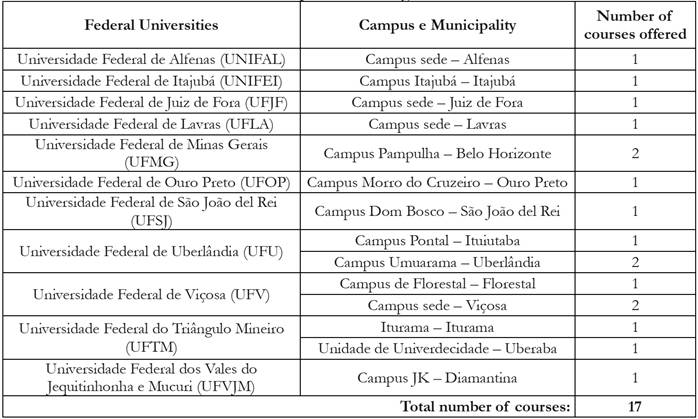
The first step in collecting data for this study consisted of mapping the on-campus undergraduate programs in Biological Sciences offered by federal universities in the state of Minas Gerais. This survey was conducted using the e-MEC website of the Ministry of Education and Culture. This survey was carried out in the first two months of 2021 and allowed for the mapping of the courses offered by the institutions listed in Chart 1.
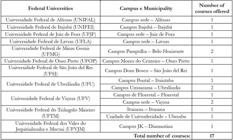
Federal universities in Minas Gerais that offer a Bachelor’s degree in Biological Sciences (in-person modality)
After this initial search, the next step consisted of visiting the institutions’ websites to access and download the Course Project Plans (PPCs). Four of the mapped institutions did not have their PPCs or course outlines available for download on their websites. Therefore, an email was sent to the coordinators of the respective courses, explaining the research objectives and requesting the documents. The four coordinators contacted sent the requested documents. All PPCs are saved and available for consultation in a shared folder on Dropbox3.
Regarding the data analysis procedure, this research was based on the qualitative data analysis proposed by Yin (2016). According to the author, this process consists of five phases arranged in an interactive and non-linear way. These are: compilation, decomposition, recomposition, interpretation, and conclusion.
To compile the data, the course plans were read in their entirety, seeking to identify aspects that addressed the theme of inclusive education for students with special educational needs. All excerpts from the course plans and syllabi that met the study's objectives were selected and recorded in a summary.
The described stage allowed us to observe that the themes related to the inclusive education of PAEE students were diluted across different topics that make up the documents, highlighting the following moments: presentation of the PPC (Pedagogical Project of the Course), justifications, course objectives, competencies and skills, and professional profile of the graduate. For analysis purposes, the term “fundamentals of the PPC” was used to indicate the listed topics. Regarding the presence of the theme in the disciplines, this was also identified in different parts of the PPCs, such as in the discipline title, in the syllabus description, in the objectives, in the program content, or in the bibliography.
Having finalized the compilation process, the result was a “database” with 17 summaries, containing all citations on inclusive education found in the fundamentals, as well as descriptions of all subjects that, in some way, addressed topics related to inclusive education.
To facilitate the process of data decomposition and recomposition, two “matrices as arrays” were created, as explained by Yin (2016). One matrix presented all mentions of inclusive education present in the course foundations, and the other presented the description of all course subjects that included elements of inclusive education.
RESULTS AND DISCUSSION
Biology teacher training courses: general characterization and evidence of inclusive education in their foundations
General information provided by the courses, such as the year of restructuring of the PPC, the total workload, the minimum completion time, and the number of places offered annually, is shown in Table 1.
Among the characteristics presented in Table 1, it is possible to initially list the role that federal higher education institutions in Minas Gerais play in relation to the training of qualified teachers for teaching Science and Biology in basic education in this region, judging by the 2019 data from the Minas Gerais Basic Education Census (Brasil, 2020). This data shows that, in this state, 23.7% of teachers who teach Science (present in the final years of Elementary School) and 15.6% of teachers who teach Biology (present in High School) did not have a full undergraduate degree in a higher education course, designated by the LDB (Brazilian Law of Directives and Bases of National Education) as necessary training for teaching in basic education (Brasil, 1996, Art. 62).
Another aspect to mention regarding the data provided by the Census refers to the students enrolled in these stages of schooling in the state. According to the data, in 2019, there were a total of 1.8 million enrollments at these levels of education, of which approximately 60,000 enrollments were from students considered to belong to the PAEE (Brasil, 2020). Within this context, the relevance of these universities in supplying adequately trained teachers is emphasized, especially when considering the number of places offered by the institutions each year (810 vacancies) and, consequently, the number of graduates that can be estimated upon completion of the undergraduate degree in teaching.
The data in Table 1 also indicate that, with the exception of the courses at UFMG (Daytime and Nightly) and UFV-Viçosa (Fulltime and Nightly), the latest curricular restructurings of the PPCs took place between 2017 and 2020, a period that followed the publication of the National Curricular Guidelines for initial higher education (Brasil, 2015a).
In this sense, it is evident that these courses are in line with the 2015 National Curriculum Guidelines (DCN) when these guidelines recommend altering the minimum course load for undergraduate programs, which had been stipulated by CNE/CP Resolution No. 2, of February 19, 2002 (Brasil, 2002b). Based on the 2015 DCN, courses were instructed to increase from 2,800 hours distributed over at least six academic semesters to 3,200 hours distributed over at least eight academic semesters.
As discussed earlier in this work, the 2015 National Curriculum Guidelines (DCN) represented considerable advances for the area of inclusive education, as they boosted the debate on diversity and its place in the curricula of teacher training courses. Due to the restructuring resulting from these DCN, some courses include, in their foundations, sections of this document that advocate for a graduate capable of working with the diversity represented by the PAEE (Program for the Support of Students with Special Educational Needs). This is the case of the PPC of UFSJ (2019, p. 15), UFOP (2020, p. 27), UFU-Umuarama (2018, p. 44), UFU-Pontal (2018, p. 13), UNIFAL (2018, p. 18), and UFVJM (2018, p. 21) when they mention that undergraduate students should be able to,
identify sociocultural and educational issues and problems, adopting an investigative, integrative, and proactive approach to complex realities, in order to contribute to overcoming social, ethnic-racial, economic, cultural, religious, political, gender, sexual, and other forms of exclusion; to demonstrate awareness of diversity, respecting differences of an environmental-ecological, ethnic-racial, gender, generational, social class, religious, special needs, sexual diversity, and others; (Brasil, 2015a, Art. 7, emphasis added).
In addition to the explicit mention of the 2015 National Curriculum Guidelines (DCN), the training of a teacher who considers the specific needs of students who are PAEE and works from the perspective of inclusive education is also reflected directly and indirectly in the fundamentals of the Pedagogical Project of the Course.
Regarding direct indications related to the topic, the UFVJM's Pedagogical Project states, in the “competencies and skills” section, that the undergraduate student must “have an understanding of learning processes in order to be able to work with diversity and special educational needs” (UFVJM, 2018, p. 21, emphasis added). Another indication appears in the “skills” section of the UFSJ's PPC when it addresses that the teacher in training must “have the capacity to work with people with special needs at different levels of school organization, in order to ensure their citizenship rights” (UFSJ, 2019, p. 13, emphasis added).
Regarding the indirect presence of the theme, this occurs when universities signal an educational approach that values respect and appreciation for diversity and human differences. As an example, the UFTM-Iturama’s Pedagogical Project (PPC) states that the course aims to
[...] train an educator committed to human development in all its dimensions, with the skills to: make pedagogical choices according to developmental cycles and human diversity, in accordance with politically, ethically, aesthetically, and epistemologically coherent principles; [and] provide opportunities for dialogue among students, guiding them to respect and value human diversity, with a view to tolerance, solidarity, and the exercise of citizenship (UFTM-Iturama, 2020, p. 45, emphasis added).
It is also worth remembering that all courses, in their fundamental principles set out in the PPC (Pedagogical Project of the Course), affirm their intention to contribute, through teacher training, to the construction of a just, equitable, egalitarian, democratic and inclusive society, with professionals who act in favor of humanistic and ethical principles, tolerance, solidarity, mutual respect, citizenship, human dignity, human rights, among others.
Nevertheless, it is necessary to ensure that these discourses do not remain merely words and are emptied of meaning and the commitment to making these ideals a reality. In this regard, Dias (2018, p. 92) warns about this issue when he mentions that “Clichés such as ‘educating for citizenship’, ‘learning to learn’, ‘education for all’, among others, appear in pedagogical projects without any reflection on the limitations and contradictions that such terms carry with them”.
This reinforces the idea that if universities claim to contribute to building an egalitarian and just society where everyone has the right to citizenship and respect, they should assume the responsibility of training teachers who will guarantee the right to a quality education for students with special educational needs (PAEE). Such education should not occur in segregated environments, but in regular classrooms where the diverse student body has the opportunity to coexist and cooperate, just as all students have access to biological knowledge, considering the repertoire of knowledge and pedagogical practices teachers have acquired during their training. In other words, it is understood that for the aspirations expressed by universities to be realized, it is necessary that the teachers trained by these institutions, throughout their careers, transform the schools where they work into “microcosms” of a society in transformation (Schaffner; Buswell, 1999).
Supporting the aforementioned statement, Karagiannis, Stainback, and Stainback (1999) argue that school is the place where seeds can be sown when aiming for a new society. According to the authors,
If we truly desire a just and egalitarian society, where all people have equal value and equal rights, we need to reassess how we operate in our schools to provide students with disabilities the opportunities and skills to participate in the new society that is emerging. If we want support and equality for all people, segregation in schools cannot be justified (Karagiannis; Stainback; Stainback, 1999, p. 29).
Starting from the references to inclusive education highlighted in the foundations of the documents and based on the fact that “[...] planning contains the message of anticipating the future with determined intentions, the administration must be at the service of the realization of these intentions” (Carvalho, 2019, p. 100). Therefore, it is up to the course coordinators, together with the teachers and students, to promote the realization of the ideal teaching profile envisioned by the courses.
However, it can be seen that the paths taken by teacher training courses in the inclusive education perspective are diverse, given that each course strives for a different training approach. In light of this, the identification of the places where topics related to inclusive education are discussed and reflected upon with undergraduate students in these courses is explained in the following section.
The curriculum sections designed for discussion on inclusive education (IE)
Based on the analysis of the information present in the PPCs (Pedagogical Project of the Course), it was identified that the themes related to inclusive education are present in three distinct areas of the curricular structure of the courses, namely: the mandatory curricular components, the optional curricular components, and the extracurricular activities, as illustrated in Figure 1.

The mandatory curricular components of the courses are those that must be completed by undergraduate students to obtain their degree. They are presented in the form of mandatory subjects, a final course project, the ENADE exam, among other interfaces.
With regard to elective curricular components, these are considered to be those that contain complementary knowledge for the training of undergraduate students and may be presented through elective courses.
Graph 1below highlights the number of mandatory and elective courses in which topics related to inclusive education were identified in their detailed descriptions.
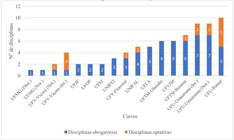
Number of courses identified that address topics related to inclusive education, by undergraduate course analyzed
Based on the data presented in Graph 1, it can be seen that 78 courses addressing this theme were identified in the 17 undergraduate courses analyzed. Of these, 79.5% (62) are mandatory, while 20.5% (16) are elective courses. It is also noted that all the undergraduate courses analyzed have at least one mandatory course that addresses some topic related to inclusive education.
Considering that the mandatory courses in undergraduate courses are those whose knowledge is considered fundamental for teacher training, it can be stated that discussions related to inclusive education have been gaining ground in the curricula of undergraduate programs in Biological Sciences. This conquest of spaces becomes even more evident when comparing the results of the present research with those of similar investigations (Gatti; Nunes, 2009; Vilela-Ribeiro; Benite, 2011; Oliveira et al., 2011; Pedroso; Campos; Duarte, 2013; Basso, 2015; Silva; Lodi; Barbieri, 2015; Dias, 2015, 2018; Simões, 2016; Trindade; Coelho; Costa, 2017; Rocha-Oliveira; Dias; Siqueira, 2019; Adams, 2020; Bazon; Silva, 2020; Conceição; Souza, 2020), which found that the theme of inclusive education was limited to the mandatory subject of Libras (Brazilian Sign Language) and, rarely, was it found in the form of an elective course.
This increased presence of discussions about the education of PAEE students in the “noble and legitimate spaces of the curriculum”, as designated by Arroyo (2013), demonstrates, even though only initially, the potential the curriculum has to become a public space of rights, in which groups that have remained historically marginalized, silenced, inferiorized, hidden, and forgotten can finally be recognized (Arroyo, 2013).
points out that, in the same way that curricula have contributed to a policy of silencing and concealing social groups - such as groups of people with disabilities and those of the PAEE - these groups can contribute to the construction of a policy for recovering these memories. In the author’s words,
By being sensitive to and respecting the specific struggles of each collective for the uniqueness of its collective identity, the curriculum can be one of the political spaces for practices and projects of memories left for so long on the margins of the curricular territory-time-space. The curriculum can be one of the places of resonance for the struggles for identity that come from the diversity of spaces, collective actions, and social movements. A place for re-evaluation, re-signification of history and memories considered unique and legitimate (Arroyo, 2013, p. 297).
Regarding the so-called “peripheral” aspects of the curriculum, that is, those spaces that are not integrated into its “legitimate” schedules (Arroyo, 2013), Graph 1 shows that eight undergraduate courses offer elective courses that address topics related to inclusive education. However, despite being less numerous, elective courses can play an important role in curricula, mainly by allowing reflection and in-depth study of the subject for undergraduate students who may express interest in the topic. However, it is worth remembering that, being elective, these courses may not be offered every year, given that the university is not committed to offering them.
It is also worth highlighting that the number of courses identified for each undergraduate course analyzed changes depending on the year in which the PPCs were restructured. This data is illustrated below in Graph 2.
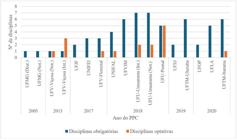
Relationship between the number of courses identified by undergraduate course and the year of restructuring of the PPC
Based on the data presented in Graph 2, it is possible to observe that, in relation to the PPCs (Pedagogical Project of the Course) that were structured before 2015, these present only one mandatory course in their curriculum that discusses the theme of inclusive education. This course is Libras (Brazilian Sign Language), and its presence can be associated with the mandatory inclusion of Libras in teacher training curricula, stipulated by official documents promulgated before 2015 (Brasil, 2002c, 2005).
On the other hand, when observing the PPCs (Pedagogical Project of the Course) that were restructured after 2015, it is observed that the theme of inclusive education is no longer restricted only to the subject of Libras and begins to permeate other mandatory courses in the curriculum as well. It is also observed that mandatory courses assume a prominent position in addressing the theme, while elective courses take a secondary role.
Therefore, it is essential to highlight the gains resulting from the policies disseminated and implemented during this period and the role they played in the restructuring process of teacher training courses. Particularly interesting is the enactment, on July 6, 2015, of Law No. 13.146, which established the Brazilian Law for the Inclusion of Persons with Disabilities (LBI), recognized as a landmark and a symbol of the defense of the rights of persons with disabilities (Brasil, 2015b), and, especially, the publication of the 2015 National Curriculum Guidelines (DCN), a document prepared during a historical moment of intense discussions and debates on inclusive education and approved by the scientific community and representative bodies of teachers (Ferreira; Ferraz; Ferraz, 2021).
However, the gains from the 2015 National Curriculum Guidelines (DCN), some of which are shown in the data presented in Graph 2, may be reversed by the new requirements of the 2019 DCN. As discussed earlier in this work, much is lost with the 2019 DCN, especially regarding reflection on the inclusive education of students with special educational needs (PAEE) in teacher training.
In Article 27 of the 2019 National Curriculum Guidelines (DCN), for example, which stipulates that institutions that implemented the 2015 guidelines have a three-year deadline to make the necessary adjustments as outlined in the new DCN (Brazil, 2019), it is known that undergraduate courses that reformulated their Pedagogical Projects (PPCs) before their publication in 2019 will undergo further restructuring in the coming years. However, it is expected that the achievements stemming from the 2015 DCN will remain in these courses and move towards a greater expansion and deepening of the theme of inclusive education across the various courses of the curriculum.
In addition to the presence of the topic in mandatory and elective curricular components, the PPCs also presented the possibility of bringing undergraduate students closer to this discussion in the space of extracurricular activities, as discussed in the following item.
According to Souza, Chapani, and Caldeira (2020, p. 6), extracurricular activities are defined as “[...] all activities promoted by the training institution, but which are not part of the curriculum of the undergraduate course in which the students participate”. Examples of such activities include extension projects, tutoring activities, the Institutional Program for Scientific Initiation Scholarships (PIBIC), the Institutional Program for Teaching Initiation Scholarships (PIBID), etc. These are optional, non-mandatory activities that allow the student teacher autonomy to make their training process more flexible. Despite the nomenclature, this work considers that these activities are not separate from the teacher training curriculum, but also constitute it (Souza; Chapani; Caldeira, 2020).
In accordance with the 2015 National Curriculum Guidelines (DCN), all students must complete a minimum of 200 hours in complementary activities, which must be carried out in “[...] specific theoretical-practical activities of interest to the students [...] through scientific initiation, initiation to teaching, extension, tutoring, among others, in accordance with the institution’s course project” (Brasil, 2015a, Art. 13). In this sense, even though extracurricular activities are not mandatory, participation in these activities can be used to fulfill the required hours for complementary activities, depending on the regulations set forth in the Course Project.
From this, it was observed that students interested in the topic can fulfill some of the hours allocated to complementary activities in extracurricular activities promoted by the institutional bodies responsible for matters related to the inclusion of PAEE students and staff with disabilities in higher education. Of the analyzed PPCs, those of UFOP, UFTM-Iturama, UFTM-Uberaba, and UFU-Pontal indicate this type of offering.
UFOP, for example, mentions that the Inclusive Education Center (NEI) of the university has as one of its objectives “[...] to identify the training or qualification needs of human resources, suggesting and promoting training and development that address the themes of inclusive education and accessibility” (UFOP, 2020, p. 63, emphasis added). In the case of undergraduate courses promoted by UFTM, assistance to PAEE undergraduate students is provided by the Program for Assistance and Guidance to Students with Special Educational Needs (PAONEE). Among the program’s actions is “[...] collaborating in the promotion of training courses for teachers and scientific activities related to the topic” (UFTM-Iturama, 2020, p. 36).
In the case of these universities, they do not make it clear what type of activities are offered, whether they are scientific research, extension projects, long or short courses, seminars or lectures, among others, nor do they clarify to which specific audience they are intended.
This highlights the opportunities for undergraduate students to engage with the subject matter offered by the Center for Teaching, Research, Extension and Support in Special Education (CEPAE) at UFU-Pontal. Among the responsibilities of the center, those that can be experienced by undergraduate students in the form of complementary activities stand out:
To guarantee a democratic space for the discussion of ideas, theoretical debates, and exchanges of experiences among all people interested in and/or involved with issues related to Special Education, seeking solutions to the various problems that this area faces, as well as implementing projects that promote its transformation and development; [...]
To promote scientific events, lectures, seminars, debates, and studies involving the discussion, reflection, and dissemination of studies and works related to current issues in Special Education; [...] To bring together researchers in the field of Special Education for discussion, analysis, and socialization of the results of their research. (UFU-Pontal, 2018, p. 68).
It is also worth mentioning the existence of the “Study and Research Group on Autism Spectrum Disorders” linked to the Accessibility Center of UFU-Pontal, which, according to the PPC of the undergraduate course in Biological Sciences, “[...] has organized the event ‘Colloquium on Autism Spectrum Disorder’ providing a space for discussions on the schooling processes of students with Autism Spectrum Disorder in the context of the regular classroom and the special classroom” (UFU-Pontal, 2018, p. 69).
It is observed that, regarding the “spaces” designated for discussion about inclusive education in undergraduate curricula, UFU-Pontal stands out in the number of subjects focused on the topic (see Graph 1), as well as in the documented organization of extracurricular activities that enable the participation of undergraduate students. The strong presence of proposals in this institution can be associated with the influence of CEPAE, which aims, among its responsibilities, to:
meet the legal requirements that indicate the need for all teacher training courses to develop pedagogical actions that include the training of a professional who is sensitive and adequately prepared for efficient pedagogical practice with students with special educational needs integrated into the regular education system; (UFU-Pontal, 2018, p. 69).
In addition to providing teaching, research, and outreach activities for the academic community, CEPAE is also responsible for offering continuing education to the external community through training courses in Libras (Brazilian Sign Language), assistive technologies for the blind, training for Libras interpreters and translators, as well as advanced courses in different types of Specialized Educational Services.
The case of UFU-Pontal highlights how much the curricula of teacher training courses are the result of a selective tradition and, therefore, are not neutral (Apple, 2002). This is because, being a constant debate at the university, the topic may have been recognized as legitimate knowledge and, as a result, has been intensified in the curricular structure of the undergraduate course in Biological Sciences.
Regarding the PPCs of the other courses analyzed, these do not mention the implementation of extracurricular activities focused on inclusive education. However, their absence in the PPCs does not preclude the possibility of research opportunities, extension activities, and study groups addressing this theme.
In this regard, it is important to highlight the need for undergraduate courses to recognize extracurricular activities as formative environments for undergraduate students and, therefore, to institutionalize the aforementioned projects in the PPC documents of the undergraduate programs as activities belonging to the university and the course, identifying them as important contributors to the training of undergraduate students.
By way of example, and considering the educational background of the first author of this work, it is known that UNIFEI offers several opportunities to engage with the theme of inclusive education within extracurricular activities. Among these, the following stand out: opportunities to develop scientific initiation projects within the research project registered at the institution, entitled: “The use of multifunctional resource rooms and science teaching: A study on inclusion in the microregion of Itajubá”; events and projects organized by the Center for Studies in Teacher Training, Technologies and Inclusion (NEFTi) and the Center for Inclusive Education (NEI); and the existence of the “Interdisciplinary Study and Research Group on Technologies, Science Education and Inclusion”. All these activities are available to students of the Biological Sciences degree program and allowed the first author of this work to participate in and deepen her theoretical understanding of inclusive education. However, these possibilities are not mentioned or acknowledged in the course’s PPC as a training environment.
FINAL REMARKS
More than 25 years after the event that gave rise to the Salamanca Declaration, the Brazilian education system is still moving towards becoming truly inclusive for all the diversity that makes up this country.
Since the Salamanca Declaration, successive official guidelines have been published by the government reinforcing the need to consider teacher training as a fundamental path when seeking to achieve the ideal of inclusive education. However, despite recognizing the potential of initial teacher training in this initiative, Brazilian official documents contribute little to guiding effective ways to include this theme in the curricula of teacher training courses.
To comply with the National Curriculum Guidelines, would it be enough for teacher training courses to simply end the discussion on inclusive education within the context of the Libras (Brazilian Sign Language) subject and a subject called Inclusive and Special Education? What other configurations could be used to present issues related to the education of students with special educational needs - so long absent from schools and curricula - within the prominent space of Biology teacher training curricula?
Considering that it is not enough to criticize undergraduate courses, pointing out that they have not fulfilled their role when it comes to preparing teachers to work from a diversity perspective, but that it is necessary to go further, pointing to new training designs, this study aimed to analyze how inclusive education is proposed in the curricula of undergraduate courses in Biological Sciences at federal universities in the state of Minas Gerais, considered to be institutions of academic excellence in the country.
The analyses obtained through this research, which is characterized as qualitative and documentary research, allowed us to verify that the theme of inclusive education has been increasingly recognized as legitimate knowledge to be worked on during teacher training, because, in addition to the documents mentioning this issue in the foundations of their PPCs, they also designate different places in the curriculum for the theme to be discussed, namely: the mandatory curricular components, the optional curricular components and the extracurricular activities.
Contrary to what was expected regarding the results of this research, considering related investigations, the number of mandatory courses that address topics related to inclusive education was quite significant, since the analysis of the curricular syllabi of the 17 courses allowed the identification of a total of 78 subjects, of which 79.5% (62) are mandatory, while 20.5% (16) are optional.
These results highlight the impact that official guiding documents, especially the National Curriculum Guidelines, have on shaping teacher training courses, given that the topic has ceased to be restricted to the scope of the Libras (Brazilian Sign Language) discipline and has begun to permeate other mandatory curriculum subjects after 2015.
It is understood that this research opens possibilities for new investigations and productions to be carried out, in order to clarify, for example, the way in which university professors have conducted these disciplines, or even works that aim to understand how these disciplines have impacted the way of thinking of undergraduate students and their practices as teachers in basic education. The production and dissemination of accounts of experiences from these different subjects would be a way to get closer to and understand their formative processes and their performance in elementary and secondary education.
Based on this work, it is highlighted that there is a need for curricular documents that clarify, in greater detail, the content selected to compose the syllabi of their subjects, avoiding the use of generic phrases and words, as well as explaining, in detail, how the hours allocated to theory and practice will be handled, thus enabling and facilitating further documentary research.
Also, regarding extracurricular activities, it is reiterated that courses must provide the academic community with information about projects carried out within the scope of extension projects, study groups, and scientific initiation programs, so that other researchers can understand how the theme of inclusive education has been integrated into this space. This analysis could not be carried out with the necessary depth in this research, given that the PPCs rarely mention or describe the formative activities carried out within the scope of extracurricular activities. Therefore, it is recommended that initiatives concerning the theme of inclusion be detailed in the PPC documents or on the course’s web pages.
Finally, it is important to point out that initial teacher training alone is not capable of resolving all the obstacles that inclusive education faces in order to be implemented in Brazilian schools. Factors such as the widespread lack of resources, the precariousness of the teaching career, the lack of well-structured public policies, and the minimal awareness of the school community regarding inclusion in this space are some of the challenges that need to be overcome.
Furthermore, it is recognized that as long as a society is based on prejudiced and unequal relationships, in which some groups become rich at the expense of the degradation of the living conditions of others, inclusion will hardly be achieved. However, it is understood that, by unveiling this cruel dynamic existing in the social composition, a step is already taken towards moving towards criticality and change.
ACKNOWLEDGEMENTS
We would like to thank the Minas Gerais State Research Support Foundation(FAPEMIG) and the National Council for Scientific and Technological Development (CNPq).
References
-
ADAMS, Fernanda. A discussão da educação especial nas disciplinas de núcleos pedagógicos nos cursos de ciências da natureza. Revista Cocar, Belém, v. 14, n. 30, p. 1-16, set./dez. 2020. Disponível em: <Disponível em: https://periodicos.uepa.br/index.php/cocar/article/view/3383 >. Acesso em: 29 jun. 2021.
» https://periodicos.uepa.br/index.php/cocar/article/view/3383 - APPLE, Michael. A Política do Conhecimento Oficial: faz sentido a idéia de um currículo nacional? In: MOREIRA, A. F.; SILVA, T. T. Currículo, Cultura e Sociedade 7. ed. São Paulo: Cortez, 2002. Cap. 3, p. 58-92.
- ARROYO, Miguel. Currículo, Território em Disputa 5. ed. Petrópolis: Vozes, 2013.
- BASSO, Sabrina. Cursos licenciatura na área de ciências: a temática da inclusão escolar de alunos com necessidades educacionais especiais. 2015. 130 f.Tese (Doutorado em Educação para a Ciência) - Programa de Pós-Graduação em Educação para a Ciência, Universidade Estadual Paulista, Bauru, 2015.
-
BASTOS, Amélia; LINDEMANN, Renata; REYES, Vitória. Educação inclusiva e o ensino de ciências: um estudo sobre as proposições da área. Journal of Research in Special Educational Needs, v. 16, n. s1, 2016. 426-429. Disponível em: <https://onlinelibrary.wiley.com/doi/abs/10.1111/1471-3802.12302>. Acesso em: 29 set. 2020.
» https://doi.org/10.1111/1471-3802.12302 -
BAZON, Fernanda.; SILVA, Gabriela. Formação de professores na perspectiva da educação inclusiva: análise de currículos de licenciaturas em ciências biológicas, química e física. Revista Pedagógica, Chapecó, v. 22, p. 1-24, 2020. Disponível em: <Disponível em: http://pegasus.unochapeco.edu.br/revistas/index.php/pedagogica/article/view/4570 >. Acesso em: 29 jun. 2021.
» http://pegasus.unochapeco.edu.br/revistas/index.php/pedagogica/article/view/4570 -
BAZZO, Vera; SHEIBE, Leda. De volta para o futuro... retrocessos na atual política de formação docente. Revista Retratos da Escola, Brasília, v. 13, n. 27, p. 669-684, set./dez. 2019.Disponível em: <Disponível em: http://retratosdaescola.emnuvens.com.br/rde/article/view/1038 >. Acesso em: 17 jan. 2022.
» http://retratosdaescola.emnuvens.com.br/rde/article/view/1038 - BOOTH, Tony; AINSCOW, Mel. Índex para a inclusão: desenvolvendo a aprendizagem e a participação na escola. Tradução de Ana Bernard Costa e José Vaz Pinto. Sintra-Portugal: Cidadãos do Mundo, 2002.
-
BORGES, Ellen.; DIAS, Viviane.; CORRÊA, André. Educação inclusiva e ensino de Ciências: análise dos trabalhos publicados no ENPEC entre 2007 e 2017. Com a Palavra, O Professor, Vitória da Conquista (BA), v. 5, n. 12, p. 210-235, mai./ago. 2020. Disponível em: <Disponível em: http://revista.geem.mat.br/index.php/CPP/article/view/494 >. Acesso em: 17 jan. 2022.
» http://revista.geem.mat.br/index.php/CPP/article/view/494 - BRASIL. Constituição (1988) Constituição da República Federativa do Brasil de 1988 Brasília, DF: Presidência da República, 1988.
- BRASIL. Decreto Nº 5.626, de 22 de dezembro de 2005 Dispõe sobre a Língua Brasileira de Sinais - Libras. Brasília, DF: Presidência da República, 2005.
- BRASIL. Instituto Nacional de Estudos e Pesquisas Educacionais Anísio Teixeira (Inep) Censo da Educação Básica Estadual 2019: Resumo Técnico. Brasília: Inep, 2020.
- BRASIL. Instituto Nacional de Estudos e Pesquisas Educacionais Anísio Teixeira (Inep) Censo da Educação Básica 2020: Resumo Técnico. Brasília: Inep, 2021.
- BRASIL. Lei Nº 13.146, de 6 de julho de 2015 Institui a Lei Brasileira de Inclusão da Pessoa com Deficiência (Estatuto da Pessoa com Deficiência). Brasília, DF: Presidência da República, 2015b.
- BRASIL. Lei Nº 9.394, de 20 de dezembro de 1996 Estabelece as diretrizes e bases da educação nacional. Brasília, DF: Presidência da República, 1996.
- BRASIL. Lei Nº 10.436, de 24 de abril de 2002 Dispõe sobre a Língua Brasileira de Sinais - Libras e dá outras providências. Brasília, DF: Presidência da República, 2002c.
- BRASIL. Política Nacional de Educação Especial na Perspectiva da Educação Inclusiva Brasília, DF: MEC, 2008.
- BRASIL. Resolução CNE/CEB Nº 2, de setembro de 2001 Institui as Diretrizes Nacionais para a Educação Especial na Educação Básica. Brasília, DF: MEC; SEESP, 2001.
- BRASIL. Resolução CNE/CP Nº 1, de 18 de fevereiro de 2002 Institui Diretrizes Curriculares Nacionais para a Formação de Professores da Educação Básica, em nível superior, curso de licenciatura, de graduação plena. Brasília, DF: MEC, 2002a.
- BRASIL. Resolução CNE/CP Nº 2, de 19 de fevereiro de 2002 Institui a duração e carga horária dos cursos de licenciatura, graduação plena, de formação de professores da Educação Básica em nível superior. Brasília, DF: MEC, 2002b.
- BRASIL. Resolução CNE/CP Nº 2, de 1 de julho de 2015 Define as Diretrizes Curriculares Nacionais para a formação inicial em nível superior (cursos de licenciatura, cursos de formação pedagógica para graduados e cursos de segunda licenciatura) e para a formação continuada. Brasília, DF: MEC, 2015a.
- BRASIL. Resolução CNE/CP Nº 2, de 20 de dezembro de 2019 Define as Diretrizes Curriculares Nacionais para a Formação Inicial de Professores para a Educação Básica e institui a Base Nacional Comum para a Formação Inicial de Professores da Educação Básica (BNC-Formação). Brasília, DF: MEC, 2019.
- CARVALHO, Rosita. Educação Inclusiva: com os pingos nos "is". 13. ed. Porto Alegre: Mediação, 2019.
-
CONCEIÇÃO, Valéria; SOUZA, Janayna. Formação inicial de professores na perspectiva da educação inclusiva: reflexões sobre um projeto pedagógico de licenciatura em ciências biológicas. In: CONGRESSO NACIONAL DE EDUCAÇÃO, 7., 2020, Maceió, AL. Anais. Maceió, 2020. Disponível em: <Disponível em: https://editorarealize.com.br/editora/anais/conedu/2020/TRABALHO_EV140_MD4_SA10_ID1935_14032020140027.pdf >. Acesso em: 19 jan 2022.
» https://editorarealize.com.br/editora/anais/conedu/2020/TRABALHO_EV140_MD4_SA10_ID1935_14032020140027.pdf - DIAS, Viviane. Formação de professores e educação inclusiva: uma análise à luz da Teoria Crítica da Sociedade. 2018. 263f. Tese (Doutorado em Educação) - Programa de Pós-Graduação em Educação e Contemporaneidade, Universidade do Estado da Bahia, Salvador, 2018.
-
DIAS, Viviane. Abordagem da educação inclusiva nas matrizes curriculares dos cursos de formação de professores na universidade estadual de Santa Cruz - Bahia. In: COLÓQUIO INTERNACIONAL "EDUCAÇÃO E CONTEMPORANEIDADE", 4., 2015, São Cristóvão, SE. Anais Educon, Aracaju, v. 9, n. 1, p. 1-10, set. 2015. Disponível em: <Disponível em: http://anais.educonse.com.br/2015/abordagem_da_educacao_inclusiva_nas_matrizes_curriculares_dos_cur.pdf >. Acesso em: 19 jan. 2022.
» http://anais.educonse.com.br/2015/abordagem_da_educacao_inclusiva_nas_matrizes_curriculares_dos_cur.pdf -
FERREIRA, Lúcia; FERRAZ, Roselane; FERRAZ, Rita. Diretrizes Curriculares Nacionais para formação de professores: desafios e configurações para as licenciaturas. Scielopreprints, 2021. Disponivel em: <Disponivel em: https://preprints.scielo.org/index.php/scielo/preprint/view/2228 >. Acesso em: 17 jan. 2022.
» https://preprints.scielo.org/index.php/scielo/preprint/view/2228 - GATTI, Bernadete; BARRETO, Elba. Professores do Brasil: impasses e desafios. Brasília: UNESCO, 2009.
- GATTI, Bernadete; NUNES, Marina. Formação de professores para o ensino fundamental: estudo de currículos das licenciaturas em pedagogia, língua portuguesa, matemática e ciências biológicas. São Paulo: FCC/DPE, 2009.
- KARAGIANNIS, Anastasios; STAINBACK, Susan; STAINBACK, Willian. Fundamentos do Ensino Inclusivo. In: STAINBACK, S.; STAINBACK, W. Inclusão: um guia para educadores. Porto Alegre: Artmed, 1999. Cap. 1, p. 21-34.
- MARTINS, Lígia. O legado do século XX para a formação de professores. In: MARTINS, L. M.; DUARTE, N. Formação de Professores: Limites Contemporâneos e Alternativas Necessárias. São Paulo: Cultura Acadêmica, 2010. Cap. 1, p. 13-32.
- MOREIRA, Marco Antônio. Pesquisa em Ensino de Ciências: Métodos Qualitativos. In: MOREIRA, M. A.; ROSA, P. R. S. Pesquisa em Ensino: Métodos Qualitativos e Quantitativos. 1ª. ed. Porto Alegre: UFRGS, 2009. Cap. 1, p. 5-31.
- OLIVEIRA, Anna. Formação de Professores em Educação Especial: a busca de uma direção. In: MENDES, E. G.; ALMEIDA, M. A.; WILLIAMS, L. C. D. A. Temas em Educação Especial: avanços recentes. São Carlos: EdUFSCar, 2009. p. 239-243.
-
OLIVEIRA, Mayara; ANTUNES, Adriana; ROCHA, Thiago; TEIXEIRA, Simone. Educação Inclusiva e a formação de professores de Ciências: o papel das universidades federais na capacitação dos futuros educadores. Ensaio Pesquisa em Educação em Ciências, Belo Horizonte, v. 13, n. 3, p. 99-117, set./dez. 2011. Disponível em: <Disponível em: https://www.scielo.br/j/epec/a/3tHCfkTCMh6WpTsNwHBctXv/?format=pdf⟨=pt >. Acesso em: 29 jun. 2021.
» https://www.scielo.br/j/epec/a/3tHCfkTCMh6WpTsNwHBctXv/?format=pdf⟨=pt -
PEDROSO, Cristina; CAMPOS, Juliane; DUARTE, Márcia. Formação de professores e educação inclusiva: análise das matrizes curriculares dos cursos de licenciatura. Revista Educação Unisinos, v. 17, n. 1, p. 40-47, jan./abr. 2013. Disponível em: <Disponível em: http://revistas.unisinos.br/index.php/educacao/article/view/edu.2013.171.05/1411 >. Acesso em: 29 jun. 2021.
» http://revistas.unisinos.br/index.php/educacao/article/view/edu.2013.171.05/1411 -
ROCHA-OLIVEIRA, Rafaela; DIAS, Viviane; SIQUEIRA, Maxwell. Formação de Professores de Biologia e Educação Inclusiva: Indícios do Projeto Acadêmico Curricular. Revista Brasileira de Pesquisa em Educação em Ciências, v. 19, p. 225-250, 2019. Disponível em: <Disponível em: https://periodicos.ufmg.br/index.php/rbpec/article/view/4935 >. Acesso em: 29 jun. 2021.
» https://periodicos.ufmg.br/index.php/rbpec/article/view/4935 -
ROCHA-OLIVEIRA, Rafaela; MACHADO, Maíra; SIQUEIRA, Maxwell. Formamos professores para a educação inclusiva? Análise de publicações sobre formação de professores de Ciências/Biologia. Revista Brasileira de Ensino de Ciência e Tecnologia, Ponta Grossa, v. 10, n. 2, p. 170-192, mai./ago. 2017. Disponível em: <Disponível em: https://revistas.utfpr.edu.br/rbect/article/view/3784 >. Acesso em: 17 jan. 2022.
» https://revistas.utfpr.edu.br/rbect/article/view/3784 - SACRISTÁN, Gimeno. O currículo: uma reflexão sobre a prática. Porto Alegre, RS: Artmed, 2013.
-
SANTANA, Ronaldo; SOFIATO, Cássia. O estado da arte das pesquisas sobre o ensino de Ciências para estudantes surdos. Práxis Educativa, v. 13, n. 2, p. 596-616, 2018. Disponível em: <Disponível em: https://revistas.apps.uepg.br/index.php/praxiseducativa/article/view/11059 >. Acesso em: 29 set. 2020.
» https://revistas.apps.uepg.br/index.php/praxiseducativa/article/view/11059 - SCHAFFNER, Beth; BUSWELL, Barbara. Dez Elementos Críticos para a Criação de Comunidades de Ensino Inclusivo e Eficaz. In: STAINBACK, S.; STAINBACK, W. Inclusão: um guia para educadores. Porto Alegre: Artmed, 1999. Cap. 4, p. 69-87.
- SEVERINO, Antonio. Metodologia do trabalho científico 2. ed. São Paulo: Cortez, 2017.
-
SILVA, Hanna; LODI, Ana; BARBIERI, Bruna. Cursos de licenciatura: a formação de professores para atuação na perspectiva da educação para a diversidade. Revista Ibero-Americana de Estudos em Educação, Araraquara, v. 10, n. esp. 1, p. 719-740, 2015. Disponível em: <Disponível em: https://periodicos.fclar.unesp.br/iberoamericana/article/view/7925 >. Acesso em: 29 jun. 2021.
» https://periodicos.fclar.unesp.br/iberoamericana/article/view/7925 -
SILVA, Larissa; BEGO, Amadeu. Levantamento Bibliográfico sobre Educação Especial e Ensino de Ciências no Brasil. Revista Brasileira de Educação Especial, Marília, v. 24, n .3, p. 343-358, 2018. Disponível em: <Disponível em: https://repositorio.unesp.br/handle/11449/158127 >. Acesso em: 29 set. 2020.
» https://repositorio.unesp.br/handle/11449/158127 - SIMÕES, Maria. Formação do indivíduo, formação docente e educação especial: o lugar do sujeito e o compromisso com a adaptação. 2016. 165f. Tese (Doutorado em Educação) - Programa de Pós-Graduação em Educação: História, Política, Sociedade, Pontifícia Universidade Católica de São Paulo, São Paulo, 2016.
-
SOUZA, Aiala; CHAPANI, Daisi; CALDEIRA, Ana. A participação de estudantes de dois cursos de licenciatura em Ciências Biológicas em atividades extracurriculares: possibilidades para uma formação plena. Revista de Iniciação à Docência, v. 4, n. 2, p. 5-24, fev. 2020. Disponível em: <Disponível em: https://periodicos2.uesb.br/index.php/rid/article/view/6218 >. Acesso em17 jan. 2022.
» https://periodicos2.uesb.br/index.php/rid/article/view/6218 -
STELLA, Larissa; MASSABNI, Vânia. Ensino de Ciências Biológicas: materiais didáticos para alunos com necessidades educativas especiais.Ciência & Educação (Bauru), v. 25, p. 353-374, 2019. Disponível em: < Disponível em: https://www.scielo.br/j/ciedu/a/cKGN5zGwbT9p5tZVXYCH5Nm/?lang=pt&format=html >. Acesso em: 17 jan. 2022.
» https://www.scielo.br/j/ciedu/a/cKGN5zGwbT9p5tZVXYCH5Nm/?lang=pt&format=html -
TEDESCHI, Sirley; PAVAN, Ruth. A presença de monstros e sujeitos maléficos no currículo: uma invenção das relações modernas/coloniais de poder. In: REUNIÃO NACIONAL ANPED, 38., 2017, São Luís, MA. Anais. São Luís, 2017. Disponível em: <Disponível em: http://38reuniao.anped.org.br/sites/default/files/resources/programacao/trabalho_38anped_2017_GT12_234 >. Acesso em: 19 jan. 2022.
» http://38reuniao.anped.org.br/sites/default/files/resources/programacao/trabalho_38anped_2017_GT12_234 -
TEIXEIRA, Paulo; MEGID NETO, Jorge. A Produção Acadêmica em Ensino de Biologia no Brasil - 40 anos (1972-2011): Base Institucional e Tendências Temáticas e Metodológicas. Rev. Bras. Pesq. Educ. em Ciênc., v. 17, n. 2, p. 521-549, 2017. Disponível em: <Disponível em: https://periodicos.ufmg.br/index.php/rbpec/article/view/4519 >. Acesso em: 29 set. 2020.
» https://periodicos.ufmg.br/index.php/rbpec/article/view/4519 -
THESING, Mariana; COSTAS, Fabiane. Estado do conhecimento e educação especial: um olhar para as produções da ANPED (2010 a 2015). In: REUNIÃO NACIONAL ANPED, 38., 2017, São Luís, MA. Anais. São Luís, 2017. Disponível em: <Disponível em: http://38reuniao.anped.org.br/sites/default/files/resources/programacao/trabalho_38anped_2017_GT15_1127.pdf >. Acesso em: 17 jan. 2022.
» http://38reuniao.anped.org.br/sites/default/files/resources/programacao/trabalho_38anped_2017_GT15_1127.pdf -
TRINDADE, Nilson; COELHO, João; COSTA, Vitor. A formação de professores de biologia na perspectiva da educação inclusiva. Revista Espacios, v. 28, n. 35, p. 1-18, 2017. Disponível em: <Disponível em: http://www.revistaespacios.com/a17v38n35/a17v38n35p18.pdf >. Acesso em: 17 jan. 2022.
» http://www.revistaespacios.com/a17v38n35/a17v38n35p18.pdf - UNESCO. Declaração de Salamanca e linha de ação sobre necessidades educativas especiais Brasília: UNESCO, 1994.
-
VILELA-RIBEIRO, Eveline; BENITE, Anna. Sobre a educação inclusiva na formação de professores de Ciências: a tessitura dos currículos praticados. Acta Scientiarum Education, Maringá, v. 33, n. 2, p. 239-245, 2011. Disponível em: <Disponível em: https://periodicos.uem.br/ojs/index.php/ActaSciEduc/article/view/14407 >. Acesso em: 29 jun. 2021.
» https://periodicos.uem.br/ojs/index.php/ActaSciEduc/article/view/14407 - YIN, Robert. Pesquisa qualitativa do início ao fim Tradução de Daniel Bueno. Porto Alegre: Penso, 2016.

 Source: Created by the authors, 2022.
 Source: Created by the authors, 2022.
 Source: Created by the authors, 2022.
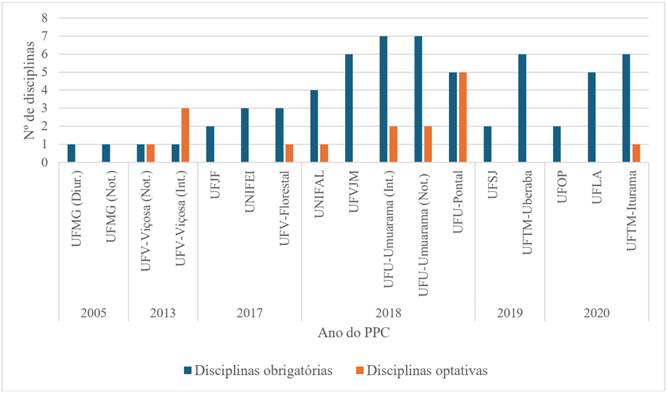 Source: Created by the authors, 2022.