 THE PEDAGOGICAL RESIDENCY PROGRAM (CAPES) FROM THE POINT OF VIEW OF ACADEMIC STUDENTS: EXPERIENCES IN REMOTE EDUCATION
ABSTRACT:
This paper aims to discuss the meanings assigned to everyday educational experiences carried out within the subproject for Literacy in the Pedagogical Residency Program (PRP), sponsored by Coordination for the Improvement of Higher Education Personnel (CAPES-Coordenação de Aperfeiçoamento de Pessoal de Nível Superior), developed by the Pedagogy course at the University of Campinas during the COVID-19 pandemic. For that, we present the political context of the program as well as the narratives produced from collective interviews with the teachers-in-training who participated in the subproject between 2020 and 2022. For the theoretical and methodological framework, our base is the narratives of lived experience and the learned lessons from the research informed by the circulating meanings about the educational paths of these future elementary teachers. In this way, discussions regarding the motivations and expectations related to the program, the experiences of residents in remote teaching, the dialogues between the program and training in Pedagogy, and the conflicts between emergency remote teaching and the in-person return of activities in basic education schools were outlined. We discuss the importance of these collective forms of work reported by teachers-in-training for their education and the limitation of the Pedagogical Residency as a program available to a restricted number of undergraduate students in teacher education programs.
Keywords:
teacher education; Pedagogical Residency Program; emergency remote teaching; narratives of pedagogical experiences
RESUMO:
O presente estudo tem como objetivo discutir os sentidos atribuídos às experiências formativas cotidianas pelos estudantes bolsistas do subprojeto de Alfabetização do Programa Residência Pedagógica (PRP), vinculado à Coordenação de Aperfeiçoamento de Pessoal de Nível Superior (CAPES), desenvolvido no curso de Pedagogia da Universidade Estadual de Campinas, em contexto da pandemia de Covid-19. Para tanto, são apresentados o contexto político do programa e as narrativas produzidas a partir de entrevistas coletivas com os residentes que atuaram no subprojeto entre 2020 e 2022. Como referencial teórico-metodológico, utilizam-se as narrativas de experiência do vivido e a construção de lições indiciadas pelos sentidos em circulação sobre os percursos formativos das futuras professoras da educação básica. Desse modo, delineiam-se leituras referentes às motivações e expectativas em relação ao programa, às experiências das residentes no ensino remoto, aos diálogos entre o PRP e a formação em Pedagogia, além das tensões vivenciadas durante a transição entre o ensino remoto emergencial e o retorno às atividades presenciais nas escolas de educação básica. Considera-se a importância das formas coletivas de atuação destacadas nos relatos para a formação das estudantes como professoras e a limitação da Residência Pedagógica enquanto programa destinado a um número restrito de alunos das licenciaturas.
Palavras-chave:
formação de professores; Programa Residência Pedagógica; ensino remoto emergencial; narrativas de experiências pedagógica
RESUMEN:
El presente estudio tiene como objetivo discutir los significados atribuidos a las experiencias formativas cotidianas, vividas en el contexto de la pandemia del COVID-19, en el subproyecto de alfabetización del Programa de Residencia Pedagógica (PRP), vinculado a la Coordinación para el Perfeccionamiento del Personal de Educación Superior (CAPES), desarrollado en el curso de Pedagogía de la Universidad de Campinas. Con este fin, se presenta el contexto político del programa, así como las narrativas producidas a partir de entrevistas colectivas con los estudiantes-becarios que trabajaron en el subproyecto entre los años 2020 y 2022. Como referencial teórico y metodológico, se asumen las narrativas de la experiencia vivida y la construcción de aprendizajes indicados por los sentidos que circulan sobre las trayectorias formativas de los futuros profesores de educación básica. Así, se esbozan lecturas respecto a las motivaciones y expectativas del programa, las experiencias de los becarios en la enseñanza remota, los diálogos entre el programa y la formación en Pedagogía y las tensiones entre la enseñanza remota y el regreso presencial de las actividades en las escuelas de educación básica. Consideramos la importancia de las formas de acción colectiva destacadas en los reportes para la formación de los estudiantes como profesores y la limitación de la Residencia Pedagógica como programa dirigido a un número restringido de estudiantes de pregrado.
Palabras clave:
formación docente; Programa de Residencia Pedagógica; enseñanza remota de emergencia; narrativas de experiencias pedagógicas
INTRODUCTION
Changes in the Brazilian political scenario following the impeachment of then-president Dilma Roussef in 2016 led to some dismantling of educational policies, including teacher training (Freitas, 2018; Dourado, 2019). In this context, the launch of a “new” Teacher Training Policy by the Ministry of Education (MEC) in October 2017 highlights the redirection of the purposes and objectives of the training bases for education professionals towards the implementation of reforms and adjustments aimed at meeting an increasingly homogenizing educacional agenda (Dourado, 2019).
Initially marked by the announcement of the Pedagogical Residency Program (PRP), this policy was complemented by the subsequent publication of the National Curricular Guidelines (DCNs-Diretrizes Curriculares Nacionais) for Initial Training (Brasil, 2019) and Continuing Education (Brasil, 2020b). These documents revoked and removed Resolution CNE/CP number 2/2015 (Brasil, 2015), prepared based on constant discussions between ministerial bodies, trade unions, and professional organizations, following scientific principles established since the 1980s (Aguiar, 2017). In 2024, new National Curricular Guidelines for Initial Higher Education Training for Basic School Education Professionals (Brasil, 2024) were prepared, following criticism of the 2019 Guidelines.
Lavoura, Alves, and Santos Junior (2020) point out that Resolution number 2/2019, in addition to severely affecting university autonomy by presenting a more prescriptive tone, eliminated from the Initial Training Guidelines a broader training perspective that, in the 2015 DCNs, encompassed continuing education and the appreciation of teaching professionals. Furthermore, as the authors note, by directly linking to the National Common Curricular Base2 (BNCC-Base Nacional Comum Curricular), the document adopted a professional training model based on competencies and skills aimed at solving immediate problems, with an approach that compromises the cultural formation of future teachers.
In this same context, the PRP emerged in March 2018 from the partnership between the MEC and the Coordination for the Improvement of Higher Education Personnel (CAPES-Coordenação de Aperfeiçoamento de Pessoal de Nível Superior), a federal agency under the Ministry of Education responsible for expanding and consolidating postgraduate education (master's and doctoral programs) across all Brazilian states3. Notice 6/2018 lists the main objectives of the program as follows:
I. Improve the training of undergraduate students by developing projects that strengthen the field of practice and encourage undergraduates to actively practice the relationship between theory and professional teaching practice, using data collection and diagnosis on teaching and learning at school, among other teaching methods and methodologies;
II. Induce the reformulation of supervised internships in undergraduate courses, based on the experience of the pedagogical residency;
III. Strengthen, expand and consolidate the relationship between the HEI and the school, promoting synergy between the entity that trains and the one that receives undergraduates and encouraging the leading role of education networks in teacher training.
IV. Promote the adaptation of curricula and pedagogical proposals of initial teacher training courses for basic education to the guidelines of the National Common Curricular Base (BNCC) (CAPES, 2018, p. 1).
The PRP also requires universities to develop subprojects in areas of interest and is assisted by the higher education institution (HEI). These subprojects must follow the objectives of the notice and must be developed in schools by undergraduate students in collaboration with basic education teachers. Once approved, scholarships are awarded to resident students of the HEI, the institutional coordinator of the HEI, the supervising teacher of the HEI, and the preceptor of the basic education school. The student must have completed at least 50% of the course or be enrolled in the 5th period or higher, and the maximum duration of the quotas granted is 18 months.
Notice 1/2020 indicates literacy as one of the priority areas of knowledge of the PRP. Therefore, in addition to aiming to promote the adaptation of curricula to the BNCC, in the case of Literacy subprojects, the notice provides for their compatibility with the National Literacy Policy (PNA-Política Nacional de Alfabetização):
[...] they must base the planning of their activities on evidence from cognitive sciences and observe the principles, objectives, and guidelines set out in the National Literacy Policy, established by Decree 9,765, of April 11, 2019, to guarantee the integration between the pedagogical practices of literacy and numeracy. The activities of these subprojects must be carried out in early childhood education classes, from the 1st to the 2nd year of elementary school I, or for young people and adults (CAPES, 2020, p. 2).
When analyzing the Pedagogical Residency Program in its initial proposal, Faria and Diniz-Pereira (2019) identify a tendency to defend the expansion of practical training for teachers “[...] not always accompanied by an in-depth discussion regarding the conditions of teaching work, their career and remuneration” (Faria; Diniz-Pereira, 2019, p. 351). This criticism extends to the resolutions and the centrality of the BNCC for the formulation of educational policies since these movements are based on criticisms of an excessively theoretical training of teachers and exclusively methodological debates, seeking, as Mortatti (2019) highlights to camouflage the intrinsic intentionality of these policies, when analyzing the construction of the PNA.
Furthermore, Santana and Barbosa (2020) point out how the main entities in the educational field act for the implementation of the PRP and constitute the discourses about it. They state that “[...] the program operates with norms of standardization of conduct, which determine both training and performance, while the entities resist and challenge the proposal imposed for teacher training” (Santana; Barbosa, 2020, p. 15). Thus, the authors talk about the role of resistance as constitutive of the implementation of the PRP, highlighting the strategies of accusation, rejection, restriction and repudiation assumed by scientific entities towards the CAPES program, such as the document signed by different entities such as the National Association of Graduate Studies and Research in Education (ANPEd-Associação Nacional de Pós-Graduação e Pesquisa em Educação) and the National Association for the Training of Professionals in Education (ANFOPE-Associação Nacional pela Formação de Profissionais da Educação), in which they repudiate the curricular narrowing of the association between the PRP and the BNCC (ANFOPE, 2018).
Therefore, we understand the importance of studies that situate the institutional designs of the PRP in subprojects, their contributions, and the practical dilemmas experienced by teachers and students of undergraduate courses within them (Barboza; Prata-Linhares, 2022). In this sense, we present the results of a research focused on the training of students of the Pedagogy course, within the scope of the CAPES Pedagogical Residency Program. By questioning the experiences provided by the PRP - Literacy subproject, developed at the College of Education of the State University of Campinas (UNICAMP) between 2020 and 2022, we aim to discuss the meanings that the resident students attribute to their experiences in this subproject, considering the formative and contextual challenges of the Covid-19 pandemic.
This study is part of a series of studies investigating the relationship between teaching initiation programs and the professional development processes of future teachers participating in these programs (Gatti et al., 2014; André, 2018; Signorelli; André, 2019; Noffs; Rodrigues, 2016; Felipe; Bahia, 2020; Couto; Lino, 2023; Vanzuita; Guérios, 2024). These studies highlight both the impact that these programs can have on undergraduate curricula (Gatti et al., 2014) and the positive impacts on the professional initiation processes of participants (André, 2018).
Below, we organize the article into three subtitles. In the first, we describe the structure and some training actions carried out in the Literacy subproject of FE/UNICAMP. Next, we explain the methodological path adopted and the principles assumed in the interpretation of the students' reports. In the third subtitle, the discussion of the meanings produced in the interviews is organized into four axes. Finally, we present considerations based on the interpretative movement carried out.
THE PRP SUBPROJECT - FE/UNICAMP LITERACY
Included in the first PRP call for proposals, the Literacy subproject of the Pedagogy course at Unicamp was systematized in favor of the practical-theoretical-practical articulation and aimed to qualify teachers in initial training to work with literacy for children in the early years of elementary school and young people, adults and seniors in Youth and Adult Education4 (EJA - Educação de Jovens e Adultos). In addition, it aimed to provide public schools, through a partnership with the public university, with the opportunity to reflect on and improve their teaching work by ensuring conditions for continued teacher training for the teachers involved in the project.
The Literacy subproject of the PRP Unicamp has a partnership with two municipal public schools in the city of Campinas5. Due to its size, the Municipal Department of Education of Campinas operates in a decentralized manner, through five Decentralized Educational Action Centers (Naeds-Núcleos de Ação Educativa Descentralizados) divided by geographic regions: Naed Leste, Naed Noroeste, Naed Norte, Naed Sudoeste, and Naed Sul. Regarding the partner schools of the Literacy subproject of the PRP of FE/Unicamp, one of them belongs to Naed Noroeste, and the other to Naed Norte.
The group of Pedagogy students and partner teachers, who, like the project’s supervising professors at the university, were responsible for monitoring and guiding the residents, was divided into three groups: one for literacy in Youth and Adult Education and two others in the early years of elementary school. Although the official name for the teachers who represent the basic education school is preceptor teacher, according to the CAPES notice, we chose to describe them as partners. This is because, more than those who give precepts, according to the etymology of the word “preceptor”, we understand that there is a relationship of partnership and mutual training between the Pedagogy students and the basic education teachers. It is undeniable that there are lessons learned from the more experienced teachers; there is teaching, but not solely and unilaterally. For this reason, we assumed the term partner teachers, professoras parceiras in the feminine, since they are mostly women.
At the beginning of the project, the recognition of the state of public calamity due to the Covid-19 pandemic extended and changed the planning of the subproject, which began in the second half of 2020 in the context of emergency remote teaching and ended in March 2022, totaling 18 months. To develop the work, the meetings were held, mainly, through the Google Meet platform and involved both moments of planning activities and working with children, young people and adults, as well as meetings between residents, partner teachers of basic education and university advisors, in small and large groups, to share experiences and write reflective narratives.
The dynamics of meetings and records were organized based on the work roles systematized in Chart 1.
In the end, when looking at the entire experience lived within the subproject of the College of Education at Unicamp, we question what meanings were produced in the students in initial training involved in the program's subproject.
METHODOLOGICAL APPROACH OF THE RESEARCH
In this qualitative study, we conducted oral interviews with resident students of Pedagogy involved in the Literacy subproject of RP Unicamp between 2020 and 2022, collectively. The invitation was sent to all 27 students who participated in the subproject over the 18 months, through text messages via WhatsApp social media. Fourteen of the invited students were able to participate in the research.
In our investigative work, we prioritize collective interviews. In this regard, Kramer (2003) emphasizes that, as a methodological strategy, collective interviews lend greater authenticity to the discourses produced, favoring the personal dimension alongside the professional dimension, since those involved, when listening to the testimonies of other interviewees, compare their experiences with these reports. According to the author, a collective hearing generates a greater sense of reliability than when faced with one or two researchers, as in the case of individual interviews. In the work, these aspects tend to deepen the recovery of the educational trajectory of the students in the subproject, enabling the investment of new meanings to their educational experiences.
We also adopted the principles of narratives of educational experiences, as discussed by Lima, C. Geraldi and J. Geraldi (2015). This is because, in educational research, narrating what we have experienced involves a commitment to building a relationship with professionals and the daily life of the school, for the elaboration of meanings by the researched subjects to produce knowledge that speaks to and from education.
As Lima, C. Geraldi and J. Geraldi (2015) point out, when they focus on the singular, the local, the unpredictable and the implied, narratives are distinguished by “[...] making explicit the subjectivities at play, by the construction of polyphony of the characters, by a good plot and a moral outcome” (Lima; Geraldi, C.; Geraldi, J., 2015, p. 23). Thus, through the narrated experiences, it is possible to construct elements that bring us closer to the plots that cover the phenomenon under analysis:
[...] The researcher's work consists of studying lived situations to formulate explanatory hypotheses. The objective is to understand the phenomena and the ways of acting on them [...] the important thing is not the events themselves, but using them to construct the character (ECO, 2003)6 and the plotting of the text in terms of clues or paths provided, to allow the narrator and the reader to construct the lessons indicated therein (Lima; Geraldi, C.; Geraldi, J.;2015, p. 35).
This way of producing knowledge is therefore guided by the search, in discursive materialities, for hypotheses that result from reflection on the narrated experience. Thus, as the authors consider, the “[...] way of approaching what people say about events is achieved by comparing what is said with other things said, producing discourses about discourses” (Lima; Geraldi; Geraldi; 2015, p. 38).
This study was submitted to the Human Research Ethics Committee and approved7. The interviews were conducted via Google Meet and audio-recorded, with the consent of the participants, who signed the Free and Informed Consent Form agreeing to the recording, transcription and subsequent disclosure of excerpts, protecting their identities. For this reason, the names used to identify the interviewees and the people mentioned in the reports are all fictitious.
Initially, participants were asked to narrate their daily experiences in the Literacy subproject of the Unicamp PRP during the pandemic. During the narratives, through a supporting script, the interviewees were invited to highlight why they became interested in the PRP, what were the main challenges experienced in working in the context of the Covid-19 pandemic and how they evaluated the experiences provided by the program for their training, in particular, and for the training of teachers in the undergraduate program, in general.
The groups were organized according to each student's availability. The interviews were conducted in May and September 2022 and resulted in almost five hours of recordings, which were transcribed using the Studios Youtube audio transcription system and the Transkritor software. Subsequently, reviews and textual adjustments were made, framing the transcription of the speeches as close as possible to the written form of Portuguese to ensure enjoyment in its reading.
Based on the readings of the interviews, we extracted excerpts from the transcripts that became the focus of analysis. Based on this, we carried out the exercise of grouping excerpts from the reports into axes that reflected recurring elements in the narratives of the Pedagogy students. Thus, in the end, we had, in a grouped form, four thematic axes that indicated the meanings produced about the experience in the Literacy subproject of the PRP Unicamp: 1. Motivations and expectations regarding the program, 2. Experiences of the residents in remote education, 3. The PRP and training in the Pedagogy course, and 4. Tensions between emergency remote education and the return to in-person classes.
The first axis is composed of reports in which the residents show the main motivations for entering the Pedagogical Residency and their initial expectations of the program and the Literacy subproject.
In the thematic axis “Residents’ experiences in remote teaching”, we gathered statements that describe the work carried out in the Pedagogical Residency activities, how these experiences were meant by the students and how the PRP contributed to the initial teacher training of the undergraduate students in Pedagogy who participated in it during the pandemic context.
In the axis “The PRP and training in the Pedagogy course”, reports and reflections are gathered that measure how, when looking at the experiences in the PRP, undergraduate students (re)think of training in the Pedagogy course at Unicamp.
The last axis is mobilized by the tensions between experiences in emergency remote teaching and the return to in-person schools at the end of the subproject, which, in the residents' narratives, gives meaning to the experiences during the pandemic.
THE MEANINGS OF EXPERIENCES IN THE PRP SUBPROJECT - FE/UNICAMP LITERACY FOR PEDAGOGY STUDENTS
The interviews aimed to build dialogues and meanings for the experiences lived in the PRP - Literacy Program at FE/Unicamp. The excerpts brought for discussion are organized based on the four thematic axes constructed during the investigation. This organization aims to systematize recurring issues in the interviews. However, although there is a division into axes, the themes are around in most of the excerpts. In other words, they are not limited to specific excerpts or reports but are constructed in the plots discursively woven by the study participants.
Motivations and expectations regarding the program
One of the main motivators expressed in the statements of the undergraduate students for participating in the PRP was their previous experiences in the Institutional Teaching Initiation Grant Program8 (PIBID-Programa Institucional de Bolsa de Iniciação à Docência). Seven of the fourteen interviewees had also participated in PIBID. For this group of students, the programs that, through grants and partnerships with field schools, insert undergraduate students into basic education, have become synonymous with quality training and a way to get closer to the daily school routine and the classroom.
Below, we present two excerpts in which the participants explain this motivation, recognizing the contributions of PIBID to their professional training:
Why did I join RP? I had already completed PIBID. At the time, I completed PIBID. For me, that experience of being in the classroom, without an internship, and even before the internships, was very important for my education, and even for looking for jobs later, because, having been to several schools, I had very different experiences. I had experience in EJA, experience with deaf education, and experience with various types of children with disabilities. That added a lot to my resume. Then, I thought of RP as a continuation. I knew it would be different, that its objectives are different, but, since it is a kind of ‘sister’ program, it would be something just as good (Camila. Interview transcript, May 2022).
Since I had participated in PIBID in 2018, and it had the same coordinator who was going to do the RP project, I was interested. There was also the issue of not being able to do a mandatory internship and not wanting to lose contact with the school. I didn't want to be outside of that environment. So, since I saw the value that PIBID had in my training as a teacher, because I had been in school since the first year, experiencing that space, and I didn’t want to lose that just because of the pandemic, I took a risk and went to the Residency. I think these were the first thoughts: ‘I don’t want to be out of school, especially since we are being deprived of internships because of the pandemic’. I already really liked how PIBID worked, everything that PIBID meant to me. I also wanted to experience that in the Residency, even though I didn’t know much about the program. So, I kept asking myself: ‘Will it work the same? Won't it be? What will the focus be? How will it work?’. The focus on literacy was something that attracted me too because it is an area that I like (Eliza, Interview transcript, September 2022).
Despite the students' initial uncertainties regarding how the PRP would work, since there were still no references to its development, the PIBID experience encouraged them to want to be part of the Pedagogical Residency, especially considering, as Eliza points out, that the projects shared similar coordination and institutional structures.
The students' positive view of teaching initiation programs reminds us of results found in other studies (André, 2018; Felipe; Bahia, 2020; Vanzuita; Guérios, 2024). André (2018), when studying the professional integration process of teachers who graduated from three teaching initiation programs - PIBID, Bolsa Alfabetização and Residência Pedagógica at the Federal University of São Paulo, Guarulhos Campus - identifies that such programs have contributed to mitigating shocks with future performance and establishing professional autonomy and an investigative stance in the participants.
Felipe and Bahia (2020), when discussing experiences in the PRP, also highlight how residents emphasize the possibilities of experiencing educational work in its entirety and research practice as an activity that articulates theory and practice.
Vanzuita and Guérios (2024) indicate that undergraduate students indicate, as one of the main motivations for participating in these programs, the possibility of actively participating in teaching work. They understand that the programs “[...] provide an opportunity to learn about the teaching reality even during initial training” (Vanzuita; Guérios, 2024, p. 16).
Consequently, in the perception of participants in these programs, their training is enriched in these spaces, preparing them more broadly for the challenges of the teaching profession. However, this does not eliminate subsequent dissatisfaction with working conditions and the devaluation of the career (André, 2018). Therefore, according to Cruz, Farias, and Hobold (2020), professional induction cannot be understood without considering the objective and subjective working conditions experienced by teachers.
The absence of schools during the pandemic was another motivation for joining the PRP that appeared in the interviews. Eliza, for example, indicates this in the speech transcribed above.
In early 2020, Opinion 5/2020 (Brazil, 2020a), issued by the National Education Council, upon recognizing the state of public calamity resulting from the COVID-19 pandemic, indicated that social isolation measures and non-face-to-face pedagogical activities would apply to all levels of education. At the Unicamp College of Education, students who were not close to completing the credits for the full course were initially advised to postpone internship activities, especially in recognition of the difficulties in welcoming them and the possible losses arising from not having face-to-face interaction in basic education schools. As alternatives, still in 2020, supervised activities were developed to validate internships that involved interviews with education professionals and studies of school documents.
In her report, Eliza sees the PRP-Unicamp, through the proposal in the call for proposals, as a way to overcome the distance from school, which was intensified by the suspension of in-person classes, making it impossible to carry out mandatory internships in person. Thus, during one of the worst phases of the pandemic, as a way of entering the teaching profession, the program was configured as a link that, within the possibilities of emergency remote teaching, allowed the teachers in training to get closer to an unusual school routine.
The focus on literacy was also a motivator for joining the subproject because it was a topic of interest to the residents interviewed and/or, as Olívia highlights in the excerpt below, it involved a core field of Pedagogy that was little explored during the course:
The focus of the Residency, which is a focus on literacy, starts with something that, I think, is very important for Pedagogy. This is because many people see pedagogical work basically as teaching literacy, as if there were no other ways to be a pedagogue other than helping children in the process of learning to read and write, which, is a very important issue and which, in today's college, is 'weak'. I don't think so, I'm sure. In our training, we have a literacy subject and it's obvious that we can't learn everything.
There is no formula for teaching literacy, also because the process depends a lot on other factors and varies according to time, with the social and economic reality of the child. There is no formula, but, at the same time, I think it's something that, during the course, ends up 'overlooking'. In the Residency, we were able to have more contact with this and were able to reflect on this process during the pandemic, right? So, there were several difficulties, which were also those that the teachers had with the reality of the school. This brings up some of the social difficulties that I was talking about. How are we going to discuss pedagogical practice if there is a crisis that makes the school's first concern being social? In every report I wrote for the Residency, I said that we were reflecting on several things at school (Olívia. Interview transcript, May 2022).
Olivia discusses the field of literacy and produces a report that demonstrates the complexity of the situation she experienced, permeated by its uniqueness and by the political, economic and social contexts, which makes her recognize that the school's functions go beyond the dimension of teaching. The excerpt is introduced by a reflection by the resident about the social imaginary according to which the work of the pedagogue would be linked, in particular, to the literacy of children. Despite understanding the limitations of this judgment, she recognizes the responsibility of the professional trained in Pedagogy in the appropriation of reading and writing by students in basic education and, based on this, criticizes the course regarding the work with literacy, recognizing the limited space dedicated to the debate on the topic. In general, in the interviews, the topic appears as essential knowledge for the training of teachers in the initial years. Therefore, for the students, the PRP also becomes an opportunity to delve deeper into the topics worked on throughout the course.
Olivia’s speech also refers to the tactics (Certeau, 2014) produced within the program. We do not experience the linearity of political intentionality since the context of practice, everyday life, reconfigures it. In everyday practices, ordinary people (Certeau, 2014) can produce the redimension of the official discourse. In this regard, we return to the objective of the PRP regarding the prediction of following the PNA and how this policy focuses, above all, on the methodological discussion of literacy, leveling the action of political, social, and economic conditions (Mortatti, 2019). The scholarship holder, differently, within the scope of the Residency, recognizes that: “There is no formula for teaching literacy, also because the process depends a lot on other factors and varies according to time, with the social and economic reality of the child” and, throughout her account, she delves deeper into the reflection on these conditions. Olivia talks about the conflict she experienced when she recognized how important it was to live the experience with literacy and to dialogue with the references. she had been studying to make them more complex, at the same time that there was a loss by the children in their literacy process. In this way, she indicates the ways in which she re-signifies knowledge appropriated throughout her trajectory in the course that, in the classroom experiences in the pandemic context, are compared and expanded, which allows the student-resident to formulate understandings about the specificities of the process of appropriation of writing and reading by children.
These forms of resizing the PRP, aligning it with a more autonomous and critical perspective of teaching, are also highlighted by Couto and Lino (2023) when they discuss the context of implementation of subprojects in public universities in Rio de Janeiro. In the words of the authors, this process occurred through the reinterpretation and translation of “[...] its determinations to accommodate them to a conception of education as a social practice, favoring a reflective experience and progressive construction of teaching knowledge” (Couto; Lino, 2023, p. 4).
Residents’ experiences in emergency remote teaching
This thematic axis was based on reports of activities developed by residents in schools during the pandemic. With social distancing and the suspension of in-person classes, the pedagogical work in the Literacy subproject is mostly mediated by Digital Information and Communication Technologies.
As Rondini, Pedro, and Duarte (2020) observe regarding this context:
Changes in the educational system had to be carried out quickly, so that, from one day to the next, teachers had to transfer content and adapt their face-to-face classes to online platforms using Digital Information and Communication Technologies (TDIC), without preparation for this, or with superficial preparation, also on an emergency basis (Rondini; Pedro; Duarte, 2020, p. 43).
Oliveira and Pereira Junior (2020) and Oliveira (2020) also point out the weaknesses in the educational provision due to the lack of access and technological support for teachers and students and the lack of experience and prior preparation for the use of technologies. Furthermore, in addition to highlighting the inequalities that the country has, the pandemic has generated anxiety among educational managers and teachers due to their concern about fulfilling the curricular programs planned for the school year, since many education systems “[...] are subject to the pressures inherent to how Brazilian education is regulated, which is extremely dependent on external assessments, especially the Basic Education Development Index (IDEB-Índice de Desenvolvimento da Educação Básica)” (Oliveira; Pereira Junior, 2020, p. 733).
Based on this reality, the students describe their work and address various aspects of their experience during their time at the school. Their stories focus particularly on the challenges they faced and the forms of action developed in the PRP/CAPES. The role of collective work was very present in their narratives, involving both the resident students and the relationship between partner teachers, university advisors, and residents. As a result of this collective work, there were joint pedagogical practices that, for them, enhanced their educational paths and teaching relationships:
There is also the welcoming of the residents, right?! Usually, the interns are just there. They are there in the back of the room, and that's it. So, I was able to get my hands dirty. It was great to see how necessary our lesson plans were. Sometimes, they were all we had to rely on. I liked seeing this more practical side of systematizing the classes and their importance. The narratives! I would say that it was very important to see professors who not only told us to create narratives but who created narratives. I don't know if you have had contact with Verônica's research, but she studies her narratives. She talked a lot about narratives. It was great to talk to her about this. I would always talk to her about narratives, many times, to 'cry' and say: "Verônica, I don't know how to create a narrative!" At the beginning of the Residency, 'poor' her, I would send her a message saying: "I don't know what to do. How do I create a narrative?" (...)
In the TDCs, I saw an attempt to create a collective work. I don't know what it's like in other schools because, in the in-person internship I participated in, we didn't have contact with these meetings. We just stayed in the room in silence and took notes. Every time I asked questions or tried to have a conversation with the teacher, I felt she was very distant. She didn't give me these openings. In the Residency, when we were in our meetings and had this opportunity to "I'm going to talk", "I'm going to open up", to say what we felt, even if it was something bad, like criticism or dislikes, I felt that it was a very open space. I liked this, the TDCs and the meetings, in addition to the openness to the Freinet practice that we followed. (Amélia. Interview transcript, May 2022).
During the workshops, everyone helped. The teachers helped each other and I think everyone had a lot of support. I liked the dynamics of the program. I think it's great to have the meetings every two weeks; that way, it's not too much for anyone. In addition, there are the small meetings, where we have more opportunities to talk. It's great for those who are shy, who don't like talking to a lot of people, since we can discuss things within our group. I also highlight the different ways in which the activities carried out are presented: singing, using newspapers. I think it's cool and it's not boring. We use creativity, we use other languages. I love other languages.
The meetings with the teachers were also very good. We were very lucky with the teachers too, right? They helped us a lot to participate in school activities. Sometimes, it was a little difficult for me to participate in TDC because of the schedules, which didn't match up. But I think it's cool that we have the opportunity to be able to participate in these moments. Sometimes, they even asked for our opinions. (Clarice. Interview transcript, May 2022).
We always prepared material in advance to explain to the children so they could do it and have contact with their families beforehand. We created a video tutorial on what the activity was like and what we expected to work, and if it didn't, that was okay. So, we always got together to discuss the theoretical part: "Why is this activity important?" The teachers gave us this requirement. They said, "You need this to get to such and such a place." Then, Eliza and I got together and created materials for both motor coordination and storytelling. We recorded several storytelling videos that were even uploaded to the school's YouTube channel. It was cool!
During the production phase, we held collective storytelling workshops. We got together beforehand to discuss what the plan would be and to plan the activities. We would read a book with the children, and then we would go to the storytelling part, which was done collectively. One really sad thing was that there wasn't much participation; So, there weren't that many children who entered. Combining the two first-year classes, on average, ten children entered Meet. Some days, there were fifteen children; some days, there were seven or five. It varied a lot. (Bianca. Interview transcript, September 2022).
In addition to the small meetings and gatherings between residents, partner teachers, and supervisors, the students positively highlighted their participation in Collective Teaching Work (TDCs - Trabalho Docente Coletivo)9 in elementary schools in the early years. They also mentioned the pedagogical work organized in workshops inspired by Freinet Pedagogy10, which integrates the practice of a group of elementary school teachers from one of the schools involved in the Literacy PRP of FE/Unicamp. In this way, the educational potential of the partner schools is highlighted, that is, how the pedagogical projects developed within these institutions act in the education of future teachers. Thus, we can also highlight the relationships with the partner teachers, who, in dialogue with the residents, enabled the enrichment of their educational paths.
This participation in moments of collective work reminds us of the importance of professional socialization based on intergenerational relationships (Sarti, 2009; 2021; Sarti; Bueno, 2017). Actively participating in extracurricular activities and understanding teaching work beyond the classroom generates in the students of the course, a greater sense of belonging, which is also indicated by Felipe and Bahia (2020). It allows them to (re)cognize broader dimensions of the teacher's performance, understanding the collective as a space that enhances and structures pedagogical practice.
The literature highlights the need to identify the paths and conditions for constructing these spaces and qualify the participation of the different actors involved in them (Gatti et al., 2019; Sarti, 2021). In this sense, the reports show how the students qualify the time and experiences in the collective as significant aspects of their education. The intensity of these experiences occurred not only because, during the pandemic, there were more opportunities to participate in meetings with the teachers, but also because there was institutionally agreed time in which the elementary and university teachers worked together as trainers and in which the residents could be more involved in the school's daily activities.
Regarding the work with students, Bianca, in the report above, highlights signs of a context marked by difficulties in accessing technological resources by the group of students enrolled in the schools that are partners in the subproject, which resulted in low participation in some workshops organized by the residents. In Brazil, according to the IBGE (2022), more than 28.2 million people do not have access to the internet, that is, 15.3% of the national population. This reality was also present in the basic education schools involved in the Pedagogical Residency and was felt by the students when developing activities with the children.
In the excerpt below, student Amélia indicates how the lack of physical and face-to-face contact with the children has an impact on the construction of pedagogical knowledge essential for her future work:
Something I missed was that even though we had several Meet sessions with the children, I didn't feel like I was able to look at all of them because, many times in the workshops, I felt lost. Which child was calling me? Which child was saying “teacher”? Sometimes, there were things that I couldn't help the child with because it was too difficult. For example, I did a finger puppet workshop once, and it was very complicated. I just had to roll the paper up into a roll, which, in person, would be so much simpler to explain, but online, it took me a long time for all the children, one by one, to understand. So, I also missed the contact, which has to do with the pandemic context and everything else. I missed that presence in the classroom. (Amélia. Interview transcript, May 2022).
The lack of face-to-face meetings with children to help them handle materials or to be able to actively listen are absences indicated by Amélia in the construction of a way of being and becoming a teacher. The student brings to light her commitment to children. As there is a feeling of lack of contact that will influence her educational path, there is also the identification that children have been harmed by the pandemic context. This recognition is materialized in bringing to consciousness and objectifying through language the concern with what she was unable to do with the children, which demonstrates the understanding of the importance of her commitment to basic education students. Thus, through dialogue with Bakhtin (2017), we understand that the resident assumes, in the ethical scope of action, a responsible and not indifferent thought towards the subjects to whom the teaching is directed.
The challenges experienced by the residents in their relationships with students highlight social problems in access to digital technologies by a large portion of Brazilian families and the impracticality of physical pedagogical actions essential for teaching-learning relationships. The report of these experiences, therefore, reinforces how the school is the privileged locus of exchanges and coexistence, which are essential for the learning process.
The PRP and training in the Pedagogy course
In the reports of the interviewed residents, there are connections between the experiences in the PRP and the training in the Pedagogy course at Unicamp. Based on these statements, it is possible to get closer to how, when looking at the subproject, we resize the training in the undergraduate course and reflect on the relationships between the theoretical knowledge learned in the Pedagogy disciplines and the pedagogical practices in basic education schools.
I had the opportunity to take the course with Araújo during the course, and I was able to combine it with the PR. I was able to relate everything I was doing in the residency to his course, which was the elementary school internship. Then he helped us. I would say: “Teacher, in the Residency, I went to do this activity with the students, and I had difficulty with it.” Araújo was able to combine his class with the doubts I had about the Residency. It was cool.
So, let's recap. I had a literacy class, but I wasn't able to put it into practice. I went to the Residency and managed to combine the Residency with another literacy course and, later, with the internship course, which was cool. I think that, if I hadn't had this experience during the Residency, this 'link' that I made with these two subjects from the Pedagogy course wouldn't have been possible. It would have been something that would just stay in my mind, formulating hypotheses, and I wouldn't have seen how it worked in practice. Of course, there is much more in the field that I was unable to explore but that I can learn from. And it’s not that I was like ‘wow!’, but it was cool, a learning experience that I will take with me forever, because they were enriching activities and dialogues (Marina. Interview transcript, May 2022).
Marina tells us about the literacy work she did in a first-year class that she supervised as a resident. She describes how the work in the Pedagogical Residency relates to the Pedagogy course and, in particular, to the Literacy and Internship subjects in the Early Years of Elementary School. As a Pedagogy student, she sought to bring elements to the school that would dialogue with the teachers' practices. For the resident, being in a first-year classroom with a teacher who shared the entire planning gave her examples of activities and helped her position herself as a teacher in the literacy process.
Another point highlighted between the practice in the subproject and the classes at the university was the use of PRP activities in basic education for the field workload of supervised internships, which was agreed upon by the Internship Congregation of the College of Education at Unicamp due to the atypical context of the pandemic (Congregação da Faculdade de Educação, 2021a; 2021b). Marina says that, by taking advantage of the internship guidance space to discuss the events of work in schools, she gained an additional space for reflection and research on what she experienced. In this movement, she also brought discussions that contributed to the training of colleagues enrolled in the discipline and who attended the supervision spaces at the university.
The relationships with the course and internships, specifically, were issues frequently brought up in the speeches of other residents, as can be seen in the following excerpts:
I don't know if it's because of the RP proposal. I think that the proposal is not that different because, in internships, we often don't just have the role of observing; we always have a more active participation. But I think that RP necessarily raises the issue of a project designed for people who are nearing the end of their course, and, in internships, we are usually between the middle and the end. In RP, some people were leaving the project because they were graduating. I think that it speaks to these needs at the end of the course, that we are going to graduate and will need to be in the classroom. So, we think about the difference between thinking about a pedagogical activity 'now' or in six months. People already put themselves in that role, which is different from when you do an internship one or two years before graduating.
I think that RP is a project designed for people who are finishing their course, like a residency. This is because there is the fundamental issue of people becoming more specialized in pedagogical practice. I think this ends up having an impact. Maybe it’s a ‘thing’ in the proposal because, as I said, the internship is the first contact we have as teachers with the classroom and with a critical eye; so, observation is also very important (Olívia. Interview transcript, May 2022).
I like the idea of the Pedagogical Residency in terms of continuity. It was interesting to have continuity, even though we are divided into modules. I changed schools during the project, but even so, because the project is being built collectively, it didn't change much. I know that it also depends on the relationship with the school. It's not just having the Pedagogical Residency that guarantees that we will have a good experience, because I know of other Residency projects that were a little more rigid, a little different from ours, due to the way the school received them.
I think PR is a good complement to our internships. I like our internships because they allow us to visit other schools. In addition to this continuity, there is also plurality. We can encounter other realities, other ways of working, and building our knowledge and critical thinking based on these experiences.
It was very important for me to continue working in the Residency: doing projects, always being in contact with the other residents, with the teachers of the class so we could think about what was going to be done, because that's not something I can do during the internship. In the internships, I see that, sometimes, once in a while, the teacher will ask: "Do you want to do something?". But it's not so systematized, let's say. It's something very specific.
In the Elementary School internship, we didn't always have time to create a bond and understand the class. I think the Residency is cool for this reason because it takes time. It's not just about arriving and starting an activity; you need to get to know the dynamics of the class, see what's happening, what's possible, and what's not possible, and part of that is planning what we're going to do (Heloísa. Interview transcript, May 2022).
One issue that generally appears in the reports is the absence of elements experienced in the Pedagogical Residency Program in other contexts of professional initiation, whether in paid or mandatory internships. Although, for some years, the College of Education at Unicamp has been institutionalizing partnerships with schools and professionals from the Municipal Education Network of Campinas in mandatory internships, constituting a powerful space for initial and continuing education (Bragança et al., 2021; Bragança, 2021), not all undergraduates have the opportunity and availability to work in partner schools, nor the same workload as the program's scholarship holders, to dedicate to working in schools.
In other studies, focusing on experiences in teaching initiation programs, the difficulty in establishing a stronger bond with schools within the scope of internships is also noted (Felipe; Bahia, 2020) when compared to the experiences in subprojects. In this regard, when analyzing the relationships between PIBID and curricular internships, Pimenta and Lima (2019) indicate the difficulties of the program's subprojects in taking root “[...] in undergraduate courses to strengthen their political-pedagogical project as a whole” (Pimenta; Lima, 2019). Despite recognizing the rich contributions to the training of students participating in the program, the authors indicate how these difficulties in taking root result in the creation of “differentiated” groups of undergraduates, favoring competitiveness instead of mobilizing changes in other components, such as mandatory curricular internships.
When looking at the dialogues in the collective interviews, we identified that many residents recognize the complementarity between internships and the Pedagogical Residency. Olívia, when rescuing historically constituted conceptions of internship, such as the internship as observation (Pimenta; Lima, 2017), considers it a fundamental but not the only action in the teacher training process. The resident also points out the fact that she feels that the PRP is more linked to the specific needs of completing the undergraduate course. Heloísa, on the other hand, locates the importance of internships due to the contributions that the plurality of contexts can bring to the training of future teachers. In addition, she emphasizes that the existence of the PRP alone does not guarantee significant and positive experiences, highlighting the importance of how the program is conducted within the university and schools.
The short reach of programs such as the Pedagogical Residency and PIBID is a problem recognized by the residents when they indicate that other students in the course should have the opportunity to experience the PRP subprojects. The challenge is to find ways to bring aspects of these programs to the undergraduate course to enhance partnerships with basic education schools and enrich the undergraduate students' educational experiences.
Tensions between emergency remote teaching and the return to face-to-face learning
The different phases of the pandemic affected the work of the residents in the schools and the project activities. In this sense, the program closely followed the phases of easing social distancing. While the authorities in office decreed the return of teachers and children to school, the Literacy subproject of FE/Unicamp organized to continue working with the schools.
During the first half of 2021, following the São Paulo State Government's SP Plan, the Campinas Municipal Network began what was characterized as “hybrid” teaching, since it involved both online and in-person activities. Despite much resistance due to uncertainty regarding the health conditions for the return, classes returned to in-person, serving 35% of students, on a staggered basis, but without mandatory attendance.
In basic education, there was a rotation of students. Students in the same class were divided into groups to avoid crowding; the divided classes attended school for five days, returning after a period of seven days. Thus, there were two groups of students who attended school on alternating weeks.
At Unicamp, however, the rules for returning to classes and internships for undergraduate students were different. In a note released at the beginning of 2021, the university determined that:
Concerns persist regarding the increase in the number of confirmed cases, COVID-19 mortality, and the increase in the occupancy of intensive care beds for COVID-19 in different regions of the State of São Paulo. Therefore, it is essential to remain in Period 3 (P3) of Phase 2 of the Plan for the Resumption of In-Person Activities for an indefinite period. This worsening led to the regression of the São Paulo Plan to the yellow phase in 13 regions of the State and the orange phase in another 4 regions.
In this sense, the Internal Committee for Monitoring COVID-19 recommends: 1) The extension of Period 3 of Phase 2 of the Plan for the Resumption of In-Person Activities for an indefinite period; 2) That the Units and Agencies continue to prioritize remote activities (UNICAMP, 2021, p. 1).
This fact contributed to the residents' being unable to go to the field schools of the Pedagogical Residency. During this period of disharmony between the university and the basic education school, Camila reports that when she joined the PRP, the schools were working with the in-person return of all students; however, the residents, who followed Unicamp's return plan, could not carry out in-person activities yet. She describes that she felt that the group, both residents and teachers, had difficulty adjusting to this reality:
When I started, the children had already returned to in-person classes. It was a different experience from yours, who started at the beginning of the Residency. They were 100% in-person. I didn't get to participate in activities with the children 100% online. What happened was that when I started, the kids were completely lost because they were in-person, and we couldn't go to in-person classes. So much so that I started and was going to stay in a room; I even did TDC with the teachers, we talked, but in the end, they canceled and I couldn't go into that room, which was for first graders, because they couldn't handle it. They wouldn't be able to get us online to work together. All the demand that was coming from the children — I don't know if I can say it was because of the pandemic, because they were in the first grade — was a lot, and they still had to put us together, especially in the first grade, when the children demand a lot. The children weren't used to school because of the pandemic.
One day, after a month, they asked me if I could switch to a third grade. So they switched me to the third grade with Verônica, who was already more engaged; she paid more attention. She would put the computer on a projector and we would talk to the children. (Camila. Interview transcript, May 2022).
Under the conditions described by Camila, the organization of teaching work was carried out in short periods and the short term. Upon entering the Pedagogical Residency, the student found both the school and the institutional subproject in a phase of reorganization and planning forced by the new scenario. With a new plan for the residents to continue their work, it was necessary to develop alternatives for working with the children. The solution found was for the residents to participate in classes via videoconference. Reconciling the coexistence of two forms of presence in the classroom was not an easy task since, in addition to the interest of the schools involved, it required practical knowledge about the use of some technologies.
It was only at the beginning of 2022 that the residents were able to start in-person activities at the schools. In the excerpt below, Júlia summarizes a feeling experienced by some of the Pedagogy students when the in-person activities of the subproject returned:
What I'm going to say now is a critique of PR so that we can rethink this. When we went back to in-person classes, the part of participating in planning meetings and TDC was lost. It was just the classroom, and I think we lost a lot with that. A lot, indeed. So, when I went back to in-person classes at school, I spent four hours there, with a teacher, on the same day of the week, and it was the same classes every day: time at the park, time for this, time for that...
I believe we need to think of a new formula for PR and take advantage of some of the good things we had during the pandemic to try to change this. Maybe review the number of hours; maybe it doesn't have to be all in one day of the week; maybe a TDC day; maybe you can participate in the teachers' planning, etc. Of course, I know that this is too much, that our 400 reais stipend barely pays for transportation to these schools, which are far away.
Many things would need to be reviewed, but I believe they would be worth it so that PR could become a real residency, working as well as it did for us during the pandemic. Despite the online teaching during the pandemic, I think I learned much more about the reality of school during this period than in the face-to-face course and in the internships, I had done, both in my first degree and in Pedagogy before the pandemic. (Júlia. Interview transcript, May 2022).
Júlia reports that when she returned to in-person teaching, she felt limited to observation work at the school. In the context of emergency remote teaching, the resident points out that she was able to learn about some aspects of teaching work, such as planning meetings and TDCs, which were often invisible in the school's daily routine. For her, knowing these times and spaces of action was important for her training as a teacher. This corroborates the importance of a collaborative culture from the initial training of teachers (Nóvoa, 2019; Sarti, 2009, 2021) and the positive perceptions of participants in teaching initiation programs regarding contact with other activities related to teaching (Gatti et al., 2014; André, 2018; Signorelli; André, 2019).
The approach to other areas of teaching work during the pandemic allowed for more active participation in planning activities and work discussions. Therefore, Julia, even recognizing the limitation in the value of the scholarships, which at the time was R$400.0011, makes proposals for a reformulation of the PRP's in-person activities, so that the broader experience with the organization of pedagogical work is not lost or left in the background.
SOME LESSONS
The study sought to get closer to the perspective of student residents regarding participation in a subproject of the CAPES Pedagogical Residency Program, which was part of the country's Teacher Training Policy since it was discontinued in 2024. By conducting interviews and gathering narratives from Pedagogy students about their experiences in the PRP, we circulated between the motivations for joining the subproject and the meanings they attribute to the experiences in the context of emergency remote teaching, the relationships between the PRP and undergraduate training, and the return to in-person teaching at basic education schools.
Among the main motivators for joining the PRP, students highlight previous experiences in other professional insertion programs, such as PIBID, the possibility of getting closer to the reality of the school, especially due to social distancing due to the pandemic context, and the interest in the theme of the subproject. Following the notes presented in other works focusing on these programs (Gatti et al., 2014; André, 2018; Felipe; Bahia, 2020; Vanzuita; Guérios, 2024), participants' perceptions are positive regarding their experiences for their professional training.
In general, when they think about their experiences in the Literacy subproject of FE/Unicamp, the residents indicate that the program brought important contributions to their training as teachers, even in the face of the challenges of the pandemic context. The time dedicated to the project, institutionally agreed upon and which occurred both through participation in meetings with children and in meetings with school teachers and in meetings with colleagues and university professors, was one of the aspects that contributed to a significant training experience, according to the students of the Pedagogy course. Furthermore, the close relationship with the basic education teachers, considered trainers, contributed to the creation of collaborative spaces and intergenerational partnerships (Nóvoa, 2019; Sarti, 2009; 2021; Sarti; Bueno, 2017).
Based on the students' statements, the experience in the PRP has shown that it has enabled the development of connections between knowledge acquired throughout the course and pedagogical practice in basic education. This was especially due to the welcoming and collective work in schools, issues frequently highlighted as positive in the reports. For the students, experiencing collective teaching work fostered more effective pedagogical performance and even allowed them to overcome insecurity regarding classroom practice.
The CAPES Pedagogical Residency Program, even though it was designed to align with policies from a technical-instrumental perspective (Faria; Diniz-Pereira, 2019), in the local construction of its projects, indicates possibilities for significant experiences for the initiation into the teaching career, especially regarding the construction of collective spaces for debates, action and reflective experiences (Couto; Lino, 2023). This indication occurs especially due to its resizing in everyday practice. It must be considered, however, that when analyzing the broader problems of teacher training in Brazil, it is a limited instrument since it is still intended for a very restricted number of undergraduate students. Furthermore, when thinking about the quality of the pedagogical work developed in schools, the debate on such proposals should not stray from the search for solutions for better working conditions and broader structural problems (André, 2018) faced and experienced in schools.
References
-
AGUIAR, Márcia Ângela. Políticas de currículo e formação dos profissionais da educação básica no Brasil: desafios para a gestão educacional. Espaço do currículo, João Pessoa, v. 10, n. 1, p. 49-61, jan./abr. 2017. https://doi.org/10.15687/rec.v10i1.32578
» https://doi.org/10.15687/rec.v10i1.32578 -
ANDRÉ, Marli Eliza Dalmazo Afonso de. Professores iniciantes: egressos de programas de iniciação à docência. Revista Brasileira de Educação, Rio de Janeiro, v. 23, p. 1-20, 2018. https://doi.org/10.1590/S1413-24782018230095
» https://doi.org/10.1590/S1413-24782018230095 -
ASSOCIAÇÃO NACIONAL PELA FORMAÇÃO DE PROFISSIONAIS DA EDUCAÇÃO - ANFOPE. Entidades se posicionam contrárias à padronização e controle impostos pelo Programa de Residência Pedagógica! Não à BNCC! 6 out. 2018. Disponível em:Disponível em:https://www.anfope.org.br/cartas-e-manifestos/ Acesso em: 10 out. 2024.
» https://www.anfope.org.br/cartas-e-manifestos/ - BAKHTIN, Mikhail Mikhailovich. Para uma filosofia do ato responsável 3ª ed. Trad. Valdemir Miotello & Carlos Alberto Faraco. São Carlos: Pedro & João Editores, 2017.
-
BARBOZA, Luciana Caixeta; PRATA-LINHARES, Martha Maria. Levantamento de teses e dissertações que abordam o Programa Residência Pedagógica na Biblioteca Digital Brasileira de Teses e Dissertações. Revista Triângulo, Uberaba, v. 15, n. 2, p. 114-126, 2022. https://doi.org/10.18554/rt.v15i2.6305
» https://doi.org/10.18554/rt.v15i2.6305 -
BRAGANÇA, Inês Ferreira de Souza. Formação docente na escola e na universidade: contribuições das narrativas (auto)biográficas. Educação em Revista, Belo Horizonte, v. 37, p. 1-18, 2021. http://dx.doi.org/10.1590/0102-469832746
» https://doi.org/10.1590/0102-469832746 - BRAGANÇA, Inês Ferreira de Souza; VARANI, Adriana; PRADO, Guilherme do Val Toledo; RINK, Juliana. Narrativas, saberes e formação docente no diálogo universidade-escola. In: SORDI, Mara R. L. de; JÜRGENSEN, Bruno D. da C. P.; SANTOS, Marcos H. A. dos. (Orgs.). Qualidade da escola pública: perspectivas e desafios. São Carlos: Pedro & João Editores, 2021. p. 61-83.
- BRASIL. Resolução CNE/CP n. 02, de 1º de julho de 2015 Define as Diretrizes Curriculares Nacionais para a formação inicial em nível superior (cursos de licenciatura, cursos de formação pedagógica para graduados e cursos de segunda licenciatura) e para a formação continuada. Brasília, 2015.
- BRASIL. Resolução CNE/CP n. 02, de 20 de dezembro de 2019 Define as Diretrizes Curriculares Nacionais para a Formação Inicial de Professores para a Educação Básica e institui a Base Nacional Comum para a Formação inicial de Professores da Educação Básica (BCN- Formação). Brasília, 2019.
- BRASIL. Parecer CNE/CP nº 5, de 28 de abril de 2020 Reorganização do Calendário Escolar e da possibilidade de cômputo de atividades não presenciais para fins de cumprimento da carga horária mínima anual, em razão da Pandemia da COVID-19. Brasília, 2020a.
- BRASIL. Resolução CNE/CP n. 01, de 27 de outubro de 2020 Dispõe sobre as Diretrizes Curriculares Nacionais para a Formação Continuada de Professores da Educação Básica e institui a Base Nacional Comum para a Formação Continuada de Professores da Educação Básica (BNC-Formação Continuada). Brasília, 2020b.
- BRASIL. Resolução CNE/CP nº 4, de 29 de maio de 2024 Dispõe sobre as Diretrizes Curriculares Nacionais para a Formação Inicial em Nível Superior de Profissionais do Magistério da Educação Escolar Básica (cursos de licenciatura, cursos de formação pedagógica para graduados não licenciados e cursos de segunda licenciatura). Brasília, 2024.
- CAMPINAS. Lei nº 12.987 de 28 de junho de 2007 Dispõe sobre o plano de cargos, carreiras e vencimentos do magistério público municipal de Campinas e dá outras providências. Campinas, 2007.
-
CAPES. Coordenação de Aperfeiçoamento de Pessoal de Nível Superior. Edital CAPES nº 06/2018: Chamada Pública para apresentação de propostas no âmbito do Programa de Residência Pedagógica. Brasília, 2018. Disponível em: Disponível em: https://www.gov.br/capes/pt-br/centrais-de-conteudo/01032018-edital-6-2018-residencia-pedagogica-pdf/view Acesso em: 25 out. 2023.
» https://www.gov.br/capes/pt-br/centrais-de-conteudo/01032018-edital-6-2018-residencia-pedagogica-pdf/view -
CAPES. Coordenação de Aperfeiçoamento de Pessoal de Nível Superior. Edital CAPES nº 1/2020: Chamada Pública para apresentação de propostas no âmbito do Programa de Residência Pedagógica. Brasília, 2020. Disponível em: Disponível em: https://www.gov.br/capes/pt-br/centrais-de-conteudo/06012020-edital-1-2020-resid-c3-aancia-pedag-c3-b3gica-pdf Acesso em: 25 out. 2023.
» https://www.gov.br/capes/pt-br/centrais-de-conteudo/06012020-edital-1-2020-resid-c3-aancia-pedag-c3-b3gica-pdf - CERTEAU, Michel de. A invenção do cotidiano. 1. Artes de fazer 22ª ed. Trad. Ephraim F. Alves. Petrópolis: Vozes, 2014.
- CONGREGAÇÃO DA FACULDADE DE EDUCAÇÃO. Plano emergencial para disciplinas de estágios supervisionados 1S2021 Faculdade de Educação, Universidade Estadual de Campinas. Campinas, 2021a.
- CONGREGAÇÃO DA FACULDADE DE EDUCAÇÃO. Plano emergencial para disciplinas de estágios supervisionados 2S2021 Faculdade de Educação, Universidade Estadual de Campinas. Campinas, 2021b.
-
COUTO, Priscila; LINO, Lucilia Augusta. Programa Institucional de Residência Pedagógica: recontextualização em universidades públicas fluminenses. In: Reunião Nacional da ANPEd, 41, Manaus, 2023. Anais eletrônicos [...] Disponível em: Disponível em: https://anais.anped.org.br/sites/default/files/arquivos_16_46 Acesso em: 7 out. 2024.
» https://anais.anped.org.br/sites/default/files/arquivos_16_46 -
CRUZ, Giseli Barreto da; FARIAS, Isabel Maria Sabino de; HOBOLD, Márcia de Souza. Indução profissional e o início do trabalho docente: debates e necessidades. Revista Eletrônica de Educação, São Carlos, v. 14, p. e4149114, p. 1-15, 2020. https://doi.org/10.14244/198271994149
» https://doi.org/10.14244/198271994149 -
DOURADO, Luiz Fernandes. Estado, educação e democracia no Brasil: retrocessos e resistências. Educação & Sociedade, Campinas, v. 40, p. 1-24, 2019. https://doi.org/10.1590/ES0101-73302019224639
» https://doi.org/10.1590/ES0101-73302019224639 -
FARIA, Juliana Batista; DINIZ-PEREIRA, Júlio Emílio. Residência pedagógica: afinal, o que é isso? Revista de Educação Pública, Cuiabá, v. 28, n. 68, p. 333-356, maio/ago. 2019. Disponível em: Disponível em: https://periodicoscientificos.ufmt.br/ojs/index.php/educacaopublica/article/view/8393 Acesso em25 out. 2023.
» https://periodicoscientificos.ufmt.br/ojs/index.php/educacaopublica/article/view/8393 -
FELIPE, Eliana Silva; BAHIA, Celi. Aprendendo a ser professor: as contribuições do programa Residência Pedagógica. Formação Docente - Revista Brasileira de Pesquisa sobre Formação de Professores, Belo Horizonte, v. 12, n. 25, p. 81-94, 2020. https://doi.org/10.31639/rbpfp.v13i25.436
» https://doi.org/10.31639/rbpfp.v13i25.436 -
FREITAS, Helena Costa Lopes de. 30 anos da Constituição: avanços e retrocessos na formação de professores. Retratos da Escola, Brasília, v. 12, n. 24, p. 511-528, 2018. https://doi.org/10.22420/rde.v12i24.912
» https://doi.org/10.22420/rde.v12i24.912 -
GATTI, Bernardete A.; ANDRÉ, Marli E. D. A.; GIMENES, Nelson A. S.; FERRAGUT, Laurizete. Um estudo avaliativo do Programa Institucional de Bolsa de Iniciação à Docência (Pibid) São Paulo: FCC/SEP, 2014. Disponível em:Disponível em:https://publicacoes.fcc.org.br/textosfcc/issue/view/298 Acesso em:7 out. 2024.
» https://publicacoes.fcc.org.br/textosfcc/issue/view/298 - IBGE. Pesquisa Nacional por Amostra de Domicílios(PNAD). Rio de Janeiro: IBGE, 2022.
- KRAMER, Sonia. Entrevistas coletivas: uma alternativa para lidar com diversidade, hierarquia e poder na pesquisa em ciências humanas. In: FREITAS, Maria T.; JOBIM& SOUZA, Solange; KRAMER, Sonia. (Orgs.). Ciências humanas e pesquisa: leituras de Mikhail Bakhtin. São Paulo: Cortez, 2003, p. 57-76.
-
LAVOURA, Tiago Nicola; ALVES, Melina Silva; SANTOS JUNIOR, Cláudio de Lira. Política de formação de professores e a destruição das forças produtivas: BCN-Formação em debate. Revista Práxis Educativa, Vitória da Conquista, v. 16, n. 37, p. 553-577, 2020. https://doi.org/10.22481/praxisedu.v16i37.6405
» https://doi.org/10.22481/praxisedu.v16i37.6405 -
LIMA, Maria Emília Caixeta de Castro; GERALDI, Corinta Maria Grisolia; GERALDI, João Wanderley. O trabalho com narrativas na investigação em educação. Educação em Revista, Belo Horizonte, v. 31, n. 1, p. 17-44, jan./mar. 2015. https://doi.org/10.1590/0102-4698130280
» https://doi.org/10.1590/0102-4698130280 -
MORTATTI, Maria do Rosário Longo. Brasil 2091: notas sobre a “política nacional de alfabetização”. Revista Olhares, Guarulhos, v. 7, n. 3, p. 17-51, nov. 2019. https://doi.org/10.34024/olhares.2019.v7.9980
» https://doi.org/10.34024/olhares.2019.v7.9980 -
NOFFS, Neide de Aquino; RODRIGUES, Regina Célia Cola. A formação docente: PIBID e o estágio curricular supervisionado. Revista e-Curriculum, São Paulo, v. 14, n. 01, p. 357-374, jan./mar. 2016. Disponível em:Disponível em:https://revistas.pucsp.br/index.php/curriculum/article/view/26851 Acesso em: 7 out. 2024.
» https://revistas.pucsp.br/index.php/curriculum/article/view/26851 -
NÓVOA, António. Os professores e a sua formação num tempo de metamorfose da escola. Educação & Realidade, Porto Alegre, v. 44, n. 3, e84910, p. 1-15, 2019. https://doi.org/10.1590/2175-623684910
» https://doi.org/10.1590/2175-623684910 - OLIVEIRA, Anne Marie Milon. Célestin Freinet: Raízes Sociais e Políticas de uma Proposta Pedagógica. Papéis e Cópias de Botafogo e Escola de Professores, 1995.
-
OLIVEIRA, Dalila Andrade. Condições de trabalho docente e a defesa da escola pública: fragilidades evidenciadas pela pandemia. Revista USP, São Paulo, n. 127, p. 27-40, out./dez. 2020. https://doi.org/10.11606/issn.2316-9036.i127p27-40
» https://doi.org/10.11606/issn.2316-9036.i127p27-40 -
OLIVEIRA, Dalila Andrade; PEREIRA JUNIOR, Edmilson Antonio. Trabalho docente em tempos de pandemia: mais um retrato da desigualdade educacional brasileira. Retratos da Escola, Brasília, v. 14, n. 30, p. 719-735, set./dez. 2020. https://doi.org/10.22420/rde.v14i30.1212
» https://doi.org/10.22420/rde.v14i30.1212 - PIMENTA, Selma Garrido; LIMA, Maria Socorro Lucena. Estágio e docência 8ª ed.São Paulo: Cortez Editora, 2017.
-
PIMENTA, Selma Garrido; LIMA, Maria Socorro Lucena. Estágios supervisionados e o Programa Institucional de Bolsas de Iniciação à Docência: duas faces da mesma moeda? Revista Brasileira de Educação, Rio de Janeiro, v. 24, p. 1-20, 2019. https://doi.org/10.1590/S1413-24782019240001
» https://doi.org/10.1590/S1413-24782019240001 -
RONDINI, Carina Alexandra; PEDRO, Ketilin Mayra; DUARTE, Cláudia dos Santos. Pandemia da Covid-19 e o ensino remoto emergencial: mudanças na prática pedagógica. Interfaces Científicas, Aracaju, v. 10, n. 1, p. 41-57, 2020. https://doi.org/10.17564/2316-3828.2020v10n1p41-57
» https://doi.org/10.17564/2316-3828.2020v10n1p41-57 -
SANTANA, Flávia Cristina de Macêdo; BARBOSA, Jonei Cerqueira. O dispositivo formativo da residência pedagógica: ataques, lutas e resistências. Revista Brasileira de Educação, Rio de Janeiro, v. 25, p. 1-21, 2020. https://doi.org/10.1590/S1413-24782020250065
» https://doi.org/10.1590/S1413-24782020250065 -
SARTI, Flávia Medeiros. Parceria intergeracional e formação docente. Educação em Revista, Belo Horizonte, v. 25, n. 2, p. 133-152, ago. 2009. https://doi.org/10.1590/S0102-46982009000200006
» https://doi.org/10.1590/S0102-46982009000200006 -
SARTI, Flávia Medeiros. Relações intergeracionais no mercado brasileiro de formação docente: antigos e novos desafios a considerar. Pro-Posições, Campinas, v. 32, e20180082, p. 1-20, 2021. https://doi.org/10.1590/1980-6248-2018-0082
» https://doi.org/10.1590/1980-6248-2018-0082 -
SARTI, Flávia Medeiros; BUENO, Michelle Cristina. Relação intergeracional e aprendizagem docente: elementos para rediscutir a formação de professores. Revista Educação em Questão, Natal, v. 55, n. 45, p. 227-253, 2017. https://doi.org/10.21680/1981-1802.2017v55n45ID12752
» https://doi.org/10.21680/1981-1802.2017v55n45ID12752 -
SIGNORELLI, Glaucia; ANDRÉ, Marli. Contribuições do Programa Institucional de Bolsas de Iniciação à Docência (PIBID) para a inserção profissional de professoras iniciantes. Revista Devir Educação, Lavras, v. 3, n. 2, p. 27-52, jul./dez. 2019. https://doi.org/10.30905/ded.v3i2.173
» https://doi.org/10.30905/ded.v3i2.173 - UNICAMP. Nota 01/2021 - Comissão Interna para Monitoramento da Covid-19 Campinas, 2021.
-
VANZUITA, Alexandre; GUÉRIOS, Juliana. Impactos do PIBID e do Programa de Residência Pedagógica no processo de indução profissional. Revista Eletrônica de Educação, São Carlos, v. 18, e6458019, p. 1-22, 2024. https://doi.org/10.14244/198271996458
» https://doi.org/10.14244/198271996458
-
1
Article published with funding from theConselho Nacional de Desenvolvimento Científico e Tecnológico- CNPq/Brazil for editing, layout and XML conversion services.
-
2
BNCC (Base Nacional Comum Curricular) is a national educational framework, homologated in December 2017, that outlines essential learning objectives and competencies for basic education in Brazil. The BNCC focuses on skills-based training, which has been critiqued for limiting the cultural and critical development of students.
-
3
It is important to note that, in 2007, CAPES expanded its activities to encompass teacher education for basic education.
-
4
EJA (Educação de Jovens e Adultos) is a modality of basic education in Brazil, designed for young people and adults who have not completed their formal education in the regular schooling system. It provides flexible learning opportunities aimed at addressing the specific needs of these individuals, fostering inclusion and promoting access to education for all.
-
5
Located in the interior of the State of São Paulo, it is the third most populous city in the state and the 14th in the country. According to data from the 2022 Census of the Brazilian Institute of Geography and Statistics (IBGE), the population of Campinas is 1,138,309 people.
-
6
ECO, U. Tratado Geral de Semiótica. São Paulo: Editora Perspectiva, 2003.
-
7
CAAE: 40677820.0.0000.8142.
-
8
PIBID (Programa Institucional de Bolsa de Iniciação à Docência) is a Brazilian program established by Decree No. 7.219/2010 that provides undergraduate students in the first half of their degree with practical teaching experiences in public schools. In contrast, Programa Residência Pedagógica targets students in the second half of their degree.
-
9
The TDCs are part of the teaching staff's workday as mandatory activity hours. They are defined in section I, item a, of Art. 12 of Municipal Law 12987/2007 (Campinas, 2007) as a “[...] training space that includes pedagogical meetings of the school team for the construction, monitoring and evaluation of the political-pedagogical project of the Educational Unit and for activities of interest to the Municipal Department of Education”.
-
10
Célestin Freinet (1896-1966), a French educator from the early 20th century, worked in public schools and advocated for a school for the people, through work. The principles of his proposal are autonomy, work, cooperation, and free expression. He created instruments that met these principles, including the studio, the wall newspaper and free text. For a deeper understanding of his thinking, we suggest reading Oliveira (1995).
-
11
In February 2023, PIBID and PRP benefits increased by 75%, from R$400.00 to R$700.00. However, this amount still falls short when compared to the average cost of a basic food basket in São Paulo, which was R$790.57 in January 2023, for example.
History
-
Received
06 Jan 2024 -
Preprint posted on
18 Nov 2023
10.1590/SciELOPreprints.7393 -
Accepted
14 Oct 2024

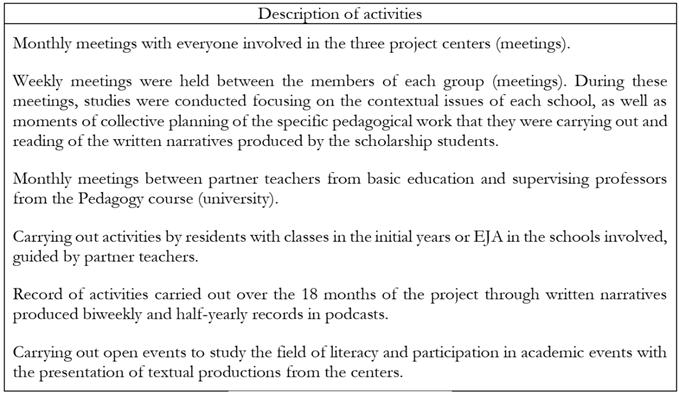 Source: Author´s creation, 2023.