
 Education as Fiction: the pandemic and the televised pedagogical scene
ABSTRACT
In this article, we take as our object the emergency remote teaching model operated by the education network of the State of São Paulo during covid-19 pandemic, which provided for the broadcasting of classes via open television. We build our argument in an essayistic way, demonstrating that this model produces a type of pedagogical scene that, ultimately, converts the educational process into a fiction. We will initially present a discussion about the meaning of pedagogical scene. This, as a television representation, presents itself to the viewer as an illegitimate duplication of the school formative experience. We concluded that this duplication contradicts the training commitment that should remain imperative during the pandemic period.
Keywords
Pedagogical Scene; Fiction; Emergency Remote Teaching; State of São Paulo; Critical Theory of Society
RESUMO
Neste artigo, tomamos como objeto de análise o modelo de ensino remoto emergencial operado, durante a pandemia de covid-19, pela rede de ensino do Estado de São Paulo, que previa a veiculação de aulas via televisão aberta. Construímos nossa argumentação de maneira ensaística, evidenciando que esse modelo produz um tipo de cena pedagógica que, no limite, converte o processo educacional em uma ficção. Apresentaremos, inicialmente, uma discussão sobre a acepção de cena pedagógica. Esta, como representação televisiva, apresenta-se ao espectador como uma duplicação ilegítima da experiência formativa escolar. Conclui-se que essa duplicação contradiz o compromisso formativo que deveria se manter como imperativo durante o período pandêmico.
Palavras-chave
Cena Pedagógica; Ficção; Ensino Remoto Emergencial; Estado de São Paulo; Teoria Crítica da Sociedade
Introduction
[…] I also want to highlight what I consider to be the specific danger of television: it is the reproduction of these incredibly false situations […]
(Adorno, 1995).
The vertiginous spread of the coronavirus in the years 2020 and 2021 demanded emergency actions in various sectors of society, one of them being basic education. Faced with the demand for social isolation — the main measure to prevent the spread of the virus — public and private institutions around the world were compelled to interrupt its regular functioning for an indefinite period of time, in order, from then on, to operate remote education models, which occurred in a multi-fold manner.
Among the various strategies adopted, by public and private networks of teaching, for the transfer of pedagogical actions to the remote model during the pandemic period, we took as the object of critical-interpretative analysis the model adopted in the state of São Paulo/Brazil. This model, operationalized by the Center of Media for Education SP (CMSP) platform, was used in the production of video lessons in TV studios, developed by expert teachers, taught by one or two teachers of the Network, and broadcast on open television. In addition, the video lessons were also available on the YouTube streaming platform, where they could be watched asynchronously. The production of this material was based on the defense that the transmission of classes by television would be a way to ensure teaching and learning in the face of the imperative of social isolation.
However, the critical interpretation of this emergency distance learning model1 allowed us to observe that the video classrooms in question consolidate a kind of proposal predominantly tailored to television models that carry the brands of entertainment. In an attempt to promote the adaptation to this model of television education, the representation of a pedagogical scene is conceived, delimited by protocols, rules, demands and space-temporal limitations of television production. Such a scene implies, by its nature, the demobilization of what was once conceived as class: a representation of what must be taught and of the new knowledge to be acquired, so that one comes into contact with these through the formative experience2 (Gruschka, 2014). Or, a circumscribed representation of the classroom space and time3— a locus in which, historically and culturally, a kind of pedagogical work was consolidated, organized from defined objectives and erected based on social ties and pedagogical ties between teachers and students (Nóvoa, 2020).
Faced with the enclosure of a myriad of educational models in which the camera, and all sorts of technical-audiovisual devices, constitute the central mediation of teaching and learning, the televisioned pedagogical scene becomes the focus of our attention, precisely because it was the central reference of school education in the state of São Paulo during the pandemic period. By gaining centrality amidst this contingent, the pedagogical scene produced by CMSP gains strength in the face of the unviability of presenciality and, consequently, creates a representation of its own that alters the nature of teaching and learning processes, becoming univocal as formative mediation.
What would characterize such a representation? What were the implications of television mediation for the experience of school content during the pandemic? And to what extent does the production of the pedagogical scene in question generate the falsification of training in itself? Such questions are referential for the development of our argument.
Using some of the theoretical-critical categories postulated by Theodor W. Adorno and Walter Benjamin, we will seek to interpret what we have previously called the pedagogical scene, which, in the video lessons produced by CMSP, is presented to the viewer from an illegitimate duplicate of the educational experience of school. Such a pseudo-realistic duplication movement, in the sense of our analyses, turns the educational process operationalized by the CMSP into a politically oriented fiction, capable of concealing school education in favor of vague interests.
As an attempt to shape the content of our reflections, we chose to build our argumentation by taking as a reference a kind of language that is intended to be open to the essayistic character. The essay is presented to us by Adorno (2003), in his text titled Ensaio como Forma, as a type of composition that is realized through the reciprocal interaction between the concepts in the process of an intellectual experience. Instead of framing this experience in a single, precise, exact sense, the essay allows its various moments to interplay (Adorno, 2003, p. 30). Thus, one tries to take the object of thought experience in a non-restrictive way, elevating it beyond oneself, and “[…] not by obsession in seeking its foundations as if they were buried treasures” (Adorno, 2003, p. 30).
The thought experience presented here takes as a starting point the reality of the object chosen by us as the north and as the center of our investigative journey, that is, the video lessons themselves, reconstructed in their immanence and exposed from their latent senses (Oevermann, 2000). This reconstructive movement, in turn, will not be delimited to enclose the object in crystallized categorizations, but rather understood as a source so that, ensayistically, we put “[…] in words what the object allows to glimpse under the conditions generated by the act of writing” (Adorno, 2003, p. 36).
The Televisioned Pedagogical Scene
The use of scenic terminology was extracted from the field of theatre and the language of film and audiovisual: scene, which, in general lines, can be understood as a unit of place and time (Grillo, 2007). The etymology of the word — from the Latin, scena— refers to the composition of a unit of representation: this one is offered to view as a work or show produced intentionally and directed to a specific audience (Houaiss, 1999). Those who compose it, considering the proper distinctions between theatre and the audiovisual, “[…] show themselves in a scenic representation, equipped with a role, undertaking a movement of acting” (Aulete, 2011).
At first glance, the conjunction between this scenic terminology and the pedagogical dimension may seem paradoxical: the production of scenes, in general, implies that their spectators mobilize schemes that enable them to watch them. Such schemes, the result of a complex process of forming sensitivity, become, in a sense, pedagogical: as Walter Benjamin said, the world, as a representation, is grasped from the moment we appropriate the schemes that enable us to perceive it. The historical constitution of our sensitivity and our understanding, which allows us to perceive and interpret the phenomena, is the result of a formative process. However, we resort to the concept of pedagogical scene in an attempt to characterize the developments of a type of television audiovisual production that, declaredly, carries with it the pretension to emulate the pedagogical character of what was historically conceived as a classroom. Such emulation, by its nature, becomes spectacular by submitting the contents to the camera.
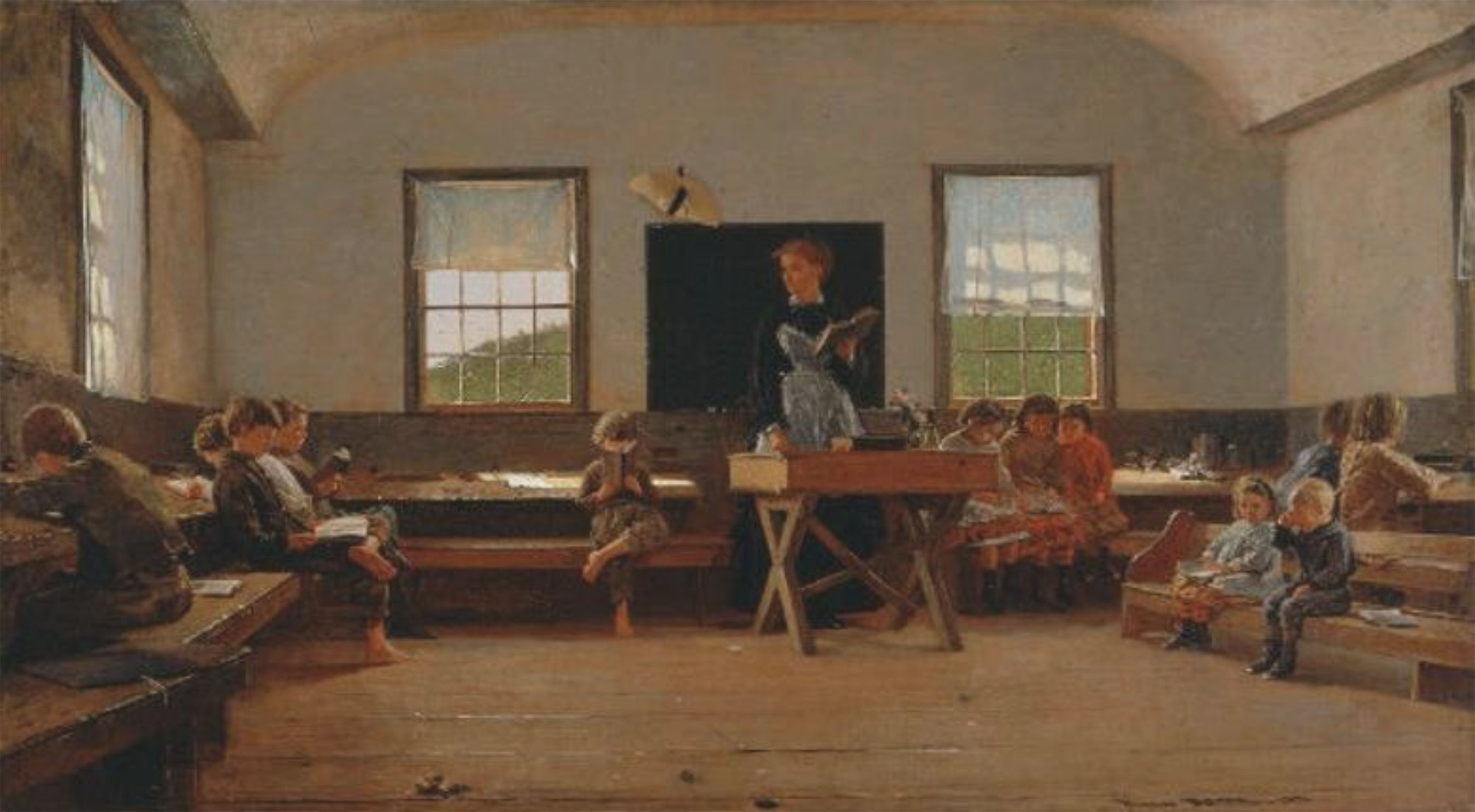
Let's take the class's dimension as a starting point. In general terms, the organization of pedagogical work in a class involves the participation of subjects involved in the educational process, who perform different social roles and occupy the times and spaces that make up the formative action intended to be undertaken. Thus, it is possible to infer that the class has its own contours and dynamics, which involve a series of mediations that frame it. Such mediations have been portrayed in different ways throughout the history of education and art, as can be seen in the work of Winslow Homer (1871):

This pictorial work of 1871 presents, among the many possible representations, a classroom in its most classical format4. It is possible to note that in the central position there is the black frame, an artifact that, given the proper updates to its shape and the materials that make it up, finds a place in many of the school models to the present day. The centrality of the black frame in this work seems to extend symbolically to the centrality of writing and reading in the process of teaching and learning: these practices constitute a ritual characteristic of the school universe, shared by teachers and students. Writing implies the enunciation of something, so that this something persists in space and time through arbitrary signs that must be understood. Through these, learners are introduced to the domains of writing and reading, which allow them to share certain historical, cultural, and social codes. Such a domain is also portrayed in Homer's work (1871) through the materials that are shared by the teacher and the students — for example, the books, which are read individually or collectively. These, associated with students' insertion into the universe of writing and reading, are also elements that make up the pedagogical scene in question.
However, one realizes that there is a distinction between the way the teacher and the students perform their actions: she is standing upright, also in the center of the picture, so that, in this position, she can observe the actions of the students present in the space. There is an element of distinction between the social roles exercised by both groups: while the role of the teacher consists in teaching — and, in the limit, controlling and disciplining its students so that they learn to exercise their role appropriately — students reserve themselves to the role of learners, who see the teacher as an authority figure.
At the same time, it is possible to observe the composition of the scene where the actions of the social actors in question are consolidated, in which wooden wallets are observed, in which the students sit collectively or individually; the teacher's desk, also in a distinct position in front of the student wallets, centralized and under her control; and various materials, such as papers, folders, pencils, among others. All these elements, together, characterize the unity between time and space of this social situation, which has its own narrative. Although the pictorial record does not give us clues about this narrative, it is possible to infer that its cadence is embedded by a kind of language that is quite representative, which concerns the way in which the interactions and communication between social actors are erected along what was conventionally called a classroom — or, in other words, the narrative derived from the scenic game, developed in a particular public space that lacks the presenciality of the involved. The presenciality in this representation allows subjects to fulfill determined social roles unintentionally and to be subject to the construction of organic narratives.
The dimension of the audiovisual scene, on the other hand, implies intentional action, artificially produced by the camera and directed at a group of spectators. According to Benjamin (1987), the introduction of the camera produces forms of representation and acting that succumb to the technical requirements of the environment. There is a framed space, composed of a set of elements: actors, lighting, locations, soundtrack, costumes, among many others. The messages sent to the audience therefore resort to distinct signs —such as the scene, the assembly, and the performance of the camera —that are arranged so that temporality becomes fragmented. While in the theatre, a performance is represented that requires the actor's body, his life, for the character to be built; in the cinema, it is the camera that does it, since the cinematographic discourse is built from the cuts and the assembly (Xavier, 1977).
The break with presenciality and the introduction of mechanisms associated with audiovisual production during the pandemic period led to the demobilization of the classroom's spatiality and temporality, which, from then on, became subject to the mediation of the camera. Consequently, new frames delimit it, transforming it into a scene that, named intentionally, carries the pretension to reproduce pedagogically the meaning of the classroom.
Benjamin (1987), already in the 1930s, had stated that the positioning of the camera as the central apparatus of the cinema provoked a remodel of what is comprised by the scene, in the extent that, through the reproduction enabled by technical mechanisms, this became consumed in a distinct way by a public capable, until then, to relate to the theatrical scene. In his words:
Making a movie, mostly a sound film, offers a spectacle never seen before. There is not, during filming, a single point of observation that allows us to exclude from our field of vision cameras, lighting devices, assistants, and other objects outside the scene
(Benjamin, 1987, p. 122).
The cinema, in its early days, consisted of a spectacle never seen in other times, and this is due to the control exercised by the technical mechanisms used in its production — the lighting devices, the camera assistants, among other elements. This circumstance, according to Benjamin (1987), makes it impossible to approximate a scene produced in a studio to one performed theatrically on the stage. The camera's optical unconsciousness becomes decisive for the reception of the movies by the viewers, and the aptitude for large-scale technical reproducibility, as the philosopher puts it, is what enables the insurrection of a model of mass diffusion that distances cinema from the theatre — even from that which has become widely known as filmed theatre. This is because the camera (and all the apparatus linked to it) deeply impregnates reality, to the point of causing the viewer to consume what is reproduced from an undistinction: instead of reminding him of the technically artificial, fictional, and illusory character of the images, the screen becomes, pretendingly, an extension of the experience with the real.
Taking as reference the Benjamin diagnosis, and considering that television productions follow a similar logic to that of cinema with regard to the large-scale assembly and reproducibility processes5, we took advantage of a parallel: just as the appropriation of the camera and the technical mechanisms characteristic of cinematic production transformed the nature of art in the early twentieth century, it would be possible to infer that the incorporation of such mechanisms (preserved the due timeliness of the audiovisual productive means) in the pedagogical process produced by the CMSP transforms the nature of the educational act widely known as the classroom, transforming it into a television pedagogical scene, which, being subjected to the determinations of the camera, becomes a fiction.
Adorno (1995, p. 89) states that “[…] television presents itself as a cultural and pedagogical problem”. The philosopher, here, does not specifically refer to the productions that aim educational purposes, such as those that were carried out in the state of São Paulo during the pandemic period. In general lines, Adorno qualifies television as an apparatus produced within the cultural industry; its orientation, such as the cinema mainstream, is directed to the production of profit associated with the promotion of the effect that is intended to legitimize, this effect calculated to reach the viewers and consumers with precision, so as to penetrate deeply into its psychic structure. As explained by Cabot (2016), television is, as a principle, a type of mechanized and standardized production for an audience that is subjected to the dynamics of the total flow. As it enters the private and intimate sphere, television gradually becomes the center of the home, refining the mechanisms of formation and enrichment of sensitivities already engendered by the film language.
The supposedly pedagogical scene produced by CMSP, in this sense, does not escape the rules of the apparatus. Putting on a remodeling of the classroom from the perspective of large-scale reproduction, we have in this scene the objectivation and reproduction of copies of the educational act, through the introduction of the camera and the mechanisms associated with its manipulation. In the condition of copying, the educational act loses its organic character: the social roles of the teacher and the student, for example, cease to be executed in an unintentional and objective way, turning into acting oriented to and by the camera. The performance of the subjects of the pedagogical process, especially the teacher responsible for presenting the video lessons, becomes disguised, considering that its central point is to act for a myriad of undefined subjects, which are unknown to him and hidden from the camera's eye.
This is because the production of the television pedagogical scene is guided by the adaptation of the contents and mediations typical of a class to certain visualization patterns, which are exogenous to the formative and educational pretensions of a classical class. Such patterns of visualization arise from what Horkheimer and Adorno (1985) called pseudorealism. Like Benjamin's anti-event (1987), the concealment of fictional character operational by cinematographic mechanisms and techniques is also identified by Horkheimer and Adorno (1985) in their theses on the cultural industry. In these, the philosophers present pseudo-realism as a mechanism capable of guiding the identity reproduced in the products that intend to forge an indistinguishable continuity between the real and its image. In his words:
The old experience of the movie viewer, who perceives the street as an extension of the film he just saw, because he himself intends to rigorously reproduce the world of everyday perception, has become the norm of production. The greater the perfection with which their techniques (the ones of the cultural industry) duplicate empirical objects, the easier it becomes today to obtain the illusion that the outside world is the unbroken prolongation of the world that unfolds in the film
(Horkheimer; Adorno, 1985, p. 118).
The screen, as a prolongation of the experience with reality, imposes itself as truth and as a norm, either in the cinema guided by naturalist aesthetics capable of producing the opacity of its basic mechanisms, or in television, guided by the continuous flow that prevents any denser reflection on such mechanisms. There is, in terms of Cabot (2016), an illusory representation. In the mastery of the technical trick and the supposedly similar way of presenting the contents, as the philosophers put it, lies the secret of the efficiency of imprisonment of consciousness, which leads the viewer to believe in the equalization between image and reality, identifying with the patterns of behavior, consumption, and thought carried. Such patterns imply a distortion of empirical life, which, when carried to the screen, is endowed with a false sense.
This false sense models the formation of the public's will, as Cabot (2016) notes, shaping a circle of manipulation of desire and the need for enjoyment at any cost. In favour of the self-preservation of subjects who are expropriated of their vital and intellectual forces by the materiality of everyday life — in the terms of Horkheimer and Adorno (1985), subjects who had their ego dissolved— the substitutive satisfactions materialized by the cultural industry seek the memory of pleasure. This, associated with the feeling of omnipotence and narcissistic completeness of childhood, allows these subjects, supported by artificial representations presented to them through images, to return, albeit briefly, to a false state of freedom and authentic pleasure. By offering the viewer the immediate satisfaction, organized and produced purposefully in an attempt to lead him to identify with what he is watching, an illusory process is consolidated, which blinds the audience and makes it impossible to reveal the falsehood of what is being watched. Thus, his desire for images that lead him to the pleasure of repeating the always identical — an imaginary delight, fed by narcissistic pseudosatisfactions.
By providing these subjects with narcissistic satisfaction, the cultural industry produces a kind of mimicism guided by the copy, the duplicate, which is presented to them in the form of ordinary fun and entertainment. This copy aims to identify with what is seen, to become the first referent of reality to be grasped, a representation more meaningful than reality itself. Thus, the desire of the weakened ego is satisfied and stimulated, while at the same time the illusion of this subject is fed that the pleasure produced by consuming that copy coincides with what makes him a free being. As explained by Freitas (2005, p. 122):
Besides the cultural industry taking advantage of the weakness of the narcissistic ego of its consumers, constantly feeding them with pseudo-satisfactions, it still deceives them as to their determination as subjects, insofar as it obliterates the look at what could make them different from what the collectivity made of them.
The production of pseudo-realistic images, in this sense, produces the distortion of reality, starting from simplification and reductionism, by embodying formulas and clichés widely conveyed. Such processes are guided by the premise that the fiction presented on the screen must be produced in an attractive way, approaching life, without, however, highlighting what was denied to the viewer, whatever freedom. By surrendering to the scopic pulse engendered by what is assisted (Cabot, 2016), one absorbs the representations created by the industry, which become socially approved models: models that, in accordance with the needs of serial production, are reduced in their complexity and operational in a stereotypical way.
Thus, it can be inferred that the public desires to find a supposed pleasure engendered by the pseudo-realistic representations carried by television images, whether in relation to programs that assume entertainment as a purpose, or in relation to programs of supposedly educational purpose, such as the pedagogical scene produced by CMSP. By adapting to the television model, the video lessons absorb the assumptions of a kind of production oriented to a supposedly pleasant, emotional, and intellectual reception, and also to the promise of future gratifications, as highlighted by Adorno (1991). Thus, through the television classroom, a narcissistic relationship with the pedagogical process is fostered, camouflaged by a supposed educational and formative pretension.
In formative terms, the pedagogical scene produced by the video classrooms can be understood as a fiction that turns the educational process of school into something that it should not be —in other words, something that contradicts it. This is because the school's function6 is not to produce fictions or representations, but to teach so that the learning of the contents is consolidated; to teach so that individuals have a deep, historical, and formative experience with the contents. At the limit, teaching to humanize them through the educational act oriented to emancipation, being this linked to critical self-reflection. The act of educating, teaching, and forming implies that the teacher exercises the social role that is instituted to him. Students, in turn, learn to become students through discipline, fundamental to learning their role. There is, in the case of class, the construction of objective representations of reality, since the school constitutes a shared material universe and mediates in favor of the experience of this reality.
As a copy, the educational act loses its organic character: the social roles of the teacher and the student cease to be executed in an unintentional and objective way, turning into an act oriented to and by the camera. The performance of the subjects of the pedagogical process — especially the performance of the teacher — becomes disguised, considering that its core point is to act for a myriad of undefined subjects, which are unknown to him and hidden by the eye of the camera. Instead of relating to the students, the teacher relates to a technical team, which is unknown to the audience. At the limit, the production of the television pedagogical scene implies a blocking of the experience with the world as representation, in favour of a fictional representation of the class disguised by television's productive mechanisms.
Education as Fiction
We therefore observe how such mechanisms manifest themselves in the materiality of the pedagogical scene produced by the CMSP. To interpret it, we operate an audiovisual empirical reconstruction of video lessons7 broadcast via open TV and stored on the streaming platform YouTube. The critical interpretative exercise has been consolidated from the careful reconstruction of the dynamics and events established on the screen, allowing us to identify their logic and concretize a thought experience — which, as we initially stated, remains open and incomplete within the scope of this essay —about their senses.
Let us take as a starting point the space-time organization, which is altered in favor of an adaptation to the environment. In a class, space and time are delimited according to the educational rituals that are fulfilled in it. Writing in the black frame, for example, or even reading texts collectively and individually are rituals that enunciate that, in this space and time, writing is considered as a system that expresses constance, patience, and discipline, oriented to the appropriation of these codes and shared in a delimited space. In the television pedagogical scene, on the other hand, space and time cease to be a unit, becoming fragmented. Teacher and students do not occupy the same space, nor do they relate in an organic way. The temporality of the class is delimited by the temporality of the television grid and its respective productive procedures: cuts and camerations, rituals that differ from those that orient the time of teaching and learning.
In cinema and television, the fictional character takes shape through a continuous and discontinuous space-time structure, since presenciality is no longer a requirement. The introduction of the camera produces forms of representation of the image that succumb to the technical requirements of the medium, such as Benjamin's anti-evidence (1987). There is a framed and framed space, composed of a diversity of elements that stand out from those concerning the classroom. The messages sent to the audience, therefore, resort to distinct signs, coming from the scene, the assembly, and the performance of the camera, which are arranged and organized in a fragmented temporality. While in a class, the action of teachers and students expresses an organic action, starring subjects who fulfill determined social roles in an unintentional way, in television production, this action is centralized in the camera and the assembly resulting from the images captured by it.
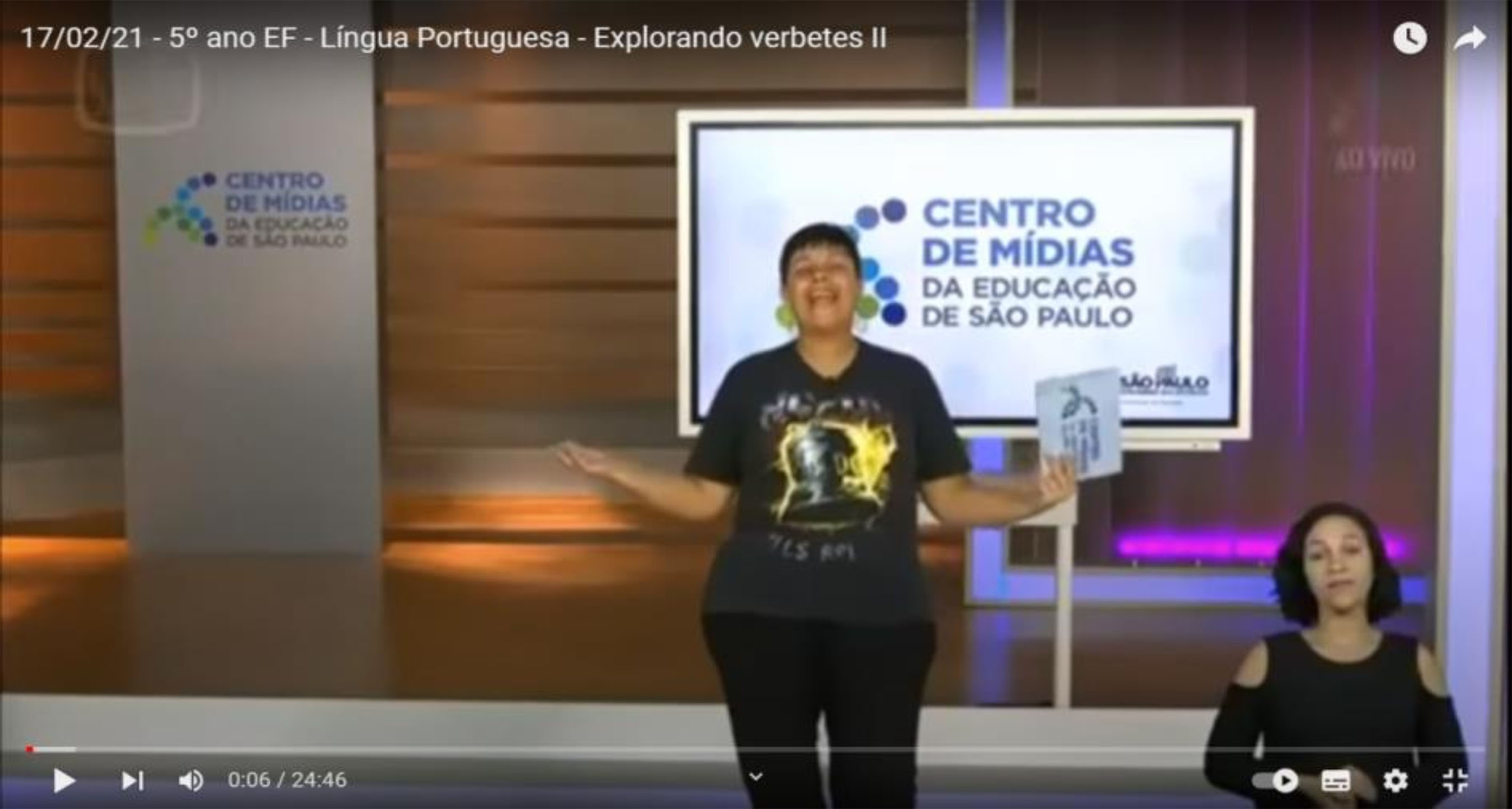
Consequently, in the television pedagogical scene, certain rituals characteristic of a classical classroom are replaced by protocols of the audiovisual environment, which determine the nature of the formative relationship built by the mediation of the screen. This relationship is guided by the following visual frame:


In a comparative movement, taking as reference the pictorial work of Winslow Homer, it is possible to observe the updated presence of elements from a classical classroom: the louse as a central image, for example. In the case of the televised pedagogical scene, the black frame is converted into a digital puzzle, an apparatus that, like a black box, saves a myriad of functionalities and technical mechanisms that are unknown to its users. In it, the processes associated with reading and writing — previously carried out manually and laboriously by the teacher and students — are accessed from a simple touch on the screen, which moves and reproduces previously prepared texts and images, quickly and efficiently.
The teacher, in the pedagogical scene produced by CMSP, is also centrally positioned. In general lines, the camerations little shift you from this privileged position, with the exception of the moments when the content of the digital puzzle is projected completely on the screen, in a general plane. On the one hand, in Homer's work, the teacher has a book in her hands, and her gaze is fixed on the actions of the students; on the other hand, in the video class, the teacher-studio8 has eyes fixed on the camera, a supposed window that takes him to his audience. In much of the video lessons performed, the book is replaced by a form, an instrument commonly used by television presenters. While the book carried by Homer’s teacher refers to the density of the content that is captured by the teacher and taught to the students, the sheet, in its concisity, refers to the shortness of television temporality: a script that should guide the positioning and performance of the teacher-studio in front of the cameras.
It is noteworthy that the platform pretends to simulate the construction of a space that, supposedly, should resemble the space of a class undertaken in person in the school space. Apparently, the pedagogical scene produced by CMSP is conceived as the affirmation of a class, in which the camera element will be introduced a posteriori. In an analogy, this pedagogical scene would be idealized from the premise that refers to the idea of filmed theater: a representation submitted to the eye of the camera, a static camera that, at least in thesis, would not change in anything the scene developed on the stage, since it would be positioned under the viewpoint of the viewer. At the limit, there seems to be a pretension that the video classroom reproduces the experience of a classroom in its classic patterns, guided by the presenciality and the organic relationship with what is taught; the intrusion of the camera, in this perspective, would not cause any alteration in the filmed content.
However, such a pretense must be considered in its fragility, since the organization of this pedagogical scene implies a characterization that is typical of the television mettier: the teacher-studio is positioned in a scenario, which in much resembles the scenarios of informational programs produced simultaneously; low colors and lights denote an intimist and sophisticated tone; plans alternate between the figure of the teacher-studio and the projection of content in the digital lounge, operated by third parties; camerations, which imply that the teacher obey the demands of different operators; and, moreover, the massive presence of the platform logo in various points of the screen, a presence that constantly affirms the audiovisual and television environment and allows the viewer to recognize, through a single image, the content that is being consumed.
This characterization is valid since, from it, it becomes possible to uncover the fictional character of the pedagogical scene in question. Added to it is the form chosen to adapt the school contents and teaching mediation to television, guided by characteristic standards of the entertainment mettier. Unlike a class, which has specific purposes associated with learning and the formative experience, with content that is elaborated in a particular and intersubjective way, the television pedagogical scene implies a type of production that converts such purposes into one: to play certain roles, which give flow to a pattern of visualization that allows the audience to have fun.
The effort of a teacher, in a class, consists in seeking relevant means for students to produce organic relationships between the contents; this is a concern of the order of didactics. This concern takes another order when the camera enters the scene: means are sought to expand the reach and the visualization of the contents, so that they are consumed in a univocal way and on a large scale. For this purpose, it is necessary to provide the viewer with images that nourish their desire, that provoke a supposed and immediately pleasant reception and that give flow to the fantasy of narcissistic omnipotence. The teacher, in this sense, becomes a entertainer: more than mediating the relationship between the students and the contents, their concerns focus on entertaining them, and teaching is relegated to a second plan.
From this it is inferred that the figure of the docent-studio, as a representative figure of the teaching, gives centrality to its interaction with the participants of the video class, taking as a central criterion the popularity, in front of which the docent-studio stands out as a character that gains notoriety; in other words, as a kind of celebrity from which one wants to draw attention. This is acknowledged by the studio teachers themselves, who admire the propaganda and self-promotion of themselves—emphatically through social networks, as one of the studio teachers points out: “Post on social networks, you, a 5th year student, doing Pro Aline’s lesson and using what? Your pajamas! That’s it! […] the hashtag you’re going to use is the math pyjama hashtag, and it will mark Professor Aline Gaqui!” (Media Center SP, 2020a).
Alienated from his pedagogical work, this teacher-presentator must submit to the representation of a role distinct from that associated with teaching. It should adjust the form of the usual classroom speech to the form of the typical speech of the television genre. For this purpose, he creates a generic script, which, together with the tone adopted in his speech, produces an atmosphere that refers to entertainment — in the case, a supposedly productive entertainment, since the proposal, in particular, is characterized and is consumed, supposedly, like a class. The effusiveness, exaggeration, enthusiasm and excessive sympathy that manifest in the continuous laughter are some of the brands that accompany the positioning that is required. This data can be observed in the following excerpts, which mark the opening of two separate video lessons:
Good afternoon, 5th year guys! I'm Professor Aline Gaqui, and if I'm in the area, it's because today is another day of ma-te-ma-ti-cs on your screen. 5th year gallery of my heart, another math class this Thursday!
(Media Center SP, 2020a).
Good day… Oops [laughs]! Good afternoon, 4th year guys! I'm Professor Evandra, and today, geography class, people. It's Friday! All are very welcome!
(Media Center SP, 2021b).
In general, the form of communication established by teachers-presenters seems to obey a standard. There is a formal greeting – good morning or good evening – followed, usually, by a disguised term, which reveals a relaxed attempt to approach your interlocutors: galerie or personal, in the highlighted passages. Also the use of expressions as folks of my heart, telly, its friday!, demarcate that the formality of the initial greeting is contradicted by an attempt to adapt to the scene built via television, obeying its communicative standard – which, in the limit, is a fictional standard, established by a kind of routerization. This, as another element that denounces the falsehood of the pedagogical scene in question, gives indications that the speeches and dealing with the game of cameras seem to have been memorized and rehearsed, presenting small errors that denounce the artificiality of their staging.
As in the case of a Science video class for 3rd year students, in which the teacher-studio begins his presentation as follows:
Good morning, third year students! Welcome to this class, which is a science class. I am Professor Joelson, you already know me, we haven't met for a while but we're here together, through the screen, in this time of Science class! [Gets a signal with the head to someone behind the camera][turns to the right and speaks to a second camera] I want to say [freezes and stammers] welcome […]
(Media Center SP, 2020c).
Attention is drawn here to the way the teacher recites this text: in a paused, precise way, like someone who dedicated himself tirelessly to memorizing and rehearsing the script to interpret it in the best possible way. This is until the moment when, losing himself in his acting and in the movements required by the change of cameras, the teacher-studio, in a moment, gets stuck trying to pronounce the words that are required of him at that moment.
Such patterns are disguised through the constant reinforcement of the supposed interaction between the teacher-studio and the students via chat, also converted into a duplicate of an organic interaction, such as the one that would be effective in a class. Students send messages through the chat, and at certain moments in the video class, these messages can be read by studio teachers. Apparently, the interaction with the chat occurs at moments predetermined by the video class script, whether these moments arise from rhetorical questions posed by the studio teachers, or are used for dialogues that extrapolate the pedagogical dimension of content mediation:
Oh, and the people talking hi in the chat! And already so asking for a kiss! The school gallery Camilo Castelo Branco, the fifth year A gallery, everyone participating! Ah, the staff of the school, Ana Pontes, fifth year C, everyone available! The staff, students of Antônio Branco School, fifth year A, Professor Reducino de Oliveira, fifth year A, hahaha, very good, people! Go on!
(Media Center SP, 2021a).
[…] and there, everybody is in quarantine, everybody is locked up at home, and there, that already rolled around? Tell me in the chat, I want to see. Oh, there's a people talking party, a virtual class, fine. What else? Film session […]
(Media Center SP, 2020a).
It is not common in a classroom that a teacher sends kisses to his students, or interrupts the class to read messages from students from different schools. It is also not common for other teachers to interact with the content presented, a role normally exercised by students. Different from the classroom, the video classrooms have an impulse for the teacher to interact with his audience in a stimulating way, sending kisses and hugs to the viewers and emulating a dialogic interaction, which, in the end, is false, considering the fusion between the presented classroom and the massive dimension of television. In this sense, the simulation of dialogic interaction becomes an exogenous artifice, since the teacher-studio must forge an interaction that, due to the character of the fictional scenic construction, will not actually happen.
In this movement, one perceives the dealing with the desire of this subject-student-spectator, who, in the terms of Horkheimer and Adorno (1985), lacks a glorified image of himself: such an image is stimulated by the voice given to him through the chat, and that marks a supposed distinction between the myriad of spectators who attend the video class. The immediate pleasure of being perceived and mentioned by the figure of the teacher-presentator is mobilized by the way of the dispute; however, this dispute is waged in a false field, which becomes more significant than the formative process and, at the limit, more significant than reality itself.
In short, this way the fictional character of the pedagogical scene built by the CMSP is materialized, so that the students, converted into spectators, think to consume the television classes in the same way that, at least in thesis, they would experience a class; and the teachers-presentators, in turn, believe to fulfill their role of mediating the formative process, when, in reality, they must act in a way to adhere to the exogenous standards imposed by studio production. Although the fictional character of television productions, in general, is already manifested in the structure under which a whole standardized productive system is erected, guided by pulsational gratification mechanisms (Cabot, 2016), it becomes relevant to observe how this structure manifests itself in a proposed educational purpose, or, in other words, in the production of a type of scene that affirms its supposedly pedagogical intentionality. Given this finding, it becomes pertinent to determine the general and structural plan of adherence to this emergency remote education model during the pandemic period.
Final considerations: a politically oriented fiction
We seek, throughout this discussion, to put into debate the latent sense structures that shape the school education carried out in the state of São Paulo during the pandemic period. Taking as a starting point an essayistic construction movement around what we call the pedagogical scene, which expresses the meanings that give life to the teaching and learning processes consolidated by institutionalized school education, we seek to highlight the contradictions that bind the proposition of the television classes produced and carried by the Center of Media of Education of São Paulo.
Adhering to a television-based emergency remote education model is not a coincidence. In spite of the contingent of social isolation, which prompted the adaptation of the classroom to a myriad of formats that approach it to a greater or lesser extent, the production of the television pedagogical scene emerges as an attempt to emulate the pedagogical process and its distinct mediations. Instead of assuming the fictional, pseudo-realistic and, to the limit, false character of this kind of production, we observe the defense of this proposal by managers and subjects acting in the field of education, based on the argument of a supposed democratization of education during the pandemic period, considering that access to open television, at least in the thesis, is something common in much of the households of the state of São Paulo.
It is admitted, in normative terms, that it is necessary to do everything possible to ensure excellence in learning. In characterizing the São Paulo Educational Media Center, the guidance document on non-presencial school activities, prepared by the State Secretariat of Education at the start of the pandemic, suggests that this platform is responsible for producing “[…] quality live lessons, accessible to all by open TV” (São Paulo, 2020, p. 19). It seems to us that the criterion of quality adopted by the managers of this proposal reveals a fundamental contradiction of this teaching model, since it is antithetic to the meanings of what was once understood as integral training, which would involve not only learning the content with mastery, but also deep experience with the knowledge to be grasped and elaborated. Could a fictional production, such as the one operated by CMSP, carry out such an experiment? Television, in its structure predominantly oriented to fill the empirical life with a false sense (Adorno, 1995), would be able to promote the critical skills of the subjects of the formative process, relevant to this experience?
Such questions lead us to the conclusion that the sense of excellence learning and quality, taken as the background for the production of the television pedagogical scene of the CMSP, is understood from the premise of massification: by prioritizing a large-scale production model, which level the learners and submits the teachers to a standardized model of acting, one has the consolidation of a formative perspective aligned to the fictional dimension typical of television production. In the terms of Adorno (1995), this dimension is guided by the attempt to massively instill in people a false conscience and the concealment of reality, from the imposition of a set of values that are assumed as real, preventing subjects from identifying them in their falsehood. In short, there is, with the logic of massification, a political-ideological direction of the senses attributed to education.
This direction, in the case of the state of São Paulo, is associated with the projection of this educational network in front of other educational systems. By looking at the normative documents9 that supported the creation of the CMSP, it is possible to identify a discourse associated with economicist values and interests, oriented to competition in favor of a educational market. Education, in these documents, is taken as an object of competitive advantage that gives visibility to the state of São Paulo in front of organizations such as the Organization for Economic Cooperation and Development (OECD) and the World Bank. For this purpose, it invests in external assessment-oriented learning and in innovative educational proposals that gain large-scale visibility. This learning, directed to the maintenance of the market, is limited to the dimension of the knowledge to do, which makes the training of subjects in all its dimensions impossible, as well as the deep experience with the contents and knowledge of the training.
According to Laval (2004, p. 64), this consolidates the degradation of the symbolic and moral foundations of the school institution, associated predominantly with the emancipatory value of culture and the formation of active citizens. These, in turn, give way to conformity to a neoliberal rationality, which, by its values and interests, brings in itself the destruction of educational and formative ties guided by an organic and mediated relationship between teachers and students and by the consolidation of deep thinking experiences with the objects of knowledge.
Such values and interests, which understand education as a profitable investment for the market, seem to be consistent with the production of the television pedagogical scene, which transfers training to a fictional dimension, revealed in the materiality of the CMSP video lessons. If this dimension implies the maintenance of a false consciousness, which makes a real understanding of the state of minority impossible, it has to be said that adherence to the television emergency remote education model, rather than broadening access to learning, strengthens the integration of video classrooms into the merchandise circuit of the cultural industry within neoliberal rationality, making them condescending with the logic of serial production and commercial entertainment. At the limit, the centrality of the pedagogical scene produced by the CMSP lies in inebriating and ludibriating subjects through the maintenance of their desire and narcissistic illusion, so that, in this way, sub-reptilian interests are consolidated.
It remains to us, at the end of this exhibition, to question to what extent the values and interests of an autonomous training, in the context of this formative structure imposed at the institutional level, could be sustained, or even recovered. Faced with this interrogation — which remains suspended and susceptible to experiences of reflection — we recover a brief excerpt from Adorno (1994, p. 105), when of his criticism of the ideology of the cultural industry: “[…] in seeking to reach the masses, even the ideology of the cultural industry ends up being as antagonistic as the society for which it is destined. It contains the antidote to its own lies. Nothing more could be invoked for your salvation.”
If this ideology contains “[…] the antidote of its own lies”, we dare assume that such adornic assertive indicates a certain educational principle, meaningful to the context of a fictional formation. Explaining to the subjects of the pedagogical processes the concealed, false and ludibriating character of the structure that sustains the pedagogical scene they consume; taking it as an enigma, composed of layers of meaning to be excavated; and stripping the senses of the values and interests hidden in such a structure are movements that can become raw material for this antidote.
In other words, this movement requires the explanation of the contradictions that demarcate the structure produced fictionally by the CMSP, discussed throughout this text. Here lies the emancipatory potential of the analyzed material and the educational appropriation of the categorization called pedagogical scene. We could hardly approach a formative project in a landscape in which the perception of the world is reduced to existing forms of life or to a blind contact with reality as it presents itself.
Recovering Adorno's recognized essay entitled Education and emancipation, we infer that the experience of thinking in relation to the reality, the content and the forms and structures of the subject's thinking is the one that safeguards the emancipatory potential of the formative processes; an experience that does not silence in the face of contradiction; an exercise that puts in question the very falsehood of today's pedagogical models. In this context, it is necessary to elaborate critically on such emancipation-oriented experiences.
-
1
This interpretative movement was carried out from the methodology of objective hermeneutics, based on Adorno's Negative Dialectics (2009).
-
2
Representation of what, according to Gruschka (2014, p. 25), “[...] must be taught, whose contents cannot be inserted as initial phenomena. [...] The class is obliged to make a rigid selection of the subjects of knowledge of the world, in this sense, it cannot teach everything, but, above all, it needs to try to find what can lead to the whole”.
-
3
According to Hamilton (1992, p. 42), the ideas of classroom and class arise with the rearrangement of medieval pedagogical practices: a “[...] accurate and clear division of students into classes, that is, graduated divisions by stages or increasing levels of complexity, according to the age and knowledge of students [...]. It was believed that with these units, education would be promoted more efficiently.”
-
4
Classic, here, considers the modern school pedagogical configuration — which, already in the sixteenth century, is subjected to a process of rationalization. The establishment of school systems based on the idea of a common education for all, which breaks with the unitary model, brings new itineraries that mark a pedagogical turn. The rationalization of school education brings to light terms and archetypes consistent with the new model in question: class, curriculum, programming, education for all, qualification requirements — which define the new character of education from then on (Hamilton, 1992; Cambi, 1999).
-
5
The analysis by Theodor Adorno (1991) of television, conducted in the 1950s, qualified it as a cultural problem, since its effects, according to the philosopher, impact viewers at various levels, insofar as the apparatus exercises extensive control of the public, mainly by entering and becoming the center of the private dimension, the organization of homes (Adorno, 1991). Here is the nodal point that distinguishes it from cinema, conceived, in its early days, as an apparatus restricted to the public dimension. Although conceived and oriented to different purposes, television and cinema preserve certain structural similarities, considering what was postulated by Walter Benjamin (1987): the insurgence of the technical image in motion promotes a new type of experience for the viewer, who, in the face of the new medium, has its perceptive faculties radically modified, since the faculty of vision starts to rely on the technical competition of the camera eye. This, capable of potentializing the assimilation of reality, assumes the coordination of human perception by acting in the same way as vision, dive, however, so deeply into the objects, to the point of showing what in them would not be perceivable to the naked eye, capturing dimensions that transcend them. In Benjaminic terms, the camera's optical unconsciousness, through the manipulation of light and sound, acts in favour of a distinction between reality and technical image, in order to produce effects on the viewer and recreate the world seen on the screen.
-
6
Here are considered the pedagogical conceptions that associate it with the formation of individuals in their integrity.
-
7
This assumption was taken as a reference for the empirical reconstruction of four CMSP video lessons, so that, from it, its structural meaning was revealed. At a second point, we generalized this structure, so that we could, from the methodological principles delimited by Oeverrmann (2000), understand the general structure of the case, which is presented in this text.
-
8
Nomenclature used by the CMSP to name the teachers who present the video lessons.
-
9
These documents — the Strategic Plan of Management (2019-2022): Education for the 21st Century (São Paulo, 2019a); the Pedagogical Fundamentals of the Paulist Curriculum (2019) (São Paulo, 2019b); and the Guiding Document on Nonpresencial School Activities (2020) — were interpreted in the light of the theoretical-methodological reference for objective hermeneutics as part of the research.
Availability of research data
The data set supporting the results of this study is published in the article itself.
References
- ADORNO, Theodor W. How to look at television. In: ADORNO, Theodor W. The Culture Industry: selected essays on mass culture. London: Routledge, 1991. P. 136-153.
- ADORNO, Theodor W. Notas sobre o filme. In: ADORNO, Theodor W. Sociologia São Paulo: Ática, 1994. P. 100-104. (Coleção Grandes Cientistas Sociais).
- ADORNO, Theodor W. Educação e emancipação Tradução Wolfgang Leo Maar. Rio de Janeiro: Paz e Terra, 1995. P. 169-185.
- ADORNO, Theodor W. O ensaio como forma. In: ADORNO, Theodor W. Notas de Literatura I São Paulo: Editora 34, 2003. (Coleção Espírito Crítico).
- ADORNO, Theodor W. Dialética negativa Rio de Janeiro: Zahar, 2009.
-
AULETE. Cena. In: DICIONÁRIO Aulete, 2011. Disponível em: https://www.aulete.com.br/ Acesso em: 23 jun. 2025.
» https://www.aulete.com.br/ - BENJAMIN, Walter. A obra de arte na era de sua reprodutibilidade técnica. In: BENJAMIN, Walter. Magia e técnica, arte e política – ensaios sobre literatura e história da cultura. 2 ed. São Paulo: Brasiliense, 1987. P. 165-197.
- CABOT, Mateu. Estereotipos de la representación del cuerpo en la televisión. Aspectos de la crítica de la cultura de masas de Th. W. Adorno. Daimon Revista Internacional de Filosofía, p. 621-631, 2016. Supl. 5.
- CAMBI, Franco. História da Pedagogia São Paulo: Unesp, 1999.
-
CENTRO DE MÍDIAS SP. 01/10 - 5º ano EF - Matemática - Festa do pijama 5º ano EF – CMSP, 1 out. 2020a. Disponível em: https://www.youtube.com/watch?v=6SBhlxiTaX4 Acesso em: 19 jun. 2025.
» https://www.youtube.com/watch?v=6SBhlxiTaX4 -
CENTRO DE MÍDIAS SP. A história é contada por meio do tempo 5º ano EF – CMSP, 15 jun. 2020b. Disponível em: https://www.youtube.com/watch?v=WWkZgXVCIYI Acesso em: 19 jun. 2025.
» https://www.youtube.com/watch?v=WWkZgXVCIYI -
CENTRO DE MÍDIAS SP. 28/10 - 3º ano EF - Ciências - Insetos e suas bocas 3º ano EF - CMSP, 28 out. 2020c. Disponível em: https://www.youtube.com/watch?v=8RamYNNJqTg Acesso em: 23 jun. 2025.
» https://www.youtube.com/watch?v=8RamYNNJqTg -
CENTRO DE MÍDIAS SP. 17/02/21 - 5º ano EF - Língua Portuguesa - Explorando verbetes II 5º ano EF - CMSP, 18 fev. 2021a. Disponível em: https://www.youtube.com/watch?v=wgpC56YhwZQ Acesso em: 19 jun. 2025.
» https://www.youtube.com/watch?v=wgpC56YhwZQ -
CENTRO DE MÍDIAS SP. 29/10/21 - 4º ano EF - Geografia - Divisão politico-administrativa do brasil: Parte II 4º ano EF – CMSP, 2021b. Disponível em: https://www.youtube.com/watch?v=hwBsqSj6C9U Acesso em: 23 jun. 2025.
» https://www.youtube.com/watch?v=hwBsqSj6C9U - FREITAS, Verlaine. Indústria cultural: o empobrecimento narcísico da subjetividade. Kriterion, Belo Horizonte, n. 112, p. 332-344, dez. 2005.
- GRILLO, João Mário. As lições do cinema: manual de filmologia. Lisboa: Edições Colibri, 2007.
- GRUSCHKA, Andreas. Adeus pedagogia? O fim das fronteiras da relação pedagógica e a perda da função da pedagogia. In: LASTÓRIA, Luiz Antônio Calmon Nabuco; GOMES, Luiz Roberto; GRUSCHKA, Andreas; ZUIN, Antonio Álvaro Soares. Teoria Crítica: escritos sobre educação. São Paulo: Nankin, 2014. P. 273-290.
- HAMILTON, David. A trajetória de uma pesquisa: sobre as origens dos termos classe e curriculum. Tradução Tomaz Tadeu da Silva. Teoria & Educação, Porto Alegre, v. 6, p. 33-52, 1992.
- HOMER, Winslow. The Country School 1871. 1 original de arte, óleo sobre tela, 54 x 97,2 cm. St. Louis Art Museum, St. Louis, Missouri, Estados Unidos.
- HORKHEIMER, Max; ADORNO, Theodor W. Dialética do esclarecimento Tradução Guido Antônio de Almeida. Rio de Janeiro: Jorge Zahar, 1985.
-
HOUAISS. Cena. In: DICIONÁRIO Houaiss, 1999. Disponível em: https://houaiss.uol.com.br/ Acesso em: 23 jun. 2025.
» https://houaiss.uol.com.br/ - LAVAL, Christian. A escola não é uma empresa: o neo-liberalismo em ataque ao ensino público. Londrina: Planta, 2004.
- NÓVOA, António. A pandemia da covid-19 e o futuro da Educação. Revista Com Censo, v. 7, n. 3, ago. 2020.
- OEVERMANN, Ulrich. Die Methode der Fallrekonstruktion in der Grundlagenforschung sowie der klinischen und pädagogischen Praxis. In: KRAIMER, Klaus. Die Fallrekonstruktion Frankfurt: Suhrkamp Verlag, 2000. P. 58-156.
- SÃO PAULO (Estado). Secretaria de Educação. Plano Estratégico de Gestão (2019-2022): educação para o século XXI. São Paulo: SEDUC, 2019a.
- SÃO PAULO (Estado). Secretaria de Educação. Currículo Paulista, SEDUC/Undime SP São Paulo: SEDUC, 2019b.
- SÃO PAULO (Estado). Secretaria da Educação. Documento orientador das atividades escolares não presenciais São Paulo: SEDUC, 2020.
- XAVIER, Ismail. O discurso cinematográfico: a opacidade e a transparência. Rio de Janeiro: Paz e Terra, 1977.
Edited by
-
Editor in charge:
Paula Corrêa Henning

 Source:
  Source:
  Source:
  Source: