
 Agencements and Engenderings that Support the Foundations of the Contemporary School
ABSTRACT
In light of Foucault's thinking, this article analyzes educational practices, highlighting the mechanisms of knowledge/power that produce subjection through mechanisms of governmentality of bodies. Based on the concept of biopolitics, we develop an analysis of the foundations that structure basic education, pointing out the maintenance devices that maintain the neoliberal model, which inhibit the processes of singularization of students and promote a conformity that hinders new inventive ways of existing. We recognize the need to problematize the genealogies of these social and historical realities, proposing the creation of spaces/times that favor the emancipation of subjects.
Keywords
Contemporary School; Biopower; Governmentality
RESUMO
À luz do pensamento de Foucault, o presente artigo analisa as práticas educacionais, destacando os mecanismos de saber/poder que produzem sujeição através de mecanismos de governamentalidade dos corpos. A partir do conceito de biopolítica, tecemos uma analítica sobre as bases que estruturam a escola básica, apontando os dispositivos de manutenção que mantêm o modelo neoliberal, os quais inibem os processos de singularização de estudantes e promovem uma conformidade que dificulta novas formas inventivas de existir. Reconhecemos a necessidade de problematizar as genealogias dessas realidades sociais e históricas, propondo a criação de espaços/tempos que favoreçam a emancipação dos sujeitos.
Palavras-chave
Escola Contemporânea; Biopoder; Governamentalidade
Introduction
One walks for several days among trees and stones. Rarely does the gaze settle on one thing, and, when it does, it is recognized by the symbol of some other thing [...]. Finally, the journey leads to the city of Tamara. One enters streets full of signs hanging from the walls. The eyes do not see things, but images of things that mean other things [...]. Other symbols warn of what is forbidden in some place [...] and what is permitted — [...]. At the door of the temples, one sees the statues of the gods, each represented with its attributes [...]: by which the faithful can recognize them and address to them the appropriate prayer. If a building bears no insignia or figure, its shape and the place it occupies in the organization of the city are enough to indicate its function: the royal palace, the prison, the mint, the Pythagorean school, the brothel. Even the goods that the sellers display on their stalls are valued not for themselves, but as symbols of other things: [...]. The gaze moves through the streets as if they were written pages; the city says everything you must think, makes you repeat the discourse, and, while you believe you are visiting Tamara, you do nothing but record the names with which it defines itself and all its parts. What the city is really like beneath this heavy wrapping of symbols, what it contains and what it hides, upon leaving Tamara it is impossible to know [...]
(Calvino, 1990, p. 17).
Just as Marco Polo observes — in one of his exploratory journeys — that the citizens of Tamara spend more time deciphering symbols than questioning the surrounding world, in our insertions into school institutions, we perceive that students of contemporary schools run the risk of getting lost in a system that prioritizes performance, evaluations, and academic rituals, instead of establishing a more aesthetic relationship with learning and with their self-formations. If the city of Tamara says everything you must think, the school, in turn, is also seen as a place that defines the behaviors, the ways of thinking, and the norms that students must follow. The rules, the curricular structure, and the social expectations are aimed at the attempt to mold students so that they conform to certain standards, limiting the freedom of thought that the aesthetic experience can provide. School life can thus be conceived as a form of symbolic training, in which the student is trained to respond to pre-established stimuli and codes, instead of developing an inventive autonomy.
In this sense, the concept of disciplinary society, formulated by Michel Foucault (2014), helps us to understand how the modern school became a privileged space of surveillance and normalization that, in more subtle ways, persist to this day. For the author, discipline is a technology of power that operates through constant surveillance, the organization of time, space, and examination, with the aim of forming docile bodies and subjects obedient to social norms. However, Foucault also warns that it is not enough merely to discipline the conduct of subjects; it is necessary to implement a management of life — what he calls biopower. With this thought, the French philosopher and the citizens of Tamara interpellate us and raise questions about contemporary schooled education: would today’s school really be less disciplinary than those of the past? What in fact has changed since the invention of the modern school up to our present days? Which disciplinary practices persist, even if adapted to a new historical time?
Historically, schooled education has involved not only the discipline of students’ conduct but also the comprehensive regulation of their lives. These engenderings go beyond the walls of the school, being produced by machinic assemblages engineered by educational policies. These policies, in turn, are aligned with political and economic interests, directly implicated in the power relations between education and society. Practices that manifest themselves in educational policies aimed at controlling not only what happens inside classrooms but also aspects of students’ lives outside school. This occurs through m acro evaluation policies based on standardized tests, attendance control programs, and strict disciplinary policies. These measures can be seen as forms of management of students’ lives and, consequently, of the management of populations’ lives. This happens because school institutions have taken on the function of producing citizens compliant with certain cultural and social values.
If, as Foucault shows us, the disciplinary society is organized in closed institutions that shape subjects through norms and continuous surveillance, Gilles Deleuze (2000) proposes that this form of control has not disappeared, but has transformed into something more diffuse and flexible: the society of control. In this new configuration, it is no longer only a matter of enclosure and surveillance, but of accompanying subjects at all times and spaces, through data, tracking, and individualized goals. The school, in this context, ceases to be an isolated space of disciplining and becomes a node within a broader network of continuous control, where students are permanently evaluated, monitored, and adjusted to external performance standards, no longer only by rigid rules, but by algorithms, rankings, and productivity indexes. It is a shift from the model of obedience to a model of constant adaptation.
In this article, the thoughts of Foucault and Deleuze are devices that invite us to an analysis of educational practices that go beyond strict discipline, involving the broader regulation of students’ lives, often in response to the needs and interests of a form of governability that encompasses both mechanisms of power and practices of governing bodies, aimed at subjection, as well as a form of governance that establishes the relations of subjects with themselves and with others.
If we understand schooled education as a complex territory of interactions between power, knowledge, and governance, we can infer that school practices are not only vehicles for the transmission of knowledge, but also spaces where dynamics of control are forged, seeking to manage lives. This raises questions about the paradoxes between the discourse of freedom and contemporary technologies of surveillance, which have made forms of control more efficient, under the justification of civic formation.
As an example of a contemporary educational policy that updates the forms of regulation and management of life to which we referred above, we can cite the National Common Curricular Base (BNCC), implemented in 2017, which presents itself as a normative document “[...] for the education systems and for public and private Basic Education institutions or school networks [...] to establish or revise their curricula” (Brasil, 2017, p. 5).
It is thus a mode of managing education through the control of school administration, the student training process, and the work of teachers, in order to “[...] guarantee the set of essential learnings for Brazilian students, their integral development through the ten general competencies” (Brasil, 2017, p. 7).
The central focus of this document presents itself in a discursive formation that emphasizes the relevance of competencies and skills aimed at shaping students for a knowledge that translates into information that does not necessarily constitute true understanding, and a know-how that is reduced to problem-solving. In the words of Foucault (2021), this would be an art of governing in which “[...] it is not a matter of imposing a law on men, but of arranging things, that is, using more tactics than laws, or using the maximum of laws as tactics” (p. 101).
According to Neitzel and Schwengber (2019, p. 213), “[...] competence designates the aptitude to carry out a certain predictable operation, to act according to a procedural routine. That is, to have competence is to act on something based on knowledge and preparation for it.” In this context, skill refers to the execution of tasks based on certain knowledge, resources, pedagogical instruments, etc., thus being an operational dimension of competencies.
The BNCC is a policy of governability shaped by the forces of conservatism and neoliberalism, since it serves the interests of individuals, groups, and institutions linked to the financial market, such as the “Escola sem Partido” Movement, which, since 2004, advocates that children’s education is exclusively the responsibility of the family, with the school being responsible only for the neutral transmission of content (Guilherme; Picoli, 2018).
Moreover, neoconservative groups stand out, such as neopentecostal religious institutions and the conservative wing of Catholicism, which claim that textbooks carry out ideological brainwashing on children and adolescents, as well as promoting obscenity and sexual libertinism (Penna, 2015), aiming to eradicate Christian values. Finally, there is also the Base Movement, formed by institutions linked to the financial sector, such as the Lemann Foundation, the Roberto Marinho Foundation, the Ayrton Senna Institute, the Unibanco Institute, and Itaú BBA.
The statements of this policy are directed toward the management of lives, in order to meet the demands of neoliberalism, aiming at the production of subjects aligned with a specific way of being, thinking, and acting, so as to reproduce, in society, a rationality that aligns with the hegemonic ideology of capitalism.
It is a prescription1 It is a prescription that dictates doing for the sake of doing, in an instrumental education sustained by the interests of the neoliberal model, which is concerned with qualification for alienated labor in a competitive world, oriented toward a market that produces desires, and “[...] the population appears [...] more as an end and instrument of government [...] as a subject of needs, of aspirations, [...] an object in the hands of the government; as conscious [...] of what it wants, and unconsciously in relation to what it is desired to do” (Foucault, 2021, p. 425-426). The world, in this conception, is already set: society functions in this way and establishes, beforehand, what each new human being must become.
The concern with adapting children and young people to this human economy has the underlying objective of maintaining the world as it is, that is, a capitalistic production of subjectivity that surpasses any form of production (Guattari; Rolnik, 1996, p. 26). In this logic, subjects are subjected to forms of semiotization that reflect the mirror of their time: they conform, as if there were an immutable nature, even under the most perverse living conditions. This occurs because reproducing the hegemonic order of things may seem to be a way of staying connected to the great productive machines (Guattari; Rolnik, 1996, p. 26), in order to escape exclusion.
In this context, the process of consolidating neoliberal governmentality in our country is revealed through the BNCC as yet another element shaping subjects adaptable to consumption, competition, flexibility, and entrepreneurship. In short, the BNCC is configured as the operationalization of neoliberal governmentality in the contemporary school. Through “[...] a supposedly universal, egalitarian, and therefore falsely identical and homogeneous” (Cury, 1995, p. 49), the discourse that enunciates the right of poorer students to have equal access to the same basic content as students from wealthier families fulfills the function of covering, with a smoke screen, the main value (competence) promoted by the BNCC, which, between the lines of its text, becomes yet another mechanism for denying exploitation and class division.
From the perspective of the aforementioned document, the public authorities shirk their social responsibilities, creating machinations that demand from the school tasks restricted to the fulfillment of goals and objectives external to the school. The teacher, in turn, comes to be seen as the main responsible party for the educational action and, consequently, for the failure or success of standardized assessment processes.
Moreover, there is an inculcation of values regarding individual success (the establishment of social meritocracy2), in which, according to this line of thought, failure and poverty are seen as the responsibility of individuals who do not achieve success because they are too lazy, ignorant, or do not seek to become more qualified for the transforming labor market, thus inciting them to undertake on their own. Entrepreneurship, here understood as uberização of the workforce.
The expression uberization of labor3, which we currently use, constitutes a metaphor for the neoliberal model of work, which, in discourse, presents itself as more flexible, under the justification that the professional provides services according to demand, becoming their own boss and managing their own work. However, in practice, this discourse conceals a significant exploitation of labor by the large companies that dominate the market, exempting them from expenses related to labor rights, while workers are deluded by the idea that they are entrepreneurs and owners of their lives.
A good – finite, limited, desirable, useful – that has its rules of appearance and also its conditions of appropriation and use: a good that, consequently, from its very existence (and not simply in its ‘practical applications’), raises the question of power; a good that is, by nature, the object of a struggle, and of a political struggle
(Foucault, 2012a, p. 135-136).
Public elementary education (1st to 9th grade of Basic Education) is structured to serve as a means of maintaining the neoliberal model, offering no alternatives except alignment with mechanisms of oppression and attempts to erase differences, normalizing individuals—that is, preventing them from being something other than what is expected. This neutralization of differences, whether small or large, hinders the creation of new ways of relating inventively, except within a collective of competitors who dominate any random occurrence, transforming it into what must be predictable. For Foucault (2014, p. 89): “[...] in every society the production of discourse is at the same time controlled, selected, organized, and redistributed through a number of procedures whose function is to conjure its powers and dangers, to dominate its random occurrence [...]”. According to Gallo (2017, p. 78), “[...] what is seen in a project of this nature is a desire for population control, what Michel Foucault called biopolitics.”
If we refuse to reduce education aimed at the popular classes to mere technocracy, we consider it necessary to uncover the elements that structure contemporary education. We must be attentive to the machinations that are subtly reinforced through strategies that serve the interests of the dominant. If we cannot completely escape the neoliberal game, we must know how it works, for, after all, as Foucault (2012b, p. 136) already said, “[...] I have no solution to propose. But I consider it useless to disguise: it is necessary to try to go to the depths of things and confront them.”
Archaeology of the School in the Present
For Castro (2014, p. 24), “[...] archaeology is a description of discursive events. The task of philosophy consists in diagnosing what happens, the actuality.” For this very reason, as we excavate the territories of the contemporary school, tactics and strategies—some more, others less fossilized—are unveiled, which help us understand how the school has updated its practices to neutralize, normalize, and discipline, linking them to knowledge, discourses, and technologies of power, as Rochefort (1982, p. 94) points out:
Immediately after nursery, the six-year-old child is ‘screwed’ into a hard chair to study meaningless chatter for hours on end. Is it by chance that the developing child, this force of nature, this adventurous explorer, is kept motionless, petrified, confined, reduced to staring at the walls while the sun shines outside? Could there be a better way to learn submission? For a century, we have watched children dragging their feet under the desks, twisting their bodies and jumping like frogs when the bell rings. This type of behavior is attributed to childhood turbulence: never to the unbearable immobility imposed on children—the blame is always placed on the victim. No, it is not by chance. It is a plan. A plan unknown to those who carry it out. It is about taming. Physically domesticating this fantastic machine of desires and pleasures that is the child.
Rochefort’s considerations help us revisit the disciplinary mechanisms of surveillance, normalizing sanction, and examination in the modern school pointed out by Michel Foucault (2014), providing clues to make visible the forms of control (Deleuze, 2000) used today, since power “[...] does not bind forces to reduce them; it seeks to link them to multiply them and use them as a whole” (Foucault, 2014, p. 143).
Surveillance
Diagnosing reality consists in establishing what constitutes our present, the events we repeat. [...] But actuality is not only the present in the sense of repetition: diagnosing reality also consists in marking the differences. It is not a matter of understanding the present from the past (as an era of the world) nor from the future (as announcement or promise), but in its difference from itself. The concept of critique allows linking the present-repetition and the present-difference
(Castro, 2014, p. 107-108).
Due to the increase in the number of students, schools, and different administrations (public and private), and in the face of the discourse of a school for all, the need to improve the methods of organizing and disciplining in contemporary institutions has intensified. Rocha (2000) points out three types of surveillance: repressive, disciplinary, and technological, which meet the need to enhance control in the contemporary school. This surveillance is understood as “[...] an apparatus where the techniques that allow seeing induce effects of power, and where, in return, the means of coercion make clearly visible those on whom they are applied” (Foucault, 2014, p. 143). It is, therefore, a mechanism of coercion that, once internalized, imposes on us a certain conformity and obedience to norms and values that perpetuate the hegemony of dominant thought and makes us believe that we act according to what we think.
Repressive surveillance is exercised through symbolic attitudes that combine with one another so that everyone accepts the imposed rules, even without fully understanding their necessity, leaving no doubt about their motives or legitimacy, as long as they are executed. This occurs simply because it is so; therefore, it is considered repressive for being hierarchical, undemocratic, unilateral, and operating through control. For Gallo (1997, p. 13), this type of mechanism affects individuals “[...] in their own bodies and behaviors, constituting a true political anatomy, which individualizes the relation of power.”

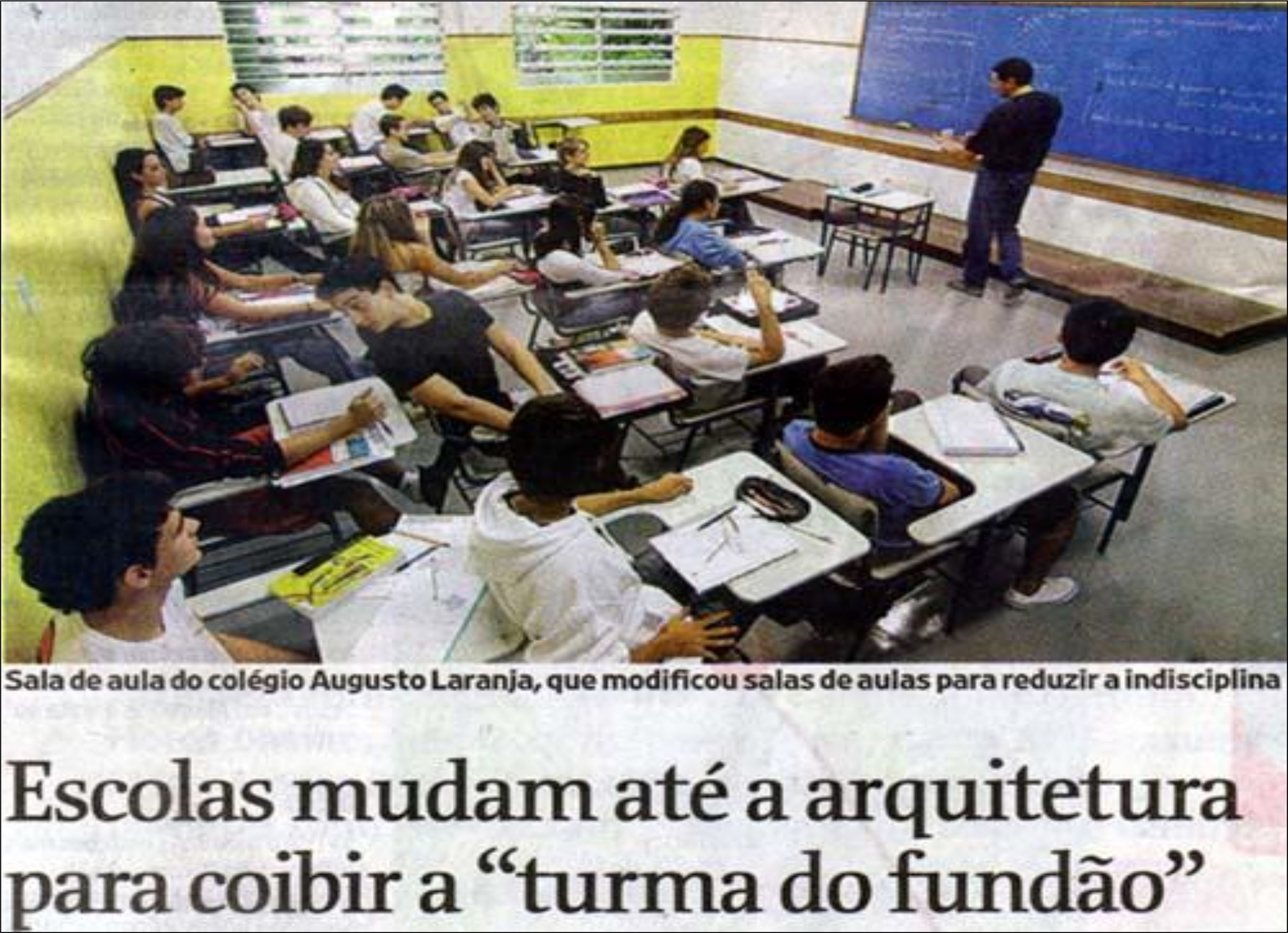
The separation of students by age (and, in some schools, by sex), the arrangement of desks in rows facing the board, the presentation of content in an abstract manner, and activities that follow progressively increasing levels of difficulty by grade are subtle mechanisms of control and surveillance—simple, yet effective—that allow the teacher to deliver the curricular content that must be completed within the time established for the subject.
The distribution of children across the desks seems, at first glance, random; the nature of the teacher’s relationship with each of them, however, gradually outlines a spatial distribution of abilities: in the front desks, the good students, as a form of reward, constitute a ‘front commission’ that ensures the identification of the class as ‘strong’; in the last desk, [...] the ‘lost cases.’ [...] But the front desks do not have a single meaning within the group; they are a reward for those who become docile and can be a punishment for those who do not meet the teacher’s expectations in terms of behavior or task performance
(Patto, 2022, p. 411).
Students are “[...] frequently moved from place to place with the aim of breaking up ‘dangerous coagulations,’” since “[...] the division of students in search of homogeneity is, besides being illusory, dangerous, as it stigmatizes and can prevent, more than allow, school progression” (Patto, 2022, p. 410, 346). This disciplinary surveillance is characterized by a productive economy of body control, since anyone can be the watcher and also occupy the position of example, showing the way forward, teaching the rules, and “[...] if they do not know this, they will be watched, disciplined, taught, made aware, so that they learn to behave without causing major disturbances” (Rocha, 2000, p. 11). It is a type of action that subjugates the other, delimiting how far one can go, what kind of behavior is allowed, and which spaces and positions may be occupied.


The Coordinator of the Pedagogical Coordination Office, in the exercise of their legal attributions, based on Decree No. 64,187 of April 17, 2019, issues the present Ordinance. Art. 1 The in-person support of School Principals, School Directors, and/or Pedagogical Management Coordinators in the routine of Teachers in the classroom is established as a necessary prerequisite. Sole paragraph. The observation of lessons of all teachers in the School Unit must be part of the routine of School Principals, School Directors, and/or Pedagogical Management Coordinators. Art. 2 The objectives of this ordinance are: I – to integrate the school through the articulation of the leadership of the School Principal/School Director; II – to improve classroom practices through observations and notes; III – to bring school management closer to pedagogical practice. Art. 3 Classroom observation must generate a report according to the model to be made available on the Digital School Secretariat (menu: school management, with a link entitled “support instrument”). Sole paragraph. The document must be sent, in digital format, to the Teaching Directorate at the end of the term. Art. 4 The number of classroom observations, followed by a report, must be at least two per week. Sole paragraph. The lesson observation routine should cover as many teachers as possible throughout the school term. Art. 5 The practice of classroom observation must be guided by the following pedagogical assumptions: I – the formative nature of the evaluation of teaching practice; II – the quality of curricular mobilization; III – the appreciation of active learning strategies; IV – the importance of student engagement in the teaching-learning processes. Art. 6 This Ordinance comes into force on the date of its publication
(DOE, Section I, 07/28/2023, p. 36, our emphasis)8.
According to Araújo (2007, p. 32), the “[...] technology of continuous and permanent surveillance functions as a disciplinary operator; it allows control, experimentation, and modification of behavior.” In the contemporary school, it operates as a panopticon, a concept coined by Jeremy Bentham and reinterpreted by Michel Foucault (2014), in which the sensation of constant surveillance and the possibility of being observed at any moment induce individuals to self-regulate their behavior, creating an environment in which self-discipline becomes predominant. This generates conformity in the relationships between students and teachers, aligning with institutional objectives and norms, which, in turn, maintains control and order within the school context. Therefore, the technology of continuous surveillance acts as a device of power that perpetuates discipline and control in the contemporary school.
Technological surveillance refers to technological instruments (such as cameras, identification cards, serial numbers, metal detectors, among others); that is, it includes the sound signals, continuous recordings that control and register actions, and automatic locks that prevent passage or entry. It is a timeless, impersonal form of surveillance, largely tied to the instantaneous, immediate, globalized, and technological society in which we live, with forms of control characterized by subtler and less localized monitoring. Contemporary society is marked by instantaneity, globalization, and technological advancement, reflecting what Deleuze (2000) describes as a replacement of the closed and regulated spaces of disciplinary societies with an open and continuous network of control.
In this new configuration, control operates through technological mechanisms and excessive information that prevent and hinder problematization, regulating behaviors in a silent manner, unlike the visible and structured mechanisms of traditional surveillance.

In this context, the school ceases to resemble the prison described by Foucault, where individuals were rigidly located and monitored through a hierarchical structure of power. In control societies, as pointed out by Deleuze (2000), the pyramidal disciplinary model gives way to more fluid, dispersed, and decentralized mechanisms. The school, in this new scenario, transforms into a space where control is manifested not only through the presence of explicit watchers or the imposition of rigid rules, but through subtle regulatory mechanisms that adapt to the needs of a global and technological society.
Instead of direct and localized surveillance, the school now operates under a regime of continuous modulation, supported by digital technologies, educational platforms, and constant assessment systems, which replace the old architectural forms and regulations. Control extends beyond the school walls, following the individual throughout their life, whether through personal data, algorithms, or merit systems, which adjust behaviors and decisions according to preestablished social standards.
The Normalizing Sanction
For Foucault (2014, p. 154), the normalizing sanction is a mechanism of standardization to ensure that the body does not deviate from the norm, discipline, or obedience, so that “[...] the power of the norm functions easily within a system of formal equality, for within a homogeneity that is the rule, it introduces, as a useful imperative and the result of a measure, the entire gradation of individual differences.”
As in the modern school, in the contemporary school, the processes of normalization produce classifications and hierarchies related to the need to establish criteria for people to conform to parameters considered normal. This creates a regime that, subtly, regulates the behavior of individuals through discourses that assert the premise of equality. In this way, the normalizing sanction aims to align the individual with these normative standards, allowing their classification as they are observed; but, paradoxically, it generates uniformity, depriving singularities of their strength.

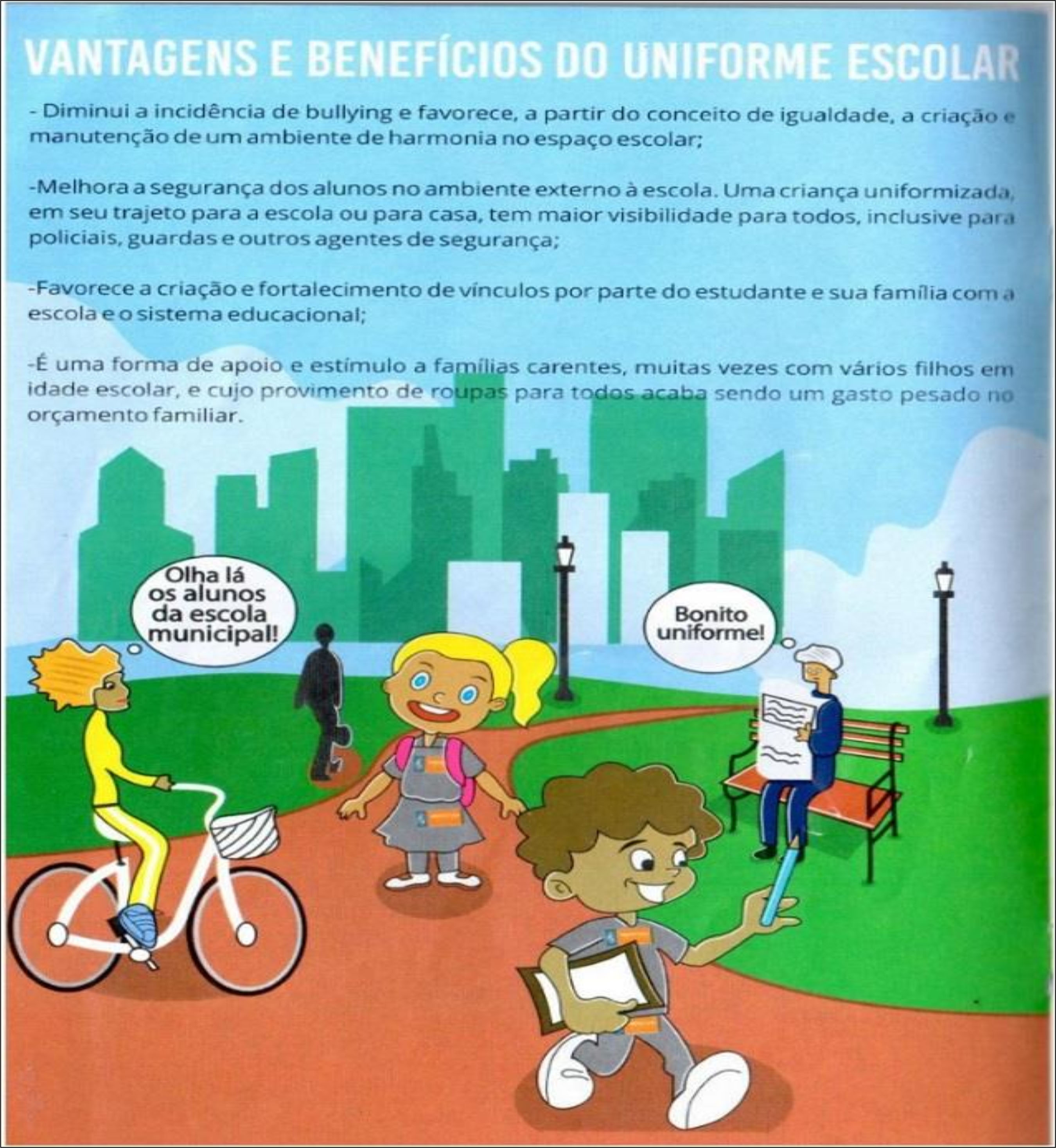
In the case of the School Uniform Manual of the municipal education network of Pelotas/RS, it becomes a regulator of individuals’ conduct, not only regarding dress in accordance with habits of modesty and hygiene, but also in promoting safety. Furthermore, it presents itself as a regime of appearances, a sign that allows the identification and conferral of social belonging and distinction to those who wear it. The normalizing sanction induces ways of being and fixes identities, associating appropriate behaviors that impose sanctions on those who breach the order and rewards on those who comply. It operates on everything considered undesirable and deviating from established conformity, using micro-penalties to maintain institutional normality.

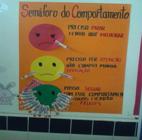
Unlike corporal punishments, in the contemporary school, the correction of deviations occurs through sanctions expressed by penalties manifested through words, glances, deprivations (prohibiting the student from going to recess or participating in their favorite class), sending the student to the principal’s office, summoning the parents, recording warnings, applying suspensions, expulsions, that is, “[...] a whole series of subtle processes, [...] slight deprivations and small humiliations” (Foucault, 2014, p. 149).
According to Silva and Silva (2021, p. 7), “[...] the school we have is heir to a conception marked by processes of uniformization, homogenization, and standardization. And this goes from the school uniform to the evaluation processes.”
To consolidate the legitimization and reproduction of standards, the school spares no effort to silence, make invisible, deny, and fail to recognize diversity.
The Examination
The examination integrates “[...] the techniques of the hierarchy that watches and those of the sanction that normalizes” (Foucault, 2014, p. 154) by imposing mandatory visibility for those who must be seen, in a spatial and temporal ritual, with the arrangement of places and a timed beginning and end, that is, “[...] a normalizing control, a surveillance that allows qualifying, classifying, and punishing” (Foucault, 2014, p. 156).
When the examination aligns with the logic of meritocracy, this dynamic intensifies. Meritocracy asserts that success or failure depends solely on individual merit, ignoring socioeconomic, cultural, and structural contexts that affect individuals’ performance. The examination, in this context, becomes an essential device to validate meritocracy, creating an artificial hierarchy that justifies social inequalities.
Through the examination, the school and other institutions reproduce the idea that those who achieve the best results are, by definition, the most capable, hardworking, and deserving. This reinforces continuous surveillance over individuals, who are classified not only based on their abilities but also according to their conformity to the normative standards imposed by society. Those who meet expectations are rewarded, while those who fall behind are labeled as failures, perpetuating a cycle of exclusion and inequality.
This meritocracy conceals the structural inequalities that favor certain groups to the detriment of others, legitimizing a system that rewards preexisting privileges. Thus, the examination, as a technique of power, serves not only to monitor and normalize, but also to sustain a meritocratic society that masks the real conditions of access and opportunity, maintaining social hierarchies under the guise of justice and neutrality.

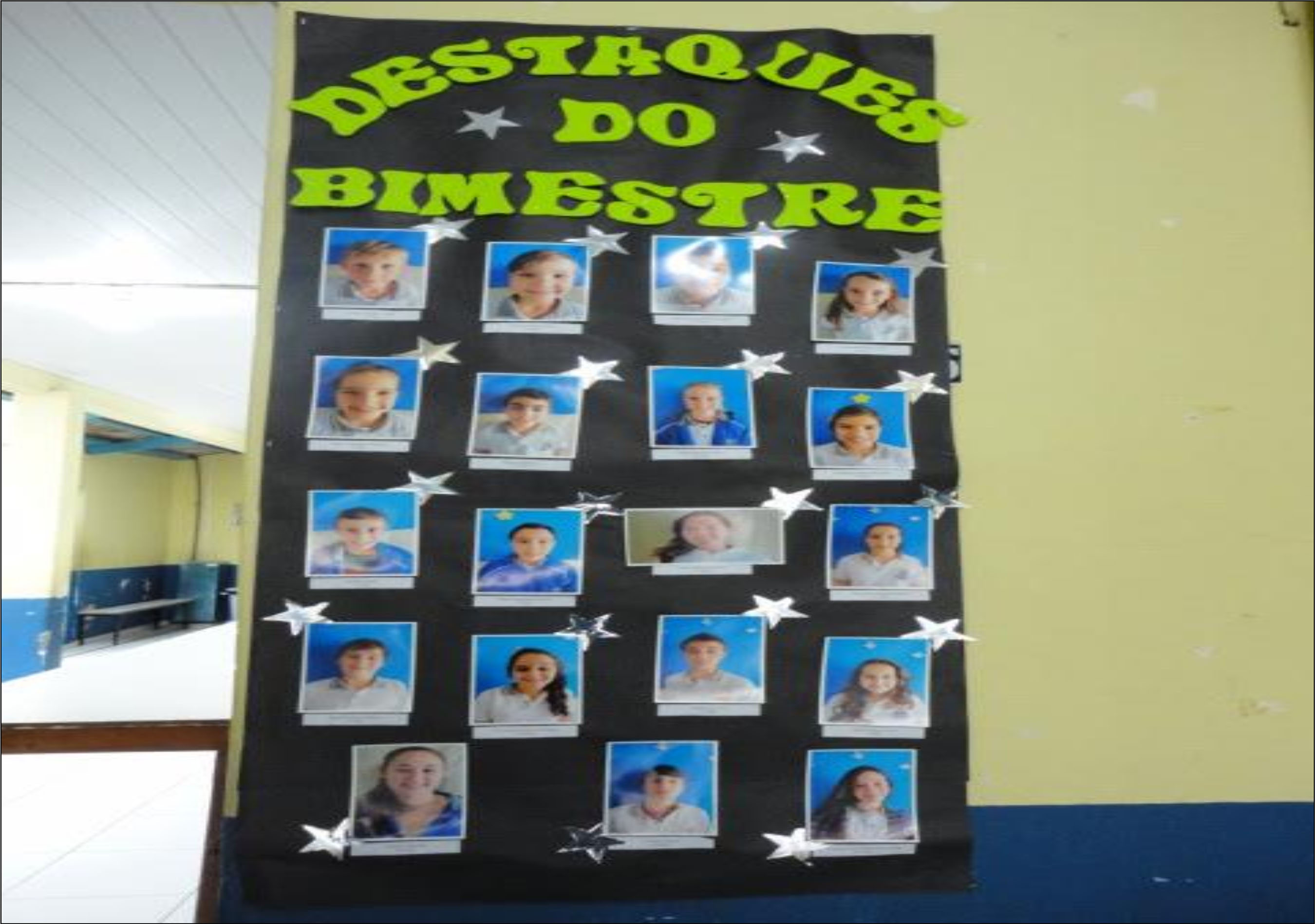
“Outstanding Student 2022” Project delivers 53 bicycles to students from 3rd to 9th grade in the municipal school system of Pinheiro Machado
Whether through reports (on behavior, participation, and performance during classes) or tests with assigned grades, power is documented and the individual is described, analyzed, compared to others, classified, normalized, or excluded. The normalizing society reproduces and justifies itself through practices, discourses, and knowledge that judge the undisciplined and problematic, grounding and reinforcing the hierarchy that produces class inequality.
Student characteristics closely linked to a school process that leads to failure are considered part of the personality or nature of the failing child: ‘the unsuccessful child is not interested in learning,’ ‘the repeatedly retained student is apathetic or aggressive,’ ‘the child from a lower class learns at a slower pace,’ are examples of this inversion. Teachers also tend to assign responsibility to those who are hierarchically subordinate to them; when asked to speak about their students’ school failure, the blame invariably falls on the child and their family
(Patto, 2022, p. 552).
The main national examinations are based on the premise of being a tool for identifying problems and diagnoses that, once identified, can provide actions for educational improvement, guiding decisions, implementing programs, and developing public policies within the scope of education. However, they succumb to mechanisms of control, selection, comparison, competition, training, and classification on a vertical scale. They measure quantitatively and rank in terms of individuals’ ability, level, and nature, constituting devices of segregation to validate and legitimize social processes that exclude and make invisible the supposedly maladjusted individual.


Folha de S. Paulo: Students from Sobral, Ciro’s hometown, report pressure to cheat on exams
The examination continues to play a central role in perpetuating power relations, as a fundamental instrument of governance in contemporary school institutions.
In educational terms, it can never be repeated enough: what is new is making evaluation a technology of economic inspiration that not only classifies, segregates, positions, and hierarchizes, but also teaches, promotes, and naturalizes social classification, segregation, positioning, and hierarchization. It is enough to understand these innovations to understand why evaluation has become a beacon for the curriculum
(Veiga-Neto, 2012, p. 12).
In this way, archaeological analyses based on Varela and Alvarez-Uria (1995) and Foucault (2014) enabled us to distinguish the layers that have been sedimenting over time—disciplinary practices of control and power, which, despite undergoing updates, are still present in the contemporary school.
Hoping for the School...
[...] the art of presenting is not only the art of making something known; it is the art of making something exist; the art of giving authority to a thought, a number, a letter, a gesture, a movement, or an action; and, in this sense, it brings this something to life
(Masschelein; Simons, 2013, p. 35).
Masschelein and Simons (2013) help us think about education today, pointing out that, within governability, we can create other spaces, other deviations, other paths, and new ways of relating. Therefore, if contemporary schools follow and reproduce models and patterns that have spanned generations and are still present in the school context, in the 21st century, it is necessary to create heterotopias—spaces/times of creation, other ways of living, artistic, philosophical, and inventive—that promote other perceptions and experiences, in the challenge of renewing and innovating teaching, enhancing multiple possibilities for learning, so that “[...] the school routine becomes a space for building the autonomy of teachers and students” (Gallo, 2002, p. 166).
Thus, approaching the school in a heterotopic way, a lieu sans lieu [a place without a place]—refers to envisioning different spaces and transforming the school into a place of instituting relationships, not predetermined, not customary, but inventive, multiple, even if through gaps. It is about making the school and the classroom an authentic place of possibilities, a form of presence and the creation of a utopia of the future. To this end, it is necessary to give voice to learning experiences as the experience of being-in-the-middle.
In this sense, to say that the school is a place of possibility means to say that the school is the means to create another reality, a forthcoming reality. But the possible is not necessarily futuristic. Reality is always possibility, because it is inexhaustible in itself. [...] That which is latent is that which is in waiting, like life in the seed, and which, at a given moment, under the appropriate conditions, will become manifest
(López, 2017, p. 229).
The experience that places us in the in-between of things, in the course of life, allows for eruptions, so that new courses become possible. In this context, offering students a school experience means providing perceptions, listening, and visions that stimulate problematizing thinking. It is essential to make space for the voices of children to resonate. To this end, the school needs to break with occupied and controlled time, suspending it to propose free time, a moment of suspension, open to questions that lead students to ask themselves: “What do I see? What do I think about this? What do I do with this?” (Rancière, 2007).
A walk outside of measured time, a time that does not suffer delay. It consists of long conversations and learnings that occur through attentional modes capable of mapping the movements of experience. This experience takes place in the events that traverse us through affections, creating a nomadic journey of learning. Such learnings leave familiar places to be on the lookout, to see and think about the world in other ways, discovering other ways of inhabiting the world.
Walking means shifting the gaze so that we can see in a different way, so that we can see the visible (distant things, viewpoints, open spaces, perspectives that open along the path are visible, not hidden, not beyond here), and in a way that allows us to be transformed. This is what walking consists of: a displacement of the gaze enabled by experience, a passive submission (receiving orders from the path) and, at the same time, a (active) sketch of the path. [...] What gives meaning to walking is the possibility of looking beyond any perspective, a vision or a gaze that transforms us (and, therefore, is an experience) while we are subject to what we see. [...] The important thing in walking is to set this subject and this position in motion. Walking is an ex-position, a being outside the position
(Masschelein; Simons, 2014, p. 43).
For Larrosa (2002), experience is what passes through us, what happens to us, what touches us. For this reason, a class consists of “[...] paths of affections through chronos and aion times, which interpenetrate in the intersection of the uses of times and the times in use” (Marques, et al., 2020, p. 90). Therefore, experience is singular; it constitutes knowledge that cannot be experienced in the same way by two people, even when encountering the same content. We can then understand that there are things that cannot be taught, but that happen in the teaching and learning process—things that consist of touching and being “[...] touched by the signs of the world, creating their own landscapes, thus reorganizing their patterns of understanding the world and life” (Silva; Marton, 2012, p. 138).
In this way, the classroom needs to be constituted as a living space, of encounter, shared experiences, authorship, feeling, thinking, deconstruction, and new ways of being and existing in the world, where each person can experience knowledge through experiences that foster learning and translate the signs of the world from their own perspectives. It is necessary to conceive the school and the classroom as meeting places for the expression of inquietudes and concerns, which question and view the things of the world from different perspectives—a way of interrogating so that something can happen, appear, unveil itself, and become visible. The importance of recognizing the set of practices and symbolic expressions that are intimately related to different lifestyles, cultural and economic conditions, and the varied expectations for the future, concerns, and interests of the students is emphasized here. Only in this way is it possible to build another school.
The problem is that, in general, we think about Foucault’s critique of the school institution. And if we take Foucault’s critique of the school institution as the standard of what education is, we could hardly speak of practices of freedom in education, because we would see education as this ‘conformation of the subject,’ as this ‘external construction’ of the subject according to certain social principles and molds. But if we think of education as one of those instruments of care of the self, we can also see in the educational process this way in which the subject cultivates themselves. We can see in the educational process not only a process of transmitting knowledge, this extremely content-focused education we are used to seeing; this education that always has an external objective to the subject [...], which is to finish elementary school, complete high school, pass a college entrance exam, complete a university degree, and enter the job market [...]. There is always an external objective placed on the educational process, and very rarely do we think of the educational process as an effective process of building the subject, in which the goal is the subject cultivating themselves through this educational process. But if we focus on these works of the later Foucault [...], what we will discover is precisely the possibility of thinking of education as this process of self-cultivation, of caring for oneself
(Gallo, 2011, DVD).
We need to definitively cut the roots that still maintain the residues of this colonizing school, which, historica ly, was an instrument of control, discipline, and biopower in the service of a colonization that sought to civilize bodies and minds according to Eurocentric values, excluding the knowledge of the original and enslaved peoples, considering them savage bodies.
In view of the above, it is necessary to create an educational project intertwined with a pedagogy that breaks with forms of colonization that produce material and symbolic violence against children from disadvantaged classes, sustained by a pedagogy that perpetuates itself in a dissimulated manner under an educational agenda governed by the false justification of social equality, which in no way promotes equal rights. Only in this way will it be possible to speak of “[...] liberty, fraternity, and equality!” since, until now, these words are nothing more than discursive fallacies, producing statements that fall into the void of an unequal liberalism.
As an attempt to transpose the content-focused logic and to deviate from the mechanization, reproduction, and hierarchization that regulate, control, and monitor the teaching and learning process—and that occupy time in a merely productivist bias, little or nothing inventive—this article invites its potential readers to rethink another school: a common and fertile space that enables singular and collective experiences. It is in this sense that the invitation is established: to interrogate what had already been seen or believed, breaking “[...] with the ways of thinking and living of one’s time, by not accepting the tyranny of the established [...] and living fully open to revolutionizing an educational and social reality marked by exclusion and submission” (Kohan, 2013, p. 61).
Small Considerations – or, perhaps... not to conclude...
With this writing, our aim was to intertwine dialogues and new school perspectives, creating a network that connects relationships in the school as a sharing of the sensible (Rancière, 2009). It is not about structuring ready-made recipes or outlining mechanical steps to build an ideal school, but rather about challenging the ways in which education has been constructed so that we can think of ways to reinvent it based on lived experiences, shared affections, and the listening to the subjectivities that inhabit the school space.
It is a bet on a pedagogy that recognizes students as subjects of knowledge, capable of problematizing their social and historical realities, and of producing alternative meanings for their existences. It is, therefore, about opening fissures in the dominant school model, guided by control, normalization, and the reproduction of inequalities, to imagine and experiment with an education that creates space-time for emancipation, for the aesthetic creation of self and world, and that restores to the subjects the right to look—that is, the right to see, feel, and think beyond the social positions that are preassigned to our students. Are there schools like this? This is the question we propose to map: to trace practices, listen to voices, and welcome gestures that indicate the potential of another possible school. A school less guided by the fear of error and more led by the desire to learn in order to transform.
Notes
-
1
Structured through General Competencies, Specific Competencies of Components and Thematic Units, Object of Knowledge, and Skills, the BNCC follows an approach according to which the belief is that, by starting from the Objects of Knowledge and Skills, the Specific Competencies of each component are developed, reaching the Specific Competencies of each Area and culminating in the acquisition of the General Competencies.
-
2
In contemporary Sociology, meritocracy is defined as a system characterized by hierarchization and political neutrality, in which social positions are occupied based on individual merit, this being measured and certified through exams or diplomas (Bilhim, 2009).
-
3
Available at: https://www.brasildefato.com.br/2023/07/24/como-a-terceirizacao-e-a-uberizacao-precarizam-as-condicoes-de-vida-dos-trabalhadores. Accessed on: July 27, 2023.
-
4
Available at: http://www.emdialogo.uff.br/content/escolas-mudam-arquitetura-para-coibir-turma-do-fund%C3%A3o. Accessed on: August 13, 2023.
-
5
Available at: https://www.bandab.com.br/geral/com-objetivo-de-combater-pequenas-corrupcoes-professor-universitario-faz-analogia-e-foto-viraliza/. Accessed on: August 13, 2023.
-
6
Available at: https://br.pinterest.com/pin/10836855332340899/. Accessed on: August 13, 2023.
-
7
Available at: http://ebpicf.blogspot.com/2013/08/mural-dos-alunos-destaques-do-2-bimestre.html. Accessed on: August 13, 2023.
- 8
-
9
Available at: https://www.aen.pr.gov.br/Noticia/Tecnologia-de-reconhecimento-facial-na-chamada-chega-16-mil-colegios-da-rede-estadual. Accessed on: August 15, 2023.
-
10
Available at: https://www.colegioweb.com.br/noticias/rj-aluno-e-impedido-de-entrar-na-escola-por-usar-guias-de-candomble.html. Accessed on: August 31, 2023.
-
11
Available at: https://www.jornaltradicao.com.br/pinheiro-machado/educacao/projeto-aluno-destaque-2022-entrega-53-bicicletas-para-alunos-de-3o-a-9o-ano-da-rede-municipal-em-pinheiro-machado/. Accessed on: September 6, 2023.
-
12
Available at: https://opopular.com.br/cidades/alunos-dizem-que-escola-os-impediu-de-fazer-prova-brasil-1.1382344. Accessed on: September 6, 2023.
-
13
Available at: https://www1.folha.uol.com.br/poder/2018/09/estudantes-de-sobral-berco-de-ciro-relatam-pressao-para-fraudar-provas.shtml. Accessed on: September 6, 2023.
Availability of research data
the dataset supporting the results of this study is published in this article.
References
- ARAÚJO, Inês Lacerda. Sujeito e cultura: vigiar e punir ou educar? Revista Educação – Especial Foucault Pensa a educação, n. 3, p. 26-35, 2007.
- BILHIM, João Abreu de Faria. Teoria Organizacional: estruturas e pessoas. Lisboa: ISCSP, 2009.
- BRASIL. Base Nacional Comum Curricular Brasília: Secretaria da Educação Básica, 2017.
- CALVINO, Ítalo. Cidades Invisíveis São Paulo: Companhia das Letras, 1990.
- CASTRO, Edgardo. Introdução a Foucault Belo Horizonte: Autêntica, 2014.
- CURY, Carlos Roberto Jamil. As categorias. In: CURY, Carlos Roberto Jamil. Educação e contradição: elementos metodológicos para uma teoria crítica do fenômeno educativo. São Paulo: Cortez, 1995. P. 55-85.
-
DELEUZE, Gilles. Post-Scriptum sobre as Sociedades de Controle. L'Autre Journal, n. 1, maio de 1990. Texto extraído de Conversações. Rio de Janeiro: Editora 34, 2000. Disponível em: https://historiacultural.mpbnet.com.br/pos-modernismo/Post-Scriptum_sobre_as_Sociedades_de_Controle.pdf Acesso em: 24 set. 2024.
» https://historiacultural.mpbnet.com.br/pos-modernismo/Post-Scriptum_sobre_as_Sociedades_de_Controle.pdf - FOUCAULT, Michel. Arqueologia do saber Rio de Janeiro: Forense universitária, 2012a.
- FOUCAULT, Michel. Ditos e Escritos – Ética, Sexualidade e Política – vol. V. Rio de Janeiro: Forense Universitária, 2012b.
- FOUCAULT, Michel. O corpo utópico, as heterotopias São Paulo: n-1 Edições, 2013.
- FOUCAULT, Michel. Vigiar e punir: nascimento da prisão. Petrópolis: Vozes, 2014.
- FOUCAULT, Michel. Microfísica do Poder São Paulo: Paz e Terra, 2021.
- GALLO, Silvio. Repensar a educação: Foucault. Revista Filosofia, Sociedade e Educação, Ano I, n. 1, p. 93-118, 1997.
- GALLO, Silvio. Em torno de uma Educação Menor. Educação & Realidade, Porto Alegre, Rio Grande do Sul, v. 27, n. 2, p.1-10, jul./dez. 2002.
- GALLO, Silvio. Biopolítica e subjetividade: resistência? Educar em Revista, Curitiba, n. 66, p. 77-94, out./dez. 2017.
- GALLO, Silvio; ASPIS, Renata Lima. Foucault e a educação Coleção Filósofos e Educação. São Paulo: Paulus, 2011. 1 DVD (60min), widescreen, color.
- GUATTARI, Félix; ROLNIK, Suely. Micropolítica: cartografias do desejo. Petrópolis, RJ: Vozes, 1996.
- GUILHERME, Alexandre Anselmo; PICOLI, Bruno Antonio. Escola sem Partido-elementos totalitários em uma democracia moderna: uma reflexão a partir de Arendt. Revista Brasileira de Educação, v. 23, 2018.
- KOHAN, Walter. O mestre inventor–relatos de um viajante educador São Paulo: Autêntica, 2013.
- LARROSA, Jorge. Notas sobre a experiência e o saber de experiência. Revista brasileira de educação, São Paulo, n. 19, p. 20-28, jan./fev./mar./abr. 2002.
- LÓPEZ, Maximiliano Valerio. Filmar a escola: teoria da escola. In: LARROSA, Jorge. Elogio da escola Belo Horizonte: Autêntica editora, 2017. P. 225-234.
- MARQUES, Luciana Pacheco et al. Sobre temposespaços e conhecimentos curriculares: indícios e narrativas de escolas inovadoras. Revista Educação Online, v. 15, n. 33, p. 68-91, jan./abr. 2020.
- MASSCHELEIN, Jan; SIMONS, Marteen. Em Defesa da Escola: uma questão pública. Belo Horizonte: Autêntica, 2013.
- MASSCHELEIN, Jan; SIMONS, Marteen. A pedagogia, a democracia, a escola Belo Horizonte: Autêntica, 2014.
- NEITZEL, Odair; SCHWENGBER, Ivan Luís. Os conceitos de capacidade, habilidade e competência e a BNCC. Revista Educação E Emancipação, v.12, n. 2, p. 210-227, maio/ago. 2019.
- PATTO, Maria Helena Souza. A produção do fracasso escolar: histórias de submissão e rebeldia. São Paulo: Instituto de Psicologia da Universidade de São Paulo, 2022.
- PELOTAS. Manual do uniforme escolar Prefeitura Municipal de Pelotas, 2015.
- PENNA, Fernando. Sobre o ódio ao professor: entrevista com Fernando Penna. Movimento-Revista de educação, n. 3, 2015.
- RANCIÈRE, Jacques. O mestre ignorante. Cinco lições sobre emancipação intelectual. São Paulo: Autêntica, 2007.
- RANCIÈRE, Jacques. A partilha do sensível: estética e política. São Paulo: Editora 34, 2009.
- ROCHA, Cristianne Maria Famer. Espaços escolares: nada fora do controle. In: CONGRESSO BRASILEIRO DE HISTÓRIA DA EDUCAÇÃO. EDUCAÇÃO NO BRASIL: HISTÓRIA E HISTORIOGRAFIA, 1., 2000, Rio de Janeiro: UFRJ. Anais [...] Rio de Janeiro, 2000.
- ROCHEFORT, Christine. Los niños primero Barcelona: Anagrama, 1982.
- SILVA, Dagmar de Mello e; SILVA, Leiliane Domingues da. Por que precisamos falar de inclusão? Diálogos e Diversidade, v. 1, p.1-10, 2021.
- SILVA, Dagmar de Mello e; MARTON, Silmara Lídia. Autoformação e experiência sensível em ‘Filosofia com crianças’. Revista Sul-Americana de Filosofia e Educação (RESAFE), n. 18, p. 124-141, maio/out. 2012.
- VARELA, Julia; ALVAREZ-URIA, Fernando. Arqueología de la escuela Madrid: Las ediciones de la piqueta, 1995.
- VEIGA-NETO, Alfredo. Currículo: um desvio à direita ou Delírios Avaliatórios. In: X COLÓQUIO SOBRE QUESTÕES CURRICULARES E VI COLÓQUIO LUSO-BRASILEIRO DE CURRÍCULO, 2012, Belo Horizonte: UFMG. Anais[...]. Belo Horizonte: 2012. P. 1-17.
-
Editor in charge:
Iana Gomes de Lima

 Source: Website
 Source: Website
  Source: Website
  Source: Website
  Note: Through the combination of artificial intelligence and biometrics, attendance recording is done via images sent to Celepar (Information and Communication Technology of Paraná), reducing roll call time (on average 5 minutes), enabling more accurate recording, and preventing the risk of someone answering roll call on behalf of another person. Source: Website
  Source:
  Source: Website
  Source: Website
  Source: Website
  Source: Website