 Partnerships in Education in the State of Minas Gerais: a study on the Trilhas de Futuro Program
ABSTRACT
Over the past decades, the State Department of Education of Minas Gerais has established public-private partnerships across all levels and modalities of education within the state education system. This article aims to analyze the Trilhas de Futuro Program within the scope of the Regional Superintendency of Education of Pouso Alegre/MG, with a focus on educational policies shaped through public-private partnerships. This is a qualitative research study, grounded in the analysis of legislation, official regulations, and public calls for proposals. The study concludes that the Trilhas de Futuro Program represents an educational policy that follows a clear path toward privatization, characterized by the transfer of public funds to private entities.
Keywords
Trilhas de Futuro Program
; Technical and Vocational Education; Public-Private Partnerships; Educational Public Policy
RESUMO
A Secretaria de Estado de Educação de Minas Gerais estabeleceu nas últimas décadas parcerias público-privado na rede estadual em todos os níveis e modalidades de ensino. O objetivo do artigo é fazer uma análise do Programa Trilhas de Futuro no âmbito da Superintendência Regional de Ensino de Pouso Alegre/MG, considerando as políticas educacionais feitas por parcerias público-privada. Trata-se de um estudo que envolve os procedimentos metodológicos de análise da legislação, regimentos e editais e se configura como uma pesquisa qualitativa. Conclui-se que o Programa Trilhas de Futuro é expressão de uma política educacional que percorre o caminho da privatização em um nítido processo de transferência do fundo público para a iniciativa privada.
Palavras-chave
Programa Trilhas de Futuro; Ensino Técnico e Profissional; Parcerias Público e Privada; Políticas Públicas Educacionais
Introduction
The businessman Romeu Zema, from the Partido Novo, took office as governor of Minas Gerais in 2019. The recently founded party deliberately makes explicit its political, economic, and ideological views, which are oriented toward the free market, a morally conservative agenda, and the defense of a minimal state. The Partido Novo believes that the state is not capable of providing public services with the same efficiency and effectiveness as the private sector and advocates for a process of privatizing public services and implementing public-private partnerships as private solutions for public services. In this context, since the beginning of the current administration, the State Department of Education of Minas Gerais (SEE/MG) has established several partnerships with foundations, institutes, and non-governmental organizations to operate in various areas, such as school management and curriculum programs in the state school system. The position of the Partido Novo regarding education, as outlined in the government plan presented during the campaign, reveals the state government's clear commercial intentions for education in Minas Gerais, such as the well-known voucher system: "[...] scholarship programs in private schools for public school students and the expansion of technical and vocational education" (Partido Novo, 2018).
Education in Minas Gerais is a pioneer in the tradition of public-private partnerships, and in recent years, several educational consultancies from third-sector institutions have emerged. These include the Fundação de Desenvolvimento Gerencial (FDG), focused on elementary education; Instituto Unibanco, which proposes school management strategies for high school education; Instituto de Corresponsabilidade pela Educação (ICE), which works with full-time high school education based on the pedagogical model of the “Escola da Escolha” (School of Choice); Instituto Iungo, which supports teacher training during the implementation of the New High School curriculum; and the SOMAR Project, which aims to establish partnerships with civil society organizations for the comprehensive management of state schools. In addition to these partnerships, there is the Mãos Dadas (Hand in hand) Project, which aims to transfer responsibility for elementary education from the state to interested municipalities, encouraged by financial transfers from the state government to the municipal level. Finally, with the goal of expanding vocational education, the Trilhas de Futuro program was created in 2021.
The Trilhas de Futuro Program was established by Resolution SEE/MG 4.583/2021 as a high school level technical vocational education program (Brasil, 1996), and it is justified by its meeting with the State Education Plan of Minas Gerais requirements (PEE/MG). On June 16, 2021, in a press conference held for major media outlets across the state, the government of Minas Gerais announced the expansion of vocational education.
Minas Gerais is making progress in both the quality of education offered to students and the provision of vocational training for young people in the state. Through the Trilhas de Futuro program, the Government of Minas will expand the number of free spots in vocational education. The program, launched on Wednesday [June 16], is the result of a joint effort between the State Departments of Education (SEE/MG), Social Development (Sedese), and Economic Development (Sede). In addition to Governor Romeu Zema, the launch event was attended by the Secretary of Education, Julia Sant’Anna; the Secretary of Economic Development, Fernando Passalio; and the Undersecretary of Labor and Employment from Sedese, Raphael Vasconcelos
(Governo..., 2021b).
The PEE/MG (State Education Plan of Minas Gerais), established by Ordinary Law No. 23.197 of December 26, 2018, sets the goals for state education for the period between 2018 and 2027. Regarding Technical and Vocational Education, the goal 11 of the PEE/MG aims at the “Expansion of upper secondary technical and vocational education, tripling the number of enrollments, ensuring the quality of the provision and the expansion of at least 50% of this service within the public sector” (Minas Gerais, 2018).
The funding for the Trilhas de Futuro Program comes from public resources of the State of Minas Gerais. The funds transferred to private institutions originate from the State Share of the Education Salary Tax (QESE) and the Fund for the Maintenance and Development of Basic Education and the Valorization of Education Professionals (FUNDEB), amounting to R$ 790,437,396.45 between November 2021 and December 2022. The fund’s constitutional purpose is to finance actions for the maintenance and development of public basic education. Thus, by transferring FUNDEB resources to private institutions, the government chooses to go against the PEE/MG and not invest in its own public education network. Moreover, it immediately prioritizes the provision of a significant portion of technical and vocational education through the private sector, clearly adopting an outsourcing model for public educational services.
The State Department of Education (SEE) is structured into 47 Regional Superintendencies of Education (SRE), geographically distributed throughout the state. The Trilhas de Futuro Program is present in 45 of these superintendencies. For the present study, the partnerships established within the jurisdiction of the Regional Superintendency of Education (SRE) of Pouso Alegre, located in the southern region of Minas Gerais, were selected in its first edition, considering the greater convenience and ease of access to data and partner institutions.
In the first accreditation process, the SRE Pouso Alegre established partnerships with six educational institutions, filling 2,240 slots across four different municipalities. All partnerships were made with private educational institutions: SENAI (units in Pouso Alegre, Santa Rita do Sapucaí, and Extrema), SENAC (Pouso Alegre), Colégio Nilta D’Onófrio de Carvalho (Cambuí), and the School of Development and Business Excellence – ENDEX (Pouso Alegre). Two institutions offer the nursing technician course in the evening. The other four, which are part of the “Sistema S,” offer courses in various technological fields, such as industrial production, information and communication, management and business, among others.
The general objective of this research is to analyze the public-private partnership policy for promoting vocational education through the Trilhas de Futuro Program. Thus, the guiding research question for this study is: have the public-private partnerships established through the Trilhas de Futuro Program fostered a process of privatization of education in Minas Gerais and the transfer of public funds to the private sector, thereby distorting the nature of public education and its social function?
The relevance of this research on vocational education carried out through partnerships between the public sector and private initiative lies in the growing importance and prioritization of vocational education in Brazilian education legislation. This trend has justified various government projects that promote different types or forms of education privatization.
For the methodological procedures, bibliographic and documentary research was conducted, along with an exploration of public sources issued by the State Department of Education, the State Department of Finance, and the State Department of Planning and Management. These sources include resolutions, legislation, regulatory public acts, accreditation notices, financial data, and statistical information. Therefore, this is a qualitative research study.
During the administration of businessman Romeu Zema, Minas Gerais deepened its educational partnerships with the private sector in areas such as curriculum organization and education management across all levels and modalities of education. This demonstrates that public vocational education is not only undergoing a process of regression through outsourcing but is also being used as a means to appropriate (divert) public funds, a practice that is even legitimized by the goals established in the PEE/MG itself.
State, Education and Neoliberalism
In Gramsci's conception, the State, as a promoter of public policies, is established in its relationship with civil society (Gramsci, 2001; Farias, 2022). According to Liguori (2017), the State manifests itself in a narrow sense as a constituted political power articulated with civil society, that is, it is constituted beyond the political sphere itself, engaging in a dialectical relationship with civil society, forming the conception of the Integral or Expanded State (Farias, 2022).
Thus, the “State, in the Gramscian construction, is a social relationship; it is the expression of social relations of production and the materialization of the projects by the bloc in power” (Farias, 2022, p. 2). The Expanded State allows us to uncover the interests of different groups and classes in the struggle for hegemony, as a way to determine its direction in serving their respective demands and political agendas. In this way, the State in its narrow sense is revealed in the relationship between political society and civil society, as “[...] hegemony armored by coercion” (Liguori, 2017, n. p.).
From this perspective, driven by hegemonic disputes, State reforms aim to transform the state apparatus according to the ideologies of the ruling classes in power. The neoliberal State Reform in Brazil, which began under President Fernando Henrique Cardoso (1995–1998), gained popular support fueled by his role in the creation of the Real Plan. The Master Plan for the Reform of the State Apparatus (PDRAE), conceived by Bresser-Pereira (2017), then Minister of Federal Administration and State Reform (MARE), was carried out under the justification of increasing the efficiency and effectiveness of State bodies and agencies, improving the strategic capabilities of the government, and ensuring the democratic foundations of public administration (Araújo; Castro, 2011).
The PDRAE transforms the social role of the State and the way it is managed by adopting mechanisms typical of corporate management, a model referred to as managerial administration or managerialism. The shift from viewing individuals as users of public services to treating them as clients aligns with the principles of commercial administration, positioning the citizen as a consumer of public services and undermining the concept of the public as the very purpose of those services. This creates a new notion of “public”, the non-State public. According to Freitas (2014), this is not merely an economic change, but the introduction of an ideology that penetrates the core of the State, redefining how the state apparatus is managed and how private interests are integrated into the public sector.
Neoliberalism has expanded into all dimensions of social life in the contemporary world. Neoliberal ideology functions as a strategy of resistance against socialist political perspectives and the welfare state. Its integration into daily life and popular culture gains strength and followers through the supposed efficiency of private enterprise, masking its true goal: the private appropriation of the State and public funds. As such, neoliberal ideology spreads across all dimensions of social relations and becomes deeply embedded even within the working class itself, which begins to adopt the notion of the “economic man,” rooted in ideas of efficiency, effectiveness, and entrepreneurship. The result is a shift of responsibility away from the State in regard to job creation and investment in social policies.
Educational reforms in Brazil during the 1990s, inspired by the World Conference on Education for All in Jomtien (Thailand), more strongly embraced the idea of public education as a tool for promoting economic development in peripheral countries (Filho et al., 2015). The World Bank began to intervene directly in the formulation of national policies and to influence educational legislation. At the same time, large corporations increasingly took control of basic education on multiple fronts. According to Piolli (2019), the commodification of education subjects public education to the terms of Capital, so that education serves as an instrument of accumulation.
Neoliberal conceptions permeate all educational policies. Numerous mechanisms of intervention and appropriation of education are employed with the aim of dismantling public schools. Major corporate groups have actively participated in the formulation of educational policies. As Leher (2021, p. 13) states: “[...] the high command of capital engages in political processes precisely to ensure governments that align with its class interests and, thereby, secure its particularist objectives”. In this way, the business sector seeks to influence the very genesis of educational policies to ensure that the public sector acts in favor of private interests. Leher further adds that:
[...] the same is true regarding the private hegemony apparatuses of economic groups (APHe) operating in the educational sector: their goal is to achieve the highest possible degree of hegemony over society as a whole and, necessarily, over state affairs related to education. Therefore, directly and indirectly, they seek to influence governments to engage in education in accordance with their class interests
(Leher, 2021, p. 13).
The promotion of the ideology of entrepreneurship and employability, the proposal of competency-based pedagogy, standardized minimum curricula, large-scale assessments, among other aspects of the neoliberal discourse, actually represent the preparation of basic education for widespread privatization. They appropriate educational policies so that public schools, as providers of public services, carry out pedagogical work tainted by neoliberal ideology, indoctrinating students according to the narrowest precepts of the bourgeoisie.
Partnerships and Vocational Education in Minas Gerais
The context of the privatization of education in Minas Gerais is marked by the 2018 election scenario, characterized by polarization between right- and left-wing political forces. This polarization stemmed from the political, legal-parliamentary, and media-driven coup of 2016, which led to the political imprisonment of former president Luiz Inácio Lula da Silva (PT) in April 2018. This situation served as fuel to ignite a wave of attacks against the Brazilian left. Driven by social media and the spread of anti-PT sentiment, the Brazilian right, especially the far-right movement, gained prominence and occupied a significant space in the national political scene (Freitas, 2018; Caetano; Peroni, 2022). Another important contextual factor was the rise of the global far-right, particularly the election of Donald Trump in the United States (2017–2021), which had a strong influence on Brazilian politics. As a result of this context, Jair Messias Bolsonaro of the Liberal Party (PL) was elected President of the Republic, defeating Fernando Haddad of the Workers’ Party (PT), and the businessman Romeu Zema Neto of the Partido Novo was elected governor of the state of Minas Gerais.
For his candidacy, Romeu Zema presented a government plan for the electoral race, aligned with the internal rules and statute of the Partido Novo. The government plan appealed to the marketing slogan Liberty, Even if Late, referencing the heroic deeds of the Inconfidentes who fought for the freedom of Minas Gerais during the colonial period. This invoked a liberal-republican symbolism, promising voters that Minas Gerais would free itself from the so-called “old politics”. Explicitly, the government plan clearly demonstrates a neoliberal stance, stating that the party is made up of people of unquestionable honesty and believes that “[…] governments have harmed society due to their excessive interference and lack of integrity” (Partido Novo, 2018, p. 4). This reveals an electoral process marked by the mass political-ideological education of the population of Minas Gerais around neoliberal values and the defense of rescuing the state from the hands of previous governments, which, in the candidate’s view, had harmed the state.
The concepts of bourgeois democracy and freedom, defended and expanded by neoliberalism, have been framed as the solution to the social problems caused by the State. This logic is evident across all five pillars of the government plan: State Management; Wealth Generation, Health, Public Security, and Education (Partido Novo, 2018, p. 5). Furthermore, it presents proposals grounded in the Minimal State model, which results in policies of concessions, privatization programs, and public-private partnerships. Another noteworthy aspect is the intention to discredit previous administrations, emphasizing the issue of corruption and highlighting the numerous shortcomings of past governments in managing the State.
The PEE/MG (2018-2027) is considered a reference point for the implementation of educational policies (Pereira; Valente, 2021), setting goals for all levels of state education and aligning with the National Education Plan (PNE). The PEE/MG addresses Technical and Vocational Education at the Secondary Level (EPTNM) in its goal 11, recommending a tripling of enrollments in this modality, with half of these to be in the public sector (Minas Gerais, 2018). Its goals and indicators span the entire public education system, establishing strategies for early childhood education, elementary education, regular high school, full-time education, technical and vocational education, as well as higher education. The strategies defined also emphasize the importance of specialized educational services, youth and adult education. Additionally, the plan covers different areas of education such as funding, teacher training, democratic management, formal indicators of public education quality, and school performance benchmarks. It is within this context that the Minas Gerais state government seeks to adapt education to the expectations of its political supporters, according to its political-partisan convictions.
The path chosen by the government to achieve the goals outlined in the PEE/MG was to follow a privatization-oriented approach. While education in Minas Gerais has a tradition of developing policies through public-private partnerships and has historically maintained such collaborations, the state has now signed contracts that establish the direct involvement of private organizations, foundations, and educational institutions, whether through consulting services or educational offerings, across all levels and modalities of education. This was previously a responsibility strictly reserved for the state education system, and now represents a specific form of public education privatization in Minas Gerais.
Garcia (2019) argues that the privatization of education occurs not only through the transfer of ownership but also through the delegation of responsibility for service delivery and the adoption of business-style management practices. Following the dimensions and forms of private participation in public education as systematized by Adrião (2018), Chart 1 presents a summary of educational programs and projects initiated and managed by the private sector, via organizations, foundations, and third-sector institutes maintained by major private sector groups, categorized by educational stages and modalities.
Private partners operate within the educational segments of the state public school system, offering school management methods and processes, organizational and curricular designs, work methodology models or parameters, and even taking over the educational management of public schools themselves. They assume responsibility for implementing public policies, with promises of improving the quality of public education.
The public education policies in Minas Gerais are aligned with a government plan that has clear neoliberal objectives and a market-driven ideology. These policies are carried out with significant financial support from public funds, over R$ 15 billion in 2022 alone. One example is the voucher policy, presented as a strategy to improve the teaching process, though it has not yet been implemented. In this perspective, schools are no longer seen as spaces for public education, but are instead limited to the narrow purpose of developing skills, competencies, and aptitudes, disregarding the broader social goals of education and the subjective right to education as a common good (Cury, 2018). As a result, schools are no longer regarded as spaces for cultural development, citizenship, and democracy, fundamental principles of the Federal Constitution, thus hindering the construction of school autonomy and democratic school governance (Paro, 2016).
While partnerships are justified by the supposed superior quality of private education, promoted as a model to be applied in public schools, the state fails to comply with the mandatory national minimum wage for teachers, despite legal challenges to enforce it (Romeu..., 2022). This reveals the contradictory narrative surrounding the supposed prestige of education. In truth, there is no intention to honor public education, but rather to use it as a tool to serve market interests.
Education policies are thus planned and instituted from the perspective of the corporate education reform. As Freitas (2018, p. 28-29) states:
Thinking of the school as a ‘business’, lower-quality schools must give way to higher-quality ones, being closed down; lower-performing students must give way to higher-performing ones, being held back through successive tests; lower-quality teachers must give way to higher-quality ones, being dismissed. Just like in a ‘business’, educational processes must be ‘standardized’ and subjected to ‘control’.
This perspective on education, which involves public-private partnerships with commercial purposes and promotes corporate-style educational reforms to serve the immediate interests of the market, is not compatible with a universal model of high-quality, formative education, which presupposes a public and democratic educational system. According to Paro (2016, p. 23):
The state school will truly be public when the school-age population has general and equal access to a good quality education. And this can only be ensured through democratic control of the school, since all evidence shows that the State has not been interested in universalizing quality education.
The transformation of public education into a market niche for private initiative represents a profound change of the publicly managed public school (Freitas, 2018, p. 54) into a business. The Partido Novo offers nothing new, as Minas Gerais education since 2019 has sought to follow the managerial model of public management established since the State reform instituted by President Fernando Henrique Cardoso (FHC), from the perspective of the privatization of the State and its institutions. Thus, in Minas Gerais education, various public-private partnerships have been established in each educational stage and modality, intensifying the privatization of education in Minas Gerais with masterful commercial insight.
The Educational Policy ofMinas Gerais in the Trilhas de Futuro Program
In the same vein as other educational partnerships, vocational education has become a target for privatization, which announced in August 2021 the 1st Edition of the Trilhas de Futuro Program, expanding the number of openings for vocational courses. Thus, it is established that “[...] Trilhas de Futuro is a project of the Government of the State of Minas Gerais for the free provision of technical courses to high school students and graduates” (Trilhas de Futuro/MG, n.d.), meaning free, but not public.
The Trilhas de Futuro Program, which initially planned for 40,000 openings, quickly expanded to 75,000, with a budget of 540 million reais. This expansion reflects the government’s commitment to outsourcing vocational education, transferring responsibilities to the private sector. To enable this expansion, it was necessary to regulate the program, as indicated in Chart 2, which presents the legal and regulatory norms of Trilhas de Futuro.
The SEE/MG published Resolution SEE 4.583 of 2021, which addresses the creation of the program, establishing the justification, target audience, among other regulations. The vacancies are primarily reserved for students enrolled in the Minas Gerais state public school system, including high school graduates (Minas Gerais, 2021c). The Trilhas de Futuro Program states that “[...] it is based on vocational training and the promotion of employability of trained students” (Minas Gerais, 2021b), which demonstrates its formative perspective.
Private or public educational institutions can participate in the accreditation process as long as they comply with financial, fiscal, labor, and other criteria. Thus, any institution or school, private or public, with official authorization to operate and offer technical courses could be accredited. The accreditation process did not open a public competition among interested educational institutions; those that presented the required documentation listed in the accreditation notice were immediately accredited. Additionally, Resolution SEE 4.583/2021 defines that accredited private educational institutions must have as the object of the contract the in-person technical courses listed in the National Catalogue of Technical Courses (CTCN) and certification recognized by the Ministry of Education (Minas Gerais, 2021a).
Adrião (2018) states that one of the recent dimensions and forms of privatization of education occurs through provision. Adrião (2018, p. 11) defines privatization through provision as, besides allowing the creation of private schools, creating a “public financing to private organizations”, which unfolds into “[...] subsidies to provision through agreements/contracts/partnership terms between governments and private organizations and demand subsidies through tax incentives” (Adrião, 2018, p. 11), which clearly applies to the privatization of provision in the Trilhas de Futuro Program.
The delivery of public educational services to achieve the target set in the PEE/MG for vocational education was the driving force behind the creation of the Trilhas de Futuro Program. According to Pereira and Valente (2021), there is a tendency to abandon state policies due to the implementation of government policies, which accurately reflects the decision to implement much of Minas Gerais’ vocational education through public-private partnerships.
It was a government decision to transfer nearly R$ 800 million in public sector financial resources directly to the private sector in 2021 (November and December) and 2022. Resolutions SEE 4.583/2021 and SEE 4.623/2021 provided for the payment of meal and transportation allowances of R$18.00 per day to enrolled and attending students, helping them stay in school by covering study-related costs, even though education is free (Minas Gerais, 2021c).
On the other hand, state public schools also offer EPTNM modality classes with technical courses in operation. According to the announcement by Agência Minas Gerais (Secretaria..., 2023), students enrolled in technical courses at state schools do not receive meal and transportation allowances but receive only R$ 189.60 per capita, allocated to the school and used to cover the cost of school meals for the academic year, which represents approximately R$ 0.95 per school day. In other words, SEE/MG does not provide the same obligation for free school transportation allowances for students in vocational education within its own state network as it does for the Trilhas de Futuro Program. Below are the funds allocated to vocational education in Minas Gerais.
The government used a contract mechanism that exempts the bidding process, in a clear move toward the exogenous privatization of vocational education (Borghi, 2018), where most of the supply is provided by the private sector (Adrião, 2018); in other words, the government purchases courses from private educational institutions to promote the expansion of vocational education.
Throughout the state of Minas Gerais, in the first accreditation notice, the Trilhas do Futuro Program – 1st Edition, 203 accreditations were made. Despite this, the program reached only 110 out of the 853 municipalities, meaning it fails to promote the democratization of vocational education. Even though the other regions of the territory do not have the program, all municipalities have state schools that could host vocational courses tailored to the region’s characteristics, with public-state funding for setting up laboratories, hiring teachers through public exams, teacher training and qualification, and infrastructure expansion within their own education network, as part of a state policy.
Fifty-eight different types of courses were contracted, enabling the occupation of 73,564 vacancies and receiving 268,252 applications. This number of vacancies is very close to the initial estimate of 75,000. Among the contracted private educational institutions, those belonging to the Sistema S stand out, in particular SENAI and SENAC, which together secured contracts for approximately 35,000 enrollments in the 1st Accreditation Notice (Trilhas de Futuro, n.d.).
According to the State Transparency Portal (Minas Gerais, 2022a), 84% of the resources were allocated to the Trilhas de Futuro Program, corresponding to about 800 million reais between 2021 and 2022. Consequently, only 16% of the funds were directed to the state’s own education network to implement its vocational education. Therefore, by not prioritizing public provision of vocational education, a highly profitable public educational market niche is expanded.
With the financial transfer to private institutions, the government chooses not to invest in its own education network, prioritizing the transfer of public resources to private institutions, clearly opting for the privatization of the public educational service. Thus, vocational education becomes the gateway for commercial interests that see in state public education an opportunity to boost profits and expand their market.
The implementation of the Trilhas do Futuro Program unquestionably takes place under the influence of managerialism in the mold of neoliberalism. Under the leadership of free market principles, the internalization of commercial thinking at the core of public administration causes the government, in its role of formulating public policies, to create both market demand and secure supply for the success of the endeavor. The supply and demand, which are basic principles of liberal economics based on Adam Smith’s “invisible hand” of the market, are completely ignored, resulting in what can be described as a false neoliberalism. Thus, while the government-managed program accredits vacancies in the educational market, mostly composed of private institutions, it promotes not only the supply of technical courses but also the demand for candidates.
The Trilhas de Futuro Program covered 45 of the 47 regional education superintendencies. Of the 73,564 vacancies, 2,240 are allocated to 6 private institutions within the jurisdiction of the Pouso Alegre Regional Education Superintendence (SRE) (Trilhas de Futuro, n.d.). Although the notice allowed the accreditation of public educational institutions, there was no interest from any institution within the Pouso Alegre SRE. Chart 3 presents the accredited private institutions.
Institutions Accredited in the Trilhas de Futuro Program in the Pouso Alegre Regional Education Office (SRE Pouso Alegre)
The accredited institutions are concentrated in only 4 municipalities within the jurisdiction of the Pouso Alegre Regional Education Office (highlighted in purple on the map), out of a total of 30 municipalities. These are precisely among the 5 most populous and economically developed municipalities in the region. The Trilhas de Futuro Program does not serve the municipalities where vocational education is lacking, as the institutions are concentrated in the more developed cities of the region.
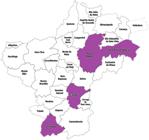
The accredited educational institutions are private entities whose primary objective is profitability. As such, the accredited companies are located where they find sufficient demand to sustain their operations economically. This contrasts with the public logic of universalizing education, which prioritizes public schools under public management and aims to reflect and promote the appropriation of historical and cultural knowledge that should be expanded and democratized to reach the communities not served by private initiatives (Paro, 2023).
The most in-demand course was the nursing technician program, which also offered the highest number of available spots. The S System, represented by SENAI units in Pouso Alegre, Extrema, and Santa Rita do Sapucaí, and by SENAC in Pouso Alegre, were the institutions that offered the highest number of spots, totaling 1,660, which represents 74% of the overall total.
Payments to institutions are made periodically. The first payment is made two days after the contract is signed and covers one month of the course, based on the cost per student multiplied by the number of confirmed enrollments. Subsequent payments are made every two months, depending on student attendance for each payment cycle (Minas Gerais, 2021b). Each type of course has a specific financial allocation. The amount received depends on the type of course, its total hours, and the number of spots actually filled. In this context, the funds received by the institutions during the 1st Edition were: SENAI (Pouso Alegre, Extrema, and Santa Rita do Sapucaí): R$ 6,246,871.27; SENAC Pouso Alegre: R$ 2,218,724.96; Colégio Nilta D’Onófrio de Carvalho: R$ 1,005,539.43; and finally, Colégio ENDEX: R$ 3,042,337.48. Table 2 presents the financial resources allocated by institution and course.
Payments Made to Accredited Educational Institutions in the Trilhas de Futuro Program within the Pouso Alegre Regional Education Office in 2021 (November and December) and 2022
The Trilhas de Futuro Program offers students not only free tuition but also meal and transportation allowances. Nevertheless, dropout rates remain high. Based on the total number of initial enrollments, the program shows an average dropout rate of 58.60% (Trilhas de Futuro, n.d.). Therefore, out of 2,240 initial enrollments, 1,313 students dropped out. Table 3 shows the number of active enrollments compared to the initial enrollments (Trilhas de Futuro, n.d.), which calls for a reassessment of the ideology of private sector efficiency in contrast to the public sector, a well-known topic in debates about the role of the State.
A prominent aspect related to the dropout rate is the connection with the institutional goals for employees of the State Department of Education. Decree No. 48,113, dated December 30, 2020, regulates the granting of a cost-of-living allowance for meals to public servants of the Executive Branch. This allowance consists of two parts: a fixed portion and a variable portion, which are paid per day effectively worked by employees in agencies and entities that commit to the Goals and Indicators Plan. The variable portion is granted to the employee proportionally to the achievement of the goals set by the government. In this context, the Secretariat of Government of Minas Gerais (SEGOV/MG), in collaboration with SEE/MG, established *Joint Resolution COFIN-SEE 001* on April 28, 2022, which defines the goals and indicators to be met by SEE/MG. The resolution links the variable portion to two goals: a) Number of students enrolled in Full-Time High School; b) Number of students enrolled in the Trilhas de Futuro Program (Minas Gerais, 2022b).
Regarding the specific goal in item b, the issue revolves around student enrollments. The challenge is nearly unattainable because it involves private educational companies over which public servants have no authority or competence to intervene in pedagogical actions or dropout prevention measures. Despite receiving public funding, accredited private institutions retain their administrative and pedagogical autonomy and should be responsible for ensuring educational quality and maintaining enrollments in their schools (Brasil, 1996). However, contradictorily, the government requires public servants to act as agents promoting educational expansion through the implementation of a government plan in the form of a program that is managed by the private sector. At the same time, it holds public servants accountable for the success of a partnership over which they have no control.
Student enrollment in the courses adhered to the criteria established by SEE Resolution No. 4,623 of 2021, which regulates the candidate selection process. Article 2 of the resolution stipulates that priority should be given to students actively enrolled in the 2nd and 3rd years of upper secondary education in the state network, followed by students from any grade level in youth and adult education programs, and finally, those who have already completed upper secondary education.
In the municipality of Pouso Alegre, the three accredited institutions offered a total of 1,340 seats, of which 1,334 were initially filled. The vast majority of enrolled students were not registered in any state school. As a result, the intended prioritization was not effectively upheld, since 76% of the filled seats were occupied by students who had already completed upper secondary education.
The schools located in the central area of Pouso Alegre (EE Monsenhor José Paulino; EE Dr. José Marques de Oliveira; EE Presidente Bernardes; EE Presidente Arthur da Costa e Silva) registered the highest number of enrolled students. Conversely, state schools situated in the municipality's peripheral regions (EE Virgília Paschoal; EE de Ensino Médio Shangrilá; EE Vinícius Meyer; EE Professora Geraldina Tosta) played a less significant role in filling the accredited seats. Moreover, EE Professora Mariana Pereira Fernandes, located in a municipal district, and EE de Ensino Médio do Algodão, situated in a rural neighborhood of Pouso Alegre, reported minimal enrollments. These disparities reflect the social and territorial inequalities that emerge as a consequence of a market-driven approach to education.
The proportion of enrollments in relation to the total number of students in the respective state schools was notably low, indicating that the Trilhas de Futuro Program did not effectively serve or reach students within the state education network itself. This reveals a stark dissonance between the program’s implementation and its stated objective of targeting students in basic education.
Final Considerations
The Trilhas de Futuro Program represents a clear manifestation of an educational policy that advances the path of privatization, directly addressing the research question concerning the transfer (or diversion) of public funds to the private sector and the resulting distortion of public education and its social function.
This study conducted an analysis of regulatory guidelines, educational legislation, public-private partnership contracts, as well as various budgetary and financial data sources. The findings reveal a process of vocational education expansion that has been outsourced to private entities, whose underlying objective is the private appropriation of public funds – constituting a clear policy of transferring public resources to serve private market interests.
The financial resources allocated to the program were found to be exponentially higher than those allocated to the technical and vocational education provided by the state’s own public education network. This issue emerges as a matter of critical importance in the context of educational policy, especially regarding the development of vocational education. Although the State Department of Education of Minas Gerais (SEE/MG) holds legal responsibility for providing vocational education, it has failed to present a consistent proposal for strengthening its own public network. The process of privatization extends beyond financial and budgetary dimensions, permeating the educational, pedagogical, curricular, and school management spheres.
Although the government justifies the Trilhas de Futuro Program through the State Education Plan of Minas Gerais (PEE/MG), which establishes the expansion of vocational education opportunities for the current decade, this expansion has not been pursued within the public education system itself. Even though most upper secondary schools are structurally capable of implementing vocational education–and each municipality in the state has at least one such school–the policy decision prioritized public-private partnerships instead.
This study focused exclusively on the first edition of the Trilhas de Futuro Program, which began accrediting institutions in July 2021. However, the program continued with subsequent editions: the second edition was launched in April 2022, followed by the third in November 2022, and the fourth in September 2023. Furthermore, the program has expanded into higher education through Trilhas de Futuro Educadores, which accredits both public and private institutions of higher education to offer postgraduate specialization, master's, and doctoral programs to civil servants of SEE/MG. This initiative is already in its second edition.
Unfortunately, the study was unable to cover a broader timeframe, leaving open the possibility of future research that encompasses the full duration of the current governor's term. Such an extension would enable a more comprehensive understanding of the privatization trajectory in vocational education in Minas Gerais. It would also allow for the inclusion of all 47 Regional Superintendencies of Education, highlighting the limitations of the present article while simultaneously indicating avenues for further inquiry and offering grounded hypotheses. As such, the conclusions and consequences observed in this study may acquire broader theoretical and reflective dimensions through more in-depth research.
The study's theoretical contribution to the field of educational research lies in its critical reflection on the role of vocational education within legislation and educational policy frameworks. These frameworks have increasingly accommodated neoliberal ideological projects. On the one hand, they facilitate the private appropriation of state public funds at the expense of public and popular education. On the other, they diminish the cultural and political formation of Brazilian youth through precarious vocational training programs tied to the exploitation of labor within a subordinated and dependent capitalist society. In this context, before questioning the role of education, it becomes necessary to conduct a deeper analysis of the nature of what is commonly referred to as the "labor market" and the way it is configured within the educational horizon.
Thus, it is within this scenario that public education in the state network is situated. Public education in Minas Gerais is increasingly subject to the direct influence of the private sector and, indirectly, to the ideological control of corporate organizations involved in education, aligned with their respective business sponsors. As Borghi (2021, p. 2,747) asserts, “it is necessary to defend public education – publicly funded and publicly managed – as the only model that can be democratic in its essence and capable of establishing collective purposes and meanings for education”.
In conclusion, the prevailing trend is for public education to progressively abandon many of its social functions, especially its fundamental role: the formation of citizens.
Availability of research data
the dataset supporting the findings of this study is published within the article itself.
References
-
ADRIÃO, Theresa. Dimensões e formas da privatização da educação no Brasil: caracterização a partir de mapeamento de produções nacionais e internacionais. Currículo sem Fronteiras, v. 18, n. 1, p. 8-28, jan./abr. 2018. Disponível em: https://edisciplinas.usp.br/pluginfile.php/5692189/mod_resource/content/1/Teresa%20Adriao_Dimens%C3%B5es%20e%20Formas%20da%20Privatiza%C3%A7%C3%A3o.pdf Acesso em: 10 dez. 2022.
» https://edisciplinas.usp.br/pluginfile.php/5692189/mod_resource/content/1/Teresa%20Adriao_Dimens%C3%B5es%20e%20Formas%20da%20Privatiza%C3%A7%C3%A3o.pdf -
ARAÚJO, Suêldes de; CASTRO, Alda Maria Duarte Araújo de. Gestão Educativo Gerencial: superação do modelo burocrático? Ensaio: avaliação e políticas públicas em Educação, Rio de Janeiro, v. 19, n. 70, p. 81-106, jan./mar. 2011. Disponível em: https://www.scielo.br/j/ensaio/a/BfVtShRQgbcPfN4MjtL3RXR/?format=pdf⟨=pt Acesso em: 20 mar. 2022.
» https://www.scielo.br/j/ensaio/a/BfVtShRQgbcPfN4MjtL3RXR/?format=pdf⟨=pt -
BORGHI, Raquel Fontes. Que educação é pública? A privatização de um direito. ECCOS - Revista Científica, São Paulo, n. 46, p. 19-32, maio/ago. 2018. Disponível em: https://periodicos.uninove.br/eccos/article/view/7832/4968 Acesso em: 15 out. 2022.
» https://periodicos.uninove.br/eccos/article/view/7832/4968 -
BORGHI, Raquel Fontes. Atuação do setor privado no processo de construção curricular: o sequestro dos fins públicos da educação. Revista Online de Política e Gestão Educacional, Araraquara, v. 25, n. 3, p. 2744-2758, set./dez. 2021. Disponível em: https://periodicos.fclar.unesp.br/rpge/article/view/14903/12127 Acesso em: 30 jul. 2023.
» https://periodicos.fclar.unesp.br/rpge/article/view/14903/12127 -
BRASIL. Tesouro Nacional Transparente. Transferências a Estados e Municípios s.d. Disponível em: https://www.tesourotransparente.gov.br/temas/estados-e-municipios/transferencias-a-estados-e-municipios/#item-visualizacaohttps://www.tesourotransparente.gov.br/temas/estados-e-municipios/transferencias-a-estados-e-municipios/#item-visualizacao Acesso em: 23 jan. 2023.
» https://www.tesourotransparente.gov.br/temas/estados-e-municipios/transferencias-a-estados-e-municipios/#item-visualizacaohttps://www.tesourotransparente.gov.br/temas/estados-e-municipios/transferencias-a-estados-e-municipios/#item-visualizacao -
BRASIL. Lei nº 9.394, de 20 de dezembro de 1996. Lei de Diretrizes e Bases da Educação Nacional. Diário Oficial da União, Brasília, 1996. Disponível em: https://www.planalto.gov.br/ccivil_03/leis/l9394.htm Acesso em: 10 out. 2022.
» https://www.planalto.gov.br/ccivil_03/leis/l9394.htm -
BRESSER-PEREIRA, Luiz Carlos. Reforma gerencial e legitimação do estado social. Revista Administração Pública Rio de Janeiro, jan-fev. 2017. Disponível em: https://bibliotecadigital.fgv.br/ojs/index.php/rap/article/view/65932 Acesso em: 02 out. 2022.
» https://bibliotecadigital.fgv.br/ojs/index.php/rap/article/view/65932 -
CAETANO, Maria Raquel; PERONI, Vera Maria. Relações entre o Público e o Privado na Educaçao Brasileira: Neoliberalismo e Neoconservadorismo - Projeto em disputa. Revista Trabalho Necessário, v. 20, maio-ago. 2022. Disponível em: https://periodicos.uff.br/trabalhonecessario/article/view/53469 Acesso em: 20 jan. 2023.
» https://periodicos.uff.br/trabalhonecessario/article/view/53469 -
CURY, Carlos Roberto Jamil. Do público e do privado na constituição de 1988 e nas leis educacionais. Educação e Sociedade, Campinas, v. 39, n. 145, p. 870-889, out.-dez. 2018. Disponível em: https://www.scielo.br/j/es/a/WvkSMZCkdNHgYDhp9WGnBNM/?lang=pt&format=pdf. Acesso em: 15 out. 2022.
» https://www.scielo.br/j/es/a/WvkSMZCkdNHgYDhp9WGnBNM/?lang=pt&format=pdf -
FARIAS, Adriana Medeiros. Estado Ampliado e o Empresariamento da Educação Pública. Revista Trabalho Necessário, v. 20, n. 42, p. 01-24, 22 jul. 2022. Disponível em: https://periodicos.uff.br/trabalhonecessario/article/view/53532 Acesso em: 10 out. 2022.
» https://periodicos.uff.br/trabalhonecessario/article/view/53532 -
FILHO, Osterne Maia et al. O Empresariamento da Educação: uma análise da reforma educacional da década de 1990. In: RABELO, Jackline; JIMENES, Susana; SEGUNDO, Maria das Dores Mendes (Org.). Movimento de educação para todos e a crítica marxista Fortaleza: Imprensa Universitária, 2015. P. 87-102. Disponível em: https://repositorio.ufc.br/bitstream/riufc/16670/1/2015_liv_jrabelo.pdf#page=70 Acesso em: 28 mar. 2023.
» https://repositorio.ufc.br/bitstream/riufc/16670/1/2015_liv_jrabelo.pdf#page=70 -
FREITAS, Luiz Carlos de. Os empresários e a política educacional: como o proclamado direito à educação de qualidade é negado na prática pelos reformadores empresariais. Germinal: marxismo e educação em debate, v. 6, n. 1, p. 48-59, 2014. DOI: 10.9771/gmed.v6i1.12594. Disponível em: https://periodicos.ufba.br/index.php/revistagerminal/article/view/12594 Acesso em: 15 jun. 2023.
» https://doi.org/10.9771/gmed.v6i1.12594» https://periodicos.ufba.br/index.php/revistagerminal/article/view/12594 - FREITAS, Luiz Carlos. A Reforma empresarial da educação: nova direita, velhas ideias. 1.ed. São Paulo: Expressão Popular, 2018.
-
GARCIA, Teise de Oliveira Guaranha. Contratualização de resultados na gestão educacional escolar em redes estaduais de ensino. Revista Brasileira de Política e Administração da Educação, v. 35, n. 1, p. 077–098, 2019. DOI: 10.21573/vol1n12019.89873. Disponível em: https://seer.ufrgs.br/index.php/rbpae/article/view/89873 Acesso em: 07 jul. 2022.
» https://doi.org/10.21573/vol1n12019.89873» https://seer.ufrgs.br/index.php/rbpae/article/view/89873 -
GOVERNO amplia número de vagas e prorroga período de inscrição do Trilhas de Futuro. Agência Minas Gerais 30 agosto 2021a. Disponível em: https://www.agenciaminas.mg.gov.br/noticia/governo-amplia-numero-de-vagas-e-prorroga-periodo-de-inscricao-do-trilhas-de-futuro Acesso em: 20 jan. 2023
» https://www.agenciaminas.mg.gov.br/noticia/governo-amplia-numero-de-vagas-e-prorroga-periodo-de-inscricao-do-trilhas-de-futuro -
GOVERNO de Minas lança 40 mil vagas gratuitas para capacitar estudantes profissionalmente Agência Minas Gerais, Belo Horizonte, 2021b. Disponível em: https://www.agenciaminas.mg.gov.br/noticia/governo-de-minas-lanca-40-mil-vagas-gratuitas-para-capacitar-estudantes-profissionalmente Acesso em: 20 jan. 2023.
» https://www.agenciaminas.mg.gov.br/noticia/governo-de-minas-lanca-40-mil-vagas-gratuitas-para-capacitar-estudantes-profissionalmente -
GRAMSCI, Antonio. Cadernos do Cárcere v. 2. 2. ed. Tradução: Carlos Nelson Coutinho. Rio de Janeiro: Civilização Brasileira, 2001. Disponível em: https://ia601001.us.archive.org/20/items/AntonioGramsciCadernosDoCrcereVolII/Antonio%20Gramsci%20-%20Cadernos%20do%20c%C3%A1rcere%20-%20vol%20II.pdf Acesso em: 19 mar. 2023.
» https://ia601001.us.archive.org/20/items/AntonioGramsciCadernosDoCrcereVolII/Antonio%20Gramsci%20-%20Cadernos%20do%20c%C3%A1rcere%20-%20vol%20II.pdf -
LEHER, R. Estado, Reforma Administrativa e mercantilização da educação e das políticas sociais. Germinal: marxismo e educação em debate, v. 13, n. 1, p. 9–29, 2021. DOI: 10.9771/gmed.v13i1.43851. Disponível em: https://periodicos.ufba.br/index.php/revistagerminal/article/view/43851 Acesso em: 15 jun. 2023.
» https://doi.org/10.9771/gmed.v13i1.43851» https://periodicos.ufba.br/index.php/revistagerminal/article/view/43851 -
LIGUORI, G.; VOZA, Pasquale (Orgs.). Dicionário Gramsciano Tradução de Ana Maria Chiarini; Diego Silveira Coelho Ferreira, Leandro de Oliveira Galastri e Silvia de Bernardinis. São Paulo: Editora Boitempo, 2017. Disponível em: https://elahp.com.br/download/dicionario-gramsciano-guido-liguori-e-pasquale-vozaed-boitempo/ Acesso em: 19 mar. 2022.
» https://elahp.com.br/download/dicionario-gramsciano-guido-liguori-e-pasquale-vozaed-boitempo/ -
MINAS GERAIS. Lei nº 23.197, de 26 de dezembro de 2018. Institui o Plano Estadual de Educação – PEE – para o período de 2018 a 2027 e dá outras providências. Assembleia Legislativa de Minas Gerais, Belo Horizonte, dez, 2018. Disponível em: https://www.almg.gov.br/legislacao-mineira/texto/LEI/23197/2018/ Acesso em: 23 jul. 2023
» https://www.almg.gov.br/legislacao-mineira/texto/LEI/23197/2018/ -
MINAS GERAIS. Resolução SEE Nº 4.583, de 21 de junho de 2021 Cria o Projeto Trilhas de Futuro, e dá outras providências. Minas Gerais: Secretaria de Estado de Educação, 2021a. Disponível em: https://www2.educacao.mg.gov.br/images/documentos/RESOLU%C3%87%C3%83O%20SEE%20N%C2%BA%204.583,%20DE%2021%20DE%20JUNHO%20DE%202021.pdf Acesso em: 24 jan 2023.
» https://www2.educacao.mg.gov.br/images/documentos/RESOLU%C3%87%C3%83O%20SEE%20N%C2%BA%204.583,%20DE%2021%20DE%20JUNHO%20DE%202021.pdf -
MINAS GERAIS. Edital de Credenciamento SEE nº 01 de 02 de julho de 2021 Minas Gerais: Secretaria de Estado de Educação, 2021b. Disponível em: https://www2.educacao.mg.gov.br/images/documentos/EDITAL%20DE%20CREDENCIAMENTO%20SEE%20N%C2%BA%20012021.pdf Acesso em: 24 jan 2023.
» https://www2.educacao.mg.gov.br/images/documentos/EDITAL%20DE%20CREDENCIAMENTO%20SEE%20N%C2%BA%20012021.pdf -
MINAS GERAIS. Resolução SEE Nº 4.623 de 18 de agosto de 2021 Dispõe sobre o processo de seleção dos estudantes participantes do Projeto Trilhas de Futuro e dá outras providências. Minas Gerais: Secretaria de Estado de Educação, 2021c. Disponível em: https://www2.educacao.mg.gov.br/images/documentos/RESOLU%C3%87%C3%83O%20SEE%20N%C2%BA%204.6232021.pdf Acesso em: 20 jan 2023 .
» https://www2.educacao.mg.gov.br/images/documentos/RESOLU%C3%87%C3%83O%20SEE%20N%C2%BA%204.6232021.pdf -
MINAS GERAIS. Controladoria Geral do Estado - CGE. Portal da Transparência do Governo do Estado Minas Gerais, 2021d. Disponível em: https://www.transparencia.mg.gov.br/despesa-estado/despesa/despesa-programas/2021/01-01-2021/31-12-2021/14175/4160/55791/534/20/42 Acesso em: 10 jan. 2023.
» https://www.transparencia.mg.gov.br/despesa-estado/despesa/despesa-programas/2021/01-01-2021/31-12-2021/14175/4160/55791/534/20/42 -
MINAS GERAIS. Controladoria Geral do Estado - CGE. Portal da Transparência do Governo do Estado Minas Gerais, 2022a. Disponível em: https://www.transparencia.mg.gov.br/despesa-estado/despesa/despesa-programas/2021/01-01-2021/31-12-2021/14175/4160/55791/534/20/42 Acesso em: 10 jan. 2023.
» https://www.transparencia.mg.gov.br/despesa-estado/despesa/despesa-programas/2021/01-01-2021/31-12-2021/14175/4160/55791/534/20/42 -
MINAS GERAIS. Secretaria de Estado da Fazendo de Minas Gerais. Resolução Conjunta COFIN/SEF/ Nº 001, 10 de fevereiro de 2022 Estabelece estratégias de otimização da receita tributária estadual, as regras de fixação das metas anual e parciais de incremento da arrecadação tributária, o valor das metas anual e parciais para o exercício de 2022 e os valores e as regras de concessão da ajuda de custo de que trata o art. 189 da Lei nº 22.257, de 27 de julho de 2016, e o Decreto nº 48.113, de 30 de dezembro de 2020, para os servidores da Secretaria de Estado de Fazenda. Belo Horizonte, 2022b. Disponível em: https://www.fazenda.mg.gov.br/secretaria/legislacao_institucional/resolucao/Resolucao_conj_COFIN-SEF_001-2022.pdf Acesso em: 20 jan 2023.
» https://www.fazenda.mg.gov.br/secretaria/legislacao_institucional/resolucao/Resolucao_conj_COFIN-SEF_001-2022.pdf - PARO, Vitor Henrique. Gestão Democrática da Escola Pública 4. ed. São Paulo: Cortez Editora, 2016.
-
PARO, Vitor Henrique. Gestão, política, economia e ética na educação São Paulo: FEUSP, 2023. Disponível em: https://www.vitorparo.com.br/wp-content/uploads/2019/09/Gestao-Politica-Economia-e-Etica-na-Educacao-1.pdf Acesso em: 25 maio 2023.
» https://www.vitorparo.com.br/wp-content/uploads/2019/09/Gestao-Politica-Economia-e-Etica-na-Educacao-1.pdf -
PARTIDO NOVO. Liberdade ainda que tardia. Plano de Governo de Romeu Zema 2018. Disponível em: https://divulgacandcontas.tse.jus.br/candidaturas/oficial/2018/BR/MG/2022802018/130000600702//proposta_1533160671813.pdf Acesso em: 25 ago. 2022.
» https://divulgacandcontas.tse.jus.br/candidaturas/oficial/2018/BR/MG/2022802018/130000600702//proposta_1533160671813.pdf -
PEREIRA, Marcos Antônio Lima; VALENTE, Lucia de Fátima. O plano estadual de educação de Minas Gerais e a gestão das políticas educacionais no estado: o que há de “NOVO”?. Educação em Foco, v. 26, n. 1, 2021. Disponível em: https://periodicos.ufjf.br/index.php/edufoco/article/view/35922 Acesso em: 1 mar. 2023.
» https://periodicos.ufjf.br/index.php/edufoco/article/view/35922 -
PIOLLI, Evaldo. O processo de mercantilização da educação e o novo ciclo de reformas educacionais no Brasil pós-golpe institucional de 2016. Revista Exitus, v. 9, n. 1, p. 17-33, 2019. DOI: 10.24065/2237-9460.2019v9n1ID714. Disponível em: http://www.ufopa.edu.br/portaldeperiodicos/index.php/revistaexitus/article/view/714 Acesso em: 15 jun. 2023.
» https://doi.org/10.24065/2237-9460.2019v9n1ID714» http://www.ufopa.edu.br/portaldeperiodicos/index.php/revistaexitus/article/view/714 -
ROMEU Zema contesta lei que reajusta salários do funcionalismo de MG. Supremo Tribunal Federal, Brasília, 2022. Disponível em: https://portal.stf.jus.br/noticias/verNoticiaDetalhe.asp?idConteudo=485552&ori=1. Acesso em: 22 jun 2023.
» https://portal.stf.jus.br/noticias/verNoticiaDetalhe.asp?idConteudo=485552&ori=1 -
SECRETARIA de Estado de Educação reestrutura repasses para alimentação escolar e garante mais recursos para as unidades escolares. Agência Minas Gerais, Belo Horizonte, 2023. Disponível em: https://www2.educacao.mg.gov.br/component/gmg/story/12197-secretaria-de-estadode-educacao-reestrutura-repasses-para-alimentacao-escolar-e-garante-maisrecursos-para-as-unidadesescolares#:~:text=Com%20a%20mudan%C3%A7a%2C%20o%20valor,no%20fornec imento%20de%20alimenta%C3%A7%C3%A3o%20escolar Acesso em: 26 jan. 2023.
» https://www2.educacao.mg.gov.br/component/gmg/story/12197-secretaria-de-estadode-educacao-reestrutura-repasses-para-alimentacao-escolar-e-garante-maisrecursos-para-as-unidadesescolares#:~:text=Com%20a%20mudan%C3%A7a%2C%20o%20valor,no%20fornec imento%20de%20alimenta%C3%A7%C3%A3o%20escolar -
SECRETARIA DE ESTADO DE EDUCAÇÃO DE MINAS GERAIS. Principais Ações, Programa e Projetos Belo Horizonte, MG. s.d. Disponível em: https://www.educacao.mg.gov.br/a-secretaria/princiais-programas-e-projetos/ Acesso em: 10 out. 2022.
» https://www.educacao.mg.gov.br/a-secretaria/princiais-programas-e-projetos/ -
TRILHAS DE FUTURO. Trilhas de Futuro Secretaria de Estado de Educação de Minas Gerais. s.d. Disponível em: https://www.trilhasdefuturo.mg.gov.br/index.html Acesso em 23 maio. 2023.
» https://www.trilhasdefuturo.mg.gov.br/index.html
Edited by
-
Editor in charge:
Carla Karnoppi Vasques

 Source: Prepared by the author.