
 APPROACHING BIBLIOMETRICS AND PROSOPOGRAPHY: THE COMPREHENSIVE PUBLISHING LANDSCAPE OF CNPQ (BRAZIL) AND CONICET (ARGENTINA) AND ITS COVERAGE IN GLOBAL DATABASES
ABSTRACT
Objective: Global databases such as Web of Science and Scopus have determined the standard indicators to measure the research output in national comparisons and its quality evaluation for decades. Already classic studies of science proved that this landscape of scientific production was distorted by using overly selective bibliographical indexes that were considered “international databases” while their coverage was severely limited. A relevant part of the bibliometric literature in the last 10 years has revolved around the limitations of these global data sources and the search for alternatives to explore more comprehensive universes of the scholarly output, considering all disciplines and languages.
Methods: Particularly relevant in this debate are some recently created bibliographic services and search engines that provide new opportunities: Dimensions, Lens, Open Alex, CrossRef and Google Scholar. Our specific contribution to these studies relies on a methodological shift based on a convergence between prosopography and bibliometrics. For that end, we selected two countries that can be considered “peripheral centers” in the Latin American region.
Results: Firstly, we determined a universe of national researchers of the National Council for Scientific and Technological Development (CNPq, Brazil) and the National Council for Scientific and Technical Research (CONICET, Argentina). The target populations are composed of 10,619 tenured researchers at CONICET and 14,418 holders of the CNPq’s “research productivity fellowship”. Secondly, we built a database with their comprehensive publishing performance uploaded in the national curricular information systems, the Brazilian Lattes and Argentina’s SIGEVA, that includes metadata for all articles. After computational and manual data cleaning of this database, we retained a total 464,361 articles for Brazil and 81,005 for Argentina published in 2013-2020.
Conclusions: The comparative study shows that Argentina and Brazil have similar patterns of coverage in the global databases, although they differ in terms of collaboration practices and national publishing.
KEYWORDS:
Bibliometric Coverage; Brazil-Argentina; Wos-Scopus; National Publishing Databases; Prosopography
RESUMO
Objetivo: Bases de dados globais como Web of Science e Scopus determinaram os indicadores padrão para medir a produção de pesquisa e sua avaliação de qualidade em análises nacionais por décadas. Estudos clássicos da ciência já provaram que este cenário de produção científica foi distorcido pelo uso de índices bibliográficos excessivamente seletivos que eram considerados “bases de dados internacionais”, enquanto sua cobertura era severamente limitada. Uma parte relevante da literatura bibliométrica nos últimos 10 anos tem girado em torno das limitações dessas fontes de dados globais e da busca por alternativas para explorar universos mais abrangentes de produção acadêmica, considerando todas as disciplinas e idiomas.
Método: Particularmente relevantes nesse debate estão alguns serviços bibliográficos e motores de busca recentemente criados que oferecem novas oportunidades: Dimensions, Lens, Open Alex, CrossRef e Google Scholar. Nossa contribuição específica a esses estudos se baseia em uma mudança metodológica fundamentada na convergência entre a prosopografia e a bibliometria. Para isso, selecionamos dois países que podem ser considerados “centros periféricos” na América Latina.
Resultados: Primeiramente, determinamos um universo de pesquisadores nacionais do Conselho Nacional de Desenvolvimento Científico e Tecnológico (CNPq, Brasil) e do Conselho Nacional de Investigações Científicas e Técnicas (CONICET, Argentina). As populações-alvo são compostas por 10.619 pesquisadores efetivos do CONICET e 14.418 bolsistas de produtividade em pesquisa do CNPq. Em segundo lugar, construímos uma base de dados abrangente com o desempenho das publicações desses pesquisadores, a partir dos sistemas nacionais de informação curricular, o Lattes brasileiro e o SIGEVA da Argentina, que incluem metadados de todos os artigos. Após a limpeza de dados computacional e manual desta base de dados, obtivemos um total de 464.361 artigos para o Brasil e 81.005 para a Argentina, publicados entre 2013 e 2020.
Conclusões: O estudo comparativo mostra que Argentina e Brasil têm padrões semelhantes de cobertura nas bases de dados globais, embora se diferenciem em termos de práticas de colaboração e publicações nacionais.
PALAVRAS-CHAVE:
Cobertura bibliométrica; Brasil-Argentina; WoS-Scopus; Bases de dados de publicações nacionais; Prosopografia
1 INTRODUCTION
Publishing platforms and international indexing services are critical components of the current research system, providing the basis for bibliometric reports as well as for research assessment and university rankings. The two main global databases, Web of Science (WoS, property of Clarivate) and Scopus (property of Elsevier), have determined the standard indicators to measure the research output in national comparisons and its quality evaluation. Already classic studies of science proved that the landscape of the scientific production from the so-called periphery was distorted using overly selective bibliographical indexes that were encumbered as “international databases” while their coverage was severely limited (Gareau, 1988; Arvanitis; Gaillard, 1992; Van Leeuwen et al., 2001). According to numerous available comparative studies, Scopus and WoS are structurally biased regarding the research produced in non-Western countries, in non-English language, and specially within the arts, humanities, and social sciences (Martín-Martín et al., 2021). An important share of the output of the European countries published in non-English languages is also left aside and it is also extensively proven that significant part of the scholarship in the social sciences and humanities is left outside these sources, and this is particularly striking for books, which carry a large part of knowledge in these disciplines (Engels et al., 2018). Consequently, as Ràfols, Ciarli and Chavarro (2015) have argued, the exclusive use of these two databases in bibliometric studies results in a significantly distorted view of the national research agendas.
A relevant part of the literature in the last ten years has revolved around the exploration on these global data sources and the search for new alternatives to build a more comprehensive outlook of scholarly publishing, considering all disciplines and languages. Particularly relevant in this research domain are the bibliographic services that provide opportunities to auscultate production beyond WoS and Scopus: Google Scholar, Dimensions, Lens, and Open Alex. The available studies agree in considering that Google Scholar includes a much broader range of documents and coverage, but also that it is only a search engine, with less quality control (Doğan et al., 2022). Open Alex is currently a progressive alternative and a collaborative infrastructure attempting to overcome these limits, and several research teams are developing studies to calibrate its coverage.
Our specific contribution to these coverage studies proposes a methodological shift based on a convergence between the bourdieusian field approach and a situated perspective in bibliometrics. This consists of focusing on research communities identified through national categorization systems that regularly classify them and play a relevant role in their recognition in science and higher education. These countries have national curricular information systems available with the metadata for all their publications; some of these are public, and others provide the metadata upon demand. Compiling and curating these national data sources has an additional heuristic value that allows us to discuss who these researchers are and to what extent their publications are represented in the global databases. These bottom-up studies based on curriculum databases make visible the multi-scalar dynamics of national and regional publishing circuits, showing the resilience of bibliodiversity and multilingualism.
In the frame of a comparative project, we explored two national research communities and their curriculum databases, the National Council for Scientific and Technological Development (CNPq) and the National Council for Scientific and Technical Research (CONICET) through the Brazilian Lattes1 and Argentina’s SIGEVA2. Lattes is a complex system with decades of development that includes all academic and educational staff in the country, with personal and institutional identifiers, along with a stamp by the indexers services certifying publication. Used by numerous researchers, Lattes serves as a valuable tool for evaluating the national scientific output and academic development (Digiampietri et al., 2019; Digiampietri et al., 2012b). SIGEVA is a system for administrative management and research assessment created by CONICET which encompasses all its agents (researchers, professionals, fellows, administrative staff). While Lattes is public and is the unique database for curriculum in Brazil, SIGEVA is not public (only available for research on formal demand), and it is not the only curriculum database in the country.
To move away from the studies that analyze a disembodied set of publications harvested from global databases, in this research we selected two countries that can be considered “peripheral centers” in the Latin American region. Firstly, we determined a universe of national researchers of the National Council for Scientific and Technological Development (CNPq, Brazil) and the National Council for Scientific and Technical Research (CONICET, Argentina). The target populations are composed of 10,619 tenured researchers at CONICET and 14,418 holders of the CNPq’s “research productivity fellowship”. Secondly, we built a database with their comprehensive publishing performance uploaded to the national curricular information systems, the Brazilian Lattes and Argentina’s SIGEVA, that includes metadata for all articles of these researchers. After computational and manual data cleaning of this database, we retained a total 464,361 articles for Brazil and 81,005 for Argentina, published in 2013-2020. As we will see, as scientific fields, Brazil and Argentina differ in several ways, although both research communities have similar patterns of limited coverage in the global databases.
2 GLOBAL DATA SOURCES UNDER SCRUTINY
The critique to the dominant standards for research assessment based on the Impact Factor is extensive to WoS and Scopus, because these selective proprietary databases played a relevant role in establishing global academic hierarchies, all of which had a relevant incidence in the current prestige-building system (Marginson, 2020). These global databases conquered such a status that a paper published in these mainstream journals became the materialization of an “international export” of scientific knowledge, while articles published in other indexing platforms, such as SciELO or Redalyc were devalued as local research, reinforcing them as peripheral science (Vessuri; Cetto; Guèdon, 2014). These “export” counts in the sphere of circulation came to express the state of the national scientific development of any given country, converting this portion of papers into the reflex of the sphere of knowledge production from a given country. International collaboration was valued as a feature of scientific development and national publishing was considered a sign of peripheriality.
In a study covering 1980-2021, Aksnes and Sivertsen (2023) show that the traditional relation established between collaboration rates and the economic status of a nation has changed over time and only a moderate correlation was still found between a country’s income and its publishing performance. On the other hand, the breakthrough of China to a leading global role, and the rise of India, Iran, South Korea, and Brazil shows that national collaboration has often been more generative than international co-authorship (Shu et al., 2023). Kwiek (2020) notes that in five countries in 2018, including the US and China, domestic co-authored papers received higher global citation rates than international papers. On the contrary, in international collaboration papers, when an emerging country author is first, citation shows often lower (Chinchilla-Rodríguez; Sugimoto; Larivière, 2019).
Overall, the global patterns of internationalization and scientific development described using WoS or Scopus are currently under scrutiny. Van Leeuwen (2022) argues that three large multidisciplinary databases (WoS, Scopus, Dimensions) show limits in terms of coverage and also regarding reliable and transparent citation statistics. With an awareness of the role played by these mainstream databases in creating the existing academic elites, interesting studies have tried to understand the formation of these top cited researchers. Akbaritabar, Castro Torres and Larivière (2023) analyze a small fraction of influential scientists who benefit disproportionately and concentrate its outcome in the form of impact and citations.
The fact that Google Scholar covers the social sciences more broadly opened its increasing use as a bibliometric data source for research assessment, but its commercial nature creates constant obstacles for an autonomous development such as the efforts made by the COLAV3 (Spanish acronym for Colaboratorio de Vinculación para las Ciencias Sociales Computacionales, University of Antioquia) in Colombia. The first comprehensive studies of Google Scholar’s unique citations reported the existence of a wide range of non-WoS citing sources, especially from non-journal documents including theses, books, conference papers, and unpublished materials (Kousha; Thelwall, 2007). This was considered an advantage of Google Scholar, since it could be useful to surpass the limitations of WoS and Scopus and for citation tracking of social impact beyond academic journals. Martín-Martín et al. (2018) followed these first studies pursued from 2007 until 2016 revealing the growth over time in the coverage of citations in Google Scholar, reporting much more comprehensive and consistent values across subject areas. However, they found strong correlations between Google Scholar and Scopus. The high citation count correlations made by Harzing and Alakangas (2016) also suggest that Google Scholar advantage was not substantial, as it provided essentially the same citation rankings as Scopus and WoS at the document level in most subject categories. The distribution of non-English among the unique Google Scholar citations do increase, but most of these citations found only by Google Scholar still came from non-journal sources (Martín-Martín et al., 2018).
This explains why WoS and Scopus are still used in studies of science where that criticism is mainly developed. The main argument is that WoS has the highest overall quality among the sets considered, and that the differences in quality comparing with databases such as Google Scholar or others lies primarily in how the data sources are organized (Nguyen et al., 2022). Archambault et al. (2006) argue that it is like a long-lasting marriage: there has been a healthy dialogue between the partners, and both the tools and the users have grown in sophistication through mutually beneficial exchanges. However, after decades of persistent use, the language bias has increased, and the coverage problems persist. In addition, the debate on these global data sources not only revolves around coverage, but also transparency, given the predatory journals expelled from these collections and the different means for gaming the metrics observed in recent studies (Biagioli; Lippman, 2019; Siler; Larivière, 2022; Beigel, 2025).
On its part, recent studies of national data sources show that non-hegemonic countries have become increasingly diversified, not only in terms of scientific production but also regarding international circulation. A consequent argument in favor of national data collection is the enlightenment of comprehensive research agendas, multilingual output and bibliodiversity -particularly books and non-journal formats. Additionally, according to Siler e Larivière (2022) national databases are increasingly seen as a potential solution for a responsible research evaluation. Eventually, these sources can also boost a necessary move towards a virtuous interaction between science and society. Ràfols et al. (2023), for example, argue that the dissemination of agricultural research through initiatives like ‘extension’ (service) programs at the universities has long been recognized as essential for development, but these contributions are invisible in global data sources.
Considering CNPq research fellows, Oliveira et al. (2021) examined gender inequalities within Brazilian academia by analyzing the distribution of CNPq research productivity fellowships (PQ) through a mixed-methods approach. The research highlights how implicit social norms and institutional dynamics, beyond formal evaluation criteria, deepen gender disparities in access to symbolic and material academic capital. The study further calls attention to the need for longitudinal analyses to better understand career progression across gender lines, especially in relation to access to top-tier fellowships (PQ 1A and Senior).
In a more recent work, Oliveira et al. (2024) studied the CNPq productivity fellows in the field of Sociology in Brazil. This work assessed quantitatively the academic output of this group using an indicator composed of 18 variables. The results revealed significant inequalities in the distribution of scholarships, with strong regional concentration (especially in the Southeast), gender asymmetries, and the influence of graduate program rankings. The research also pointed out that factors such as political capital, management positions, and institutional prestige decisively influence the hierarchy of fellows, often more so than scientific output measured by bibliometric indicators. The identification of the most productive profile among the fellows (level 1D) and the lower emphasis on qualified publications in journals as an evaluation criterion reinforce the need to understand the mechanisms of academic recognition beyond quantifiable productivity.
Regarding Brazilian scientific output and its international indexation, Melo, Trinca, and Maricato (2021) examined the limitations of WoS as an exclusive source for evaluating Brazilian scientific production, analyzing data from the 4,377 graduate programs registered on the Sucupira Platform in 2017 and 2018. The authors found that only 46.56% of the journals used by researchers were indexed in WoS, with significant variation across disciplines, from 91% in Biological Sciences to only 10% in Law. The study warns of the risks of decontextualized evaluations based solely on international bibliographic databases and highlights the importance of considering the specific dynamics of knowledge production and scientific communication in each field. Moreover, it is situated within a broader debate on the excessive and uncritical use of bibliometric metrics, engaging with international declarations and manifestos, such as Dora (2012) and the Leiden Manifesto (2015), which criticize the performative effects and distortions caused by such indicators. The work also reinforces the need for evaluation policies that are more attuned to the epistemological and geopolitical diversity of science, valuing national sources such as the Sucupira Platform and initiatives like Lattes. These findings were particularly relevant to our comparative study between Brazil and Argentina, as they show that the reliance on databases like WoS may obscure the complexity of national and regional scientific production.
Nonetheless, the national curriculum databases have several data-cleaning problems that range from the basic information on the articles without DOI, including the author order that could be mistaken during the uploading by the researcher. We have been curating these national curriculum databases for quite a long time in the framework of a comparative study, completing a national dataset with all the available DOI documents published by the researchers in Argentina and Brazil. We explored publishing performance, collaboration, multilingualism, and gender asymmetries, putting in relation the national databases with Google Scholar (Baranger; Beigel, 2021; Beigel; Gallardo, 2021; Vélez Cuartas et al., 2022; Beigel, 2024). After several explorations aimed at the creation of a multi-source publishing database for Argentina (Vélez Cuartas et al. 2022), we found several obstacles to build a comprehensive database merging Google Scholar with the national curriculum databases. This paper shows our pertinent results in this journey as also its limitations.
3 TARGET POPULATIONS
In this paper we explore two research communities, the CNPq in Brazil and the CONICET in Argentina, and their publishing performance between 2013 and 2020. A relevant part of these researchers circulates outside the high impact journals, but most of them also participate in national and regional publishing circuits. Choosing these research communities implies observing the most productive researchers who are subject to similar academic career evaluations, leaving aside a large group of professors in both countries. To move from the studies that analyze a disembodied set of publications harvested from global databases we examine the complete research output of these researchers using the national curriculum databases that are used for their national classification. The list of active personnel provided by CONICET for this research was composed of 10,619 tenured researchers. The Brazilian list included 14,418 holders of the CNPq’s “research productivity fellowship” 4.
The Argentinian CONICET was created in 1958 and is a public research-performing agency, which Scientific and Technological Researcher Career (CIC, Carrera del Investigador Científico) is based on annual competitions that ensure a full-time position and relative stability. It is structured in five categories of ascending hierarchy: Assistant, Adjunct, Independent, Principal, and Superior Researcher. Teaching is not mandatory, although the majority of the CONICET researchers hold a teaching position at a public (national) university. While there is a difference in researchers’ salary associated with their position in the hierarchy, there is no direct monetary compensation for publishing productivity.
In turn, CNPq was created in 1951 and is a public research-funding institution not offering research careers with full-time positions, but a prestigious so-called “productivity grant” (bolsa de produtividade in Portuguese) to a selected group of researchers. It grants a prestigious monetary incentive to tenured researchers on a competitive basis. The awardees hold a university professorship or a research position in a research institute. This bolsa does not refer to a stipend assigned to young doctoral or postdoctoral students to finance their studies, but a financial support given to researchers for a research project5. As a result of this evaluation, the awardees are assigned to one of five levels (2, 1D, 1C, 1B and 1A) that serve the purpose of a national classification for the most productive researchers in the country.
CONICET has a highly internationalized evaluative culture even if it doesn't have a direct monetary incentive for mainstream publishing. Academic writing in English, journal rankings, and impact indicators have a cross-cutting incidence on the indicators considered for tenure, as well as on career promotions, across all disciplines in the exact, natural, biological, agricultural, and engineering sciences. However, in the social sciences and the humanities (SSH) CONICET committees also value publication in journals included in Latin American indexing services such as SciELO or Latindex-Catalog (Beigel, 2017). As a result, applicants with articles in these journals can achieve similar scores to those in mainstream publications6. Even with some ambiguities, many national and regional journals receive a significant flow of articles from CONICET researchers and fellows aspiring for tenure. So, although the evaluative culture of the agency promotes international publication, this norm, together with the lack of an additional salary incentive for publication in Scopus or WoS, certainly impacted on the bibliodiversity observed in the CONICET's production.
In the comparison of the two target populations, several differences arise, particularly in terms of gender. Argentina shows a progressive diminishment of gender asymmetries at CONICET, especially regarding the move of women up to the higher categories of the research career. Currently, parity is achieved in the intermediate category (Independent researchers), and this seems to be a slow but systematic virtuous tendency (Beigel; Gallardo; Bekerman, 2018). Brazil shows a high masculine dominance overall, not only in the higher categories: only 35% of the “bolsistas” are women.
The CNPq’s evaluation committees use journals’ rankings to evaluate the researchers’ bibliographic production. Unlike CONICET, though, it uses the so-called Qualis system, which classifies national and international publications. Journals are classified in ordinal strata with A1 being the highest, followed by A2, B1, B2, B3, B4, B5, and C, the least valued (Martínez-Ávila, 2019). The vast majority of the CNPq’s evaluation committees use the journal impact factor as an indicator to establish quality of a published article7. It should be noted that Brazil has many journals indexed in international services, such as Scopus and WoS, and hundreds of journals indexed in SciELO. Mugnaini et al. (2019) analyses the complete list of publications of 260,663 scholars/postgraduate students included in Lattes Brazil, showing that national journals occupy a significant portion of the articles in all areas. Even more striking is that national publishing is a relevant tendency, although inverse to the tendency of publishing in Portuguese, which is much lower than Argentina’s publishing in Spanish (Beigel et al., 2023).
In this paper we use the Brazilian Lattes Platform which has become strategic not only for planning and management activities, but also for formulating policies for the Ministry of Science and Technology and other government bodies in science, technology and innovation8. The database is constantly updated by the workload of each researcher, who normally updates his/her CV at least once a year. Since it is not a database curated or monitored by a repository system, it was necessary for us to develop a curatorship to identify duplicates, eliminate records that did not correspond to articles published in journals, and determine the sex of the researchers that was not included in the public information9. The CNPQ-PUB table was thus constructed from the harvesting of all metadata of articles published between 2013-2020 and interconnected with a trajectory database called CNPq-INV through the ID of the researchers, containing prosopographic information: disciplinary affiliation, year of birth, sex, the institution of work, year of entry to CNPq, category of the researcher, doctoral training, among others. It contains records for 14,814 “bolsistas” according to the official information we extracted from the CNPq lists as of June 2021.
4 METHODS
Our methodology combines Bibliometrics with Prosopography (Duval, 2020), being the latter a kind of collective biography that has been frequently used by Bourdieu (1998) to understand the trajectory of the agents in a field. It is based on the study of the objective and relational features of the individuals belonging to the same space, collecting information such as: social origin, professional category, training, disciplinary self-ascription, social, and cultural capital. Our database is nurtured on previous studies on these target populations and contains information of all researchers, collected directly from national sources (Lattes and SIGEVA). Our methodological strategy thus, departs observing researchers in the understanding that scientific practices are the product of their habitus, based on their personal history and the position they occupy within their disciplinary field. These practices are also a product of the position in which their discipline is situated within the scientific field, considered as a whole, as well as its relationship to the field of power and other scientific fields at a global scale.
From this perspective, authors are not considered empirical individuals, simply based on records with a unique first and last name (or with an ORCID-type identifier, as is the case in bibliometrics when this is available), but rather as epistemic individuals, that is, as combinations of efficient properties revealed through a prosopography description that anchors into a specific location of groups of researchers in the scientific field. Moreover, Bourdieu (1984) considered the proper name to be a dead end, because
it says that what it designates is different, without stating how it differs. An instrument of recognition, and not of knowledge, it identifies an empirical individual, globally apprehended as singular, that is, as different, but without an analysis of difference. The constructed individual, on the contrary, is defined by a finite set of properties (...), it locates its referent not in ordinary space, but in a space constructed from the differences produced by the very definition of the finite set of the effective variables (Bourdieu, 1984, p. 35-36)10.
Our strategy leads to the construction of disciplinary collectives based on the researchers' self-adscription, in a way that is different from the approach in bibliometrics where authors/articles are grouped according to the disciplinary classification established by the journals in which they publish. Differently, in this paper, we establish the discipline of each article not by the classification made by the global databases but using the disciplinary classification declared by each researcher-author in the prosopography database. This perspective may represent a limitation for interdisciplinary researchers, but it overcomes the numerous limitations observed in this matter in the journal indexing platforms (Shu et al., 2020). Finally, to undertake the coverage study, we followed the procedure proposed by Martin-Martin et al. (2021) to obtain the complete list of all documents covered by each source, match the documents across databases, and report the size of the overlaps. For citations, we compared performance using the same process but including Google Scholar.
The list of productivity fellows from CNPq (Brazil) was obtained from CNPq website11 in February 2021, and data on 14,418 productivity fellows were retrieved. For each fellow, their full name, institution, fellowship level, and the disciplinary area in which the fellowship was granted were collected. Based on this information, a semi-automated process was carried out to identify each researcher's Lattes CV. This process began with an exact match of the name and institution of each fellow against a locally stored database containing all CVs from the Lattes Platform obtained in 2019. All cases that presented any inconsistency or required verification (e.g., CV not found, CV found but linked to a different institution or area of expertise than the one associated with the fellowship, or more than one CV identified for the same name [homonyms]) were manually analyzed and resolved. As a result, the Lattes CV identifiers were found for all 14,418 fellows. Using these identifiers, updated XML-format versions of the CVs were downloaded in March 2021.
From each fellow’s Lattes CV, their journal publications were extracted. Initially, 646,063 article records published between 2013 and 2020 were identified; however, the same article might appear in the CVs of multiple individuals. Based on this data, an entity resolution/disambiguation process was carried out to identify how many unique articles were present in the dataset and what coauthorship relationships existed among the analyzed productivity fellows. This process was based on the algorithm proposed by Digiampietri et al. (2012a), which checks for compatibility among publication titles, publication years, and author lists to determine whether the same article is listed in different CVs. At the end of this process, a total of 464,361 unique journal articles was obtained.
To identify these articles in the Google Scholar, Web of Science, and Scopus databases, two distinct processes were carried out. For identification in Google Scholar, an automated search was conducted using the title of each of the 464,361 articles. The result of each search was stored, including the retrieved title and the number of citations. A comparison process was then applied to verify whether the retrieved title matched the searched title, ensuring that the citation count corresponded to the correct article. Additionally, a manual verification was performed on the 4,643 most cited articles (1% of the total) to ensure data accuracy.
For identification in the Web of Science and Scopus databases, the following procedure was adopted: metadata were first collected for all articles published between 2013 and 2020 that included at least one author affiliated with a Brazilian institution. Each of the 464,361 articles was then automatically compared with the metadata from both databases. When available, the comparison was based on the article's DOI. In cases where the DOI was not available, an entity resolution process -similar to the one proposed by Digiampietri et al. (2012b)- was employed to identify matching articles.
In Argentina, the SIGEVA database is not publicly open, so we built a database from now on called CONICET-PUB with 2 sources. In first place, the dataset with the publications provided by the CONICET Repository, including all the articles (2013-2020) uploaded by the researchers and curated by the team of the Repository12. The careful data-cleaning work carried out by a national network of curators of this repository gives an important quality to this database, and its main advantage is that it allows linking the articles with the CONICET researchers who have authored them. However, it also has some problems. The main issue is that the speed at which the data is updated depends on the workflow of the Repository, and, over the selected period, as we get closer to the present, the annual number of articles tends to stagnate or even decrease.
Second, this database was enriched with the dataset prepared in 2021 in collaboration with the COLAV, which amalgamated different global sources about Argentina and CONICET for a previous study (Vélez Cuartas et al., 2022). We aggregated all the articles from the period 2013-2020 that were not included in the Repository dataset. The CONICET-PUB database is interconnected with the trajectory database called CONICET-INV through the ID of the researchers with data on their disciplinary affiliation, year of birth, sex, institution of work, year of tenure in CONICET, category in the research career, doctoral training, among others. It contains data on 10,619 full-time researchers who were active as of June 2021. This information from the SIGEVA system was provided, at our formal request, by the CONICET authorities. This prosopography database has been updated and enhanced along prior research projects carried out by the authors. The enrichment of the bibliometric data (citations in Google Scholar, WoS, and Scopus) followed the same process already described for Brazil.
The data extraction from the CONICET Repository was conducted on September 29, 2020. The original table included 113,212 publications of various types from CONICET researchers. After the data cleaning process, only 81,005 records were retained. These records pertain to articles in scientific journals published between 2013 and 2020, with most metadata available, featuring at least one CONICET researcher who was active in 2020 as an author.
5 RESULTS
The 2013-2020 research output of the CONICET researchers amounts to 81,005 articles, and the CNPq researchers to 464,361. This section presents the aggregated data by disciplinary areas where researchers are enlisted. We have applied the CONICET classification to analyze also the scientific output of the CNPq researchers after a recategorization for comparison purposes. Table 1 shows the total number of articles corresponding to researchers in each area, and the proportion of them identified by DOI. As we can see, the output without DOI is significant, especially in the SSH for both countries.
The average number of publications per researcher is significantly higher for CNPq than for CONICET. CNPq researchers have an average of 31.3 articles each, compared to 7.6 articles for CONICET researchers. This contrast is related to the higher collaboration tendency observed in Brazil which we will explore deeply below. For CNPq, Figure 1 illustrates a steady increase in the number of articles published by CNPq researchers where the most substantial growth is observed in Agriculture Sciences and Engineering. The number of publications per year by the Social Sciences and Humanities remains relatively constant across the period.

By contrast, publications authored by CONICET researchers show relatively consistent numbers from year to year (as indicated in Figure 2). The decrease in 2020 can be attributed to delays in curating and uploading the new articles in the institutional repository. The decline is more pronounced for researchers in Social Sciences and Humanities, possibly due to the lower availability of DOIs (as seen in Table 1). We will revisit this point in the following section.

In general terms, the production of CNPq researchers shows a greater number of co-authors than CONICET (See Table 2). For all disciplines, the proportion of articles with individual authorship is higher for CONICET than for CNPq. This is particularly notable for the Social Sciences and Humanities, where more than half of the articles by CONICET researchers have single authorship, while is reaches only 23.6% in the case of CNPq. In the first three fields there is a predominance of coauthored publications with up to 5 coauthors, except in Biological Sciences in Brazil, where the range with the most cases is 6-10 authors. In this area there are also numerous articles with between 11 and 20 co-authors (more for CNPq than for CONICET). For Exact and Natural Sciences, the proportions with more than 20 co-authors are particularly high in both countries, which mainly corresponds to publications in the field of high-energy physics.
If we now explore the author position in collaborative articles, Brazil shows fewer first positions compared with CONICET (considering only articles with 3-20 authors). Indirectly, this observation can be related to the difference in the total volume of publications already mentioned. The contrary is true regarding the last position, while the intermediate position remains approximately the same for both countries (See Figure 3).

Author position by broad field and country. CNPq-Brazil N=378,144; CONICET-Argentina N=55,486
The weight of the last author's position in Brazil can be explained partly by the morphological composition of the CNPQ, composed of a higher proportion of "senior" researchers compared with CONICET. Moreover, in Argentina there is a very relevant portion of young researchers, who are in the "Assistant" category, and are compelled by the evaluation requirements to concentrate very early in publications as first authors. In addition, there is the fact that in Argentina collaboration tends to have fewer authors than in Brazil, which reduces the overall volume of publications.
6 THE COMPARATIVE COVERAGE ANALYSIS
The coverage comparison by data source gives evidence that the leading indexing services, Scopus and WoS, cover a very similar subset of publications, while the uncovered portion is 34% for CONICET and 39% for CNPq. As expected, Figure 4 shows that the articles not covered by Web of Science or Scopus are significantly higher in Brazil.

CONICET-Argentina and CNPQ-Brazil articles 2013-2020 by datasource CNPq-Brazil N=464,361; CONICET-Argentina N=81,005.
Figure 5 displays the coverage disaggregated by the broad field of the researchers. As we can see, the proportion of articles not indexed in the mainstream circuit is higher in Brazil than in Argentina for the four broad fields. This is related, among other indications that will be explored below, to the greater tendency of CNPq researchers to publish more articles in the Brazilian journals. On the other hand, Argentines tend to publish less articles with fewer authors, but they have a greater preference for journals from other countries. The share not indexed in Scopus or WoS may be indexed in other services, such as SciELO, Redalyc, Latindex or others, given that the evaluative culture of both countries reward other indexations. But also a part of these articles may not be indexed or connected to the lack of DOI. The exploration of this portion of the output shall be part of a future work.

CONICET-Argentina and CNPQ-Brazil articles by data source, per indexation, broad field and country. CNPq-Brazil N=464,361; CONICET-Argentina N=81,005.
The articles not indexed in WoS or Scopus for the SSH, as we can see, reach 72% for CONICET and 81% for CNPq. But the coverage of WoS and Scopus evolves in an ascendant pattern in these disciplines. Figure 6 shows the progression from 2017-2020, strikingly reaching 80% by the end of the period. This particular figure for Argentina’s SSH might be explained by the creation of the WoS Emerging Sources and its recent inclusion in the core collection. In contrast to the behavior of CONICET, CNPq shows a sustained tendency with a small increase in 2017 for the SSH but less pronounced (see Figure 7).

CONICET-Argentina articles 2013-2020 by datasource, per year and broad field in %. N=81,005.

In terms of language coverage, the national database in Figure 8 shows a small portion of publications in the national languages for the “hard sciences”, although the incidence of Portuguese for Brazil is higher than that of Spanish for Argentina. But compared with WoS, presented in Figure 9, interesting differences arise: English is practically the unique language. In contrast, the production harvested from the curricular sources shows a higher incidence of the articles written in national languages, with a noticeable participation in agricultural sciences and engineering.

Articles 2013-2020 by country, language and broad field. CNPq-Brazil N=464,181; CONICET-Argentina N=80,931.

Articles 2013-2020 indexed by Web of Science by country, language and broad field. CNPq-Brazil N=249,381; CONICET-Argentina N=46,306.
The situation, of course different for the Social Sciences and Humanities, is shown comparatively in Figure 10. For the complete production in the curricular bases, it can be observed that national languages occupy 74-75% of the total. Conversely, the production indexed in WoS is dominated by English in both countries, although with a greater weight in Brazil. It is possible that the latter is linked to the growing tendency to publish in English in Brazilian journals, as mentioned above, and the marginality of this phenomenon in Argentine journals.

Articles indexed by Web of Science by country and language. Social Sciences and Humanities researchers. CNPq-Brazil N=8,469; CONICET-Argentina N=4,820.
In Figure 11 we focus on the country of the journal and only within the curricular database13. As we see, national publishing is significantly higher for Brazil globally (36% versus 16% for Argentina) and also higher in all disciplines. This notorious inclination for national journals is not complemented by publications in the rest of Latin America and the Caribbean (2%). Among Argentine researchers, instead, publication in their own country's journals is quite low, but publications in the regional journals have a relevant share in the SSH and is higher also for other disciplines than for Brazil.

Country/Region of the journal by region, broad field and country. CNPq-Brazil N=460,304; CONICET-Argentina N=78,381.
The weight of Brazilian national publishing in the Social Sciences and Humanities is very high: only 25% of the articles were published outside the country. Also, in Agricultural Sciences and Engineering, the weight of journals published in Brazil is remarkable, with 37% of the articles published there. On top of a tradition of national publishing, SciELO plays a decisive role with a collection of quality journals that have been betting on open access and international impact for over two decades. The fact that national publication in Brazil is so high, while publication in Portuguese (see Figure 8) does not follow to the same extent, is related to the fact that Brazilian journals have produced a systematic shift towards English (Beigel et al., 2023). On the other hand, publication in European journals seems to exceed those of North America (mostly composed of journals based in the US) as we see in Figure 11. But this may be due to the fact that the country of many journals is established with the country of the Publisher but the actual location of the journal is dynamic given the increasing transnationalization of journals and the acquisition by publishing groups.
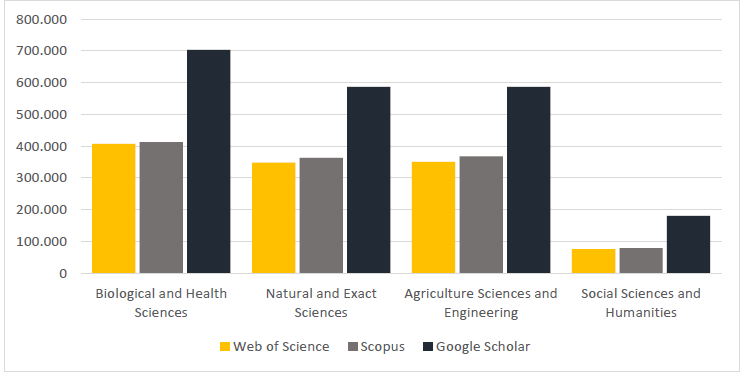
Finally, we explored the citations of the CONICET and CNPq datasets comparing Google Scholar14, WoS and Scopus. Here we take all the citations of the articles and we see that the total number of citations collected through Google Scholar is significantly higher than that reported by Scopus or Web of Science for both countries (see Figure 12 and Figure 13). Being a search engine and not an indexing service, Google Scholar counts all types of citations, and therefore, the count should be significantly higher. However, we do not count the total number of citations registered in Google Scholar but only those referring to each unique article record identified in each country's dataset.


The greater breadth of Google Scholar is also evident when considering the number of articles harvested by each source. For Brazil, there are a total of 439,199 articles in Google Scholar (almost all the articles in CNPQ-PUB), 265,984 in Scopus and 249,382 in WoS (Figure 4). For Argentina, there are a total of 63,173 articles in Google Scholar (almost all the CONICET-PUB articles), 50,826 in Scopus and 49,474 in WoS (Figure 4). However, it is important to note that in addition to a significantly higher number of articles, the average number of citations per article is also higher for Brazil. In Figure 14 we exclude Web of Science to facilitate comparison because its behavior is almost identical to Scopus. We can see that in practically all areas the average number of citations per article is higher for Google Scholar.

Average citations, by database and broad field, per country. CNPq-Brazil N=464,361; CONICET-Argentina N=81,005.
7 CONCLUSIONS AND POLICY REMARKS
The comparison of the publishing performance in the national datasets of CONICET and CNPq indicates differences in terms of publishing practices and similarities related to the limitations that affect the visibility of part of the output. Among the differences, Brazil has a higher rate of authors per article in all disciplines and more frequent last authorships than CONICET, a tendency that seems related to the “seniorship” of the demographic profile of CNPq. We found an inverse relation between language and country of the journal: while CNPq researchers from all disciplines publish in national journals, their peers in CONICET show a general tendency to international publishing -with a noticeable participation of the Latin American journals in this tendency. Therefore, Argentina exhibits a significant incidence of the publications in his national language. Meanwhile, in the CNPq dataset we verify that Portuguese has been systematically replaced by English. In previous studies (Beigel et al., 2023) we delved into the causal factors of this tendency, most likely related to the isolation of Portuguese in the region and the policies implemented by SciELO.
Among the similar trends, the structural limitations due to infrastructure and material resources are reflected in the proportion of the output that is not identified by a DOI which is complemented by the lack of ORCID available for the authors in the case of Argentina. The bibliodiversity and multilingualism observed in the national datasets is a result of the bottom-up harvesting made on curriculum management systems where the researchers tend to complete all their productions. This broader landscape fueled with national databases should be interoperable with open infrastructures, although a this depends of the digital capacity of these agencies to assign a persistent identifier to each digital object. As we saw this is still weak and proves the prevalence of the digital asymmetries and its consequences in terms of visibility and recognition.
The coverage analysis of a complete set of articles for two localized research communities allows us to seize the diverse circuits of circulation at stake. We could see that as much as 34.1% of the articles of CONICET researchers and 38.9% of CNPq researchers are not indexed by WoS or Scopus. Moreover, as we have shown, both organizations represent perhaps the portion of science and technology personnel most strongly influenced by the global evaluative, which means that a significant portion of the national output by the professors that are not part of these research agencies is completely left out when analyzing only Scopus and WoS. It is in the Social Sciences and Humanities where the lowest coverage of traditional databases is observed, as might be expected. However, this is not a phenomenon restricted to this disciplinary area. Particularly for Brazil and for the Biological and Health Sciences and the Agricultural and Engineering Sciences, the portion of publications that circulate outside the mainstream circuit is also relevant. On the other hand, the linguistic diversity of the two bodies of publications represents a very salient feature of the type of approach proposed.
The similar coverage found for CNPq and CONICET through the “trajectory correction” provided by the curricular databases shows that the national classification systems and the criteria established for career-building largely define the publication strategies. In Brazil national publishing is fostered by the Qualis system, a national journal classification used to evaluate graduate programs. The Qualis classification is built by local committees including national and international journals in a ranking of excellence. Although the impact factor is highly used for these qualifications, the Brazilian journals are highly esteemed. In Argentina, the evaluation system is also relevant for publishing strategies and the SSH tendency to the Latin American circuit is explained by the CONICET regulations on this matter. However, a much lesser tendency to national publishing was observed.
Faced with the biases of global databases, the use of national sources appears with increasing interest not only in bibliometrics but also as an instrument for a reform or research assessment towards a responsible evaluation. The most promising experience of building an infrastructure based in national datasources is the Current Research Information Systems (CRIS) and particularly the Norwegian Model. In Latin America, two relevant cases of CRIS projects at national level are in progress today: the PerúCRIS Platform15 and the Brazilian BrCris16, this latter developed by the Instituto Brasileiro de Informação em Ciência e Tecnologia (IBICT), in consortium with the major national public agencies: CONFAP, CNPq, CAPES, RNP, Fundaciones Estaduales de Apoyo a la Pesquisa and SciELO. The BrCris Module17 aims to both national CRIS have built their technological infrastructure through the use of open software DSpace7. Both work in a collaboration with the Federated Network of Institutional Repositories of Scientific Publications (LA Referencia18) which harvests repositories from 12 Ibero-American countries. Other Latin American countries are more oriented to a federated governance of the institutional repositories, such as the case of Argentina. In most countries of the region the curricular databases are well-extended and community managed.
After many years of explorations and studies on the coverage by Google Scholar and despite its acknowledged limitations, its coverage in terms of citations gives additional evidence of the need to broaden the data sources to explore the circulation and impact, beyond the traditional indicators produced by Scopus and WoS. Hopefully, OpenAlex will represent an alternative in this direction. The technical work needed to integrate national databases is complex, but the major challenge will still be anchored to the publications without permanent identifiers. A structural constraint that affects the visibility of all peripheral and non-peripheral research communities.
REFERENCES
- AKBARITABAR, Aliakbar; TORRES, Andrés Felipe Castro; LARIVIÈRE, Vincent. A global perspective on the social structure of science. Alemanha: Max Planck Institute for Demographic Research, 2023.
- AKSNES, Dag W.; SIVERTSEN, Gunnar. Global trends in international research collaboration, 1980-2021. Journal of Data and Information Science, [s. l.], v. 8, n. 2, p. 26-42, 2023.
- ARCHAMBAULT, Éric; VIGNOLA-GAGNÉ, Étienne; CÔTÉ, Grégoire; LARIVIÈRE, Vincent; GINGRASB, Yves. Benchmarking scientific output in the social sciences and humanities: The limits of existing databases. Scientometrics, [s. l.], v. 68, n. 3, p. 329-342, 2006.
- ARVANITIS, Rigas; GAILLARD, Jacques. Vers un renouveau des indicateurs de science pour les pays en développement. In: ARVANITIS, Rigas; GAILLARD, Jacques. Les indicateurs de science pour les pays en développement/Science Indicators for Developing Countries. Paris: Editions de l'ORSTOM, 1992. p. 9-36.
- BARANGER, Denis; BEIGEL, Fernanda. La publication en Ibéro-Amérique en tant que mode d’internationalisation des chercheurs en sciences humaines et sociales du Conicet (Argentine). Revue d’anthropologie des connaissances, [s. l.], v. 15, n. n. 3, 2021.
- BEIGEL, Fernanda. Peripheral scientists, between Ariel and Caliban. Institutional know-how and circuits of recognition in Argentina. The “career-best publications” of the researchers at CONICET. Dados, Rio de Janeiro, v. 60, n. 3, p. 825-865, 2017.
-
BEIGEL, Fernanda. Report on the research assessment in Uruguay in a reflexive perspective. [S. l.: s. n.]: 2024. Disponível em: https://cecic.fcp.uncuyo.edu.ar/wp-content/uploads/2024/10/INFORME-URUGUAY-FINAL-TRADUCIDO-al-INGLES-y-rev-02-10-24.pdf Acesso em: 30 jul. 2025.
» https://cecic.fcp.uncuyo.edu.ar/wp-content/uploads/2024/10/INFORME-URUGUAY-FINAL-TRADUCIDO-al-INGLES-y-rev-02-10-24.pdf - BEIGEL, Fernanda. The transformative relation between publishers and editors: Research quality and academic autonomy at stake. Quantitative Science Studies, [s. l.], v. 6, p. 154-170, 2025.
- BEIGEL, Fernanda; ALMEIDA, Ana; GALLARDO, Osvaldo; DIGIAMPIETRI, Luciano; GOMEZ, Soledad; CANDIDO, Marcia; CIRIZA, Alejandra; ROSSOMANDO, Pia; MOSCHKOVICH, Marilia; PECHENY, Mario. Scientific production and gender inequalities in two academic elites: Brazil and Argentina. Revue d’histoire des sciences humaines, Paris, n. 42, p. 255-280, 2023.
- BEIGEL, Fernanda; GALLARDO, Osvaldo; BEKERMAN, Fabiana. Institutional expansion and scientific development in the periphery: the structural heterogeneity of Argentina’s academic field. Minerva, [s. l.], v. 56, n. 3, p. 305-331, 2018.
- BEIGEL, Fernanda; GALLARDO, Osvaldo. Publishing performance, bibliodiversity and bilingualism in a complete corpus of scientific publications. Revista Iberoamericana de Sciencia, Tecnología y Sociedad, Buenos Aires, v. 16, n. 46, p. 41-71, 2021.
- BIAGIOLI, Mario; LIPPMAN, Alexandra. Introduction: metrics and the new ecologies of academic misconduct. In: BIAGIOLI, Mario; LIPPMAN, Alexandra (ed.). Gaming the Metrics: misconduct and manipulation in academic research. Cambridge: MIT Press, 2019. p.1-23.
- BOURDIEU, Pierre. Homo academicus. Paris: Minuit, 1984.
- BOURDIEU, Pierre. Les règles de l'art: genèse et structure du champ littéraire. Paris: Éditions du Seuil, 1998.
- CHINCHILLA-RODRÍGUEZ, Zaida; SUGIMOTO, Cassidy R.; LARIVIÈRE, Vincent. Follow the leader: on the relationship between leadership and scholarly impact in international collaborations. PloS One, [s. l.], v. 14, n. 6, e0218309, 2019.
- DIGIAMPIETRI, Luciano; MENA-CHALCO, Jesús; SILVA, Gabriela; OLIVEIRA, Leonardo; MALHEIROS, Ana; MEIRA, Dania. Dinâmica das relações de coautoria nos programas de pós-graduação em computação no Brasil. In: BRAZILIAN WORKSHOP ON SOCIAL NETWORK ANALYSIS AND MINING (BRASNAM), 1., 2012, Curitiba. Anais [...]. Porto Alegre: Sociedade Brasileira de Computação, 2012a. p. 105-116.
- DIGIAMPIETRI, Luciano; MENA-CHALCO, Jesús; PÉREZ-ALCÁZAR, José; TUESTA, Esteban; DELGADO, Karina; MUGNAINI, Rogério; SILVA, Gabriela. Minerando e caracterizando dados de currículos Lattes. In: BRAZILIAN WORKSHOP ON SOCIAL NETWORK ANALYSIS AND MINING (BRASNAM), 1., 2012, Curitiba. Anais [...]. Porto Alegre: Sociedade Brasileira de Computação, 2012b. p. 117-128.
- DIGIAMPIETRI, Luciano; MUGNAINI, Rogério; TRUCOLO, Caio; DELGADO, Karina; MENA-CHALCO, Jesus; KÖHLER, André. Geographic and disciplinary distribution of the Brazilian's PHD community: patterns of the scientific collaboration structure. Brazilian Journal of Information Science, [s. l.], v. 13, n. 4, p. 113-131, 2019.
- DOĞAN, Güleda; TAŞKIN, Zehra; KULCZYCKI, Emanuel; PÖLÖNEN, Janne. What makes top 20 JIF journals “top”?: Exploring characteristics of journals indexed in the Journal Citation Reports. In: INTERNATIONAL CONFERENCE ON SCIENCE AND TECHNOLOGY INDICATORS, 26., 2022, [s. l.]. Proceedings [...]. [S. l.]: STI, 2022.
- DUVAL, Julien. Prosopographie. In: Sapiro, G. (org.). Dictionnaire international Bourdieu. París: CNRS, 2020. p. 692.
- ENGELS, Tim; STARČIČ, Andreja; KULCZYCKI, Emanuel; PÖLÖNEN, Janne; SIVERTSEN, Gunnar. Are book publications disappearing from scholarly communication in the social sciences and humanities? Aslib Journal of Information Management, [s. l.], v. 70, n. 6, p. 592-607, 2018.
- GAREAU, Frederick H. Another type of third world dependency: the social sciences. International Sociology, [s. l.], v. 3, n. 2, p. 171-178, 1988.
- HARZING, Anne-Wil; ALAKANGAS, Satu. Google Scholar, Scopus and the Web of Science: a longitudinal and cross-disciplinary comparison. Scientometrics, [s. l.], v. 106, n. 2, p. 787-804, 2016.
- KOUSHA, Kayvan; THELWALL, Mike. Google Scholar citations and Google Web/URL citations: A multi‐discipline exploratory analysis. Journal of the American Society for Information Science and Technology, [s. l.], v. 58, n. 7, p. 1055-1065, 2007.
- KWIEK, Marek. Internationalists and locals: international research collaboration in a resource-poor system. Scientometrics, [s. l.], v. 124, n. 1, p. 57-105, 2020.
- MARGINSON, Simon. The world research system: expansion, diversification, network and hierarchy. In: CALLENDER, Claire; LOCKE, Willian; MARGINSON, Simon. Changing higher education for a changing world. London: Bloomsbury Academic, 2020. p. 35-51.
- MARTÍNEZ-ÁVILA, Daniel. Qualis Periódicos: el sistema brasileño de evaluación de revistas. Anuario ThinkEPI, [s. l.], v. 13, e13e01, 2019.
- MARTÍN-MARTÍN, Alberto; ORDUNA-MALEA, Enrique; THELWALL, Mike; LÓPEZ-CÓZAR, Emilio Delgado. Google Scholar, Web of Science, and Scopus: a systematic comparison of citations in 252 subject categories. Journal of Informetrics, [s. l.], v. 12, n. 4, p. 1160-1177, 2018.
- MARTÍN-MARTÍN, Alberto; THELWALL, Mike; ORDUNA-MALEA, Enrique; LÓPEZ-CÓZAR, Emilio Delgado. Google Scholar, Microsoft Academic, Scopus, Dimensions, Web of Science, and OpenCitations’ COCI: a multidisciplinary comparison of coverage via citations. Scientometrics, [s. l.], v. 126, n. 1, p. 871-906, 2021.
- MELO, João Henrick Neri de; TRINCA, Tatiane Pacanaro; MARICATO, João de Melo. Limites dos indicadores bibliométricos de bases de dados internacionais para avaliação da Pós-Graduação brasileira: a cobertura da Web of Science nas diferentes áreas do conhecimento. Transinformação, Campinas, v. 33, e200071, 2021.
- MUGNAINI, Rogério; DAMACENO, Rafael; DIGIAMPIETRI, Luciano; MENA-CHALCO, Jesús. Panorama da produção científica do Brasil além da indexação: uma análise exploratória da comunicação em periódicos. Transinformação, Campinas, v. 31, e190033, 2019.
- NGUYEN, Ba; LUCZAK-ROESCH, Markus; DINNEEN, Jesse; LARIVIÈRE, Vincent. Assessing the quality of bibliographic data sources for measuring international research collaboration. Quantitative Science Studies, [s. l.], v. 3, n. 3, p. 529-559, 2022.
- OLIVEIRA, Amurabi; MELO, Marina; RODRIGUES, Quemuel; PEQUENO, Mayres. Gênero e desigualdade na academia brasileira: uma análise a partir dos bolsistas de produtividade em pesquisa do CNPq. Configurações. Revista Ciências Sociais, [s. l.], n. 27, p. 75-93, 2021.
- OLIVEIRA, Amurabi; MELO, Marina; SILVA, Mayres; RODRIGUES, Quemuel. Las lógicas de producción académica de los investigadores de productividad en investigación del CNPq en Sociología. Acta Sociológica, n. 93, enero/abr., p. 211-243, 2024.
- RÀFOLS, Ismael; CIARLI, Tommaso.; CHAVARRO, Diego. Under-reporting research relevant to local needs in the global south. Database biases in the representation of knowledge on rice. In: GLOBELICS CONFERENCE, 2015, Havana, Cuba. Anais [...]. [S. l.: s. n.]: 2015.
- RÀFOLS, Ismael; MUTHU, Madhan; RODRÍGUEZ-GAIRÍN, Josep-Manuel; SOMOZA-FERNÁNDEZ, Marta; URBANO, Cristóbal. Why coverage matters: invisibility of agricultural research from the Global South may be an obstacle to development. In: CENTRE FOR SCIENCE AND TECHNOLOGY STUDIES. Leiden Madtrics, Leiden, 21 jul. 202.
- SHU, Fei; QUAN, Wei; CHEN, Bikun; QIU, Junping; SUGIMOTO, Cassidy; LARIVIÈRE, Vincent. The role of Web of Science publications in China’s tenure system. Scientometrics, [s. l.], v. 122, n. 3, p. 1683-1695, 2020.
- SHU, Fei; WANG, Xiaojian; LIU, Sichen; QIU, Junping; LARIVIÈRE, Vincent. Global impact or national accessibility? A paradox in China’s science. Scientometrics, [s. l.], v. 128, n. 1, p. 263-277, 2023.
- SILER, Kyle; LARIVIÈRE, Vincent. Who games metrics and rankings? Institutional niches and journal impact factor inflation. Research Policy, [s. l.], v. 51, n. 10, p. 104608, 2022.
- VAN LEEUWEN, Thed; MOED, Henk; TIJSSEN, Robert; VISSER, Martijn; VAN RAAN, Anthony. Language biases in the coverage of the Science Citation Index and its consequences for international comparisons of national research performance. Scientometrics, [s. l.], v. 51, n. 1, p. 335-346, 2001.
- VAN LEEUWEN, Thed. Using research metrics in support of assessing social sciences research performance: a comparison of major bibliographic systems. In: ENGELS, Tim C. eE.; KULCZYCKI, Emanuel. Handbook on research assessment in the social sciences. [S. l.]: Edward Elgar Publishing, 2022. p. 148-161.
-
VÉLEZ CUARTAS, Gabriel; BEIGEL, Fernanda; RESTREPO QUINTERO, Diego Alejandro; URIBE TIRADO, Alejandro; GUTIÉRREZ GUTIÉRREZ, Gerardo; PALLARES DELGADO, César Orlando; SOTO HERRERA, Diego Alejandro; GALLARDO, Osvaldo. La producción argentina en acceso abierto y pagos de APC. Buenos Aires: CONICET, 2022. Disponível em: https://www.conicet.gov.ar/wp-content/uploads/INFORME-CONICET-Argentina-Publicaciones-y-Pagos-de-APC-REVISADO-2023.pdf Acesso em: 30 jul. 2025.
» https://www.conicet.gov.ar/wp-content/uploads/INFORME-CONICET-Argentina-Publicaciones-y-Pagos-de-APC-REVISADO-2023.pdf - VESSURI, Hebe; GUÉDON, Jean-Claude; CETTO, Ana María. Excellence or quality? Impact of the current competition regime on science and scientific publishing in Latin America and its implications for development. Current sociology, [s. l.], v. 62, n. 5, p. 647-665, 2014.
-
USO DE INTELIGÊNCIA ARTIFICIAL
Não se aplica
-
FINANCIAMENTO
The authors gratefully recognize the support for this research from: Women and Science Chair, Paris Dauphine-PSL University Chair, in collaboration with the Fondation L’Oréal, La Poste, Generali France, Safran, and Talan; the Agence Universitaire de la Francophonie (AUF Americas-PRISA 2021), and the public funding from Argentina: PIP-CONICET 2020-0974/PICT 2021-0146.
-
CONSENTIMENTO DE USO DE IMAGEM
Não se aplica
-
APROVAÇÃO DE COMITÊ DE ÉTICA EM PESQUISA
Não se aplica
-
DISPONIBILIDADE DE DADOS DE PESQUISA E OUTROS MATERIAIS
(x) Os dados já estão disponíveis em repositórios de dados confiáveis. Fornecer os títulos dos conjuntos de dados e as URLs correspondentes:(X) Os dados possuem restrição de acesso, por isso queremos compartilhar apenas os metadados publicamente:The datasets built for this comparative research are being curated and will be made available in the repository of CONICET (Argentina) and the repository of Universidade de Sao Paulo (Brazil) after taking all precautions related to the care of personal data.
-
PUBLISHER
Universidade Federal de Santa Catarina. As ideias expressadas neste artigo são de responsabilidade das pessoas autoras, não representando, necessariamente, a opinião dos editores ou da universidade.
-
LICENÇA DE USO
Os autores cedem à Encontros Bibli os direitos exclusivos de primeira publicação, com o trabalho simultaneamente licenciado sob a Licença Creative Commons Attribution (CC BY) 4.0 International. Estra licença permite que terceiros remixem, adaptem e criem a partir do trabalho publicado, atribuindo o devido crédito de autoria e publicação inicial neste periódico. Os autores têm autorização para assumir contratos adicionais separadamente, para distribuição não exclusiva da versão do trabalho publicada neste periódico (ex.: publicar em repositório institucional, em site pessoal, publicar uma tradução, ou como capítulo de livro), com reconhecimento de autoria e publicação inicial neste periódico.
-
1
Officially "Platform Lattes", managed by CNPq (see https://lattes.cnpq.br/).
-
2
Spanish acronym for Integrated Management and Evaluation System, managed by CONICET (see https://sigeva.conicet.gov.ar/).
- 3
-
4
Both lists of active researchers were built with official information provided by CNPq and CONICET between February and June 2021.
-
5
The economic reward of the “bolsa de produtividade” is USD 215-300 per month, according to the researcher category. Source: https://www.in.gov.br/web/dou/-/portaria-cnpq-n-1.237-de-17-de-fevereiro-de-2023-465632489 (accessed 07/04/2023).
-
6
An institutional decision is responsible for this: a special regulation for the SSH classifies journals indexed in the mainstream circuit on the same level as those indexed in the regional databases. See Resolution N°2249/2014 in https://www.CONICET.gov.ar/bases-para-la-categorizacion-de-publicaciones-periodicas-en-ciencias-sociales-y-humanidades/ (accessed 07/04/2023).
-
7
According to the available documents, the only areas that do not use impact indicators are anthropology/archaeology, education, architecture, urbanism, and arts/music (CNPq, 2020).
-
8
About Lattes Platform https://www.gov.br/cnpq/pt-br/acesso-a-informacao/acoes-e-programas/plataforma-lattes (accesed 16/06/2025).
-
9
Sex and race were publicly available in the past, but they were deleted from open Lattes several years ago as part of a public policy to avoid discrimination -a contested decision that is not consensual among experts in academic inequalities.
-
10
Translated by the authors.
-
11
See http://plsql1.cnpq.br/divulg/RESULTADO_PQ_102003.curso (accessed 16/06/2025).
-
12
We thank the CONICET for the access given to the SIGEVA information for this research and especially to the coordinator of the CONICET Digital Repository, Lorena Carlino, for her help in the construction and review of the dataset.
-
13
The country of the journal is curated by the Repository in Argentina. In the case of Brazil we manually revised the Brazilian and Latin American journals and opted for a regional organization of the data for the rest of the journals.
-
14
We thank COLAV for the preparation of this citation database in Google Scholar. Citations were extracted from Google Scholar in August 2023, Web of Science in May 2023, and Scopus in August 2023.
- 15
- 16
- 17
- 18
-
19
Entenda a diferença entre dados, conjunto de dados e metadados: Dados: são as informações coletadas ou registradas durante a realização de uma pesquisa. Podem ser números, textos, imagens, gravações de áudio ou vídeo, entre outros, e são usados para responder às perguntas de pesquisa ou testar hipóteses. Por exemplo, em uma pesquisa com questionários, os dados são as respostas dos participantes. Conjunto de dados: são todos os materiais coletados ou obtidos durante a realização da pesquisa. Isso pode incluir planilhas com números, arquivos de texto, imagens, gravações de áudio ou vídeo, entre outros tipos de documentos que reúnem as informações utilizadas no estudo. Esses materiais formam a base para as conclusões e análises apresentadas no artigo. Metadados: são dados sobre os dados, fornecem informações que ajudam a entender e organizar o conjunto de dados. Por exemplo, os metadados podem incluir a data em que os dados foram coletados, o nome de quem coletou, o tipo de dados, o método usado, e outras descrições que explicam o que os dados representam e como foram gerados.
Edited by
(x) Os dados já estão disponíveis em repositórios de dados confiáveis. Fornecer os títulos dos conjuntos de dados e as URLs correspondentes:
(X) Os dados possuem restrição de acesso, por isso queremos compartilhar apenas os metadados publicamente:
The datasets built for this comparative research are being curated and will be made available in the repository of CONICET (Argentina) and the repository of Universidade de Sao Paulo (Brazil) after taking all precautions related to the care of personal data.

 Source: CNPq-PUB 2021. Note: each article is counted in each broad field if it has at least one author from the corresponding disciplinary area. The sum of each column of Articles exceeds the total due co-authorship between researchers from different areas.
 Source: CONICET-PUB 2021. Note: each article is counted in each major area if it has at least one author from the corresponding disciplinary area. The sum of each column of Articles exceeds the total due co-authorship between researchers from different fields.
 Source: CNPq-PUB 2021 and CONICET-PUB 2021. Note: Only articles from 3 to 20 authors were included. Each group of 3 columns adds up to 100%.
 Source: CNPq-PUB 2021 and CONICET-PUB 2021.
 Source: CNPq-PUB 2021 and CONICET-PUB 2021.
 Source: CONICET-PUB 2021.
 Source: CNPq-PUB 2021.
 Source: CNPq-PUB 2021 and CONICET-PUB 2021. Articles without information on language were excluded. Note: "national language" means Portuguese for Brazil and Spanish for Argentina. Spanish for Brazil and Spanish for Argentina are in the "Others" category.
 Source: CNPq-PUB 2021 and CONICET-PUB 2021.
 Source: CNPq-PUB 2021 and CONICET-PUB 2021, WoS extracted in May 2023.
 Source: CNPq-PUB 2021 and CONICET-PUB 2021. Note: each article is counted in each column if it has at least one author from the corresponding broad field. "Latin America and the Caribbean" excludes the country itself. Cases without data were excluded from the representation. To facilitate the representation, smaller value labels were omitted. Articles without information on the country of publication were excluded.
 Source: CNPq-PUB 2021. Note: each article is counted in each column if it has at least one CNPq author from the corresponding broad field.
 Source: CONICET-PUB 2021. Note: each article is counted in each column if it has at least one author from the corresponding disciplinary area.
 Source: CNPq-PUB 2021 and CONICET-PUB 2021. Note: each article is counted in each column if it has at least one author from the corresponding broad field.