 Renal replacement therapy in acute kidney injury: challenges and weaknesses in hospital care
ABSTRACT
Objective to describe the challenges and weaknesses faced by nurses in applying renal replacement therapy at the bedside in patients with acute kidney injury in intensive care units in Santa Catarina.
Method a qualitative, descriptive-exploratory study conducted between May and August 2024, involving 20 nurses working in intensive care units and hospital dialysis services. Data were collected through an electronic questionnaire and analyzed according to the content analysis method proposed by Bardin.
Results two thematic categories emerged. The first revealed interruptions in renal replacement therapy due to non-clinical factors, related to difficulties in vascular access management, returning blood from the extracorporeal circuit, identifying coagulation, and water distribution. The second highlighted aspects that compromise safe use in the intensive care unit, including work organization, nursing staff sizing, communication between intensive care and hemodialysis services, and infrastructure adequacy.
Final considerations and implications for the practice the study revealed challenges in the operationalization of renal replacement therapy that affect patient safety in intensive care units. Acknowledging these weaknesses demonstrates the need for strategies that enhance care quality and promote greater safety in clinical practice.
Keywords:
Health Management; Acute Kidney Injury; Patient Safety; Renal Replacement Therapy; Intensive Care Units
RESUMO
Objetivo descrever os desafios e fragilidades dos enfermeiros para a utilização da terapia de substituição renal à beira leito em pacientes com injúria renal aguda em Unidades de Terapia Intensiva de Santa Catarina.
Método estudo qualitativo, descritivo-exploratório, realizado entre maio e agosto de 2024, com 20 enfermeiros atuantes em Unidades de Terapia Intensiva e serviços de diálise hospitalar. Os dados foram coletados por questionário eletrônico e analisados segundo a análise de conteúdo proposta por Bardin.
Resultados emergiram duas categorias temáticas. A primeira evidenciou interrupções da terapia de substituição renal por fatores não clínicos, relacionados às dificuldades no manuseio do acesso vascular, devolução do sangue do circuito extracorpóreo, identificação de coagulação e distribuição de água. A segunda apontou aspectos que comprometem a utilização segura na unidade intensiva, envolvendo a organização do trabalho, o dimensionamento da equipe de enfermagem, a comunicação entre os setores de terapia e hemodiálise e a adequação da infraestrutura.
Considerações finais e implicações para a prática o estudo evidenciou desafios na operacionalização da terapia de substituição renal que interferem na segurança do cuidado em Unidades de Terapia Intensiva. O reconhecimento dessas fragilidades aponta a necessidade de estratégias que qualifiquem a assistência e promovam maior segurança na prática assistencial.
Palavras-chave:
Gestão em Saúde; Injúria Renal Aguda; Segurança do Paciente; Terapia de Substituição Renal; Unidades de Terapia Intensiva
RESUMEN
Objetivo describir los desafíos y las debilidades que enfrentan los enfermeros en el uso de la terapia de reemplazo renal a pie de cama en pacientes con lesión renal aguda internados en Unidades de Cuidados Intensivos del estado de Santa Catarina.
Método estudio cualitativo, descriptivo-exploratorio, realizado entre mayo y agosto de 2024, con la participación de 20 enfermeros que se desempeñaban en Unidades de Cuidados Intensivos y servicios de diálisis hospitalaria. Los datos fueron recolectados mediante un cuestionario electrónico y analizados según el análisis de contenido propuesto por Bardin.
Resultados emergieron dos categorías temáticas. La primera evidenció interrupciones de la terapia de reemplazo renal por factores no clínicos, relacionadas con dificultades en el manejo del acceso vascular, la devolución de la sangre del circuito extracorpóreo, la identificación de coagulación y la distribución de agua. La segunda señaló aspectos que comprometen el uso seguro en la unidad de cuidados intensivos, incluidos la organización del trabajo, la dotación del personal de enfermería, la comunicación entre los sectores de terapia y hemodiálisis, y la adecuación de la infraestructura.
Consideraciones finales e implicaciones para la práctica el estudio evidenció desafíos en la operacionalización de la terapia de reemplazo renal que interfieren en la seguridad del cuidado en las unidades de cuidados intensivos. El reconocimiento de estas debilidades señala la necesidad de desarrollar estrategias que cualifiquen la atención y promuevan una mayor seguridad en la práctica asistencial.
Palabras clave:
Gestión en Salud; Lesión Renal Aguda; Seguridad del Paciente; Terapia de Reemplazo Renal; Unidades de Cuidados Intensivos
INTRODUCTION
Kidney disease affects more than 850 million individuals worldwide. In Latin America, its incidence and access to care are strongly influenced by socioeconomic, cultural, and political factors, resulting in inequalities that manifest from screening and diagnosis to prevention, treatment, and access to renal replacement therapy (RRT).1,2
International studies3-5 indicate that, in Intensive Care Units (ICUs), up to 75% of patients may develop acute kidney injury (AKI), approximately 20% of whom require RRT. AKI is associated with higher mortality rates and an increased risk of progression to chronic kidney disease (CKD) among survivors. Although RRT is an essential intervention, its application may directly affect renal function recovery, making optimization of this therapy a crucial strategy for the prognosis of critically ill patients.
In the intensive care context, modalities such as intermittent, prolonged, and continuous hemodialysis (HD) stand out, including continuous veno-venous hemodialysis, continuous veno-venous hemofiltration, and continuous veno-venous hemodiafiltration, whose selection depends on the patient’s clinical condition, resource availability, and the team’s expertise.3,6
Nursing staff knowledge regarding the hemodynamics of the extracorporeal circuit is essential to prevent malfunctions, identify early dysfunctions such as system obstruction or clotting, and respond appropriately to alarms.7 These actions ensure therapeutic effectiveness, reduce risks and costs, and minimize workload.8 However, it is observed that part of the nursing staff acquires this knowledge empirically, which may compromise patient safety and clinical outcomes.1,9
RRT is a technically complex procedure involving multiple risks related to modality selection, session frequency, technology management, vascular access type, and clinical monitoring of critically ill patients. Understanding the factors contributing to health incidents is fundamental for developing strategies that ensure safe and effective use of RRT in intensive care settings.6,10
The nursing role is central in this context, encompassing management of the procedure in the ICU, maintenance of the extracorporeal circuit, and direct patient care.9 The implementation of preventive measures, protocols, and evidence-based interventions contributes to reducing adverse events and maximizing treatment efficiency.10,11 High-complexity environments, such as ICUs, have a higher likelihood of incidents due to intensive use of technology, need for rapid decision-making, and information overload.12
In patient safety, health incidents are defined as events or circumstances that may result in harm, injury, suffering, or death.13 These incidents can be classified as “near miss” (when they do not reach the patient), incidents without harm (affect the patient but without consequences), and incidents with harm or adverse events (result in perceptible injury). In Brazil, the National Patient Safety Program (NPSP), established by Ordinance nº 529/2013, provides guidelines and preventive measures aimed at reducing incidents and promoting care safety.14
Given the high prevalence of adverse events among patients undergoing RRT, it is essential to understand the factors that interfere with nurses’ safe performance in ICUs, recognizing the procedure’s complexity and the importance of this professional in ensuring patient safety.12
Although recent multicenter surveys indicate the predominance of quantitative and implementation studies on RRT, qualitative investigations exploring nurses’ performance, clinical decision-making, and bedside experiences remain scarce.8,9,15 This methodological gap limits a deeper understanding of the organizational, educational, and contextual factors that influence nursing practice in RRT.
In this scenario, the objective of this study was to describe nurses’ challenges and weaknesses in applying renal replacement therapy at the bedside in patients with acute kidney injury in Intensive Care Units in Santa Catarina.
METHOD
This is a qualitative, descriptive, and exploratory study grounded in the assumptions of qualitative health research, developed with nurses working in ICUs and bedside RRT services in the state of Santa Catarina, Brazil. The study’s conduct and reporting followed the Consolidated Criteria for Reporting Qualitative Research (COREQ) guidelines, used solely as a framework to ensure methodological quality and transparency, without constituting a theoretical or methodological reference for the research.16
The state of Santa Catarina has 57 certified intensive care service units for performing renal replacement therapy, distributed among public, private, and philanthropic institutions, conferring heterogeneity to work organization and resource availability. In this study, most participants worked in mixed services, a relevant aspect for understanding the care context investigated.
The participation invitation was disseminated on social networks (Instagram, Facebook, and LinkedIn), email groups, and messaging applications (WhatsApp), ensuring no prior relationship between participants and researchers.
Participant selection followed non-probabilistic snowball sampling.17 Initially, 12 professionals who responded to the electronic form were invited to refer other nurses within their network who met the inclusion criteria, with anonymity of referrals preserved. The sample expanded progressively, characterizing the adopted technique. Eight questionnaires were sent through these referrals, all fully completed and returned, totaling 20 questionnaires in the sample. No formal refusals were recorded, only the absence of responses from forms made available through social media within the established data collection period.
Data collection was carried out through a questionnaire developed by the researchers and made available in digital format on the Google Forms® platform. The instrument was composed of mandatory open and closed questions, organized into two sections: “socioprofessional characterization of participants” and questions related to nursing practice, consistent with the study objective. The open questions were designed to elicit descriptive narratives of professional practice, allowing the collection of rich and sufficient responses for content analysis. These questions explored professional experiences, processes, and the work environment, as well as the routine and workflow of hospital dialysis services in Intensive Care Units. Following Minayo’s recommendations, sample delimitation was guided by the principle of thematic saturation, prioritizing the breadth and depth of multiple dimensions of the investigated phenomenon rather than a previously defined number of participants. Data saturation was reached after the 18th questionnaire, when no new relevant codes emerged; collection continued through the 20th instrument to confirm analytical stability.18
Data collection occurred between May and August 2024, following the schedule previously defined by the researchers. Inclusion criteria were: being a nurse engaged in renal replacement therapy for patients admitted to ICUs or working in nephrology services supervising hemodialysis of critically ill patients. Exclusion criteria comprised questionnaires with inconsistent responses or unrelated to the study objective, considering that the instrument was specifically designed to investigate nursing practice within the proposed context. Inclusion criteria were presented in the invitation and reiterated at the beginning of the electronic form, with continuation conditioned on confirmation of meeting these criteria.
Data were analyzed using thematic content analysis according to Bardin, with category construction by themes.19 The analytical process followed the three phases proposed by the author: pre-analysis, data exploration, and results treatment with inference and interpretation. During pre-analysis, floating reading, corpus organization, initial idea systematization, hypothesis and objective formulation, and data preparation in an electronic spreadsheet (Microsoft Excel®) were carried out. In the material exploration phase, previously defined analytical decisions were systematically applied through initial coding and thematic grouping. Finally, during data treatment and interpretation, data were synthesized and interpreted, enabling the construction of frameworks and models representative of the study findings. Corpus organization and analysis were performed manually, supported by Microsoft Excel®, used exclusively for response systematization and without specific qualitative analysis software. Methodological rigor was ensured through the criteria of homogeneity, exclusivity, exhaustiveness, and pertinence.
The study complied with the ethical standards established by Resolution nº 466/2012 of the National Health Council and, as it involved virtual data collection, followed the guidelines of Circular Letter nº 2/2021/CONEP/SECNS/MS.20,21 The project was approved by the Research Ethics Committee through the Brazil Platform (CAAE: 77560924.2.0000.0121). All participants received the Informed Consent Form (ICF) in digital format, allowing full reading and electronic registration of consent prior to completing the questionnaire.
RESULTS
Twenty fully completed questionnaires were obtained through a form developed on the Google Forms platform. The instrument was divided into two sections: the first addressed socioprofessional characterization of participants, and the second focused on nursing practice in managing RRT for individuals with AKI in adult ICUs in the state of Santa Catarina.
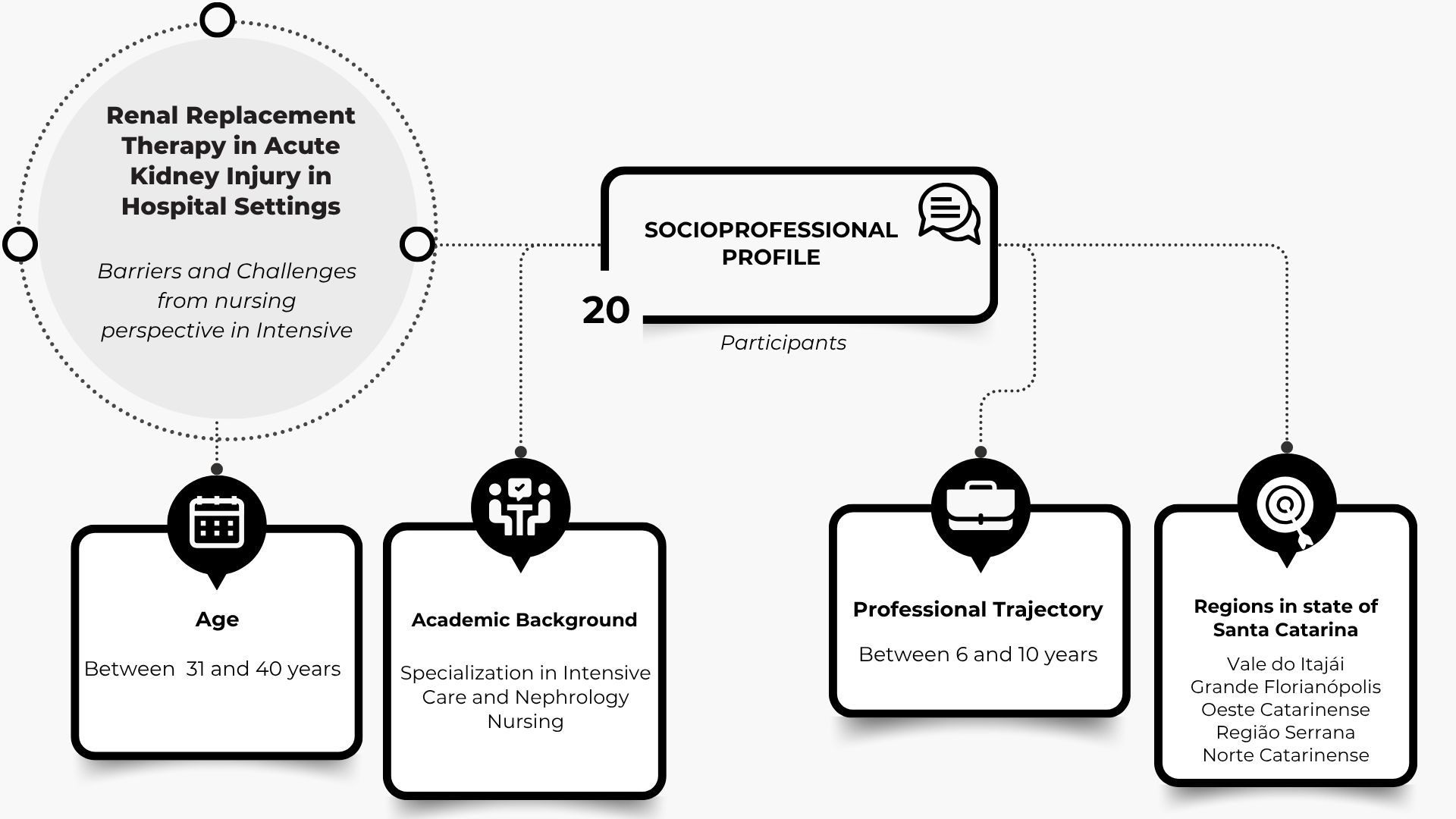
The socioprofessional profile indicated that participants were familiar with the topic and represented different regions in the state of Santa Catarina, including Vale do Itajaí, Greater Florianópolis, Western Santa Catarina, Serra Region, and Northern Santa Catarina.
Characterization of this profile is presented in Figure 1, created by the authors using Canva resources (2025) for non-commercial use. It was observed that nurses working in the area addressed were mostly between 31 and 40 years old and had 6 to 10 years of professional experience. The sample also revealed a significant proportion of professionals with lato sensu specialization in Nephrology and Intensive Care.

The second section of the questionnaire addressed characteristics related to nursing practice in managing RRT for individuals with AKI in ICUs. Based on content analysis, two thematic categories were organized and are presented in Figure 2: Interruption of bedside renal replacement therapy due to factors unrelated to the patient’s clinical condition; Aspects that compromise safe use of renal replacement therapy in the Intensive Care Unit.

Interruption of bedside renal replacement therapy due to factors unrelated to the patient’s clinical condition
Nursing professionals’ accounts indicated that bedside RRT is frequently affected by non-clinical factors such as technical limitations, professional insecurity, and structural deficiencies, which compromise treatment continuity and efficiency. Technical training and infrastructure improvement emerge as essential strategies to reduce interruptions and ensure patient safety.
Vascular access management
Vascular access management emerged as a central challenge. Professionals reported difficulties maintaining blood flow through catheters and arteriovenous fistula (AVF) punctures, often requiring medical intervention to proceed with RRT:
Technicians tell me that the catheter no longer presents flow [...] I try to reposition the patient, but most of the time the access is already obstructed (ENF01).
When I notice catheter flow difficulty, I inform the nurse from the hemodialysis sector, who often manages to improve flow and continue the session (ENF03).
Lack of experience with certain types of access contributes to insecurity and the need to replace the catheter:
The hemodialysis sector team is not always at the bedside, and when an alarm occurs that stops flow I do not know what to do immediately to reestablish flow (ENF08).
Some patients have AVFs, but since I do not have much experience, sometimes the puncture is not satisfactory and we need to ask the physician to insert a catheter (ENF05).
Findings indicate that inadequate vascular access management goes beyond an isolated technical difficulty and constitutes a structural factor in RRT interruptions. Reported insecurity reveals gaps in practical training and continuing education, as well as weaknesses in coordination between the ICU team and the hemodialysis sector. From the authors’ perspective, recurrent dependence on medical or specialized professional intervention highlights the need to strengthen nurses’ technical autonomy and institutional protocols that ensure immediate support for access management, reducing patient risk and avoidable therapy interruptions.
Risk of system clotting and blood return
Another critical factor is system clotting, which generates insecurity among professionals and may lead to session interruption:
I find it difficult to resolve when the HD system clots; we are always overloaded with activities and cannot remain as attentive to clotting as needed, and since we cannot use heparin every time, the system clots and we must replace all material or end the session (ENF06).
I admit I become very anxious when everything clots, because we do not always have HD in the sector, so when it happens there is immediate insecurity about harming the patient (ENF09).
Sometimes the technician does not notice the problem during the session and only acts when the machine triggers repeated alarms (ENF10).
System clotting constitutes a multifactorial adverse event related to limited anticoagulation use, workload, and insufficient vigilance during therapy. Recurrence of this problem demonstrates the need to reorganize work processes, invest in ongoing training, and define responsibilities clearly, aiming at prevention, early management, and reduction of therapeutic losses and care risks.
Failures in water distribution and quality
Structural problems, especially those related to water distribution and quality, also interfere with therapy:
Here it is very difficult; every week we end up having to terminate hemodialysis early because there is not enough water for the osmosis to function, which certainly affects patient treatment (ENF13).
Sometimes water quality is not adequate, and for safety reasons the portable osmosis unit shuts down. We always inform maintenance about water parameters displayed by the osmosis system, but it takes days to be resolved (ENF14).
Failures in water distribution and quality reveal structural limitations that compromise RRT continuity and safety, exposing institutional vulnerability. These interruptions point to the need for investments in infrastructure, preventive maintenance, and agile response workflows, recognizing treated water as an essential component in dialysis therapy.
Aspects that compromise safe use of renal replacement therapy in the Intensive Care Unit
The second category showed that RRT faces challenges related to work organization, staffing, communication between professionals, and unit infrastructure. These factors directly affect treatment safety and efficiency, demonstrating that therapy implementation depends on both technical competencies and adequate organizational arrangements. Other aspects mentioned less frequently included low appreciation of staff and scarcity of specific training in dialysis care.
Work activity organization
Professionals reported difficulties in reconciling HD with other ICU care routines:
We prioritize performing hemodialysis during daytime routine; therefore, when there are two to four patients to dialyze, the routine becomes very demanding to organize all care (ENF13).
Everyone knows the patient has been receiving HD for days, but there is always disagreement because the physical therapist wants to sit the patient up, there is the need to take the patient for a CT scan, and other care for that patient (ENF14).
There is never planning of the most suitable time; the technician from the hemodialysis sector arrives and starts HD, and sometimes there is an extubation plan or tests to be collected, which is also affected because some tests cannot be collected during HD (ENF15).
When we discuss in the multidisciplinary meeting whether the patient will undergo dialysis, I can schedule antibiotic administration according to the defined HD time, but unfortunately the hemodialysis nurse is not always available (ENF16).
Lack of integrated RRT planning within ICU routine favors care conflicts, overlapping interventions, and higher risk of delays, interruptions, and adverse events. This weakness in multiprofessional coordination suggests that RRT is still treated as a parallel activity rather than an inseparable component of critically ill patients’ therapeutic plan, highlighting the need to incorporate it into daily unit planning, strengthen interdisciplinary communication, and reinforce nurses’ role as coordinators of care.
Staffing and team qualification
Insufficient staffing and lack of adequate training compromised safe delivery of RRT:
Our team is usually incomplete due to vacations or sick leave, so when there is a patient on dialysis this is one of the most critical cases in the ICU and demands a great deal from us (ENF03).
Hemodialysis is performed by ICU technicians. With a reduced staff, difficulties in performing therapy often result in ending the session on the same day (ENF04).
Turnover is high, placing additional burden on professionals who know how to perform HD and preventing training that would keep the entire team competent (ENF06).
Testimonies indicate that understaffing and turnover are critical factors for RRT safety, since concentrating knowledge in a few professionals generates overload, weakens care continuity, and restricts dissemination of technical competencies. This scenario demonstrates the need for institutional policies targeting adequate staffing and continuing education, recognizing RRT as a complex practice that requires qualified and available professionals.
Communication between teams
Deficient communication between ICU and hemodialysis teams compromised activity organization and definition of therapeutic goals:
Hemodialysis staff arrive in the ICU to perform HD and we are not even aware that there was a patient scheduled for dialysis; sometimes we have CT scans and other care that interfere with the session (ENF08).
When I start HD, I do not always know the objective of that day’s session because the physician does not inform us and only leaves the printed prescription with parameters (ENF10).
Fragmented communication between teams undermines shared decision-making and weakens understanding of RRT therapeutic goals, reducing care predictability and increasing the likelihood of conflicts and unnecessary interruptions. In this sense, communication becomes a key element in patient safety, requiring creation of formal spaces for information exchange and joint definition of care goals.
Infrastructure and equipment functioning
Structural problems and equipment failures also affected RRT continuity and safety:
Even when we can call the hemodialysis sector team, many times we must resolve complications alone; sometimes the problem lies in the machine or water supply, which generates considerable stress (ENF07).
Equipment must be connected to the water network, but faucets often leak, causing disruption and leaving the bed wet. In addition, there are few power outlets available, which hinders simultaneous use of necessary equipment (ENF10).
The site designated for draining hemodialysis machine effluent is inadequate. Leaks or blockages frequently occur, flooding the bed area and sometimes involving not only water but also the fluid removed from the patient (ENF11).
Problems are not always related to water; sometimes they originate in the osmosis system itself, which requires maintenance, filter changes, and disinfection. I am not sure whether there is regular monitoring for these aspects (ENF12).
These findings highlight organizational, structural, and communication challenges that compromise RRT safety and efficiency in ICUs. They demonstrate the need for institutional strategies and continuing education initiatives that ensure safe use of therapy and strengthen nurses’ leadership role in managing bedside RRT.
DISCUSSION
The study highlights challenges and weaknesses faced by nursing staff in delivering renal replacement therapy in ICUs, showing that management difficulties may lead to treatment interruption and reduced therapeutic effectiveness. Among the most frequently reported factors unrelated to patients’ clinical condition are vascular access problems, return of blood from the extracorporeal circuit, interpretation of clotting indicators, and failures in water distribution in the unit.
Adjustment of blood flow, anticoagulation management, and blood return require precise interventions by nursing staff, since errors in these procedures may result in blood loss and unfavorable clinical outcomes. Interruption or inefficiency of RRT is often identified through laboratory changes, which reinforces the importance of continuous monitoring, clinical reasoning, and nurses’ technical leadership.9,10
Adverse events such as extracorporeal system clotting and vascular access failures are recurrent and demand vigilance and safe decision-making in roles intrinsically associated with nursing leadership.22 The distinction between active and latent errors helps explain how structural deficiencies and the performance of inexperienced professionals may lead to incidents, including blood loss during continuous hemodialysis.9,10
These findings align with PNSP guidelines, established by Ordinance nº 529/2013, which emphasize adoption of safe practices, care protocols, and a safety culture at all levels of care.23 Implementation of specific protocols for vascular device management and anticoagulation is essential to reduce failures and ensure therapeutic continuity.
Nurses’ technical competence and experience directly influence safety and effectiveness of care, particularly in procedures such as equipment setup, scale calibration, blood return, and alarm management.8,10 In addition, rigorous vascular access supervision is indispensable to prevent infections and obstructions and to ensure hemodialysis efficiency, especially when arteriovenous fistulas or venous catheters are used.24,25
RRT demands skills in three interdependent dimensions: extracorporeal machine management, vascular access care, and direct patient care. Consequently, therapy safety and effectiveness depend on nurses’ ability to detect early changes, intervene in complications, and adopt immediate measures in response to failures, ensuring treatment continuity and preservation of renal function.8,10,22
In relation to this, the intensivist nurse’s role must go beyond hemodynamic monitoring to include extracorporeal circulation management, technical leadership, and interdisciplinary coordination with nephrology teams. Professional qualification through specialization, residency, or certification positively affects clinical outcomes and reduces adverse events.26,27
Work organization and adequate staffing also influence care safety. Work overload and extended shifts are associated with programming errors in dialysis machines and preventable incidents.28 In this context, effective communication between intensive care professionals and hemodialysis teams is indispensable for multiprofessional care, enabling appropriate scheduling, medication adjustments, and safe RRT delivery.22
Infrastructure and availability of technological resources, such as hemodialysis machines and purified water systems, also directly affect patient safety and therapeutic effectiveness. Failures in these processes increase morbidity and mortality, generate professional frustration, and underscore the need for protocols, preventive maintenance, and an institutional safety culture.29,30
Bedside hemodialysis nursing practice requires a multidimensional approach that integrates nephrology knowledge, technical competencies, and care management to ensure safe and effective renal replacement therapy for critically ill patients.28 This study emphasizes the relevance of collaboration between intensivist nurses and nephrology specialists, continuous training for teams, and implementation of management, communication, and infrastructure strategies aimed at reducing adverse events.
COFEN Resolution nº 389/2011 is consistent with SBN and PNSP guidelines by highlighting technical competence, clinical decision-making, and nursing leadership as pillars of safe practice.23,31,32 Its implementation goes beyond a merely normative dimension and constitutes an essential strategy to improve care quality and strengthen the safety culture in hospital and outpatient hemodialysis services.
Thus, the dialogue between this study’s findings and Brazilian public policies shows that RRT effectiveness depends not only on nursing staff technical competence, but also on implementation of safety policies, protocol standardization, and structural investments aligned with national care quality goals. Integration of PNSP actions, SBN guidelines, and COFEN regulations represents a strategic pathway for strengthening nephrology nursing practice that is safe, high-quality, and patient-centered in hospital settings.
FINAL CONSIDERATIONS AND IMPLICATIONS FOR PRACTICE
Study results clearly described challenges and weaknesses faced by nurses in bedside renal replacement therapy for patients with acute kidney injury in Intensive Care Units, demonstrating that RRT safety and effectiveness depend on articulation between technical competence, continuous vigilance, and adequate organizational and structural conditions.
Weaknesses were identified in vascular access management, system clotting risk, professional insecurity in the face of complications, as well as structural and operational limitations such as water quality and distribution failures, equipment inadequacies, and maintenance difficulties. These aspects, combined with work overload, understaffing, and fragmented communication between ICU and hemodialysis professionals, compromise therapy continuity and expose critically ill patients to care risks.
In this context, it becomes evident that RRT is still often incorporated into ICU routines in a way that is insufficiently integrated with the therapeutic plan, which weakens work processes and limits nurses’ leadership in managing bedside therapy. Practical implications include the need to develop and implement institutional regulations and clinical protocols guiding RRT, as well as ongoing professional training strategies and stronger integration between intensivist nurses and nephrology specialists to improve care quality and consolidate a patient safety culture.
Further encouragement of scientific production and multicenter studies is recommended to broaden understanding of nursing practice in RRT, especially in Latin America, where literature on this topic remains scarce and nephrology nursing still has limited visibility in hospital care.
As a study limitation, the geographically restricted scope to the state of Santa Catarina may limit generalization of findings. Nevertheless, results help address existing gaps in the literature and reinforce the need for future investigations exploring collaborative practices, work organization, and strategies aimed at patient safety in critical care settings.
ACKNOWLEDGMENTS
We thank the Universidade Federal de Santa Catarina and faculty from the Graduate Program in Nursing for their guidance and support throughout this academic journey. We especially thank participating institutions and respondents, whose commitment and collaboration were fundamental for this study’s development.
FINANCIAL SUPPORT
DATA AVAILABILITY RESEARCH
The data will be available upon request to the corresponding author via email. Since this qualitative study is based on narratives recorded in participants’ forms, containing potentially sensitive content related to health services. Even with code-based anonymization, there remains a risk of reidentification by context and information combination in narratives.
References
-
1 Bello AK, Okpechi IG, Levin A, Ye F, Saad S, Zaidi D et al. ISN–Global Kidney Health Atlas: a report by the International Society of Nephrology. Brussels: International Society of Nephrology; 2023. [citado 2025 jan 10]. Disponível em: https://www.theisn.org/wp-content/uploads/media/ISN%20Atlas_2023%20Digital.pdf
» https://www.theisn.org/wp-content/uploads/media/ISN%20Atlas_2023%20Digital.pdf -
2 Bello AK, Okpechi IG, Levin A, Ye F, Damster S, Arruebo S et al. An update on the global disparities in kidney disease. Lancet Glob Health. 2024;12(3):e382-95. https://doi.org/10.1016/S2214-109X(23)00570-3 PMid:38365413.
» https://doi.org/10.1016/S2214-109X(23)00570-3 -
3 Monard C, Marel A, Joannidis M, Ostermann M, Peng Z, Doi K, et al. Renal replacement therapy modalities and techniques in intensive care units: an international survey. J Crit Care. 2025;88:155076. https://doi.org/10.1016/j.jcrc.2025.155076 PMid:40179459.
» https://doi.org/10.1016/j.jcrc.2025.155076 -
4 Ostermann M, Lumlertgul N, Jeong R, See E, Joannidis M, James M. Acute kidney injury. Lancet. 2025;405(10474):241-56. https://doi.org/10.1016/S0140-6736(24)02385-7 PMid:39826969.
» https://doi.org/10.1016/S0140-6736(24)02385-7 -
5 Levine Z, Vijayan A. Prolonged intermittent kidney replacement therapy. Clin J Am Soc Nephrol. 2023;18(3):383-91. https://doi.org/10.2215/CJN.04310422 PMid:36041792.
» https://doi.org/10.2215/CJN.04310422 -
6 Chan RJ, Helmeczi W, Canney M, Clark EG. Management of intermittent hemodialysis in critically ill patients. Clin J Am Soc Nephrol. 2023;18(2):245-55. https://doi.org/10.2215/CJN.04000422 PMid:35840348.
» https://doi.org/10.2215/CJN.04000422 -
7 Lu Z, Hong Y, Tian Y, Zhang L, Li Y. The effectiveness of a specialized nursing team intervention in the unplanned interruption of continuous renal replacement therapy. Iran J Public Health. 2022 Mar;51(3):544-51. https://doi.org/10.18502/ijph.v51i3.8930 PMid:35865059.
» https://doi.org/10.18502/ijph.v51i3.8930 -
8 Kılıç G, Eskigülek Y, Erdoğan B, Arpa H, Erbaş G, Baştürk B. Opinions of intensive care nurses on continuous renal replacement therapy: a qualitative study. Ther Apher Dial. 2024 Dec;28(6):886-92. https://doi.org/10.1111/1744-9987.14176 PMid:38867443.
» https://doi.org/10.1111/1744-9987.14176 -
9 Yu X, Ouyang L, Li J, Peng Y, Zhong D, Yang H et al. Knowledge, attitude, practice, needs, and implementation status of intensive care unit staff toward continuous renal replacement therapy: a survey of 66 hospitals in central and South China. BMC Nurs. 2024 Apr 26;23(1):281. https://doi.org/10.1186/s12912-024-01953-6 PMid:38671501.
» https://doi.org/10.1186/s12912-024-01953-6 -
10 Zhang Y, Ma J, Zhu F, Zheng A, Li Z, Tian C, et al. Analysis of ICU nurses’ CRRT downtime management knowledge, attitude, and practice status and influencing factors based on latent profiles and chain mediation analysis: a multicenter, cross-sectional survey. BMC Nurs. 2025;24(1):1230. https://doi.org/10.1186/s12912-025-03837-9 PMid:41029363.
» https://doi.org/10.1186/s12912-025-03837-9 -
11 Barbosa JCG, Pereira FJR, Barros MAA, Costa DLS, Azevedo EB. Acute kidney injury in critically ill patients. Enferm Foco. 2024;15:e2024122. https://doi.org/10.21675/2357-707X.2024.v15.e-2024122
» https://doi.org/10.21675/2357-707X.2024.v15.e-2024122 -
12 González-Fernández M, Quílez-Trasobares N, Barea-Mendoza JA, Molina-Collado Z, Arias-Verdú D, Barrueco-Francioni J et al. Evaluation of the registry DIALYREG for the assessment of continuous renal replacement techniques in the critically ill patient. Sci Rep. 2023 Apr 20;13(1):6479. https://doi.org/10.1038/s41598-023-32795-y PMid:37081011.
» https://doi.org/10.1038/s41598-023-32795-y -
13 World Health Organization. Conceptual framework for patient safety. Geneva: WHO; 2011 [citado 2025 jan 10]. Disponível em: https://apps.who.int/iris/handle/10665/70882
» https://apps.who.int/iris/handle/10665/70882 -
14 Resolução RDC nº 36, de 25 de julho de 2013 (BR). Institui ações para a segurança do paciente. Diário Oficial da União [periódico na internet], Brasília (DF); 2013 [citado 2025 jan 10]. Disponível em: https://www.gov.br/anvisa
» https://www.gov.br/anvisa -
15 Wang Y, Yang L, Lei Y. The global status of nursing research on hemodialysis: a bibliometric and visualized analysis. Medicine (Baltimore). 2024;103(39):e39707. https://doi.org/10.1097/MD.0000000000039707 PMid:39331890.
» https://doi.org/10.1097/MD.0000000000039707 -
16 Tong A, Sainsbury P, Craig J. Consolidated criteria for reporting qualitative research (COREQ). Int J Qual Health Care. 2007;19(6):349-57. https://doi.org/10.1093/intqhc/mzm042 PMid:17872937.
» https://doi.org/10.1093/intqhc/mzm042 -
17 Johnson TP. Snowball sampling: introduction. In: Balakrishnan N, Colton T, Everitt B, Piegorsch W, Ruggeri F, Teugels J. Wiley StatsRef: statistics reference online. Chichester: Wiley; 2014. https://doi.org/10.1002/9781118445112.stat05720
» https://doi.org/10.1002/9781118445112.stat05720 -
18 Minayo MCS. Amostragem e saturação em pesquisa qualitativa. Rev Pesq Qual. 2017 [citado 2025 jan 10];5(7):1-12. Disponível em: https://editora.sepq.org.br/rpq/article/view/82
» https://editora.sepq.org.br/rpq/article/view/82 - 19 Bardin L. Análise de conteúdo. Lisboa: Edições 70; 2016.
-
20 Conselho Nacional de Saúde. Comissão Nacional de Ética em Pesquisa. Brasília: CNS; 2023 [citado 2025 jan 10]. Disponível em: https://conselho.saude.gov.br
» https://conselho.saude.gov.br -
21 Conselho Nacional de Saúde. Comissão Nacional de Ética em Pesquisa. Ofício Circular nº 2/2021/CONEP/SECNS/MS, de 24 de fevereiro de 2021. Orientações para procedimentos em pesquisas com qualquer etapa em ambiente virtual. Brasília (DF); 2021 [citado 2025 jan 10]. Disponível em: https://conselho.saude.gov.br/oficios-circulares
» https://conselho.saude.gov.br/oficios-circulares -
22 Silva PCG, Bastos WDG. Nursing care for patients undergoing hemodialysis. Rev Recien. 2022;12(38):257-67. http://doi.org/10.24276/rrecien2022.12.38.257-267
» http://doi.org/10.24276/rrecien2022.12.38.257-267 -
23 Portaria nº 529, de 1º de abril de 2013 (BR). Institui o Programa Nacional de Segurança do Paciente. Diário Oficial da União [periódico na internet], Brasília (DF); 2013 [citado 2025 jan 10]. Disponível em: https://www.gov.br/saude
» https://www.gov.br/saude -
24 Lok CE, Yuo T, Lee T. Hemodialysis vascular access: core curriculum. Am J Kidney Dis. 2025;85(2):236-52. https://doi.org/10.1053/j.ajkd.2024.05.021 PMid:39625430.
» https://doi.org/10.1053/j.ajkd.2024.05.021 - 25 Higgins MCSS, Diamond M, Mauro DM, Kapoor BS, Steigner ML, Fidelman N et al. ACR Appropriateness Criteria® Dialysis Fistula Malfunction. J Am Coll Radiol. 2023;20(11S):S382-412. PMid:38040461.
-
26 Vincent JL, Boulanger C, van Mol MMC, Hawryluck L, Azoulay E. Ten areas for ICU clinicians to be aware of. Crit Care. 2022;26(1):310. https://doi.org/10.1186/s13054-022-04182-y PMid:36229859.
» https://doi.org/10.1186/s13054-022-04182-y - 27 Gomes TO, Girão FB, Santos TDL, Silva MH, Portes EA, Melo CL et al. Training profile of intensive care nurses in Brazil: cross-sectional study. Rev Bras Enferm. 2024;77(6):e20230460. PMid:39699361.
-
28 Saad A, Ahmed N, Alsadi J, Al-Absi DT, Almulla M, Simsekler MCE et al. An integrative risk assessment approach to enhancing patient safety in Continuous Renal Replacement Therapy (CRRT). J Saf Sci Resil. 2024;5(3):344-54. https://doi.org/10.1016/j.jnlssr.2024.04.003
» https://doi.org/10.1016/j.jnlssr.2024.04.003 -
29 Carvalho HNM, Formigosa DEC, Ferreira MGS, Pacheco JO, Gaia MA. Patient safety in dialysis therapy from the perspective of nursing. Rev Eletr Acervo Saúde. 2023;23(11):e14263. http://doi.org/10.25248/reas.e14263.2023
» http://doi.org/10.25248/reas.e14263.2023 -
30 Jesus PR, Ferreira JAB, Carmo JDS, Albertino SRG, Vicentini AS No, Santos LMGD et al. Monitoring the quality of the water used in mobile dialysis services in intensive care units in the city of Rio de Janeiro. J Bras Nefrol. 2022;44(1):32-41. https://doi.org/10.1590/2175-8239-jbn-2020-0217 PMid:34314476.
» https://doi.org/10.1590/2175-8239-jbn-2020-0217 -
31 Resolução nº 389, de 18 de outubro de 2011 (BR). Atualiza, no âmbito do Sistema Cofen / Conselhos Regionais de Enfermagem, os procedimentos para registro de título de pós-graduação lato e stricto sensu concedido a Enfermeiros e lista as Especialidades. Diário Oficial da União [periódico na internet], Brasília (DF); 2011 [citado 2025 jan 10]. Disponível em: http://www.cofen.gov.br
» http://www.cofen.gov.br -
32 Sociedade Brasileira de Nefrologia. Diretrizes para terapia renal substitutiva. São Paulo: SBN; 2021 [citado 2025 jan 10]. Disponível em: https://sbn.org.br
» https://sbn.org.br