 Quilombola education in nursing: aquilombamento, critical interculturality, and counter-colonization
Abstract
Objective to analyze the potentialities of the education of quilombola nurses in confronting racism and promoting equity and racial equality.
Method a theoretical-reflective study grounded in decolonial and counter-colonial epistemologies, articulated with the authors’ educational experiences and critical literature on health, education, and quilombola populations. The analysis was organized based on references from the Global South and on categories that problematize inequalities, territoriality, and knowledge production in nursing education. The study was conducted between January and October 2025.
Results the text is structured around three main axes: aquilombamento as an educational practice and epistemic resistance; critical interculturality in nursing education; and the transformative potentialities of the presence of quilombola nurses within the structure of the Unified Health System.
Final considerations and implications for practice the inclusion of quilombola peoples in undergraduate nursing programs represents an opportunity for implementing epistemological change within curricula. The incorporation of concepts developed by authors from the Global South, aligned with social resistance, politics, and the epistemology of quilombola populations, promotes structural mechanisms for confronting different forms of racism.
Keywords:
Diversity, Equity, Inclusion; Education, Nursing; Nursing; Public Policy; Quilombola Communities
Resumo
Objetivo analisar as potencialidades da formação de enfermeiras e enfermeiros quilombolas para enfrentamento do racismo e promoção da equidade e igualdade racial.
Método estudo teórico-reflexivo, ancorado em epistemologias decoloniais e contracoloniais, articulado à experiência formativa das autoras e à literatura crítica sobre saúde, educação e populações quilombolas. A análise foi organizada com base em referenciais do Sul Global e em categorias que problematizam desigualdades, territorialidade e produção de saberes na formação em enfermagem. Foi realizado entre janeiro e outubro de 2025.
Resultados o texto está estruturado em três eixos principais: o aquilombamento como prática educativa e resistência epistêmica; a interculturalidade crítica na formação em enfermagem; e as potencialidades transformadoras da presença de enfermeiras e enfermeiros quilombolas na estrutura do Sistema Único de Saúde.
Considerações finais e implicações para a prática a inclusão de quilombolas em cursos superiores de graduação em enfermagem é oportunidade para a implementação da mudança epistemológica nos currículos. A inserção de conceitos de autores do Sul Global alinhados à resistência social, à política e à epistêmologia das populações quilombolas promove mecanismos estruturais para enfrentamento dos diferentes tipos de racismo.
Palavras-chave:
Diversidade, Equidade, Inclusão; Educação em Enfermagem; Enfermagem; Política Pública; Quilombolas
Resumen
Objetivo analizar las potencialidades de la formación de enfermeros y enfermeras quilombolas para enfrentar el racismo y promover la equidad e igualdad racial.
Método estudio teórico-reflexivo basado en epistemologías decoloniales y contracoloniales, articulado con la experiencia formativa de las autoras y con la literatura crítica sobre salud, educación y poblaciones quilombolas. El análisis se organizó con base en referentes del Sur Global y en categorías que problematizan desigualdades, territorialidad y producción de conocimientos en la formación en enfermería. Se llevó a cabo entre enero y octubre de 2025.
Resultados el texto está estructurado en tres ejes principales: el aquilombamento como práctica educativa y resistencia epistémica; la interculturalidad crítica en la formación en enfermería; y las potencialidades transformadoras de la presencia de enfermeros y enfermeras quilombolas en la estructura del Sistema Único de Salud.
Consideraciones finales e implicaciones para la práctica la inclusión de quilombolas en los cursos superiores de grado en enfermería representa una oportunidad para la implementación del cambio epistemológico en los currículos. La incorporación de conceptos de autores del Sur Global alineados con la resistencia social, la política y la epistemología de las poblaciones quilombolas fomenta mecanismos estructurales para enfrentar los diferentes tipos de racismo.
Palabras clave:
Diversidad, Equidad e Inclusión; Educación en Enfermería; Enfermería; Política Pública; Quilombolas
INTRODUCTION
Quilombola health constitutes a field marked by historical inequalities, profound territorial asymmetries, and persistent expressions of structural racism in Brazil.1 Amid these challenges, the presence of quilombola students in higher education emerges as a political-epistemic movement that challenges institutional practices and calls for new configurations of teaching, research, and care.2 This access to higher education3 is ensured by Law 14,723/2023, which represents an expansion of the Quota Law and has supported discussions on diversity, equity, and inclusion.
This inclusion faces several challenges, particularly institutional racism,2,3 the absence of effective retention policies such as financial support programs, insufficient representation of quilombola-related themes in curricular structures,4 difficulties associated with adapting to a new life routine marked by cultural differences,5 and limited faculty training regarding the cultural and social specificities of quilombola communities.6 Such barriers hinder not only access, but also the retention and full academic development of these students,3 highlighting the need for structural and pedagogical advances in higher education.
In nursing, a profession intrinsically linked to community dynamics, this tension becomes especially relevant, as it challenges pedagogical models that still reproduce a biomedical, Eurocentric vision, distant from territories and anti-racist practices.7-9 On the other hand, the training of nursing professionals from quilombola communities emerges as a strategic opportunity to incorporate traditional knowledge and discuss its interfaces with the National Policy for Comprehensive Healthcare for the Black Population (PNAISPN - Política Nacional de Atenção Integral à Saúde da População Negra).10 In this context, the training of nursing professionals from quilombola communities is configured as a formative and political vector to promote the inclusion of historically marginalized groups, recognizing their cultural and social specificities.1,10
Within this context, undergraduate nursing education becomes a strategic field of epistemic dispute. Therefore, it is essential to understand that these students are, above all, subjects with singular experiences rooted in the lived realities and resistance of their communities. The reconstruction of pedagogical action thus becomes indispensable for overcoming traditional paradigms and advancing the production of knowledge regarding the diverse quilombola territories.3,6 This transformation requires recognizing the multiple realities and singularities of these spaces, moving away from positivist models and promoting a broader and more contextualized understanding of their historical and social processes.2
Despite the expansion of access and retention policies,2-4 scientific literature on the education of quilombola nurses remains scarce, with a predominance of analyses focused on the health of the Black population5,9,10 or healthcare in quilombola territories,1 without systematically examining nursing education itself.7,9 The epistemic, pedagogical, and political potential mobilized by quilombola students upon entering university remains underexplored, as does the analysis of how their trajectories may contribute to curricular reorientation and strengthening of the Unified Health System (SUS – Sistema Único de Saúde).
To this end, it is necessary to adopt epistemic perspectives originating from the Global South.11,12 This approach enables dialogue regarding the presence of quilombola students in health-related programs at public universities, contributing to the overcoming of exclusionary practices and the construction of more equitable care models.13-15 This perspective contributes to the theoretical-political debate on nursing education and to the consolidation of educational practices committed to social, territorial, and epistemic justice.2
To problematize this gap, this study adopts a theoretical framework grounded in three interconnected axes. Aquilombamento 10 is understood as an educational, political, and community-based practice that operates both as a strategy of resistance11 and as a matrix for knowledge production. Critical interculturality, in contrast to merely celebratory approaches to diversity and functional interculturality, guides educational processes that recognize the conflicts, asymmetries, and power disputes13 permeating educational spaces and territories. Counter-colonization12 enables quilombola students to challenge hegemonic models and center their knowledge and territories within knowledge production processes.
Given this context, the following question arises: how can the education of quilombola nurses in Brazil contribute to promoting equity within the SUS, considering the structural, epistemological, and institutional challenges faced by these students at universities? Thus, this theoretical-reflective study aims to analyze the potential of quilombola nursing education to confront structural racism and promote equity and racial equality.
METHOD
This theoretical-reflective study is based on a critical and dialogical approach, anchored in decolonial and counter-colonial epistemologies.8,9 This perspective is aligned with the authors’ experiences and critical thinking, enabling an in-depth analysis of the intersections between education and health, focusing on the sociocultural, political, and epistemic implications involved in the undergraduate education of quilombola nurses. The study was conducted between January and October 2025.
The investigation focuses on the challenges and potentialities of inclusion and education within the field of nursing, structured around three main analytical axes: (1) Aquilombamento as an educational practice and epistemic resistance; (2) Critical interculturality in nursing education; and (3) Transformative potentialities of quilombola nursing education for the Unified Health System.
The theoretical construction of this study is grounded in essential references for understanding epistemologies from the Global South, especially the thought of Beatriz Nascimento regarding quilombo, memory, and cultural resistance, which serve as the basis for understanding aquilombamento as a political-epistemic practice, as well as the notion of counter-colonization formulated by Antônio Bispo dos Santos.8,9,12
Accordingly, quilombola populations are understood as Black collectivities historically organized as forms of resistance against racism, grounded in ancestry, belonging, and their own ways of life. The quilombo is not reduced to a “remnant” of the past; rather, it is a living category of freedom production and cultural resistance that grounds territory, memory, collective action, and worldviews that promote counter-colonization.12 Aquilombamento is understood as the process of creating protection and belonging as a strategy of re-existence in the face of structural racism.11
Thus, when addressing quilombola specificities, this study refers to an articulated set of collective territoriality, ancestry and memory as social technology, community organization, distinct forms of authority, care and healing practices that cannot be reduced to the biomedical model, and recurrent experiences of institutional racism that shape access, bonding, communication, and adherence to care within the SUS.11,12
Based on these contributions, a critical reflection is proposed regarding the education of future quilombola nursing professionals, articulating contemporary pedagogical practices with the demands of the SUS, especially within the framework of the PNAISPN and the National Curriculum Guidelines for undergraduate nursing courses (DCENFs - Diretrizes Curriculares Nacionais para os cursos de graduação em Enfermagem), of the resolution CNE/CES No. 01 of May 15, 2026.
During the preparation of this research article, the authors used Chat GPT version 2025 for grammatical and spelling review of the text. After using this tool/model/service, the authors reviewed and edited the content in accordance with the scientific method and assume full responsibility for the content of the publication.
Additionally, this study is aligned with the practical experiences of the authors, one a quilombola nurse and the other a non-quilombola nurse, both working in the fields of education, health, and research, enabling dialogue between theory and practice and enriching the analysis with situated perspectives committed to social transformation grounded in Aníbal Quijano’s assumptions regarding the “Coloniality of Power”.13
RESULTS AND DISCUSSION
To support the analysis developed in this study, an integrated framework is initially presented, articulating the fundamental theoretical concepts necessary for understanding the undergraduate education of quilombola nurses. This framework aims to operationalize critical references by demonstrating how each concept functions as an analytical operator, illuminates dimensions of education, reveals structural tensions, and points to possible pathways for constructing educational practices committed to racial justice, equity, and epistemological transformation.
The perspective adopted here recognizes that undergraduate nursing education for quilombola students cannot be analyzed separately from historical resistance movements, Black and quilombola epistemologies, and disputes over the legitimacy of knowledge within the university. In this sense, key concepts developed by Black and quilombola intellectuals who critique the coloniality of power, denounce epistemicide, and propose forms of curricular reorganization grounded in ancestry, territory, and community agency are mobilized. Thus, Chart 1 synthesizes these operators and clarifies their contributions to the analytical axes presented below.
Interconnected reflective framework based on the theoretical analysis of the training of nurses from quilombola communities.
Aquilombamento as an educational practice and epistemic resistance
Aquilombamento,10 as an educational practice, constitutes a conceptual framework that goes beyond its historical notion8,9 and comes to operate as a political category within health education. In educational contexts, it functions as a mechanism through which quilombola students mobilize ancestry, community belonging,9 and strategies of resistance in order to reposition themselves as active epistemic subjects.14 From this perspective, aquilombamento is not merely a physical presence within the university, but rather an affirmation of students’ epistemic authority,10,11 in which quilombola experiences and memories challenge curricula and displace Eurocentric pedagogical rationalities.
It is a pedagogy that emerges from quilombola subjects themselves and is expressed through collective practices such as talking circles, support networks, and ancestral narratives.10,11 These processes establish an epistemology of aquilombamento 10 as an articulating axis, as illustrated in Figure 1, in which care involves ethical-affective relationships grounded in territory. Upon entering undergraduate nursing programs, quilombola students do not merely adapt to the curriculum; rather, they reconfigure it, as their presence exposes gaps,7 silences, and historical absences regarding Black and quilombola populations.

Conceptual mandala of aquilombamento as an articulating axis in undergraduate nursing education.
The “Mandala of Aquilombamento” is proposed as a pedagogical-reflective device for reorganizing education through a territorialized and antiracist logic, in which memory, cosmovision, territory, ancestral epistemologies, autonomy, and counter-colonization cease to be peripheral themes and begin to operate as curricular mediations.10-13 From this perspective, aquilombamento functions as a key framework for interpretation and action, guiding the selection of references, the ways care situations are problematized, and the forms through which learning criteria are constructed to recognize historical inequalities and disputes over knowledge permeating health education.7-9
As an educational strategy, it depends on concrete conditions for implementation. First, it requires pedagogical co-governance, including the collective agreement of objectives, activities, and assessment criteria with student participation and, when appropriate, dialogue with community actors, thereby preventing the mandala from functioning merely as a normative statement.2,4 Second, it requires qualified faculty mediation capable of sustaining critical reflection, making epistemological conflicts explicit, and ensuring coherence between discourse and practice.15,16 Third, it demands formative assessment supported by evidence of learning through portfolios, reflective journals, and territorialized products.
At the same time, this strategy entails ethical-political considerations. There is a risk of appropriation without reciprocity, especially when quilombola students are placed in the position of permanent representatives, or when territory is mobilized as a pedagogical resource without reciprocity or institutional accountability.12,13 To mitigate these effects, the mandala is committed to clarifying the limits of what may be extracted from the territory, distributing responsibilities, and recognizing that counter-colonizing12 also involves challenging the institution itself.2,14
Aquilombamento strengthens counter-colonial pedagogical practices and expands quilombola representation within academic spaces.1,2 This approach contributes to the education of professionals committed to racial equity and social justice, capable of recognizing and addressing the specificities of quilombola populations across their diverse territories.2,14,15
It constitutes an ethics of freedom that challenges the colonial logic still present and strengthens quilombola leading role.14 It resignifies quilombola presence within the university, shifting it from a merely quantitative logic of inclusion toward a qualitative form of insertion,16,17 in which quilombola students become leading figures of curricular debates.
This emergence may occur through physical spaces of resistance and social, political, and epistemic restructuring of quilombola populations,4 for instance through student associations, the creation of research groups focused on quilombola epistemologies, the presence of quilombola leaders,4 and the adoption of participatory methodologies.
These actions challenge and permeate curricula, research, and extension activities,11 guided toward the co-construction of methodologies and the redirection of research lines, ensuring continuity of the historical resistance highlighted by several authors.8,9,11 This consolidates a form of epistemic resistance, as it confronts the epistemicide that has historically delegitimized quilombola peoples as legitimate sources of knowledge in health, contributing to an epistemic and epistemological shift. Thus, it constitutes a movement of resistance against the coloniality of knowledge, contesting the hegemony of dominant knowledge systems.
Interculturality in nursing education
Discussing nursing education through a critical intercultural lens, unlike merely celebratory approaches to diversity, allows for the debate of different types of knowledge and constitutive dimensions of care and the training process.14 It allows recognition and appreciation of the diverse health practices present in multicultural territories, such as quilombola communities. This constitutes a fundamental condition for confronting institutional racism, which directly impacts adherence to care and access to healthcare services.1,2
In nursing, this shift is not limited to the insertion of content7,9 regarding quilombola health into curricula; rather, it requires the active participation of communities in defining educational guidelines and strengthening student identity and leading role.2,4,5 When their territorial experiences are recognized as a legitimate part of the educational process, future quilombola nurses begin to act as leading figures and mediators between biomedical knowledge and traditional practices, expanding nursing’s capacity to provide culturally safe care.10 This movement challenges and reorients educational institutional structures, contributing to confronting structural racism and consolidating institutional spaces of resistance.6,10
The integration between biomedical and traditional knowledge, central to critical interculturality, provides support for rupturing with scientific racism, which has historically marginalized Black populations in knowledge production and health practices.10 It gives visibility to traditional practices such as blessings, community care networks, and quilombola social technologies, not as complementary elements, but as epistemologies in their own right.
Thus, Figure 2 illustrates that the process of rupture and interaction among different forms of knowledge does not occur simply or through mere juxtaposition, but rather through tensions, negotiations, and recognition of existing asymmetries. Furthermore, it is essential to incorporate into contemporary analysis the impact of algorithmic racism,17 which perpetuates discrimination through digital technologies and amplifies the challenges faced in constructing a critically intercultural education.
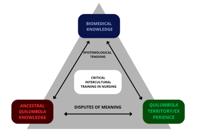
The model illustrates the dynamic articulation among three epistemic forces — biomedical knowledge, ancestral quilombola knowledge, and territory/community experience — which meet in processes of tension, dispute, and mediation within education and care provided through the SUS.1,11-13,15,16 The central area represents critical intercultural training as a tool that can impact work in health, especially in Primary Health Care (PHC), by improving practices of welcoming, communication, bonding, and collective actions in quilombola territories.1,15,16 Within this process, quilombola students assume the role of leading figures and mediators, promoting antiracist health practices and valuing traditional knowledge within the SUS.1,2,4,7,14-16
This mediation becomes evident when institutional protocols and routines come into tension with quilombola territorial rationalities of care, requiring educational processes to make explicit the disputes over legitimacy and the exclusionary effects produced by institutions.1,11-13,16 In these contexts, incorporation of the triangle materializes through critical intercultural educational devices such as mediated talking circles, analysis of territorialized cases, cartographies of care, and negotiated assessment processes with reflective records that render visible and accountable the processes of translation, negotiation, and ethical responsibility guided by antiracism and cultural safety.7,9,15,16
On the other hand, confronting these challenges requires nursing faculty education to include specific training and cultural sensitivity regarding the presence of Black students, especially quilombola students,8 as well as engagement with institutional barriers that hinder their retention and academic development, including lack of faculty representation, prejudice, and insufficient support mechanisms for student retention.17,18 This highlights the urgency of discussing implementation of affirmative actions and structural changes in higher education that include administrative staff and increased access for Black faculty members, including discussions related to graduate education.17
Faculty education must go beyond technical expertise by incorporating a perspective that recognizes the plurality of knowledge systems and contributes to an antiracist and socially just education.8 This approach transforms the university environment into a space that values quilombola identities and strengthens the academic development of these students by recognizing their trajectories as carriers of ancestral knowledge and legitimizing their experiences as sources of knowledge. By engaging with territories, memories, and practices of resistance, curricula become more coherent with the realities of quilombola populations and the needs of the SUS.8,13
For implementation in educational activities, aquilombamento may be incorporated into extension projects, talking circles, and cultural workshops. When integrated into care practices, these initiatives position the quilombo as a legitimate epistemic territory.8,9,13 This demonstrates that quilombos are not merely physical spaces, but also sites of intellectual elaboration, collective memory, and knowledge production,8 reaffirming the centrality of quilombola experience in constructing an emancipatory and antiracist education.
The implementation of inclusive pedagogical strategies, such as welcoming spaces, study groups, and research centers, strengthens the connection between universities and quilombola communities.13 This proximity fosters dialogue among different epistemologies, challenges the hegemony of Eurocentric knowledge, and ensures culturally relevant curricula.
Thus, nursing expands its capacity to promote health and value quilombola care practices.16,19,20 This movement is essential for overcoming Eurocentrism in nursing education and the persistence of the coloniality of power within academia.8,9 Such an approach promotes dialogue among different epistemologies and confronts the hegemony of Eurocentric knowledge that marginalizes knowledge produced in the Global South.8,9
Furthermore, valuing ancestral knowledge is associated with a commitment to continuing education and professional development, such as offering continuing education courses focused on Black population health and workshops on integrative and complementary health practices. This requires professionals to be prepared to analyze specific contexts and contributes to educating professionals capable of working in diverse, complex, and racially marked settings.13
Transformative potential in the structure of the Unified Health System
The education of quilombola nurses for practice within the SUS has transformative potential, as it brings care practices closer to the social, cultural, and territorial realities of rural Black communities. This insertion challenges traditional models of care and demonstrates that the SUS can only materialize as an equitable public policy when it recognizes the specificities of quilombola health and territories, confronts historical barriers to access, and combats the institutional racism structuring the system.
Valuing and aligning education with quilombola health practices means recognizing rituals, knowledge systems, and community networks as legitimate components of health promotion. To achieve this, it is essential to integrate the knowledge and active participation of quilombola community members into university processes, overcoming challenges related to student retention.4,5 This enables alignment with the semiotics of territories, their symbols, and the meanings attributed to different forms of interpretation.
The systematic inclusion of these dimensions within academic curricula brings universities closer to healthcare services and creates synergies between education and practice, contributing to the implementation of the PNAISPN.6 This curricular and institutional articulation shifts the focus away from the hegemonic biomedical model and reaffirms the SUS commitment to racial equity and the valorization of ancestral knowledge.
Recognition of quilombola nurses as epistemic subjects13 is equally strategic. These professionals act as cultural mediators, strengthening bonds between healthcare services and communities, promoting contextualized care practices coherent with quilombola ways of life, and contributing to the reorientation of care practices, the development of contextualized care plans, and the dispute over meanings attributed to care within health teams. Within the SUS, they contribute to strengthening community belonging, reinforcing public policies, and consolidating intercultural practices that legitimize multiple epistemologies in care.
For these transformations to become consolidated, investment in policies of valorization and permanent education is necessary. The implementation of institutional support and career development strategies expands equitable access to services and resignifies care, making it sensitive to the territorial, cultural, and social dimensions structuring quilombola communities.10 This action recognizes the centrality of ancestral care practices among quilombola communities as a guiding principle for care.
This strengthens implementation of care that is sensitive to the cultural specificities of quilombola communities15 and indicates that transformative practices within the SUS depend on equally transformative educational processes. This transformation is aligned with recent discussions surrounding the DCENFs, social justice, and equity in health.
Thus, active participation becomes a central element for consolidating a SUS truly committed to equity and to the valorization of ancestral knowledge.18 Incorporating quilombola voices into the development of protocols, programs, and PHC actions enables the system to recognize local care practices, increase adherence to services, and strengthen bonds between healthcare professionals and communities. When articulated with the valorization of ancestral knowledge and the continuing education of professionals, this process contributes to care that is culturally aligned with aquilombamento,10 avoiding interventions detached from territorial realities and promoting greater effectiveness in health actions.
In this regard, academic education becomes an instrument of equity,4 preparing nurses to act with critical awareness and ethical-political commitment. The implementation of strategic actions aimed at dignity, respect,19 and institutional policies that guarantee student retention, welcoming environments, and identity recognition reduces barriers imposed by structural racism20-22 and strengthens the academic trajectories of quilombola students. Such policies increase the sustainability of transformative actions within the SUS and consolidate a higher education system committed to social justice,23 equity, and the education of professionals prepared to confront observed health inequalities and the intersectionalities traversing Black bodies.24,25
FINAL CONSIDERATIONS AND IMPLICATIONS FOR PRACTICE
The education of quilombola nurses emerges as a fundamental strategy for confronting structural racism and promoting equity and racial equality within the SUS. By ensuring the presence of these professionals in healthcare services, not only is quilombola representation expanded, but critical intercultural dialogue is also strengthened, promoting the valorization of ancestral knowledge and care practices originating from quilombola communities. This insertion contributes to overcoming historical barriers to access and combating institutional racism, since it legitimizes different forms of care and recognizes the cultural specificities of rural Black populations.
In this sense, incorporating quilombola peoples as epistemic subjects within higher education, as well as integrating decolonial and counter-colonial epistemologies into academic education, becomes indispensable. Reconfiguration of nursing curricula through the inclusion of content that values quilombola health practices and promotes respect for ancestry constitutes an essential step toward rupturing colonial structures that have historically marginalized such knowledge systems.
The concept of aquilombamento therefore emerges as a central axis, enabling the construction of spaces of epistemic resistance and strengthening quilombola identity within academia. Thus, the education of quilombola nurses not only prepares professionals who are more sensitive and committed to social justice, but also consolidates a nursing practice aligned with the promotion of equity and the effective reduction of racial inequalities in health. Counter-colonization constitutes the movement that contributes to breaking with rigid and historically exclusionary processes in nursing education that fail to represent the diverse symbols and meanings emerging from territories.
In light of the DCENFs, we argue that although the 2026 normative document advances at the principled level, it still presents limitations in addressing diversity and equity in general terms, with limited curricular operationalization, that is, without antiracist pedagogical devices, territorialized pedagogical practices, assessment indicators/criteria, and institutional accountability mechanisms. In this sense, the “Mandala of Aquilombamento” contributes by detailing these demands, moving beyond rhetorical inclusion toward an education committed to social justice and the confrontation of institutional racism.
This study is limited to reflections based on specific concepts and therefore cannot represent different academic contexts. Future research is recommended to deepen analyses regarding the impact of quilombola nursing education on the transformation of healthcare services, as well as to investigate the experiences of these professionals in different regional contexts and examine the role of quilombola epistemologies in the construction of more inclusive nursing curricula. Furthermore, it is necessary to assess the effectiveness of public policies aimed at valuing and retaining quilombola students in higher education.
ACKNOWLEDGMENTS
Association of Quilombola Students of Universidade Federal do Pará.
DATA AVAILABILITY RESEARCH
The contents underlying the research text are included in the article.
-
FINANCIAL SUPPORT
None.
References
-
1 Gomes RF, Oliveira PSD, Silva MLO, Miranda SVC, Sampaio CA. Therapeutic itineraries in health care in Quilombola communities. Cien Saude Colet. 2024;29(3):e01602023. https://doi.org/10.1590/1413-81232024293.01602023en PMid:38451635.
» https://doi.org/10.1590/1413-81232024293.01602023en -
2 Feldmann MG, Libório ARSC. Estudantes quilombolas na educação superior: políticas afirmativas de acesso e permanência. Ensaio. 2023;31(121):e0233911. https://doi.org/10.1590/s0104-40362023003103911
» https://doi.org/10.1590/s0104-40362023003103911 -
3 Bernardino-Costa J. Política afirmativa, democratização do acesso à universidade e propostas de avaliação: Lei de cotas teve papel central para a entrada de negros, indígenas e estudantes oriundos de escolas públicas nas universidades públicas. Cienc Cult. 2023;75(1):1-9. https://doi.org/10.5935/2317-6660.20230003
» https://doi.org/10.5935/2317-6660.20230003 -
4 Maciel CE, Oliveira OC. Os estudantes quilombolas na UFRRJ: entre o direito do acesso e o desafio da permanência. Rev FAEEBA Educ Contemp. 2025;34(79):211-26. https://doi.org/10.21879/faeeba2358-0194.2025.v34.n79.p211-226
» https://doi.org/10.21879/faeeba2358-0194.2025.v34.n79.p211-226 -
5 Cardoso DM, Pimentel ACV, Souza RDSN. Jovens universitários quilombolas e adaptações de seus modos de vida na cidade. Nova Rev Amaz. [Internet]. 2021; [citado 2026 jan 6];9(2):167-79. Disponível em: https://periodicos.ufpa.br/index.php/nra/article/view/11725/0
» https://periodicos.ufpa.br/index.php/nra/article/view/11725/0 -
6 McLetchie-Holder S, Showunmi V, Bragg S. Personal tutoring black nursing students: a qualitative study of the experiences of students and tutors. Nurse Educ Today. 2025;146:106552. https://doi.org/10.1016/j.nedt.2024.106552 PMid:39721410.
» https://doi.org/10.1016/j.nedt.2024.106552 -
7 Castro PC, Santos DN, Cardoso ALM, Negrão JC, Lacerda RGF, Silva BCM et al. Análise curricular e identificação de temáticas étnico-raciais em um curso de enfermagem. Rev Enferm Atual In Derme. 2024;98(2):e024292. https://doi.org/10.31011/reaid-2024-v.98-n.2-art.1965
» https://doi.org/10.31011/reaid-2024-v.98-n.2-art.1965 -
8 Sepulveda C, Fadigas MD, Sánchez Arteaga JM. Educação das relações étnico-raciais a partir da história do racismo científico: princípios de planejamento e materiais curriculares educativos. REnBio. 2022;15(2):808-30. https://doi.org/10.46667/renbio.v15inesp2.743
» https://doi.org/10.46667/renbio.v15inesp2.743 -
9 Rodrigues GM, Lima BDS, Souza ESD, Fernandes H, Ferreira SC, Fernandes FSL. Black population’s health in nursing training: students’ knowledge. Rev Bras Enferm. 2025;78(78, Suppl 1):e20240330. https://doi.org/10.1590/0034-7167-2024-0330pt PMid:40561351.
» https://doi.org/10.1590/0034-7167-2024-0330pt -
10 Rimoli TM, Santos APMB, Mendes EC. Aquilombamento como ferramenta de resistência e promoção de saúde da população negra. Rev Saude Col UEFS. 2023;13(2):1-7. https://doi.org/10.13102/rscdauefs.v13i2.9284
» https://doi.org/10.13102/rscdauefs.v13i2.9284 - 11 Nascimento B. O conceito de quilombo e a resistência cultural negra. Afrodiáspora. 1985;3(6-7):41-9.
- 12 Bispo dos Santos A. Colonização, quilombos: modos e significados. Brasília: INCT/UnB; 2019.
- 13 Quijano A. Colonialidade do poder, Eurocentrismo e América Latina. In: Lander E, editor. A colonialidade do saber: eurocentrismo e ciências sociais. Perspectivas latino-americanas. São Paulo: CLACSO; 2005. p. 116-42.
-
14 Statler MC, Wall BM, Richardson JW, Jones RA, Kools S. Illuminating the contributions of African American nurse scientists despite structural racism barriers: a qualitative descriptive study. ANS Adv Nurs Sci. 2023;46(4):381-98. https://doi.org/10.1097/ANS.0000000000000463 PMid:36730844.
» https://doi.org/10.1097/ANS.0000000000000463 -
15 Mkandawire-Valhmu L, Bender M, Woo J, Chinn P. Introducing the special collection on decolonizing nursing academia to enhance the success of students and faculty identifying as Black, Indigenous and people of color. Nurs Outlook. 2025;73(2):102381. https://doi.org/10.1016/j.outlook.2025.102381 PMid:39951992.
» https://doi.org/10.1016/j.outlook.2025.102381 -
16 Beagan BL, Bizzeth SR, Etowa J. Interpersonal, institutional, and structural racism in Canadian nursing: a culture of silence. Can J Nurs Res. 2023;55(2):195-205. https://doi.org/10.1177/08445621221110140 PMid:35746848.
» https://doi.org/10.1177/08445621221110140 -
17 Araújo J. Racismo algorítmico e microagressões nas redes sociais. Domínios Linguagem. 2024;18:e1849. https://doi.org/10.14393/DLv18a2024-49
» https://doi.org/10.14393/DLv18a2024-49 -
18 Silva LWS, Souza GA, Barbosa AAL, Almeida GS, Silva ACS. Saberes de quilombos nas práticas de saúde: uma revisão sistemática da literatura. Odeere. 2024;9(3):134-58. https://doi.org/10.22481/odeere.v9i3.15023
» https://doi.org/10.22481/odeere.v9i3.15023 -
19 Nielsen S, Clerkin K, Sullivan J, Kosuth E, Dennis S, Killingsworth L et al. Improving equity and inclusion: One nursing school’s journey to update the dress code. Nurse Educ Today. 2025 Sep;152:106764. https://doi.org/10.1016/j.nedt.2025.106764 PMid:40339324.
» https://doi.org/10.1016/j.nedt.2025.106764 -
20 Gordon P, Patterson L. Sustaining success for Black nursing students. J Prof Nurs. 2023;49:102-7. https://doi.org/10.1016/j.profnurs.2023.09.009 PMid:38042543.
» https://doi.org/10.1016/j.profnurs.2023.09.009 -
21 Yearwood EL, Floyd B. Strategies to engage and retain African-American students in BSN programs based on oral history. J Prof Nurs. 2023;49:171-7. https://doi.org/10.1016/j.profnurs.2023.10.001 PMid:38042553.
» https://doi.org/10.1016/j.profnurs.2023.10.001 -
22 Playfair C, Hunt G, Costa C. Developing anti-racist undergraduate nursing education: themes and action. Br J Nurs. 2023;32(15):736-42. https://doi.org/10.12968/bjon.2023.32.15.736 PMid:37596088.
» https://doi.org/10.12968/bjon.2023.32.15.736 -
23 Santos MSS, Pinto CMI, Moura VCS, Silva GNS, Laurindo RP. Conversations in the course Topics in ethnic-racial relations: teachings of bell hooks in nursing education. Esc Anna Nery. 2025;29:e20240125. https://doi.org/10.1590/2177-9465-ean-2024-0125pt
» https://doi.org/10.1590/2177-9465-ean-2024-0125pt -
24 Oliveira DL, Souza TO, Medeiros TM. Characterization of nursing undergraduate students during the COVID-19: analysis of ethnic-racial and socioeconomic dimensions. Esc Anna Nery. 2024;28:e20240029. https://doi.org/10.1590/2177-9465-ean-2024-0029pt
» https://doi.org/10.1590/2177-9465-ean-2024-0029pt -
25 Younas A, Monari EN, Ali P. Applying intersectionality to address inequalities in nursing education. Nurse Educ Pract. 2024;77:103982. https://doi.org/10.1016/j.nepr.2024.103982 PMid:38669734.
» https://doi.org/10.1016/j.nepr.2024.103982
Edited by
-
ASSOCIATED EDITOR
Gerson Luiz Marinho https://orcid.org/0000-0002-2430-3896
-
SCIENTIFIC EDITORMarcelle Miranda da Silva https://orcid.org/0000-0003-4872-7252


