 Social prejudice in children living with gastrostomy: mothers’ perception
ABSTRACT
Objective to analyze mothers’ perception of the prejudice faced by children with gastrostomy.
Method a qualitative descriptive study, developed using the Creative Sensitive Method, carrying out five Body Knowledge dynamics with ten mothers of children in early childhood who have been living with a gastrostomy at home for more than a year. The setting was the outpatient clinic of a federal hospital in the city of Rio de Janeiro, Brazil, a reference in the care of children with special health needs. Lexical analysis was applied with the aid of IRaMuTeQ® software.
Results the daily struggle of the family of children with gastrostomy in facing prejudice and its limitations corresponds to the class of words that reveals the social prejudice faced by children and their families, due to feeding being carried out in an unconventional way, which has negative repercussions on mothers’ mental health.
Final considerations and implications for practice mothers encounter resistance from people in accepting feeding through a tube, facing social prejudice together with the children, which can compromise the mental health of both. It is hoped that this study will contribute to maternal strengthening and empowerment in the face of limitations and provide support so that they can live free from social prejudice.
Keywords:
Caregivers; Gastrostomy; Home; Nursing; Prejudice
RESUMO
Objetivo analisar a percepção materna sobre o preconceito enfrentado por crianças com gastrostomia.
Método estudo qualitativo e descritivo, desenvolvido através do Método Criativo Sensível, realizando cinco dinâmicas Corpo Saber com dez mães de crianças na primeira infância que vivem com gastrostomia no domicílio há mais de um ano. O cenário foi o ambulatório de um hospital federal na cidade do Rio de Janeiro, Brasil, referência no cuidado de crianças com necessidades de saúde especiais. Aplicou-se a análise lexical com o auxílio do software IRaMuTeQ®.
Resultados a luta cotidiana da família da criança com gastrostomia no enfrentamento do preconceito e suas limitações corresponde à classe de palavras que revela o preconceito social enfrentado por crianças e suas famílias, devido ao fato de que a alimentação é realizada de um modo não convencional, o que repercute negativamente na saúde mental das mães.
Considerações finais e implicações para a prática as mães encontram resistência das pessoas na aceitação da alimentação por um tubo, enfrentando, junto com a criança, preconceito social, podendo comprometer a saúde mental de ambos. Espera-se que este estudo contribua para o fortalecimento e o empoderamento materno diante das limitações, e propicie suporte para que possam viver livres de preconceito social.
Palavras-chaves:
Cuidadores; Domicílio; Enfermagem; Gastrostomia; Preconceito
RESUMEN
Objetivo analizar la percepción materna sobre el prejuicio que enfrentan los niños con gastrostomía.
Método estudio cualitativo descriptivo, desarrollado mediante el Método Creativo Sensible, realizando cinco dinámicas de Conocimiento Corporal con diez madres de niños en la primera infancia que viven con una gastrostomía en su hogar desde hace más de un año. El escenario fue el ambulatorio de un hospital federal de la ciudad de Río de Janeiro, Brasil, referencia en la atención de niños con necesidades especiales de salud. El análisis léxico se aplicó con ayuda del software IRaMuTeQ®.
Resultados la lucha diaria de la familia del niño con gastrostomía por enfrentar los prejuicios y sus limitaciones corresponde a la clase de palabras que revela el prejuicio social que enfrentan los niños y sus familias, debido a que la alimentación se realiza de forma no convencional, lo que repercute negativamente en la salud mental de las madres.
Consideraciones finales e implicaciones para la práctica las madres encuentran resistencia de las personas a aceptar la alimentación por sonda, enfrentando prejuicios sociales junto al niño, que pueden comprometer la salud mental de ambos. Se espera que este estudio contribuya al fortalecimiento y empoderamiento materno frente a las limitaciones y brinde apoyo para que puedan vivir libres de prejuicios sociales.
Palabras-claves:
Cuidadores; Domicilio; Enfermería; Gastrostomía; Prejuicio
INTRODUCTION
Conceptually, the term “prejudice” can be understood as a pre-established judgment that manifests itself in a discriminatory attitude towards people, beliefs and feelings in a perverse and often inconsequential manner. It originates from ignorance and intolerance of what is considered abnormal in relation to pre-established standards.1 Prejudice generates a hostile or negative attitude towards a certain group, based on distorted or incomplete generalizations.2
Children with special healthcare needs (CSHCN), as well as the subgroup of those living with gastrostomy, are more likely to suffer prejudice when compared to others, due to their physical conditions, limitations in daily activities, use of technologies and also due to issues related to race and ethnicity.3,4 If, on the one hand, gastrostomy ensures nutritional support, with the presence of a feeding tube, visible on the external wall of the abdomen, essential for children’s subsistence, on the other hand, it generates changes in body image that can culminate in stigmas, discrimination and social prejudice, arousing looks of strangeness and rejection in society.2,5
Data from the United States of America (USA) indicate a 19% increase in the number of surgical procedures for gastrostomy in children between 1997 and 2009, with improvements in weight and length gain scores, as well as improvements in quality of life of children6,7 and caregivers.
In the United Kingdom, the prevalence of gastrostomy is 84 per 100,000 children, and is associated with neurological disorders (57.1%) and structural abnormalities (16.2%). Unsafe swallowing was the most common indication (61%), followed by nutritional or water supplementation (28.6%) and behavioral reasons (8.7%).8 The majority (85.1%) of gastrostomies were inserted in children under two years of age. Another European study on children with cerebral palsy found a difference in the prevalence of gastrostomy in the countries of the region, with the highest in Sweden and the lowest in Portugal, probably associated with cultural differences, with different levels of acceptance by parents or regional and national difficulties in accessing the surgery, and also with medical practices in involving parents in decision-making regarding surgery.8,9
A study on the profile of children and adolescents dependent on technology, developed in a pediatric hospital in the city of Florianópolis, state of Santa Catarina, Brazil, recorded gastrostomy as a technological device used in 103 children and adolescents, revealing a high rate equivalent to 56.3% of the study population.10
Thus, children living with gastrostomy are socially vulnerable, as they are at greater risk of being victims of prejudice from society. This can generate conflicting feelings in these children as they grow up, evolving into denial, anger and sadness, before they reach an understanding and acceptance of gastrostomy as a special health need.2,3
In this regard, the weaknesses experienced after inserting the technological device (gastrostomy) are highlighted by mothers, who reduce or avoid socialization of children. Social restriction is imposed by the difficulty of preparing the diet and its administration in a public place, transporting children and the necessary materials. However, the main factor for restriction is prejudice arising from aesthetic sequels, causing, at times, feelings of shame, generating suffering and anguish because it represents a sign of disability.11
A study conducted in the USA shows that prejudice is a public health crisis that harms health equity for hospitalized children across the country and that it must be addressed in health institutions and outside them, so as not to compromise childhood care.7,8
Thus, both children with gastrostomy and their families face a challenging daily life when it comes to social interaction. Discussing diversity with members of society tends to facilitate acceptance of different people, such as children with gastrostomy.1,4,5
In this field of action, nurses are challenged to understand mothers’ perceptions about social interaction of children with gastrostomy in order to promote inclusive care, supporting, guiding, equipping them and improving their quality of life. Nurses should care for CSHCN with gastrostomy without judging their body appearance, eating habits, disability, race or ethnicity. It is the role of nurses to help mothers, family members and children with gastrostomy in the socialization process, identifying and intervening in the matrices of prejudice. In this regard, it is necessary to value social interaction integrated with usual and routine care, as this is what ensures a safe continuity of life.2
This study is justified insofar as it brings to light the invisibility of the daily lives of these families in facing social prejudices that are often hidden. It is necessary to give a voice to families of children living with gastrostomy and to make public the prejudice they experience daily, seeking to put an end to ableism and transform this prejudice into respect for differences. Moreover, it brings to the center of discussion a topic relevant to this specific group, whose approach still lacks investigation and in-depth study.12,13
This study aimed to analyze maternal perception of the prejudice faced by children with gastrostomy.
METHOD
This article was written following the COnsolidated criteria for REporting Qualitative research (COREQ) checklist.14
This is a qualitative art-based research approach developed with the Creative Sensitive Method (CSM).1,15 The study was conducted between January and March 2020 at the clinical pediatric outpatient clinic of a hospital in the Brazilian Health System (In Portuguese, Sistema Único de Saúde - SUS) specialized care network in the city of Rio de Janeiro, Brazil. Participants were ten mothers of children with gastrostomy, over 18 years of age, with the ability to communicate orally, who were invited while they were in the waiting room of an outpatient clinic in a federal hospital in the city of Rio de Janeiro, awaiting a call for a medical appointment for their children. Family members with hospitalized children, in the immediate postoperative period of gastrostomy and who had not gone home after birth were excluded. Eligible children with gastrostomy were those in early childhood (from birth to six years of age)16 , in outpatient care and who were cared for by their family members at home for a minimum period of one month. All participants who met the inclusion criteria were individually invited, while they were alone, to participate in the study. All accepted, and there were no refusals or requests to leave during or after the development of a Creativity and Sensitivity Dynamic (CSD).
A nurse, researcher and master’s student at a Brazilian federal university collected the data by applying art-based dynamics (Body Knowledge CSD) to mothers of children with gastrostomy. This dynamic is a group research strategy that explores the physical and social dimensions of care in its relationship with the environment and the body. Before carrying out the dynamic with study participants, the researcher took a preparatory course offered to master’s and doctoral students at the institution where she was affiliated. In this course, she learned the epistemological bases of MCS and CSD and their applicability, having carried out a practical simulation of their development, which gave her confidence, knowledge and experience to use in data collection for the master’s degree, with mothers of children with gastrostomy, in the study setting.
In the study setting, CSD were carried out in the meeting room of the pediatric outpatient clinic of a federal hospital in the city of Rio de Janeiro, a place with privacy and silence. The method was developed in its five stages. In the first stage, participants were introduced, who were welcomed by the researcher and research assistant, invited to take a seat in the room, and after everyone was present, a free presentation of participants, the research assistant and the researcher (cultural animator) was carried out. The second stage was the presentation of the dynamics and the question generating the debate (how do you perceive the prejudice against your child with gastrostomy?), the theme of the meeting and the material available for the development of CSD. The third stage was the elaboration of the artistic production individually. The fourth stage was the presentation of the artistic production, mediated by a cultural animator, who asked mothers to present orally, explain their productions and show them visually to the participants. At this point, the members shared their perceptions of the productions, which were spontaneously collected within the group. In the fifth and final stage, group synthesis, the entire group shared their experiences in depth, consistency and coherence, moving from the individual to the collective, creating a plurality of experiences. In this stage, there was a group discussion of what was presented in the fourth stage and about the collective experience, discussing the limits and possibilities of artistic productions and empirical material. All stages were recorded in digital audio.15,17
The drawings (artistic productions) produced were shared in the group space to summarize otherness, which is common in the confrontations experienced by family members in social coexistence. The artistic production, being illustrative, was used to promote group dialogue and the sharing of different experiences, generating data, which were analyzed immediately after completion. Five group meetings of CSD Body Knowledge were held, recorded in audio on an MP3 player, with two participants each day, totaling five hours and ten minutes of authorized digital recording. The recorded material was later transcribed in full and constituted the primary source of data. In all group meetings, the same question generating debate was maintained, which was internalized and mobilized the artistic productions by participants, with no changes being necessary in study conduction or data collection.
Data collection ended with theoretical saturation, defined based on repetition of information (manifest content) about the object of study. Thus, two mothers participated in each meeting for CSD. In total, five meetings were held, totaling ten participants. The degree of saturation was evidenced in the fourth meeting, and it was decided to continue collection until the fifth meeting, to confirm the absence of new data. All meetings were conducted with the same generating question. Thus, with repetition of information, the absence of new data was confirmed, confirming that theoretical saturation had been reached.18
Data analysis (participants’ statements) was carried out with the help of softwareInterface de R pour les Analyses Multidimensionnelles de Textes et de Questionnaires (IRaMuTeQ®) version 0.7 alpha 2, available on its official website (http://www.iramuteq.org/).19 The textual analysis was divided into five stages: corpus preparation; command line development; corpus correction and review; data processing; and Descending Hierarchical Classification (DHC) or Reinert Method interpretation. DHC was used to organize the text segments, grouping similar vocabularies into classes, which facilitated the presentation and analysis of relationships among them.19
The research was implemented after approval by the Research Ethics Committee of the research institution, in accordance with the laws that regulate ethics in research with human beings in Brazil.20 A consent form signature was obtained before the scheduled meeting in mutual agreement with participants. Anonymity and confidentiality in data collection were ensured, as only the main researcher was present at the time of data collection and CSD performance. An alphanumeric coding was adopted to identify participants (M1, M2, M3, M4, sequentially, up to M10).
RESULTS
All ten participants in the Body Knowledge CSD were women, nine of whom were biological mothers and one was an adoptive mother, aged between 23 and 61 years, with an average age of 34 years. All of them self-identified as black or brown, and lived in the state of Rio de Janeiro, in the Southeast region, which has a high concentration of technology and tertiary and rehabilitation hospitals in the Brazilian public health system healthcare network. Regarding education, all had completed elementary school; nine had completed high school; and one was in higher education. Mothers shared care with other women in the family (sister, grandmother, and aunt) and a significant other (godmother), but male participation was also mentioned (father and brother).
It was found that the mothers participating in the study had children aged between 0 and 6 years (early childhood). The time of feeding via gastrostomy varied between five months and five years. All children were declared by their mothers as black or brown, eight girls and two boys. Two children were diagnosed with microcephaly due to Zika virus. Each of the eight children presented, sequentially, DiGeorge syndrome, hypotonia due to fetal distress, hydrocephalus, cerebral palsy, Down syndrome, meningitis and chronic renal failure. In addition to the need for technological care such as gastrostomy, there were children who lived with tracheostomy, Bipap® ventilation, ventriculoperitoneal bypass valve, nephrostomy, fully implantable venous catheter and foot orthosis. These children belonged to families with a monthly family income of up to one national minimum wage (R$ 1,045.00). One child participated in the federal government’s income transfer program, as he received monthly financial aid in the amount of one national minimum wage from the Continuous Benefit Payment.
The text corpus in IRaMuTeQ® consisted of 805 text segments, of which 677 (84.10%) were analyzed. The lexical analysis of the material obtained in the Body Knowledge CSD group debate highlighted class 2, which grouped 131 text segments (19.4%). In this class, the lexicons related to prejudice were people, prejudice, child, care, face, society, report, special, ask, among others (Figure 1).
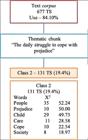
Therefore, we will present participants’ statements about social prejudice against children living with gastrostomy in the following thematic chunk.
The daily struggle to cope with prejudice
The daily struggle to cope with prejudice is compounded by the challenges of ensuring safety in the care of children living with a gastrostomy, regardless of the social environment.
A stoma attracts the attention of people around her and provokes different reactions that are perceived by the mother and witnessed by other family members (grandmother), even before her own child needs a gastrostomy to feed. The strangeness and curiosity of other people about the gastrostomy are perceived by the mothers, as demonstrated in the statements presented below and in Figure 2.

Artistic production carried out by M3 and M4 during the Body Knowledge dynamic. Rio de Janeiro, RJ, Brazil, 2020.
Before, when I saw a child with a gastrostomy, I would think, “My God! What is that?” Because it’s a strange thing, it’s not a common thing. (M3)
It happened to me that when I was out on the street, I had to feed my son through the gastrostomy. People would look at me and ask, “Does he eat through his stomach?” (M4)
As for prejudice, older people don’t understand why he eats through this (stoma). They are curious to know if one day he will eat through his mouth so that they can put an end to this prejudice, which is even greater for him.(M10)
A stoma causes a change in children’s body image and way of feeding, which elucidates the response of distancing from those around them and the indignation of family caregivers (mother and grandmother) (Figure 3).

Artistic production carried out by M9 during the Body Knowledge dynamic. Rio de Janeiro, RJ, Brazil, 2020.
Then he looked at me and asked what a gastrostomy was, picked up his son and left. I looked at my mother’s face and said, “I can’t believe this is happening to me”. My mother said that we would get through it and the CSHCN 4 would remove the gastrostomy. (M4)
[...] one day, my son was a monster. That’s how people saw my son, because I went through a lot of prejudice on the streets.(M9)
Social prejudice manifests itself through strangeness and distance during interaction, which generates reactions of sadness, interferes with the process of acceptance and the need to overcome in order to move forward, caring for children with gastrostomy in everyday life.
I became depressed, not because of my son, but because I loved my son, an unconditional love and for everything he was still going to go through. (M7)
I didn’t want a gastrostomy in my son’s life this year. This year, I said I didn’t want a gastrostomy for my son anymore (referring to prejudice) and I was sad. (M8)
We left all this in the report so the teacher (at school) would be aware of the gastrostomy and the limitations of the CSHCN 9. They made me understand that I have to love him above any prejudice. I still believe that [...] he will eat through his mouth – I fight for that to happen – I think it’s just a detail.(M9)
The previous narratives reveal that maternal perception is centered on love, denial of gastrostomy (due to prejudice), struggle to overcome prejudice and hope for normalization of food administration through the mouth, and not through a technological device. As they live in the expanded social environment, beyond the home and the hospital space, they increase their perception of the responses of people who are around them (street or other public environment). Prejudice manifests itself in estrangement, with the change in body image, and in isolation, representing limitations to social interaction.
DISCUSSION
The mothers of the children participating in this study live in poverty, are black and brown, and are socially vulnerable. They are women who dedicate themselves to the uninterrupted care of CSHCN living with gastrostomy to feed themselves, but who have clinical weaknesses and risk of hospital readmissions due to the complexity of the medical diagnoses. They need to maintain safe care for their children, regardless of the place of care, at home or on the street. Feeding through gastrostomy in a public space draws the attention of passersby to a different way of eating, to the change in body image, and can trigger a pre-judgment of an eating practice that is not natural.2,21,22
The fact that study participants were mothers of children with gastrostomies, as well as their race and belonging to the lowest social class, as they received up to the national minimum wage, may also have contributed to discriminatory activities and lack of social support, as evidenced in the speeches and artistic productions of CSD, in which the word “prejudice” was recurrent. A study shows that black people and those with low levels of education are less likely to be supported by friends, have an adult who cares about them, and have a family who supports them in difficult times.22,23 When special health needs, such as living with a gastrostomy, are combined with issues of race, ethnicity, and social status, evidence suggests that black children growing up in poverty face more challenges than children from families with greater purchasing power and social status. They often live in suburban neighborhoods with poor housing, limited access to healthcare, and poorly resourced schools. This puts these children at risk for poor academic performance, school dropout, abuse and neglect, behavioral and social-emotional problems, as well as physical health problems and social prejudice.24
Some social determinants of mental health for children appeared in this study and may contribute to social prejudice, such as food insecurity, housing insecurity, parental unemployment and mental health. Food insecurity is due to the difficulty of eating in public places and accessing quality food. The social determinant of housing insecurity occurs due to low income and the possibility of living in an area with greater exposure to urban violence, with greater distance and increased expenses with travel to healthcare services. Parental unemployment occurs due to the high demand for healthcare for children with gastrostomy, due to the fact that many mothers did not work to care for their children and only one received financial assistance from the government.2,13,25 The social determinant of children’s mental health identified in this study was low maternal education. Of the ten mothers participating in this study, nine had only completed high school. These results, similar to those of another study, reflect discrimination, social isolation and lower access to and quality of healthcare services.21
In the artistic production of M4, M9 and M10, prejudice was represented both inside and outside children’s body. The presence of a gastrostomy reveals a negative public perception of tube feeding, as well as the practical challenges of administering food, limiting children’s and their caregiver’s outings. A systematic review study revealed that mothers feel judged and criticized when feeding their children through a gastrostomy in public. The negative perception of a gastrostomy can extend to caregivers’ family and friends, with reports of reduced social contact in 81.5% of caregivers of children living with a gastrostomy.26 Another study shows that most of these caregivers are children’s mothers and that they gave up work outside the home to care for their children, which has a general impact on their life context. Most of the time, they are the main caregivers of children with disabilities, which reflects in their low availability of time to carry out activities outside the home, such as leisure, thus reflecting on their quality of life.27
The participants in this study reported in CSD that they perceive discriminatory looks from strangers in society towards their children who live with gastrostomy. These are perceptions described by mothers that children are monsters, reinforcing attitudes of isolation and prejudice. Therefore, it is up to mothers to first accept gastrostomy as an alternative and necessary form of feeding to maintain the clinical balance and health of their children, and then to break with the prejudiced views of people in society. One way to overcome prejudice is through information and transmission of information to people whose views mothers perceive as prejudiced.28
The acceptance of gastrostomy initially involves mothers and families of children perceiving health technology as a necessary resource for survival, with improvements in life, so that they can fight for acceptance and for a reduction in strange looks and questions in social interactions. Worldwide, 15% of the world’s population or one billion people live with some type of disability or special health need18 , and are subject to prejudice.
The results of this study appear to be in line with data observed in American children and adolescents with special health needs, as they are more exposed to prejudice, identifying those who have developmental delay (17.3%), disorder or disability (5.7%), limited ability to move or play, who need special equipment such as gastrostomy (4.6%) and received home care (2.4%).18
Therefore, CSHCN have limitations in life and need to be thought of as children with the same priorities as others, such as eating, communicating, playing and learning. However, society is not prepared to live with a different reality, of children with gastrostomy, for instance, who require special care for feeding and maintaining life. This lack of acceptance of differences generates prejudiced attitudes in people.2
However, in contemporary times, in addition to prejudice, there are other challenges to including people with special health needs in society, such as difficulties related to inefficient public health resources, especially in Latin American countries.15 An integrative review presents the therapeutic itinerary experienced by families of CSHCN in search of healthcare (exams, consultations, emergency and rehabilitation care, supplies), educational care (daycare centers, schools) and social benefits (Bolsa Família (Family Allowance), Organic Law of Social Assistance) in Brazil, highlighted by the difficulties in access, low resolution and (dis)continuity of actions. Different scenarios and paths, always longer and more difficult, were taken by family members in an attempt to have their health, educational and social needs met.29
Sadness, indignation and depression were feelings that affect the mental health of mothers of CSHCN who live with gastrostomy, whenever they perceive prejudiced attitudes towards their children. Disorders in mothers’ mental or physical health can hinder the quality of care provided to children. Social support interventions aimed at families of black, low-income and at-risk individuals are needed to neutralize many of the negative effects of family prejudice.30
One maternal concern is how prejudice can harm the mental health of these children. Research involving discrimination and injustice against children and their caregivers shows that prejudice is present at home, at school, among peers, on social media, in communities, and in society, with messages of devaluation, dehumanization, or indifference.21,22 Another study shows a strong relationship between prejudice and mental illnesses in childhood, such as anxiety, depression, and psychological distress, as well as a weaker association with disruptive and neglectful behaviors, in addition to substance abuse and use.22
Concerning maternal mental health, in this study, some mothers reported sadness and depression, but North American data show that 48% of CSHCN parents have anxiety disorder and 41% have depression.25 These mothers are under greater pressure to balance caregiving routines and family commitments, while also having to manage their own anxieties about the future of their children who are victims of social prejudice.20, 31
Children with schizophrenia who come from black, brown and poor families are more likely to suffer from social prejudice and health inequality.21 Prejudice leads to physical, psychological and social oppression, and the locus of the cause of oppression is present in social institutions and systems. It is necessary to understand and document how oppression impairs the optimal development of children with gastrostomy so that measures can be adopted by healthcare professionals and in community settings.19,21 CSHCN with gastrostomy have their care and health needs met mainly in specialized institutions and in secondary and tertiary levels of healthcare in the SUS. However, they must be incorporated into primary care services, thus enabling comprehensive and universal high-quality care, reducing prejudice on the part of healthcare professionals, training them to care for CSHCN and promoting coordinated, dynamic and shared work between the different levels of the health system.32
The literature recommends that attempts to prevent prejudice and acceptance of children with gastrostomy in society should involve schools, since they spend a significant part of their childhood in these settings. Parents should feel empowered to ask teachers about how they approach and promote an environment of diversity and inclusion in the classroom.7,24,31
Prejudice must be combated throughout society, especially in places where children circulate and are cared for, including homes, schools and hospitals, involving everyone in the community.25
FINAL CONSIDERATIONS AND IMPLICATION FOR PRACTICE
The narratives of the mothers in this study bring together a framework of feelings and perceptions arising from prejudice that often lead them to inappropriate social interactions, with the potential to harm both their own mental health and that of their children. In this context, in the daily care of children with gastrostomy feeding, they perceive the weight of prejudice in the eyes and attitudes of other people, which leads them to assume a strong role when facing unusual situations in defense of their children.
Social prejudice and the difficulty of family acceptance of children with gastrostomy are realities that need to be a matter of concern for national and international policy makers, professionals, healthcare services and society in general so that effective strategies can be found to guarantee children with technological devices a life without prejudice.
Among the limitations of this study, we highlighted the implementation of research in the outpatient setting and not at home, with only family representation restricted to a single caregiver per family: mothers.
It is expected that this study will contribute to maternal strengthening and empowerment in the face of children’s limitations and provide support so that they can live free from social prejudice, expanding scientific knowledge inherent in the prejudice caused by the change in the body image of children with gastrostomy. Furthermore, the aim is to encourage nursing professionals to encourage family caregivers to confront prejudice, discrimination and adverse social situations, in the search for overcoming the difficulties faced daily in health equity.
DATA AVAILABILITY RESEARCH
Data will be available upon request to authors.
ACKNOWLEDGMENTS
None.
-
FINANCIAL SUPPORT
None.
References
-
1 Brewer MB. The psychology of prejudice: ingroup love and outgroup hate? J Soc Issues. 1999 dez;55(3):429-44. http://doi.org/10.1111/0022-4537.00126
» http://doi.org/10.1111/0022-4537.00126 -
2 Hartog K, Hubbard CD, Krouwer AF, Thornicroft G, Kohrt BA, Jordans MJD. Stigma reduction interventions for children and adolescents in low- and middle-income countries: Systematic review of intervention strategies. Soc Sci Med. 2020 fev;246:112749. http://doi.org/10.1016/j.socscimed.2019.112749 PMid:31978636.
» http://doi.org/10.1016/j.socscimed.2019.112749 -
3 Ming DY, Jones KA, White MJ, Pritchard JE, Hammill BG, Bush C et al. Healthcare utilization for Medicaid-Insured Children with medical complexity: differences by sociodemographic characteristics. Matern Child Health J. 2022 out;26(12):2407-18. http://doi.org/10.1007/s10995-022-03543-x PMid:36198851.
» http://doi.org/10.1007/s10995-022-03543-x -
4 Di Leo G, Pascolo P, Hamadeh K, Trombetta A, Ghirardo S, Schleef J et al. Gastrostomy placement and management in children: a single-center experience. Nutrients. 2019 jul;11(7):1555. http://doi.org/10.3390/nu11071555 PMid:31295800.
» http://doi.org/10.3390/nu11071555 -
5 Mott Young AH, Parker DM, Ansoanuur FP, Werner I, Banks YS. Talking to children about race and racism. JAMA Pediatr. 2021 mar;175(5):544. http://doi.org/10.1001/jamapediatrics.2020.7130 PMid:33779699.
» http://doi.org/10.1001/jamapediatrics.2020.7130 -
6 Benavidez GA, Zahnd WE, Hung P, Eberth JM. Chronic disease prevalence in the US: sociodemographic and geographic variations by zip code tabulation area. Prev Chronic Dis. 2024 fev;21:230267. http://doi.org/10.5888/pcd21.230267 PMid:38426538.
» http://doi.org/10.5888/pcd21.230267 -
7 Purtell R, Tam RP, Avondet E, Gradick K. We are part of the problem: the role of children’s hospitals in addressing health inequity. Hosp Pract. 2021 mar;49(sup1):445-55. http://doi.org/10.1080/21548331.2022.2032072 PMid:35061953.
» http://doi.org/10.1080/21548331.2022.2032072 -
8 Pardy C, Kharma N, Lau R, Kelly V, Yardley I. Point prevalence of gastrostomy in a paediatric population. J Pediatr Gastroenterol Nutr. 2021 dez;72(4):528-31. http://doi.org/10.1097/MPG.0000000000003016 PMid:33306583.
» http://doi.org/10.1097/MPG.0000000000003016 -
9 Morris JK, Garne E, Loane M, Barisic I, Densem J, Latos-Bieleńska A et al. EUROlinkCAT protocol for a European population- based data linkage study investigating the survival, morbidity and education of children with congenital anomalies. BMJ Open. 2021 jun;11(6):e047859. http://doi.org/10.1136/bmjopen-2020-047859 PMid:34183346.
» http://doi.org/10.1136/bmjopen-2020-047859 - 10 Sala MCT, Anders JC, Pina JC, Okido ACC, Souza AIJ. Perfil de crianças e adolescentes dependentes de tecnologia em um hospital pediátrico do Sul do país. Esc Anna Nery. 2024;28:e20220409. http://doi.org/10.1590/2177-9465-EAN-2022-0409pt.
-
11 Nguyen-Truong CKY, Rakha S, Eti DU, Angelesco L. Deconstructing racialized experiences in healthcare: what a missed opportunity for healing looks like and healthcare resources for children and their families. Asian Pac Isl Nurs J. 2021;5(4):227-35. http://doi.org/10.31372/20200504.1109 PMid:33791410.
» http://doi.org/10.31372/20200504.1109 - 12 Lage SRM, Lunardelli RSA, Kawakami TT. O capacitismo e suas formas de opressão nas ações do dia a dia. Encontros Bibli. 2023;28:e93040. http://doi.org/10.5007/1518-2924.2023.e93040.
- 13 Sousa, BVN, Araújo CRS, Oliveira EF, Freitas KKA, Costa PDR, Silva VB. Vulnerabilidade de crianças com necessidades especiais de saúde: implicações para a enfermagem. Saúde Debate. 2022;46(spe5):91-103. http://doi.org/10.1590/0103-11042022E508.
-
14 Tong A, Sainsbury P, Craig J. Consolidated criteria for reporting qualitative research (COREQ): a 32-item checklist for interviews and focus groups. Int J Qual Health Care. 2007;19(6):349-57. http://doi.org/10.1093/intqhc/mzm042 PMid:17872937.
» http://doi.org/10.1093/intqhc/mzm042 -
15 Ribeiro APLP, Moraes JRMM, Queiroz ABA, Góes FGB, Silva LFD, Souza TV. Home care for children with gastrostomy. Rev Bras Enferm. 2022;75(75, Suppl 2):e20200699. http://doi.org/10.1590/0034-7167-2020-0699 PMid:34787274.
» http://doi.org/10.1590/0034-7167-2020-0699 - 16 Ministério da Saúde (BR). Política nacional de atenção integral à saúde da criança: orientações para implementação. Brasília: Ministério da Saúde; 2018.
-
17 Precce ML, Moraes JRMM, Pacheco STA, Silva LF, Conceição DS, Rodrigues EC. Educational demands of family members of children with special health care needs in the transition from hospital to home. Rev Bras Enferm. 2020;73(Suppl 4):e20190156. http://doi.org/10.1590/0034-7167-2019-0156 PMid:32756741.
» http://doi.org/10.1590/0034-7167-2019-0156 -
18 Nascimento LCN, Souza TV, Oliveira ICDS, Moraes JRMM, Aguiar RCB, Silva LFD. Theoretical saturation in qualitative research: an experience report in interview with schoolchildren. Rev Bras Enferm. 2018;71(1):228-33. http://doi.org/10.1590/0034-7167-2016-0616 PMid:29324967.
» http://doi.org/10.1590/0034-7167-2016-0616 -
19 Camargo BV, Justo AM. Tutorial para o uso do software de análise textual IRAMUTEQ [Internet]. Florianópolis: Universidade Federal de Santa Catarina, Laboratório de Psicologia Social da Comunicação e Cognição; 2013 [citado 2024 nov 6]. Disponível em: http://www.iramuteq.org/documentation/fichiers/tutoriel-en-portugais
» http://www.iramuteq.org/documentation/fichiers/tutoriel-en-portugais -
20 Resolução no 466, de 12 de dezembro de 2012 (BR). Diário Oficial da União [periódico na internet], Brasília (DF), 13 jun. 2013 [citado 2024 Nov 6]. Disponível em: http://www.conselho.saude.gov.br/web_comissoes/conep/index.html
» http://www.conselho.saude.gov.br/web_comissoes/conep/index.html -
21 Cotton NK, Shim RS. Social determinants of health, structural racism, and the impact on child and adolescent mental health. J Am Acad Child Adolesc Psychiatry. 2022;61(11):1385-89. http://doi.org/10.1016/j.jaac.2022.04.020 PMid:35533798.
» http://doi.org/10.1016/j.jaac.2022.04.020 -
22 Kim S, Bang KS, Jeong Y, Lee G, Shin DA, Kim M. The experience of unmarried mothers raising their children in residential facilities: a phenomenological qualitative study. BMC Womens Health. 2022;22(1):274. http://doi.org/10.1186/s12905-022-01727-9 PMid:35790953.
» http://doi.org/10.1186/s12905-022-01727-9 -
23 Crouch E, Srivastav A, McRell AS. Examining racial/ethnic differences in positive childhood experiences among respondents in a southern state. J Child Adolesc Trauma. 2022;15(4):1191-98. http://doi.org/10.1007/s40653-022-00453-6 PMid:36439661.
» http://doi.org/10.1007/s40653-022-00453-6 -
24 Unaka NI, Winn A, Spinks-Franklin A, Poitevien P, Trimm F, Lujano BJN et al. An entrustable professional activity addressing racism and pediatric health inequities. Pediatrics. 2022;149(2):e2021054604. http://doi.org/10.1542/peds.2021-054604 PMid:35001103.
» http://doi.org/10.1542/peds.2021-054604 -
25 Xiao Y, Mann JJ, Chow JC, Brown TT, Snowden LR, Yip PS et al. Patterns of social determinants of health and child mental health, cognition, and physical health. JAMA Pediatr. 2023;177(12):1294-305. http://doi.org/10.1001/jamapediatrics.2023.4218 PMid:37843837.
» http://doi.org/10.1001/jamapediatrics.2023.4218 -
26 Prakash J, Pardy C, Yardley I, Kelly V. Psychological and social impacts on carers of children with a gastrostomy: a systematic review. Pediatr Surg Int. 2024;40(1):44. http://doi.org/10.1007/s00383-023-05618-4 PMid:38294568.
» http://doi.org/10.1007/s00383-023-05618-4 -
27 Pereira BRS, Cabral KDS, Carvalho VPS, Calado DB, Gonçalves CFG, Sá AKL et al. Conhecimento da qualidade de vida de cuidadores de crianças com deficiência. Braz J Dev. 2020;6(9):71449-60. http://doi.org/10.34117/bjdv6n9-551
» http://doi.org/10.34117/bjdv6n9-551 -
28 Priest N, Paradies Y, Trenerry B, Truong M, Karlsen S, Kelly Y. A systematic review of studies examining the relationship between reported racism and health and wellbeing for children and young people. Soc Sci Med. 2013;95:115-27. http://doi.org/10.1016/j.socscimed.2012.11.031 PMid:23312306.
» http://doi.org/10.1016/j.socscimed.2012.11.031 - 29 Campos RB, Alderete G, Silva RMM, Zilly A. Itinerário terapêutico de crianças com necessidades especiais de saúde: revisão integrativa. Rev Eletr Enferm. 2023;26:77290. http://doi.org/10.5216/ree.v25.77290.
-
30 Bethell C, Blackwell CK, Gombojav N, Davis MB, Bruner C, Garner AS. Toward measurement for a whole child health policy: validity and national and state prevalence of the integrated child risk index. Acad Pediatr. 2022;22(6):952-64. http://doi.org/10.1016/j.acap.2021.12.001 PMid:34896272.
» http://doi.org/10.1016/j.acap.2021.12.001 -
31 Beech BM, Ford C, Thorpe Jr RJ, Bruce MA, Norris KC. Poverty, racism, and the public health crisis in America. Front Public Health. 2021;9:699049. http://doi.org/10.3389/fpubh.2021.699049 PMid:34552904.
» http://doi.org/10.3389/fpubh.2021.699049 -
32 Validova A, Strane D, Matone M, Wang X, Rosenquist R, Luan X et al. Underinsurance among children with special health care needs in the United States. JAMA Netw Open. 2023;6(12):e2348890. http://doi.org/10.1001/jamanetworkopen.2023.48890 PMid:38147335.
» http://doi.org/10.1001/jamanetworkopen.2023.48890
Edited by
-
ASSOCIATED EDITOR
Eliane Tatsch Neves https://orcid.org/0000-0002-1559-9533
-
SCIENTIFIC EDITOR
Marcelle Miranda da Silva https://orcid.org/0000-0003-4872-7252


