
 Amazonia in symbiosis: traces of humankinds facing the Anthropocene
ABSTRACT
This paper offers a critical discussion on some definitions of the Anthropocene. From approaches in archeology, ethnology, ecology and indigenous debate, Amazonia is the center of reflection on different moments of the history of human interaction with the region. When we recognize the marks of an accelerated and irresponsible exploration, we need to particularize the marks of humanity. We discuss millennial marks, also permanent, of human actions that transformed Amazonia. Meanwhile, these marks are produced by people who understood complex relations that promoted and created conditions to expand the diversity. Such wisdom, which continues in the present, insists on affirming that it cannot be made only by human. Therefore, the question that emerges is: which humans and which Anthropocenes are we dealing with?
KEYWORDS:
Anthropocene; Diversity; Amazonia; Symbiosis
RESUMO
Este texto propõe uma discussão crítica sobre algumas definições do Antropoceno. A partir de abordagens na arqueologia, etnologia, ecologia e no debate indígena, a Amazônia é o centro de reflexão sobre diferentes momentos da história de interação humana com a região. Ao reconhecermos as marcas de uma exploração acelerada e irresponsável, surge a necessidade de particularizar o que vem sendo entendido como marcas da humanidade. São discutidas marcas milenares, também permanentes, de ações humanas que transformaram a Amazônia. No entanto, essas marcas foram produzidas por pessoas que compreenderam relações complexas que promoveram e criaram condições para ampliar a diversidade. Tal sabedoria, que continua no presente, insiste em afirmar que isso não pode ser tarefa só de humanos. Portanto, a pergunta que emerge é: de quais humanos e de quais Antropocenos estamos tratando?
PALAVRAS-CHAVE:
Antropoceno; Diversidade; Amazônia; Simbiose
At the turn of the millennium, with the beginning of the discussion about the definition of the term Anthropocene, the search for geological and landscape markers of the “new era” also began, such as colonialism (Lewis; Maslin, 2015), the invention of the steam engine (Crutzen; Stoermer, 2000) or the atomic bomb (Zalasiewicz et al., 2015). While the debate was initially led by geologists and climate experts, it has now become an arena of controversy between academics and scientists from a wide range of disciplines, artists, writers, politicians, leaders of traditional peoples and activists from socio-environmental movements. Diverse ways of inhabiting the Earth generate divergences in understanding the current collective experiences of transformation, resurgence, resilience, crisis or collapse. This article adds to the efforts of other previous analyses (Danowski; Viveiros de Castro, 2014; Kawa, 2016; De la Cadena, 2018; Winkler-Prins; Levis, 2020; Marras; Taddei, 2022) in which Amazonia emerges as a paradigmatic region for thinking about the persistence of human and nonhuman life in forests, savannas, rivers, cities and plantations in the Anthropocene.
How many worlds fit into the Anthropocene?
The inauguration of the concept of the Anthropocene, according to Crutzen; Stoermer (2000), emphasizes humanity’s central role as a geological and cosmic force, with effects on the Earth and atmosphere that will last for thousands of years. This marks the beginning of a new era that will require a world- wide strategy for managing global ecosystems in the face of the stresses induced by human activities. We can also consider the analytical keys of the Great Acceleration and the Sixth Extinction to point in this direction. The idea of the Great Acceleration was based on the detection by the International Geosphere-Biosphere Program (IGBP) (Steffen et al., 2004) of a process of synchronous acceleration with strong evidence of alterations in the functioning of the Earth system, particularly the climate, that began in the 1950s and continues to the present day. Based on indicators of socio-economic and thermodynamic trends, the Great Acceleration process identifies unprecedented modifications: the rates of change caused by humanity on a global scale over the last 80 years place the planetary system in a new state. In turn, the era in which we live is also referred to as the Sixth Extinction (Lovelock; Allaby, 1983), linking the current processes of mass extinction of animal, plant and fungal species to the five previous major extinction events in the history of life on Earth - the last of which occurred 66 million years ago, during the Cretaceous, with the disappearance of the dinosaurs (Brusatte et al., 2015). The Global Assessment Report on Biodiversity and Ecosystem Services (IPBES, 2019) found that of the approximately 8 million species present in global ecosystems, 1 million plant and animal species are currently threatened with extinction. Studies of the distribution of biomass on a planetary scale show that 96% of the global biomass of mammals corresponds to humans and livestock (mostly cows and pigs), reducing the biomass of the planet’s wild mammals to 4% (Bar-on et al., 2018).
Another way to define planetary change is to select 9 factors that have accelerated the transformations that have taken place over the last few centuries, known as “planetary boundaries” (Rockström et al., 2009). These interrelated boundaries aim to define the preconditions for human development by establishing biophysical thresholds that, if crossed, could have catastrophic consequences on a global scale. The goal is therefore to identify a “safe operating space” for humans. In 2009, Rockström and his colleagues warned that humanity had already crossed 3 of the 9 boundaries: the disruption by fertilizers in the nitrogen cycle, the loss of biodiversity, and CO2 emissions, which were already well above safe limits.
Based on various parameters, these approaches develop procedures to classify human footprints in the planet’s atmosphere and ecosystems, taking into account biotic and abiotic components. Some even take into account extraterrestrial actions, such as the footprints of astronauts who walked on the moon (Zalasiewicz et al., 2014). The plurality of views has opened up a panorama of criticism of the idea of the Anthropocene. One of the most acute questions has been formulated through the concept of the Capitalocene (Moore, 2014; Haraway, 2015), which highlights the centrality of capitalism at the current crossroads of planetary life. The aim is to reveal “a dirty secret of modern world history: that secret is how capitalism was built on excluding most humans from Humanity” (Moore, 2016, p.79) through a process that is currently reaching “the exhaustion of its Cheap Nature strategy” (ibidem, p.113). Similarly, the authors propose the term Plantationocene for its comprehensiveness in identifying a system that operates on the basis of slavery, biodiversity loss and carbon consumption, causing “the rapid displacement and reformulation of germplasm, genomes, cuttings, and all other names and forms of part organisms and of deracinated plants, animals, and people’’ (Haraway, 2015, p.162). The Plantationocene reveals the extent of practices that destroy multi-species landscapes by replacing them with homogeneous private properties. The commodification of the plantation implements a scalable model (Tsing, 2012b) that disrupts the heterogeneous flows of symbioses between living bodies. Capitalocene and Plantationocene coincide in highlighting the relationship between capitalism and the articulation of humans and other organisms in the dynamics of environmental destruction, confronting ideologies that privilege the centrality of Homo sapiens (Hoelle; Kawa, 2020).
Loss of socio-diversity has not emerged as a relevant factor in most attempts to measure human impact on the planet. It seems to us that the interest and investment in bringing the mammoth back to life are greater than the efforts to combat the extinction of minorities, the loss of languages, and the dismantling of knowledge and technologies that directly affect other indicators of diversity. It seems to us that the attempt to generalize the human phenomenon worldwide once again ignores the active role of a part of humanity. Is it relevant to homologate a global time frame or to define a stratigraphic layer as a spatial marker that constitutes the “golden spike” of the Anthropocene, given the diversity of ways of inhabiting the earth and thinking about temporalities? Is it possible to live in a geological epoch and not be part of it? Or would the Anthropocene be one (or more) archaeological site(s) and would we be able to delimit the spaces of those responsible and their traces? Would the rest be Holocene refuges or non-sites of human action? The most immediate answer would probably be: yes, we live in the Anthropocene because the consequences of human actions are global. Thus, some cause the Anthropocene, others suffer from it. We propose to add more categories and to think that there are actions that can be classified as anti-anthropocenic.
Amerindian critiques of the Anthropocene concept mark divergences from the idea of a unified world and distance themselves from Western approaches to a globalist concept of humankind, which thus becomes a contested category. The reflections of indigenous intellectuals point to other perspectives. Zoe Todd, a Métis anthropologist in Canada, attributes a gentrifying effect to the concept proposed by Crutzen, which erases the diversity of human ways of life. Todd warns of the need to decolonize the Anthropocene as an analytical category with a Eurocentric, racist and patriarchal matrix. In the face of a teleology that homogeneously implicates all humans in the current state of the world, it is necessary to draw on the indigenous “ecological imagination” (Todd, 2015) and to turn to other forms of reciprocity, relationality and responsibility. Locally constructed responses to in situ challenges cannot be drawn from a single ontological matrix. For his part, Kyle Whyte, a Potawatomi philosopher in the United States, evaluates the Anthropocene as an intensified episode of historical colonialism in which indigenous peoples live an experience of déjà vu that re-edits the practices fostered by capitalist expansion. “Anthropogenic” climate change must be approached from a perspective of kinship and reciprocity between humans and nonhumans. “For indigenous peoples, ‘the Anthropocene epoch’, as a concept some people invoke often to envision the future, does not present us, at first glance, with the specter of unprecedented changes” (Whyte, 2017). A process of indigenization of the future implies a reflection on the perspectives of ancestors and on the desire of current generations to be good ancestors for future generations.
The narrative memory of the peoples of the Gran Chaco transmits experiences of the transformation of the world by floods, fires, and earthquakes, and records the excesses of colonial violence and land expropriation. The configuration of the world does not result exclusively from human intentionality: the dog-star of Toba mythology, the pillar-trees of the sky of Nivacle and Wichi oral memory, the rainbow-snake of Toba-Pilagá narratives (Tola et al., 2019) emerge as agents of transformation and regeneration of humanity after catastrophes. The world is configured in a flow of metamorphoses without origin or end, in a spiral temporality that requires the constant rehabilitation of relations of care and diplomacy between humans and nonhumans.
In Brazil, Ailton Krenak rejects a unitary concept of humanity when he considers the drastic inequalities in the world. A humanity disconnected from the earth is contrasted with “a rougher, rustic, organic layer, a sub-humanity, a people who cling to the earth” (Krenak, 2019, p. 10). The discourse of the Anthropocene thus becomes a mechanism for resignation in the face of other stories told by the peoples of the earth, capable of “postponing the end of the world.” In line with this perspective, Jera Guarani, a Mbya leader, proposes “becoming wild”: faced with the dangerous situation of planet Earth, indigenous ways of life are an alternative for the jurua themselves, the non-indigenous (Guarani, 2020). Based on the experience of the destruction of the Atlantic Forest, the Guarani propose an open debate in which the nature of cataclysms is connected to their conception of the origin of the world and their cosmography. The non-homogeneous cycles of destruction of the world realize a “cleansing of the earth” and prepare a new humankind “populated only by the descendants of the divinities, the Mbya themselves, since the whites have already exhausted all their chances and have irreversibly unnerved the Nhanderu “ (Pierri, 2013, p.169). For them, therefore, there is no “end of history” but a regeneration of the land and humankind that excludes white people. These perspectives are in line with Davi Kopenawa’s shamanic critique of “the people of Merchandise”: “In the forest, we human beings are the ‘ecology.’ But it is equally the xapiri, the game, the trees, the rivers, the fish, the sky, the rain, the wind, and the sun! It is everything that came into being in the forest, far from the white people: everything that isn’t surrounded by fences yet” (Kopenawa; Albert, 2015, p. 480). The destruction of the land-forest (urihi), promoted by the “earth-eaters”, people with minds “full of oblivion”, “dreaming only of themselves”, greedy for “cannibal gold”, will cause the pathogenic dispersal of metal smoke and the subsequent fall of the sky - a recurring theme in the mythology of the South American lowlands (Nimuendaju, 1987[1914]; Viveiros de Castro, 1986).
Traces of the Anthropocene: human, inhuman or more-than-human?
When we encounter antisocial behavior committed by humans, we often define it as something inhuman that distances us from our human condition. Ironically, when these actions are carried out on a large scale, with the potential to affect human groups and planetary life in general, we identify them as expressions of human traces on Earth: the idea of the Anthropocene is built on these traces. At the root of current transformations is the capitalist regime in all its variations - colonization, slavery, industrialization, neoliberalism, info-capitalism, geo-engineering. One of its effects that we would not hesitate to call inhuman is hunger. The United Nations estimates that nearly 10% of the world’s population is starving. Nearly 30% suffer from some form of food insecurity. Millions of children will not reach adulthood because of this condition. Unicef estimates that in the 15 countries where the situation is most severe, a child dies of malnutrition every 60 seconds. At the other end of the scale, the richest 10% of individuals concentrate 76% of the wealth generated by the exploitation of nature and the labor of the entire planet (Chancel et al., 2022). When catastrophic facets like these are considered, the regime is often labeled “savage capitalism” (Traverso, 2017).
However, the “savage” populations of the Amazon rainforest have a conception of humankinds that transcends the limits of a single natural species and supports an ethic of care for other forms of life. The condition of “true humans” present in Amazonian cosmologies is extended to - and disputed with - other beings in the forest, a subjective perspective on the worlds they inhabit can be recognized in animals, plants, stars, and master spirits. In other words, “the common point of reference for all beings in nature is not humans as a species but rather humanity as condition” (Descola, 1986, p.120). The forest is thus an interspecific space of human and more-than-human societies. The ideas of corporeality and sociality built on the foundations of kinship, consubstantiality and the symbolic economy of otherness (Viveiros de Castro, 2002); relationships with animals based on the ethics of hunting, animal gift and familiarization (Fausto, 2002); relationships with plants inspired by care, kinship (Maizza, 2014; Morim de Lima, 2017) and the “botany of precaution” (Aparicio, 2020); and the recognition of multiple cosmological domains in the constitution of landscapes (Oliveira, 2016) are all components that shape indigenous lands as places where deforestation is minimised and the forest maintained (Calaboni et al., 2021) supporting a proliferation of biodiversity at the highest levels (Dawson et al., 2021). The concepts and practices of indigenous peoples contrast with Western extractive corporations that reduce animals, plants, and minerals to the status of natural resources to ensure accelerated global economic growth.
Botanical estimates suggest that a 1-hectare patch of dense ombrophilous forest in the Amazon can contain more than 4,700 trees over 10 cm in diameter (Condé; Tonini, 2013). Data published by the National Space Research Institute (INPE, 2022) estimate that the Brazilian legal Amazon alone lost 11,568 km2 of forest by 2022. That means that approximately 5 billion trees were felled and, for the most part, burned without any use being made of them. This action will undoubtedly leave a permanent mark on the planet. The paradox is that precisely inhumane actions define the configuration of a new planet era based on the traces of humankinds. If, on the one hand, the conventional view emphasizes the exceptionality of our species because of its rationality, on the other hand, phenomena such as global inequality or the depletion of forests must be taken into account: we are imprinting the traces of irrationality. If we don’t change our approach, we anticipate the end of Homo sapiens’ time on the planet. Before that, we will condemn countless other species to extinction at a rate faster than any other natural selection process on record. Would these legacies be human or inhuman? Is the Anthropocene the excessive humanization (“anthropization”) of the planet or the effect of a superlative dehumanization (a sort of “de-anthropocene”)? For the Amerindians, the breakdown of sociality, the lack of moderation with animals and plants, excessive behavior, exacerbated anger and sadness, individualism, and the inability to share constitute an inhuman condition. For this reason, in Amazonian cosmologies, whites are considered hyper-predators, along with jaguars, anacondas, the dead, and pathogenic spirits.
The paradox is that in contemporary Western societies, it is possible to see a connection between the growth of inequality and the advance of climate denialism: both axes are part of a single phenomenon (Latour, 2017). The debate on the planet’s future involves a struggle over the concept of humanity. As we have seen, people who “hold onto the earth” develop forms of life intertwined with the other forms of life present in landscapes and conceive of a world that differs from the anthropocentrism and exceptionalism that characterize the Western conception of humanity. While it is true to say that in capitalist modernity “Nature was full of humans treated as Nature” (Moore, 2016, p.87), it is also necessary to recognize that for indigenous and traditional peoples, landscapes are inhabited by other humans and nonhumans treated as societies. In line with indigenous worldviews, new approaches propose a revision of the concept of humanity, overcoming anthropocentrism and diverging from postmodernist positions. In this sense, Haraway addresses the relevance of companion species in the constitution of human life and creatively proposes a subversive etymology according to which “human” emerges from humus, confronting the idea of the self-constituted Homo and highlighting the possibility of multi-species histories: “We are humus, not Homo, not Anthropos; we are compost, not posthuman” (Haraway, 2016, p.55). This perspective affirms a vital kinship between humans and other living beings. It is closely related to Native American cosmologies.
Similarly, Tsing (2012) states that “human nature is an interspecies relationship”, highlighting how Western models have consolidated the links between monoculture and racism, and reinforced the boundaries between species. In contrast, traditional populations are immersed in relationships with landscapes through symbioses between species, an essential condition for the proliferation of life. The author also proposes the concept of resurgence as “the work of many organisms, negotiating across differences, to forge assemblages of multispecies livability in the midst of disturbance” (Tsing, 2017, p.52), and considers the territories cohabited by traditional peoples as Holocene refuges. This is not about defining boundaries to separate chronologies or spaces (it would not be appropriate to point to a kind of Holocene primitivism on the part of indigenous peoples in the face of the Anthropocenic “progress” of modernity), nor is it about isolating traditional territories as hotspots of intact biodiversity and primordial harmony. In this sense, indigenous lifeways coexist with the traces of the Anthropocene but also point to other possibilities for coexistence and co-evolution. We could think, for example, of isolated indigenous peoples who persist in the forest not as archaic remnants, but as 21st-century populations declaring their contemporary refusal (Ribeiro et al., 2022) of the Anthropocene flows that surround them. Or to open our eyes to the so-called “emerging” or “resurgent” indigenous peoples - in reality “resistant” (Viveiros de Castro, 2019) who insist on their difference in scenarios of civic homogenization, the establishment of latifundia and the extinction of biodiversity.
What does the body of indigenous action in Amazonia represent?
The proposals of traditional communities around the world are still little heard of outside the human sciences, but even Western sciences have accumulated data that allow them to demonstrate local and regional specificities to think about the sites of the Anthropocene. Amazonia has many local particularities, but at the same time, it has a continental regionality that makes it the largest river basin on the planet. In this sense, we will discuss how some archaeological, ethnological and botanical research in Amazonia can help us to rethink the universalism of the Anthropocene concept. Furthermore, as will be shown, human actions in Amazonia have their own temporalities, so it seems important to us to understand that the traces of these actions are not simply reactions to the capitalist Anthropocene, but fit into other logics of human interaction with the “natural” world. In this section, we will look at traces relating to the transformation of relief (buildings), population density, known political systems, and forest composition (biodiversity). The aim is to highlight human actions that point to anti-anthropocenic dynamics.
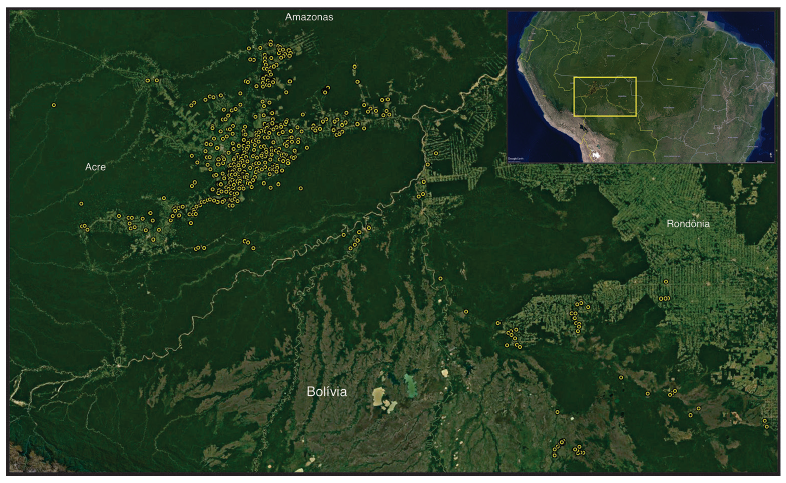
Among the factors causing global change, Crutze and Stoermer (2000) cite data from Vitousek and colleagues (1997) to suggest that 30 to 50 percent of the Earth’s surface has been altered by human activity. Certainly, the forested parts of the planet, and especially Amazonia, have not been included in the tally of anthropogenic change. However, landmarks more significant than a footprint on the moon, such as the Amazonian geoglyphs (Schaan, 2016), remain covered by mature forests and are places where only the indirect impacts of the Anthropocene would be felt. However, deforestation in recent decades, a major impact of the Anthropocene in Amazonia, has just made hundreds of these geoglyphs visible to satellites (another milestone in modern planetary intervention). (Figures 1, 2, 3 and 4).
The geoglyphs were built by indigenous peoples between approximately 600 and 2,000 years BP (Trindade, 2010). In addition to these constructions, there are several other traces of significant interventions in the Amazonian landscape in the past (Moraes; Neves, 2012). One of the main examples of landscape transformation was the formation of “Amazonian Dark Earth” (ADE) on persistent settlement sites. The first ADEs date back 6,000 years (Watling et al., 2018) and range from 1 to over 200 ha in area. There are currently more than 2,000 identified ADEs. These sites have become permanent markers of Amerindian occupation and are still used today by traditional communities. They are part of the archaeosphere (Edgeworth, 2018) and are changes that have a positive impact on the environment.
It is estimated that the history of human occupation in Amazonia dates back at least 13,000 years (Roosevelt et al., 1996; Morcote-Rios et al., 2021). It has also been suggested that around the time the first Europeans arrived in the region, approximately 10 million people were living in Amazonia (Denevan, 2014). While these data provide imprecise estimates, to understand the specificity of human action it is essential to ask what was happening in other parts of the world at the same time as the supposed 10 million people living in the Amazon. When Europe was undergoing a supposed “Neolithic Revolution” - a process that actually took about 3,000 years (Graeber; Wengrow, 2021) - what was happening in Amazonia? What was happening in Europe at the height of Egyptian civilization? What was happening in the forests of Africa when the first nuclear warhead exploded? What is happening in the forested part of the Amazon as we write this text?
Archaeological estimates suggest that the 16th century is not the peak of population in Amazonia (Moraes, 2015; Neves et al., 2021). In several places, the largest archaeological sites are dated to around 1,000 BP. In the upper Xingu, for example, Heckenberger (2005) shows that precolonial sites can be up to 10 times larger than today’s large villages. So, what would an “untouched forest” look like where more than 10 million people lived at least a thousand years ago? A population that was only surpassed again after 1970.1


Section of a polygon with deforestation (1,260 hectares) that exposed 11 geoglyphs, Labrea-AM.


The first attempts to explain the trajectory of human occupation in Amazonia were based on the idea of a single trajectory for humanity. Supported by a perspective of linear evolutionism, first naturalists (Martius, 1982), and then anthropologists and archaeologists (Steward, 1948; Evans; Meggers, 1968; Meggers, 1971) tried to determine at what stage of the human trajectory the American peoples were. Development, degeneration, adaptive difficulties, and environmental limitations were recurring terms in these syntheses, which sought to compare these phenomena with the achievements of societies in the Andean region, Mesoamerica, Mexico, and Western societies, among others. The conclusions were that environmental limitations and resource scarcity did not allow Amazonian peoples to experiment ways that would lead to class distinctions, urbanism, and state formations - only the Western path leads to the Anthropocene and capitalism.
At the time, there was already a lively debate on the theme proposed by Pierre Clastres (1974) in “Society versus the State”. This work showed that cultural choices, not necessarily adaptive ones, also led to different trajectories for human collectives. However, in the 1980s, 1990s, and 2000s, especially in archaeology, the response to attempts to find evidence against environmental determinism ended up directing research toward the search for landscape substitution (deforestation), large-scale agriculture, and hierarchical societies, leading to the postulation of political systems known as Amazonian Cacicados (Roosevelt, 1993). Research made it possible to affirm that the Amazonian environment is not limited, but it again led to a universal evolutionary linearity and an “Amazonian midpoint” that can be characterized as agricultural determinism (Moraes, 2015). Contemporary ethnographies have highlighted how the diversity of indigenous practices for transforming landscapes is associated with political choices that make characterizations of Amerindians as “nomadic”, “sedentary”, agents of “agricultural regression” or “agriculturalists” inadequate; for example, the swidden model is often associated with high levels of mobility, which contradicts the stabilizing perception attributed to agriculture in Western contexts. Likewise, the emergence of villages with higher population densities does not prevent people from maintaining alternative dwellings in dispersed locations throughout the territory, causing a constant flow of residential impermanence (Aparicio, 2019). Because of this uniqueness, Lévi-Strauss identified an “anti-neolithic paradigm” among Amerindians, as opposed to the idea of a teleological sequentiality between a supposed initial hunter-gatherer condition and a later agricultural state (Lévi-Strauss, 1967; Otto, 2018). Thus, there is no imperative to progress from hunter-gatherer trekking to manioc cultivation: co-existence between the two at different scales is possible. Eventual choices for “loss of agriculture” or its incorporation, resumption, alternation, and so on, result from political choices (Gow, 2011). Similarly, Graeber and Wengrow (2021) characterize indigenous cultivation in Amazonia as “play farming” which includes not only swidden crops but also tree species (Levis et al., 2018).
The repercussions of decades of debate still reverberate today. The speed of data dissemination, combined with the processing capacity of computers, has led to the creation of predictive models of the impact of human activity in Amazonia and attempts to separate what would be transformed places from those with little or no interference from human activity (pristine landscapes). The question is that the variables used for these classifications still look for factors such as deforestation, large fires, and monocultures as evidence of the presence or absence of humans (Piperno et al., 2015; McMichael et al., 2017).
The current rapprochement between archaeology, the indigenous question, ethnology and ecology (Heckenberger et al., 2008; Cabral, 2014; Fausto; Neves, 2018; Jácome; Wai Wai, 2020; Ribeiro et al., 2023) has opened up possibilities for thinking about Amerindian action, its innovation and resilience in the face of different scenarios and, above all, the transformative role of its continuity in the long term. In one of these recent efforts at large-scale analysis, this time in botany, Hans ter Steege and more than a hundred collaborators (ter Steege et al., 2013) suggested that the diversity of trees in the Amazon is made up of approximately 16,000 species. In addition to this colossal figure for diversity, the work also highlighted that despite the diversity, 227 species are hyperdominant in Amazonian landscapes. In particular, the 16,000 species estimate has been heavily criticized by other botanical studies. Domingos Cardoso and several collaborators (Cardoso et al., 2017) suggest the need for a more accurate classification of the Amazon, stating, among other things, that “6,727 trees represent the best current count of seed plant species recorded in the Amazon rainforest”. In 2020, ter Steege’s team re-ran the calculations, adjusted the parameters, and concluded that the new results, despite minor variations, were very close to the numbers presented in 2013 (ter Steege et al., 2020).
The most outstanding component of this work for human-forest interaction studies was precisely the proposed list of hyperdominant species. The 2013 and 2020 studies highlight the presence of 6 palm species in the top 10 of the list of 227 species.
The same species of hyperdominant palms shown by ter Steege et al. (2020) have appeared in the archaeological record since the earliest evidence of occupation (Morcote-Rios et al., 2021). Gaspar Morcote-Rios (Morcote-Rios et al., 2014, p.39) was one of the first to inquire about the role of humans in the hyperdominance of Amazonian plants. A good example is the case of açaí, one of the most important plants in today’s Amazonian diet, and listed in 2013 as the most abundant species in the Amazon. Charred seeds of the so-called pulp palms (açaí, bacaba, patauá and buriti) appear among the traces of human occupation more than 9,000 years ago at the Peña Roja site in the Colombian Amazon (Mora Camargo, 2003; Morcote-Rios et al., 2014) and at least 10,000 years ago in the Pedra Pintada cave (Shock; Moraes, 2019). In light of these data, it is hypothesized that at least 10,000 years of human relationships with these plants may be responsible for the hyperdominance of widely used and/or consumed species.
Sara Coelho and colleagues (Coelho et al., 2021) conducted extensive research on the uses (food, medicine, manufacturing, construction and fuel) of trees and palms in the Amazon and found information suggesting that about half of the known species are used in one of these categories, highlighting that many have multiple uses. However, when the same data are compared with species dominance, the figures are even more impressive: 84% of the species that dominate the landscape are listed as having one or more uses. In general, species with uses are 6.4 times more abundant than those without use information. Coelho and colleagues concluded that 207 species that appear as hyperdominant in the works of ter Steege et al. (2013; 2020) presented use information.
The concept of meaningful place, developed in an archaeology more connected to indigenous action in North America (Zedeño; Bowser, 2009), shows an interesting way to think about the historical stock of biodiversity formation and to reflect on the results of the hyperdominance of species in the Amazon. For them, place is a discrete locus of behavioral styles, materials and memories. And meaningful, a product of the interaction of people with each other, as well as with the natural and the supernatural (ibidem, p.6).
On the Madeira River, the Teotônio waterfall is an interesting place to think about the concept of a significant place. Around 9,000 years ago, people began to camp on its banks, probably attracted by the abundance and ease of catching fish during the piracemas. As one of the main points impassable by navigation, one of the first for those going up the river or one of the last for those coming down, it is certainly also a significant symbolic and locational landmark. After 3,000 years of frequenting the site, feedback appears to have intensified to the point where a thick layer of ADE has formed. The formation of ADE suggests that from 6,000 years onwards, permanence periods at the waterfall became longer. In addition to fish consumption, organic remains from the processing of other foods, such as cassava, squash, and other cultivated plants, appear in the records. However, the decision to convert the site into an open field for cultivation apparently wasn’t made. The record shows that the continuity and increased diversity in the occurrence of useful plants such as palms, nuts, fruits, tubers, and roots predominated until the most recent layers of occupation (Watling et al., 2018).
In the Pedra Pintada Cave, in Monte Alegre-PA, traces of human presence have been found since before 12,000 years ago. In addition to evidence of the production of lithic tools, pigment production, probably associated with the paintings on the walls of the shelter, charred remains of plants from different compartments of the region (savanna, forest, and floodplain) are abundant in fire features (Roosevelt et al., 1996; Pereira; Moraes, 2019).
About a thousand years ago, there is evidence of what must have been the largest concentrations of people in villages (Amazonian cities?) in Amazonia. Regions such as Santarém (Roosevelt, 1992), the upper Xingu (Heckenberger, 2005), the island of Marajó (Schaan, 2008), the lower Madeira and the Manaus area (Neves, 2022) have preserved archaeological sites covering dozens or even hundreds of hectares. Traces of maize and manioc are present in different contexts. Once again, the continuity of diversity and the massive presence of palm trees, fruit plants and nuts are remarkable (Roosevelt, 1980; Shock, 2021). Persistent sites, such as Pedra Pintada Cave, continued to be visited as part of these resource acquisition strategies.
When we think about what the Anthropocene represents, this period of great, damaging and permanent changes, the idea that persistently occupied places in Amazonia can be, and are, places of greater diversity and abundance comes into direct opposition with “Western inhumanity”.
Care for biodiversity is certainly one of the hallmarks of Amazonian ways of relating to the landscape. Indigenous knowledge manifests in such a way that hunting and fishing practices promote the proliferation of terrestrial and aquatic species. The management of the landscape through the succession of forest/ swidden/ successional vegetation/ forest acts as a dynamic to increase biodiversity. The apparent disorganization of indigenous crops from an agronomic point of view is actually a complex system of co-evolution of humans, plants, birds, rodents, insects, fungi, etc., which incorporates shamanic practices, kinship and ritual. Clement and collaborators (2021) suggest that in the South American lowlands, 517 plant species show some incipient domestication, 38 are semi-domesticated, and 45 are domesticated. This is why “in the Upper Rio Negro there are more than 100 varieties of manioc; in the Caiapó, 56 varieties of sweet potatoes; in the Canela, 52 varieties of broad beans; in the Kawaiwete, 27 varieties of peanuts; in the Wajãpi, 17 varieties of cotton; in the Baniua, 78 varieties of pepper - not to mention the diversity of species in every swidden and backyard garden. For the Caiapó, a beautiful garden is one with a lot of diversity” (Carneiro da Cunha, 2019). Plants and people promote human-plant circuits of exchange and reciprocity that define the diversifying emphasis of indigenous agricultural systems, in a configuration according to which “indigenous peoples are more than selectors of varieties of the same species. They are, in fact, collectors” (ibidem). We find a dynamic that is diametrically opposed to commodity systems based on the conversion of forests into plantations, the private appropriation of public lands, the exclusion of traditional populations, the reduction of multi-species landscapes, the contamination by pesticides, and the genetic manipulation and control of seeds and breeding matrices according to the demands of the global market.
We can also recognize two contemporary traces that express contrasts in the relationship between humans and the Amazonian landscape: on the one hand, the paths, tracks and indigenous trails; on the other, the roads and highways promoted by the State (in Brazil, more incisively since the military dictatorship) and agribusiness. Thus, for the Kaxinawá, humans, tapirs and other species collaborate to open up paths in the forest. Knowledge of the territory is acquired bodily by hunters based on olfactory, visual, sound and tactile perceptions of animal and plant presences they encounter on shared routes (McCallum, 2015). Among the Suruwaha, “hard paths” (agi hixa) connect longhouses, streams, swiddens and different regions of the forest, but people also recognize, through tobacco inhalation, “elastic paths” (agi duwari) that connect humans with singing spirits (kurimia) and masters of wild fruit spirits (agabuji karuji), so that their route requires knowledge and caution (Aparicio, 2017). In the same region, the Banawá recognize the dangerous cooperation of humans and jaguars in the consolidation of the trails, which are in turn disturbed by herds of peccaries and disputed by the spirits-owners of the nut trees (mowe abono) (Aparicio, 2020).
The Yanomami organize their territory through a toponymy based on significant places connected by “father-paths” (hwɨɨ and yo pata) and streams, and recognize outside this reticular space “closed forests” (urihi komi) occupied by extra-human predators. In this way, they promote a “practical use of the forest oriented by a web of sites and routes, rather than a set of roughly bounded areas (concentric or otherwise) characterized as zones of natural-resource exploitation” (Albert; Le Tourneau, 2007, p.589). Similar ways of organizing the landscape based on itinerancy along paths, memory, and the experience of shamanic trances are also observed among the Matsés (Matos, 2017). In general, for Amazonian peoples, paths not only express the ways of using space but also materialize experiences of connectedness between people and events (Belik, 2019) with other forest dwellers.
While indigenous paths and trails are markers of interspecies coexistence, roads and highways are of a very different nature, as their opening is the main vector of forest destruction (Ferrante; Fearnside, 2020). Conceived as infrastructures paradigmatic for national integration, roads and highways eliminate biodiversity and expand plant, animal, and human monocultures - it is through them that the “monocultures of the mind” described by Vandana Shiva (1993) advance. Combined with the advance of deforestation, the roads accelerate logging activities and the conversion of forests into areas for the production of soy, corn and extensive cattle ranching. Following political decisions to open up and consolidate, which underestimate the impact on the ecosystem, government institutions are unable to manage the socio-environmental conflicts caused by the roads, which often create areas of low governance and high levels of violence. The “fishbone” configuration (Figure 5), typical of the process of opening up the Amazonian highways, produces a subsequent proliferation of illegal roads and tracks that amplifies processes of land grabbing and invasion of public lands. Unlike the ancient geoglyphs, in which the Amerindians inscribed their cosmologies on the territory through marks that coexisted in a symbiotic way with the landscape, roads and highways introduce disturbances to life forms on a scale that allows us to identify them as “geoglyphs of the Anthropocene”.

“Fishbone” pattern: (1) Manaus-Boa Vista highway (BR-174) and Perimetral Norte highway (BR-210) in Rorainópolis and São João da Baliza (RR); (2) Transamazônica highway (BR-230) with Cuiabá-Santarém highway (BR-163) in the Tapajós-Xingu interfluve; (3) M. Rondon, Washington Luís and B. Faria Lima (BR-364) highways between Pimenta Buinhos and Ariquemes (RO). Faria Lima Highway (BR-364) between Pimenta Bueno and Ariquemes (RO). The future of the “Fishbone” in contrast with the Uru-Eu-Wau-Wau and Rio Branco/Massaco Indigenous Lands on the left and Igarapé Lourdes, Zoró, Sete de Setembro, Parque do Aripuanã, Nambikwara and Enawenê-Nawê Indigenous Lands on the right.
Concluding remarks
The figures that illustrate these pages express significant contrasts between the ways of relating to the forest developed by Amerindians and by past and present colonial agents. The geoglyphs built and the ADEs formed in Amazonia persisted for centuries, in the first case as constructions promoted by the indigenous populations in their territories, then hidden in the vegetation, preserved until the suppression of the forest made them visible again. In the second case, the positive impact of the formation of ADEs continues to support traditional agricultural production. Indigenous marks in the forest are the result of forms of humans-landscape coexistence that contrast with the new marks of the Anthropocene. If the villages, ceremonial squares, paths, gardens, and other places promoted by Amazonian peoples actualize connections between species, human collectives, political forms, languages, technologies, and cosmovisions in constant interaction; Western initiatives develop disconnections between people, territories, cultures, and interrupt multiple interspecies flows.
Both the reflections of indigenous intellectuals and the analysis of Amerindian conceptions and practices reveal that the criteria for identifying the Anthropocene are constructed on the basis of exceptionalist and universalist parameters. The forest does not emerge as a passive site where the effects of the Anthropocene are felt. Amazonian populations insist on producing creative lifestyles that allow for the unfolding of symbioses between humans and more-than-humans. If historical ecology research in recent decades has identified processes of anthropogenic forest formation in Amazonia, it is appropriate to affirm, in line with regional cosmologies, the dynamics of symbiogenic forest formation. By asserting their difference in the ways they inhabit the land, humans and more-than-humans in Amazonia are confronting the Anthropocene. Their familiarity with the standing forest, their assertion of autonomy and political resistance, their cultural diversity, and their notions that extend the boundaries of sociality to all forest dwellers point to the possibility of other human marks capable of activating transformations beyond the Anthropocene.
Pathways to continuity in the present will depend on collective choices. De-Westernizing concepts and solutions also means pointing out which are the archaeological sites of destruction and which are the sites of continuity of multi-species life. The one and the other affect each other, but they are definitely not the same traces of humanity.
References
- ALBERT, B.; LE TOURNEAU, F.-M. Ethnogeography and resource use among the Yanomami”. Current Anth., v.48, n.4, p.584-92, 2007.
- APARICIO, M. A explosão do olhar: do tabaco nos Arawa do rio Purus. Mana, v.23, p.9-35, 2017.
- _______. A relação banawá. Socialidade e transformação nos Arawá do Purus. T. doc. Rio de Janeiro: Museu Nacional, 2019.
- _______. Contradomesticação na Amazônia indígena: a botânica da precaução. In: Vozes vegetais: diversidade, resistências e histórias da floresta. São Paulo: Ubu Editora/IRD, 2020. p.189-212.
- BAR-ON, Y. M.; PHILLIPS, R.; MILO, R. The biomass distribution on Earth. PNAS, v.115, p.25, p.6506-11, 2018.
- BELIK, D. Caminhos Indígenas: espaços de movimentação pela Amazônia. Espacialidades, v.15, n.2, p.133-61, 2019.
- BRUSATTE, S. L. et al. The extinction of the dinosaurs. Biological Rev., v.90, n.2, p.628-42, 2015.
- CABRAL, M. P. “E se todos fossem arqueólogos?”: experiências na Terra Indígena Wajãpi. AA, v.39, n.2, p.115-32, 2014.
- CALABONI, A. et al. Os Territórios Indígenas e Tradicionais Protegem a Biodiversidade? In: Povos Tradicionais e Biodiversidade no Brasil. Seção 5. São Paulo: SBPC, 2021. p.9-134.
- CARDOSO, D. et al. Amazon plant diversity revealed by a taxonomically verified species list. PNAS, v.114, n.40, p.10695-700, 2017.
- CARNEIRO DA CUNHA, M. Povos da megadiversidade. Piauí, n.148, 2019.
- CHANCEL, L. et al. (Ed.) World inequality report 2022. Harvard Univ. Press, 2022.
- CLASTRES, P. La société contre l’Etat. Paris: Minuit, 1974.
- CLEMENT, C. R. et al. Disentangling domestication from food production systems in the Neotropics. Quaternary, v.4, n.1, p.4, 2021.
- COELHO, S. D. et al. Eighty-four per cent of all Amazonian arboreal plant individuals are useful to humans. Plos one, v.16, n.10, e0257875, 2021.
- CONDÉ, T. M.; TONINI, H. Fitossociologia de uma floresta ombrófila densa na Amazônia Setentrional, Roraima, Brasil. Acta Amazonica, v.43, p.247-59, 2013.
- CRUTZEN, P. J.; STOERMER, E. F. The “Anthropocene”. GCN, v.41, p.17, 2000.
- DANOWSKI, D.; VIVEIROS DE CASTRO, E. Há mundo por vir? Florianópolis: Cultura e Barbárie, 2014.
- DAWSON, N. et al. The role of Indigenous peoples and local communities in effective and equitable conservation. Ecology and Society, v.26, n.3, 2021.
- DE LA CADENA, M. Natureza incomum: histórias do antropo-cego. RIEB, p.95-117, 2018.
- DENEVAN, W. M. Estimating amazonian indian numbers in 1492. JLAG, p.207-21, 2014.
- DESCOLA, Ph. La Nature Domestique. Paris: Maison des Sciences de l’Homme, 1986.
- EDGEWORTH, M. More than just a record: Active ecological effects of archaeological strata. In: Historical Archaeology and Environment. Springer, Cham, p.19-40, 2018.
- EVANS, C.; MEGGERS, B. Archaeological Investigations on the Rio Napo, Eastern Ecuador. Smithsonian Contributions to Anthropology, v.6, 1968.
- FAUSTO, C. Banquete de gente: comensalidade e canibalismo na Amazônia. Mana, v. 8, p. 7-44, 2002.
- FAUSTO, C.; NEVES, E. G. Was there ever a Neolithic in the Neotropics? Antiquity, v.92, n.366, p.1604-18, 2018.
- FERRANTE, L.; FEARNSIDE, P. M. The Amazon’s road to deforestation. Science, v.369, n.6504, p.634, 2020.
- GOW, P. “Me deixa em paz!”. Rev. de Antropologia, v.54, n.1, p.11-46, 2011.
- GRAEBER, D.; WENGROW, D. The dawn of everything. Penguin UK: s.n., 2021.
- GUARANI, J. Tornar-se selvagem. Piseagrama, Belo Horizonte, n.14, p.12-19, 2020.
- HARAWAY, D. J. Anthropocene, Capitalocene, Plantationocene, Chthulucene. Env. Humanities, v.6, n.1, p.159-65, 2015.
- _______. Staying with the trouble. S.l.: Duke University Press, 2016.
- HECKENBERGER, M. The ecology of power. S.l.: Psycho. Press, 2005.
- HECKENBERGER, M. J. et al. Pre-Columbian urbanism, anthropogenic landscapes, and the future of the Amazon. Science, v.321, n.5893, p.1214-17, 2008.
- HOELLE, J.; KAWA, N. C. Placing the anthropos in Anthropocene. AAAG, v.111, n.3, p.655-62, 2020.
-
INPE, 2022. Nota técnica estimativa PRODES 2022 revisada. Disponível em: <https://www.gov.br/inpe/pt-br/assuntos/ultimas-noticias/sei_01340-009084_2022_72_notatecnica_estimativa_prodes_2022_revisada_lu_lm_27_10_rev_la-002.pdf>.
» https://www.gov.br/inpe/pt-br/assuntos/ultimas-noticias/sei_01340-009084_2022_72_notatecnica_estimativa_prodes_2022_revisada_lu_lm_27_10_rev_la-002.pdf - IPBES. Global assessment report on biodiversity and ecosystem services. Bonn: IPBES secretariat,1148 p., 2019.
- JÁCOME, C.; WAI WAI, J. X. A paisagem e as cerâmicas arqueológicas na bacia Trombetas. Bol. MPEG, v.15, 2020.
- KAWA, N. C. Amazonia in the Anthropocene. Texas: University of Texas Press, 2016.
- KOPENAWA, A.; ALBERT, B. A queda do céu. São Paulo: Cia. das Letras, 2015.
- KRENAK, A. Ideias para adiar o fim do mundo. São Paulo: Cia. das Letras, 2019.
- LATOUR, B. Où atterrir? Paris: La Découverte, 2017.
- LÉVI-STRAUSS, C. Mythologiques, II: Du miel aux cendres, Paris: Plon, 1967.
- LEVIS, C. et al. How people domesticated Amazonian forests. FEE, n.5, p.171s., 2018.
- LEWIS, S. L.; MASLIN, M. A. Defining the anthropocene. Nature, v.519, n.7542, p.171-80, 2015.
- LOVELOCK, J. E.; ALLABY, M. The Great Extinction. New York: Doubleday, 1983.
- MAIZZA, F. Sobre as crianças-planta. Mana, v.20, p.491-518, 2014.
- MARRAS, S.; TADDEI, R. (Org.) O Antropoceno: sobre modos de compor mundos. Belo Horizonte: Fino Traço, 2022.
- MARTIUS, K. F. V. O estado de direito entre os autóctones do Brasil. Belo Horizonte; São Paulo: Itatiaia, 1982.
- MATOS, B. A. Caminhos e malocas: conjuntos na Amazônia Ocidental. Rev. de Antropologia da UFSCar, v.9, n.1, p.37-60, 2017.
- McCALLUM, C. Espaço, pessoa e movimento na socialidade ameríndia. Rev. de Antropologia, v.58, n.1, p.223-56, 2015.
- McMICHAEL, C. N. et al. Ancient human disturbances may be skewing our understanding of Amazonian forests. PNAS, v.114, n.3, p.522-7, 2017.
- MEGGERS, B. J. Amazonia: Man and Culture in a Counterfeit Paradise. Chicago: SISP, 1971.
- MORIM DE LIMA, A. G. A cultura da batata-doce. Mana, v.23, p.455-90, 2017.
- MOORE, J. W. The end of cheap nature. In: Structures of the World Political Economy and the Future of Global Conflict and Cooperation. S.l.: s.n., 2014.
- _______. The Rise of Cheap Nature. In: Anthropocene or Capitalocene? S.l.: Pm Press, 2016.
- MORA CAMARGO, S. Early inhabitants of the Amazonian tropical rain forest: a study of humans and environmental dynamics. S.l.: CCA, 2003.
- MORAES, C. P. O determinismo agrícola na arqueologia amazônica. REA, v.29, p.25-43, 2015.
- MORAES, C. P.; NEVES, E. G. O ano 1000. Amazônica, v.4, n.1, p.122-48, 2012.
- MORCOTE-RÍOS, G. et al. Recolectores del Holoceno temprano en la floresta amazónica colombiana. Antes de Orellana. IFEA/FLACSO/US Embassy, Quito, p.39-50, 2014.
- MORCOTE-RÍOS, G. et al. Colonisation and early peopling of the Colombian Amazon during the Late Pleistocene and the Early Holocene: new evidence from La Serranía La Lindosa. QI, v.578, p.5-19, 2021.
- NEVES, E. G. et al. Peoples of the Amazon before European colonization. Amazon Assessment Report 2021. UNSDSN, New York, USA, 2021.
- NEVES, E. G. Sob os Tempos do Equinócio. S.l.: Ubu Editora, 2022.
- NIMUENDAJÚ, C. U. As lendas da criação e destruição do mundo como fundamentos da religião dos Apapocúva-Guarani. São Paulo: Edusp; Hucitec, 1987.
- OLIVEIRA, J. C. Mundos de roças e florestas. Bol. MPEG, v.11, p.115-31, 2016.
- OTTO, R. A besta árida. Teoria e Sociedade, n.24/2, p.131-54, 2018.
- PEREIRA, E. S.; MORAES, C. P. A cronologia das pinturas rupestres da Caverna da Pedra Pintada, Monte Alegre, Pará: revisão histórica e novos dados. Bol MPEG v.14, p.327-42, 2019.
- PIERRI, D. C. Como acabará essa terra Tellus, v.13, n.24, 2013.
- PIPERNO, D. R.; MCMICHAEL, C.; BUSH, M. B. Amazonia and the Anthropocene: What was the spatial extent and intensity of human landscape modification in the Amazon Basin at the end of prehistory? The Holocene, v.25, n.10, p.1588-97, 2015.
- RIBEIRO, F.; APARICIO, M.; MATOS, B. A. Isolation As A Statement of Refusal. Tipití, v.18, n.1, p.143-7, 2022.
- RIBEIRO, F.; MORAES, C.; VALLE, R. Through Zo’é Paths and Capoeiras: Networks of Relations in the Guianas and the “Sparse Population” Question. In. Historical Ecology and Landscape Archaeology in Lowland South America, Springer Nature Switzerland AG, 2023.
- ROCKSTRÖM, J. et al. Planetary boundaries. Ecol. and Society, v.14, n.2, 2009.
- ROOSEVELT, A. C. Parmana. S.l.: Acad. Press, 1980.
- _______. Arqueologia amazônica. In: CUNHA, M. C. da. (Org.) História dos índios no Brasil. São Paulo: Cia. das Letras, 1992. p.53-86.
- _______. The rise and fall of the Amazon chiefdoms. L’Homme, p.255-283, 1993.
- ROOSEVELT, A. C. et al. Paleoindian cave dwellers in the Amazon: the peopling of the Americas. Science, v.272, n.5260, p.373-84, 1996.
- SCHAAN, D. P. The nonagricultural chiefdoms of Marajó Island. HSAA, p.339-57, 2008.
- _______. Sacred geographies of ancient Amazonia: historical ecology of social complexity. London: Routledge, 2016.
- SHIVA, V. Monocultures of the mind. S.l.: Palgrave Macmillan, 1993.
- SHOCK, M. P. As Seen Through the Trees, a Lens into Amazonian Mobility and Its Lasting Landscape. SACWA, p.219-48, 2021.
- SHOCK, M. P.; MORAES, C. P. A floresta é o domus. Bol. MPEG, v.14, p.263-89, 2019.
- STEFFEN, W. et al. Global Change and the Earth System: A Planet Under Pressure. Berlin: Heidelberg; New York: Verlag-Springer, 2004.
- STEWARD, J. H. Handbook of South American Indians. V.III. The Tropical Forest Tribes. Amer. Ethnol, 143, 986, 1948.
- ter STEEGE, H. et al. Hyperdominance in the Amazonian tree flora. Science, v.342, n.6156, 1243092, 2013.
- ter STEEGE, H. et al. Biased-corrected richness estimates for the Amazonian tree flora. Sci. Reports, v.10, n.1, 10130, 2020.
- TODD, Z. Indigenizing the Anthropocene. London: Open Hum. Press, 2015. p.241-54.
- TOLA, F. et al. Entre el futuro que ya llegó y el pasado que nunca pasó. Mana, v.25, p.809-836, 2019.
- TRAVERSO, E. Trump’s Savage Capitalism. WPJ, v.34, n.1, p.13-17, 2017.
- TRINDADE, T. B. Sítios com estruturas de terra em vala no sudoeste da bacia Amazônica: Histórico de pesquisas e perspectivas atuais. Cadernos do LEPAARQ v.7.13/14, p.47-64, 2010.
- TSING, A. L. Unruly Edges. Env. hum., v.1, n.1, p.141-54, 2012a.
- _______. On Nonscalability. Common knowledge, v.18, n.3, p.505-24, 2012b.
- _______. A threat to Holocene resurgence is a threat to livability. In: The anthropology of sustainability. New York: Springer, 2017. p.51-65.
- VITOUSEK, P. M. et al. Human domination of Earth’s ecosystems. Science, v.277, n.5325, p.494-9, 1997.
- VIVEIROS DE CASTRO, E. Araweté: os deuses canibais. Rio de Janeiro: Zahar/Anpocs, 1986.
- _______. A inconstância da alma selvagem e outros ensaios de antropologia. São Paulo: Cosac Naify, 2002.
- _______. Nenhum povo é uma ilha. In: Cercos e resistências. São Paulo: ISA, 2019. p.8-14.
- WATLING, J. et al. Direct archaeological evidence for Southwestern Amazonia as an early plant domestication and food production centre. Plos one, v.13, n.7, e0199868, 2018.
- WHYTE, K. Indigenous climate change studies. ELN, v.55, n.1, p.153-162, 2017.
- WINKLERPRINS, A.; LEVIS, C. Reframing Pre-European Amazonia through an Anthropocene Lens. AAAG, v.111, n.3, p.858-68, 2020.
- ZALASIEWICZ, J. et al. The technofossil record of humans. Anthropocene Rev., v.1, p.34-43, 2014.
- ZALASIEWICZ, J. et al. When did the Anthropocene begin? Quaternary International, v.383, p.196-203, 2015.
- ZEDEÑO, M. N.; BOWSER, B. J. The archaeology of meaningful places. Utah: University of Utah Press, 2009.

 Source: Available at: <https://sites.google.com/view/amazonarch; Google Earth images>.
 Source: Google Earth images.
 Source: Google Earth images.
 Source: Maps Apple image.
 Source: Google Earth and Apple Maps.