
 A history of how the Waiwai of Amazonia have been building and now telling their archaeologies
ABSTRACT
This text speaks about important moments for the trajectory of my people, the Waiwai, who, along with various of our relatives, live in the Wayamu Territory. I narrate episodes that have significantly transformed these trajectories, for example contact with missionaries. Along with this, I discuss my discovery of archaeology and how it has allowed me to re-encounter important parts of our history. This re-encounter, or return, has led me reflect and speak on the necessity for an indigenous archaeology and about changing the narrative of the Amazonian past from what it has been.
KEYWORDS:
Waiwai; Indigenous archaeology; The past; Knowledge; Elders
RESUMO
Neste texto falo de momentos importantes de trajetórias de meu povo, os Waiwai, que, junto com vários outros parentes, atualmente vivem no Território Wayamu. Narro alguns episódios que transformaram significativamente essas trajetórias, como o contato com missionários. Abordo também a minha descoberta da arqueologia e como isso proporcionou o reencontro com uma parte importante de nossa história. Esse reencontro/retorno me fez pensar na necessidade de falar de uma arqueologia indígena e também mudar um pouco do que vem sendo falado do passado da Amazônia.
PALAVRAS-CHAVE:
Waiwai; Arqueologia indígena; Passado; Conhecimento; Ancião
Many Indigenous Peoples live in Brazil today. Some of them have demarcated lands, others do not, but they are in all regions of the country. In Amazonia, one of these people is mine, the Waiwai, which is a denomination that brings together several other people linked by kinship, most of them speakers of languages from the Karib linguistic family. These people live in the states of Pará, Amazonas and Roraima, in Brazil, in addition to Wai Wai people who live in the south of Guyana and Suriname. In Brazil, they are in the Trombetas-Mapuera, Nhamundá-Mapuera and Kaxuyana-Tunayana Indigenous Territories, which are adjacent territories, and in the Wai Wai Indigenous Territory. Currently, all these Indigenous Territories, together with the Katxuyana-Tunayana Indigenous Territory, form a territory recognized as Wayamu Territory (Caixeta de Queiroz, 2008). Most people are in the Trombetas-Mapuera, Nhamundá-Mapuera and Kaxuyana-Tunayana Indigenous Territories (Iepé, 2021 p.80). The Wayamu Territory is shared by the Waiwai, Mawayana, Hiskariyana, Xerew, Tunayana, Katwena, Kaxuyana, Parukwoto, Tiriyo, Kahyana, Hiskariyana, Mawayana, Cikyana, among others. Before, these people were dispersed, but they were neighbors and there were interactions in a network of relationships, involving marriage, alliances, wars, and exchanges. Influenced by missionaries, they were all brought together to become evangelicals.
The first village promoted by missionaries was in the former British Guiana, now Guyana, in the late 1940s. The missionaries founded the Kanaxen village to bring together groups and to evangelize them. There, definitive contact was established with the North American missionaries who became recognized as paranakarî. We have ethnographic records by researchers and travelers who describe this trajectory (Gallois, 2005; Howard, 1993). In my master’s thesis (Wai Wai, 2022), I also looked for reports from former residents of the Kikwo River (Baracuxi) about this historical moment of contact with the missionaries.
The trajectories and objectives of these Indigenous People were not to be converted. The reason for going to Kanaxen village was to get tools offered by foreigners. Then the missionaries convinced the strongest leaders of the groups to warn their people not to return to their old homes. The elders I interviewed, my father, Renato Poriciwi Wai Wai, my mother, Lea Wahciki Wai Wai, and my father’s sister, Kamña Wai Wai, participated in this journey and told this story of how the arrival began. They arrived in a village called Yakayaka, some Waiwai already lived there, inside a large roundhouse (maloca). Yakayaka’s location is not currently precisely known, but it was close to Kanaxen (Map 1). Carumas (also called Tarumã) also lived there. There was no mission in that village. Every Sunday and Wednesday the pastors came to worship, but the Indigenous People continued with sporadic shamanic practices. But the prohibitions regarding shamanism were already beginning. Afterwards, people started to make their homes in Kanaxen (Map 1). My parents’ group, led by Maporio, an important leader, arrived there between September and December. They opened a swidden close to the missionaries, so they could get manioc to plant. The missionaries had a large farm, they had sugarcane, sweet manioc, bitter manioc, pineapple, and maize on the farm. From time to time, people secretly took things from the fields, but the missionaries forbade them from taking the plants and food. For this reason, some wanted to return to their villages, but the missionaries did not want to let them return. The Indigenous People wanted to build a large maloca in Kanaxen, for everyone to live together. But the missionaries said to make smaller houses for each family, to prevent some men from messing with other men’s wives. So, they stopped using large malocas for collective housing. Nowadays, inside the big maloca we only hold parties, events, weddings and other activities. And smaller houses became standard for family housing.
Thus began the evangelization and search for new yanan (other isolated peoples). Talking to my father Poriciwi, I tried to find out why they were gathering all these people. He replied: The shaman Ewka appointed himself as one of the leaders of the pastors and with that he wanted all the groups to come to Kanaxen, to hear the story of God. This is the reason for the name of the village, Kanaxen, which in the Waiwai language means “God loves you” akexe nay Kaan.
Several changes took place in this village, many things were no longer practiced, and others were changed. After having many people living there, Ewka thought about founding a new village, on the river of the old villages, the Kumowo River (river of many bacabas) - called the Mapuera River nowadays, a name given because it has a concentration of bacaba palms. At that time my maternal grandfather, Caramca, was Ewka’s deputy. They had an internal meeting and Ewka wanted everyone who had come to Kanaxen to return to their villages. They told the other leaders that they were going to establish a village and take their groups back to Brazil. Thus, they returned to the Mapuera River, now in Brazil (Map 1). The missionaries did not want to lose contact with them. They wanted them to build a village in a place on the river without a bend, so that the missionaries could land their plane on the river and thus maintain contact with the Waiwai. This was the reason for choosing the place where the Mapuera village is located.
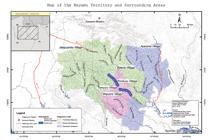
Mapuera village was established in a place that was an old village. We have stories that our parents tell. Mapuera village was occupied by our Xerew relatives in the last years before evangelization. They came from the headwaters of the Kari stream, which flows into the right bank of the Mapuera River, below the current Tamyuru village (Map 1), on the right bank of the Mapuera River. The Mapuera village was previously abandoned due to a lot of theft of women. Then the Xerew rebuilt this ancient village. They had two villages close to the river and another almost 1 km away from the Mapuera village, close to the Minirwaka stream (Map 1). We know about this village because, to this day, in front of the Mapuera River there are two stones. A howler monkey appeared on them, xîpîrî in Waiwai, in the Xerew language the stone is called mawtohrî, which is why the place is called “howler rock”. People who lived in the Mapuera village saw images of the men who stole the Xerew women. So, they called this the “people of the anaconda”, okoymo yana, which is why, to this day, this stone is respected by our people.
This animal that looked like a monkey sat on the rock basking in the sun. When the Indigenous People paddled past, he attacked; it was very dangerous paddling close to there. At night, in the village on the riverbank, where Mapuera is now, some Xerews lived. These monkeys came like men at night to flirt with women. The Xerews didn’t know yet, they were thinking it was visitors who came from other communities. After some time, a girl was taken by a young okoymo yana, anaconda people. She went and saw what the bottom of the river looked like. She entered the river and didn’t drown, she entered as if she were going home and saw the snakes. She asked her boyfriend if this is anaconda, okoymo? The young man replied: That is kwahsî tipici. Then, they continued walking and she saw the waterfalls. The young man replied: These are not waterfalls, this is the îîpî mountain. For the people who live beneath the river, what we call one name they call another. The young Xerew stayed there for three days. Her father and mother were worried that she was missing. The shamans of the anaconda people then asked the young man to take her back. They heard that her parents were crying a lot and she told the girl: You can go back, your parents are crying because you are here. She came back with smoked monkey, banana, yam and potatoes. They saw her on the way walking and the waiting family ran to hug her. Then her parents started asking where she had gone. The girl told her mother that the young man invited her to go with him, go into the river with him, she didn’t want to, the young man insisted on the invitation, and she went. She told her family that there were people living under the river. The Xerews who lived in this village near the river left to live near the Minirwaka stream (Map 1). And that’s how they discovered the existence of people who lived in the water and came to steal their women. So, the elders who went to Guyana told the Waiwai and when they came to occupy this village again, they started to tell this story to us, so today we call this stone xîpîrî tohnî.
In addition to this village, the Xerew had another along the Akari stream. There they fled too. In that village there were many symptoms of fever and many people died, probably from malaria. Some Xerew elders said that this village was not a good place to live. Many people had died there. Nowadays, in rainy weather, there is a lot of malaria in the Mapuera village. Maybe that’s when they were infected. These are the reasons that led them to move from this village. After a long time, we occupied this place again. On the Mapuera River, going up to its headwaters there are signs of occupations, old camps, old villages, axe polishers and marks on the stones in the streams and waterfalls, where our ancestors passed and lived.
But then Ewka thought about establishing a new village in Roraima. He invited his deputy, Caramca, and said to him: “Caramca, are we going to take our group to live only among the Waiwai in Roraima?” As the Katwena wanted to live close to the Waiwai, Caramca told Ewka: “We left Guyana, arrived here in Mapuera and built a village, brought the people, it took a lot of work to bring them.” Then he told them not to go anywhere else, as he wanted to die among them, in the Mapuera village.
In this village, several Indigenous groups began to live together definitively. Previously there were visits, at least from some people who lived further away, for reasons of distance. There are currently larger villages in three countries: Brazil, Guyana and Suriname. Even today, some meetings and exchanges of goods with relatives who live far away continue. It happens during church conference time with a warawan partner, and they enjoy it. Our relationship networks were never interrupted.
Two villages grew with ethnically diverse populations. It took a while for them to understand each other, exchange knowledge and get married. Over time, the villages were divided and separated into groups, such as Waiwai, Mawayana, Hiskariyana, Katwena, Cikyana, Xerew, among others. I realized that these groups mentioned above did not want to mix. It took time and, very slowly, they began to disperse and found new small villages on the banks of the Mapuera River.
In Roraima, Jatapuzinho village was established to evangelize Karapawyana relatives. The idea was to establish a new home for the Waiwai. Since then, the Karapawyana have lived close to the Waiwai. But it took a long time to get used to them. The Karapawyana, like the Waiwai, initially wanted to look for tools and then return to their villages. Some Karapawyana stayed and did not want to come with the Waiwai. Those who didn’t come moved to another village. They told those who stayed, if they didn’t return it was to tell them they were dead. As the Karapawyana have not returned to this day, those who came with the Waiwai think that the others are all dead. This last village, Jatapuzinho, was established by the leader Ewka to unit these isolated relatives. Currently there are several other villages on the Jatapuzinho River. Over time, new villages were established.
Before the missionaries, our ancestors lived differently. There were many visits, exchanges and wars. The villages were small, each ethnic group lived in their parents’ villages of origin. Some villages had a lot of people, more than one maloca, but they had the habit of making several camps for occasional visits. They were also always visited and, sometimes, due to conflict, others moved. Sometimes they went to another village of neighboring relatives. They were free and lived according to their customs and way of seeing the world.
I want to talk mainly about that time. This essay is a continuation of the research I have been doing to translate our cultures. It is our cultures and languages that are guiding us, and we Indigenous People need to put it on paper (Wai Wai, 2017; Jácome; Wai Wai, 2020).
Our knowledge comes from our villages and our territory, then other knowledge came that we also wanted to learn. Our parents wanted us young people to learn new things from white people. Many things were no longer said about older cultural practices. When I arrived at University, I understood the importance of considering the past, our knowledge, our traditions and the way we live. Today it seems like we were leaving our things aside, failing to practice our culture. The elders who taught me also asked me why I wanted to learn these stories. There are other stories that should only be passed on internally, they cannot be passed on to other people. When I said that they were important people, my interlocutors translated it for me: they said that many people died. But I wanted to get to this point in the conversation, I said that it’s not just white people’s knowledge that we have to learn. We young people also need to learn about our own knowledge. At first, my people thought it was strange, an Indigenous person taking an archeology course, as it was already forbidden to talk about these ancient things. It took me a while to translate for them what archeology is in our languages. Then came other Waiwai researchers studying archeology and anthropology, Otekmi Wai Wai (2021), Cooni Wai Wai (2019), Walter Wai Wai (2017), Roque Yaxikma (2018), Alexandre Wai Wai (2018). Thus, the elders found importance in knowledge and began to understand better. They began to receive more visits, agree to do interviews, record audio and take photos. All of this is already understood as something that helps us in our fight to retain our culture.
I have learned some archeology theory and practice. Since I was a child, I already knew some things about our history, but at that time, I couldn’t imagine that it was our archaeology. When I studied archeology, I gradually came to understand the difference in the way of classifying the history of the Waiwai. Ancient villages, artifacts, anthropogenic landscapes... I began to understand and try to translate a concept of history into our language in my master’s thesis. With this translation, we Waiwai can try to explain it to the Waiwai of the future and to white people.
We already talk a lot about “our past” and “our history”, but are we saying the same thing as white people (karaywa) when we express ourselves in this way? I think that what we call history, white people (or anthropologists and archaeologists) call mythology, but, for us, these are true stories, lived by our ancestors. In the Wai Wai language, there are three terms to refer to the past:
-
- Pahxantho yehtopo (pahxantho = ancient past; yehtopo = history): a very ancient, ancestral time in which the “real” characters in the story are not named.
-
- Pahxa Ehtoponhîrî Komo (pahxa = past; ehtoponhîrî = history; komo = people): history that took place in an earlier time, in a relatively distant past, but in which the people and the place can be located (for example, the time of a festivity that took place between my parents or grandparents).
-
- Amna ponho (amna = us; ponho = past): an event in which we participated and can report, for example, amna totoponho means “the trip we took”.
-
- Orotono yehtopo (oroto = now; yehtopo = history). An account of what is happening.
Therefore, the two stories I tell below are more like what we call Pahxa Ehtoponhîrî Komo, as they are stories that took place during my grandparents’ time on the Kikwo River, of the dances and festivals of that time. The stories I tell later took place in a very ancient time and are more like a version of the Pahxantho yehtopo. Our research trip to the location of these events in the past is an amna totoponho (Wai Wai, 2022 p.44).
Here I want to bring the archeology of my Waiwai people, of a specific group, of a group I lived with. I want to bring some examples of conversations in my family, who live in the Mapuera village, Trombetas-Mapuera Indigenous Land. Nowadays, where I live, on the Mapuera River, many people who were previously separated live together. These groups mixed through marriage, as mentioned above. They survived the ancient times, the times of disease and today we are almost 2,000 people in the villages on the Mapuera River alone (there are still Waiwai people scattered on other rivers in Brazil, Guyana and Suriname; in total we are about 5 thousand people (Wai Wai, 2022 p.30).
There are other researchers who have been providing ethnographic information for a long time, through materials, drawings and body paintings made by Indigenous People. Some of these materials are found in old villages and are part of our histories, Amna yehtoponho. We, the Waiwai people, are descendants of these ancient people, we continue what our people have been transmitting to us, the current people.
We are descendants of Mawari and Woxi. There are already written documents by other researchers on this. It is possible to find verses from stories by Mawari and Woxi (Caixeta de Queiroz; Migliano, 2009). I have heard stories that my father and his brother, Axwarapa, heard from my great-grandfather, the shaman Maporio. We are descendants of the two brothers, Mawari and Woxi. They were brothers who lived before our creation, the creation of our people. They were also shamans. They were hunters who knew how to make arrows well. They had the ability to hit game. Mawari caught daughters of okoymo yana (anaconda), two girls. Since then, our people have been mixing, for a long time, since our creation. In this sense, shamans have been sharing knowledge, their natural sciences and the development of their ways of living. We find archaeological sites and ceramic fragments made of clay in many regions. Perhaps, if our ancestors hadn’t practiced this exchange of knowledge, marriages and help from nature spirits years ago, we, the current people, wouldn’t know that these people of ours came bringing their way of living, cultural diversity, language, culture and all the histories of participation in networks of exchange of their wisdom of nature.
These two brothers discovered many things that we know about forests today. Our other knowledge also came from the forest. There are seasons that bear fruit in the forests, for animals and humans; some are also used for medicine. What is the best time to garden and the best time for festivals? My father, during my field research, told stories about festivities. They had festivals organized by season, between January and March, when there are more fruits and when the animals eat better and become fatter. This festival was known as the mawa festival, a type of frog that sings during the rainy season. That was the time they had festivities. Nowadays, according to Poriciwi, they no longer organize festivities this way. The missionaries, with whom they lived in Kanaxen, intervened and they can no longer organize festivities with fermented drinks, cigarettes, and the festival became Easter.
Another festival was also organized during the dry season, the hunters and gatherers festival. Drinks were also made at that time. We drank various wines, such as buriti, bacaba and Brazil nut. Nowadays, we celebrate the feast of hunters and gatherers at Christmas. In 2017, when I translated an audio recorded by anthropologist Leonor Valentino, for her doctoral research (Valentino, 2019), this narrative appeared. Other information and narratives from the Ayarama village, with the Tunayana people, on the Trombetas River can be seen in Valentino (2019, p.197-9).
In these audio interviews, Pooco Kawukma says that the harpy eagle had taught a Tunayana man for the first time, showing him pucukwa, a fermented drink made from manioc. The eagle also showed him a tough vine. Pooco Kawukma got to know the process of making it, he learned from the eagle. He also learned how to make hunting poison, how to season it and showed the vine to use. There are two types of poison, Okomkîrîsî vine and another Yaymo vine. And that’s how they came to name the vines. These types of knowledge are what Indigenous People later shared with several other Indigenous Peoples. According to Yakuta, an elder who has explained a little to me, I asked him: Why do we sometimes find artifacts in the old village similar to what was made in another place far away? He answered me: There is an owner of this world, he has been teaching, he is the same owner of this nature, he who taught our shamans. These owners, the knowledgeable elders translate as the ekatî spirit. Therefore, we believe that ekatî exists. All natural beings offer knowledge to different Indigenous Peoples.
When I was invited by anthropologist Myrian Barboza to participate in her doctoral research fieldwork with the Katukina (Leitão-Barboza, 2019; Leitão-Barboza et al., 2019), an Indigenous People who live in western Amazonas state, we heard many stories. I want to record and share a part of a story told to her. It’s about Katukina knowledge. When I told the story of the shaman Maporio, who encountered the spirit of the ponko, wild pigs, chief Katukina said:
The men went to clear the fields, several of them, and left their wives in the house to take care of their food. The otters came with fish and traded fish with the women in exchange for sex. This way the women fed their husbands with fish. But later the husbands discovered that their wives were cheating on them. So, the men start killing all their wives. Then the shaman asked them: And now, what can you do? They all thought they wanted to see another world, so the shaman transformed half of the men into wild pigs and peccaries.
When I told him, he believed it, because many other people have become animals and many animals have become people. When I took this story to tell the Indigenous People in our archeology activities, they told other similar stories. We have stories told by our parents also (see Jácome and Wai Wai, 2020; Caixeta de Queiroz, 2015).
Like the story of the man and his wives who didn’t get pregnant. They raised an anaconda named Petaru. When its owner went hunting, he brought large game and agouti. As we Indigenous People have a custom when someone kills big game, their neighbors come to get pieces of meat. So, their neighbors came, and they gave them meat. But they forgot Petaru, she was already listening to the neighbors talking. When the neighbors passed by Petaru they said: Your owners killed big game, do you know? A few minutes later the owner came to bring food, opened the fence and said: “Here is your food Petaru.” Petaru jumped on him, swallowed his owner and walked away. The shaman invited the otters to go look for and kill Petaru. Giant otters are one of the largest predators in the river, they are strong, fast and fight collectively. So, they are the ones the shamans contacted for help and to solve their problems.
In this way, this world is not just for humans to survive, for all this to continue, for Indigenous People to continue, there must be biodiversity. Today, forests are part of the continuity of the construction of the lives of Indigenous Peoples.
This is how our ancestors came to know the Amazonian forest and named the other forests. In general, like the Waiwai, other groups also know many tree names. Among other conversations I had with my relatives, they said that trees are natural, but yes, they also have their owners, even those that are used by us Indigenous People. Most of them are used because of fruits and their other uses, and others because of need to solve tasks. For example, when trees are recognized by people because of the use of fruit, bark for medicine or use of leaves, they become natarî plants, sometimes planted by Indigenous People. They become plants taken and planted by Indigenous People, but many others are not edible. Some plants are also planted by animals, such as tapirs, tortoises, toucans, jacamins, among others. Like some palm fruits, such as patauá, bacaba, buritis, they were also used by Indigenous People who took them from their owners, took them and gave names to these plants. They became other owners, with other names.
I have accompanied archaeologist Igor Rodrigues in his research with elders and plant specialists (Rodrigues, 2022). One of them, Amaña, claims that animals are the owners of plants. But these plants are also used by people to make plant braids. After a long time, cultural changes came, new knowledge arrived, new ways of doing things, ways of making the same design of things. Then other groups came translating the same drawings according to their people.
Particularly, my people transmit information orally, both nowadays and in the past. When I talked to my father, first for my undergraduate research (Wai Wai, 2017), I tried to write stories about what life was like before contact with this world in which we live. After almost 80 years the Waiwai left their old villages. But nowadays, these ancient places are like “savings accounts”, where animals, fish and others reproduce naturally, where they are not persecuted. Only during ceremonial times can we go to these places. With the growth in the number of people in the villages, there is no longer any game or fish close to the house. Places like mountains, uplands, where there are various types of fruit trees, are where many animals live. The game fled far away. There were a lot of fish, but with contact with white people, many men acquired nets, which also reduced the number of fish. Therefore, according to information from Poriciwi, he saw that in the past there was fishing with timbó once a year, to avoid the persecution of fish.
During my field research, I learned from my family that the shaman Maporio (he was also a leader and at the same time a shaman), when they went to Guyana, he threw away the amulets that he could not take, as these amulets belonged where they were created. Their belongings were left behind during the move to the new villages. At the archaeological site, the ancient village that was occupied by his people, from the reports I heard I discovered that many things were left by them, such as their house, the fields, cemetery, their plants, fishing lake, mountains where they collected fruits and other things. These are the so-called “natural” landscapes that have been transformed into the idea that Indigenous People created them, but they are part of the construction of ancient knowledge that involves Indigenous People and other beings. Nowadays, some trails that provided access to the villages continue and others have closed.
When we identify sites and camps in Amazonia, they are certainly the result of the experience of other Indigenous groups, who lived in that place a long time ago. There were malocas in the villages and the elder Towa said that before his people only had smaller houses, made of açaí leaves and hammocks made of xaraw and pîîrî kahxapu. According to him, a man went hunting in the woods and when he was there it rained a lot. The little bird approached, started calling krahko and the man told him to shut up. Then the bird turned into people, called the man and asked him: “Do you know how to build a house?” The man replied, “No.” Then, the bird showed how to build houses, showed wood, vines, straw... Elder Towa said that this was how his people started building malocas in their villages.
Final considerations
From my point of view, studying Indigenous archaeology, past and present, is my return to my origins. Learning my archeology served me to search for my origins. In fact, archeology was not the first contact with this origin. Archeology helped organize knowledge and has shown the way to learn more. My research is about Indigenous knowledge guided by elders. My discovery was to see a world that I didn’t even know that my people carry in ancient memories. The ways of knowing Amazonia are knowledge as legitimate as that of science, but they are transmitted through shamans. Archeology showed a path to understand my people’s point of view. For them the value of archeology is that I can write and record our traditions, which tells us the meanings. Listening to the elders is a connection with the past and my training in archeology and in the community are ways of making a connection with Indigenous theories. Learning and understanding how to live in Amazonia, caring for all nature, which has lives and spirits, will help us heal our pain. If we are not careful with them, we will be harmed, as there are other beings in the forests that can ruin the lives of humans. So, I want to contribute to ensuring that this knowledge is always passed on to future generations..
Acknowledgements
At the beginning I want to thank my family, in the person of my father, Poriciwi, and my mother, Lea Wahciki. I want to thank all the elders who shared their knowledge with me. I thank my anthropologist and archaeologist friends, and Karaywas teachers. I also thank the researchers who helped me with the text and with sharing the knowledge written here, Claide de Paula Moraes and Igor Rodrigues. I also thank Carla Jaimes Betancourt and Carlos Machado, coordinators of the Heritage and Territoriality Project: past, present, and future perceptions among the Tacana, Tsimane’, Mosetén and Waiwai (funded by the Volkswagen Foundation) who are helping me approach and talk with the Waiwai of Roraima. I also thank the Waiwai from the Xaary, Anauá and Jatapuzinho communities, as well as all the leaders. I thank Myrtle Shock for translating the summary into English and for all the patience she always had with me. I thank Charles R. Clement for translating the main text into English. I also thank the generosity of the reviewer who made suggestions to improve the final version of the text.
References
- CAIXETA DE QUEIROZ, R. Trombetas-Mapuera-territorio indígena. Brasília: Funai-PPTAL, 2008.
- _______. Cosmologia História Wai Wai Katxuyana: sobre os Movimento de Fusão e Dispersão dos Povos (Yana). In: GRUPIONI, D. F; ANDRADE, L. M. M (Org.) Entre Águas Bravas e Mansas, índios & quilombolas em Oriximiná. São Paulo/Iepé, 2015. p.104-32.
- CAIXETA DE QUEIROZ, R.; MIGLIANO, M. História de Mawary. Belo Horizonte: Associação Filmes de Quintal, DVD, 56 min, Son, color. Filme- nVídeo, 2009.
- GALLOIS, D. T (Org.) Rede de Relações nas Guianas. São Paulo: Associação Editoral Humanitas; Fapesp, 2005.
- HOWARD, C. V. Pawana: a farsa dos visitantes entre os Waiwai da Amazônia. In: VIVEIROS DE CASTRO, E.; CUNHA, M. C. Amazônia. Etnologia e História Indígena. São Paulo: NHIIUSP; Fapesp, 1993.
- IEPÉ. Plano de Gestão Territorial e Ambiental do Território Wayamu: TI Nhamunda Mapuera; Trombetas -Mapuera e TI Tunayana. Santarém: Iepé, 2021.
- JÁCOME, C. P.; WAI WAI, J. X. A paisagem e as cerâmica arqueológicas na bacia Trombetas: uma discussão da arqueologia Karaiwa e Wai Wai. Boletim do Museu Paraense Emilio Goeldi, Serie Ciências Humanas, v.15, n.3, e 20190140, 2020.
- LEITÃO-BARBOZA, M. S. “Tükuna cosmopolitical cartography”: the gendered meaning and use of territories by Katukina indigenous people (Biá River, Brazilian Amazonia). Gainesville, 2019. Tese (Doutorado) - Departamento de Antropologia, University of Florida.
- LEITÃO-BARBOZA, M. S.; TUKANO, L. D. Y.; WAIWAI, J. X. -Corpoterritorialização- Katukina: lampejos etnográficos sob as perspectivas femininas indígenas. Amazônica Revista de Antropologia, v.11, p.503-47, 2019.
- RODRIGUES, I. M. M. Tramas da tecnologia: etnoarqueologia da variabilidade dos traçados dos povos do rio Mapuera. São Paulo, 2022. Tese (Doutorado) - Museu de Arqueologia e Etnologia, Universidade de São Paulo.
- SOUZA, A. A. Waiwai Yana Komo. Rotas de transformações Ameríndias. Um estudo de caso na região das Guianas. Dissertação de Mestrado, Antropologia Social, Universidade Federal do Amazonas, 2018.
- VALENTINO, L. As transformações da pessoa entre os Katwena e os Tunayana dos rios Mapuera e Trombetas. Rio de Janeiro, 2019. Tese (Doutorado) - Museu Nacional, Universidade Federal do Rio de Janeiro.
- WAI WAI, C. A cerâmica Wai Wai: modos de fazer do passado e do presente. Trabalho de Conclusão de Curso, Graduação em Arqueologia, Universidade Federal do Oeste do Pará, Santarém, 2019.
- WAI WAI, J. X. Levantamento etnoarqueológico sobre a cerâmica Konduri e ocupação dos Wai Wai na região da Terra Indígena Trombetas-Mapuera (Pará, Brasil). Trabalho de Conclusão de Curso. Graduação em Arqueologia, Universidade Federal do Oeste do Pará, Santarém, 2017.
- WAI WAI, J. X. Etnografia e história das aldeias antigas do rio Kikwo, Pará, Brasil. Belo Horizonte, 2022. Dissertação (Mestrado) - Universidade Federal de Minas Gerais.
- WAI WAI, O. K. O Xkmari Wai Wai: produção de raladores pelas anciãs na aldeia Mapuera. Trabalho de Conclusão de Curso, Graduação em Arqueologia, Universidade Federal do Oeste do Pará, Santarém, 2021.
- WAI WAI, R. Y. Uma descrição etnográfica sobre os instrumentos musicais Wai Wai Raatî. Trabalho de Conclusão de Curso. Graduação em Antropologia, Universidade Federal do Oeste do Pará, Santarém, 2018.
- WAI WAI, W. P. A mudança no ritual do povo Wai Wai. Trabalho de Conclusão de Curso. Graduação em Antropologia, Universidade Federal do Oeste do Pará, Santarém, 2017.

 Source: Prepared by Ney Rafael Gomes Monteiro, 2024.