 Racist Discourse Circulating in the Media in Times of Crisis
Abstract
The present article sets out to analyze instances of racial discourse circulating in both the Brazilian and international media during a particular time of crisis - the Covid 19 pandemic - and follows this analysis with a reflection regarding such texts and the ongoing antiracist struggle in Brazil, with a view to the crucial role played by language and discourse in such contexts. To this end, I draw on Kilomba (2019), Fanon (2008), Muniz (2016, 2022), Munanga (2024), and Austin (1962), among others. The data selected comes from textual tracking work in digital networks (Fabrício, 2014) from 2020 up to the present. In transnational trajectories of text circulation, racist discourse features in a variety of semiosis contexts, ranging from traditional media (such as newspapers) to WhatsApp groups. Alternatively, so do discourses that celebrate black populations, whether in English language classrooms, or in regular schools, where children have access to more positive perspectives of black populations, thus signaling that through language/discourse new inroads can be made on the long-term path of a struggle that is more imbued with hope.
Keywords:
text circulation
;
discourse
;
race
;
racism
;
indexicality
Resumo
O presente artigo apresenta os discursos de racismo que circularam em algumas mídias brasileiras/internacionais sinalizando a relevância da linguagem/discurso na naturalização do racismo, contribuindo, desta forma, com pesquisa do campo dos estudos linguísticos aplicados e do discurso. Para tal, me embaso em Kilomba (2019), Fanon (2008), Muniz (2016, 2022), Munanga (2024), Austin (1962) dentre outras/os. Os dados são oriundos de rastreamento de texto (Fabrício, 2014) realizado de 2020 até o presente. Em uma circulação de texto transnacional, o racismo circula em semioses distintas mídias tradicionais como jornais, mas também em grupos de Whatsapp. Em contrapartida, circulam também discursos em sala de aulas de Língua Inglesa e com crianças discursos de valoração da população negra, sinalizando, desta forma, que na linguagem/discurso abrem possibilidades para o ato de esperançar em luta.
Palavras-chave:
circulação de textos
;
discursos
;
raça
;
racism
;
indexicalidade
1. Trailblazing
In the past five years, in a world undergoing continuous crises, language and discourse studies have become increasingly relevant to lay bare how the social sphere is very much part and parcel of our actions in the world, and the implications such actions may have on ourselves and on society as a whole. I call on a blend of intertwining theoretical frameworks, both from the Global North and the Global South, to address a topic that features on this side of the Atlantic - in Latin America and, more specifically, in Brazil. During the early colonial period, such linguistic indices1 - race and racism2 - had not yet been clearly conceptualized, but racism was already in place throughout the world, of which black African enslavement is such a searing example. Let us take, for instance, Latin American scholar Aimé Césaire, author of Discourse on Colonialism, which was first published in 1978. In it, the author discusses the issue of colonialism with regards to Europe:
A civilization that proves incapable of solving the problems it creates is a decadent civilization. A civilization that choses to close its eyes to its most crucial problems is a stricken civilization. A civilization that uses its principles for trickery and deceit is a dying civilization. (Aimé Césaire, 1978, p.15)
Césaire, in approaching colonialism, addresses the incapacity of ‘civilization’ - an expression historically synonymous with European society - to resolve the issues generated by colonialism and the scars it left in its path. Borrowing from this perspective, let us transpose this line of thought into our contemporary world. In this century, as societies, in our respective countries and continents, we experience complex, harrowing situations. Lived experiences which may be shared with the click of a mouse or by a touch of a screen thanks to advanced digital technologies. Newspapers continue to report on the exodus of Syrians, or Afghans who, in the hope of a better life, seek shelter in other countries: for instance, in Latin American countries. Within Latin America itself, we learn of the displacement of refugees from Haiti, or Venezuela, who seek refuge in neighboring countries. These migrants come with the intention of starting anew, in search of a life with greater dignity and respect for their humanity.
Concurrently, here in Latin America we witnessed fascist-leaning governments being replaced by progressive ones - the former having caused profound damage to still fragile democracies, such as ours in Brazil. Much like Latin America, part of the African continent is still today experiencing the effects of colonization and of colonialism, and every day we see boats full of black Africans fleeing conflict, poverty, dehumanization, and social precarity. They risk their lives across the Mediterranean to seek exile in Europe. These black migrants, whose humanity was taken for granted in their homeland, are then socially construed as abject, unwanted and despicable in the places they go in search of a better life. Also, at this historical juncture, plunged into a war between neighboring countries, Europe is not living the glorious times of its heyday; the future on that side of the Atlantic seems rather uncertain and painful. Meanwhile, in Asia, we observe a constant flirting with conflict involving the two Koreas, China and the West.
Furthermore, we must not forget that these local crises, taking place within each country, then became more acute with the COVID-19 pandemic3, which further accentuated conflicts, inequalities and poverty among us. Global conflicts, as well as domestic disputes, became intensified. Throughout the pandemic, feminicide, racism, class disputes, LGBTphobia, xenophobia, all increased alarmingly across the world. In these multifaceted aspects of the many crises, social minorities in both Eastern and Western countries stood to lose the most. We saw, for example, how rich countries got their vaccines, while those outside this socioeconomic perimeter had to wait patiently before they too could have access. Many lives were lost before there was life-saving vaccination available for all. At the height of the pandemic, we saw how poor countries were mostly left out of the vaccine rollout, ignored and underestimated by those in the Northern hemisphere who, on many instances, completely disregarded humanitarian rights. The South was left adrift. The address made by South African President Cyril Ramaphosa4 at the Summit for a New Global Financing Pact, a gathering of world leaders held in Paris in June of 2023, illustrated part of what the Global South experienced. In the case of Covid, says Ramaphosa, African countries felt like they were practically begging for the vaccine, which the so-called First World countries had access to and were hogging. We also saw the inefficiency of local governments which, by minimizing the pandemic, allowed a much larger relative proportion of their population to die from Covid (in the Brazilian case, under President Bolsonaro, more than 700,000 people lost their lives). There were, in short, economic, health, political, moral and humanitarian crises, and in this context, these aspects materialized in the texts that circulated on the various media platforms through discourse / language.
The year of 2025 starts off with even more challenges imposed by the policies implemented by the ‘new’ US president Donald Trump. Two of them I shall briefly mention here: deep cuts to diversity-supporting programmes of all kinds (also equity and inclusion); and the persecution of researchers who investigate such topics in their research projects. Topics such as the ones dealt with here, involving race and racism, are looked unfavourably upon by the Trump administration. These facts I have highlighted here have circulated intensely in the form of semiotic texts in the media. This circulation of texts, and with it of discourses, is the core interest of this article.
With this five-year preamble to establish a context, let us now move to the task at hand, for the present article sets out to examine the circulation of discourses of racism both in the Brazilian and the international media, and to promote a rethinking of the antiracist struggle, pointing to the relevance of language and discourse in this process. For this purpose, I reach out to research on race and language in the context of applied linguistics studies5 carried out by applied linguists such as Aparecida de Jesus Ferreira (2018, 2021), Ione Silva Jovino (2021), and Kelly Barros Santos (2021), to name but a few who place race - in close articulation with language / discourse - at the core of their investigations.
The article is organized into four sections: First, I introduce a brief conceptualization of race, racism and of the white supremacist canon. Then, I present a definition of language, discourse and entextualization, and go over a few examples. Next, I address the importance of the antiracist struggle and the relevance of language and discourse studies in this context. And I close it all with some final considerations. Let us now move on to a brief presentation of race, racism and white supremacist definitions in present-day contexts.
2. White supremacy and racism
There are three important theoretical constructs we must deal with before we follow with our considerations: the notions of white supremacy, race, and racism. Da Silva & Schurster (2022) point out that social Darwinism was greatly influential along the 19th century. White supremacy was taken to be the natural culmination and final product of ‘human evolution’. In the authors’ view, the notion of such supremacy then became trivialized. In this sense, Europeans were/are seen to personify such evolution. In our contemporary world, this representation of European superiority is shared with Americans. It is important to point out that it does not mean to say that all Americans or all Europeans were/are seen as superior, just the portion of the population socially construed and understood to be ‘white’. The ideologies of a white supremacy foster an understanding of the roots of racism and of the privilege of whiteness. As Bonds & Inwood explain,
The concept of white supremacy forcefully calls attention to the brutality and dehumanization of racial exploitation and domination that emerges from settler colonial societies. While white privilege remains an important analytic frame to analyze the taken-for-granted benefits and protections afforded to whites based upon skin color, the concept of privilege emphasizes the social condition of whiteness, rather than the institutions, practices, and processes that produce this condition in the first place (Leonardo, 2004; Smith, 2012; Pulido, 2015). White supremacy accentuates the structures of white power and the domination and exploitation that give rise to social exclusion and premature death of people of color in settler colonial states (Bonds & Inwood, 2016, p.716).
One of the ideologies of white supremacy is nativism, which, according to Guimarães (2022, p.3), references people native to a certain place. It is worth mentioning, though, that by ‘native’ one often means the white people who are originally from that place. A clear example of this can be found in the context of the Russian-Ukrainian conflict. Reports circulating in international media and in social media posts called attention to the fact that black people were being prevented from boarding trains out of Ukraine. It seems the railroad trains, which offered a way out of the zone of conflict, were not intended for them. At the time, semiotic texts such as this one from NBC News, published on 2 March 2022, circulated on social media platforms such as X/Twitter, Instagram, Facebook and WhatsApp denouncing the racism experienced by black Ukrainians on the Ukrainian border. In this case, it would be worth asking: who, then, qualifies as native? The semiotic text was published on the NBC News account on X on 2 March 2022 at 11:16 am. The video lasts 03:23. It is a snippet of a news item broadcast by the same television channel during one of its newscasts. On X, the post received 260 likes, 22 comments and was reposted by an additional 185 people.

In Figure 1, linguistic clues such as ‘Ukraine’s refugees of color’, ‘racism’, and ‘borders’ indexicalize who effectively qualifies as a native in the logic of white supremacy, and how whiteness - a power system privileging white people (Schucman 2014, Carone & Bento, 2019) - operates to keep their privileges in place. This is most evident when life and death are in the balance. Following Guimarães (2022), we could say that the so-called natives were not deemed to be the black Ukrainians, as these were prevented from boarding the trains that would take them to safety.
Another central value for supremacists, according to both Bonds & Inwood (2016) and Guimaraes (2022), is the perspective that states the superiority of the white race over all others. This entails that everything related to the white race - sets of values, music, culture, fashion, etc. - is attributed greater importance than the corresponding category in other racial groups. This ideology implies that certain lives occupy a place of preference while accessing the means of transportation, of being on the train, or crossing the border, while others do not.
It is worth saying that, like Munanga (2004) I do not approach the concept of race in its biologizing aspect, but rather, in its social perspective. In other words, the category of 'race' is a useful fiction, a phantasmic construction (MBEMBE, 2014), a changeable and unstable fantasy (SULLIVAN, 2003), as I have pointed out in Melo; Silva Júnior; Marques (2020, p. 419). According to Barnard (2004), the notion of race is fluid, much like gender and sexuality, when approached from a queer perspective. Race is also a historical, cultural, social-discursive and performative construct (MELO & MOITA LOPES, 2014, 2016). In addition, its reception is dependent on geographical context. A good case in point is when Brazilians immediately legible as white in Brazil travel to the United States or Europe, where they may be perceived as ‘Latinos’. In the film Bacurau, which came out in 2019, when a Brazilian couple, perceived as white in Brazil, present themselves as white to a group of white Americans, the astonishment of the Americans is noticeable, as well as the ensuing bizarre effect, since white Americans, along with white Europeans, see themselves as part of the select group of those who can ‘legitimately’ be called white (all else outside of this “pure” white core is hierarchically positioned as being worth less, and the effects of this valuation can be seen, for example, in the case of the player Vinicius Júnior, which I shall mention further on). The fluidity of race lies in hetero-identifying the other according to the context, according to our present-day historical backdrop and to one’s own idea of race. A black person, depending on their socioeconomic background, their place of residence and their level of schooling, can be legible as ‘not black’, being construed as 'morena/o'6 in Brazil, a feature of racism, Brazilian style. Regarding racism, it exists because the concept or idea of race as a biological fact exists. Both notions feed off each other. According to Gomes (2005, p. 52)
racism is, on the one hand, a behaviour, an action resulting from aversion, at times, hatred towards people whose perceived racial membership is based on observable features such as: skin colour, hair type, etc. It is, on the other hand, a set of beliefs and images having to do with segments of society who posit the existence of superior and inferior races. Racism also results from the desire to impose a particular truth or a certain belief as unique and true.
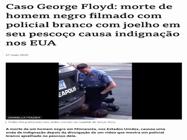
Racism, as Bonds & Inwood (2016) point out, is intertwined with ideologies of white superiority. The effects of such intersection could be observed, for instance, in the United States, in the January 6 (2021) assault on the Capitol, when white supremacists stormed a site that fundamentally represents American democracy, and the underlying ideologies of white supremacy were readily noticeable. In the United States we still witness, not infrequently, cases of overt police brutality resulting in the killing of black people in the streets, as was the case of the deadly positional asphyxia which killed George Floyd in May of 2020. Racism, in articulation with the values mentioned earlier, is a cause for death and destruction. The following text was published on the BBC Brazil website on 27 May 2020, and there are no indices pointing to the author of the report or the time of publication. Darnella Frazier's name refers to the author of the video that went viral showing the police's actions. There is no space for comments in the article (Figure 2):
Another example of this intertwining of racism and white supremacist ideologies happened on 26 January 2023, when Madrid police removed an effigy of black Brazilian footballer Vinicius Júnior, who plays for Real Madrid (Figure 3). The effigy was hanging by its neck from a bridge in the Spanish capital. In this semiotic text we can observe how discourses hinging on old racial ideologies rear their ugly head. Furthermore, not long ago, during a match between Valencia and Real Madrid, another similar effigy was displayed, and the player suffered racist abuse from Valencia’s supporters by means of indexical clues such as ‘mono’ [monkey]. The report, entitled: “Vini Jr.'s dummy is hung by Atlético de Madrid fans simulating a hanging”, was published on 26 January 2023 in the Folha de S. Paulo website at 10:06 pm.

From an article published on 26 January 2023, at 10:06 pm - in Brazilian news site “Folha de S. Paulo” 8
Even though race is a fluid concept operating differently, be it in Ukraine, the United States, Spain or Brazil, and despite the different effects of the interplay between race and nationality in these spaces (i.e. a black Brazilian goes through a different process of racial construction to a black Ukrainian or a black American), there is still a point of convergence between all the examples cited, which is the discursive construct that black lives are worth less on the human scale. The multisemiotic texts analysed point to a series of racist discourses, concerning black people, which circulate in the West. This is not new to any of us, regardless of where we live, or come from. In this context we turn to, of multiple crises, non-white skin, and for our purposes black skin, is constructed through discourses which indexicalize ideologies of inferiority, dehumanization, criminality and danger, as I have mentioned in previous studies (Melo & Moita Lopes, 2012, 2014; Melo, 2019, 2022) This has been going on for centuries. The skin that is mistrusted is that of black people, and depending on the corporeal-discursive actions implemented, one palpable effect of this mistrust could well be death, be it symbolic, or very real. According to Nilma Lino Gomes and Glenda Cristina Valim de Melo (2016, p.116),
Today we are experiencing a more dramatic situation with racism, regarding the way in which it has become embedded in our social structure, in power relations, in economic and gender relations, in such an ingrained way that it has become naturalized.
I believe there is possibly a prevailing insensitivity when coming to terms with how much suffering and death can be generated by racism associated with ideologies of whiteness and white superiority. Choosing not to acknowledge this suffering may even constitute part of the privilege of whiteness. As Mbembe (2015) states, whiteness was constructed as ‘privileged’ - the main source for the ‘racial conduct’ norms. Simas (2016, n/d) - himself a white Brazilian researcher- argues that the white race relies on “the protection of skin colour”, in other words, white skin offers a protection from racist violence.
Based on Collins & Bilge (2021) and Gonzalez (2020), who define intersectionality, one can say that the intersectionality9 among these four systems of oppression - white supremacy, race, racism and whiteness - helped shape actions both in the Global North and the Global South. Racism is like the pollen carried by the wind: it shapes social structures and public policy worldwide; it is not exclusively a Brazilian problem. Whether racism will take shape and manifest itself is contingent on culture and society.
Aided by digital technologies, different acts and instances of racism spread even faster. In a global context of multiple crises, racism and whiteness gain momentum and traverse transnational trajectories either with a click of a mouse or the touch of a screen on Facebook, Instagram, Twitter, WhatsApp, TikTok, among countless other social media platforms. But what do white supremacy and racism have to do with language and discourse?
Racism, both structural and structuring (FANON, [1952] 2008), along with discriminatory manifestations - for instance, against women - takes shape through language. Therefore, racism, as well as all other forms of discrimination, is a historically, socially, culturally, discursively and performatively situated construct. (Borges & Melo, 2019, p.3).
Every time we formulate and/or reproduce racist texts, we are performing actions in and through language which may bring about countless unforeseen consequences, as Kassandra Muniz (2016, 2022) points out. In this sense, race is not separate from language. I understand that racism and language coexist in and through language, giving existence to the world we live in, which is also structured on patriarchy, CIS heteronormativity, capitalism and other power structures that are exercised at different levels, such as local and translocal, as we shall have the opportunity to see next.
3. Language, discourse and race
In order to discuss the intertwining concepts of language, discourse and race, I base myself on Grada Kilomba (2019) and Fanon ([1952]2008), who teach us the relevance of language to understand social life; that is, to understand ourselves and the society we live in. In this sense, language brings into existence and materializes both ourselves and the world we live in. According to Fanon (2008, p.33),
We attach a fundamental importance to the phenomenon of language and consequently consider the study of language essential for providing us with one element in understanding the black man’s dimension of being-for-others, it being understood that to speak is to exist absolutely for the other.
In the first chapter of his Black Skin, White Masks, Franz Fanon stresses the relevance of language in the construction of subjects and how, in the process of colonization, the other’s language is what calls us into existence, whereby existing would ultimately mean our becoming white. Given that Brazil is a country of diaspora, colonization was a process shaped, naturalized and sedimented in and by means of the other’s language. In other words, in/through language, European white settlers ingrained in indigenous and black peoples’ existence discourses of inferiority, dehumanizing and hypersexualizing them - discourses which still circulate, affecting lives even today.
If following John Austin (1962) and Jacques Derrida (1988) we consider that we do things with language, and that it gives rise to countless unforeseen effects, I would like to return to the notion of performative speech acts, drawn from both authors’ theoretical framework, but as featured in Judith Butler’s proposition. For Butler, language itself is the very thing that we do.
We do things with language, produce effects with language, and we do things to language, but language is also the thing that we do. Language is a name for our doing: both “what” we do (the name for the action that we characteristically perform) and that which we effect, the act and its consequences. (BUTLER, 1997, p. 8).
With this perspective of language as action as a starting point, I understand, then, that race is the work of discourse, or in Hall’s words, race is a "discursive category" (HALL, 2006, p.67). Race is a fiction, as Césaire (1978), Fanon (2008) and Mbembe (2014, 2018) pointed out on several occasions, and as an invention, race is constructed in and through language, in connection with history, culture and social context. That is to say that, through the use of language we enact race, racism, white supremacy and whiteness. They are not separate from language and discourse. They are embedded in the discourses that circulate in the semiotic texts that travel around the globe over fibre optics, cables and wires. They reverberate in countless effects.
Still in this perspective of language as action we speak of an ontology of being, as a certain transitory condition (being as progressive aspect), rather than of be, as unchanging essential state or condition (be as stative verb); that is to say, we enact discursive performances. As Jacques Derrida (1988) points out, the discursive performances we enact are naturalized by iterability and citationality. In other words, through repetition, in ever new and changing contexts, discourses on race, racism, white supremacy and whiteness become naturalized.
In a prior study (MELO 2019 and 2023) I mention the fact that slavery was officially banned in Brazil in 1888, and legislation has been passed since the twentieth century outlawing discrimination as well as racist and discriminatory representations of black people. Nevertheless, some of the same dehumanizing discourses and texts that accompanied slavery can still be found circulating these days and are even used to indicate which lives matter and which don’t. The dehumanizing and the objectification of the black population, unfortunately, is not a thing of the past, exclusive to that period of Brazilian history.
Which humans count as the human? Which humans are eligible for recognition within the sphere of appearance, and which are not? What racist norms, for instance, operate to distinguish among those who can be recognized as human and those who cannot? - questions made all the more relevant when historically entrenched forms of racism rely on bestial constructions of blackness. (BUTLER, 2018, p.43).
Butler’s query on the bestializing of blackness against our basic rights to humanity led me to ask myself how such racist discourses come to be naturalized. They are repeated with each click, and each time is brand new or, in Derrida’s ([1972] 1988) words: a copy of a copy. As Gee contends (2004, p. 15), discourses are ways of being in the world which “integrate identities or combined ways of saying-doing-thinking-feeling-valuing, [...] which identify us as members of a group.” Besides, discourse is performance enacted in the circulation of texts or in entextualizations. These discourses that travel through a variety of spaces with a touch of a screen point to the past, to the present and, sadly, are prospecting possible futures.
I might add, aligning myself with Grada Kilomba, that the vocabulary, discourses, images, gestures, actions and ways of looking place black subjects and people of colour as ‘Others’ - the ‘difference’ against which white subjects are measured - but also as ‘Otherness’ (KILOMBA, 2019, p.78). Being racialized is something that specifically concerns blacks and indigenous peoples; it doesn’t refer to white people, although they too would be liable of being racialized. It is crucial that we come to an understanding of ‘white’ as race; also, it might help understand the spread of these racist discourses.
4. The circulation of racist texts in the comments of a fascist president
Brazilian population faced, between 2019 and 2022, a Brazilian-style far-right government. The far-right ideology which developed at first in Europe and the United States10, once again seems to extend its tentacles over the four corners of the globe. In Gomes’s view (2019), for the Brazilian population between 2015 and 2022, a painful process was set in motion. Particularly in these four years, when we were in the throes of former President Bolsonaro’s government, an administration so dystopic that in June of 2023 he was sentenced to an eight-year election ban. Bolsonaro implemented what Mbembe (2018) calls necropolitics, in other words, a politics of death, potentialized by the Covid-19 pandemic. Several workers’ rights, social-security rights and welfare rights were either banned or curtailed11.
Moreover, the former President and the ‘bolsonarismo’ movement he gave rise to harbour conservative beliefs and ideologies, such as the ideology of white supremacy, radical Christian perspectives, radical neoliberalism, among others. All of that in a country where the majority of the population is black and poor12. Bolsonaro reinforced the discourse of ‘racial democracy,’ which posits that we are all equal, living in perfect racial harmony here in Brazil, a discourse by means of which the structuring racism still present in the country is erased and made little of.
Racism rears its ugly head in the widespread genocide of indigenous and black populations in different areas of the Brazilian territory. If we consider the intersectionality of race, gender, and sexuality, which as Lélia Gonzalez (1984) and countless other black feminists argue is the avenue of oppression, the loss for the country becomes even greater. During Bolsonaro’s government, indigenous women and children died in extreme poverty; black women were the main victims of domestic violence, while black men were the main target of police brutality. With regard to black women in particular, the data is alarming: in 2022, 202,608 women suffered domestic violence, 55 per cent of which were black women. Of the murders in 2022, 67 per cent were of black women.13 In the words of Nilma Lino Gomes:
We experience, in our present-day context, a negative inflexion in politics, in the judicial sphere, in political party organizing and in tackling inequality. These are times of political tension, of a resurgence and a coming to power of the far-right in our country, since the 2018 election. (GOMES, 2019, p.125).
Albeit from five years ago, this statement by Brazilian intellectual Nilma Lino Gomes (2019) in no way suggests that the negative inflexion is over with President Lula taking office on 1 January 2023, as head of a coalition of progressive and centrist parties. Time has moved on, but even with the affirmative action policies implemented by the current administration, and even with a Ministry of Racial Equality, a Ministry of Culture and a Ministry of Human Rights headed by black women members of Cabinet, the effects of racist, LGBT-phobic, misogynist, classist and xenophobic values emerge in the circulation of semiotic texts on tablets, notebooks and cell phone screens all around the country. They cross borders and reach unimaginable places. The impact of supremacist discourses and ideologies may be felt in the daily episodes of racism taking place in learning institutions, supermarkets, shops, restaurants and many other places across Brazil. In WhatsApp groups, black lives are met with violence. It would be important, in view of all we have been discussing, to take into consideration the words of Brazilian philosopher Vladimir Safatle (2023), at this moment of inflection:
... now, one must definitely not rule out the possibility that Brazil has become a test case for a new stage in the international far-right movement, namely, the insurrectional stage. In this context, ‘insurrectional stage’ would mean that the international far-right would increasingly tend to operate as a long-term anti-institutional force. A force that may express itself by gathering large crowds in public demonstrations, by means of direct action, by forms of outright defiance of constituted authorities. In other words, a series of strategies which until not long ago characterized the left-wing revolutionaries’ playbook and is now being employed by the far-right, as if the world had been upended. (SAFATLE, 2023)
In Brazil, the far-right movement is present beyond Congressional and political spaces. During the past election, parents questioned teachers and other education professionals about the content being taught their children. According to these parents, schools and universities were ‘indoctrinating’ their families. Over these five years, fascist demonstrations were held all over the country. Social media is a malleable space for this kind of presence. Semiotic texts travel on Instagram, Facebook, X, YouTube and Tik Tok. Groups on WhatsApp and Telegram share fake news based on far-right ideologies. Fragments of language and discourse circulate producing different kinds of effects that often get out of control.
In this digital space, language mixing and various hybridizations take place. Let us take the case of languages that mix in this context, so that different fragments form a text. Blommaert and Rampton (2011) reflect that these language mixings denature the idea of the purity of language and its structural composition. As Blommaert (2010), Fabrício (2013) and Melo (2019) point out, these texts perform textual trajectories. Fabrício (2013, p.156) adds that the multiple, versatile trajectories of texts direct us to “exchanges, revaluations and transformations of texts ‘in transit’ through different contexts.” Throughout these textual trajectories, texts become fluid, are mixed, and are entextualized. According to Bauman and Briggs (1990), entextualization is “discourse’s reflective capacity of being shared in different meaning-making systems and the framing of the text that carries its features to other spaces” (MELO & MOITA LOPES, 2015, p.60). This process also involves decontextualization and recontextualization, which allows for the construction of new meanings, for texts in contexts that are understood as changeable and mobile, instead of static and rigid.
Let us, then, take a look at what was circulating in Brazilian media regarding former President Jair Bolsonaro’s racist discourse. Before turning to the actual analysis, it is worth noting that the former president circulated on his social networks that Brazil is a mixed-race country, a so-called 'racial democracy'. These two discourses are powerful, as they revisit racial ideologies of racial harmony and of the absence of racism that have long informed Brazilian history. With the arrival of a far-right government, aligned with the principles of white supremacy, these ideologies also start circulating in the media. According to Nilma Lino Gomes and Glenda Cristina Valim de Melo (2015, p.116):
However, the more society advances in this understanding, the more conservative and racist groups reorganize themselves to reinforce the myth of racial democracy and permeate the social mindset with the discourse that there is no racism or racial inequality, but rather a peaceful coexistence between Brazilians based on racial miscegenation.
The semiotic texts below were taken from the Brazilian media (Folha de S. Paulo, Alma Preta and Terra) during the former president's term in office, when he made reference to the black population, either at events with businessmen or with followers. This data circulated in the media in 2020, 2021 and 2022. In Figure 4, we can see the former president in the centre, dressed in a shirt and tie, no jacket, pointing to a context of greater informality and smiling as he blurts out yet another racist comment. The title is: Bolsonaro makes another racist remark to a supporter: “Did they manage to fucking lift you? What you weigh? More than 7 arrobas, right”.
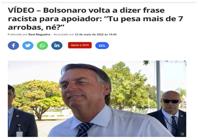
In Figure 5, the former president also appears in the centre of the image, but unlike the previous picture, he has his left arm raised and his mouth open in a grimace. These bodily indices reinforce those occasions when the former president enunciated inappropriate performative speech acts on various subjects, including racist remarks. The report includes a transcription of the dialogue below, taking place between Bolsonaro and a black man:
Black Man: “Bolsonaro, I’m a black man through and through, I voted for you and I’m gonna vote for you again in 2022. You’re the best president Brazil’s had.”
Bolsonaro: “And you weigh more than 8 arrobas. What are you hiding in that dirty hair of yours? I can spot a cockroach from here.”
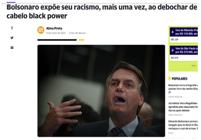
In the two semiotic texts above, the former president mobilizes racist discourses marked by the linguistic indices ‘Did they manage to fucking lift you? What you weigh? More than 7 arrobas, right?’ and 'And you weigh more than 8 arrobas. What are you hiding in that dirty hair of yours? I can spot a cockroach from here’. These indices point to the animalization of black people, relating them to animals such as cows, pigs and oxen, that are weighed in arrobas. In addition, by using irony to mock the man's Afro, the former president mobilizes the discourse of filth regarding the hair, given that cockroaches inhabit dirty places. These discourses hierarchize black people as inferior and as filthy. As mentioned in Melo (2019, p.20):
‘understanding that language is a repetition of speech acts that has the power to produce or annihilate lives means that what we do with language cannot be separated from materiality.’ In this sense, I agree with Butler (2018, p. 35) when she says that ‘a statement gives existence to what it declares (illocutionary) or causes a series of events to occur as a consequence of (perlocutionary) statement.’
In this sense, although race is an invention, as mentioned in the previous sections, it materializes through linguistic clues in the discourses that are entextualized in the textual trajectories. The effects of this circulation are unforeseeable. It is worth pointing out that in the interaction between the black man and the former president (Figure 5), we can observe the former's racial alienation, as both Fanon (2008) and Neusa Souza Santos (1983) teach us. Racism is such a perverse weapon that it profoundly affects the construction of the black person's own subjectivity.
Mockery and irony can also be observed in Figures 6 and 7. In the first one, we have two characters, Bolsonaro and the podcast host Felipe Vilela, taking part in a podcast interview with Bolsonaro (on Collab podcast), broadcast on 12 September 2022, i.e. during the 2022 presidential election campaign period. During the conversation, Bolsonaro asks the presenter about his ethnic origin. The media outlet, Folha de S. Paulo, chooses to publish an image in which Felipe is looking down, not directly at Bolsonaro, and the latter looks dejected and sad.
However, when you watch a video of the scene (available on the Alma Preta channel on YouTube) in this excerpt of the conversation, they both show different body stances. It is the former president who is energetically gesturing towards Felipe, while the black man seems a little embarrassed, and looks down. The choice of an image suggesting a different perspective points to the discourse of a white man being cornered by a black man, when dealing with racial issues. In the picture, the discourse of the white man being victimized by a black person is being entextualized and it is the black man who seems aggressive. The following dialogue between takes place:
Bolsonaro: “Are you an Afrodescendant?”
Felipe Vilela: “I am.”
Bolsonaro: “You’re kind of dark-skinned, aren’t you? Oh no, that’s a crime. Didn’t people tell you I’m a racist?”

The linguistic indices “Are you an Afrodescendant?” point to the attempt to position oneself as someone who seeks to use politically correct terminology. However, despite being a term used in many Latin American countries, originating from the circulation of texts from the United Nations Organization, in Brazil the black movement favours the term "negro" for the same context. The attempt is frustrated by the use of the term 'dark-skinned' (escurinho), one of the racist linguistic marks used to avoid hetero-identifying the other party as black. When the former presidential candidate says "Oh, no that's a crime. Didn't people tell you I'm a racist?", he is provoking the interviewer and pointing to a discourse of mockery, suggesting he would be committing a crime of racism by calling him dark-skinned, while also reinforcing with irony that he himself would be a racist. There are discourses of impunity for racism at play here.
As for Figure 7, the news site Terra chooses not to include any image and focuses only on the headline and the report itself, which features a snippet of the interaction between a black man and the former president. The following dialogue ensues:
Black Man: “Bolsonaro, I’m a black man through and through, I voted for you and I’m gonna vote for you again in 2022. You’re the best president Brazil’s had.”
Bolsonaro: “And you weigh more than 8 arrobas.

As in Figures 5 and 6, the linguistic indices “And you weigh more than 8 arrobas”, point to a discourse that dehumanizes black people, even if they praise him, as the black man does. This animalization can be observed throughout Brazilian history in different periods: during enslavement, in the building of the Republic, including scientific discourse itself, which construed black people as bestial.
In these few texts whose media trajectory we investigate, through the use of irony, discourses of animalization, uncleanliness and dehumanization towards black populations are mobilized. The agent does so without showing any concern for breaking antiracist legislation in force in the country. In employing this language that causes so much hurt and suffering, the effects are incalculable (MELO & ROCHA, 2015). With each entextualization, the texts leave a little of themselves and take ownership of the features of the context in which they are recontextualized. In other words: along their trajectory, the texts establish a dialogue with each other, mobilize new meanings and precipitate others - there is a transformation of these texts; they are updated. In this textual circulation in the media, discourses of inferiority, dehumanization, animalization travel on-line emphasizing a negative perspective about black people. According to Gomes,
the negative way in which we, black women and men, are referred to by means of epithets; the immediate connection drawn between being black and the idea of criminality pervading the printed press, broadcast media, social media and everyday social contexts; racial stereotypes and how, through language, they are quickly picked up by children and are subsumed in Brazilian subjectivity; the link established between blackness and unattractiveness, depriving us of the right to feel beautiful, among many others, are issues that are expressed through language and have to do with power, whiteness, racism and inequalities. (GOMES, 2016, p.121).
As mentioned by the author, there is a negative way of constructing and referring to black people in the media. This discursive construction affects the subjectivities of black people, including their perception of how to identify racist discourses directly aimed at them. Racism in its perversity alienates black people from themselves, making it a cruel perfect crime. The examples cited so far show how racism is put into circulation in language in a repetition of discourses that reinforce negative stereotypes about this population. The media in its different guises has the power to set in motion a range of texts and discourses whose effects are observed in social practices. Judith Butler, in dealing with discursive violence, calls attention to the fact that,
On the level of discourse, certain lives are not considered lives at all, they cannot be humanized; they fit no dominant frame for the human, and their dehumanization occurs first, at this level. This level then gives rise to physical violence that in some sense delivers the message of dehumanization which is already at work in the culture. (BUTLER, 2004, p.34).
Drawing on Butler, we could say that racism starts at discourse level. It then becomes naturalized in reiteration, circulating and describing a variety of trajectories. According to Melo and Rocha (2015, p.106), “understanding that language is a repetition of speech acts that has the power to produce or annihilate lives means that what we do with language cannot be separated from materiality.” In this sense, I agree with Butler (2018, p.35) when she says that “a statement gives existence to what it declares or causes a series of events to occur as a consequence of said statement.” According to Mbembe (2018), the state is not the only one that has the right to kill; the army can also regulate and carry out killings. However, we must not overlook an intense and recent phenomenon: the control of technology companies over the texts and discourses that circulate in the media. With their algorithms, modelling, databases, texts produced in programming languages and artificial intelligence, various applications and software hit the market promising varied interactions never experienced before. The media, whether traditional or alternative, make use of these resources.
5. Alternative discourses and other stories about our black lives
As the far-right gains ground in the West, the circulation of discourses pointing to racial supremacist ideologies gains momentum. These ideologies of white supremacy indexicalize the black population as inferior, dehumanized, dangerous, violent, and so on. However, how may we engage in the antiracist struggle through language and at discourse level? Earlier we mentioned language that causes hurt and suffering. I’d like to hold on to that metaphor, but focusing on language that transforms, or in the metaphor’s terms, to focus on language that heals.
Regarding the transformative aspect of language, iterability is central to language usage because each speech act refers to others previously stated. However, we mustn’t think that when we repeat, we repeat the same; in fact, iterability is not just a copy, it is also the possibility of the new arising, and of the creative aspect that can break with the idea of ‘real substances’. In other words, considering the Austinian felicity conditions, when we enunciate infelicitous speech acts that do not repeat the idea of ‘substances of truth’ or speech acts performed in the past, we produce ‘something different’. There is the possibility of a breakdown and a transformation of language. Through it we may forge and give rise to other stories, i.e., breaking with the single stories that cause so much suffering. In sum, the antiracist struggle is to be played out in the realm of discourse as well.
I started this article mentioning the importance of this struggle, but to go forward, we still need to understand how racist discourses operate in society and how language and discourse are not apart from these systems of power. In fact, as researchers of language and discourse, it is also in our field that antiracism in language can circulate to offer hopeful narratives to those whose hope is constantly taken away. The danger of a single story, as mentioned by Chimamanda Adichie [data?], poses a serious danger to the world and is relevant to understand this other logic introduced by artificial intelligence, algorithms and computer science that is present in social media and in media in general. There is an infrastructure operating that and impacting our lives. In this sense, we are not just dealing with discourses originating in everyday language, but also in computer languages.
Munanga (2024) suggested three ways in which to engage in the antiracist struggle. He did so in reference to the Brazilian context. However, his suggestions may prove a way forward not only in Brazil, but in South America and beyond. The way forward proposed by Munanga involves legislation, education and affirmative action. I would add financial investment contesting white supremacist ideologies and the privileges of whiteness and their effects, and finally, building an understanding of white as constituting a race. We combat racism by a combination of public policies and the redistribution of wealth.
Turning to educational contexts, language and discourse are essential for understanding how oppressive devices function in the world, because it is there that they materialize and come into being. The negotiation of adjustments in our daily interactions with texts may be the key to our survival amid the destructive ideologies in question. I don’t mean to suggest that everything will be solved through language work, but language and discourse, in articulation with history, culture and social contexts, may point to ways forward in our fight against racism.
According to Angelou (1978), while necropower and necropolitics attempt to do away with black lives, it is important to call out and put an end to narratives that serve to disempower black bodies. In this sense, one way of engaging in the struggle may be by circulating alternative narratives about people like me, or spreading the word about stories such as the ones that follow. The following semiotic texts were produced by Brazilian teachers in English and Arts classes at a school in the state of Rio de Janeiro, in compliance with Law 10,639, which legislates on the teaching of Afro-Brazilian and African history and culture. It is worth pointing out that this law was passed more than 20 years ago and was expanded into Law 11,645, which also includes the history and culture of Indigenous peoples. Throughout the school year, the group’s English teacher worked with the interaction between English language and race for black children. Storytelling, painting, visits to black spaces in Rio de Janeiro and exhibitions of work done by the children were all part of the teaching methodology employed by the teacher.14

The images show Brazilian basic education schoolteachers telling their students positive stories of blackness, counterbalancing the single story told by Gilberto Freyre, according to whom black people did not rise up against enslavement. In the activities shown in the pictures, having read texts on black resistance and on the strategic intelligence that enabled us to come thus far, students are asked to make depictions and tell positive stories of themselves, learning to appreciate our aesthetics, culture, intelligence, looks (body, hair) etc. In another picture, after having visited an exhibition on Dona Ivone Lara, a black Brazilian samba composer and singer, a group of black children pay a visit to the Instituto dos Pretos Novos15 in Pequena África, in the city of Rio. There they were able to learn that their ancestors, contrary to what textbooks will tell us, resisted and built a country (Figure 8).
I close by putting out a challenge to us all. In language and discourse everything is possible. If language and discourse can kill, through them we can also make life begin anew. In all contexts we engage in, we can foster life and mitigate part of our human suffering. Through language and discourse, we can begin our antiracist struggle, if we are up for it. Who will be better off with our involvement? We all will!
Acknowledgment
I am grateful to the National Council for Scientific and Technological Development (CNPq - Grant No. 305302/2022-1), and to the Rio de Janeiro State Research Foundation (FAPERJ - Grants No. E-26.202.772/2019 and E-26.210.671/2024) for the financial support given to the project entitled “Da Solidão à Violência Obstétrica: Circulação de textos, Performatividade de Raça, Interseccionalidades”. I am also grateful to Luciana Penna Fernandes for translating this article.
References
-
Adichie, C. (2009). Chimamanda Adichie: o perigo de uma única história Disponível em: Disponível em: https://www.youtube.com/watch?v=D9Ihs241zeg&t=195s , acessado em 15 de fevereiro de 2025.
» https://www.youtube.com/watch?v=D9Ihs241zeg&t=195s - Austin, J. L. [(1962)1990]. Quando dizer é fazer. Palavras e ação Trad. Danilo Marcondes. Artes Médicas.
- Barnard, I. (2004). Queer race: cultural interventions in the racial politics of queer theory. Peter Lang.
- Blommaert, J. (2010). The sociolinguistics of Globalization Cambridge University Press.
- Bonds, A., & Inwood, J. (2016). Beyond white privilege: Geographies of white supremacy and settler colonialism. Progress in Human Geography Vol. 40(6) 715-733.
- Borges, R. C. S., & Melo, G. C. V. de. (2019). Quando a raça e o gênero estão em questão: embates discursivos em rede social. Revista Estudos Feministas, v. 27, p. 1-13.
- Butler, J. (1997). Excitable Speech: A Politics of the Performative Routledge.
-
Butler, J. (2004). Undoing Gender Routledge. https://doi.org/10.4324/9780203499627.
» https://doi.org/https://doi.org/10.4324/9780203499627 - Butler, J. (2018). Corpos em aliança e a políticas das ruas: notas sobre uma teoria performative de assembleia Editora Civilização Brasileira.
- Caputo, U. de N., & Aragusuku, H. A. (2024). Donald Trump e o fascismo: uma análise inspirada na teoria crítica. In: Psicol USP 35, p. 01-09.
- Césaire, A. (1978). Discurso sobre o colonialismo Lisboa: Sá da Costa.
- Collins, P. H., & Bilge, S. (2021)Interseccionalidade Tradução de Rane Souza. 1. ed. Boitempo.
- da Silva, F. C. T., & Schurster, K. (2022). Passageiros da tempestade: fascistas e negacionistas no tempo presente Cepe Editora.
- Derrida, J. [(1972)1988]. Signature event context. In: Limited inc. evanston Northwestern University Press. p. 1-23
- Fabrício, B. F. (2013). A “outridade lusófona” em tempos de globalização: identidade cultural como potencial semiótico. In: L. P. Moita Lopes (org.). O português no século XXI: cenário geopolítico e sociolinguístico Parábola. p. 144-168.
- Fabrício, B. F. (2014). The empire blogs back: Gendered and sexualized cultural “others” in superdiversified digital trajectories. Discourse, Context & Media 4(5), p. 7-18.
- Fanon, F. [(1952) 2008]. Pele Negra, Máscaras Brancas UFBA.
- Ferreira, A. de J. (2018). Educação Linguística Crítica e Identidades Sociais de Raça. In: R. R. Pessoa, V. P. V. Silvestre, & W. M. Mór. (Org.). Perspectivas Crítica de Educação Linguística no Brasil: Trajetórias e práticas de professoras(es) universitárias (os) de Inglês 1ed. Pá de Palavra, v. 1, p. 41-48.
- Ferreira, A. de J. (2021). Epistemologies Of Critical Racial Literacy In The Brazilian Context: Identities Of Foreign Language Teachers, And Intersectionality With Race, Gender And Social Class. Revista Virtual Lingu@ Nostr@, v. 8, n. 1, p. 130-156.
- Gee, J. (2004). Situated Language and Learning. A critique of traditional schooling Routledge.
- Gomes, N. L. (2005). Alguns termos e conceitos presentes no debate sobre relações raciais no Brasil: uma breve discussão. In: R. Henriques. (Org.). Educação anti-racista: caminhos abertos pela Lei Federal no. 10.639/03 Brasília: SECAD/MEC. p. 39-62.
- Gomes, N. L. (2019). A compreensão da tensão regulação/emancipação do corpo e da corporeidade negra na reinvenção da resistência democrática. Perseu: História, Memória e Política, v. 1, p. 123-142.
- Gomes, N. L., & Melo, G. C. V. de. (2016). Entrevista com Nilma Lino Gomes. Linguagem em Foco Fortaleza, v. 8, p. 115-122.
- Gonzalez, L. (1984). Racismo e Sexismo na Cultura Brasileira. In: Revista Ciências Sociais Hoje Anpocs. p. 223-244.
- Gonzalez, L. (2020). Por um Feminismo Afro-Latino-Americano: Ensaios, Intervenções e Diálogos Zahar.
-
Guimaraes, L. M. (2022). A Nova Extrema Direita Disponível em: Disponível em: https://www.academia.edu/73472174/A_Nova_Extrema_Direita_no_Ocidente Acessado em 02 de julho de 2023.
» https://www.academia.edu/73472174/A_Nova_Extrema_Direita_no_Ocidente - Hall, S. (2006). A Identidade Cultural na Pós-Modernidade Tradução: Tomaz Tadeu da Silva e Guaracira Lopes Louro. 11a ed. Rio de Janeiro: DP&A.
- Jovino, I. da S. (2021). Crianças negras em imagens de Debret para a Viagem pitoresca e histórica ao Brasil Ione da Silva Jovino. EM ABERTO, v. 34, p. 171-180.
- Kilomba, G. (2019). Memórias da Plantação: episódios de racismo cotidiano Cobogó.
- Mbembe, A. (2014). Crítica da razão negra Antígona.
- Mbembe, A. (2018). Necropolítica. Biopoder, soberania, estado de exceção, política da morte n-1edições.
- Melo, G. C. V. de, & Rocha, L. L. (2015). Linguagem como performance: discursos que também. Ferem. In: M. G. Rodrigues et al. (org.). Discurso: sentidos e ação 10. ed. Unifran. p. 101-120.
- Melo, G. C. V., & Moita Lopes, L. P. (2014). A performance narrativa de uma blogueira: “tornando-se preta em um segundo nascimento”. Alfa Revista Linguística, Araraquara, v. 58, p. 541-56.
- Melo, G. C. V. de, Silva Melgaço, P. J., & Marques, A. A. S. (2020). Discursos sobre raça: quando as teorias queer nos ajudam a interrogar a norma. Cadernos de Linguagem e Sociedade, v. 24, p. 410-434.
- Melo, G. C. V. de. (2019). Slave Trade Ads In The 19th Century: Textual Trajectory, Entextualization And Indexical Orders Mobilized On Contemporary Ads. Revista Brasileira de Linguística Aplicada, v. 19, p. 871-900.
- Melo, G. C. V. (2023). Slave trade ads in the 19th century: textual trajectory, entextualization and indexical orders mobilized on contemporary ads in a brazilian. In: S. Makoni, A. Kaiper-Marquez, & L. Mokwena. (Org.). The Routledge Handbook of Language and the Global South/s 1. ed. Routledge, v. 514. p. 189-201.
-
Moraes, F. M. de (2024). “O racismo continua vivo, apesar da ciência, da educação e da racionalidade”: uma entrevista com Munanga.Latitude, Maceió-AL, Brasil, v. 17, n. 2, p. 1-13. Disponível em: Disponível em: https://www.seer.ufal.br/index.php/latitude/article/view/17458 Acesso em 17 de fevereiro de 2025.
» https://www.seer.ufal.br/index.php/latitude/article/view/17458 - Munanga, K. (2004). A difícil tarefa de definir quem é negro no Brasil. Estudos Avançados, São Paulo, v. 18, n.50.
-
Safatle, V. (2023). A força e o futuro da extrema direita no Brasil pós-8 de janeiro. In: Revista Piauí Disponível em: Disponível em: https://piaui.folha.uol.com.br/materia/a-insurreicao/ acessado em 14 de janeiro de 2025.
» https://piaui.folha.uol.com.br/materia/a-insurreicao/ - Santos, K. B. (2021). Meus(minhas) filhos(as) jamais serão pretos (as) de iaiá e nem de ioiô: Uma breve viagem através da maternidade das mães-pretas quilombolas que me confiaram suas meninas e meninos. Lingu@ nostr@ - revista virtual de estudos de gramática e de linguística, v. 8, p. 179-195.
-
Silverstein, M. (2003). Indexical order and the dialectics of sociolinguistic life. Language & Communication, [S.l], v. 23, p. 193-229. https://doi.org/10.1016/S0271-5309(03)00013-2
» https://doi.org/https://doi.org/10.1016/S0271-5309(03)00013-2 - Souza, N. S. (1983).Tornar-se Negro ou as Vicissitudes da Identidade do Negro em Ascensão Social Graal.
-
1
Understood here in Silverstein’s (2003) perspective, i.e. as linguistic features that indicate the semiotic actions of the participants in the interaction.
-
2
In the field of applied linguistic studies, we have scholars who treat language and race as intertwined, considering them to be an inseparable continuum. Authors such as Aparecida de Jesus Ferreira, Kassandra Muniz, Gabriel Nascimento and Luiz Paulo da Moita Lopes are known to highlight linguistic indices in their work.
-
3
Covid-19 was declared a pandemic by the World Health Organization from 2020 onwards, up until 2023.
-
4
For more information see: https://youtu.be/i4HGSXiKfc8?si=RKjAJHsDteJgJ76W.
-
5
In Brazil, racial studies first became a line of investigative work in Applied Linguistics in the late 1980s with professor Terezinha de Jesus Machado Maher’s research. Professor Maher followed in the vein of Marilda Cavalcanti’s studies concerning Indigenous populations, language and teacher training issues. In the 1990s, Luiz Paulo da Moita Lopes incorporated black race issues in his investigations when approaching questions of identity.
-
6
Translator’s Note - A vague, catch-all term that may mean brown and light-skinned, tanned, or even fair-skinned and dark-haired. A term used in Brazil to avoid hetero-identification or self-declaration as black.
-
7
Headline reads: George Floyd Case: death of black man caught on video with a white policeman pressing his knee against the black man’s neck causes outrage in the U.S.
-
8
Caption: Dummy donning Vinicius Júnior's kit shirt hanging from a bridge in Spain. The banner above it reads ‘Madrid hates Real’.
-
9
Intersectionality is taken here as oppressive power structures which operate bringing inequality and suffering. Lélia Gonzalez takes an intersectional approach in her study of the conditions black women have to face in Brazil, and also when dealing with black feminism, by questioning ‘conventional’ feminist structures. Although Gonzalez at the time did not employ the term ‘intersectionality’, she has pioneered the focus on interlocking identity markers. Patricia Hill Collins and Sirma Bilge, in turn, understand intersectionality to be a theoretical-methodological approach allowing us to fight for social justice by getting to know different forms of oppression that are in play.
-
10
The first fascist and far-right movements emerged in Italy during the First World War and spread throughout Europe and the world. They were characterised by ‘nationalism, ethnic and racial chauvinism, statism, paramilitarism, social conservative content, the use of irrational myths to justify their political practice, anti-liberalism, anti-democracy and anti-socialism.’ (Caputo & Aragusuku, 2024, p.1).
-
11
All along the Bolsonaro administration in Brazil, from 2019 to 2022, several of the public policies implemented had the effect of restraining social security rights, for example, by raising the retirement age. Also, a series of rights that were lost were attacked by the former president.
-
12
For further information see Ipea - Presentation .
-
13
For further information, access: Pesquisa DataSenado detalha a violência doméstica contra mulheres negras: desigualdades e desafios [DataSenate details domestic violence against black women: inequalities and challenges]
-
14
For more information regarding the educational work mentioned, see: https://periodicos.uff.br/sededeler/article/view/55517/34581.
-
15
TN - Memorial Museum in Rio de Janeiro on black culture and black enslavement in a region of the city known as Pequena África (Little Africa).
Edited by
-
EDITORA GERAL:
Marcia Veirano Pinto http://orcid.org/0000-0002-0795-6297
The data used in this study are available in the article.


