
 Translation, standard language ideology and the erosion of regional linguistic practices: The Rajbanshi example
Abstract
This study examines the decisive role of translation as a method of linguistic documentation and its implications for language standardisation, focusing on the case of Rajbanshi, a language spoken in northeastern India. It critically engages with Charu Chandra Sanyal’s (1965) documentation of Rajbanshi in relation to earlier colonial initiatives, particularly Grierson’s Linguistic Survey of India (1909), which employed translation as a primary tool for data collection. While translation has historically been seen as a neutral mechanism for representing linguistic diversity, this study argues that translation has instead functioned as an instrument of linguistic hierarchy and standardisation, reinforcing dominant language ideologies. By examining both colonial and post-colonial approaches to translation-based linguistic documentation, the study highlights how the standard language ideology (SLI), as conceptualised by Lippi-Green (1997) and Kroskrity (2004), has shaped Rajbanshi’s representation. It demonstrates how translation choices—ranging from lexical selection to value attribution—have influenced Rajbanshi’s classification as a dialect of Bengali, marginalising its linguistic distinctiveness. The analysis extends to contemporary linguistic policies, revealing how recent efforts to standardise Rajbanshi (2015-2016) echo colonial-era documentation biases. By tracing the historical trajectory of translation in linguistic data collection, this study calls for a re-evaluation of translation-based documentation methodologies to ensure more inclusive and representative linguistic records.
Keywords
translation; standard language ideology; linguistic documentation; Rajbanshi; untranslatability
1. Introduction
Translation has always been a significant tool for, among other purposes, collecting linguistic data for documentation. Linguists engaged in different sub-disciplines regularly use translation for research. In addition to making linguistic data accessible to a larger demographic, translations also offer room for analysis and interpretation, including but not limited to grammar and syntax (Henderson, 2007, p. 609). Yet, despite the significance it has in academia, the ideology-driven biases within the translation process and the equivalency-focused challenges it faces when used for data collection have been subjected to scrutiny. The Linguistic Survey of India, spearheaded by George Abraham Grierson, demonstrates both these pointers.
The Linguistic Survey of India (Grierson, 1909) initiative started collecting data from different corners of British India (including present-day India, Bangladesh, Pakistan, and Burma) by employing local resource persons for data collection. The gigantic initiative of collecting, analysing, and documenting data on Indian languages used the translation of sentences from one language to another. It also gave comparative forms that can help one elicit the differences from the translated corpus. The projection of data in the Linguistic Survey of India (LSI) and the generalisations made by Grierson have been considered major reference points by linguists as well as community members. Later, the LSI was used as a reference to establish distinct community-based linguistic identities and establish linguistic rights based on these communities. This colonial project also established the primary basis for the reorganisation of state boundaries in post-independence India in 1956. In cases where there have been multiple varieties of language and transitional forms, specific varieties have been chosen as the tool to assert the identity, while other varieties have been marginalised. It thus can be argued that Grierson’s LSI, which used the translation method for data collection, has been instrumental in the development of numerous linguistic communities in India during and after colonial rule.
Instrumental to bilingual or multilingual translation is the process of selection, where the person translating the source text chooses vocabulary, grammar, and other aspects of the target language based on their perceptions. In the case of linguistic data collection, such as the one done by Grierson, the speaker has the freedom to select one variety over the others, labelling one variety as the ‘correct’ one and pushing others under the umbrella of dialects. More importantly, this selection is not arbitrary; instead, it is driven by what can be defined as language ideologies. The inherent ideology-driven bias can be located in the selection aspect of linguistic documentation. The impact of this bias on language standardisation becomes the premise for this study. To review the case of the Rajbanshi language and comment on the role of translation from the viewpoint of Standard Language Ideology (SLI) on the language documentation process, Charu Chandra Sanyal’s (1965) documentation of the Rajbanshi language has been used. By problematising such linguistic documentation initiatives in India and their impact on policy and practice, this study aims to achieve the following objectives:
-
Explore the challenges the translation method poses in preserving the unique regional characteristics of the language by analysing both colonial and post-colonial treatments of the Rajbanshi language.
-
Understand how the standard language ideology has been facilitated and perpetuated by colonial efforts that evolved in the post-colonial period, specifically in the context of language documentation.
-
Analyse the role of the standard language ideology (SLI) in transforming the internal stratifications of the society, community, and its image.
Through a comparative study of Grierson’s LSI and Charu Sanyal’s work on Rajbanshi, the research seeks to unearth the challenges of using the translation method for language documentation. In particular, the study aims to understand the impact of translation—when used as a method of linguistic documentation—on the standardisation and marginalisation of regional linguistic varieties of languages in India.
2. Translation as a method of collecting data
Translation has historically been used as a significant tool to collect linguistic data. While a linguist uses a structured questionnaire to collect data in any language, they ask the informant to translate the target sentences from any other language known to the speaker. In many cases, the sentences collected are verified later for validation.
One problem with the translation method of data collection should be noted at this point. If the informant of the target languages knows more than one variety, they can choose a sentence in one ‘preferred’ form. Language ideology, as discussed later in the article, plays a significant role in how this preference is formed and maintained in social discourse. As Hermans (1999) suggests, the translator is not an ‘invisible mediator’ but an active participant whose deliberate and subconscious choices can significantly influence the outcome of a translation. Though Hermans focuses on literary translation, the idea offers a valuable vantage point to look at other instances, including the use of translation for linguistic data collection. If the speakers/informants are aware of the so-called ‘preferred’ version of the language, the non-standard and/or stereotyped varieties are pushed to the margins. Multiple components of language ideology play a role in shaping the popular perception of language. Thus, as the speaker’s mind is aligned towards the ‘ideal’ variety as per their perception, the translation generates data in the ‘preferred’ forms. From a different view, the linguist’s selection of the location of data collection (where a linguistic variety is spoken) and the selection of speakers (users of the standard/non-standard variety) is equally connected to the language ideology.
In most field-based works that involve data collection, the linguist often establishes a rapport/network among the community members/users of the target language. The speakers tend to ‘choose’ so-called ‘refined’ forms, which act as the target linguistic form for the translation. The selection of speakers by the community members themselves is typically driven by ideology. The communities usually decide to present the ‘gatekeepers1’ of languages as the ‘ideal’ speakers, and the gatekeepers push the translation towards the desired form, which will probably be a future candidate for a selection round of standardisation. Given the impact of translation on the identities of linguistic communities (Bassnett, 2014), these preferences and the process of selection have an extensive effect on how communities negotiate their image, prestige, and perceived identities.
The processes mentioned above deliberately exclude particular varieties of marginalised forms that are rarely represented by many field-based studies of linguistic data repositories/sketch grammar/other studies. The entire process demonstrates a language ideology-related bias, where authority and prestige are given to particular speakers from particular zones, often the ones associated with cultural capitals. If the researcher is an outsider, the bias may affect their choices and inferences as well. If the researcher is from the community, the bias can be strengthened or resisted. In both situations, the effect of these biases within translation goes beyond the image and identity of speech communities but extends to how standard language forms and norms are created. Selection, one of the significant steps in language standardisation according to Haugen (1996), is the most heavily affected by the data collection process. When the data collection favours, deliberately or unconsciously, the representation of prestige varieties over non-prestigious ones, the standard forms of the language are also altered, thus paving the way for linguicism (Milroy, 2001). In addition, the biases influencing the translation process can cause the erasure of many elements present in non-prestige varieties, thus creating a standard form that is devoid of unique cultural elements.
At this point, one must also have a nuanced understanding of the multidisciplinary nature of translation. Translation is not only a cultural tool; it is a political as well as an epistemological tool, too. One’s position associated with the language ideology, thus, can be represented when using translation as a method of linguistic data collection, as ideologies influence the translation process. Billiani (2009) showed how state or church ideologies manipulate texts for ideological reasons while translating. According to Alvarez and Vidal (1999), translators are constrained in many ways by their ideology, by the superiority or inferiority towards the language in which they are writing, and the text being translated. The language in which the texts are translated depends on what the dominant institutions of ideology expect of them. Translation has been viewed as a political act for exercising power; it can also be used as a resistance against power. Evan and Fernandez (2018) state that translation can serve the purpose of inclusion as well as exclusion beyond a colonial perspective. Translating can also be viewed as a conflict (Baker, 2006). Micro and macro aspects of the circulation of narratives in translation are involved with either dominance or resistance.
In a nutshell, translators can make choices while selecting a variety for translation; they can avoid certain documents to get rid of the non-preferred varieties and manipulate translation to create biased narratives. It can contribute to the process of gatekeeping and asserting power through language; the translator can exclude certain linguistic forms while translating. Colonial India witnessed many such linguistic data collection initiatives, where these preferences and power dynamics left a notable impact on the lived experiences of speech communities. One work that demonstrates this double-edged nature of translation is the Linguistic Survey of India by George Abraham Grierson.
3. Translation and standard language ideology in colonial India
As mentioned in the introduction, Grierson’s Linguistic Survey of India, published in 1909, is a viable example to show the confluence of translation and standard language ideology in colonial India. The colonial project, which is frequently revered for exhibiting the linguistic diversity of the Indian subcontinent, is not devoid of colonial/language ideology biases. Grierson’s Linguistic Survey of India (1909, p. 18) exemplifies early initiatives for collecting linguistic data. This colonial administrator-turned-linguist targeted to document 179 languages (out of 231 languages) and 554 dialects (out of 774 dialects) of the Indian subcontinent through his massive project, as he mentions2. Grierson (1909, p. 18) stated that the “intelligent clerks” could make the list of languages, as it was not a difficult task. Grierson (1909) further adds that each officer for the LSI project was asked to collect three specimens of the local vernaculars. In preparing these specimens, the first step involved the translation of the parable of the “Prodigal Son,” thereby facilitating an initial examination of thematic constructs relevant to the texts. In most of the cases, the translators did not know English. So, the resource persons were given translations in some known Indian languages. The translation process involved members of the British and Foreign Bible Societies, missionaries, and two government officials. The initial translations, published in 1897 under the title Specimen Translations in Various Indian Languages, served as foundational examples. Subsequently, a second set of specimens was gathered, this time chosen locally and accompanied by English translations representing regional vernaculars. Notably, officers were instructed to refrain from using literary language, instead opting for regional vernaculars, even if these were considered “vulgar patois.” The third specimen involved translating selected words and sentences, and upon completion, circulars were distributed to facilitate the collection of these linguistic specimens.
Grierson (1909) mentioned that there were difficulties regarding the editing of the specimens, such as revisions. He also mentioned that only one or two specimens were obtained for many Himalayan languages and languages of Assam. This is important to note for the current analysis, as the language under discussion belongs to the Himalayan foothills. The translation method was adopted by many philologists and administrators later. However, Grierson's three-tier approach to selection and data collection for his survey was not maintained in many cases. Not much has been known regarding the data collection for Chatterji’s Origin and Development of Bengali Language (1926). However, the work was later used as a reference for many philologists, as works from local authors were absent. Chatterji’s (1926) footsteps were adopted by local dialectologists from Bengal who inherited his ideological position regarding standardisation, and their choices to select linguistic varieties for translation were affected for the same reason.
4. Rajbanshi language in colonial representation
Rajbanshi is a language spoken in India (northern Bengal, Assam, Meghalaya, and Bihar), Nepal, and Bangladesh. The census of India (2011) mentions Rajbanshi as a dialect of Bengali, and the number of speakers, as mentioned in the 2001 census of India, is 3,386,617 in seven districts of West Bengal. The same language, or rather some variants, is considered a dialect of Assamese of Assam. The language has a different pronominal system, noun-verb agreement, and negation patterns3 compared to Standard Colloquial Bengali/Bangla (SCB). It has a wide range of classifiers, like many Tibeto-Burman languages. It is said that the Koch tribe wanted to gain their rights as Hindus. Thus, they organised a sacred thread ceremony in Rangpur4 in 1912 and declared themselves Khatriyas. According to Bose (2003), Rajbanshis claim that there are three different types of identities based on their association and ideology. Rajbanshi is considered an Indo-Aryan language, but its history is associated with the Tibeto-Burman people. According to Singh (1998, p. 2927), “It is said that they belong to the great Bodo family that entered India in the 10th century B.C. from the east and settled on the banks of the Brahmaputra and gradually spread over Assam and the whole of North Bengal”. Grierson (1903, p. 163) mentioned Rajbanshi as a well-known dialect of Northern Bengal5.
LSI has been a significant reference for anyone concerned with the languages of the Indian subcontinent. The educated elite of British-ruled India who sought to engage in similar linguistic6 endeavours—such as gathering lexical, syntactic, and narrative data; conducting foundational analyses; developing grammar sketches; and producing anthropological observations involving languages—were motivated in different ways from the LSI. Local initiatives of writing grammar, especially descriptive sketch grammar, became popular. Chatterji (1926) classified Rajbanshi as a dialect of Bengali/Bangla, identifying it as Kamrupi Upabhasha (the Kamrupi dialect) and characterising Rajbanshi as a non-standard form of Bangla7. Inspired by the LSI, some elite Bengali Bhadralok8 or formally educated native elites composed books on grammar and anthropological anthologies of the communities. Sanyal wrote a book on the cultural-linguistic aspects of the Rajbanshi community of North Bengal in 1965 titled The Rajbanshis of North Bengal, published by the Asiatic Society of Calcutta9. It was a significant work on the Rajbanshi community, which helped the concerned elites to know about the Rajbanshi community of north Bengal. It was the first formal work to introduce a formal platform for the identity of the Rajbanshi community. In contrast, the community was essentially labelled with negative connotations, thus propagating the attitudinal bias of the native elites.
Looking at the history of social changes in Northern Bengal, one can find that the establishment of tea gardens and railway systems10 led to the recruitment of the “educated” elites, or the Bengali Babus, who received formal education in institutes under the patronage of the British government of India. The package of formal education incorporated subtle doses of language ideology, too. Thus, the educated Bengali Bhadralok, who settled at different locations in Northern Bengal for administrative work in the railways and tea gardens, for example, started to look down upon the Rajbanshis and gave them various pejorative tags.
The perception regarding Rajbanshis and their language was still strongly associated with negative attitudes by the outsider elites (along with the settler elites) after the Indian independence and reorganisation of states. Since the 1960s, the local government has tried to spread awareness of formal education and cultural knowledge among different communities in the northern part of Bengal. Some schools were founded too in the region11 to spread formal education in the Rajbanshi-speaking areas. In the same decade, Sanyal’s book was coming up, and it grabbed much public attention. One finds that a decisive turn in public perception and attitudes regarding the language use of the Rajbanshis was shaped in the 1960s. The local literary magazine of the Rajbanshi intelligentsia, “Pohati”, started publishing its issues in the 1970s12. The assertion of identity for the Rajbanshis began through stereotyping by the local native elites in colonial times, but local agencies were visible from the 1960s and 1970s through different print mediums.
5. Post-colonial continuities: The role of native elites
Sanyal’s (1965) seminal work on Rajbanshi can be considered a project from the Calcutta School of Philology, and he acknowledges Chatterji at the very beginning part of his work13. Sanyal was influenced by Grierson’s work, too, and it should be mentioned at this point that the important piece of work on Rajbanshi fell into the trap of SLI, as most of the varieties of Rajbanshi were ignored. Sanyal mentions that a Hindu social group named Rajbanshi speaks a dialect of Bengali14. Sanyal also noted the mutual intelligibility factors of Rajbanshi in relation to Standard Colloquial Bengali, thus not leaving any space to question the point that it is indeed a variety of Bengali. While unveiling the fact that Sanyal highlighted only selected varieties of Rajbanshi, the role of translation in the collection of data needs to be understood.
One can see that certain varieties of Rajbanshi were chosen to be projected as representative forms of Rajbanshi, while many other forms were ignored. At this point, one can also consider the fact that the local cultural elites of the Rajbanshi community started to project came into the limelight in the 1960s with Rajbanshi-Bangla bilingual journals like Uttarbanga, and prominently in the 1970s and 1980s with exclusively Rajbanshi journals like Pohati, and later in the 1990s with another Rajbanshi journal named Ujani.
Sanyal’s work impacted and shaped the perception of local cultural elites regarding their ‘preferred’ varieties, while conflicting ideologies were visible among the local elites, too. Sanyal’s 1965 book, which is still considered a major source of information regarding the Rajbanshi community, introduces the community from a historical, sociological, and anthropological perspective. The work provided detailed information on the material culture of the community. Customs and ceremonies, social relationships, beliefs and practices, etc. Along with the description of the traditional huts, certain vocabularies of Rajbanshi have been introduced. The relevant terms have been mentioned in Roman and Bangla scripts, while the explanations have been given in English.
Some examples have been given here15:
Names of attires:
Kapa—a scarf worn around the neck and the waist, forming a big pocket in front of the abdomen to keep titbits.
Ghata Thekra/Ghatini —a bamboo ladle for turning grains while being pounded in “Chum Gain”.
Natsuni— a bundle of jute for cleaning the kitchen and cooking utensils.
Nethani —a bundle of jute or cotton cloth for wiping the floor (Sanyal, 1965, p. 36).
The name of vegetables:
Chim—a (Dolichos lableb), (S.C.B.- Sim).
Herua—Very young radish (Raphanus satisvus). The leaves of radish are also called Dherua. Io.
Dud kushi—Snake g:>urd (Memordica Cochin Chinensis) S.C.B.-Chichinga.
Helenca—Bitter sag (Hingcha repens). lz. Khira-Cucumber (Cucumis sativus).
Khoksha—Figs (Ficus cunja or Ficus Glomerata).
Kolmi sak— (Impomea serpiaria) (Sanyal, 1965, p. 44).
Attempts to establish explicit connections with Standard Colloquial Bangla (SCB) are evident in the translation of Rajbanshi terms into English in Sanyal’s work, indicating the influence of Chatterji’s assertion that Rajbanshi is a dialect of Bangla. This alignment subtly reinforces a marginalising perspective by subsuming Rajbanshi under Bangla. For example, specific cultural components have been portrayed as subcomponents of Bengali culture rather than traits of unique Rajbanshi culture. Notably, some songs have been translated into English; however, instead of Roman script, these songs are rendered in Bangla script When the Rajbanshi community members had to choose a script, Bangla script was the easiest option for them as all the community members had access to it, as Bengali elites dominated the Rajbanshi-speaking area. Roman script was not an option, as missionary activities were almost zero in the Rajbanshi areas. The implicit influence of SCB conventions on Rajbanshi representation. As an illustration, a translation of a song collected from Coach Behar can be cited here:
The heron wept in the trap. The trapper has laid the trap with 'puthi' fish (barbus stigma) as bait. The fool of the heron attracted by the bait flew into the trap. The heron tried his best to extricate himself from the snare. The string of Kunkura with which the trap was made was as strong as iron wire. The heron caught in the trap began to blame his fate and was sorry for his hard lot as he had to leave his comrade forever. A Chokha (ruddy goose-Casarca ferruginea orrutila) was flying by. He signalled the female heron that her male was captured on the dry bed of the river Dhorla. At this the female heron flew to the river side and saw her male partner. The female heron wept at the sight of the male and the male wept on seeing his wife
(Sanyal, 1965, p. 54).
However, the lullaby “Chowa Bhurka” has been mentioned in both transliteration in English, Bangla script, and translated English version: “I gone your father out to tend the swine got be some money while moving with them a fool must he be, he threw away the money in disgust your mother took another husband” (Sanyal, 1965, p. 68). Towards the end of his seminal work, Sanyal mentions the sample of the Rajbanshi language with translations. For example, translation of the following:
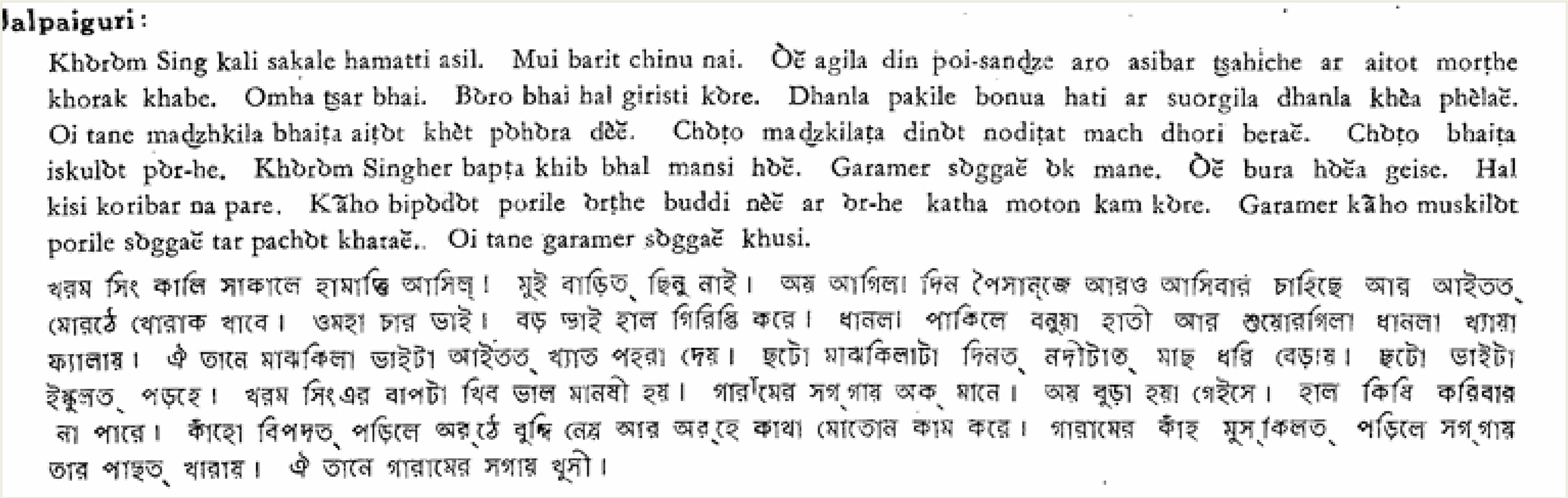
Khorom Sing came to my house yesterday evening. I was not at home. He will come again tomorrow evening and dine with me at night. They are four brothers. The eldest has taken to cultivation. When the paddy ripens, the wild elephants and the boars eat them up. So, the second brother stays in the field at might to watch ova the crop. The third brother catches fish in the river during the day. The youngest is at school. Khorom Sing's father is a very good fellow. Ail the village people respect him. He has grown old. He cannot till the land, with his own hands. If anyone is in difficulty, he seeks advice from him and acts accordingly. If anyone is in trouble the whole village help him. So, the villagers are happy
(Sanyal, 1965, p. 248-49).
Here is the data taken from Coach Behar (Sanyal, 1965)16:

Here is another set of data from Jalpaiguri (Sanyal, 1965)17:

In alignment with the objectives of this study, it can be observed that data collection and translation were limited to specific, selectively chosen locations. A closer examination of these sites reveals a preference for centralised locations, thereby underscoring a key issue addressed in this research: the influence of standard language ideology. According to Rosina Lippi-Green (1997) and Kroskrity (2004), standard language ideology is the belief that one particular variety of the language is the most correct and objectively the best and that forms other than the so-called standard are objectively incorrect and invalid.
It is also important to mention Milroy’s (2001) definition in relation to LSI, where there is a socially constructed belief system that the selection of particular varieties is far from arbitrary. Instead, Milroy (2001) argues that the selection itself contributes to the sustenance of dominant social and political groups in the linguistic realm. In light of the current example, it can be argued that Sanyal’s selection and use of particular varieties of Rajbanshi for translation, following the previous works by Grierson, planted seeds for the future scope of standardisation and prepared ground. In the case of Rajbanshi, selecting varieties from central locations has given speech communities in these areas an advantage in conforming to language norms. These communities have thus become influential in creating and maintaining the standard language ideology.
It has been mentioned earlier that the Rajbanshi community observed a change from the 1960s onwards. There were new schools and new literary magazines that started publishing in their own language and composed poems, essays, and stories of locally relevant themes. Translation from Bangla to Rajbanshi was started, which was not only an assertion of the Rajbanshi linguistic identity but also an effort to differentiate with the domain of Bengali literary identity.
Rajbanshi community members started several efforts to standardise their own language formally after 200018. The North Bengal Academy of Culture was established during 2004-05, centring on the University of North Bengal at Siliguri, the cultural-economic hub of North Bengal. The academy was renamed Rajbanshi Academy later, and they published their journal, ‘Degor,’ which became a major landmark in the history of the standardisation of Rajbanshi. The government supported Rajbanshi Academy, which was established in 2015-1619, in Coach Behar town, where the Coach Behar variety was considered the target variety for projecting the standard Rajbanshi. Shifting the academy's location from an economic hub (Siliguri) to the old literary-cultural hub (Coach Behar) signifies a major transition. A dispute over the language's name became explicit, with two names or labels—Rajbanshi and Kamtapuri—being increasingly used in the public domain. Although tensions over the name had existed for a long time, they came into the spotlight when the centre of standardisation changed its location.
Early literary efforts were made in various locations where local authors and publishers took the initiative to write in Rajbanshi (e.g., the Mainaguri area of Jalpaiguri or the Balurghat area of Dinajpur). The locations were also related to the emerging centres of local political powers, but the present work is not concerned with it. Here, one can observe that the early works on Rajbanshi, like Sanyal, clearly paved the path for the selection of the future standard language. The emergence of a state-owned language academy indicated the direction of the standard language ideology by choosing the Coach Behar variety for translations. However, there were conflicts with other varieties of Rajbanshi, which were evident regarding their use in print culture.
Upon considering the distribution of the Rajbanshi language in India (the language is also spoken in Nepal and Bangladesh), one can find that apart from Cooch Behar and Jalpaiguri (that Sanyal used for translating data), Rajbanshi is also spoken in the Darjeeling foothills, Alipurduar, Dinajpur, Malda area, and also the Assam border of remote Coach Behar, which is far from the Coach Behar town. One should also consider the relationship between standard language ideology and cultural capital in this instance because standard language ideology attributes better prestige to varieties that belong to speech communities having higher cultural capital. In the selection aspect of standardisation, SLI almost always ensures that the selected versions of any language are the versions with some cultural capital. Cooch Behar town area, where the present-day Rajbanshi academy is located as a part of the standardisation drive, was a part of the royal family circle of the area. It was the area where the royal family invited the pandits to reside and contribute to their learnings. It can be conjectured that the Bengali elite administrators/academicians, for obvious reasons, chose the Coach Behar area to project the language data.
6. Language ideologies and translation
As Kroskrity (2010, p.192) mentions, “language ideologies” are the “beliefs, feelings, and conceptions about language structure and use which often index the political-economic interests of individual speakers, ethnic and other interest groups, and nation-states.” Standard language ideology is the ideology of “authenticity” implemented in the language domain where one variant is projected as the standard and acceptable, and other variants are eliminated and projected as the unacceptable and low languages (Lippi-Green, 2012, p. 173). When the idea of standard language is generated, some languages automatically come under the non-standard label. Theories of language standardisation (Haugen, 1996; Milroy, 2001) mention that the language standardisation process can take place without a modern administrative entity. Instead, many instances of language standardisation show how the privileged strata of society continued to manipulate language norms and policies to propagate exclusionary ideologies. These instances often involve the use of translation as well.
During the translation of non-standard language forms, prevailing standard language ideologies often drive the rendition toward a mimicry of the standard, ultimately compromising fidelity to the original. This process inhibits the conveyance of extralinguistic meanings, leading to a translation that lacks both authenticity and contextual accuracy. This erasure of linguistic diversity within translation reinforces dominant language norms, rendering invisible the unique sociocultural identities embedded in non-standard forms. To quote Venuti (1995):
A translated text is judged acceptable by most publishers, reviewers, and readers when it reads fluently when the absence of linguistic or stylistic peculiarities makes it seem transparent... but this fluency also often erases the linguistic and cultural differences of the source text
(Venuti, 1995, p. 1).
Standard language ideology was newly formulated in Bengal's educational, social, and linguistic discourse in the nineteenth century when the codified standard Bangla gained prominence. The process of standardisation of Bengali as a part of colonial codification encouraged members of other communities to mimic the process. At the same time, the variety with authority acted as the target linguistic variety for translation. Rajbanshi was not an exception to this trend, as seen in how the standardisation-related discourses in Rajbanshi demonstrate the dominance of the Bhadralok class within those communities. This nexus between standard language ideology, dominant speech communities, and translation techniques offers some valuable insights as well.
7. The Bhadralok’s interpretation of Rajbanshi and the problem of translation
In the process of selecting and popularising the “preferred” linguistic forms while translating, the Bhadralok class, or the local elites, played a significant role. Bhadralok, the English-educated local elites of the colonial era, promoted standard Bangla as a means of fulfilling their writing aspirations and shaping their spoken discourse. For writing, they codified and popularised Sadhubhasha—the newly codified Sanskritised Bengali containing mainly the tatsama words20—and for speaking purposes, they engineered Chalit bhasha or the Standard Colloquial Bengali, which largely contained tadvaba words21. However, in this process of popularising standard Bangla for both spoken and written communication, non-standard languages (local varieties of Bangla and other regional languages) came under threat. The local elites established linguistic hegemony by promoting standard Bangla as the language of education, culture, discourse, and print, as well as a marker of eliteness and Bhadralok identity. As a result, non-standard languages (which were once well-known through popular oral narratives) lost their prominence in socio-cultural and linguistic discourse, leading non-standard language users to shift to standard Bangla in pursuit of socio-cultural, educational, and linguistic status.
In the case of the translation procedure, the hegemony of standard Bangla over non-standard language users (in this case, the Rajbanshi language) became unavoidable. The Rajbanshi speakers used the recommendations of the elite educated Bengalis as the Bengalis were the model reference community for them. Here, if the ideas of Lung (2000, p. 267) are taken into consideration, translators often “disregard non-standard language” and are highly prone to avoiding the “extra-linguistic information in the original”. They tend to derive their understanding of the non-standard language from the available standard language. In this process, the specificity, regionality, and cultural particularities of the non-standard language are lost. Due to the linguistic hegemony of standard Bangla, the stylistic and semantic particularities of the Rajbanshi language could not be fully preserved. In this regard, Lung (2000) further comments:
When they deal with [the] translation of non-standard usage, they only discuss register and formal as well as informal usage. They do not deal with the function and the social motivation of the relevant non-standard usage. Non-standard usage is a language style that deviates from accepted and recognised norms in a specific speech community
(Lung, 2000, p. 268).
The Bhadralok took on the agency of writing and publishing grammar and dictionaries, strongly influenced by colonial grammar-writing projects. As the Linguistic Survey of India (LSI) served as a significant reference, they adopted the same methods for data collection. Rutten and Vosters (2021) comment on the Dutch language:
Within a few years, these ideas were realised in a series of educational reforms and language laws issued in the first decade of the nineteenth century. This policy immediately resulted in the publication of an orthography and grammar of Dutch meant for use in education and in the administration
(Rutten & Vosters, 2021, p. 71).
Similarly, education reform, as well as the publication of grammar and dictionaries, depended on standard language ideology.
William Jones of the Royal Asiatic Society in London established the Asiatic Society of Calcutta in 1784 to conduct Oriental research. Sanyal’s work was published by the Asiatic Society, creating a path for an elite-dominated philological circle. Thus, as previously discussed, the selection of centres for data collection and translation was primarily limited to central locations rather than remote areas. In other words, the varieties of Rajbanshi chosen for translation were controlled by the Bhadralok, subtly ensuring that the representation of the Rajbanshi language remained as close to standard Bangla as possible.
8. Conclusion
This study has underscored the multi-tangential influence of translation in the context of linguistic data collection and other language documentation purposes. In particular, the influence of standard language ideology on the translation process has been the focus. Considering examples such as the Linguistic Survey of India by Grierson and Sanyal’s work on Rajbanshi, this study has discussed how colonial discourses and post-colonial initiatives for language documentation became fertile ground for standard language ideology.
While language ideologies have been part of public discourses for a long time, some challenges that translation poses provide a more convenient way for these ideologies to integrate. It also becomes clear that the native elites, influenced by the colonial initiatives, adopted the translation method for data collection. As a result, these Bhadralok communities naturally became a part of the standard language ideology. As seen from the case of the Rajbanshi language and speech communities speaking the language, language ideology-based biases continue to impact how community members, as well as outsiders, perceive aspects like correctness and authority. In this process, one can also see a transference of standard language ideology, influencing subsequent standardisation processes as well. The varieties chosen previously by the elites became the natural choice for the selection of standard Rajbanshi.
The case of Rajbanshi is thus a valid example to show the impact of standard language ideology on translation, which is typically considered an apolitical process. It also shows how the involvement of the state can have long-lasting implications for language standardisation, in turn affecting speech communities and their lived experiences. Therefore, avoiding the problematic influence of standard language ideology in translation requires, first, acknowledging the political nature of the translation process and, second, taking conscious measures to ensure that a biased selection does not derail the outcome of data collection.
-
Funding
Not applicable.
-
Image copyright
Not applicable.
-
Approval by ethics committee
Not applicable.
-
Publisher
Cadernos de Tradução is a publication of the Graduate Program in Translation Studies at the Federal University of Santa Catarina. The journal Cadernos de Tradução is hosted by the Portal de Periódicos UFSC. The ideas expressed in this paper are the responsibility of its authors and do not necessarily represent the views of the editors or the university.
-
1
The gatekeepers of languages are the members of some speech community, who have some sort of power and authority. Community members rely on them while representing the community language to outsiders. Often, the gatekeepers are driven by the standard language ideology and promote particular varieties of languages only.
-
2
The census of India in 1921 mentioned 188 languages.
-
3
Bangla has post-verbal negation while Rajbanshi has pre-verbal negation.
-
4
Ranpur is currently located in Bangladesh.
-
5
For details, see Grierson (1903, p. 163). Linguistic Survey of India, Vol. 5, Part I.
-
6
Primarily the philologists of India.
-
7
A number of varieties were marked as varieties of Bangla too, like the varieties of Odia is Baleswar area of present-day Odisha.
-
8
The Bhadralok were educated elites. We shall be talking about them in the article.
-
9
Charu Chandra Sanyal received the prestigious prize named Rabindra Purashkar in the year 1968.
-
10
The first railway network in the northern part of Bengal was in 1862.
-
11
As was found during a field trip in the Rajbanshi area by one author in 206-17 in Northern Bengal.
-
12
Conversation with the editor of Ujani, Mr. Naresh Roy, field notes taken by one of the authors, January 2017.
-
13
See preface (Sanyal, 1965).
-
14
See the preface (Sanyal, 1965, p. 36).
-
15
See Sanyal (1965, p. 36).
-
16
Sanyal (1965) mentioned some texts collected from Jalpaiguri and Coach Behar for demonstrating the variation of language. Transliteration has not been used.
-
17
Sanyal (1965) mentioned some texts collected from Jalpaiguri and Coach Behar for demonstrating the variation of language. Transliteration has not been used.
-
18
Interview with Dipak Kumar Roy, different times in 2024.
-
19
Though there was a preparatory phase for the explicit standardization efforts. It includes codification of words and taking up dictionary projects by the local universities.
-
20
Words which are said to have Sanskrit origins.
-
21
As per Fergusson’s (2006) Diglossia, both Sadhubhasha and Chalit bhasha were included in the circle of the “high” form of the language. While Sadhubhasha was used in the formal domain, Chalit bhasha, a high form of Bengali, was used as the spoken variety of the standard Bangla among the Bhadralok.
Research dataset
Not applicable.
References
-
Alvarez, R., & Vidal, M. C. A. (1999). Translating: A Political Act. In R. Alvarez & M. C. A. Vidal (Eds.), Translation, power, subversion (pp. 1–9). Multilingual Matters. https://doi.org/10.21832/9781800417915-002
» https://doi.org/10.21832/9781800417915-002 -
Baker, M. (2006). Translation and Conflict: A Narrative Account Routledge. https://doi.org/10.4324/9780203099919
» https://doi.org/10.4324/9780203099919 - Bassnett, S. (2014). Translation and Identity Routledge.
- Billiani, F. (2009). Censorship. In M. Baker & G. Saldanha (Eds.), Routledge Encyclopedia of Translation Studies (pp. 28–31). Routledge.
- Bose, S. (2003). Dynamics of a Caste Movement: The Rajbanshis of North Bengal: 1910-1947 Manohar Publishers.
- Chatterji, S. K. (1926). The Origin and Development of Bengali Language Rupa.
- Evans, J., & Fernández, F. (2018). Emancipation, Secret Stories and the Language of Hegemony. In F. Fernández & J. Evans (Eds.), The Routledge Handbook of Translation and Politics (pp. 1–14). Routledge.
-
Grierson, G. A. (1903). Linguistic Survey of India: Vol. II Superintendent of Government Printing, India. https://archive.org/details/in.ernet.dli.2015.62459
» https://archive.org/details/in.ernet.dli.2015.62459 -
Grierson, G. A. (1909). Linguistic Survey of India: Vol. III. Superintendent of Government Printing, India. https://archive.org/details/in.ernet.dli.2015.32103
» https://archive.org/details/in.ernet.dli.2015.32103 -
Haugen, E. (1966). Dialect, Language, Nation. American Anthropologist, 68(4), 922–935. https://doi.org/10.1525/aa.1966.68.4.02a00040
» https://doi.org/10.1525/aa.1966.68.4.02a00040 -
Henderson, D. (2007). Language and Translation. In S. P. Turner & M. W. Risjord (Eds.), Philosophy of Anthropology and Sociology (pp. 607–638). Elsevier. https://doi.org/10.1016/B978-044451542-1/50019-2
» https://doi.org/10.1016/B978-044451542-1/50019-2 - Hermans, T. (1999). Translation in Systems: Descriptive and System-oriented Approaches Explained St. Jerome Publishing.
- Kroskrity, P. V. (2004). Language Ideologies. In A. Duranti (Ed.), A Companion to Linguistic Anthropology (pp. 496–517). Blackwell.
- Kroskrity, P. V. (2010). Language Ideologies: Evolving Perspectives. In P. V. Kroskrity (Ed.), Regimes of Language: Ideologies, Polities, and Identities (pp. 1–34). SAR Press.
- Lippi-Green, R. (1997). English with an Accent: Language, Ideology, and Discrimination in the United States Routledge.
- Lippi-Green, R. (2012). English with an Accent: Language, Ideology, and Discrimination in the United States 2nd. ed. Taylor & Francis.
-
Lung, R. (2000). Non-standard Language in Translation. Perspectives, 8(4), 267–274. https://doi.org/10.1080/0907676X.2000.9961395
» https://doi.org/10.1080/0907676X.2000.9961395 -
Milroy, J. (2001). Language Ideologies and the Consequences of Standardisation. Journal of Sociolinguistics, 5(4), 530–555. https://doi.org/10.1111/1467-9481.00163
» https://doi.org/10.1111/1467-9481.00163 - Sanyal, C. C. (1965). The Rajbanshis of North Bengal The Asiatic Society.
- Singh, K. S. (1998). India’s Communities: Anthropological Survey of India Vol. 6. Oxford University Press.
- Venuti, L. (1995). The Translator’s Invisibility: A History of Translation Routledge.
Edited by
-
Guest editor
Umarani Pappuswamy
-
Section editors
Andréia Guerini – Willian Moura
-
Technical editing
Alice S. Rezende – Ingrid Bignardi – João G. P. Silveira – Kamila Oliveira

 Source:
  Source: