
 Analysis of patterns of violence against women in Brazil: an unsupervised machine learning approach
Analyze patterns of association between diagnoses related to domestic violence in hospital admissions and identify clinical-demographic profiles using unsupervised machine learning. Data from the SUS Hospital Information System between 2008 and 2023 were used, covering 90,798 hospitalizations of women aged 20 to 59 years with ICD-10 codes related to violence. Frameworks for data preparation were applied, as well as algorithms for identifying association rules between diagnoses and topic modeling. The hospitalization rate stabilized after 2012, with an average between 2.6 and 3.2 per 100,000 women. States such as São Paulo, Bahia, and Minas Gerais accounted for 46% of absolute cases; Rio Grande do Norte and Pará presented the highest proportional rates. The algorithm identified significant rules between types of injury and mechanisms of aggression. Latent Dirichlet Allocation modeling revealed nine distinct profiles, highlighting young women undergoing emergency surgeries due to polytrauma. The use of machine learning identified relevant clinical-epidemiological patterns to support prediction and surveillance strategies in Primary Care, contributing to addressing gender-based violence.
Key words:
Violence Against Women; Hospital Information Systems; Machine Learning; Artificial Intelligence
 Thumbnail
 Thumbnail
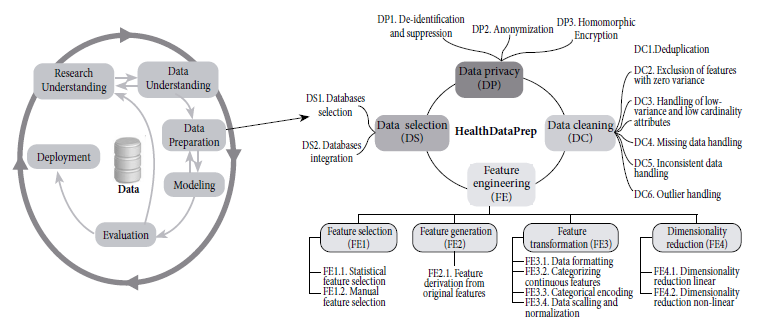 Source: Shimaoka et al.
 Source: Authors, 2025.