
 Assessment of professional training on the topic of accidents and violence in the Unified Health System
Abstract
Accidents and violence are complex topics and require professional training. We evaluated how the training of SUS professionals on accidents and violence is implemented at different levels: primary care, pre-hospital, hospital, and rehabilitation care. The quantitative data from 531 questionnaires on nine evaluative indicators and qualitative data from 63 interviews derive from evaluative research on implementing the national policy to reduce morbimortality from accidents and violence. Data were analyzed with specific methods and worked on through triangulated methods. Capitals and cities with 100,000 or more inhabitants in the Brazilian regions showed the best results regarding training their professionals. Primary care invested more than other levels in this guideline. Training for prevention and health promotion actions to care for victims and monitor violence and accidents occurs more on the professionals’ initiative than on institutional policy. We conclude that there is a need to strengthen partnerships with educational institutions since graduation and reinforce the institutionalization of ongoing training on the two topics in question.
Key words:
Accidents; Violence; Assessment; Continuing education; Professional training
Resumo
Acidentes e violências são temas complexos e demandam formação profissional. Avalia-se como a formação dos profissionais do SUS sobre acidentes e violências está sendo implementada nos diferentes níveis: atenção primária, pré-hospitalar, hospitalar e reabilitação. Os dados quantitativos de 531 questionários sobre nove indicadores avaliativos, e qualitativos por meio de 63 entrevistas, provêm de uma pesquisa avaliativa sobre a implementação da política nacional de redução da morbimortalidade por acidentes e violência. Os dados foram analisados com métodos específicos e trabalhados por meio da triangulação de métodos. As capitais e cidades com 100 mil ou mais habitantes das regiões do país mostraram os melhores resultados quanto à formação dos seus profissionais. A atenção primária investiu mais do que os outros níveis nessa diretriz. A formação para ações de prevenção e de promoção à saúde para atender às vítimas e para monitorar a violência e os acidentes ocorrem mais por iniciativa individual dos profissionais do que por política institucional. Conclui-se que há necessidade de fortalecer parcerias com instituições de ensino desde a graduação e de reforçar a institucionalização da formação permanente sobre os dois temas em pauta.
Palavras-chave:
Acidentes; Violência; Avaliação; Educação permanente; Formação profissional
Resumen
Los accidentes y la violencia son temas complejos que requieren formación profesional. Evaluamos cómo se implementa la formación de los profesionales del SUS en materia de accidentes y violencia en diferentes niveles: atención primaria, prehospitalaria, hospitalaria y rehabilitación. Los datos cuantitativos de 531 cuestionarios sobre nueve indicadores evaluativos y los datos cualitativos de 63 entrevistas provienen de una investigación evaluativa sobre la implementación de la política nacional para reducir la morbimortalidad por accidentes y violencia. Los datos se analizaron con métodos específicos y se procesaron mediante métodos triangulados. Las capitales y ciudades con 100.000 o más habitantes en las regiones brasileñas mostraron los mejores resultados en la formación de sus profesionales. La atención primaria invirtió más que otros niveles en esta directriz. La formación en acciones de prevención y promoción de la salud para la atención a las víctimas y el monitoreo de la violencia y los accidentes se basa más en la iniciativa de los profesionales que en las políticas institucionales. Concluimos que es necesario fortalecer las alianzas con las instituciones educativas desde la graduación y reforzar la institucionalización de la formación continua en ambos temas.
Palabras clave:
Accidentes; Violencia; Evaluación; Educación continua; Formación profesional
Introduction
Continuing health education (EPS) is a political-pedagogical strategy based on issues and demands in the health work context. Several authors highlight it as a crucial action for professional qualification and improvement of the health work process1,2. EPS integrates teaching, service, management, and social control. It aims to improve professional practices in responding to the population’s care demands2.
The training of health professionals and the care of accident and violence victims are guidelines of the National Policy for Reducing Morbimortality from Accidents and Violence/PNRMAV3. The guideline human resources training concerns providing theoretical, technical, and sociopolitical knowledge to ensure humanized care, qualified listening, and support for victims. It is also essential to support surveillance, prevention, health promotion, peace culture, and organization of services for comprehensive care for people in situations of violence3. Professional training can occur within formal and non-formal education, such as specific actions to update protocols and service flows.
The training guidelines prioritize including subjects on accidents and violence in technical and higher education health courses. Some studies assess that EPS faces significant barriers to its implementation due to the incipient coordination with Education, the reduced funding for learning activities, and the mismatch between the needs of the SUS and the training of professionals to work in such challenging contexts that simultaneously address injuries, traumas, and cultural issues2.
Regarding care provided in cases of accidents and violence, many unprepared professionals experience anguish when victims arrive at health services. Difficulties range from identifying a suspected or confirmed situation of violence to notifying and referring patients to other services in the protection network4-6.
The magnitude of the demands generated by injuries and traumas resulting from accidents and violence in the Brazilian health system highlights the need for human resources prepared to address care complexity. Many cases are of minor severity and treated at the primary care (PC) level. However, more severe injuries require highly complex care. In 2023 alone, approximately 1.5 million hospitalization authorizations to treat accidents and violence were recorded in the Unified Health System (SUS), 11.1% of the total hospitalizations for all causes in Brazil7.
Given this context, this article investigates how the training process on care for victims of accidents and violence is being implemented at the following healthcare levels: primary care (PC), pre-hospital and hospital care (PHC/HC), and rehabilitation care (RC) in the SUS.
Methods
This article analyzes the implementation of one PNRMAV guideline, which is training human training on accidents and violence, based on information from a larger survey that evaluated the aforementioned policy from 2020 to 2023.
The original study adopted the theoretical frameworks of evaluative research8-13 to analyze the PNRMAV implementation process12-14. It was based on points recommended by those who worked with evaluative research and aimed to understand and explain (a) what contributes to the successful implementation of programs, projects, and services where they were successful; (b) the factors and resistance that hinder implementation in places where it occurs slowly or does not occur at all; and (c) the limitations of the policy toward its entire validity. The evaluation’s strategic objective was to support best practices and course adjustments15, supported by the stakeholders’ views. The more extensive study also highlighted lessons learned from current or past experiences12,16.
The analysis used triangulation of methods16-20, which promotes a complementary dialogue between quantitative and qualitative approaches, different data collection techniques, and the perspective of stakeholders who, in this case, were involved in implementing the policy, considered as self-evaluating subjects16. Managers from all Brazilian municipalities were invited to participate in the survey. The quantitative data was derived from 531 self-assessment questionnaires, answered via the Redcap platform by SUS managers and professionals, 290 of whom were PC workers, 128 from PHC/HC, and 113 from RC, covering 379 Brazilian municipalities, including the capitals.
The following topics were analyzed in the questionnaires regarding the training of human resources to treat and care for accident and violence victims: existence of a municipal support policy; the release of professionals for training; types, and frequency of the two topics addressed in EPS actions; and partnerships of the municipal health management for the training of its professionals. The analysis considered all participating municipalities and capitals.
Based on previous studies21,22 and discussions with a group of experts, composed of a team of researchers and technicians from the Ministry of Health (MS) with extensive experience in the topics evaluated, relevant questions were identified for the questionnaires for each healthcare level to develop and calculate evaluation indicators. The following topics were highlighted among these questions: training for health promotion and prevention of accidents and violence; training for the care and assistance to people who have suffered injuries and trauma; training for monitoring accident and violence cases that reach health services; and training in advanced life support for people who have suffered trauma (Advanced Trauma Life Support - ATLS). The quantitative evaluation of this guideline consisted of nine indicators (3 for PC, 4 for PHC/HC, and 2 for RC), and the construction procedure is shown in Chart 1.
The indicators’ analysis classified the guidelines’ performance and implementation as good, fair, and poor. The qualitative data was derived from the responses to an open-ended question in the questionnaire about the managers’ perception of the best or worst policy guidelines implemented in the municipality and the reasons for this assessment, and from 63 interviews with managers at the federal level and from representative bodies of health secretaries in the country, managers, and professionals who operate PNRMAV actions at the municipal and state levels in violence prevention and protection centers and networks, and surveillance services on the subject.
The Ministry of Health and the state and municipal health secretaries appointed the respondents. Most people interviewed were female in all 26 state capitals and the Federal District (DF). In addition to the state capitals, ten cities were included in this study stage, two in each region, selected by population size (small and large) and performance in assessing the composite indicator on the guideline in question. In order to select them, the scores obtained for each care level and the performance in the guideline studied (good, fair, or poor) were added together. The selected city was replaced by another with similar characteristics when it refused to participate in the survey.
Fourteen of the 63 interviews were held in the North, 19 in the Northeast, 12 in the Southeast, 10 in the South, and five in the Midwest. The following were also interviewed: one representative of the Ministry of Health, one of the state secretaries, and one of the municipal secretaries. For this article, two questions from the roadmap were analyzed: one about providing training on accidents and the other about violence. The interviews were conducted remotely in 2022 (given the unavailability of face-to-face meetings during COVID-19) and recorded through the Google Meet platform. The audios were transcribed and reviewed by experts and lasted an average of one hour each. We adopted thematic content analysis23, including organizing the collected material, performing the analytical description of the research corpus, and interpreting based on the theoretical references adopted24.
The Sergio Arouca National School of Public Health (Fiocruz) Research Ethics Committee approved the research under Opinion nº 4.732.884 of May 25, 2021. All participants signed the Informed Consent Registry (RCLE) they received via email.
Results
In total, 49.6% of PC managers, 35.6% of HC managers, and 55.6% of RC managers reported the availability of a municipal policy to release or support professionals to undertake accident and violence training in all the municipalities studied. These percentages were higher in the capitals: 64.7% in PC and 66.7% in HC and RC (data not shown in table).
PC has a scenario of greater release for training professionals in cities with larger populations (100,000 or more inhabitants) in all Brazilian regions, reaching 44.4% in the North, 71.4% in the Northeast, 76.2% in the Southeast, and 83.3% in the South and the Midwest (data not shown in the table). In general, in RC, larger municipalities reported more releases of professionals for training than smaller ones in the regions, except for in the Northeast. EPS actions on health promotion and prevention of accidents and violence offered to health professionals and other areas, by care level, are shown below (data not shown in table):
In PC, 65.9% of municipalities reported holding EPS actions on the topics on the agenda for health and 47.3% for other sectors, seeking networking. These percentages rose to 94.1% and 64.7% in the capitals. The training of PC teams on the topic in 49.5% of the total municipalities - not the capitals - is aimed at health teams and 38.6% other workers (receptionists, drivers, typists, and professionals from other areas). Capitals invest more in the training of health teams (76.5%) and less in other workers (29.4%);
In HC, 56.2% of the municipalities surveyed were involved in EPS actions for the health sector, and 34.6% were for professionals from other areas. These percentages reached 83.3% and 66.7% in the capitals, respectively. In the municipalities, training on these topics for health professionals was reported by 45.6% of them, and for other workers in the sector, and others by 39.4%. In the capitals, a good level of investment was observed in the training of teams (100%) and for other workers from other sectors (80%). In the Brazilian regions, training actions on the topic under discussion in hospital care predominated in the larger municipalities;
In RC, 65.3% of municipalities reported EPS actions for health and 51.5% for professionals in other areas; in the capitals, these percentages rose to 100.0% and 83.3%, respectively.
Most municipalities and capitals participating in the survey responded that some EPS action conducted regarding care for accident and violence cases at least once a year extended to health professionals, social assistance, education, and non-governmental organizations at the three care levels. The interviews showed that one of the main actions was to improve the completion of the violence notification form, and training was also provided to the typists of this form. Regarding accidents, the respondents mentioned training actions in partnership with traffic authorities, encouraged by the Vida no Trânsito (Life in Traffic) Program (PVT). The following excerpts show the efforts to train the teams:
The city is investing heavily in this field, which is privileged for training residents. The idea is that they can work in this network in the future (Primary Care, Rio de Janeiro/RJ).
We have conducted training activities on violence, for example, involving community stakeholders. If we can invest and create strategies like this, we can directly impact the issue of violence (Primary Care, Porto Alegre/RS).
The training of PC professionals in accidents and violence relies mainly on the workers’ initiative in the municipalities and capitals. Short-term courses (41.4% in the municipalities and 52.9% in the capitals) are the most common course offered by the institution or in partnership with an educational or research institution. In most cases, management supports the individual initiative of professionals for advanced training, specialization, master’s, and doctoral courses. In the PHC/HC of the studied municipalities, most professionals’ responses showed the incentive for training on the topics in question. However, professionals receive institutional support if they decide to take a course. In the capitals, half of the respondents stated that short-term courses are facilitated when taken on their initiative or through an agreement; the initiative for stricto sensu courses, in general, stems from the very professionals. RC is the system level that showed the least investment in training professionals in the municipalities and the capitals. Short-term courses were mentioned by 32% of the respondents in all municipalities and 50% of the capitals (Table 1).
The interview reports corroborate the information that most professionals take the initiative to improve their training, particularly at PC and RC levels, as shown in the following excerpt.
Our working group includes undergraduate, graduate, and multidisciplinary residency students but is an independent group. We come from an activism within [the field of prevention] of violence. It is not linked to the services, although our managers allow us to be there during working hours. We have almost no institutional support (Respondent Surveillance - Santa Maria/RS).
Regarding EPS actions and the types of accidents and violence addressed, 43.5% of the municipalities investigated reported the existence of this type of activity in PC to assist accident victims and 46.4% for violence victims. These percentages are higher in the capitals, 58.8% and 64.7%, respectively (data not shown in the table).
Regarding HC, we found percentages above 80% of responding managers from all cities and capitals who stated that they raise awareness among SUS professionals, train them to record and systematize cases and improve the quality of information for epidemiological surveillance of accidents. As for training for assistance in cases of violence, the percentages reached 90% of the municipalities studied and were even higher in the capitals: here, all respondents said they developed actions to raise awareness among professionals, 80% addressed the importance of records, and 80% said they invested in improving information. In RC, 22.4% of respondents from the municipalities studied reported providing training for monitoring accidents and 33.3% for violence. In the capitals, these percentages rise to 33.3% for accidents and 83.3% for violence. In the regions, larger cities had higher rates of violence monitoring training: 36.7% of respondents from all municipalities and 50.0% of the capitals investigated. The frequency with which RC professionals directly involved in assisting accident victims receive training activities is at least once a year in 77.1% of the municipalities studied, and this action is extended to other professionals in 76.5% of them (data not shown in the table).
Table 2 shows the main types of accidents addressed in EPS actions with greater (at least once a year) and lesser frequency at the three care levels. Higher percentages of training activities at least once a year are observed in the PC and HC of the capitals compared to the municipalities’ total. However, a high percentage of accidents was never addressed in EPS. It was noteworthy, for example, that only 52.0% of the capitals and 51.5% of the municipalities reported transport accidents and falls, respectively, as objects of EPS in RC at least once a year. However, it is likely that victims of these events are the majority of users who reach rehabilitation services. Equally troubling is the information that 32.7% of all municipalities and 39.8% of capitals have never offered training on transport accidents and falls for professionals working in rehabilitation. The percentages of capitals reporting training for addressing these types of accidents are much higher in PC and HC, which suggests that they are adequately better served than those working in RC.
Several types of violence are addressed in the EPS of several municipalities once a year at all care levels. This pattern is higher in the capitals. However, we should underscore the considerable percentage of municipalities that have never addressed the incidence of violence and accidents in the continuing education of professionals (Table 3).
In interviews with PC professionals, notifying violent events was reported as the most discussed topic in training across geographic regions. Several respondents reported that states and municipalities have invested in correctly completing the reporting form for interpersonal and self-inflicted violence, with special attention to the most vulnerable populations (older adults, children, women, LGBTQIA+, and Black and Indigenous people). The respondents also highlighted a variety of violence-related training topics, such as care for self-harm victims, sexual violence against children and adolescents; diagnosis and action in the face of child labor exploitation; care humanization, reception, assistance, and referral in the SUS; care line for violence victims; legal abortion; monitoring and follow-up of cases; and support networks. Regarding accidents, training to address injuries and work accidents was mentioned.
At PHC/HC level, the main topics covered were prevention and care for trauma caused by traffic accidents and others; identification and reporting of cases of domestic and sexual violence against women and referrals to services such as shelters; approach to sexual violence against children, young people and women; and legal abortion. In RC, the leading training topics were related to accidents, such as the Prohibition Law, speed limits, and victimization of motorcyclists.
Establishing partnerships between municipal health management for training on accidents and violence with educational, research, and extension institutions is rare, with less than 10% in all surveyed municipalities. University extension that would contribute to covering undergraduate students in a wide range of activities at the three care levels for accident and violence victims also shows a low percentage in the capitals: one-third in PC, PHC, and AH, and 28.6% in RC (data not shown in the table).
The qualitative data highlight that established partnerships occurred with Federal and State Universities, Public Health Schools, SUS Technical Schools, Open University of the Unified Health System (UNASUS), the State Department of Traffic (DETRAN), the Fire Department, the Federal Highway Police (PRF), the Traffic Battalion, Civil Police and Military Police (PM), the Mobile Emergency Care Service (SAMU), the Forensic Medical Institute (IML), the Women’s Care Network, the State Secretariats of Public Security, Education, Women and Diversity, and Social Assistance, the Public Prosecutor’s Office, the Public Defender’s Office, and Civil Society Organizations.
The interview information also shows that training in violence and health has been a significant demand among SUS professionals. The following were cited as very important: the distance learning course “Impacts of Violence on Health”, promoted by the Oswaldo Cruz Foundation (FIOCRUZ) in partnership with the Ministry of Health; the courses offered by the Laboratory of Child Studies (LACRI) and the Center for Violence Studies (NEV), both from the University of São Paulo (USP); the Epidemiological Research Program on Family Violence (PIEVF) offered by the State University of Rio de Janeiro (UERJ); and courses offered on these topics at the Federal Universities of Goiás and Minas Gerais.
Human resources training guideline evaluation indicators
The indicator that summarizes the implementation of the guideline on Human Resource Training shows weak results. We observed poor performance of this guideline at all care levels and for all municipalities investigated, especially at the PHC/HC (55.6%) and RC (52%) levels. Compared to the other levels, despite having a low percentage, Primary Care shows a slightly better performance in the summary indicator on the training of professionals for the topic in question (Graph 1).
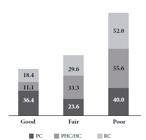
Summary indicator of the assessment of the PNRMAV human resources training guideline implementation by healthcare level.
The evaluation shows better results in Brazilian capitals: 64.7% of PC, 50% of PHC/HC, and 33.3% of RC. Only 23.5% of PC, 16.7% of RC, and zero percent of PHC/HC were classified as poor regarding implementing the guideline (data not shown in the graph).
In the open-ended question of the questionnaire, the PC participants had the best evaluation of the guideline, as it is the level with more investment in the performance, training, and qualification of professionals in the two topics in question. Respondents said that the poor performance of some municipalities in this guideline can be attributed to the difficulty in accessing training opportunities, especially for those working in remote areas, where courses are unavailable and educational institutions are physically distant. Notably, the COVID-19 pandemic prevented in-person training events; it hindered the recruitment of professionals and accentuated the lack of qualified people to serve groups victimized by accidents and violence.
The respondents highlighted that the worst performance found at the PHC/HC level might be associated with the lack of interest and availability of professionals for training, the lack of human resources to conduct the EPS, and the low dissemination and limited supply of courses. They also highlighted the need for specialized teachers, government support for training, and the renewal of teams through public competitions. Although some managers have argued that the PHC/HC level has training on accidents and that they hire specialists for ongoing training, the frequent turnover of care teams was reflected in the summary indicator of the implementation of the evaluated guideline.
Regarding the implementation of the guideline at the rehabilitation level, the participants reported that there was mostly no investment in specific courses and training to address trauma and injuries caused by violence and accidents in the municipalities. However, the professionals said that investing in training to care for and monitor patients is one of the best forms of prevention. At the same time, they pointed out difficulties such as lack of time and a shortage of human resources and financial incentives to conduct courses.
Discussion
The human resources training guideline was assessed by the indicators of this research as being largely incipient at all care levels, reiterating the many persistent difficulties in the PNRMAV’s internalization in the SUS.
The quantitative approach to training SUS professionals for the topics under discussion shows that, in percentage terms, the capitals and the larger municipalities in the different Brazilian regions stood out positively in most of the items surveyed, probably because they had more significant support from training institutions. The data also indicate that the PC level has invested the most in the EPS of its professionals and other sectors.
At all care levels, training occurs mainly at the initiative of professionals rather than through encouragement from the institutions where they work, corroborated by quantitative and qualitative data. Although it occurs infrequently, all municipalities and capitals are linked to some universities and educational institutions that support them with courses and operational research.
The lack of support for ongoing training at all care levels is particularly acute in small municipalities, especially regarding hospital and rehabilitation care. One of the most significant challenges is the high turnover of workers in these sectors and the lack of adequate infrastructure for developing activities25.
However, much of the responsibility for this gap must undoubtedly be shared with universities and research centers, which need to get closer to services, make their studies more strategic, and promote the consolidation of the PNRMAV as a broad strategic action of the SUS in favor of life and human rights. This approach, through extension and research actions, is promising and can favor the autonomy of health professionals vis-à-vis challenging issues such as accidents and violence2.
The respondents explained other difficulties in conducting consolidating training that guides them in caring for accident and violence victims, which is the case of resistance from professionals regarding the topic, the absence of doctors in training activities offered to health professionals, which implies a discontinuous comprehensive care process, threats and retaliation against health professionals when they report cases, and machismo rooted in social gender relationships reproduced in care and work relationships.
Although training for reporting violence and accidents is the action most frequently reported by managers and professionals, there is resistance to offering or taking the courses. A study with health professionals in PC indicates that they continue to feel unprepared to notify, even recognizing it as one of their tasks26. Notably, although the EPS contributes to improving care and records of cases of violence treated in the SUS, adherence to the existing notification system in the country is below the desired27,28, which indicates the need for more training investments. The professional training gap begins in undergraduate courses, which generally do not address the topic of violence and accidents as social issues that affect health. There is little in-depth analysis of the complexity of these events, which results in the lack of a “comprehensive, emancipatory, and intersectoral perspective” with direct repercussions on healthcare27.
Intersectorality is discussed at several points in this study and needs to be considered in the training and work of the health sector28, as does intrasectorality29. Both require coordination between services at the same level and between different bodies for the care of people who suffer accidents and violence. The research showed the sector’s colossal difficulty in ensuring that victims of these events are cared for, partly due to training deficiencies.
A study by Minayo and Deslandes21 investigated the implementation of the PNRMAV in five capitals of Brazil and found that the training of human resources received little investment and, when available, was through short courses. The current research shows that this type of support remains far below what is needed, although there is a greater supply of specialization, master’s and doctorate degrees, and distance learning courses, which has been taken advantage of by the efforts of professionals, some institutions, and encouragement from the Ministry of Health.
Some assertions remain fifteen years after the first assessment21. One of them is that, although accidents and violence are among the leading causes of death in Brazil, in the hegemonic medical view that predominates in the SUS, these are public safety issues, and the health sector is only responsible for treating injuries and traumas. Resistance to addressing violence, especially in the SUS, is manifested in the lack of priority for victim care and reduced investment in training professionals30, the lack of standards and protocols, and poor communication with society, which is partly due to biomedical hegemony. Thus, violence and accidents are absent from the curriculum of undergraduate courses in the areas that make up the health sciences despite going against the PNRMAV’s recommendations3. The knowledge gaps from institutions that train in the health sciences affect the routine of health units27,31,32.
As a strategy for training professionals, EPS requires political will and financial, organizational, and human resource investments for its implementation33. This study’s findings reinforce the need for investment in SUS workers through comprehensive, dialogical, and emancipatory education34, which depends on investment and expansion of training and updating processes for service health teams with continuous, systematic, and participatory work27.
This article has several limitations. The main one is that it is nested in a study conducted during the COVID-19 pandemic. This epidemic affected the training initiatives for health professionals whose routines were changed to address a public health emergency. It prevented them from participating in and developing the study, which was almost impossible. Therefore, the data presented are not statistically representative of what happens in Brazilian municipalities and services regarding the demands and care for victims of accidents and violence. However, the new information presented here can contribute to the reflection of managers to invest in the training of professionals at different care levels.
References
- 1 Tesser CD, Garcia AV, Vendruscolo C, Argenta CE. Estratégia saúde da família e análise da realidade social: subsídios para políticas de promoção da saúde e educação permanente. Cien Saude Colet 2011; 16(11):4295-4306.
- 2 Silva CBG, Scherer MDA. A implementação da Política Nacional de Educação Permanente em Saúde na visão de atores que a constroem. Interface (Botucatu) 2020; 24:e190840.
- 3 Brasil. Ministério da Saúde (MS). Portaria MS/GM nº 737, de 16 de maio de 2001. Política nacional de redução da morbimortalidade por acidentes e violências. Diário Oficial da União; 2001; 17 maio.
- 4 Santos JPB, Lima RRT. Permanent health education to qualify the reception of women victims of violence: debating a proposal. Res Soc Dev 2020; 9(1):e173911859.
- 5 Souza MAR, Peres AM, Mafioletti TM. Educação permanente na rede de atenção às mulheres em situação de violência. Rev Enferm Ref 2020; 5(2):1-9.
- 6 Souza MAR, Peres AM, Wall ML, Haddad MCFL, Sade PMC, Lowen IMV, Zangão MOB. Care for women in situations of violence: construction of a model of permanent health education. Rev Gaucha Enferm 2022; 43:e20210203.
-
7 Brasil. Ministério da Saúde (MS). DATASUS. Morbidade Hospitalar do SUS [Internet]. [acessado 2024 set 19]. Disponível em: https://datasus.saude.gov.br/acesso-a-informacao/morbidade-hospitalar-do-sus-sih-sus
» https://datasus.saude.gov.br/acesso-a-informacao/morbidade-hospitalar-do-sus-sih-sus - 8 Braverman MT, Engle M, Arnold MA, Rennekemp R, editors. Program evaluation in a complex organizational system: lessons from cooperative extension, new directions for evaluation. Washington, D.C. American Evaluation Association Edition; 2008.
- 9 Contandriopoulos A, Champagne F, Denis J, Pineault R. Avaliação na área de saúde: conceitos e métodos. In: Hartz ZMA, editor. Avaliação em saúde: dos modelos conceituais à prática na análise da implantação de programas. Rio de Janeiro: Fiocruz; 1997. p. 29-48.
- 10 Contandriopoulos AP. Avaliando a institucionalização da avaliação. Cien Saude Colet 2006; 11(3):705-711.
- 11 Scriven M. Evaluation in the new millennium: the transdisciplinarity vision. In: Donaldson P, Steward I, Scriven M, editors. Evaluating social programs and problems: visions for a new millennium. New Jersey: Lawrence Earlbaum Associates Publishers; 2005. p. 1-30.
- 12 United Kingdom Government. Guide for Process Evaluation. London: UK; 2018.
- 13 Worthen BR, Sanders JR, Fitzpatrick JL. Avaliação de programas sociais. São Paulo: Instituto Fonte, Ed. Gente; 2004.
- 14 Zucker LG. The role of institutionalization in cultural persistence. P. 83-107. In: Powell WW, Dimaggio PJ, editors. The new institutionalism in organizational analysis. Chicago: The University of Chicago Press; 1991.
- 15 Donabedian A. The seven pillars of quality. Arch Pathol Lab Med 1990; 114(11):1115-1118.
- 16 Minayo MCS, Assis SG, Souza ER, organizadoras. Avaliação por triangulação de métodos - avaliação de programas sociais. Rio de Janeiro: Editora Fiocruz; 2005.
- 17 Denzin NK. The research act. Chicago: Aldine Publishing Company; 1973.
- 18 Minayo MCS, Sanchez O. Quantitativo-qualitativo: oposição ou complementaridade? Cad Saude Publica 1993; 9(3):239-262.
- 19 Minayo MCS, Cruz Neto O. Triangulación de métodos en la evaluación de programas y servicios de salud. In: Bronfman M, Castro R, organizadores. Salud, cambio social y política: perspectivas desde América Latina. México: Edamex; 1999. p. 65-80.
- 20 Hartz ZA. Institucionalizing the evaluation of health programs and policies in France: cuisine internationales over fast food and sur mesure over ready-made. Cad Saude Publica 1999; 15(2):229-260.
- 21 Minayo MCS, Deslandes SF, organizadoras. Análise diagnóstica da política nacional de saúde para redução de acidentes e violências. Rio de Janeiro: Editora Fiocruz; 2007.
- 22 Souza ER, organizadora. Avaliação dos núcleos de prevenção à violência e promoção da saúde do Brasil frente à política de redução de morbimortalidade por acidentes e violências. Rio de Janeiro: Claves/ENSP/Fiocruz; 2012.
- 23 Bardin L. Análise de conteúdo. São Paulo: Edições 70; 2011.
- 24 Triviños ANS. Introdução à pesquisa em ciências sociais: a pesquisa qualitativa em educação. São Paulo: Atlas; 1987.
- 25 Adamy EK, Zocche DAA, Vendruscolo C, Metelski FK, Argenta C, Valentini JS. Tecendo a educação permanente em saúde no contexto hospitalar: relato de experiência. Rev Enferm Centro-Oeste Mineiro 2018; 8:e1924.
- 26 Cruz NPS, Silva MC, Santos HL, Oliveira CM. Preenchimento da ficha de notificação compulsória de violência interpessoal e autoprovocada: desafios enfrentados pelo profissional de saúde. HumanÆ 2019; 13(2):1-16.
- 27 Moreira GAR, Freitas KM, Cavalcanti LF, Vieira LJES, Silva RM. Qualificação de profissionais da saúde para a atenção às mulheres em situação de violência sexual. Trab Educ Saude 2018; 16(3):1039-1055.
- 28 Couto VA, Rocha RLS, Ribeiro LML, Silveira AM. Intersetorialidade e ações de combate à violência contra a mulher. Rev Estud Fem 2018; 26(2):e45859.
- 29 Brasil. Ministério da Saúde (MS). Portaria nº 2.446/GM/MS, de 11 de novembro de 2014. Redefine a Política Nacional de Promoção da Saúde (PNPS). Diário Oficial da União 2014; 12 nov.
- 30 Minayo MCS, Souza ER, Silva MMA, Assis SG. Institucionalização do tema da violência no SUS: avanços e desafios. Cien Saude Colet 2018; 23(6):2007-2016.
- 31 Minayo MCS, Souza ER, Assis SG. É preciso retomar com força a Política Nacional de Redução da Morbimortalidade por Acidentes e Violência (PNRMAV). Cien Saude Colet 2023; 28(6):1598.
- 32 Freire P. Pedagogia da autonomia: saberes necessários à prática educativa. São Paulo: Paz e Terra; 2006.

 Source: Authors.