
 Determinants of inequality in access to mammography: evidence from ELSI-Brazil
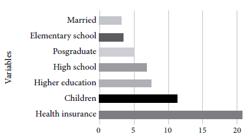
Brazilian women’s widespread mammography access is a challenge for public health. Social determinants of health have been analyzed to try to explain the channels responsible for differences in access to breast cancer screening. This study investigates the difference in mammography performance between white and yellow (WY) and black, brown and indigenous (BBI) women based on socioeconomic indicators available in the Longitudinal Study of Brazilian Elderly Health (ELSI-Brazil) and the use of the decomposition for nonlinear models. The results indicate that mammography probability is 10.24 percentage points higher among WY. The difference in explanatory variables composition contributes 57.8% to the total difference. Which means that if BBI had the same composition of explanatory variables (such as health insurance, education, marital status, number of children) as WY the probability of having a mammogram would be 5.92 percentage points higher. In addition to the characteristics related to the public health system, there is a need for public policies that address the physical, mental and emotional well-being of women, especially those who need them most, with a view to reducing inequalities in access to mammography.
Key words:
Mammography; Breast cancer; Inequality; Access; Differential
 Thumbnail
 Source: Authors, 2024, with data from ELSI-BRAZIL.