
 Determinants of inequality in access to mammography: evidence from ELSI-Brazil
Abstract
Brazilian women’s widespread mammography access is a challenge for public health. Social determinants of health have been analyzed to try to explain the channels responsible for differences in access to breast cancer screening. This study investigates the difference in mammography performance between white and yellow (WY) and black, brown and indigenous (BBI) women based on socioeconomic indicators available in the Longitudinal Study of Brazilian Elderly Health (ELSI-Brazil) and the use of the decomposition for nonlinear models. The results indicate that mammography probability is 10.24 percentage points higher among WY. The difference in explanatory variables composition contributes 57.8% to the total difference. Which means that if BBI had the same composition of explanatory variables (such as health insurance, education, marital status, number of children) as WY the probability of having a mammogram would be 5.92 percentage points higher. In addition to the characteristics related to the public health system, there is a need for public policies that address the physical, mental and emotional well-being of women, especially those who need them most, with a view to reducing inequalities in access to mammography.
Key words:
Mammography; Breast cancer; Inequality; Access; Differential
Resumo
O amplo acesso das mulheres brasileiras à mamografia é um desafio para a saúde pública. Os determinantes sociais da saúde têm sido analisados para tentar explicar os canais responsáveis pelas diferenças no acesso ao rastreamento do câncer da mama. Este estudo investiga a diferença no acesso à mamografia entre mulheres brancas e amarelas (WY) e pretas, pardas e indígenas (BBI) com base em indicadores socioeconômicos disponíveis no Estudo Longitudinal da Saúde dos Idosos Brasileiros (ELSI-Brasil) e no uso de decomposição para modelos não lineares. Os resultados indicam que a probabilidade da mamografia é 10,24 pontos percentuais maior entre os WY. A diferença na composição das variáveis explicativas contribui com 57,8% para a diferença total. Isso significa que se o BBI tivesse a mesma composição de variáveis explicativas (como plano de saúde, escolaridade, estado civil, número de filhos) que o WY a probabilidade de fazer mamografia seria 5,92 pontos percentuais maior. Além das características relacionadas ao sistema público de saúde, há necessidade de políticas públicas que abordem o bem-estar físico, mental e emocional das mulheres, especialmente daquelas que mais necessitam, com vistas à redução das desigualdades no acesso a mamografia.
Palavras-chave:
Mamografia; Câncer de mama; Desigualdade; Acesso; Diferencial
Resumen
El acceso amplio de las mujeres brasileñas a la mamografía representa un desafío para la salud pública. Los determinantes sociales de la salud se han analizado para explicar las diferencias en el acceso al rastreo del cáncer de mama. Este estudio investiga la diferencia en el acceso a la mamografía entre mujeres blancas y amarillas (WY) y negras, pardas e indígenas (BBI), utilizando indicadores socioeconómicos del Estudio Longitudinal de la Salud de los Adultos Mayores Brasileños (ELSI-Brasil) y la descomposición en modelos no lineales. Los resultados muestran que la probabilidad de realizarse la mamografía es 10,24 puntos porcentuales mayor entre las WY. La diferencia en la composición de las variables explicativas contribuye con un 57,8% de la diferencia total. Es decir, si las BBI tuvieran la misma composición de variables (como seguro de salud, escolaridad, estado civil, número de hijos) que las WY, la probabilidad de hacerse la mamografía sería 5,92 puntos porcentuales mayor. Además de las características del sistema público de salud, se necesitan políticas públicas que aborden el bienestar físico, mental y emocional de las mujeres, especialmente de aquellas que más lo necesitan, para reducir las desigualdades en el acceso a la mamografía.
Palabras clave:
Mamografía; Cáncer de mama; Desigualdad; Acceso; Diferencial
Introduction
In Brazil, breast cancer is the leading cause of death and the second most common neoplasm. It accounts for approximately 10.5% of all malignant tumors found in the female population. Between 2023 and 2025, about 74,000 new diagnoses are estimated1. Cases are expected to increase in the coming decades due to the aging of the population, changes in lifestyle, and reproductive factors in women2,3.
The literature describes that early detection can significantly reduce breast cancer mortality rates in the long term4, as well as minimize the emotional, financial and physical costs of more invasive treatments5. Therefore, mammography is the main way of identifying abnormalities using X-ray images of the breasts6.
Despite the importance of screening mammography in early detection, widespread access to screening mammography for Brazilian women is still a challenge. The Unified Health System recommends biennial screening for women aged 50 to 69. It is estimated that only 58.3% of the target audience for mammography undergo mammography during the period recommended by public health authorities1. This percentage considers public and private systems based on the National Health Survey.
As with other health indicators, many socioeconomic variables have been analyzed to try to explain the channels responsible for differences in screening access. Social determinants of health (SDH) are defined as non-medical factors that influence health outcomes. This means that the conditions in which “people are born, grow, work, live and age determine the status of and access to health care”7.
The main socioeconomic characteristics analyzed are family income, skin color, education, health insurance, place of residence, age group, marital status, number of children and occupational status8-12. Silva et al.13 show that the main determinants of women who did not undergo the exam were age 65 to 69, brown or black skin color, living with more than three people, with incomplete elementary education level, in the 1st quintile of socioeconomic income, without health insurance, registered with the Family Health Strategy and living in the North and Northeast regions. These studies typically employ multivariate methods, in which all variables are random and interrelated, so their different effects cannot be interpreted separately.
In general, white women, with higher income and education, most often undergo mammograms at the recommended frequency14. Furthermore, mammography coverage is more prevalent in large urban centers15 and in locations with better socioeconomic conditions9. The proportion of Brazilian women who have never had a mammogram in the most vulnerable regions of the country (North and Northeast) is 38%, while in the most developed regions (Central-South) the average is 20.3%14.
Regarding inequality based on skin color, in the Brazilian Unified Health System, screening rates for black women are at least twice as low as those for white women16. From 2015 to 2021, 5,453 black women per 100,000 underwent screening, compared to 10,815 for white women16. Screening coverage, considering both public and private systems, is around 55.5% for black women and 61.8% for white women14.
Few studies in the economic sciences focus on investigating women’s health. Statistical decomposition methods can be applied to explain inequalities in health outcomes between any two groups. These groups are defined based on race, gender, socioeconomic status, etc17. Therefore, it is believed that there is a gap in the literature in analyzing the determinants of access inequalities among Brazilian women of different ethnicities. Black women are a socially vulnerable group that needs medical care.
In addition to social inequalities, Brazil faces rapid demographic aging. This will require more resources to track aging diseases, such as breast cancer. Identifying the causes of inequalities in mammography access among women can help create more assertive health policies for social development.
Therefore, the research investigates the performance of screening among white and non-white women based on socioeconomic indicators available in the Brazilian Longitudinal Study of Elderly Health (ELSI-Brazil). Decomposition of non-linear models18-20 was used to analyze screening differences and the contribution of each factor. It is believed that studies of this type can contribute to the formulation of health policies that aim to reduce inequalities in screening access.
Methods
Data
The Brazilian Longitudinal Study of Older Adults (ELSI-Brazil) is the first large-scale longitudinal study of older adults conducted in Brazil. Coordinated by the Federal University of Minas Gerais and the Oswaldo Cruz Foundation with funding from the Ministry of Health21.
The database contains information on social and biological determinants of aging. The research was conducted with adults aged 50 or over living in 70 municipalities located in the five major geographical regions of the country. ELSI-Brazil has a conceptual structure common to other longitudinal studies from several countries using the Health and Retirement Studies series21,22.
Data collection was divided into two waves. The first was carried out between 2015 and 2016 with 9,412 elderly people. The second wave was carried out between 2019-2021 with 9,949 participants, including sample replacement. Of the sample from the first wave, 6,172 participated in the second interview, 2,270 were lost to follow-up and 970 died22.
The questionnaires administered to the participants included questions about socioeconomic characteristics, childhood and adolescent experiences, personal experiences, health, depression, anxiety, among others. The dependent variable was constructed based on the question: “When was the last time you had a mammogram or breast X-ray?” The possible answers were grouped into two general ones: “Never had a mammogram” for those who had never had the procedure or who did not know whether they had one or not, and “Had a mammogram” for those who had had one for at least three years or more.
Skin color was established according to the designation of the Brazilian Institute of Geography and Statistics (IBGE). The women sample was divided into two groups. The first group, called BBI, considered the skin color of black, brown or indigenous people. While the second group was defined as WY, with women who self-declared white and yellow.
Empirical strategy
The research investigates the effect of socioeconomic factors on differences in screening access between WY and BBI women. It uses data from the first wave of ELSI-Brazil. First, a logit model was estimated to analyze the relationship between the binary variable “Have you had a mammogram?” and independent variables. This involves determining the probability of a mammogram.
Logistic regression is given by:
where P (Y = 1 | X ) is the probability of having a mammogram equal to 1 given the explanatory variables X; β0 is intercept; β1 + ... + βk are the coefficients of the independent variables: health plan i is a category variable that receives 1 if woman i has private health insurance and 0 otherwise; BBI is a categorical variable that assigns 1 if woman i has self-declared as black, brown or indigenous and 0 otherwise; education i is a multilevel dummy variable that attributes frequency in one of the stages of education: “Never studied/Don’t know”, “Elementary school”, “Secondary school”, “Higher education” or “Postgraduate”; married i is a categorical variable that receives 1 if positive and 0 for other marital situations and children i indicates the number of biological and/or adopted children of woman i.
Decomposition analysis was used to identify the contribution of independent variables to explain differences between groups. It calculated the change in predicted average probability resulting from replacing one independent variable at a time for one group. In addition, other variables remained constant for the other group23.
The Fairlie decomposition18,19 was used to decompose inequality determinants in tracking between white and black women. It is an extension of the Oaxaca-Blinder Decomposition to nonlinear regression models, such as logit and probit for binary dependent variables. The Fairlie model18,19 has been used in related studies, such as Zhao et al.23, Fagbamigbe et al.24 and Yuan et al.25.
Fairlie18,19 defines the decomposition of the nonlinear equation Y = F (Xβ) as follows:
where Ȳ a e Ȳ b represent the average probabilities of binary outcomes of breast cancer screening in the two groups; is a cumulative distribution function of the logistic distribution; Ȳ a -Ȳ b is the total variation due to differences between groups; N a e N b designate the sample sizes of the two populations. The first term in parentheses in (2) indicates the portion of the gap due to differences in observable characteristics between the groups and the estimated coefficients. The second term shows the differences in Y levels.
Results
Descriptive statistics
Table 1 below highlights the differences between women groups according to observable characteristics. The asterisks indicate the significance level of the proportions test for the two samples.
The proportion tests highlight that the characteristics observed between the samples are significantly different at 1%. This is not true for the proportion of women who attended high school and elementary school. In particular, the difference between WY and BBI women who never studied is 10 percentage points. The same difference is observed among women who have never had a mammogram. In addition, it is possible to find a difference of 13 percentage points among those with private health insurance.
Estimates
The ceteris paribus estimates and their respective heteroscedasticity-robust standard errors of the logit model are described in Table 2.
All else being equal, having a private health insurance is associated with an increase of approximately 12.9% in the probability of having a mammogram. The effect is highly significant at 1%. Women in the BBI group are approximately 4.5% less likely to have a mammogram, all else being equal. Similarly, having a higher level of education and being married are associated with increased chances of completing the exam, ceteris paribus. In particular, attending higher education increases the probability of having the exam by 17.4%, with other variables constant. The smaller the number of children, the lower the probability of a mammogram. One more child decreases the chance of a mammogram by approximately 1.6%, all else being equal.
The decomposition was carried out using the R language implementation available on GitHub of the methodology described in Powers et al.20,26. As indicated by equation (2), the differential in mammogram probability can be attributed to compositional differences between groups. This is differences in characteristics or endowments. In addition, it is due to differences in the effects of these characteristics, i.e., differences in coefficients.
Table 3 below highlights the contributions to the differential in mammogram probability:
Among WY women, 82.2% had the exam, and for BBI women, the proportion is approximately 72%. The difference found is 0.1024. The positive value indicates that the average probability of having a mammogram is higher among WY women than BBI women. The difference of 0.1024 means that the probability of having a mammogram is 10.24 percentage points higher in the WY group than in the BBI group. The difference in the composition of the explanatory variables contributes 57.8% to the total difference. This shows that if BBI women had the same composition of explanatory variables (such as health insurance, education, marital status, number of children, etc.) as WY women, the probability of having a mammogram would be 5.92 percentage points greater.
The coefficients of the variables contribute 42.2% to the total difference. This indicates that the difference in the coefficients of the variables, that is, the way in which the relationship between each variable and the probability of having a mammogram differs between the groups, reduces the probability of having a mammogram by 4.32 percentage points for BBI.
The results indicate that WY have characteristics distinct from BBI women in relation to the explanatory variables included in this study. These characteristics include having a health insurance and an educational level. As seen in Table 1, the WY group has a higher proportion of women with a health insurance and higher educational levels. Figure 1 highlights the percentage contributions of each explanatory variable:
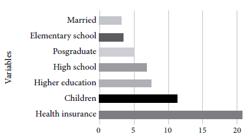
It is possible to identify that the health insurance variable contributes most to the total difference between women groups. Higher education and the number of children also contribute between 7.5% and 12% to the difference.
Discussion
The results agree with the literature13,27. According to the National Cancer Institute14, white women with higher education levels are those who most often undergo mammograms at the frequency recommended by public health authorities. Likewise, undergoing the exam is positively related to being married or in a stable union and having health insurance28,29.
The concept of intersectionality is useful for explaining health inequalities30, as it refers to the understanding that characteristics such as race and ethnicity, social class, gender, sexuality, nationality, and age operate as factors shaping complex social inequalities31. In this way, it highlights the simultaneous and interactive influences on health stemming from multiple axes of inequality that, in some manner, reinforce social oppression32.
The literature describes barriers to mammography access by ethnic-racial minorities. The barriers are related to factors at the individual, community and health system levels33. Adverse individual-level social conditions can negatively affect health or health care34. In general, the more health-related social needs a woman has, the less likely she is to have a mammogram34.
Socioeconomic factors include income and educational levels. People living in poverty often lack health literacy and access to the resources needed to obtain essential care for long-term health and well-being35. Other socioeconomic determinants related to poverty include food insecurity and lack of access to reliable transportation34.
Additionally, personal attitudes and beliefs and negative experiences in the health care system may influence the likelihood of seeking mammography screening33. As well as dissatisfaction with life, social isolation or hours lost at work34.
In Brazil, racial discrimination is a structural problem that affects many areas of society, especially access to opportunities. Black women are the group most affected by inequalities in income, education, the job market and political representation. They also have the highest percentage of poverty-stricken people and spend more time on domestic activities36.
Likewise, the aging of the Brazilian population is a reality and is related to the feminization of old age27,37. According to data from the 2022 Census demographic portrait, more than 10% of the population is elderly and the female population is larger than the male population (94 men for every 100 women). Women live, on average, seven years longer than men (80.5 years versus 73.6). As aging is the main risk factor for breast cancer, public policies are essential to deal with the natural increase in cases in the coming decades.
This implies that in addition to the need to promote public health by increasing consultations, professionals and equipment, other multisectoral actions must be considered to reduce inequalities in access to health27. In this regard, policies should be implemented to reduce poverty, improve living conditions and promote practices and behaviors to prevent diseases.
Conclusion
Mammography is the main way of identifying breast anomalies using X-ray images6. The literature indicates social determinants of health are the primary mechanisms for mammography access. In particular, income, race, education level and age group are the main determinants of not having a mammogram13.
Thus, this research sought to analyze the differences in mammography access between WY and BBI through decomposition of nonlinear models. The study focused on women aged 50 and over who participated in the first wave of ELSI-Brazil, a longitudinal study of elderly Brazilians.
The study findings are in agreement with the literature and show that characteristics such as educational level, adherence to private health insurance, number of children and marital status are relevant predictor variables for the probability of getting a mammogram. All else being equal, having a private health insurance plan is associated with an increase of approximately 12.9% in the probability of undergoing a mammogram. Women in the BBI group are approximately 4.5% less likely to undergo a mammogram, all else being equal. Likewise, having a higher educational level and being married are associated with increased chances of passing the exam, ceteris paribus.
The decomposition indicated that the probability of mammography was 10.24 percentage points higher among the WY group than among the BBI group. The difference in the composition of the explanatory variables contributed 57.8% of the total difference, while the coefficients accounted for 42.2%. This means that the explanatory variables in the model are the main determinants of the difference in mammography. If BBI had the same composition of explanatory variables as WY, mammography probability would increase by 5.92 percentage points.
In Brazil, racial discrimination is a structural problem that affects women’s access to opportunities, including health care. In addition, population aging is associated with feminization of old age27. There are more elderly women and they live longer than men, as well as having challenges throughout the aging process37.
To expand the comprehensive well-being of women, particularly those who need it most, public policies are necessary in addition to the characteristics associated with public health systems such as the provision of equipment and professionals. Women’s health should include physical, mental and emotional well-being. Actions to reduce poverty, improve life satisfaction, and promote healthy lifestyle habits. In addition, it is imperative to continue research on access to mammography and social determinants of women’s health.
References
-
1 Instituto Nacional de Câncer (INCA). Dados e números sobre câncer de mama: Relatório Anual 2023 [Internet]. 2024 [acessado 2024 jun 20]. Disponível em: https://www.inca.gov.br/sites/ufu.sti.inca.local/files//media/document//relatorio_dados-e-numeros-ca-mama-2023.pdf
» https://www.inca.gov.br/sites/ufu.sti.inca.local/files//media/document//relatorio_dados-e-numeros-ca-mama-2023.pdf - 2 Greenwald ZR, Fregnani JH, Longatto-Filho A, Watanabe A, Mattos JSC, Vazquez FL, Franco EL. The performance of mobile screening units in a breast cancer screening program in Brazil. Cancer Causes Control 2017; 29(2):233-241.
- 3 McCormack VA, Boffetta P. Today's lifestyles, tomorrow's cancers: trends in lifestyle risk factors for cancer in low- and middle-income countries. Ann Oncol 2011; 22(11):2349-2357.
- 4 Wang L. Early diagnosis of breast cancer. Sensors 2017; 17(7):1572.
- 5 Kowalski AE. Mammograms and mortality: how has the evidence evolved? J Econ Perspect 2021; 35(2):119-140.
- 6 Buchmueller TC, Goldzahl L. The effect of organized breast cancer screening on mammography use: Evidence from France. Health Econ 2018; 27(12):1963-1980.
-
7 World Health Organization (WHO). Operational framework for monitoring social determinants of health equity [Internet]. 2024 [cited 2024 jun 10]. Available from: https://www.who.int/publications/i/item/9789240088320
» https://www.who.int/publications/i/item/9789240088320 - 8 Lages RB, Oliveira GD, Simeão Filho VM, Nogueira FM, Teles JB, Vieira SC. Desigualdades associadas à não realização de mamografia na zona urbana de Teresina-Piauí-Brasil, 2010-2011. Rev Bras Epidemiol 2012; 15(4):737-747.
- 9 Rodrigues JD, Cruz MS, Paixão AN. Uma análise da prevenção do câncer de mama no Brasil. Cienc Amp Saude Colet 2015; 20(10):3163-3176.
- 10 Theme Filha MM, Leal MD, Oliveira EF, Esteves-Pereira AP, Gama SG. Regional and social inequalities in the performance of Pap test and screening mammography and their correlation with lifestyle: Brazilian national health survey, 2013. Int J Equity Health 2016; 15(1):136.
- 11 Melo EC, Oliveira EX, Chor D, Carvalho MS, Pinheiro RS. Inequalities in socioeconomic status and race and the odds of undergoing a mammogram in Brazil. Int J Equity Health 2016; 15(1):e43.
-
12 Ramos ACV, Alves LS, Berra TZ, Popolin MP, Arcoverde MAM, Campoy LT, Martoreli Júnior JF, Lapão LV, Palha PF, Arcêncio RA. Estratégia Saúde da Família, saúde suplementar e desigualdade no acesso à mamografia no Brasil. Rev Panam Salud Publica 2018;42:e166. doi:10.26633/rpsp.2018.166.
» https://doi.org/10.26633/rpsp.2018.166 - 13 Silva DM, Oliveira BLCA, Lopes MVO, Fernandes AFC, Pinheiro AKB, Aquino PS. Determinantes sociais de saúde associados à realização de mamografia segundo a Pesquisa Nacional de Saúde de 2013 e 2019. Cien Saude Colet 2025; 30(1):e11452023.
-
14 Instituto Nacional de Câncer (INCA). Rastreamento do câncer de mama na população-alvo [Internet]. 2022 [acessado 2026 jun 2]. Disponível em: https://www.gov.br/inca/pt-br/assuntos/gestor-e-profissional-de-saude/controle-do-cancer-de-mama/dados-e-numeros/rastreamento-do-cancer-de-mama-na-populacao-alvo
» https://www.gov.br/inca/pt-br/assuntos/gestor-e-profissional-de-saude/controle-do-cancer-de-mama/dados-e-numeros/rastreamento-do-cancer-de-mama-na-populacao-alvo - 15 Nogueira MC, Fayer VA, Corrêa CSL, Guerra MR, Stavola B, Dos-Santos-Silva I, Bustamante-Teixeira MT, Silva GAE. Inequities in access to mammographic screening in Brazil. Cad Saude Publica 2019; 35(6):e00099817.
-
16 Silva AR, Scorzafave LG. Inequality by skin color in breast cancer screening in Brazil: a differences-in-differences analysis of the COVID-19 pandemic. J Racial Ethn Health Disparities 2024 [ahead of print]. DOI:10.1007/s40615-024-01908-2.
» https://doi.org/10.1007/s40615-024-01908-2 - 17 Rahimi E, Hashemi Nazari SS. A detailed explanation and graphical representation of the Blinder-Oaxaca decomposition method with its application in health inequalities. Emerg Themes Epidemiol 2021; 18(1):e100.
- 18 Fairlie RW. The absence of the African-American owned business: an analysis of the dynamics of self-employment. J Labor Econ 1999; 17(1):80-108.
- 19 Fairlie RW. An extension of the Blinder-Oaxaca decomposition technique to logit and probit models. J Econ Soc Meas 2005; 30(4):305-316.
- 20 Powers DA, Yoshioka H, Yun MS. Mvdcmp: multivariate decomposition for nonlinear response models. Stata J 2011; 11(4):556-576.
- 21 Lima-Costa MF, Andrade FB, Souza PRB Jr, Neri AL, Duarte YAO, Castro-Costa E, Oliveira C. The Brazilian Longitudinal Study of Aging (ELSI-Brazil): Objectives and Design. Am J Epidemiology 2018; 187(7):1345-1353.
- 22 Lima-Costa MF, Melo Mambrini JV, Bof Andrade F, Souza PRB, Vasconcellos MT, Neri AL, Castro-Costa E, Macinko J, Oliveira C. Cohort profile: the Brazilian Longitudinal Study of Ageing (ELSI-Brazil). Int J Epidemiol 2023; 52(1):57-65.
- 23 Zhao Z, Yu B, Hu F, Zheng C, Gui J, Liu J, Sun J, Shi J, Yuan L. Decomposition and comparative analysis of health inequities between the male and female older adults in China: a national cross-sectional study. BMC Public Health 2023; 23(1):e15814.
- 24 Fagbamigbe AF, Adebola OG, Dukhi N, Fagbamigbe OS, Uthman OA. Exploring the socio-economic determinants of educational inequalities in diarrhea among under-five children in low- and middle-income countries: a Fairlie decomposition analysis. Arch Public Health 2021; 79(1):e639.
- 25 Yuan L, Yu B, Gao L, Du M, Lv Y, Liu X, Sun J. Decomposition analysis of health inequalities between the urban and rural oldest-old populations in China: evidence from a national survey. SSM Popul Health 2023; 21:101325.
-
26 Powers DA. Multivariate-regression-decomposition: decompose observed group differences in first moments into components reflecting group differences in characteristics and group differences in the effects of those characteristics [Internet]. [cited 2026 ago 12]. Available from: https://github.com/DanAPowers/Multivariate-Regression-Decomposition
» https://github.com/DanAPowers/Multivariate-Regression-Decomposition - 27 Carvalho PF. Iniquidades no uso de serviços de saúde entre mulheres mais velhas (50+): evidências do ELSI-Brasil [dissertação]. Belo Horizonte: Fiocruz, Instituto René Rachou; 2023.
- 28 Moreira AP, Malta DC, Carvalho AT. Tendência de realização da mamografia e fatores associados em mulheres de 50 a 69 anos. Cad Saude Colet 2023; 31(3):e0594.
- 29 Oliveira EX, Pinheiro RS, Melo EC, Carvalho MS. Condicionantes socioeconômicos e geográficos do acesso à mamografia no Brasil, 2003-2008. Cien Saude Colet 2011; 16(9):3649-3664.
- 30 Shannon G, Morgan R, Zeinali Z, Brady L, Couto MT, Devakumar D, Eder B, Karadag O, Mukherjee M, Peres MFT, Ryngelblum M, Sabharwal N, Schonfield A, Silwane P, Singh D, Ryneveld M, Vilakati S, Watego C, Whyle E, Muraya K. Intersectional insights into racism and health: not just a question of identity. Lancet 2022; 400(10368):2125-2136.
- 31 Collins PH. Intersectionality's definitional dilemmas. Annu Rev Sociol 2015; 41(1):1-20.
- 32 Bambra C. Placing intersectional inequalities in health. Health Place 2022; 75:102761.
- 33 Corrarino JE. Barriers to mammography use for Black women. J Nurse Pract 2015; 11(8):790-796.
- 34 Miller JW, King JA, Trivers KF, et al. Vital Signs: Mammography Use and Association with Social Determinants of Health and Health-Related Social Needs Among Women - United States, 2022. MMWR Morb Mortal Wkly Rep 2024; 73(15)351-357.
-
35 Jones T, Wisdom-Chambers K, Freeman K, Edwards K. Barriers to Mammography Screening among Black Women at a Community Health Center in South Florida, USA. Med Res Arch 2023; 11(4):10.18103/mra.v11i4.3814.
» https://doi.org/10.18103/mra.v11i4.3814 -
36 Instituto Brasileiro de Geografia e Estatística (IBGE). Mulheres pretas ou pardas gastam mais tempo em tarefas domésticas, participam menos do mercado de trabalho e são mais afetadas pela pobreza. 2012 [acessado 2024 jul 10]. Disponível em: https://agenciadenoticias.ibge.gov.br/agencia-noticias/2012-agencia-de-noticias/noticias/39358-mulheres-pretas-ou-pardas-gastam-mais-tempo-em-tarefas-domesticas-participam-menos-do-mercado-de-trabalho-e-sao-mais-afetadas-pela-pobreza
» https://agenciadenoticias.ibge.gov.br/agencia-noticias/2012-agencia-de-noticias/noticias/39358-mulheres-pretas-ou-pardas-gastam-mais-tempo-em-tarefas-domesticas-participam-menos-do-mercado-de-trabalho-e-sao-mais-afetadas-pela-pobreza - 37 Cepellos VM. Feminização do envelhecimento: um fenômeno multifacetado muito além dos números. Rev Adm Empres 2021; 61(2):1-7.
The data sources adopted in the research are indicated in the article’s body.

 Source: Authors, 2024, with data from ELSI-BRAZIL.