
 Digital health ecosystem in the municipality of Rio de Janeiro, Brazil: the experience of the creation of the minhasaude.rio application
Abstract
This article describes the digital transformation trajectory of the Municipal Health Department of Rio de Janeiro (SMS-Rio), leading to the creation of minhasaude.rio application. The study was divided into two phases: document analysis and systematization of the app’s development process, which was structured into three stages: information digitization, integration and construction of the health data lake, and creation of the app. Since its launch, the number of registered users has increased, with information on regulatory information, appointment scheduling, exams, and vaccination history being the most widely accessed. Integration with the federal government’s gov.br for first-time access now accounts for 25% of new users. The users are predominantly black/brown, women, between the ages of 18 and 69 years. In 2025, 39.2% of the users reported being extremely satisfied. The case illustrates the digital maturity and modernization of healthcare services, featuring local solutions that enable personalized care and seamless data integration. The updates and public involvement are key elements for the success of the implemented technology.
Key words:
Information technology; Health information interoperability; Digital health; Mobile applications; Health information management
Resumo
O artigo descreve a trajetória da transformação digital da Secretaria Municipal de Saúde do Rio de Janeiro (SMS-Rio) até a concepção do aplicativo minhasaude.rio. O estudo foi dividido em dois momentos: análise documental e sistematização do processo de construção do aplicativo, estruturado em três etapas - digitalização das informações, integração e construção do data lake da saúde e criação do aplicativo. Desde o lançamento, houve aumento no número de usuários cadastrados, sendo as informações de regulação, agendamento de consultas, exames e histórico de vacinas as mais acessadas. A integração com gov.br, do governo federal, para cadastramento ao aplicativo passou a representar 25% dos novos usuários. Os usuários são, majoritariamente, mulheres na faixa etária de 18 a 69 anos e pretos/pardos. Em 2025, 39,2% dos usuários estavam altamente satisfeitos. O caso revela maturidade digital e modernização dos serviços de saúde com soluções locais para personalização do cuidado e integração dos dados. A atualização de funcionalidades e o engajamento da população são elementos-chave para o sucesso da tecnologia implementada.
Palavras-chave:
Tecnologia da informação; Interoperabilidade da informação em saúde; Saúde digital; Aplicativos móveis; Gestão da informação em saúde
Resumen
El artículo describe la trayectoria de transformación digital de la Secretaría Municipal de Salud de Río de Janeiro (SMS-Rio) hasta la creación de la aplicación minhasaude.rio. El estudio se dividió en dos fases: análisis documental y sistematización del proceso de desarrollo de la aplicación, estructurado en tres etapas: digitalización de la información, integración y construcción del data lake de salud, y la creación de la aplicación. Desde su lanzamiento, el numero de usuarios registrados aumentó. La información sobre regulación de acceso, programación de citas, exámenes y historial de vacunaciones son las más consultadas. La integración con el sitio web gov.br del gobierno federal para el primer acceso representa el 25% de los nuevos usuarios. Los usuarios son predominantemente negro/mestizo, mujeres de entre 18 y 69 años. En 2025, 39,2 % de los usuarios estaban altamente satisfechos. El caso ilustra la madurez digital y la modernización de los servicios de salud, con soluciones locales para la atención personalizada y la integración de datos. Las actualizaciones de las funcionalidades y la participación ciudadana son elementos clave para el éxito de la tecnología implementada.
Palabras clave:
Tecnología de la información; Interoperabilidad de la información en salud; Salud digital; Aplicaciones móviles; Gestión de la información en salud
Introduction
Expanding citizens’ access to health information is a long-standing commitment of the Brazilian Unified Health System (SUS). Despite this, the system still operates primarily under a technocratic logic, geared towards professionals and managers, which restricts the active participation of users in self-care and health decisions. Even with the spread of the internet and digital technologies capable of promoting greater engagement, centralized and uninteractive practices still persist1,2.
The COVID-19 pandemic accelerated the adoption of solutions, popularizing the use of applications, in addition to boosting the use of electronic medical records, telemedicine, and personalized treatments. This scenario consolidated a new user profile, more accustomed to technology and interested in tools that support the management of their own health3.
This movement aligns with international guidelines, such as those of the World Health Organization, which reinforces, through the Sustainable Development agenda, the use of information technologies as a strategy to reduce digital exclusion and expand knowledge, minimizing inequalities, accelerating human progress, and strengthening health systems4.
In Brazil, the creation of the Department for Digital Information and Health (Secretaria de Informação e Saúde Digital - SEIDIGI), of the Ministry of Health, in January 2023, highlights the centrality of the topic on the public agenda. With the institution of the Digital SUS Program5, the goal of promoting digital transformation in SUS is reinforced, focusing on digital culture, expansion of services, and interoperability. In parallel, milestones, such as the Access to Information Law6, which regulates, practically and effectively, the constitutional right to public information, and the General Data Protection Law7, which guarantees the security and privacy of information, consolidate the right of citizens to information and the protection of their personal data.
In the current scenario in Brazil, the internet is present in 90% of all households, with the cell phone being the main access device (99.5%)8. In 2022, there were more than 249 million smartphones in use in the country, which represents more than 1.2 devices per inhabitant9. This reflects a highly connected society, where digital expansion has enabled new forms of interaction between SUS and citizens.
The city of Rio de Janeiro, the second largest municipality in Brazil, has followed this trend. However, data fragmentation, the multiplicity of information systems, and the low interoperability between them, a persistent problem since the 1980s, continue to limit management, care, and the production of qualified information10.
Faced with these challenges, the municipality of Rio de Janeiro (MRJ) adopted strategies aimed at strengthening the interoperability of health information systems, expanding user access to health information, and seeking greater effectiveness, transparency, and integration between systems. From this context emerges the initiative to develop a citizen-focused health application, which is aligned with national digital health guidelines and the demands of an increasingly connected population.
This study presents the MRJ’s experience in the conception, development, and implementation of a pioneering application on a municipal scale, focusing on the user and more detailed data on health and care flow. The research describes the institutional maturation process in the digitization of health information, the technological and design choices, and the models for making the tool available. In addition, it analyzes the user profile and the most accessed functionalities, offering practical evidence to guide managers in formulating digital health strategies that are more responsive to the real needs of the population, which is one of the contributions of the work to the field of digitization in health.
Methodology
This study provides a descriptive historical overview of the digitization process in healthcare in MRJ, focusing on the creation of the minhasaude.rio application and its consolidation as a SUS app in the city. The study covers the period from 2009, when the implementation of electronic medical records began in Primary Health Care (PHC) units, until July 2025, as this was a time of strong consolidation of the digital structure in the municipality’s public health system. For the purposes of analyzing the app, the latest version available at the time of conception of this study was considered (Android, v 4.6.1; IOS, v 4.7.3), taking into account all of its available functionalities.
To this end, the experience initially involved a documentary analysis of current legal frameworks concerning the digitization process and access to information, and then traced a historical overview of the stages that included the creation of the application, from the beginning of the activities involved in mapping the systems and tools involved in the digitization of healthcare to the availability of information for the population. The documentary phase aimed to retrieve records related to the health digitization process in the MRJ territory. To achieve this, it started from the principles and legal guidelines that guided the construction of the minhasaude.rio app, considering: (1) national regulations regarding access to information and the use and protection of data - the Access to Information Law6 and the General Data Protection Law7; and (2) the documentation of the Rio de Janeiro City Hall specifically related to the health area, which addresses plans and/or projects on the publication of health information and the implementation of digital health in the municipality, in addition to management contracts signed with Social Organizations (SO) and Civil Society Organizations (CSO).
The documentary records reveal the guidelines for the implementation of electronic medical records and other digital tools in the health units of MRJ, which also address digitization in healthcare and whose data integrates the information made available to the user. The Health Information Systems (HIS) of SUS that make up the content available on minhsaude.rio were also considered to be “documentary bases”, since they are sources of the information used in the app.
Except the aforementioned laws - selected by the authors because they are instruments related to the fundamental right to information and the protection of the intimacy and privacy of users, especially concerning personal data - the systematization of the search for other documents was carried out in the “Transparency” tab of the portal of the Municipal Health Department of Rio de Janeiro (saude.prefeitura.rio). For the analysis period, contracts, plans, and other current documents whose reading identified relevance to the studied theme were considered. The HIS were selected according to their relevance to the functionalities available on minhsaude.rio.
The second analysis section explains the digitalization of healthcare and the creation of the minhasaude.rio app itself, in three stages: Digitization of health information; creation of the Health Data Lake; and creation of minhasaude.rio.
To explain the digitalization of health information, the actions carried out by the Municipal Health Department of Rio de Janeiro were presented, which deal with the transformation of traditional health data into digital data, also considering the elements included in the prior document analysis (management contracts and government plans).
Regarding the creation of the Health Data Lake, the website of the Rio de Janeiro City Hall’s Data Lake (https://www.dados.rio/datalake) and its GitHub (https://github.com/prefeitura-rio) - a platform for hosting and version control of source code widely used in the scientific and technological community - were consulted to understand the interoperability of health systems and platforms and the development of this institutional data repository.
The creation of minhasaude.rio described the application’s construction process, considering the available functionalities and usage profile between October 2022 and July 2025; finally, the degree of user satisfaction in their experience using minhasaude.rio was presented, using the Net Promoter Score (NPS) methodology.
The satisfaction survey was implemented in January 2025, and the analysis covered the period between January and July 2025. The user accesses the satisfaction survey functionality voluntarily, as it is not automatically triggered. The evaluation is carried out using a score from 0 to 10, following the NPS scale - a metric that measures experience, satisfaction, and loyalty, based on the likelihood of a user recommending a service to others. The NPS was calculated according to the classic methodology, categorizing respondents into detractors (scores 0 to 6), neutrals (7 and 8), and promoters (9 and 10), with the final index obtained by the difference between the percentage of promoters and detractors.
Although the second phase of the study was didactically organized into three stages, in practice, they occur continuously and in an integrated manner. The process of digitizing healthcare and consolidating data into an open-access application is dynamic, with each stage feeding back into the next and promoting a permanent cycle of improvement in access to information.
This study used publicly available information, both in terms of documentary research, available at saúde.prefeitura.rio, and in the analysis of the app, for which information is freely accessible and available on the website minhasaude.rio, was used.
Results
The results identified the main legal milestones of digital health and reconstructed the process that led to the development of the application, from the initial mapping of health systems and platforms to the provision of services to the public. This investigation made it possible to organize the steps involved, recognize the progress made, and demonstrate how they supported the creation of an accessible platform aligned with digital health guidelines.
The result of the document analysis showed the existence of 21 health information systems or platforms developed by different national, state, and municipal entities. Of these, ten SUS information systems were nationally based; one system was state-level, related to patient regulation; and ten dealt with municipal systems/platforms, including management contracts - which reinforce the existence of electronic medical records and laboratory report management systems implemented in the municipality, municipal plans (Strategic Plan 2021-2024 and Multi-Year Plan 2022-2025), and health platforms. This finding highlighted the need to integrate and organize health data in a way that translates into information to improve both healthcare and health management (Chart 1).
Given this scenario, SMS-Rio gradually initiated a process of digitizing healthcare, culminating in the creation of a structured digital ecosystem that involved the three stages mentioned in the methodology, the results of which are described below (Figure 1).
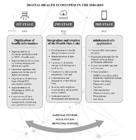
Digital health ecosystem in Rio de Janeiro: from the digitization of health data to the creation of the minhasaude.rio app.
Step 1: digitization of health information
Step 1 corresponded to the first step in the process of digitizing healthcare and management information for the City Hall of Rio de Janeiro, to ensure the standardization, organization, and integration of different databases aimed at individualizing patient care pathways. It was identified that the digitization of healthcare involved the implementation of electronic medical records in all healthcare units of the healthcare network, the development of digital systems for management, and the organization of ministerial databases of the HIS.
The process of digitizing clinical healthcare data began in 2009, culminating between 2021 and 2024, a period in which the goal was set to implement electronic medical records in 100% of all healthcare units, an objective achieved in December 2024, including veterinary hospitals under the management of SMS-Rio, as observed through management contracts. Next, new digital systems were created that would enable, on the one hand, the structuring of data-based work processes with standardized records, and on the other, allow the manager to view and evaluate the dynamics of the implemented policies in real time. In this sense, SMS-Rio advanced in the development of its respective systems/platforms.
Afterwards, the databases of the official SUS information systems were organized, processed, cleaned, and individualized to later integrate them into a common digital ecosystem, the Data Lake.
Step 2: creating the health data lake
Step 2 comprises the initiative to develop a dedicated and autonomous health data lake in MRJ.
Browsing the websites https://www.dados.rio/datalake and https://github.com/prefeitura-rio made it possible to understand how this repository is structured, organized by departments, sub-departments, and projects, clearly identifying the infrastructure used, the datasets included, the algorithms employed, as well as all the transformation and cleaning steps applied to the data.
The transformations made to the data are recorded, allowing for traceability and repetition of analyses with security, correcting any problems quickly and accurately, attesting to the reliability of the results for decision-making. It is important to note that this access is restricted to the code and does not authorize direct access to the databases, preserving confidentiality and privacy. In this way, the Data Lake complies with the LGPD7 by adopting such practices as pseudonymization, minimization, and segregation of sensitive health data by purpose (assistance, management, transparency, and research), while ensuring transparency, reproducibility, social auditing, and collaboration between public managers, researchers, and civil society in the governance of public data.
Table 1 presents the systems and platforms that comprise the health Data Lake. The implementation of this architecture strengthened governance and information quality, helping to overcome historical challenges, such as the low governance of municipal databases and the fragmentation of data previously distributed among various platforms and partners (Social Organizations, public companies, and other contracted services). The interoperability achieved made it possible to generate more qualified information tailored to care needs. Furthermore, greater ease and efficiency in the use of data by the different end-user areas of healthcare were observed.
Step 3: minhasaude.rio app
Step 3 continues the digital maturity process of SMS-Rio, expressing a new product available for use by the population that consolidates information communicable to the general public, starting from the movement to improve the use of health data described in steps 1 and 2.
In October 2022, SMS-Rio launched the digital tool minhasaude.rio, in website and application modalities, as a strategy for access to health information for the population of Rio de Janeiro, in an attempt to promote health.
The minhasaude.rio app, a digital legacy of the COVID-19 pandemic in Rio de Janeiro, was initially created to allow users to self-report the disease, facilitating communication and shared care with the family health team. This increased engagement in the use of digital services by offering a useful service with a direct social impact. After the pandemic, the application was expanded to integrate various types of health information, with reliable access and active communication in the care process.
Regarding the login, it was found that minhasaude.rio can be accessed by any user through authentication via a Gov.br account or registration on the platform. However, access to most functionalities is conditional upon the user’s prior link to their reference Family Clinic, which can be verified through the guides available on the application’s website (https://web2.smsrio.org/portalPaciente/). This guidance is a fundamental premise for the full use of the system.
During the study period, the minhasaude.rio digital tool had 15 functionalities, allowing the user to perform the following actions: view their personal information and linkage to the Family Health Team (FHT); schedule appointments with their referring doctor and nurse; track the status of their requests in SISREG; view their surgery information, their hospitalization history, and the waiting time for care in emergency and urgent care units; among others.
Regarding clinical data, users can view their laboratory test reports and record their blood glucose, blood pressure, allergies, and weight/height information, receiving personalized messages that support the monitoring of their health condition. In health surveillance, in addition to viewing their vaccination history, they can request home vaccination. In the “My Pets” functionality, the user can register and schedule the neutering of their dog and/or cat.
For people with fibromyalgia or autism spectrum disorder (ASD), it is possible to request an identification card. Within the scope of health promotion, guidelines are provided for adopting a healthier lifestyle through regular physical activity and a balanced diet.
More recently, teleconsultation in PHC has been made available through the platform, enabling care in the patient’s own home. This strategy ensures that the most vulnerable users, who have difficulty moving around the territory due to health conditions or situations of violence in the territory, are also assisted.
User profile of the minhasaude.rio app
The evolution of registrations throughout the semesters showed a strong relationship with the launch of new features in the evaluated period between 2022 and 2025, going from 34,037 new registrations to 135,146, respectively. The biggest jumps in the number of registrations occurred in the 2nd semester of 2023, with the launch of online scheduling in PHC and the issuance of the autism spectrum card, and in 2024 with the inclusion of the complete vaccination card, veterinary health service, and teleconsultation in PHC. In July 2025, minhasaude.rio had a total of 802,561 registered - unique social security number (CPF) users (Figure 2).
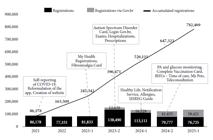
Evolution of registrations and launch of features on minhasaude.rio by semester - 2021 to 2025.
The growth peaks suggest that the introduction of new features has a direct and positive impact on public engagement, highlighting the importance of constant innovations to expand the user base. In semesters without new releases, the increase in registrations is less significant, further reinforcing the connection between new products and sign-ups.
The ‘gov.br’ function was integrated into the application as an access credential in 2023, bringing security and reliability requirements to the user, who, until then, had access to the application conditioned on registering directly within the app itself. Since August 2023, the period of the functionality’s launch, 535,721 new registrations have been recorded, of which 137,773 (25.7%) occurred through ‘gov.br’, demonstrating the adoption of the new functionality and its potential as a facilitator of digital access (Figure 2).
When evaluating the demographic profile of users registered in the application, it was observed that 66% are female and 34% are male. The age group with the highest adoption rate is 18 to 69 years, representing 83% of total users. Regarding race/skin color, 38% are registered as brown, followed by 31% as white. Concerning this point, a significant percentage of missing information is observed for this category (16%). When the user’s health district/programmatic area was evaluated, the data showed that most of the registered users are from the territories of AP 33, 40, and 52. The users’ origin corresponds to the most populous neighborhoods in the city (Table 1).
In 2025, 2,656,048 accesses to the application were recorded across its different functionalities, with 39.09% seeking information about their situation in SISREG. Note that the same person can access their request more than once, which is why the number of accesses is higher than the number of people (Table 2).
Next, the functionalities of Appointment Scheduling (17.61%) and Exams (8.66%) appear, representing significant interest from users of the app. Functionalities, such as Vaccines, Where to Get Care, and My Health Records, are also frequently accessed. Although on a smaller scale, functionalities, such as My Pets, Wallets, Prescriptions, and Teleconsultation (not yet available for the entire MRJ), demonstrate the diversity of topics accessed on the platform, reflecting its multifunctional role in the daily lives of users. It should be noted that the My Pets functionality was only made available at the end of 2024, in December.
Despite the short analysis period, when compared to other functionalities, it already ranks among the seven most sought-after and accessed on the platform during the evaluated period (January to July 2025). This performance demonstrates rapid user engagement with the new functionality, showing the potential for adoption of innovative resources integrated into minhasaude.rio and reflecting the growing interest of the population in services related to animal health (Table 2).
Of the 802,561 registered users, 12,106 users (1.5%) participated in the satisfaction survey from January to July 2025. The NPS calculation classified 48.8% of the users as detractors (scores of 0 to 6), 12.1% as neutrals (scores of 7 and 8), and 39.1% as promoters (scores of 9 and 10), resulting in an NPS of -9.7. This result indicates a polarized perception among users, with a higher proportion of detractors compared to promoters (Figure 3). As no selection criteria were used, and the sample is extremely limited, it cannot be affirmed that the recorded quantitative data have external validity.

Distribution of NPS satisfaction survey scores for the minhasaude.rio platform, January to July 2025.
Discussion
The results of this study show that the adoption of the application, supported by the data integration enabled by the health data lake, boosted the expansion of access to information and the qualified use of digital services among citizens. There was increasing user engagement and good acceptance of the tool, especially in the search for essential care information, such as regulatory information, appointments, exams, and vaccination history, which highlights its potential to support management and personalize health care.
These results converge with the literature, which highlights the need for digital transformation in the public sector to be guided by the creation of public value, transparency, and data protection, as well as being conducted ethically and sustainably, as proposed by Belli et al.11. The experience analyzed demonstrates that technological advancement is only sustainable when accompanied by robust governance, continuous updating of functionalities, and active participation of the population in the use of digital tools.
The use of Information and Communication Technologies (ICTs) has driven the transformation of health systems in various national and international contexts. Furthermore, ICTs are essential for strengthening HCNs and overcoming service fragmentation12. Therefore, the Ministry of Health, in its 2020-2028 digital health plan, emphasizes the importance of integrating and digitizing information systems to promote person-centered healthcare based on data and evidence13. Thus, the digitization of public health represents not only a technological advance but also a structural transformation in the way healthcare is delivered.
International experiences show that ICTs, when well applied, improve continuity of care, patient safety, and the management of health services. In Canada, the Infoway program develops integrated digital solutions for patient-centered care14. Estonia is a benchmark for its national interoperable electronic health record system, with real-time access for professionals and citizens, promoting transparency and efficiency in management15.
Mobile applications, such as My Digital SUS (Meu SUS Digital) and minhasaude.rio, stand out in the digital transformation of health in Brazil, but they still face problems with population adoption: in 2024, My Digital SUS had 4.5 million active users, about 2% of the population16 and, in 2025, minhasaude.rio reached 12% of Rio de Janeiro’s population. Studies indicate that this limitation stems from factors such as security and privacy, unequal access, lack of training, and infrastructure restrictions17.
Despite the identified barriers, the trajectory of digitization in healthcare appears irreversible, consolidating itself as a trend in the sector. A study by Nichiata and Passaro18 identified 43 health applications developed by different levels of government, totaling more than 28 million downloads and positive reviews, but still facing challenges of communication and regional inequality. The research highlights the leading role of minhasaude.rio as an example of data unification and digitization, with a focus on transparency, personalization, and increased access.
The advancement of digital transformation in the health sector of MRJ can be evidenced by the performance obtained in the National Digital Health Maturity Index (Índice Nacional de Maturidade em Saúde Digital - INMSD), an instrument applied by SEIDIGI, through the Digital SUS Program, to measure the degree of digitization and the capacity of health units in the use of digital technologies. The evaluation considers such dimensions as management, infrastructure, processes, and services offered to the population. In this context, SMS-Rio achieved a score of 0.78, placing it at an advanced stage of digital maturity.
Among the innovations in digital health, mobile applications stand out as important strategies for institutional digital presence, especially in municipalities, where health policies are implemented, and contact with the user is more direct. Nichiata and Passaro18 identified forty-three applications developed by Municipal and State Departments and the Ministry of Health, highlighting the leading role of local governments in this field and the potential of digital platforms to expand access to information and services. The research revealed more than 28 million downloads and an average positive user rating, although challenges persist regarding strategic communication and regional inequality in the provision of these technologies.
The assessment of the demographic profile showed results consistent with the literature in which women are those who most access the health service19. By contrast, the age groups with the highest engagement were adults aged 18 and 60 years of age, indicating greater attention to the elderly groups regarding digital literacy20. In terms of race/skin color, blacks and browns together indicating 46% of the app’s users, which is also consistent with the patterns identified in other studies that this population is the main user of the SUS21. The most densely populated areas of the city are those in which the highest number of users registered in the app was were observed.
The quality and updating of health information systems are key to ensuring interoperability and trust in SUS data. The study found that 19% of registrations did not have a registered address, information from CadSUS, an essential database in PHC, which can be a limiting factor in user profile analyses. It is recommended that the application allow for address and telephone number updates to improve data accuracy. It is also suggested that the Ministry of Health evaluate the use of the Brazilian social security numbers (CPFs) as a unique identifier to strengthen management and best practices in national systems, since their absence makes it difficult to integrate data, ensure information quality, and enable complex and accurate analyses in public management.
Regarding user satisfaction, although this is a fairly recent evaluation that limits the ability to conclude the tool, this analysis is useful for verifying the need for improvements in the application for greater user satisfaction, as well as evaluating user engagement and participation in the application’s development. Studies suggest the importance of improving the application based on user feedback to increase adoption and enhance the experience, reinforcing the need for the integration of digital technologies into SUS in a participatory and user-centered manner22.
This study did not directly investigate users’ perceptions, which limits the understanding of the use of and satisfaction with minhasaude.rio. Future studies could include interviews or other qualitative approaches to delve deeper into these dimensions and guide improvements to the platform.
In addition, research that seeks to understand the work dynamics of the developers and managers of the application can enrich studies on digitization in public health, providing strategic information on political and technical decisions to improve access to information.
Conclusion
The minhasaude.rio app, developed by SMS-Rio, is an innovative health product with multiple functionalities designed to connect SUS users to the healthcare network, addressing their health needs. The creation of this tool was only possible due to the institutional trajectory undertaken by the municipal administration, which began in 2009 with the digitization of information and culminated in the construction of the health Data Lake. The app’s engagement, measured by the number of new registered users, depends on continuous updating and the incorporation of new functionalities, aiming to generate value for the user and the health system through a constant increase in satisfaction. To this end, managers must create spaces for collaborative construction and active user participation, such as focus groups or permanent forums with local, district, and municipal health councils. The experience of the municipality of Rio de Janeiro with the minhasaude.rio platform is cited in this study as an example of an initiative focused on the unification and digitization of health data, prioritizing transparency, information personalization, and increased access.
References
- 1 Araújo ISM, Cardoso JM. Comunicação e saúde. Rio de Janeiro: Editora Fiocruz; 2007.
- 2 Bortolon PC. A alegria de estarmos juntos: comunicação alegre e saúde na sociedade conectada [tese]. Rio de Janeiro: Fiocruz; 2018.
- 3 Liu L, Miguel-Cruz A. Technology adoption and diffusion in healthcare at onset of COVID-19 and beyond. Healthc Manage Forum 2022; 35(3):161-167.
-
4 World Health Organization (WHO). Global strategy on digital health 2020-2025 [Internet]. 2021 [cited 2025 ago 8]. Available from: https://www.who.int/publications/i/item/9789240020924
» https://www.who.int/publications/i/item/9789240020924 - 5 Brasil. Ministério da Saúde (MS). Portaria GM/MS nº 3.232, de 1º de março de 2024. Institui o Programa SUS Digital no âmbito do Sistema Único de Saúde (SUS). Diário Oficial União 2024; 1 mar.
- 6 Brasil. Presidência da República. Lei nº 12.527, de 18 de novembro de 2011. Regula o acesso a informações previsto no inciso XXXIII do art. 5º, no inciso II do § 3º do art. 37 e no § 2º do art. 216 da Constituição Federal; altera a Lei nº 8.112, de 11 de dezembro de 1990; revoga a Lei nº 11.111, de 5 de maio de 2005, entre outras providências. Diário Oficial União 2011; 18 nov.
- 7 Brasil. Presidência da República. Lei nº 13.709, de 14 de agosto de 2018. Lei Geral de Proteção de Dados Pessoais (LGPD). Diário Oficial União 2018; 14 ago.
- 8 Instituto Brasileiro de Geografia e Estatística (IBGE). Pesquisa Nacional por Amostra de Domicílios Contínua (PNAD Contínua). Rio de Janeiro: IBGE; 2021.
- 9 Fundação Getulio Vargas (FGV). Pesquisa do uso de tecnologia da informação. São Paulo: Fundação Getulio Vargas; 2023.
- 10 Coelho GC, Andreazza R, Chioro A. Integration among national health information systems in Brazil: the case of e-SUS Primary Care. Rev Saude Publica 2021; 55:93.
- 11 Belli L, Magalhães L, Nunes JL, Gaspar WB, Franqueira B, Bakonyi E, Scovino F, Carabeta J. Governança de dados no setor público: abertura de dados governamentais, proteção de dados pessoais e segurança da informação para uma transformação digital sustentável. Rio de Janeiro: Lumen Juris; 2024.
- 12 Mendes EV. As redes de atenção à saúde. Brasília: OPAS, OMS, CONASS; 2011.
- 13 Brasil. Ministério da Saúde (MS). Secretaria-Executiva. Departamento de Informática do SUS. Estratégia de Saúde Digital para o Brasil 2020-2028. Brasília: MS; 2020.
- 14 Shah V, Chowdhury S. Health informatics in Canada: successes, challenges and emerging trends. Health Policy Technol 2018; 7(2):155-163.
- 15 Kunnasniemi H, Tiik M, Taal H, Kukemelk H, Jürgenson E, Ross P. The Estonian eHealth journey: e-health as a driver for change. Eur J Public Health 2019; 29(Suppl. 4):ckz185.693.
-
16 Brasil. Ministério da Saúde (MS). Meu SUS Digital aumenta serviços e informações de saúde para a população [Internet]. 2024 [acessado 2025 ago 7]. Disponível em: https://agenciagov.ebc.com.br/noticias/202407/sus-digital-estrategia-do-ministerio-da-saude-amplia-acesso-da-populacao-as-informacoes-de-saude-e-inicia-a-implantacao-de-prontuario-unificado
» https://agenciagov.ebc.com.br/noticias/202407/sus-digital-estrategia-do-ministerio-da-saude-amplia-acesso-da-populacao-as-informacoes-de-saude-e-inicia-a-implantacao-de-prontuario-unificado - 17 Oliveira JV, Sengik AR, Lunardi GL. Dispositivos móveis na área da saúde: uma revisão sistemática sobre os principais facilitadores e inibidores a sua adoção. Rev Adm Hosp Inov Saude 2023; 20(1):84-102.
- 18 Nichiata LYI, Passaro T. mHealth e saúde pública: a presença digital do Sistema Único de Saúde do Brasil por meio de aplicativos de dispositivos móveis. RECIIS 2023; 17(3):503-516.
- 19 Leal MC, Pereira APE, Viana MCM, Santos CM, Lima JM. Desigualdades de gênero e raciais no acesso e uso dos serviços de atenção primária à saúde no Brasil. Cien Saude Colet 2021; 26(9):4021-4032.
- 20 Fragelli TBO, Oliveira JAC, Machado VP, Garcia KR, Pereira LC, Karnikowski MGO, Areda CA. Desafios do design da informação para inclusão digital de idosos na perspectiva da literacia em saúde: uma revisão de escopo. InfoDesign 2024; 21(2):1-18.
- 21 Instituto Brasileiro de Geografia e Estatística (IBGE). Pesquisa Nacional de Saúde 2019: acesso e utilização de serviços de saúde. Rio de Janeiro: IBGE; 2020.
- 22 Rocha TIU. Satisfação de usuários do SUS com o uso de um aplicativo de smartphone para tratamento de sintomas depressivos [dissertação]. São Paulo: USP; 2021.
The data sources adopted in the research are indicated in the article’s body.

 Note: National systems - Outpatient Information System (SIA), Hospital Information System (SIH), Mortality Information System (SIM), Live Birth Information System (SINASC), National Registry of Health Establishments (CNES), National Immunization Program Information System (SIPNI), Cancer Information System (SISCAN), Referenced Hospital Discharge System (SISARE), Unified Health System Registration System (CADSUS); National Regulation System (SISREG); State system - State Regulation System (SER); Municipal systems - Electronic Health Records (EHRs), Veterinary Records (VRs), Imaging Examination Reporting System, Laboratory Test Result Reporting System; Hospital Census System, Emergency and Urgency Census System, Surgical Scheduling System, Elective Surgery System; “Where to Get Care” platform, WhatsApp-based communication of primary care teams. Features of minhasaude.rio: SISREG; scheduling; examinations; vaccines; “where to get care”; health records; pet records; fibromyalgia card; autism spectrum disorder card; elective surgery; prescriptions; hospitalizations; teleconsultation; UPAs - service waiting time; healthy living.Source: Authors.
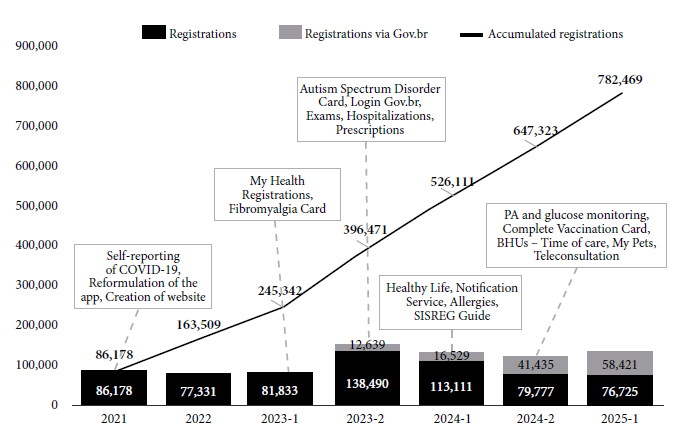 Note: Between 2021 and the first half of 2022, the application was exclusively used for COVID-19 self-notification. Source: Authors, based on data extracted from the SISREG Transparency Portal on July 29, 2025.
 Note: Users can respond to the satisfaction survey (NPS) as many times as they want, but only the most recent response registered for each social security number (CPF) is considered for analysis. Source: Authors, with data extracted from the SISREG Transparency Portal on 7/29/2025.