 Twenty years of research in pharmaceutical services in the context of primary health care: a scoping review
Abstract
The National Pharmaceutical Policy (PNAF) is a significant milestone for pharmaceutical services (PS) within the Unified Health System (SUS). Besides defining PS, the PNAF’s strategic lines highlight the need for complementary sectoral policies, research, and development to ensure its effective implementation. In this context, considering the extensive Brazilian scientific production on PS and the role of primary health care (PHC) as the main strategy for access to SUS, this scoping review aims to map the studies published on PS in PHC over the past 20 years, from the perspective of the PNAF’s strategic lines. One hundred thirty-four of the 266 articles included addressed the rational use of medicines-RUM, followed by articles on the qualification and maintenance of PS services (72) and access to medicines (25). The promotion of research in PS through agencies and the Ministry of Health and the National Survey on Access and RUM has led to a growing number of publications, especially in the last decade. Producing evidence to inform public policies is essential for planning actions in health services and systems management, as well as for advancing training, practices, and scientific research aligned with the state and needs of PS in Brazil.
Key words:
Pharmaceutical services; National Policy of Pharmaceutical Assistance; Primary health care; Unified Health System
Resumo
A Política Nacional de Assistência Farmacêutica (PNAF) é um marco fundamental para a assistência farmacêutica (AF) no Sistema Único de Saúde (SUS). Além de conceituar a AF, a PNAF indica, em seus eixos estratégicos, a necessidade de políticas setoriais, pesquisa e desenvolvimento para sua efetivação. Considerando a ampla produção científica brasileira sobre AF e a atenção primária à saúde (APS) como principal estratégia de acesso ao SUS, esta revisão de escopo busca mapear os estudos publicados sobre AF na APS nos últimos 20 anos, sob a ótica dos eixos da PNAF. Dos 266 artigos incluídos, 134 abordaram o uso racional de medicamentos (URM), seguidos por estudos sobre qualificação e manutenção dos serviços de AF (72) e acesso a medicamentos (25). O fomento à pesquisa em AF, por meio de agências e do Ministério da Saúde, bem como a Pesquisa Nacional sobre Acesso e URM, impulsionaram o aumento das publicações, especialmente na última década. A produção de evidências para subsidiar políticas públicas é essencial para o planejamento de ações na gestão dos serviços e sistemas de saúde, além de contribuir para o avanço da formação, das práticas e da ciência voltadas à AF no Brasil.
Palavras-chave:
Assistência farmacêutica; Política Nacional de Assistência Farmacêutica; Atenção primária à saúde; Sistema Único de Saúde
Resumen
La Política Nacional de Asistencia Farmacéutica (PNAF) es un hito clave para los servicios farmacéuticos (SF) en el Sistema Único de Salud (SUS). Además de conceptualizar los SF, la PNAF indica, en sus ejes estratégicos, la necesidad de otras políticas sectoriales, investigación y desarrollo para su implementación efectiva. Considerando la vasta producción científica brasileña sobre SF, y la atención primaria de salud (APS) como principal estrategia de acceso al SUS, esta revisión de alcance mapeó estudios publicados sobre SF en la APS en los últimos 20 años, bajo la óptica de los ejes de la PNAF. De los 266 artículos incluidos, 134 abordaron el uso racional de medicamentos (URM), seguido por la calificación y mantenimiento de los SF (72) y el acceso a medicamentos (25). El fomento de la investigación en SF, vía agencias y el Ministerio de Salud, junto con la Encuesta Nacional sobre Acceso y URM, impulsó un crecimiento notable de publicaciones, especialmente en la última década. La generación de evidencia para informar políticas públicas es fundamental para planificar acciones en la gestión de servicios y sistemas de salud y para el avance de la formación, prácticas y ciencia adecuadas a lo que son, y dónde están los SF en Brasil.
Palabras clave:
Servicios farmacéuticos; Política Nacional de Asistencia Farmacéutica; Atención primaria de salud; Sistema Único de Salud
Introduction
The “Assistência Farmacêutica”, a Brazilian concept developed during the organization process to promote the access to medicines within the Unified Health System (SUS), received its most comprehensive definition in the publication of the National Pharmaceutical Policy (PNAF) in 2004. In the PNAF, it is defined as a “set of actions for the promotion, protection, and recovery of health, both individual and collective, with the medicine as an essential input and aiming at access to and rational use of medicines.” Although the term in Portuguese covers not only the services provided directly by pharmacists, but also a wide range of actions to ensure access to medicines, the term used here is Pharmaceutical Services (PS).
To achieve the ambitious goal of Brazilian health policy of guaranteeing comprehensive and universal access to therapies, the PNAF indicates the need for other sectoral policies in health, research and development, such as science and technology and human resource training, as well as the integration of management spheres, described in its 13 strategic lines1.
In the organization of access to medicines within the SUS, the principle of decentralized actions and services that comprise the Unified Health System (SUS), established by Law N°8.080/1990, was created the 1990s. With the extinction of the Central Medicines Agency (CEME) and the publication of the National Medicines Policy (PNM) in 1998, the organization of PS was based on decentralization and the search for resources for the acquisition of medicines, which fostered the challenge for subnational entities to strengthen their management capacity. The last decade has been marked by the challenge of strengthening the primary healthcare (PHC) model and its organizational forms, such as the extinction of financing blocks and the need to overcome the challenges posed by fiscal austerity measures and privatizing models, which have impacted primary healthcare actions at the municipal level2.
Municipalities are federative entities with a high level of responsibility in implementing the health policy. With the decentralized public health system, Brazilian municipalities have become responsible for the primary care of their citizens. Each municipality in the country has had to create a management structure and implement health services, often starting from scratch. However, we observe huge differences between them from an economic, social, organizational, and geographical standpoint, resulting in greater or lesser challenges in guaranteeing the health of their population3.
The decentralized PS in PHC was established late, with the extinction of CEME, and the implementation of regulations for tripartite financing and the responsibilities of municipalities in the management of local resources and services. This process resulted in a significant increase in the pharmaceutical workforce in the SUS4,5, with a relevant presence in municipal management6. PS are established as part of the organizational structure of municipal health management in approximately 90% of municipalities7, and generate significant impacts on access to medicines7-9. Even so, many challenges require technical, training, financial, social, and political investments to ensure that the entire Brazilian population has their right to full access to therapy guaranteed in all municipalities.
This path of consolidating PS in PHC has been accompanied by the scientific community, regarding teaching, outreach, and research, particularly in pharmacy, creating research groups and/or lines of research dedicated to the subject in all regions of the country, totaling more than 260 groups that have lines of research on the subject10. CNPq recognized the development of research and created a new sub-area in Pharmacy dedicated to Clinical Pharmacy, Pharmaceutical Care and Services, besides the sub-areas of Pharmacy traditionally dedicated to research on medicines and supplies. Over the last two decades, pharmaceutical care has been a constant presence on research priority agendas at the national and state levels11.
The production of evidence to inform public policies is a fundamental condition for good social development. Access to and use of scientific information is an important condition for public health managers to ensure that this process is based on robust, current, and efficient evidence12. Considering the vast Brazilian scientific production on PS and the lack of studies with this profile, this review seeks to map, from an unprecedented perspective, the studies published on PS in primary healthcare within the SUS in the last 20 years from the perspective of PNAF’s lines, to identify their contributions, knowledge gaps, and priorities for future research.
Methods
We adopted a literature scoping review, which allows mapping key concepts following the methodology proposed by the Joanna Briggs Institute (JBI). The report followed the Preferred Reporting Items for Systematic Reviews and Meta-Analyses extension for Scoping Reviews (PRISMA-ScR) checklist13,14. The study design and research question followed the Population, Concept, and Context (PCC) strategy, where P (population) = Municipalities/PHC services of the SUS, C (concept) = Concept of Pharmaceutical Services (PS) established in the National Pharmaceutical Policy, and C (Context) = Primary Health Care (PHC).
The research question was “What has been produced in the scientific literature on Pharmaceutical Services in Primary Health Care in Brazil in the last 20 years?”. The descriptors used were “Pharmaceutical Services”, “Primary Health Care”, and “Brazil”, using DeCS and MeSH to search for terms and synonyms organized using the Boolean operators “AND” and “OR”. The Portuguese, English, and Spanish languages were used as filters. The proposed period for analysis was from 2004 to 2023. The searches were conducted in February 2024 in the PubMed, Embase, Scopus, Web of Science, LILACS, and SciELO databases. The supplementary material presents the search strategies.
The inclusion criteria considered were scientific articles that addressed PS in PHC in the public and private sectors developed in Brazil. The exclusion criteria established that dissertations, theses, reviews of any kind, and articles that addressed PS exclusively at another (specialized or hospital) care level would not be considered in this study. Articles addressing vocational education in general and medicines manufacturing were also excluded, as were those addressing medicines clinical trials, which, despite being included in the PNAF’s guidelines, would require specific search terms to encompass all the literature produced on these topics. Articles that met the inclusion criteria based on titles and abstracts but could not be found for viewing/download were also excluded. Duplicate removal was initially performed using the Zotero platform, and the file, after prior removal, was uploaded to the Rayyan platform, where titles and abstracts were then selected using a triple-masked review process. Three researchers conducted the process, and any conflict was resolved with a fourth reviewer.
The variables selected for data collection from the selected articles were title, year of publication, journal, authors, study location (state), sampling (municipal, regional, or national), study type, data types collected (primary/secondary), and year of study development/data collection. Regarding the sampling type, “regional” was considered when data collection occurred in more than one municipality. Furthermore, the articles were organized by their theme and classified under the lines of the National Pharmaceutical Services Policy (PNAF).
The 13 strategic lines were considered, where, for classification purposes, line I was named “Access to medicines”, lines II and III were grouped as “Qualification and maintenance of pharmaceutical services”, line IV was considered “Decentralization of pharmaceutical services”, line V as “Human resources”, line VI “Official Laboratory supplies”, line VII “Medicines lists”, line VIII “Internalization and development of technologies”, line IX “Development of technological innovations”, line X “Medicinal plants and herbal remedies/traditional knowledge”, line XI “Health Surveillance Policy”, line XII “market regulation and monitoring” and line XIII “Rational use of medicines - prescription, dispensing, and consumption”. The classification of articles in each of the lines of the National Pharmaceutical Services Policy considered the central theme, as well as objectives, main results, and discussion. Thus, even though the articles could fit into more than one line, the central theme guided the classification within the PNAF’s lines.
Results
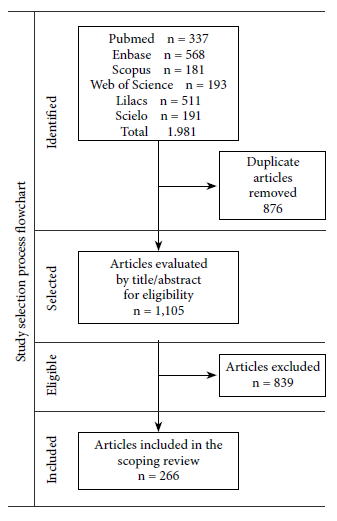
The searches were conducted on February 24, 2024, and 1,981 publications were found. After reading titles and abstracts, 320 articles were selected for full-text reading. Fifty-four were excluded for not meeting the inclusion criteria, leaving 266 articles for data collection, as illustrated in Figure 1. The supplementary material presents the list of selected articles.

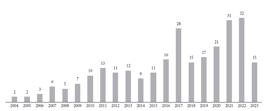
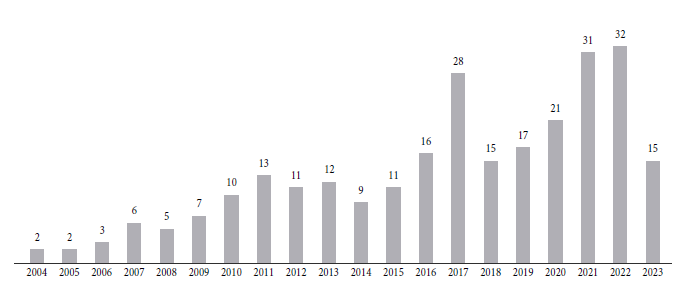
The number of published articles increased from 2004 to 2011 (from 2 to 13 articles), with a significant increase in 2017 (28 articles) and the highest number of publications in 2021 and 2022 (31 and 32 articles, respectively), as shown in Graph 1.
The studies were developed or had their development or data collection initiated from 1998 to 2022. Six percent of the total of 266 articles did not report the data collection period, 63% were developed or had their development/collection initiated from 2011 to 2022, and 15% were developed in 2014.
Regarding the methodological design, 70% of the studies were cross-sectional (188), and only 9% (25) represented studies with quasi-experimental or experimental methodology. Eighty-two percent used primary data, while secondary data were used in 11% of the articles. Figure 2 shows the total number of publications by state where the study occurred. The state of Minas Gerais had the highest number of studies conducted during the period (59), followed by São Paulo (42), and Rio Grande do Sul (23). Notably, approximately 15% (41) of the publications were conducted nationally, and 10 articles did not indicate the exact location where the study was conducted. However, we observe a noticeable scarcity of studies conducted in the northern region of the country.

Regarding the classification of publications according to the PNAF lines, Chart 1 shows a greater number of articles related to the category of promotion of RUM (134), followed by articles that address aspects of the qualification and maintenance of PS services (72) and access to medicines (25). The RUM-related themes’ line has been increasing over the years, with a high number of publications in 2013, 2021, and 2022, as shown in Graph 2. As for publications with an approach related to the qualification line, a significant increase is observed in 2017, the only year in which publications on this category exceeded those on the RUM line. The peak of publications on the qualification and maintenance of PS services was observed in 2022.

It was observed that, within the Brazilian PHC, studies on Pharmaceutical Services that address lines related to the Health Surveillance Policy (n = 6) - which advocates access to safe and quality products, drug lists (n = 6), and topics related to the development, appreciation, training, retention, and capacity building of human resources (n = 11) are still scarce. The search strategy did not find articles that addressed topics related to the lines “Decentralization of pharmaceutical services”, “Official laboratory supplies”, “Internalization and development of technologies”, “Development of technological innovations”, or “Market regulation and monitoring”, using the search strategy employed.
Regarding the main themes addressed in the selected articles, approximately 38% of the publications (102) were studies on medicines use, of which 2% (6) specifically addressed the use of medicinal plants and/or herbal remedies. In general, these studies address the analysis of medicine prescriptions, adherence, and usage profiles, among others. Next, 14% of the published articles addressed the topic of PS management, with evaluations on medicine logistics, service infrastructure, medicines costs, and the like. Access to medicines was the subject in approximately 9% of the publications (25), with studies addressing medicines availability, access strategies, and/or geographical accessibility.
Discussion
Based on the mapping and analysis of scientific articles produced on PS in PHC and published over the last 20 years, since the publication of the PNAF, we identified the development of research and the achievement of space in scientific communication channels. PS research, building evidence in this field, has been fostered over the last few years with funding from research funding agencies and the Ministry of Health, through calls for proposals such as the Research Program for the SUS (PPSUS), which invested approximately BRL 33.5 million in the field from 2011 to 201415. The inclusion of the research sub-area “Pharmaceutical Services, Pharmaceutical Care, and Clinical Pharmacy” within the “Pharmacy” field of the National Council for Scientific and Technological Development (CNPq) in the 2010s may have contributed to the growth of research and publications over the last few years11.
The constant growth since 2004 reached a significant point in 2017. During this period, besides the several ongoing projects, the results of the National Survey on Access and Rational Use of Medicines, funded by the Ministry of Health (MS)15, were published, covering pharmaceutical services in PHC, addressing issues directly related to the management of pharmaceutical services in the municipalities16.
The regional inequalities in publications during the period corroborate the findings of Cavalcante (2011), who observed that the distribution of scientific resources generally follows the distribution of the country’s economic activity, with particular emphasis on the Southeast and South, which have a high proportion of PhDs and technical-scientific personnel17. Yamamoto18 already pointed to inequalities in research funding and a prevalence of resources allocated to the Southeast. These regions also have the highest concentrations of postgraduate programs, the environment in which most of the country’s scientific research is developed.
Of particular relevance is the concentration on cross-sectional studies, with local focus and aimed at evaluating the profile of use, dispensing, and consumption of medicines, to the detriment of intervention studies that can attest to results stemming from a specific program, action, or investment in municipal pharmaceutical services to improve access to medicines or health outcomes.
Observational studies, in general, are based on the premise of systematic and standardized observation, in order to collect and record data or information at a given point in time, without the intention of interfering with the study variables19. Cross-sectional observational studies, the most frequently found in this review, have advantages such as lower cost and greater speed of execution, but sometimes make it impossible or difficult to conduct cause-and-effect type association analyses. Santos et al.22 highlight the importance of conducting research that addresses the impacts produced by actions or services in health. However, a low percentage of articles evaluating the impacts of PS interventions in PHC (9%) is observed, which compromises the ability of studies to produce sufficient evidence to inform decision-making in public policies.
We should also underscore that evidence found for one population is often not easily applied to others, particularly in a country with such unique characteristics across different regions and socioeconomic conditions. Some of these evidences have already been demonstrated, such as issues impacting the PS’ management capacity20 and the financing of the medicines in PHC21.
The themes addressed by scientific production during the period express the complex “set of actions” involved in the implementation of the PNAF. To enable access to medicines in Brazil as a fundamental human right established as a result of public policies, PS encompass supply and several technical actions under the responsibility of municipal management23-25 and primary care services. Bermudez26 states that access to medicines is “the relationship between the need for medicines and their relevant supply, in which this need is satisfied at the time and place required by the user, with the guarantee of quality and sufficient information for proper use”. However, some authors resort to the debate about differences between access and accessibility, and that, when talking about access to medicines, it is also necessary to consider access to services, since the supply of the product (medicine) alone is not enough27.
Although the themes addressed have been categorized, many studies respond to more than one research question and line of the PNAF. Almost a third of the studies addressed issues directly or indirectly related to access to medicines, whether by addressing issues of PS management, access indicators, selection and lists of medicines, or a direct approach to the dimensions of access. In this sense, the PNAF’s lines are integrated and are therefore interdependent. PS management has developed from needs related to access to medicines and services and is based conceptually on the precepts of health management, understood as “a technical, political and social process”28.
Pharmaceutical management involves logistical activities at all levels of care, as well as humanistic aspects of leadership, planning capacity, management, and articulation28,29. The scientific production presented here and classified within the axes of qualification and maintenance of services has already been modifying the understanding of this management method, beyond logistical aspects. This fact shows that developing PS research in Brazil means thinking from this broad set of actions, which are defined in several research objects, but above all, doing so from the perspective of health needs22,30.
It therefore makes sense that the most significant number of publications found over the years address the line related to the rational use of medicines, considering the change in perception of the role of the pharmacist and PS, moving away from the centrality of the medicine alone, to the focus on the medicine as a necessary instrument in the health care process31,32.
The development of the pharmacist’s role, as indicated in studies addressing pharmaceutical care, must be combined with the needs of multidisciplinary teamwork. In this regard, PHC proves to be a promising space for this work, since it allows the pharmacist’s work to be developed in a broader way within health care, through the bond with the patient and the coordination of care with other professionals on the teams33. Thus, studies that address the pharmaceutical workforce focused on promoting health care can contribute to improving actions within the scope of PHC, justifying Brazilian investments in building teamwork models, such as the Family Health Care Centers (NASF) and the E-multi team34.
Still within the RUM line, a high number of medicines utilization studies have been developed in the country over the last 20 years. The development of studies in pharmacoepidemiology and pharmacoeconomics, such as medicine utilization studies, is identified as an important tool for combating inappropriate medicines use and unnecessary expenses35, and the description of such practices by research can and should guide investments in services and coping strategies.
It is also worth highlighting the inherent breadth of the URM category, due to its very concept, which is defined by the World Health Organization (WHO) at the Nairobi Conference in 198536 as the situation in which “patients receive medication appropriate to their clinical needs, in doses that meet their individual needs, for an appropriate period and at the lowest cost to them and their community”. Thus, this line includes articles that address actions governing the prescription, dispensing, and use of medicines, such as pharmaceutical care and healthcare in general, with the actions of healthcare teams. Therefore, this category would have expectedly concentrated the largest number of results.
Regarding the “Health Surveillance Policy” line, Costa et al.37 point out that there are few comprehensive studies on health surveillance related to medicines within PHC, and also note that the findings on pharmacovigilance initiatives indicate an initial stage of organization of these activities in primary care. These observations corroborate the fact that few articles on this topic were found.
The lack of articles whose central theme addressed topics such as “Decentralization of pharmaceutical services”, “Official laboratory supplies”, “Internalization and development of technologies”, “Development of technological innovations”, or “Market regulation and monitoring” may be related to the focus on primary health care, which is essentially developed at the municipal level. Therefore, regarding the axis of “Decentralization of actions”, the lack of articles may be related to the assumption that actions in PHC are, by their nature, already decentralized and, therefore, there would not actually be many publications focusing on this theme. However, further investigation is necessary to verify whether this is related to a gap in PS research in PHC or limitations inherent in the search strategy adopted.
Regarding the other fields where no related articles were found, we underscore the Federal Government’s role, through the Ministry of Health, as a promoter and coordinator of actions aimed at national development and sovereignty in terms of stimulating the production of medicines and supplies in the country.38 In addition, the National Health Surveillance Agency (ANVISA) is responsible for “regulating, controlling, evaluating and monitoring procedures, products, substances and health services and services of interest to health”39.
Final considerations
In light of the above discussion, we can conclude that conducting PS research in Brazil is, above all, about producing evidence to support the PNAF and other health policies in the country. An important strategy is the movement advocated by the WHO for Evidence-Informed Policies, to promote the systematic and transparent use of scientific evidence in the development and improvement of health policies. This initiative provides an exchange between managers, researchers, and representatives of civil society, facilitating the formulation and implementation of policies, and the management of health services and systems informed by scientific evidence.
We should also mention that studies aimed at understanding the concrete backdrop in which the identity of pharmaceutical management and services, and of the pharmacist as a health professional, have shed new light on this topic, offering a promising perspective for the advancement of training, practices, and science appropriate to what are PS and where they are in Brazil.
This study’s main limitation relates to the use of general descriptors such as “pharmaceutical services” and “primary health care”, which do not allow for the retrieval of all studies conducted during the period that address more specific topics of the National Pharmaceutical Services Policy (PNAF), such as issues related to the development, valuation, training, retention, and capacity building of human resources; market regulation mechanisms; and the development of technological innovations, for example. Other search strategies need to be developed for these specific themes. Articles on topics related to the PNAF’s core principles, but which did not include the terms applied to this research in the text, may not have been identified by the search strategy.
References
- 1 Brasil. Ministério da Saúde (MS). Resolução nº 338, de 6 de maio de 2004. Aprova a Política Nacional de Assistência Farmacêutica. Diário Oficial União 2004; 20 maio.
- 2 Bermudez JAZ, Esher A, Osorio Castro CGS, Vasconcelos DMM, Chaves GC, Oliveira MA, Santos M, Silva R, Almeida F, Pereira L, Costa V, Gomes H. Assistência farmacêutica nos 30 anos do SUS na perspectiva da integralidade. Cien Saude Colet 2018; 23(6):1937-1949.
- 3 Pinto LF, Giovanella L. Do programa à estratégia saúde da família: expansão do acesso e redução das internações por condições sensíveis à atenção básica (ICSAB). Cien Saude Colet 2018; 23(6):1903-1914.
- 4 Carvalho MN, Costa EMOD, Sakai MH, Gil CRR, Leite SN. Expansão e diversificação da força de trabalho de nível superior nas unidades básicas de saúde no Brasil, 2008-2013. Saude Debate 2016; 40(109):154-162.
- 5 Carvalho MN, Gil CRR, Costa EMOD, Sakai MH, Leite SN. Necessidade e dinâmica da força de trabalho na atenção básica de saúde no Brasil. Cien Saude Colet 2018; 23(1):295-302.
- 6 Carvalho MN, Alvares J, Costa KS, Guerra Junior AA, Acurcio FA, Costa EA, Silva R, Almeida F, Pereira L, Gomes H. Workforce in the pharmaceutical services of the primary health care of SUS, Brazil. Rev Saude Publica 2017; 51(Supl. 2):16s.
- 7 Souza GS, Costa EA, Barros RD, Pereira MT, Barreto JL, Guerra Junior AA, Silva R, Almeida F, Gomes H. Characterization of the institutionalization of pharmaceutical services in Brazilian primary health care. Rev Saude Publica 2017; 51(Supl. 2):7s.
- 8 Tavares NUL, Luiza VL, Oliveira MA, Costa KS, Mengue SS, Arrais PSD, Silva R, Almeida F, Pereira L. Free access to medicines for the treatment of chronic diseases in Brazil. Rev Saude Publica 2016; 50(Supl. 2):7s.
- 9 Alvares J, Guerra Junior AA, Araujo VE, Almeida AM, Dias CZ, Ascef BO, Silva R, Pereira L, Gomes H. Access to medicines by patients of the primary health care in the Brazilian Unified Health System. Rev Saude Publica 2017(Supl. 2); 51:20s.
- 10 Conselho Nacional de Desenvolvimento Científico e Tecnológico (CNPq). Diretório dos grupos de pesquisa no Brasil. Lattes [Internet]. 2024 [citado 2024 set 29]. Disponível em: https://lattes.cnpq.br/web/dgp
- 11 Mendes SJ, Carnut L, Leite SN. Pesquisa em assistência farmacêutica no Brasil. In: Storpirtis R, Mori ALPM, Yochiy A, Faria ALJ, organizadores. Farmácia clínica e cuidado farmacêutico - ciência, educação e prática profissional. São Paulo: Atheneu; 2024. p. 769.
- 12 Brownson RC, Baker EA, Leet TL, Gilles Pie KN, True WR. Evidence-based public health. New York: Oxford University Press; 2011.
- 13 Peters MDJ, Godfrey C, McInerney P, Munn Z, Tricco AC, Khalil H. Chapter 11: Scoping reviews (2020 version). In: Aromataris E, Munn Z, editors. JBI manual for evidence synthesis. Adelaide: JBI; 2020.
- 14 Tricco AC, Lillie E, Zarin W, O'Brien KK, Colquhoun H, Levac D, Moher D, Peters MDJ, Horsley T, Weeks L, Hempel S, Akl EA, Chang C, McGowan J, Stewart L, Hartling L, Aldcroft A, Wilson MG, Garritty C, Lewin S, Godfrey CM, MacDonald MT, Langlois EV, Soares-Weiser K, Moriarty J, Clifford T, Tunçalp Ö, Straus SE. PRISMA extension for scoping reviews (PRISMA-ScR): checklist and explanation. Ann Intern Med 2018; 169(7):467-473.
- 15 Gadelha CAG, Costa KS, Nascimento Junior JM, Soeiro OM, Mengue SS, Motta ML, Silva R, Almeida F, Pereira L. PNAUM: integrated approach to pharmaceutical services, science, technology and innovation. Rev Saude Publica 2016; 50(Supl. 2):3s.
- 16 Alvares J, Alves MCGP, Escuder MML, Almeida AM, Izidoro JB, Guerra Junior AA, Silva R, Pereira L, Gomes H. Pesquisa nacional sobre acesso, utilização e promoção do uso racional de medicamentos: métodos. Rev Saude Publica 2017; 51(Supl. 2):4s.
- 17 Cavalcante LR. Desigualdades regionais em ciência, tecnologia e inovação (CT&I) no Brasil: uma análise de sua evolução recente. Brasília: Ipea; 2011.
- 18 Yanomoto OH. Financiamento da pesquisa no Brasil: distorções e desigualdades. Estud Psicol (Natal) 2000; 5(2):279-287.
- 19 Zangirolami-Raimundo J, Echeimberg JO, Leone C. Research methodology topics: cross-sectional studies. J Hum Growth Dev 2018; 28(3):356-360.
- 20 Faraco EB, Leite SN. Avaliação da capacidade de gestão da assistência farmacêutica na atenção primária à saúde dos municípios brasileiros [tese]. Florianópolis: UFSC; 2023.
- 21 Oliveira WR, Santana RS, Leite SN. O financiamento de medicamentos nos municípios no Brasil: de quem é a responsabilidade? Rev Saude Publica 2024; 58:48.
- 22 Santos AO, Barros FPC, Delduque MC. A pesquisa em saúde no Brasil: desafios a enfrentar. Saude Debate 2020; 43(n. esp. 5):126-136.
- 23 Leite SN, Guimaraes MCL, Rover MRM, Mendes SJ. Gestão da assistência farmacêutica. In: Leite SN, Soares L, Mendes SJ, Vilvert AF, Schneider LMC, organizadores. Gestão da assistência farmacêutica. Florianópolis: EDUFSC; 2016.
- 24 Bermudez JAZ, Costa NRN, Noronha JC, organizadores. Desafios do acesso a medicamentos no Brasil. Rio de Janeiro: Editora Fiocruz; 2020.
- 25 Karnikowski MGO, Galato D, Meiners MMMA, Silva EV, Gerlack LF, Bos AJG, Silva R, Almeida F, Pereira L. Caracterização da seleção de medicamentos para a atenção primária no Brasil. Rev Saude Publica 2017; 51(Supl. 2):9s.
- 26 Bermudez JAZ. Indústria farmacêutica, Estado e sociedade: crítica da política de medicamentos no Brasil. Rio de Janeiro: Sociedade Brasileira de Vigilância de Medicamentos; 1995.
- 27 Soares L, Santos RI. O processo saúde-doença-cuidado. In: Santos RI, Farias MR, Pupu GD, organizadores. Políticas de saúde e acesso a medicamentos. Florianópolis: EDUFSC; 2016. p. 21-58.
- 28 Guimaraes MCL, Santos SMC, Melo C, Silva R, Almeida F, Pereira L. Avaliação da capacidade de gestão de organizações sociais: uma proposta metodológica em desenvolvimento. Cad Saude Publica 2004; 20(6):1642-1650.
- 29 Leite SN, Farias MR, Manzini F, Mendes SJ, Rover MRM, organizadores. Gestão da assistência farmacêutica: proposta para avaliação no contexto municipal, a experiência em Santa Catarina. Florianópolis: UFSC; 2015.
- 30 Vargas Pelaez CM, Soares L, Rover MRM, Blatt CR, Mantel Teeuwisse A, Buenaventura FAR, Silva R, Almeida F, Pereira L. Towards a theoretical model on medicines as a health need. Soc Sci Med 2017; 178:167-174.
- 31 Melo DO, Castro LLC. A contribuição do farmacêutico para a promoção do acesso e uso racional de medicamentos essenciais no SUS. Cien Saude Colet 2017; 22(1):235-244.
- 32 Mendes SJ, Soares L, Leite SN, Silva R, Almeida F, Pereira L. Pharmaceutical services in primary health care (PHC) in São Paulo: a participant observation study. Cad Saude Colet 2022; 13(4):831.
- 33 Mendes SJ, Farisco M, Leite SN, Storpirtis S. A broad view of pharmaceutical services in multidisciplinary teams of public primary healthcare centers: a mixed methods study in a large city in Brazil. Prim Health Care Res Dev 2022; 23:e31.
- 34 Bispo Junior JP, Almeida ER. Equipes multiprofissionais (eMulti): potencialidades e desafios para a ampliação da atenção primária à saúde no Brasil. Cad Saude Publica 2023; 39(10):e00120123.
- 35 Melo DO, Simone ALM. Farmacoepidemiologia - aplicações no cotidiano dos serviços e sistemas de saúde. In: Storpirtis R, Mori ALPM, Yochiy A, Faria ALJ, organizadores. Farmácia clínica e cuidado farmacêutico - ciência, educação e prática profissional. São Paulo: Atheneu; 2024. p. 769.
- 36 World Health Organization (WHO). The rational use of drugs: report of the Conference of Experts, Nairobi, 25-29 November 1985. Genebra: WHO; 1987.
- 37 Costa EA, Araujo PS, Pereira MT, Souto AC, Souza GS, Guerra Junior AA, Silva R, Almeida F, Pereira L. Situação sanitária dos medicamentos na atenção básica no Sistema Único de Saúde. Rev Saude Publica 2017; 51(Supl. 2):12s.
- 38 Gadelha CAG, Temporão JG. Desenvolvimento, inovação e saúde: a perspectiva teórica e política do complexo econômico-industrial da saúde. Cien Saude Colet 2018; 23(6):1891-1902.
- 39 Brasil. Ministério da Saúde (MS). Conselho Nacional de Saúde (CNS). Resolução MS/CNS nº 588, de 12 de julho de 2018: institui a Política Nacional de Vigilância em Saúde. Diário Oficial da União 2018; 13 jul.
-
Funding
Coordenação de Aperfeiçoamento de Pessoal de Nível Superior (CAPES).
-
Data availability statement
The data sources used in the research are indicated in the body of the article. The supplementary material cited in the article is available at: https://doi.org/10.48331/SCIELODATA.WCJKBY.
The data sources used in the research are indicated in the body of the article. The supplementary material cited in the article is available at: https://doi.org/10.48331/SCIELODATA.WCJKBY.

 Source: Authors.
 Source: Authors.
 * For the purpose of creating the map, studies conducted in more than one state (5), national studies (41) and those not reported (10) were not included. Source: Authors.
 Source: Authors.