
 Twenty years of the Primary Care Reform in Portugal: lessons learned and new challenges
Abstract
In 1971, in a disruptive process with the dominant culture, the creation of a community network of health centers was begun in Portugal, with universal coverage of the national territory. In October 2005, an ambitious PHC reform was launched. The experience of this reform is now being revisited, motivating some reflections on the lessons learned and on challenges for the future. The last 20 years have been divided into four periods: from 2005 to 2010, marked by the reformist impulse that transformed the traditional hierarchical organization of health centers into networks of multidisciplinary family health service (FHS) teams; between 2010 and 2015, focusing on the severe financial crisis that affected the global economy; from 2015 to 2020, marked by economic and social consequences and the post-crisis recovery; and between 2020 and 2025, tainted by the COVID-19 pandemic, the lasting impacts of the pandemic, and, in the past two years, the generalization of the joint administration of primary, long-term, and hospital care under the legal figure of local health units (LHUs). Considering the full spectrum, the authors propose the integration of the aspects analyzed under the multidimensional perspective of the concept of Local Health.
Key words:
Health Center; Primary Health Care Reform; National Health Service; Local Health Units; Local Health
Resumo
Em 1971, num processo disruptivo com a cultura dominante, foi iniciada em Portugal a criação de uma rede comunitária de centros de saúde, com cobertura universal do território nacional. Em outubro de 2005, foi impulsionada uma ambiciosa reforma dos CSP. A experiência dessa reforma é agora revisitada, motivando algumas reflexões sobre as lições aprendidas e sobre desafios para o futuro. Os últimos 20 anos foram divididos em quatro períodos: o de 2005 a 2010, marcado pelo impulso reformista que transformou a organização hierárquica tradicional dos centros de saúde em redes de equipes multiprofissionais de saúde familiar; entre 2010 a 2015 decorreu a grave crise financeira que afetou a economia global; de 2015 a 2020, sobressaíram as consequências económicas e sociais e a recuperação pós-crise; finalmente, de 2020 aos dias atuais viveram-se: a pandemia de COVID-19; os efeitos do desgaste pandémico; e, nos últimos dois anos, a generalização da administração conjunta dos cuidados de saúde primários, continuados e hospitalares sob figura jurídica de unidades locais de saúde (ULS). Os autores propõem a integração dos aspetos analisados na perspetiva multidimensional do conceito de Saúde Local.
Palavras-chave:
Centro de Saúde; Reforma dos Cuidados de Saúde Primários; Serviço Nacional de Saúde; Unidades Locais de Saúde; Saúde Local
Resumen
En 1971, en un proceso disruptivo con la cultura dominante, se inició la creación de una red comunitaria de centros de salud en Portugal, con cobertura universal del territorio nacional. En octubre de 2005 se puso en marcha una ambiciosa reforma de la atención primaria de salud. Ahora se revisa la experiencia de esta reforma, lo que motiva algunas reflexiones sobre las lecciones aprendidas y sobre los desafíos para el futuro Los últimos 20 años se han dividido en cuatro períodos: de 2005 a 2010, marcados por el impulso reformista que transformó la organización jerárquica tradicional de los centros de salud en redes de equipos de salud familiar multiprofesionales; entre 2010 y 2015 se produjo la grave crisis financiera que afectó a la economía mundial; de 2015 a 2020, se destacaron las consecuencias económicas y sociales y la recuperación posterior a la crisis; finalmente, entre 2020 y 2025 hubo: la pandemia de COVID-19; los efectos de la ropa pandémica; y, en los últimos dos años, la generalización de la administración conjunta de la atención primaria de salud, a largo plazo y hospitalaria bajo la figura jurídica de las unidades locales de salud (ULS). Considerando todo el recorrido, los autores proponen la integración de los aspectos analizados desde la perspectiva multidimensional del concepto de Salud Local.
Palabras clave:
Centro de Salud; Reforma de la Atención Primaria de Salud; Servicio Nacional de Salud; Unidades Locales de Salud; Salud Local
The beginning - Primary Health Care - 1971 to 2005
Most would agree that Primary Health Care (PHC) in Portugal has evolved consistently, despite periods of stagnation, decline, and deviations. The foundations date back to the early 1970s. In 1971, in a disruptive process with the then dominant culture, the creation of a community network of health centers was begun, seeking to achieve universal coverage for the national territory1,2.
The concept of a health center marked a turning point in the way of observing and acting in health. It was a visionary innovation implemented in Portugal and, at around the same time, in Finland. It preceded, by a few years, the PHC movement launched by the World Health Organization (WHO) in 1976-1980, which had as its historical landmark the WHO-UNICEF International Conference of 1978, in Alma-Ata (now Almaty), Kazakhstan3. The health center brand is simple and clear. It is quite easy to learn, understand, and communicate, and has positive connotations. It is a close, accessible, and available service that brings together and coordinates an organized set of professionals, teams, skills, and resources to promote and protect the health of each person, family, and local community. It is a resource that belongs to the community itself, counting on participation from the community, and is capable of meeting the vast majority of people’s daily health care needs. It also cares for the population in its local community as a whole. The first health centers, known as “first generation”, were essentially dedicated to preventive activities and were led by public health doctors and nurses. Between 1971 and 1982, approximately 350 centers were created, at least one in each county, corresponding to a municipality. Their purpose was to improve the health of their community. They did not offer “curative” care. This was provided by more than 2,000 medical posts of the Social-Medical Services within Pension Funds, which hired doctors with and without specializations. The creation of the first health centers was the result of the business vision, political skill, persistence, and knowledge of three individuals - a politician, Baltazar Rebelo de Sousa; an entrepreneur, Arnaldo Sampaio; and a scholar, Francisco Gonçalves Ferreira. The first two were the parents of two presidents of the Portuguese Republic, Marcelo Rebelo de Sousa and Jorge Sampaio. The third had no children1.
In 1982/1983, health centers began to include curative care from the medical posts of the Social-Medical Services within Pension Funds.
At that time, the medical career of the general practitioner, the role of the family doctor, and the specialization in general and family medicine were created. Each doctor had a list of around 1,500 people under his care, preferably registered by families. Thus, from 1982 onwards, health centers counted on thousands of family doctors, the vast majority of whom were young. Specific training and specialty internship (residency) programs were organized on a large scale in various areas of the country. However, the bureaucratic model of organization and management of these health centers, with no management autonomy and with isolated and passive-reactive professional work, produced results that fell short of what was desired and caused dissatisfaction among medical professionals4-6.
In 1996/1997, experiments were set in motion to reorganize small groups of family doctors with multidisciplinary teams (“Alpha Projects” and “Groups in Experimental Remuneration Regime”), in an attempt to improve the organization and the impact of health centers on the health and well-being of individuals and the population in general. Each of these units had its own coordination team, promoting a system of connective leadership, with increased commitment, involvement, and enthusiasm among professionals. However, between 1999 and 2005, the succession of ministers and health policies led to zigzags and contradictions. The movement of change that began between 1996 and 1999 halted. Only a small number of teams had made progress. The end of 2005 witnessed a new change in the political cycle.
20 years of Primary Health Care Reform - 2005 to 2025
The reformist impulse - 2005 to 2010
In October 2005, Portugal formally began an ambitious PHC reform. In this light, the present article aims to describe and analyze this reform process over a 20-year period, which will be completed in October 2025.
The main objectives for PHC reform were to provide more and better health care for citizens, increase accessibility, and, consequently, increase user satisfaction with the services. The aim also sought to increase professional satisfaction by creating good working conditions, improving organization, and rewarding good practices. At the same time, efficiency had to be improved and cost containment promoted. PHC reform was part of the broader framework of reforms in the Public Administration. It included the reconfiguration of health centers with a traditional hierarchical organization, following a two-pronged movement: (1) establishment of small autonomous functional units, with emphasis on family health units (FHUs) and community care units (CCUs) - providers of health care to the general population and (2) the creation of clusters of health centers, promoting the accumulation of resources and management structures, eliminating structural competition and achieving economies of scale. Following the provisions of the Government Program, the Council of Ministers7 created the Mission for Primary Health Care (MPHC), directly reporting to the Minister of Health, in a mission structure, to conduct the project toward the launch, coordination, and follow-up of the reconfiguration of health centers and the implementation of small autonomous functional units. In this resolution, the MPHC is responsible for, among other tasks: supporting the reconfiguration of health centers (HCs) into FHUs and other functional units, playing the role of providing for the initiatives of health professionals; technically coordinating the overall process of launching and implementing these units, as well as other aspects of the reconfiguration of HCs; performing evaluative functions, regulating conflicts, and providing effective support to FHU applications; proposing strategic and technical guidance concerning human resources policies, the ongoing training of professionals, and policies to encourage performance and quality, to be applied in a Basic Health Unit (BHU); preparing the terms of reference for contracts set up between ARS and HCs, as well as between these and FHUs; promoting the launch of innovative ways to improve coordination with other care units, namely with hospitals and continuing care; proposing, in accordance with the law, modalities for the participation of municipalities, cooperatives, and social and private entities in the management of CS and BHUs.
In this important initial stage, the MPHC was responsible for leading this profound reconfiguration, accompanying all stages of the reform, from its design to its implementation on the ground, which was one of the success factors of this first stage.
The Program of the 17th Constitutional Government, in the health area, gave a particular focus to the PHC and its importance in connecting with the user, as this is the first access for the user to health care. It explicitly stated that PHC is the core pillar of the health system, that the HC constitutes the umbrella entity for the FHUs, and that the following policy measures would be adopted: restructuring of HCs through the creation of FHUs, in accordance with the following principles: (1) small, self-organized multidisciplinary teams; (2) functional and technical organizational autonomy; (3) contracting of a basic portfolio of services; (4) decentralized diagnostic means; (5) a remuneration system that rewards productivity, accessibility, and quality;8,9 integrating of FHUs into a network and possible adoption of different legal frameworks in their management, whether belonging to the public administrative sector or to the cooperative, social, and private sectors; and the strengthening of incentives and training for family doctors, attracting young candidates. By Resolution of the Council of Ministers, the MCSP’s mandate was extended for two years and then for another year. The MPHC ended its mandate on April 14, 2010, after four and a half years of activity.
The financial crisis between 2010 and 2015
In May 2011, under the effects of a severe economic crisis, Portugal signed a Memorandum of Understanding with the International Monetary Fund (IMF), the European Commission, and the European Central Bank, in exchange for a loan of 78 billion Euros. The Memorandum of Understanding contained more than 50 concrete measures and actions related to healthcare, with the aim of saving 664 million Euros in this sector.
One important consequence was a dramatic cut in public spending on healthcare (where public expenditure on the National Health Service (NHS) represents 66% of total healthcare expenditure), which reduced spending in real terms by 8.2% in 2011 and 9.5% in 2014, which still proved to be nearly 10% lower than its peak in 2010, reflecting the impact of the economic crisis and the subsequent Memorandum of Understanding. Although this procedure represented an opportunity to optimize processes and reduce waste, in reality, some cuts were disproportionate due to the lack of rigorous evaluation.
The economic crisis has hit all of Europe, but economic crises represent both a stimulus and a barrier to reforming health systems. In many respects, the financial crisis provided a window of opportunity and a stimulus for reform.
The impact of the crisis on health in Portugal proved to be smaller than in other countries, due largely to the organization of health services in an NHS and the recent PHC reform.
From the onset, the second stage of the reform revealed a set of problems typical of the process of implementing health center clusters (HCCs). Among them was the lack of qualified human resources in management areas and the lack of financial autonomy granted to these new administrative units. One study carried out by the Organization for Economic Cooperation and Development (OECD)10 in 2015 concerning the Brazilian health system shows that, in general, the health system offers high-quality care at a low cost. One of the strengths highlighted in the OECD report is that the Portuguese PHC system is geared towards measuring, ensuring, and improving quality. Unlike most OECD health systems, Portugal has a wealth of information available in its PHCs, monitoring a large number of indicators. The OECD considers that the Portuguese health system has responded well to financial pressure, managing to balance the need to consolidate public finances with improvements in quality10.
However, some challenges remain. The disparity between the untransformed portion of health centers and the new FHUs in key quality indicators is a cause for concern. Nevertheless, the OECD recommends a strategic reflection in the area of PHCs in order to ensure that high-quality care is accessible to the entire Portuguese population10.
Post-crisis recovery between 2015 and 2020
This stage was essentially marked by the recovery from the economic crisis and the reformulation of governance, with a set of measures, the most notable of which was the review and improvement of the contracting process. At the end of 2018, 532 FHUs were in operation (278 model A - without payment linked to performance and 254 model B - with payment linked to performance)11.
When the 21st Constitutional Government took office in November 2015, the country’s economic situation was still fragile. The deficit, as a percentage of GDP, was 4.4% in 2015, forcing the continuation of policies to contain spending and increase revenues under penalty of imposition of fines. Portugal officially exited the excessive deficit procedure on June 16, 2017.
It is important to note that the crisis and weak policies led the NHS to poorly spend scarce resources, which generated serious problems and inequalities in access, lacking strategic vision and the capacity to implement essential organizational reforms. In February 2016, the Ministry of Health launched the Strategic Plan for the PHC Reform in order to resume the 2005 Reform and expand the number of NHS users with a family doctor. This plan aimed to guarantee a Family Doctor in the NHS for all citizens. This goal has yet to be achieved despite significant investments in human resources and infrastructure over the past few years, as new work organization models are needed to meet the new needs and demands of citizens, but above all to mitigate the difficulties of access already diagnosed. During the second and third stages, two important activities were carried out: the evaluation of the health system and the development of information systems. Increased transparency has gained ground with the creation of the NHS Portal, which provides real-time national information on waiting times for emergency services and outpatient consultations at NHS hospitals. At the same time, it is possible to learn about the activity of each NHS unit, as well as its financial situation and delays in payments to service providers, although the accountability process can still be improved.
The COVID-19 Pandemic - 2020 to the present day
The COVID-19 crisis has demonstrated the importance of placing PHC at the heart of health systems, both to manage an unexpected surge in demand and to maintain continuity of care for all. A strong PHC service - organized in multidisciplinary teams and with innovative roles for health professionals, integrated with community health services, equipped with digital technology and working with well-planned incentives - helps to deliver a successful health system response12.
Promising and innovative developments in PHC have been accelerated during the pandemic. These efforts need to be expanded further in order to ensure that health systems are more resilient to future public health emergencies, as well as to address the challenges of aging societies and the growing burden of chronic diseases.
PHC has reduced pressure on the back-end services of health systems by providing proximity-based, comprehensive and preventive care during and after the pandemic crisis. However, COVID-19 has had a complex impact on PHC. There have been many contexts where access and coordination have improved, due to better resources and information flows, and with a reduction in the scope of services.
PHCs have been the cornerstone of the response to COVID-19 and have proven to be highly adaptable to meet the specific demands of the pandemic, but they require sufficient resources, equipment, training, and funding. It was quickly understood that something had to be done to reduce the pressure on emergency departments and hospitalizations. Therefore, it is urgent to think of creative solutions to be able to cope with the capacity to respond to a sudden change in demand and supply dynamics in the future. It remains to be seen whether the experience gained now will translate into knowledge and sustainable implementation in the future.
Everyone recognized that PHC was a key component in the response to COVID-19. These services were able to reinvent themselves quickly. In the context of a pandemic, promoting health literacy also gained renewed importance among individuals, communities, and organizations, becoming an important public health tool. Above all, it was essential to achieve appropriate behaviors - individual or group - and non-pharmacological measures, which were key to preventing and controlling the pandemic. In the future, we will need the population to incorporate into their routine a series of behaviors associated with protection against respiratory infections. Health literacy cannot fail, nor can communication. Both are interconnected and still have a long way to go.
2024 - Primary health care (PHC) and hospitals under the same administration
The new Health Guidelines and Framework Law established that the NHS must base its actions on the integration of care13. This integration aims, among other things, to ensure that NHS beneficiaries have access to the type of care that best meets their actual needs. Article 5 of the new NHS Statute14 also determined that NHS establishments and services must guide their operations by providing proximity, integrating care, and coordinating responses. Among these organizational models, local health units (LHUs) stand out as legal entities responsible for promoting the integrated provision of primary and hospital care. Twenty-five years after the creation of the first LHU15 in Matosinhos in 1999, they were spread throughout the country. Currently, there is a movement to reorganize the NHS, the ultimate goal of which is to organize healthcare responses according to people’s needs. To assess the current situation in healthcare, we can refer to the report by the Public Finance Council, which in June presented its study on the “Evolution of the performance of the NHS” and to the Health Regulatory Authority, which published the Study “Primary Healthcare: Quality and Efficiency in UPHC and FHU”. According to the Public Finance Council16, in 2023, NHS hospital activity increased, but not enough to meet demand. In primary care, the number of medical consultations decreased. Within the scope of the National Network of Integrated Continuing Care, the greater number of users served in 2023 was not enough to respond to the increase in the number of people referred that year. The Public Finance Council therefore concluded that the level of activity of the NHS was insufficient to meet the growing needs of the population. With regard to unmet health needs, Portugal, already in 2019 (the last year for which information was published by Eurostat), had the highest level of “population with health care needs that reported unmet health needs” among the countries of the European Union and the European Economic Area. The main cause of unmet needs was waiting lists. The persistence of unmet needs, among other indicators, point to problems of inefficiency in the NHS.
From a budgetary point of view, the NHS deficit decreased in 2023, but late payments increased. In 2023, the number of SNS users increased to 10.6 million registered users, of whom 1.7 million people (16%) did not have a family doctor assigned. Compared to 2022, this represents an additional 230 thousand people in this situation. Thus, a significant gap continued to be observed in primary care between the activity carried out and that which would be necessary to meet the needs of the population.
The constraints on primary care activity as the first point of contact with the NHS, namely the greater proportion of people not registered with Family Health Units and the growing number of citizens without a family doctor, which are factors that limit access to the NHS and which may put pressure on emergency and inpatient services, sometimes forcing hospitals to redirect resources from scheduled activity to meet demand in emergency services. The saturation of access to the public health response has resulted in an increase in unmet health needs, reported according to the OECD by 40% of the Portuguese population in 2019. The highest figure in the EU.
In Portugal, the main reasons given for the existence of unmet health needs include: 1) waiting lists (which increased in 2023 for the first medical consultation, for those registered for surgery and for access to the National Network of Integrated Continuing Care) and 2) financial reasons, reflected in the increase in direct payments by users, due to the greater need to resort to private providers, a situation that is especially serious for families with lower incomes.
With regard to quality assessment, the comparison of international indicators revealed that, both in terms of the quality of upstream care (prevention) and downstream care (hospital admissions), Portugal performed above the average of OECD countries in all indicators analysed between 2019 and 2022.
This study used indicators provided by the OECD itself, such as avoidable hospitalisations as a result of the effectiveness of care provision in PHC. Since the provision of PHC tailored to the needs of users can reduce the number of unnecessary hospital admissions, avoidable hospitalisations are considered an indirect measure for assessing the quality of primary care.
According to the OECD, asthma, chronic obstructive pulmonary disease, heart failure and diabetes are examples of chronic diseases whose treatment is well defined and can be carried out at the primary health care level. Based on this criterion, Portugal stood out as the third in the group of OECD countries with the lowest number of hospital admissions motivated by clinical conditions ,such as asthma, chronic obstructive pulmonary disease, and heart failure, says the national regulator. In addition, it showed a “significant drop” in the number of avoidable hospitalizations for diabetes, becoming the second country with the fewest hospital admissions of this type, in a ranking led by Iceland. Among the 25 countries analyzed in this study, Portugal recorded the lowest number of hospital admissions for hypertension in 2022, confirming the downward trend since 2019.
In terms of short-term quality, Portugal performed above the OECD average in all analyzed indicators17. From a long-term perspective, the OECD considers that the criterion for hospital admissions due to lower limb amputations in diabetic patients reflects the quality of CAPS, as it indicates that this care was effective in preventing the progression of the disease and its complications. In this indicator, Portugal also recorded a value below the average of the OECD countries analyzed in this study. In terms of access, the study reports that, at the end of 2022, 87% of users registered at health centers had a family doctor assigned. The study confirms that the North region had the highest percentage of users registered with a family doctor assigned (97.4%), while Lisbon and Vale do Tejo had the lowest percentage (74.8%). In December 2022, a total of 6,056 doctors and 6,517 nurses worked in PHC in mainland Portugal.
The OECD also published its Health System Assessment and Comparability of a Set of Validated Indicators in late 202418. It examines two interconnected priorities: a) promoting healthy longevity and b) addressing workforce shortages in the health sector. These challenges are key to managing the balance between demand and supply capacity in European health systems. The EU faces a health workforce shortage, with an estimated 1.2 million doctors, nurses, and midwives in 2022. The shortage is the result of multiple factors: demographic aging affects both patients and the health workforce itself, combined with difficult working conditions that contribute to staff burnout and retention difficulties - challenges that have been further exacerbated by the COVID-19 pandemic. Bold policy interventions are needed in three key areas: expanding training capacity, improving working conditions to attract and retain talent, and leveraging innovations to increase productivity.
Lessons learned
The content of a reform is sometimes considered to be less important in its public and legislative approval than the timing of its presentation, the way it is presented and discussed with stakeholders, and a multitude of other factors.
The OECD has developed a cross-cutting project on these issues, called “Making Reform Happen”19. The factors behind the implementation of successful reforms have been studied, based on evidence from countries that have seen their health systems analyzed by the OECD in recent years and on an exhaustive review of the literature. The project considers several issues in particular, used in all the different areas studied: the existence of adequate institutions to support reforms, from decision to implementation; the impact and reactions of those affected by the reforms; the reform agenda; the timetable; the interactions between the different areas; the role of evidence and international organizations in supporting reforms. It is concluded that some phases of reform have to be completed before a reform can be said to have been successful; a failure in one of them usually leads to its failure. Specific issues of the health sector include, among others, the role of professional groups that provide health services, information, available evidence, international comparisons of health system performance, a clear diagnosis and an attractive design for reform, the use of political “windows of opportunity”, the use of incentives to align stakeholder interests with reform intentions, and ensuring sufficient resources to “grease the wheels of change”.
It is necessary to assess the performance of health systems - and their reforms - taking into account the main objectives of health policy. The OECD’s work has focused mainly on access, responsiveness, sustainability, quality, equity, and efficiency. We would like to highlight how important it is for the success of the reform that the creation of the FHU is a voluntary process from the bottom up, with the full involvement of health professionals. They choose the team, define an action plan, have organizational and management autonomy, based on objectives, and share responsibility. Also important was the existence of strong political support and good interaction with the media. Finally, the focus on improving accessibility to services for users and improving the quality of care was decisive.
The disappearance of the MPHC, after the planning, start-up, and implementation stages of the essential aspects and components had been completed, paved the way for a second stage of development with the institutionalization and internalization of the mechanisms for conducting the reform, raising some concerns about its sustainability. The opening of new FHUs and the overcoming of 50% coverage by this new organizational model were ensured by the more than one hundred applications in the pipeline. However, the sustainability of the reform is greatly conditioned by the growing and threatening lack of human resources, mainly family doctors; by the capacity to overcome the shortcomings of the information system; by being able to make the functional units of the HCC work in a network; and by the existence of more effective monitoring and evaluation mechanisms. However, and above all, the greatest risk to the sustainability of any reform has to do with changes in political priorities and a possible political disinvestment.
According to Pedro Ferreira et al.20, the PHC reform, then underway, initially embodied by the implementation of new management measures and the creation of the FHU, was possible thanks to a fortunate combination of three fundamental determinants: the will of the professionals and their commitment to change, the professional leadership led by a mission team and, finally, the constant political support from the Ministry of Health. The absence of any of these pillars of development would have made the entire process unfeasible.
Future challenges
The experience of the PHJCV reform in Portugal, revisited after 20 years, prompts some reflections and perspectives. Considering the progress, mistakes, obstacles, difficulties, setbacks, and vicissitudes encountered along the way, considerations such as those highlighted below occurred to us.
Need to maintain a multidimensional systemic approach
Although this is a first-order necessity, it has been difficult to maintain a multidimensional, integrated systemic approach beyond the specific focus of each reform. It will be necessary to ensure stable strategic governance and to outline a “navigation chart” with a panel of indicators (“tableau de bord”) to measure the movement and evaluate the paths and results of the change, taking into account the systemic whole.
Maintain a mission team, or equivalent, until the planned change has been completed
The lessons learned highlight the importance of having a mission team, or equivalent, in place until the planned transformations have been completed. This requires commitment and political support. It is critical to judge, together with decision-makers, the need to maintain long-term stability in health policies, beyond the usual short political cycles,
Define and adhere to a timetable for the transformation process until its completion
Without an explicit timetable for the desired transformation, a mosaic of situations and inequities can result, whether among citizens who use services or among health professionals and teams. Equitable access to quality health care is a key requirement for any transformation in such a complex system as health. Inequalities associated with the “work in progress” of a reform become unacceptable beyond a transitional period.
Active and organized social participation of users and communities
It is crucial to avoid confinement by institutional, professional, and commercial interests. To counterbalance and balance these processes properly and with common sense, structured methods and means of informed and active social participation can be used, involving both citizens and community organizations, namely local sovereign bodies, in the processes of reform and change of their public health services.
Clinical and health governance
One of the key challenges is to develop concepts, strategies, practices, and a network of clinical and health governance, including their institutionalization at the local level through multidisciplinary councils or teams dedicated to this function. Clinical and health governance in places where it was sufficiently developed between 2009 and 2023 made it possible to supervise, coordinate, and guide the various local teams, harmonize care processes and obtain better access, safety, efficiency, quality, integration, and continuing care. The variation in priorities, the preponderance of immediacy and the discontinuity of policies have weakened the development of this area. This line of action will need to be resumed and strengthened, primarily to ensure integrated care pathways between the different types of care, including continuing and palliative care, with simplified circulation, without delays, or the loss of time and information.
Training and continuous evaluation of managers for collaborative leadership21
Basic training and experience acquired by managers, or simply replacing them, do not guarantee the success of a reform. It will therefore be essential to design and implement structured, adaptive, and well-coordinated training and ongoing assessment programs for institutional and intermediate managers and local team coordinators, involving and committing them to transformative processes.
Environments and careers capable of generating motivation and satisfaction among professionals
Another challenge, perhaps the most critical, is to develop integrated governance and management models capable of managing the expectations of users and professionals, and responding to their needs. This objective requires an integrated, collaborative and local process, involving health centers, hospitals, other health services, local authorities, and the various structures of the social network. With regard to professionals, it will be necessary to meet their expectations and aspirations, including how they envisage their ongoing professional development and corresponding rewards, as well as being able to reconcile the dimensions of their lives: personal, family, and professional.
Health information system at the service of people
Technological innovation enables more advanced health information systems, supported by the digital transition and the intelligent use of the possibilities of so-called “artificial intelligence”, always geared towards a positive health culture. The health information system must be an instrument that facilitates personal and collective health processes22. The unified, integrative personal electronic health record will be the central axis of a health information system at the service of people. A record that includes the personal care plan, which is permanently updated and that can be easily used, in which each person can exercise a level of self-determination in line with one’s rights and knowledge.
In terms of technology, interoperability is a critical priority. Data and information must flow securely within the same organization and between the different levels and types of care and different organizations, allowing individuals and the health professionals authorized by them to know, monitor, manage, and reproduce their health journey.
There will be a need to create a structure dedicated to the governance of the health information system and to develop an integrated quality management system for this structure, which includes the participation and involvement of people22.
Further the concept of local health and develop health centers
The current dominant care model has become inadequate. Focused on hospitals, acute illness, and remedial care, it responds poorly to current challenges. The organization by institutional silos and professional segments exacerbates the problem. This serves to increase dissatisfaction, demotivation, and exhaustion among professionals, due to unattractive working conditions and models, with no prospects for professional development throughout life. The lack of innovation in professional careers in remuneration systems and the difficulty of reconciling work with family life and personal quality of life have led to the departure of professionals from the NHS and its low attractiveness for young health professionals.
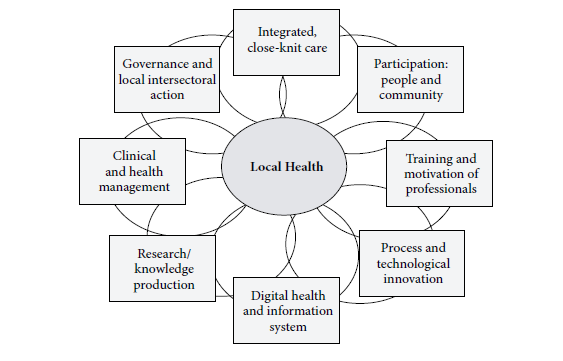
It seems to be the time and opportunity to resume and further the concept and practices of local health. From this perspective, local care and services should be the structural basis of the NHS, which reaffirms the need for a new evolution of the health center. Essential aspects of this evolution will be the connection and participation of local communities and their sovereign bodies (Figure 1). The term “local health”, unlike “global health”, is still rarely used. However, the concepts, principles, and practices inherent to it have existed for several decades. Of particular note is the conceptualization of SILOS (local health systems) by the PAHO23 in the 1990s, and several local experiences in various parts of the world.
The laying of the foundations for local health in Portugal was associated with local health systems (1999), which have been postponed to this day but are included in several laws in force, as well as with the creation of the first local health unit (ULS) in Matosinhos (1999): health centers and the local hospital. In 2023/2024, LHUs were disseminated throughout the NHS, in the hope of greater and better decision-making capacity and resource management, as well as better integration and continuity of care. In terms of the provision of care, the need to overcome the “primary care” vs. “hospital care” dichotomy has been advocated. However, at the crossroads of this resilience, different paths have been identified, sometimes divergent, sometimes contradictory. One idea that has been gaining traction is that of moving towards a new type of health center, a new evolutionary stage (Chart 1).
Proximity care - a new type of health center
In the current context of LHUs, this care should include, in addition to primary care, a considerable portion of specialist care, which until now has been provided in hospital buildings, generally far from the communities. This will make it possible to improve accessibility and availability, as well as achieve the capacity to resolve more than 90% of the health problems and needs of individuals and the population in their vicinity. Thus, it is expected to quantitatively reduce in-hospital care, with hospitals providing a support backup for problems and needs for which it is neither possible nor sustainable to maintain resources and skills close to users. On the other hand, the development of reference centers is already a national policy, and in the European Union, it has been organized in national and transnational networks, enabling the concentration of highly differentiated resources to respond to specific and/or more complex and/or rare situations.
Concluding notes
The transitions that Portuguese society is facing are diverse and complex. Major changes are taking place, particularly in the characteristics of the population of local communities, whether sociodemographic, ethnocultural, or epidemiological. Changes are also happening in society’s expectations and demands; in the diversification of professionals’ skills and expectations; in clinical and technological innovation, with increasing costs; in ethical and social dilemmas due to inequalities in access to quality care; and in the health outcomes achieved. Complex situations of multiple morbidity, including those with rare diseases, and individuals and groups in unfavorable psychosocial contexts have increased. These changes generate new patterns of needs and require a transformation of the care model. They require greater proximity, better integration, and more continuity of care, with open, dynamic, and adaptive interprofessional teams.
PHC reforms, which received strong impetus between 2005 and 2010, has come only halfway. However, it has opened up new evolutionary perspectives and enabled qualitative and quantitative advances that are evident in several health and performance indicators, particularly those published annually by the OECD18. However, it is not enough to change only one part of the system. It is necessary to trigger and harmonize changes in the remaining systemic components in order to achieve a more harmonious performance of the system as a whole.
References
-
1 Sakellarides C. Carta aberta ao meu Centro de Saúde I - a ideia do centro de saúde [Internet]. Diário de Notícias; 2023 [acessado 2024 nov 20]. Disponível em: https://www.dn.pt/arquivo/diario-de-noticias/carta-aberta-ao-meu-centro-de-saude-i-a-ideia-do-centro-de-saude-17281675.html
» https://www.dn.pt/arquivo/diario-de-noticias/carta-aberta-ao-meu-centro-de-saude-i-a-ideia-do-centro-de-saude-17281675.html - 2 Ferreira FAG. Política de Saúde em Portugal - uma experiência de definição legislativa e de organização de serviços de saúde. Lisboa: edição do autor; 1972.
- 3 Organização Mundial da Saúde (OMS). UNICEF. Conclusões e Recomendações sobre os Cuidados de Saúde Primários. Genebra: OMS; 1978.
- 4 Sakellarides CT, Oliveira LL, Albuquerque MJB, Costa IMA, Rêgo MGS. O serviço de cuidados primários de saúde (centro de saúde) - Princípios gerais e reflexões sobre uma experiência. Lisboa: Escola Nacional de Saúde Pública; 1979.
- 5 Ramos V. O ressurgimento da medicina familiar. Rev Crítica Cien Soc 1987; 23:157-168.
- 6 Associação Portuguesa dos Médicos de Clínica Geral (APMCG). Um Futuro para a Medicina de Família em Portugal. Lisboa: APMCG; 1991.
- 7 Portugal. Resolução do Conselho de Ministros nº 157, de 12 de outubro de 2005. Determina a criação de uma estrutura de missão para a reforma dos cuidados de saúde primários. Diário da República 2005; 12 out.
- 8 Portugal. Decreto-Lei n.º 298, de 22 de agosto de 2007. Estabelece o regime jurídico da organização e do funcionamento das unidades de saúde familiar (USF) e o regime de incentivos a atribuir a todos os elementos que as constituem, bem como a remuneração a atribuir aos elementos que integrem as USF de modelo B. Diário da República 2007; 22 ago.
- 9 Portugal. Ministério da Saúde. Indicadores de desempenho para as unidades de saúde familiar. Missão para os Cuidados de Saúde Primários. Lisboa: Ministério da Saúde; 2006.
- 10 Organization for Economic Co-operation and Development (OECD). Reviews of Health Care Quality: Portugal 2015. Raising standards. Lisboa: OECD; 2015.
-
11 Administração Central do Sistema de Saúde. Relatório candidaturas e constituição de USF e UCC [Internet].[acessado 2024 nov 15]. Disponível em: http://www2.acss.min-saude.pt/Portals/0/estat_nacional_2016_07_1115_24_32.pdf
» http://www2.acss.min-saude.pt/Portals/0/estat_nacional_2016_07_1115_24_32.pdf - 12 Duarte R, Lopes F, Alves F, Aguiar A, Monteiro H, Pinto M, Felgueiras Ó. COVID-19 em Portugal: a estratégia. UMinho Editora; 2022.
- 13 Portugal. Lei nº 95, de 4 de setembro de 2019. Aprova a Lei de Bases da Saúde e revoga a Lei nº 48/1990, de 24 de agosto, e o Decreto-Lei nº 185/2002, de 20 de agosto. Diário da República; 2019.
- 14 Portugal. Decreto-Lei nº 52, de 4 de agosto de 2022. Aprova o Estatuto do Serviço Nacional de Saúde. Diário da República; 2022.
- 15 Organization for Economic Co-operation and Development (OECD). Reviews of Health Care Quality: Portugal 2015. Raising standards. Lisboa: OECD; 2015.
- 16 Conselho das Finanças Públicas. Evolução do desempenho do Serviço Nacional de Saúde. Porto: 2024.
- 17 Entidade Reguladora da Saúde. Estudo Cuidados de Saúde Primários: Qualidade e Eficiência nas UCSP e USF. Porto; 2024.
- 18 Organization for Economic Co-operation and Development (OECD). European Commission. Health at a Glance: Europe 2024: State of Health in the EU Cycle [Internet]. Paris: OECD Publishing; 2024 [cited 2024 nov 20]. Available from: https://doi.org/10.1787/b3704e14-en.
- 19 Hurst J. Effective ways to realize policy reforms in health systems. Paris: OECD; 2010.
- 20 Ferreira PL, Antunes P, Portugal S. O valor dos cuidados de saúde primários. Perspetiva dos utilizadores das USF - 2009. Lisboa: Ministério da Saúde, Missão para os Cuidados de Saúde Primários; 2010.
- 21 Gordon D, McKay S, Marchildon G, Bhatia RS, Shaw J. Collaborative governance for integrated care: insights from a policy stakeholder dialogue. Int J Integrated Care 2020; 20(1):1-11.
- 22 Conselho Nacional de Saúde (CNS). Para um Melhor Sistema de Informação de Saúde ao Serviço das Pessoas [Internet]. Lisboa: CNS; 2024 [acessado 2020 nov 20]. Disponível em: https://www.cns.min-saude.pt/wp-content/uploads/2024/11/CNS-Relatorio-Sistema-de-Informacao-de-Saude-Revisto-nov.pdf.
- 23 Oficina Sanitária Panamericana. Sistemas Locales de Salud (SILOS) - Número Especial. Vol. 109(5,6). Boletín de la Oficina Sanitaria Panamericana; Noviembre Y Diciembre 1990.

 Source: Authors.