
 Digital innovation in the regulation of specialized consultations and exams in Manaus, Brazil: challenges and impacts
Abstract
The SUS Regulation System is strategic for organizing access to health services. In Manaus, it is managed by the Regulatory Complex. Traditionally, communication with users was conducted via SMS an expensive method that reached only 30% of those with scheduled appointments. The Municipal Health Secretariat (SEMSA) designed and implemented, as a nationwide first, a digital online inquiry solution to modernize communication and expand access. This study describes the development of the information system and analyzes its impacts. A mixed-methods approach was adopted: quantitative analysis of booking, confirmation, and no-show data (2021-2024) using Python, Matplotlib, and Seaborn, along with statistical projections; and qualitative analysis through interviews with managers. The system was developed in PHP and MySQL, using hybrid practices that combined agile and traditional methods. Results show growth in bookings (from 215,000 to 557,000), a reduction in the no-show rate, and a threefold increase in confirmations. Replacing SMS generated estimated savings of R$ 705,000. In 2025, the portal reached 80% of scheduled users, with an average of 10,000 authorizations per day. This experience reinforces that digital solutions yield concrete advances in management and access to public health care.
Key words:
Referrals and appointments; Teleconsultation; Digital health
Resumo
O Sistema de Regulação do SUS é estratégico para organizar o acesso aos serviços de saúde. Em Manaus, sua gestão é realizada pelo Complexo Regulador. Tradicionalmente, a comunicação com os usuários era feita via SMS, recurso oneroso e com alcance de 30% do público agendado. A Secretaria Municipal de Saúde (SEMSA) desenvolveu e implantou, de forma pioneira no Brasil, uma solução digital de consulta on-line, visando modernizar a comunicação e ampliar o acesso. Este estudo descreve o desenvolvimento do sistema de informação e analisa seus impactos. Adotou-se abordagem mista, com análise quantitativa dos dados de marcação, confirmação e absenteísmo (2021-2024), utilizando Python, Matplotlib e Seaborn, além de projeções estatísticas. A análise qualitativa incluiu entrevistas com gestores. O sistema foi desenvolvido em PHP e MySQL, com práticas híbridas entre métodos ágeis e tradicionais. Os resultados indicam crescimento nas marcações (215 mil para 557 mil), redução do absenteísmo e triplicação das confirmações. A substituição do SMS gerou economia estimada de R$ 705 mil. Em 2025, o portal atingiu 80% dos usuários agendados, com média de 10 mil autorizações diárias. A experiência reforça que soluções digitais promovem avanços concretos na gestão e no acesso à saúde pública.
Palavras-chave:
Encaminhamento e consulta; Teleconsulta; Saúde digital
Resumen
El Sistema de Regulación del SUS es estratégico para organizar el acceso a los servicios de salud. En Manaus, está gestionado por el Complejo Regulador. Tradicionalmente, la comunicación con los usuarios se realizaba por SMS, un método costoso que alcanzaba solo al 30 % de las personas con citas programadas. La Secretaría Municipal de Salud (SEMSA) diseñó e implementó, como primera iniciativa en el país, una solución digital de consulta en línea para modernizar la comunicación y ampliar el acceso. Este estudio describe el desarrollo del sistema de información y analiza sus impactos. Se adoptó un enfoque mixto: análisis cuantitativo de los datos de citas, confirmaciones y ausencias (2021-2024) utilizando Python, Matplotlib y Seaborn, junto con proyecciones estadísticas; y análisis cualitativo mediante entrevistas con gestores. El sistema fue desarrollado en PHP y MySQL, utilizando prácticas híbridas que combinaron métodos ágiles y tradicionales. Los resultados muestran crecimiento en las citas (de 215.000 a 557.000), reducción en la tasa de ausentismo y un aumento de tres veces en las confirmaciones. La sustitución del SMS generó un ahorro estimado de R$ 705.000. En 2025, el portal alcanzó al 80 % de los usuarios con citas programadas, con un promedio de 10.000 autorizaciones diarias. Esta experiencia refuerza que las soluciones digitales generan avances concretos en la gestión y el acceso a la salud pública.
Palabras clave:
Derivaciones y citas; Teleconsulta; Salud digital
Introduction
Health Regulation: Concept and Structure within the SUS
Health regulation is a core duty of public authorities. It organizes access to services, especially when facing competing interests and limited resources1. Globally, the meaning of regulation varies according to health system models and the State’s role2. Despite its complexity, regulation balances economic, social, public, and private interests to ensure that health decisions follow equity.
In the Brazilian context, health regulation is a strategic function that ensures orderly and fair access to services within the Unified Health System (SUS). It is based on three main axes set by the National Regulation Policy: allocating financial resources to Regulatory Complexes, using appropriate operational instruments, and continually training the involved teams3. These axes support a network of regulatory centers that mediate between population demand and care service supply. This includes hospital admissions, specialist consultations, diagnostic tests, elective surgeries, and urgent care4.
The absence of effective mechanisms would severely compromise people’s access to health services, causing care gaps in care and force repeated travel to seek assistance. For this reason, regulation is crucial. It ensures that decisions use technical criteria and reflect collective needs5. Regulation structures regionalization and organization of health systems. It promotes equity, streamlined resources, and continuous care improvement.
International experiences show that even countries with universal systems face regulatory challenges. These are structured in various ways due to different institutional histories. In Europe, France and the United Kingdom have autonomous regulatory bodies. Denmark, Sweden, and the Netherlands have structures tied to government. This aligns with regulatory reliance, which aims to streamline health authorities’ efforts and reduce duplicated assessments6,7.
The United States uses a hybrid and complex regulatory model. It is marked by multiple federal institutions, state laws, and strong private sector participation. This creates overlapping regulatory powers, but also fosters cooperative self-regulation and oversight. These result from interactions among health insurance, hospital accreditation, and health medical technology control. In Latin America and the Caribbean, new regulatory models use reliance strategies. This reduces asymmetries and speeds up health technology assessments, reinforcing a move toward regional integration8.
In contrast, countries in the Global South are advancing regulatory consolidation to strengthen state capacity, standardize norms, and improve health governance. Cape Verde illustrates this trend by creating the Independent Health Regulatory Authority (ERIS), which unifies powers once spread across different bodies and promotes coherence in technical and economic regulation. This effort follows international trends: integrating regulation, boosting digital surveillance, and institutionalizing evidence-based governance9.
These experiences show that, despite health systems structural and institutional differences, healthcare regulation is vital for access, rational resource use, and better services. Centralized, decentralized, or hybrid models all have a common goal. They strive for equitable access, management efficiency, and care quality, which reinforces regulation as key element to modern public health policy.
Manaus’ Experience with Regulation
The city of Manaus has taken a unique path in health regulations. The National Regulation System (SISREG), developed by DATASUS and launched nationwide in 2001, aimed to computerize and standardize healthcare processes within the SUS10. However, Manaus only adopted it in 200911. This nearly decade-long gap revealed the structural and institutional challenges the municipality faced in aligning with the national regulation model12.
The Ministry of Health saw regulatory centers as important. Ordinance No. 1,792/2012 offered financial incentives to strengthen these SUS units. This helped structure and enable municipal centers. By meeting these criteria, Manaus qualified for federal resources and maintained a regulatory center aligned with technical standards13.
Regulation’s effectiveness goes beyond technical structure and workflow digitization. Efficient user communication is essential. Users must have access to information about scheduling, authorizations, and procedures. This helps avoid unnecessary travel, reduces absenteeism, and improves slot use. Without good communication tools, access inequalities grow, especially for vulnerable populations.
Digital Technologies and Transformations in Regulation
Digital technologies are key allies in health regulation. They help redesign care pathways, remove bottlenecks, and tighten ties between users and public services. Digital solutions expand autonomy, increase process transparency, and improve communication speed. As demand rises and budgets shrink, these tools have become crucial for sustainable, modern public health systems14.
To this end, Manaus’s Health Secretariat (SEMSA) created a digital system in 2017. It focused on managing scheduling and authorizations for specialized procedures. In 2021, a major update expanded the system. Users could now check their requests online during the regulatory process. Before this, users received only SMS messages. This method was expensive and had limited effectiveness in Manaus, especially among people with little access to mobile phones.
This limitation affected management and users. It led to high absenteeism, unnecessary visits to PHC Units (UBS), and unused appointment slots. SEMSA’s Information Technology Directorate (DTI) built a digital system to solve this. Users could now track their authorization status easily on the institutional portal. This increased citizen autonomy and encouraged shared responsibility in care decision-making.
This system bridged different parts of the regulatory process. It helped cut absenteeism, made operations more efficient, and brought management closer to the public. The strategy modernized communication channels and moved public healthcare toward transparency, responsiveness, and equity.
Regulatory centers face several difficulties: the lack of integrated computerized systems, ineffective user communication, and overburdened management teams. These factors directly compromise the effectiveness of regulation and the efficient use of public resources5.
This study analyzes how Manaus’s SEMSA digital solution affects health regulation. The focus is on absenteeism reduction, resource optimization, and better access to specialized services. This technology and management partnership provides a way to discuss digital health in SUS. It explores how digital solutions promote equity, efficiency, and more public participation.
This initiative follows the National Digital Health Policy. The GM/MS Ordinance No. 3,691/2024 encourages digital technology use, especially in primary care. The policy aims for modernization, stronger management, and support for algorithmic justice.
Methods
Methodological approach
This was a predominantly longitudinal, descriptive quantitative research mixed-methods study, complemented by exploratory qualitative techniques. This methodological combination allowed for a comprehensive and multifaceted analysis of the impacts generated by the implementation of the online consultation system of the Municipal Health Secretariat of Manaus (SEMSA), taking into account both the statistical dimension of objective data and the subjective perceptions of the managers involved in the process.
Quantitative analysis: data, projections, and tools
Data collection and selection
The quantitative analysis of this study was based on historical data extracted from the regulation system of the Municipal Health Secretariat of Manaus (SEMSA) from 2021 to 2024. Indicators related to appointment scheduling, confirmation of appointments, and user absences were selected, as they directly reflect the effectiveness of communication and adherence to the regulatory workflow.
Statistical techniques applied
Different statistical techniques were used to analyze data and provide a broad understanding of the impacts of the digital solution. We employed proportion analysis to calculate the success rate of notifications by comparing the number of confirmations received with the total number of authorized appointments. The percentage variation measured the increase in confirmation effectiveness after the system was implemented. A statistical projection was also developed to estimate the reduction in users’ physical travel, based on the daily average number of appointments before and after adoption of the new tool. Finally, descriptive analysis critically interpreted the impacts of the digital strategy on user adherence to scheduled appointments and on the overall efficiency of the regulation process.
Monitoring access to the platform
Google Analytics was adopted as a tool to monitor use of the online platform in order to collect empirical data on users’ actual behavior during the period analyzed. We observed indicators such as access volume, return rate, average session duration, navigation flow, and devices used, providing an in-depth view of users’ interaction with the system. This behavioral analysis was essential for correlating managers’ perceptions with objective usage patterns, strengthening methodological triangulation and lending greater robustness to the study’s conclusions.
Computational tools used
The analyses were conducted in the Spyder development environment (version 5), using the Python programming language (version 3.12.7). The Matplotlib and Seaborn libraries were used to generate graphs and statistical visualizations, enabling trends, variations, and patterns observed in the data to be represented clearly.
Qualitative approach and monitoring of platform use
Within the qualitative component, individual interviews were conducted with four managers involved in the conception, development, and implementation of the online consultation system, using a semi-structured roadmap addressing institutional motivations, challenges, coping strategies, and perceptions regarding the system’s impacts on care workflows and user experience. Qualitative data analysis followed an interpretive approach, using content analysis to identify patterns, contrasts, and subjective dimensions, thereby providing a deeper understanding of institutional dynamics and decision-making processes and complementing the quantitative findings with contextual and qualitative evidence.
Application development
The digital system was developed using the Laravel framework, based on the PHP programming language, together with the MySQL database management system. Laravel has a modern, modular architecture aligned with good development practices and offers native features that ensure application security, scalability, and reliability. These features include authentication with session control, protection against Cross-Site Request Forgery (CSRF) attacks, automated dependency injection, encryption of sensitive data through the Illuminate/Encryption library, protection against SQL injection via the Eloquent ORM, and the use of middleware for access control and protected routes.
During development, a hybrid Software Engineering approach was adopted, combining practices from agile methods-such as incremental deliveries, continuous feedback cycles, and flexibility in scope with principles from traditional methods, such as structured planning, rigorous quality control, and formalized documentation. This strategy aimed to streamline process efficiency by reconciling adaptability with methodological rigor, focusing on delivering a secure, stable product aligned with the specific demands of public health management. The methods adopted enabled a comprehensive analysis of the multiple aspects involved in implementing the digital solution, integrating quantitative and qualitative evidence that contributed to the evaluation of the results achieved.
Results
The system’s implementation is an innovation aligned with the operational demands of public health and contemporary legal requirements, especially regarding personal data protection, as established by the General Data Protection Law (LGPD). From the conception of the solution onward, there was constant concern with information security and legal compliance, resulting in the adoption of robust practices such as access control, encryption of sensitive data, recording of user consent, and a clear definition of privacy policies. These measures ensure the confidentiality, integrity, and availability of information, promoting a safe, ethical, and reliable digital environment for all those involved in the health regulatory process.
The system was developed based on a robust architecture focused on reliability, security, and solid performance in a web environment, ensuring stability and scalability compatible with the demands of public health management. Its interface was designed in a simple and organized manner, with modern screens that provide intuitive navigation, prioritizing ease of use and agility in users’ access to information (Figure 1).

Although there is room for continuous improvement, the system gathers important elements of technology, usability, and legal responsibility, contributing to a functional, secure solution aligned with users’ needs and sector best practices.
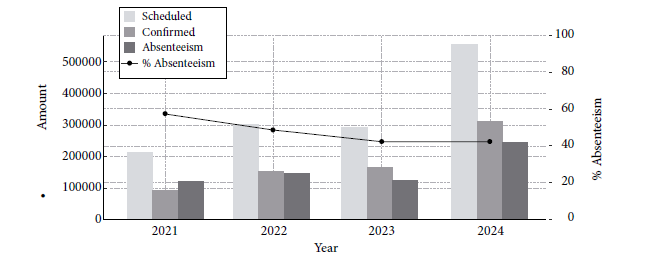
From 2021 to 2024, we observed a substantial and continuous growth in the supply of regulated procedures offered by the Municipal Health Secretariat of Manaus (SEMSA). The total number of scheduled procedures increased from 215,000 to 557,000, representing an increase of more than 159%. This growth demonstrates the expansion of the health network’s operational capacity and the new digital tool’s ability to absorb progressively larger volumes of requests without compromising service quality.
Over the same longitudinal period, the absenteeism rate among users with scheduled procedures fell significantly, from 56.75% to 42.74%. This reduction of approximately 14 percentage points reflects substantial advances in communication processes and user adherence. The finding is even more relevant considering the simultaneous increase in the supply of procedures, which in a traditional scenario could have led to either an increase or, at the very least, preserved absenteeism rates. The consistent decline in absenteeism, therefore, highlights the effectiveness of the online consultation system in promoting citizens’ engagement with their scheduled healthcare appointments.
Another relevant indicator was the increase in the number of attendance confirmations, which more than tripled during the period, rising from 93,531 to 311,857 confirmations. This result reveals the improvement of notification mechanisms and access to information and a significant increase in users’ trust in the system, as they began to monitor the status of their authorizations more actively and plan their healthcare schedules more effectively (Figure 2).

Despite the marked growth in the supply of procedures, the percentage of missed appointments remained stable in the last two years analyzed, which may be interpreted as a clear sign of the consolidation of the digital regulation model. Rather than showing proportional growth in absences, as might occur in a system that had not adapted, the data suggest that the new system reached a level of maturity capable of sustaining the expanded volume of care without deterioration in operational effectiveness.
From the analysis through Google Analytics, a relevant aspect became evident: a large proportion of access to the platform occurs from outside the state of Amazonas and even from outside Brazil. This indicates that the online consultation system is being used by family members, caregivers, or guardians living in other regions or countries who remotely monitor the scheduling and authorizations of relatives receiving SUS care in Manaus.
Among the countries with the highest volume of access in 2024, the United States stands out with 1,700 accesses and a growth of 22% compared with 2023; the Netherlands, with 284 accesses and an increase of 116%; and Indonesia, with 189 accesses and an expressive increase of 209%. Relevant access was also observed from Canada, Venezuela, and France, indicating an international expansion in the platform’s use.
These data highlight the tool’s broad social and territorial reach, allowing the remote monitoring of health regulatory flows while promoting family shared responsibility, technology-mediated care, and digital inclusion in the SUS. The adoption of solutions such as this broadens the reach of public policies, strengthens service transparency, and contributes to universal access to health information.
Another relevant impact was the substantial savings in public resources. Replacing SMS notifications, which, if maintained, would have generated an estimated cost of approximately BRL 705,530.73 from 2021 to 2024, contributed to more rational spending and promoted financial sustainability in public health management. Before the implementation of the digital solution, only about 30% of users were successfully notified. After the system was consolidated, in the first quarter of 2025, approximately 80% of users with authorized appointments regularly accessed the online consultation portal (Table 1).
In the first quarter of 2025, the system’s consolidation became evident through striking averages: approximately 10,000 authorizations processed daily and roughly 8,000 unique accesses to the portal per day, considering distinct Individual Tax Code (CPF) identification numbers. These results show the population’s broad adherence to the new communication model, highlighting the tool’s effectiveness in strengthening the bond between citizens and public health services, with a sustained reach rate of around 80%.
In addition to institutional gains, such as savings in financial resources and increased operational efficiency, the initiative provided direct and measurable benefits to the user population. The possibility of checking appointments online significantly reduced unnecessary travel to PHC Units, generating time savings and lower transportation costs, especially for socially vulnerable users. The reduced physical flow of people also contributed to improved service dynamics within the units, making services more agile and organized.
Assuming that approximately 30% of the 8,000 daily portal accesses correspond to users who would previously have sought this information in person, it is estimated that around 2,400 people no longer need to travel daily to PHC Units. Considering the distribution of this demand across approximately 200 dispensing units, an average reduction of about 12 in-person service encounters per day per health unit can be projected, reflecting a direct decrease in pressure on service queues. At the same time, we observed a substantial reduction in paper consumption for printing authorizations, contributing to more sustainable practices aligned with public service digitalization guidelines.
The online consultation digital solution has become established as an essential tool for modernizing public health management in Manaus. Its positive impacts are not limited to the financial and administrative spheres, but extend to improving user experience, strengthening digital citizenship, and promoting public management practices that are more transparent, efficient, and oriented toward concrete results.
Discussion
The experience reported here significantly reinforces Manaus public management’s commitment to promoting innovation, administrative efficiency, and stronger digital citizenship within the Unified Health System (SUS). The implementation of the online consultation system for monitoring the regulation of specialist consultations and diagnostic tests enabled substantial and concrete advances in the quality of services offered to the population, evidencing that the adoption of strategic technological solutions can transform the reality of public health consistently and lastingly.
The initiative made it possible to effectively expand users’ access to specialized services by providing clear, rapid, and easily accessible information, reducing the need for in-person travel to PHC Units and, consequently, minimizing geographic, economic, and social barriers that have historically hindered the population’s access to more complex services. At the same time, there was a marked decline in absenteeism rates, which translated not only into operational gains for public management but also into greater use of available appointment slots, thereby promoting equity in care and preventing the waste of valuable public resources.
The system was developed in full compliance with the guidelines established by the LGPD, showing the municipal administration’s ethical commitment to protecting citizens’ privacy and personal data. In addition, the entire structuring of the tool was guided by the principles of transparency, efficiency in public spending, usability, and innovation principles that are fundamental to the construction of effective and legitimate public policies. The Manaus experience shows that digital solutions, when carefully planned, grounded in solid diagnoses, and implemented responsibly, not only modernize administrative processes but also enhance democratic access to public policies.
Another noteworthy aspect was users’ substantial adherence to the implemented system, reflected in the high levels of access recorded on SEMSA’s institutional portal. The Consulta SisReg system became the most accessed among all services made available to citizens, revealing the pertinence of the solution in meeting a real and latent population demand. This active user engagement reinforces the importance of continuously investing in technologies that bring citizens closer to public management, promote protagonism in healthcare, and strengthen trust in institutions.
The experience developed in Manaus points to promising paths for strengthening a more modern, inclusive, and efficient public health system. The initiative serves as a model for other municipalities and states seeking innovative solutions to improve communication with users, streamline care flows, and rationalize the use of public resources. By demonstrating concrete and measurable results in savings, service quality, and user satisfaction, the project shows that digital transformation is an indispensable strategy for addressing the contemporary challenges of public health management.
This study’s findings directly engage with the limitations that have highlighted the barriers faced by SUS regulatory centers, such as the scarce technological resources, the low system integration level, and the challenging effective communication with users5. In this context, Manaus’ experience shows that the adoption of digital solutions can serve as a concrete strategy for overcoming these barriers, promoting greater operational efficiency, stronger citizen engagement, and improved public health management. By using accessible and integrated technologies, it was possible to modernize workflows, broaden informational reach, and reduce inequalities in access to regulated services.
This study has limitations, especially because of the predominant use of secondary administrative data, which restricts the incorporation of contextual variables such as socioeconomic factors and structural differences among health units. The qualitative component, in turn, included a small number of participants, which may limit the diverse institutional perceptions analyzed. Moreover, because the study reflects an early phase in the implementation of the digital solution, the findings reinforce the need for future longitudinal and comparative studies to assess the model’s sustainability and its impacts over time.
Final considerations
The results achieved with the SEMSA Manaus’ implementation of the online consultation system reveal relevant advances in the modernization of healthcare regulation within the SUS. The reduction in absenteeism, the marked increase in attendance confirmation, and users’ strong adherence to the portal show that the process’ digitalization is viable, functional, and aligned with people’s real needs.
In addition, the initiative is aligned with the guidelines of GM/MS Ordinance No. 3,691/2024 by promoting a solution grounded in the principles of usability, information security, interoperability, and transparency. Full compliance with the LGPD shows an ethical commitment to the protection of personal data, an essential element in digital health initiatives. By providing accessible, rapid, and reliable information, the system strengthens user autonomy and digital citizenship.
Another central aspect is the initiative’s replicability potential. Manaus’ experience shows that digital solutions designed through planning, situational diagnosis, and evidence-informed management can generate significant improvements in access and care coordination. The high demand and user engagement reinforce that society is ready for more integrated models of communication and regulatory monitoring.
Therefore, the implementation of the online consultation system represents more than technological innovation. It is a milestone in improving the relationship between the State and citizens by qualifying workflows, expanding access to information, and promoting greater institutional transparency. The project reaffirms that digital transformation in health should be understood as a strategic pathway to strengthen the SUS, reduce historical barriers to access, and move toward a more sustainable, participatory, and equity-oriented model.
Acknowledgments
The authors would first like to thank the leadership of the Municipal Health Secretariat of Manaus for its fundamental role in fostering innovation, applied research, and the dissemination of scientific knowledge by creating institutional conditions that allow successful management and health technology experiences to be systematized, published, and shared with the scientific community and managers of the Unified Health System. They also thank the Third Manaus Aqui Tem SUS Exhibition, an initiative promoted by the Manaus School of Public Health (ESAP), in partnership with the Council of Municipal Health Secretariats of Amazonas (COSEMS-AM), for providing an important space for the recognition, dissemination, and encouragement of scientific production within the SUS.
References
- 1 Giovanella L, Escorel S, Lobato LVC, Noronha JC, Carvalho AI, editores. Políticas e sistema de saúde no Brasil. 2ª ed. Rio de Janeiro: Editora Fiocruz; 2012.
- 2 Vieira-da-Silva LM, Furtado JP. Avaliação em saúde: conceitos e métodos. In: Brousselle A, Champagne F, Contandriopoulos A-P, Hartz Z, compiladores. Avaliação: conceitos e métodos. Rio de Janeiro: Editora Fiocruz; 2020. p. 15-40.
- 3 Medeiros Junior ELC, Roberto JCA, Cunha EL, Lima OP, Araújo PCD, Maduro MR, Oliveira Júnior NJ. Sistema de Regulação da Saúde do SUS. Contribuciones Cien Soc 2023; 16(7):6849-6863.
- 4 Barbosa DVS, Barbosa NB, Najberg E. Regulação médica do fluxo das urgências: análise do complexo regulador de Goiânia. Interface (Botucatu) 2014; 11(1):151-173.
- 5 Bastos LBR, Barbosa MA, Rosso CFW, Oliveira LMAC, Ferreira IP, Bastos DAS, Paiva ACJ, Santos AAS. Práticas e desafios da regulação do Sistema Único de Saúde. Rev Saude Publica 2020; 54:25.
- 6 Vaz A, Santos MR, Gwaza L, González EM, Lewandowska MP, Azatyan S, Saint-Raymond A. WHO collaborative registration procedure using stringent regulatory authorities' medicine evaluation: reliance in action? Expert Rev Clin Pharmacol 2022; 15(1):11-17.
- 7 Doerr P, Valentin M, Nakashima N, Orphanos N, Santos G, Balkamos G, Saint-Raymond A. Reliance: a smarter way of regulating medical products - The IPRP survey. Expert Rev Clin Pharmacol 2021; 14(2):173-177.
- 8 Durán CE, Cañás M, Urtasun MA, Elseviers M, Andia, T, Stichele RV, Christiaens T. Regulatory reliance to approve new medicinal products in Latin American and Caribbean countries. Rev Panam Salud Publica 2021; 45:e10.
- 9 Silva LC, Costa AWS, Filho HAA, Silva JDFS, Reis LNC, Abuhid MD, Teixeira M, Santos PR, Moraes RGC, Silva RP, Martins SR, Palmeira SP, Almeida SKM, Nobre S, Érika FR, Paiva TDN. Regulação assistencial e controle do SUS: revisão de literatura. Europub J Health Res 2024; 5(2):e5670.
-
10 Brasil. Ministério da Saúde (MS). Manual técnico do Sistema Nacional de Regulação - SISREG III. DATASUS [Internet]. 2008 [acessado 2025 jul 10]. Disponível em: https://bvsms.saude.gov.br/bvs/publicacoes/manual_tecnico_sisreg.pdf
» https://bvsms.saude.gov.br/bvs/publicacoes/manual_tecnico_sisreg.pdf -
11 Prefeitura de Manaus. Sistema de Regulação da Saúde completa 10 anos na capital [Internet]. 2019 [acessado 2025 jul 10]. Disponível em: https://www.manaus.am.gov.br/noticia/saude/sistema-de-regulacao-da-saude-completa-10-anos-na-capital/.
» https://www.manaus.am.gov.br/noticia/saude/sistema-de-regulacao-da-saude-completa-10-anos-na-capital -
12 Secretaria de Estado de Saúde do Amazonas. Plano Estadual de Saúde - PES 2012-2015 [Internet]. 2012 [acessado 2025 jul 10]. Disponível em: https://www.saude.am.gov.br/.
» https://www.saude.am.gov.br - 13 Brasil. Ministério da Saúde (MS). Portaria GM/MS nº 1.792, de 22 de agosto de 2012: Institui incentivo financeiro de custeio destinado às Centrais de Regulação organizadas no âmbito do SUS. Diário Oficial da União; 2012.
- 14 Eitan A, Kantor L, Shani M. Digital health: challenges and opportunities. Israel J Health Policy Res 2022; 11:1-7.
The data sources adopted in the research are indicated in the article’s body.

 Source: Authors.
 Source: Authors.