
 University student behaviors prone to health risks: a conceptual analysis
Abstract
The objective was to analyze the concept of university student behaviors prone to health risks, delineating its attributes, antecedents, and consequences. This study involved a conceptual analysis using an integrative literature review with searches conducted in the MEDLINE/PubMed, Scopus, PsycInfo, LILACS, BDENF, and IBECS databases. A total of 135 full-text articles were analyzed. University student behaviors prone to health risks were defined as a tendency to voluntarily adopt harmful habits that negatively impact health and well-being, characterized by voluntary, unfavorable, negative, and/or destructive aspects. They are manifested by the influence of several factors: personal and individual development, relational, family, psychological, socioeconomic, environmental, educational, extracurricular, behavioral, and healthcare. These contribute to risk behaviors such as inadequate dietary habits, unstable physical activity, toxic substance use, risky sexual practices, excessive use of digital technologies, compromised learning processes, violence, compromised mental health, dangerous driving, inadequate sleep habits, deviant conduct, and impaired concern for health. The elucidation of the concept allowed identification of the elements that compose this phenomenon, and established an initial understanding of the construct.
Key words:
Health risk behaviors; Universities; Students
Resumo
Objetivou-se analisar o conceito de comportamento de saúde propenso a risco em universitários, delimitando seus atributos, antecedentes e consequentes. Trata-se de uma análise conceitual, empregando uma revisão integrativa da literatura com buscas nas bases MEDLINE/PubMed, Scopus, PsycInfo, LILACS, BDENF e IBECS. Foram analisados 135 artigos na íntegra. Definiu-se como comportamento de saúde propenso a risco em universitários uma tendência à adoção de hábitos prejudiciais à saúde e ao bem-estar de caráter voluntário, negativo, desfavorável e/ou destrutivo. Manifesta-se a partir da influência de fatores de desenvolvimento pessoal e individual, relacionais, familiares, psicológicos, socioeconômicos, ambientais, formativos, extracurriculares, comportamentais e de cuidado em saúde. E coaduna para comportamentos de risco como hábitos alimentares inadequados, prática de atividade física instável, consumo de substâncias, práticas sexuais de risco, uso excessivo de tecnologias digitais, ensino-aprendizagem comprometido, violência, saúde mental comprometida, condução de trânsito perigosa, hábitos inadequados de sono, condutas desviantes e cuidado com a saúde prejudicada. A elucidação do conceito possibilitou a identificação dos elementos que compõem o fenômeno e estabeleceu uma compreensão inicial do construto.
Palavras-chave:
Comportamentos de risco à saúde; Universidades; Estudantes
Resumen
Se objetivó analizar el concepto de comportamiento de salud propenso al riesgo en estudiantes universitarios, delimitando sus atributos, antecedentes y consecuentes. Se realizó un análisis conceptual mediante una revisión integrativa de la literatura, con búsquedas en las bases de datos MEDLINE/PubMed, Scopus, PsycInfo, LILACS, BDENF e IBECS. Se analizaron 135 artículos completos. El comportamiento de salud propenso al riesgo en universitarios se definió como una tendencia hacia la adopción de hábitos perjudiciales para la salud y el bienestar, de carácter voluntario, negativo, desfavorable y/o destructivo. Este comportamiento se manifiesta a partir de la influencia de factores de desarrollo personal e individual, relacionales, familiares, psicológicos, socioeconómicos, ambientales, formativos, extracurriculares, comportamentales y de cuidado de la salud. Conduce a comportamientos de riesgo, tales como hábitos alimentarios inadecuados, práctica irregular de actividad física, consumo de sustancias, prácticas sexuales de riesgo, uso excesivo de tecnologías digitales, compromiso en el proceso de enseñanza-aprendizaje, violencia, deterioro de la salud mental, conducción peligrosa, hábitos de sueño inadecuados, conductas desviadas y cuidado de la salud deficiente. La elucidación del concepto permitió identificar los elementos que componen el fenómeno y estableció una comprensión inicial del constructo.
Palabras clave:
Conductas de riesgo para la salud; Universidades; Estudiantes
Introduction
Health risk behaviors, such as smoking, alcohol consumption, physical inactivity and unhealthy eating habits, have been associated with experiences at university, perhaps extending further into adulthood, leading to consequences like development of chronic, non-transmissible health conditions, important in the public health sphere, among which one may point out hypertension, diabetes, neoplasms and chronic respiratory diseases1-5.
According to this perspective, the university is materialized as a space of social production in constant transformation, presenting potential for promotion of health, as well as a propensity for adoption of risk behaviors on the part of the actors that compose it: administrators, staff, teachers and students. Therefore, the construct finds space for disputes in understanding between biologicism and the broadened concept of health, anchored in the transversality of care in different contexts and in the valorization of well-being and quality of life, as factors that directly and/or indirectly produce effects on the learning process, and on the effectiveness of healthy, sustainable environments6.
To this end, it should be noted that university experience, in principle, is marked as a period of transformations and ruptures, above all when there is association between the completion of high school, in which attributions, skills, institutional norms, and family and social bonds are modified for training follow-up7. It is also observed that, due to heterogeneity at university, it is possible for there to be groups that do not enter in an obligatory manner after completion of the previous educational phase, which favors the plurality of experiences recognizable in these spaces.
With regard to the relationship between the educational environment and behaviors prone to health risks, there are outstanding changes related to the requirements to adjust rules, enjoy good relations with peers and superiors, seek prominence in academic development, undergo excessive study workloads, face demands to achieve institutional goals, adapt to the new academic reality, different sleep routines, as well as the need for organization of time and study strategies, among others8. These demands may be presented as stressors, given they require a behavioral transition from the university student in a timely manner, often not achieved, generating self-demands, mental stress and physical symptoms9,10.
The university environment, therefore, is manifested as an influencer of the adoption by university students of behaviors prone to health risk, taking into account reflections of experiences in administrating one’s own life, and personal and future expectations. Among the justifications for this are the search for stress relief, dealing with life problems, self-acceptance, desire for a high-level personality, and pressure from peers (colleagues, family members and teachers, for example)11.
In view of this, it is important to understand that human behaviors are mediated by motivational and contextual stimuli, so that motivation starts from a multifaceted construct related to autonomy and self-determination, which can be based on behavior as a product of pleasure and personal desires, and on the association among self-determined regulatory styles. In the panorama of university health behavior, one perceives a predominance of self-determined motivation, given the individual’s predisposition to adaptation according to the situation, pressure or reward12.
Risk-prone health behavior can also be characterized as: toxic substance abuse; failure to act to prevent health problems; failure to achieve a sensation of ideal control; minimization of changes in state of health; non-acceptance of change in the state of health; and smoking13. It is related to social anxiety; inadequate social support; low self-efficacy; inadequate understanding of health information; stressors; negative perception of recommended health care strategies; and a negative perception of health professionals13.
Although university student behaviors prone to health risks are a construct of recognized interest in national and international studies, it is observed that there is a prevalence of studies with an approach to risk factors, overcoming the propensity to adopt risk behavior, the polysemy employed to treat its concept, and the need to elucidate the concept of risk-prone health behavior to effectively support institutional, public health and education policies, as well as actions to promote health.
From this perspective, realization of an analysis of its concept is justified, with a view to elucidating it, delineating its essential components, with the purpose of supporting decision-making, standardizing the language of construct adoption, as well as fostering attention and health care for university students.
Thus, it was aimed to analyze the concept of university student behaviors prone to health risks, delimiting their antecedents, attribute and consequences.
Methods
The study is of the analysis of concept type, developed according to the Walker and Avant methodological precepts, whose purpose is to evaluate, distinguish and elucidate the representative elements that offer support for a concept14.
For this purpose, eight pre-established stages were undergone14, namely: 1) selection of the concept of university student behaviors prone to health risks; 2) delimitation of the objective of refining the concept and elucidating its constituents; 3) identification of the utilization of the concept through an integrative literature review; 4) determination of the attributes employed in the literature as illustrators of the concept; 5) elaboration of the model case to describe the utilization of the concept; 6) construction of additional cases as a possibility of exemplification of the conceptual limit; 7) identification of antecedents and consequences of the concept through an integrative review of the literature; and 8) definition of the empirical references of the concept studied.
The same concept can be expressed by a multitude of word combinations. The analysis of this concept is fundamental to identify the meanings underlying these different expressions14. To identify the possible uses of the concept, as well as the antecedents, attributes and consequences, it was opted to make an integrative review of the literature. It is noteworthy that the attributes consist of terms repeatedly recorded in the literature, which illustrate the essence of the concept, characterizing what composes it and what does not. At the time, the antecedents and consequences were implied in the temporality of the concept of the phenomenon, understood as the events necessary, a priori, for its occurrence, and for the subsequent results manifested, respectively14.
The operationalization of the integrative literature review15 arose from the creation of a research question according to the PICo mnemonic strategy, P being population: university students; I - intervention: does not apply; Co - context: behaviors prone to health risks. Thus, the following guiding question was determined: “What is the definition of the concept, university student behaviors prone to health risks, their attributes, antecedents and consequences?”.
The search in the literature took place between September and November 2023, via access to the Comunidade Acadêmica Federada (CAFe) [Federated Academic Community] of the Portal de Periódicos da Coordenação de Aperfeiçoamento de Pessoal de Nível Superior (CAPES) [Portal of the Periodicals of the Higher Education Coordination for Personnel Improvement], in the databases of the National Library of Medicine and Institutes of Health (MEDLINE/PubMed), Scopus and PsycInfo. For the databases, Latin American and Caribbean Health Sciences Literature (LILACS) databases, Nursing Databases (BDENF) and Spanish Bibliographic Index in Health Sciences (IBECS), the search was performed via Biblioteca Virtual de Saúde (BVS) [Virtual Health Library].
The search strategy was organized through connection of representative descriptors of the phenomenon identified in the descriptors in Health Sciences (DECS) and Medical Subject Headings (MESH), articulated according to boolean operators AND and OR. The final equation formulated was (“Health Risk Behaviors” OR “Comportamento de risco à saúde”) AND (“Students” OR “Estudantes” OR “Universities” OR “University Students”), adjusted to each search source, conforming to the particularity of these.
Productions available in full were included virtually with approximation to the definition and/or characteristics of university student behaviors prone to health risks. The following publications were excluded: those without any connection with the theme of interest, studies unavailable virtually, repeated/duplicate, and those of the commentary type, literature reviews, editorials, dissertations and theses. In order to contemplate greater scope regarding the phenomenon, no temporal and idiomatic limit was established.
The search results were saved in *.csv format and transferred to Rayyan (https://www.rayyan.ai/) for paired blind screening between two totally independent researchers. At the time, the researchers assessed their studies by classifying them according to inclusion, doubt (perhaps) or exclusion. The cases in conflict were solved by consensus, that is, involving consultation of a third researcher.
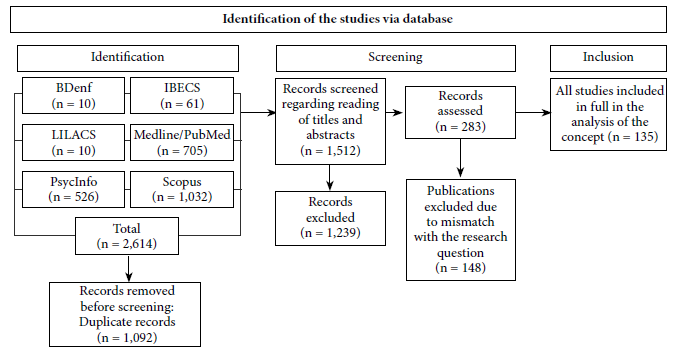
The identification, screening and inclusion steps were summarized according to the Preferred Reporting Items for Systematic Review and Meta-Analyses (PRISMA)16 (Figure 1).
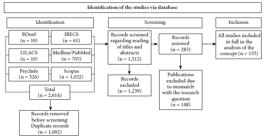
Flowchart of the identification process of studies via databases to analyze the concept of behaviors prone to health risks. Iguatu, Ceará, Brazil, 2024.
The organization of information was based on the reading of the selected articles, recognition of the use of the concept of health behavior likely to expose university students to risk, recognition of the essential characteristics of the concept, and classification of these as attributes, antecedents and consequences. The classification of the essential characteristics of the concept was carried out by three independent researchers, as conducted by the prior, integrative review of the literature.
Data were organized in a Microsoft Office Excel 2016 electronic spreadsheet, covering the year of publication, country of origin, population, study type, evidence level, concept attributes, antecedents and consequences. The evidence level considered the classification of the study type as level I - evidence of systematic reviews and/or meta-analyses of randomized clinical trials; level II - evidence of a clinical trial with randomization, controlled and well delineated; level III - evidence of studies well-delineated, controlled and without randomization; level IV - evidence of cohort or control case studies; level V - evidence of systematic reviews of descriptive and qualitative studies; level VI - evidence of descriptive and/or qualitative studies; and level VII - evidence of opinions of authorities or reports of specialist committees17.
The data were analyzed from descriptive statistics regarding the absolute and relative frequency, and summarized in an infographic, considering the characteristics of the studies, and tables, contemplating the attributes, antecedents and consequences. In the end, a conceptual model was created that visually represented the relationships among the essential elements of the health behavior concept of interest.
Then, a model case, a borderline case and an opposite case, which aimed at enabling comparisons and contrasts of the concept analyzed, were constructed, elucidating what the concept was, what it was not, and the application of its constitutive elements. Respectively, a model case demonstrated a situation of application of the concept, with its background, attributes and consequences; a borderline case presented a situation in which there were characteristic and confusing elements of the concept, that is, not belonging; and, finally, the contrary illustrated a context that did not correspond to the concept in question, in fact, opposing it.
Regarding the formulation of empirical references, the concept attributes were considered, establishing, based on the literature, the operational definitions that detailed their manifestation.
As it was a study based on published scientific articles, the ethical and legal rights of authorship through authorial reference were ensured, thus precluding the need for appreciation by a research ethics committee.
Results
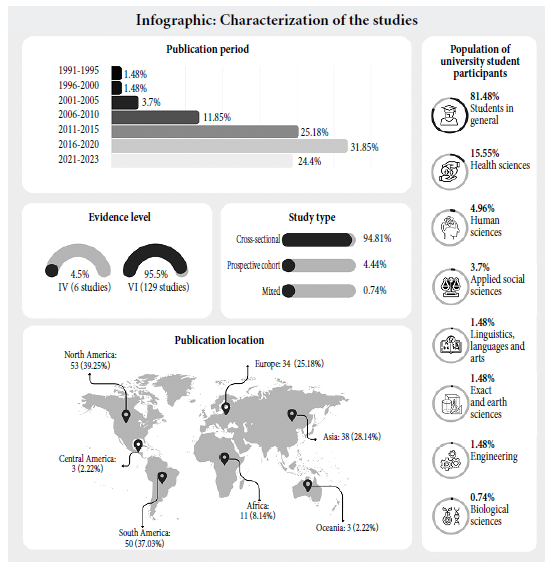
Health risk behavior has been increasingly covered in the scientific literature over the last 40 years, featuring mainly cross-sectional observational studies (94.81%) with level VI evidence (95.5%) and contemplating university students in general (81.48%), without limitation to a particular area of knowledge or undergraduate course. Regarding locality, most research on the subject (31.85%) has been concentrated in the USA, while 12 studies (8.8%) have been identified in Brazil.
The characterization of the studies is illustrated in Figure 2, presenting the period, evidence level, study type, place of publication, and population of participating university students
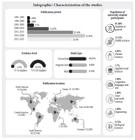
Infographic characterization of the studies included in the analysis of the concept of university student behaviors prone to health risks. Iguatu, Ceará, Brazil, 2024 (n = 135).
The selection of the concept, behaviors prone to health risk was determined by the peculiarities proper to the academic period of undergraduates and the university context, their increasing exposure to situations, scenarios and possibilities of adopting behaviors that, when recurrent and intense, contributed to the manifestation of risk to health, well-being and quality of life.
The refinement of this concept is supported by its polysemy and broad approach focused on risk behaviors, without contemplating the propensity to adopt these behaviors, understood as the set of influences preceding them that tend to lead to adoption of such behaviors.
Investigation of behaviors prone to health risks aims to recognize the components that precede their manifestation, representing the propensity to risk (antecedents); delimit the constitutive elements that characterize it (attributes); identify the primary risk behaviors to which university students are exposed (consequences); and provide applications that aid different health areas, such as care, administration, teaching and research.
Table 1 summarizes the antecedents, attributes and consequences of the concept, and the absolute and relative frequency of presence in the studies analyzed. The data can be consulted in full in the attached material, contemplating the articles analyzed and the previous characteristics, attributes and consequences extracted from them.
Thus, the concept is constituted of antecedents gathered from 11 domains, of which the psychological (47; 34.81%), relational (44; 32.59%) and formative (42; 31.1%) are the most frequent. The recurrence or intensity of the manifestation of these antecedents, whether voluntary, negative, unfavorable and/or destructive, leads to direct or indirect harm to the health, well-being and quality of life of university students, along with potential for lethality.
Among the attributes, the aspects of harm or health impairment (12; 8.88%), increased risk of injury and/or disease (7; 5.18%), and recurrence or intensity (6; 4.44%) are more prevalent in the studies analyzed. In turn, the consequences of consumption of toxic substances (118; 83.70%), inadequate eating habits (70; 51.85%), and unstable physical activity (68; 50.37%) were the most frequent, characterized as the most common risk behaviors in the population of interest.
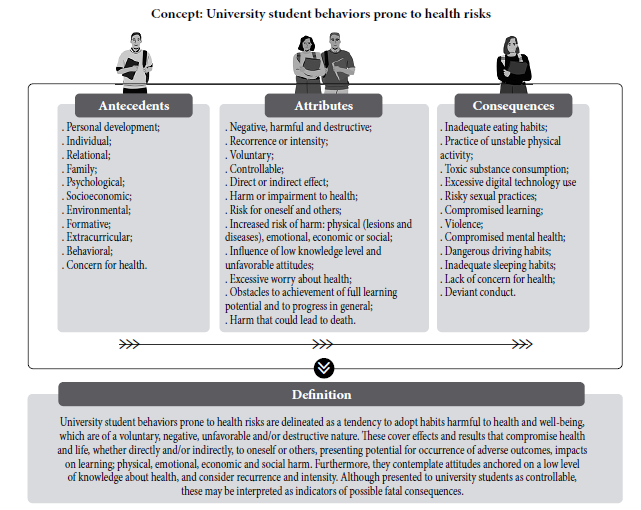
In this sense, the antecedents were delimited as the elements that predispose university students to the adoption of risk behaviors, while attributes gather together the characteristics that delimit these behaviors. Finally, the consequences can be understood as the risk behaviors themselves, adopted and manifested by university students via influence of the antecedents.
As it is a construct, the behaviors can be analyzed from the perspective of a continuum, arising from stimulation of the propensity to take risks present in motivational, contextual and structural (background) factors, leading to contemplation of behaviors that predispose the health of university students to risks (attributes), and reaching risk-level behavior(s) (consequences).
These components and their articulations are illustrated in the conceptual model (Figure 3) of such risk behaviors, presenting the definition of this concept developed from the studies analyzed.
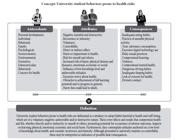
Conceptual Model of university student behaviors prone to health risks. Iguatu, Ceará, Brazil, 2024.
Better understanding of the concept is associated with the creation of fictitious cases related to everyday situations, capable of being manifested by the phenomenon of interest. Thus, the borderline and opposite case models were prepared, following a methodology that aims to explore the limits and possibilities of the concept under study.
The analysis of the model case shows us that the concepts are not static. Rather, they are multidetermined social factors, and may present variations in different contexts.
Model case: university student behaviors prone to health risks
L.L.P., 21, female, attending the second semester of Mechanical Engineering in a Federal Institute. As an undergraduate, far from parental control and curious to have new experiences, she made friends with other females in her study group. However, although she participated at all times with her colleagues, she felt inferior in relation to both the beauty standards and the academic level, which led her to recurring episodes of sadness, introversion and dissatisfaction with life. Whenever possible she took illicit drugs to escape reality, skipped meals to control her weight, and spent long hours on the computer studying to match her colleagues’ academic prowess. To keep as slim as she desired, she sought information on social networks without sharing it with friends, family and/or health professionals, adopting restrictive diets that made her weak and tired. This tiredness extended her periods of sleep, causing an increase in the number of classes missed, and thus a reduction in her academic performance, even with her home studies. At the end of the semester she failed most of the exams, which directly influenced her dissatisfaction with life, levels of happiness and mental well-being.
The model case explains the possibility of a situation experienced by university students, contemplating the attributes of the concept of university student behaviors prone to health risks, as well as the manifestation of antecedents and consequences of the construct.
In the situation, there is a tendency to adopt intense, recurring habits, harming health and well-being, which are adopted voluntarily, but exert negative, unfavorable and/or destructive impacts on learning, as well as cause physical, emotional, economic and social damage (attributes).
The propensity for adoption of this risk behavior comes from family and social influences, and personal and individual, relational, formative, psychological, behavioral development, and level of concern to maintain one’s good health (antecedents). Such influences are in line with manifestation of behaviors considered risky for university students, such as inadequate dietary habits, toxic substance consumption, compromised mental health, inadequate sleeping habits, abuse of technologies, lack of care when health is impaired, and deteriorated learning, presented by the person in the aforementioned fictitious model case.
Borderline university student behaviors prone to health risks
M.F.L.P., 19, male, was a student in the 7th period of the degree course in Medicine, and would start activities as an intern at the University Hospital of the Metropolitan Region where he studied. To do so, he would have to leave his parents’ home and live in a student residence. At the time, in the face of intense hopelessness that he would be able to complete the course, given his family’s socioeconomic difficulties, lack of parental support for his studies, and difficulty believing in his own potential, he began to take stimulating substances to reduce his hours of sleep so as to have enough time to maintain good performance in his curricular and extracurricular activities. Lack of access to proper food and difficulty preparing meals led to increased fast-food consumption. At weekends, recognizing the need to socialize, and, due to insistent invitations from fellow residents, he used to go to nightclubs, where he would drink, vape, and, afterwards, hitch lifts back with drivers under the influence of alcohol.
The borderline case, as well as that of the model, addresses a situation of application of the concept, without, however, contemplating all its attributes. In the situation reported, there was recognition of antecedents of hopelessness, living away from parents, lack of self-confidence, low family support, low socioeconomic level, concern for maintaining good academic performance, low availability of healthy food, lack of skills to prepare meals, along with influence of peers and a need to socialize. It also described negative, harmful and destructive attitudes, as well as recurrence or intensity of the actions, the voluntary character, subject to control and risk for himself and others, which were characterized as some of the attributes of the concept, along with inadequate dietary habits, toxic substance consumption, dangerous driving and inadequate sleeping habits as consequences.
Opposite case - university student behaviors prone to health risks
M.S.D.L., 20, male, was a Law degree student and liked having a very organized routine to achieve weekly goals. He enjoyed parental support for his studies, practiced physical activity regularly, had a healthy diet, cooked on Saturdays to have ready meals all week, and tried to sleep at least eight hours per night. He was organized to have extracurricular activities in the afternoon, and study in the evening. He dedicated at least one moment of the day to leisure, and, whenever had a doubt related to health, he sought the campus health care team or the professionals at the Basic Health Unit in the district.
This case portrayed a non-concept situation, where the essential characteristics presented differed totally from those expected in the concept, their attributes, antecedents and consequences. In this sense, the fictitious university student presented conduct contrary to university student behaviors prone to health risks, which are more consistent with healthy behaviors and general health promotion.
The definitions of empirical references, the last stage of the conceptual analysis, enabled the best description of the attributes, aiding understanding of how they are manifested operationally (Chart 1).
Discussion
Although widely addressed in the literature, the phenomena related to the behavior and health of university students have semantic ambiguities, especially with regard to risk behavior and risk propensity. To this end, conceptual analysis is presented as a strategy to elucidate meanings of concepts employed in a polysemic manner in contexts, time and similar situations, adapting their utilization and optimizing the work processes18.
Risk behavior, mostly emphasized in scientific publications, represents the subsequent period interrelated to risk-prone health behavior, given a continuum of health decisions that end with falling ill and even death. They are underlined as attitudes and long-term behavioral patterns that interfere and impair the health of university students19, these being represented as consequences of this study.
In a distinct manner, the risk propensity is delineated as the phase that precedes risk behavior, whose peculiarities direct and tend to make the university student adopt habits that inflict health and quality of life, and bear potential for illness. In this sense, this concept is based on predisposition to risky practices, albeit voluntary and controllable, with negative and damaging health effects.
Elucidating the constituents of university student behaviors prone to health risks is unveiled as important given it is intrinsically related to the adoption of risk behaviors, analyzed from a fragmented perspective, relating the factor to a particular situation, normally that of disease. In Brazil, for example, researches on the theme are intended to assess risk behavior for transmissible chronic diseases, risk behavior with body dissatisfaction and food disorder, or sexually transmitted infections, among others, without, however, contemplating the university students propensity to adopt these behaviors20-23.
Valuing the studies that seek to know, identify or relate risk behaviors in certain situations or diseases in university students, reflects the need to transcend delineations that reduce illness among university students to contextual experiences and the adoption of risk behaviors. What is expected is an enlarged view of the health-disease-care process, the interrelationships that influences this process, and the understanding that experiencing university does not limit or exclude influences from other life dimensions, such as family, socioeconomic, relational, environmental aspects, and personal development.
Thus, the view of a conceptual model that defines university student behaviors prone to health risks, and states its constituents provides potential to aid understanding of university experience as moments marked by diverse changes in everyday life that directly or indirectly influence well-being, the quality of life and health of individuals, such as academic activity overload, scarcity of free time, high levels of tiredness and stress23.
Conceptual analysis enables evolution of knowledge, qualification of the work process related to the expansion of the spectral view of the object, and the possibility of assisting other studies24.
In the case of the antecedents of the concept studied, these can be understood as the behaviors and attitudes that predispose the adoption of risk behaviors. In this sense, the psychological dimension that comprises, among others, situations of psychological suffering, sadness, low self-esteem, anxiety and depression, is consolidated in the literature as the major predisposing factor in risk behavior. This note may be related to the centrality of the mindset and emotions in human processes, influencing and being influenced directly by the other dimensions identified25.
Such a perspective can be explored by reflection of the relational dimension on the psychological dimension, in which relational conflicts, prominent competition and the need for inclusion increase the occurrence of mental disorders such as academic stress, anxiety and depressive states26.
In the relational context, the development of partnerships in an environment of new experiences, experimentation, freedom and autonomy assumes a facilitating role of adaptation and socialization, while causing predisposition to health risk behaviors, especially those socially normalized. This connotation finds support in the representation of peers as models of influence, providing opportunities and pressure for adoption of behaviors, principally those related to toxic substance abuse, grouping of prevalent consequences recognized in the literature2.
In the academic area, higher education brings with it a scope of attributions and responsibilities that demand university students to manage time, commitment and effort in the learning process. Thus, activity overload submits university students to various worries, especially those related to academic performance26, and these may trigger subordination of healthy eating habits1 and increased illicit drug consumption27 as a form of approximation to the situation.
Although addressed less frequently in the studies analyzed, the importance of contemplating the other dimensions preceding the phenomenon in the health practices, in the formulation of public policies and in studies seeking a better understanding of behaviors prone to health risks is highlighted, as they also contribute to their manifestation.
Regarding the attributes that define the university student behaviors prone to health risk, it is necessary to recognize that this is characterized by the adoption of negative, harmful and destructive attitudes. However, it is necessary for there to be increased continuity or intensity, be of a voluntary character, subject to control, represent risk to themselves and others, and prevent them from achieving potential levels of learning and general progress2,28,29.
Advancing in the face of the identification of the most prevalent characteristics that involve the concept of this study in the university population, such as health impairment, increased risk of injury and/or diseases, and their recurrence or intensity, it is necessary to consider vulnerability and the health risks of university students in a significant manner30.
In this line of argument, student health is therefore a current issue that needs to be understood from the interaction among the demands inherent to higher education and the social, economic and personal aspects, it being necessary to consider the attributes that explain behaviors prone to health risks.
Thus, acting with a view to promoting university students’ health is presented as a possibility to reduce adoption of these behaviors, prevent risks, and provide individual and collective empowerment to take better decisions and advocate for good health31.
It is urgent to strengthen the university context as a health promoter, considering the current perspectives of the academic reality. In its conceptual matrix, health promotion consists of a field of theories and practices that materializes as the foundation of the new health paradigm, seeking to overcome that care based essentially on the biomedical, hospital model. Thus, it proposes development of actions that consider and contribute to social participation, as well as articulation between research and the reality of the health services and communities31,32.
The university environment weaves influences on the well-being and health of the individuals, with a possibility of assuming health promoting behavior and/or diminishing risk propensity. Behaviors adopted in the university period may be perpetuated and contribute to development of chronic illness conditions. Thus, adopting the university as a space for health intervention and aiming to make it a health promoter space is imperative2.
The consequences of the elaborated conceptual model represent the risk behaviors to which university students are exposed, and may be prone to adoption, covering inadequate eating habits, unstable physical activity, toxic substance consumption, excessive use of digital technologies, risky sexual practices, compromised learning, violence, compromised mental health, dangerous driving, inadequate sleeping habits, lack of concern for health issues, and deviant conduct.
The set of risk behaviors pointed out adversely affects the health and well-being of university students to a greater or lesser degree, with reflections on the learning process, which raise or lower the indicators of educational retention, attendance and absenteeism/ evasion33,34.
It is key to underline that behaviors prone to health risks are mostly distributed in interrelational flows, such that each predictor presents potential to trigger several behaviors simultaneously, as well as arise from these35. For example, one may point out: stress resulting from lack of time to perform necessary tasks may drive anxiety behavior, increase fast-food consumption, expose the individual to toxic substance abuse, modify sleep patterns, among other behaviors predisposed to manifestation of stress.
A study involving 974 university nursing students provided evidence that these behaviors directly contributed to the high prevalence of risk factors for non-transmissible chronic diseases, highlighting the need for educational programs in order to reduce these factors. Such findings make these actions urgent, since lifestyle is one of the most important determinants of student health36.
Given this complexity, it has stimulated discussion about the need to adapt to health promotion, considering its connections with academic success and the optimization of the transition to the world of work. In this sense, a health-promoting university has the potential to contribute to reduction of the adoption of university student behaviors prone to health risks. It is a movement of construction of a learning space and organizational culture directed to health, capable of reducing the barriers to healthy behavior utilizing the public and/or environment as a scenario for dissemination of health information37.
Considering the polysemy involved in the adoption of the concept, university student behaviors prone to health risks, as well as the importance of investing in health promotion in universities as a movement with international repercussions, the elucidation of this concept in this study demonstrates possibilities of contributing to: a) professional performance, especially of university health teams, such as those found in the federal network of institutes of education, science and technology, and in primary health care; b) provision of assistance for effective decision-making by education, health and social assistance administrators, directing care to the constituents of the phenomenon; c) support for formulation of institutional and public policies that match the recognized, evidence-based realities; and d) pointing out possibilities for researchers to investigate better, such as interrelationships among the antecedents, attributes and consequences, recognition of grouping in clusters, structuring of causal chains and identification of confusing and mediating variables; among others.
The adoption of the controlled search term, health risk behavior, may be presented as a limitation of this study, given the desire to study a phenomenon related to this, that of propensity to risk, but without possessing any representation as a controlled search term. However, this decision is justified in view of the desire to expand the possibilities of search and the reduced number of studies that properly adopt the term, behaviors prone to health risks. Another limitation that can be pointed out consists of recognition that the majority of the studies are cross-sectional, which makes it impossible to identify causal flows among the constituents of the concept.
Conclusion
Conceptual analysis has allowed recognition of university student behaviors prone to health risks, such as the predisposition to adoption of behaviors harmful to well-being and health that feature a voluntary, negative, unfavorable and/or destructive character.
In this scenario, it was evidenced as a complex phenomenon that contemplates11 antecedents related to personal, individual, relational, family, psychological, socioeconomic, environmental, formative, extracurricular, behavioral and health care attitudes. In addition, there are 12 attributes corresponding to characteristics that indicate a university student has behavior identified as prone to health risks, and thus 12 consequences derived from the occurrence of the concept.
Therefore, the analysis of this concept converges to an initial appropriation of the construct with a view to providing directions and utilization in concrete actions, such as care, administration and research, enabling professional nuclei to identify dimensions for individual and/or interprofessional intervention.
In conclusion, considering the contextual character of the phenomenon, the need to update the concept in the future is underlined in view of the specificities and constant modification of the academic profile, university, teaching and factors that predict it.
References
- 1 Al Ali NM, Khazaaleh FK. Assessment of food consumption, smoking, alcohol use, and physical activity by sex and major of study among a sample of college students in Jordan. Heliyon 2023; 9(4):e16405.
- 2 Gesualdo C, Pinquart M. Health behaviors of German university freshmen during COVID19 in association with health behaviors of close social ties, living arrangement, and time spent with peers. Health Psychol Behav Med 2021; 9(1):582-599.
- 3 Alves JG, Braga LP, Souza CS, Pereira EV, Mendonca GUG, Oliveira CAN, Costa EC, Sousa LB. Grupo focal online para a coleta de dados de pesquisas qualitativas: relato de experiência. Esc Anna Nery 2023; 27:e20220447.
- 4 Van Hooijdonk KJM, Simons SSH, Van Noorden THJ, Geurts SAE, Vink JM. Prevalence and clustering of health behaviours and the association with sociodemographics and mental wellbeing in Dutch university students. Prev Med Rep 2023; 35:102307.
- 5 Dong C, Chen H, Yang Y, Li Y, Sun Y, Sun H. Patterns of risky health behaviors and associations with chronic diseases among young adult nursing students: a latent class analysis. J Nurs Res 2022; 30(6):e243.
- 6 Mazan JS, Oliveira MC, MeloSilva LL. Trajetorias de estudantes cotistas para o ingresso numa universidade pública brasileira. Psicol Estud 2023; 28:e52125.
- 7 Mota AAS, Pimentel SM, Mota MRS. Expressões de sofrimento psiquico de estudantes da Universidade Federal do Tocantins. Educ Pesqui 2023;49:e254990.
- 8 Andriola WB, Araujo AC. Adaptação de alunos ao ambiente universitário: estudo de caso em cursos de graduação da Universidade Federal do Ceara. Ensaio Aval Pol Public Educ 2021; 29(110):135-159.
- 9 Ariño DO, Bardagi MP. Relação entre fatores acadêmicos e a saúde mental de estudantes universitários. Psicol Pesq 2018; 12(3):44-52.
- 10 Hersi L, Tesfay K, Gesesew H, Krahl W, Ereg D, Tesfaye M. Mental distress and associated factors among undergraduate students at the University of Hargeisa, Somaliland: a crosssectional study. Int J Ment Health Syst 2017; 11:39.
- 11 Poscia A, Parente P, Frisicale EM, Teleman AA, Waure C, Pietro ML. Risky behaviours among university students in Italy. Ann Ist Super Sanita 2015; 51(2):111-115.
- 12 Ntoumanis N, Ng JYY, Prestwich A, Quested E, Hancox JE, ThogersenNtoumani C. A metaanalysis of selfdetermination theoryinformed intervention studies in the health domain: effects on motivation, health behavior, physical, and psychological health. Health Psychol Rev 2021; 15(2):214-244.
- 13 Herdman TH, Kamitsuru S, Lopes CT. Diagnósticos de Enfermagem da NANDAI: definições e classificações 20212023. Porto Alegre: Artemed; 2021.
- 14 Walker LO, Avant KC. Strategies for theory construction in nursing. Boston: Pearson Prentice Hall; 2019.
- 15 Mendes LDS, Silveira RCCP, Galvao CM. Uso de gerenciador de referências bibliográficas na seleção dos estudos primários em revisão integrativa. Texto Contexto Enferm 2019; 28:e20170204.
- 16 Page MJ, McKenzie JE, Bossuyt PM, Boutron I, Hoffmann TC, Mulrow CD. The PRISMA 2020 statement: an updated guideline for reporting systematic reviews. BMJ 2021; 372:n71.
- 17 Stillwell SB, FineoutOverholt E, Melnyk BM, Williamson KM. Searching for the evidence: strategies to help you conduct a successful search. Am J Nurs 2010; 110(5):41-47.
- 18 Madureira VSF, Silva DMGV, Trentini M, Souza SS. Métodos de análise conceitual na enfermagem: uma reflexão teórica. Esc Anna Nery 2021; 25(2):e20200186.
- 19 Wattanapisit A, Abdul HR, Car J, AbdulMunin KH, Cruz HTO, Chia M. The clusters of healthrisk behaviours and mental wellbeing and their sociodemographic correlates: a study of 15,366 ASEAN university students. BMC Public Health 2022; 22:123.
- 20 Costa VB, Santos LRS, Salviano CF, Fernandes AGO. Doenças crônicas não transmissíveis entre universitários: simultaneidade de comportamentos de risco. Rev Enferm Digit Cuid Promoc Saude 2023; 8:e0008.
- 21 Monteiro LZ, Varela AR, Lira BA, Rauber SB, Toledo JO, Spíndola MS, Carneiro MLA, Braga Junior F. Lifestyle and risk behaviors for chronic noncommunicable diseases among healthcare undergraduates in Midwest, Brazil. Cien Saude Colet 2022; 26(7):2911-2920.
- 22 Spíndola T, Fonte VRF, Francisco MTR, Martins ERC, Moraes PC, Melo LD. Práticas sexuais e comportamentos de risco para infecções sexualmente transmissíveis entre jovens. Rev Enferm UERJ 2021; 29(1):e63117.
- 23 Vieira AM, Rocha BES, Souza MLR S. Comportamento de risco para transtorno alimentar e preocupação com o corpo em universitários de uma instituição de ensino superior. RBONE 2023; 17(108):307-317.
- 24 Duarte FH S, Silva S O, Enders BC, Lira ALB C, Dantas RAN, Dantas DV. Diagnóstico precoce da infecção por HIV/Aids: análise de conceito. Rev Bras Enferm 2023; 76(3):e20230003.
- 25 Liu X, Ping S, Gao W. Changes in Undergraduate Students' Psychological WellBeing as They Experience University Life. Int J Environ Res Public Health 2019; 16:2864.
- 26 Rehman R, Fatima K, Hussain M, Sarim M, Gazzaz ZJ, Baig M, RodríguezBlázquez C. Association between depression and health risk behaviors among university students, Karachi, Pakistan. Cogent Psychol 2021; 8:1.
- 27 Chandler L, Abdujawad AW, Mitra S, McEligot AJ. Marijuana use and highrisk health behaviors among diverse college students postlegalization of recreational marijuana use. Public Health Pract 2021; 2:100195.
- 28 Erden G, Çoksan S, Özdogru AA, ErgülTopçu A, Azak Y, Uçar GK, ÖgelBalaban H, Dikmeer Y. Turkish University Students' Social Support, Daily Activities, SelfSupportive and Health Risk Behaviors During COVID19 Pandemic. Pol Psychol Bull 2023; 54(1):37-47.
- 29 Pires AMF S, Gusmão WDP, Pureza IR OM, Gomes MHL, Custódio RMBP, Oliveira JJFC. Avaliação do comportamento de risco de graduandos de Medicina em uma universidade de Alagoas. Rev Bras Educ Med 2022; 46(1):e033.
- 30 SuárezVilla M, LastreAmell G, Orostegui MA, GonzálezRamírez DI, TarribaNiebles NP, MartínezMontañez MJ. Fatores de risco influenciam o consumo de substâncias psicoativas em estudantes universitários em tempos de covid19. Enferm Globo 2023; 22(70):349-381.
- 31 Machado LDS, Xavier SPL, Maia ER, Vasconcelos MIO, Silva MRF, Machado MFAS. Health promotion conceptions and expressions in the training process of the multi-professional residency. Texto Contexto Enferm 2021; 30:e20200129.
- 32 Macedo AP, Cruz JM, Ribeiro JM. Promover a saúde no novo paradigma. Rev Bras Promoc Saude 2018; 31(Supl.):1-2.
- 33 Araujo ACC, Pederneira MMM, Oliveira MC, Nova SPCC. Motivos da evasão universitária e serviços de apoio ao estudante. Rev Bras Orientac Prof 2023; 24(1):3-16.
- 34 Costa DM, Oliveira I, Andrade RMM, Paulo MCC, Silva DAC. Presenteísmo na educação superior: um estudo nas modalidades graduação, especialização e mestrado. Pensam Realidade 2021; 36(2):97-116.
- 35 Ureau FV, Duarte PM, Teixeira FS. Simultaneidade de comportamentos de risco para doenças crônicas não transmissíveis em universitários de baixa renda de uma cidade do Sul do Brasil. Cad Saude Colet 2019; 27(3):316-324.
- 36 Monteiro LZ, Varela AR, Spíndola MS, Carneiro MLA, Oliveira DMS, Toledo JO. High prevalence of risk factors for non-communicable diseases in university students of a nursing course. Cad Saude Colet 2023; 31(1):e30040429.
- 37 Darker CD, Doyle MML, Tanner M, McGrath D, Doherty L, DreyerGibney K, Barrett EM, Fitzpatrick D, Murphy P, Ivers JHH, Burke E, Ryan M, McCarron M, Sheils O, Hevey D, Leen A, Keogh L, Breda P, Bannett AE, Petersen F, Nolan A, Barry JM. Developing a health promoting university in Trinity College Dublin: overview and outline process evaluation. Health Promot Int 2023; 38(4):daac205.
-
Funding
Conecta Mais Q-Inova Call IFPB - Notice Nº 38/2023; Scientific Initiation Scholarship URCA/FECOP.
-
Data availability statement
The data sources adopted in the research are indicated in the article’s body. Supplementary material is available at: https://doi.org/10.48331/SCIELODATA.S3ER2R.
The data sources adopted in the research are indicated in the article’s body. Supplementary material is available at: https://doi.org/10.48331/SCIELODATA.S3ER2R.

 Source: Authors.
 Source: Authors.
 Source: Authors.