
 Young federal representatives: between the conservative agenda and reproductive and sexual rights
Abstract
This research aimed to analyze how the young representatives elected in 2022 align with the agenda of gender, sexuality, and reproductive rights amid the rising conservatism. To this end, we adopted a qualitative methodology based on document analysis, considering the data provided by the House of Representatives. The variables considered for the research scope were: age 21-29 years, political party, and bills submitted in the current legislature regarding gender, sexuality, and reproductive rights. Based on these criteria, we identified 18 young Representatives and 46 bills. The results showed that young conservative representatives are the majority among those under 30, and they propose more restrictive projects concerning sexual and gender freedom. Although young progressive Representatives are a minority, they have submitted more bills on gender and reproductive rights, but avoid more sensitive issues, focusing on policies to combat violence and sexual harassment.
Key words:
Young representatives; Conservative; Progressive; Reproductive rights
Resumo
O artigo analisa como os jovens deputados(as) eleitos em 2022 se posicionam em relação a temas como gênero, sexualidade e direitos reprodutivos, mostrando as diferenças entre os progressistas e os conservadores. Trata-se de uma pesquisa qualitativa de análise documental que sistematizou todos os Projetos de Lei (33) que versavam sobre gênero, sexualidade e direitos reprodutivos protocolados por todos os 18 jovens deputados(as) (de 21 a 29 anos) da atual legislatura (2022). Os resultados evidenciam que os conservadores são maioria entre os deputados(as) jovens e que eles pautam projetos que restringem a liberdade sexual e de gênero. Os deputados(as) jovens progressistas, apesar de minoria, têm mais projetos protocolados sobre a temática de gênero e direitos reprodutivos, mas evitam questões mais sensíveis, focando suas propostas em políticas de combate à violência e ao assédio sexual. Interpretamos esses resultados com reflexões que mostram como pautas que alterem relações de dominação são mais difíceis de entrar no debate. O artigo contribui para a compreensão sobre o avanço do conservadorismo na arena parlamentar levado por jovens que têm nos direitos sexuais um de seus principais temas de combate.
Palavras-chave:
Jovens deputados(as); Conservadores; Progressistas; Direitos reprodutivos
Resumen
El presente artículo analiza cómo los jóvenes diputados(as) elegidos en 2022 se posicionan con relación a temas como género, sexualidad y derechos reproductivos, mostrando las diferencias entre los progresistas y los conservadores. Se trata de una investigación cualitativa de análisis documental que sistematizó todos los Proyectos de Ley (33) que versaban sobre género, sexualidad y derechos reproductivos protocolados por todos los dieciocho jóvenes diputados(as) (de 21 a 29 años) de la actual legislatura (2022). Los resultados evidencian que los jóvenes conservadores son mayoría entre los diputados(as) jóvenes y que ellos proponen proyectos que restringen la libertad sexual y de género. Los diputados(as) jóvenes progresistas, a pesar de ser minoría, tienen más proyectos protocolados sobre la temática de género y derechos reproductivos, pero evitan cuestiones más sensibles, enfocando sus propuestas en políticas de combate a la violencia y el acoso sexual. Interpretamos estos resultados con reflexiones que muestran cómo las pautas que alteran las relaciones de dominación son más difíciles de entrar en el debate. El artículo contribuye a la comprensión sobre el avance del conservadurismo en la arena parlamentaria llevado por jóvenes que tienen en los derechos sexuales uno de sus principales temas de combate.
Palabras clave:
Jóvenes diputados(as); Conservadores; Progresistas; Derechos reproductivos
Introduction
The 2022 Elections highlighted the strength of conservatism in the legislative sphere. According to data from the Superior Electoral Court, in 2022, the Liberal Party (PL) of then-President Jair Bolsonaro won the largest seats in the House of Representatives and the Senate; adding the seats of traditional right-wing parties, this formed a majority of conservative Representatives in the Legislature1.
The perceived advances in progressive ideology, since the redemocratization and especially during the Workers’ Party administrations, are one of the factors cited in the literature to indicate the strengthening of conservatism. Among the advances promoted by progressives are policies of income redistribution, quotas, and the very conception of the state as an instrument to address social inequalities. All of these principles run counter to what conservatism understands as the natural order of society2.
By conservatism, we understand the style of thinking based on a reaction to the progressive agenda. In other words, conservatives react and tend to block changes in social structures and the status quo3,4. Conservatism thus transcends mere traditionalism, not limiting itself to fear of change, but mobilizing forces to contain any action that threatens what they understand as the natural balance of the world3.
Furthermore, conservatism is one of the principal axes of what makes up the so-called “new right”, achieving a process of confluence with authoritarian thought and neoliberalism5,6. Another factor of contemporary conservatism is its strong presence in the digital sphere, using social media as a means of dissemination and strengthening7.
Differently, progressive thought can be understood as a movement that advocates for change in political and social structures, based on the belief that the development of societies must be connected to the advancement of general well-being8. For the progressive, this movement of society toward general well-being can be accelerated by political action, including revolution.
Current studies on conservatism indicate that this movement has expanded, gaining political space and asserting itself publicly. In this regard, research addressing the emergence of conservative social movements stands out, noting that forms of organization traditionally understood as progressive have been co-opted and redefined by conservatives9-11. Studies also show the advance of conservatism in education and culture, areas in which they attempt to control curricular content and restrict the use of public resources12,13.
The advocacy of conservative issues among young people has been attracting attention. For example, in Brazil, in mid-2015 and 2016, the Movimento Brasil Livre (MBL) gained significant prominence in Brazilian politics, organizing several demonstrations in favor of the impeachment of former President Dilma Rousseff (Workers’ Party)10. In the 2022 elections for federal representatives, young Nikolas Ferreira (the most voted Representative in the last election) ran a conservative-based campaign and is affiliated with one of Brazil’s most conservative parties, the Liberal Party (PL)14.
We analyzed the positions of these young representatives in this paper, focusing on their bills that address sexual and reproductive rights, including gender and sexuality issues. In addition to presenting their bills, we explained the difficulties in advancing the progressive agenda in the field of reproductive and sexual rights in the Brazilian parliament.
A common definition of youth considers the age of individuals. In Brazil, the 2013 Youth Statute defines youth as the population group aged 15-2915. However, this is a limited definition because it fails to encompass the social traits that characterize the group. In this work, we begin with a social and relational definition, which considers youth as a dynamic, historically, socially, and culturally constructed relationship16.
The sociological literature of the late 20th century tended to treat youth from a predominantly progressive perspective, primarily due to their participation in movements for redemocratization, even going so far as to consider youth as a category that anticipates processes of social change17,18. This interpretation influenced the vision of a progressive youth that does not correspond to the social reality in which young people have identified, especially in the first quarter of the 21st century, with changes in the direction of proposals from the right and conservatism19-21.
As early as the 1990s, sociologists pointed to the conservative bias of Brazilian society, albeit with distinct characteristics from current conservatism. Due to the redemocratization process and the end of the USSR, the conservatism of the 1980s and 1990s was further removed from the dynamics of anti-communism, and even from neoliberalism. Conservatism was more closely linked to the defense of social institutions, such as the family, and even expressed a specific rejection of the Catholic religious field, which at the time was strongly linked to liberation theology22.
Current studies on youth and political positions show that young people have assumed a leading role in conservative social movements, such as the Movimento Brasil Livre (MBL), Vem Pra Rua (MVPR), and other movements connected to conservative Christian churches10,23,24. The literature on youth and conservatism correlates the advance of this ideology among young people with the spread of social media, highlighting that the virtual space has become a locus of political organization for young people25,26.
Studies on youth and conservative positions generally focus on opinion polls (measuring youth political culture) in addition to studies on protests. This research adds to this knowledge by investigating the conservative political positions of youth in the parliamentary sphere. We believe that the parliamentary sphere not only reflects society’s positions, but also, due to the institution’s inherent political maneuvering, the same issues are decided differently. We should also emphasize the impact of decisions made by parliamentary bodies, as they become laws that guide public policies that can expand or restrict rights. The conservative camp encompasses different themes, such as the clash in the fields of economy and public security, which comprise 29% and 23% of the most discussed issues by young people in the 57th legislature, in addition to sexual and reproductive rights, the subject of this article.
In this article, we specifically investigated the positioning of young Representatives regarding sexual and reproductive rights. Sexual and reproductive rights concern the very application of human rights, encompassing the expression of one’s own sexuality; sexual health; sexual freedom; combating gender identity discrimination, homophobia, and transphobia; contraception and family planning27,28. Another factor that led us to focus on sexual and reproductive rights was the observation that moral issues are a topic dear to the conservative camp, since they contradict what conservatism understands as natural law4.
Furthermore, recent years have seen the advancement of the conservative agenda on these rights, highlighted by controversial bills such as Bill 1.904/2024, which proposes to ban abortion after 22 weeks under any circumstances, applying a harsher penalty to women who have abortions than to rapists. It is no coincidence that Bill 1.904/2024 has been nicknamed the “Rape Bill”29. The research problem that guides this study can be summarized in the following question: How do young Representatives elected in 2022 position themselves vis-à-vis reproductive and sexual rights?
We hypothesize that, despite popular belief that youth political positions are progressive, they have been conservative in the parliamentary sphere. It is precisely issues related to reproductive and sexual rights that mobilize conservatives more radically, while progressive youth tend to advocate for more timid changes in this area. As a result, these issues not only stagnate but also recede.
This study is divided into two sections, followed by a conclusion. In the first section, we present the methodological approach followed in the study, highlighting the data collection and analysis methods. The following section presents the results and a discussion of the data. Finally, in the conclusion, we summarize the study’s inputs and the research agendas that remain open.
Methods
This qualitative study investigated the positions of young Representatives in the Federal Congress, using the technique of documentary and content analysis for this purpose. Although we know that youth is a social category and cannot be defined solely by biological criteria, young members of Congress were considered those aged 21-29 years in the election year (2022). The age of 21 was chosen in view of the electoral law that prohibits Representatives under 21 years of age30. Based on these inclusion and exclusion criteria, we accessed the profiles of the Representatives available on the official website of the House of Representatives and arrived at 18 young Representatives.
As a method of analysis, we used the assumptions of content analysis, specifically conceptual analysis31,32. Thus, we searched the open data set of the House of Representatives for Bills (PLs) headed or supported by young Representatives that addressed sexuality, gender, abortion, and reproductive rights, since these categories are included within sexual rights28.
The data were retrieved from the “Legislative Activity” section, which provides Excel files with bills from the National Congress, sorted by keywords such as party, caucus, or congressperson. The keywords used were gender, abortion, and reproductive rights, entered together in the “subject” field on the legislative activities tab, with only the “Bill” option selected to search for results. The data was categorized manually by reading the summaries of each bill submitted by the selected Representatives using Excel. Having established the list of young representatives, we excluded bills that were unlinked to any of them, leaving 33 bills. Once the bills were collected, we categorized them to determine how they promote or undermine sexual and reproductive rights.
To differentiate between young conservatives and progressives, we first considered their party affiliation, understanding that conservatives are linked to parties closer to the right and sometimes to the center. Ideologically, Brazilian parties can be classified as far-left, left, center-left, center, center-right, right, and far-right33. In this regard, the closer a party is to the far-right, the more closely it is tied to the dynamics inherent to conservatism. Another element adopted for this analysis was the position regarding the bills on sexual rights, returning to the theory that conservatives tend to position themselves against changes in sexual standards, considered by them as a sacred and natural order4.
Results and discussion
First, it is important to introduce the individuals investigated in the research. It is worth noting that the presence of young representatives is small within the universe of 513 congressmen, totaling only 18, Amom Mandel (Cidadania); André Fernandes (PL); Camila Jara (PT); Tabata Amaral (PSB); Dandara (PT); Pedro Campos (PSB) 26 projects; Maria Arraes (Solidariedade); Nikolas Ferreira (PL), Pedro Aihara (PRD); Kim Kataguiri (União), Neto Carletto (PP), and Amanda Gentil (PP); Matheus Noronha (PL); Yandra de André (União), Lula da Fonte (PP); Ícaro de Vlamir (PL), Emanuelzinho (MDB), and Luíza Canziani (PR).
The low turnout of young elected officials is not surprising, considering that the literature itself already shows that institutionalized spaces are not attractive to young people. More than just hierarchical structures hindering youth participation, Congress, like political parties, also presents a structure designed for adults, hindering the integration of young people, who tend to seek other forms of political participation34,35. The average age is 26. It is primarily explained by Brazilian electoral rules, which only allow 21-year-olds to be sworn in as Representatives36. Furthermore, as already discussed, institutional politics is designed by adults and for them, which makes it difficult for young people to enter.
Looking at the ideological-partisan issue, we see a large majority of young representatives in right-wing parties, accounting for 13 of the total. Only four representatives are in openly left-wing parties, and one is in a centrist party. Although party affiliations are not ideologically rigid, overall, most Brazilian parties are ideologically right-wing33, and this figure is replicated when considering young Representatives.
Ideological-partisan affiliation data already show that the premise of a revolutionary youth par excellence is not evident in Brazilian political reality, at least in the parliamentary sphere. These data reinforce the perception of studies that point to how young people have identified more with conservatism than with progressivism21,23. In part, this movement needs to be understood in the long term, given that conservatism is established as a reaction to change processes4.
Thus, the emergence of a more conservative youth needs to be read in light of the country’s advancement of moral agendas throughout the first decades of the 21st century, led by the Workers’ Party. The Workers’ Party, due to its ties to social movements, brought activists into public office, which translated into significant advances in the fields of feminism and anti-racism, to name just two examples. Furthermore, we should consider the strength of Brazilian conservatism in recent years, which led to the election of former President Jair Bolsonaro in 2018.
Studies had already shown how the rise of the so-called new right was connected to conservatism. In the work “Less Marx, more Mises” (free translation from the Portuguese), we find some elements that highlight how conservatism was influencing youth, including utilizing political action repertoires previously understood as characteristic of progressives, such as grassroots work and street movements11.
The strength of conservatism among young people is also reflected in the number of votes conservative Representatives received. One example is the difference between the most-voted young Representative, Nikolas Ferreira (1.4 million votes), and the just over 300,000 received by Representative Tabata Amaral. This is important because, despite a particular perception that the left has returned to power and, therefore, conservatism has cooled, the data reveal precisely its strength.
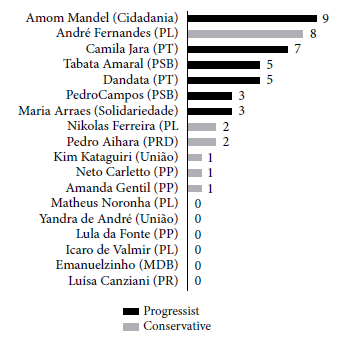
To assess the positions of young Representatives, we present in Graph 1 the number of bills proposed by them related to issues of gender, sexuality, abortion, and reproductive rights. We included the names of the Representatives so that it is possible to see which young Representatives are most involved in the debate on reproductive rights and sexual freedoms. Furthermore, we identified the ideological affiliation of these young Representatives by skin color, with Black representing progressives and gray representing conservatives.
Graph 1 shows the number of bills in which young Representatives are involved, either as lead authors or in partnership with other Representatives. The graph only describes the total number of bills linked to sexual and reproductive rights. We highlight that among the Representatives with bills focused on this topic, the total number of proposals at the beginning of this legislative session was: Amom Mandel (Cidadania) 35 bills; André Fernandes (PL) 27 bills; Camila Jara (PT) 30 bills; Tabata Amaral (PSB) 15 bills; Dandara (PT) 20 bills; Pedro Campos (PSB) 26 bills; Maria Arraes (Solidariedade) 23 bills; Nikolas Ferreira (PL) 19 bills; Pedro Aihara (PRD) 13 bills; Kim Kataguiri (União) 46 bills; Neto Carletto (PP) 17 bills; and Amanda Gentil (PP) 10 bills. As shown in Graph 1, the following representatives do not have bills on this topic: Matheus Noronha (PL); Yandra de André (União), Lula da Fonte (PP); Ícaro de Vlamir (PL), Emanuelzinho (MDB), and Luíza Canziani (PR).
These data show that young members of Congress have a broad agenda of projects and that sexual rights are not the central theme of their proposals, with public safety and economic projects taking first place, respectively. However, since this study focuses specifically on the actions of young conservative and progressive members of Congress on sexual and reproductive rights, we consider only this data in the following analysis.
Leading the way, with the most significant number of bills submitted related to sexual and reproductive rights, is Representative Amom Mandel (Cidadania) with 9 bills; André Fernandes (PL) with 8 bills, followed by Camila Jara (PT) with 7 bills; Tabata Amaral (PSB) 6 bills; Dandara (PT) has 5 bills; and Pedro Campos (PSB) has 3 bills. Maria Arraes (Solidariedade) has 3 bills, and Nikolas Ferreira (PL) and Pedro Aihara (PRD) have 2. With only one bill submitted, we have Representatives Kim Kataguiri (União), Neto Carletto (PP), and Amanda Gentil (PP). The remaining young Representatives do not have any bills linked to the sexual and reproductive rights agenda. Thus, of the 18 young members of Congress, 13 are involved in the debate on sexual and reproductive rights.
Analyzing the data in Graph 1, we note that the Representative with the most bills linked to gender issues and sexual and reproductive rights is Amom Mandel (Cidadania). This Representative hails from a more centrist party ideologically, but his positioning is similar to that of more progressive members of Congress. Furthermore, of the nine bills he is linked to, three are proposed in partnership with members of Congress from left-wing parties, such as the Workers’ Party (PT), the Democratic Party (PDT), and the Brazilian Socialist Party (PSB). In second place in terms of the number of bills filed, Representative André Fernandes (PL) presents an avowedly conservative stance. Although initially not a party with strong electoral performance on the Brazilian right, with former President Bolsonaro’s candidacy for the party, it has increasingly taken a stance closer to the far right33.
In this regard, understanding conservatism as a movement organized to suppress the advancement of progressive agendas, the fact that a conservative representative is second in proposing bills addressing gender and sexual and reproductive rights aligns with the theoretical premises of conservatism, which has as one of its elements the defense of moral agendas linked to religious beliefs. In this sense, controlling the sexual agenda is directly connected to what conservatism understands as the defense of the family.38
Another finding revealed in Graph 1 is that although young Representatives are predominantly right-wing, progressive Representatives lead the way in proposing bills focused on the sexual and reproductive rights agenda. All young Representatives on the left have submitted bills to the National Congress. Six of the young Representatives from right-wing parties have not submitted any bills related to gender and sexual or reproductive rights. These data reveal that the left overwhelmingly embraces the gender agenda and that young members of Congress from this ideological camp are more engaged with this discussion. This is an expected result, considering that discussions about gender and sexuality are important topics in the progressive camp.
Regarding conservative Representatives, this agenda clearly does not mobilize them in the same direction, since their projects focus on issues restricting sexual freedoms. Once again, the theoretical perspective of conservatism helps to understand this movement. In the Brazilian context, conservatism constitutes a synthesis of rejection of the left, the defense of Christian morality, and an alignment with neoliberalism4.
Specifically on the issue of abortion, Bill 1904/2024, supported by André Fernandes and Nikolas Ferreira, proposes changes to the current abortion law. The changes would prohibit abortion in any case after 22 weeks of gestation, carrying a penalty of 20 years in prison for women who undergo the procedure, a penalty exceeding the 15 years for rape29.
In this regard, the conservative Representatives’ emphasis on more radical bills aligns with our research hypothesis. Although the social imaginary views youth as eminently progressive, in the parliamentary political arena, the actions of young people, even those who are openly progressive, are more restrained. In contrast, young conservatives propose more radical, reactionary reforms, influencing not only the stagnation of the debate on sexual rights but also its regression.
Notably, although progressive representatives propose more laws regarding reproductive and sexual rights, the proposals of young conservatives have the most significant impact on these freedoms. This situation is primarily due to conservatives’ willingness to propose more controversial and restrictive bills on sexual freedoms. At the same time, progressives spearhead bills that are situated in areas that generate less political friction with voters, such as combating domestic violence and harassment.
To further analyze the content of the bills and assess how young Representatives relate to sexual and reproductive rights, Chart 1 lists the Representatives, followed by the main categories defended in the bills to which they are affiliated. Young Representatives are also classified as progressive or conservative.
Based on Chart 1, we can see that the bills (PLs) filed by young Representatives addressing gender, sexuality, and reproductive rights generally revolve around regulating sexual violence, recognizing gender identities, controlling sexual content, and standardizing reproductive practices. However, there are substantive differences between the bills proposed by Representatives from the progressive camp and those from the conservative camp.
In the progressive camp, the main topics addressed are: 1) Combating harassment and sexual violence, with proposals such as the “No means no” protocol; 2) Promoting rights related to gender identity, such as the use of social names and the prohibition of conversion therapies; 3) Recording and addressing discrimination against women and LGBTQIA+ people; 4) Expanding access to contraceptive methods; and 5) Offering support measures for victims, such as post-abortion psychological support and leave for forensic examinations.
In the conservative camp, the bills focus on: 1) increased penalties for sexual crimes and harassment (without articulation with feminist or gender agendas); 2) restrictions on policies aimed at the trans population, such as banning hormone blockers for children; 3) projects with strong moral appeal, such as banning public funding for so-called “premature sexualization” events; and 4) criminalizing abortion after 22 weeks, with penalties greater than those for rape. These agendas reflect an alignment with punitive moralism and the defense of traditional gender and sexuality norms. This division highlights how young members of Congress, even when addressing similar issues, do so from opposing perspectives: on the one hand, the defense of rights and guarantees; on the other, containment and repression.
The results also show that Representatives affiliated with centrist, center-left, and left-wing parties are more active in proposing bills focused on gender, sexuality, and reproductive rights. At the same time, right-wing and far-right parliamentarians are the numerical majority, but act primarily to restrict these agendas. Notably, most proposals among progressive representatives address sexual violence and discrimination, although they fail to advance issues that alter structural relations of domination, such as the decriminalization of abortion. Among conservative representatives, however, bills that also address violence or harassment have a punitive focus and are often linked to measures that restrict rights, such as the criminalization of abortion and the prohibition of policies for trans people. Thus, although there is formal thematic overlap, the political meanings of the proposals are distinct and, in many cases, antagonistic.
We chose to explore only the bills of representatives with the highest number of bills on sexual and reproductive rights. Starting with the Representative with the highest number of bills associated with his name is Amom Mandel (Cidadania). Among the issues addressed by the young Representative are protection against children’s exposure to pornography on social media; increased punishment for sexual crimes; prevention of sexual violence in schools; campaigns against harassment and protection for victims; access to contraceptives and psychological support for women who have suffered abortions. The agendas championed by Amom Mandel, despite his affiliation with a centrist party, place him in the progressive camp, not only for his defense of fundamental rights and freedoms, but also for his appeal to reproductive rights. Advocating for access to contraceptives, and the consequent right to family planning, and promoting psychological support for women who have suffered an abortion, positions this congressman’s agenda against the grain of conservatism.
Similarly, when we examine the bills proposed by young, progressive congressmen, we find that even among them, the agenda for change and debate on sexual and reproductive rights is not central. Generally speaking, we observe that the main issue emerging in the bills of progressive representatives is combating sexual and domestic violence. Second, defending gender identity is only a measure directly linked to reproductive rights, promoting the use of contraceptives. These issues do not alter the foundations of the social structure of domination. What feminists hope for is that, regarding sexual and reproductive rights, women can make decisions about their bodies. The bills presented tend to control men’s violence against women merely.
It follows, then, that, as Mannheim’s theory of conservatism shows, even non-conservative individuals tend to reject processes of change and social innovation. This is explained by the fact that societies are generally largely traditionalist in their customs, and even the left is resistant to change, especially in sexual morality, which is deeply rooted in Christian tradition. Thus, even among young progressives, embracing this political agenda clashes with the traditionalism inherent in societies, especially in Brazil.
Issues like the decriminalization of abortion are discussed within social movements, but the debate in parliamentary arenas is much more conservative. This is because progressive representatives also need the support of a segment of society that is not progressive to be elected. In this sense, it is important not to overly offend the electorate’s traditionalist tendency to react with suspicion to any profound change in the so-called correct social standards23.
A theoretical interpretation of an essentially conservative society also helps us understand why the more conservative young representatives in this study had a higher overall electoral vote share than the progressive candidates. Conservatives find it easier to align their views with the electorate’s demands, since conservatism is an exaggerated expression of traditionalism, embodied in the form of an organized movement against the social changes fueled by progressives23.
To better understand this point, we analyzed the issues proposed by young and conservative Representatives. We explored only the bills proposed by the Representative with the most proposals in sexual and reproductive rights, André Fernandes (PL). The Representative advocates for proposals similar to progressive demands, such as combating sexual harassment and cybercrimes with a sexual nature. However, he is linked to projects that directly contradict sexual, reproductive, and gender rights.
The first one worth highlighting is the proposal to deny access to hormone treatment for transgender children. There is also a ban on public funding for events that promote the “sexualization of children”, control over reporting of abortions, and, finally, the proposal to make abortion after 22 weeks a simple homicide crime. So, the same representative, who is in a conservative party, has conservative bills regarding gender identity, but progressive ones regarding sexual harassment. Once again, these bills attempt to curb male violence against women, but they limit women’s and men’s right to choose their gender and sexuality.
Similarly, even among the other young, more conservative representatives, we observed that most of the proposals revolved around policies aimed at combating sexual harassment and abuse. This issue lies at a crossroads where, despite addressing rights related to gender and sexuality, it does not directly challenge precepts considered part of the social order.
In short, the data generally reveal that even young progressives are unable to make significant changes in the political arena of reproductive rights, avoiding this issue altogether. The greatest demands revolve around the right to affirm gender identities and protection from sexual abuse and harassment. This finding highlights the strength of traditionalism even among young progressives, highlighting that profound social changes in sexuality and reproductive rights remain taboo, a topic that politicians tend to avoid due to its negative impact on the electorate.
On the other hand, the conservative agenda can advance without limits, as it does not question relations of domination; on the contrary, it perpetuates them. In Brazil, the conservative agenda leverages a certain prestige and promotes projects that limit women’s decision-making power. Young conservative representatives not only seek to directly interfere with individual freedoms regarding the treatment of their bodies, but also seek to enact punitive rules in legislation to curb dissent.
The work then shows the challenges of the progressive agenda in sexual and reproductive rights in the legislature, considering the Brazilian society’s traditionalism, the electoral calculations that occur in parliamentary arenas, and the conservative wave still very present in Brazil.
Conclusion
This research aimed to analyze how young Representatives elected in 2022 align with conservative or progressive agendas regarding issues of gender, sexuality, and sexual and reproductive rights. With the emergence of conservative movements, it has become important to assess how young people identify with these opposing ideological currents and how this influences public policies.
A qualitative methodology based on document analysis was adopted to achieve this study’s objectives. Data collection involved accessing the House of Representatives’ database, which contains, among other information, congressperson profiles, proposed bills, votes, and speeches. Once the young representatives had been identified, we began collecting bills they had drafted or supported that addressed sexuality, gender, and sexual and reproductive rights. The bills were then categorized and associated with the respective representative. With this organized data, we used content analysis, supported by the theory of conservatism.
The results highlighted the prominence of young members of Congress affiliated with conservative right-wing parties. Not only are the majority of young people elected to federal office members of right-wing parties, but their electoral representation was higher than that of young progressives. Another finding presented in the survey was that young progressives, despite being a minority, most often present proposals related to gender, sexuality, and sexual and reproductive rights.
Despite the greater number of bills introduced by young progressive Representatives, the bills generally focus on combating domestic violence and sexual harassment. In the conservative camp, young representatives also introduce bills against sexual violence and harassment. Therefore, issues central to the feminist camp, such as the decriminalization of abortion, are not put on the agenda by the progressive camp because these issues alter societal relations of domination and, therefore, tend to be rejected. One of the reasons they are rejected in the parliamentary arena is the calculation made for the upcoming elections, which also considers the conservative vote.
On the other hand, young and conservative Representatives endorse bills that seek to restrict gender freedom, especially on issues related to identity. Therefore, the conservative agenda is constructed and advances more easily, as it does not question relations of domination, but instead tends to defend them. The conservative agenda in the parliamentary arena also takes advantage of the conservative wave in Brazil. This work then shows the presence and ease with which conservative agendas advance in Brazil. On the other hand, it uncovers the difficulties in proposing and advancing truly progressive agendas - ones that alter relations of domination.
Future studies should systematically analyze social markers such as class, ethnicity, gender, and sexuality of members of Congress, considering how these dimensions influence their political positions. Gender, in particular, should be central to these analyses, given its structural role in shaping progressive political projects, which is justified by the observation that women’s rights, in general, are frequently attacked by conservative groups. Investigating these markers could produce a deeper understanding of how political subjectivities and legislative projects coordinate, and how some identities are more likely to challenge or reproduce existing relations of domination. Furthermore, we understand the importance of considering the dynamics of the legislative process and its implications for the conservative and progressive agendas.
In practical terms, we suggest focusing on the election of young Representatives who genuinely champion progressive agendas, that is, who change relations of domination regarding sexual and reproductive rights. In the parliamentary arena, these Representatives will already face many conservatives who have a great deal of ease in proposing and advancing their agendas, precisely because they do not change relations of domination.
References
-
1 O Celeiro. Um congresso mais conservador [Internet]. 2022 [acessado 2024 jul 15]. Disponível em: https://jornalceleiro.com.br/2022/10/um-congresso-mais-conservador/
» https://jornalceleiro.com.br/2022/10/um-congresso-mais-conservador - 2 Dombrowski O. Conservador nos costumes e liberal na economia: liberdade, igualdade e democracia em Burke, Oakeshott e Hayek. Rev Katal 2020; 23(2):223-234.
- 3 Mannheim K. O pensamento conservador. In: Martins JS, organizador. Introdução crítica à sociologia rural. São Paulo: Hucitec; 1986. p. 77-131.
- 4 Lynch CEC. Conservadorismo caleidoscópico: Edmund Burke e o pensamento político do Brasil oitocentista. Lua Nova Rev Cult Polít. 2017;(100):313-364.
- 5 Cepêda VA. A nova direita no Brasil: contexto e matrizes conceituais. Mediações 2018; 23(2):40-74.
- 6 Santos F, Tanscheit T. Quando velhos atores saem de cena: a ascensão da nova direita política no Brasil. Colomb Int 2019; 99:151-186.
- 7 Rocha C. O boom das novas direitas brasileiras: financiamento ou militância? In: Solano E, organizadora. O ódio como política: a reinvenção das direitas no Brasil. São Paulo: Boitempo; 2018. p. 47-52.
- 8 Bobbio N, Matteucci N, Pasquino G. Dicionário de política. Brasília: Editora UNB; 1998.
- 9 Lima ECA, Lima ICC. Conservadorismo, neoconservadorismo e bolsonarização. Rev Debates 2020; 14(1):173-199.
- 10 Oliveira FM. Conservadorismo brasileiro: surgimento e atuação de movimentos sociais conservadores. In: Open Science Research III. São Paulo: Científica Digital; 2022; p. 1904-1920.
- 11 Rocha C. Menos Marx, mais Mises: o liberalismo e a nova direita no Brasil. Sao Paulo, SP: Todavia Editora; 2021.
- 12 Moura CHG, Silva PF. Escola sem partido e conservadorismo moral: instrumentalização da religião, sexualidade e gênero. Psicol Cienc Prof 2023; 43:e250951.
- 13 Machuy C, Schneider M, Seixas P. Inimigo à esquerda: conservadorismo brasileiro e as origens da guerra contra a cultura. Rev Eco-Pos. 2024; 27(1):353-377.
-
14 G1. Quem é Nikolas Ferreira (PL), o deputado federal mais votado do Brasil e da história de Minas Gerais [Internet]. 2022 [acessado 2023 ago 20]. Disponível em: https://g1.globo.com/mg/minas-gerais/eleicoes/2022/noticia/2022/10/03/quem-e-nikolas-ferreira-pl-o-deputado-federal-mais-votado-do-brasil-e-da-historia-de-minas-gerais.ghtml
» https://g1.globo.com/mg/minas-gerais/eleicoes/2022/noticia/2022/10/03/quem-e-nikolas-ferreira-pl-o-deputado-federal-mais-votado-do-brasil-e-da-historia-de-minas-gerais.ghtml - 15 Brasil. Presidência da República. Lei nº 12.852, de 5 de agosto de 2013. Institui o Estatuto da Juventude e dispõe sobre os direitos dos jovens, os princípios e diretrizes das políticas públicas de juventude e o Sistema Nacional de Juventude - SINAJUVE. Diário Oficial da União 2013; 6 ago.
- 16 Vommaro P. Juventudes y políticas en la Argentina y en América Latina: tendencias, conflictos y desafíos. Ciudad Autónoma de Buenos Aires: Grupo Editor Universitario; 2015.
- 17 Melucci A. Juventude, tempo e movimento sociais. Rev Bras Educ 1997; 6:5-14.
- 18 Scherer-Warren I. Manifestações de rua no brasil 2013: encontros e desencontros na política. Cad CRH 2014; 27(71):417-429.
- 19 Araújo RO, Perez OC. Diferenças no antipartidarismo entre jovens estudantes, jovens solteiros e jovens adultos. Pro-Posições 2025; 36:e2025c0202BR.
- 20 Perez OC. A importância das diversidades nas análises sobre juventudes e participação política. Estud Sociol 2024; 29(n. esp. 1):739-756.
- 21 Perez OC, Araújo RO. Gênero, raça e classe dos eleitores jovens conservadores e progressistas. Rev Agenda Politica 2024; 11(3):114-126.
- 22 Pierucci AF. As bases da nova direita. Novos Estud CEBRAP 1987; 19:26-45.
- 23 Weller W, Bassalo LMB. A insurgência de uma geração de jovens conservadores: reflexões a partir de Karl Mannheim. Estud Av 2020; 34(99):391-408.
- 24 Severo RG, Gonçalves LD. Ofensiva conservadora: a busca da anulação da participação de jovens na vida pública pelo Escola Sem Partido. Rev Educere Educ 2020; 15(36):1-18.
- 25 Severo RG, Barcellos SB, Gomes SSR. Confiança e socialização política nas mídias digitais: perspectiva de jovens no ensino médio do Rio Grande do Sul. Rev Dialogo Educ 2023; 23(76):493-514.
- 26 Baquero M, Morais JA. A internet e a (des)politização dos jovens brasileiros. Rev Cad Campo 2018; 25:33-62.
-
27 Ciscati R. Direitos reprodutivos: o que são, e qual a situação no Brasil [Internet]. 2020 [acessado jul 24 2024]. Disponível em: https://www.brasildedireitos.org.br/atualidades/direitos-reprodutivos-o-que-so-e-qual-a-situao-no-brasil/
» https://www.brasildedireitos.org.br/atualidades/direitos-reprodutivos-o-que-so-e-qual-a-situao-no-brasil - 28 Gomes JCA. Direitos sexuais e reprodutivos ou direitos sexuais e direitos reprodutivos? Dilemas e contradições nos marcos normativos nacionais e internacionais. Rev Direito GV 2021; 17:e2136.
-
29 Sales P. Entenda o projeto que dá até 20 anos de prisão para mulher estuprada que abortar [Internet]. 2024 [acessado 2024 jul 24]. Disponível em: https://congressoemfoco.uol.com.br/area/congresso-nacional/entenda-o-projeto-que-da-ate-20-anos-de-prisao-para-mulher-estuprada-que-abortar/
» https://congressoemfoco.uol.com.br/area/congresso-nacional/entenda-o-projeto-que-da-ate-20-anos-de-prisao-para-mulher-estuprada-que-abortar -
30 Tribunal Superior Eleitoral (TSE). Glossário explica requisito da idade eleitoral [Internet]. 2021 [acessado 2025 jun 1]. Disponível em: https://www.tse.jus.br/comunicacao/noticias/2021/Dezembro/glossario-explica-requisito-da-idade-eleitoral
» https://www.tse.jus.br/comunicacao/noticias/2021/Dezembro/glossario-explica-requisito-da-idade-eleitoral - 31 Bardin L. Análise de conteúdo. Lisboa: Edições 70; 1977.
- 32 Rossi GB, Serralvo FA, Joao BN. Análise de conteúdo. Rev Bras Mark (REMark) 2014; 13(4):39-48.
- 33 Bolognesi B, Ribeiro E, Codato A. Uma nova classificação ideológica dos partidos políticos brasileiros. Dados 2022; 66(2):1-27.
- 34 Araújo RO, Perez OC. Antipartidarismo entre as juventudes no Brasil, Chile e Colômbia. Estud Sociol 2021; 26(50):327-349.
- 35 Perez OC. Relações entre coletivos com as Jornadas de Junho. Opinião Publica 2020; 25(3):577-596.
- 36 Brasil. Constituição da República Federativa do Brasil: promulgada em 5 de outubro de 1988. São Paulo: Saraiva; 1990.
- 37 Perez OC, Coacci T, Sousa LM. Movimentos sociais e direitos LGBTQIA+: possibilidades e disputas. Simbiitica Rev Eletronica 2023; 10(2):1-11.
- 38 Scruton R. Conservadorismo: um convite à grande tradição. Rio de Janeiro: Record; 2019.
The data sources adopted in the research are indicated in the article’s body.

 Source: Authors, based on data from the House of Representatives (2024).