 Critical analysis of policies and strategies to combat the Zika virus in Brazil: using the WPR approach
Abstract
Exploring narratives present in public policies to control the Zika virus becomes fundamental, given the possibility of new epidemic waves and their harmful effects. The objective of this study was to critically analyze the documents guiding the fight against the Zika virus, implemented by the Brazilian government, from 2016 to 2022. This is a qualitative, exploratory, documentary and analytical study, using the What’s The Problem Represented approach (WPR). Three categories emerged from the analysis: (I) Representation of the problem: biomedical and technical narrative in the health-disease process; (II) Solutions, political options and their effects on the operationalization of actions and on the lives of children and mothers and; (III) The silence and neglect of policies in the effectiveness of actions: low integration between information systems and low focus on structural and collective actions, limited access to care technologies of greater complexity and cost for children with congenital syndrome associated with Zika virus infection; limited support network for family groups made up of black women, with low income and little education. The analysis highlights a set of policy options that have contextual and epidemiological relevance, but that make vulnerable populations invisible.
Key words:
Zika Virus; Health Policy; Arbovirus Infections
Resumo
Explorar narrativas presentes nas políticas públicas de controle do Zika vírus se torna fundamental, haja visto a possibilidade de novas ondas epidêmicas e seus efeitos danosos. O objetivo deste estudo foi analisar criticamente os documentos norteadores do enfrentamento do Zika vírus, implementados pelo governo brasileiro, no período de 2016 a 2022. Trata-se de um estudo qualitativo, exploratório, documental e analítico, utilizando a abordagem What’s The Problem Represented (WPR). Da análise emergiram três categorias: (I) Representação do problema: narrativa biomédica e tecnicista no processo saúde-doença; (II) Soluções, opções políticas e os efeitos destas na operacionalização das ações e na vida das crianças e das mães e; (III) Os silêncios e a negligência das políticas na efetividade das ações: baixa integração entre os sistemas de informações e baixo enfoque em ações estruturais e coletivas, limitação do acesso a tecnologias de cuidado de maior complexidade e custo para crianças com síndrome congênita associada à infecção pelo vírus Zika; limitada rede de apoio a grupos familiares compostos por mulheres negras, de baixa renda e pouca escolaridade. A análise evidencia um conjunto de opções políticas que possuem relevância contextual e epidemiológica, porém que invisibilizam populações vulneráveis.
Palavras-chave:
Zika vírus; Política de Saúde; Infecções por Arbovírus
Resumen
Explorar narrativas presentes en las políticas públicas de control del virus Zika es fundamental, dada posibilidad de nuevas olas epidémicas y sus efectos nocivos. El objetivo de este estudio fue analizar críticamente documentos orientadores para el enfrentamiento del virus Zika, implementados por el gobierno brasileño, en el período de 2016 a 2022. Estudio cualitativo, exploratorio, documental y analítico, utilizando What’s The Problem Represented (WPR). Del análisis surgieron tres categorías: (I) Representación del problema: narrativa biomédica y técnica en el proceso salud-enfermedad; (II) Soluciones, opciones políticas y sus efectos en la operacionalización de las acciones y en la vida de niños, niñas y madres; (III) Silencio y desatención de las políticas en la efectividad de las acciones: baja integración entre sistemas de información y bajo foco en acciones estructurales y colectivas, limitado acceso a tecnologías de atención más complejas y costosas para niños con síndrome congénito asociado a la infección por el virus Zika; Red de apoyo limitada para grupos familiares integrados por mujeres negras, con bajos ingresos y poca educación. El análisis destaca un conjunto de opciones políticas que tienen relevancia contextual y epidemiológica, pero que invisibilizan a las poblaciones vulnerables.
Palabras clave:
Virus Zika; Política Sanitaria; Infecciones por Arbovirus
Introduction
Following its emergence in 2015, the Zika epidemic in Brazil posed a number of public health challenges due the association of the virus with cases of congenital microcephaly and other fetal malformations and the scarcity of knowledge for effective intervention1-3.
Although the second wave of infection spread throughout the entire country, the Northeast region had a higher number of recorded cases of microcephaly than other regions, highlighting significant regional differences. To this day, the causes that led this region to be the most affected remain unknown4. However, there seems to be a relationship between infection severity and socioenvironmental determinants such as poor housing and social vulnerability5,6.
Social vulnerability is particularly marked among families of children with Congenital Zika Syndrome (CZS), adding to the burden already imposed by the disease7. Partner abandonment, low level of family support8, precarious financial situation, difficulty accessing health services and maternal physical and mental exhaustion are some of the issues that exacerbate the already severe post-infection fetal outcome8-10.
To mitigate the effects of the Zika epidemic in Brazil, the federal government has implemented guidelines, control and monitoring strategies and care protocols11. However, factors such as poor coordination between actors, deficiencies in basic sanitation services, social inequality, lack of public accountability and placing the blame on vulnerable populations have limited the effectiveness of response strategies12-15.
In this context, public policy analysis can play an important role in mitigating social problems by improving the formulation and implementation of the evaluated policies16. Despite progress over recent years in the analysis and evaluation of health policies, a number of issues remain unaddressed, given that the program and policy implementation process is a terrain characterized by bargaining, coalition-building and the ‘convergence of different intentions’17.
Conventional approaches to policy analysis tend to focus on solving problems rather than questioning their origin18. Since the representation of problems in a policy can often lead to distortions in design, structuring and operationalization, questioning and exploring the policy can help improve analysis and guide corrections19. In this context, the use of analytical tools that allow us to understand ‘implicit problems’ within public policies can open up perspectives to find solutions, making it possible to reflect on the role governments and institutions play in generating these problems20.
In view of the above, this study aimed to critically analyze documents that guided the Brazilian government’s response to the Zika epidemic using the What’s The Problem Represented to Be? (WPR) approach 18.
Methods
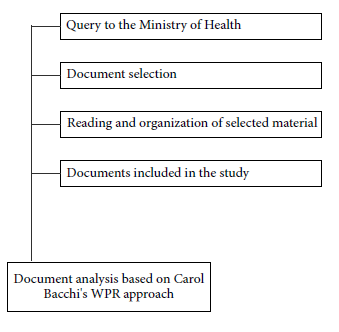
We conducted an exploratory qualitative documentary analysis using the WPR approach. The documents were selected and analyzed in four steps: (1) search of the communication channels of the Brazilian Ministry of Health to find documents; (2) document selection; (3) reading and organization of material; and (4) critical analysis using the WPR approach. The study search and selection process is illustrated in Figure 1.

In the first step, a request was made to the General Office for the Coordination of Arbovirus Surveillance via the Fala.BR platform to access all documents relating to Zika control and prevention implemented by the Brazilian government, including guidelines, protocols, policies, strategies and action plans published since the emergence and identification of the virus in the country in 201521.
All documents addressing Zika guidelines and control and prevention strategies were included. Documents referring exclusively to clinical issues and vector management were excluded.
The full-text versions of the documents were then read, organized and analyzed using the WPR approach, which applies six analytical questions (Chart 1)18:
(1) What’s the ‘problem’ represented to be?; (2) What presuppositions or assumptions underpin this representation of the ‘problem’?; (3) How has this representation of the ‘problem’ come about?; (4) Where are the silences?; (5) What effects are produced by this representation of the ‘problem’?; (6) How has the ‘problem’ been questioned?
The questions aim to explore and critically question ‘that which is not problematized’, since public policies can have limitations due to the way they highlight or silence ‘problem’ issues18 (p.13). Thus, discussing and identifying issues that are silenced in the representations of problems provides a different perspective, enabling reflection on the practices that can produce these ‘problems’20.
The documents analyzed in this study are shown in Chart 2. According to National Health Council resolution 510 (April 7, 2016), studies that use publicly available information are exempt from ethics review.
Results
Four documents published between 2016 and 2022, the period of the Zika virus epidemic, were selected. The WPR analysis of the narratives resulted in the following three categories: representations of the problem detected from the objectives and lines of action outlined in the documents; solutions formulated based on political options in the historical context; silences explored in the document analysis and presented in Chart 3.
Representation of the problem: dominant narrative of the health and disease process
The findings show that the representation of the increase in cases of Zika virus infection and microcephaly resulting from CZS is based on responses that are still underpinned by knowledge supported by the doctor-centered model, which overlooks socio-environmental aspects. The focus on the cause of disease perpetuates a technical, vectorial, biological, clinical and statistical approach, without progressing on the social determinants of health (SDHs). While the importance of SDHs may be acknowledged, these aspects are not part of the operationalization of policies. Risk is still understood from a classical, epidemiological and statistical standpoint, which aims to control biological and quantitative indicators, with limited discussion of aspects of vulnerability, which are so important when dealing with affected groups.
The cause of congenital defects is presented as exposure to the virus, which is a biological perspective, thus underplaying social, economic, environmental and ecological determinants. The guidelines and actions focus on child functioning rather than quality of life. Combating the vector remains focused on individual responsibility, through peridomestic control of Aedes aegypti and the use of insecticides (larvicides and adulticides) during inspections by endemic disease control workers.
The representations of the problem influence policy options and dictate the absence of important issues in policies that would otherwise ensure more effective actions, particularly affecting the prevention of new epidemics and Zika and CZS case monitoring.
Solutions, political options and their effects on the implementation of actions and children’s and mothers’ lives
The political options underline the importance of the epidemiological and emergency issues that marked the study period. Response strategies were underpinned by epidemiological data, combining vector control actions, care and support for affected groups, and making it possible to integrate and expand actions and services related to monitoring changes in the growth and development of children, differentiating Zika from other infectious diseases caused by viruses. Reports detailing experiences and the history of the epidemic from the point of view of various professionals were also published with the aim of filling gaps in knowledge on the impact of the Zika virus.
However, despite presenting contextualized options relevant to the epidemiological scenario, these political options were influenced by the representations of the problems, impacting the operationalization of actions, making them: fragmented in the field of action and work processes; limited in the contextual, conceptual and effective use of SDHs; fragile from an intersectoral perspective; unidirectional by not highlighting that the problems are systemic and structural; procedural and not backed up by comprehensive care; insufficient in relation to aspects of social, economic, racial and gender vulnerabilities; exclusionary in failing to perceive and include women and children as primary subjects in the development of actions and policies.
One of the effects of these policies on children with CZS is that treatment of cases focuses on functioning rather than quality of life. Fragmentation of care in the health care network occurs when responsibility for provision of more complex and costly care technologies is not clearly defined in the lines of care provided by federated entities.
The effect of silences and neglectful policies on the effectiveness of actions
Silences included limited integration of information systems, as well as the lack of specific actions to ensure system reliability, particularly when it comes to case reporting. Resulting problems, such as poor data consistency and agility, can limit the effectiveness of case investigation and monitoring, hampering outbreak and epidemic prevention and control decision-making.
Differences across regions and populations are often ignored, and the Zika virus epidemic is addressed from a single perspective. In particular, the lives of low-income black women with a low level of education living in peripheral communities lacking basic sanitation, adequate garbage collection and access to clean drinking water should be better represented, ensuring the completeness of data and inclusion of variables on the case notification form; however, there are no specific proposals for the formulation of policies and actions to address these specificities. Neglect of the interrelation between these variables in the policies analyzed shows the absence of important discussions on intersectionality and consequent repercussions for the care and support provided to affected women, children and families.
The documents fail to address, or only superficially touch on, structural causes such as basic sanitation, urban infrastructure, deforestation, poor housing, social vulnerability and access to clean drinking water (Figure 2). Overcoming weaknesses in health education actions is also not addressed and the documents disregard family participation. There is a lack of spaces for active listening and methods to promote listening tailored to meeting affected women’s and children’s health needs.

Compilation of the findings of the WPR analysis of Zika policies and response strategies in Brazil.
Government vector control measures focus on mechanical and chemical control in the form of short-term prevention actions, minimizing the importance of community-level long-term actions addressing infrastructure and sanitation.
While the documents address issues related to the care of pregnant women and children with microcephaly, the guarantee of a comprehensive diagnosis and quality care and follow-up has yet to materialize. Comprehensive care guidelines exist, but there is no specific guidance on referrals and advice, especially considering regional differences. Furthermore, difficulties experienced by mothers on their pathway through the health network are disregarded.
Also with regard to diagnosis, the documents recognize the importance of adequate and sufficient human and material resources, laboratory facilities, equipment and qualified professionals to ensure early, accurate and comprehensive diagnosis; however, specific forms of long-term funding of these resources are not discussed.
A graphical summary of the findings from the Zika virus monitoring policies and action documents is presented in Figure 2.
Discussion
The silences identified in this study show that the political option for responding to the Zika virus is based on a biological, doctor/medication-centered perspective, with a strong focus on disease prevention and few solutions based on the SDHs, which are often reduced to vector control issues. The dominant narrative of the health and disease process overlooks the complexity of the arbovirus and its impacts, which is consistent with other studies in Brazil26,27 showing the presence of this narrative in the discussion of chronic diseases.
Government vector prevention and control campaigns lack educational communication, being merely informative rather than educational. There is therefore a need to develop dialogic strategies aimed at transforming everyday practices, since arbovirus prevention and control should extend beyond the elimination of vector breeding sites28.
A study by Pereira29 shows that prevention campaigns focus on individual responsibility, disregarding collective aspects such as the importance of looking after public spaces and the lack of general commitment to and co-responsibility for prevention30. They therefore place the population in the position of preventive subject, thinking only of the individual, blaming the mosquito vector and disregarding environmental and climatic factors as a cause and in preventive actions29.
Our findings reveal a clear need to develop effective integrated systems that provide access to up-to-date data and enable the construction of consistent and reliable information31,32. In line with a study carried out in Pernambuco identifying the need to reorganize services, resources and investment in the qualification of surveillance professionals, the results show that specific actions are essential to improve the quality of information systems so that they can achieve their objectives33.
Studies show that the Zika epidemic in Brazil has disproportionately affected black women with low socioeconomic status34,35, with black and brown women being more likely to have a live birth with CZS than white women34.
Due to factors such as social vulnerability, poor housing and poor access to education, black women are at higher risk of infection35, as shown in the study by Lima et al. 36. The study showed that black, single, unemployed women with a low level of education are more likely to be affected by the Zika virus, reinforcing the importance of planning strategies to combat racial discrimination and social vulnerability, which are discussions that are absent from the policies analyzed30.
In this respect, it is important to mention that certain variables, such as race/skin color and education level are underreported. This can contribute to the persistence of social and racial inequality and hamper the recognition of the needs of each specific group36.
It is important to highlight that the notorious racism and sexism suffered by black women in policies in Brazil hinders universal and equitable access to services provided by the country’s national health system, Sistema Único de Saúde (SUS)37. The documents analyzed are silent on specific actions and policies tailored to this group, ignoring the importance of intersecting race, gender and class categories in determining the health of this group, whose rights are denied on a daily basis37.
From this perspective, it is essential to hold continuing debates about institutional racism in health organizations, since this makes it possible to combat inequality, providing equal access to health services for this population and, consequently, more targeted and effective actions for this group38. Racism is operationalized through actions in conjunction with different policies and mechanisms of repressive control, providing specific groups the minimum needed for survival. In this way, the state neglects the black population through public policies that do not uphold basic principles of justice, equity and universality39.
With regard to socioeconomic conditions and health emergencies, a study in Pernambuco found that families living in neighborhoods with a monthly income of less than two minimum wages are at higher risk of infection by Zika virus40. These results are consistent with the findings of Souza et al. 41, who reported high prevalence of microcephaly in areas with poor living conditions.
Queiroz and Medronho42 found an association between high incidence of arboviruses and low economic status, while other authors highlight the importance of adequate water treatment and supply and sewage disposall4,34,41,43 in the fight against infectious diseases43.
Access to health services by mothers and relatives of children affected by CZS is another critical point that must be considered in relation to the post-Zika epidemic2. Some studies have shown that these groups encounter difficulties accessing adequate health care due to the lack of specialists, public transport and social vulnerability2,44.
Meireles et al. 45 emphasize that factors such as low socioeconomic status and poor access to health services are the biggest challenges faced by caregivers, since care for these children is mostly provided outside the municipality of residence. Long travel times to specialist health services or facilities (some families must make a 6-hour round trip for a 30-minute appointment)44 and lack of public transport in the outskirts of cities or rural areas result in the abandonment of early stimulation sessions46. While the federal government has introduced financial assistance for families of children with CZS (sanctioned by Law No. 13985), the amount is insufficient to cover treatment expenses, meaning that other support structures need to be implemented within the health network47.
The lack of specific welcoming and active listening actions for mothers and family members in policy implementation weakens the inclusion of women from this group in the development of actions ranging from planning to child rehabilitation.
Lack of knowledge about the risk and severity of CZS highlights the need to disseminate adequate information48. Issues such as family planning, the right to abortion under specific circumstances, access to health services and social security need to be better addressed in official documents on the Zika virus.
In addition, building dialogic spaces with other mothers experiencing similar situations enables sharing of experiences, help and emotional support, as well as moments of joy and collective empowerment49.
It therefore falls on public managers to incorporate solutions and structural alternatives into policies to address weakness in the health care system and in communication between health professionals and services, promoting comprehensive care for vulnerable groups, particularly women and children. Actions aimed at tackling the Zika virus will only be truly effective if they encompass practices that promote social equity1,48,50.
Conclusion
The WPR approach applied to documents that guided the Brazilian government’s response to the Zika epidemic enabled the identification of silences that have had a negative impact on arbovirus control and prevention, culminating in policies that disregard the social determinants of this problem, including racial, gender and income equity for the development of integrative actions.
A broad-ranging discussion on restructuring the health care network is essential for it to be able to effectively support women and children with CZS, considering comprehensiveness, intersectionality and the reduction of the psychosocial and economic impacts on these families, which are issues that continue to be addressed in an imprecise and ineffective manner in official documents.
Acknowledgements
We are grateful to the Graduate Program at the Federal University of Viçosa and to Coordination for the Development of Higher Education Personnel - Brazil (CAPES).
References
- 1 Freitas PDSS, Soares GB, Oliveira AE, Azevedo Bussinguer EC, Leonor E, Maciel N. Políticas Emergenciais em Saúde: os paradoxos da epidemia do Zika vírus. In: Miranda AE, Rangel C, Costa-Moura, R, organizadores. Questões sobre direitos humanos: justiça, saúde e meio ambiente. Vitória: UFES, Proex; 2018. p. 144-168.
- 2 Peiter P, Pereira R, França I. Análise de dimensões do acesso à saúde das crianças com Síndrome Congênita de Zika (SCZ) na Região Metropolitana do Rio de Janeiro. Saude Soc 2020; 29(2):1-14.
- 3 Siqueira SAV, Hollanda E, Beserra IKN, Lobato L, Vaitsman J. A implementação de ações intersetoriais na assistência a crianças com síndrome congênita do vírus Zika no estado do Rio de Janeiro. Physis. 2024; 34:e34SP102.
- 4 Oliveira WK, França GVA, Carmo EH, Duncan BB, Kuchenbecker RS, Schmidt MI. Infection-related microcephaly after the 2015 and 2016 Zika virus outbreaks in Brazil: a surveillance-based analysis. Lancet 2017; 390(10097):861-870.
- 5 Cunha LS, Medeiros WR, Lima Junior FAV, Pereira SA. Relationship between social inequality indicators and the spatial distribution of zika virus cases. Cien Saude Colet 2020; 25(5):1839-1850.
- 6 Souza MPA, Natividade MS, Werneck GL, Santos DN. Congenital Zika syndrome and living conditions in the largest city of northeastern Brazil. BMC Public Health 2022; 22(1):1-11.
- 7 Marinho F, Araújo VEM, Porto DL, Ferreira HL, Coelho MRS, Lecca RCR, Oliveira H, Poncioni IPA, Maranhão MHN, Mendes YMMB, Fernandes RM, Lima RB, Rabello Neto DL. Microcefalia no Brasil: prevalência e caracterização dos casos a partir do Sistema de Informações sobre Nascidos Vivos (Sinasc), 2000-2015. Epidemiol Serv Saude 2016; 25(4):701-712.
- 8 Hamad GBNZ, Tupinambás U, Souza KV. Vulnerabilities and stresses of families of children with Congenital Zika Virus Syndrome. Rev Rene 2021; 22:e62772.
- 9 Bulhões CSG, Almeida AM, Reichert APS, Abreu PD, Dias MD. Oral history of mothers of children with Congenital Zika Virus Syndrome. Texto Contexto Enferm 2020; 29:e20190167.
- 10 Silva DA, Silva EQ. Mental health from the perspective of women affected by the Zika virus: An ethnographic study in Pará State, Brazil. Cad Saude Publica 2020; 36(8):e00100019.
- 11 Morano JP, Holt DA. The social determinants of health contextualized for the Zika virus. Int J Infect Dis 2017; 65:142-143.
- 12 Freire AC, Brito FCS, Assis AMS, Monteiro MS, Da Silva FMP. Caminhos de enfrentamento das arboviroses na Paraíba: a governança na 6ª Gerência Regional de Saúde. Rev Principia 2019; 45:64-75.
- 13 Alves FEF, Gomes Moreira CL. Estratégias de controle e prevenção das arboviroses causadas pelo Aedes aegypti. Temas Saude 2020; 20(6):108-124.
- 14 Costa LD, Barros AD, Lorenzo C, Mendonça AVM, Sousa MF. Perception of the population on the role of authorities and communities in controlling arboviruses. Saude Debate 2022; 46(134):790-802.
- 15 Viegas LL, Ventura DFL, Nunes J. Uma leitura crítica das emergências em saúde global: o caso da epidemia de zika de 2016. Cien Saude Colet 2022; 27(11):4075-4084.
- 16 Estevão RB, Ferreira MDM. Análise de Políticas Públicas: uma breve revisão de aspectos metodológicos para formulação de políticas. Holos 2018; 3:168-185.
- 17 Magalhães R, Burlandy L, Senna M, Schottz V, Scalercio G. A implementação do programa Bolsa Família: as experiências de São Francisco de Itabapoana e Duque de Caxias. Cien Saude Colet 2007; 12(6):1513-1524.
- 18 Bacchi CL. Analysing Policy: What's the Problem Represented to Be? Frenchs Forest (NSW): Pearson Education; 2009.
- 19 Tawell A, Mccluskey G. Utilising Bacchi's what's the problem represented to be? (WPR) approach to analyse national school exclusion policy in England and Scotland: a worked example. Int J Res Method Educ 2022; 45(2):137-149.
- 20 Bacchi CL, Goodwin S. Poststructural policy analysis: A guide to practice. Berlin: Springer; 2016.
- 21 Garcia, LP. Epidemia do vírus Zika e microcefalia no Brasil: emergência, evolução e enfrentamento. Texto Discussão. Rio de Janeiro: Ipea; 2018.
- 22 Brasil. Ministério da Saúde (MS). Secretaria de Vigilância em Saúde. Estratégia de Resposta ao vírus Zika e o combate ao mosquito transmissor. Brasília: MS; 2016.
- 23 Brasil. Ministério da Saúde (MS). Secretaria de Vigilância em Saúde. Secretaria de Atenção à Saúde. Orientações integradas de vigilância e atenção à saúde no âmbito da Emergência de Saúde Pública de Importância Nacional. Brasília: MS; 2017.
- 24 Brasil. Ministério da Saúde (MS). Secretaria de Vigilância em Saúde. Vírus Zika no Brasil: a resposta do SUS. Brasília: MS; 2017.
- 25 Brasil. Ministério da Saúde (MS). Secretaria de Vigilância em Saúde. Departamento de Imunização e Doenças Transmissíveis. Plano de contingência para resposta às emergências em Saúde Pública por dengue, chikungunya e Zika. Brasília: MS; 2022.
- 26 Rodrigues LS, Miranda NG, Cabrini D. Obesidade e interseccionalidade: análise crítica de narrativas no âmbito das políticas públicas de saúde no Brasil (2004-2021). Cad Saude Publica 2023; 39(7):e00240322.
- 27 Paim MB, Kovaleski DF. Análise das diretrizes brasileiras de obesidade: patologização do corpo gordo, abordagem focada na perda de peso e gordofobia. Saude Soc 2020; 29:e190227.
- 28 Andrade NF, Prado EAJ, Albarado AJ, Sousa MF, Mendonça, AVM. Análise das campanhas de prevenção às arboviroses dengue, zika e chikungunya do Ministério da Saúde na perspectiva da educação e comunicação em saúde. Saude Debate 2020; 44(126):871-880.
- 29 Pereira AC. Discurso e sentido nas campanhas publicitárias sobre "doenças tropicais" transmitidas pelo Aedes aegypti. Physis 2017; 27(4):1225-1241.
- 30 Valente PA, Antunes MN, Matos SS, Avery L, Pimenta DN. Associações de mães e familiares afetados pela síndrome congênita de Zika vírus: perfil e principais discussões relacionadas. Physis 2024; 34:e34SP109.
- 31 Lana RM, Coelho FC, Gomes MFC, Cruz OG, Bastos LS, Villela DAM, Codeço CT. Emergência do novo coronavírus (SARS-CoV-2) e o papel de uma vigilância nacional em saúde oportuna e efetiva. Cad Saude Publica 2020; 36(3):1-5.
- 32 Marques CA, Siqueira MM, Portugal FB. Assessment of the lack of completeness of compulsory dengue fever notifications registered by a small municipality in Brazil. Cien Saude Colet 2020; 25(3):891-900.
- 33 Maia DAB, Frias PG, Assunção RS, Vidal AS, Vanderlei LCM. Avaliação da implantação do Sistema de Informação de Agravos de Notificação em Pernambuco, 2014. Epidemiol Serv Saude 2019; 28(1):e2018187.
- 34 Paixão ES, Fernandes QHRF, Cardim LL, Pescarini JM, Costa MCN, Falcão IR, Brickley EB, Santos ACS, Souza AP, Carvalho-Sauer RCO, Smeeth L, Rodrigues LC, Barreto ML, Teixeira MG. Socioeconomic risk markers of congenital Zika syndrome: a nationwide, registry-based study in Brazil. BMJ Global Health 2022; 7(9):e009600.
- 35 Santana KSO, D'Oliveira Júnior A, Bittencourt LJ, Nascimento MM, Guimarães ICS, Soares E, Rodgers MSM, Fradkin AN. Analysis of the socio-environmental vulnerability of black and caucasian pregnant women in Salvador, Bahia, Brazil to the occurrence of microcephaly associated with the congenital syndrome of zika virus. Geospat Health 2020; 15(1):50-59.
- 36 Lima CCOJ, Almeida AOLC, Santos JB, Camargo CL, Martins RD. O impacto social na população negra acometida por Zika virus em Salvador, Bahia. Enferm Brasil 2022; 21(1):6-17.
- 37 Silva RA, Menezes JDA. A interseccionalidade na produção científica brasileira. Pesq Prát Psicossociais 2020; 15(4):1-16.
- 38 Oliveira BMC, Kubiak F. Racismo institucional e a saúde da mulher negra: uma análise da produção científica brasileira. Saude Debate 2019; 43(122):939-948.
- 39 Luz MAPC, Luz FA, Ferreira CAF, Fulle BF. Racismo Institucional: da faxina étnica a violência na Cidade de São Paulo nos anos de 2010 a 2017. Latin Am J Dev 2021; 3(1):234-243.
- 40 Lobkowicz L, Power GM, Souza WV, Montarroyos UR, Martelli CMT, Araújo TVB, Bezerra LCA, Dhalia R, Marques ETA, Miranda-Filho DB, Brickley EB, Ximenes RAA. Neighbourhood-level income and Zika virus infection during pregnancy in Recife, Pernambuco, Brazil: an ecological perspective, 2015-2017. BMJ Global Health 2021; 6(12):1-7.
- 41 Souza WV, Albuquerque MFPM, Vazquez E, Bezerra LCA, Mendes ACG, Lyra TM, Araújo TVB, Oliveira ALS, Braga MC, Ximenes RAA, Miranda-Filho DB, Silva APSC, Rodrigues L, Martelli CMT. Microcephaly epidemic related to the Zika virus and living conditions in Recife, Northeast Brazil. BMC Public Health 2018; 18(1):1-7.
- 42 Queiroz ERS, Medronho, RA. Overlap between dengue, Zika and chikungunya hotspots in the city of Rio de Janeiro. PLoS One 2022; 17(9):1-11.
- 43 Oliver SL, Ribeiro H. Zika virus syndrome, lack of environmental policies and risks of worsening by cyanobacteria proliferation in a climate change scenario. Rev Saude Publica 2020; 54:83.
- 44 Ambrogi IG, Brito L, Diniz D. The vulnerabilities of lives: Zika, women and children in Alagoas state, Brazil. Cad Saude Publica 2020; 36(12):e00032020.
- 45 Meireles NFP, Duarte PHM, Mélo TM, Pereira HCB, Pinheiro YT, Silva RMC, Morais JD. Perfil sociodemográfico familiar e clínico de crianças com disfunções neurológicas atendidas no programa de intervenção precoce. Arch Health Invest 2017; 6(10):495-499.
- 46 Oliveira BSB, Melo FMS, Oliveira RKL, Figueiredo Neta JF, Monteiro FPM, Joventino ES. Early stimulation in the development of children with microcephaly: maternal perception. Rev Bras Enferm 2019; 72(Supl. 3):139-146.
- 47 Brasil. Lei nº 13.985, de 7 de abril de 2020. Institui pensão especial destinada a crianças com Síndrome Congênita do Zika Vírus, nascidas entre 1º de janeiro de 2015 e 31 de dezembro de 2019, beneficiárias do Benefício de Prestação Continuada (BPC). Diário Oficial União 2020; 7 abr.
- 48 Mota VMR, Cavalcanti LPG, Delfino AS, Lopes TECF, Pessoa ALS, Ribeiro EM. Abortion in cases of Zika virus congenital infection. Rev Bras Ginecol Obstet 2018; 40(7):417-424.
- 49 Barros, SMM, Monteiro PAL, Neves MB, Maciel GTS. Fortalecendo a rede de apoio de mães no contexto da síndrome congênita do vírus Zika: relatos de uma intervenção psicossocial e sistêmica. Nova Perspect Sist 2017; 8:38-59.
- 50 Vieira VLD, Pedrosa RKB, Santos NCCB, Reichert APS, Vaz EMC, Collet N. Articulations of mothers for the comprehensive care of children with microcephaly associated with Zika virus. Reme Rev Min Enferm 2021; 25:1-9.
The data sources adopted in the research are indicated in the article’s body.

 Source: Authors, 2023.
 Source: Authors, 2023.