
 National Pharmaceutical Policy and the Health Economic-Industrial Complex: influences and invisibilities
Abstract
In 2024, we celebrate the twentieth anniversary of the National Pharmaceutical Policy (PNAF), which involves actions to promote, protect, and restore health, with the population’s access to medicines and their rational use as an essential part of its principles. This intersectoral policy is strategic for including SUS demands in the agenda of other sectors with impacts on the field of Health, including those that are part of the Health Economic-Industrial Complex (CEIS). Given its characteristics, this study aimed to identify the PNAF’s influence in CEIS-related public policies from 2004 to 2024 to improve such policies. We adopted the model developed by Walt and Gilson (1994) to analyze public policies, identifying contexts proposed by Araújo Júnior and Maciel Filho (2001) and the typology of policies proposed by Walt (1994). The results showed the PNAF’s principles and strategic lines in 17 CEIS-and-Health-related sectoral policies over 20 years, with notable invisibilities from 2017 to April 2023.
Key words:
Pharmaceutical Policy; Health Economic-Industrial Complex; Public Policies; Medicines
Resumo
O ano de 2024 marca os vinte anos da vigência da Política Nacional de Assistência Farmacêutica (PNAF), a qual envolve ações de promoção, proteção e recuperação da saúde, tendo o acesso da população aos medicamentos e seu uso racional como parte essencial dos seus princípios. Essa política intersetorial é estratégica para a inclusão das demandas do SUS na agenda dos demais setores com impactos no campo da saúde, incluindo aqueles integrantes do Complexo Econômico-Industrial da Saúde (CEIS). Dadas as suas características, o objetivo do presente estudo foi identificar as permeações da PNAF nas políticas públicas relacionas ao CEIS, entre os anos 2004 e 2024, visando contribuir para o aprimoramento de tais políticas. Adotou-se o modelo desenvolvido por Walt e Gilson (1994) para análise de políticas públicas, com identificação de contextos proposta por Araújo Júnior e Maciel Filho (2001) e tipologia de políticas proposta por Walt (1994). Os resultados evidenciaram permeações dos princípios e eixos estratégicos da PNAF em 17 políticas setoriais relacionadas ao CEIS e à saúde no período de 20 anos, com destacadas invisibilidades no período de 2017 a abril de 2023.
Palavras-chave:
Assistência Farmacêutica; Complexo Econômico-Industrial da Saúde; Políticas Públicas; Medicamentos
Resumen
El año 2024 marca el vigésimo aniversario de la Política Nacional de Asistencia Farmacéutica (PNAF), que abarca acciones para promover, proteger y restaurar la salud, teniendo como principios esenciales el acceso de la población a los medicamentos y su uso racional. Esta política intersectorial es estratégica para incluir las demandas del SUS en la agenda de otros sectores con impacto en el campo de la salud, incluyendo aquellos dentro del Complejo Económico-Industrial de la Salud (CEIS). Dadas sus características, el objetivo de este estudio fue identificar la influencia de la PNAF en las políticas públicas relacionadas con el CEIS entre 2004 y 2024, con el objetivo de contribuir a su mejora. Se adoptó el modelo desarrollado por Walt y Gilson (1994) para el análisis de políticas públicas, con la identificación de contextos propuesta por Araújo Júnior y Maciel Filho (2001) y la tipología de políticas propuesta por Walt (1994). Los resultados revelaron la permeabilidad de los principios y ejes estratégicos del PNAF en 17 políticas sectoriales relacionadas con el CEIS y la salud a lo largo de 20 años, con notable invisibilidad entre 2017 y 2023.
Palabras clave:
Asistencia Farmacéutica; Complejo Económico-Industrial de la Salud; Políticas Públicas; Medicamentos
Introduction
In 2024, we celebrated twenty years since the enactment and effective implementation of the National Pharmaceutical Policy (PNAF), established by Resolution No. 338/2004 of the National Health Council (CNS) and approved by the then Health Minister of State1. This policy involves actions for the promotion, protection, and recovery of health, with the population’s access to medicines and comprehensive health care for their rational use as an essential part of its principles. Notably, beyond the set of actions that characterize health services, the concept of Pharmaceutical Services adopted in Brazil has assumed the dimension of a broader policy integrated into the national health policy, with an explicit intersectoral character2. This increased complexity requires the adaptation of the descriptors used for better understanding within the context of national and international academic and scientific dialogue, especially in English. Thus, understanding it only as “pharmaceutical services” or “pharmaceutical assistance”3 results in severe conceptual reductionism and the construction of an ontology distanced from the breadth conferred on Pharmaceutical Policy by the public oversight and social participation in the Brazilian Unified Health System (SUS). Therefore, the term National Pharmaceutical Policy was adopted as a synonym in this study, with the understanding that it is the most faithful translation from the Brazilian context to the dialogues in this field of knowledge.
This reference is essential, since the PNAF was the first public policy formulated and instituted by the social control of the SUS4,5 and translated the understanding of social segments regarding their strategic role in guiding other sectoral policies with impacts on health6, including those related to the Health Economic-Industrial Complex (CEIS).
According to current understanding, the CEIS involves the broad, complex, and interdependent relationships between economic, productive, technological, and innovation activities in the context of Health7,8. The relationships and interdependencies of this complex must be promoted and regulated by the State9,10, including considerations relating to the material and economic base of the SUS and health as a strategic vector for the country’s development. This “State in action” operates through government actions and uses public policies as its instruments, which make explicit what and whom the State serves, based on the prevailing interpretations in a given society.11
According to Gadelha12, the productive and innovative space of CEIS constitutes the central arena in which the tension between the interests of capital and social objectives is realized in Health. Thus, the identification and analysis of the transversalities between public policies and this complex can contribute to its improvement. In this context, considering that the PNAF includes in its principles the function of contributing to ensuring that Health demands are considered in the process of formulating sectoral policies, the present study aims to identify the PNAF’s cross-sectionality through its interconnections with CEIS-related policies, in order to contribute to the formulation and strengthening of public policies focused on overcoming vulnerabilities of the SUS regarding the availability, incorporation, and access to technologies necessary for health care processes.
Methods
The study was conducted through documentary research from January 2004 to October 2024, a timeframe encompassing the 20 years since the establishment of the PNAF. The analytical model proposed by Walt and Gilson13 for health policy analysis (HPA) was adopted. The analytical framework developed by the authors, whose elements constitute the so-called “policy analysis triangle”, incorporates the complexity arising from the interrelationships and influences between stakeholders, context, processes, and policy content, also considering the complexity of the social, cultural, economic, and political interrelationships from which a given public policy derives, within a given historical context.
For the study, we adopted the “public policy” concept suggested by Muller and Surel14, according to which the term refers to a “process in which public action programs are developed and implemented, including political-administrative devices coordinated around explicit objectives of government action in a defined sector or geographic area”.
We employed the categorization proposed by Araújo Júnior and Maciel Filho15 to identify macro and micro-contexts related to the policies studied. We used the typology proposed by Walt16 for the classification into macro-policies (or systemic policies) or micro-policies (or sectoral policies). The strategies defined in the Situational Strategic Planning method described by Matus17 were additionally adopted for the analysis of the policies, especially regarding the stakeholders possibly involved in building consensus on the problems to be tackled, the objectives to be achieved, and the alternative actions to be implemented to achieve them.
Considering that evaluation should also ascertain the value (ideas or meanings of what should be), the need satisfied, and the target image in the realization of governmental action18, the analysis of interrelationships can be significantly enhanced by investigating the cross-sectionality of a given public policy in the broader context of the formulation process, content, and development of other policies. Thus, the analytical model adopted in the study also included as a foundation the PNAF’s cross-sectional perspective in the context of other CEIS-related public policies. Cross-sectionality, assumed by the study as an analytical category, encompasses the inclusion of a common theme in several policies and the incorporation of multidimensional perspectives into the development of policies19,20 and their instruments, considered in light of the multidimensional perception of the problems21. The analysis of cross-sectionality was conducted using influence as an analytical dimension, understood here as the incorporation or consideration of a value, theme, or perspective contained in the target image assumed for the PNAF in other CEIS-related public policies or governmental actions.
The principles and strategic lines of the PNAF presented in Chart 1 were adopted in the study as a reference for the target image of this public policy, considering Matus’ definition22 of target image as the idealized vision of what one wishes to achieve with a given policy, constituting the situation for a future time and marking the direction of the strategies to be implemented.
The document search was conducted on the websites and in physical publications of the following Brazilian institutional structures: Special Secretariat for Legal Affairs of the Civil House of the Presidency of the Republic; Ministries of Health, Economy; Science, Technology and Innovation, Development, Industry, Commerce and Services; National Health Council; National Health Surveillance Agency; Institute for Applied Economic Research and the National Bank for Economic and Social Development.
The study included documents that addressed Brazilian public policies in the following fields: pharmaceutical services; development and internalization of technologies for the production of medicines of interest to the SUS; the Health economic-industrial complex; and access to and health regulation of medicines.
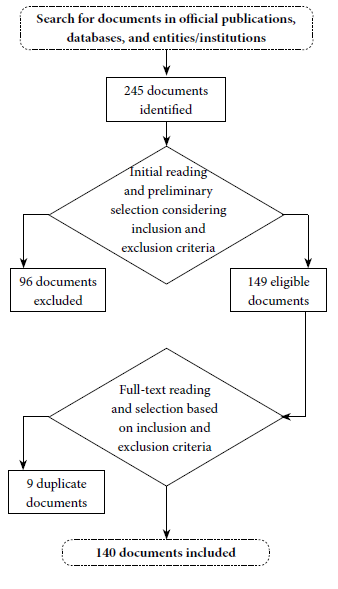
Documents addressing solely administrative and/or organizational aspects were excluded from the analysis. The search resulted in the identification of 245 documents, 140 of which were considered for analysis after applying the inclusion and exclusion criteria. Figure 1 shows the flow of the document search and selection process for the study.

Results
Considering the PNAF’s principles and strategic lines (target image), a high degree of its influence was observed in the CEIS-related macro-policies included in the study (Chart 2).
The synthesis of the analysis of public policies in which the PNAF was identified as influencing the development of CEIS is shown in Chart 3.
Discussion
When defined by the National Health Council (CNS) and adopted as a strategic public policy by the Ministry of Health in 2004, the PNAF exceeded the provision of medicines and the organization of pharmaceutical services, becoming a formal instrument to contribute to the inclusion of SUS demands in the agendas and decisions within other systemic or sectoral public policies6.
From 2004 onwards, the PNAF’s principles and strategic lines guided the inclusion of the SUS in the context of the Forum for Competitiveness of the Pharmaceutical Production Chain, organized by the then MDIC23, through the Department of Pharmaceutical Policy and Strategic Inputs/Secretariat of Science, Technology and Strategic Inputs of the Ministry of Health (DAF/SCTIE/MS). The consensus definitions of this Forum reflected the priorities established by the PNAF, especially regarding stimulating modernization and research, development, and innovation (RD&I) activities within official pharmaceutical laboratories (LFO); industrial development policy; and the adoption of partnerships between the public and private productive sectors for the national production of technologies demanded by the SUS. These agreements resulted in the unprecedented inclusion of the topic of pharmaceuticals and medicines among the four priorities of Brazil’s Industrial, Technological and Foreign Trade Policy (PITCE)24, with relevant institutional developments for public actions aimed at productive development with impacts in the field of Health25,26.
Following the Second National Conference on Science, Technology and Innovation in Health (CNCTIS) in 2004, whose recommendations were approved by the CNS27, the National Policy on Science, Technology and Innovation in Health28 was established, which incorporated definitions such as the strengthening of LFOs, the intensification of RD&I activities in the fields of APIs and medicines, including herbal medicines, and the training and qualification of people. These definitions show the influence of the PNAF’s principles and strategic lines, resulting from the political process of institutionalizing the PNAF as a strategic policy of the Ministry of Health.
In 2007, the macro-policy of reducing the vulnerability of the then National STD/AIDS Program resulted in the adoption of a compulsory license for the national production of the drug Efavirenz as part of public actions to preserve access to ARVs for people living with HIV29,30. This license is a constant flexibility of the Agreement on Trade-Related Aspects of Intellectual Property Rights-TRIPS31. That year, Efavirenz was the most widely used imported ARV in Brazil, and negotiations with the company holding its patent to reduce the prices charged to the SUS were unsuccessful32. These negotiations had been ongoing since 2003, with periods of strong resistance and inflexibility on the part of the producing company33, and the then-management of DAF/SCTIE actively participated in this negotiation process, recording the demands of the SUS and their rejection by the company holding the drug’s patent. The national production of the generic version of the drug Efavirenz was performed by the LFO Institute of Technology in Pharmaceuticals Farmanguinhos/Fiocruz, through partnerships established with national pharmaceutical and chemical companies6,10, inaugurating, in the field of synthetic drugs, the innovative strategy of a productive arrangement based on the formalization of a public-private partnership to meet the demand of the SUS and overcome the identified vulnerability6,34. This strategy, within a context of more detailed theoretical elaboration, was adopted when PDPs were subsequently established as instruments for the development of CEIS10,34. In the field of health surveillance, the initiative led by Farmanguinhos was accompanied, within Anvisa, by the innovative institution of the so-called Technical-Regulatory Committee (CTR) to monitor the development, production, and registration in Brazil of the drug subject to compulsory licensing35, which enabled early and collaborative interfaces between the regulatory authority and the productive entities responsible for the national production of Efavirenz. The initiative resulted in a significant reduction in the time required to compile the dossier and register the medicine34 (p.135-136). Within this set of public actions, the PNAF’s general principles were identified, and particularly the strategic lines relating to the strategic role of LFOs, technological development, health surveillance actions, and regulation of the market for strategic inputs and products for the Health sector.
Also, in 2007, but pointing to public actions for the period 2008-2011, the Mais Saúde36 Program was instituted, whose strategies showed general consonances with the PNAF’s general principles, including the guarantee of a universal, equitable, and comprehensive health system, health promotion actions, intersectorality, and the prioritization of the qualification of health professionals. Regarding the CEIS, the program pointed to its association with SUS objectives and the productive transformation of the country as one of its guidelines, as well as its compatibility with technological standards appropriate to health needs36 (p.13). The measures relating to this line of the Mais Saúde Program revealed a significant influence of the PNAF’s target image, particularly vis-à-vis the role of LFOs for the production of medicines and vaccines of interest to the SUS, the internalization of technologies for the national production of APIs, and the modernization of the National Health Surveillance System (SNVS), from the perspective of expanding the population’s access to medicines.
In 2008, the National Program for Promoting Public Production and Innovation in the Health Industrial Complex was established, whose objectives included strengthening and modernizing LFOs that produce medicines and immunobiologicals of strategic relevance to the SUS; increasing their innovative capacity and contribution to reducing the existing technological gap and to the economic, scientific, and technological development of the country37. These objectives reflect the influence of the PNAF’s strategic lines, especially those related to the public production of medicines and industrial, scientific, and technological development. This influence is further reinforced in Article 5 of the Ordinance of the Office of the Minister of Health that established the Program37, according to which the “Program will be implemented within the Secretariat of Science, Technology and Strategic Inputs of the Ministry of Health, in an integrated and coordinated fashion with the National Pharmaceutical Policy’ actions”. However, in contradiction to the important reference to pharmaceutical assistance actions, the considerations presented in the aforementioned Ordinance did not refer to the PNAF, although they included the national drug policies (1998)38 and medicinal plants and phytotherapeutic products (2006)39. This invisibility may denote a focus on drug technology without considering it in the context of the expanded dimensions brought about by the PNAF.
Although the operationalization of PDPs as an instrument to enhance CEIS began in 2009, its theoretical elaboration as a mechanism for using the State’s purchasing power occurred in 200810, where the establishment of the program was defined by Ministerial Decree GM/MS No. 837/201240. In defining its objectives and objects, this legal framework expressed the PNAF’s strategic lines, particularly those related to industrial development aimed at internalizing the public production of pharmaceuticals, medicines, vaccines, sera, and biological products, which is a significant influence and reflects the intersectorality inherent in the PNAF as a systemic public policy.
In health regulation, 2011 marked important developments in the PNAF and the sectoral policy for the development of the CEIS, reflected in the expansion of the innovative regulatory practice of the CTR, adopted during the compulsory licensing for the national production of the drug Efavirenz. This expansion, defined by RDC No. 2/2011/Anvisa, created CTRs to monitor all PDPs aimed at technology transfers for the production of medicines of interest to the SUS.
In 2012, as a result of the macro-policy represented by the Greater Brazil Plan41, the Ministry of Health established the Program for the Development of the Health Industrial Complex (PROCIS), through Ministry of Health Ordinance No. 506/201242, aimed at strengthening the production and innovation infrastructure in public health. The objectives of PROCIS explicitly displayed the influence of the PNAF’s principles and strategic lines, highlighting technological development and innovation; internalization of the production of strategic technologies for the SUS; qualification of personnel; strengthening of LFOs and CEIS; and adjustments in the regulatory-health field. Regarding this last aspect, ANVISA issued RDC No. 50/201243, which aimed to accelerate the registration processes for products subject to PDPs.
Also, in 2012, with the establishment of the National Strategy for Science, Technology, and Innovation 2012-2015 within the Ministry of Science, Technology, and Innovation (MCTI)44, priority programs were established for promising sectors, among which were “Pharmaceuticals and the Health Industrial Complex”. For this sector, the objectives established were to strengthen and expand the national industry producing pharmaceuticals, other products, and equipment for health. The associated strategies included promoting the development of pharmaceuticals based on biodiversity and associated traditional knowledge; promoting instruments for the transfer of technology from private, national, and international industries to the LFOs, which were identified as an influence of the PNAF’s target image.
In 2014, the macro-policy of using and rationalizing the State’s purchasing power supported the sectoral policy that redefined the guidelines and criteria for defining strategic products for the SUS (Unified Health System), as well as the establishment, monitoring, and evaluation of PDPs through Ordinance GM/MS No. 2,531/201445. The new legal framework defined PDPs as instruments for the development of CEIS, development of LFOs, and the internalization of technologies and national manufacturing of strategic products for the SUS; new bases for defining strategic products. These definitions highlight the influence of the PNAF’s target image, including the requirements for regulatory and health compliance and observance of the criteria defined by the Chamber of Economic Regulation of Medicines (CMED).
With the enactment of Law No. 13,243/201646, which improved measures to encourage innovation and scientific and technological research in the productive environment, targeting technological capacity building, achieving technological autonomy and developing the country’s national and regional productive system, the PNAF’s strategic lines were embodied in that law, especially those identified with VIII and IX of Resolution No. 338/CNS/20041.
In 2016, the National Technological Innovation in Health Policy (PNITS) was established as a systemic policy through Decree No. 9,245/201747, which regulated the use of the State’s purchasing power for strategic products and services for the SUS within the CEIS and provided for the Executive Group of the Health Industrial Complex (GECIS) and the Permanent Forum for Articulation with Civil Society (FPAS). The PNAF’s target image permeated the definitions of this legal framework, especially regarding the encouragement of research, scientific, technological, and industrial development, and innovation to meet the priority demands of the SUS. The establishment of the PNITS, which occurred after the beginning of the political-institutional process of weakening democracy in Brazil48, marked the beginning of a long period of invisibility of different public policies, including the PNAF. From December 2017 to late 2022, no systemic or sectoral policies with identified PNAF’s or CEIS’ influence were identified, and the documentary search identified only publications of an administrative or organizational nature, without the characteristics of public policies, according to the concept adopted in this study.
The cycle of invisibility was broken in 2023 with the enactment of Decree No. 11,464/202349, which defined that the Executive Group of the Health Economic-Industrial Complex (GECEIS) aimed to promote governmental coordination to strengthen production and innovation focused on the SUS, ensuring universal, equitable, and comprehensive access to health. According to this legal framework, the CEIS comprises the strategic economic, productive, and technological base for the production and innovation of medicines, vaccines, APIs, blood products, biotechnological products, health services, and goods and services related to health information and connectivity, among others. The GECEIS was assigned the responsibility of monitoring government actions for production and innovation in support of the SUS, including public policies related to research, technological development and innovation, induction, financing, and incentives for local production and professional education and qualification. The same Decree established that reducing the technological vulnerability of the SUS is one of the strategic guidelines that should govern actions within the CEIS. Therefore, the CEIS must consider the different public policies (systemic or sectoral) that impact the characteristic interrelationships of this complex, among which is the PNAF. In general, the definitions brought by Decree No. 11,464/2023 are permeated by the PNAF’s principles and strategic lines and reinforce the intersectoral nature of this systemic policy.
Also in April 2023, through Decree No. 11,49450, the Interministerial Committee for the Elimination of Tuberculosis and Other Socially Determined Diseases (CIEDDS) was established, as amended by Decree No. 11,908/202451. Its responsibilities included proposing measures and actions to ensure the intersectoral coordination of federal public policies to meet the goals related to the elimination of tuberculosis and other socially determined diseases as public health problems by 2030. This situation reflects the PNAF’s objective, especially regarding its intersectorality and its actions for the promotion, protection, and recovery of health.
Also, in 2023, through Decree No. 11,715 of September 2652, the National Strategy for the Development of CEIS was established, whose objectives involve rebuilding the local capacity to supply APIs, medicines, vaccines and sera, blood products, and biotechnological products; coordinating public policy instruments, such as using of the State’s purchasing power, financing, regulation, scientific and technological infrastructure; boosting research, development, innovation and the production of technologies and services to promote, prevent, diagnose, treat and rehabilitate health. These objectives express the PNAF’s target image influence, although their implementations were not prioritized by the government structure between 2018 and 2022.
In December 2023, the Program for the Expansion and Modernization of CEIS Infrastructure (PDCEIS)53 was established, whose guidelines include stimulating the productive, technological, and managerial transformation necessary to reduce the vulnerability of the SUS; promoting the expansion and modernization of the productive, technological, and innovation capacities of the national CEIS institutions. Its objectives are to enable the productive, technological, and innovation capacity necessary for the execution of the PDP Program, the Local Development and Innovation Program (PDIL), the Program for the Preparation of Vaccines, Sera and Blood Products (PPVACSH), the Program for Production and Technological Development for Neglected Populations and Diseases (PPDN), among others. These guidelines and objectives constitute fulfillment of the PNAF’s target image.
The Neoindustrialization Action Plan was established in 202454 and aimed to include the development and national production of technologies and services for the prevention, diagnosis, and treatment of endemic and neglected diseases in the country and the region, as well as for the prevention and treatment of diseases and conditions with the most significant impact on the sustainability of the SUS. These objectives reflect the influence of the PNAF’s principles and strategic lines within the context of the priorities of Brazilian industrial policy.
Conclusions
The study identified a high level of influence target image defined for the PNAF in public policies identified from 2004 to October 2024 and related to CEIS, characterizing its transversality as an intersectoral public policy. The identification of this influence contributes to considering the PNAF as a reference for institutionalized policy to formulate and develop public actions, especially those aimed at overcoming the vulnerabilities of the SUS and the health agenda as a vector for a national development model.
However, the study also identified invisibilities in the PNAF, particularly in the period between 2017 and 2020, characterized both by the exclusion of its reference in supporting normative frameworks for the establishment of public actions and by its understanding only as initiatives of an administrative nature. These invisibilities may compromise the institutionality of the PNAF’s strategic lines. This process, when implementing a public policy, may indicate a profound alteration in the policy’s aims and not only in the means to achieve them55. In this context, we should underscore that, by approving the PNAF, society’s control over the SUS qualified it as a strategic policy in the field of Health, with the dynamics inherent to the intersectorality of systemic policies, as opposed to reducing it to logistical and organizational procedures.
On the other hand, the lack of systemic or sectoral policies identified with the PNAF’s influence or the CEIS principles between December 2017 and the end of 2022 is a significant gap. This gap must be considered in the context of a weakened Brazilian democracy promoted by the 2016 parliamentary-judicial coup, by attacks on social, political, and civil rights48 and by the critical health situation related to the COVID-19 pandemic, in a political process external to the institutional framework of the SUS56, but which profoundly affected it.
References
- 1 Brasil. Conselho Nacional de Saúde (CNS). Resolução n° 338, de 6 de maio de 2004. Aprova a Política Nacional de Assistência Farmacêutica. Diário Oficial da União 2004; 20 maio.
- 2 Rech N. Acesso aos medicamentos e à assistência farmacêutica. Brasília: MS, Secretaria de Ciência, Tecnologia e Insumos Estratégicos; 2005.
- 3 Organização Pan-Americana da Saúde (OPAS). Organização Mundial da Saúde (OMS). BIREME. Centro Latino-Americano e do Caribe de Informação em Ciências da Saúde. Descritores em Ciências da Saúde. OPAS, OMS; 2025.
- 4 Vasconcelos DMM, Calado GS, Bermudez JAZ, Costa JCS, Oliveira MA, Cortés MA, Veloso, NF. Panorama da produção local de medicamentos no Brasil. desafios e vulnerabilidades. Brasília: Fiocruz, OPAS, OMS; 2023.
- 5 Leite SN, Manzini F, Veiga A, Lima MEO, Pereira MA, Araujo, SQ, Santos RF, Bermudez JAZ. Ciência, Tecnologia e Assistência Farmacêutica em pauta: contribuições da sociedade para a 16a Conferência Nacional de Sau´de. Cien Saude Colet 2018; 23(12):4259-4268.
- 6 Rech N. Regulação sanitária, desenvolvimento tecnológico e acesso aos medicamentos: análise da experiência brasileira no contexto da Política Nacional de Assistência Farmacêutica [tese]. Florianópolis: Programa de Pós-Graduação em Assistência Farmacêutica; 2022.
- 7 Nascimento MAC, Moreira JDD, Oliveira GRR, Oliveira TB. O Complexo Econômico-Industrial da Saúde como alternativa estratégica para a superação do subdesenvolvimento. Trab Educ Saude 2024; 22:e02991262.
- 8 Gadelha CAG. Complexo Econômico-Industrial da Saúde: a base econômica e material do Sistema Único de Saúde. Cad Saude Publica 2022; 38(Supl. 2):e00263321.
- 9 Gadelha CAG, Maldonado J, Vargas M, Barbosa PR, Costa LS. A dinâmica do sistema produtivo da saúde. Inovação e complexo econômico-industrial. Rio de Janeiro: Editora Fiocruz; 2012.
- 10 Gadelha CAG, Temporão JG. Desenvolvimento, Inovac¸a~o e Sau´de: a perspectiva teo´rica e poli´tica do Complexo Econo^mico-Industrial da Sau´de. Cien Saude Colet 2018; 23(6):1891-1902.
- 11 Grisa C. As políticas públicas como dispositivos de autoreferencialidade e autoreflexividade das sociedades modernas: contribuições da abordagem de Pierre Muller. In: Lima LL, Schabbach L, organizadores. Políticas públicas: questões teórico-metodológicas emergentes. Porto Alegre: UFRGS; 2020. p. 77-105.
- 12 Gadelha CAG. O Complexo Econo^mico-Industrial da Sau´de 4.0: por uma visa~o integrada do desenvolvimento econo^mico, social e ambiental. Cad Desenvolv 2021; 16(28):25-49.
- 13 Walt G, Gilson L. Reforming the health sector in developing countries: the central role of policy analysis. Health Policy Plan 1994; 9(4):353-370.
- 14 Muller P, Surel Y. Análise das políticas públicas. Pelotas: EDUCAT; 2002.
- 15 Araújo Júnior JLC, Maciel Filho R. Developing an operational framework for health policy analysis. Rev Bras Saude Matern Infant 2001; 1(3):203-221.
- 16 Walt G. Health policy. An introduction to process and power. People, governments and international agencies-who drives policy and how it is made. London: Witwatersrand University; 1994.
- 17 Matus C. Política, planejamento e governo. Brasília: Ipea; 1993.
- 18 Garcia RC. Subsi´dios para organizar avaliac¸o~es da ac¸a~o governamental. Planej Polit Publicas 2001; 23:7-70.
- 19 Lima LL, D'Ascenzi L, Lui L, Aguiar RB. Poli´ticas pu´blicas e desenvolvimento: uma proposta de modelo de ana´lise. Rev Bras Gestao Urbana 2021; 13:e20210048.
- 20 Serra A. La gestión transversal. Expectativas y resultados. Rev CLAD Reforma Democracia 2005; 32:1-17.
- 21 Lima LL, Rodrigues MIA, organizadores. Campo de públicas em ação: coletânea em teoria e gestão de políticas públicas. Porto Alegre: Editora da UFRGS/CEGOV; 2017.
- 22 Matus C. Política, planejamento e governo. 3a ed. Brasília: Ipea; 1983.
- 23 Brasil. Ministe´rio da Sau´de (MS). Ministe´rio do Desenvolvimento, Indústria e Comércio Exterior. Fórum de competitividade da cadeia produtiva farmacêutica 2003-2006: O desafio de prosseguir Brasília: MS; 2007.
- 24 Brasil. Casa Civil da Presidência da República. Diretrizes de política industrial, tecnológica e de comércio exterior. Brasília: Casa Civil da Presidência da República; 2004.
- 25 Brasil. Agência Brasileira de Desenvolvimento Industrial (ABDI). Dez anos de política industrial: balanço e perspectivas - 2004-2014. Brasília: ABDI, 2015.
- 26 Palmeira Filho PL, Pieroni JP, Antunes MAS, Martins JV. O desafio do financiamento a` inovac¸a~o farmace^utica no Brasil: a experie^ncia do BNDES Profarma. BNDES 2012; 37:67-90.
- 27 Brasil. Conselho Nacional de Saúde (CNS). Ministério da Saúde (MS). Secretaria de Ciência, Tecnologia e Insumos Estratégicos. 2a Conferência Nacional de Ciência, Tecnologia e Inovação em Saúde. Brasília: MS; 2005.
- 28 Brasil. Ministério da Saúde (MS). Secretaria de Ciência, Tecnologia e Insumos Estratégicos. Departamento de Ciência e Tecnologia. Política Nacional de Ciência, Tecnologia e Inovação em Saúde. Brasília: MS; 2008.
- 29 Brasil. Ministério da Saúde (MS). Portaria n° 886, de 24 de abril de 2007. Declara de interesse público os direitos de patente sobre o efavirenz, para fins de concessão de licença compulsória para uso não comercial. Diário Oficial da União 2007; 25 abr.
- 30 Brasil. Presidência da República. Decreto n° 6.108, de 4 de maio de 2007. Concede licenciamento compulsório, por interesse público, de patentes referentes ao Efavirenz, para fins de uso público não-comercial. Diário Oficial da União 2007; 5 maio.
- 31 Bermudez JAZ, Epsztejn R, Oliveira MA, Hasenclever L. O acordo TIPS da OMC e a proteção patentária no Brasil: mudanças recentes e implicações para a produção local e o acesso da população aos medicamentos. Rio de Janeiro: Fiocruz; 2000.
- 32 Hallal R, Ravasi G, Kuchenbecker R, Greco D, Simão M. O acesso universal ao tratamento antirretroviral no Brasil. Tempus Actas Saude Colet 2010: 53-65.
- 33 Grangeiro A, Teixeira L, Bastos F, Teixeira P. Sustentabilidade da política de acesso a medicamentos anti-retrovirais no Brasil. Rev Saude Publica 2006; 40(Supl.):60-69.
- 34 Rech N, Farias MR. Regulac¸a~o sanita´ria e desenvolvimento tecnolo´gico: estrate´gias inovadoras para o acesso a medicamentos no SUS. Cien Saude Colet 2021; 26(11):5427-5440.
- 35 Brasil. Agência Nacional de Vigilância Sanitária. Portaria no 583, de 8 de agosto de 2007. Institui o Comite^ Te´cnico Regulato´rio, no a^mbito da Age^ncia Nacional de Vigila^ncia Sanita´ria (ANVISA), com a finalidade de acompanhar o processo de desenvolvimento, produc¸a~o e registro no Brasil do medicamento objeto do Decreto no 6.108, de 04 de maio de 2007. Diário Oficial da União 2007; 09 ago.
- 36 Brasil. Ministe´rio da Sau´de (MS). Secretaria-Executiva. Mais sau´de: direito de todos - 2008-2011. 3ª ed. Brasi´lia: MS; 2009.
- 37 Brasil. Ministério da Saúde (MS). Portaria no 374, de 28 de fevereiro de 2008. Institui no a^mbito do Sistema U´nico de Sau´de - SUS, o Programa Nacional de Fomento a` Produc¸a~o Pu´blica e Inovac¸a~o no Complexo Industrial da Sau´de. Diário Oficial da União 2008; 29 fev.
- 38 Brasil. Ministe´rio da Sau´de (MS). Portaria n° 3.916, de 30 de outubro de 1998. Aprova a política nacional de medicamentos. Dia´rio Oficial da Unia~o 1998; 10 nov.
- 39 Brasil. Presidência da República. Decreto no 5.813, de 22 de junho de 2006. Aprova a Política Nacional de Plantas Medicinais e Fitoterápicos e dá outras providências. Diário Oficial da União 2006; 23 jun.
- 40 Vargas MA, Almeida ACS, Guimarães ALC. Parcerias para desenvolvimento produtivo (PDPS-MS): contexto atual, impactos no sistema de sau´de e perspectivas para a poli´tica industrial. Rio de Janeiro: Fiocruz; 2017.
- 41 Brasil. Presidência da República. Decreto n° 7.540 de e de agosto de 2011. Institui o Plano Brasil Maior - PBM e cria o seu sistema de gestão. Diário oficial da União 2011; 3 ago.
- 42 Brasil. Ministério da Saúde (MS). Portaria n° 506, de 21 de março de 2012. Institui o Programa para o Desenvolvimento do Complexo Industrial da Saúde (PROCIS) e seu Comitê Gestor. Diário Oficial da União 2012; 22 mar.
- 43 Brasília. Agência Nacional de Vigilância Sanitária (Anvisa). Resolução da Diretoria Colegiada RDC - n° 50, de 13 de setembro de 2012. Dispõe sobre os procedimentos no âmbito da Anvisa para registro de produtos em processo de desenvolvimento ou de transferência de tecnologias objetos de Parcerias de Desenvolvimento Produtivo público-público ou público-privado de interesse do Sistema Único de Saúde. Diário Oficial da União 2012; 14 set.
- 44 Brasil. Ministe´rio da Cie^ncia, Tecnologia e Inovac¸a~o (MCTI). Estrate´gia Nacional de Cie^ncia, Tecnologia e Inovac¸a~o 2012 - 2015: balanço das atividades estruturantes 2011. Brasília: MCTI; 2011.
- 45 Brasil. Ministério da Saúde (MS). Portaria GM/MS no 2.531, de 12 de novembro de 2014. Redefine as diretrizes e os critérios para a definição da lista de produtos estratégicos para o Sistema Único de Saúde (SUS) e o estabelecimento das Parcerias para o Desenvolvimento Produtivo (PDP) e disciplina os respectivos processos de submissão, instrução, decisão, transferência e absorção de tecnologia, aquisição de produtos estratégicos para o SUS no âmbito das PDP e o respectivo monitoramento e avaliação. Diário Oficial da União 2014; 13 nov.
- 46 Brasil. Presidência da República. Lei no 13.243, de 11 de janeiro de 2016. Dispo~e sobre estímulos ao desenvolvimento cienti´fico, a` pesquisa, a` capacitac¸a~o cienti´fica e tecnolo´gica e dá outras providências. Diário Oficial da União 2016; 12 jan.
- 47 Brasil. Presidência da República. Decreto n° 9.245 de 20 de dezembro de 2017. Institui a Politica Nacional de Inovação Tecnológica na Saúde. Diário Oficial da União 2017; 21 dez.
- 48 Souza LEPF, Paim JS, Teixeira CF, Bahia L, Guimara~es R, Machado CV, Campos GW, Azevedo-e-Silva G. Os desafios atuais da luta pelo direito universal a` sau´de no Brasil. Cien Saude Colet 2019; 24(8):2783-2792.
- 49 Brasil. Decreto no 11.464, de 3 de abril de 2023. Dispo~e sobre o Grupo Executivo do Complexo Econo^mico-Industrial da Sau´de. Diário Oficial da União 2023; Edição Extra, 3 abr.
- 50 Brasil. Decreto no 11.494, de 17 de abril de 2023. Institui o Comite^ Interministerial para a Eliminac¸a~o da Tuberculose e de Outras Doenc¸as Determinadas Socialmente - CIEDDS. Diário Oficial da União 2023; 18 abr.
- 51 Brasil. Decreto no 11.908, de 6 de fevereiro de 2024. Institui o Programa Brasil Saudável - Unir para Cuidar, e altera o Decreto nº 11.494, de 17 de abril de 2023, para dispor sobre o Comitê Interministerial para a Eliminação da Tuberculose e de Outras Doenças Determinadas Socialmente - CIEDDS. Diário Oficial da União 2024; 7 fev.
- 52 Brasil. Decreto no 11.715, de 26 de setembro de 2023. Institui a Estrate´gia Nacional para o Desenvolvimento do Complexo Econo^mico-Industrial da Sau´de. Diário Oficial da União 2024; 27 set.
- 53 Brasil. Ministério da Saúde (MS). Portaria GM/MS no 2.262, de 8 de dezembro de 2023. Institui o Programa para Ampliac¸a~o e Modernizac¸a~o de Infraestrutura do Complexo Econo^mico-Industrial da Sau´de - PDCEIS. Diário Oficial da União 2024; 8 dez.
- 54 Brasil. Ministe´rio do Desenvolvimento, Indu´stria, Come´rcio e Servic¸os (MDIC). Nova indu´stria Brasil: forte, transformadora e sustenta´vel. Plano de Ac¸a~o para a neoindustrializac¸a~o 2024-2026. Brasi´lia: MDIC, Conselho Nacional de Desenvolvimento Industrial; 2024.
- 55 Oliveira VE, Couto CG. Diretrizes priorita´rias e fases da implementac¸a~o: como mudam as poli´ticas pu´blicas. In: Lotta G, organizador. Teoria e análises sobre implantação de políticas públicas no Brasil. Brasília: Enap; 2019.
- 56 Fleury S, Fava VMD. Vacina contra Covid-19: arena da disputa federativa brasileira. Saude Debate 2022; 46(n. esp. 1): 248-264.
The data sources adopted in the research are indicated in the article’s body.

 Source: Authors.