 Occupational brucellosis among veterinarians in the Distrito Federal, Brazil
ABSTRACT:
This study estimated the self-reported prevalence of accidental exposure and its associated risk factors related to the S19 and RB51 vaccine strains, as well as occupational brucellosis among veterinarians registered at the Secretaria de Estado da Agricultura, Abastecimento e Desenvolvimento Rural (SEAGRI) in the Distrito Federal (DF), Brazil. Data were collected through an online questionnaire, with one hundred and seven (107) participants included in the census. Accidental exposure to the S19 vaccine was reported by 22.43% (24/107) of the respondents, whereas the prevalence of self-reported occupational brucellosis cases was 8.41% (9/107), 55.56% (5/9) of which were attributed to S19 exposure. Multivariate logistic regression models for vaccine exposure and self-reported brucellosis by veterinarians were tested, but no significant results were obtained for any variable selected by the purposeful selection algorithm. Although risk factors associated with these outcomes were not identified in the studied population, the present study contributes significantly to the formulation of public policies aimed at disease prevention and control, as well as improvements in health education for these veterinarians.
Key words:
Brucella abortus
; vacinne; job-related; veterinary; S19; RB51
RESUMO:
Este estudo teve como objetivo estimar a prevalência autorrelatada de exposição acidental e seus fatores de risco às cepas vacinais S19 e RB51 e brucelose ocupacional entre médicos veterinários registrados na Secretaria de Estado da Agricultura, Abastecimento e Desenvolvimento Rural (SEAGRI), no Distrito Federal (DF), Brasil. Os dados foram coletados por meio de um questionário online, com cento e sete (107) participantes no censo. Foram relatados casos de exposição acidental à vacina B19 22,43% (24/107), enquanto a prevalência de brucelose ocupacional autorrelatada foi de 8,41% (9/107), dos quais 55,56% (5/9) foram atribuídos à exposição à S19. Modelos logísticos multivariados usando exposição à vacina e brucelose autorrelatada por veterinários foram testados, mas não foi obtido resulto para nenhuma variável selecionada pelo algoritmo de seleção proposital. Embora os fatores de risco associados a esses desfechos não tenham sido identificados na população estudada, o presente estudo contribui significativamente para a formulação de políticas públicas buscando prevenção, controle da doença e melhorias da educação em saúde desses médicos veterinários.
Palavras-chave:
Brucella abortus
; vacina; relacionado ao trabalho; veterinário; B19; RB51
INTRODUCTION
Brucellosis is an infectious bacterial disease transmitted from animals to humans, classifying it as a zoonosis. Among the pathogenic Brucella species, B. abortus, B. melitensis and B. suis are the most virulent, affecting both their natural hosts and humans (WOAH, 2022). Notably, no cases of B. melitensis have been reported in Brazil. The disease has a significant economic impact due to reproductive losses in domestic animals and poses a public health concern, since it causes a debilitating febrile illness in humans (CORBEL, 2006; PEREIRA et al., 2020; QURESHI et al., 2023).
Human brucellosis, caused by different Brucella species, has been reported worldwide, with a greater incidence in developing countries (DEAN et al., 2012; LAINE et al., 2022). Recent studies have estimated an extremely high global incidence of 1.6-2.1 million new human cases annually (LAINE et al., 2023). The disease presents a wide range of symptoms and clinical manifestations in humans, often referred to as having “a thousand faces”. However, intermittent fever, malaise, weakness, anorexia, headache and persistent prostration are reported by most patients (SAURET & VILISSOVA, 2002; PAPPAS et al., 2006). Hepatomegaly and splenomegaly may occur in 30% to 60% of acute cases. In addition, osteoarticular complications account for more than half of all focal complications (SAURET & VILISSOVA, 2002; FRANCO et al., 2007; ROUSHAN et al., 2014). Genitourinary complications, including epididymo-orchitis, glomerulonephritis, and renal abscesses, affect about 10% of patients (FRANCO et al., 2007).
The disease has a strong occupational component, and a recent systematic review identified rural and slaughterhouse workers, veterinarians, laboratorians and hunters as the most at-risk groups. Not using personal protective equipment (PPE) is a significant risk factor for acquiring the disease (PEREIRA et al., 2020). Among these groups, veterinarians who administer brucellosis vaccines are of particular concern, because vaccine strains S19 and RB51, used for bovine vaccination, are pathogenic to humans and have been widely reported in the literature as causing accidental infections (KUTLU et al., 2014; LYTRAS et al., 2016; PEREIRA et al., 2021; PROCH et al., 2018). In Brazil, a study carried out in Minas Gerais state showed that 32.83% (108/329) [95% confidence interval (CI): 27.78-38.19%] of veterinarians registered with the Programa Nacional de Controle e Erradicação da Brucelose e Tuberculose Animal (PNCEBT) to vaccinate cattle against brucellosis reported accidental exposure to these vaccines (PEREIRA et al., 2021). Studies such as this, which aim to estimate the self-reported prevalence of accidental exposure and identify associated risk factors, are essential for promoting public health policies to reduce new brucellosis infections.
According to SEAGRI-DF (2020) and IBGE (2021), in 2022 the Distrito Federal, Brazil had 1,468 livestock properties, 85,771 cattle, and 107 veterinarians registered to vaccinate against bovine brucellosis. A 2003 seroprevalence study indicated that 2.5% (95% CI: 1.0-5.1%) of properties in the DF were positive for bovine brucellosis (GONÇALVES et al., 2009). A more recent survey performed in 2015 showed no significant change in prevalence compared to the earlier study [3.1% (95% CI: 1.31% - 4.9%)] (LICURGO, 2015). By contrast, the epidemiological situation of human brucellosis in this region, and in most parts of Brazil, remains completely unknown.
Given this scenario, the aim of this study was to estimate the self-reported prevalence of B. abortus infection and accidental exposure to S19 and RB51 vaccines among veterinarians registered with the PNCEBT in the DF, Brazil, and assess potential risk factors associated with vaccine accidents and occupational brucellosis among these professionals.
MATERIALS AND METHODS
Study area
The study was conducted in the DF, one of Brazil’s federative units, which includes Brasília, the nation’s capital. The DF is located in the Central-West region of Brazil and covers an area of 5,760.784 km², corresponding to 0.6% of the national territory (IBGE, 2017).
Study design and population
From March to November 2022, a cross-sectional study was conducted involving all veterinarians enrolled in the PNCEBT and authorized by Secretaria de Estado da Agricultura, Abastecimento e Desenvolvimento Rural (SEAGRI-DF) the state animal health authority, to vaccinate against bovine brucellosis. At the time of the study, the 108 veterinarians registered with SEAGRI-DF and qualified to vaccinate against bovine brucellosis were invited to participate in the study.
Ethical considerations
The study was approved by the Human Research Ethics Committee of the Universidade Federal de Lavras (UFLA), under protocol number 52981021.9.0000.5148. Informed consent was obtained from all participants before questionnaire administration.
Questionnaire survey
Data were collected using an online questionnaire created using the Google Forms platform, adapted from a previous study conducted in Minas Gerais state (PEREIRA et al., 2021). The questionnaire was emailed to all professionals registered with SEAGRI-DF. The first part of the questionnaire contained general information questions, such as: age, gender (male, female or other), years of professional experience, area of specialization (beef or dairy cattle, dogs and cats, administrative duties, or others), knowledge about human brucellosis (transmission, clinical signs and symptoms), infection control practices, and potentially risky procedures (e.g., vaccine administration and reproductive procedures in cattle). The second section contained specific questions related to possible accidental exposure to S19 and RB51 vaccine strains and occupational brucellosis. Respondents who reported vaccine exposure or brucellosis infection were asked about prophylactic measures, diagnostic methods, symptom duration and severity, treatments, and any relapses. The questionnaire was administered in Portuguese, but a bilingual version (Portuguese and English) is available in Supplementary Information SI 1.
Variable transformation
In order to assess participants’ knowledge of transmission and clinical signs of human brucellosis, as well as their preventive practices, three variable recategorizations were performed as described by PEREIRA et al. (2021). Briefly, responses regarding knowledge of transmission and clinical signs were scored based on decreasing order of importance, and the total scores were classified as “good”, “intermediate” or “poor”. Variables related to the use of gloves, lab coats, goggles and masks, and their reported frequency of use, were grouped into a single variable: “use of personal protective equipment (PPE)”. The PPE-related variables were also transformed based on their importance in disease prevention and frequency of use (never, sometimes and always).
Statistical analysis
Data on accidental anti-B. abortus vaccine exposure and B. abortus infection were based on self-reporting. Apparent prevalence was calculated for i): accidental vaccine exposure, and ii): occupational brucellosis, by dividing the number of self-reported cases by the total number of veterinarians. Descriptive statistics included frequency distributions for categorical variables, and medians, means, interquartile ranges (IQR), and standard deviations (SD) for continuous variables. Univariate associations were evaluated using the chi-square or Fisher’s exact tests for qualitative variables, and univariate logistic regression for quantitative variables (DOHOO et al., 2014). Variables with a P-value < 0.25 in univariate analysis were included in the multivariate logistic regression models to evaluate potential risk factors for accidental exposure to brucellosis vaccines and occupational brucellosis. Models were built using the purposeful selection method for logistic regression according to HOSMER et al. (2013). All statistical analyses and figures were generated using R Studio (version: 2024.12.1+563).
RESULTS
One veterinarian registered at SEAGRI-DF declined to participate and was excluded from the analysis, resulting in a final sample of 107 veterinarians. Of these, 87.85% (94/107) lived in Brasília, 66.36% (71/107) were male, 32.71% (35/107) female, and 0.93% (1/107) declared their gender as other. Descriptive statistics of all study variables are shown in Supplementary Information SI 2. The average age of participants was 43 years (SD = 11, median = 41, IQR = 15) and the average duration of professional experience was 16 years (SD = 11, median = 14, IQR = 13). A total of 27.10% (29/107) reported also being accredited by PNCEBT to perform diagnostic tests for brucellosis. The main areas of professional activity were dairy cattle/buffalo (32.71% or 35/107), beef cattle/buffalo (28.04% or 30/107), horses (12.15% or 13/107), dogs and cats (10.28% or 11/107), commercial/administrative roles (6.54% or 7/107), rural extension (5.61% or 6/107), and other areas (4.67% or 5/107). Furthermore, 47.66% (51/107) reported being self-employed, 34.58% (37/107) were public servants, and 17.76% (19/107) employees of private companies.
The most common veterinary procedures related to brucellosis transmission performed by respondents during the six months preceding the questionnaire were bovine brucellosis vaccination (78.90% or 85/107), assistance with calving (49.53% or 53/107), manual placental removal (42.05% or 45/107) and handling of bovine abortions (40.18% or 43/107). In terms of PPE use during these procedures, 20.56% (22/107) reported never wearing a lab coat. Goggles and masks were never used by 18.70% (20/107) of respondents, and 1.87% (2/107) reported never wearing gloves (Figure 1A). The main reasons for sometimes or never using PPE were lack of habit, difficulty performing the procedure, and lack of available equipment (Figure 1B). Non-use due to lack of habit was reported by 66.67% (30/45) of those not wearing masks, 51.17% (22/43) of those not using goggles, 36.54% (19/52) of those not wearing lab coats, and 42.86% (3/7) of those not using gloves. Difficulty performing the procedure was the reason for not wearing a mask (20% or 9/45), goggles (34.88% or 15/43), lab coat (38.46% or 20/52) and gloves (57.14% or 4/7). Lack of equipment was reported as a reason for not wearing goggles by 3.74% (4/107) of participants.

A) Frequency of wearing personal protective equipment (PPE); NA: Not applicable. B) Reasons for not wearing them, as reported by SEAGRI-DF-registered veterinarians authorized to vaccinate against bovine brucellosis in the Distrito Federal, Brazil, 2022.
Knowledge of human brucellosis transmission was classified as good in 58.87% (63/107) of participants and intermediate in 40.18% (43/107), whereas only 1 (0.93%) scored poorly. When asked about their understanding of human brucellosis symptoms, 82.24% (88/107) showed good knowledge, 11.21% (12/107) intermediate, and 6.54% (7/107) poor (Figure 2). The most common method of disposing of S19 and RB51 vaccines was as infectious waste (74.77% or 80/107), followed by burial on the property (8.41% or 9/107), discarding in general rural waste (3.74% or 4/107), and returning materials to the veterinary supplier (2.80% or 3/107).

Self-reported accidental exposure to the S19 vaccine related to: A) Knowledge of transmission; B) Knowledge of human brucellosis symptoms, reported by SEAGRI-DF-registered veterinarians authorized to vaccinate against bovine brucellosis in the Distrito Federal, Brazil, 2022.
Among the respondents, 11.21% (12/107) were responsible for supervising registered vaccinators. All of these professionals reported training these individuals to vaccinate against brucellosis. However, when asked about PPE use by vaccinators, 16.67% (2/12) reportedly did not wear a mask, and the same percentage did not wear a lab coat. Only one veterinarian (8.33% or 1/12) reported that the vaccinator was accidentally exposed to the S19 on one occasion, subsequently seeking medical attention and experiencing symptoms such as myalgia, weakness, fever, pain at the inoculation site, and chills.
With respect to the prevalence of accidental exposure to cattle brucellosis vaccines among veterinarians, 22.43% (24/107) reported exposure. All of these cases (100%, 24/24) involved exposure to the S19 vaccine, with 70.83% (17/24) exposed once, 20.83% (5/24) twice, and 8.33% (2/24) more than twice. Exposures occurred mainly due to needle-stick injury (50% or 12/24), contact of non-wounded skin with the vaccine (33.33% or 8/24), exposure of ocular mucosa to vaccine aerosols (25% or 6/24), and splashing of the vaccine into the oronasal mucosa (12.50% or (3/24). These incidents occurred during cattle vaccination (54.17% or 13/24), handling of the vaccine vial (37.05% or 9/24), material disposal (20.83% or 5/24), recapping the needle (20.83% or 5/24), disassembling the syringe (8.33% or 2/24), and releasing the syringe plunger when removing the vaccine from the vial (4.17% or 1/24). Participants could select more than one exposure type and vaccine accident. Veterinarians attributed accidental exposure to the vaccine to the following: i): animal temperament (41.67% or 10/24), ii): inadequate protective measures (41.67% or 10/24), lack of proper vaccination infrastructure on the property (25% or 6/24), carelessness (16.67% or 4/24), and iii): vial pressure (8.33% or 2/24) (participants could select more than one alternative). In relation to PPE use at the time of exposure, 95.83% (23/24) of respondents reported wearing gloves, 16.67% (4/24) goggles, 12.50% (3/24) masks, 12.50% (3/24) lab coats, and 4.17% (1/24) reported not using any PPE (multiple answers allowed). Among those exposed, 87.50% (21/24) washed the affected area, 58.33% (14/24) applied an antiseptic, 45.83% (11/24) sought medical care, 8.33% (2/24) took no action, 4.17% (1/24) contacted health surveillance services, and 4.17% (1/24) waited for the results of self-requested tests before seeking medical care (more than one option could be selected).
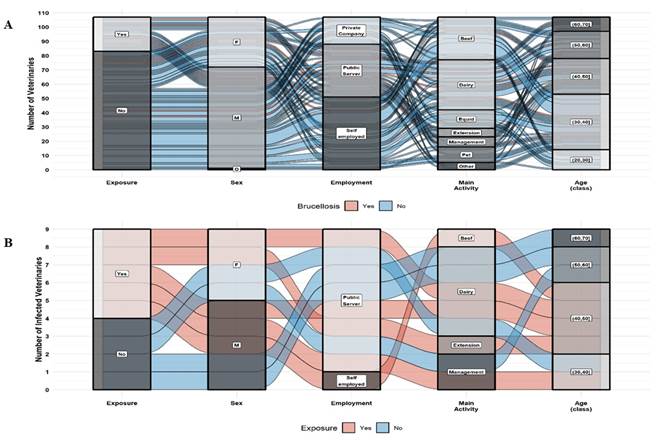
The prevalence of self-reported occupational brucellosis among veterinarians registered with SEAGRI-DF was 8.41% (9/107). Of these, 55.56% (5/9) reported infection following accidental exposure to S19 (Figure 3B), 22.22% (2/9) through unprotected contact with abortion materials or uterine secretions, 11.11% (1/9) due to aerosol inhalation from these materials, and 11.11% (1/9) were unsure of the cause. Figure 3 provides a detailed characterization of veterinarians who self-reported brucellosis, covering aspects such as vaccine exposure, age, gender, area of practice, employment status, knowledge of human brucellosis symptoms and transmission, and frequency of their PPE use. It is important to underscore that only 33.33% (3/9) of these individuals sought medical care after reporting brucellosis. Table 1 shows the clinical signs, diagnostic tests, and treatments administered, where applicable. No veterinarians reported a recurrence of symptoms after treatment.

A) B) General characteristics of SEAGRI-DF-registered veterinarians authorized to vaccinate against bovine brucellosis in the Distrito Federal, Brazil, 2022. B) General characteristics of SEAGRI-DF-registered veterinarians authorized to vaccinate against bovine brucellosis in the Distrito Federal, Brazil, 2022, who self-reported brucellosis.
Variables with a P-value < 0.25 in the univariate analysis were included in the multivariate logistic regression models (Table 2), which evaluated potential risk factors for accidental vaccine exposure and occupational brucellosis. Despite the fact that multivariate models considered accidental exposure to brucellosis vaccines or occupational brucellosis as outcomes, they did not identify any variables as statistically significant using the purposeful selection algorithm (HOSMER et al., 2013).
Univariate analysis results for brucellosis and accidental anti-Brucella abortus vaccine exposure among veterinarians from the Distrito Federal, Brazil, 2022.
DISCUSSION
Human brucellosis poses a significant threat to public and animal health. Veterinarians are especially vulnerable because of their frequent contact with infected animals and/or live attenuated vaccines (PEREIRA et al., 2020; VIVES-SOTO et al., 2024). The present study found an alarming 22.43% rate of accidental exposure to the S19 vaccine and a significant self-reported human brucellosis prevalence of 8.41% among veterinarians registered with SEAGRI-DF in 2022. Indeed, over half (55.56%, 5/9) of those who reported contracting the disease had been exposed to the vaccine. Studies such as this investigation are crucial for understanding the risk factors and behaviors associated with brucellosis infection and the need for targeted surveillance and health education initiatives to prevent brucellosis among veterinarians (VIVES-SOTO et al., 2024). These findings can guide public policies and influence decision-making, ensuring that interventions are effective in mitigating occupational risks.
Established transmission routes for human brucellosis include direct contact with abortion or birth materials from infected cows and exposure to the S19 and RB51 vaccines (CORBEL, 2006; NJERU et al., 2016). Reports of contact with these sources of infection were frequent among the interviewees, confirming the high occupational risk associated with this profession. Around 80% of veterinarians reported vaccinating against bovine brucellosis in the six months prior to completing the questionnaire, almost half (49.53%) had assisted with parturition, more than one-fifth (20.56%) reported never wearing lab coats, and nearly 20% (18.70%) never wear goggles or masks during these procedures. This is particularly concerning given that in Minas Gerais state, PPE use was recognized as a protective factor against exposure to S19 and RB51 vaccines (PEREIRA et al., 2021). In that study, only 0.93% (1/108) of the individuals exposed to brucellosis vaccines had worn all recommended PPE at the time of exposure. Similarly, in the present study only three veterinarians wore masks and lab coats at the time of exposure, which highlights negligence in biosafety practices. It should be emphasized that proper PPE use is essential in protecting professionals from biological risks related to vaccination accidents, and there is an urgent need to promote adequate biosafety training and practices among veterinarians in the Distrito Federal and Minas Gerais. Although gloves are effective in preventing contact between contaminated materials and broken skin or mucous membranes, it is important to underscore that they do not prevent self-inoculation accidents involving needles, given that punctures can easily pierce glove material. Therefore, in addition to PPE use, it is essential to adopt safe handling practices for needles and vaccination equipment to minimize the risk of self-inoculation.
Several previous studies conducted in different parts of the world (NICOLETTI et al., 1986; MAMANI et al., 2018; ZHANG et al., 2018; PEREIRA et al., 2020; PEREIRA et al., 2021; PROCH et al., 2018) have highlighted the low or improper use of PPE among professionals exposed to brucellosis. A study carried out in Turkey reported similar findings, where the prevalence of self-reported brucellosis among the participants was 11.8% (84/712), and almost two thirds (61% or 51/84) of these cases were associated with unprotected contact with infected materials (KUTLU et al., 2014). In that study, more than half of the professionals who did not wear masks or goggles cited lack of habit as the main reason, and more than one-third reported not wearing a lab coat or gloves. Taken together, these findings showed a widespread disregard for biosafety standards. They also suggested that veterinarians worldwide have long faced challenges in routinely using PPE, which significantly increases their risk of exposure and transmission of brucellosis among this population. Furthermore, these results indicated an urgent need to improve education and raise awareness among veterinarians, and the registered vaccinators they supervise, regarding the importance of personal protection practices and proper PPE use in preventing brucellosis. Implementing biosafety measures and promoting a safe working environment are crucial to reduce the incidence of occupational infections and safeguarding the health of these professionals.
In addition to PPE use, the level of knowledge about brucellosis has also been linked to the risk of vaccine exposure among veterinarians (PEREIRA et al., 2021). In our study; although, 58.67% (63/107) of participants demonstrated good knowledge of human transmission of the disease, 41.33% (45/107) showed intermediate or poor knowledge, which may explain the high prevalence of accidental exposures. In a previous study conducted in Minas Gerais (PEREIRA et al., 2021), there was a statistically significant association between knowledge of symptoms and the risk of vaccine accidents among veterinarians, even though only 12.46% (41/329) were classified as having poor knowledge about transmission. However, it is important to emphasize that in both studies, regardless of the high percentage of individuals classified as having good knowledge about brucellosis transmission, a considerable number of professionals disregarded PPE use. This underscores not only the neglected character of human brucellosis (FRANC et al., 2018), but also suggested that the occupational risk is often underestimated by veterinarians themselves.
A recent review emphasized the risk that Brucella vaccines pose to humans, identifying needle-stick injuries as the most common source of exposure (VIVES-SOTO et al., 2024). The authors described six case reports involving eight vaccine-related cases of brucellosis. Consistent with these findings, our study (55.56%; 5/9) and that of PEREIRA et al. (2021) (46.67% or 7/15) suggest that accidental exposure to anti-brucellosis vaccines is a leading occupational risk factor for human brucellosis in Minas Gerais and Distrito Federal, and probably in Brazil, since the brucellosis vaccination is mandatory in most Brazilian states, except Santa Catarina. However, it is important to note that this study also investigated other potential infection sources, including aerosol inhalation and contact with abortion materials, as shown in table 1. These findings suggested flaws in animal management during vaccination, vaccination practices and/or PPE use. In Brazil, it is highly likely that human cases of brucellosis resulting from accidental exposure to vaccines are significantly underestimated given that (i) the country has the world’s largest commercial cattle herd, (ii) has been mandating vaccination of heifers against brucellosis since 2001 (BRASIL, 2001; FAO, 2024), (iii) has vaccinated over 16 million animals annually in recent years (MAPA, 2020), (iv) and approximately 48,000 professionals (around 23,000 veterinarians and 25,000 vaccinators) are directly involved in these procedures (CFMV, 2023). Thus, further studies similar to ours and the Minas Gerais investigation (PEREIRA et al., 2021) are essential to determine occupational risk and the contribution of vaccine-related accidents to this outcome in other Brazilian states. The risks may vary depending on the heterogeneity of vaccination coverage across states (MAPA, 2020), which should guide the PNCEBT and public health authorities in implementing measures to reduce risks and vaccine-related injuries.
Another important point is that in both the present study and the Minas Gerais investigation, most veterinarians reported exposure to the S19 vaccine. This may be related to the preferential use of this strain in Brazil, given its lower cost and greater market availability (SEAGRI-DF, 2021; MAPA, 2020). In relation to the profile of veterinarians who self-reported brucellosis in the present study, it is important to underscore that most were employed by the public sector (Figure 3B), which was responsible for vaccinating 55.98% (3,425/6,118) of the heifers immunized in 2022 (Personal Information). Coupled with the fact that more than 40% (43.24 or 16/37) reported never using at least one type of PPE, this may explain why public sector veterinarians accounted for most of the vaccine-related accidents observed in the present study (70.84% or 17/24). Although, these professionals should have better access to PPE, the high frequency of accidents indicates failures in PPE distribution, availability, or adherence to biosafety protocols. Four out of five individuals reported clinical signs of brucellosis following accidental exposure to S19 (Table 1).
Additionally, two veterinarians who reported brucellosis and accidental exposure to S19 tested negative in the diagnostic exams (Table 1). This may be due to factors such as the time elapsed between exposure and testing, or the stage of the disease (acute, subclinical or chronic). Furthermore, the questionnaire did not collect information on the time between exposure, symptom onset, and diagnostic testing, which limits a more accurate interpretation of these cases. This finding highlighted the diagnostic challenges of human brucellosis and the need for more accurate diagnostic tools and improved clinical management protocols for occupational cases.
One of the main limitations of the present study was the absence of a fitted multivariate logistic regression model for accidental exposure and occupational brucellosis, since none of the tested models contained variables with p-values above the cut-off point for the Wald test (0.05) (BURSAC et al., 2008). Failure to validate a final model may suggest either that the variables tested were not correlated with the outcomes, or that the low frequency of responses led to small sample sizes, preventing model fitting. The latter appears to be the most appropriate inference, since several previous studies of veterinarians have identified some of the variables tested here as risk factors for accidental exposure and occupational brucellosis (KUTLU et al., 2014; LYTRAS et al., 2016; PROCH et al., 2018; PEREIRA et al., 2020; PEREIRA et al., 2021). Nevertheless, the information gathered in this study may contribute significantly to the formulation of public policies and better health education for the professionals involved in brucellosis vaccination in the Distrito Federal. These results reinforced the need for more effective strategies to prevent brucellosis among veterinarians and for including this disease in the differential diagnosis of infections among these professionals.
CONCLUSION
In conclusion, this study identified a self-reported prevalence of 8.41% (9/107) B. abortus infection and 22.43% (24/107) accidental exposure to the S19 vaccine among veterinarians registered with SEAGRI in the Distrito Federal. However, the risk factors associated with these outcomes could not be identified in the studied population.
ACKNOWLEDGMENTS
The authors would like to thank the research institutions Fundação de Amparo à Pesquisa do Estado de Minas Gerais (FAPEMIG), Coordenação de Aperfeiçoamento de Pessoal de Nível Superior (CAPES) and Conselho Nacional de Desenvolvimento Científico e Tecnológico (CNPq). ACRF thanks CAPES in particular for the scholarship. This study was financed in part by the CAPES, Brasil - Finance code 001.
REFERENCES
-
BRASIL. Instrução Normativa n. 2 de 10 de janeiro de 2001. 2001. Online. Available from: <Available from: https://www.gov.br/agricultura/pt-br/assuntos/sanidade-animal-e-vegetal/saude-animal/programas-de-saude-animal/pncebt/principais-normas-pncebt/in-2-de-10-de-janeiro-de-2001-institui-o-pncebt.pdf/view >. Accessed: Feb. 20, 2024.
» https://www.gov.br/agricultura/pt-br/assuntos/sanidade-animal-e-vegetal/saude-animal/programas-de-saude-animal/pncebt/principais-normas-pncebt/in-2-de-10-de-janeiro-de-2001-institui-o-pncebt.pdf/view -
BURSAC, Z. et al. Purposeful selection of variables in logistic regression. Source Code for Biology and Medicine, v.3, p.1-8, 2008. Available from: <Available from: http://doi.org/ 10.1186/1751-0473-3-17 >. Accessed: Feb. 10, 2023. doi: 10.1186/1751-0473-3-17.
» https://doi.org/10.1186/1751-0473-3-17.» http://doi.org/ 10.1186/1751-0473-3-17 - CORBEL, M. J. Brucellosis in humans and animals. World Health Organization, 2006.
-
CONSELHO FEDERAL DE MINAS GERAIS - CFMV. 2023. Online. Available from: <Available from: https://www.cfmv.gov.br/ >. Accessed: Feb. 20, 2024.
» https://www.cfmv.gov.br/ -
DEAN, A. S. et al. Global burden of human brucellosis: a systematic review of disease frequency. PLoS Neglected Tropical Diseases, v.6, n.10, p.e1865, 2012. Available from: <Available from: https://journals.plos.org/plosntds/article?id=10.1371/journal.pntd.0001865 >. Accessed: Feb. 10, 2023. doi: 10.1371/journal.pntd.0001865.
» https://doi.org/10.1371/journal.pntd.0001865.» https://journals.plos.org/plosntds/article?id=10.1371/journal.pntd.0001865 - DOHOO, I. R. et al. Veterinary Epidemiologic Research. Canada: VER, Incorporated, 2014.
-
FAOSTAT. Crops and Livestock Products. 2024. Online. Available from: <Available from: https://www.fao.org/faostat/en/#data/QCL >. Accessed: Sept. 30, 2024.
» https://www.fao.org/faostat/en/#data/QCL -
FRANC, K. A. et al. Brucellosis remains a neglected disease in the developing world: a call for interdisciplinary action. BMC Public Health, v.18, p.1-9, 2018. Available from: <Available from: https://link.springer.com/article/10.1186/s12889-017-5016-y >. Accessed: Feb. 10, 2023. doi: 10.1186/s12889-017-5016-y.
» https://doi.org/10.1186/s12889-017-5016-y.» https://link.springer.com/article/10.1186/s12889-017-5016-y -
FRANCO, M. P. et al. Human brucellosis. The Lancet infectious diseases, v.7, n.12, p.775-786, 2007. Available from: <Available from: https://www.thelancet.com/journals/laninf/article/PIIS1473309907702864/fulltext >. Accessed: Feb. 10, 2023.
» https://www.thelancet.com/journals/laninf/article/PIIS1473309907702864/fulltext -
GONÇALVES, V. S. P. et al. Situação epidemiológica da brucelose bovina no Distrito Federal. Arquivo Brasileiro de Medicina Veterinária e Zootecnia, v.61, p.14-18, 2009. Available from: <Available from: https://www.scielo.br/j/abmvz/a/dtm4WZQ4d7g39xshMMsGb7R/ >. Accessed: Feb. 10, 2023. doi: 10.1590/S0102-09352009000700003.
» https://doi.org/10.1590/S0102-09352009000700003.» https://www.scielo.br/j/abmvz/a/dtm4WZQ4d7g39xshMMsGb7R/ - HOSMER, J. R. et al. Applied logistic regression. John Wiley & Sons, 2013.
-
INSTITUTO BRASILEIRO DE GEOGRAFIA E ESTATÍTICA- IBGE. Censo Agropecuário de 2017. 2017. Online. Available from: <Available from: https://sidra.ibge.gov.br/tabela/6918 >. Accessed: Oct. 18, 2021.
» https://sidra.ibge.gov.br/tabela/6918 -
INSTITUTO BRASILEIRO DE GEOGRAFIA E ESTATÍTICA- IBGE. Produção Agropecuária de 2021. 2021. Online. Available from: <Available from: https://www.ibge.gov.br/explica/producao-agropecuaria/bovinos/df >. Accessed: Oct. 18, 2021.
» https://www.ibge.gov.br/explica/producao-agropecuaria/bovinos/df -
KUTLU, M. et al. Risk factors for occupational brucellosis among veterinary personnel in Turkey. Preventive Veterinary Medicine, v.117, n.1, p.52-58, 2014. Available from: <Available from: https://doi.org/10.1016/j.prevetmed.2014.07.010 >. Accessed: Feb. 10, 2023. doi: 10.1016/j.prevetmed.2014.07.010.
» https://doi.org/10.1016/j.prevetmed.2014.07.010.» https://doi.org/10.1016/j.prevetmed.2014.07.010 -
LAINE, C. G. et al. Human brucellosis: Widespread information deficiency hinders an understanding of global disease frequency. PLOS Neglected Tropical Diseases, v.16, n.5, p.e0010404, 2022. Available from: <Available from: https://journals.plos.org/plosntds/article?id=10.1371/journal.pntd.0010404 >. Accessed: Feb. 10, 2023. doi: 10.1371/journal.pntd.0010404.
» https://doi.org/10.1371/journal.pntd.0010404.» https://journals.plos.org/plosntds/article?id=10.1371/journal.pntd.0010404 -
LAINE, C. G. et al. Global estimate of human brucellosis incidence. Emerging Infectious Diseases, v.29, n.9, p.1789, 2023. Available from: <Available from: https://pmc.ncbi.nlm.nih.gov/articles/PMC10461652/ >. Accessed: Feb. 10, 2023. doi: 10.3201/eid2909.230052.
» https://doi.org/10.3201/eid2909.230052.» https://pmc.ncbi.nlm.nih.gov/articles/PMC10461652/ - LICURGO, J. B. Prevalência e fatores de risco da Brucelose bovina no Distrito Federal, Brasil, 2015. 2015 Monograph/Dissertation/Thesis. Universidade de Brasília.
-
LYTRAS, T. et al. Incidence patterns and occupational risk factors of human brucellosis in Greece, 2004-2015. The International Journal of Occupational and Environmental medicine, v.7, n.4, p.221, 2016. Available from: <Available from: https://pmc.ncbi.nlm.nih.gov/articles/PMC6817955/ >. Accessed: Feb. 10, 2023. doi: 10.15171/ijoem.2016.806.
» https://doi.org/10.15171/ijoem.2016.806.» https://pmc.ncbi.nlm.nih.gov/articles/PMC6817955/ -
MAMANI, M. et al. Seroprevalence of brucellosis in butchers, veterinarians and slaughterhouse workers in Hamadan, western Iran. Journal of Research in Health Sciences, v.18, n.1, p.406, 2018. Available from: <Available from: https://pmc.ncbi.nlm.nih.gov/articles/PMC7204412/ >. Accessed: Mar. 22, 2023.
» https://pmc.ncbi.nlm.nih.gov/articles/PMC7204412/ -
MINISTÉRIO DA AGRICULTURA PECUÁRIA E ABASTECIMENTO- MAPA. Diagnóstico Situacional do PNCEBT. MAPA, 2020. Online. Available from: <Available from: https://www.gov.br/agricultura/pt-br/assuntos/sanidade-animal-e-vegetal/saude-animal/programas-de-saude-animal/pncebt/DSPNCEBT.pdf >. Accessed: Sept. 18, 2024.
» https://www.gov.br/agricultura/pt-br/assuntos/sanidade-animal-e-vegetal/saude-animal/programas-de-saude-animal/pncebt/DSPNCEBT.pdf -
NICOLETTI, P. et al. Illness in a veterinary student following accidental inoculation of Brucella abortus strain 19. Journal of American College Health, v.34, n.5, p.236-237, 1986. Available from: <Available from: https://www.tandfonline.com/doi/pdf/10.1080/07448481.1986.9938944 >. Accessed: Feb. 10, 2023. doi: 10.1080/07448481.1986.9938944.
» https://doi.org/10.1080/07448481.1986.9938944.» https://www.tandfonline.com/doi/pdf/10.1080/07448481.1986.9938944 -
NJERU, J. et al. Systematic review of brucellosis in Kenya: disease frequency in humans and animals and risk factors for human infection. BMC Public Health, v.16, p.1-15, 2016. Available from: <Available from: https://link.springer.com/article/10.1186/s12889-016-3532-9 >. Accessed: Feb. 10, 2023. doi: 10.1186/s12889-016-3532-9.
» https://doi.org/10.1186/s12889-016-3532-9.» https://link.springer.com/article/10.1186/s12889-016-3532-9 -
PAPPAS, G. et al. The new global map of human brucellosis. The Lancet infectious diseases, v.6, n.2, p.91-99, 2006. Available from: <Available from: https://www.thelancet.com/journals/laninf/article/PIIS1473-3099(06)70382-6/ >. Accessed: Feb. 10, 2023.
» https://www.thelancet.com/journals/laninf/article/PIIS1473-3099(06)70382-6/ -
PEREIRA, C. R. et al. Occupational exposure to Brucella spp.: A systematic review and meta-analysis. PLoS Neglected Tropical Diseases, v.14, n.5, p.e0008164, 2020. Available from: <Available from: https://journals.plos.org/plosntds/article?id=10.1371/journal.pntd.0008164 >. Accessed: Mar., 22, 2023. doi: 10.1371/journal.pntd.0008164.
» https://doi.org/10.1371/journal.pntd.0008164.» https://journals.plos.org/plosntds/article?id=10.1371/journal.pntd.0008164 -
PEREIRA, C. R. et al. Accidental exposure to Brucella abortus vaccines and occupational brucellosis among veterinarians in Minas Gerais state, Brazil. Transboundary and Emerging Diseases, v.68, n.3, p.1363-1376, 2021. Available from: <Available from: https://onlinelibrary.wiley.com/doi/abs/10.1111/tbed.13797 >. Accessed: Mar. 22, 2023. doi: 10.1111/tbed.13797.
» https://doi.org/10.1111/tbed.13797.» https://onlinelibrary.wiley.com/doi/abs/10.1111/tbed.13797 -
PROCH, V. et al. Risk factors for occupational Brucella infection in veterinary personnel in India. Transboundary and Emerging Diseases, v.65, n.3, p.791-798, 2018. Available from: <Available from: https://onlinelibrary.wiley.com/doi/10.1111/tbed.12804 >. Accessed: Mar. 22, 2023. doi: 10.1111/tbed.12804.
» https://doi.org/10.1111/tbed.12804.» https://onlinelibrary.wiley.com/doi/10.1111/tbed.12804 -
QURESHI, K. A. et al. Brucellosis: epidemiology, pathogenesis, diagnosis and treatment - a comprehensive review. Annals of Medicine, v.55, n.2, p.2295398, 2023. Available from: <Available from: https://www.tandfonline.com/doi/full/10.1080/07853890.2023.2295398 >. Accessed: Oct. 30, 2024. doi: 10.1080/07853890.2023.2295398.
» https://doi.org/10.1080/07853890.2023.2295398.» https://www.tandfonline.com/doi/full/10.1080/07853890.2023.2295398 -
ROUSHAN, M. R. H. et al. A study of Brucella infection in humans. Crescent Journal of Medical and Biological Sciences, v.1, n.3, p.69-75, 2014. Available from: <Available from: https://www.researchgate.net/publication/331159830_A_Study_of_Brucella_Infection_in_Humans >. Accessed: Feb. 10, 2023.
» https://www.researchgate.net/publication/331159830_A_Study_of_Brucella_Infection_in_Humans -
SAURET, J. M.; VILISSOVA, N. Human brucellosis. The Journal of the American Board of Family Practice, v.15, n.5, p.401-406, 2002. Available from: <Available from: https://www.jabfm.org/content/15/5/401.short >. Accessed: Oct. 30, 2024.
» https://www.jabfm.org/content/15/5/401.short -
SECRETARIA DO ESTADO DA AGRICULTURA, ABASTECIMENTO E DESENVOLVIMENTO RURAL DO DISTRITO FEDERAL - SEAGRI-DF. Relatório de Exploração Pecuária do Distrito Federal. 2020. Brasília, DF. Online. Available from: <Available from: https://www.seagri.df.gov.br/ >. Accessed: Oct. 18, 2021.
» https://www.seagri.df.gov.br/ -
SECRETARIA DE ESTADO DA AGRICULTURA, ABASTECIMENTO E DESENVOLVIMENTO RURAL DO DISTRITO FEDERAL- SEAGRI-DF. Portaria nº 35 de 21 de junho de 2021. Distrito Federal, 2021. Available from: <Available from: https://www.sinj.df.gov.br/sinj/DetalhesDeNorma.aspx?id_norma=41dda454f2a74cda970a1c7bafc806d2 >. Accessed: Oct. 18, 2021.
» https://www.sinj.df.gov.br/sinj/DetalhesDeNorma.aspx?id_norma=41dda454f2a74cda970a1c7bafc806d2 -
VIVES-SOTO, M. et al. What risk do Brucella vaccines pose to humans? A systematic review of the scientific literature on occupational exposure. PLoS Neglected Tropical Diseases, v.18, n.1, p.e0011889, 2024. Available from: <Available from: https://journals.plos.org/plosntds/article?id=10.1371/journal.pntd.0011889 >. Accessed: Oct. 30, 2024. doi: 10.1371/journal.pntd.0011889.
» https://doi.org/10.1371/journal.pntd.0011889.» https://journals.plos.org/plosntds/article?id=10.1371/journal.pntd.0011889 -
WORLD ORGANIZATION FOR ANIMAL HEALTH-WOAH. (2022).Brucellosis. Retrivied Aug. 18, 2022. Available from: <Available from: https://www.woah.org/en/disease/brucellosis/ >. Accessed: Mar. 22, 2023.
» https://www.woah.org/en/disease/brucellosis/ -
ZHANG, P. Z. P. et al. A report of a brucellosis outbreak caused by vaccination. CABI Databases, 2018. Available from: <Available from: https://www.cabidigitallibrary.org/doi/full/10.5555/20183224360 >. Accessed: Mar. 30, 2023. doi: 10.5555/20183224360.
» https://doi.org/10.5555/20183224360.» https://www.cabidigitallibrary.org/doi/full/10.5555/20183224360
BIOETHICS AND BIOSECURITY COMMITTEE APPROVAL
-
CR-2025-0107.R2
-
The study was approved by the Comitê de Ética em Pesquisa com Seres Humanos of Universidade Federal de Lavras (UFLA), under protocol number 52981021.9.0000.5148.
-
DATA AVAILABILITY STATEMENT
The data that support the findings of this study are available on request from the corresponding author. The data are not publicly available due to privacy or ethical restrictions.
-
DECLARATION OF USE OF ARTIFICIAL INTELLIGENCE
No artificial intelligence tools were used in the preparation of this manuscript.
Edited by
-
ASSOCIATE EDITOR:
Rudi Weiblen (0000-0002-1737-9817)
-
SCIENTIFIC EDITOR:
Juliana Felipetto Cargnelutti (0000-0002-3160-3643)
The data that support the findings of this study are available on request from the corresponding author. The data are not publicly available due to privacy or ethical restrictions.