 Deficit irrigation and ascorbic acid in guava cultivation at different development stages
ABSTRACT:
In the semi-arid region of Northeast Brazil, irregular rainfall throughout the year has become a challenge for agricultural production. Given the above, this study evaluated the effects of foliar application of ascorbic acid on the morphophysiology, production components and fruit quality of guava cv. Paluma under irrigation strategies with water deficit. Treatments consisted of a combination of seven irrigation strategies with water deficit - IMS (SE - plants under full irrigation throughout the cycle - 100% crop evapotranspiration - ETc; VE - plants irrigated with water deficit (50% ETc) in the vegetative stage; FL - flowering stage; FR - fruiting stage; MAT - in the fruit maturation stage; VE/FL - in the vegetative and flowering stages; VE/FR - vegetative and fruiting stages) and four concentrations of ascorbic acid - AsA (0, 200, 400 and 600 mg L-1), distributed in a randomized block design, in a split-plot scheme with three replicates, with each plot consisting of 3 usable plants. Water deficit in the vegetative/fruiting stage negatively affected growth in stem diameter, crown volume, crown diameter and vegetative vigor index, average fruit weight, and polar and equatorial diameter of guava fruits at 390 days after transplanting. Foliar application of ascorbic acid at a concentration of 600 mg L-1 promoted positive effects on total fruit weight and yield of guava at 390 days after transplanting. Water deficit in the maturation stage stimulated the synthesis of vitamin C and soluble solids in guava plants at 390 days after transplanting.
Key words:
Psidium guajava L.; non-enzymatic compound; water deficit.
RESUMO:
No semiárido do Nordeste brasileiro a irregularidade das chuvas ao longo do ano tem se tornado um desafio para a produção agrícola. Diante do exposto, objetivou-se avaliar os efeitos da aplicação foliar de ácido ascórbico na morfofisiologia, componentes de produção e qualidade dos frutos de goiabeira cv. Paluma sob estratégias de irrigação com déficit hídrico. Os tratamentos foram constituídos da combinação de sete estratégias de irrigação com déficit hídrico - EMI (SE - plantas sob irrigação plena durante todo o ciclo - 100% da evapotranspiração da cultura - ETc; VE - plantas irrigadas com déficit hídrico (50% da ETc) na fase vegetativa; FL - floração; FR - frutificação; MAT - na fase maturação dos frutos; VE/FL - nas fases vegetativa e de floração; VE/FR - vegetativa e frutificação) e quatro concentrações de ácido ascórbico - AsA (0; 200; 400 e 600 mg L-1), distribuídos em delineamento de blocos casualizados, em esquema parcelas subdivididas com três repetições, cada parcela foi constituída por três plantas úteis. O déficit hídrico na fase vegetativa/frutificação afetou de forma negativa o crescimento em diâmetro de caule, volume de copa, diâmetro de copa e índice de vigor vegetativo, peso médio de frutos, diâmetro polar e equatorial dos frutos da goiabeira, aos 390 dias após o transplantio. A aplicação foliar de ácido ascórbico na concentração de 600 mg L-1 proporcionou efeitos positivos no peso total de frutos e produtividade da goiabeira, aos 390 dias após o transplantio. O déficit hídrico na fase de maturação estimulou a síntese de vitamina C e sólidos solúveis da goiabeira aos 390 dias após o transplantio.
Palavras-chave:
Psidium guajava L.; composto não-enzimático; déficit hídrico.
INTRODUCTION
Guava (Psidium guajava L.) is a species native to tropical America, widely distributed throughout the Brazilian territory, which stands out for producing fruits with a pleasant flavor, high nutritional value and great acceptance in the market (SILVA et al., 2015). The fruits can be consumed fresh or processed into various products, such as guava paste, jellies, pulps, fruits in syrup, puree, bases for drinks, soft drinks, juices and syrups (COSTA et al., 2017). The versatility and nutritional value of the fruits make guava a fruit crop of great socioeconomic importance in Brazil (OLIVEIRA et al., 2019).
In the 2023 harvest, Brazil reached an average production of 582,832 tons spread over 22,487 hectares, resulting in an average yield of 25,919 kg per hectare, with the Northeast region standing out as one of the main producers, with the states of Pernambuco, Bahia and Ceará leading with productions of 205,960, 45,135 and 39,493 tons, respectively; Paraíba contributed approximately 2,692 tons, which is equivalent to an average yield of 7,237 kg per hectare (IBGE, 2024).
Although, this fruit crop has great potential in the region, its production is limited by water restriction. This is due to the inconstancy of precipitation, in terms of both quantity and spatial distribution, with most of the rain concentrated in just four months of the year in several municipalities (NÓBREGA et al., 2024). The decrease in water availability can cause negative effects on plant growth, biochemical properties, yield, and quality of fruits (FÁTIMA et al., 2024a). However, the intensity of this damage varies according to the species, cultivar, edaphoclimatic conditions, management practices, time of exposure to stress, in addition to the phenological stage of the plant (ARAÚJO et al., 2010).
Water deficit irrigation management consists of applying the amount of water necessary to maintain agricultural production, allowing plants to go through short periods of water stress (OLIVEIRA et al., 2020). According to SILVA et al. (2018), this method can reduce water consumption, improve fruit quality, and increase plant resistance to drought conditions. To maximize the potential of guava cultivation in the semi-arid region of Brazil, it is essential to establish irrigation strategies adapted to local climatic conditions to maximize its production.
Thus, foliar application of elicitors has been widely studied, due to their role as abiotic stress-signaling agents, contributing to the acclimatization of plants under water restriction (WANG et al., 2018). Among the elicitors, ascorbic acid (AsA) stands out for its function as an antioxidant agent, protecting plants against oxidative stress. AsA acts in the detoxification of reactive oxygen species (ROS) and in the protection of lipids and proteins against the adverse effects of oxidative stress, caused by water deficit (AKRAM et al., 2017; SHARMA et al., 2019).
The mitigating action of ascorbic acid has been observed in several studies, highlighting its role in the regulation of antioxidant defense processes in plants under water deficit conditions, as demonstrated by FÁTIMA et al. (2024b) in sour passion fruit (Passiflora edulis Sims) and by LACERDA et al. (2025) and TORRES et al. (2025) in guava (Psidium guajava L.)
In view of the above, this study evaluated the effects of foliar application of ascorbic acid on the morphophysiology, production components and postharvest quality of guava fruits, cv. Paluma, under irrigation strategies with water deficit in a semi-arid area.
MATERIALS AND METHODS
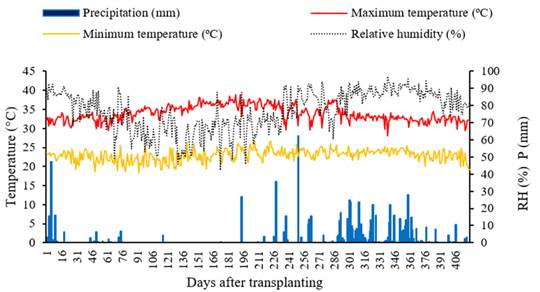
The experiment was carried out under field conditions in the area belonging to the ‘Rolando Enrique Rivas Castellón’ Experimental Farm of the Center for Sciences and Agri-Food Technology - CCTA of the Universidade Federal de Campina Grande - UFCG, located in the municipality of São Domingos, Paraíba, Brazil (06º48’50”S; 37º56’31”W, 190 m). According to Köppen’s classification, the climate of the region is BSh, which means a hot semi-arid climate, with scarce rainfall and irregular distribution throughout the year (ALVARES et al., 2013). The climate data collected during the experiment, temperature (maximum and minimum), relative humidity, and precipitation, are shown in figure 1.
Data on maximum and minimum temperature (ºC), relative humidity (%) and precipitation (mm) during the experimental period.
Treatments consisted of the combination of seven irrigation strategies with water deficit - IMS (SE - plants under full irrigation throughout the cycle - 100% crop evapotranspiration - ETc; EV - plants irrigated with 50% ETc in the vegetative stage; FL - plants under water deficit in the flowering stage; FR - fruiting stage; VE/FL - in the vegetative and flowering stages, with full irrigation in the fruiting stage; VE/FR - plants subjected to water deficit in the vegetative and fruiting stages) and four concentrations of ascorbic acid - AsA (0, 200, 400 and 600 mg L-1), distributed in a randomized block design, in a split-plot scheme with three replicates, each plot consisting of 3 usable plants and a 3 m border between the plots. Plots corresponded to irrigation strategies and subplots to ascorbic acid concentrations. Ascorbic acid concentrations were defined based on a study conducted by GAAFAR et al. (2020) using 0, 200 and 400 mg L-1 in common bean under water deficit conditions.
The cultivar used in this study was Paluma, propagated by cuttings. Paluma is a cultivar that has large fruits (over 200 g), with a piriform shape, a short ‘neck’ and smooth skin. Its pulp is thick (from 1.3 cm to 2.0 cm), firm, with intense red color and pleasant flavor (EMBRAPA, 2010).
The area was prepared by plowing followed by harrowing, aiming the unraveling and leveling of the area. The soil of the experimental area is classified as Neossolo Flúvico Ta Eutrófico típico (Fluvent) of loamy sand texture. Before transplanting the seedlings to the field, soil samples were collected in the experimental area, in the 0-40 cm layer, and then mixed to form a composite sample, whose chemical and physical characteristics were obtained according to the methodology of TEIXEIRA et al. (2017) and are presented in table 1.
The guava seedlings were transplanted to the field in 30 cm × 30 cm × 30 cm holes when they reached 40 cm in height. At transplanting, the collar (region between the roots and the trunk) of the seedlings was above the ground level, to avoid the emergence of roots. Formative pruning was carried out to guide the plant to obtain well-distributed branches with balanced and airy architecture, thus allowing a greater penetration of light and favoring ventilation inside the crown. The plants were conducted on a single stem up to 50 cm in height, when the terminal bud was eliminated. From the shoots that appeared, four well-distributed branches were left in the directions of the four cardinal points. After reaching maturity, the main branches were pruned, so that they remained with a length of 40 cm.
Fertilization with nitrogen, phosphorus and potassium was carried out as recommended by BARBOSA & LIMA (2010). Fertilization with P2O5 and K2O was calculated considering the potential fertility of the soil. Fertilization with micronutrients was carried out every 15 days to avoid the appearance of nutritional deficiencies. In the vegetative stage, nitrogen fertilization was split into portions and supplied in 24 applications per year, starting at 30 days after transplanting. In the flowering and fruiting stages, 30% of the nitrogen was supplied after fruiting pruning, and the remaining 70% was applied in a decreasing manner, up to 150 days after pruning, as described by BARBOSA & LIMA (2010).
Potassium fertilization was applied 30% after pruning, 15% after fruit set, 25% in the intermediate stage of fruit growth and 30% in the final stage of fruit growth (before maturation). Phosphate fertilization was carried out at once at planting and before each fruiting pruning, considering the results of the soil analysis. Cultural practices and phytosanitary treatments were carried out as recommended for the crop, by monitoring the emergence of pests and diseases and adopting control measures when necessary.
The irrigation system adopted was localized by drip, using 32 mm PVC pipes in the main line and 16 mm low-density polyethylene pipes in the lateral lines, with drippers with flow rate of 10 L h-1. Two pressure-compensating drippers (GA 10 Gripa model) were installed for each plant, each one 15 cm away from the stem. The plants were irrigated daily, at 07:00 am, with water supply according to the strategy adopted, and the depth was estimated based on ETc according to BERNARDO et al. (2019), using Eq. 1:
(1)
Where:
ETc - Crop evapotranspiration, mm d-1;
ETo - Reference evapotranspiration, mm d-1;
Kc = crop coefficient,
The Kc values adopted were 0.40 until flowering and 0.65 from flowering to the end of the cultivation cycle, according to EMBRAPA (2010).
Soil moisture content was also quantified, using the Time Domain Reflectometer (TDR), through high-frequency electromagnetic pulse emissions by the sensor connected to a coaxial cable, which reads the reflections occurred during a given time and read them as distance, according to their relationship with the dielectric constant (TOPP et al., 1980). In the experimental area, access pipes were installed in each treatment, totaling 16 treatments, distributed throughout the experiment, so the TDR was previously calibrated in the cultivation area, and readings were taken weekly before the beginning of irrigation.
Macronutrients were applied by fertigation using a Venturi injector at 15-day intervals after transplanting (CAVALCANTI, 2008), and their quantity was established based on soil analysis. Fertilization with micronutrients was performed every 30 days starting at 30 DAT, by foliar application, with a solution at a concentration of 1.0 g L-1 of Dripsol Micro® (1.2% magnesium, 0.85% boron, 3.4% iron, 4.2% zinc, 3.2% manganese, 0.5% copper and 0.06% molybdenum).
Foliar applications with ascorbic acid began at 72 h before the imposition of water deficit on the plants. Subsequently, the applications were carried out every 20 days and started at 5 pm until the plants reached the full flowering stage. Ascorbic acid concentrations were obtained by dissolving it in distilled water, which was prepared on the day of each application. AsA was applied by foliar applications, to fully wet the aerial part. A surfactant (Tween 20 to 0.025%) was added to the spray solutions to break the surface tension of the water and favor the penetration of ascorbic acid into the leaves. The plants were isolated with a structure made of plastic tarpaulin during the applications of ascorbic acid concentrations to prevent the solutions from drifting. The average volume of spray applied during the experimental period was 1.256 L per plant.
At 390 days after transplanting (DAT), stem diameter was determined using a digital caliper; crown diameter (DCrown) was obtained through the average of the crown diameter observed in the row direction (RD) and interrow direction (IRD); crown volume (VCrown) was calculated from plant height (H), RD and IRD, using Eq. 2, and VVI was calculated according to Portella et al. (2016), using Eq. 3:
(2)
Where:
VCrown - crown volume (m3);
H - plant height (m);
RD - crown diameter in the row direction (m); and
IRD - diameter of the crown in the interrow direction (m).
(3)
Where:
VVI - vegetative vigor index;
H - plant height (m);
DCrown - crown diameter (m); and
SD - stem diameter (m).
As production components, the following parameters were measured: number of fruits per plant (NF), average fruit weight (AFW), total fruit weight (TFW), and yield (YLD). The fruits were harvested when they showed a change from green to yellow, considered to be the point of harvest. NF was determined by counting the fruits harvested. TFW was obtained by the sum of the weight of all fruits produced per plant. The AFW was obtained through the ratio between the fresh mass of fruits and the total number of fruits harvested. Fruit diameters were obtained with a digital caliper, and yield was obtained considering the planting density of the area and extrapolated to one hectare.
For postharvest quality, the following parameters were evaluated: physical attributes, polar (PD) and equatorial (ED) diameters, and the chemical characteristics of the fruits, through the hydrogen potential - pH, soluble solids - SS (ºBrix), titratable acidity - TA (% citric acid) and ascorbic acid - AA (mg 100g-1 of pulp).
Guava pulp pH was determined using a digital potentiometer with a glass membrane electrode and a resolution of 0.01. Soluble solids were expressed in ºBrix and determined using a portable refractometer with a resolution of 0.2. Titratable acidity was measured according to the standards of the Adolfo Lutz Institute (IAL, 2008) and expressed as a percentage of citric acid. The concentration of ascorbic acid was determined by titration, using 1 g of pulp, plus 49 mL of 0.5% oxalic acid and titrated against Tillmans’ solution until the appearance of pink color (IAL, 2008).
The data collected in this study were subjected to the normality test (Shapiro-Wilk) and subsequently subjected to analysis of variance using the F test and, when there was significance, the mean comparison test (Scott-Knott) was performed at the 0.05 probability level for the factor irrigation strategies with water deficit, and linear and quadratic polynomial regression analysis for the different concentrations of ascorbic acid, using the statistical software SISVAR-ESAL version 5.7 (FERREIRA, 2019).
The multivariate structure of the results was evaluated by principal component analysis (PCA), synthesizing the amount of relevant information contained in the original data set in a smaller number of dimensions, resulting from linear combinations of the original variables generated from the eigenvalues (λ ≥ 1.0) in the correlation matrix, explaining a percentage greater than 10% of the total variance (GOVAERTS et al., 2007).
From the reduction of the dimensions, the original data of the variables of each component were subjected to multivariate analysis of variance (MANOVA) by the HOTELLING’s (1947) test at 0.05 probability level for irrigation strategies with water deficit and ascorbic acid concentrations, as well as for the interaction between the factors. Variables with a correlation coefficient greater than or equal to 0.65 were maintained in each principal component (PC) (HAIR et al., 2009). Statistical analyses were performed using Statistica v.7.0 software (STATSOFT, 2024).
RESULTS AND DISCUSSION
There were significant effects for the interaction between the factors irrigation management strategies and foliar application of ascorbic acid (IMS × AsA) on the polar fruit diameter (PD), equatorial fruit diameter (ED), number of fruits (NF), average fruit weight (AFW), total fruit weight (TFW), and yield (YLD) of guava (Table 2). Irrigation management strategies had a significant effect on the relative water content (RWC) of guava 390 days after transplanting.
Summary of analysis of variance for the polar fruit diameter (PD), equatorial fruit diameter (ED), number of fruits (NF), average fruit weight (AFW), total fruit weight (TFW), yield (YLD), relative water content (RWC), and electrolyte leakage (EL%) of guava grown under irrigation management strategies and foliar application of ascorbic acid, at 390 days after transplanting.
There was interaction between the factors irrigation management strategies and foliar application of ascorbic acid (IMS × AsA), showing significant effects on canopy volume (VCrown), canopy diameter (DCrown), vegetative vigor index (VVI), vitamin C (Vit-C), soluble solids (SS), hydrogen potential (pH), and titratable acidity (TA) of guava fruits (Table 3). There was a significant effect of ascorbic acid concentrations on stem diameter (SD) of guava trees at 390 days after transplanting.
Summary of the analysis of variance regarding stem diameter (SD), canopy volume (VCrown), canopy diameter (DCrown), vegetative vigor index (VVI), vitamin C (Vit-C), soluble solids (SS), hydrogen potential (pH), titratable acidity (TA), of guava trees cultivated under irrigation management strategies and foliar application of ascorbic acid, 390 days after transplanting.
The multidimensional space of the original variables was reduced to two principal components (PC1 and PC2) with eigenvalues greater than λ ≥ 1.0, as highlighted by Kaiser (1960). The eigenvalues and percentage of variance explained for each component (Table 4) together represent 50.69% of the total variation. PC1 explained 27.74% of the total variance, and PC2 represented 22.95% of the variance.
A significant effect (P ≤ 0.01) of the interaction between irrigation management strategies (IMS) with water deficit and ascorbic acid (AsA) concentrations was observed for PC1 and PC2 (Table 4). A significant effect (P ≤ 0.01) of irrigation management strategies and ascorbic acid concentrations was also found when analyzed separately.
The multidimensional space of the original variables was reduced to two principal components (PC1 and PC2) with eigenvalues greater than λ ≥ 1.0, as highlighted by Kaiser (1960). The eigenvalues and percentage of variance explained for each component (Table 5) together represent 50.69% of the total variation. PC1 explained 27.74% of the total variance, and PC2 represented 22.95% of the variance.
A significant effect (P ≤ 0.01) of the interaction between irrigation management strategies (IMS) with water deficit and ascorbic acid (AsA) concentrations was observed for PC1 and PC2 (Table 5). A significant effect (P ≤ 0.01) of irrigation management strategies and ascorbic acid concentrations was also found when analyzed separately.
The behavior of the treatments is expressed in figure 2A and figure 2B, referring to the first and second principal components (PC1 and PC2). In the first principal component (PC1) there is possibly an interaction between irrigation strategies and ascorbic acid concentrations. It can be observed that the correlation coefficients were greater than 0.60 for the variables TFW, PD, RWC, EL%, SD, VCrown, DCrown, VVI, YLD, and SS.

Two-dimensional projection of the scores of the principal components for the factors irrigation strategies with water deficit - IMS and concentrations of ascorbic acid - AsA (A) and of the variables analyzed (B) in the two principal components (PC1 and PC2). T1- plants under full irrigation throughout the cycle and without application of ascorbic acid; T2- plants under full irrigation throughout the cycle and application of 200 mg L-1 of ascorbic acid; T3- plants under full irrigation throughout the cycle and application of 400 mg L-1 of ascorbic acid; T4- plants under full irrigation throughout the cycle and application of 600 mg L-1 of ascorbic acid; T5 - water deficit (50% of crop evapotranspiration - ETc) in the vegetative stage and without application of ascorbic acid; T6 - water deficit (50% of crop evapotranspiration - ETc) in the vegetative stage and application of 200 mg L-1 of ascorbic acid; T7 - water deficit (50% of crop evapotranspiration - ETc) in the vegetative stage and application of 400 mg L-1 of ascorbic acid; T8 - water deficit (50% of crop evapotranspiration - ETc) in the vegetative stage and application of 600 mg L-1 of ascorbic acid; T9 - in the flowering stage and without application of ascorbic acid; T10 - in the flowering stage and application of 200 mg L-1 of ascorbic acid; T11 - in the flowering stage and application of 400 mg L-1 of ascorbic acid; T12 - in the flowering stage and application of 600 mg L-1 of ascorbic acid; T13 - in the fruiting stage and without application of ascorbic acid; T14 - in the fruiting stage and application of 200 mg L-1 of ascorbic acid; T15 - in the fruiting stage and application of 400 mg L-1 of ascorbic acid; T16 - in the fruiting stage and application of 600 mg L-1 of ascorbic acid; T17 - in the maturation stage and without application of ascorbic acid; T18 - in the maturation stage and application of 200 mg L-1 of ascorbic acid; T19 - in the maturation stage and application of 400 mg L-1 of ascorbic acid; T20 - in the maturation stage and application of 600 mg L-1 of ascorbic acid; T21 - in the vegetative and flowering stages and without application of ascorbic acid; T22 - in the vegetative and flowering stages and application of 200 mg L-1 of ascorbic acid; T23 - in the vegetative and flowering stages and application of 400 mg L-1 of ascorbic acid; T24 - in the vegetative and flowering stages and application of 600 mg L-1 of ascorbic acid; T25 - in the vegetative and fruiting stages and without application of ascorbic acid; T26 - in the vegetative and fruiting stages and application of 200 mg L-1 of ascorbic acid; T27 - in the vegetative and fruiting stages and application of 400 mg L-1 of ascorbic acid; T28 - in the vegetative and fruiting stages and application of 600 mg L-1 of ascorbic acid; TFW (Total fruit weight/plant - kg); AFW (Average fruit weight - g per fruit); PD (Fruit polar diameter - mm); ED (Fruit equatorial diameter - mm); YLD (Yield - kg ha-1); RWC (Relative water content - %); EL% (Electrolyte leakage - %); SD (Stem diameter - mm); VCrown (Crown volume - m3); DCrown (Crown diameter - m2); VVI (Vegetative Vigor Index); Vit-C (Vitamin C - mg 100 g-1 of pulp); SS (Soluble Solids - ºBrix); pH (Hydrogen potential) and TA (Titratable Acidity -% Citric Acid).
In the principal component 1, for stem diameter (SD), crown volume (VCrown), crown diameter (DCrown) and vegetative vigor index (VVI), the highest values (44.10 mm, 6.87 m3, 2.86 m2 and 0.09, respectively) were observed in plants subjected to water deficit in the fruiting stage and without application of ascorbic acid (T5), when compared to plants grown under 50% ETc in the vegetative/fruiting stages (T9).
Among the strategies, the intermittent water deficit, that is, in the vegetative stage and later in the fruiting stage, contributed to inhibiting plant growth, which was already explained by the deleterious effects of water deficit that vary according to the intensity, duration and development stage in which the plants were subjected (ARAÚJO et al., 2010). In a study carried out with sour passion fruit, FÁTIMA et al. (2024b) found greater tolerance to water deficit in the flowering stage, and according to the authors, the water deficit caused changes in photosynthetic activities at different stages of development of sour passion fruit plants.
Plant growth inhibition under water deficit conditions may be associated with the reduction of turgor pressure in cells. Turgor pressure is critical for cell rigidity and thus for cell expansion and growth; when water availability is low, turgor pressure decreases, resulting in limitations for cell division and expansion (ANJUM et al., 2016). Under conditions of water deficit, growth inhibition results from the diversion of metabolic energy to maintain the vital functions for plant development, such as the synthesis of organic and inorganic solutes (FÁTIMA et al., 2019).
The highest value (77.92%) for relative water content in the leaf blade (RWC) was observed in plants grown under water deficit (50% ETc) in the fruiting stage and ascorbic acid concentration of 200 mg L-1 (T6), while the lowest value was obtained under water deficit in the vegetative/flowering stages and ascorbic acid concentration of 400 mg L-1 (T19). Regarding electrolyte leakage (EL%), the lowest value (13.11%) was found in plants irrigated with 100% ETc during the entire cycle and under ascorbic acid concentration of 600 mg L-1 (T4).
The increase in the relative water content with the application of ascorbic acid may be related to its performance in improving turgor potential, which promotes the maintenance of water balance in plant tissues (EL-BIALLY et al., 2018). AsA also promotes increase in cell wall strength and in its ability to withstand water loss under abiotic stress conditions such as water stress (NAZ et al., 2016)
The reduction in electrolyte leakage observed when the ascorbic acid concentration of 600 mg L-1 was applied to guava cultivated under water deficit in the fruiting stage may be indicative of the elimination of ROS and protection of lipids and proteins (FATAH & SADEK, 2020). Usually under conditions of water deficit, there tends to be an increase in the production of ROS, such as hydroxyl radicals and lipid peroxides, which can contribute to the degradation of membrane lipids, causing the breakdown of lipid structures and impairing the function of membranes (PEIFANG et al., 2015).
Regarding the total fruit weight (TFW) and yield (YLD) of guava plants, it was found that full irrigation (100% ETc) throughout the cycle and without application of ascorbic acid (T1), promoted higher TFW of 9.59 kg per plant and YLD of 10.97 ton ha-1 when compared to the T26 treatment, i.e., plants under water deficit in the fruiting stage and application of ascorbic acid at a concentration of 600 mg L-1 showed increments of 50.20 and 55.22%, respectively. The yield obtained in this study is above the average produced by the state of Paraíba, which is 7.24 ton ha-1, according to IBGE (2024).
The reduction in total fruit weight and yield in plants under water deficit in the fruiting stage can be explained by the limitation in water availability and also the local climatic conditions, since according to NÓBREGA et al. (2024) they have high evapotranspiration rates, thus requiring greater availability of water for fruit filling. According to SOARES et al. (2023), the effects of water restriction on plants can be diverse and can affect physiological, growth and biochemical processes, and production. In studies carried out by SIMÕES et al. (2021) with mango, total fruit weight and yield were also more affected by water deficit in the fruiting stage.
For fruit polar diameter (PD), an increase was observed in plants under water deficit in the vegetative/flowering stages and application of ascorbic acid at a concentration of 400 mg L-1 (T19), with an average value of 98.94 mm, an increase of 21.47 mm when compared to those that received 100% ETc during the entire cycle and without application of ascorbic acid (T1).
Foliar application of ascorbic acid promoted a beneficial effect on the polar diameter of guava fruits under water deficit in the vegetative/flowering stage, as well as the relative water content and electrolyte leakage in the leaf blade; this may be associated with the physiological function of AsA in the detoxification of ROS that are produced under water deficit conditions, as reported by WANG et al. (2018) and NAZ et al. (2016), who observed that, when applied externally, AsA can play a crucial role in the protection of proteins and lipids.
The highest value of soluble solids (SS) was observed in plants subjected to water deficit in the maturation stage and without application of ascorbic acid (T25), which obtained a value of 14.10 °Brix. On the other hand, plants irrigated with 50% ETc and under AsA concentration of 200 mg L-1 in the vegetative stage (T14) obtained the lowest values; when comparing them, an increase of 3.84 °Brix was observed.
Soluble solids contents are significantly influenced by water deficit, as reported by LENG et al. (2024), being an important variable to understand how plants respond to stress conditions. The positive correlation between water deficit and increased levels of sugars such as glucose and fructose may indicate that plants adjust their metabolism to survive under water-restricted conditions (LENG et al., 2024).
In principal component 2, increments in the average fruit weight (AFW) and number of fruits per plant (NF) were observed in plants under full irrigation (100% ETc) and without ascorbic acid application (T1), equal to 203.49 g per fruit and 49.6 units, respectively, while the lowest values were observed in T11 for AFW and T26 for NF. When comparing the highest and lowest values, increments of 69.62 g per fruit and 29.15 units were observed, respectively.
According to ZHONG et al. (2019), there is a tendency for the mass of fruits to increase as water availability increases, which is essential to understand the relationship between irrigation and agricultural yield, corroborating the results obtained in the present study. According to SADIQ et al. (2017), water plays a critical role in several physiological processes in plants, including nutrient uptake, photosynthesis, and fruit formation.
Application of 400 mg L-1 of AsA promoted a beneficial effect on the equatorial diameter of the fruits (ED) of guava cv. Paluma under water deficit in the vegetative/flowering stages (T19), with an increase of 12.01 mm when compared to the fruits of plants subjected to 100% ETc irrigation depth and without application of ascorbic acid (T1).
Equatorial diameter showed the same behavior as polar diameter, and the action of ascorbic acid in improving fruit size may be linked to the fact that AsA contributes to improving several important aspects such as the photosynthetic rate and efficiency of photosynthesis, thus promoting greater production of carbohydrates and consequently better growth and production of plants (KHAN et al., 2012).
Regarding the vitamin C contents, it was observed that irrigation with 50% ETc in the maturation stage and without application of ascorbic acid (T25) promoted the highest values (47.69 mg 100 g-1 of pulp); when compared to the control treatment T1 (plants irrigated with 100% ETc and without application of ascorbic acid), there was an increase of 9.43%. The increase in vitamin C contents in fruits of guava subjected to water deficit conditions can be explained by its functions, as it is a non-antioxidant compound that increases under water deficit conditions, acting to protect cells against oxidative stress (AKRAM et al., 2017).
Guava pulp pH reached the highest value (4.45) in plants grown under water deficit in the vegetative/flowering stage and foliar application of AsA at a concentration of 400 m L-1 (T19). Conversely, plants grown under full irrigation throughout the cycle and without ascorbic acid application (T1) obtained lower mean values. pH is a crucial factor in evaluating the quality of fruits, including guava. Lower pH values are associated with higher acidity, which can help preserve fruit pulp during storage and processing; in addition, the use of lower pH can allow fruits to be preserved without the need for high heat treatments, which can often result in nutrient loss and change in organoleptic characteristics, such as flavor, color and aroma (BENEVIDES et al., 2008). For titratable acidity (TA), higher mean values and 2.98 % acid citric were found in the fruits of plants subjected to water deficit of 50% ETc in the vegetative/fruiting stages and without application of ascorbic acid (T9), denoting an increase of 22.48% in TTA when compared to the lowest values observed in T1. The increase in titratable acidity in guava fruits is highly desirable in the food industry, as it reduces the need for artificial acidifiers, improving the nutritional and organoleptic quality of the products (BRASIL et al., 2016).
OLIVEIRA et al. (2020) highlighted that natural acidity contributes to the preservation of the sensory attributes of products. SILVA et al. (2018) also reinforced that reducing the use of artificial acidifiers is beneficial to health, improving food quality. Despite the reduction in fruit quality variables in different treatments, the quality of guava pulp meets the quality standard established by Normative No. 49, of September 26, 2018 of the Ministry of Agriculture, Livestock and Food Supply, which defines the minimum parameters for soluble solids (7 ºBrix), pH (7.5), titratable acidity (0.4 g citric acid/100 g pulp) and ascorbic acid (24 mg/100 g pulp) (BRASIL, 2018).
CONCLUSION
Water deficit in the vegetative/fruiting stages negatively affects growth in stem diameter, crown volume, crown diameter and vegetative vigor index, average fruit weight, and polar and equatorial diameter of guava fruits, at 390 days after transplanting. Foliar application of ascorbic acid at a concentration of 600 mg L-1 promotes beneficial effects on total fruit weight and yield of guava. Water deficit in the maturation stage stimulates the synthesis of vitamin C and soluble solids of guava.
ACKNOWLEDGMENTS
The authors would like to thank Conselho Nacional de Desenvolvimento Científico e Tecnológico (CNPq) for the financial assistance provided to conduct this study.
REFERENCES
-
AKRAM, N. A. et al. Ascorbic acid-a potential oxidant scavenger and its role in plant development and abiotic stress tolerance. Frontiers in Plant Science, v.8, n.1, p.1-17, 2017. Available from: <Available from: https://www.frontiersin.org/journals/plantscience/articles/10.3389/fpls.-2017.00613/full >. Accessed: Nov. 10, 2024. doi: 10.3389/fpls.2017.00613.
» https://doi.org/10.3389/fpls.2017.00613.» https://www.frontiersin.org/journals/plantscience/articles/10.3389/fpls.-2017.00613/full -
ALVARES, C. A. et al. Köppen’s climate classification map for Brazil. Meteorologische, v.22, n.6, p.711-728, 2013. Available from: <Available from: https://www.schweizerbart.de/papers/metz/detail/22/-84051/Koppen_s_climate_classification_map_for_Brazil >. Accessed: Oct. 22, 2024. doi: 10.1127/0941-2948/2013/0507.
» https://doi.org/10.1127/0941-2948/2013/0507.» https://www.schweizerbart.de/papers/metz/detail/22/-84051/Koppen_s_climate_classification_map_for_Brazil -
ANJUM, S. A. et al. Effect of progressive drought stress on growth, leaf gas exchange, and antioxidant production in two maize cultivars. Environmental Science and Pollution Research, v.23, n.17, p.17132-17141, 2016. Available from: <Available from: https://link.springer.com/artic-le/10.1007/s11356-016-6894-8 >. Accessed: Oct. 22, 2024. doi: 10.1007/s11356-016-6894-8.
» https://doi.org/10.1007/s11356-016-6894-8.» https://link.springer.com/artic-le/10.1007/s11356-016-6894-8 -
ARAÚJO, S. A. C. et al. Características fotossintéticas de genótipos de capim-elefante anão (Pennisetum purpureum Schum), em estresse hídrico. Acta Scientiarum, Animal Sciences, v.32, n.1, p.1-7, 2010. Available from: <Available from: https://ojs.uem.br/ojs/index.php/ActaSciAnim-Sci/article/view/8961 >. Accessed: Oct. 22, 2024. doi: 10.4025/actascianimsci.v32i1.8961.
» https://doi.org/10.4025/actascianimsci.v32i1.8961.» https://ojs.uem.br/ojs/index.php/ActaSciAnim-Sci/article/view/8961 -
BARBOSA, F. R. et al. A cultura da goiaba. 2.ed. Brasília, DF: Embrapa Informação Tecnológica, 2010. 180p. Available from: <Available from: https://www.embrapa.br/en/busca-de-publicacoes/-/publicacao/946625/a-cultura-da-goiaba >. Accessed: Oct. 22, 2024.
» https://www.embrapa.br/en/busca-de-publicacoes/-/publicacao/946625/a-cultura-da-goiaba -
BENEVIDES, S. D. et al. Qualidade da manga e polpa de manga Ubá. Ciência e Tecnologia de Alimentos, v.28, n.3, p.571-578, 2008. Available from: <Available from: https://www.scielo.br/j/cta/a/-bmj4m7CQhrCbfLm8DHYN3mM/?lang=en >. Accessed: Oct. 22, 2024. doi: 10.1590/S0101-20612008000300011.
» https://doi.org/10.1590/S0101-20612008000300011.» https://www.scielo.br/j/cta/a/-bmj4m7CQhrCbfLm8DHYN3mM/?lang=en -
BERNARDO, S. et al. Manual de Irrigação. 9. ed. Viçosa: UFV, 2019. 545p. Available from: <Available from: https://www.livrariaufv.com.br/manual-de-irrigacao-9-ed.html >. Accessed: Oct. 22, 2024.
» https://www.livrariaufv.com.br/manual-de-irrigacao-9-ed.html -
BRASIL, A. S. et al. Avaliação da qualidade físico-química de polpas de fruta congeladas comercializadas na cidade de Cuiabá MT. Revista Brasileira de Fruticultura, v.38, n.1, p.167-175, 2016. Available from: <Available from: https://www.scielo.br/j/rbf/a/SN6fHYk7P7S3ZR4Kb8hM6n-L/?lang=pt >. Accessed: Oct. 22, 2024. doi: 10.1590/0100-2945-253/14.
» https://doi.org/10.1590/0100-2945-253/14.» https://www.scielo.br/j/rbf/a/SN6fHYk7P7S3ZR4Kb8hM6n-L/?lang=pt -
BRASIL. Ministério as Agricultura e do Abastecimento. Regulamento técnico geral para fixação dos padrões de identidade e qualidade para polpa de fruta. Instrução Normativa nº 37, 2018. Available from: <Available from: https://www.gov.br/agricultura/pt-br/assuntos/inspecao/produtos-vegetal/legislacao-1/instrucao-normativa-n-37-de-1-de-outubro-de-2018.pdf >. Accessed: Oct. 22, 2024.
» https://www.gov.br/agricultura/pt-br/assuntos/inspecao/produtos-vegetal/legislacao-1/instrucao-normativa-n-37-de-1-de-outubro-de-2018.pdf -
CAVALCANTI, F. J. A. Recomendações de adubação para o Estado de Pernambuco: 2. aproximação. 3. ed. Recife: IPA. 2008. 212 p. Available from: <Available from: https://www.ipa.br/inf-ormacoes-tecnicas/ >. Accessed: Oct. 22, 2024.
» https://www.ipa.br/inf-ormacoes-tecnicas/ -
COSTA, F. R. et al. Transformação e uso da goiaba na indústria alimentícia. Ciência e Tecnologia de Alimentos, v.32, n.1, p.89-97, 2017. Available from: <Available from: https://www.sbcta.org.br/revista-food-science-and-technology >. Accessed: Oct. 22, 2024. doi: 10.31510/infa.v19i1.1348.
» https://doi.org/10.31510/infa.v19i1.1348.» https://www.sbcta.org.br/revista-food-science-and-technology -
EL-BIALLY, M. et al. Efficacy of ascorbic acid as a cofactor for alleviating water deficit impacts and enhancing sunflower yield and irrigation water-use efficiency. Agricultural water management, v.208, p.132-139, 2018. Available from: <Available from: https://www-.sciencedirect.com/science/article/abs/pii/S0378377418308138 >. Accessed: Oct. 22, 2024. doi: 10.1016/j.agwat.2018.06.016.
» https://doi.org/10.1016/j.agwat.2018.06.016.» https://www-.sciencedirect.com/science/article/abs/pii/S0378377418308138 -
EMBRAPA- Empresa Brasileira de Pesquisa Agropecuária. A cultura da goiaba. 2.ed. Brasília: Informação tecnológica, 2010. 180p. Available from: <Available from: https://www.embrapa.br/en/busca-de-publicacoes/-/publicacao/946625/a-cultura-da-goiaba >. Accessed: Oct. 22, 2024.
» https://www.embrapa.br/en/busca-de-publicacoes/-/publicacao/946625/a-cultura-da-goiaba -
FATAH, E. M. A.; SADEK, K. A. Impact of different application methods and concentrations of ascorbic acid on sugar beet under salinity stress conditions. Alexandria Journal of Agricultural Sciences, v.65, n.1, p.31-44, 2020. Available from: <Available from: https://alexja.journals.ekb.e-g/article_90853.html >. Accessed: Oct. 22, 2024. doi: 10.21608/alexja.2020.90853.
» https://doi.org/10.21608/alexja.2020.90853.» https://alexja.journals.ekb.e-g/article_90853.html -
FÁTIMA, R. T. de et al. Production and postharvest quality of sour passion fruit under deficit irrigation strategies and foliar application of ascorbic acid. New Zealand Journal of Crop and Horticultural Science, v.52, n.1, p.1-25, 2024a. Available from: <Available from: https://www.tand-fonline.com/doi/full/10.1080/01140671.2024.2412976 >. Accessed: Oct. 22, 2024. doi: 10.1080/01140671.2024.2412976.
» https://doi.org/10.1080/01140671.2024.2412976.» https://www.tand-fonline.com/doi/full/10.1080/01140671.2024.2412976 -
FÁTIMA, R. T. de et al. Adubação silicatada como atenuante do estresse hídrico no crescimento e trocas gasosas da alface. Engenharia na Agricultura, v.27, n.1, p.170-178, 2019. Available from: <Available from: https://periodicos.ufv.br/reveng/article/view/892/0 >. Accessed: Oct. 22, 2024. doi: 10.13083/reveng.v27i-2.892.
» https://doi.org/10.13083/reveng.v27i-2.892.» https://periodicos.ufv.br/reveng/article/view/892/0 -
FÁTIMA, R. T. de et al. Effect of different timing of water deficit combined with foliar application of ascorbic acid on physiological variables of sour passion fruit. Arid Land Research and Management, v.38, n.1, p.1-25, 2024b. Available from: <Available from: https://www.tandfonline.com/doi/full/10.1080/15324982.2024.2387098 >. Accessed: Oct. 22, 2024. doi: 10.1080/15324982.2024.2387098.
» https://doi.org/10.1080/15324982.2024.2387098.» https://www.tandfonline.com/doi/full/10.1080/15324982.2024.2387098 -
FERREIRA, D. F. Sisvar: A computer analysis system to fixed effects split plot type designs. Revista Brasileira de Biometria, v.37, n.4, p.529-535, 2019. Available from: <Available from: https://biometria.ufla.br/index.php/BBJ/article/view/450 >. Accessed: Oct. 22, 2024. doi: 10.28951/rbb.v37i-4.450.
» https://doi.org/10.28951/rbb.v37i-4.450.» https://biometria.ufla.br/index.php/BBJ/article/view/450 -
FRANCIS, F. J. Analysis of anthocyanins. In: Markakis, P. (ed). Anthocyanins as food colors. New York: Academic Press, 1982, p.181-207. Available from: <Available from: https://archive.org/det-ails/anthocyanins-as-food-colors >. Accessed: Oct. 22, 2024.
» https://archive.org/det-ails/anthocyanins-as-food-colors -
GAAFAR, A. A. et al. Ascorbic acid induces the increase of secondary metabolites, antioxidant activity, growth, and productivity of the common bean under water stress conditions. Plants, v.9, n.5, p.627, 2020. Available from: <Available from: https://www.mdpi.com/2223-7747/9/5/627 >. Accessed: Oct. 22, 2024. doi: 10.3390/plants9050627.
» https://doi.org/10.3390/plants9050627.» https://www.mdpi.com/2223-7747/9/5/627 -
GOVAERTS, B. et al. Influence of permanent raised bed planting and residue management on physical and chemical soil quality in rain fed maize/wheat systems. Plant and Soil, v.291, n.1, p.39-54, 2007. Available from: <Available from: https://link.springer.com/article/10.1007/s11104-006-9172-6 >. Accessed: Oct. 22, 2024. doi: 10.1007/s11104-006-9172-6.
» https://doi.org/10.1007/s11104-006-9172-6.» https://link.springer.com/article/10.1007/s11104-006-9172-6 -
HAIR, F. J. et al. Análise multivariada de dados. 6. ed. Tradução Adonai Schlup Sant’Anna. Porto Alegre: Bookman. 688p, 2009. Available from: <Available from: https://www.bookman.com.br >. Accessed: Oct. 22, 2024.
» https://www.bookman.com.br -
HOTELLING, H. et al. Multivariate quality control. Techniques of statistical analysis. New York: John Wiley & Sons. 1947. 73p. Available from: <Available from: https://link.spr-inger.com/referenceworkentry/10.1007/1-4020-0611-X_657 >. Accessed: Oct. 22, 2024.
» https://link.spr-inger.com/referenceworkentry/10.1007/1-4020-0611-X_657 - IAL - Instituto Adolfo Lutz. Normas analíticas do Instituto Adolfo Lutz. v.1: Métodos químicos e físicos para análise de alimentos. 3.ed. São Paulo: IMESP, 2008. 1020p.
-
IBGE - Instituto Brasileiro de Geografia e Estatística. Produção agrícola - lavoura permanente. 2024. Available from: <Available from: https://cidades.ibge.gov.br/brasil/pesquisa/15/11954. 2019 >. Accessed: Sept. 03, 2024.
» https://cidades.ibge.gov.br/brasil/pesquisa/15/11954. 2019 -
KHAN, T. A. et al. A review of ascorbic acid potentialities against oxidative stress induced in plants. Journal of Agrobiology, v.28, n.2, p.97-111, 2012. Available from: <Available from: https://www.scielo.br/j/jss/a/m6mPwVC3r87nM5vCxR68YMx/ >. Accessed: Oct. 22, 2024. doi: 10.2478/v10146-011-0011-x.
» https://doi.org/10.2478/v10146-011-0011-x.» https://www.scielo.br/j/jss/a/m6mPwVC3r87nM5vCxR68YMx/ -
LACERDA, C. N. et al. Foliar application of ascorbic acid in guava cultivation under water replacement levels. Revista Caatinga, v. 38, n.1, e-12595, 2025. Available from: <Available from: https://www.scielo.br/j/rcaat/a/P98KVbdkGfktcjpQyYhp85M/?lang=en >. Accessed: Oct. 22, 2024. doi: 10.1590/1983-21252025v3812595rc.
» https://doi.org/10.1590/1983-21252025v3812595rc.» https://www.scielo.br/j/rcaat/a/P98KVbdkGfktcjpQyYhp85M/?lang=en -
LENG, F. et al. Different frequencies of water deficit irrigation treatments improve fruit quality of Zitian seedless grapes under on-tree storage. Food Chemistry, v.454, n.1, e-139629, 2024. Available from: <Available from: https://papers.ssrn.com/sol3/papers.cfm?abstract_id=4725996 >. Accessed: Oct. 22, 2024. doi: 10.1016/j.foodchem.2024.139629.
» https://doi.org/10.1016/j.foodchem.2024.139629.» https://papers.ssrn.com/sol3/papers.cfm?abstract_id=4725996 -
LIMA, R. F. de et al. Fibras de algodoeiro herbáceo sob déficit hídrico. Revista Verde de Agroecologia e Desenvolvimento Sustentável, v.13, n.4, p.427-436, 2018. Available from: <Available from: https://www.embrapa.br/busca-de-publicacoes/-/publicacao/1107098/cultivares-de-algodoeiro-herbaceo-sob-deficit-hidrico-aplicado-em-fases-fenologicas >. Accessed: Oct. 22, 2024. doi: 10.18378/-rvads.v13i4.5940.
» https://doi.org/10.18378/-rvads.v13i4.5940.» https://www.embrapa.br/busca-de-publicacoes/-/publicacao/1107098/cultivares-de-algodoeiro-herbaceo-sob-deficit-hidrico-aplicado-em-fases-fenologicas -
NAZ, H. et al. Impact of ascorbic acid on growth and some physiological attributes of cucumber (Cucumis sativus) plants under water-deficit conditions. Journal of Botany, v.3, n.48, p.877-883, 2016. Available from: <Available from: https://www.researchgate.net/-publication/304958308_I-mpact_of_ascorbic_acid_on_growth_and_some_physiological_attributes_of_cucumber_Cucumis_Sativus_plants_under_water-deficit_conditions >. Accessed: Oct. 22, 2024.
» https://www.researchgate.net/-publication/304958308_I-mpact_of_ascorbic_acid_on_growth_and_some_physiological_attributes_of_cucumber_Cucumis_Sativus_plants_under_water-deficit_conditions -
NÓBREGA, J. S. et al. Hydrogen peroxide alleviates salt stress effects on gas exchange, growth, and production of naturally colored cotton. Plants, v.13, n.3, e390, 2024. Available from: <Available from: https://www.mdpi.com/2223-7747/13/3/390 >. Accessed: Oct. 22, 2024. doi: 10.3390/plants13030390.
» https://doi.org/10.3390/plants13030390.» https://www.mdpi.com/2223-7747/13/3/390 -
OLIVEIRA, J. F. et al. Importância da acidez natural em frutas. Revista de Alimentos e Nutrição, v.25, n.1, p.45-52, 2020. Available from: <Available from: https://www.scielo.br/j/estpsi/-a/L6j64vKkynZH9Gc4PtNWQng/ >. Accessed: Oct. 22, 2024. doi: 10.1590/1677-5449.190148.
» https://doi.org/10.1590/1677-5449.190148.» https://www.scielo.br/j/estpsi/-a/L6j64vKkynZH9Gc4PtNWQng/ -
OLIVEIRA, R. G. et al. Nutritional value of guava and its acceptance in the Brazilian market. Journal de Agricultura e Alimentos, v.42, n.1, p.22-30, 2019. Available from: <Available from: https://doi.org/10.1590/jfst.2019.123130 >. Accessed: Oct. 22, 2024. doi: 10.1590/jfst.2019.123130.
» https://doi.org/10.1590/jfst.2019.123130.» https://doi.org/10.1590/jfst.2019.123130 -
PEIFANG, C. et al. Physiological responses of seedling roots of the desert 727 plant Reaumuria soongorica to drought stress. Acta Pratacultuae Sinica, v.24, n.1, p.72-80, 2015. Available from: <Available from: http://cyxb.magtech.com.cn/CN/10.11686/cyxb20150110 >. Accessed: Oct. 22, 2024. doi: 10.1016/j.chnaes.2015.06.010.
» https://doi.org/10.1016/j.chnaes.2015.06.010.» http://cyxb.magtech.com.cn/CN/10.11686/cyxb20150110 -
ROLDÁN-CAÑAS, J. et al. Water and irrigation management in arid and semiarid zones. Water, v.13, n.17, e-2446, 2021. Available from: <Available from: https://www.mdpi.com/2073-4441/13/17/2446 >. Accessed: Oct. 22, 2024. doi: 10.3390/w13172446.
» https://doi.org/10.3390/w13172446.» https://www.mdpi.com/2073-4441/13/17/2446 -
SADIQ, M. et al. Tocopherol confers water stress tolerance: 749 Sugar and osmoprotectant metabolism in mung bean [Vigna radiata (L.) 750 Wilczek]. Agrochimica, v.61, n.1, p.28-42, 2017. Available from: <Available from: https://www.researchgate.net/publication/318836435_Tocopherol_confers_water_stress_tolerance_Sugar_and_osmoprotectant_metabolism_in_mung_bean_Vigna_radiata_L_Wilczek >. Accessed: Nov. 11, 2025. doi: 10.12871/0021857201713.
» https://doi.org/10.12871/0021857201713.» https://www.researchgate.net/publication/318836435_Tocopherol_confers_water_stress_tolerance_Sugar_and_osmoprotectant_metabolism_in_mung_bean_Vigna_radiata_L_Wilczek -
SHARMA, R. et al. Oxidative stress mitigation and initiation of antioxidant and osmoprotectant responses mediated by ascorbic acid in Brassica juncea L. subjected to copper (II) stress. Ecotoxicology and Environmental Safety, v.182, n.1, e-109436, 2019. Available from: <Available from: https://www.sciencedirect.com/science/article/pii/S0160412019302913 >. Accessed: Oct. 22, 2024. doi: 10.1016/j.ecoenv.2019.109436.
» https://doi.org/10.1016/j.ecoenv.2019.109436.» https://www.sciencedirect.com/science/article/pii/S0160412019302913 -
SILVA, J. M. et al. A importância econômica da goiabeira no Brasil. Revista Brasileira de Fruticultura, v.37, n.1, p.57-65, 2015. Available from: <Available from: https://www.scielo.br/j-/rbfu/v37n1/0000000000000001 >. Accessed: Oct. 22, 2024. doi: 10.1590/0100-29452020447.
» https://doi.org/10.1590/0100-29452020447.» https://www.scielo.br/j-/rbfu/v37n1/0000000000000001 -
SILVA, L. A. et al. Reducing artificial acidifiers and their health benefits. Journal de Nutrição e Alimentos, v.32, n.1, p.101-109, 2018. Available from: <Available from: https://brasilia.fiocruz.br/aagts/wp-content/uploads/sites/4/2020/07/Silva_et_al-2018-BMC_Medical_Research_Methodology_PT.pdf >. Accessed: Oct. 22, 2024. doi: 10.1590/1677-5449.2018-001.
» https://doi.org/10.1590/1677-5449.2018-001.» https://brasilia.fiocruz.br/aagts/wp-content/uploads/sites/4/2020/07/Silva_et_al-2018-BMC_Medical_Research_Methodology_PT.pdf -
SIMÕES, W. L. et al. Fisiologia, produção e qualidade de frutos da mangueira Tommy atkins sob diferentes sistemas de irrigação. Irriga, v.1, n.1, p.56-66, 2021. Available from: <Available from: https://www.alice.cnptia.embrapa.br/alice/bitstream/doc/1132619/1/Fisiologia-producao-e-qualidade-de-frutos-da-mangueira-2021.pdf >. Accessed: Oct. 22, 2024. doi: 10.15809/irriga.2021v1n1p56-66.
» https://doi.org/10.15809/irriga.2021v1n1p56-66.» https://www.alice.cnptia.embrapa.br/alice/bitstream/doc/1132619/1/Fisiologia-producao-e-qualidade-de-frutos-da-mangueira-2021.pdf -
SOARES, L. A. dos A. et al. Gas exchange, growth, and production of cotton genotypes under water deficit in phenological stages. Revista Caatinga, v.36, n.1, p.145-157, 2023. Available from: <Available from: https://www.revista.caatinga.com.br/2023/36/145-157 >. Accessed: Oct. 22, 2024. doi: 10.1590/1983-21252023v36n116rc.
» https://doi.org/10.1590/1983-21252023v36n116rc.» https://www.revista.caatinga.com.br/2023/36/145-157 - STATSOFT, I. N. C. Programa computacional Statistica. 7.0. E. A. U., 2024.
-
WANG, Y. et al. The synthesis of ascorbic acid in rice roots plays an important role in the salt tolerance of rice by scavenging ROS. International Journal of Molecular Sciences, v.19, n.11, p.3347, 2018. Available from: <Available from: https://www.mdpi.com/1422-0067/19/11/3347 >. Accessed: Nov. 11, 2025. doi: 10.3390/ijms19113347.
» https://doi.org/10.3390/ijms19113347.» https://www.mdpi.com/1422-0067/19/11/3347 -
ZHONG, Y. et al. Response of fruit yield, fruit quality, and water use efficiency to water deficits for apple trees under surge-root irrigation in the Loess Plateau of China. Agricultural Water Management, v.222, n.1, p.221-230, 2019. Available from: <Available from: https://www.sciencedirect.com/science/article/abs/pii/S0378377419302707 >. Accessed: Nov. 11, 2025. doi: 10.1016/j.agwat.2019.05.035.
» https://doi.org/10.1016/j.agwat.2019.05.035.» https://www.sciencedirect.com/science/article/abs/pii/S0378377419302707
-
CR-2025-0078.R2
-
DATA AVAILABILITY STATEMENT
The raw data used in this work are available from the first author.
-
DECLARATION OF USE OF ARTIFICIAL INTELLIGENCE
The authors declare that they did not use artificial intelligence tools to write the manuscript, nor to replace their own skills during its preparation.
-
Funding Statement
There was no funding for this publication
Edited by
-
ASSOCIATE EDITOR:
Leandro Souza da Silva (0000-0002-1636-6643)
-
SCIENTIFIC EDITOR:
Juliana Sanches (0000-0002-4139-1509)
The raw data used in this work are available from the first author.