 Optimization of methodologies for evaluating the pollen viability of Eucalyptus urophylla S.T Blake
ABSTRACT:
Interspecific hybridization has been widely employed in genetic improvement programs for species of the genus Eucalyptus, contributing significantly to the increased productivity of forest plantations. In hybrid production, it is essential that the pollen used for controlled pollination exhibits high viability. In this study, we evaluated the effect of boric acid on in vitro pollen germination of Eucalyptus urophylla S.T. Blake, and the influence of tetrazolium salt on pollen viability. Different concentrations of boric acid (0, 0.15, 0.30, 0.45, and 0.60 mg L-1) were tested at different incubation periods (6, 12, 24, and 48 h). In addition, tetrazolium salt at concentrations of 1, 1.5, and 2% were evaluated at incubation periods of 30, 60, and 120 min. We found that boric acid had no significant effect on E. urophylla pollen germination, with the highest germination rate (73.4%) observed 48 h after incubation. In the colorimetric analysis using tetrazolium salt, concentrations of 1.5% and 2% for 120 min, and 2% for 60 min proved to be the most suitable for pollen viability assessment. These results indicated that the tetrazolium test is a rapid and effective method that can serve as an alternative to the in vitro germination tests in culture media under controlled laboratory conditions.
Key words:
forest genetic improvement; pollen germination; boric acid; tetrazolium
RESUMO:
A hibridização interespecífica tem sido amplamente utilizada em programas de melhoramento genético para espécies do gênero Eucalyptus, contribuindo significativamente para o aumento da produtividade em plantações florestais. Na produção de híbridos, é essencial que o pólen utilizado na polinização controlada tenha alta viabilidade. Este estudo teve como objetivo avaliar o efeito do ácido bórico na germinação in vitro do pólen de Eucalyptus urophylla S.T. Blake, bem como a influência do sal de tetrazólio na viabilidade do pólen. Para isso, diferentes concentrações de ácido bórico (0; 0,15; 0,30; 0,45; e 0,60 mg L-1) foram testadas em diferentes tempos de incubação (6, 12, 24 e 48 horas). Além disso, o sal de tetrazólio nas concentrações de 1%, 1,5% e 2% foi avaliado nos tempos de incubação de 30, 60 e 120 minutos. As avalições mostram que o ácido bórico não teve efeito significativo na germinação do pólen de E. urophylla, sendo observada a maior taxa de germinação (73,4%) 48 horas após a incubação. Na análise colorimétrica com sal de tetrazólio, as concentrações de 1,5% e 2% por 120 minutos e 2% por 60 minutos foram as mais adequadas para a avaliação da viabilidade do pólen. Portanto, os resultados indicam que o teste com tetrazólio é um método rápido e eficaz, que pode servir como alternativa ao teste de germinação in vitro em meio de cultura sob condições controladas em laboratório.
Palavras-chave:
melhoramento genético florestal; germinação de pólen; ácido bórico; tetrazólio
INTRODUCTION
Eucalyptus spp. and hybrids are prominent in Brazilian forestry because of their silvicultural characteristics, such as rapid growth, wood quality, and wide diversity of applications in industrial segments (CASTRO et al., 2016). According to IBÁ (2023), in 2023, Brazil had 10.23 million hectares designated for planted forests, with an average Eucalyptus productivity of 33.7 m3/ha/year.
Eucalyptus urophylla S.T. Blake belongs to the subgenus Symphyomyrtus and is one of the few species that is not native to Australia. It occurs naturally in Indonesia and along the coast of East Timor at altitudes ranging from 500-3,000 m (JÚNIOR & GARCIA, 2023). This species is among the most widely planted globally. In Brazil, it exhibits high adaptability to different edaphoclimatic conditions (MILHOMEM et al., 2025). Additionally, it demonstrates rapid growth, early flowering, high wood density, resistance to diseases such as canker, and ease of vegetative propagation, making it the most widely utilized species in interspecific hybrid production (HODGE & DVORAK, 2015; ROCHA et al., 2006). Among the most cultivated hybrids, Eucalyptus grandis × Eucalyptus urophylla stands out, combining the rapid growth and wood quality of E. grandis with the resistance to biotic factors and adaptability of E. urophylla (GONÇALVES et al., 2013). Furthermore, clone I144 has gained prominence in the forestry sector owing to its high yield, good adaptation to different environments, and disease resistance, making it a strategic choice for commercial plantations (REZENDE et al., 2019).
Interspecific hybridization is a rapid and effective approach to promote heterosis, with the aim of achieving genetic gains in forest breeding programs, and is a strategy widely employed for Eucalyptus spp. Controlled crosses are primarily performed using the Artificially Induced Protogyny (AIP) technique, which enables greater efficiency and operationalization of pollination (ASSIS et al., 2005).
Pollen viability is a factor of paramount importance in conducting controlled crosses because it influences pollen tube development, the fertilization process, and seed formation (SANTOS et al., 2021; SOARES et al., 2011). Several factors affect the physiological quality of pollen, including floral bud maturation, processing, drying management, environmental storage conditions, and genetic and nutritional factors of the mother plants.
Pollen viability is primarily determined by techniques such as in vitro germination, colorimetry, direct light microscopy (LI et al., 2023), and impedance flow cytometry. In vitro germination tests are typically performed in liquid or semi-solid nutrient media containing agar, amino acids, boron, or calcium (JAYAPRAKASH, 2018). Sugars present in the culture medium are the primary components required for pollen germination (LYRA et al., 2011), as they play a nutritive role and act on osmotic balance, facilitating nutrient diffusion (TAYLOR & HEPLER, 1997; ALCARAZ et al., 2011). Boron is a micronutrient used in culture media to stimulate pollen tube growth and assist in pollen germination (FRANZON et al., 2006).
The in vitro germination technique simulates the natural conditions of the stigma by inducing pollen tube emission, which is subsequently visualized using an optical microscope (ALMEIDA et al., 2011). However, techniques employing dyes (e.g., 2,3,5-triphenyltetrazolium chloride, potassium iodide, aniline blue, and acetic carmine) are faster and more practical for pollen viability assessment, provided that the dye and concentration used do not mask the actual germination value (SANTOS et al., 2021). To minimize this problem, protocol optimization is necessary to identify appropriate dyes, concentrations, and evaluation times for each species (MUNHOZ et al., 2008).
This evaluated the effect of different concentrations of boric acid on in vitro pollen germination of Eucalyptus urophylla, and investigated the effect of tetrazolium salt on pollen viability.
MATERIALS AND METHODS
To assess E. urophylla pollen viability, pollen from 10 trees with genetic materials originating from Timor was collected in the municipality of Butiá (30°07′12″S, 51°57′43″W), Rio Grande do Sul, and provided to us by CMPC Celulose Riograndense. Floral bud collection was conducted in a seedling-seed orchard (SSO) owned by the company. Branches were collected from selected mother trees with buds at the pre-anthesis stage, and the branch extremities were maintained in water until they were transported to the company’s Forest Nursery. Using pliers, the floral operculum was removed from the stamens for pollen grain release. Subsequently, the stamens were dried in an oven at 30 ºC for 12 h, and then placed in a desiccator with silica gel for 36 h (FONSECA et al., 2010). After drying, the material was deposited on a 270-mesh sieve coupled with a collection bottom and filtered with the aid of a brush to remove stamen remnants, filaments, and other floral structures and obtain the pollen. The processed pollen was stored in cryotubes and maintained in a freezer at -18 ºC for three years. Pollen thawing was performed in a refrigerator at 4-6 ºC for 1 h before use.
The in vitro germination tests were conducted at the Biotechnology Laboratory of the State Center for Forest Diagnosis and Research (CEFLOR), Department of Agricultural Diagnosis and Research (DDPA-RS), in the municipality of Santa Maria, Rio Grande do Sul, Brazil. For in vitro germination, different concentrations of boric acid (0, 0.15, 0.30, 0.45, and 0.60 mg L-1) and incubation periods (6, 12, 24, and 48 h after spraying) were evaluated, totaling 20 treatments. The culture medium contained 8 g L-1 of Kasvi® agar and 300 g L-1 of sucrose, with the medium pH adjusted to 5.8 (HORSLEY et al., 2007; FONSECA et al., 2010).
The nutrient medium was autoclaved for 20 min at 120 ºC and 1 atm and subsequently placed in a laminar flow chamber under ultraviolet light for 20 min without the presence of pollen. The medium was then poured into Petri dishes (20 mL per unit) and divided into four quadrants to facilitate pollen grain counting. The pollen was distributed using a brush over the culture medium in a homogeneous manner, filling the entire plate. The in vitro germination assay was conducted in a randomized complete block experimental design with five replications, in a 5 × 4 factorial scheme (boron concentrations × incubation period).
After pollen application, the plates were placed in a climate-controlled growth room at 25 ± 1 ºC in the dark. For each evaluation period, images were captured using an optical microscope at 40× magnification and a digital camera was used to subsequently process the germination counts. Counting was performed manually using Microsoft Paint® software, in which each evaluated pollen grain was marked and classified as germinated or non-germinated.
Counting was not performed in locations where pollen grains formed aggregates on the culture medium to minimize errors during classification. For each Petri dish (replication), 100 pollen grains were counted, totaling 400 pollen grains per treatment. Pollen grains were considered germinated when they exhibited pollen tube emission (length greater than or equal to twice the pollen grain diameter). The results are expressed as germination percentages (WHEELER & MCCOMB, 2006; HORSLEY et al., 2007).
For the colorimetric analysis of pollen viability, 2,3,5-triphenyl tetrazolium chloride dye (tetrazolium salt) was used according to the method described by Dafni (1992). Different salt concentrations (1.0, 1.5, and 2.0%) and staining durations (30, 60, and 120 min) were evaluated. First, an aqueous stock solution of 2% (w/v) tetrazolium was prepared by dilution to obtain the target concentrations. Using a brush, the pollen was sprayed onto glass slides containing two drops of tetrazolium from the respective treatments and sealed with coverslips. The treatments were incubated in a B.O.D-type germination chamber at 35 ºC in the dark to prevent tetrazolium reduction (SHIVANNA, 2003).
After each staining period, the pollen grains were classified as viable (colored; red or pink) or non-viable (absence of coloration). For pollen grain counting, the same methodology described above was used. Colorimetric analysis was conducted in a randomized complete block design with five replicates per treatment, in a 3 × 3 factorial scheme (tetrazolium concentration × time).
The germination percentage and pollen viability data were tested for residual normality and homogeneity of variances using the Shapiro-Wilk and Bartlett’s tests. For variables that did not meet the statistical assumptions, an arcsine square root transformation of ×/100 was performed. Subsequently, data were subjected to analysis of variance (ANOVA) and means were compared using Tukey’s test. A P-value < 0.05 was considered significant. The “ExpDes.pt” package in R software was used for analysis (FERREIRA et al., 2021).
RESULTS AND DISCUSSION
No interaction was observed between boron and the time factors (P = 0.32), with only the time factor being significant (P = 0.012). The highest germination rate (73.4 %) was observed after 48 h of incubation (Figure 1). Wheeler & McComb (2006) reported results similar to those of the present study, where the presence of boric acid in the culture medium had no effect on in vitro pollen germination of Eucalyptus marginata or on pollen viability of Campomanesia xanthocarpa (FRANZON et al., 2006).
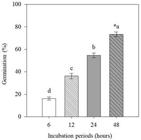
Germination percentage of Eucalyptus urophylla pollen grains subjected to different incubation periods. *Different letters indicate significant differences according to Tukey’s test (P < 0.05). Vertical bars indicate standard error.
Boron is an important element for pollen germination, as it interacts with sucrose to form an ionizable complex that reacts rapidly with cell membranes and enhances germination; however, its optimal concentration varies among species (POTTS & GORE, 2000; JAYAPRAKASH, 2018). HORSLEY et al. (2007) verified that the addition of 0.15 mg L-1 of boric acid to culture medium supplemented with 30% sucrose promoted higher pollen germination rates in five Eucalyptus species (E. grandis, E. dunnii, E. smithii, E. nitens, and E. macarthurii), in addition to promoting greater pollen tube growth. In the present study, among the evaluated concentrations, boron had no significant effect on E. urophylla, which may be influenced by the nutritional status of the pollen donor and receptor plants, as well as genotypic differences, requiring specific conditions in the in vitro germination test for each case. It is possible that concentrations higher than those tested in this study could have positive effects on pollen germination, given that the response to boron may be dependent on the optimal concentration range. Therefore, future studies should evaluate higher nutrient concentrations and consider possible interactions with other factors in the culture medium.
The incubation period of in vitro pollen germination tests is fundamental for ensuring the accuracy and reliability of the results. This period allows pollen cells to adequately develop the pollen tube, facilitating the observation of the germination process and; consequently, the assessment of pollen viability. Defining the appropriate incubation time optimizes the conditions such that the obtained data more accurately reflect pollen quality. WHEELER & MCCOMB (2006) reported higher pollen germination rates in E. marginata after 48 h of incubation. The evaluation time varies for each species, and shorter periods reduce test exposure to contamination, yielding more practical and accurate results.
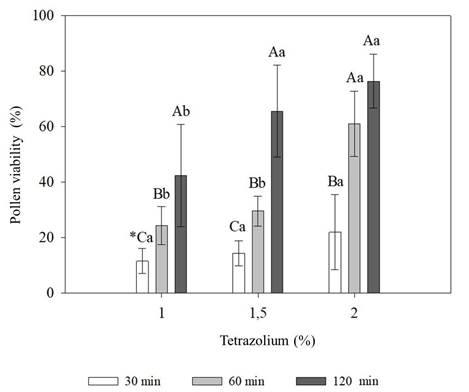
In the colorimetric analysis using tetrazolium salt, E. urophylla pollen viability showed an interaction between concentration and time factors (P = 0.0052). Concentrations of 1.5% (120 min), 2% (60 min), and 2% (120 min) exhibited the highest pollen viability, with rates of 65.6, 61, and 76.4%, respectively, associated with the best staining pattern and uniformity (carmine red) (Figure 2 and Figure 3). During the 30-min period at concentrations of 1.0% and 1.5%, the viability rates were 12% and 14%; respectively, which were the least expressive results (Figure 3).

Staining pattern of Eucalyptus urophylla pollen grains at different tetrazolium salt concentrations and evaluation times. Tetrazolium concentration of 1% at 30 min (A), 60 min (B), and 120 min (C). Tetrazolium concentration of 1.5% at 30 min (D), 60 min (E), and 120 min (F). Tetrazolium concentration of 2% at 30 min (G), 60 min (H), and 120 min (I).
Pollen viability percentage of Eucalyptus urophylla by colorimetric assay with tetrazolium salt. Different uppercase (time) and lowercase (tetrazolium concentration) letters indicate significant differences according to Tukey’s test (P < 0.05). Vertical bars indicate standard error.
Tetrazolium salt acts inside living cells, providing a clear separation between living, colored tissues that respire (cellular viability), and those that have lost viability and remain uncolored (BRASIL, 2009). However, studies on seed analysis studies have identified differences in tonality with staining, and greater vigor indicated by uniform staining with a carmine red appearance (DEMINICIS et al., 2014; QUINTANA et al., 2023). Additionally, intense tonality may indicate tissues in deterioration (BITTENCOURT & VIEIRA, 1997). For pollen viability analysis through in vitro germination, the indicated evaluation time was longer (48 h) than that for the tetrazolium salt, for which results were obtained more rapidly (60 or 120 min). When comparing the assays, superior pollen viability results were observed in the colorimetric analysis (3% difference relative to the germination test, using 2% tetrazolium for 120 min). Some techniques may lead to an overestimation or underestimation of pollen grain viability (MUNHOZ et al., 2008), as is the case with tetrazolium salts. However, in the present study, the observed differences between the assays were considered acceptable.
The colorimetric method only verifies the cellular activity of pollen and cannot evaluate its capacity to emit the pollen tubes (SANTOS et al., 2021). Furthermore, pollen must have sufficient vigor to emit a pollen tube of adequate length to reach the embryo sac, where the double fertilization process occurs (STOKES & GEITMANN, 2025). The dyes may react with chemical constituents or structures that do not reflect the ability of pollen grains to germinate (MUNHOZ et al., 2008). The ideal approach for methodology standardization is the use of both tests (in vitro and colorimetric), aiming to obtain more accurate results, such that the difference between the results falls within tolerable limits. The results obtained with the same E. urophylla pollen batch for in vitro germination (73%) and colorimetry (76%) showed a difference of 3%. To obtain results within a short time frame and in a more practical manner, the tetrazolium test is an effective alternative for pollen quality control in breeding programs of forestry companies, given that the colorimetric assay and conventional test results were similar.
According to JAYAPRAKASH (2018), the in vitro germination method is the most appropriate for estimating viability; although in some cases, it may underestimate values when no defined protocol exists for the species. This contrasts with the colorimetric method, which generally overestimates viability, with no completely satisfactory method available (SANTOS et al., 2021). Nevertheless, it is worth emphasizing that both techniques tend to overestimate in vivo fertilization, as they do not account for important factors such as stigma receptivity, genetic barriers, and environmental influences (MCCLURE et al., 2000; SHEPHERD et al., 2008). Therefore, in defining the most effective methods, a comparison between both tests is essential, in addition to the results obtained from controlled crosses, such as fruit set percentage, seed quantity, and germination, because pre- or post-zygotic barriers may exist in interspecific hybrid production.
The adequacy of the methods used for each species is fundamental to the success of pollen viability assessment, which is an essential procedure in breeding and genetic conservation programs, as pollen is used in controlled cross breeding aiming to develop superior genotypes, in addition to ex situ conservation of genetic material in germplasm banks. Storage time may cause a loss of viability, especially when the environmental conditions (storage temperature and pollen water content) are inadequate, justifying the use of this analysis.
CONCLUSION
In in vitro pollen germination of E. urophylla, boric acid had no influence on the culture medium, with the recommendation that the test should be evaluated 48 h after incubation in a culture medium containing agar and sucrose. In colorimetric analysis with tetrazolium salt, concentrations of 1.5% and 2% for 120 min and 2% for 60 min were the most suitable for pollen viability assessment, representing a rapid and effective method that can replace the traditional method. It should be emphasized that the nutritional status of the mother plants may influence pollen viability and the nutritional composition of the culture medium in the in vitro germination test. Boron concentrations higher than those evaluated in the present study may favor pollen germination, as this response is related to the optimal concentration range for each species. Therefore, further studies exploring higher nutrient levels are required.
ACKNOWLEDGMENTS
The research was financed in part by the Coordenação de Aperfeiçoamento de Pessoal de Nível Superior (CAPES), Brasil - Finance code 001CAPES), CMPC - Celulose Riograndense, and the Forest Research Center (DDPA).
REFERENCES
-
ALCARAZ, M. L. et al. In vitro pollen germination in avocado (Persea americana Mill.): Optimization of the method and effect of temperature. Scientia Horticulturae, v.130, p.152-156, 2011. Available from: <Available from: https://www.sciencedirect.com/science/article/abs/pii/S0304423811003207?via%3Dihub >. Accessed: May, 14, 2024. doi: 10.1016/j.scienta.2011.06.030.
» https://doi.org/10.1016/j.scienta.2011.06.030.» https://www.sciencedirect.com/science/article/abs/pii/S0304423811003207?via%3Dihub -
ALMEIDA, C. et al. Conservation and in vitro germination of pollen of maize (Zea mays subsp. mays). Revista Brasileira de Botânica, v.34, n.4, p.493-497, 2011. Available from: <Available from: https://www.scielo.br/j/rbb/a/dtYd8kxNnG8YxGvHtdKKbkk/?lang=pt&format=pdf >. Accessed: May, 13, 2024. doi: 10.1590/S0100-84042011000400003.
» https://doi.org/10.1590/S0100-84042011000400003.» https://www.scielo.br/j/rbb/a/dtYd8kxNnG8YxGvHtdKKbkk/?lang=pt&format=pdf -
ASSIS, T. F. et al. Artificially induced protogyny: an advance in the controlled pollination of Eucalyptus Australian Forestry, v.68, n.1, p.27-33, 2005. Available from: <Available from: https://doi.org/10.1080/00049158.2005.10676223 >. Accessed: May, 14, 2024. doi: 10.1080/00049158.2005.10676223.
» https://doi.org/10.1080/00049158.2005.10676223.» https://doi.org/10.1080/00049158.2005.10676223 -
BITTENCOURT, S. R. M.; VIEIRA, R. D. Use of reduced concentrations of tetrazolium solutions for the evaluation of the viability of peanut seed lots. Seed Science and Technology, v.25, n.1, p.75-82, 1997. Available from: <Available from: https://www.researchgate.net/publication/294223894_Use_of_reduced_concentrations_of_tetrazolium_solutions_for_the_evaluation_of_the_viability_of_peanut_seed_lots >. Accessed: May, 14, 2024.
» https://www.researchgate.net/publication/294223894_Use_of_reduced_concentrations_of_tetrazolium_solutions_for_the_evaluation_of_the_viability_of_peanut_seed_lots -
BRASIL- Ministério da Agricultura, Pecuária e Abastecimento. Regra para análise de sementes Ministério da Agricultura, Pecuária e Abastecimento. Secretaria de Defesa Agropecuária, Brasília: MAPA/ACS, 2009. 399p. Available from: <https://www.gov.br/agricultura/pt-br/assuntos/insumos-agropecuarios/arquivos-publicacoes-insumos/2946_regras_analise__sementes.pdf>. Accessed: May, 15, 2024.
» https://www.gov.br/agricultura/pt-br/assuntos/insumos-agropecuarios/arquivos-publicacoes-insumos/2946_regras_analise__sementes.pdf -
CASTRO, C. A. D. O. et al. Brief history of Eucalyptus breeding in Brazil under perspective of biometric advances. Ciência Rural, v.46, n.9, p.1585-1593, 2016. Available from: <Available from: https://www.scielo.br/j/cr/a/Ky6FBf5m7WMNLxkwtYQPhrp/?lang=en >. Accessed: May, 15, 2024. doi: 10.1590/0103-8478cr20150645.
» https://doi.org/10.1590/0103-8478cr20150645.» https://www.scielo.br/j/cr/a/Ky6FBf5m7WMNLxkwtYQPhrp/?lang=en - DAFNI, A. Pollination ecology: a practical approach. New York: Oxford University Press, 1992. p.250.
-
DEMINICIS, B. B. et al. Tetrazolium Test to Evaluate Stizolobium aterrimum Seeds Quality. American Journal of Plant Sciences, v.5, n.1, p.148-152, 2014. Available from: <Available from: https://www.scirp.org/pdf/AJPS_2014012111513305.pdf >. Acessed: Jan. 21, 2026. doi: 10.4236/ajps.2014.51019.
» https://doi.org/10.4236/ajps.2014.51019.» https://www.scirp.org/pdf/AJPS_2014012111513305.pdf -
FERREIRA, A. et al. ExpDes.pt: Experimental Designs pacakge (Portuguese). R package version 1.1.2, 2021. Available from: <Available from: https://cran.r-project.org/web/packages/ExpDes.pt/index.html >. Accessed: May, 15, 2024. doi: 10.4236/am.2014.519280.
» https://doi.org/10.4236/am.2014.519280.» https://cran.r-project.org/web/packages/ExpDes.pt/index.html - FONSECA, S. M. et al. Manual Prático de Melhoramento Genético do Eucalipto. Viçosa: Universidade Federal de Viçosa, 2010. 200p.
-
FRANZON, R. C. et al. In vitro pollen germination of guabirobeira (Campomanesia xanthocarpa Berg). Ceres, v.53, n.305, p.129-134, 2006. Available from: <Available from: https://ojs.ceres.ufv.br/ceres/article/view/3120 >. Accessed: May, 13, 2024.
» https://ojs.ceres.ufv.br/ceres/article/view/3120 -
GONÇALVES, J. L .M. et al. Integrating genetic and silvicultural strategies to minimize abiotic and biotic constraints in Brazilian eucalypt plantations. Forest Ecology Management, v.301, p.6-27, 2013. Available from: <Available from: https://www.sciencedirect.com/science/article/abs/pii/S037811271200761X >. Accessed: Feb. 10, 2025. doi: 10.1016/j.foreco.2012.12.030.
» https://doi.org/10.1016/j.foreco.2012.12.030.» https://www.sciencedirect.com/science/article/abs/pii/S037811271200761X -
HODGE, G. R; DVORAK, W.S. Provenance variation and within-provenance genetic parameters in Eucalyptus Urophylla across 125 test sites in Brazil, Colombia, Mexico, South Africa and Venezuela. Tree Genetics & Genomes, v.11, n.3, p.1-18, 2015. Available from: <Available from: https://www.researchgate.net/publication/277929741_Provenance_variation_and_within-provenance_genetic_parameters_in_Eucalyptus_urophylla_across_125_test_sites_in_Brazil_Colombia_Mexico_South_Africa_and_Venezuela >. Accessed: May, 14, 2024. doi: 10.1007/s11295-015-0889-3.
» https://doi.org/10.1007/s11295-015-0889-3.» https://www.researchgate.net/publication/277929741_Provenance_variation_and_within-provenance_genetic_parameters_in_Eucalyptus_urophylla_across_125_test_sites_in_Brazil_Colombia_Mexico_South_Africa_and_Venezuela -
HORSLEY, T. N. et al. Optimising storage and in vitro germination of Eucalyptus pollen. Australian Journal of Botany, v.55, n.1, p.83-89, 2007. Available from: <Available from: https://www.researchgate.net/publication/248899245_Optimising_storage_and_in_vitro_germination_of_Eucalyptus_pollen >. Accessed: May, 13, 2024. doi: 10.1071/BT05194.
» https://doi.org/10.1071/BT05194.» https://www.researchgate.net/publication/248899245_Optimising_storage_and_in_vitro_germination_of_Eucalyptus_pollen -
IBÁ - Indústria Brasileira de Árvores. Relatório Anual 2023. São Paulo: IBÁ, 2023. Available from: <Available from: https://iba.org/relatorio2024.pdf >. Accessed: Feb. 10, 2025.
» https://iba.org/relatorio2024.pdf -
JAYAPRAKASH, P. Pollen Germination in vitro In: MOKWALA, P. W. (Eds). Pollination in Plants, Intech Open, p.81-96, 2018. Available from: <Available from: https://www.intechopen.com/chapters/60074 >. Accessed: May, 20, 2024. doi: 10.5772/intechopen.75360.
» https://doi.org/10.5772/intechopen.75360.» https://www.intechopen.com/chapters/60074 -
JÚNIOR, L. S; GARCIA, J. N. Physical and mechanical properties of Eucalyptus Urophylla Brazilian Journal of Agriculture, v.98, n.1, p.12-22, 2023. Available from: <Available from: https://www.researchgate.net/publication/371662409_Physical_and_mechanical_properties_of_Eucalyptus_urophylla >. Accessed: May, 22, 2024. doi: 10.37856/bja.v98i1.4317.
» https://doi.org/10.37856/bja.v98i1.4317.» https://www.researchgate.net/publication/371662409_Physical_and_mechanical_properties_of_Eucalyptus_urophylla -
LI, M. et al. Optimization of In vitro germination, viability tests and storage of paeonia ostii pollen. Plants, v.12, p.2460, 2023. Available from: <Available from: https://www.mdpi.com/2223-7747/12/13/2460 >. Acessed: Jan. 21, 2026. doi: 10.3390/plants12132460.
» https://doi.org/10.3390/plants12132460.» https://www.mdpi.com/2223-7747/12/13/2460 -
LYRA, D. H. et al. Pollen viability and germination in Jatropha ribifolia and Jatropha mollissima (Euphorbiaceae): species with potential for biofuel production. African Journal of Biotechnology, v.10, n.3, p.368-374, 2011. Available from: <Available from: https://www.ajol.info/index.php/ajb/article/view/92232 >. Accessed: May, 15, 2024. doi: 10.5897/AJB10.808.
» https://doi.org/10.5897/AJB10.808.» https://www.ajol.info/index.php/ajb/article/view/92232 -
MCCLURE, B. A. et al. Factors affecting inter and intra-specific pollen rejection in Nicotiana Annals of Botany, v.85, p.113-123, 2000. Available from: <Available from: https://academic.oup.com/aob/article/85/suppl_1/113/102790?login=false >. Accessed: May, 15, 2024. doi: 10.1006/anbo.1999.1061.
» https://doi.org/10.1006/anbo.1999.1061.» https://academic.oup.com/aob/article/85/suppl_1/113/102790?login=false -
MILHOMEM, S. B. B. et al. Response of Eucalyptus seedlings to water stress in a warm tropical region in Brazil. Forests, v.16, p.1802, 2025. Available from: <Available from: https://www.mdpi.com/1999-4907/16/12/1802 >. Accessed: Jan. 21, 2026. doi: 10.3390/f16121802.
» https://doi.org/10.3390/f16121802.» https://www.mdpi.com/1999-4907/16/12/1802 -
MUNHOZ, M. et al. Pollen viability of Carica papaya L.: a methodological comparison. Revista Brasileira de Botânica, v.31, n.2, p.209-214, 2008. Available from: <Available from: https://www.scielo.br/j/rbb/a/KHPrm8wyZ7yXvf9xxYrG5st/?format=html⟨=pt >. Accessed: May, 15, 2024. doi: 10.1590/S0100-84042008000200003.
» https://doi.org/10.1590/S0100-84042008000200003.» https://www.scielo.br/j/rbb/a/KHPrm8wyZ7yXvf9xxYrG5st/?format=html⟨=pt -
POTTS, B. M.; GORE, P. Reproductive biology and controlled pollination of Eucalyptus - review. In: DUNGEY, H. S. et al. (Eds). Hybrid Breeding and Genetics. Proceedings of QFRI/CRC-SPF Symposium, 9-14 April 2000. Department of Primary Industries, p.2-68, 2000. Available from: <Available from: https://figshare.utas.edu.au/ndownloader/files/40896761/1 >. Accessed: May, 22, 2024.
» https://figshare.utas.edu.au/ndownloader/files/40896761/1 -
QUINTANA, Y. G. et al. Seed viability, germination and seedling quality patterns of three forest species for restoration in Amazonian conditions. Enfoque UTE, v.14, n.1, p.18-32, 2023. Available from: <Available from: https://www.redalyc.org/journal/5722/572273150002/html/ >. Acessed: Jan. 21, 2026. doi: 10.29019/enfoqueute.890.
» https://doi.org/10.29019/enfoqueute.890.» https://www.redalyc.org/journal/5722/572273150002/html/ -
REZENDE, E. H. et al. Evaluation of resistance in Eucalyptus grandis progenies against leaf spot of Cylindrocladium and Kirramyces Summa Phytopathologica, v.45, n.3, p.295-301, 2019. Available from: <Available from: https://www.scielo.br/j/sp/a/NnDq868qLQbwsk95gpbhS8P/?lang=pt >. Accessed: Feb. 10, 2025. doi: 10.1590/0100-5405/191990.
» https://doi.org/10.1590/0100-5405/191990.» https://www.scielo.br/j/sp/a/NnDq868qLQbwsk95gpbhS8P/?lang=pt -
ROCHA, M. G. B. et al. Genetic evaluation of half-sib Eucalyptus urophylla progenies by the REML/BLUP and Minimum Squares Procedure. Ciência Florestal, v.16, n.4, p.369-379, 2006. Available from: <Available from: https://www.scielo.br/j/cflo/a/84ZWDnVDvhx3h5NKNYr9mBD/abstract/?lang=pt >. Accessed: Feb. 10, 2025. doi: 10.5902/198050981918.
» https://doi.org/10.5902/198050981918.» https://www.scielo.br/j/cflo/a/84ZWDnVDvhx3h5NKNYr9mBD/abstract/?lang=pt -
SANTOS, A. C. S. et al. Pollen viability of Eucalyptus spp. with specific stains. Scientia Forestalis, v.49, n.131, p.1-10, 2021. Available from: <Available from: https://www.alice.cnptia.embrapa.br/alice/handle/doc/1133975 >. Accessed: May, 22, 2024. doi: 10.18671/scifor.v49n131.17.
» https://doi.org/10.18671/scifor.v49n131.17.» https://www.alice.cnptia.embrapa.br/alice/handle/doc/1133975 - SHIVANNA, K. R. Pollen biology and biotechnology. Boca Raton: CRC Press, 2003. p.316.
-
SHEPHERD, M. et al. Genetic structuring in the spotted gum complex (genus Corymbia, section Politaria). Australian Systematic Botany, v.21, p.5-25, 2008. Available from: <Available from: https://www.cabidigitallibrary.org/doi/full/10.5555/20083109202 >. Accessed: May, 23, 2024. doi: 10.1071/SB07028.
» https://doi.org/10.1071/SB07028.» https://www.cabidigitallibrary.org/doi/full/10.5555/20083109202 -
SOARES, T. L. et al. Morphology and viability of pollen grains from wild varieties of pineapple. Ciência Rural, v.41, n.10, p.1744-1749, 2011. Available from: <Available from: https://www.scielo.br/j/cr/a/gfb83pKLvnZqRp4p9mvBCRF/?lang=pt >. Accessed: Feb. 10, 2025. doi: 10.1590/S0103-84782011001000011.
» https://doi.org/10.1590/S0103-84782011001000011.» https://www.scielo.br/j/cr/a/gfb83pKLvnZqRp4p9mvBCRF/?lang=pt -
STOKES, M.; GEITMANN, A. Screening methods for thermotolerance in pollen. Annals of Botany, v.135, n.1, p.71-88, 2025. Available from: <Available from: https://academic.oup.com/aob/article/135/1-2/71/7665857 >. Acessed: Jan. 21, 2026. doi: 10.1093/aob/mcae067.
» https://doi.org/10.1093/aob/mcae067.» https://academic.oup.com/aob/article/135/1-2/71/7665857 -
TAYLOR, L. P.; HEPLER, P. K. Pollen germination and tube growth. Annual Review of Plant Physiology and Plant Molecular Biology, v.48, p.461-91, 1997. Available from: <Available from: https://pubmed.ncbi.nlm.nih.gov/15012271/ >. Accessed: May, 23, 2024. doi: 10.1146/annurev.arplant.48.1.461.
» https://doi.org/10.1146/annurev.arplant.48.1.461.» https://pubmed.ncbi.nlm.nih.gov/15012271/ -
WHEELER, M. A.; MCCOMB, J. A. In vitro pollen viability and pollen storage in Eucalyptus marginata (Myrtaceae). Australian Forestry, v.69, p.32-37, 2006. Available from: <Available from: https://www.researchgate.net/publication/216817617_In-vitro_pollen_viability_and_pollen_storage_in_Eucalyptus_marginata_Myrtaceae >. Accessed: May, 24, 2024. doi: 10.1080/00049158.2006.10674985.
» https://doi.org/10.1080/00049158.2006.10674985.» https://www.researchgate.net/publication/216817617_In-vitro_pollen_viability_and_pollen_storage_in_Eucalyptus_marginata_Myrtaceae
Edited by
-
ASSOCIATE EDITOR:
Alessandro Dal’Col Lúcio (0000-0003-0761-4200)
-
SCIENTIFIC EDITOR:
Rômulo Trevisan (0000-0002-8535-0119)
Not applicable.