 Bayesian modeling of herbicide dose-response curves with maximum entropy priors
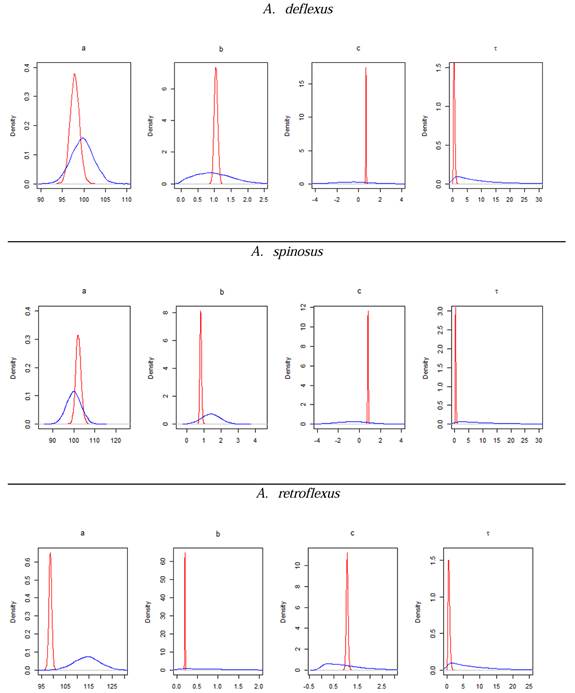
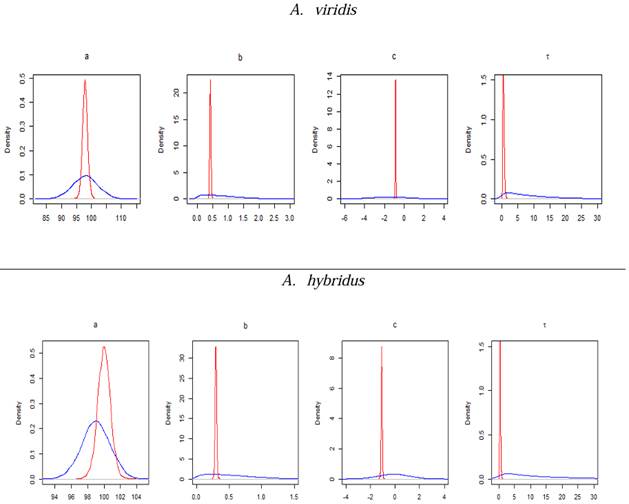
Several factors influence the agricultural sector, and weed interference is one of the most damaging factors in crop development and productivity. One of the most common strategies for controlling weeds is the use of herbicides, the efficiency of which is evaluated by the relationship between the dose and response in plants and can be described by nonlinear regression models. This study used Bayesian inference with maximum entropy priors for the parameters of the nonlinear, logistic, and Weibull models to describe the dose-response data of five Amaranthus weed species subjected to the herbicide trifloxysulfuron-sodium. The doses tested were 16D, 4D, D, 1/4D, 1/16D, 1/64D, and 0, where D is the recommended dose of 3.75 g ha-1 in the first application, and 7.5 g ha-1 in the second. The results indicated that the Groot model best described the data for A. deflexus, A. spinosus, and A. retroflexus, while the logistic model was more appropriate for A. viridis and A. hybridus. No significant differences were detected between the maximum and minimum controls; however, the doses required to achieve a 50% control varied. These values were lower for A. retroflexus (0.1980 g ha-1) and higher for A. deflexus (1.0440 g ha-1), indicating differences in the susceptibility of these species to trifloxysulfuron-sodium.
Key words:
Bayesian inference; nonlinear models; MCMC; trifloxysulfuron-sodium; susceptibility
 Thumbnail
 Thumbnail