 Foliar application of reduced glutathione in sour passion fruit cultivation under salt stress
ABSTRACT:
Water scarcity caused by irregular rainfall is a major challenge for agriculture in the semi-arid region of the Northeast Brazil, making it necessary to use irrigation with high-salinity water. However, excess salt in irrigation water compromise plant growth and development. Therefore, it is crucial to adopt strategies that mitigate the effects of saline stress, ensuring both crop productivity and agricultural sustainability in this region. This study was to evaluate the morphophysiology and physical characteristics of sour passion fruit under saline water irrigation and foliar application of reduced glutathione (GSH) in the semi-arid region of Paraíba, Brazil. The experiment was conducted under greenhouse conditions, at the Center of Technology and Natural Resources of the Universidade Federal de Campina Grande - UFCG, in Campina Grande, PB, Brazil. Treatments consisted of a combination of two factors: five levels of electrical conductivity of irrigation water - ECw (0.4, 1.2, 2.0, 2.8, and 3.6 dS m-1), associated with four concentrations of GSH (0, 40, 80, and 120 mg L-1). Plants were distributed in a randomized block design, in a 5 × 4 factorial arrangement, with three replicates, totaling 60 experimental units. Irrigation water salinity compromised the physiology and physical traits of the fruits of ‘BRS GA1’ sour passion fruit. Foliar application of GSH at concentration of 120 mg L-1 promoted increase in the CO2 assimilation rate of ‘BRS GA1’ sour passion fruit. The application of GSH did not significantly affect fruit size or peel thickness, but it did contribute to increase pulp weight. Applying GSH at a concentration of 67 mg L-¹ to plants irrigated with water of 0.4 dS m-¹, resulted in the highest pulp weight (103.58 g), which represents a 4.6% increase compared to plants exposed to the same salinity level without GSH application. Foliar application of reduced glutathione at concentrations up to 120 mg L-¹ resulted in an increase in the CO2 assimilation rate of passion fruit under semi-arid conditions.
Key words:
Passiflora edulis Sims; oxidative stress; antioxidant; salinity; Physical characteristics of fruit
RESUMO:
A escassez hídrica decorrente da irregularidade das chuvas representa um desafio crítico para a agricultura no semiárido do Nordeste brasileiro, tornando necessário o uso de águas de elevada salinidade na irrigação. Contudo, o excesso de sais na água compromete o crescimento e desenvolvimento das plantas. Diante desse cenário, torna-se imprescindível adotar estratégias que atenuem os efeitos do estresse salino, garantindo a produtividade agrícola e a sustentabilidade dos cultivos na região. Objetivou-se com este estudo avaliar a morfofisiologia e a caracterização física dos frutos de maracujazeiro-azedo sob irrigação com águas salinas e aplicação via foliar de glutationa reduzida (GSH), em condições do semiárido Paraibano. O experimento foi conduzido em condições de casa de vegetação, no Centro de Tecnologia e Recursos Naturais, da Universidade Federal de Campina Grande - UFCG, em Campina Grande - PB. Os tratamentos foram constituídos pela combinação de dois fatores: cinco níveis de condutividade elétrica da água de irrigação - CEa (0,4; 1,2; 2,0; 2,8 e 3,6 dS m-1), associados a quatro concentrações de GSH (0; 40; 80 e 120 mg L-1). As plantas foram distribuídas no delineamento de blocos casualizados, em arranjo fatorial 5 × 4, com três repetições. Os resultados mostram que a salinidade da água de irrigação prejudicou a fisiologia e os atributos físicos dos frutos de maracujazeiro-azedo ‘BRS GA1’. Além disso, a aplicação via foliar de GSH na concentração 120 mg L-1, proporcionou aumento na taxa de assimilação de CO2 de maracujazeiro-azedo BRS GA1 e a aplicação de GSH não afetou significativamente o tamanho do fruto ou a espessura da casca, mas contribuiu para o aumento do peso da polpa. Já a aplicação de GSH na concentração de 67 mg L-¹ em plantas irrigadas com água a 0,4 dS m-¹ resultou no maior valor de peso da polpa (103,58 g), o que representa um aumento de 4,6% em comparação com plantas expostas ao mesmo nível de salinidade sem aplicação com GSH. A aplicação foliar de glutationa reduzida em concentrações de até 120 mg L-¹ resultou em aumento na taxa de assimilação de CO2 do maracujazeiro-azedo nas condições de semiárido.
Palavras-chave:
Passiflora edulis Sims; estresse oxidativo; antioxidante; salinidade; características físicas do fruto
INTRODUCTION
Sour passion fruit (Passiflora edulis Sims) is a tropical fruit plant of great socioeconomic importance, especially in the Northeast region of Brazil, which provides favorable edaphoclimatic conditions for its development, and has stood out mainly among small and medium-sized producers (FÁTIMA et al., 2025).
Its fruits are mainly intended for fresh consumption or, after processing, for the production of juices, sweets, ice cream, nectars, liqueurs, among others. In addition to the fruit, phytoconstituents with medicinal properties are found in the different parts of the plant (COSTA et al., 2023; XU et al., 2023).
In the semi-arid region of Northeast Brazil, the use of irrigation is essential, due to the spatial-temporal variability of rainfall, combined with the high evaporative demand, which results in water deficit for plants, as well as a reduction in the quality of water available for irrigation, making it necessary to use water resources of restrictive quality for crop production (LIMA et al., 2023a).
The salinity of irrigation water and/or soil inhibits plant growth through osmotic and ionic effects, altering the stability of cell membranes, affecting the physiological and biochemical functions of plants, leading to disturbances in water relations and changes in water and nutrient absorption (PINHEIRO et al., 2022a).
In addition, there is an overproduction of reactive oxygen species (ROS), caused by the leakage of electrolytes into the cellular environment from the electron transport activities of chloroplasts, mitochondria, and other organelles, which are capable of interacting with all types of organic molecules, such as nucleic acids and lipids (HASANUZZAMAN et al., 2021; ZHANG et al., 2021). Salinity can also modify electron transport, altering the activity of photosystem II, which is responsible for the oxidation of water molecules to produce electrons and can also cause disorganization of carbon (C) and nitrogen (N) assimilatory pathways (HASANUZZAMAN et al., 2021; ZHANG et al., 2021).
To avoid oxidative damage, caused by salt stress, plants have a complex antioxidant defense system, composed of enzymatic and non-enzymatic components, capable of neutralizing the toxicity of ROS. The enzymatic detoxification mechanism involves superoxide dismutase (SOD), catalase (CAT), ascorbate peroxidase (APX), and glutathione reductase (GR) (HASANUZZAMAN et al., 2021).
In this context, several strategies have been employed to mitigate the effects of salt stress on plants, especially foliar application of reduced glutathione (GSH). It participates in the degradation of H2O2 through a reaction catalyzed by the enzyme Glutathione Peroxidase (GSH-Px). It participates in the Ascorbate-Glutathione (AsA-GSH) cycle, along with ascorbic acid (AsA), operating on the chloroplast, plastid, mitochondria, and peroxisomes, fighting the overproduction of ROS (SACHDEV et al., 2021).
In a study evaluating the application of GSH in tomato plants under salt stress, CONG et al. (2024) reported that GSH treatment alleviated damage to chlorophyll fluorescence and to the antioxidant complex caused by salinity. Moreover, GSH enhanced the electron transfer efficiency of photosystem II (PSII) and counteracted the adverse effects of salt stress on the redox properties of photosystem I (PSI), thereby increasing the rate of light energy absorption. The authors also noted that GSH stimulated enzymatic activities in the Calvin cycle.
Considering the importance of the sour passion fruit in Brazilian agribusiness, particularly in the Northeast region, further studies are essential to assess the effectiveness of foliar GSH application in mitigating salt stress in this crop. Such research could support the expansion of cultivation in the semi-arid conditions of Paraíba, Brazil. Therefore, the objective of this study was to evaluate the effects of foliar application of reduced glutathione on the morphophysiology and physical characteristics of sour passion fruit irrigated with saline water.
MATERIALS AND METHODS
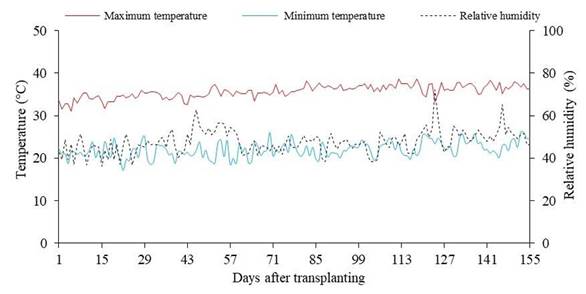
The experiment was carried out from April to December 2023 under greenhouse conditions, at the Center for Technology and Natural Resources of the Universidade Federal de Campina Grande - UFCG, in Campina Grande - PB, at the geographic coordinates 7°15’18” S and 35°52’28” W, with an altitude of 550 m. According to Köppen’s classification, the climate of the region is BSh type, which means a hot semi-arid climate, with scarce rainfall and irregular distribution during the year. It has an average annual precipitation of 802.7 mm, with maximum temperature of 27.5 °C, minimum temperature of 19.2 °C, and mean relative humidity of 83% (ALVARES et al., 2013). The climatic data collected during the experiment is presented in figure 1.
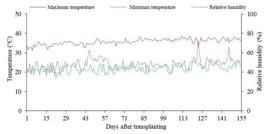
Maximum temperature, minimum temperature, and relative humidity of the air during the experimental period from July 05 to December 06, 2023. X and Y - Reduced glutathione concentrations and electrical conductivity of water - ECw, respectively; * and ns - Significant at P ≤ 0.05 and not significant (P > 0.05) by the F test, respectively.
Sour passion fruit plants were distributed in a randomized block design, in a 5 × 4 factorial arrangement, with three replicates. Treatments consisted of a combination of two factors: five levels of electrical conductivity of irrigation water - ECw (0.4, 1.2, 2.0, 2.8, and 3.6 dS m-1), associated with four concentrations of reduced glutathione - GSH (0, 40, 80, and 120 mg L-1). The ECw levels were established based on earlier studies evaluating the effects of irrigation with saline water on sour passion fruit cultivars (SOUZA et al., 2020; LIMA et al., 2023b). Glutathione concentrations were determined according to a study conducted by MAHMOUD et al. (2017).
Seeds of sour passion fruit cv. BRS Gigante Amarelo (‘BRS GA1’), a hybrid characterized by having oblong-shaped fruits, with a slightly flattened base and apex, weighing from 120 to 350 g, pulp yield around 40% and soluble solids contents of 13 to 15 °Brix. It is a anthracnose-tolerant cultivar. Planting can be carried out at any time of the year (when irrigated), in different types of soil. It does not adopt to regions subject to frost (EMBRAPA, 2008).
Sowing was carried out by planting 3 seeds in plastic bags with dimensions of 15 × 20 cm, filled with 1.8 kg of soil. After emergence, when the seedlings were about 10 cm tall, thinning was carried out, leaving only one plant per bag. Fertilization with nitrogen, phosphorus, and potassium during the seedling formation stage was carried out according to the recommendation of NOVAIS et al. (1991), using 100, 150, and 300 mg kg-1 of soil of N, K2O, and P2O5, respectively, split into four portions and applied at an average interval of 10 days, via irrigation water. Irrigations were carried out daily using water with EC of 0.4 dS m-1 during the entire seedling formation period. Before transplanting the seedlings to the lysimeters, soil samples were collected and chemical and physical characteristics: Ca2+ = 1.87 cmolc kg-1; Mg2+ = 1.70 cmolc kg-1; Na+ = 0.04 cmolc kg-1; K+ = 0.28 cmolc kg-1; H+ = 0 cmolc kg-1; Al3+ = 0 cmolc kg-1; CEC = 3.89 cmolc kg-1; ESP = 1.02; SARse = 1.86 (mmol L-1)0.5 Organic matter = 17.62 dag kg-1; P = 2.92 mg kg-1 and pH in water (1:2.5) = 5.60; Particle-size fraction: Sand =675.2 g kg-1; Silt = 221.1 g kg-1; Clay = 103.7 g kg-1.
Before transplanting the seedlings to the lysimeters, the soil moisture content was raised to the level corresponding to the maximum water retention capacity, with local-supply water from Campina Grande. At the time of transplanting (60 days after sowing), the seedlings had an average height of 1.0 m. Recepients with capacity of 200 L were adopted as drainage lysimeters. Two 16-mm-diameter drains were installed at the base of each lysimeter. After positioning the lysimeters on the bases, a geotextile was placed at the bottom to prevent clogging of the drains, followed by a 0.5-kg layer of crushed stone (nº zero) and 250 kg of soil classified as Neossolo Regolítico (Entisol - Psamment) with sandy loam texture (0-30 cm depth) of the municipality of Lagoa Seca, PB. Two 2-L plastic bottles were placed under each lysimeter to collect the drained volume and determine water consumption by plants.
A vertical trellis system was used, as described by LIMA et al. (2023a). Tendrils and unwanted branches were eliminated throughout the experiment to favor full development of the crop, according to procedures adopted by PINHEIRO et al. (2022). Pollination was carried out manually, until the beginning of harvest, but there were also carpenter bees (Xylocopa spp.) performing natural pollination.
During the crop cycle, the irrigation water of the treatment with the lowest level of electrical conductivity (0.4 dS m-1) came from the public supply system of Campina Grande, PB. The other levels were obtained by the dissolution of NaCl, CaCl2.2H2O, and MgCl2.6H2O salts, in the equivalent proportion 7:2:1, respectively, in the local-supply water of Campina Grande, PB, considering the relationship between ECw and salt concentration (RICHARDS, 1954), according to equation 1:
(1)
Where:
Q - Quantity of salts to be added (mmolc L-1); and;
ECw - electrical conductivity of water (dS m-1).
After transplanting, irrigation was carried out daily, applying to each container the volume corresponding to that obtained by the water balance, determined by equation 2:
(2)
Where:
VI = Volume of water to be used in the next irrigation event (mL);
Va = Volume applied in the previous irrigation event (mL);
Vd = Volume drained (mL); and
LF = Leaching fraction of 0.15 applied every 15 days to reduce the concentration of salts in the root zone of the plants.
Irrigation with brackish water began 72 h after the first application of reduced glutathione, which was performed 40 days after transplanting. Post-transplant fertilization was performed as recommended by COSTA et al. (2008). Fertilization with nitrogen, phosphorus and potassium began at 15 days after transplanting (DAT), applied fortnightly via fertigation. Urea (45% N), monoammonium phosphate (60% P2O5 and 12% N) and potassium sulfate (51.5% K2O and 17% S) were used as sources of nitrogen, phosphorus and potassium, respectively. 65 g of N per plant were applied in the crop formation stage and 160 g of N per plant were applied in the flowering and fruiting stages. Potassium was applied as 65 g of K2O per plant in the crop formation stage (vegetative stage) and 280 g of K2O per plant in the flowering and fruiting stage. Phosphorus was applied as 50 g of P2O5 per plant in the cycle.
Micronutrients were supplied through the leaves every 10 days, throughout the cycle, using a knapsack sprayer, with a solution containing 1.0 g L-1 of Dripsol Micro Rexene® Equilibrium (1.2% (Mg), 0.85% (B), 3.4% (Fe), 4.2% (Zn), 3.2% (Mn), 0.5% (Cu) and 0.06% (Mo)). Phytosanitary control was carried out preventively to control the possible emergence of pests and diseases, as well as corrective spraying, when necessary. Phytosanitary control was carried out using Cercobin® and Folicur® as fungicides, Lannate®, Battus® and Evidence® with insecticidal action, and Vertimec® with acaricidal, insecticidal and nematicidal action.
Reduced glutathione concentrations were prepared by dissolving Reduced Glutathione-L (GSH) in distilled water, according to each treatment, with addition of the nonionic adhesive spreader Wil Fix® at concentration of 0.5 mL L-1 in all treatments to reduce the flow of the product, fixing it for a longer time on the leaf blade, promoting greater leaf absorption. In plants of the control treatment (0 mg L-1), only distilled water with adhesive spreader was applied. During the experiment, an average of 8 L of GSH solution was used per treatment, an average volume of 0.53 L per plant was applied. Reduced glutathione applications began at 40 DAT, when the plants were in the pre-flowering stage, and later the applications were carried out at 15-day intervals. Applications were carried out from 4:30 p.m., and each plant was isolated using TNT (Non-woven Fabric) curtains to prevent the solution from drifting between plants of different treatments.
At 140 DAT, in the fruiting/fruit maturation stage, growth, relative water content (RWC), electrolyte leakage (EL), chlorophyll a (Chl a), chlorophyll b (Chl b), and carotenoid (Car) contents, and gas exchange were evaluated.
Relative water content in the leaf blade was determined by using a copper perforator to obtain five leaf discs, with an area of 113 mm2, from a mature leaf of the tertiary branch. Immediately after collection, the discs were weighed, avoiding moisture loss, to obtain fresh mass (FM). Subsequently, the discs were immersed in 50 mL of distilled water and stored for 24 h. After this period, excess water from the discs was removed with paper towels to obtain the turgid mass (TM) of the samples, which were then dried in an oven at temperature of 65 ± 3 ºC, until reaching a constant weight to obtain the dry mass (DM). RWC was determined according to WEATHERLEY (1950), using equation 3:
(3)
Where:
RWC = Relative water content in the leaf blade (%);
FM = Leaf fresh mass (g);
TM = Leaf turgid mass (g); and
DM = Leaf dry mass (g).
To determine electrolyte leakage in the leaf blade, a copper perforator was used to obtain five leaf discs, with an area of 113 mm2, from a mature leaf of the tertiary branch, which were stored in glass beakers containing 50 mL of distilled water for 24 h. Next, the initial electrical conductivity (Xi) was read. Subsequently, the samples were closed with aluminum foil and subjected to a temperature of 90 °C for 120 minutes, in a drying oven. After the contents cooled down (at temperature of 25 °C), the final electrical conductivity (Xf) was read. Electrolyte leakage in the leaf blade was expressed as the percentage of initial electrical conductivity relative to the electrical conductivity after treatment for 120 min at 90 ºC, according to the methodology of SCOTTI-CAMPOS et al. (2013), considering equation 4:
(4)
Where:
EL= electrolyte leakage (%);
Xi = Initial electrical conductivity (dS m-1); and,
Xf = Final electrical conductivity (dS m-1).
Contents of photosynthetic pigments (chlorophyll a, chlorophyll b, and carotenoids) were obtained according to WELLBURN (1994), after collection of three discs from the blade of a mature leaf of the tertiary branch. The discs were weighed, kept in Dimethyl Sulfoxide (DMSO) for 48 hours, and stored at room temperature, keeping the samples in the dark. From the extracts, the contents of chlorophyll a, chlorophyll b, and carotenoids in the solutions were determined using a spectrophotometer at absorbance wavelength (A) (480, 649, and 665 nm), according to equations 5, 6 and 7.
Chlorophyll a (Chl a) = (12.19 x A665) - (3.45 x A649) (5)
Chlorophyll b (Chl b) = (21.99 x A649) - (5.32 x ABS665) (6)
Carotenoids (Car) = [(1000 x A480) - (2.14 x Chl a) - (70.16 x Chl b)] /220 (7)
Gas exchange was evaluated through stomatal conductance - gs (mol H2O m-2 s-1), transpiration - E (mmol H2O m-2 s-1), CO2 assimilation rate - A (μmol CO2 m-2 s-1), and internal CO2 concentration - Ci (μmol CO2 m-2 s-1), which were used to calculate the instantaneous carboxylation efficiency (A/Ci) - CEi) and intrinsic water use efficiency (A/gs) - (WUEi). The gas exchange of passion fruit was evaluated between 07:00 a.m. and 10:00 a.m., using a median, intact leaf of the productive branch, with a portable infrared carbon dioxide analyzer (IRGA), model “LCPro+” from ADC BioScientific Ltda, under natural conditions of air temperature, CO2 concentration and using an artificial radiation source of 1200 μmol m-2 s-1, established by the light saturation curve of photosynthesis.
Physical characterization of the fruits was carried out, by evaluating external attributes, including equatorial and longitudinal diameter, pulp weight, and peel thickness. Characterization was conducted throughout the production period. Fruits were harvested at physiological maturity, when the peel exhibited a yellow to reddish coloration. After harvest, 10 fruits per treatment were randomly selected for analysis. The equatorial and polar diameters and peel thickness were measured using a caliper (the latter after cutting the fruit) and pulp weight was determined on a semi-analytical balance with a precision of 3,000 g.
The data were subjected to the distribution normality test (Shapiro-Wilk) and then analysis of variance was performed at 0.05 and 0.01 probability levels (F test); in cases of significance, linear and quadratic regression analysis was performed, using the statistical software SISVAR-ESAL (FERREIRA, 2019). The regression model (linear or quadratic) was chosen based on the significance of the coefficients of determination. In case of significance of the interaction between factors, SigmaPlot 12.5 software was used to create the response surfaces.
RESULTS AND DISCUSSION
Irrigation water salinity levels had a significant effect (P ≤ 0.01) on all variables studied, except for stem diameter of ‘BRS GA1’ sour passion fruit at 140 DAT. Reduced glutathione concentrations did not interfere significantly (P > 0.05) in any of the variables analyzed in sour passion fruit. However, the interaction between the factors (SL × GSH) had a significant effect (P ≤ 0.01) on the relative water content in the leaf blade of sour passion fruit, at 140 DAT.
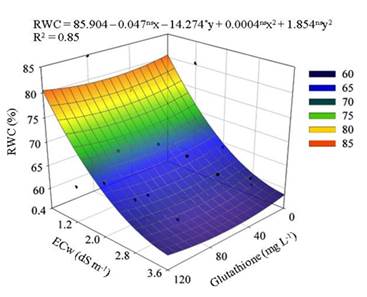
The increase in irrigation water salinity reduced the relative water content (RWC) of sour passion fruit (Figure 2). In plants without glutathione application, RWC decreased by 27.26% as ECw increased from 0.4 dS m-1 to 3.6 dS m-1. In contrast plants treated with glutathione showed smaller variationin RWC, with a maximum value of 80.61% observed at concentration of 120 mg L-1 under irrigation with 0.4 dS m-1 water, and the lowest value (57.16%) at 59 mg L-1 under 3.6 dS m-1 water.
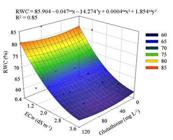
Relative water content in the leaf blade of ‘BRS GA1’ sour passion fruit plants as a function of the interaction between the levels of electrical conductivity of water - ECw and concentrations of reduced glutathione - GSH, at 140 days after transplanting. **Significant at P ≤ 0.01 by the F test.
Thus, the reduction in RWC of sour passion fruit plants is likely associated with the excess of dissolved salts in the soil solution which decreases the osmotic potential and; consequently, the water potential, thereby limiting water and nutrients uptake by the plants (BEHDAD et al., 2021; SILVA et al., 2021). Similar results were reported by SILVA NETA et al. (2021), who studied the morphophysiology of ‘BRS Rubi do Cerrado’ sour passion fruit seedlings irrigated with saline water of up to 3.5 dS m-1 and observed a 2.91% reduction in RWC for each unit increase in electrical conductivity.
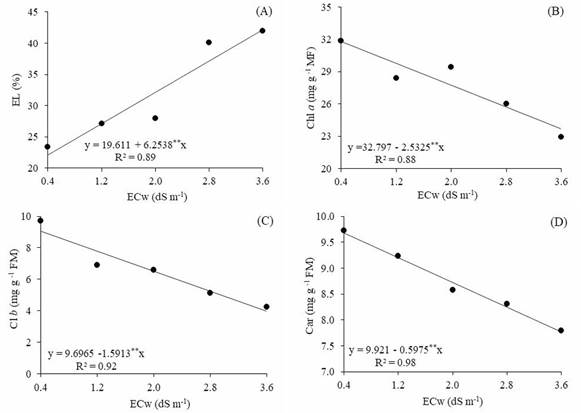
For electrolyte leakage in the leaf blade of sour passion fruit, a linear increase was observed with the increase in water salinity levels, equal to 31.88% per unit increase in ECw (Figure 3A). When comparing the EL of plants cultivated under ECw of 3.6 dS m-1 to that of plants irrigated with water of 0.4 dS m-1, an increase of 90.5% was observed. Electrolyte leakage can serve as a stress signaling agent in plants, since this condition causes an imbalance in the fight against ROS, which impact the formation of the cell membrane, inducing peroxidation and, perhaps, rupture of the membrane (HASANUZZAMAN, 2020; BEHDAD et al., 2021).

Electrolyte leakage in the leaf blade (A), chlorophyll a (B), chlorophyll b (C), and carotenoid (D) contents of ‘BRS GA1’ sour passion fruit, as a function of irrigation water salinity levels - ECw, at 140 days after transplanting. X and Y - Reduced glutathione concentrations and electrical conductivity of water - ECw, respectively; * and ns - Significant at P ≤ 0.05 and not significant (P > 0.05) by the F test, respectively.
This condition is usually observed with the increase in irrigation salinity level, which has been associated with water and metabolic imbalance caused by the accumulation of ions at toxic levels, such as Na+ and Cl- (HNILIČKOVÁ et al., 2019; YUDINA et al., 2020). A similar behavior was found by PAIVA et al. (2023), when evaluating the effects of water salinity from 0.3 to 3.5 dS m-1 in sour passion fruit genotypes, with increments of 70.63, 60.86, and 80.35% for the genotypes ‘BRS GA1’, ‘BRS SC1’ and ‘SCS 437’ at the highest salinity (3.5 dS m-1) compared to the control (0.3 dS m-1).
Chlorophyll a (Figure 3B), chlorophyll b (Figure 3C), and carotenoid (Figure 3D) contents in sour passion fruit were negatively affected by irrigation water salinity, with reductions of 7.72, 16.41, and 6.02%, respectively, per unit increase in the electrical conductivity of irrigation water. When comparing the Chl a, Chl b, and Car contents of plants cultivated under ECw of 3.6 dS m-1 to those of plants irrigated with the lowest salinity level (0.4 dS m-1), reductions of 25.48, 56.24, and 19.73% were observed, respectively.
These effects may be due to the inhibition of the synthesis of 5-aminolevulinic acid and the activity of the enzymes chlorophyllase, hydroxylase, and dioxygenase, which causes the rupture of the chloroplast envelope layer in the thylakoids, as proven by the increase in electrolyte leakage, resulting in the inhibition of the formation of new chlorophyll molecules, especially at high salinity levels (GOMES et al., 2017; OLIVEIRA et al., 2021).
It is worth highlighting that the reductions presented were higher in Chl b than in Chl a, with carotenoid contents being less affected by salinity. This is an expected behavior, considering that chlorophyll b works as an accessory pigment in the capture of energy by the photosystem, while chlorophyll a functions as the reaction center responsible for the transfer of energy to plastoquinone, and carotenoids are important antioxidants, playing a fundamental role in the dissipation of light energy during the photochemical process (YAMAMOTO, 2016; SHARIF et al., 2019).
The reduction in the capture and maintenance of energy control contributes to reducing oxidative damage to the photosystem, which is aggravated by losses of Calvin cycle activity (YANG et al., 2019). Similar behavior in photosynthetic pigment contents due to increased salinity of irrigation water in sour passion fruit was also observed by SOUZA et al. (2023) in the ‘BRS SC1’ genotype and LIMA et al. (2023b) in the ‘BRS GA1’ genotype.
Irrigation water salinity levels had a significant effect (P ≤ 0.01) n gas exchange, except for the stomatal conductance of ‘BRS GA1’ sour passion fruit at 140 DAT. Reduced glutathione concentrations significantly interfered with transpiration (E), CO2 assimilation rate (A), and instantaneous carboxylation efficiency (CEi) of sour passion fruit plants. The interaction between the factors (SL × GSH) significantly affected (P ≤ 0.05) the transpiration of sour passion fruit at 140 DAT.
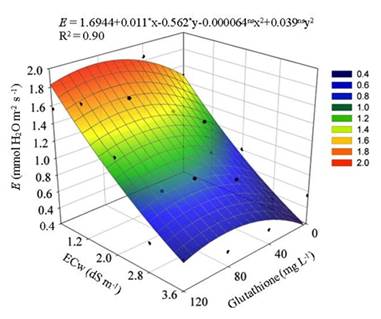
Leaf transpiration of sour passion fruit was reduced by the increase in water salinity level (Figure 4), with a reduction of 88.03% between plants grown under 0.4 dS m-1 (1.476 mmol H2O m-2 s-1) and 3.6 dS m-1 (0.176 mmol H2O m-2 s-1) without GSH application. GSH application contributed to increasing E, and its maximum value (1.945 mmol H2O m-2 s-1) was observed when using the GSH concentration of 80 mg L-1 in plants irrigated with water of 0.4 dS m-1, being 31.82% higher than that observed in plants without GSH application. However, the greatest difference in GSH application was observed in plants under ECw of 3.6 dS m-1, with a concentration of 80 mg L-1 of GSH, which resulted in a value of 0.646 mmol H2O m-2 s-1, being 265.84% higher than that established in plants without GSH application under the same irrigation condition (Figure 4).
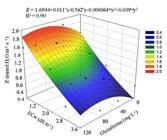
Transpiration - E of ‘BRS GA1’ sour passion fruit, as a function of the interaction between the levels of electrical conductivity of irrigation water - ECw and concentrations of reduced glutathione - GSH, at 140 days after transplanting. **Significant at P ≤ 0.01 by the F test.
It is worth pointing out that the transport of solutes in the xylem is driven by the transpiration flow of the plant, which is affected by water restriction resulting from the condition of salt accumulation near the root system, a response commonly observed in studies on irrigation water salinity, as a way to reduce excessive water loss to the environment (DIAS et al., 2020; LIMA et al., 2021). Thus, the maintenance of transpiration by glutathione may be related to the function of this compound in the control of ROS in the photosystem, as well as in the investment of solutes close to the root system of the plant, maintaining influx of the soil solution and control of specific ions in the root system (GILL et al., 2013).
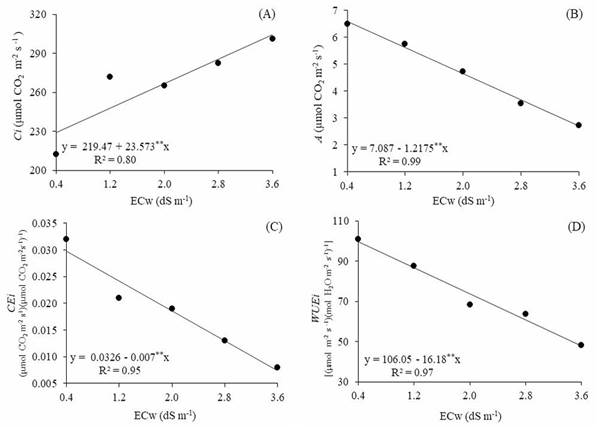
Internal CO2 concentration increased as a function of the electrical conductivity of irrigation water, by 10.74% per unit increase in ECw, which resulted in an increase of 32.95% in the Ci of plants irrigated with ECw of 3.6 dS m-1 compared to those cultivated under irrigation with the lowest salinity level (0.4 dS m-1) (Figure 5A). This result indicated the occurrence of oxidative damage to the photosynthetic apparatus by salt stress, which reduces the carboxylase function of RuBisCO and, perhaps, the carbon consumption in the Calvin cycle (PAN et al., 2021).
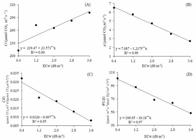
Internal CO2 concentration - Ci (A), CO2 assimilation rate - A (B), instantaneous carboxylation efficiency - CEi (C), and intrinsic water use efficiency - WUEi (D) of ‘BRS GA1’ sour passion fruit plants, as a function of irrigation water salinity levels - ECw. **Significant at P ≤ 0.01 by the F test.
The CO2 assimilation rate (A) confirms the impacts of salinity on the physiology of sour passion fruit (Figure 5B), as the unit increase of ECw caused a decrease of 17.17%. Thus, the CO2 assimilation rate varied from 6.6 μmol CO2 m-2 s-1 at ECw of 0.4 dS m-1 to 2.70 μmol CO2 m-2 s-1 at ECw of 3.6 dS m-1, reducing photosynthetic activity by 59.03%. Therefore, considering the effects on the other gas exchange parameters, it is inferred that the damage to photosynthesis goes beyond stomatal factors, which can be associated with losses in the production of ATP and NADPH, due to the damage observed in the contents of photosynthetic pigments, which compromise the energy potential in the photosystem, impairing the Calvin cycle (HASANUZZAMAN et al., 2020; PAN et al., 2021; PINHEIRO et al., 2022a).
As observed in the CO2 assimilation rate, instantaneous carboxylation efficiency (Figure 5C) and intrinsic water use efficiency (Figure 5D) were negatively impacted by the increase in irrigation water salinity, with linear reductions of 21.47 and 15.25% per unit increase in ECw, respectively. In general, CEi and WUEi decreased by 75.16 and 51.99%, respectively, when comparing the lowest (0.4 dS m-1) with the highest (3.6 dS m-1) water salinity level, proving the impacts of salt stress on photosynthetic activity, which can be associated with metabolic disorders caused by the accumulation of Na+ and Cl- in the plant, in view of the chemical composition of the irrigation water, compromising osmotic regulation, in addition to antioxidant defense, thus impairing photochemical efficiency and the activity of the RuBisCO enzyme (ARIF et al., 2020).
In a study on the physiological parameters of sour passion fruit LIMA et al. (2023a), concluded that irrigation using water with electrical conductivity of 4.0 dS m-1, regardless of the stage of crop development, reduces the photosynthetic parameters of sour passion fruit, at 220 DAT. A similar behavior was observed by PAIVA et al. (2023), who evaluated the effects of irrigation water salinity (0.3, 1.1, 1.9, 2.7, and 3.5 dS m-1) on photosynthetic pigment synthesis, gas exchange, and photochemical efficiency of sour passion fruit genotypes (‘BRS GA1’, ‘BRS SC1’, and ‘SCS 437’) and reported that the increase in the electrical conductivity of irrigation water negatively affected the physiological characteristics of sour passion fruit at 154 days after transplantation, causing damage to pigment synthesis, gas exchange, and photosynthetic efficiency of the studied genotypes.
Regarding the effects of reduced glutathione application on CO2 assimilation rate (Figure 6A), an increase of 0.36% was observed with an increase of 40 mg L-1 in GSH concentration. In relative terms, there was an increase of 44.05% in the A of plants that received GSH at concentration of 120 mg L-1 compared to the control treatment (0 mg L-1). Thus, the increase in CO2 assimilation rate promoted by the application of GSH can be explained by the antioxidant role played by this non-enzymatic compound in the metabolism, reducing the intensity of oxidative stress, avoiding possible cell damage, thus resulting in the maintenance of the photosynthetic apparatus (SHI et al., 2020; SACHDEV et al., 2021).
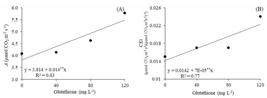
CO2 assimilation rate - A (A) and instantaneous carboxylation efficiency - CEi (B) of ‘BRS GA1’ sour passion fruit, as a function of reduced glutathione concentrations, at 140 days after transplanting. **Significant at P ≤ 0.01 by the F test.
The instantaneous carboxylation efficiency (CEi) was also significantly influenced by foliar application of reduced glutathione (Figure 6B), with an increase of 19.60% for each 40 mg L-1 increment in GSH concentration. Plants treated with 120 mg L-1 exhibited a 59.15% higher CEi compared to control. These improvements may be attributed to the maintenance of carboxylase activity in relation to RuBisCO oxidase, enhancing the utilization of carbon in the substomatal chambers (IÑIGUEZ et al., 2021).
The interaction between the factors (SL × GSH) significantly influenced (P ≤ 0.01) pulp weight (PW). The salinity levels of irrigation water significantly affected (P ≤ 0.01) the polar diameter (PD), equatorial diameter (ED), and pulp weight (PW) and at P ≤ 0.05 the peel thickness (PT). Reduced glutathione concentrations did not significantly (P > 0.05) interfere in any of the variables analyzed of ‘BRS GA1’ sour passion fruit, at 155 DAT.
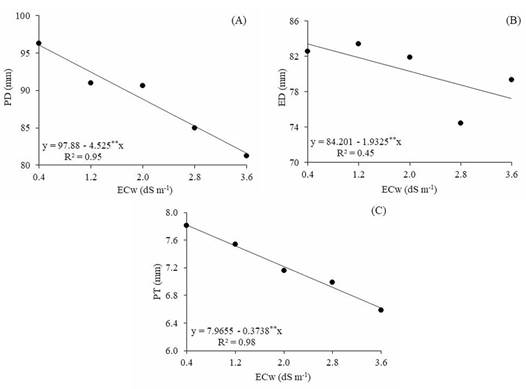
The polar diameter (PD), equatorial diameter (ED), and peel thickness (PT) of sour passion fruit were negatively affected by ECw (Figure 7), with reductions of 4.62, 2.29, and 4.69% per unit increment in ECw, respectively. Plants irrigated with ECw of 3.6 dS m-1 had reductions of 14.48, 6.18 and 1.2 mm in PD, ED and PT compared to those cultivated under water salinity of 0.4 dS m-1. Reduction in fruit size is a consequence of energy expenditure for the maintenance of metabolic activities, through ionic and osmotic homeostasis, which occurs through the accumulation of sugars, organic acids, and ions in the vacuole, reducing the investment in maintaining the physical characteristics of the fruit (LIMA et al., 2021b; LACERDA et al., 2022). Negative effects of salinity on fruit characteristics were observed by PINHEIRO et al. (2023) in a study with sour passion fruit under irrigation strategies with saline water (4.0 dS m-1) varying the phenological stages of the crop. These authors reported that irrigation with water of 4.0 dS m-1 in the flowering stage or continuously in the vegetative and flowering stages reduced fruit size.
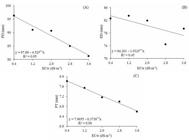
Polar diameter - PD (A), equatorial diameter - ED (B), and peel thickness - PT (C) of ‘BRS GA1’ sour passion fruit as a function of irrigation water salinity levels - ECw. X and Y - Reduced glutathione concentrations and electrical conductivity of water - ECw, respectively; ns - not significant (P > 0.05) by the F test, respectively.
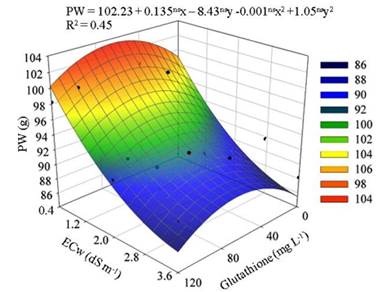
Pulp weight (PW) (Figure 8) in fruits of sour passion fruit plants without glutathione application was reduced by 13.67% as the water salinity increased from 0.4 dS m-1 to 3.6 dS m-1, reaching the lowest value of 85.49 g. The application of GSH at concentration of 67 mg L-1 in plants irrigated with water of 0.4 dS m-1 resulted in the maximum value of pulp weight, 103.58 g, which is 4.6% higher than that obtained at the same salinity level in plants without GSH application. This behavior was similar to that obtained in plants irrigated with the highest salinity level, which showed an increase of 5.32% compared to the value obtained without glutathione application.
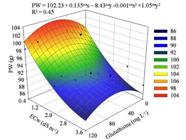
Pulp weight - PW of ‘BRS GA1’ sour passion fruit, as a function of the interaction between irrigation water salinity levels - ECw and reduced glutathione concentrations - GSH, at 155 days after transplanting.
The physiological role of reduced glutathione in plant cells involves defense against oxidative stress, being considered the main determinant of the cellular redox state, neutralizing ROS produced during periods of stress, maintaining the flow of photoassimilates for fruit filling (NAHAR et al., 2015; KOH et al., 2021). This behavior is compromised under the condition of high salinity of irrigation water, which due to the negative effects on leaf water relations and photosynthetic activity, impairs carbohydrate transport in the plant, causing reduction in fruit size and consequently in pulp weight (LIMA et al., 2020).
CONCLUSION
Irrigation water salinity above 0.4 dS m-1 impairs the physiological performance and physical attributes of the fruits of ‘BRS GA1’ sour passion fruit.
Foliar application of reduced glutathione at concentration of 120 mg L-1 enhances the CO2 assimilation rate in ‘BRS GA1’plants.
The application of reduced gluathione (<120 mg L-1) also exerts a beneficial effect on the relative water content of sour passion fruit irrigated with 0.4 dS m-1 water.
ACKNOWLEDGMENTS
Authors acknowledge support received from the INCT in Sustainable Agriculture in the Tropical Semi-Arid Region-INCTAgriS, Conselho Nacional de Desenvolvimento Científico e Tecnológico (CNPq), process 406570/2022-1, Fundação Cearense de Apoio ao Desenvolvimento Científico e Tecnológico (Funcap), process INCT-35960-62747.65.95/51, Coordenação de Aperfeiçoamento de Pessoal de Nível Superior (CAPES), and was financed in part by the Coordenação de Aperfeiçoamento de Pessoal de Nível Superior (CAPES), Brasil - Finance code 001, CNPq - process 406570/2022-1 and Funcap - process INCT-35960-62747.65.95/51.
REFERENCES
-
ALVARES, C. A. et al. Köppen’s climate classification map for Brazil. Meteorologische Zeitschrift, v.22, p.711-728, 2013. Available from: <Available from: https://www.schweizerbart.de/papers/metz/detail/22/82078/Koppen_s_climate_classification_map_for_Brazil >. Accessed: Mar. 18, 2025. doi: 10.1127/0941-2948/2013/0507.
» https://doi.org/10.1127/0941-2948/2013/0507.» https://www.schweizerbart.de/papers/metz/detail/22/82078/Koppen_s_climate_classification_map_for_Brazil -
ARIF, Y. et al. Salinity induced physiological and biochemical changes in plants: An omic approach towards salt stress tolerance. Plant Physiology and Biochemistry, v.156, p.64-77, 2020. Available from: <Available from: https://pubmed.ncbi.nlm.nih.gov/32906023/ >. Accessed: Mar. 08, 2025. doi: 10.1016/j.plaphy.2020.08.042.
» https://doi.org/10.1016/j.plaphy.2020.08.042.» https://pubmed.ncbi.nlm.nih.gov/32906023/ -
BEHDAD, A. et al. Growth, leaf gas exchange and physiological parameters of two Glycyrrhiza glabra L. populations subjected to salt stress condition. Rhizosphere, v.17, p.1-11, 2021. Available from: <Available from: https://www.sciencedirect.com/science/article/abs/pii/S245221982100015X/ >. Accessed: Mar. 08, 2025. doi: 10.1016/j.rhisph.2021.100319.
» https://doi.org/10.1016/j.rhisph.2021.100319.» https://www.sciencedirect.com/science/article/abs/pii/S245221982100015X/ -
CONG, Y. et al. Nitric oxide signal is required for glutathione-induced enhancement of photosynthesis in salt-stressed Solanum lycopersicum L. Frontiers in Plant Science, v.15, p.1-14, 2024. Available from: <Available from: https://www.frontiersin.org/journals/plant-science/articles/10.3389/fpls.2024.1413653/full >. Accessed: Feb. 01, 2025. doi: 10.3389/fpls.2024.1413653.
» https://doi.org/10.3389/fpls.2024.1413653.» https://www.frontiersin.org/journals/plant-science/articles/10.3389/fpls.2024.1413653/full -
COSTA, A. de F. S. da et al. Recomendações técnicas para o cultivo do maracujazeiro. Vitória, ES: Incaper, 56 p, 2008. Available from: <Available from: https://biblioteca.incaper.es.gov.br/digital/bitstream/item/106/1/DOC-162-Tecnologias-Producao-Maracuja-CD-7.pdf >. Accessed: Feb. 01, 2025.
» https://biblioteca.incaper.es.gov.br/digital/bitstream/item/106/1/DOC-162-Tecnologias-Producao-Maracuja-CD-7.pdf -
COSTA, C. A. R. da et al. Phenolic compounds profile and antioxidant activity of purple passion fruit’s pulp, peel and seed at different maturation stages. Scientia Horticulturae, v.321, p.1-8, 2023. Available from: <Available from: https://www.sciencedirect.com/science/article/abs/pii/S0304423823004156 >. Accessed: Feb. 05, 2025. doi: 10.1016/j.scienta.2023.112244.
» https://doi.org/10.1016/j.scienta.2023.112244.» https://www.sciencedirect.com/science/article/abs/pii/S0304423823004156 -
DIAS, A. S. de et al. Growth and gas exchanges of cotton under water salinity and nitrogen-potassium combination. Revista Caatinga, v.33, p.470-479, 2020. Available from: <Available from: https://www.scielo.br/j/rcaat/a/88hbHNMkMxrthcvvHvjttCK/ >. Accessed: Feb. 06, 2025. doi: 10.1590/1983-21252020v33n219rc.
» https://doi.org/10.1590/1983-21252020v33n219rc.» https://www.scielo.br/j/rcaat/a/88hbHNMkMxrthcvvHvjttCK/ -
EMPRESA BRASILEIRA DE PESQUISA AGROPECUÁRIA - EMBRAPA. Híbrido de maracujazeiro azedo BRS Gigante Amarelo: Recomendações básicas de cultivo. 2. ed. Brasília, DF: EMBRAPA CERRADO, 2008. 2 p. Available from: <Available from: https://www.embrapa.br/en/busca-de-publicacoes/-/publicacao/1041757/hibrido-de-maracujazeiro-azedo-brs-gigante-amarelo-recomendacoes-basicas-de-cultivo >. Accessed: Jan. 15, 2025.
» https://www.embrapa.br/en/busca-de-publicacoes/-/publicacao/1041757/hibrido-de-maracujazeiro-azedo-brs-gigante-amarelo-recomendacoes-basicas-de-cultivo -
FÁTIMA, R. T. et al. Effect of different timing of water deficit combined with foliar application of ascorbic acid on physiological variables of sour passion fruit. Arid Land Research and Management, v.39, n.2, p.237-261, 2025. Available from: <Available from: https://www.tandfonline.com/doi/full/10.1080/15324982.2024.2387098 >. Accessed: Feb. 06, 2025. doi: 10.1080/15324982.2024.2387098.
» https://doi.org/10.1080/15324982.2024.2387098.» https://www.tandfonline.com/doi/full/10.1080/15324982.2024.2387098 -
FERREIRA, D. F. SISVAR: A computer analysis system to fixed effects split plot type designs. Revista Brasileira de Biometria, v.37, p.529-535, 2019. Available from: <Available from: https://biometria.ufla.br/index.php/BBJ/article/view/450 >. Accessed: Feb. 08, 2025. doi: 10.28951/rbb.v37i4.450.
» https://doi.org/10.28951/rbb.v37i4.450.» https://biometria.ufla.br/index.php/BBJ/article/view/450 -
GILL, S. S. et al. Glutathione and glutathione reductase: a boon in disguise for plant abiotic stress defense operations. Plant Physiology and Biochemistry, v.70, p.204-212, 2013. Available from: <Available from: https://www.sciencedirect.com/science/article/abs/pii/S0981942813002076 >. Accessed: Feb. 18, 2025. doi: 10.1016/j.plaphy.2013.05.032.
» https://doi.org/10.1016/j.plaphy.2013.05.032.» https://www.sciencedirect.com/science/article/abs/pii/S0981942813002076 -
GOMES, M. A. C. et al. Salinity effects on photosynthetic pigments, proline, biomass and nitric oxide in Salvinia auriculata Aubl. Acta Limnologica Brasiliensia, v.29, p.e9, 2017. Available from: <Available from: https://www.scielo.br/j/alb/a/9WLDQfw3XLc6tffCctMJ4Ks/ >. Accessed: Feb. 15, 2025. doi: 10.1590/s2179-975x4716.
» https://doi.org/10.1590/s2179-975x4716.» https://www.scielo.br/j/alb/a/9WLDQfw3XLc6tffCctMJ4Ks/ -
HASANUZZAMAN, M. et al. Reactive oxygen species and antioxidant defense in plants under abiotic stress: Revisiting the crucial role of a universal defense regulator. Antioxidants, v.9, p.1-52, 2020. Available from: <Available from: https://pubmed.ncbi.nlm.nih.gov/32751256/ >. Accessed: Feb. 14, 2025. doi: 10.3390/antiox9080681.
» https://doi.org/10.3390/antiox9080681.» https://pubmed.ncbi.nlm.nih.gov/32751256/ -
HASANUZZAMAN, M. et al. Regulation of reactive oxygen species and antioxidant defense in plants under salinity. International Journal of Molecular Sciences. v.22, p.e9326, 2021. Available from: <Available from: https://pubmed.ncbi.nlm.nih.gov/34502233/ >. Accessed: Feb. 10, 2025. doi: 10.3390/ ijms22179326.
» https://doi.org/10.3390/ ijms22179326.» https://pubmed.ncbi.nlm.nih.gov/34502233/ -
HNILIČKOVÁ, H. et al. Effect of salt stress on growth, electrolyte leakage, Na+ and K+ content in selected plant species. Plant, Soil and Environment, v.65, p.90-96, 2019. Available from: <Available from: https://pse.agriculturejournals.cz/artkey/pse-201902-0006_effect-of-salt-stress-on-growth-electrolyte-leakage-na-and-k-content-in-selected-plant-species.php >. Accessed: Feb. 12, 2025. doi: 10.17221/620/2018-PSE.
» https://doi.org/10.17221/620/2018-PSE.» https://pse.agriculturejournals.cz/artkey/pse-201902-0006_effect-of-salt-stress-on-growth-electrolyte-leakage-na-and-k-content-in-selected-plant-species.php -
IÑIGUEZ, C. et al. Improving photosynthesis through the enhancement of Rubisco carboxylation capacity. Biochemical Society Transactions, v.49, p.2007-2019, 2021. Available from: <Available from: https://pubmed.ncbi.nlm.nih.gov/34623388/ >. Accessed: Jan. 11, 2025. doi: 10.1042/BST20201056.
» https://doi.org/10.1042/BST20201056.» https://pubmed.ncbi.nlm.nih.gov/34623388/ -
KOH, Y. S. et al. Mitigation of environmental stress-impacts in plants: Role of sole and combinatory exogenous application of glutathione. Frontiers in Plant Science, v.12, p.e791205, 2021. Available from: <Available from: https://www.frontiersin.org/journals/plant-science/articles/10.3389/fpls.2021.791205/full >. Accessed: Jan. 13, 2025. doi: 10.3389/fpls.2021.791205.
» https://doi.org/10.3389/fpls.2021.791205.» https://www.frontiersin.org/journals/plant-science/articles/10.3389/fpls.2021.791205/full -
LACERDA, C. N. de et al. Morphophysiology and production of guava as a function of water salinity and salicylic acid. Revista Brasileira de Engenharia Agrícola e Ambiental, v.26, p.451-458, 2022. Available from: <Available from: https://www.scielo.br/j/rbeaa/a/Vz7dBj4Vy7VNTyfFvZbKvng/ >. Accessed: Jan. 09, 2025. doi: 10.1590/1807-1929/agriambi.v26n6p451-45.
» https://doi.org/10.1590/1807-1929/agriambi.v26n6p451-45.» https://www.scielo.br/j/rbeaa/a/Vz7dBj4Vy7VNTyfFvZbKvng/ -
LIMA, G. S. de et al. Gas exchange, growth, and quality of passion fruit seedlings cultivated with saline water. Semina: Ciências Agrárias, v.42, p.137-154, 2021. Available from: <Available from: https://ojs.uel.br/revistas/uel/index.php/semagrarias/article/view/40413 >. Accessed: Jan. 07, 2025. doi: 10.5433/1679- 0359.2021v42n1p137.
» https://doi.org/10.5433/1679- 0359.2021v42n1p137.» https://ojs.uel.br/revistas/uel/index.php/semagrarias/article/view/40413 -
LIMA, G. S. de et al. Physiological indices of sour passion fruit under brackish water irrigation strategies and potassium fertilization. Revista Brasileira de Engenharia Agrícola e Ambiental, v.27, p.383-392, 2023a. Available from: <Available from: https://www.scielo.br/j/rbeaa/a/Xf4JCDfhQjS4L9dLHjN5JRP/ >. Accessed: Jan. 05, 2025. doi: 10.1590/1807-1929/agriambi.v27n5p383-392.
» https://doi.org/10.1590/1807-1929/agriambi.v27n5p383-392.» https://www.scielo.br/j/rbeaa/a/Xf4JCDfhQjS4L9dLHjN5JRP/ -
LIMA, G. S. de et al. Tolerance of sour passion fruit cultivars to salt stress in a semi-arid region. Revista Brasileira de Engenharia Agrícola e Ambiental, v.27, p.785-794, 2023b. Available from: <Available from: https://www.scielo.br/j/rbeaa/a/gsXsxfhsFyZFx4GyhmvZvNH/?lang=en/ >. Accessed: Jan. 15, 2025. doi: 10.1590/1807- 1929/agriambi.v27n10p785-794.
» https://doi.org/10.1590/1807- 1929/agriambi.v27n10p785-794.» https://www.scielo.br/j/rbeaa/a/gsXsxfhsFyZFx4GyhmvZvNH/?lang=en/ -
LIMA, L. K. S. et al. Growth, physiological, anatomical and nutritional responses of two phenotypically distinct passion fruit species (Passiflora L.) and their hybrid under saline conditions. Scientia Horticulturae, v.263, p.1-15, 2020. Available from: <Available from: https://www.sciencedirect.com/science/article/abs/pii/S0304423819309239 >. Accessed: Jan. 25, 2025. doi: 10.1016/j.scienta.2019.109037.
» https://doi.org/10.1016/j.scienta.2019.109037.» https://www.sciencedirect.com/science/article/abs/pii/S0304423819309239 -
MAHMOUD, M. et al. Glutathione induced antioxidant protection against salinity stress in chickpea (Cicer arietinum L.) plant. Egyptian Journal of Botany, v.57, p.293-302, 2017. Available from: <Available from: https://ejbo.journals.ekb.eg/article_3612.html >. Accessed: Jan. 22, 2025. doi: 10.21608/ejbo.2017.636.1029.
» https://doi.org/10.21608/ejbo.2017.636.1029.» https://ejbo.journals.ekb.eg/article_3612.html -
NAHAR, K. et al. Glutathione-induced drought stress tolerance in mung bean: coordinated roles of the antioxidant defence and methylglyoxal detoxification systems. AoB Plants, v.7, p.e069, 2015. Available from: <Available from: https://pubmed.ncbi.nlm.nih.gov/26134121/ >. Accessed: Jan. 26, 2025. doi: 10.1093/aobpla/plv069.
» https://doi.org/10.1093/aobpla/plv069.» https://pubmed.ncbi.nlm.nih.gov/26134121/ - NOVAIS, R. F. et al. Ensaio em ambiente controlado. In: OLIVEIRA, A. J. (ed.) Métodos de pesquisa em fertilidade do solo. Brasília: Embrapa SEA, Cap.12, p.189-253, 1991.
-
OLIVEIRA, T. F. et al. Protective action of priming agents on Urochloa brizantha seeds under water restriction and salinity conditions. Journal of Seed Science, v.43, p.e202143010, 2021. Available from: <Available from: https://www.scielo.br/j/jss/a/yCRZDjSDcPRTxBbfMLhnRxg/ >. Accessed: Jan. 26, 2025. doi: 10.1590/2317-1545v43237830.
» https://doi.org/10.1590/2317-1545v43237830.» https://www.scielo.br/j/jss/a/yCRZDjSDcPRTxBbfMLhnRxg/ -
PAIVA, F. J. da S. et al. The effects of irrigation water salinity on the synthesis of photosynthetic pigments, gas exchange, and photochemical efficiency of sour passion fruit genotypes. Plants, v.12, p.e894, 2023. Available from: <Available from: https://www.mdpi.com/2223-7747/12/22/3894 >. Accessed: Dec. 28, 2024. doi: 10.3390/plants12223894.
» https://doi.org/10.3390/plants12223894.» https://www.mdpi.com/2223-7747/12/22/3894 -
PAN, T.; LIU, M. et al. Non-stomatal limitation of photosynthesis by soil salinity. Critical Reviews in Environmental Science and Technology, v.51, p.791-825, 2021. Available from: <Available from: https://www.tandfonline.com/doi/full/10.1080/10643389.2020.1735231 >. Accessed: Dec. 28, 2024. doi: 10.1080/10643389.2020.1735231.
» https://doi.org/10.1080/10643389.2020.1735231.» https://www.tandfonline.com/doi/full/10.1080/10643389.2020.1735231 -
PINHEIRO, F. W. A. et al. Quantum yield, chlorophyll, and cell damage in yellow passion fruit under irrigation strategies with brackish water and potassium. Brazilian Journal of Biology, v.84, p.e265519, 2022. Available from: <Available from: https://www.scielo.br/j/bjb/a/P5x8fTdzpCgfc74ScLW976s// >. Accessed: Jan. 28, 2025. doi: 10.1590/1519-6984.265519.
» https://doi.org/10.1590/1519-6984.265519.» https://www.scielo.br/j/bjb/a/P5x8fTdzpCgfc74ScLW976s// -
PINHEIRO, F. W. A. et al. Gas exchange and yellow passion fruit production under irrigation strategies using brackish water and potassium. Revista Ciência Agronômica, v.53, p.e20217816, 2022a. Available from: <Available from: https://www.scielo.br/j/rca/a/NNMNJFP8ZFVvYSvZ47d9pyq/ >. Accessed: Jan. 27, 2025. doi: 10.5935/1806-6690.20220009.
» https://doi.org/10.5935/1806-6690.20220009.» https://www.scielo.br/j/rca/a/NNMNJFP8ZFVvYSvZ47d9pyq/ -
PINHEIRO, F. W. A. et al. Potassium fertilization in the cultivation of sour passion fruit under irrigation strategies with brackish water. Revista Brasileira de Engenharia Agrícola e Ambiental, v.27, p.42-50, 2023. Available from: <Available from: https://www.scielo.br/j/rbeaa/a/cdmV9k5GdR5cVyPdBfFZpzN/ >. Accessed: Jan. 28, 2025. doi: 10.1590/1807-1929/agriambi.v27n1p42-50.
» https://doi.org/10.1590/1807-1929/agriambi.v27n1p42-50.» https://www.scielo.br/j/rbeaa/a/cdmV9k5GdR5cVyPdBfFZpzN/ - RICHARDS, L. A. Diagnosis and improvement of saline and alkali soils. Washington: U.S, Department of Agriculture. 1954. 160 p.
-
SACHDEV, S. et al. Abiotic stress and reactive oxygen species: Generation, signaling, and defense mechanisms. Antioxidants, v.10, p.e277, 2021. Available from: <Available from: https://pubmed.ncbi.nlm.nih.gov/33670123/ >. Accessed: Jan. 28, 2025. doi: 10.3390/antiox10020277.
» https://doi.org/10.3390/antiox10020277.» https://pubmed.ncbi.nlm.nih.gov/33670123/ -
SCOTTI-CAMPOS, P. et al. Physiological responses and membrane integrity in three Vigna genotypes with contrasting drought tolerance. Emirates Journal of Food and Agriculture, v.25, p.1002-1013, 2013. Available from: <Available from: https://www.ejfa.me/index.php/journal/article/view/1248 >. Accessed: Jan. 21, 2025. doi: 10.9755/ejfa.v25i12.16733.
» https://doi.org/10.9755/ejfa.v25i12.16733.» https://www.ejfa.me/index.php/journal/article/view/1248 -
SHARIF, I. et al. Salinity stress in cotton: effects, mechanism of tolerance and its management strategies. Physiology and Molecular Biology of Plants, v.25, p.807-820, 2019. Available from: <Available from: https://link.springer.com/article/10.1007/s12298-019-00676-2 >. Accessed: Jan. 20, 2025. doi: 10.1007/s12298-019-00676-2.
» https://doi.org/10.1007/s12298-019-00676-2.» https://link.springer.com/article/10.1007/s12298-019-00676-2 -
SHI, X. L. et al. External potassium mediates the response and tolerance to salt stress in peanut at the flowering and needling stages. Photosynthetica, v.58, p.1141-1149, 2020. Available from: <Available from: https://ps.ueb.cas.cz/artkey/phs-202005-0009_external-potassium-mediates-the-response-and-tolerance-to-salt-stress-in-peanut-at-the-flowering-and-needling.php >. Accessed: Jan. 20, 2025. doi: 10.32615/ps.2020.070.
» https://doi.org/10.32615/ps.2020.070.» https://ps.ueb.cas.cz/artkey/phs-202005-0009_external-potassium-mediates-the-response-and-tolerance-to-salt-stress-in-peanut-at-the-flowering-and-needling.php -
SILVA, A. A. R. da et al. Salicylic acid relieves the effect of saline stress on soursop morphysiology. Ciência e Agrotecnologia, v.45, p.e007021, 2021. Available from: <Available from: https://www.scielo.br/j/cagro/a/YY6crBjctjLwFmmqnw4jxzS/ >. Accessed: Jan. 26, 2025. doi:10.1590/1413-7054202145007021.
» https://doi.org/10.1590/1413-7054202145007021» https://www.scielo.br/j/cagro/a/YY6crBjctjLwFmmqnw4jxzS/ -
SILVA NETA, A. M. S. et al. Morphophysiology of the passion fruit ‘BRS Rubi do Cerrado’ irrigated with saline waters and nitrogen fertilization. Comunicata Scientiae, v.12, p.e3456, 2021. Available from: <Available from: https://comunicata.emnuvens.com.br/comunicata/article/view/3456 >. Accessed: Jan. 28, 2025. doi: 10.14295/cs.v12.3456.
» https://doi.org/10.14295/cs.v12.3456.» https://comunicata.emnuvens.com.br/comunicata/article/view/3456 -
SOUZA, T. M. A. et al. Calcium silicate as salt stress attenuator in seedlings of yellow passion fruit cv. BRS GA1. Revista Caatinga, v.33, p.509-517, 2020. Available from: <Available from: https://www.scielo.br/j/rcaat/a/dWJ3NNNBTYbgrSYQrRqM7sb/?lang=en >. Accessed: Jan. 26, 2025. doi: 10.1590/1983-21252020v33n223rc.
» https://doi.org/10.1590/1983-21252020v33n223rc.» https://www.scielo.br/j/rcaat/a/dWJ3NNNBTYbgrSYQrRqM7sb/?lang=en -
SOUZA, W. B. B. de et al. Potassium fertilization as salt stress attenuator in sour passion fruit. Ciência Rural, v.53, p.1-12, 2023. Available from: <Available from: https://www.scielo.br/j/cr/a/7VNFVZckMzWyT5Jz6JbrzDw/ >. Accessed: Jan. 27, 2025. doi: 10.1590/0103-8478cr20210769.
» https://doi.org/10.1590/0103-8478cr20210769.» https://www.scielo.br/j/cr/a/7VNFVZckMzWyT5Jz6JbrzDw/ -
WEATHERLEY, P. E. Studies in the water relations of the cotton plant. I - The field measurements of water deficits in leaves. New Phytologist, v.49, p.81-97, 1950. Available from: <Available from: https://nph.onlinelibrary.wiley.com/doi/abs/10.1111/j.1469-8137.1950.tb05146.x >. Accessed: Jan. 21, 2025. doi: 10.1111/j.1469-8137.1950.tb05146.
» https://doi.org/10.1111/j.1469-8137.1950.tb05146.» https://nph.onlinelibrary.wiley.com/doi/abs/10.1111/j.1469-8137.1950.tb05146.x -
WELLBURN, A. R. The spectral determination of chlorophylls a and b, as well as total carotenoids, using various solvents with spectrophotometers of different resolution. Journal of Plant Physiology, v.144, p.307-313, 1994. Available from: <Available from: https://www.sciencedirect.com/science/article/abs/pii/S0176161711811922 >. Accessed: Jan. 19, 2025. doi: 10.1016/S0176-1617(11)81192-2.
» https://doi.org/10.1016/S0176-1617(11)81192-2.» https://www.sciencedirect.com/science/article/abs/pii/S0176161711811922 -
XU, H. et al. CaCl2 treatment effectively delays postharvest senescence of passion fruit. Food Chemistry, v.417, p.1-10, 2023. Available from: <Available from: https://www.sciencedirect.com/science/article/abs/pii/S030881462300403X >. Accessed: Jan. 11, 2025. doi: 10.1016/j.foodchem.2023.135786.
» https://doi.org/10.1016/j.foodchem.2023.135786.» https://www.sciencedirect.com/science/article/abs/pii/S030881462300403X -
YAMAMOTO, Y. Quality control of photosystem II: the mechanisms for avoidance and tolerance of light and heat stresses are closely linked to membrane fluidity of the thylakoids. Frontiers in Plant Science, v.7, p.e1136, 2016. Available from: <Available from: https://pubmed.ncbi.nlm.nih.gov/27532009/ >. Accessed: Dec. 11, 2024. doi: 10.3389/fpls.2016.01136.
» https://doi.org/10.3389/fpls.2016.01136.» https://pubmed.ncbi.nlm.nih.gov/27532009/ -
YANG, Z. et al. Photosynthetic regulation under salt stress and salt-tolerance mechanism of sweet sorghum. Frontiers in Plant Science, v.10, p.1-12, 2019. Available from: <Available from: https://www.frontiersin.org/journals/plant-science/articles/10.3389/fpls.2019.01722/full >. Accessed: Dec. 11, 2024. doi: 10.3389/fpls.2019.01722.
» https://doi.org/10.3389/fpls.2019.01722.» https://www.frontiersin.org/journals/plant-science/articles/10.3389/fpls.2019.01722/full -
YUDINA, L. et al. A light-induced decrease in the photochemical reflectance index (PRI) can be used to estimate the energy-dependent component of non-photochemical quenching under heat stress and soil drought in pea, wheat, and pumpkin. Photosynthesis Research, v.146, p.175-187, 2020. Available from: <Available from: https://link.springer.com/article/10.1007/s11120-020-00718-x >. Accessed: Dec. 08, 2024. doi: 10.1007/s11120-020-00718-x.
» https://doi.org/10.1007/s11120-020-00718-x.» https://link.springer.com/article/10.1007/s11120-020-00718-x -
ZHANG, G. et al. Exogenous application of chitosan alleviate salinity stress in lettuce (Lactuca sativa L.). Horticulturae, v.7, p.e342, 2021. Available from: <Available from: https://www.mdpi.com/2311-7524/7/10/342 >. Accessed: Dec. 08, 2024. doi: 10.3390/horticulturae7100342.
» https://doi.org/10.3390/horticulturae7100342.» https://www.mdpi.com/2311-7524/7/10/342
-
CR-2025-0136.R2
-
DATA AVAILABILITY STATEMENT
The raw data used in this work are available from the first author.
-
DECLARATION OF USE OF ARTIFICIAL INTELLIGENCE
The authors declare that they did not use artificial intelligence tools to write the manuscript, nor to replace their own skills during its preparation.
Edited by
-
ASSOCIATE EDITOR:
Leandro Souza da Silva (0000-0002-1636-6643)
-
SCIENTIFIC EDITOR:
Mara Fernandes Moura Furlan (0000-0002-1327-5527)
The raw data used in this work are available from the first author.