 Aspects of using Manihot silage in the finishing of small ruminants: An integrative approach
ABSTRACT:
This study identified ways of using Manihot silage to feed finishing goats and sheep. A review protocol was developed in which the search terms were previously tested based on the PVO strategy, to determine the guiding question, the population (P): finishing sheep and goats; variables (V) of interest: the use of Manihot silage; and the outcomes (O): the performance of animals fed Manihot spp. silage. The following guiding question was formulated: What are the impacts of using Manihot silage in the diet of finishing sheep and goats? The databases used were SCOPUS (Elsevier), Web of Science and Science direct, and the search was carried out until September 6, 2023. A total of 1,856 research articles were identified; however, only 13 were considered eligible for answering the guiding question for data extraction. The most used species were pornunça (Manihot sp.) in 46.15% of the articles, maniçoba (Manihot pseudoglaziovii) in 30.8%, and cassava (Manihot esculenta) in 23.06%. A total of 296 sheep and 51 goats were used in the studies. The use of silage from the plants of the genus Manihot showed to be a viable feeding alternative for finishing goats and sheep, with a high adaptive capacity in tropical regions.
Key words:
alternative feed; lambs; goats; cassava (Manihot esculenta); maniçoba (Manihot pseudoglaziovii); pornunça (Manihot sp
RESUMO:
Esse estudo identificou as formas de uso da silagem de Manihot para a alimentação de caprinos e ovinos em terminação. Foi desenvolvido um protocolo de revisão em que os termos de busca foram previamente testados, baseados na estratégia PVO para determinar a questão norteadora, sendo a população (P): ovinos e caprinos em terminação; variáveis (V) de interesse: o uso da silagem de Manihot; e os resultados (O): o desempenho de animais alimentados com silagem de Manihot spp.). Formulou-se a seguinte questão norteadora: Quais os impactos do uso da silagem de Manihot na dieta de ovinos e caprinos em terminação? As bases de dados utilizadas foram SCOPUS (Elsevier), Web of Science e Science direct, sendo a busca realizada até o dia 06 de setembro de 2023. Foram identificados 1.856 artigos de pesquisas, no entanto, apenas 13 foram considerados elegíveis e incluído que respondiam à questão norteadora para extração de dados. As espécies mais utilizadas foram a pornunça (Manihot sp.) com 46,15%, maniçoba (Manihot pseudoglaziovii) com 30,8% e a mandioca (Manihot esculenta) com 23,06% dos artigos. Um total de 296 ovinos e 51 caprinos foram utilizados nos estudos. A utilização das silagens de forrageiras do gênero Manihot mostra-se como alternativa alimentar viável para caprinos e ovinos em terminação, possuindo alta capacidade adaptativa em regiões tropicais.
Palavras-chave:
alimento alternativo; cordeiros; caprinos; mandioca (Manihot esculenta); maniçoba (Manihot pseudoglaziovii); pornunça (Manihot sp.).
INTRODUCTION
The availability of forage resources for ruminant animals in tropical regions is a constant challenge within production systems, particularly because of the long periods of drought, irregular rainfall and nutrient-poor soils, resulting in scarce forage production and low nutritional value (ARAÚJO et al., 2009), with a direct impact on animal performance (HUANG et al., 2017).
The use of forage plants that are native and/or adapted to these regions, particularly those that can withstand periods of drought and are highly efficient in water use (COSTA et al., 2022), is an alternative for forage supply. Therefore, it is important to identify and develop technologies linked to the use of these forage species, ensuring the availability of roughage with adequate nutritional value for the animals (LIMA et al., 2023). Some of these species have stood out due to their high productive, adaptability to environmental conditions, resistance to pests and diseases, and nutritional characteristics that meet the dietary requirements of livestock (SOUZA et al., 2022). Among these forage species are plants of the Manihot genus, including cassava (Manihot esculenta) and maniçoba (Manihot pseudoglaziovii), which are perennial, shrubby species belonging to the Euphorbiaceae family, (BELTRÃO et al., 2006; FOLONI et al., 2010). Also notable is pornunça (Manihot sp.), considered a natural hybrid between cassava (Manihot esculenta) and maniçoba (Manihot esculenta × Manihot pseudoglaziovii). Forage plants of the Manihot genus are distinguished for their high biomass yield and protein-rich leaves, as well as their strong regrowth capacity after cutting. In addition, their roots store significant amounts of starch, conferring notable resistance to periods of water scarcity (ANDRADE et al., 2014; LIMA et al., 2022).
The use of silage made from Manihot species has been highlighted as a good nutritional alternative for goats and sheep, particularly in regions affected by adverse edaphoclimatic conditions (SENA et al., 2014). This practice has demonstrated significant improvements in ruminant performance and in the overall efficiency of production systems (FERREIRA et al., 2009). It is important to note that; although, plants of the Manihot genus contain cyanogenic glycosides that can be toxic by releasing hydrocyanic acid (HCN), the conservation process considerably reduces the concentrations of this acid, making it a safe option for animal feeding (MATOS et al., 2005; BELTRÃO et al., 2015).
Thus, replacing high-cost feed ingredients with alternative roughage sources helps producers during periods of low feed availability. This highlighted the need for research that assesses the ideal quantity and productive potential of Manihot silage for small ruminants (AMORIM et al., 2023). Different parts of cassava (Manihot esculenta) can be used as animal feed, such as the leaves, peels and bran. These residues, which would often be discarded, can be transformed into nutritious feed (PEREIRA et al., 2018). Cassava (Manihot esculenta) leaves, for example, are rich in protein and can be dehydrated and included in the feed, serving as a protein supplement. Cassava (Manihot esculenta) peels and bran, which are rich in carbohydrates, can be used as a source of energy. Therefore, when properly processed, these by-products can be mixed with other ingredients in the formulation of balanced rations (SANTOS et al., 2001).
To this end, the integrative review represents an efficient tool for researchers, as it allows the collection and critical analysis of published studies within a particular field, generating more knowledge and enhancing scientific understanding on the topic (SOUZA, 2010). By grounding the discussion in scientific evidence, this method contributes to a better understanding of the subject (WHITTEMORE & KNAFL, 2005). Therefore, this study identified and synthesized studies on the use of Manihot silage in diets of finishing goats and sheep through an integrative review approach.
METHODS
This is an integrative review study used to generate a consistent overview of the use of Manihot silage in the finishing of sheep and goats. This is currently the broadest review research method for determining knowledge on a specific topic (SOUZA, 2010). It also aimed to identify, analyze and synthesize the results of independent studies on the same topic.
Development of the protocol and guiding question
To formulate the guiding question of this review, the PVO mnemonic strategy was adopted. In this method, the population (P) consisted of finishing sheep and goats, the variable (V) of interest was the use of Manihot silage, and the outcome (O) referred to the performance of animals fed with this silage. Based on these elements, the following guiding question was developed: “What are the impacts of using Manihot silage in the diet of finishing sheep and goats?”.
Database search
The articles were selected by two trained researchers using three databases: Scopus, ScienceDirect (Elsevier), and Web of Science (Clarivate Analytics). Studies published up to September 6, 2023, that addressed the guiding question were included. Access to the databases was provided via the CAPES Periodicals Portal through the proxy of the Universidade Federal do Piauí (UFPI, Brazil). Table 1 shows the terms used in the search and their respective synonyms.
Screening and data extraction
In the first stage, the databases were screened, and two independent reviewers assessed the search results by examining the titles and abstracts, selecting only scientific articles. In the subsequent stage, the full texts of the selected articles were analyzed in detail and evaluated according to the eligibility criteria defined in the review protocol. Microsoft Excel® was used to support and orgaize the screening process throughout all phases.
A data extraction form specifically designed for this study was used to systematically collect relevant information from each article. The form included details related to publication identification (article title, indexed databases, authors, country, language, and year of publication), the name of the scientific journal, and methodological aspects (description of the experimental design, including criteria for the composition of treatment groups and comparisons/controls, experimental period, variables analyzed, and results). Additionally, data were extracted on animal performance outcomes, study limitations, and conclusions.
Critical analysis of the studies included
The selected studies were initially classified based on the level of evidence generated, following the Joanna Briggs Institute (JBI) classification system, with only studies categorized as Level 1 evidence being included. To assess the methodological quality of the included studies, the CASP instruments, appropriate to each study’s methodological design were used (available at: <https://casp-uk.net/casp-tools-checklists/>). Only studies that fulfilled the essential criteria of compliance with the research methods described in each study were considered eligible for inclusion.
RESULTS
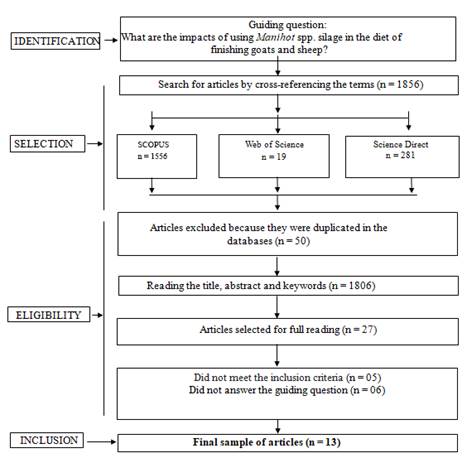
The search returned a total of 1,986 studies, of which 1,857 were scientific articles. Of this total, 23 were identified as potential data sources of interest. Thirteen publications were considered eligible and included for answering the guiding question for data extraction (Figure 1).
Flowchart of the selection process for the final sample of the integrative review (Adapted from MOHER et al., 2010).
Of all the articles, 46.2% of the authors studied pornunça (Manihot sp.), 30.8% maniçoba (Manihot pseudoglaziovii), and 23.1% cassava (Manihot esculenta). The experimental period of the articles studying pornunça (Manihot sp.) ranged from 21 to 69 days, with an average of 51 days (Table 2). In experiments with maniçoba (Manihot pseudoglaziovii), evaluations ranged from 15 to 63 days, with an average of 42 days. While in the cassava (Manihot esculenta) studies the experimental period ranged from 56 to 90 days, with an average of 76 days.
Methodological characteristics of studies on the use of Manihot silage for finishing goats and sheep.
Of the total number of animals used in the selected studies, 296 were sheep and 51 were goats, totaling 347 experimental units, which monitored data on the chemical composition of the species and the performance of the animals fed on the diet containing the different species. The chemical composition of the Manihot species and the composition of the experimental diets were analyzed (Table 3 and Table 4).
Among the selected studies, only one specified the cutting age for the Manihot species, indicating that pornunça (Manihot sp.) was harvested six months after regrowth, at an established cutting height of 1.5 meters. Regarding the chemical composition of the Manihot species, all articles showed results for dry matter, mineral matter, crude protein and ether extract, while 69.2% of the articles showed results for NDF and ADF, 30.7% for cellulose and hemicellulose, 69.2% for lignin and 53.8% for total carbohydrates (Table 3).
In terms of animal performance, 92.3% of the articles reported initial weight and 84.1% reported final weight. Additionally, average gain results were described in 61.5% of the papers, while carcass yield, feed conversion, dry matter digestibility and hot and cold carcass weights were reported in 15.9%, 30.76%, 61.5% and 38.4% of the studies, respectively (Table 5).
DISCUSSION
Studies characterization
The articles selected for inclusion in this integrative review were published in journals indexed in major scientific databases, ensuring the research’s reliability. Therefore, this review shows safety due to the solid methodology adopted, with thorough screening by the reviewers for the inclusion or exclusion of articles that could compromise or distort the analysis.
Most of the studies that were excluded at the eligibility stage (full reading by the reviewers) were articles that contained information regarding the effect of using hay on the performance of goats and sheep or animal species that were not of interest to the research. In addition, studies with finishing females were discarded, and several studies were excluded because they used species of Manihot in the fresh form, such as cassava (Manihot esculenta) peel, in the diet of finishing lambs or goats, as this was not the focus of the review (MENEZES et al., 2004).
To summarize, the articles were included according to the criterion that the studies had information on the silage of Manihot species in diets of finishing lambs or goats (SILVA et al., 2023), in which data on the chemical composition of the feed and the performance of the animals subjected to treatments with Manihot silage were extracted.
The first published studies on the use of this species occurred in 2009, with the inclusion of maniçoba (Manihot pseudoglaziovii) silage associated with different energy sources, focusing on goat performance. In the same year, another article focused on the intake and digestibility of maniçoba (Manihot pseudoglaziovii) was published (MEDINA et al., 2009a). In 2011, another study evaluated the processing of cassava (Manihot esculenta) in sheep feeding, ensiling cassava (Manihot esculenta) for 30 days and obtaining performance results in Santa Inês lambs (FARIAS et al., 2011).
The publication timeline of the selected studies varied significantly, with 65.5% published within the past six years. Research on Manihot silage typically spans 60 days and are typically structured in two phases: the first assessing performance, and the second focusing on carcass characteristics.
All the research on Manihot species has been conducted in Brazil, as it is a plant native to South America. Due to its resilience to the soil and climatic conditions of tropical regions (SEPTYA et al., 2022), as well as its high efficiency in water use, it is an interesting alternative feed resource for goat and sheep production systems (CAMPOS et al., 2017). Thus, conservation in the form of silage, to be offered during periods of low forage availability has proven to be an efficient way to maintain good production rates (AMORIM et al., 2023). Therefore, further research on forage plants of the Manihot genus will be needed to establish them as an alternative feed for goats and sheep, and to prove their potential for conservation in the form of silage, promoting the dissemination of the results, particularly internationally.
Chemical composition and digestibility
It is noteworthy that even when used as a dietary roughage, cultivars of the genus Manihot have shown protein content that can meet nutritional requirements. Cassava (Manihot esculenta), for example, has a high CP content both in the shoot and roots, making it a viable alternative feed resource for ruminant animals (FERREIRA et al., 2009; SILVA et al., 2023). It should be noted that the composition of experimental diets varies greatly depending on the different ingredients used by the different authors, and protein is a key factor as it can affect the nutritional value of the diet.
The analysis and characterization of total carbohydrates in these forages is important and partly determines the quality of the ensiled material. The total carbohydrates in Manihot silage, including non-fiber carbohydrates, contribute significantly to its nutritional value, with high digestibility and total digestible nutrient content, which when reduced, impact digestibility (DANTAS et al., 2008). In addition to affecting the nutritional quality of the silage, determining the optimal harvest time for the ensiling process is crucial. The total carbohydrate values reported in the articles included in this research are consistent with the findings of VAN SOEST (1994), indicating that carbohydrates account for approximately 50 to 80% of the dry matter content in forage plants.
Fiber represents an indispensable component and one of the main items in the diet of ruminants, which depending on its physical and chemical characteristics can directly interfere with the digestive physiology of the rumen (ZHIVOTOVSKY, 2022). In the present review, 100% of the authors presented results on the NDF and 84.4% on the ADF content of the experimental diets, which are, respectively, directly linked and inversely proportional to intake (ISMARTOYO, 2022) and feed digestibility (VAN SOEST, 1994). Lignin is part of the cell wall of plants and is not affected by digestive enzymes, interfering with fiber digestibility (MERTENS, 1994) and directly affecting animal performance.
Fiber is important in the energy metabolism of ruminants, since regardless of the carbohydrate source, it is fermented by microorganisms and converted into short-chain fatty acids (SCFA), mainly acetic, propionic and butyric acid, which can account for 60 to 80% of ruminant energy needs. However, high levels of fiber can reduce the efficiency with which carbohydrates and other nutrients are used (MERTENS, 1994; MERTENS, 1997). In addition, it was found a variation of 20.46% in the DM digestibility of the different experimental diets, which is influenced by the quality of the Manihot species and its acceptability by the animals, directly reflecting their performance (VAN SOEST, 1994; BRANCO et al., 2010). The digestibility of Manihot silage for lambs has been reported as high in several studies. Research on Pornunça (Manihot sp.) silage has shown that increasing the levels of plant silage in the diet of lambs led to greater digestibility of DM, NDF and CP due to its good nutritional quality (AMORIM et al., 2023).
The limitation is that only one article presented the harvesting age of the species, and few studies presented the results of the cutting height of the plant, with more information in the studies with pornunça (Manihot sp.). Few articles contained information on the digestibility of the dry matter, therefore, it is necessary to standardize this information. Future research should place greater emphasis on evaluating the digestibility of Manihot silages to better use them in the feeding of small ruminants.
Intake and performance
All articles presented intake data, which is crucial given its potential impact on animal nutrition and performance in the tropics. Research on pornunça (Manihot sp.) and maniçoba (Manihot pseudoglaziovii) silages highlighted the benefits of incorporating these two species in ruminant diets. Increasing levels of Manihot silage in the diet led to higher dry matter intake and nutrient digestibility (CAMPOS et al., 2019; AMORIM et al., 2023; SILVA et al., 2023). In addition, feeding Manihot silage resulted in higher nutrient intake and digestibility without affecting physiological responses or hematological parameters (MATOS et al., 2005), i.e., animal health, which is a primary evaluation characteristic when aiming to include alternative feed ingredients in ruminant diets.
The use of Manihot as a source of preserved roughage in the form of silage has promoted average daily gain (ADG) above 200 g of BW/day (CARVALHO et al., 2017; CAMPOS et al., 2019b; AMORIM et al., 2023). However, there is a high variation (82 to 208.2 g of BW/day) in the performance of goats and sheep respectively, according to the Manihot species. As a result, the difference in daily weight gain between goats and sheep can be attributed to factors such as diet composition, genetic differences and metabolic requirements. Research indicated that goats and sheep have different energy and protein requirements for maintenance and weight gain, influenced by their genotype and body composition (ALMEIDA et al., 2020). Diets and supplementation play a crucial role in increasing weight gain in both species, impacting on productive performance. In addition, concentrating supplementation can increase fattening capacity in both sheep and goats, affecting their weight gain patterns (KHAN et al., 2014).
Carcass and meat characteristics
The nutritional characteristics of Manihot silage promoted greater hot and cold carcass weights and yields compared to other alternative feeds (MEDINA et al., 2009a). The higher digestibility of the diet had a positive influence on carcass yield (MEDINA et al., 2009b; OLIVEIRA et al., 2018). Research with sheep indicated that replacing Tifton 85 hay with maniçoba (Manihot pseudoglaziovii) hay or silage did not affect average daily gain or body weight at slaughter, demonstrating the potential of maniçoba (Manihot pseudoglaziovii) as a viable alternative feed source for ruminants (GOMES et al., 2021). These results suggest that incorporating cassava (Manihot esculenta) silage into goat and sheep diets can lead to favorable carcass gains and efficient feed conversion, characterizing this forage as a viable feed option for ruminants in arid and semi-arid tropical regions (MACIEL et al., 2018).
The evaluation of goat diets containing cassava (Manihot esculenta) silage and different energy sources highlighted the importance of the effect of silage composition on carcass weight and yield (MEDINA et al., 2009a). It is worth noting that most articles do not provide information on carcass yield, feed conversion, hot and cold carcass weight or ADG, which are very important indices to evaluate performance, characterizing and indicating superior carcasses and the viability of the production system (MATIAS et al., 2020; AMORIM et al., 2023).
Implications and suggestions
The literature review identified only two studies involving goats, highlighting the limited research available on this species. Therefore, it is necessary to intensify studies on the inclusion of Manihot in the diet of animals, considering the high adaptive capacity to arid and semiarid tropical regions, representing an important option for animal production systems.
Another point to be highlighted is the lack of information on the optimal age and height of the plant for harvest and ensiling, which are directly related to the efficiency of the fermentation process and the final quality of the product. Therefore, it is important to develop agronomic research to evaluate different planting systems and determine the best time to cut the plant in order to obtain better quality silage. In addition, it is important to incorporate parameters to evaluate the digestibility of silages obtained from the different species, generating more accurate information for ruminant production systems.
Finally, it is important to evaluate the productive potential of the Manihot genus, in other tropical climate conditions, seeking to validate information for different environments, given the greater concentration of studies carried out in the state of Pernambuco, which makes it difficult to validate the results found in the research.
CONCLUSION
The use of silage from forage plants of the genus Manihot proved to be a viable feed alternative for finishing goats and sheep. The Manihot species present high adaptive capacity in tropical regions and represent a viable forage option for silage production and feeding small ruminants throughout the year.
ACKNOWLEDGMENTS
This study was supported by the Conselho Nacional de Desenvolvimento Científico e Tecnológico (CNPq), and the Coordenação de Aperfeiçoamento de Pessoal de Nível Superior (CAPES) - Financing Code 001.
REFERENCES
-
ALMEIDA, A. K. et al. Genotype effects on energy and protein requirements in growing male goats. Animal, v.14, n.2, p.323-331, 2020. Available from: <Available from: https://www.sciencedirect.com/science/article/pii/S1751731120000348 > Accessed: Apr. 30, 2024. doi: 10.1017/S1751731120000348.
» https://doi.org/10.1017/S1751731120000348.» https://www.sciencedirect.com/science/article/pii/S1751731120000348 -
AMORIM, J. S. et al. Nutritional, physiological, hematological, and biochemical responses of lambs fed increasing levels of Pornunça silage. Scientia Agricola, v.80, e20210037, 2023. Available from: <Available from: https://www.scielo.br/j/sa/a/9cmHGBP6M9d7HmYpmxmDMQL/ > Accessed: May, 20, 2024. doi: 10.1590/1678-992X-2021-0037.
» https://doi.org/10.1590/1678-992X-2021-0037.» https://www.scielo.br/j/sa/a/9cmHGBP6M9d7HmYpmxmDMQL/ -
ANDRADE, A. P. et al. Chemical-nutritional composition of maniçoba (Manihot sp.) and its relationship with soil chemical characteristics. Revista Brasileira de Zootecnia, v.43, n.4, 161-168, 2014. Available from: <Available from: https://www.scielo.br/j/rbz/a/Q7Rs7fkQhxQX3Z7gKqkkDQN/?lang=en > Accessed: Jan. 12, 2024. doi: 10.1590/S1516-35982014000400001.
» https://doi.org/10.1590/S1516-35982014000400001.» https://www.scielo.br/j/rbz/a/Q7Rs7fkQhxQX3Z7gKqkkDQN/?lang=en -
ARAÚJO, M. J. et al. Intake and digestibility of nutrients in Moxotó dairy goats fed diets with different Maniçoba hay levels. Revista Brasileira de Zootecnia, v.38, n.6, p.1088-1095, 2009. Available from: <Available from: https://www.scielo.br/j/rbz/a/5gdgHCh9nZDDyj76Ns5XZfN/abstract/?lang=pt >. Accessed: Oct. 12, 2024. doi: 10.1590/S1516-35982009000600017.
» https://doi.org/10.1590/S1516-35982009000600017.» https://www.scielo.br/j/rbz/a/5gdgHCh9nZDDyj76Ns5XZfN/abstract/?lang=pt -
BELTRÃO, F. A. S. et al. Morphometric analisis of maniçoba accesses (Manihot pseudoglaziovii Pax & Hoffm.) and two allied cultivated species of forage interest. Revista Caatinga, v.19, n.2, p.103-111, 2006. Available from: <Available from: http://redalyc.org/articulo.oa?id=237117566001&tab=4 >. Accessed: Nov. 12, 2024.
» http://redalyc.org/articulo.oa?id=237117566001&tab=4 -
BELTRÃO, F. A. S. et al. Chemical characterization of different sorts of Maniçoba (Manihot pseudoglaziovii Pax and Hoffm) of interest forage. Engenharia Ambiental, v.12, n.2, p.135-142, 2015. Available from: <Available from: http://ferramentas.unipinhal.edu.br/engenhariaambiental/viewarticle.php?id=1247 >. Accessed: Feb. 24, 2024.
» http://ferramentas.unipinhal.edu.br/engenhariaambiental/viewarticle.php?id=1247 -
BRANCO, R. H. et al. Effect of levels of neutral detergent fiber derived from forage on microbial efficiency and digestive parameters in dairy goats. Revista Brasileira de Zootecnia, v.39, n.2, p.372-381, 2010. Available from: <Available from: https://www.scielo.br/j/rbz/a/RPVhzGrhgYTxSYvCD4q8BGp/?lang=pt >. Accessed: Nov 12, 2023. doi: 10.1590/S1516-35982010000200021.
» https://doi.org/10.1590/S1516-35982010000200021.» https://www.scielo.br/j/rbz/a/RPVhzGrhgYTxSYvCD4q8BGp/?lang=pt -
CAMPOS, F. S. et al. Characteristics of carcass and non-carcass components of lambs fed diets containing silages of forages adapted to the semi-arid environment. South African Journal of Animal Science, v.9, n.1, p.119-130, 2019b. Available from: <Available from: https://www.scielo.org.za/scielo.php?script=sci_arttext&pid=S0375-15892019000100013 >. Accessed: Sept. 16, 2024. doi: 10.4314/sajas.v49i1.14.
» https://doi.org/10.4314/sajas.v49i1.14.» https://www.scielo.org.za/scielo.php?script=sci_arttext&pid=S0375-15892019000100013 -
CAMPOS, F. S. et al. Influence of diets with silage from forage plants adapted to the semi-arid conditions on lamb quality and sensory attributes. Meat Science, v.124, p.61-68, 2017. Available from: <Available from: https://pubmed.ncbi.nlm.nih.gov/27838573/ >. Accessed: Jul. 28, 2024. doi: 10.1016/j.meatsci.2016.10.011.
» https://doi.org/10.1016/j.meatsci.2016.10.011.» https://pubmed.ncbi.nlm.nih.gov/27838573/ -
CAMPOS, F. S. et al. Alternative forage for goats and sheep raised in semiarid. Revista eletrônica - Nutritime, v.14, n.2, p.5004-5013, 2017. Available from: <Available from: https://nutritime.com.br/artigos/artigo-416-alternativa-de-forragem-para-caprinos-e-ovinos-criados-no-semiarido/ >. Accessed: Jun. 02, 2024.
» https://nutritime.com.br/artigos/artigo-416-alternativa-de-forragem-para-caprinos-e-ovinos-criados-no-semiarido/ -
CAMPOS, F. S. et al. Metabolic profile and histopathology of kidneys and liver of lambs fed silages of forages adapted to a semi-arid environment. South African Journal of Animal Science, v.49, n.3, p.555-563, 2019a. Available from: <Available from: https://www.scielo.org.za/scielo.php?script=sci_arttext&pid=S0375-15892019000300016 >. Accessed: Jul. 27, 2024. doi: 10.4314/sajas.v49i3.16.
» https://doi.org/10.4314/sajas.v49i3.16.» https://www.scielo.org.za/scielo.php?script=sci_arttext&pid=S0375-15892019000300016 -
CARVALHO, G. G. P. et al. Intake, digestibility, performance, and feeding behavior of lambs fed diets containing silages of different tropical forage species. Animal Feed Science and Technology, v.228, p.140-148, 2017. Available from: <Available from: https://www.sciencedirect.com/science/article/pii/S037784011730456X >. Accessed: Jul. 30, 2024. doi: 10.1016/j.anifeedsci.2017.04.006.
» https://doi.org/10.1016/j.anifeedsci.2017.04.006.» https://www.sciencedirect.com/science/article/pii/S037784011730456X -
COSTA, R. G. et al. Spineless cactus as only water source for feedlot lambs. Acta Horticulture, v.1343, p.213-224, 2022. Available from: <Available from: https://www.actahort.org/books/1343/1343_29.htm >. Accessed: Jul. 30, 2024. doi: 10.17660/ActaHortic.2022.1343.29.
» https://doi.org/10.17660/ActaHortic.2022.1343.29.» https://www.actahort.org/books/1343/1343_29.htm -
FARIA, P. B. et al. Processing of cassava peel in sheep feeding: performance, carcass characteristics, ruminal morphology and economic efficiency. Revista Brasileira de Zootecnia, v.40, n.12, p.2929-2937, 2011. Available from: <Available from: https://www.scielo.br/j/rbz/a/HGWvD6mb5W4wyq6GBRk5qJH/ >. Accessed: Jul. 30, 2024. doi: 10.1590/S1516-35982011001200041.
» https://doi.org/10.1590/S1516-35982011001200041.» https://www.scielo.br/j/rbz/a/HGWvD6mb5W4wyq6GBRk5qJH/ -
FERREIRA, A. L. et al. Production and nutritional value of shoot area of cassava, maniçoba, and pornunça. Revista Brasileira de Saúde e Produção Animal, v.10, n.1, p.129-136, 2009. Available from: <Available from: https://www.cabidigitallibrary.org/doi/pdf/10.5555/20093296325 >. Accessed: Jul. 30, 2024.
» https://www.cabidigitallibrary.org/doi/pdf/10.5555/20093296325 -
FOLONI, J. S. et al. Evaluation of cassava cultivars in the western region of the State of São Paulo. Agrarian, v.3, n.7, p44-50, 2010. Available from: <Available from: https://ojs.ufgd.edu.br/index.php/agrarian/article/view/1083 >. Accessed: Jul. 30, 2024
» https://ojs.ufgd.edu.br/index.php/agrarian/article/view/1083 -
GOMES, M. L. R. et al. Maniçoba for sheep and goats-forage yield, conservation strategies, animal performance and quality of products. Ciência Rural, v.52, n.3, e20201096, 2021. Available from: <Available from: https://www.scielo.br/j/cr/a/wwMkrkX8mpMwBjTKJBH8hhr/ >. Accessed: Jul. 23, 2024. doi: 10.1590/0103-8478cr20201096.
» https://doi.org/10.1590/0103-8478cr20201096.» https://www.scielo.br/j/cr/a/wwMkrkX8mpMwBjTKJBH8hhr/ -
HUANG, J. Y. et al. Dryland climate change: recent progress and challenges. Reviews of Geophysics, v.55, n.3, p.719-778, 2017. Available from: <Available from: https://agupubs.onlinelibrary.wiley.com/doi/full/10.1002/2016RG000550 >. Accessed: Jul. 23, 2024. doi: 10.1002/2016RG000550.
» https://doi.org/10.1002/2016RG000550.» https://agupubs.onlinelibrary.wiley.com/doi/full/10.1002/2016RG000550 -
ISMARTOYO, I. et al. The Feed ADF and NDF Digestibility of Goat Fed Four Difference Diets. Hasanuddin Journal of Animal Science, v.4, n.1, p.41-47, 2022. <https://journal.unhas.ac.id/index.php/hajas/article/view/20192>. Accessed: Aug. 22, 2024. doi: 10.20956/hajas.v4i1.20192.
» https://doi.org/10.20956/hajas.v4i1.20192.» https://journal.unhas.ac.id/index.php/hajas/article/view/20192 -
KHAN, M. F. U. et al. Study on fattening potential of different sheep and goat breeds under different plan of nutrition in Pakistan. The Journal of Animal & Plant Sciences, v.24, n.1, p.83-86, 2014. <https://www.semanticscholar.org/paper/STUDY-ON-FATTENING-POTENTIAL-OF-DIFFERENT-SHEEP-AND-Khan-Ashfaq/219d6c3b30e5db16a70f7a2456a36c92627273f4>. Accessed: Aug. 22, 2024.
» https://www.semanticscholar.org/paper/STUDY-ON-FATTENING-POTENTIAL-OF-DIFFERENT-SHEEP-AND-Khan-Ashfaq/219d6c3b30e5db16a70f7a2456a36c92627273f4 -
LIMA, A. E. S. et al. Chemical composition and morphophysiological responses of Manihot plants. Semina: Ciências Agrárias, v.43, n.5, p.2237-2252, 2022. Available from: <Available from: https://ojs.uel.br/revistas/uel/index.php/semagrarias/article/download/45607/47999 >. Accessed: Aug. 22, 2024. doi: 10.5433/1679-0359.22v43n5p2237.
» https://doi.org/10.5433/1679-0359.22v43n5p2237.» https://ojs.uel.br/revistas/uel/index.php/semagrarias/article/download/45607/47999 -
LIMA, I. F. et al. Climatological aspects of precipitation on cassava (Manihot esculenta Crantz) yield in the mesoregions of Northeast Pará and Metropolitan Belém. Revista Brasileira De Climatologia, v.32, n.19, p.658-683, 2023. Available from: <Available from: https://ojs.ufgd.edu.br/rbclima/article/view/14620 >. Accessed: Aug. 23, 2024. doi: 10.55761/abclima.v32i19.14620.
» https://doi.org/10.55761/abclima.v32i19.14620.» https://ojs.ufgd.edu.br/rbclima/article/view/14620 -
MACIEL, M. D. V. et al. Maniçoba hay or silage replaces Tifton 85 hay in spineless cactus diets for sheep. Acta Scientiarum. Animal Sciences, v.41, n.1, p.e42553, 2018. Available from: <Available from: https://www.scielo.br/j/asas/a/7rtpQBFK4YcmMS7cNhNQx4M/?lang=en >. Accessed: Aug. 29, 2024. doi: 10.4025/actascianimsci.v41i1.42553.
» https://doi.org/10.4025/actascianimsci.v41i1.42553.» https://www.scielo.br/j/asas/a/7rtpQBFK4YcmMS7cNhNQx4M/?lang=en -
MATIAS, A. G. S. et al. Fermentation profile and nutritional quality of silages composed of cactus pear and maniçoba for goat feeding. The Journal of Agricultural Science, v.158, n.4, p.304-312, 2020. Available from: <Available from: https://ouci.dntb.gov.ua/en/works/4kPbaYEl/ >. Accessed: Aug. 29, 2024. doi: 10.1017/S0021859620000581.
» https://doi.org/10.1017/S0021859620000581.» https://ouci.dntb.gov.ua/en/works/4kPbaYEl/ -
MATOS, D. S. et al. Chemical composition and nutritional value of the maniçoba silage (Manihot epruinosa). Archivos de Zootecnia, v.54, n.208, p.619-629, 2005. Available from: <Available from: https://www.redalyc.org/articulo.oa?id=49520804 >. Accessed: Aug. 29, 2024.
» https://www.redalyc.org/articulo.oa?id=49520804 -
MEDINA, F. T. et al. Manioc silage associated with energy sources on feeding goats: Intake and digestibility. Acta Scientiarum - Animal Sciences, v.31, n.3, p.265-269, 2009a. Available from: <Available from: https://www.cabidigitallibrary.org/doi/full/10.5555/20093306398 >. Accessed: Aug. 29, 2024. doi: 10.4025/actascianimsci.v31i3.5228.
» https://doi.org/10.4025/actascianimsci.v31i3.5228.» https://www.cabidigitallibrary.org/doi/full/10.5555/20093306398 -
MEDINA, F. T. et al. Manioc silage associated with different energy sources in goat feeding: performance. Acta Scientiarum - Animal Sciences, v.31, n.2, p.151-155, 2009b. Available from: <Available from: https://www.cabidigitallibrary.org/doi/full/10.5555/20093306398 >. Accessed: Aug. 29, 2024. doi: 10.4025/actascianimsci.v31i1.5078.
» https://doi.org/10.4025/actascianimsci.v31i1.5078.» https://www.cabidigitallibrary.org/doi/full/10.5555/20093306398 -
MENEZES, M. P. C. et al. Substitution of corn by cassava (Manihot esculenta Crantz) peel in complete rations for goats: intake, digestibility and weight gain. Revista Brasileira de Zootecnia, v.33, n.3, p.729-737, 2004. Available from: <Available from: https://www.scielo.br/j/rbz/a/bQVsPxknYfyRgNPYQD3zmVq/ >. Accessed: Aug. 29, 2024. doi: 10.1590/S1516-35982004000300022.
» https://doi.org/10.1590/S1516-35982004000300022.» https://www.scielo.br/j/rbz/a/bQVsPxknYfyRgNPYQD3zmVq/ -
MERTENS, D. R. Regulation of Forage Intake. In: FAHLEY. JR, G. C. (Ed.), Forage Quality, Evaluation, and Utilization. American Society of Agronomy, p.450-493, 1994. Available from: <Available from: https://acsess.onlinelibrary.wiley.com/doi/abs/10.2134/1994.foragequality.c11 >. Accessed: Jan. 14, 2024. doi: 10.2134/1994.foragequality.c11.
» https://doi.org/10.2134/1994.foragequality.c11.» https://acsess.onlinelibrary.wiley.com/doi/abs/10.2134/1994.foragequality.c11 -
MERTENS, D. R. Creating a system for meeting the fiber requirements of dairy cows. Journal of Dairy Science, v.80, n.7, p.1463-1481, 1997. Available from: <Available from: https://www.sciencedirect.com/science/article/pii/S0022030297760752 >. Accessed: Aug. 29, 2024. doi: 10.3168/jds.S0022-0302(97)76075-2.
» https://doi.org/10.3168/jds.S0022-0302(97)76075-2.» https://www.sciencedirect.com/science/article/pii/S0022030297760752 -
MOHER, D. et al. Preferred reporting items for systematic reviews and meta-analyses: the PRISMA statement. International Journal of Surgery Open, v.8, p.336-341, 2010. Available from: <Available from: https://pubmed.ncbi.nlm.nih.gov/19621072/ > Accessed: May, 20, 2024. doi: 10.7326/0003-4819-151-4-200908180-001.
» https://doi.org/10.7326/0003-4819-151-4-200908180-001.» https://pubmed.ncbi.nlm.nih.gov/19621072/ -
National Research Council [NRC] Nutrient requirements of small ruminants: sheep, goats, cervids, and new world camelids (7th ed.). Washington, DC: National Academy Press, 2007. Available from: <Available from: https://nap.nationalacademies.org/read/11654/chapter/1 >. Accessed: Aug. 24, 2024.
» https://nap.nationalacademies.org/read/11654/chapter/1 -
OLIVEIRA, A. P. D. et al. Effect of ensiling gliricidia with cassava on silage quality, growth performance, digestibility, ingestive behavior and carcass traits in lambs. Animal Feed Science and Technology, v.241, p.198-209, 2018. Available from: <Available from: https://www.sciencedirect.com/science/article/abs/pii/S0377840117311987 > Accessed: Aug. 29, 2024. doi: 10.1016/j.anifeedsci.2018.05.004.
» https://doi.org/10.1016/j.anifeedsci.2018.05.004.» https://www.sciencedirect.com/science/article/abs/pii/S0377840117311987 -
OLIVEIRA, J. Q. D. et al. Performance and urea-n concentrations in sheep fed ensiled cassava foliage with alternative additives. Revista Brasileira de Saúde e Produção Animal, v.15, n.3, p.570-583, 2014. Available from: <Available from: https://www.scielo.br/j/rbspa/a/r5hcTyW5Qrm96fvzKdMvvmr/abstract/?lang=pt >. Accessed: Jun. 08, 2024.
» https://www.scielo.br/j/rbspa/a/r5hcTyW5Qrm96fvzKdMvvmr/abstract/?lang=pt -
PEREIRA, L. C. et al. Economic aspects of the aerial part of in natura cassava (Manihot esculenta Crantz) for the nutrition of confined and semi-confined lambs. Arquivo Brasileiro de Medicina Veterinária e Zootecnia, v.70, n.1, p.279-286, 2018. Available from: <Available from: https://www.scielo.br/j/abmvz/a/7hKNq6bSQ4kpLWNBDVRMcLz/abstract/?lang=pt >. Accessed: Jun. 08, 2024. doi: 10.1590/1678-4162-9281.
» https://doi.org/10.1590/1678-4162-9281.» https://www.scielo.br/j/abmvz/a/7hKNq6bSQ4kpLWNBDVRMcLz/abstract/?lang=pt -
SANTOS, G. et al. Alternative silages from agro-industrial waste. Simpósio sobre Produção e Utilização de Forragens Conservadas, p.262-285, 2001. Available from: <Available from: https://www.nupel.uem.br/Silagens-alternativas-rama-bagaco-laranja.pdf >. Accessed: Jun 23, 2024.
» https://www.nupel.uem.br/Silagens-alternativas-rama-bagaco-laranja.pdf -
SENA, L. S. et al. Degradability of silage of different shoot fractions of four cassava cultivars. Ciência Animal Brasileira, v.15, n.3, p.249-258, 2014. Available from: <Available from: https://www.scielo.br/j/cab/a/G4Ky6VLgsbBdC9xNdrqmGmB/?lang=pt >. Accessed: Jun. 25, 2024. doi: 10.1590/1809-6891v15i316567.
» https://doi.org/10.1590/1809-6891v15i316567.» https://www.scielo.br/j/cab/a/G4Ky6VLgsbBdC9xNdrqmGmB/?lang=pt -
SEPTYA, H. et al. A comparative evaluation of statistical empirical and neural intelligence modeling of Manihot esculenta -derived leaves extract for optimized bio-coagulationflocculation of turbid water. Industrial Crops and Products, v.186, p.115194, 2022. Available from: <Available from: https://www.sciencedirect.com/science/article/pii/S092666902200677X?via%3Dihub >. Accessed: Jun. 25, 2024. doi: 10.1016/j.indcrop.2022.115194.
» https://doi.org/10.1016/j.indcrop.2022.115194.» https://www.sciencedirect.com/science/article/pii/S092666902200677X?via%3Dihub -
SILVA, T. S. et al. Intake, digestibility, nitrogen balance and performance in lamb fed spineless cactus silage associated with forages adapted to the semiarid environment Spineless cactus silages in diets for lambs. Livestock Science, v.268, p.105168, 2023. Available from: <Available from: https://www.sciencedirect.com/science/article/abs/pii/S187114132300015X >. Accessed: Jun. 25, 2024. doi: 10.1016/j.livsci.2023.105168.
» https://doi.org/10.1016/j.livsci.2023.105168.» https://www.sciencedirect.com/science/article/abs/pii/S187114132300015X -
SOUZA, A. S. et al. Selection of Manihot genotypes tolerant to salinity during initial establishment. Scientia plena, v.18, n.3, 2022. Available from: <Available from: http://scientiaplena.org.br/sp/article/view/6475 >. Accessed: Jun. 03, 2024. doi: 10.1590/S1679-45082010RW1134.
» https://doi.org/10.1590/S1679-45082010RW1134.» http://scientiaplena.org.br/sp/article/view/6475 -
SOUZA, M. T. et al Integrative review: what is it? How to do it?. Einstein, v.8, n.1, p.102-106, 2010. Available from: <Available from: https://www.scielo.br/j/eins/a/ZQTBkVJZqcWrTT34cXLjtBx/?lang=pt >. Accessed: Jan. 04, 2024. doi: 10.1590/S1679-45082010RW1134.
» https://doi.org/10.1590/S1679-45082010RW1134.» https://www.scielo.br/j/eins/a/ZQTBkVJZqcWrTT34cXLjtBx/?lang=pt -
VAN SOEST, P. J. Nutritional ecology of the ruminant. 2nd ed. New York: Cornell University Press, 476p, 1994. Available from: <Available from: https://www.jstor.org/stable/10.7591/j.ctv5rf668 >. Accessed: Jan. 04, 2024.
» https://www.jstor.org/stable/10.7591/j.ctv5rf668 -
WHITTEMORE, R.; KNAFL, K. The integrative review: updated methodology. Journal of Advanced Nursing, v.52, n.5, p.546-553, 2005. Available from: <Available from: https://pubmed.ncbi.nlm.nih.gov/16268861/ >. Accessed: Jan. 05, 2024. doi: 10.1111/j.1365-2648.2005.03621.x.
» https://doi.org/10.1111/j.1365-2648.2005.03621.x.» https://pubmed.ncbi.nlm.nih.gov/16268861/
Edited by
-
ASSOCIATE EDITOR:
Rudi Weiblen (0000-0002-1737-9817)
-
SCIENTIFIC EDITOR:
Henrique Ribeiro-Filho (0000-0002-4455-6866)
All data generated or analyzed during this study are included in this published.