
 questioning techniques in a philosophical group-discussion scaffolding estonian preschoolers critical thinking and reasoning
abstract
In a fast-changing and evolving world, we need more and more flexible and critical thinkers. Critical thinking is a cornerstone of education and a necessity for all human activity. One of the growing problems in an increasingly digital society is the constant loss of dialogue and reflective discussion in the learning process. In pedagogical practice, critical thinking is effectively exercised through discussion and questioning. Philosophical discussion with the support of the Philosophy for Children programme is a good way to support pre-school children's critical thinking and reasoning skills. The aim of this follow-up qualitative study was to describe different questioning techniques during group-discussion utilising the Philosophy for Children programme in order to scaffold Estonian preschoolers' reasoning. The data was collected during an 8-month period through philosophical group-discussions engaged five- to six-years-old children with 20 observations from five groups (N=58). Transcripts from group-discussions were analysed using qualitative analysis. The findings indicated that the functions of a discussion leader´s open- and closed-ended questions varied depending on the children´s responses and behavior. Eight functions for open-ended questions and five functions with five parallel functions for closed-ended questions are described. Some closed-ended questions can support higher-level thinking in cases where they prompt children to compare, hesitate, or explain. A model for asking questions in group discussions was prepared, providing guidelines for asking questions in a purposeful manner, based on the function of the previous question and the child's answer. The informed understanding of questioning techniques is useful to identify how kindergarten teachers can scaffold children during group-discussions.
keywords:
preschool; critical thinking; reasoning; questioning techniques; philosophy for children
resumen
En un mundo en rápida evolución y cambio, necesitamos cada vez más pensadores flexibles y críticos. El pensamiento crítico es una piedra angular de la educación y una necesidad para toda actividad humana. Uno de los problemas crecientes en una sociedad cada vez más digitalizada es la pérdida constante de diálogo y debate reflexivo en el proceso de aprendizaje. En la práctica pedagógica, el pensamiento crítico se ejerce eficazmente mediante el debate y el cuestionamiento. La discusión filosófica con el apoyo del programa Filosofía para Niños es una buena manera de apoyar el pensamiento crítico y la capacidad de razonamiento de los niños en edad preescolar. El objetivo de este estudio cualitativo de seguimiento era describir diferentes técnicas de cuestionamiento durante grupos de discusión utilizando el programa Filosofía para Niños con el fin de apoyar el razonamiento de los preescolares estonios. Los datos se recogieron durante un período de 8 meses a través de discusiones filosóficas en grupo con niños de cinco a seis años, con 20 observaciones de cinco grupos (N=58). Las transcripciones de las discusiones de grupo se analizaron mediante análisis cualitativo. Los resultados indicaron que las funciones de las preguntas abiertas y cerradas del moderador variaban en función de las respuestas y el comportamiento de los niños. Se describen ocho funciones para preguntas abiertas y cinco funciones con cinco funciones paralelas para preguntas cerradas. Algunas preguntas cerradas pueden fomentar un pensamiento de mayor nivel en los casos en que incitan a los niños a comparar, dudar o explicar. Se preparó un modelo para formular preguntas en debates grupales, que proporcionaban directrices para formular preguntas de manera intencionada, basándose en la función de la pregunta anterior y la respuesta del niño. La comprensión informada de las técnicas de formulación de preguntas es útil para identificar cómo los profesores de preescolar pueden ayudar a los niños durante los debates en grupo.
palabras clave:
preescolar; pensamiento crítico; razonamiento; técnicas de interrogatorio; filosofía para niños
resumo
Em um mundo em rápida mudança e evolução, precisamos de pensadores cada vez mais flexíveis e críticos. O pensamento crítico é a base da educação e uma necessidade para todas as atividades humanas. Um dos problemas crescentes em uma sociedade cada vez mais digital é a perda constante do diálogo e da discussão reflexiva no processo de aprendizagem. Na prática pedagógica, o pensamento crítico é exercido de forma eficaz por meio de discussões e questionamentos. A discussão filosófica com o apoio do programa Filosofia para Crianças é uma boa maneira de apoiar o pensamento crítico e as habilidades de raciocínio das crianças em idade pré-escolar. O objetivo deste estudo qualitativo de acompanhamento foi descrever diferentes técnicas de questionamento durante a discussão em grupo utilizando o programa Filosofia para Crianças a fim de apoiar o raciocínio de pré-escolares estonianos. Os dados foram coletados durante um período de 8 meses por meio de discussões filosóficas em grupo envolvendo crianças de cinco a seis anos de idade, com 20 observações de cinco grupos (N=58). As transcrições das discussões em grupo foram analisadas por meio de análise qualitativa. Os resultados indicaram que as funções das perguntas abertas e fechadas de um líder de discussão variavam de acordo com as respostas e o comportamento das crianças. São descritas oito funções para perguntas abertas e cinco funções com cinco funções paralelas para perguntas fechadas. Algumas perguntas fechadas podem estimular o raciocínio de nível superior nos casos em que levam as crianças a comparar, hesitar ou explicar. Foi elaborado um modelo para fazer perguntas em discussões em grupo, fornecendo orientações para fazer perguntas de maneira objetiva, com base na função da pergunta anterior e na resposta da criança. A compreensão informada das técnicas de questionamento é útil para identificar como os professores do jardim de infância podem apoiar as crianças durante as discussões em grupo.
palavras-chave:
pré-escola; pensamento crítico; raciocínio; técnicas de questionamento; filosofia para crianças
introduction
The Estonian National curriculum for early childhood education (Alushariduse riiklik õppekava, 2025) suggests that critical thinking skills need to be taught and provide the foundation on which the teacher should apply practical discussions on vital topics in teaching, in addition to skilfully asking appropriate questions and activating higher thought processes. It has been shown that teachers are aware of the importance of discussion in supporting children's thinking skills, however there is a lack of consistency in the implementation of discussions and a systematic ability to ask purposeful questions (Robitaille & Maldonado, 2015; Säre, 2019; Walsh & Sattes, 2015). Teachers are usually not very good at asking or formulating questions, and a large number lack confidence and practice in asking questions (Lone, 2011). In the past, it has been seen as valuable to train future teachers at university level with discussion and questioning skills under the Philosophy for Children programme (P4C) (Lipman, 1977), which can foster children's reasoning and promote meaningful dialogue and thinking skills (Kizel, 2019; Moodley & Chetty, 2024; Nikolidaki, 2025).
Discussion-based teaching is promoted to enable children to support the development of different skills such as critical thinking, deeper understanding and collaboration (Brookfield & Preskill, 2005; Cam, 2013; Hess, 2004; Walsh & Sattes, 2015; Witherspoon, Sykes, & Bell, 2016).
Critical thinking means “given to a wide range of cognitive skills and intellectual dispositions needed to effectively identify, analyse, and evaluate arguments and truth claims; to discover and overcome personal prejudices and biases; to formulate and present convincing reasons in support of conclusions; and to make reasonable, intelligent decisions about what to believe and what to not“. (Bassham et al., 2008, p. 1)
Moodley and Chetty (2024) interpret the discussion-based P4C programme designed by Lipman to foster children's critical thinking, and in which he defines the central concept of thinking through critical consciousness, as an integral part of creativity and caring, and through a socio-philosophical approach:
Lipman’s conceptualisation of critical thinking in education is about the need to wonder at, ponder and question, to be curious about the world, toward habitual practice, to engage in high levels of thinking and reasoning beyond mere memorisation and regurgitation of facts. Employing a philosophical slant, critical thinking for Lipman is about enabling democratic engagement and social awareness. Based on this conceptualisation, Lipman developed a pedagogical approach and method for explicit engagement with critical thinking pedagogy and practice within a community of philosophical inquiry; his Philosophy for Children (P4C). (p. 12)
Discussion becomes meaningful for children when it relates to real everyday topics or problems with real world issues, as is the case when implementing philosophical discussions under the P4C programme. It is clear that starting to discuss these issues at an early age maintains an interest in learning and the world and provides skills that are necessary in the future. Witherspoon et al. (2016) defines discussion as a shared exchange of ideas which involves listening and talking between and among teachers and children with the aim to develop children´s communication skills and to shape their understanding of the world. The role of the teacher is to moderate discussion, not to manipulate or steer it, rather to support and guide discussion by implementing a certain structure, maintain focus, question children to facilitate them to listen to each other, draw analogies, seek clarity and bring the discussion to a meaningful conclusion - with the main purpose to enable children to think for themselves.
However, the art of questioning does not seem to be considered important in education, and in general it seems that when teachers pose a question in class, they do not try to initiate a dialogue about the question, but seek concrete answers from the students (Lone, 2011). But questioning is fundamental to facilitate children´s ability to think critically and reason during discussion. In the context of discussion, verbal reasoning has been called a higher cognitive process, organizing thoughts in a grammatically accurate and logical way (Lipman, 1977). In a previous study in this project (Säre et al., 2019) it became apparent that children´s reasoning skills in a philosophical group-discussion seem to depend significantly on specific questions as well as questioning techniques of the discussion leader. A prior quantitative analysis from the same project (Säre, et al., 2016) showed that implementing questioning techniques helped to bring the reasoning skills of the children of the experimental group to a higher level than the children of the control group.
Cognitive skills develop steadily rather than through participating in learning activities, requiring a pleasant, relaxed and methodical learning process (i.e. it is a longer process), playing with ideas, constant dialogue, active construction of the learning phenomena in the child's own mind and learning quick solutions to slow down. Quick solutions for the teacher are often closed-ended questions, children that briefly answer a teacher’s questions, and unfortunately the vast majority of the questions asked by the teacher are often closed questions (Birbili, 2013; Lee & Kinzie, 2012; Walsh & Sattes, 2011). However, teachers are models of thinking and arguing in the process of discussion. Previous research has also shown that closed-ended questions, including factual questions, occur most frequently in teacher’s questions (Birbili, 2013; Lee & Kinzie, 2012; Siraj-Blatchford & Manni, 2008) and that the closed-ended questions are aimed at activating relatively lower memory processes (memory and factual knowledge control) and thus do not lead children to think deeper or reason (Lee & Kinzie, 2012; Walsh & Sattes, 2005). A quantitative analysis of the previous study in this project (Säre et al., 2019) also showed that a significant number of closed-ended questions (different functions) can lead pre-schoolers to reason at a higher cognitive level. This point made it necessary to conduct this follow-up qualitative study to describe different questioning techniques and different functions of the questions. The function of the questions provides a goal, determines the expected cognitive level, with the aim of activating certain cognitive processes and content focus when answering the question (Pagliaro, 2011; Walsh & Sattes, 2011).
questioning for discussion: the purpose of questions
Different types and different functions of questions activate different types of cognitive processes in children. Discussion planning plays an important role in creating purposeful and effective questions, so questions should be drafted consciously during planning, taking into account the purpose that the questions are intended to achieve (Brookfield & Preskill, 2005; Pagliaro, 2011).
The wording and function of the question predicts how long an answer is expected, and the question function indicates which substantive and cognitive task is expected to be performed on a particular question. According to Vygotsky's (2014/1934) theory, thinking develops concurrently with the practice of speech, and the longer a child speaks, the greater the chance for the child to develop cognitive skills. The effectiveness of the question must take into account the rule that the discussion leader does not speak for more than 20%, so that the children's speaking time during discussion is at least 80%, which provides enough opportunities to practice thinking and speaking (Walsh & Sattes, 2011).
Questions are often described as two broad types: open-ended and closed-ended. The goals of open-ended questions are to think deeper and broader, to make new connections, to relate to previous knowledge and to reflect on one's own and others' beliefs (Walsh & Sattes, 2015). Open-ended questions lead to longer answers, and multiple responses being acceptable (Lee et al., 2012). Ho (2005) argues that open-ended questions guide children to respond based on their experiences and opinions and do not require definitively fact-based knowledge. In order to reach the reasoning phase, questions of interpretation, description of the process, in addition to some yes/no questions with a specific function may be appropriate (Säre et al., 2019).
It has been determined that closed-ended questions lead to answering unequivocally and briefly, lending itself to providing specific answers, directing the use of limited vocabulary, and only asking to repeat the information heard previously (Ho, 2005; Lee & Kinzie, 2012). Closed questions focus on the application of lower cognitive skills, i.e. focus mainly on the control of knowledge and understanding. Closed questions are not usually questions for analysis or reasoning, but questions for fact-checking or testing memory (Birbili, 2013; Lee & Kinzie, 2012). Some closed-ended questions may be inauthentic if the teacher is already aware of the answer to the question, attempting to give the child an understanding of what kind of answer is expected (Siraj-Blatchford & Manni, 2008). Asking some closed questions reveals what children don't know, and can be shameful or embarrass children, causing them to remain silent when asked questions in the future (Lone, 2011).
However, the quality of question does not depend solely on the type of the question, and the function as it is commonly believed (Ho, 2005), as the purpose and function of the question also depends on the specific wording, the way the question is posed (e.g. what, why), and whether the question is based on the child's previous answer or the topic of discussion (Walsh & Sattes, 2005), and also on the repetition of the question (Krähenbühl & Blades, 2008). Little is known about how consciously and systematically repeated questions scaffold the child to give more open and deep responses (Krähenbühl & Blades, 2008).
questioning techniques: teacher´s attitude, beliefs and behavior
Discussion leaders can use several questioning techniques to scaffold children`s thinking and involve them in higher cognitive processes (explaining, reasoning, making decisions, evaluating, concluding). Researches have shown that when teachers apply questioning techniques thoughtfully and ask purposeful questions support children to learn to reason and think critically (Chin, 2007; Daniel et al., 2012; Harris & Williams, 2012; Robitaille & Maldonado, 2015; Sun et al., 2015; Säre et al., 2016; Säre et al., 2019).
Regarding questioning techniques, teacher's beliefs, attitudes and behavior are emphasized (Walsh & Sattes, 2015). The teacher's attitude is to be sincere, authentic and clear in their own intentions and without a personal agenda. Children's motivation to speak and think is associated with the teacher's openness, authenticity, respect and honesty. It also includes the teacher's body language and facial expressions, which should be consistent with the language used (Brookfield & Preskill, 2005).
The chosen attitude and beliefs are reflected in the teacher's behavior and actions. Teacher's activities among questioning techniques vary from asking a question in order to scaffold thinking, initiate, ponder, clarify assumption, continue involving everyone, reword and summarize children's views. A teacher who believes that taking time for thinking is important, uses wait time 1, 2 and 3, which is preferably at least 3 to 5 seconds (Pagliaro, 2011). Wait time 1 is a period of silence after a question intended for thinking, before anyone comments or responds. Wait time 2 is taken for quiet thinking after the child's answer to the question, this time is between the child's response and the teacher's comment. Wait time 3 is applied as a quiet reflection time between two children's responses or statements, although Walsh and Sattes (2005) consider them collectively as the time between two answers, statements or comments - whether it is the teacher or the child. In order to teach children the purpose of wait time and to make it comfortable for them, it is wise to refer to it as thinking time. Through discussion, children are empowered to learn to use silence to think (Walsh & Sattes, 2015). According to wait time 1, the teacher waits after asking a question and before giving the child a chance to speak. Most children may find the waiting time uncomfortable, so it is important to explain to them that they can use the waiting time to think about a possible answer in case it is their turn to respond (Walsh & Sattes, 2011). Wait times 2 and 3 are very similar in terms of content, the main purpose of giving children time to think is to ask them to wait at least 3 to 5 seconds after the last speaker has commented (whether a child or a teacher), process what the speaker had to say, and think about how they could respond. Children who express their thoughts before the speaker has finished may hinder their own cognitive processing. Implementing wait time can help moderate the speech of dominant participants in discussions, thereby allowing others more time for thinking and reflection. This gives everyone a better opportunity to contribute to the discussion and feel more confident when speaking (Walsh & Sattes, 2015).
Asking questions to scaffold higher-order thinking seems to be one of the biggest challenges for teachers (Säre, 2019). The discussion leader can raise a question to clarify reasoning behind an opinion or rephrase the question if the children did not understand the question (Pagliaro, 2011). In the context of discussion, it is essential to analyse the questioning techniques and the function of question to scaffold by thinking critically, creatively and collaboratively in a caring environment (McLeod et al., 2020). Caring through questioning involves empathy, listening attentively, responding sensitively and to be aware of the feelings, thoughts and experiences; respecting difference, dignity and to ensure that no one is excluded. Collaborative questioning involves listening to each other´s ideas, the exchange of opinions, agreeing and disagreeing in an acceptable manner, explaining to peers in a comprehensible way the reasons for their viewpoint, trying to understand common beliefs and shaping everyone’s understanding. Critical questioning involves identifying reasoning, explaining arguments, analysing similarities and differences, drawing conclusions, thinking independently by reflecting on past experiences, seeking meaning and understanding, and taking risks based on knowledge. Creative questioning involves discovering new ways, dreaming and having fun, testing new ideas, and choosing alternative explanations. (McLeod et al., 2020; Pagliaro, 2011)
The aim was to describe different questioning techniques during group-discussion using the programme Philosophy for Children in order to scaffold Estonian preschoolers' reasoning. Two research questions were formulated to achieve the aim:
-
1.
Which are the specific functions of questions asked during group-discussions to scaffold children to reason?
-
2.
Which questioning techniques, attitude, beliefs and behavior of a discussion leader used in a group-discussion help to scaffold children to answer and to reason?
method
participants
The size of the sample was 58 (31 boys and 27 girls) Estonian-speaking children aged between 5 and 6 years, the mean age of the sample was 67 months. Participation in the study was voluntary, and children from three kindergartens (two urban, N = 37; one rural, N = 21) were divided into groups of 9-13 members, forming three groups in urban kindergartens and two in a rural kindergarten (Table 1). The parents of all children were informed and signed consent forms agreeing to participate in this study. The research was carried out in accordance with all ethical principles, respecting the free will, well-being, anonymity and confidentiality of the subjects. The children included in the sample were without a diagnosis of special needs, this information was provided by the parents who gave their consent for the child's participation in the study. The nearest kindergartens were chosen which had a separate room for group-discussions to implement weekly during eight months, and who gave consent, therefore convenience sampling was used.
the data collection
This study is part of a larger study aiming to determine the effectiveness of practicing the programme of Philosophy with children in Estonia, with the main objective of supporting the development of pre-schooler´s verbal reasoning skills (Säre, Luik & Fisher, 2016; Säre, Luik & Tulviste, 2016, Säre et al., 2019). This research was conducted as a long-term qualitative case study in order to investigate qualitatively and more deeply, the data was collected for the whole project (Säre, Luik & Tulviste, 2016). The data collection method was observation with video recordings. The observation times were dispersed chosen to collect data in different time-periods over eight months. All 58 children who participated in this study were divided into five groups (number of children in groups: 9 - 13) to participate in philosophical group-discussions once a week. A trained researcher (female) carried out discussions with groups who went to the kindergarten every week and conducted philosophical group-discussions with children according to the programme Philosophy for children (P4C). In total, 141 visits were made to the groups for discussions. The researcher conducted 26-29 discussions with each group over a period of eight months. There were a few weeks in between when it was not possible to hold discussions, e.g., due to public holidays when the kindergarten was closed on the agreed discussion day, which is why the number of discussions was not equal in each group. Each visit involved carrying out the discussion. The same researcher recorded 20 observations of philosophical group-discussions where children were sitting in a circle on the carpet or chairs with the researcher (discussion leader). All five groups were observed on four occasions: on the 10th, 16th, 21st and 25th week. The weeks for observation with video recordings were chosen randomly in order to obtain examples from different moments during the research period, but also for convenience, to spread the researcher's workload, as the same researcher set up the video recording equipment before the children gathered for the discussion. The first observation was carried out on the topic: What is time?, the second: How can bad words hurt?, the third: How does it feel when everybody speaks at the same time?, the fourth: What do you think, does god exist or not? Topics for discussion are chosen from the children's environment, which is relevant according to the national curriculum in Estonia, age-appropriate, raises questions and is interesting according to the program of philosophizing with children (Zoller, 2008; Zeitler, 2010).
Areas for discussion:
-
1.
Who am I? Feelings, emotions, senses, the uniqueness of an individual.
-
2.
Me and others. How am I related to others?
-
3.
Me and the world.
-
4.
Values. What is important in life? (Zoller, 2008)
Some other topics during the research were for example: What is friendship? Why do adults always get to decide? What is love? Why do we need rules in our daily lives? But from the point of view of the reasoning, the subject of the discussion is not the most important. What is most important is the process of the debate, where appropriate questions are asked to guide children to think and reason.
Additionally, a researcher´s diary was used to make notes and record comments about the planning of philosophical group-discussions, to document dates, time and place of the events, how many children participated in the discussion each time, which questioning techniques the discussion leader planned to use, other thoughts before and after the real discussion, which questioning techniques were used in discussions and thoughts post-discussion. Since the researcher was also the author of the article, it was necessary to document as much as possible. Before each discussion, the researcher prepared for the discussion by considering different versions of how the discussion might proceed. The researcher chose the topic of the discussion, prepared different ways of setting the mood depending on the actual situation and the children's mood, thought through various sub-topics that might arise and raise questions in the children's minds, and prepared possible questions for the various sub-topics in advance so that if the children's thoughts during the discussion turned to a particular topic, it would be possible to ask the prepared questions with some adaptation. This means that during the discussion, the discussion leader listened to what the participants had to say, and asked questions based on the children's expressed thoughts.
the content of philosophical group-discussions
The topic of philosophical group-discussions was chosen according to the participant’s age (national curriculum) and interests (children's literature) and was related to everyday life and activities as recommended in the Philosophy for Children programme. The role of the discussion leader was to introduce the discussion, including to tell a story, ask questions, summarise and to scaffold children to talk and to reason, but avoid sharing their own opinion. The introduction to the discussion was chosen in advance by the discussion leader, which was usually a text from children's literature, as is traditional in the P4C method, but pictures, picture books, role-playing, or fantasy journeys were also used (Calvert, 2004; Damm, 2003; Damm, 2009; Haglund, 2007; De Laubier et al., 2006; Labbé & Puech, 2003; Matthews, 1991; Morf, 1998; Zeitler, 2010; Zoller, 2008). Children were encouraged to speak, to argue and to reason freely, using agreed rules (Säre et al., 2019). Philosophical group-discussions were implemented as a structured activity where children could share their opinion and think about other children’s thoughts, wonder and ask about the world (Cam, 2013; Reznitskaya, 2012).
data analysis
The observations of video recordings were transcribed. Included in the data analysis were all the questions asked by the discussion leader and all of the children´s responses. The aim of content analysis was to find significant meanings in the transcripts (Vaismoradi et al., 2013). The unit of analysis was a meaningful sentence. The process of analysis followed three main phases: preparation, organising and reporting (Elo & Kyngäs, 2008).
First, the transcripts of observations were read multiple times to familiarize with the data and notes were made to describe all aspects of the content (Vaismoradi et al., 2013). The data on the discussion leader´s questions and verbal questioning techniques were analysed using inductive coding. Meaningful features of transcripts were collected to coding sheets to create codes. Codes with similar content were collated and formed categories. The data was then reduced by collapsing similar categories and dissimilar into broader categories to reach increased understanding and to generate knowledge. Data collected in the researcher´s diary about questioning techniques was analysed qualitatively using inductive content analysis.
The data about children answers in observations was analysed using deductive coding as used by Säre et al. (2016) and was adapted for reliability purposes. The unit of analysis was a meaningful phrase. Three categories for verbal reasons were as follows: association based on reality (R1), connection between the words (R2), and sense-making explanation (R3). Examples of a meaningful phrase from a child that was used as a unit of coding: I was allowed to choose the candy myself (R1), It makes me nervous that time is passing so quickly (R2), Mom didn't have time because she had to cook for the others (R3). If the child answered only with a vocalisation mhmh or with body language then it was coded as a non-verbal turn. If the child´s response was classified under a category then it was coded as reason. When the child answered verbally but without reasoning it was coded as a verbal turn (Säre et al., 2016).
The coding of data was carried out separately by two researchers and the results were then compared. To ensure interrater reliability, two researchers independently coded a sample of 20% of the observations with video recordings, which is commonly used in qualitative studies. They cross-checked each other’s codes to ensure that the results accurately reflected intercoder reliability (Cheung & Tai, 2023). Differences were discussed and a consensus was reached in negotiations. Authentic examples of different observations are taken from all groups to illustrate results.
results
The first part of the analysis describes the results of the specific functions of questions asked in a group-discussion and the second part of analysis describes results of questioning techniques used for discussion leaders in a group-discussion in order to scaffold children to answer and to reason. The results are presented in categories formed during the analysis.
the function of questions
Through 20 observed discussions, the discussion leader used questions with different functions. Two main-categories were: (1) open-ended questions and (2) closed-ended questions. Thirteen open- and closed-ended question functions were formed as sub-categories. Eight functions for open-ended questions and five functions with five parallel-functions for closed-ended questions are described in tables with examples from group-discussions (Tables 2 and 3).
the wording of the open- and closed-ended question
Different questioning techniques help to scaffold children to answer and to reason. The wording of the question indicates the attitude of the questioner, making the question pleasant and acceptable for the respondent. The results of the study showed that the phrase What do you mean gave the impression that the child is expected to respond with one´s own opinion, which means that it was easier and more convenient to answer and helped to avoid mistakes such as the fear of answering incorrectly. Different open- and closed-ended questions (Table 2 and 3) wording included the phrase What do you mean, which was suitable for different questions with different functions, for example What do you mean, why…?, or Why didn´t you hear, what do you mean? The phrase What do you mean in addition to the questions seemed to highlight the meaning of the questions better. The phrase invited the child to answer in a warmer manner, it even made the closed-ended question “more open”, as if encouraging the child to express or justify their opinion: What do you think, can bad words hurt at all? (Group 3, from 16th discussion).
Open-ended questions which guided the explanation (e.g. function 3. in Table 2), in combination with words What do you mean, guided children to excitedly seek longer explanations, give examples and respond with reasoning. For instance, a guided question to explain the concepts: What do you mean, what does it mean, when somebody says that bad words hurt? For example, group 2, from 10th discussion: (Table 4)
the rewording of the open- and closed-ended question
The rewording of the same open- or closed-ended question (Table 2 and 3) supported children in answering and reasoning. Children did not always respond verbally, sometimes children were silent or smiled instead of answering verbally. If the child did not give a verbal explanation then the discussion leader asked with a new formulation of the same question (in the same function) and doing so gave an understanding that other children's responses are also expected. If the child answered with a single word, the discussion leader asked a new question with an additional, longer explanation (e.g. function 3. in Table 2): Could you explain more, what does it mean, when somebody says, bad words hurt? Or, if the child was silent after asking a new open-ended question that guided to reason, the discussion leader reworded the question and asked the question that guides to reason in a completely new formulation. Therefore, the function of the question was still the same but changed the formulation (Why do you think so? ⇒ What leads you to believe that he was there?).
the connection between the open-ended question and the child's answer
Open-ended questions (Table 2), that were initiated from children´s previous action or behavior scaffolded children to answer and to argue on the meta-level (e.g. function 4. in Table 2), such as at the beginning of the discussion by talking about the rules used in discussion. For example, group 4, from 11th discussion: (Table 5)
If the question was formulated according to the children’s previous answer, it also provided the opportunity of maintaining the focus and motivation of the children. The discussion leader asked an open-ended question after the child described an example or opinion, in order to guide the child to reason a previously expressed opinion (e.g. function 5. in Table 2), then the question began with words Why do you think that …? and added the child´s statement. For example: Why are you thinking that god is helping dead people? (group 1, from 24th discussion). Children argued on the meta-level about their thinking process or about action involved previously, and when the question was initiated from children´s responses. For instance, children´s higher cognitive processes were activated from those discussion leader questions: How do you come to the idea that nobody knows what time is? (group 3, from 10th discussion), and a question: What disturbed him that he could not hear? (group 3, from 21th discussion). When the discussion leader asked at the meta-level why the child thinks this way, the teacher values and acknowledges the child's speech and also further encourages children to justify their opinion (Researcher´s diary). The formulation of a complete question helped the child to answer and justify, it was cognitively easier, because children still remembered the idea they had expressed. Such a question is equally understandable for children, they understand more clearly what had been asked (Researcher´s diary).
repeating of the open-ended question
The repeating of the open-ended question (Table 2) in a new or in the same formulation allowed children to answer the question again, which also helped them to focus on the topic and gave time to think again. Repeating the same question also helped them to deepen and expand on their thoughts and gave an understanding that the discussion leader was sincerely interested in what children really mean and what they want to say. When the discussion leader consistently explored and asked the same question over again, as if dissatisfied with all the answers, it gave an understanding that we have to think more about that topic. These repeated questions activated children who had talked and those who had not talked yet. The tireless exploration through questions regarding the same content and with a similar function guided children to look for new answers, analyse them and to constantly generate new ideas (Researcher diary).
closed-ended questions and children's verbal reasons
Another interesting finding surprised in this study, by Yes/No question five parallel-functions appeared clearly (5.1 - 5.5 in Table 3), which were perceptible by deepening in formulation of the question. Three functions emerged from among these five parallel-function (5.2, 5.3, 5.4 in Table 3) which guided children to answer Yes or No, but also to give longer answers and to reason based on their own experience or opinion. By these three parallel functions the response to the question was unpredictable and the discussion leader did not wait for one specific answer from the child (Researcher diary).
The function of closed-ended questions was to guide the child to say a specific fact or express an opinion (e.g. function 1 in Table 3). For instance, after a play in the beginning of discussion, the discussion leader asked closed-ended questions several times to guide all children to give a short answer to the question Did you hear your pairmate?, to find out the facts which could be argued about after. Only after that the discussion leader asked an open-ended question from the whole group But why did you not hear? to guide children to find reasons (e.g. function 5. in Table 2) for their previous opinions, the children answered with longer explanations (group 4, from 22 th discussion).
However, in some cases closed-ended questions guided children to reason verbally too, such as open-ended questions. For example, group 5, from 23rd discussion: (Table 6)
Closed-ended questions (Table 3) guided children to reason longer; (1) when the previous question was a small summary from children´s previous answers, and (2) when the question was initiated from children's opinions expressed previously, (3) when the question included a phrase like: What do you think?, (4) when children were given enough time to think (Researcher’s diary). For instance, What do you think now, does god exist or not? (group 5, from 23rd discussion), What do you think, can words hurt the same way? (group 2, from 16th philosophical discussion).
Some closed-ended questions guided children to compare two aspects (e.g. function 2 in Table 3), or specifically explain the opinion expressed already (e.g. function 5.4. in Table 3), or distinguish one action from the other, or guided children to think about consequences of two different actions. For instance, that kind of relation emerged by those questions: Yes, but when you actually do not hit, can words also hurt? Is the bullyng also…? Is bullying the same as ….? What do others think, are hitting and bad words equally bad? - children gave answers to these questions in longer verbal responses and verbal reasons (groups 1, 4, 5 from 15th and 16th discussion). Such closed-ended questions help direct preschoolers to talk and thereby provide material for preparing a reasoning (Researcher diary). For example, group 1, from 16th discussion: (Table 7)
the function of questions and the order of asking questions
The discussion leader was constantly looking for a systematic questioning pattern as a questioning technique that would support the child's thinking step by step and would be easy to implement. The discussion leader created a model for asking questions, which was repeatedly tested in different discussions, and which is presented in Figure 1. Based on this model, the discussion leader practiced formulating questions for each topic to ask in the group discussions (Researcher’s diary).
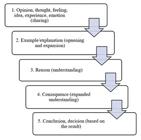
Model of asking questions in a group-discussion: The function of questions and the order to ask questions in a group-discussion to scaffold children step by step to improve their reasoning skills and critical thinking. Note: The model illustrates how questions can function in philosophical discussion; it is not a norm that must be followed in every discussion.
discussion leader's attitude and beliefs reflected in behavior and actions
The discussion leader believed good questions help to think that all children´s answers deserve attention and need to be accepted in a respectful way. The discussion leader was interested in what the child was thinking and made an effort to find out from each child how the child came to such an idea. The discussion leader listened neutrally and responded to the children's answers non-judgmentally (without saying right or wrong, without evaluative body language). For example, … even if I had heard a child telling me something I didn't understand or giving an answer that seemed to be wrong for me, I still remained calm and neutral. …didn't show it in any way with facial expression or body language (Researcher´s diary).
Attitude monitoring also made it difficult for the discussion leader to be fully present and to see that words and actions were aligned. For example, ... this is immediately reflected in the children's responses when I am not fully present. This is very important, because then the children dare to express their opinion. They need to feel that I have no ulterior motives. (Researcher´s diary).
discussion leader´s own opinion
It was also revealed that the discussion leader attempted to refrain from expressing their personal opinion in every discussion by directing the children to reason. If the children wanted to share their opinion during the discussion, the discussion leader aimed to ask the children a question about it. Discussion leader also thought about the topic before the discussion, and has prepared sample questions for the discussion process so as not to be tempted to share their views with the children in the middle of the discussion, because the opinion shared by the discussion leader themselves can inhibit children's thinking and courage to express their own opinion (Researcher´s diary).
time for thinking and agreements
Another discussion leader´s attitude that is related to the topic was to give the children sufficient time to think and to organise their responses. To this end, the discussion leader had developed an agreement with the preschoolers. If after the question the children started waving their hands and everyone wanted to answer at the same time, the discussion leader used a gesture, with a request to lay their hands down: …let's put our hands down and take time to think, and if I repeat the question again, only after that raise your hand if you are ready to answer the question. (Researcher´s diary)
In the same way, using a talking ball gave extra time for thinking. The discussion leader introduced the agreement that whoever has the ball speaks. As long as the ball was moving from one speaker's hand to another, everyone had time to think about what words to use to express their opinion (Researcher´s diary).
A thinking-experiment was used in various discussions, which allowed children to delve deeper through fantasy and help to understand the subject better, but also provided the necessary quiet time to think (technically Wait time 1) and also supported slower thinkers as well as quieter and more modest children. The thinking-experiments facilitated higher cognitive processes and encouraged children to speak and answer questions. For example, one thinking-experiment could begin with the following words: Please imagine what it would be like if that were the case. What if time did not exist? or How would it be if all the people in the world could do what they wanted? or What if all people in the world were friends? or What if no one in the world could lie? (Researcher’s diary).
discussion
Asking questions is not an easy task to guide children's productive thinking in a group discussion. Firstly, the teacher must have an understanding of which cognitive processes are activated by asking open-ended or closed-ended questions with different functions. Secondly, as Chin (2007) also argues, the teacher must have pedagogical skills to generate appropriate questions that are gradually built up from the previous ones in order to help children create conceptual frameworks. Thirdly, to use a range of different questioning techniques to encourage children to express their thoughts and support the children’s way of thinking.
In order to answer the first research question, the open- and closed-ended questions asked during the group-discussions and their functions were described. The analysis revealed eight functions of open questions and five functions of closed questions, along with five sub-functions (Table 2 and Table 3). In order to answer the second research question, the techniques used in asking open- and closed-ended questions that emerged in the analysis and the attitude and beliefs of the discussion leader that were reflected in the corresponding activities and behavior were described. Next, a discussion will be opened on the main results.
According to the results of this research, a Model of asking questions in a group-discussion was prepared, that provides instructions for asking questions in a purposeful way based on the function of the previous question and the child's answer (Figure 1). For example, a question with the function to guide to express opinion (or idea or experience …) is suitable to ask before the question with the function that guides to reason. Normally, it is preferable to first ask what the child thinks and then to ask why the child thinks so. Asking questions with the purpose of enhancing reasoning skills, whether the question that guides to reason should be asked as soon as possible in a group-discussion, when the children are not fatigued and their attention is high. Therefore, it is important to avoid questions that just control memory, waste time unnecessarily which are then asked immediately after the introduction or at the beginning of the discussions. The question that guides to reason should be asked immediately after the opinion or example has been expressed. Also, when beginning the discussion with a why question, the discussion leader needs to be aware which are these cognitive activities that children have to cope with independently and in silence in order to be prepared to answer. Firstly, the child has to generate their own opinion and then analyse why they think that way, then to put it into words, then inform that they want to answer with agreed hand sign whilst at the same time wait for their order, and also to keep in mind their thought, simultaneously listening to another child talking and, finally, received the signal to give their reason verbally. These eight simultaneous cognitive and behavioral activities are a big challenge for a 5-to-6-year-old, thus need to be carefully considered before asking why questions as soon as possible in a group discussion while they still are motivated to think about them. Each subsequent question from the discussion leader is initiated from the child´s response and it helps to consider which type and function of question should come next, e.g. based on the Model of asking questions in a group-discussion. Chin (2007) has also considered that the teacher's questioning must be purposefully structured around different forms of thinking and that the questions must act as rungs of the "cognitive ladder" allowing for higher levels of understanding. Similarly, the concept shown in the Model of asking questions in a group-discussion helps create a bridge where knowledge is gradually co-created socially. When the discussion leader, following the model, began with questions that explored the children's opinions, experiences, or specific examples, and only then moved on to questions that required justification, the children were able to express their thoughts more clearly. This is based on Pagliaro's (2011) assertion that the discussion leader's questions should guide children's thinking and be reformulated when necessary to ensure comprehensibility. Supporting children's thinking step by step with questions of different functions can in turn help to avoid cognitive overload. Additional questions should only be asked after the previous question has been answered in order to avoid overwhelming the child with several questions at once, thus avoiding cognitive overload.
The study also supports the theoretical claim that effective questioning must foster caring, collaborative, critical, and creative thinking (McLeod et al., 2020; Pagliaro, 2011). For example, "why?" questions encouraged critical thinking and were particularly effective when the children's attention, self-confidence, and willingness to think were already sufficient. The understanding that caring and collaborative questioning requires sensitivity to children's emotional readiness is also confirmed (McLeod et al., 2020; Pagliaro, 2011). The study showed that memory-testing questions posed at the beginning of discussions reduced children’s focus and willingness to think. In contrast, encouraging expressions such as “What do you think?” or “What do others think?” helped create a caring atmosphere, increased willingness to speak, and supported collaborative thinking. In the discussion, it is important to ask questions in a wording that activates the children verbally and also eliminates the fear of answering incorrectly. For example, questions can contain phrases What do you mean or What do you think which in this study were often added in the formulation of open- and closed-ended questions. These kinds of phrases seemed to activate children to respond verbally and with reasoning. This could be because, by asking the question, the phrase gave some kind of space, freedom, softness and warmth. Simply using the pronoun, you in the wording of the question helps to personalise the question as Pagliaro has highlighted (2011). Personalizing the question in this way also encourages and activates the children and signals that the child really can say what's on their mind.
A particularly noteworthy finding concerns closed-ended questions. Although often considered restrictive, the results show that closed-ended questions can support critical thinking in cases where they prompt the child to compare, hesitate, or explain. Three functions of a closed-ended question are to help guide children to longer responses and at times to reason verbally, therefore, it is recommended to ask children some Yes/No questions: (1) which guide to hesitate, (2) to explain, and (3) to compare. With these three functions of Yes/No questions, the discussion leader did not know the potential answer to the question, and the children often answered these closed-ended questions longer and reasoned verbally. This finding opposes the research from Lee and Kinzie (2012), who pointed out that closed-ended questions do not lead to answering longer and argumentatively. These closed-ended questions provided a safe and easily comprehensible structure that enabled children to engage in critical thinking, such as identifying reasons, comparing viewpoints, and drawing conclusions. Thus, not all closed-ended questions can be considered worthless in supporting higher-level reasoning skills. Younger children can better understand some closed-ended questions, which are cognitively more accessible and understandable to them, and therefore also enable them to answer more logically and with reasoning. One reason why the child does not answer the question is that they do not understand the content of the question (Walsh & Sattes, 2015).
The reason why children in this study gave longer answers to some closed-ended questions, providing reasons and explanations, may lie in the nature of the discussion process and regular participation in it. In the context of philosophical debate, where a closed-ended question is usually followed by an open-ended question that prompts the respondent to justify their previously expressed opinion, if this happens repeatedly, it becomes a habit. This is made possible by a discussion process in which participants consistently engage and where it has become common for participants to justify their opinions even before they are explicitly asked to do so, thus enabling them to give longer answers and justifications even to closed questions.
The repetition of questions gives the child more time to think and encourages children to answer verbally. Therefore, it is essential to highlight that repeated questions elicit the attention again and again, whilst also giving the prompt to more than one child, and thereby the repeated question becomes more meaningful and understandable for the child. The child will better understand the meaning of single words, discussing deeply and maintaining focus on the topic. This is similar to the findings of Krähenbühl and Blades (2008), who pointed out that the repetition of the question helped to guide children to give more open and more verbal responses. The repetition of questions provides the possibility to hear potential unfamiliar concepts in the question multiple times. It is important to understand the meaning of the concepts and to make these their own, this finding is consistent with Vygotsky´s (2014/1934) conclusion, that by hearing the same concept repeatedly, the meaning of the concept is understood, after which the child can start using the new concept themselves.
The discussion leader´s role is vital for purposeful discussion. The discussion leader needs to scaffold children with curiosity and interest, ask what the child is thinking and why the child responds in that way without judgment and in a neutral, accepting and respectful way. For example, Walsh and Sattes (2015) also give general recommendations to refrain from judgemental comments to every child response. In addition, the teacher should be more interested in how the child came to such an opinion, rather than what is the correct answer to the question (Walsh & Sattes, 2011). As Chen et al. (2017) argued, teachers are not always willing to listen to what students have to say. If we want children to be ready to actively participate in discussions, the teacher’s inquisitive attitude becomes decisive. The teacher’s role must be to encourage the children so that they want to express their opinion. The discussion leader's decision not to steer the children towards specific answers allowed them to apply creative thinking, seek alternative explanations, and test new ideas, just as McLeod et al. (2020) and Pagliaro (2011) consider supporting creative thinking to be important.
The discussion leader's belief in keeping their own thoughts largely hidden for as long as possible so that the children would not hesitate to express their thoughts, which might differ from those of the discussion leader, also gave the children new ideas and a sense of value. Pagliaro (2011) shares a similar view that teachers should be able to forget and even block their own thoughts about the topic. The results showed that the discussion leader needs to believe that giving one's opinion is not a priority, instead to think about own thoughts about the topic of the discussion before the discussion takes place, for example, when preparing the questions for the discussion process. The discussion leader's own thoughts should be kept largely hidden so that children do not follow their example and do not hesitate to express their own thoughts, which may differ from those of the discussion leader´s. Instead of expressing one's opinion it is better to ask a question to scaffold children´s own thinking.
Some limitations of this study. One drawback can be pointed out when categorizing questions, only open and closed questions were selected, and subtypes of procedural questions were not created. Since in this work it was important to discover which cognitive processes the questions activate in the respondent from the point of view of reasoning ability, differentiation was offered by different functions of the questions.
The second limitation concerns the interpretation of the results in relation to the sample. The children in the sample studied with several different teachers on a daily basis, so it is not possible to identify what else influenced the results. The results obtained are context specific and transferability is unknown.
The third limitation relates to the choice of topics discussed with the children in the study. The choice of the topic of the discussion is important in order to make it meaningful and interesting for the children, in order to motivate them to talk and think. One of the dangers is and always will be that some topics will interest one child more and another less, so not all children will have shown their full potential for reasoning in these discussions. In order to promote children's thinking at a higher cognitive level, it is necessary to systematically use different questioning techniques, and the teacher must carefully monitor the attitude that the child creates when asking questions and show curiosity and the desire to listen to the child. Similarly, Chen et al. (2017) consider that the teacher needs a flexible approach to orchestrate the discussion. The challenge of the discussion leader is always to choose an appropriate question and questioning technique in the reflections during the discussion, because every discussion and every discussion leader is different. It would be necessary to study in more depth how to support the discussion leader who simultaneously analyses the answers given by the children and keeps the topic in focus and decides on the next step in the discussion.
conclusion
The findings of this study indicate that supporting children’s productive and higher-order thinking in group discussions depends largely on the discussion leader’s purposeful and theory-based use of questions. The results of this study may be useful for discussion leaders who wish to conduct philosophical discussions with children. In conclusion, the eight functions of open questions and five functions of closed questions described in the results and interpreted in the discussion, together with the model for asking questions in group-discussions, help the discussion leader to create a logical structure and prepare for a possible discussion. It can be concluded that, among the open-ended questions, why-questions most clearly supported critical thinking, and their function was to guide reasoning. It is important to ask why-questions about what the child has said previously. However, in order to support and justify a child's thinking, it may be necessary to ask questions with a different function before reaching the why-questions in the discussion process. Therefore, it may also be necessary to ask some closed-ended questions designed to encourage the child to hesitate, explain, and compare, which may also lead preschoolers to reasoning. However, there is a risk of causing cognitive overload in the child's mind by asking too many different questions during the discussion process.
One strength of the study is that it highlights one possible way in which a consciously structured sequence of questions can reduce the cognitive load on children. During this study, a model for asking questions in group discussions was developed, which provides guidelines for asking questions in a purposeful manner, based on the function of the previous question and the child's answer. Following this model can support the child's thinking and reasoning in a way that helps avoid cognitive overload, as questions are asked step by step with questions of different functions.
In conclusion, this study shows that conducting meaningful philosophical group discussions with children requires a comprehensive and theoretically grounded approach. Effective discussion management depends on a logically structured sequence of questions, question wording that is understandable, personalized, and supportive for the child, conscious repetition and rephrasing of questions, and a discussion leader whose attitude, beliefs, and behavior are non-judgmental, inclusive, attentive, and caring.
Further research into philosophical discussions with school-aged children could help bridge the gap between theoretical understanding and practical support for critical thinking. The development of critical thinking skills is considered very important for people of all ages. This points to the need to investigate how philosophical discussion supports critical thinking and reasoning in school-age children and how discussion leaders who conduct philosophical discussions with adolescents can be better supported. Based on the results of this study, it is necessary to find other models for asking questions in the discussion process, compare them, and also clarify the applicability of the question-asking model created in this study with other discussion leaders and other target groups.
Acknowledgements:
Many thanks to the children who participated in the study. This research was supported by ESF Eduko programme
references
- Alushariduse riiklik õppekava, (2025). [National curriculum for early childhood education in Estonia.]
- Bassham, G., Irwin, W., Nardone, H., & Wallace, J. M. (2008). Critical thinking. A student´s introduction Third edition. McGraw-Hill.
-
Birbili, M. (2013). Developing young children's thinking skills in Greek early childhood classrooms: curriculum and practice. Early Child Development and Care, 183(8), 1101-1114, DOI: http://dx.doi.org/10.1080/03004430.2013.772990
» https://doi.org/10.1080/03004430.2013.772990 - Brookfield, S. D., & Preskill, S. (2005). Discussion as a way of teaching. Tools and techniques for democratic classrooms Jossey-Bass.
- Calvert, K. (2004).Können Steine glücklich sein?: Philosophieren mit Kindern Rowohlt Taschenbuch.
-
Cam, P. (2013). Philosophy for children, values education and the inquiring society. Educational Philosophy and Theory, 46, 1203-1211, http://dx.doi.org/10.1080/00131857.2013.771443
» https://doi.org/10.1080/00131857.2013.771443 - Chen, Y. C., Hand, B., & Norton-Meier, L. (2017). Teacher roles of questioning in early elementary science classrooms: A framework promoting student cognitive complexities in argumentation. Research in Science Education, 47, 373-405.
-
Cheung, K. K. C., & Tai, K. W. H. (2021). The use of intercoder reliability in qualitative interview data analysis in science education.Research in Science & Technological Education,41(3), 1155-1175. https://doi.org/10.1080/02635143.2021.1993179
» https://doi.org/10.1080/02635143.2021.1993179 - Chin, C. (2007). Teacher questioning in science classrooms: Approaches that stimulate productive thinking. Journal of Research in Science Teaching: The Official Journal of the National Association for Research in Science Teaching, 44(6), 815-843.
- Damm, A. (2003). Ist 7 viel?: 44 Fragen für viele Antworten. Moritz Verlag.
- Damm, A. (2009).Nichts und wieder nichts: Anlässe, um miteinander über Nichts nachzudenken Moritz Verlag.
-
Daniel, M. F., Gagnon, M., & Pettier, J. C. (2012). Chapter 7 Philosophy for Children and the Developmental Process of Dialogical Critical Thinking in Groups of Preschool Children. By John A. Sutterby (Ed.) Early Education in a Global Context. Scribbr. http://goo.gl/OdQAtj
» http://goo.gl/OdQAtj - De Laubier, M., Proteaux, C., & Randerath, J. (2006).Wie geht die Welt?: hundert Kinderfragen Gabriel in der Thienemann-Esslinger Verlag.
-
Elo, S., & Kyngäs, H. (2008). The qualitative content analysis process. Journal of Advanced Nursing 62(1), 107-115. http://doi: 10.1111/j.1365-2648.2007.04569.x
» https://doi.org/10.1111/j.1365-2648.2007.04569.x - Haglund, L. (2007). Gedankenspiele: Philosophie für Kinder Bertelsmann Verlag.
- Harris, D., & Williams, J. (2012). The association of classroom interactions, year group and social class. British Educational Research Journal, 38(3), 373-397.
- Hess, D. E. (2004). Discussion in social studies: Is it worth the trouble? Social Education, 68(2), 151-157.
-
Ho, D. G. E. (2005). Why do teachers ask the questions they ask? Regional Language Centre Journal, 36, 297 - 310. https://doi: 10.1177/0033688205060052
» https://doi.org/10.1177/0033688205060052 -
Kizel, A. (2019). Following philosophy with children concepts in practice of teacher education.Childhood & Philosophy,15, 01-21. https://doi.org/10.12957/childphilo.2019.44574
» https://doi.org/10.12957/childphilo.2019.44574 - Koolieelse lasteasutuse riiklik õppekava (2008). [Estonian National Curriculum.]
- Krähenbühl, S. J., & Blades, M. (2008). Does the form of question repetition have an effect on children’s recall accuracy and consistency? International Journal of Police Science & Management, 11(4), 460-475.
- Labbé, B., & Puech, M. (2003).Denk dir die Welt: Philosophie für Kinder Loewe.
-
Lee, Y., & Kinzie, M. B. (2012). Teacher question and student response with regard to cognition and language use. Instructional Science, 40, 857-874. https://doi:10.1007/s11251-011-9193-2
» https://doi.org/10.1007/s11251-011-9193-2 -
Lee, Y., Kinzie, M. B., & Whittaker, J. V. (2012). Impact of online support for teachers’ open-ended questioning in pre-k science activities. Teaching and Teacher Education, 28, 568 - 577, https://doi:10.1016/j.tate.2012.01.002
» https://doi.org/10.1016/j.tate.2012.01.002 - Lipman, M. (1977). Philosophy in the classroom, 1-106. Institute for the Advancement of Philosophy for Children, Montclair State College, Upper Montclair, New Jersey.
-
Lone, J. M. (2011). Questions and the community of philosophical inquiry. Childhood & Philosophy , 7(13), 75-89. Retrieved from https://www.e-publicacoes.uerj.br/childhood/article/view/20579
» https://www.e-publicacoes.uerj.br/childhood/article/view/20579 - Matthews, G. B. (1991).Denkproben: philosophische Ideen jüngerer Kinder Freese Verlag.
-
McLeod, N., Stockell, K., Astbury, E., & Julie McCann, J. (2020). Nurturing young children’s self-identity and respect for difference through artwork as a provocation using philosophical enquiry: a pilot study. Early Years, https://doi: 10.1080/09575146.2020.1817870
» https://doi.org/10.1080/09575146.2020.1817870 -
Moodley, D. E., & Chetty, R. (2024). Conceptualizing critical thinking pedagogy in teacher education. Childhood & Philosophy , 20, 01-23, https://doi.org/10.12957/childphilo.2024.81799
» https://doi.org/10.12957/childphilo.2024.81799 - Morf, E. Z. (1998).Philosophische Reise: unterwegs mit Kindern auf der Suche nach Lebensfreude und Sinn Atlantis Verlag.
-
Nikolidaki, S. (2025). Training preschool education students to listen philosophically to children.Childhood & Philosophy ,21, 01-28. https://doi.org/10.12957/childphilo.2025.88813
» https://doi.org/10.12957/childphilo.2025.88813 - Pagliaro, M. M. (2011). Exemplary classroom questioning Rowman & Littlefied education
-
Reznitskaya, A. (2012). Rethinking language use during literature discussions. The Reading Teacher 65, 446-456. https://doi:10.1002/TRTR.01066
» https://doi.org/10.1002/TRTR.01066 - Robitaille, Y. P., & Maldonado, N. (2015). Teachers’ experiences relative to successful questioning and discussion. American International Journal of Contemporary Research, 5(1), 7 - 16.
-
Siraj-Blatchford, I., & Manni, L. (2008). ‘Would you like to tidy up now?’ An analysis of adult questioning in the English Foundation Stage Early Years, 28(1), 5-22. https://doi: 10.1080/09575140701842213
» https://doi.org/10.1080/09575140701842213 -
Säre, E., Luik, P., & Fisher, R. (2016). Supporting educational researchers and practitioners in their work in education: assessing the verbal reasoning skills of 5- to 6-year-old children. European Early Childhood Education Research Journal, 25(5), 638-651, https://doi:10.1080/1350293X.2016.1213564
» https://doi.org/10.1080/1350293X.2016.1213564 -
Säre, E., Luik, P., & Tulviste, T. (2016). Improving pre-schoolers´ reasoning skills using the Philosophy for Children programme. Trames: Journal of the Humanities and Social Sciences, 20(3), 273-295. Estonia: Estonian Academy Publishers, https://doi: 10.3176/tr.2016.3.03
» https://doi.org/10.3176/tr.2016.3.03 -
Säre, E., Tulviste, T., & Luik, P. (2019). The function of questions in developing a preschooler’s verbal reasoning skills during philosophical group discussions. Early Child Development and Care , 189(4), 555-568, https://doi: 10.1080/03004430.2017.1331221
» https://doi.org/10.1080/03004430.2017.1331221 - Säre, E. (2019). Teacher´s competence to compose questions supporting students reasoning skills.IJO - International Journal of Educational Research, 27−36.
- Sun, J., Anderson, R. C., Lin, T.-J., & Morris, J. (2015). Social and cognitive development during collaborative reasoning. In C. S. Asterhan, S. N. Clarke, & L. B. Resnick (Eds.), Socializing intelligence through academic talk and dialogue American Educational Research Association.
- Walsh, J.A., & Sattes, B. D. (2015). Questioning for classroom discussion ASCD.
- Walsh, J. A., & Sattes, B. D. (2011). Thinking through quality questioning Sage.
- Walsh, J. A., & Sattes, B. D. (2005). Quality questioning. Research-based practice to engage every learner Sage.
- Witherspoon, M., Sykes, G., & Bell, C. (2016). Leading a classroom discussion: Definition, supportive evidence, and measurement of the ETS® National Observational Teaching Examination (NOTE) assessment series (Research Memorandum No. RM-16-09). Princeton.
-
Vaismoradi, M., Bondas. T., & Turunen, H. (2013). Content analysis and thematic analysis: Implications for conducting a qualitative descriptive study. Journal of Nursing & Health Sciences, 15(3), 398-405. https://doi: 10.1111/nhs.12048.
» https://doi.org/10.1111/nhs.12048 - Vygotsky, L. (2014/1934). Title in Estonian: Mõtlemine ja kõne. Psühholoogilised uurimused [ Title in English: Thinking and speech. Psychological studies] Ilmamaa. Translated original from 1934.
- Zeitler, K. (2010) Siehst du die Welt auch so wie ich? Philosophieren in der Kita Verlag Herder.
- Zoller, E. (2008) Väikesed filosoofid: kuidas reageerida laste rasketele küsimustele Ilo.
credits
-
how to quote this article:
ABNTSäre, E. Questioning techniques in a philosophical group-discussion scaffolding estonian preschoolers critical thinking and reasoning. childhood & philosophy, v. 22, p. 1-33, 2026. Disponível em: ______. Acesso em: ______. doi: 10.12957/childphilo.2026.927228APA:Säre, E. (2026). Questioning techniques in a philosophical group-discussion scaffolding estonian preschoolers critical thinking and reasoning. childhood & philosophy, 22, 1-33. doi: 10.12957/childphilo.2026.927228
-
Financing:
Author(s) confirm that there are no relevant financial or non-financial competing interests to report.
-
Ethical approval:
Not applicable.
-
Availability of data and material:
Not applicable.
-
Image:
Not applicable.
-
Preprint:
Not published in preprint repository.
-
article submitted to the similarity system

Edited by
Not applicable.

 Source: Author.