 Does surgical treatment of lumbar disc herniation recurrence using the endoscopic technique improve radicular pain? A systematic review and meta-analysis
ABSTRACT
To evaluate the effectiveness of percutaneous endoscopic lumbar discectomy (PELD) in the treatment of recurrent lumbar disc herniation, comparing it with conventional techniques with an emphasis on the improvement of radicular pain. Systematic review and meta-analysis of 6 studies with statistical analysis using the fixed-effect Mantel-Haenszel model and Cochran’s Q test for heterogeneity. Improvement in radicular pain was assessed using the Visual Analog Scale (VAS), and recurrence rates were evaluated using relative risk (RR), adopting a significance level of 0.05%. A total of 622 patients were included (55% male, 45% female) with a mean age of 46 years. The endoscopic technique reduced VAS scores by more than 23% compared to traditional techniques. Disability scales, evaluated through measures of central tendency, showed no significant differences between techniques. Recurrence rates in the experimental (endoscopic) group were 4.7%, with a pooled RR of 3.66 (95% CI: 1.8–5.1) and high heterogeneity (I² = 95%). There was no significant difference in recurrence rates based on follow-up duration (mean of 2 years). The endoscopic technique was effective in improving radicular pain in the surgical treatment of recurrent lumbar disc herniation, and when compared to the conventional technique, this improvement was 23% greater based on the analysis of visual analog scale (VAS) scores. Level of Evidence I; Systematicc reviewb of Level I RCTs (and study results were homogenousc)
Keywords:
Orthopedics; Surgery; Spine; Herniated Disc; Minimally Invasive Surgical Procedures
RESUMO:
Avaliar a eficácia da discectomia endoscópica percutânea (DELP) no tratamento de recidivas de hérnia de disco lombar, comparando-a com técnicas convencionais com ênfase na melhora da dor radicular. Revisão sistemática e metanálise de 6 artigos com análise estatística pelo modelo fixo de Mantel-Haenszel e teste Q de Cochran para heterogeneidade. A melhora da dor radicular foi avaliada pela escala visual analógica (EVA) e as taxas de recidiva pelo risco relativo (RR), adotando-se um nível de significância de 0,05%. Foram incluídos 622 pacientes (55% homens, 45% mulheres) com média de 46 anos, com a técnica endoscópica reduzindo em mais de 23% a pontuação da EVA comparado às técnicas tradicionais. Escalas de incapacidade, avaliadas por medidas de tendência central, não evidenciaram diferenças entre as técnicas. As taxas de recidiva no grupo experimental (endoscópico) foram de 4,7%, com RR acumulado de 3,66 (IC 95%: 1,8–5,1) com alta heterogeneidade (I² = 95%). Não houve diferença significativa nas recidivas pelo tempo de acompanhamento (média de 2 anos). A técnica endoscópica foi eficaz na melhora da dor radicular no tratamento cirúrgico da recidiva da hérnia de disco lombar e quando comparado com a técnica convencional, essa melhora foi 23% maior com base na análise das pontuações da escala visual analógica (EVA). Nível de Evidência I; Revisão sistemáticab de ECRC (Estudos clínicos randomizados e controlados) de Nível I (e resultados do estudo foram homogêneosc).
Descritores:
Ortopedia; Cirurgia; Coluna Vertebral; Hérnia de Disco; Procedimentos Cirúrgicos Minimamente Invasivos
RESUMEN:
Evaluar la eficacia de la discectomía endoscópica percutánea (DELP) en el tratamiento de recurrencias de hernia de disco lumbar, comparándola con técnicas convencionales, con énfasis en la mejora del dolor radicular. Revisión sistemática y metaanálisis de 6 artículos con análisis estadístico mediante el modelo fijo de Mantel-Haenszel y la prueba Q de Cochran para heterogeneidad. La mejora del dolor radicular se evaluó mediante la escala visual analógica (EVA), y las tasas de recurrencia por el riesgo relativo (RR), adoptando un nivel de significancia del 0,05%. Se incluyeron 622 pacientes (55% hombres, 45% mujeres) con una media de edad de 46 años, observándose que la técnica endoscópica redujo en más del 23% la puntuación de la EVA en comparación con las técnicas tradicionales. Las escalas de discapacidad, evaluadas mediante medidas de tendencia central, no evidenciaron diferencias entre las técnicas. Las tasas de recurrencia en el grupo experimental (endoscópico) fueron del 4,7%, con un RR acumulado de 3,66 (IC 95%: 1,8–5,1) y una alta heterogeneidad (I² = 95%). No hubo diferencia significativa en las recurrencias según el tiempo de seguimiento (media de 2 años). La técnica endoscópica fue eficaz en la mejora del dolor radicular en el tratamiento quirúrgico de la recurrencia de la hernia de disco lumbar y, en comparación con la técnica convencional, esta mejora fue un 23% mayor según el análisis de las puntuaciones de la escala visual analógica (EVA). Nivel de evidencia I; Revisión sistemáticab de ECRC (Estudios clínicos randomizados y controlados) de Nivel I (y resultados del estudio fueron homogéneosc).
Descriptores:
Ortopedia; Cirugía; Columna; Hernia Discal; Procedimientos Quirúrgicos Mínimamente Invasivos
INTRODUCTION
Lumbar disc herniation is a highly prevalent condition that often results especially in low back pain and neurological symptoms, significantly impacting patients’ quality of life. Surgical treatment is indicated in cases where conservative therapy does not provide adequate symptom relief, preventing the patient from returning to their usual activities, or in the presence of progressive neurological deficit. Among the surgical options for disc herniation removal, microdiscectomy remains the standard approach; however, currently, percutaneous endoscopic lumbar discectomy (PELD) has gained prominence as a minimally invasive technique for treating lumbar disc herniations. It is known that PELD offers results comparable to traditional techniques, with additional advantages such as shorter hospitalization time, minimal tissue damage, little pain at the surgical site, virtually zero infection rates, and a quicker return to work activities.1,2
Some patients experience recurrence of radicular symptoms after a symptom-free period, which may be due to postoperative recurrence of the primary disc herniation. A meta-analysis of nine comparative studies aimed to investigate the epidemiological prevalence of recurrent herniation in patients after percutaneous endoscopic lumbar discectomy and analyze potentially related risk factors found that surgery had a recurrence rate of 3.6%, usually occurring within the first 6 months after the procedure. Additionally, age over 50 years, obesity (BMI ≥ 25), as well as the presence of lumbar disc herniation at higher levels and with central location, were independent risk factors, while surgical approaches (PETD or PEID), lateral discs, migrated discs, and foraminoplasty do not influence recurrence, contributing to better preoperative assessment and patient selection.1
In the context of postoperative recurrence, when surgical treatment is indicated, endoscopic techniques may provide the advantage of avoiding scar tissue from previous surgery, such as being able to perform a transforaminal approach after a microdiscectomy or after an interlaminar approach in an attempt to avoid complications that this tissue may predispose.3
Recurrence of disc herniation remains a relevant clinical concern that may require re-surgical intervention, whether after conventional approaches or through minimally invasive techniques. Identifying risk factors for recurrence is essential to improve surgical outcomes and guide patient selection, as revision surgeries have higher complication rates and greater technical difficulty due to adhesions and scar tissue. Factors such as the integrity of the annulus fibrosus, atrophy of the paravertebral muscles, MODIC changes, advanced age, high BMI, surgical technique employed, and individual patient characteristics may influence recurrence rates.4seguida de lombociatalgia e, finalmente, de dor ciática pura. A história natural da hérnia de disco é de resolução rápida dos sintomas (quatro a seis semanas
Based on the above, this study aims to evaluate, through a meta-analytical analysis, the effectiveness of percutaneous endoscopic discectomy with an emphasis on improving radicular pain for the treatment of recurrent lumbar disc herniation, comparing it with conventional surgical techniques.
METHODOLOGY
A systematic review and meta-analysis was conducted to investigate the degree of improvement of radicular pain in patients with recurrent lumbar disc herniation after surgical treatment. To this end, the outcome evaluated was based on the scores of the visual analog scale (VAS). In addition, we also analyzed the recurrence rates, which were based on the relative risk (RR) concerning the incidence percentages of recurrences resulting from this surgical approach, analyzed based on the number of occurrences divided by the sample size of patients. In the analysis, in addition to calculating the measures of association, the fixed Mantel-Haenszel model was applied to evaluate the outcome.
The search strategy aimed to locate relevant published studies that answered the guiding question of the review. With the collaboration of a librarian, an initial search was conducted in the PubMed database to identify articles on the topic and to check if other terms, word variations, and keywords found in this search would be relevant to be added to the final search strategy. The informational resources for this review are the following databases and portals: PubMed, Scopus, Web of Science, Embase, Cochrane Library.
Keywords [medical subject descriptors (MeSH) and free terms] were used, which included: Endoscopy OR “Endoscopic Surgical Procedure” OR “Surgical Endoscopy” OR Endoscopic AND (“Lumbar Vertebrae” OR “lumbar vertebra” OR “lumbar Vertebra”) AND (Recurrence OR Recurrences OR Relapse OR Relapses OR Recrudescence OR Recrudescences) OR (“disease recurrence” OR “periodic disease” OR “relapsing disease” OR “symptom flare up” OR “recurrent disease”).
The titles and abstracts of the retrieved articles were imported into the Rayyan QCRI tool (Qatar Computing Research Institute, Doha, Qatar), being examined by two reviewers independently and in a blinded manner for evaluation against the established inclusion and exclusion criteria for the review. The articles included after the analysis of titles and abstracts were retrieved in full text. The full texts of the selected studies were evaluated in detail again by the two reviewers, also independently. Any discrepancies that arose at each stage of the selection process would be resolved through discussion between the two evaluators.
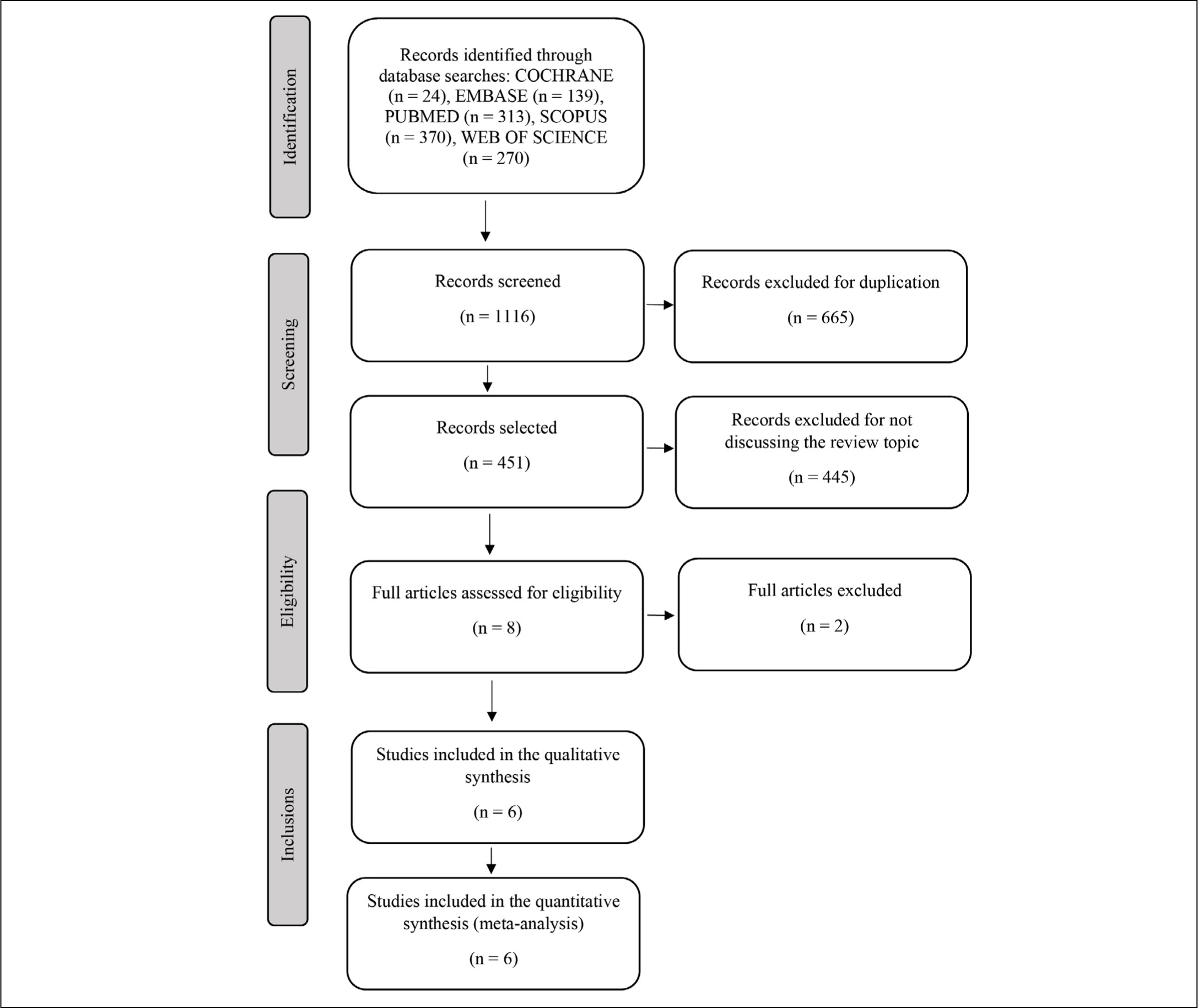
The results of the search and the study inclusion process are presented in the PRISMA flowchart (Figure 1).
Inclusion and exclusion criteria
Studies that analyzed the surgical treatment of postoperative recurrence of lumbar disc herniation using the endoscopic technique, including randomized and non-randomized clinical trials, cohort studies, and case series with at least 50 patients were included. All studies should have been published in the last 10 years and have a minimum follow-up of 1 year, with no language restrictions.
Studies conducted in children and adolescents, literature reviews, case reports, duplicate articles, comments, and interviews were excluded. In addition, studies that did not include the use of the endoscopic approach or that addressed other pathologies other than recurrent disc herniation were also excluded.
Heterogeneity was examined using Cochran’s Q test, whose null hypothesis posits that the studies included in the meta-analysis do not exhibit heterogeneity regarding randomized analyses and proposed therapeutic interventions. The percentages of efficacy of the surgeries were based on the hypothesis testing results and the association measures reported in the articles, adjusted by the I² index, according to the methodology described by Thompson and Higgins.5
Descriptive statistical analyses of the selected articles were performed, with hypothesis tests adopting a significance level of 0.05%. All statistical analyses were conducted using the software JASP, version 0.19.2 (2024).
The analysis of the DELP results in relation to the visual analog scales (VAS) was performed using Pearson’s correlation coefficient, based on the scoring and average variables between the techniques. The disability scale, as well as variables associated with surgical success, such as age, sex, surgery time, and complications during and after the procedures, were evaluated considering the differences in mean and confidence interval. In addition, hypothesis tests were conducted according to the parametric distribution of the data, using the Student’s t-test, adopting a significance level of 0.05.
RESULTS
After applying the exclusion criteria, 6 articles were included in the statistical analyses, considering the description of the methodologies applied to clinical trials associated with prospective cohorts and sample robustness. The descriptive analysis of the selected articles is represented in Tables 1 and 2.
Q Test values and the I2 test for the meta-analysis of the 6 articles that evaluate recurrence rates with endoscopic surgical techniques between 2008 and 2015.
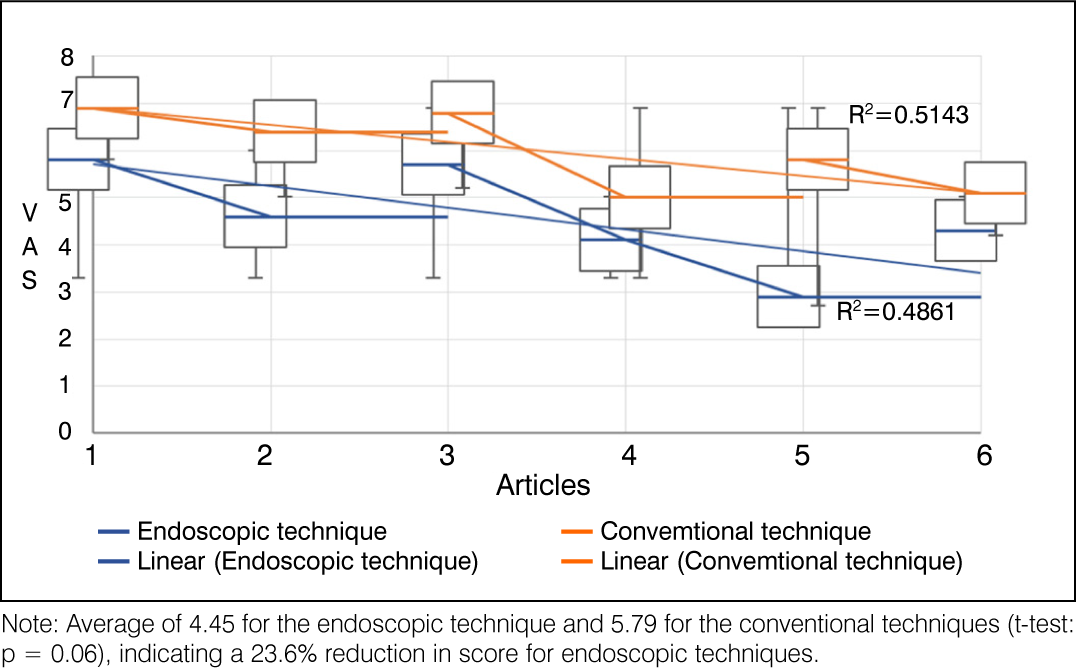
The results related to disability scales, VAS, surgery time, complications, and hospital stay can be seen in Table 3 and Figure 2. No differences were observed between the biological variables of sex and age. Of the 622 patients, 342 (55%) were male and 280 (45%) were female (p-value = 0.07), with an average age of 46 years in both sexes (p-value = 0.06).
Comparison of variables between surgical techniques using the paired t-test, with calculations based on the averages of the 6 analyzed articles.
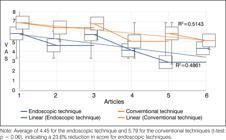
Score rate of the VAS, compared between conventional and endoscopic techniques, based on means and 95% confidence intervals (CIs), as observed in the six articles analyzed by Pearson regression technique.
Regarding the analytical factors involving recurrences in the experimental group, the incidence rates were 4.70% (geometric mean), with a cumulative Relative Risk of 3.66 (CI 1.8 – 5.1), as presented in Table 2. In total, the 6 selected studies included 622 patients (mean of 103), with a range varying from 56 to 262 patients.
The characteristics involving the data collection of each evaluated study and the recurrence time are described in Table 4. The follow-up time of the groups (mean of 2 years) did not show a significant difference regarding the recurrence rates between conventional and endoscopic techniques, based on the results of the t test of Student (p > 0.05).
Data collection and hypothesis testing for the difference between incidence rates regarding follow-up time between conventional and endoscopic techniques.
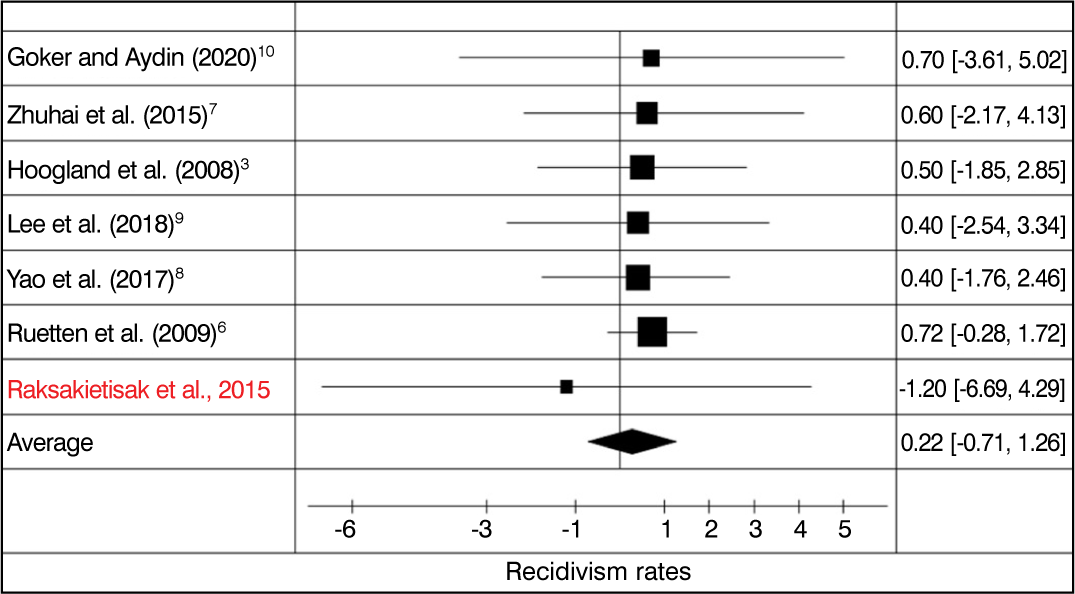
Figure 3 presents the Forest Plot gathering the articles that performed the direct comparison between the incidence rates of recurrences related to endoscopic surgical techniques. In this graph, the respective relative risks (RR) are highlighted.
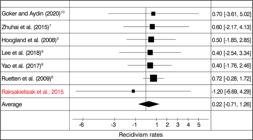
Forest plot regarding the measures of effect (Relative Risk - RR), comparing recurrence rates.
Values below 1.0 (to the left of the null line) show an effective reduction in the risk of recurrence with the use of endoscopic techniques, indicating them as a protective factor against this type of unfavorable outcome.
DISCUSSION
Regardless of the positive clinical results, this meta-analysis revealed that endoscopic techniques generally have lower recurrence rates. The calculation of the average RR allowed us to infer that patients operated on with endoscopic techniques had a recurrence risk of 3.6 times, contrasting with the RR of conventional techniques, which varied between 5 and 20 times. Despite the discrepancies in the analyses of these percentages,6 statistically significant differences were observed in all studies analyzed when the time variable (2 years of follow-up) was considered.
The analyses conducted in this study did not show a significant relationship between the scores obtained on the VAS and the surgical technique employed. The linear relationships presented moderate values of R2R2 (0.51 for conventional techniques and 0.41 for the endoscopic technique) (Figure 2). These confidence intervals suggest, supported by the means and their results, the absence of a significant difference between the scores. However, an average reduction of over 23% in the VAS score was noted among patients undergoing the endoscopic technique compared to those undergoing traditional techniques. Regarding the disability scales, these were not compared in all the analyzed articles, limiting their evaluation to measures of central tendency, which in turn also did not indicate significant differences between the evaluated techniques (Table 3).
Although it is not the primary objective of this work, the results of this systematic review and meta-analysis suggest that the use of endoscopic techniques for the treatment of disc herniation recurrences is associated with lower recurrence rates compared to conventional surgical techniques. The average relative risk (RR) of 3.6 indicates a significant superiority of endoscopic approaches in reducing recurrences, even considering the confidence interval (CI 95%: 1.8 – 5.1). These findings corroborate the literature related to the topic, which points to minimally invasive techniques as a promising alternative in terms of safety and efficacy, especially in patients with an increased risk of postoperative recurrences.6,11
Despite the observed benefits, the analysis of the follow-up time (average of 2 years) did not demonstrate significant differences in recurrence rates among the included studies. This may be attributed to methodological variability and differences in patient inclusion criteria, as discussed by Hoogland et al.3 and Lee et al.9. In addition, the substantial heterogeneity among the studies (I² = 95%) reflects the diversity of study designs, sample sizes, and surgical approaches adopted, which limits the generalization of the results.
Although the outcome favors endoscopic techniques, it is important to consider that other factors, such as the surgeon’s experience, appropriate patient selection, and postoperative management, can significantly influence clinical outcomes, as evidenced in some studies that early ambulation may be responsible for recurrence after DELP.12 Recent studies indicate that the learning curve for endoscopic techniques is longer compared to open techniques, which may impact the rate of complications and recurrences at the beginning of clinical implementation.13,14
Additionally, endoscopic techniques offer additional advantages, such as shorter hospitalization time, reduced postoperative pain, and quicker return to daily activities, which can improve patients’ quality of life.9,14 However, these benefits need to be balanced with the costs associated with the technology and the specialized training required, especially in healthcare systems with limited resources.
Finally, the robustness of the results of this meta-analysis supports the hypothesis that endoscopic techniques are an effective approach for improving radicular pain in the treatment of recurrent disc herniation and also for reducing recurrences after primary surgery.
CONCLUSION
The endoscopic technique was effective in improving radicular pain in the surgical treatment of recurrent lumbar disc herniation, and when compared to the conventional technique, this improvement was 23% greater based on the analysis of the visual analog scale (VAS) scores.
-
Study conducted by the Universidade Estadual de Campinas (UNICAMP), Zeferino Vaz University City - Barão Geraldo, Campinas, SP, Brazil, 13083-970.
DATA AVAILABILITY DECLARATION
Data will be made available upon request.
REFERENCES
- 1 Yin S, Du H, Yang W, Duan C, Feng C, Tao H. Prevalence of Recurrent Herniation Following Percutaneous Endoscopic Lumbar Discectomy: A Meta-Analysis. Pain Physician. 2018;21(4):337-350.
- 2 Asano LYJ, Bergamaschi JPM, Dowling Á, Rodrigues LMR. Transforaminal Endoscopic Lumbar Discectomy: Clinical Outcomes and Complications. Rev Bras Ortop. 2020;55(01):048–53.
-
3 Hoogland T, van den Brekel-Dijkstra K, Schubert M, Miklitz B. Endoscopic transforaminal discectomy for recurrent lumbar disc herniation: a prospective, cohort evaluation of 262 consecutive cases. Spine (Phila Pa 1976). 2008;33(9):973-8. doi: 10.1097/BRS.0b013e31816c8ade.
» https://doi.org/10.1097/BRS.0b013e31816c8ade -
4 Vialle LR, Vialle EN, Suárez Henao JE, Giraldo G. LUMBAR DISC HERNIATION. Rev Bras Ortop. 2015;45(1):17-22. doi: 10.1016/S2255-4971(15)30211-1.
» https://doi.org/10.1016/S2255-4971(15)30211-1 -
5 Thompson SG, Higgins JP. How should meta-regression analyses be undertaken and interpreted? Stat Med. 2002;21(11):1559-73. doi: 10.1002/sim.1187.
» https://doi.org/10.1002/sim.1187 -
6 Ruetten S, Komp M, Merk H, Godolias G. Recurrent lumbar disc herniation after conventional discectomy: a prospective, randomized study comparing full-endoscopic interlaminar and transforaminal versus microsurgical revision. J Spinal Disord Tech. 2009;22(2):122-9. doi: 10.1097/BSD.0b013e318175ddb4.
» https://doi.org/10.1097/BSD.0b013e318175ddb4 - 7 Li Z, Zeng Jiancheng, Song Y, Kong Q, Wang X, Chen G, et al. EFFECTIVENESS OF PERCUTANEOUS ENDOSCOPIC TRANSFORAMINAL DISCECTOMY FOR RECURRENT LUMBAR DISC HERNIATION. Zhongguo Xiu Fu Chong Jian Wai Ke Za Zhi. 2015 Jan;29(1):43-7.
-
8 Yao Y, Zhang H, Wu J, Liu H, Zhang Z, Tang Y, et al. Comparison of Three Minimally Invasive Spine Surgery Methods for Revision Surgery for Recurrent Herniation After Percutaneous Endoscopic Lumbar Discectomy. World Neurosurg. 2017;100:641-647.e1. doi: 10.1016/j.wneu.2017.01.089.
» https://doi.org/10.1016/j.wneu.2017.01.089 -
9 Lee JS, Kim HS, Pee YH, Jang JS, Jang IT. Comparison of Percutaneous Endoscopic Lumbar Diskectomy and Open Lumbar Microdiskectomy for Recurrent Lumbar Disk Herniation. J Neurol Surg A Cent Eur Neurosurg. 2018;79(6):447-452. doi: 10.1055/s-0037-1608870.
» https://doi.org/10.1055/s-0037-1608870 -
10 Goker B, Aydin S. Endoscopic Surgery for Recurrent Disc Herniation After Microscopic or Endoscopic Lumbar Discectomy. Turk Neurosurg. 2020;30(1):112-118. doi: 10.5137/1019-5149.JTN.27360-19.3.
» https://doi.org/10.5137/1019-5149.JTN.27360-19.3 -
11 Ahn Y, Lee SH, Park WM, Lee HY, Shin SW, Kang HY. Percutaneous endoscopic lumbar discectomy for recurrent disc herniation: surgical technique, outcome, and prognostic factors of 43 consecutive cases. Spine (Phila Pa 1976). 2004;29(16):E326-32. doi: 10.1097/01.brs.0000134591.32462.98.
» https://doi.org/10.1097/01.brs.0000134591.32462.98 -
12 Wang F, Chen K, Lin Q, Ma Y, Huang H, Wang C, et al. Earlier or heavier spinal loading is more likely to lead to recurrent lumbar disc herniation after percutaneous endoscopic lumbar discectomy. J Orthop Surg Res. 2022;17(1):356. doi: 10.1186/s13018-022-03242-x.
» https://doi.org/10.1186/s13018-022-03242-x -
13 Telfeian AE, Oyelese A, Fridley J, Moldovan K, Gokaslan ZL. Transforaminal Endoscopic Approach for Lumbar Extraforaminal Synovial Cysts: Technical Note. World Neurosurg. 2020;134:415-419. doi: 10.1016/j.wneu.2019.11.033.
» https://doi.org/10.1016/j.wneu.2019.11.033 -
14 Choi KC, Lee JH, Kim JS, Sabal LA, Lee S, Kim H, Lee SH. Unsuccessful percutaneous endoscopic lumbar discectomy: a single-center experience of 10,228 cases. Neurosurgery. 2015;76(4):372-80. doi: 10.1227/NEU.0000000000000628.
» https://doi.org/10.1227/NEU.0000000000000628