
 Smart cities: theoretical formulations and empirical approaches in the national and international scenario
Abstract
This article offers an alternative methodological framework for the smart city field, starting from a chronological literature review and empirical analysis of the smart city Konza Technopolis (Kenya), the smartification of São Paulo (State of São Paulo, Brazil), and the Smart City Laguna (State of Ceará, Brazil). Smart city experiences have been developed since the late 1990s, with greater expressiveness in the urban space from the 2010s onwards, concomitantly with an increase in the number of studies about the theme. Currently, the theme demonstrates a high level of discussion and maturity. Given its breadth, an analytical focus is necessary to address the particularities related to the three categories presented here: (1) smart cities developed from scratch; (2) initiatives aimed at consolidated cities; and (3) real estate developments.
smart city; smart city categories; Konza Technopolis; São Paulo; Smart City Laguna
Resumo
Este artigo oferece uma alternativa de recorte metodológico para o campo da Smart city, partindo de uma revisão bibliográfica temporal e análise empírica da Smart city Konza Technopolis (Quênia), da smartificação de São Paulo (SP/Brasil), e da Smart city Laguna (CE/Brasil). As experiências Smart city desenvolvem-se desde o final de 1990, detendo maior expressividade no espaço urbano a partir dos anos 2010, concomitantemente ao aumento das pesquisas a seu respeito. Atualmente, a temática apresenta elevado nível de discussão e amadurecimento e, dada sua amplitude, torna-se necessário o direcionamento analítico, devido às particularidades relativas às três categorias aqui apresentadas: (1) as Smart cities desenvolvidas a partir do zero; (2) as iniciativas voltadas às cidades consolidadas; e (3) os empreendimentos imobiliários.
smart city; categorias smart city; Konza Technopolis; São Paulo; Smart city Laguna
Introduction
In a scenario of urban growth with problems to be resolved regarding issues of natural resource control, mobility, infrastructure functionality, and especially the quest for public management capable of offering a high level of urban quality of life for people, the field of Smart Cities has gained prominence in studies and practical experiences. Therefore, it is of fundamental importance for the field of urban planning to understand the development of such a phenomenon.
Even though experiences in implementing Smart City initiatives began to expand more intensively around 2010 to the present moment, the theoretical debate on the topic is not so recent, as will be seen in the following section, based on the work of authors such as Söderstrom, Paasche e Klauser (2014), Hall et al. (2000), and Mahizhnan (1999), which allow for the discussion of the history of these initiatives.
Since the last decade of the 20th century, the subject has been addressed by various theorists around the world, and more recently, it has gained greater maturity and critical analysis of its dynamics. Dialectically, the analysis undertaken here is based on a bibliographic review of this field of study from the 1990s to the most recent years, contrasting these perceptions with the current experiences in the process of development in the world and in Brazil.
This work is the result of a long period of research related to the field of urban planning and the theme of the capitalist production of space. Within the scope of the Urban Management and Public Policies Center (NUGEPP),1 since 2019, studies have been developed initially analyzing the phenomenon of the expansion of a certain category of Smart Cities on the African continent, subsequently aiming to mature the understanding of how other development dynamics of Smart Cities occur in different territories, in the Brazilian and international context, based on the research of authors such as Avianto (2017), Balkaran (2019), Silva (2021), Leal (2022), Capdevilla and Zarlenga (2015), among others, which will be discussed in the next section.
The results presented in this work are the fruit of research development, which considered the qualitative exploratory methodology, enabling an understanding of how this scenario of expansion of urbanistic experiences related to this field of study was constructed. As this is a dynamic that has been widely explored more recently, with a large part of its implementation experiences still in development and projects spread across various territories around the globe, this article seeks to offer a categorization basis for Smart Cities that serves for the development of future research. At the same time, it reflects an understanding of the current development scenario of such initiatives and provides possibilities for analytical cutouts.
The central argument of this work lies in the understanding that: considering the breadth and potential for socio-spatial transformation of urbanistic practices promoted as Smart Cities, it is necessary to pay attention to the particularities of each of the categories presented — (1) Smart Cities developed from scratch; (2) experiences aimed at consolidated cities; and (3) real estate developments. This is to avoid unwarranted generalization of these initiatives as an object of study and/or practical intervention.
In this sense, it is important to highlight that for each category of Smart City defined by this work, knowledge as a methodological foundation is crucial. However, future research should observe the peculiarities of their respective objects of study, which may differentiate them between one category and another presented here, until the development of new categories is envisioned. This is because the Smart City object is constantly evolving, mainly to meet the demands for innovation in products within the real estate market or as a solution to urban problems.
This essay is structured into three parts – (1) Theoretical formulations on Smart City, in which the development of this concept and the maturation of its critical reflections will be presented; (2) Proposition of Smart City categories, where the relevant conditions of each presented category will be exposed; and (3) Empirical approaches, where three case studies will be presented and critically analyzed as examples of each of the proposed categories.
Theoretical formulations on Smart City
The field of study and urbanistic experience of Smart Cities is not recent. As presented by Söderström, Paasche, and Klauser (2014), as early as 1997, experiences already self-titled as Smart were being developed in the cities of Cyberjaya and Putrajaya in Malaysia, with the State as the protagonist. At that time, there was a discursive intersection between the use of technology in urban space aimed at improving the population’s quality of life through the automation and optimization of urban processes and services.
Even though advancements in communication means promoted by information technologies, which theoretically would corroborate greater articulation and exchange of knowledge internationally among academia, when we dedicate ourselves to investigating the production of knowledge related to this field of study, it is not possible to find a semantic alignment regarding the interpretations about it. An example of this can be seen through a brief comparative analysis between two manuscripts produced by different authors situated in distinct territories.
In the late 1990s, we can find the work of Mahizhnan (1999), which already presents a critical perspective by highlighting the geographical particularities of Singapore, an island state, and its constant need to be “Smart” to deal with the scarcity of its natural resources. In Mahizhnan (ibid.) it is understood the necessity of not advancing solely with technologies, viewing them as potential saviors, but recognizing that there are both positive and negative aspects linked to their use. Moreover, it is the people who are indeed capable of guiding a positive transformation through the right choices.
In contrast, in the early 2000s, in the USA, research was promoted by the Brookhaven National Laboratory that aimed to incorporate public and private actors in the discussion of this possibility of urban development, primarily guided by standards of efficiency and economic growth. In that scenario, for these participants, the success of a Smart City initiative would be based on the development of technology focused on urban space, directed towards the operational aspects of the city, capable of providing integrated information for state managers (Hall et al., 2000).
Much was said about the tripartite relationship between the State, market, and academia to promote the evolution of technologies capable of making their cities more competitive in the context of international investment flows, excluding the participation of people. As can be seen in Figure 01, in the diagram created by the Brookhaven Laboratory, there is no mention of social participation in the study and development of Smart Cities.

Proposed Diagram for the Research and Development of Smart Cities by the Brookhaven National Laboratory (2000) U.S. Department of Energy
In various approaches, the Smart City is presented as an alternative solution to urban problems, whether they are socio-spatial, economic, or environmental in nature, based on the Information and Communication Technology (ICT). At times, it is interpreted as a cure-all solution, while at other times, it is seen merely as one among other possibilities for improving the quality of life of people living in urban spaces. To a greater or lesser extent, such interpretations can be observed in the approaches mentioned above, which date from the late 1990s and early 2000s but continue to influence the analysis of subsequent works.
Since 2010, studies on Smart Cities have continued to develop. Despite a decade having passed, the concept remains opaque, with many approaches still failing to establish a solid definition. Research spans from more technical studies, related to engineering, to social sciences.
Thus, Chourabi (2012), based on a bibliographic review effort regarding Smart Cities, proposes eight factors synthesizing the themes that were relevant to the study of this field up to that point. These factors are management and organization, technology, governance, political context, people and communities, economy, built infrastructure, and natural environment, as shown below (Figure 02). The inclusion of the variable “People” in the analysis of smart city experiences is noticeable, as the author states: “Addressing the theme of people and communities as part of Smart Cities is crucial and has traditionally been neglected in favor of understanding more technological and political aspects of Smart Cities” (Chourabi et al., 2012, p. 2293, free translation).

Regarding the work of Chourabi et al. (2012), it is noticeable that although there is progress in interpreting the phenomenon, the author presents his integrative framework of the eight factors with two levels of influence. Technology, organization, and politics are classified as the most influential factors, while communities and people, among others, are considered factors with lesser influence. Subsequent studies come to view public participation as a central aspect of Smart City initiatives (Granier & Kudo, 2017).
As presented by Mendes (2020), research on Smart Cities experienced exponential growth from 2008 to 2018. This movement, in turn, led to a greater impact on recent studies, enabling a more mature analytical understanding through the review of these works and case studies. This development allows for a robust questioning of the concept of Smart City as merely a market discourse driven by major technology corporations in collaboration with local governments.
The analysis by McFarlane & Söderström (2017) highlights one of the main critical issues related to the digitalization of cities, which is necessary for the development of what is understood as a Smart City. Instead of proclaiming that a sophisticated technological infrastructure with integration and penetration into urban structures would be sufficient to achieve better urban quality, the authors contrast the intensification of technology with the intensification of knowledge. While the digital city pertains to the increased application of technologies in urban spaces, the Smart City should apply such technologies contextually, being sensitive to the environment in its broadest sense (Araújo et al., 2020).
Furthermore, McFarlane & Söderström (2017) point out that data alone are merely systematized information that, in the absence of discussion and participation from city actors, are not capable of bringing real improvement to urban spaces. Data, as they serve as a basis for discussion among various agents – whether from the private sector, public sector, or civil society – are inputs that allow for the construction of truly intelligent, Smart knowledge capable of improving a city. In this context, the relationship between the city and the intelligent citizen should be highlighted, as postulated by Capdevila and Zarlenga (2015), where the position of the intelligent, active, and proactive citizen is contrasted with the concept of the Smart City as a technological manager and data generator.
For McFarlane & Söderström (2017), the rhetoric of the “computerized” city is apolitical, as the concept of the Smart City should be associated with its social problems and not primarily guided by technological solutions. Information and Communication Technology should be understood as a tool at the disposal of people, who should be at the center of discussions and the proposal of viable alternatives for improving collective well-being in urban spaces.
The development of initiatives that incorporate and centrally address the urban challenges experienced by people, especially the more disadvantaged, is not a simple task. Such initiatives require not only space for active listening but also structures that promote social engagement and ensure the inclusion of everyone, while also addressing the reality of digital exclusion (Willis, 2019).
It becomes important to question who produces the data, how it is being produced, and who it serves. In this regard, Mendes (2020), along with Capdevila and Zarlenga (2015), propose an important analytical exercise concerning the developed initiatives, based on two categories, namely:
-
Top-down: Initiatives developed through direct collaboration between public and private actors, which promise urban development based on an imperative vision that excludes active listening from the population;
-
Bottom-up: Initiatives led by the population seeking solutions for quality urban development, aligned with the real needs and challenges faced by those who experience and inhabit urban spaces.
The contribution of the above authors becomes an important tool for analyzing current experiences, providing a perspective that highlights initiatives beyond the involvement of large technology corporations in conjunction with state agents. In his work, Mendes (2020) contributes by presenting significant case studies related to collaborations developed by social organizations, integrated with the most disadvantaged social layers, using technology as a means to achieve improvements in urban quality and social equity, with the experience of South Africa’s Social Justice Coalition (SJC)2 being cited in this context.
A critical deepening of Smart Cities is of great relevance to prevent this thematic field from being reduced to market language. It is necessary to problematize the social aspects linked to the idea of the Smart City and to particularly analyze the process of transformation occurring in each locality.
Currently, it is possible to identify various rankings of Smart Cities, both nationally and internationally. For example, the IESE Cities In Motion Index (CIMI)3 classifies cities on an international scale, positioning them according to their specific criteria to rank experiences in order of quality. The highest quality cities occupy the top positions, while those farther from the “podium” are characterized as being of lower quality. Chandler (2020) discusses this in the context of Smart Cities versus Dumb Cities.
For instance, it is evident that the use of such ranking structures intensifies the phenomenon of urban competitiveness, where cities compete to secure top positions, gaining greater visibility for future investments. When analyzing these rankings, it is intriguing to observe that the top cities already held prominent positions in the global cities arena.4
Such a process, consequently, makes them susceptible to significant investments in infrastructure and technology. It is evident that Smart City initiatives open a new frontier for action, especially for the construction and technology sectors, which can invigorate the real estate market through their dynamics of resource allocation and the enhancement of certain areas, favoring the phenomenon of the Rent Gap (Smith, 2017).
In this context, Watcher’s (2019) contribution regarding the experiences of Smart City initiatives in Toronto, Canada, is relevant. Framed as a top-down initiative resulting from negotiations between Toronto’s public sector and the private company Alphabet, a subsidiary of Google specializing in urban planning and infrastructure, the project was not implemented, among other factors, due to public distrust related to the high public expenditure required for such implementations, according to the author.
The understanding of Smart Cities as a field created by market agents is further discussed in Söderström, Paasche e Klauser’s (2014) work, which examines IBM’s (International Business Machines) actions, a major technology corporation, and the construction of its narrative as a means by which all cities wishing to become smart should utilize.
As the author presents, op cit., the corporation registered a trademark in 2008 titled Smarter Cities. In other words, in the year of the outbreak of the international financial crisis caused by the subprime mortgage crisis derived from the U.S. financial-real estate market, the company invested in the development of technologies for urban spaces as an alternative to that scenario, thereby strengthening and expanding a field to intensify its operations.
Proposition of Smart City categories
In contribution to the theoretical analyses and discussions conducted earlier, as a methodological framework, the development of the proposed Smart City categories is presented. This represents an analytical possibility for future research in this field, capable of enhancing the systematization of knowledge about such urban experiences. It allows for a panoramic understanding of the phenomenon while also highlighting the specifics of each reality to be investigated. The three Smart City categories will be presented as follows: (1) Smart Cities developed from scratch; (2) experiences related to established cities; and (3) real estate developments self-promoted as Smart Cities.
Smart Cities developed from scratch
There are various models of initiatives related to the theoretical-conceptual field of Smart Cities around the world. Different dynamics can be observed across continents and countries. Based on the studies previously developed, it is possible to identify typologies of Smart Cities developed from scratch, in the form of planned cities, through an extremely sophisticated urban-technological superstructure, led by the public sector. The city of Songdo in South Korea serves as a primary material example, receiving a classification as a ubiquitous city.5
From Songdo, it is possible to identify a certain crystallization of what is understood as a Smart City, with a diffusion of this model into Africa and Asia. Such initiatives are driven by the market and initially undertaken by the State in search of competitive prominence in the global market (Leal, 2020; 2021).
It has become apparent that these city models, conceived through an imperative technocratic planning, similar to that developed by modern architecture and urbanism, have introduced significant changes to the local reality. This is particularly due to their status as large urban infrastructures with substantial financial investments, sometimes located in regions with low levels of socioeconomic and spatial development, as well as fragile existing political-administrative structures (Balkaran, 2019; Avianto, 2017; Leal, 2020; 2021).
Experiences related to established cities
Beyond the dynamics identified above, a second category of initiatives, also expanding worldwide, can be observed. This category involves experiences related to established cities, largely Global Cities such as Singapore, Barcelona, São Paulo, among others. In this context, local governments seek, using their existing management structure and urban materiality, to create short-, medium-, and long-term plans that enable the implementation and development of Smart City initiatives. For the most part, these initiatives are based on the use of ICT (Information and Communication Technology) tools, with the theoretical goal of achieving a higher level of urban development through improvements in management structures, enhancing the quality of life for residents, economic growth, natural resource management, among other factors.
In many aspects, initiatives related to established cities differ from the characteristics of the other two categories. They operate within a pre-existing urban fabric, characterized by active and current materiality, occupancy, and urban management. Smartification tools are applied, and experiences occur simultaneously, often in a fragmented manner, establishing successful cases that can lead to integrated urban planning, providing accuracy in public decision-making.
The expansion of such initiatives related to established cities is underway in Brazil. Through the Connected Smart Cities (CSC) platform, developed by Néctar, which focuses on commercial, marketing, social media, research, and strategy sectors, and Urban System, self-promoted as a reference in market intelligence and business consulting, annual diagnostics are available that map and rank Smart City initiatives across Brazil since 2015.
From the data provided by this platform, it is evident that government efforts across the three levels – municipal, state, and federal – are focused on helping cities achieve top positions in terms of their experiences in the Smart Cities field, increasing competition between cities each year and supporting the urban intelligence services market, including those offered by IBM, Cisco, Siemens, among others.
Self-promoted real estate developments as Smart Cities
As the final proposed category, based on the analyses conducted by Silva (2021), it is possible to identify in Brazil initiatives led by the private sector through real estate developments self-promoted as Smart Cities. These projects are presented with various product and process innovations, with high liquidity levels of their real estate units, capable of creating spatialities quite different from previous ones, starting from a global and financial governance structure. Such initiatives are developing in urban spaces, in areas away from existing centralities. They aim to establish an “innovative” urban dynamic that can attract consolidation as a city through technically planned urban planning.
Although these developments, particularly in Brazil, may cover areas equivalent to around 200 to 300 hectares, and can be seen as small compared to large central urban areas, they can be understood as new centralities with significant potential to transform the socio-spatial dynamics of local urban settlements as they consolidate, potentially extending beyond their territorial limits (Silva, 2021).
Empirical approaches: national and international context
This section will present three empirical case studies that exemplify each of the categories established above, through brief contextualization, characterization, and problematization. It is emphasized however that this section will not be limited to mere description; critical analyses of their respective implementation processes, promotional discourses, and the limits of the proposed initiatives will be established. Despite their particularities, these cases are intended to bring insights into current urban dynamics related to the field of Smart Cities occurring globally.
Following the order of the categories, the presentation begins with an analysis of Konza Technopolis. This international case fits the category of Smart Cities developed from scratch, with no occurrence of this typology in Brazilian territory until the approval of this article. Issues related to its project plan, socio-spatial conflicts, and its relationship with pre-existing communities are discussed.
As an example of the second category, the Smartification of the city of São Paulo is presented as an experience related to an established city, highlighting its process of institutionalization and noting some of its planned and ongoing initiatives. The discussion includes its national leadership position granted by the Connected Smart Cities (CSC) platform and its development process.
Lastly, the self-promoted real estate development as a Smart City by Planet Group, Smart City Laguna (SCL), is analyzed. Issues related to the developer’s activities, the innovations of the project, and its occupation pattern are discussed, comparing it to the spatial layout of the municipality of São Gonçalo do Amarante, where the development is situated.
Konza Technopolis (from Scratch)
Konza Technopolis is located in Kenya in the Sub-Saharan Africa region, specifically in the eastern part of the continent. The country has a territorial extent of 580,367 square kilometers, almost the same size as the Brazilian state of Minas Gerais, with natural wealth and diversity. Its economic activity is predominantly based on agriculture, contributing over 60% to the national economy. More specifically, the Smart City is situated 60 km southeast of Nairobi, within its Metropolitan Region. The intervention area spans across the counties of Makueni and Machakos. The city, developed from scratch, is presented as the Silicon Savannah, with the goal of being promoted as a Business Process Outsourcing (BPO)6 hub, as outlined by Avianto (2017).
Such an initiative expects to contribute 10% to the country’s GDP (Gross Domestic Product), following the same contribution logic that major cities have for their national economies. An important locational aspect of Konza Technopolis is its connection via the Nairobi-Mombasa highway, which aims to link the future megacity of Nairobi with the Mombasa Port, an important region in Kenya. This route is the result of a Public-Private Partnership (PPP), fitting into the logic of urban infrastructure investment across the African continent to achieve higher levels of economic and social development.
With a relatively recent republic status, having gained independence from the United Kingdom in 1963, the Kenyan State has a political structure still undergoing recent adjustments, which directly impacts the acquisition of resources and investments from both local and international actors. The urgent need for transformations in the urban and productive structure of the continent, combined with the need for urban expansion due to expected demographic growth, has led the Kenyan government to develop a plan titled “Kenya Vision 2030,”7 with the development of Smart City Konza Technopolis as a major actor and driver of national economic growth (Leal, 2021; 2022).
The project in question is being developed as a priority by the Ministry of Information and Communications (MIC), aiming to transform Kenya into a middle-income country through investments in digital content creation, applications, PPPs, job creation, among other initiatives. In this context, the Kenyan federal government hypothesizes that the establishment of this Smart City from scratch will bring about significant economic and social transformation, representing a great hope for the country.
However, it is necessary to consider several factors, including: (1) What target audience of future residents is the development aimed at?; (2) What types of jobs will be offered, and what level of education will be required, considering its focus on technology and innovation?; (3) Does Kenya have a qualified workforce to fill these future positions, or will they be occupied by foreigners working remotely?; (4) To what extent could this initiative result in a positive return or be detrimental to the Kenyan state? From these questions, it becomes evident that if the initiative is not aligned with Kenya’s socioeconomic reality, it may soon prove unsustainable, potentially undermining the political marketing employed in promoting the Smart City.
Regarding its launch, the project had two versions. The first, developed in 2009, due to the rapid pace of the proposal, anticipated many requirements and had the Ministry of Information and Communications (MIC) as its main guide. Initially, this version did not include residential areas, contrary to the interests of other governmental agendas. Because it did not establish necessary negotiations with other government ministries, such as Planning and Environment, and did not meet the prerequisites set by the regional development plan, being overly focused on creating a commercial district, the project had to be modified (Avianto, 2017).
Subsequently, a shift in the profile of the Smart City was observed, as the state changed the justification for the project’s implementation to address the overcrowding issues in some African cities, including the Kenyan capital, Nairobi, due to its demographic growth projections. This change occurred with the development of a second plan delivered in 2012.

Image of the occupation plan and three-dimensional perspective of the first project version (2009) of Konza Technopolis in Kenya

Image of the occupation plan and three-dimensional perspective of the second project version (2012) of Konza Technopolis in Kenya
Despite the morphological differences between the two proposals, the project’s scale remains consistent. The 5,000 ha acquired by its developers are designed to be occupied, and the monumental nature of its structures, aligned with the architectural practices characteristic of market city landscapes, is evident (Harvey, 2005).
Observing global trends, the mega-project follows the discursive logic of other Smart cities. It aims to provide a better quality of life for its citizens through a robust infrastructure of technology and information management, to achieve better control over resources such as water and energy, while also enabling the establishment of new businesses.
For the installation of the mega-project, some zoning guidelines for the region were defined, such as the creation of a Special Economic Zone for Konza Technopolis, establishing tax incentives for the entry of large companies into its territory. Additionally, the government, through the Local Physical Development Plan (LPDP), has created a “buffer” zone to contain informal settlements and the proliferation of slums around the 5,000 ha of Konza Technopolis. This area encompasses a 10 km radius from the edges of the Smart city, equivalent to 20,677 ha, more than four times the area of the project
The creation of this zone brings uncertainties to the local population of the Malili and Old Konza communities, with the main concern being the occupation rules that will be determined by the government. There is little information available on this matter, leaving the surrounding population insecure about their future, and creating a genuine denial of the previous forms of occupation (Avianto, 2017).
The government’s difficulty in dealing with informal settlements in the country has serious consequences for the population, as it neglects historically established areas, including the capital Nairobi. The country is focusing on future growth, while failing to address present problems effectively. As Avianto (2017) notes, the population lacks the necessary information to understand the complexity of the project and the impacts it will have, while also highlighting the importance of their involvement in the process.
Assessing the implementation process, it is observed, albeit slowly, the transformation in the way communities use the land. The phenomenon of real estate speculation in the region causes available plots around the area to be gradually sold to investors, driven by the prospect of future value increase. This situation immediately alters local socioeconomic and cultural dynamics, such as the practice of pastoralism by the existing communities.
São Paulo (consolidated city)
With an intense urban growth dynamic since the mid-20th century, São Paulo is currently characterized as a megacity. With over 12 million inhabitants estimated for 2021 (IBGE, 2023),8 the city has experienced significant demographic growth due to a historical process of economic and industrial development. São Paulo faces various urban problems, such as high rates of informal settlements, lack of access to quality urban infrastructure, mobility issues, among other factors (Maricato, 2000; 2001). Thus, as discussed, Smart city initiatives are frequently considered as a possibility for improving the quality of life for urban residents.
To characterize the current Smart city experiences in São Paulo, this section highlights some of the initiatives currently undertaken by public and private actors operating in the São Paulo metropolis, noting the prominent role the city plays on the national stage based on the latest rankings provided by the Connected Smart Cities platform. However, it is important to note the potential pitfalls of such rankings, as will be discussed at the end of this section.
In São Paulo, the promotion of smart city initiatives is being institutionalized by the public sector. In 2021, the City Council developed the – Commission for the Creation of a Smart City Plan – where possible paths based on existing initiatives, plans, and legal frameworks are discussed in meetings, aligning with future goals.
This municipal initiative is aligned with the federal level through the – Brazilian Charter of Smart Cities – which is developed by the General Coordination of Support for the Ministry of Regional Development (MDR), prepared by various public and private partners, including the Ministry of Communications (MCom) and the Ministry of Science, Technology, and Innovation (MCTI). This initiative is defined as a political document that represents a Brazilian public agenda.
In this context of consolidating the desire to transform São Paulo into a smart city, several initiatives are being developed, including the following:
-
Green Sampa: this initiative aims to strategically coordinate actors in the field of sustainable technologies to implement a platform focused on generating innovative solutions for the sector. Led by the Municipal Department of Economic Development and Labor, and executed by the São Paulo Development Agency (ADE-Sampa) (Green Sampa, 2023);
-
Fab Lab Livre SP: this project harnesses the collective intelligence of the city’s population and promotes urban education. It involves the distribution of public, open-access laboratories for the development of creative, innovative, and educational activities (São Paulo, 2023);
-
São Paulo Aberta: a government transparency initiative in the municipality of São Paulo. It aims to enhance citizen engagement through new management practices and technological tools, integrating this initiative into the city’s smartification process (CGU, 2015);
-
Behavioral Sciences Program – (011).lab: this program aims to improve municipal public services by analyzing people’s decision-making processes and establishing controlled tests. It seeks to apply the principles of behavioral economics to public services (São Paulo, 2022);
-
Empreenda Fácil – CGTIC: developed to simplify the process of opening, licensing, regularizing, and closing businesses, this program allows for a quick issuance of licenses for medium-risk businesses, typically within just two days. The initiative has been used by the population for over 360,000 processes related to business openings, regularizations, or closures. It is noteworthy that 80% of the city’s economic activity consists of businesses in this category. The initiative also covers the processing of high-risk businesses, branches, and enterprise regularizations (São Paulo, 2017).
-
MEI Nota Fácil, a mobile app by Nota Paulistana – (011).lab + Municipal Department of Finance + Prodam: this app facilitates the simplified issuance of invoices for Individual Microentrepreneurs (MEIs) in São Paulo, supporting a more streamlined formalization of their services. This initiative is developed by the Information and Communication Technology Company of São Paulo (São Paulo, 2020).
Although it is not possible to delve deeply into each of these initiatives within this work, it is important to question their scope and limitations in light of the political marketing employed by the government. It can be observed that the initiatives discussed can be categorized into the following areas: (1) environmental care/preservation, (2) social engagement and participation in urban planning, (3) government transparency/public sector efficiency, and (4) economic stimulation.
A more in-depth analysis is necessary to understand the extent and effectiveness of these initiatives. Regarding the environment, it is important to question the stakeholders and interests involved in the implementation and proposal of solutions like Green Sampa. In the field of urban planning, concerning the Fab Lab Livre, it is crucial to determine the real transformative power of this initiative and, above all, the level of citizen engagement it has achieved. It will only truly solidify with active public participation, given the complexity of social participation in the struggle for the right to the city.
Regarding government transparency, particularly with São Paulo Aberta, even though data is shared on government websites and available to the public, it is important to consider the level of engagement and interest people have in accessing this information. There should also be concern about the readability of this information for the public. If well managed, this should be integrated with the Behavioral Sciences Program.
Lastly, concerning the initiatives linked to economic stimulation, such as Empreenda Fácil and MEI Nota Fácil, there is an evident effort by the municipal government to more efficiently regulate and stimulate commercial and service activities in the metropolis, thereby increasing tax revenue. This initiative, in turn, has a significant potential to impact urban space, as businesses generate income and employment, which in turn affects the flow of people, goods, and capital within the city’s territory.
Considering the initiatives presented above, there is a noticeable lack of focus and priority on the city’s most urgent problems. Emphasis is placed on apps, platforms, and specific projects. While it is valid to recognize the positive impact of such actions, the prioritization of these investments needs to be questioned.
In Brazil, as previously noted, there is a ranking structure for Smart cities. In this context, it is worth highlighting São Paulo’s first-place position in 2021. More specifically, the chart below shows the city’s performance in each factor observed by the platform from 2015 to 2021. It is noticeable that most of the observed factors are ranked from 25th place and above, with some exceptions, such as Health, which approached 100th place in 2019. Regarding its overall classification since 2015, the year when the ranking began, the city has consistently remained between the first and second place among Brazilian cities.
Despite the performance shown and the excellent ranking achieved by São Paulo in the General Ranking, it is important to question the impact of this in contrast to the challenges the city faces on a daily basis. As presented by Summit Mobilidade (2020).

The social inequality present in the city is reflected in factors such as access to public transportation. Only 18.1% of São Paulo’s population lives within a 1-kilometer radius of mass transit stations, such as trains, subways, and monorails. Public transportation is used by 56.6% of people for commuting to work. The average commute time to work is 56.2 minutes. While residents in Brás spend approximately 31.3 minutes, those in Marsilac spend 124.7 minutes. Nearly half of São Paulo’s households (45.5%) do not own a car. Additionally, only 41% live within a 300-meter radius of cycling infrastructure (bike lanes and bike paths).
In this scenario of competitiveness encouraged/promoted by city ranking structures, whether on a national or global scale, it becomes possible to divert attention and investments from areas of emergent interest to specific interest areas. The idea is to advance in ranking positions as a strategy for attracting private investment, following the logic of the market city. This dynamic, while benefiting capitalists, undermines the discourse of improving people’s lives and seeking a higher level of urban well-being.
Smart City Laguna (private venture)
Smart city ventures in Brazil began with the experiences of the foreign developer Planet Group, starting with Smart City Laguna, launched in 2015. Covering an area of 330 hectares, it is located in São Gonçalo do Amarante, Ceará.
According to the company’s executive director, Suzanna Marchionni, the location choice was strategic, based on a recommendation by The Economist magazine, which listed the top 10 regions for investment globally, including the Pecém region. In addition, other locational factors attracted the developer’s attention and were used as real estate promotion tools, such as the tourist dynamics due to the proximity of beaches like Taíba, Paracuru, and Cumbuco, and the connectivity with state and federal highways that facilitate quicker transportation to the coast as a whole, to the capital Fortaleza, and especially to the Port of Pecém.
In this sense, from Suzanna Marchionni’s statement, it can be identified that the attraction to the location was due to the region’s economic advantages. It is crucial to highlight that the development of that territory was, among other factors, heavily oriented towards attracting investments, whether national or foreign. In many ways, the developer’s actions symbolize the realization of governmental plans/interests, driven by a global urban competition logic.
Planet Group aims to develop the concept of a “Social Smart City,” with extensive land areas, a large number of affordable housing units, surrounded by urban infrastructure and technological solutions, including public equipment. According to the developers, Smart City Laguna is considered the world’s first Social Smart City, still in the implementation phase, but capable of inspiring investors to expand this business model to other locations, such as Smart City Aquiraz (Aquiraz/CE) and Smart City Natal (São Gonçalo do Amarante/RN) (Silva, 2021).
With its horizontal layout, the Smart Cities promoted by Planet Group claim to follow contemporary urban planning trends, such as a hierarchical road system where the main avenue handles more intense traffic, secondary roads facilitate circulation between neighborhoods, and tertiary roads encourage slower traffic, in the form of cul-de-sacs, to enhance safety. The zoning proposal also includes a mix of uses, aiming to distribute residential, commercial, and industrial areas to achieve balance.
However, upon closer examination of the project’s morphology, it can be identified that, to some extent, it undermines the integration narrative promoted by the developers of the “Social” Smart City. This is due to factors such as: (1) the presence of cul-de-sacs in the residential sector; (2) a greenbelt of trees surrounding the development; and (3) the level of segregation in the distribution of its industrial, commercial/services, and residential sectors.
While the industrial and commercial/services sectors occupy the perimeter of the development, housing the main “public” equipment, the residential sector is kept more isolated from external individuals. In other words, residents from the surrounding areas would be somewhat limited to interacting with the development only at its periphery, while residents of the Smart City would live in a more exclusive environment.
For the development of the project, technological solutions are proposed, focusing on modernizing areas such as security, urban infrastructure, sustainability, and human resources, where, according to the company, technologies are used to improve the quality of life for citizens. In this sense, the Planet app is introduced, which offers real-time monitoring of the Smart City, whether in resource management or in connecting citizens with one another.
It is important to highlight that this app provides the developers with a continuous revenue stream beyond that derived from the real estate development cycle. This revenue comes from agreements established between the developer and other companies that aim to target the residents/visitors of the Smart City as consumers. In order to achieve mass sales, these companies offer exclusive discounts to this audience while paying Planet Group for the service.
Planet, responsible for the development of the project, has been increasingly consolidating its position, gaining clients, and expanding its investments. Despite the economic and health crisis in 2020, as reported by Saraiva (2020) in the newspaper O Povo on the entity’s electronic portal, the company reported a 248% increase in revenue. Indeed, analyzing the sales map of the Smart City Laguna reveals the high liquidity of its real estate units.

In parallel, it is necessary to reflect on who these developments are targeting. On their pages and social profiles, while proposing to offer a more affordable real estate product, the developers use the argument of property appreciation as an investment asset, promoting real estate speculation and exacerbating sociospatial inequality.
In this sense, this undermines the narrative of addressing housing deficits and targeting lower-income populations promoted by the developer. As stated by the CEO of Planet Group in an interview with Pinho (2018), out of the 3,000 lots sold at that time, buyers from São Paulo ranked second, representing 25% of the sales, followed by buyers from Minas Gerais. There were also investors and individuals who wished to live or vacation in the area.
If these real estate units are acquired as vacation homes for personal use, seasonal rentals through digital platforms, or purely for speculation, their consolidation as a social smart city – one characterized by engaged residents – will once again be undermined, revealing the limits of its original proposal.
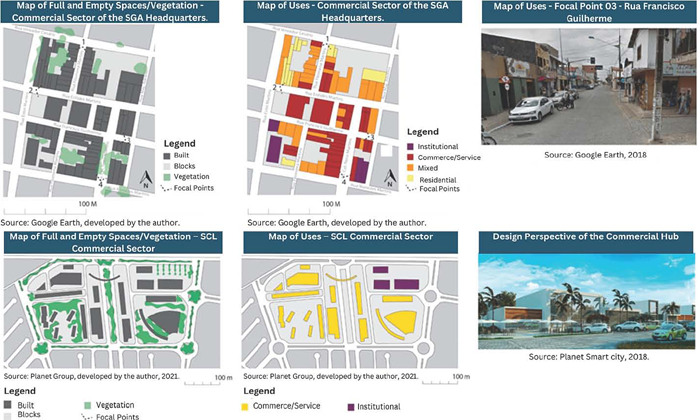
Moreover, according to Silva (2021), a more detailed study through a comparative morphotypological analysis between Smart City Laguna and the pre-existing occupations in the municipality of São Gonçalo do Amarante (see Figure 6) revealed that this development has a distinct morphology and typology compared to those occupations. This is particularly evident in the commercial areas. The occupations in the São Gonçalo do Amarante District feature a morphology of smaller blocks with subdivided buildings, primarily occupied along their perimeter, while Smart City Laguna has a morphology of larger blocks with larger, more dispersed buildings.

Comparative Analysis of Land Use and Occupation Patterns in the Commercial Sector of São Gonçalo do Amarante (CE) and Smart City Laguna (CE)
In this sense, it is evident that the design plan for this development significantly differs from the dynamics of the previous local occupation. An intervention established arbitrarily and led by a foreign entity intensifies the fragmentation of the local urban space.
Conclusions
The field of study concerning Smart Cities, as observed, is exceedingly broad and challenging to study and conceptualize. Numerous urban experiences have been developed around the world, leading to various perspectives open to critical analysis, fostering a rich debate and analytical growth among scholars, characterized by conflicts and agreements. For some, the term Smart City is seen merely as a market label, while for others, it represents an increasingly consolidated horizon of urban experiences that warrants closer examination.
In this context, this study aimed to make a meaningful contribution to the analysis of current Smart City experiences, which directly impact the production and transformation of urban spaces in the 2020s. Based on the presented categories, it was possible to concretely identify the existence of three distinct urban intervention practices. These practices differ in terms of territorial scale, planning and design guidelines, potentials for socio-spatial transformation, and distinct management and coordination structures among their responsible actors. However, they are interconnected by the concept they utilize and the promotional discourse they construct, which, among other factors, relies on technology as a key instrument for urban development.
Although the field of study has matured to understand that a Smart City extends beyond the need and “requirement” for intensive technology usage, applied through top-down management structures, the cases analyzed reveal that the discourse and practice still remain deeply rooted in the use of technology as a foundation for developing experiences that are being devised without effective public participation.
Despite their different scales and transformation potentials, the experiences discussed involve initiatives that have a significant impact on urban space. The establishment of Konza Technopolis with 5,000 hectares, plus an additional 20,677 hectares of buffer zone, although still in a slow installation process, has a substantial impact on the region where it is situated, directly and intentionally altering the dynamics of use and occupation of the pre-existing communities, as demonstrated.
The smartification experience in São Paulo, despite being comprised of specific initiatives within an existing urban fabric, is notable as the largest Latin American metropolis and Brazil’s commercial capital with over 12 million inhabitants. Through the “Empreenda Fácil – CGTIC” initiative, it managed to record over 360,000 business registration processes, which has a significant socioeconomic and spatial impact within its territory.
The Smart City Laguna initiative, a private development with a scale of 330 hectares, although it seems to have reduced territorial impact when compared to the Kenyan initiative, holds twice the scale of its immediate surrounding area and is also of the same size as the main centrality of the municipality it is part of. If it consolidates as a Smart City, it will create a dynamic of urban competitiveness with the historically established municipal centrality, yet with a distinct occupation structure capable of generating significant socio-spatial repercussions.
As observed, the dynamics related to Smart Cities are varied, and each has its own specificities that should be considered during analysis. This allows for a better understanding of this phenomenon, which is growing in terms of urbanization practices for new city planning, smart urban management, and innovation in real estate products.
Notes
-
(1)
Urban Management and Public Policies Center, Federal University of Pernambuco (NUGEPP-UFPE). With over 20 years of experience, it dedicates its studies to the area of Urban and Regional Planning, with an emphasis on Urban Policy, focusing mainly on the following thematic fields: governance, local entrepreneurship, democratic activism, popular participation – political-administrative decentralization, space production and the real estate market, and the study of the relationships between State/Market/Society. Currently, with the support of CNPq, it is developing the research “Smart Cities and Sustainable Development: the European, Asian, and Brazilian agendas,” valid from 2020 to 2025.
-
(2)
“Founded on June 16, 2008, the SJC is a member-based social movement consisting of 17 branches in Khayelitsha, Kraaifontein, Crossroads, and Gugulethu in Cape Town. With over 2,500 members primarily living in informal settlements, our campaigns are based on research, education, and advocacy.” (SJC, 2022, free translation)
-
(3)
Smart City ranking index around the world, promoted by IESE Cities in Motion Strategies, a research platform launched by the IESE Business School Center for Globalization and Strategy and the IESE Strategy Department (IESE Business School, University of Navarra) (IESE, 2020). Access the IESE Ranking:https://citiesinmotion.iese.edu/indicecim/index.eng.html?lang=en&_gl=1*1wja08s*_ga*MTQyNjM5MzI4MS4xNjc5MzQxMzA3*_ga_1ZPBDBC6NV*MTY3OTM0NTEzNi4yLjEuMTY3OTM0N TM1MC4wLjAuMA.
-
(4)
The term “global cities” was coined by Sassen in 1991 to designate the nodal points of financial flows from which global control of secondary financial markets and dispersed production sites is produced, as foreign direct investment now primarily occurs through stock and bond markets (Compans, 1999).
-
(5)
A U-City [ubiquitous city] is not merely the informational landscape that acts both as a repository of data and as a system for communicating and processing information (Crang and Graham, 2007), but it also forges new modes of urban life and new socio-political relations through a range of u-services, including u-health, u-education, u-transport, and u-government (Shwayri, 2013, p. 43-45).
-
(6)
It involves the outsourcing of certain institutional activities and processes through the intensive use of information technology. Unlike IT Sourcing, this expands its scope beyond information technology, using it as a means (Willcocks, 2004).
-
(7)
Kenya Vision 2030 is the long-term development plan for the country and is driven by a collective aspiration for a better society by the year 2030. The goal of Kenya Vision 2030 is to create “a globally competitive and prosperous country with a high quality of life by 2030” (Kenya Vision, 2023. Accessed on March 21, 2023).
-
(8)
According to the IBGE demographic census, in 2010 the population of São Paulo was 11,253,503 people, with an estimate of 12,396,372 people for 2021 (IBGE, 2023. Accessed in March 20, 2023).
References
- ARAÚJO, D. S.; GUIMARÃES, P. B. V.; COSTA, A. A. (2020). A implantação de cidades inteligentes no Nordeste brasileiro: um breve diagnóstico. Revista de Direito da Cidade, v. 12, n. 2, pp. 1084-1104.
- AVIANTO, D. (2017). Konza Techno City and Its Impact on Surrounding Local Communities. Dissertação de mestrado. Utrecht, Universidade de Utrecht.
- BALKARAN, S. (2019). Smart cities as misplaced priorities in South Africa: a complex balance of conflicting societal needs. Journal of Management & Administration, v. 2019, n. 2, pp. 1-30.
- CAPDEVILA, I.; ZARLENGA, M. I. (2015). Smart city or smart citizens? The Barcelona case. Journal of strategy and management, v. 8, n. 3, pp. 266-282.
-
CIDADES INTELIGENTES (s.d.). Disponível em: https://www.gov.br/mdr/pt-br/assuntos/desenvolvimentourbano/carta-brasileira-para-cidades-inteligentes Acesso em: 27 fev 2023.
» https://www.gov.br/mdr/pt-br/assuntos/desenvolvimentourbano/carta-brasileira-para-cidades-inteligentes - COMPANS, R. (1999). O paradigma das global cities nas estratégias de desenvolvimento local. Revista Brasileira de Estudos Urbanos e Regionais, n. 1, pp. 91-114.
-
CGU – Controladoria Geral da União. São Paulo Aberta (2015). Entrevista, [s. l.], 10 abr. Disponível em: https://www.gov.br/cgu/pt-br/governo-aberto/noticias/2015/sao-paulo-aberta-entrevista-com-a-equipe Acesso em: 23 mar 2023.
» https://www.gov.br/cgu/pt-br/governo-aberto/noticias/2015/sao-paulo-aberta-entrevista-com-a-equipe - CHANDLER, R. C. (2020). Dumb Cities: Spatial Media, Urban Communication, and the Right to the Smart City. Tese de doutorado. Pittsburgh, University of Pittsburgh.
- CHOURABI, H. et al. (2012). Understanding smart cities: An integrative framework. In: 45TH HAWAII INTERNATIONAL CONFERENCE ON SYSTEM SCIENCES. IEEE. pp. 2289-2297.
- GRANIER, B.; KUDO, H. (2016). How are citizens involved in smart cities? Analysing citizen participation in Japanese “Smart Communities”. Information Polity, v. 21, n. 1, pp. 61-76.
-
GREEN SAMPA (2023). Linhas de atuação do programa: a atuação proposta seguirá em 04 eixos, sendo eles: Green Sampa. São Paulo. Disponível em: https://adesampa.com.br/greensampa/o-programa/ Acesso em: 2 mar 2023.
» https://adesampa.com.br/greensampa/o-programa/ - HALL, R. E. et al. (2000). The vision of a smart city. Brookhaven National Lab. (BNL). Upton, Nova York.
- HARVEY, D. (2005). A produção capitalista do espaço. São Paulo, Annablume.
-
IBGE – Instituto Brasileiro de Geografia e Estatística (2023). Censo Demográfico, 2010. Disponível em: https://censo2010.ibge.gov.br/resultados.html Acesso em: 21 mar 2023.
» https://censo2010.ibge.gov.br/resultados.html -
IESE (2020). Ranking da Iese. Disponível em: https://citiesinmotion.iese.edu/indicecim/index.eng.html?lang=en&_gl=1*1wja08s*_ga*MTQyNjM5MzI4MS4xNjc5MzQxMzA3*_ga_1ZPBDBC6NV*MTY3OTM0NTEzNi4yLjEuMTY3OTM0NTM1MC4wLjAuMA Acesso em: 28 ago 2024.
» https://citiesinmotion.iese.edu/indicecim/index.eng.html?lang=en&_gl=1*1wja08s*_ga*MTQyNjM5MzI4MS4xNjc5MzQxMzA3*_ga_1ZPBDBC6NV*MTY3OTM0NTEzNi4yLjEuMTY3OTM0NTM1MC4wLjAuMA -
KENYA VISION 2030 (2023). About Vision 2030. Disponível em: https://vision2030.go.ke/about-vision-2030/ Acesso em: 21 mar 2023.
» https://vision2030.go.ke/about-vision-2030/ - LEAL, S. M. R. (2021). O revés da crise do mercado frente à crise do estado: retração da acumulação urbana nas cidades Brasil. Relatório final de pesquisa. Recife, Conselho Nacional de Desenvolvimento Científico e Tecnológico.
- LEAL, S. M. R. (2022). Cidades Inteligentes (Smart Cities) e Desenvolvimento Sustentável: as agendas europeia, asiática e brasileira. Relatório parcial de pesquisa. Recife, Conselho Nacional de Desenvolvimento Científico e Tecnológico.
- MAHIZHNAN, A. (1999). Smart cities: the Singapore case. Cities, v. 16, n. 1, pp. 13-18.
- MARICATO, E. (2000). Urbanismo na periferia do mundo globalizado: metrópoles brasileiras. São Paulo em perspectiva, n. 14, pp. 21-33.
- MARICATO, E. (2001). A bomba relógio das cidades brasileiras. Revista Democracia Viva, v. 11, pp. 3-7.
- MARICATO, E. (2015). Para entender a crise urbana. CaderNAU, v. 8, n. 1, pp. 11-22.
- MCFARLANE, C.; SÖDERSTRÖM, O. (2017). On alternative smart cities: From a technology-intensive to a knowledge-intensive smart urbanism. City, v. 21, n. 3-4, pp. 312-328.
- MENDES, T. C. M. (2020a). Smart cities: solução para as cidades ou aprofundamento das desigualdades sociais. Observatório das Metrópoles Instituto Nacional de Ciência e Tecnologia, Rio de Janeiro.
- MENDES, T. C. M. (2020b). Smart cities: iniciativas em oposição à visão neoliberal. Rio de Janeiro, [sn]. Observatório das Metrópoles Instituto Nacional de Ciência e Tecnologia, Rio de Janeiro.
- PARTTEAM & OEMKIOSKS. (2018). Suzanna Marchionni: CEO of Planet Smart City in Brazil. Connecting Stories.
-
PINHO, F. G. (2018). Grande Fortaleza terá a primeira smart city social do país. Folha de S.Paulo. São Paulo, 2 dez 2018. Disponível em: https://www1.folha.uol.com.br/sobretudo/morar/2018/12/1984866-grande-fortaleza-teraa-primeira-cidade-inteligente-social-do-pais.shtml Acesso em: 18 out 2021.
» https://www1.folha.uol.com.br/sobretudo/morar/2018/12/1984866-grande-fortaleza-teraa-primeira-cidade-inteligente-social-do-pais.shtml -
SÃO PAULO (2017). Documentos em mãos tornam mais ágil abertura de empresa pelo novo Empreenda Fácil. São Paulo, Prefeitura de São Paulo, 30 jun. Disponível em: https://www.capital.sp.gov.br/noticia/documentos-em-maos-tornam-mais-agil-abertura-de-empresa-pelo-novo-empreenda-facil Acesso em: 23 mar 2023.
» https://www.capital.sp.gov.br/noticia/documentos-em-maos-tornam-mais-agil-abertura-de-empresa-pelo-novo-empreenda-facil -
SÃO PAULO (2020). MEI nota fácil. Prodam Soluções, [s. l.]. Disponível em: https://portal.prodam.sp.gov.br/case/mei-nota-facil/ Acesso em: 23 mar 2023.
» https://portal.prodam.sp.gov.br/case/mei-nota-facil/ -
SÃO PAULO (2022). O (011).lab da Secretaria de Inovação e Tecnologia de São Paulo, com o Programa de Ciências Comportamentais, é finalista no Prêmio Evidência. São Paulo, Prefeitura de São Paulo, 25 abril. Disponível em: https://www.prefeitura.sp.gov.br/cidade/secretarias/inovacao/noticias/?p=327927 Acesso em: 23 mar 2023.
» https://www.prefeitura.sp.gov.br/cidade/secretarias/inovacao/noticias/?p=327927 -
SÃO PAULO (2023). O que é. São Paulo, Rede Fab Lab. Disponível em: https://www.fablablivresp.prefeitura.sp.gov.br/o-que-e Acesso em: 23 mar 2023.
» https://www.fablablivresp.prefeitura.sp.gov.br/o-que-e - SARAIVA, R. (2020). Cidades inteligentes: Faturamento da Planet Smart City no Brasil cresce 248%. Jornal O povo. Fortaleza, 21 dez. Economia.
- SHWAYRI, S. T. (2013). A model Korean ubiquitous eco-city? The politics of making Songdo. Journal of Urban Technology, v. 20, n. 1, pp. 39-55.
- SILVA, W. M. (2021). A participação de atores externos globais na produção dos espaços locais: O caso da Smart city Laguna na cidade de São Gonçalo do Amarante (CE). Trabalho de conclusão de curso. Recife, Universidade Federal de Pernambuco.
-
SMITH, N. (2007). Gentrificação, a fronteira e a reestruturação do espaço urbano. GEOUSP Espaço e Tempo, v. 11, n. 1, pp. 15-31. Disponível em: https://doi.org/10.11606/issn.2179-0892.geousp.2007.74046 Acesso em: 5 mar 2023.
» https://doi.org/10.11606/issn.2179-0892.geousp.2007.74046 - SÖDERSTRÖM, O.; PAASCHE, T.; KLAUSER, F. (2014). Smart cities as corporate storytelling. City, v. 18, n. 3, pp. 307-320.
-
SUMMIT MOBILIDADE (2020). Levantamento apresenta dados sobre mobilidade em São Paulo. Estadão. Disponível em: https://summitmobilidade.estadao.com.br/guia-do-transporte-urbano/levantamento-apresenta-dados-sobre-mobilidade-em-sao-paulo/#:~:text=Enquanto%20 Acesso em: 21 mar 2023.
» https://summitmobilidade.estadao.com.br/guia-do-transporte-urbano/levantamento-apresenta-dados-sobre-mobilidade-em-sao-paulo/#:~:text=Enquanto%20 -
WATCHER, S. M. (2019). What’s Fueling the Smart City Backlash? Knowledge at Wharton, 24 set. Disponível em: https://knowledge.wharton.upenn.edu/article/whats-behind-backlash-smart-cities/ Acesso em: 21 mar 2023.
» https://knowledge.wharton.upenn.edu/article/whats-behind-backlash-smart-cities/ - WILLIS, K. S. (2019). “Whose right to the smart city?” In: CARDULLO, P.; FELICIANTONIO, C.; KITCHIN, R. (ed.). The right to the smart city. Emerald Publishing Limited.
- WILLCOCKS, L. et al. (2004). It and business process outsourcing: the knowledge potential. Information systems management, v. 21, n. 3, pp. 7-15.

 Source:
  Source:
  Source:
  Fonte:
  Source: Leal 2022).
 Source: Planet Smart City, in
  Source: