 Rental through digital platforms in central areas: a hybridization between housing and lodging
Abstract
The central areas of some Brazilian cities, transformed into privileged territories for real estate development through structuring public policies and tax incentives, have recently attracted investments for the construction of buildings with studios and one-bedroom apartments, which are offered for rent through digital platforms. By dissolving the boundaries between housing and lodging and promoting the concept of “hassle-free rental”, this new real estate supply aims to serve both investors and transient residents. Through a detailed case study of Recife, the study examines the innovations in the real estate market resulting from the consolidation of this new platform-based rental model, as well as the impact of this dynamic on the urban areas hosting such developments.
Keywords:
rental; digital platforms; downtown area; housing; Recife
Resumo
As áreas centrais tradicionais de algumas cidades brasileiras, convertidas em territórios privilegiados para a promoção imobiliária a partir de políticas públicas estruturantes e de incentivos fiscais, têm recentemente atraído investimentos para a construção de empreendimentos de “unidades compactas”, do tipo estúdio ou de 1 quarto, a serem ofertados para a locação via plataformas digitais. Dissolvendo as fronteiras entre moradia e hospedagem e promovendo o conceito do “aluguel descomplicado”, a nova oferta imobiliária visa atender tanto a investidores quanto a moradores transitórios. A partir do detalhamento do caso do Recife, a pesquisa aborda as inovações no mercado imobiliário decorrentes da consolidação do novo mecanismo de oferta via plataformas, assim como as repercussões dessa dinâmica sobre áreas urbanas concentradoras de tais empreendimentos.
Palavras-chave:
aluguel; plataformas digitais; áreas centrais tradicionais; moradia; Recife
Introduction
Cities can be understood as the materialization of cumulative processes of space production that, conditioned by the current mode of production and the relationships established between different territorial scales, reveal social, economic, political, and cultural dynamics that shape urban forms and functions. Thus, cities not only reflect but also reproduce the contradictions of the dominant economic system. At the same time, they serve as a stage for conflicts and negotiations between the different agents that act in the production of urban space (Carlos, 2007; Harvey, 2005).
From this perspective, our study analyzes the real estate dynamics of traditional central areas of Brazilian cities. Since the 2000s, some of these cities have been attracting the attention of agents responsible for transformations in land use and have experienced relevant changes in their built environment and social fabric.
Corresponding to the association between the original core of the city's occupation, which materially records the history of its genesis, and its immediate surroundings, occupied later, the central areas preserve a certain functional centrality, due to the concentration of institutions, commercial establishments, and services, as well as historical centrality, as they present the widest spectrum of historical periods represented in their buildings. Containing buildings of great antiquity, large industrial and port structures that have become obsolete, and urban voids and waterfronts where there are ample possibilities for real estate production, the central areas, especially those of metropolises and coastal capitals, have become a territory of opportunities for the capitalist processes of production and resignification of spaces (Bernardino, 2018).
According to Lacerda and Bernardino (2020), the return of the real estate capital's interest in the central areas of Brazilian cities is supported by the urban entrepreneurship paradigm, strongly driven by public policies of financial and tax incentives from local governments. In addition, it is supported by infrastructure appropriation and recovery actions, emerging as a means to re-semantize existing spatialities with the aim of selling them as “new urban products”. Rediscovered by real estate capital, the central areas have become privileged territories for the experimentation of innovations, as they can simultaneously house new production cycles, with the construction of new buildings around historic sites, or processes of rehabilitation (or retrofit) of old properties (Bernardino, 2023).
Such real estate innovations, specifically concerning the residential market, can occur within the scope of innovations in processes and modes of articulation between agents, location innovations, which regard the conversion of “ordinary” locations into desirable areas, and product innovations, both at the condominium and private unit scales, with innovation processes being especially necessary to overcome moments of crisis (Abramo, 2007; Bernardino, 2018, Schumpeter, 2012; Topalov, 1984).
Recently, at the turn of the 21st century, two major crises, the subprime crisis in 2008 and the pandemic crisis in 2020, required, as Kalinoski and Procopiuck (2022) point out, a “reinvention of markets” that produced a “new housing ideology”, based on the exaltation of “transient” and “hassle-free living” (Bernardino, 2023). In light of this scenario, digital platforms - widely used to offer lodging alternatives and temporary rentals – have started to intermediate, also, the rental of units for longer periods and residential purposes. In the traditional central areas of several cities around the world, to a greater or lesser extent, depending on the technological level of the suppliers or the demand, units have started to be offered for rent through digital platforms.
By presenting new alternatives for “accessing” properties, in addition to purchasing and traditional rental methods, the market has created a process innovation that has blurred the well-known boundaries between housing and lodging. Housing as a service, or platform-based rental without bureaucracy and human intermediaries, clearly aims to maintain the profit rates of investments but also seeks to provide a modern alternative to the traditional “dream of owning a home”, in a setting where access to real estate tends to become increasingly difficult (Bernardino, Andrade and Marques, 2023).
This reformulation of strategies contributes to redefining the characteristics of real estate production and supply in order to enable the launch of new private units resulting from the hybridization of housing and lodging, in locations that can attract, indiscriminately, investors, in the position of buyers and future suppliers, or residents and tourists, in the position of temporary consumers of the properties.
Thus, the central areas of large Brazilian cities have begun to host launches of buildings with numerous compact units (studios or 1-bedroom apartments), which ideally meet the supply criteria through hassle-free rental platforms. Recognizing the adherence of this process to the urban dynamic of Recife, this article aims to characterize the innovations present in the recent real estate supply of compact properties produced in the city’s traditional central area. Based on the characteristics of the private units and condominiums, there are indications that at least twenty out of the forty developments that are in the licensing or construction phase have the ideal features for offering units through digital rental platforms, as they contain studios or one-bedroom apartments. Some of these developments that were already launched have associated their image with real estate platforms, featuring the logos of Housi, Booking, Trivago, and Airbnb in advertising brochures. The demographic effects of this new real estate dynamic are already beginning to be seen, as the increase in the number of “households” was not accompanied by population growth in the central area of Recife between 2010 and 2022.
In order to support this discussion, this text presents a section dedicated to discussing digital platforms as enablers of a supposed “new way of renting”. Next, the urban structuring processes that led to the “abandonment” of central areas by hegemonic agents of large-scale real estate production are presented, followed by the contextualization of the return of real estate capital’s interest in the central area. Using Recife as an empirical focus, this article presents real estate innovations and the commodification of the central area, discussing the public policies and legal frameworks that authorize and stimulate its revitalization. The article also discusses the effects of this new dynamic on the distribution of the resident population and on the old buildings, in light of tensions between the production of new spatialities and the symbolic obsolescence of historical heritage (Bernardino, 2015, 2018).
The data presented here were collected within the scope of the study “Old downtown area, new opportunities: Consolidated practices and innovations in the real estate dynamic of the central area of Recife”,1 especially in the derived research entitled “Private agents in the production of real estate innovations in the central area of Recife”, both developed within the scope of the Land and Real Estate Market Research Group – Gemfi, linked to the Architecture and Urbanism Department and the Postgraduate Program in Urban Development of the Federal University of Pernambuco.
Digital platforms: a new form of rental?
In Brazil, the high-rise residential apartment building, typically located in a desirable neighborhood, fully paid off, and equipped with a variety of condominium amenities and services, has gradually become the paradigm of secure and distinguished access to housing in major metropolitan areas. Despite theories that defend the autonomy of individuals in making their own choices, it is known that the relative consensus on the adequacy of a given housing condition to current residential consumption expectations, in a context marked by the capitalist production of space, is socially and conjuncturally constituted. It is important to emphasize that, in Brazil, ownership of residential property has played a defining role in the desired housing condition, delimiting the contours of what the “middle class” is. The “dream of owning a home” can be understood as the symbolic materialization of a multifaceted paradigm, constituted by market strategies for production of new residential properties, public policies that stimulate homeownership, and the efforts of families, forced to organize themselves to ‘overcome’ rental housing (Barone, 2020, Bernardino, 2023; Kopper, 2016).
At the same time, the condominium began to represent the possibility of hiring private security and surveillance as an alternative to confront the growing urban violence, while the mass production of vertical multifamily buildings corresponds to a way of producing the city that provides high profitability for the agents responsible for transformations in land use, among which are landowners and builders (Caldeira, 2011; Ribeiro, 1997; Somekh, 1997).
Although the private unit in a vertical condominium has been little questioned as a model of access to housing, the paradigm of “homeownership” has been revisited by some market agents. Digital real estate brokerage platforms offering private units that can be rented for long or short periods of stay have been gaining prominence since the beginning of the 2020s. They offer the possibility of accessing housing as a service “by subscription”, or even through debureaucratized rental, for varying periods and tailored to the consumer's needs.
An advertisement for one of the platforms that offer this service reads, “The dream of owning a home becomes a nightmare when we think about the long years of real estate financing”. The advertiser, the company Housi, claims that the platform was created to “break patterns and offer a new way of thinking about the future of housing” in light of the “much desired freedom to come and go without worries [...] to arrive and leave whenever you want” (Housi, 2020).2
To discuss the innovative nature of the provision of housing as a service, or even the hybridization between housing and lodging, it is important to mention that, in Brazil, units defined as flats3 have been produced and offered for sale or rent, for housing or lodging, and for long or short periods of stay (Mello, 2007) since the 1990s, a period when only hotels were beginning to offer services over the internet.4
The 2000s saw the launch of the first digital platforms dedicated to connecting, in different ways, individuals offering residential spaces and individuals desiring to be users of such spaces. In 2004, the platform Couchsurfing emerged as a “non-profit hospitality” service, bringing together residents willing to offer, free of charge, a domestic stay to a traveler. In 2008, the startup Airbnb was launched as a “virtual real estate agency” and began connecting owners willing to rent entire or fractional properties to users. At first, the platform’s operations had repercussions on the hotel sector: by providing lodging alternatives without bureaucracy and at relatively lower costs, it captured part of the demand formed by tourists and guests. Later on, adhesion to the platform also affected the functioning of the residential rental market. In areas with high demand for tourist lodging, it became more profitable for landlords to evict permanent tenants in order to offer properties at higher prices to seasonal users. Over time, virtual mechanisms for offering properties gradually acquired new features as they associated with the offer of new services or products.
Throughout the 2010s, proptech companies, startups dedicated to real estate negotiation and management, presented a broader and ever-changing scope of business activity. The platforms, which emerged for real estate brokerage between suppliers and consumers of built spaces, whether for rent or lodging, are constantly reformulating their operating strategies. Recently, proptechs have even started to participate in real estate development processes⁵ for buildings featuring compact private units6 and a wide variety of condominium amenities, available predominantly to investors (intermediary consumers and suppliers) or tenants, whether residents or guests.
Although the offer of compact units (studios or one-bedroom apartments) for rent can be seen as a market response to the gradual increase in the number of homes occupied by only 1 or 2 people,7 it is perhaps more prudent to consider that this process is strongly led by space production agents who can identify the demographic dynamics but tend to dictate what the “new trends in residential consumption” should be.
In general, the “new arrangements” that generate market innovations are related to the logic of “creative destruction” employed by the great entrepreneurs. Process innovation is related to abandoning previous practices, just as the creation of new products is related to promoting the obsolescence of the previous ones (Schumpeter, 2012). In the real estate market, in contexts of “urban uncertainty” (Abramo, 2007), each promoter-supplier tends to interpret, based on their knowledge about the functioning of the market, the behavior of other producers-suppliers, as well as the aspirations of consumers of residential spaces. In addition, they constantly interpret the context that defines the terms for the capitalist production of space and the mechanisms of circulation and consumption of new and used properties.
Based on these interpretations and guided by the objective of renewing demand and maintaining profit rates, real estate developers, viewed as “Schumpeterian entrepreneurs” (ibid,, 2007), engage in the creative destruction of prior processes and create market innovations. According to Schumpeter (2012), innovations occur through the introduction of a new commodity, a new way of trading the commodity, or a new production method, associated with technological development or the acquisition of a new source of inputs for production. Particularly in the real estate market, innovation in location has been gaining relevance, grounded in the transformation of “ordinary locations” (Topalov, 1984) into privileged residential areas.
Based on the terms proposed by Schumpeter (2012) and Topalov (1984) and highlighted above, and recognizing the trajectory of the supply of compact rental units for varying periods of stay, so well described by Mello (2007), it is appropriate to put into perspective the supposed innovative nature of rental through digital real estate brokerage platforms. It may well be a real estate innovation, as the way of advertising and trading the commodity is relatively new. However, more than on the innovative nature, we should focus on the sudden expansion of this supply, especially in times of dispossession; on the unfair competition that is established between aspiring residents and tourists, in a context of expansion of temporary rentals; and on the supraspatial capillarity of supply through virtual means. As will be discussed below in the case of Recife, the association between these factors can have an impact on the socio-spatial dynamics of cities.
The consumer of the “housing service”
In view of the new real estate dynamic, it is necessary to understand the relationship between the choices made by real estate producers and suppliers, in terms of locations, types, and ways of offering properties, and the potential tenants’ expectations concerning residential consumption. In 2019, the Brazilian Association of Real Estate Developers (Abrainc) published a study on “Real Estate Consumer Behavior in 2040”, carried out to investigate how the “new generations expect to live in the coming decades”. The study aimed to “outline the residence profiles that will prevail in the future” (Delloite, 2019, p.6) and offers relevant subsidies for understanding how emerging trends in the behavior of the housing demand are being understood and assimilated by the business segment responsible for supply.
This study was based on the composition of scenarios8 formulated from the analysis of economic, behavioral, and sociodemographic factors,9 considering data related to population aging and characteristics of households. Other sources were research on generation differences and consumer preferences and behavior, studies on economic and market conditions and the characteristics of the Brazilian construction industry, and works on the growth of urban centers and the maturation of digital technology:
Having outlined the scenario for the market environment as a whole and for the construction sector in particular, the study identified the major factors that could define the model for purchasing and renting properties in Brazil. These trends, which are often interconnected, were understood in light of the generational, behavioral, and socioeconomic aspects that are expected for the coming decades (DELLOITE, 2019, p. 6).
The study concluded that Millennials, born between 1985 and 1993, Generation Z, born between 1994 and 2001, and Generation Alpha, born from 2002 onwards,10 have distinct life aspirations, and this has an impact on the configuration of their consumption behaviors. Based on the results presented, it is possible to consider that Millennials are on the border between the old and new ways of consuming in the residential real estate market. Having experienced the country's economic stabilization and the structuring of social policies for income distribution, and having witnessed the popularization of the internet, many Millennials may have had opportunities and experiences that did not exist for previous generations. Even so, this generation tends to prioritize ownership of residential property over other consumer demands, and there is a larger barrier to their “adherence” to more fluid forms of housing as a service. Generation Z, according to the study, does not notice differences between online and offline when navigating through various “channels” and, furthermore,
Values aesthetic, moral, and behavioral transparency and plurality. They are redefining traditions, such as religion and marriage, but they want to exercise them freely. Security gives way to dynamism. (Ibid., p. 14).
Therefore, Generation Z, who in 2025 will be between 24 and 31 years of age, and Generation Alpha, who will be at most 24 years old, can be considered the demographic segment most susceptible to adhering to digital platforms that offer a new way of renting. As these younger generations value spatial integration and the sharing of environments for collective use, as well as disintermediation in real estate transactions, they tend to reformulate their residential consumption strategies (ibid.). Thus, renting a residential unit, rather than owning it, could be an alternative means to access housing that meets the requirements of greater flexibility and less bureaucracy, allowing consumers to remain free and able to move easily, in search of better opportunities and financial advantages (Bernardino, 2023).
For the generations preceding the Millennials, renting tended to be considered a transient housing condition linked to a relatively shorter stage of the life cycle, such as the one which follows a change in marital status (marriage and divorce) or the completion of a short-term activity (taking courses, rotating jobs), while the desire for real estate ownership remained in the background. This paradigm may not be maintained within the scope of the consumption expectations of the new generations, which leads to rented units gaining more and more space as a permanent dwelling alternative instead of a transient housing condition.
Since it is possible to deduce that there is a different residential consumption behavior between generations, it is probably safe to say that new real estate developments aimed at more fluid forms of renting tend to be formulated with a certain neutrality, so that they are able to attract specific and distinct demographic profiles that are at various stages of their life cycle and housing career. Young people, who are looking for their own homes at an increasingly early age; people who seek homes regardless of their intention of forming a nuclear family with children; couples who postpone having children; older adults who are rethinking their dwelling choices in the face of an “empty nest”; recently separated people, etc. – even belonging to different generations, they may, at the right time, want compact units that can be rented more fluidly.
It is important to emphasize, however, that the exaltation of new ways of accessing housing, rather than a mere market innovation, reverberates the reformulation of real estate production and supply strategies, especially when we consider that access to property tends to become increasingly difficult (ibid.). It is no coincidence that housing as a service and rental through digital platforms have become more widely disseminated in Brazil in times of erosion of the real value of average wages and precariousness and dissolution of formal employment relationships, when there is a tendency for greater difficulties in acquiring a property with one's own resources, or even in proving stability and sufficient income to receive real estate financing from a financial institution.
By presenting itself as a comfortable and “unprecedented” housing model that is hassle-free, debureaucratized, and unrooted, the “new rental” offered by digital platforms reveals the intention to minimize the stigma of tenancy by associating this form of housing with geographic freedom or virtual nomadism, which has become possible in light of the new forms of remote work. Ultimately, however, this is a market response to the growing difficulty faced by a “new generation” in acquiring properties and the incessant search for the allocation of resources in urban space, as the new generations of consumers, as Kalinoski and Procopiuck (2022) also argue, may abandon the “ideology of homeownership” to view housing as a service.
Although platform-based rental may represent an innovation, it is perhaps important to emphasize that rent, corresponding to the payment, by the occupant, of recurring installments to the property’s owner, is a historically consolidated form of access to housing. At the same time, the traditional “transient form of residence” without lasting ties, enabled through the use of compact accommodations in inns, boarding houses, or hotels by itinerant visitors, workers, and students who link their intended duration of stay to the completion of a specific activity (MELLO, 2007), cannot be considered an innovative practice either.
However, the desire for debureaucratization, associated with freedom and the need to “optimize processes” in the access to housing, the migratory dynamics of qualified professionals whose residential mobility is guided by their search for distinguished positions in the job market, and the predisposition to share common areas when living in compact private units are factors that have underpinned marketing discourses encouraging the consumption of housing as a service available through platforms.
For certain social segments, therefore, rental could become a rational and deliberate choice, an option for freedom and debureaucratization, and not a contingency caused by the impossibility of owning a property. Circumstances are gradually being created so that some social segments can re-signify the long-established “dream of owning a home”, especially those segments that, in their individual or family contexts, have not felt directly threatened by deprivation of access to housing.
Such individuals are in a relatively privileged condition, as they have the material and circumstantial conditions to worship the ephemeral (Baudrillard, 1972). Thus, they constitute a potential demand for the consumption of the “new” rental forms enabled by real estate platforms. At the same time, other social segments may maintain more conservative behaviors and not be inclined to give up the “security” of owning a home to adhere permanently to innovative occupancy regimes.
Recently, especially from the beginning of the 2020s onwards, new ways to access housing, no longer as a commodity to be purchased or rented but as a service that can be contracted without bureaucracy, through digital platforms for real estate supply and brokerage, have been the theme of academic discussions, such as the studies conducted by Kalinoski and Procopiuck (2022), Bernardino (2023), and Bernardino, Andrade and Marques (2023), and market discussions, like the study published by the Association of Real Estate Developers (Delloite, 2019). The theme has also given rise to transdisciplinary efforts to formulate and update reflections on the possible repercussions that the consolidation of this new model may have on urban spaces. In 2024, at the launch of the virtual and collaborative platform of the Global Observatory of Temporary Rentals, Duglat (2024) warned about the disruptive effects caused by the spread of temporary rentals on the pricing dynamics of rental markets, a supply that is predominantly performed via digital platforms. According to Duglat, high-turnover rentals generate an expectation of high income among landlords, which leads to new pricing mechanisms for long-term rental contracts as well. This may affect regular tenants who will not be able to keep up with prices based on seasonal rentals. This process can empty areas that concentrate the supply of temporary rentals, depriving them of their traditional dynamics and residents. Furthermore, middle- and low-income families who do not own their residential properties can be severely affected by the expansion of temporary or platform rentals, as they impact their possibility of access to housing and the best urban locations, in a process that ultimately raises concerns that feed into the “dream of homeownership”.
In addition to the constructed properties that are assimilated by rental platforms, it is clear that the market, by promoting new alternatives for accessing properties beyond purchasing and traditional rental methods, also modulates, synchronically, real estate production and supply. Developments containing private units in a real estate typology resulting from the hybridization of housing and lodging are launched onto the market. Such units are capable of attracting, indiscriminately, investors, as buyers and future suppliers; residents-owners, as “final” consumers; and residents-tenants, tourists, or other users in a “transient residential” situation.
The real estate developments planned to supply these units tend to be located in urban centers – places with a high density of commercial and service areas –, which simultaneously allows for the appeal of housing associated with a lifestyle based on routine travel, through active mobility, to access goods and services in the neighborhood; and lodging in locations of interest for cultural tourism, business tourism, or associated with the performance of specific activities, such as medical treatments, courses, and professional training.
In this context, the traditional central areas of Brazilian cities, rediscovered as frontiers for real estate appreciation since the early 2000s, began to attract investments for the rehabilitation of old properties or even for the construction of developments with numerous “compact” private units, in buildings that offer a wide range of condominium amenities and services.
With the Covid-19 pandemic, which repositioned the functional centrality of cities as points of convergence, flows, and supply of goods and services, the “distance economy” was boosted, and, according to Kalinoski and Procopiuck (2022, p. 4), “reinvented retail” and stimulated the transformation of living space into workspace. From 2020 onwards, with the massive adoption of remote work, the rhetoric of digital nomadism was intensified, leading to an increase in the demand for temporary housing. Once again, the boundaries between traditional residential living and lodging are blurred, reinforcing the demand for developments that introduce units into the market designed to accommodate stays dictated by specific and immediate criteria. These units are strategically located to facilitate short-term activities or the temporary enjoyment of a locale.
The nature of the intended real estate transaction – rental or purchase –, as well as the planned length of stay - permanent residence or fulfilment of an immediate and short-term need –, have an impact on the composition of criteria and on the way in which subjects evaluate the “housing situation”, whether on the scale of the neighborhood, the surroundings, or the property. This means that the subjects’ evaluation of the habitability conditions of a given property, condominium, or neighborhood is conditioned both by their housing needs and expectations, related to where they are in their life cycle and family life, and by the characteristics of the supply (Bernardino, 2011).
The expansion of the supply of “hybrid” real estate alternatives may contribute to the creation of a new demographic dynamic, marked by the fluctuation of temporary occupants who are in stages of their life cycle that require debureaucratized residences, for shorter periods. Therefore, it is important to analyze the urban contexts that tend to concentrate, in constructed properties, the supply of platform rentals, or even those that tend to attract new developments that will expand the supply of housing-lodging. This will be performed in the following sections, dedicated to contextualizing the “abandonment” of central areas and discussing the new real estate dynamic of the Traditional Central Area of Recife.
Abandonment of central areas
The traditional central areas of some Brazilian cities share a common history: they were overlooked for decades as loci of real estate investment by the hegemonic agents of capitalist spatial production, who turned their attention to the exploration of other parts of the city. When private investments in large-scale real estate production were dispersed throughout the cities, they contributed to the creation and consolidation of new neighborhoods, both upscale and popular, accompanied by their respective commercial and service centers. Such investments, which resulted in the expansion of the urban fabric and the intensification of land use in neighborhoods valued by the middle and upper classes, date back to the beginning of the operations of the National Housing Bank in the 1960s, and are also associated with processes of residential flight from central areas and migration of sophisticated commercial and service establishments to other parts of the city (Bernardino, 2018).
Back in the 1970s, the state of degradation of Brazil's historic centers motivated the formulation of strategies for their preservation, conservation, and economic growth, as well as the creation of state and municipal preservation agencies. However, it was only from the 2000s onwards, in a new conjuncture and guided by “urban entrepreneurship” actions, that real estate capital began to return to central areas and their historic sites more consistently.
Although the degraded buildings and the obsolete equipment, remnants of discontinued activities in the central areas, had already been among the objectives of “revitalization” or “rehabilitation” for some time, until the 2000s, interventions were scarce and of relatively limited scope. When construction and development companies began to go public and created new forms of association,11 the scale of real estate operations was definitively expanded.
With the new regulatory frameworks for security deeds, Consortium Urban Operations (OUC), and Expression of Interest Procedures (PMI), the bases of the relationship between companies, local governments, financing agencies, and building consumers were reestablished, which structured a new context for the composition of the necessary resources for larger-scale interventions. Subsequently, the launch of Minha Casa Minha Vida (known as MCMV, the federal government’s social housing program) in 2009, illustrated here only as another synchronic component favorable to the expansion of investments in real estate production, also reverberated in the central areas of Brazilian cities, contributing to the maintenance of their dynamism throughout the 2010s.
The very brief contextualization provided here aims to present the space production processes that culminated in the conversion of the areas corresponding to the original nuclei of occupation of cities and their surroundings into “historic centers”. These are exceptional territories, worthy of attention and care on the part of public authorities, that became targets of fragmentary legislation dividing their territory into various “special” zones – of historical interest, social interest, for urban projects and operations – and delimiting constructed complexes to be preserved as cultural heritage. Subject to legal frameworks that are constantly updated and more or less restrictive to the transformation of occupation patterns, the central areas are at the epicenter of the debate on urbanism issues.
For the purposes of the discussion proposed in this article, it is also important to mention that the central areas of most Brazilian cities have ratios of rented homes to the total number of households that are higher compared with those from other parts of the city. During the aforementioned operation of the National Housing Bank, between 1964 and 1986, the production of 4.4 million new residential units in Brazil expanded the possibilities of ownership of new properties for various income segments, contributing to the consolidation of an “ideology of homeownership”. In this case, adhering to homeownership and fulfilling the “dream of owning a home” meant giving up the old rented home, often situated in a more central location that was closer to urban facilities and services. This moment also marked a greater acceptance of “Multifamily Residential Buildings” as an appropriate housing model, to be considered also by higher-income groups.
In short, within this context of stimulus to real estate production, the frontiers of urbanization were expanded by the construction of new residential complexes and neighborhoods on the urban and metropolitan edges, and land use was intensified in peripheral neighborhoods with consolidated appreciation, relegating central areas to a marginal role in the dynamics of the capitalist production of space. There was also the consolidation of the ideology of homeownership and the growing appeal to the consumption of new apartments in multifamily buildings.
In chronological order, there was a gap between the end of the BNH's activities (1986) and the launch of the MCMV Program (2009), the two national housing policies. Faced with the scarcity of credit, real estate agents created strategies to promote the self-financing of their developments. One of them was the establishment of closed and pre-defined groups of buyers committed to paying installments to finance the construction throughout the process. Thus, real estate production concentrated on locations that were already accepted and appreciated by middle- and upper-income groups, which constituted the effective demand in that context.
During this period, treated here as a “gap between the major national housing policies”, Brazil's insertion into the dynamics of the globalized economy was also consolidated. Following the model of “urban entrepreneurship” forged by the scarcity of public resources, municipal and, in the case of Brazil, state managers began to base their actions on the urgent need to attract private investments. To overcome the problem of capital’s lack of interest in central areas, the local authorities in some cities, especially those with some tourist appeal and inclined to develop a modern tertiary sector, made investments, with public resources, in some “strategic” locations to provide them with “thematic infrastructures” capable of attracting private entrepreneurs, in an effort that produced some results in terms of the revitalization of these central territories throughout the 2000s.
During this period, the growing financialization of the real estate sector also contributed to enabling investments in large plots of land with obsolete structures and other areas with potential for real estate development. Studies on central areas that had been conducted by local governments throughout the 1980s and 1990s as part of “revitalization” programs provided an “inventory” of degraded areas with great potential for revaluation, and most of them had not undergone major interventions until the 2000s.
In this moment, given the progressive degradation, intervention in historic centers could already be considered a legitimate objective, validated both politically and socially. The existence of vacant lots in the vicinity of historic sites, or lots with buildings that could be demolished, with high floor‐area ratios, enabled the production of new verticalized developments in the central areas of some Brazilian cities, especially during the first half of the 2010s.
The context of the pandemic, starting in 2020, imposed unprecedented challenges on public and private agents operating in central areas, adding layers to the already complex discussion about the way of living in the city. Until that moment, the financialization of real estate companies, as well as the new rules for securitization and security deeds, had established new conditions for the action of space production agents. At the same time, the discourse concerning the urgency of action in central urban areas had acquired political and social legitimacy, creating a new situation that would shape the actions of agents responsible for the transformation in land use in central areas of Brazil, as will be shown in the following section.
Commodification of the central area of Recife
In Recife, during the 1980s and 1990s, in view of a panorama of urban degradation and residential flight that marked the city’s traditional central area, and associated with the emptying or underutilization of many buildings due to the migration of the most prestigious activities to new centralities, programs to revitalize some parts of the historic center started to be formulated.
From the 2000s onwards, new initiatives, based on the precepts of urban entrepreneurship, started a cycle of public and private investments in this central area that, concentrated in territories considered “strategic”, aimed at attracting new uses for the establishment of a new urban dynamic. From 2001 onwards, the Porto Digital project promoted the restructuring of the District of Recife,12 recovering and implementing infrastructures, and granted tax incentives to attract investments from information and communication technology (ICT) and creative economy (CE) companies. At the same time, the Government of the State of Pernambuco assigned built spaces for the installation of the companies. Subsequently, resources from the Monumenta Program, which provided federal financing for the rehabilitation of historical monuments, were employed in investments in properties with potential for becoming tourist attractions, also located in the District of Recife.
Synchronously, the launch of ProUni and Fies – federal government programs for the grant of student loans to pay for tuition in private institutions and to stimulate the increase in the number of seats in technical and higher education institutions – contributed to the development of an Educational Hub in the District of Santo Antônio, specifically along the listed Guararapes Avenue.
Since the mid-2000s, therefore, public investments have converged on the central area of Recife, aiming to consolidate tourist,13 technological,14 and educational hubs15 through the use of historic properties. At the same time, two high-end apartment towers were built on the waterfronts of the central area. Located at Cais de Santa Rita, in the District of São José, and Cais da Aurora, in the District of Santo Amaro, and completed in 2006 and 2009, respectively, these pioneering projects marked the return of real estate investments in residential properties to the central area of Recife, paving the way for new projects.
The Novo Recife project, planned for the waterfront at Cais José Estelita, was approved in December 2008, days before the approval of the new Master Plan. Preceding the new legal framework, “Novo Recife” has a project that, governed by the parameters of the 1996 Land Use and Occupation Law, provides for the construction of twelve towers on the site of the former Federal Railway Network. Resulting from an investment enabled by a consortium of four companies, two of which went public in the mid-2000s, the project symbolized the emergence of a new scale of investments and operations in the central area of Recife, made possible by innovative business arrangements and a new dialogue between companies and the municipal public sector.
From 2009 onwards, when the Minha Casa Minha Vida program increased the demand for new residential properties, Recife’s real estate sector found adequate lots for operation, specifically in the immediate surroundings of the historic sites in the central area of Recife. This area, which had been overlooked by the hegemonic agents of residential property production for almost 40 years, became the target of new players. According to Bernardino (2018), this fact is related to new restrictions on verticalization that were imposed in 2001 on one of the most affluent residential areas of Recife, known as the “Area of the 12 Districts”. This naturally led real estate production agents to prospect new areas with great potential for profitability.
Throughout the 2010s, given the macroeconomic scenario of abundant credit for housing purposes, combined with urban planning laws that continued to assign high floor‐area ratios to lots in the central area, there was a growing interest from private agents and investors in the area. Initially located on waterfronts and lots with unobstructed views, the developments gradually began to spread aroud, dispelling the stigma attached to living in the central area. Dozens of developments aimed at different income profiles were launched, creating “new residential spatialities” that contrast with the old ways of living in the downtown area.
Figure 1 situates the traditional central area in relation to the city and the new developments in this area in relation to the Special Zones of Social Interest (ZEIS) and Historical Heritage (ZEPH).

– Series containing, from left to right,
(a) Location of the Central Area (RPA1) and (b) Location of the residential buildings that were under construction at the end of the 2010s and other dynamics mentioned in the text (Educational Hub, Porto Digital, Novo Recife, and “Pioneering” Developments on the waterfront), as well as Special Areas of Social Interest and Cultural Heritage Preservation Areas
The “pioneering” developments in the central area of Recife were of a high-end nature, offering units of more than 150m2. Subsequently, the buildings began to offer compact, smaller units, in what could be called a second cycle of real estate production in the region.
The mapping and characterization survey of real estate production in the central area of Recife, which has been carried out since 2021,16 detected, through searches in the Licensing Portal of the Municipal Government of Recife, 73 developments in the licensing phase or recently approved for the central area. If implemented, they will represent the addition of 898,945.18 m2 of built area to the central area of Recife. Also, based on the data available on the Licensing Portal, the new projects will generate 11,332 additional parking spaces in the central area if the contributions of all the aforementioned projects are combined.
Among the 73 projects for the central area that were analyzed, 40 were classified as Multifamily Housing or Mixed housing/services, representing, if added together, a possible supply of 6,057 new residential units. By the end of 2022, 22 developments had been launched onto the market and were known to the public, and 18 had already completed the entire licensing process but had not been launched.
As for the private units offered, it is worth noting that, among the 40 residential and mixed-use buildings planned for the central area of Recife, 20 offered “compact” private units, such as studios or 1-bedroom apartments, and a variety of shared-use amenities in the condominium areas, thus presenting the desirable conditions for offering “hassle-free rental” alternatives through digital platforms.
Among the units with these characteristics that had already been launched onto the market, six presented some form of association with digital platforms offering properties for rent, lodging, or subscription-based housing, identified by the presence of the logos of the platforms Airbnb, Housi, Trivago, and Booking in advertising brochures.
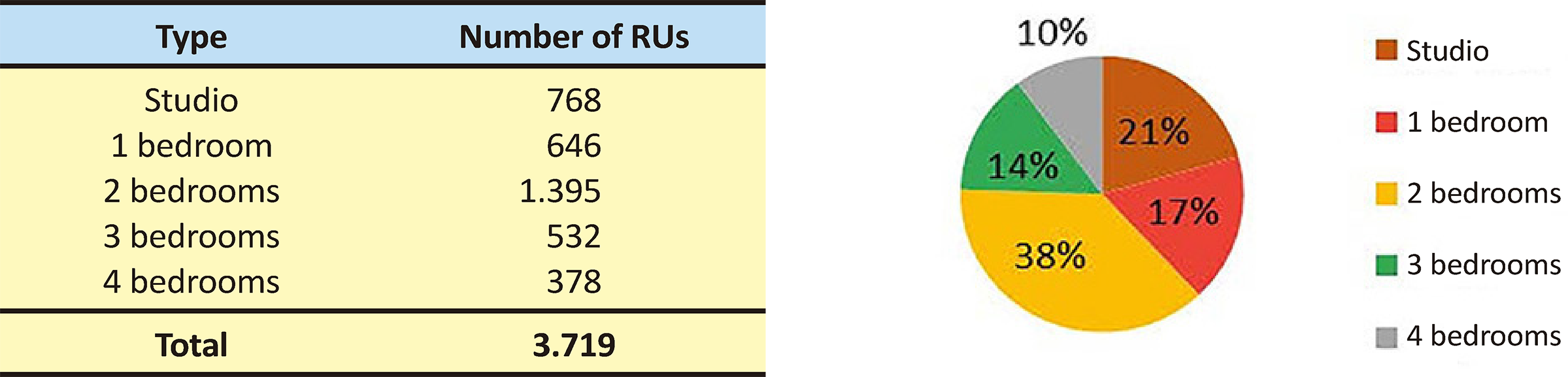
Considering that the universe of approved developments or those undergoing licensing processes may not offer a realistic scenario of the buildings whose construction is about to start, only developments that had already been launched or whose construction was underway were selected to further characterize the real estate supply expected for the central area of Recife. In this new analysis, among the 3,719 planned units, as detailed below, 1,414 are studios and 1-bedroom apartments, and 1,395 are 2-bedroom apartments, which means that 76% of the units planned for the central area are “compact”, as exemplified in the sequence of floor plans presented below.
In the central area of Recife, developers and suppliers advertise, through advertising brochures, construction company websites, online platforms, and videos, the innovative features of the buildings, such as the replacement of the traditional “24-hour gate house” with a concierge desk, with a qualified professional for check-in and check-out; the installation of electronic locks in each unit; the presence of grab--and-go convenience stores, where it is possible to purchase products without human interaction; the presence of craft rooms, a shared craft and art environment; the presence of coworking spaces, shared work environments; the presence of shared laundries; the presence of a shared studio for creating social media content; the presence of dedicated lockers for online shopping deliveries, etc. It is also possible to purchase the units with bed, table and bath linens, standardized furniture, and appliances, so that the apartment is suitable for renting and more ephemeral residential modalities, as well as lodging. These and other aspects contribute to the composition of condominiums that are different from previous housing supply alternatives and create conditions for a high turnover of users (residents and guests), offering the option of acquiring a “package” that includes the furniture and the complete set of linens for the unit, as well as “totally digital rental management carried out by the partner platform”.
The “hybrid” nature of such developments, situated between housing and lodging, is still not addressed by Recife’s legal framework (and continues to be classified as Multifamily Housing) nor by the surveys to collect census data carried out by the Brazilian Institute of Geography and Statistics, which detects an increase in the number of households that is rarely accompanied by a proportional growth in the resident population.
In the case of Recife, for example, when considering the average household size indicated by the 2010 or 2022 censuses for the Central Area, respectively of 3.05 inhabitants per household in 2010 and 2.57 in 2022, the construction and full occupancy of 3,719 new residential units could represent a scenario of 11,342 or 9,557 new residents, respectively. However, between 2010 and 2022, despite the production of new developments on the waterfront and, subsequently, in various parts of the territory, which resulted in a verified addition of 3,089 households to the central area,17 the resident population decreased from 78,114 to 73,764 inhabitants, according to census data.18
In fact, the central area of Recife also lost residents between 1991 and 2000, showing practically no population growth between 2000 and 2010.19 As can be seen in the following cartogram, some portions of this central area had an increase in resident population in their census tracts (areas in green), while others had a decrease. The comparison of the cartogram with the spatial distribution of the buildings constructed throughout the 2010s shows that population growth predominates only in the areas of the new buildings.
The production and supply of compact units for platform-based rental in the traditional central area of Recife has components of location innovation, already mentioned here, as well as innovation in the way the goods are traded. As in the case of so many other market dynamics, here too it is possible to state that such innovations are related to the materialization of business strategies to maintain the profitability of the operations.
The transformation that is underway in the central area of Recife, led by the actions of capitalist agents of space production, does not seem to respond to a real social demand. With thousands of underused and idle square meters located in a central area that has experienced population stagnation or a decrease in the resident population, there are no valid urban arguments that justify, in the medium and long term, the addition of hundreds or thousands of new private units through the construction of new buildings.
The production of new spatialities that contrast with the characteristics of older buildings may, in fact, contribute to promoting their early symbolic obsolescence, calling into question the motivations that underlie the high floor-area ratios and the offers of tax benefits modulated to attract real estate developments to the central area.
Final remarks
Contemporary transformations in the traditional central areas of Brazilian cities reveal the inseparable intertwining between the urban dynamics and the logics of capital, especially in a context characterized by the financialization of housing and the emergence of new paradigms for the consumption of residential units. The city, a privileged locus for the expression of capitalist reconfigurations, expresses contradictions and reveals, once again, that it is permeable to the action of real estate market agents. By instrumentalizing public policies and taking advantage of the exaltation of real estate innovations, capitalist agents re-signify the urban spatialities that are attractive and suitable for the new demands of real estate consumption.
In this scenario, digital platforms for real estate brokerage emerge as devices that enable an expanded commodification of housing, not only as a consumer good but mainly as a service, so that the traditional boundaries between housing and lodging, permanence and transience, are dissolved.
In the case of Recife reported in this paper, the dynamic of the central area reveals a movement of reterritorialization of real estate capital in which the concentration of buildings with compact units in an area that has lost residents in the last decade, associated, since their launch, with digital platforms, indicates a mismatch between supply and the real local housing demands.
The production of real estate developments disconnected from local demands may encourage the "reoccupation" or "rediscovery" of urban centralities; however, it may also damage the existing social fabric and deprive central areas of their traditional spatial dynamics, worsening the unequal access to housing and accelerating the obsolescence of the buildings. This negatively affects sustainability and social inclusion in central areas.
Therefore, it is essential to adopt, in the Brazilian central areas, a critical perspective on the current real estate dynamics that goes beyond discourses emphasizing the need to “dynamize" and "attract investments" to these territories. Urban planning must be an instrument of territorial justice, not an operator of the financialization of everyday life.

– Screenshots of advertising brochures of real estate launches with the logos of Housi, Airbnb, Trivago, and Booking in the ToLive One and Agamenon RoofTop developments

Examples of floor plans of private units in developments that have partnerships with digital rental platforms. Screenshots of treated and edited advertising brochures

– Comparative cartogram between population data from 2010 and 2022 in the census tracts of RPA1 and Cartogram showing the location of developments constructed in the 2010s
Acknowledgement
I would like to express my gratitude to the undergraduate students of the Architecture and Urbanism program at the Federal University of Pernambuco Alice Andrade, Gabriela Marques, Marília Moraes, and Pedro Dias, who engaged, without scholarships or remuneration, in Scientific Initiation and Institutional Internship projects, contributing to the execution of this research.
References
- ABRAMO, P. (2007). A cidade caleidoscópica: coordenação espacial e convenção urbana: uma perspectiva heterodoxa para a economia urbana Rio de Janeiro, Bertrand Brasil.
-
BARONE, A. C. C. (2020). Estratégias de aquisição da casa própria: a trajetória de algumas famílias negras paulistanas nas décadas de 1920 a 1940. Anais do Museu Paulista: História e Cultura Material, v. 28, pp. 1-40. Disponível em: https://doi.org/10.1590/1982-02672020v28d1e8 Acesso em: 17 jun 2024.
» https://doi.org/10.1590/1982-02672020v28d1e8 -
BERNARDINO, I. L. (2011). Para morar no Centro Histórico: condições de habitabilidade no Sítio Histórico da Boa Vista. Dissertação de mestrado. Recife, Universidade Federal de Pernambuco. Disponível em: https://repositorio.ufpe.br/handle/123456789/3644 Acesso em: 2024
» https://repositorio.ufpe.br/handle/123456789/3644 -
BERNARDINO, I. L. (2018). Mercado imobiliário residencial em áreas centrais tradicionais: produção de novas espacialidades e obsolescência imobiliária na definição de submercados residenciais. Tese de doutorado. Recife, Universidade Federal de Pernambuco. Disponível em: https://repositorio.ufpe.br/handle/123456789/32344?locale=pt_BR Acesso em: 2024.
» https://repositorio.ufpe.br/handle/123456789/32344?locale=pt_BR -
BERNARDINO, I. L. (2023). Inovações imobiliárias residenciais ressignificando áreas centrais brasileiras. Bitácora Urbano Territorial Bogotá, v. 33, n. 3. Disponível em: https://doi.org/10.15446/bitacora.v33n3.109570 Acesso em: 17 jun 2024.
» https://doi.org/10.15446/bitacora.v33n3.109570 -
BERNARDINO, I.; ANDRADE, A.; MARQUES, G. (2023). Inovações imobiliárias e um novo sonho da casa própria: caracterização da oferta residencial de aluguel na área central do Recife. Disponível em: https://revistes.upc.edu/index.php/SIIU/article/view/12638 Acesso em: 17 jun 2024.
» https://revistes.upc.edu/index.php/SIIU/article/view/12638 - BERNARDINO, I.; DIAS, P. (2024). Repercussões urbanísticas e sociais da recente dinamização imobiliária da área central do Recife. Relatório de pesquisa do ciclo de iniciação científica da Universidade Federal de Pernambuco 2023-2024. Recife, UFPE.
- BERNARDINO, I.; MORAES, M. (2024). As inovações nos empreendimentos residenciais na área central do Recife. Relatório de pesquisa do ciclo de iniciação científica da Universidade Federal de Pernambuco 2023-2024. Recife, UFPE.
-
BERNARDINO, I. L.; LACERDA, N. (2015). Centros históricos brasileiros: tensões entre a obsolescência imobiliária e a construção de novas espacialidades. Revista Brasileira de Estudos Urbanos e Regionais, v. 17, n. 1. Disponível em: https://rbeur.anpur.org.br/rbeur/article/view/4992/4675 Acesso em: 17 jun 2024.
» https://rbeur.anpur.org.br/rbeur/article/view/4992/4675 - CALDEIRA, T. (2011). Cidade de muros: crime, segregação e cidadania em São Paulo São Paulo, Edusp.
- CARLOS, A. F. (2007). O espaço urbano: novos escritos sobre a cidade São Paulo, FFLCH.
-
DELOITTE (2019). Comportamento do consumidor de imóveis em 2040. Estudo 2019. Research da Deloitte Brasil; Real Estate da Deloitte Brasil. Associação Brasileira de Incorporadoras Imobiliárias (Abrainc). Disponível em: https://pesquisas.lp.deloittecomunicacao.com.br/abrainc Acesso em: 9 dez 2024
» https://pesquisas.lp.deloittecomunicacao.com.br/abrainc -
DUPLAT, A. (2024). 1 vídeo (2h49'). Publicado pelo canal LabCidadeFAU-USP. Disponível em: https://www.youtube.com/watch?v=Y-b34CWarno&t=2102s Acesso em: 1º dez 2024
» https://www.youtube.com/watch?v=Y-b34CWarno&t=2102s - HARVEY, D. (2005). A produção capitalista do espaço São Paulo, Annablume.
-
HOUSI SMART LIVING (2020). Seja bem-vindx à Housi. Reclame Aqui Disponível em: https://www.reclameaqui.com.br/empresa/housi/ Acesso em: 17 jun 2024.
» https://www.reclameaqui.com.br/empresa/housi/ -
KALINOSKI, R.; PROCOPIUCK, M. (2021). Financeirização imobiliária em dois momentos: da produção à ocupação via proptechs. Cadernos Metrópole São Paulo, v. 24, pp. 119-146. Disponível em: https://www.scielo.br/j/cm/a/h468yFRdcWbS7phjZLBLnLd/ Acesso em: 28 jun 2024.
» https://www.scielo.br/j/cm/a/h468yFRdcWbS7phjZLBLnLd/ -
KOPPER, M. (2016). "Minha casa, Minha vida": experts, sentidos de classe e a invenção do "mercado" da casa própria no Brasil contemporâneo. Horizontes Antropológicos, v. 22, n. 45, pp. 185-215. Disponível em: https://www.scielo.br/j/ha/a/VYPbsVjMf68fhjD8F5XFrcf/?lang=pt&format=html Acesso em: 17 jun 2024.
» https://www.scielo.br/j/ha/a/VYPbsVjMf68fhjD8F5XFrcf/?lang=pt&format=html -
LACERDA, N.; BERNARDINO, I. L. (2020). Ressemantização das áreas centrais das cidades brasileiras e mercado imobiliário habitacional: o caso recifense (Brasil). Cadernos Metrópole São Paulo, v. 22, n. 49, pp. 913-934. Disponível em: https://www.scielo.br/j/cm/a/YrHSTLrkWtxpVtzZSv8vHNb/?lang=pt Acesso em: 28 jun 2024.
» https://www.scielo.br/j/cm/a/YrHSTLrkWtxpVtzZSv8vHNb/?lang=pt - MELLO, F. (2007). A transformação da propriedade imobiliária na cidade de São Paulo no período de 1980 a 2005: o caso dos produtos de locação de uso residencial. Dissertação de mestrado. São Paulo, Universidade São Judas Tadeu.
-
PORTAL DE LICENCIAMENTO RECIFE (2021). Consulta processos. Disponível em: https://licenciamentounificado.recife.pe.gov.br/consulta-licenciamento-e-fiscalizacao Acesso em: 2021.
» https://licenciamentounificado.recife.pe.gov.br/consulta-licenciamento-e-fiscalizacao - RECIFE (2021). Plano Diretor 2021. Lei Complementar 02/2021. Recife.
- RIBEIRO, L. C. de Q. (1997). Dos cortiços aos condomínios fechados: as formas de produção da moradia na cidade do Rio de Janeiro Rio de Janeiro, Civilização Brasileira.
- ROYER, L. de O. (2009). Financeirização da política habitacional: limites e perspectivas. Tese de doutorado. São Paulo, Universidade de São Paulo.
- SCHUMPETER, J. (2012). Teoria do desenvolvimento econômico: uma investigação sobre lucros, capital, crédito, juro e o ciclo econômico Lisboa, Fundação Calouste Gulbenkian.
- SOMEKH, N. (1997). A cidade vertical e o urbanismo modernizador São Paulo, Studio Nobel.
- TOPALOV, C. (1984). Ganancias y rentas urbanas: elementos teóricos México, Siglo Veintiuno Editores.
Notes
-
1
Umbrella research project approved by the Plenary Body of the Architecture and Urbanism Department in 2021. No funding.
-
2
The platform operates real estate developments launched by the developer Vitacon. According to Kalinoski and Procopiuck (2022), it employs marketing strategies to implement the logic of “subscription housing” throughout Brazil, partnering with local construction and development companies to promote real estate developments beyond the city of São Paulo.
-
3
The word flat means apartment in British English. In Brazilian Portuguese, the term refers to a compact unit comparable to a hotel unit.
-
4
The platform Booking, considered a pioneer, was launched in 1996.
-
5
This is the case, for example, of Housi, which is part of the construction company Vitacon and participates in the preliminary stages of real estate development, partnering with local construction companies in this process. Information obtained during a lecture given by the director responsible for the construction of the building To Live in Recife, whose units are offered through Housi - 2nd Seminar on Real Estate Market in Central Areas, promoted by the Land and Real Estate Market Research Group (GEMFI) of the Federal University of Pernambuco.
-
6
Smaller than 50m.
-
7
IBGE (Brazilian Institute of Geography and Statistics), 1991, 2000, and 2010 Censuses.
-
8
The scenarios “were selected using the morphological analysis method Field Anomaly Relaxation, which provides a vision of future contexts and eliminates illogical or incoherent factors”, so that it was possible to form complete and coherent scenarios.
-
9
Derived from public and official information, as well as from validated academic sources.
-
10
To distinguish behaviors between different generations, the study carried out a survey with 1,313 people, using an electronic questionnaire, during the month of June 2019 (before the Covid-19 pandemic).
-
11
With the formation of consortiums and other types of Special Purpose Entities, for example.
-
12
60% reduction in the Municipal Services Tax (ISS).
-
13
Incentives for the implementation of gastronomy, culture, and leisure establishments.
-
14
Attraction of Information Technology companies, under the supervision of Porto Digital, through infrastructure improvements and tax exemptions.
-
15
Attraction of technical and higher education institutions through tax exemptions.
-
16
In the scope of the Land and Real Estate Market Research Group of the Federal University of Pernambuco.
-
17
Households in the central area of Recife (RPA1) in 2010 = 25,586 / in 2022 = 28,675.
-
18
Due to the short time that has passed since the publication of aggregated data by census tracts, there are still no in-depth studies available that analyze the reasons for the decrease in the resident population.
-
19
Population living in the central area of Recife (RPA1) in 1991 = 83,100 inhabitants / in 2010 = 78,114 inhabitants / in 2022 = 73,764 inhabitants
-
Editors:
Lucia Bógus e Luiz César de Queiroz Ribeiro

 Source: Prepared by the authors from public cartographic databases (IBGE and Recife City Hall) and from the authors’ survey based on data from the Recife Licensing Portal.
 Source: Screenshots of digital advertising media
 Source:
  Source: