
 Physicomechanical properties of Acacia mangium Willd and Calophyllum brasiliense Cambess wood and their potential for industrial use
ABSTRACT
Planted forests are widely established and have shown excellent results in terms of quality for various purposes. However, newly introduced species whether native or exotic are typically found in experimental trials or small-scale plantations in Brazil and still lack studies to assess their potential within the sawn timber supply chain. Therefore, this study aimed to characterize the physicomechanical properties of wood from Acacia mangium and Calophyllum brasiliense plantations, at 15 and 16 years of age, respectively. Both species exhibited very similar physicomechanical properties. However, the anisotropy coefficient related to compression strength in Acacia mangium wood was significantly higher compared to that of Calophyllum brasiliense. While Calophyllum brasiliense showed physicomechanical properties compatible with those of Hymenolobium excelsum, Peltophorum dubium, Pouteria pachycarpa, and Goupia glabra, Acacia mangium presented characteristics similar to those of Eucalyptus used as sawn timber. The wood of Acacia mangium may be more suitable for applications requiring greater structural strength; however, its higher anisotropy coefficient indicates greater directional variation in its properties, which may affect its performance in various applications within the timber industry.
Keywords
Wood technology potential; MOR; MOE; Wood quality; Linear correlation
RESUMO
As florestas plantadas são amplamente difundidas e têm apresentado excelentes resultados em termos de qualidade para diversos fins. No entanto, espécies recentemente implantadas, sejam nativas ou exóticas, geralmente estão presentes em ensaios experimentais ou em plantações de pequena escala no Brasil e ainda carecem de estudos que identifiquem seu potencial na cadeia de suprimento de madeira serrada. Diante disso, este estudo teve como objetivo caracterizar as propriedades físico-mecânicas da madeira proveniente de plantações de Acacia mangium e Calophyllum brasiliense, aos 15 e 16 anos de idade, respectivamente. Ambas as madeiras apresentaram propriedades físico-mecânicas bastante semelhantes. Contudo, o coeficiente de anisotropia relacionado à resistência à compressão da madeira de Acacia mangium foi significativamente maior em comparação à madeira de Calophyllum brasiliense. Enquanto Calophyllum brasiliense apresentou propriedades físico-mecânicas compatíveis com as de Hymenolobium excelsum, Peltophorum dubium, Pouteria pachycarpa e Goupia glabra, a madeira de Acacia mangium mostrou características semelhantes às do Eucalyptus utilizado como madeira serrada. A madeira de Acacia mangium pode ser mais indicada para aplicações que exigem maior resistência estrutural; entretanto, seu coeficiente de anisotropia mais elevado revela uma maior variação direcional em suas propriedades, o que pode afetar seu desempenho em diferentes usos na indústria madeireira.
Palavras-chave
Potencial tecnológico da madeira; MOR; MOE; Qualidade da madeira; Correlação linear
1 INTRODUCTION
Tropical forests play a key role in regulating the global climate, conserving biodiversity, and providing essential ecosystem services including nutrient cycling, water resource protection, and carbon sequestration. Home to roughly 50% of all known species, these forests represent one of Earth's richest and most complex ecosystems. However, growing demand for natural resources, particularly tropical timber, has led to predatory exploitation and accelerated deforestation. This threatens both the integrity of these vital environments and the benefits they provide to society (Food and Agriculture Organization of the United Nations - FAO, 2022).
The exploitation of the remaining tropical forests continues, driven by the selective extraction of a few high-value native species for the production of sawn timber (Piotto et al., 2018). Planted forests are widespread and have shown excellent results in terms of quality for various purposes, as well as high productivity, due to advances in genetic improvement, cultivation techniques, and precision forestry (Giesbrecht et al., 2022).
To find alternative sources of sawn wood in newly planted tree species found on experimental or small-scale commercial plantations, research is required to confirm their suitability for processing and use as sawn timber. In particular, best management practices should be advanced toward the growth of these plantation species for commercialization. This means that the feasibility of production depends on the growth of commercially valuable trees within a rotation in reasonable time and with straight trunks and a suitable diameter for milling. In addition, improved genetic materials, thinning and pruning practices, pest and pathogen control, and wood quality of native species, or even introduced exotic species, are essential for commercialization of these woods (Krainovic et al., 2023). Among the potential species grown in plantations in Brazil, the native species Calophyllum brasiliense Cambess. (“guanandi”) and the exotic species Acacia mangium Willd. (“acacia”) stand out.
Acacia plantations in Brazil cover about 54,000 hectares, mostly concentrated in Rio Grande do Sul state (Indústria Brasileira de Árvores – IBÁ, 2023). The successful planting of Acacia mangium for timber purposes can be attributed to its vigorous growth, tolerance to acidic and poor soils, ability to thrive under severe competition conditions, relative disease tolerance, and good wood properties suitable for various purposes (Rossi et al., 2003). From a technological point of view, four-year-old Acacia mangium wood exhibits ideal characteristics for use in glued wood panels, due to its low extractive content and neutral acidity (Gonçalves and Lelis, 2012). Futhermore, the polyploidy in Acacia mangium hybrids provides opportunities for the selection and improvement of wood quality through selective breeding for specific properties (Viet et al., 2020).
Calophyllum brasiliense Cambess. is a species with a wide natural distribution, high adaptability to different soil and climate conditions, good stem form, and excellent wood quality. It is classified as a hardwood and is considered a rare and endangered species. This confirms its low representation in sawmills in the northern region of Mato Grosso state (Rissi et al., 2020). The use of C. brasiliense in reforestation has been widely recognized, and commercial plantations have been established in the São Paulo state. Also, silvicultural projects in Minas Gerais, Mato Grosso do Sul, Bahia, and Paraná states have shown good performance with mortality rates below 5% (Lima et al., 2019).
Despite their industrial potential, information on the wood quality of Calophyllum brasiliense and Acacia mangium, particularly from homogeneous stands (monocultures), remains limited. The cultivation of these species can help reduce pressure on the indiscriminate exploitation of native species and offers a viable alternative for the production of sawn timber for structural applications and the furniture industry. Therefore, this study aimed to characterize the physicomechanical properties of Acacia mangium and Calophyllum brasiliense wood from plantations.
2 MATERIALS AND METHODS
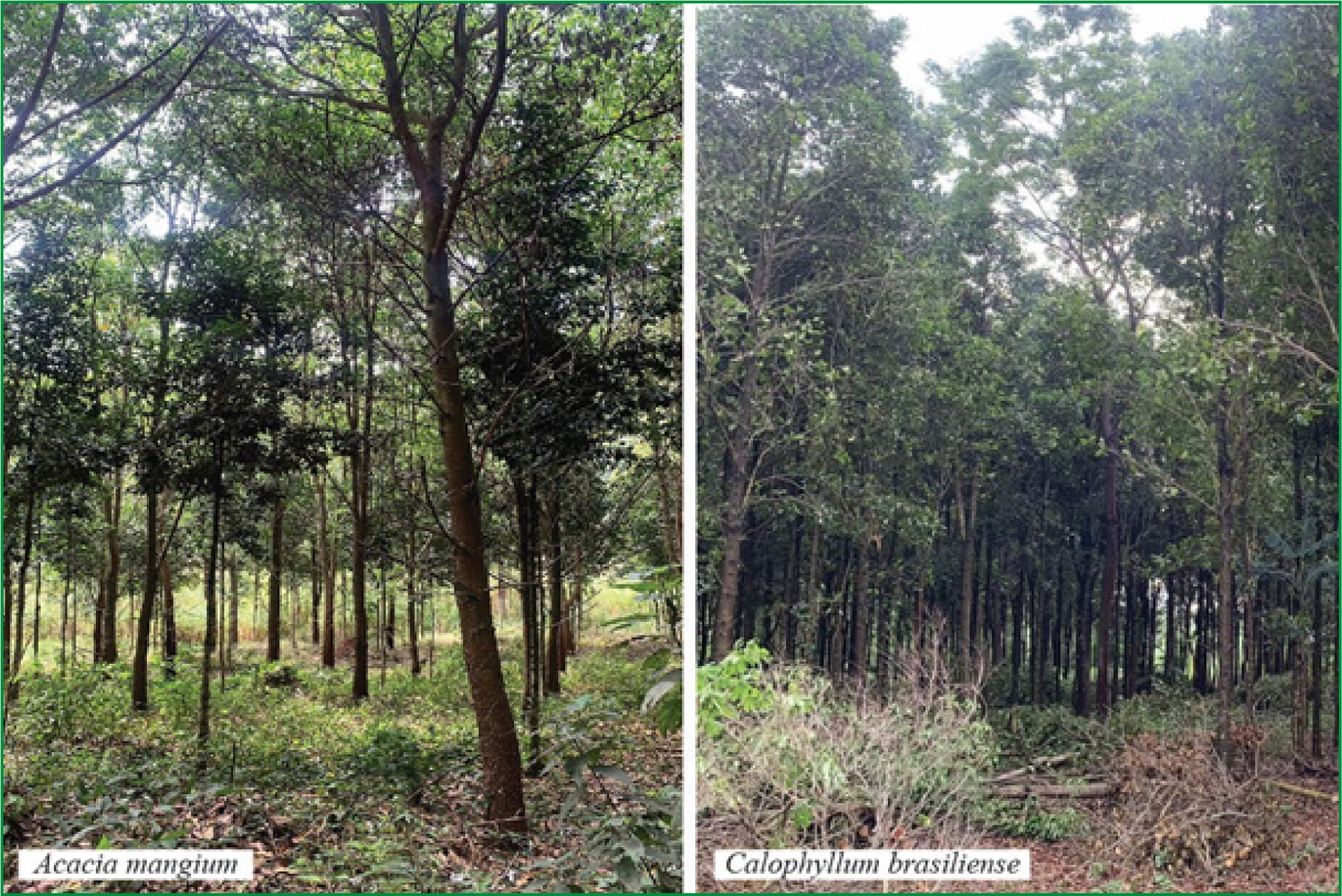
The raw materials of this study, Acacia mangium Willd. (Fabaceae) and Calophyllum brasiliense Cambess. (Calophyllaceae), were cultivated in Pindamonhangaba, SP, Brazil. Commercial plantations of both species are located at 22°54'31"S, 45°23′11″W (elev. 560 m) (Figure 1). According to the Köppen climate classification, the climate of Pindamonhangaba City is considered Cwa. That is, meteorological data indicate an average annual air temperature of 18.9°C and average annual precipitation of 1,590.8 mm (Alvares et al., 2013). Climatological water balance provides insight into the water regime of the region where the area is situated (Figure 1). From October to April, water supply exceeds 728.1 mm, while the soil water deficit, which is 3.5 mm per year, occurs from June to August, peaking in July. The planting for both species (Figure 2) was established with a spacing of 3 m × 2 m without fertilization. The plantings were installed in Melanic Gleisol, or, more specifically, the association of dystrophic Tb Melanic Gleisol with clayey texture + Tb Fluvic Neosho with medium texture + Organosol, all in the flat relief phase (Rossi, 2017).

Location in the municipality of Pindamonhangaba (red circle) in São Paulo state, Brazil. Average monthly precipitation, water deficit (DEF (-1)), water surplus (EXC), and mean temperature (black line)

Overview of Acacia mangium and Calophyllum brasiliense plantations in the municipality of Pindamonhangaba, São Paulo state
For this study, 12 trees of Calophyllum brasiliense, aged 16 years, and 12 trees of Acacia mangium, aged 15 years, were selected. The average DBH and tree height were 24 cm and 22 m in Acacia mangium and 16.5 cm and 13 m in Calophyllum brasiliense, respectively. From each sampled tree, the first log measuring 1 m in length was taken, properly identified and marked. Subsequently, these logs were transported to the Department of Forest Sciences at ESALQ/USP (Piracicaba, SP) for processing (Figure 3).
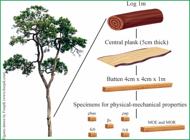
Schematic representation of sampling procedure to determine the physicomechanical properties of wood
From each of the processed logs, a central plank measuring 7 cm in thickness was extracted and subjected to natural drying for approximately 2 months.
After drying each plank, a batten measuring 4 cm× 4 cm× 100 cm was removed near the bark from which specific specimens were extracted to carry out physicomechanical tests in the Wood and Wood Products Mechanical Testing Laboratory (LEMMAD) of ESALQ/USP. The following wood properties were performed: basic density, apparent density, volumetric shrinkage, coefficient of anisotropy, compression strength, shear strength, modulus of rupture, and modulus of elasticity. For these tests, 12 specimens of each species were used.
2.1 Physical properties of wood
2.1.1 Apparent density (ρap)
Samples measuring 3 cm× 2 cm× 5 cm were obtained and dried until reaching 12% moisture content to obtain the apparent density. The dimensions of the samples were measured using a digital caliper with a sensitivity of 0.01 cm, and the mass of the specimen was obtained using a semi-analytical digital balance with a sensitivity of 0.01 g, following the NBR 7190-3 standards (Associação Brasileira de Normas Técnicas - ABNT, 2022c).
2.1.2 Basic density (ρbas)
To obtain the basic density, samples measuring 3 cm × 2 cm× 5 cm were used, and the hydrostatic balance method was employed following NBR 11941 (ABNT, 2003).
2.1.3 Dimensional variation of wood
Volumetric (βv), radial (βr), and tangential (βt) shrinkages, as well as the coefficient of anisotropy (βt/βr), were determined using samples measuring 3 cm× 2 cm× 5cm, following the NBR 7190-3 standard (ABNT, 2022c). The coefficient of anisotropy was obtained from the ratio between tangential and radial shrinkage.
2.2 Mechanical Properties of Wood
All mechanical tests were conducted with dry samples in an environment with standardized temperature until they reached 12% moisture content, a standard reference condition, following the recommendation of NBR7190-1 (ABNT, 2022a).
2.2.1 Compressive strength parallel to the grain (fc0)
To obtain the compression strength (fc0), specimens measuring 2 cm × 2 cm × 3 cm were obtained from each batten for a total of 24 units. Compression tests were conducted on a universal testing machine, following the adapted NBR 7190-3 standard (ABNT, 2022c).
2.2.2 Shear parallel to the grain (fv0)
To obtain shear strength, specimens with nominal dimensions of 2 cm × 2 cm× 3 cm with a shear area of 4 cm2 were used, and the adapted NBR 7190-1 standard (ABNT, 2022a) was employed.
2.2.3 Static bending
To test resistance to static bending, wood specimens measuring 2 cm× 2 cm × 35 cm were obtained. The tests were conducted on a universal testing machine with a load application of 10 MPa, according to the adapted NBR 7190-3 standard (ABNT, 2022c). Modulus of rupture (MOR) and modulus of elasticity (MOE) in static bending resistance were obtained simultaneously.
2.3 Statistical analysis
Homogeneity of variances was initially conducted using the Bartlett-Hartley test. Additionally, the Shapiro-Wilk test was employed for residual analysis. Subsequently, the F test for analysis of variance was carried out based on a completely randomized experimental design. If any treatment showed significant difference based on the F test, then Tukey’s range test at a 5% probability level was applied. Descriptive statistics were also utilized in data analysis. The Pearson correlation test was conducted. Statistical analyses were performed using R software (R Core Team, 2021).
3 RESULTS AND DISCUSSIONS
3.1 Physical properties of Wood
In Table 1, the mean values and standard deviation of the physical properties of Calophyllum brasiliense and Acacia mangium wood were presented.
Mean values and standard deviation for basic density (ρbas), apparent density (ρap), volumetric shrinkage (βv), radial shrinkage (βr), tangential shrinkage (βt), and. coefficient of anisotropy (βtβr) of Calophyllum brasiliense and Acacia mangium
The average basic density (ρbas) of Calophyllum brasiliense wood was 538 (kg m-3), and for Acacia mangium, it was 534 (kg m-3). According to the classification by Andrade and Jankowsky (2015), both are considered to have medium basic density.
According to Instituto de Pesquisa Tecnológica - IPT (2023), the basic density of Calophyllum brasiliense wood ranges from 490 to 510 (kg m-3). Therefore, the average basic density value reported herein is higher than that reported by Campos et al. (2019) (ρbas = 480 (kg m-3)) for seven-year-old wood from trees planted in Garça City, São Paulo state.
These basic density values of Acacia mangium are also higher than those obtained by Jusoh et al. (2014) (ρbas = 464 (kg m-3)) for seven-year-old wood planted in Malaysia and for four-year-old wood (ρbas = 400 (kg m-3)) planted in Piaui, Brazil (Guimarães Junior et al., 2014). They are even higher than those obtained by Vale et al. (1999) (ρbas = 520 (kg m-3)) for seven-year-old wood planted in Botucatu, SP. However, Barros et al. (2012) obtained a ρbas value of 580 (kg m-3) for seventeen-year-old wood planted in Iranduba, AM, which is higher than that obtained for our samples.
The mean apparent density of Acacia mangium (ρap= 582 (kg m-3)) is lower than the value reported by Segundinho et al. (2015) (ρap = 620 (kg m-3)) for eighteen-year-old wood from trees planted in Belo Oriente, MG.
For Calophyllum brasiliense, the mean apparent density (ρap = 621 (kg m-3)) we obtained is in the D30 density class according to ABNT NBR 7190-1 (2022a) for native woods of Brazil. According to IPT (2023), it is considered moderately heavy.
Wood density is a fundamental property for determining wood quality and its applicability across various applications. It is strongly influenced by environmental, silvicultural, and methodological factors. Differences between values obtained in different regions, at different ages, and using different sampling methods are common and should be carefully interpreted in light of these factors (Moulin et al., 2020). Therefore, the variations observed in the wood density of the two species, when compared with values found in the literature, can be explained by differences in growing conditions, tree age, as well as by the fact that sampling was carried out near the bark, where density values tend to be intrinsically higher.
The volumetric shrinkage of Calophyllum Brasiliense and Acacia mangium was βv = 12.03% and βv = 11.50%, respectively, both classified as having medium shrinkage according to Carvalho (1996) and IPT (2023). The obtained volumetric shrinkage value for Acacia mangium is lower than that observed by Jusoh et al. (2014) (βv = 15.89%) for seven-year-old wood planted in Malaysia. The volumetric shrinkage exhibited by Calophyllum brasiliense is considered medium by IPT (2023)
The dimensional stability of wood is an indicator of its behavior during service, and it invites comparisons between different types of wood and among samples tested at different times and in different facilities (Sargent, 2019). For coefficient of anisotropy, we obtained indices of βt/βr = 2.36 and βt/βr = 3.34 for Calophyllum brasiliense and Acacia mangium, respectively. Both species are in the high class for this index according to Carvalho (1996). For Acacia mangium wood, the coefficient of anisotropy index is higher than that obtained by Jusoh et al. (2014) (βt/βr = 2.1) for four-year-old wood planted in Piauí, Brazil (Guimarães Junior, 2014).
The anisotropy coefficients obtained in this study can be considered relatively high. This observation is likely associated with the fact that the wood samples were collected near the bark region, as the anisotropy coefficient generally increases along the pith-to-bark gradient. Higher values reflect a greater disparity between tangential and radial shrinkage, indicating increased dimensional anisotropy (Walker, 1993). This occurs because, near the pith, the wood is predominantly juvenile, characterized by a less organized anatomical structure, a higher proportion of thin-walled cells, larger microfibril angles, and greater structural variability. These characteristics tend to result in more uniform shrinkage between the radial and tangential directions, thereby reducing dimensional anisotropy. Conversely, toward the bark, there is a predominance of mature (adult) wood, which exhibits more pronounced anatomical differentiation, including thicker cell walls, better-developed cellular structure, and more aligned microfibrils. These attributes contribute to a more pronounced difference in shrinkage behavior between the radial and tangential directions, leading to higher anisotropy coefficients (Galvão and Jankowsky, 1985; Burger and Richter, 1991; Walker, 1993).
To improve the dimensional stability of wood, it is crucial to reduce its natural moisture content through air or kiln drying. This practice significantly benefits both the mechanical properties and density of the wood (Ramage et al., 2017).
By statistical comparison of physical properties between the studied trees, significant differences only arose in the evaluation of coefficient of anisotropy. Acacia mangium showed the highest values, whereas Calophyllum brasiliense wood presented the lowest values (Figure 4). A higher anisotropy coefficient signifies that Acacia mangium wood displays greater variation in physical properties like strength and deformability, depending on the load direction (longitudinal, radial, or tangential). This property is crucial for practical applications because it directly affects how the wood performs in structures or products experiencing mechanical stresses from various directions (Walker, 1993). These results suggest that the two wood species exhibit distinct characteristics, which can significantly influence their suitability for different applications in the timber industry.
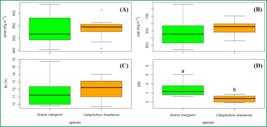
Average values of basic density (ρbas), apparent density (ρap), volumetric shrinkage (βv), radial shrinkage (βr), tangential shrinkage (βt), and coefficient of anisotropy (βtβr) of Calophyllum brasiliense and Acacia mangium
3.2 Mechanical Properties of Wood
The mean results and standard deviation of the mechanical properties of Calophyllum brasiliense and Acacia mangium wood were shown in Table 2.
Mean values and standard deviations for compression strength (fc0), shear strength (fv0), modulus of rupture (MOR), and modulus of elasticity (MOE) of Calophyllum brasiliense and Acacia mangium
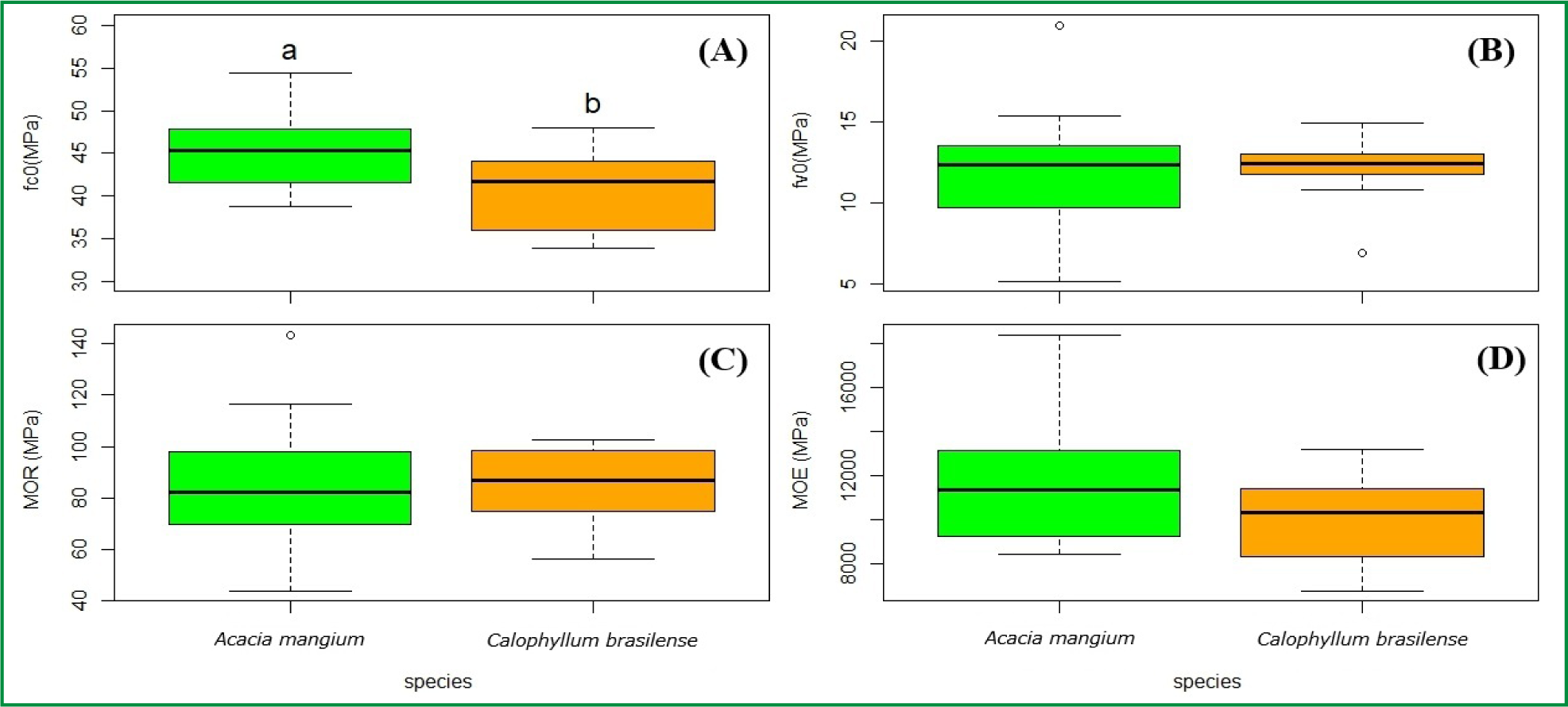
The mechanical properties of Calophyllum brasiliense and Acacia mangium were generally similar, with the exception of compressive strength (fc0), for which Acacia mangium exhibited a higher value compared to Calophyllum brasiliense (Table 2 and Figure 5A). This difference is relevant, as it suggests Acacia mangium may be better suited for applications requiring greater structural resistance.
The compression strength (fc0), shear strength (fv0), and Modulus of Elasticity (MOE) for Calophyllum brasiliense are higher than those reported by Arroyo et al. (2023), which were 51 MPa, 15.8 MPa, and 11405 MPa, respectively.
Based on our results for mechanical properties, Calophyllum brasiliense wood belongs in class D4 of the Resistance Classes of Native Forest Species, as defined in tests of defect-free specimens according to ABNT NBR 7190-1 (2022a). This classification is equal to that of the timber of such species as Hymenolobium excelsum, Peltophorum dubium, Pouteria pachycarpa, and Goupia glabra, among others.
The Modulus of Rupture (MOR) and Modulus of Elasticity (MOE) for Acacia mangium are higher than MOR and MOE obtained by Jusoh et al. (2014) (78 MPa and 9992 MPa, respectively) for seven-year-old wood planted in Malaysia and five-year-old wood planted in Vietnam (76 MPa and 7700 MPa, respectively) (Doung et al., 2023). However, for the compression strength test, 45 MPa is lower than that obtained by Doung et al. (2023).
In general, based on its mechanical properties, Acacia mangium wood belongs to class 2, along with Eucalyptus urophylla, Eucalyptus grandis, and Eucalyptus urophylla x Eucalyptus grandis woods, according to ABNT NBR 7190-2 (2022b).
Regarding the values of the mechanical properties of Acacia mangium, it was found that the Modulus of Rupture (MOR) and Modulus of Elasticity (MOE) are higher than those obtained by Jusoh et al. (2014), MOR=78 MPa and MOE=9992 MPa, respectively, for wood planted for 7 years in Malaysia, and also for wood planted for 5 years, MOR=76 MPa and MOE=7700 MPa, in Vietnam (Doung et al., 2023), however, it is lower for the compression strength fc0=53 MPa.
Only compression strength was significantly different between the two sampled trees in that the obtained compression strength of Acacia mangium is significantly higher than that of Calophyllum brasiliense wood (Figure 5).
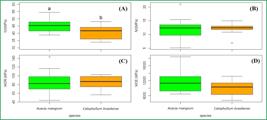
Values for compression strength parallel (fc0), shear strength (fv0), modulus of rupture (MOR), and modulus of elasticity (MOE) of Calophyllum brasiliense and Acacia mangium
When comparing the physical and mechanical property values obtained for the two species with those reported in the literature, we observed some differences. These discrepancies can be attributed to several factors, such as age, soil type, climate, silvicultural practices, among others. Furthermore, it is important to highlight that information on wood quality especially for Calophyllum brasiliense from plantations is still very limited.
3.3 Correlations between physical and mechanical properties
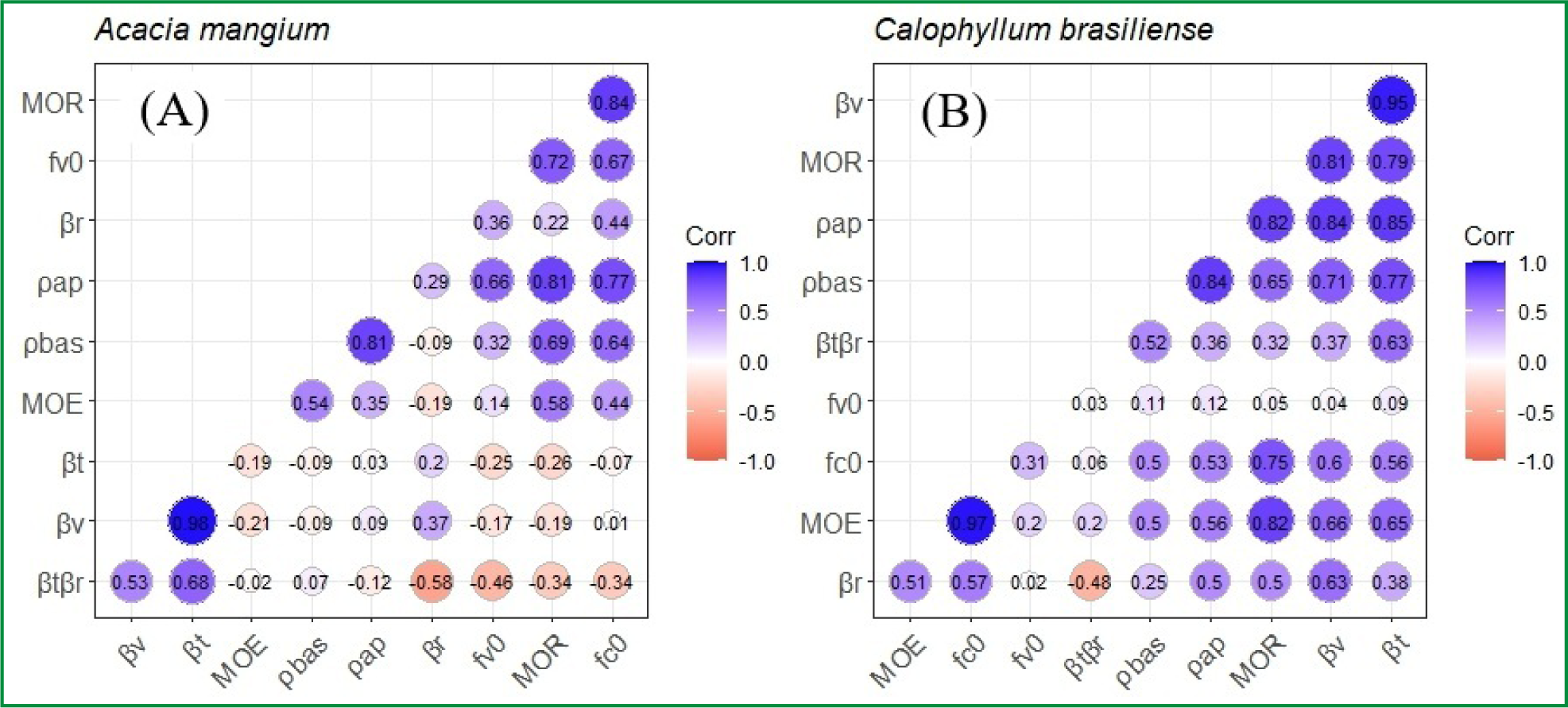
Apparent wood density is a key factor when analyzing the characteristics of different wood species and their future uses; it can also be used to estimate other mechanical properties of wood (Gomes et al., 2023). The Pearson correlation coefficient (PCC) analysis was conducted separately for each species in order to identify specific relationships between the variables. The correlations between βv and βt, fc0 and MOR, ρap and MOR, and ρap and ρbas were strongly positive in Acacia mangium, while the others were weak (Figure 6A).
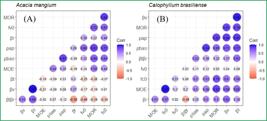
Pearson’s Correlation Coefficient for properties of Calophyllum brasiliense and Acacia mangium wood by species separately
For Calophyllum brasiliense, a strong positive relationship was observed between fc0 and MOR, with approximately 97% dependency. Other important relationships were found between βv and βt, ρap and βt, and between ρap and ρbas, while the remaining correlations were weaker (Figure 6B). Thus, only the strong correlations between βv and βt, fc0 and MOR, and ρap and ρbas were consistently observed in both species when analyzed separately.
In the case of Ruizterania albiflora wood, apparent density only showed significant correlations with modulus of elasticity in tension parallel to the fibers and the modulus of elasticity in static bending; however, other correlations may also exist (Soares et al., 2021). Nevertheless, among the analyzed physicomechanical properties, the strongest relationship was between apparent density and mechanical resistance.
In accordance with these guidelines, using Acacia mangium and Calophyllum brasiliense wood from reforestation projects would ensure the use of certified timber, thereby promoting a more sustainable construction material within the timber supply chain.
4 CONCLUSIONS
In general, our results show that:
Both the anisotropy coefficient and the compressive strength of Acacia mangium wood were significantly higher compared to the same parameters in Calophyllum brasiliense wood.
Calophyllum brasiliense exhibits physicomechanical properties comparable to those of Hymenolobium excelsum, Peltophorum dubium, Pouteria pachycarpa, and Goupia glabra.
Acacia mangium presents physicomechanical properties similar to those of Eucalyptus species commonly used as sawn timber.
Acacia mangium shows strong positive correlations between volumetric and tangential shrinkage, compressive strength and modulus of rupture, apparent density and MOR, as well as between basic density and apparent density.Calophyllum brasiliense shows a strong positive correlation between compressive strength and modulus of rupture . These data help to understand the behavior of the wood under different conditions.
Acacia mangium may be better suited for applications that require higher structural strength.
A higher anisotropy coefficient suggests that Acacia mangium wood exhibits direction dependent variations in its properties, which may influence its performance in different timber industry applications.
Future studies on Acacia mangium and Calophyllum brasiliense should explore how silvicultural practices and environmental conditions affect wood properties, aiming to optimize their industrial applications.
ACKNOWLEDGEMENTS
The authors thank Luis Eduardo Facco (Esalq – USP) for laboratory assistance.
Data Availability Statement:
Datasets related to this article will be available upon request to the corresponding author.
REFERENCES
- ALVARES, C. A.; STAPE, J. L.; SENTELHAS, P. C.; GONÇALVES, J. L. M.; SPAROVEK, G. Köppen’s climate classification map for Brazil. Meteorologische Zeitschrift, Stuttgart, v. 22, n. 6, p.711-728, 2013.
- ANDRADE, A. D.; JANKOWSKY, I. P. Pisos de madeira: características de espécies brasileiras. Piracicaba: ANPM, 2015. 184 p.
- ARROYO, F. N.; FRAGA, I. F.; RUTHES, H. C.; SOARES, L. S. Z. R.; AQUINO, V. B. D. M.; CHRISTOFORO, A. L.; LAHR, F. A. R. Influence of moisture content on physical and mechanical properties of Calophyllum sp wood. Ciência Florestal, n. 33, n.3, p. e70446, 2023.
- ASSOCIAÇÃO BRASILEIRA DE NORMAS TÉCNICAS. ABNT NBR 11941: Madeira-determinação da densidade básica. Rio de Janeiro, 2003. 6 p.
- ASSOCIAÇÃO BRASILEIRA DE NORMAS TÉCNICAS. ABNT NBR 7190-1: Projeto de estruturas de madeira. Parte 1: Critérios de dimensionamento. Rio de Janeiro, 2022a.
- ASSOCIAÇÃO BRASILEIRA DE NORMAS TÉCNICAS. ABNT NBR 7190-2: Projeto de estruturas de madeira. Parte 2: Métodos de ensaio para classificação visual e mecânica de peças estruturais de madeira. Rio de Janeiro, ABNT, 2022b.
- ASSOCIAÇÃO BRASILEIRA DE NORMAS TÉCNICAS. ABNT NBR 7190-3: Projeto de estruturas de madeira. Parte 3: Métodos de ensaio para corpos de prova isentos de defeitos para madeiras de florestas nativas. Rio de Janeiro, 2022c.
- BARROS, S. V. S.; NASCIMENTO, C. C.; AZEVEDO, C. P. Caracterização tecnológica da madeira de três espécies florestais cultivadas no Amazonas: alternativa para produção de lenha. Revista Floresta, v. 42, n. 4, p. 725- 732, 2012.
- BURGER, L. M.; RICHTER, H. G. Anatomia da Madeira São Paulo: Ed. Nobel, 1991. 154 p.
-
CARVALHO, A. Denominações convencionais para propriedades da madeira. In: CARVALHO, A. (ed.). Madeiras portuguesas: estrutura anatómica, propriedades, utilizações. Lisboa: Escola Superior de Tecnologia de Viseu - Departamento de Engenharia de Madeiras, 1996. 5 p. Available at: http://www.estgv.ipv.pt/paginaspessoais/jqomarcelo/tim3/tim3_tp1_na2.pdf Accessed in: 04 out. 2023.
» http://www.estgv.ipv.pt/paginaspessoais/jqomarcelo/tim3/tim3_tp1_na2.pdf - DOUNG, D. V.; SCHIMLECK, L.; LAM TRAN, D. Variation in wood density and mechanical properties of Acacia mangium provenances planted in Vietnam. Journal of Sustainable Forestry, London, v. 42, n. 5, 518-532, 2023.
-
FOOD AND AGRICULTURE ORGANIZATION OF THE UNITED NATIONS. The State of the World’s Forests 2022: Forest pathways for green recovery and building inclusive, resilient and sustainable economies. Rome: FAO, 2022. Available at: https://www.fao.org/state-of-forests/en/ Accessed in: 04 out. 2023.
» https://www.fao.org/state-of-forests/en/ - GALVÃO, A.P.M.; JANKOWSKY, I.P. Secagem racional da madeira São Paulo: Nobel, 1985. 111p.
- GIESBRECHT, B. M.; COLDEBELLA, R.; GENTIL, M.; NUNES, G. R. S.; FINGER, M. R.; JARDIM, J. M.; PEDRAZZI, C.; CARDOSO, G. V. The performance of Acacia mearnsii De Wild for kraft pulping. Ciência Florestal, v. 32, n. 1, p. 266-286, 2022.
- GOMES, A. F. F.; MACARENHAS, F. J. R.; DE ALMEIDA, D. H.; DIAS, A. M. P. G.; PANZERA, T. H.; ROCCO LAHR, F. A.; CHRISTOFORO, A. L. Tropical wood species: alternative model to determine the characteristic compressive strength perpendicular to grain. Southern Forests: a Journal of Forest Science, London, v. 85, n. 1, p. 19-25, 2023.
- GONÇALVES, F. G.; LELIS, R. C. C. Caracterização Tecnológica da Madeira de Acacia mangium Willd em Plantio Consorciado com Eucalipto. Floresta e Ambiente, Seropédica, v. 19, n. 3, p. 286-295, 2012.
- GUIMARÃES JUNIOR, J. B. G.; ARAÚJO, E. F.; AGUIAR, A. S.; MARTINS, E. R.; LOPES, O. Caracterização da madeira de desrama da Acacia mangium Willd cultivada no Sul do estado do Piauí para fins tecnológicos. Revista Enciclopédia Biosfera, v. 10, n. 18, p. 822-832, 2014.
-
INDÚSTRIA BRASILEIRA DE ÁRVORES. Relatório Anual 2023 Brasília: IBÁ; 2023. Available in: https://iba.org Accessed on: 06 out. 2023.
» https://iba.org -
INSTITUTO DE PESQUISAS TECNOLÓGICAS DO ESTADO DE SÃO PAULO. Informações sobre madeiras Available at: https://www.ipt.br/informacoes_madeiras3.php?madeira=70 Accessed on: 06 out. 2023.
» https://www.ipt.br/informacoes_madeiras3.php?madeira=70 - JUSOH, I.; ZAHARIN, F. A.; ADAM, N. S. Wood quality of Acacia hybrid and second-generation Acacia mangium. BioResources, Raleigh, v. 9, n. 1, p. 150-160, 2014.
- KRAINOVIC, P. M.; RESENDE, A. F.; AMAZONAS, N. T.; ALMEIDA, C. T.; ALMEIDA, D. R. A.; SILVA, C. C.; ANDRADE, H. S. F.; RODRIGUES, R. R.; BRANCALION, P. H. S. Potential native timber production in tropical forest restoration plantations. Perspectives in Ecology and Conservation, Amsterdam, v. 21, n. 4, 294-301, 2023.
- LIMA, F. C. D. C.; SEVERO, E. T. D.; CALONEGO, F.; CIRIELLO, V.; CIRIELLO, E. Determinação da massa específica básica e índice de rachadura de toras das espécies Khaya senegalensis (MOGNO AFRICANO), Khaya ivorensis (mogno africano) e Calophyllum brasiliense (guanandi). Re.C.E.E.F, Garça, v. 33, n. 1, p. 17-27, fev., 2019.
- MOULIN, J. C.; SILVA, S. R.; NUTTO, L.; VIDAURRE, G. B. Influência do espaçamento de plantio nas propriedades da madeira de eucalipto. In: VIDAURRE, G. B.; SILVA, J. G. M.; MOULIN, J. C.; CARNEIRO, A. C. O. (Org.). Qualidade da madeira de eucalipto proveniente de plantações no Brasil 1ed.Vitória -ES: EDUFES (Editora da Universidade Federal do Espírito Santo), 2020, v. 1, p. 171-195.
- PIOTTO, D.; ROLIM, S. G.; MONTAGNINI, F.; CALMON, M. Sistemas silviculturais com espécies nativas na Mata Atlântica: panorama, oportunidades e desafios. Silvicultura e Tecnologia de espécies da Mata Atlântica. Belo Horizonte: Editora Rona, 2018. p. 9-19.
-
R CORE TEAM. R: A language and environment for statistical computing. Vienna: R Foundation for Statistical Computing, 2021. 1571 p. https://www.R-project.org/
» https://www.R-project.org/ - RAMAGE, M. H.; BURRIDGE, H.; BUSSE-WICHER, M.; FEREDAY, G.; REYNOLDS, T.; SHAH, D. U.; WU, G.; YU, L.; FLEMING, P.; DENSLEY-TINGLEY, D.; ALLWOOD, J.; DUPREE, P.; LINDEN, P. F.; SCHERMAN, O. The wood from the trees: the use of timber in construction. Renewable and Sustainable Energy Reviews, Amsterdam, v. 68, n. 1, p. 333–359, 2017.
- RISSI, N. T.; MELO, R. R.; ALVES, A. R.; BATISTA, F. G.; SOUZA, M. J. C.; FERREIRA, L. M. Avaliação da qualidade da madeira serrada na amazônia mato-grossense. desafios. Revista Desafios, Palmas, v. 7, n. 4, p. 20-29, 2020.
- ROSSI, L. M. B.; AZEVEDO, C. P.; SOUZA, C. R. Acacia mangium Manaus: Documentos Embrapa Amazônia Ocidental (n.28), 2003. 29 p.
- ROSSI, M. Mapa pedológico do Estado de São Paulo: revisado e ampliado. São Paulo: Instituto Florestal, 2017. 118 p.
- SARGENT, R. Evaluating dimensional stability in solid wood: a review of current practice. Journal of Wood Science, Berlim, v. 65, Article number 36, 2019.
- SEGUNDINHO, P. G. A.; FRANÇA, L. C. A.; MEDEIROS NETO, P. N.; GONÇALVES, F. G.; SILVA OLIVEIRA, J. T. Madeira lamelada colada (MLC) com Acacia mangium e adesivos estruturais. Scientia Forestalis, v. 43, n. 107, p. 533-540, 2015.
- SOARES, L. S. Z. R.; SILVA, D. A. L.; PANZERA, T. H.; DIAS, A. M. P. G.; LARH, F. A. R.; CHRISTOFORO, A. L. Estimativa de propriedades da madeira Mandioqueira pela frequência natural de vibração e pela densidade aparente. Revista Matéria, v. 26, n. 3, e13051, 2021.
- VIET, D. D.; MA, T.; INAGAKI, T.; TU KIM, N.; QUYNH CHI, N.; TSUCHIKAWA, S. Physical and mechanical properties of fast growing polyploid Acacia hybrids (A. auriculiformis× A. mangium) from Vietnam. Forests, Basel, v. 11, n. 7, 717. 2020.
- WALKER, J. C. F. The drying of timber. In: WALKER, J. C. F. Primary wood processing: principles and practice London: Chapman & Hall, 1993. p. 247-284.
-
Evaluators in this article:
Cristiane Pedrazzi, Section Editor
-
Editorial Board:
Prof. Dr. Cristiane Pedrazzi, Editor-in-ChiefProf. Dr. Dalton Righi, Associate EditorMiguel Favila, Managing Editor

 Source: Authors (2024)
 Source: Authors (2023)
 Source: Authors (2024)
 Source: Authors (2024)In where: Means followed by the same lowercase letter do not differ from each other, according to Tukey's test (P < 0.05).
 Source: Authors (2024)In where: Means followed by the same lowercase letter do not differ from each other, according to Tukey's test (P < 0.05).
 Source: Authors (2024)In where: Negative and positive correlations are represented by red and blue, respectively. The magnitude of all correlations is represented by color intensity.