
 Environmental heterogeneity and its influence on the taxonomic richness and diversity of the Tropical Dry Forest in Pernambuco, Brazil
ABSTRACT
The present study aimed to investigate species richness and alpha and beta diversities of tree communities in six areas of Tropical Dry Forest (TDF) located in the State of Pernambuco, Northeastern Brazil. The hypotheses tested were: (i) variations in altitude, temperature, rainfall and luminosity do not affect species richness and alpha diversity but do influence beta diversity; and (ii) turnover is the main factor in determining community structure in the studied TDF areas, implying that these communities are under the pressure of environmental filtration. The first hypothesis was only partially verified by our results since one of the environmental gradients, namely rainfall, was found to exert a significant effect on species richness and alpha diversity. However, all environment gradients influenced community structure and beta diversity. The turnover process was identified as the determining factor in structuring the TDF tree communities, thereby validating the pressure caused by abiotic filters and verifying the second hypothesis. Community structure and beta diversity were influenced mainly by the pressure of altitude on turnover and, to a lesser extent, of temperature and rainfall on nestedness.
Keywords:
Abiotic filters; Nesting; Turnover
RESUMO
O objetivo com o presente estudo foi pesquisar a riqueza de espécies e as diversidades alfa e beta de comunidades arbóreas em seis áreas da Floresta Tropical Seca (FTS), localizada no estado de Pernambuco, Nordeste do Brasil. As hipóteses testadas foram: (i) variações de altitude, temperatura, pluviosidade e luminosidade não influenciam a riqueza de espécies e a diversidade alfa, mas afetam a diversidade beta, e (ii) a substituição das espécies (turnover) é o fator determinante da estrutura das comunidades nas áreas de FTS estudadas, significando que essas comunidades estão sob a pressão da filtragem ambiental. A primeira hipótese foi apenas parcialmente verificada pelos resultados, uma vez que um dos gradientes ambientais, mais especificamente a pluviosidade, exerceu um efeito significativo sobre a riqueza de espécies e a diversidade alfa. No entanto, todos os gradientes ambientais afetaram a estrutura das comunidades e a diversidade beta. O processo de turnover foi identificado como fator determinante para a estrutura das comunidades arbóreas da FTS, validando a pressão causada pelos filtros abióticos e verificando a segunda hipótese. A estrutura da comunidade e a diversidade beta foram influenciadas principalmente pela pressão da altitude sobre o turnover e, em menor grau, da temperatura e da precipitação sobre o aninhamento.
Palavras-chave:
Filtros abióticos; Aninhamento; Substituição
1 INTRODUCTION
The properties of ecosystems are generally controlled by biotic and abiotic elements that influence the structure of communities (Souza et al., 2017; Münkemüller et al., 2020). Studies have shown that taxonomic richness and diversity of plant species can increase or decrease according to several factors depending on the heterogeneity of the habitat and the pressure of biotic and abiotic (environmental) filters (Xu et al., 2017).
Community structure is characterized by the set of populations of different species that coexist in the same space concomitantly. Analysis of community structure in terms of habitat heterogeneity can clarify how stochastic (random) and deterministic (abiotic and biotic filters) processes interact causing different patterns to emerge (Braga; Oliveira; Cerqueira, 2017). In this sense, studies on the distribution and abundance of organisms across environmental gradients are valuable in understanding how the environment influences the formation of local communities (Magnago et al., 2013) regarding their specific composition, diversity and relative abundance of species (Valladares et al., 2015).
Habitat heterogeneity is defined as the spatial and temporal variation of the properties of the ecosystem (Bilia et al., 2015) and can be characterized in many ways including, among others, gradients of altitude, slope, rainfall, air humidity, chemical and physical properties of the soil, luminosity, water level in the water table and topography of the landscape (Vianna et al., 2015). In this context, the environmental gradient comprises any variation in the abiotic characteristics of a given location (Favero; Büneker; Waechter, 2022). Therefore, studies that focus on the influence of environmental gradients on community structure facilitate the understanding of variations in the vegetation by explaining habitat heterogeneity, namely the differential spatial distribution of species, populations, and other characteristics such as landscape coverage, productivity, species richness and diversity of the communities (Siqueira; Rocha, 2013; Magurran, 2013; Terra et al., 2015).
Several studies have demonstrated that, in general, abiotic factors in Tropical Dry Forests (TDF) are not significantly correlated with alpha diversity (species richness) but are associated with beta diversity (Silva-Aparicio et al., 2018), indicating that environmental filtering acts more strongly on beta diversity (Silva-Aparicio et al., 2018; Whang et al., 2019; Münkemüller et al., 2020; Zhang et al., 2022). These findings show that species composition changes across environmental gradients (Magurran, 2013), whilst knowledge of such variations allows the identification of processes responsible for community structure and the detection of loss of species diversity.
Detailed investigations of environmental gradients have shown that turnover processes appear to be the main structuring factor for the formation of communities. Such processes involve species replacement along environmental gradients that function as abiotic filters for the selection of species capable of surviving particular environments. In contrast, nestedness (nesting or grouping) processes involve species loss and are associated either with differences among community subsets owing to isolation, size of area, quality and grouping of habitats, or with species attributes such as area requirement, abundance and tolerance to abiotic factors (Cubino et al., 2021; Zhang et al., 2022).
Considering the above, the present study aimed to investigate the taxonomy, species richness, and alpha and beta diversities of tree communities in six TDF areas in the state of Pernambuco, northeastern Brazil. The hypotheses tested were: (i) that variations in altitude, temperature, rainfall and luminosity do not affect species richness and alpha diversity but do influence beta diversity; and (ii) that turnover is the main factor in determining community structure in the studied TDF areas, implying that these communities are under the pressure of environmental filtration.
2 MATERIALS AND METHODS
2.1 Site of study
The study was carried out in six areas, each characterized as TDF (FaberLangendoen et al., 2016), located in Pernambuco, Northeastern Brazil, using as reference the forest management data provided by the Serviço Florestal Brasileiro (Ministério do Meio Ambiente e Mudança do Clima, Brasília, DF, Brazil). These data were employed in the project “Support for the Implementation of the Forestry Sustainable Development Program in the Araripe Region” and originated from a partnership between Companhia de Desenvolvimento dos Vales do São Francisco e do Parnaíba (CODEVASF, 3rd Regional Superintendence), Secretaria de Agricultura e Reforma Agrária of Pernambuco and Instituto Agronômico de Pernambuco (IPA).
The six TDF areas (Figure 1) were distributed across six municipalities of the semi-arid region of Pernambuco, namely Santa Maria da Boa Vista (A1), Serra Talhada (A2), Ouricuri (A3), Dormentes (A4), Verdejante (A5) and Parnamirim (A6). The TDFs covered a total of 2,397.71 ha of Caatinga, with an average altitude of 439 m, and contained native forest species distributed in family farming settlements. According to the Köppen system, the climate of the study areas is classified as hot semi-arid (BSh’) and is characterized by an average annual temperature of 26.0°C, an average annual rainfall of 503.17 mm and an average annual luminosity of 2,823.08 h of sunshine (Climate Data, 2022). It is worth highlighting that this is the first time that these TDFs have been inventoried and submitted to draft forest management plans. Furthermore, there are no reports about any previous cutting of the native vegetation in these areas.

2.2 Sampling design, data collection and processing
The sampling design considered the factors that promote environmental heterogeneity and included altitude, temperature, rainfall and luminosity (hours of sunshine per year), and the six studied areas (municipalities) were considered repetitions. Data were obtained from the forest management plan inventories that included all trees with circumferences at breast height (1.30 m above ground) equal to or greater than 6.0 cm present in 101 plots of 20 x 20 m (400 m2 each; 40,400 m2 in total) in which species richness and diversity had been analyzed. These plots were presented randomly in the forest inventories, the level of probability adopted in the Student’s t test was 90% and the maximum sampling error was 20.0% according to protocols of the Rede de Manejo Florestal da Caatinga and Agência Estadual de Meio Ambiente de Pernambuco. Data regarding the environmental gradients were collected in 2022 from the Climate Data website (Climate Data, 2022), which provided meteorological information covering average values over a 30-year period.
2.3 Data analysis
Normality of the data regarding tree communities (species richness, diversity and dominance) and environmental gradients (altitude, temperature, rainfall and luminosity) was confirmed using the Shapiro-Wilk test. The alpha diversity in each area was calculated according to Hill numbers, which encompass three main diversity measures, namely species richness (q = 0), the corrected Shannon diversity index (q = 1) and the Simpson dominance index (q = 2) (Chao et al., 2014). Weighted average values of Hill numbers were calculated using Kruskal-Wallis non-parametric statistical analysis to verify whether the communities in the study areas had the same distribution of species richness, diversity and dominance.
In order to understand the influence of environmental heterogeneity (altitude, temperature, rainfall and luminosity) on alpha diversity, the mean values of species richness and diversity were calculated in each study area and submitted to: (i) Spearman correlation analysis - to establish possible correlations between either species richness or diversity and each of the environmental gradients separately; and (ii) multiple linear regression (MLR) analysis with the alpha level set at 0.05 - to examine correlations between either species richness or diversity (dependent variables) and all environmental gradients (independent variables) taken together.
The influence of environmental heterogeneity (altitude, temperature, rainfall and luminosity) on beta diversity was determined using partitioning methods (Cubino et al., 2021; Zhang et al., 2022). Sorensen similarity (βsor) and Jaccard dissimilarity (βjac) indices were calculated to obtain the contribution of turnover processes, while the contribution of nestedness processes (βnes) was determined from the equation βnes = βsor - βjac. The percentage contributions of turnover (βjac) and nestedness (βnes) to βsor were evaluated to determine which of the two processes most clearly explained beta diversity. Subsequently, canonical correspondence analysis (CCA) was performed to examine correlations between the diversity indices (βsor, βjac and βnes) and the environmental gradients.
RESULTS AND DISCUSSIONS
3.1 Alpha diversity
The 12 main families and 36 species identified in the TDF areas are presented in Table 1, while the mean values of Hill numbers relating to species richness and alpha diversity, together with those of the environmental gradients, are shown in Table 2.
Mean values of the Hill numbers and details of environmental gradients in six study areas of Tropical Dry Forest in Pernambuco, Brazil
Kruskal-Wallis analysis of Hill numbers revealed that there were no significant differences between the studied TDF areas regarding species richness and alpha diversity (Table 3). Spearman correlation analyses of the mean values of species richness or diversity and environmental gradients revealed that species richness was strongly correlated with rainfall while correlations with the other environmental gradients were weak (Table 4). Moreover, correlations between diversity and the four environmental gradients were also weak.
Summary of the Kruskal-Wallis analysis of Hill numbers obtained for six study areas of Tropical Dry Forest in Pernambuco, Brazil
Spearman rank correlations showing the strengths of associations between tree species richness or diversity and environmental gradients in the study areas of Tropical Dry Forest in Pernambuco, Brazil
MLR analysis of species richness and environmental gradients (altitude, temperature, rainfall and luminosity) showed that the relationships between these variables were well explained by the regression model, as shown by the goodness of fit to the data (R2 = 0.99). A similar situation existed regarding the relationships between diversity and environmental gradients, for which the coefficient of determination (R2) was 0.94. However, MLR analysis also revealed that correlations between species richness or diversity and altitude, temperature, rainfall or luminosity were outside the significance limit as expressed by F values (> 0.05) and confirmed by the corresponding p values > 0.05 (Table 5).
Multiple linear regression analyses showing the relationships between species richness or diversity and environmental gradients in the study areas of Tropical Dry Forest in Pernambuco, Brazil
The results of the statistical analyses performed on the data relating to alpha diversity demonstrated that rainfall is the only environmental factor that exerted a significant influence on species richness, while none of the studied factors affected species diversity.
3.2 Beta diversity
The variation in tree communities in the six TDF areas was expressed by beta diversity and was determined by species turnover and nestedness. As shown in Table 6, partitioning of beta diversity showed that the tree community in Serra Talhada (A2) presented the greatest level of similarity, as signified by the largest value (0.55) of βsor, while the communities in Santa Maria da Boa Vista (A1) and Ouricuri (A3) exhibited the smallest level of dissimilarity as indicated by the lowest values (0.32) of βjac. The highest degree of nestedness was found in Verdejante (A6), which presented a βnes value of 0.15, indicating that a greater loss of tree species diversity occurred in this area. The lowest levels of all indices of beta diversity were found in A3.
Partitioning of beta diversity also showed that, in the studied tree communities, the turnover process predominates over nestedness (with contributions to βsor of 73.47 and 28.57%, respectively) and constitutes the main factor responsible for beta diversity (Bernardo, 2012). Thus, abiotic filters (environmental, geographical/spatial and temporal restrictions) likely promote the structuring of beta diversity in these areas (Münkemüller et al., 2020). The preponderance of the turnover process suggests that certain environmental situations and gradients are not tolerated by some species, and these may be replaced by others that better tolerate analogous conditions (Zhang et al., 2022).
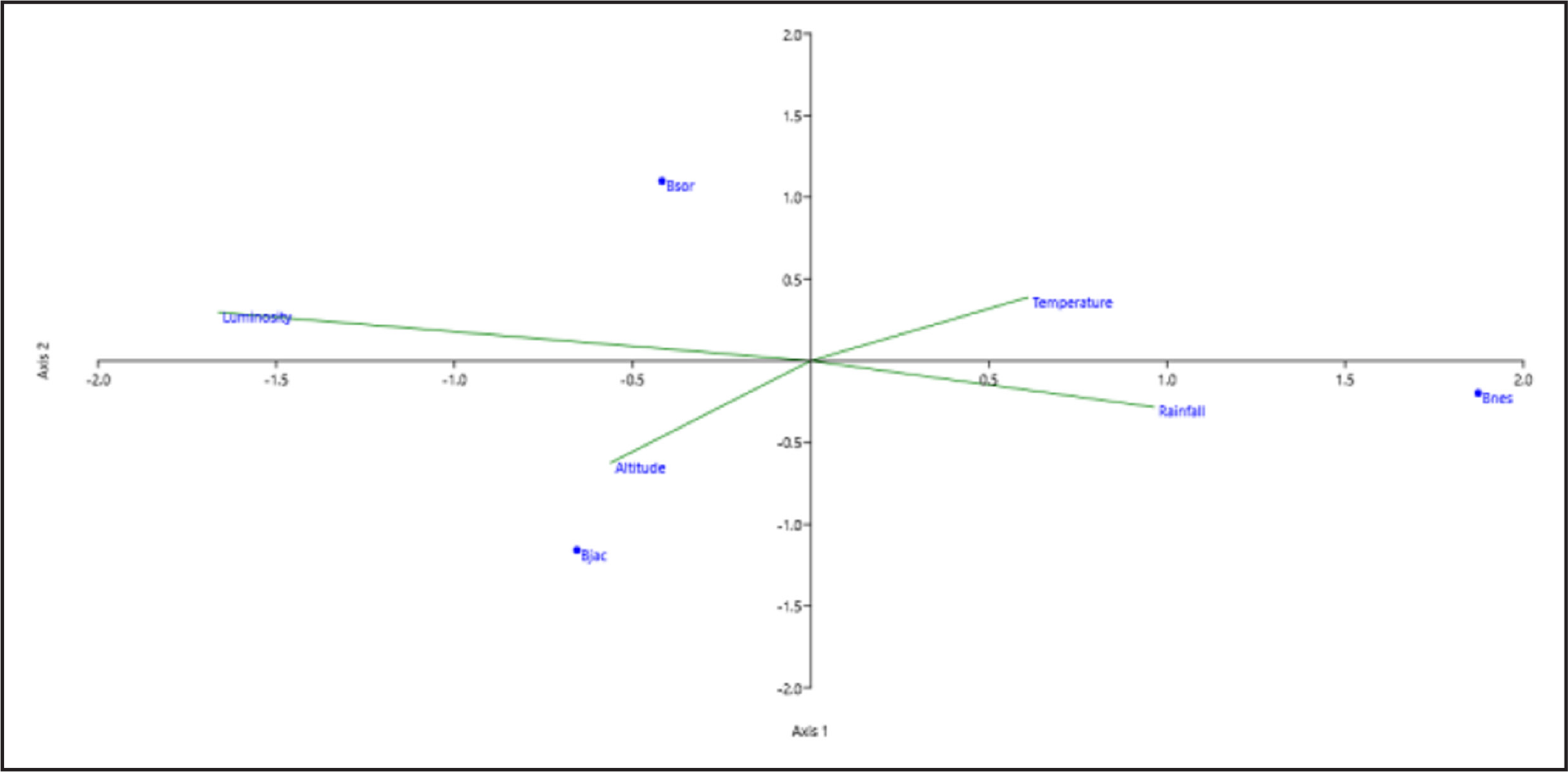
The results of CCA analysis between the beta diversity indices (βsor, βjac and βnes) and the environmental gradients (altitude, temperature, rainfall and luminosity) revealed that ordering axis 1 (x axis) provides most (97.73%) of the explanation for the variation in composition of the communities while axis 2 (y axis) provides only 2.27% (Table 7). Temperature, rainfall and luminosity remained closer to axis 1, with similarity (βsor) more associated with luminosity and nestedness (βnes) more associated with temperature and rainfall, while altitude remained closer to axis 2 and was more associated with turnover (βjac) (Figure 2).
Results of canonical correspondence analysis showing correlations of the environmental gradients in relation to ordering axes 1 and 2 in the study areas of Tropical Dry Forest in Pernambuco, Brazil

Results of canonical correspondence analysis showing the spatial arrangement of βsor, βjac and βnes in relation to the direction and magnitude of the environmental gradients in the study areas of Tropical Dry Forest in Pernambuco, Brazil
The results reported herein regarding the influence of abiotic factors on the alpha and beta diversities of tree communities in six TDF areas in Pernambuco, Brazil, were comparable with those reported previously by different researchers. For instance, our investigation revealed that rainfall strongly influenced species richness in the studied areas and that the structure of the tree communities (beta diversity) was affected significantly by the environmental gradients. In this sense, our results corroborate findings reported from different TDF areas in Mexico (Silva-Aparicio et al., 2018), China (Whang et al., 2019) and Kenya (Zhang et al., 2022).
In the case of TDFs in Pernambuco, we identified temperature and rainfall as the main environmental factors affecting nestedness (βnes), which signifies loss of diversity of tree species. We also detected altitude as the main factor affecting the process of turnover (βjac), which leads to the replacement of tree species. In light of the above, it is considered that abiotic filters (represented by the environmental gradients) play a role in the selection of tree species that are more tolerant to the TDF environment.
4 CONCLUSIONS
Our first hypothesis was only partially verified by our results since one of the environmental gradients, namely rainfall, was found to exert a significant effect on species richness and alpha diversity. However, all environment gradients influenced community structure and beta diversity. The turnover process was identified as the determining factor in structuring the TDF tree communities, thereby validating the pressure caused by abiotic filters and verifying our second hypothesis. Community structure and beta diversity were influenced mainly by the pressure of altitude on turnover and, to a lesser extent, of temperature and rainfall on nestedness.
The public authorities of the State of Pernambuco have authorized a 15-year cutting cycle of the native vegetation in the six TDF areas with the purpose of removing timber and non-timber products to supply firewood for energy production. In view of the current scenario of climate change, the continuous monitoring of these areas is critical to ensure: (i) the ecological sustainability of the areas at the end of each 15-year cycle in relation to issues regarding the maintenance of wood stock and the economic viability of the cutting plan; and (ii) the conservation of species richness and diversity and the continuity of ecosystem services provided by the TDFs.
ACKNOWLEDGEMENTS
We wish to thank the Serviço Florestal Brasileiro for suggesting the agrarian reform settlements, the Instituto Nacional de Colonização e Reforma Agrária (INCRA) for providing the management plans from which we extracted the data used in the study, and CODEVASF for financial support to our study. We are also grateful to Editione Editoração Ltda for assistance with translation and editing of the manuscript.
REFERENCES
-
BERNARDO, P. V. S. Padrões de distribuição de mamíferos de médio e grande porte em paisagens fragmentadas 2012. 99f. Dissertação (Mestrado em Ecologia e Evolução). Universidade Federal de Goiás-UFG. 2012. Disponível em: https://repositorio.bc.ufg.br/tede/bitstream/tde/2571/1/Dissertacao_Paulo_Bernardo.pdf Acesso em 28 abr. 2022.
» https://repositorio.bc.ufg.br/tede/bitstream/tde/2571/1/Dissertacao_Paulo_Bernardo.pdf -
BILIA, C. G.; PINHA, G.; PETSCH, D. K.; TAKEDA, A. M. Influência da heterogeneidade ambiental sobre os atributos da comunidade de Chironomidae em lagoas de inundação neotropicais. Heringia, v. 105, p. 20-27, 2015. DOI: 10.1590/1678-4766201510512027.
» https://doi.org/10.1590/1678-4766201510512027. -
BRAGA, C.; OLIVEIRA, J.; CERQUEIRA, R. Metacomunidades: Uma introdução aos termos e conceitos. Oecologia Australis, v. 21, p. 108-118, 2017. DOI: 10.4257/oeco.2017.2102.02.
» https://doi.org/10.4257/oeco.2017.2102.02. -
CHAO, A.; GOTELLI, N. J.; HSIEH, T. C.; SANDER, E. L.; MA, K. H.; COLWELL, R. K.; ELLISON, A. M. Rarefaction and extrapolation with Hill numbers: a framework for sampling and estimation in species diversity studies. Ecological Monographs, v. 84, p. 45-67, 2014. DOI: https://doi.org/10.1890/13-0133.1
» https://doi.org/10.1890/13-0133.1 -
CLIMATE-DATA. Clima: Pernambuco. Available at: https://pt.climate-data.org/ Accessed in: 10 fev. 2022.
» https://pt.climate-data.org/ -
CUBINO, J. P.; JIMÉNEZ-ALFARO, B.; SABATINI, F. M.; WILLNER, W.; LOSOSOVÁ, Z.; BIURRUN, I.; BRUNET, J.; CAMPOS, J. A.; INDREICA, A.; JANSEN, F.; LENOIR, J.; ŠKVORC, Ž.; VASSILEV, K.; CHYTRÝ, M. Plant taxonomic and phylogenetic turnover increases toward climatic extremes and depends on historical factors in European beech forests. Journal of Vegetation Science, v. 31, p. 1-12, 2021. DOI: 10.1111/jvs.12977.
» https://doi.org/10.1111/jvs.12977. - FABER-LANGENDOEN, D.; KEELER-WOLF, T.; MEIDINGER, D.; JOSSE, C.; WEAKLEY, A.; TART, D.; NAVARRO, G.; HOAGLAND, B.; PONOMARENKO, S.; FULTS, G.; HELMER, E. Classification and description of world formation types U.S. Department of Agriculture, Forest Service, Rocky Mountain Research Station. 222 p. 2016.
-
FÁVERO, A. A.; BÜNEKER, H. M.; WAECHTER, J. L. Patterns and metacommunity processes of epiphytic bromeliad assemblages along a coastal-inland gradient in a subtropical Brazilian geographic corridor. Austral Ecology, v. 47, p. 1184-1199, 2022, DOI: 10.1111/aec.13205.
» https://doi.org/10.1111/aec.13205. -
INSTITUTO BRASILEIRO DE GEOGRAFIA E ESTATÍSTICA - IBGE. Mapa político do Estado de Pernambuco 2023. Rio de Janeiro: IBGE, 2023. 1 mapa, color. Escala 1:650.000. Disponível em: https://www.ibge.gov.br/cidades-e-estados/pe.html Acesso em: 10 nov. 2023.
» https://www.ibge.gov.br/cidades-e-estados/pe.html -
MAGNAGO, L. F. S.; MARTINS, S. V.; SCHAEFER, C. E. G. R; NERI, A. V. Structure and diversity of restingas along a flood gradient in southeastern Brazil. Acta v. 27, p. 801-809. 2013. DOI: 10.1590/S0102-33062013000400020.
» https://doi.org/10.1590/S0102-33062013000400020. - MAGURRAN, A. E. Medindo a diversidade biológica Curitiba: Editora da UFPR. 2013, 261 p.
-
MÜNKEMÜLLER, T.; GALLIEN, L.; POLLOCK, L. J.; BARROS, C.; CARBONI, M.; CHALMANDRIER, L.; MAZEL, F.; MOKANY, K.; ROQUET, C.; SMYČKA, J.; TALLUTO, M. V.; THUILLER, W. Dos and don’ts when inferring assembly rules from diversity patterns. Global Ecology and Biogeography, v. 29, p. 1-18, 2020. DOI: 10.1111/geb.13098.
» https://doi.org/10.1111/geb.13098. -
SILVA-APARICIO, M.; CASTRO-RAMÍREZ, A.E.; CASTILLO-CAMPOS, G; RIVERA, E.P. Estructura de la vegetación leñosa en tres áreas con Selva Baja Caducifolia en el Istmo-Costa de Oaxaca, México. Revista de Biología Tropical, v. 66, p. 863-879, 2018. DOI: 10.15517/rbt.v66i2.33419.
» https://doi.org/10.15517/rbt.v66i2.33419 -
SIQUEIRA, C. C.; ROCHA, C. F. D. Gradientes altitudinais: conceitos e implicações sobre a biologia, a distribuição e a conservação dos anfíbios anuros. Oecologia Australis, v. 17, p. 282-302, 2013. DOI: 10.4257/oeco.2013.1702.09.
» https://doi.org/10.4257/oeco.2013.1702.09. -
SOUZA, K.; HIGUCHI, P.; SILVA, A. C.; SCHIMALSKI, M. B.; LOEBENS, R.; BUZZI JÚNIOR, F.; SOUZA, C. C; RODRIGUES JUNIOR, L. C.; WALTER, F. F; MISSIO, F. F.; DALLA ROSA, A. Partição de nicho por grupos funcionais de espécies arbóreas em uma floresta subtropical. Rodriguésia, v. 68, p. 1165-1175, 2017. DOI: 10.1590/2175-7860201768401.
» https://doi.org/10.1590/2175-7860201768401. -
TERRA, M. C. N. S.; MELLO, J. M.; MELLO, C. R.; SANTOS, R. M.; NUNES, A. C. R.; RAIMUNDO, M. R. Influência topo-edafo-climática na vegetação de um fragmento de Mata Atlântica na Serra da Mantiqueira, MG. Ambiente e Água, v. 10, p. 928-942, 2015. DOI: https://doi.org/10.4136/ambi-agua.1705 .
» https://doi.org/10.4136/ambi-agua.1705 -
VALLADARES, F.; BASTIAS, C. C.; GODOY, O.; GRANDA, E.; ESCUDERO, A. Species coexistence in a changing world. Frontiers in Plant Sciences v. 6, p. 1-16, 2015. DOI: 10.3389/fpls.2015.00866.
» https://doi.org/10.3389/fpls.2015.00866. -
VIANNA, L. F. N.; SILVA, E. B.; MASSIGNAM, A. M.; OLIVEIRA, S. N. Aplicação de descritores de heterogeneidade ambiental na seleção de áreas para sistemas de parcelas amostrais: um estudo de caso para a determinação de hotspots potenciais de biodiversidade. Geografia, v. 40, p. 211-239, 2015. Available at: https://www.researchgate.net Accessed in: 03 fev. 2021.
» https://www.researchgate.net - VIEIRA, S. Estatística básica São Paulo: Cengage Learning, 2012. 176 p.
-
WHANG, J.; CHEN, C.; LI, J.; FENG, Y.; LU. Q. Different ecological process determined the alpha and beta components of taxonomic, functional, and phylogenetic diversity for plant communities in dryland regions of Northwest China. Peerj p. 1-20, 2019. DOI: 10.7717/peerj.6220.
» https://doi.org/10.7717/peerj.6220. -
XU, J.; CHEN, Y.; ZHANG, L.; CHAI, Y.; WANG, M.; GUO, Y.; LI, T.; YUE, M. Using phylogeny and functional traits for assessing community assembly along environmental gradients: A deterministic process driven by elevation. Ecology and Evolution, v. 7, p. 5056-5069, 2017. DOI: 10.1002/ece3.3068.
» https://doi.org/10.1002/ece3.3068. -
ZHANG, Q.; YE, J. F.; LE, C. T.; NJENGA, D. M.; RABARIJAONA, N. R.; OMOLLO, W. O.; LU, L. M.; LIU, B.; CHEN, Z. D. New insights into the formation of biodiversity hotspots of the Kenyan flora. Diversity and Distributions v. 28, p. 2696-2711, 2022. DOI: 10.1111/ddi.13624.
» https://doi.org/10.1111/ddi.13624.

 Source: Instituto Brasileiro de Geografia e Estatística (
 Source: Authors (2023)Key: βsor = Sorensen similarity index; βjac = Jaccard dissimilarity index (turnover); βnes = nestedness