
 Analysis of transcriptome differences between two clones of Populus section Aigeiros after insect infestation
ABSTRACT
Insect resistance is an inherent characteristic of plants and determined by genotypic differences across plants. In this study, we determined differences in the gene expression patterns between two clones of Populus section Aigeiros after insect infestation and elucidated the mechanism of resistance induced by insect feeding. We performed differential gene expression (DEG) analysis by using Illumina Hiseq 2000 high-throughput sequencing of leaf samples from the upper, middle, and lower parts of Populus euramericana cv. ‘Neva’ (“P107”) and P. deltoids ‘Chuangxin’ (“P17-2”) infested with the insect. We selected 3,462 DEGs through a comparison between “P107” and “P17-2” (A vs. B). Based on the gene ontology analysis, the identified DEGs were functionally annotated, which revealed 20, 23, and 22 functional categories of “biological process”, “cellular component”, and “molecular function”, with enrichment mainly in “cellular process”, “cell part”, and “binding functions”, respectively. After insect feeding, the damaged leaves of “P107” and “P17-2” showed different degrees of resistance, along with upregulated defense gene expressions, reduced nutrient accumulation and photosynthesis, and enhanced secondary metabolite biosynthesis. This study provides a molecular basis for understanding the mechanism underlying insect resistance in plants.
Keywords
Populus section Aigeiros; Clones; Transcriptome; Differentially expressed genes; Induced resistance
RESUMO
A resistência a insetos é uma característica inerente das plantas e determinada por diferenças genotípicas entre as plantas. Neste estudo, determinamos diferenças nos padrões de expressão gênica entre dois clones de Populus seção Aigeiros após infestação de insetos e elucidamos o mecanismo de resistência induzido pela alimentação de insetos. Realizamos análise de expressão gênica diferencial (DEG) usando o sequenciamento de alto rendimento Illumina Hiseq 2000 de amostras de folhas das partes superior, média e inferior de Populus euramericana cv. ‘Neva’ (“P107”) e P. deltoides ‘Chuangxin’ (“P17-2”) infestados com o inseto. Selecionamos 3.462 DEGs por meio de uma comparação entre “P107” e “P17-2” (A vs. B). Com base na análise da ontologia genética, os DEGs identificados foram anotados funcionalmente, o que revelou 20, 23 e 22 categorias funcionais de “processo biológico”, “componente celular” e “função molecular”, com enriquecimento principalmente em “processo celular”, “parte celular” e “funções de ligação”, respectivamente. Após a alimentação dos insetos, as folhas danificadas de “P107” e “P17-2” mostraram diferentes graus de resistência, juntamente com expressões gênicas de defesa reguladas positivamente, redução do acúmulo de nutrientes e fotossíntese e aumento da biossíntese de metabólitos secundários. Este estudo fornece uma base molecular para a compreensão do mecanismo subjacente à resistência de insetos em plantas.
Palavras-chave
Seção Populus Aigeiros; Clones; Transcriptoma; Genes diferencialmente expressos; Resistência induzida
1 INTRODUCTION
Plants are generally resistant to insects, and their insect resistance is often determined by their genotype. Therefore, different varieties of the same plant infested by the same pest may show differences in the degree of damage, which is attributed to the differences in their insect resistance (Boulter, 1990, p. 185; Yang, 2014, p. 61). A study of the insect resistance of 14 poplar species and strains with strong resistance to Anoplophora glabripennis revealed that different poplar species exhibit different degrees of insect resistance under certain environmental conditions (Bao, 1999, p. 97). Additionally, Cryptorrhynchus lapathi resistance of diverse poplar species was investigated, which identified poplar varieties suitable for afforestation in Dalian (Zhang, 2005, p. 23). Plants exhibit differences in their defense responses after being invaded by herbivorous insects, which determine their anti-insect characteristics through physiological, biochemical, and morphological changes (Haukioja, 1991, p. 561; Zeng, 2008, p. 1; Zangerl, 2010, p. 122; Yu, 2021, p. 967; Li, 2023, p. 351; Li, 2024; Yan, 2024). These responses include the activation of defense mechanism at the gene level while remodeling metabolism for producing direct defense of secondary metabolites and reducing nutrient accumulation (Kessler, 2002, p. 299; Zhou, 2021, p. 108; Fang, 2025; Dorado, 2025, p. 1). Induced defense responses can promote resistance following the first invasion within plants (Rasmann, 2012, p.854). Plants induce defense responses because of their decreased resource allocation cost compared with fundamental resistance characteristics, which play a role in regulating the relationship between insects and microorganisms (Bonello, 2006, p. 95; Bolton, 2009, p.487). Developing ecological forestry and protecting the environment to reduce the loss caused by diseases and pests are ideal strategies for utilizing plants’ inherent resistance (Ferry, 2004, p. 155; Narvaes, 2005, p. 663; Jwa, 2006, p. 261).
Poplar genus comprises species with extensive distribution and high adaptability worldwide. To date, many poplar clones have been developed and are mostly used to develop timber stands, shelter forest, and for afforestation; however, insect pest invasion is highly prevalent in these plants (Xia, 2001, p. 8; Fang, 2008, p. 2308). Populus is considered a model plant to study the woody genome, and its entire annotation data and genome sequence are accessible from the Joint Genome Institute (http://genome. jgi-psf.org/Poptr1-1/Poptr1-1.home.html). In addition, the relevant genome was published in 2006 (Tuskan, 2006, p. 1596). In recent years, some studies have reported gene expression within poplar; for instance, a study used high-throughput sequencing technique to elucidate Populus deltoides’s heterosis mechanism (Ding, 2016, p.47). In addition, the transcriptome analysis of poplar was performed after Sphaerulina spp. infection (Foster, 2015) and oviposition damage in herbivorous insects (Guo, 2020, p. 1021). Furthermore, studies have analyzed the transcriptome of stress-resistant poplar (Janz, 2010, p. 1; Cossu., 2014, p. 53; Hamanishi, 2015, p. 1; Xing, 2024), transgenic poplar containing resistance genes (Zhang et al., 2014), and transcriptome changes of hybrid poplar after simulated insect infestation (Philippe, 2010, p. 787). However, comparative transcriptome analysis of various poplar clones after insect infection is lacking to date. Currently, poplar leaf-eating pests are considered a serious threat. Therefore, studying the resistance of poplar clones to these pests is crucial, especially for screening resistance genes. In this study, Populus euramericana cv. ‘Neva’ (“P107”) and P. deltoids ‘Chuangxin’ (“P17-2”) of Populus section Aigeiros clones were selected as host materials. “P107” is one of the major afforestation trees in China, which is characterized by rapid growth, high yield, and resistance to trunk borer (Zhang, 1999, p. 113). “P17-2” is bred through artificially controlled pollination and exhibits high fecundity, A. glabripennis resistance, and barren tolerance (Li, 2016, p. 130). This study analyzed and compared the gene expression patterns among different poplar clones exposed to defoliators, thus offering a molecular basis for developing insect-resistant varieties and studying the induced resistance mechanism of trees.
2. MATERIALS AND METHODS
2.1 Sampling
“P107” and “P17-2” seedlings, harvested in March 2016, were used as the plant materials in this study. The plant row spacing was 1 m × 1 m. We randomly selected one plant from each of the two clones cultivated under unified filed management conditions, regular watering, weeding, and no deworming, and with a tree height of 1.5 m by August 2016. From each plant, one leaf was collected from each of the upper, middle, and lower parts, resulting in six leaf samples. The leaves were subjected to insect infestation, and the feeding area was 10%–20%. The materials were preserved in liquid nitrogen for RNA extraction.
2.2 RNA Extraction and cDNA Library Construction
Total RNA was extracted from the “P107” and “P17-2” leaves by using the TRIzole reagent, and the integrity of the extracted RNA was assessed using the Agilent 2100 RNA Nano 6000 Assay Kit (Agilent Technologies, CA, USA). cDNA library was prepared using PCR for purifying double-stranded cDNA. After library construction, clusters were generated on cBot by using HiSeq PE Cluster Kit v4-cbot HS reagent (Illumina). Thereafter, the HiSeq4000 sequencing platform was used for running a dual-end sequencing program, which yielded 150-bp double-stranded reads.
2.3 Sequence Alignment and Differential Gene Expression Analysis
We compared DEGs selected from the Populus trichocarpa reference genome database (ftp://ftp.ncbi.nlm.nih.gov/genomes/all/GCF/000/002/775/ GCF_000002775.3_Poptr2_0/GCF_000002775.3_Poptr2_0_genomic.fna.gz). Thereafter, reads per kilobase per million reads (Trapnell et al. 2010) of every sample were acquired for calculating gene expression. DEGs were analyzed using DESeq, with Log2 (fold change, FC) = 1 and adjusted P < 0.05 set as thresholds for selecting significant DEGs. By comparing “P107” and “P17-2,” the genes with q ≤ 0.05 and log2 ratio ≥ 1 were selected as DEGs, and the number of upregulated and downregulated genes was determined. The Populus tomentosa genome annotation database (ftp://ftp.ncbi.nlm.nih.gov/genomes/all/GCF/000/002/775/GCF_000002775.3_Poptr2_0/ GCF_000002775.3_Poptr2_0_genomic.gff.gz) was used for gene annotation. The DEGs across the six leaves were stratified and clustered using R software (v. 3.1.1) (R Core Team, 2019). Thereafter, DEG annotations were performed against the Uniprot, NCBI NR, NT, and COG databases, together with the gene ontology (GO) and Kyoto Encyclopedia of Genes and Genomes (KEGG) databases. Moreover, we determined the functions of DEGs through GO enrichment analysis, whereas KEGG pathways were determined using the KEGG analysis. Finally, Fisher’s test was used to determine DEG enrichment levels, with the Fisher value of ≤0.01 considered as a selection criterion.
3 RESULTS
3.1 Transcriptome Sequencing and Comparison of Each Sample Genome with the Reference Genome
A total of 311,749,676 sequences were acquired from the cDNA libraries constructed for the six leaf samples, and an average of 51,958,279 sequences were generated for each sample. The high-quality sequences in each sample constituted an average of 87.96% of all raw sequences (Table 1). On average, 65.99% of sequences in each sample matched with the reference genome, whereas the remaining 34.02% did not. Moreover, 2.54% of sequences were matched against multimap. Thereafter, we compared specific gene alignment sequence proportions and counts among diverse leaf samples to obtain sequence distribution in three functional gene regions, namely exons, intergenic regions, and introns (Table 2). On average, the specific alignment sequence ratios were 95.15%, 2.90%, and 1.94% in exons, introns, and intergenic regions, respectively. Specific alignment sequences were used in further gene analyses.
3.2 Gene Expression Analysis in the “P107” and “P17-2” Leaf Samples
Figure 1 shows the gene expression density map of the six samples from “P107” and “P17-2,” indicating a bimodal distribution. The gene expression analysis of “P107” revealed 1,034 DEGs (410 upregulated and 624 downregulated) in the comparison between the upper and middle leaves (P107-1 vs. P107-2); 1,458 DEGs (1,075 upregulated and 383 downregulated) between the upper and lower leaves (P107-1 vs. P107-3); and 1,560 DEGs (1,202 upregulated and 358 downregulated) between the middle and lower leaves (P107-2 vs. P107-3) (Figure. 2).


In where: Diverse colors represent diverse samples.
For “P17-2,” 2,050 DEGs (including 446 upregulated and 1604 downregulated) were identified between the upper and middle leaves (P17-2-1 vs. P17-2-2); 2,714 DEGs (1,132 upregulated and 1,582 downregulated) between the upper and lower leaves (P17-2-1 vs. P17-2-3); and 4,247 DEGs (2,484 upregulated and 1,763 downregulated) between the middle and lower leaves (P17-2-2 vs. P17-2-3). A total of 3,462 DEGs (including 2,033 upregulated and 1,429 downregulated) were identified in all leaf samples when comparing “P107” and “P17-2” (A vs. B).
3.3 GO Functional Enrichment Analysis of DEGs
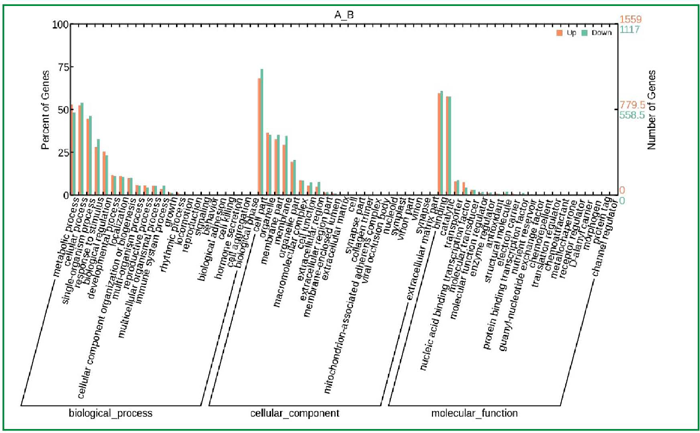
According to GO annotation, 16,468 DEGs (including 9,479 upregulated and 6,989 downregulated) in the leaves of “P107” compared with those of “P17-2” (A vs. B) could be functionally annotated, which were enriched in 20 BPs, 23 CCs, and 22 MFs. A total of 6,934 DEGs (4,053 upregulated and 2,881 downregulated) were enriched in BP, and most genes (including 817 upregulated and 601 downregulated) were enriched in “cellular process,” whereas “single-organism process,” “metabolic process,” “biological regulation,” and “response to stimulus” were the significantly enriched biological functions (Figure. 3). Among the DEGs associated with resistance, such as “reproductive process,” 88 were upregulated and 47 were downregulated. In addition, the functional genes of both “immune system process” and “multicellular organismal process” were upregulated but showed different expression levels. A total of 5,763 DEGs (3,241 upregulated and 2,522 downregulated) were enriched in the cellular component. Most genes (including 1,063 upregulated and 824 downregulated) were enriched in “cell part,” followed by “organelle,” with 566 upregulated and 392 downregulated DEGs and “membrane part,” with 506 upregulated and 392 downregulated DEGs. A total of 3,789 DEGs (2,203 upregulated and 1,586 downregulated) were enriched in molecular function. Most DEGs (including 929 upregulated and 679 downregulated) were enriched in the MF term “binding,” followed by the terms “catalytic” (with 898 upregulated and 641 downregulated genes) and “transporter” (with 124 upregulated and 97 downregulated genes).

3.4 Pathway Enrichment Analysis of DEGs
Comparison of the DEGs between “P107” and “P17-2” showed the enrichment of several DEGs in three KEGG pathways, namely secondary metabolite biosynthesis, flavonoid biosynthesis, and other types of O-glycan biosynthesis (Figure. 4). These results indicated that “P107” enhances its defense after pest invasion via secondary metabolite synthesis.

3.5 Differential Expression of Important Defense Genes
The critical defense-associated genes that were significantly upregulated within the damaged “P107” versus “P17-2” leaf samples are as follows: PR protein including chitinase class I (POPTR_0009s14410g), lectin (POPTR_0016s13070g), and cell death such as caspase (POPTR_0017s08020g). Cytochrome P450 (POPTR_0007s06260g) associated with the tryptophan pathway also showed a significant upregulation. For the damaged leaves of “P17-2” versus “P107,” the significantly upregulated genes included PR proteins such as cellulose synthase (POPTR_0010s08560g) and trypsin and protease inhibitor (TPIN) (POPTR_0007s03630g) associated with cell wall metabolism. The significantly downregulated genes were involved in photosynthetic activity such as photosystem II 10 kDa polypeptide PsbR (POPTR_0001s42980g), and starch synthase (POPTR_0017s12040g) was associated with starch biosynthesis (Tabela 3).
In where: |Log2 (Fold Change)| ≥ 1 and P value < 0.05 indicate a significant difference.
4 DISCUSSIONS
When plants are invaded by insects, they adjust the composition and quantity of chemical substances in their bodies to balance nutrient levels, thus antagonizing insect feeding (Haukioja, 1991, p. 25; Wang, 2018, p. 2068; Liu, 2021, p.230; Wu, 2022, p. 21). The KEGG enrichment pathway analysis revealed that the leaves of “P107” exhibited the highest enrichment degree of secondary metabolite biosynthesis compared with “P17-2” leaves. Depending on the biosynthesis pathways, secondary metabolites are classified as terpenoids (Keeling, 2006, p. 657), phenolic compounds (Bernards, 2008, p. 189), and alkaloids (Facchini, 2001, p. 29). The production of secondary metabolites is considered one of the manifestations of plant resistance (Zhang, 2003, p. 522; Lai, 2022, p.969). For example, the tannin content of poplar increases within insect-resistant species compared with that in non-insect-resistant species because tannin affects the digestion of protein and starch by insects (Wang, 1985, p.95). Phenols are condensed to lignin and tannins, whose levels and compositions are strongly associated with insect resistance (Li, 1997, p. 45). Phenolic compounds include astragalus compounds, flavonoids, lignin, and tannins, which induce defense response in many woody species. These compounds are found in angiosperms (Eucalyptus spp.) (Eyles, 2003, p. 204), poplars (Populus spp.) (Palo, 1984, p. 499; Tsai, 2006, 221), birches (Betula spp.) (Ruuhola, 2008, p.725), and conifers (Pinus nigra) (Blodgett, 2007, p. 511). Phenolic compounds in poplars are the main defensive secondary metabolites (Tsai, 2006, p. 221). For example, the resistance to Clostera anastomosis of diverse P. deltoides clones was shown to be positively correlated with the overall phenol content within leaf samples (Fang, 2011, p. 1042). The leaves of P. tomentosa and Acer saccharum seedlings exhibited an increase in the level of phenolic compounds for 52 h after damage, whereas the neighboring undamaged A. saccharum showed an increase in their phenol and tannin contents until 36 h after damage (Baldwin, 1983, p. 277). The role of phenol in inducing resistance remains to be verified (Mumm, 2006, p.351). Studies have found that phenol oxidation generates reactive oxygen species, resulting in oxidative stress in the insect midgut (Barbehenn, 2007, p. 129). The oxidophilic activity of phenolic compounds is directly related to insect resistance (Ruuhola, 2008, p. 725). In the later stage, the secondary metabolites of damaged leaves should be determined to analyze changes in their content.
Flavonoids with antibacterial activity are distributed within photosynthetic cells and have been detected in vegetables, fruits, seeds, nuts, flowers, stems, wine, tea, honey, and propolis (Nijveldt, 2001, p. 418; Cushnie, 2005, p. 343; Chen, 2023, p. 126). Flavonoids are secondary metabolites that are involved in different biological and antioxidant activities in plants (Kandaswami, 1994, p. 351; Cao, 1997, p. 749; Sun, 2003, p. 53; Buer, 2010, p. 98; Agati, 2012, p. 67). Most plants, such as the Populus nigra × Populus deltoides hybrid poplar “Neva,” possess high levels of secondary metabolites such as flavonoids (Zhong, 2012, p. 307). Several genes associated with flavonoid synthesis have also been identified (Wiklund, 2005, 353). These results underscore the role of secondary metabolites in the chemical defense of induced resistance in poplar.
Regarding O-glycan biosynthesis in mammals, its initial process is completed in plants. However, some critical problems remain to be solved in future studies (Strasser, 2012, p. 218). A study investigated how O-glycan defects affect Arabidopsis tip growth (Velasquez, 2015, p. 808). In rice cell culture suspension-derived recombinant human GM-CSF, O-glycosylation and O-glycan sites are present (Kim, 2016, p. 266). The role of O-glycan in cellulase activity and stability has been studied (Amore, 2017, p. 13667). This study reports the synthesis of other types of O-glycan in poplar trees for the first time, thus providing a basis for future research on O-glycan. However, the role of O-glycan in plant resistance to other insects needs to be verified further.
According to our results, markedly upregulated DEGs detected in the infested leaves of “P17-2” and “P107” include PR protein-associated genes such as chitinase, lectin, and TPIN. Both lectins and chitinases from potato tubers exhibit antifungal properties (Gozia, 1993, p. 788), and chitinases show systemic accumulation within damaged poplar trees (Clarke, 1998, p. 154). There are 17 PR families including protease inhibitors, phytodefense proteins, and lipid transfer proteins (PR-6/12/14 families, respectively) (Van Loon, 1994, p. 245; Sels, 2008, p. 941). The PR-6 family (protease inhibitors, PIN) attacks nematodes, herbivores, and pathogens by damaging their digestive enzyme activities (Jongsma, 2008, p. 235). PIN genes induced by damage affect additional insect feeding by suppressing serine protease activities (Mosolov, 2005, p. 227) and improving defenses against insects and pathogens (Ryan, 1990, p. 425). These genes include those encoding cysteine protease inhibitor, insulin protease inhibitor, and serine protease inhibitor (Yang, 2007, p. 157; Eyles, 2010, p. 893) and are expressed after insect feeding in potato, maize, rice, and tomato plants (Anderson, 1997, p.833). TPIN-like mRNA expression was reported in the case of poplar injury (Hollick, 1993, p. 563). Protective effects of some proteins, such as PINs, endochitinase, and polyphenol oxidase, against different pests have been extensively studied in poplar (Philippe, 2007, p. 111). The activities of lipoxygenase increased in 1-year-old poplar cutting leaf samples after the plants were invaded by Clostera anachoreta larvae (Hu, 2009, p. 372). Another study reported that cytochrome P450 protects organisms against foreign bodies and promotes the generation of secondary metabolites (Inoue, 2005, p. 31). Photosynthesis is reduced possibly because of massive energy consumed during defense responses (Baldwin, 1998, p. 8113). In the present study, genes associated with carbohydrate biosynthesis and photosynthetic activity showed decreased expression within the damaged leaves of “P17-2” plants compared with that in “P107.” These results suggest that plants enhance their resistance to insect pests possibly by reducing photosynthesis and redirecting energy consumption. Most of the upregulated DEGs were pathogenesis-related (PR) proteins, with differences in expression profiles between “P107” and “P17-2.” After insect feeding, the damaged leaves of “P107” and “P17-2” showed varying degrees of resistance, along with upregulated defence gene levels, reduced nutrient accumulation and photosynthesis, and enhanced secondary metabolite biosynthesis. Follow-up study using RT-PCR is needed to validate the defense genes identified and reported in the present study.
5 CONCLUSIONS
In this study, a transcriptome analysis was performed on the leaves of “P107” and “P17-2” infested by insects. Both clones developed varying degrees of resistance and showed different resistance mechanisms. Defense genes were upregulated within “P17-2” and “P107” plants; however, the expression of other genes showed a different trend. Secondary metabolite biosynthesis was identified as the most significantly enriched GO term within “P107,” whereas the most significantly enriched GO term within “P17-2” was nutrient accumulation such as starch synthesis or photosynthesis. This study provides insights into the mechanism through which woody plants develop resistance to herbivorous insects, thereby providing a theoretical basis for comprehensively analyzing insect-resistance genes and cultivating insect-resistance varieties.
ACKNOWLEDGMENTS
This research was supported by the Hebei Natural Science Foundation (grant number D2024108002).
Data Availability Statement:
Datasets related to this article will be available upon request to the corresponding author.
-
Evaluators in this article:
Ezequiel Gasparin, Section Editor
REFERENCES
- AGATI, G., AZZARELLO, E., POLLASTRI, TATTINI, M., Flavonoids as antioxidants in plants: Location and functional significance. Plant Science, v. 196, p. 67-76, 2012.
- AMORE, A., KNOTT, B. C., SUPEKAR, N. T., SHAJAHAN, A., TAYLOR, L.E. Distinct roles of N- and O-glycans in cellulase activity and stability. Proceedings of the National Academy of Sciences, v. 114, n. 52, p. 13667-13672, 2017.
- ANDERSON, M. A., VAN, H. R., WEST, J., BATEMAN, K., LEE, M., CHRISTELLER, J. T., MCDONALD, G., HEATH, R. L. Proteinase inhibitors from Nicotiana alata enhance plant resistance to insect pests. J Insect Physiol, v. 43, p. 833. 1997.
- BALDWIN, I. T. Jasmonate-induced responses are costly but benefit plants under attack in native populations. Proc Natl Acad Sci U S A, v. 95, p. 8113, 1998.
- BALDWIN, J. T., SCHULTZ, J. C. Rapid changes in tree leaf chemistry induced by damage: evidence for communication between plants. Science, v. 221, n. 4607, p. 277-279, 1983.
- BAO, S., LI, F., LI, Z., WU, T. The resistance of fourteen poplar species to Anoplophora glabripennis (Motsch.). Journal of Beijing Forestry University, v. 21, n. 4, p. 97–100, 1999.
- BARBEHENN, R. V., JONES, C. P., YIP, L., TRAN, L., CONSTABEL, C. P. Limited impact of elevated levels of polyphenol oxidase on tree-feeding caterpillars: assessing individual plant defenses with transgenic poplar. Oecologia, v. 154, n. 1, p. 129-140, 2007.
- BERNARDS, M. A., BASTRUPSPOHR, L. Induced Plant Resistance to Herbivory Volume I: Phenylpropanoid metabolism induced by wounding and insect herbivory, p. 189-211, 2008, Springer, Dordrecht.
- BLODGETT, J. T., EYLES, A., BONELLO, P. Organ-dependent induction of systemic resistance and systemic susceptibility in Pinus nigra inoculated with Sphaeropsis sapinea and Diplodia scrobiculata Tree Physiology, 27(4): 511-517, 2007.
- BOLTON, M. D. Primary metabolism and plant defense – fuel for the fire. Molecular Plant-Microbe Interactions, v. 22, n. 5, p. 487, 2009.
- BONELLO, P., GORDON, T. R., HERMS, D. A., WOOD, D. L., ERBILGIN, N. Nature and ecological implications of pathogen-induced systemic resistance in conifers: a novel hypothesis. Physiol Mol Plant Pathol, v. 68, n. 4, p. 95-104, 2006.
- BOULTER, D., GATEHOUSE, J. A., GATEHOUSE, A., HILDER, V. A. Genetic engineering of plants for insect resistance. Endeavour, v. 14, n. 4, p. 185-190, 1990.
- BUER, C. S., IMIN, N., DJORDJEVIC, M. A. Flavonoids: new roles for old molecules. Journal of Integrative Plant Biology, v. 52, n. 001, p. 98-111, 2010.
- CAO, G., SOFIC, E., PRIOR, R. L. Antioxidant and prooxidant behavior of flavonoids: structure-activity relationships. Free Radic Biol Med, v. 22, n. 5, p. 749-760, 1997.
- CHEN, Q., JIANG X. H., TAN, Y., SHUANG, S., LIU, H. J., DAI, R., TE, M. E., ZHANG, Z. Q. Changes of alfalfa metabolites induced by feeding of thrips. Jiangsu Agricultural Sciences, v. 51, n. 3, p. 126-132, 2023.
- CLARKE, H. R. G., LAWRENCE, S. D., FLASKERUD, J., KORHNAK, T. E., GORDON, M. P., DAVIS, J. M. Chitinase accumulates systemically in wounded poplar trees. Physiologia Plantarum, v. 103, n. 2, p. 154-161, 1998.
- COSSU, R. M., GIORDANI, T., CAVALLIN, A., NATALI, L. High-throughput analysis of transcriptome variation during water deficit in a poplar hybrid: a general overview. Tree Genetics & Genomes, v. 10, n. 1, p. 53-66, 2014.
- CUSHNIE, T., LAMB, A. J. Antimicrobial activity of flavonoids. International Journal of Antimicrobial Agents, v. 26, n. 5, p. 343-356, 2005.
- DING, C. J., ZHANG, W. X., GAO, M., HUANG, Q. J., CHU, Y. G., SU, X. H. Analysis of transcriptome differences among Populus deltoides with different growth potentials. Scientia Silvae Sinicae, v. 52, p. 47–58, 2016.
- DORADO, F. J., MATSIAKH, I., lVARO C, OLAIZOLA, J., ROMERALO, C., JUAN, A. M., WITZELL, J., SOLLA, A. Methyl jasmonate spray for the protection of broad-leaf trees against oomycete and fungal pathogens. Journal of Plant Diseases and Protection, v.132, n. 2, p. 1-13, 2025.
- EYLES, A., BONELLO, P., GANLEY, R., MOHAMMED, C. Induced resistance to pests and pathogens in trees. New Phytol, v. 185, p. 893–908, 2010.
- EYLES, A., DAVIES, N. W., MOHAMMED, C. Traumatic oil glands induced by pruning in the wound-associated phloem of Eucalyptus globulus: chemistry and histology. Trees, v. 18, n. 2, p. 204–210, 2003.
- FACCHINI, P. J. Alkaloid biosynthesis in plants: biochemistry, cell biology, molecular regulation, and metabolic engineering applications. Annual Review of Plant Physiology & Plant Molecular Biology, v. 52, n. 52, p. 29–66, 2001.
- FANG, J., ZHAO, B. G. Resistance of diferent clones of Populus deltoides to Clostera anastomosis (Lepidoptera: Notodontidae) larvae and the relatedm echanisms. Acta Entomologica Sinica, v. 54, n. 9, p. 1042–1050, 2011.
- FANG, S. Z. Silviculture of poplar plantation in China: A review. Chinese Journal of Applied Ecology, n.10, p. 2308-2316, 2008.
-
FANG, X., XIE, Y., YUAN, Y., LONG, Q., ZHANG, L., AID, G., ZHANG, W. The role of salicylic acid in plant defense responses against biotic stresses. Plant Hormones, v.1, n. 1, 2025. DOI:10.48130/ph-0025-0003.
» https://doi.org/10.48130/ph-0025-0003 - FERRY, N., EDWARDS, M. G., GATEHOUSE, J. A., GATEHOUSE, A. M. Plant–insect interactions: molecular approaches to insect resistance. Current Opinion in Biotechnology, v. 15, n. 2, p. 155-161, 2004.
- FOSTER, A. J., PELLETIER, G., TANGUAY, P., SEGUIN, A. Transcriptome analysis of poplar during leaf spot infection with Sphaerulina spp. PLoS One, 10: e0138162, 2015.
- GOZIA, O., CIOPRAGA, J., BENTIA, T., LUNGU, M., NITU, F. Antifungal properties of lectin and new chitinases from potato tubers. Comptes Rendus de l Académie des Sciences – Series III – Sciences de la Vie, v. 316, n. 8, p. 788-792, 1993.
-
GUO, L., ZHANG, S. F., LIU, F., KONG, X. B., ZHANG, Z. Effect of Micromelalopha sieversi (Staudinger) oviposition behavior on the transcriptome of two Populus section Aigeiros clones. Forests, 11(9), 1021; doi:10.3390/f11091021, 2020.
» https://doi.org/10.3390/f11091021 - HAMANISHI, E. T., BARCHET, G. L., DAUWE, R., MANSFIELD, S. D., CAMPBELL, M. M. Poplar trees reconfigure the transcriptome and metabolome in response to drought in a genotype-and time-of-day-dependent manner. BMC Genom, v. 16, p. 1-16, 2015.
- HAUKIOJA, E. Induction of defenses in trees. Annual Review of Entomology, 36(1): 25-42, 1991.
- HOLLICK, J. B., Gordon, M. P., A poplar tree proteinase inhibitor-like gene promoter is responsive to wounding in transgenic tobacco. Plant Mol Biol, v. 22, p. 561–572, 1993.
- HU, Z. H., WEN, Z., SHEN, Y. B., FU, H. J., ZHANG, Z. Y. Activities of lipoxygenase and phenylalanine ammonia lyase in poplar leaves induced by insect herbivory and volatiles. Journal of Forestry Research, v. 20, n. 4, p. 372, 2009.
- INOUE, K. Cytochrome P450 enzymes in biosyntheses of some plant secondary metabolites. Yakugaku Zasshi, v. 125, p. 31-49, 2005.
- JANZ, D., BEHNKE, K., SCHNITZLER, J. P., KANAWATI, B., SCHMITT-KOPPLIN, P., POLLE, A. Pathway analysis of the transcriptome and metabolome of salt sensitive and tolerant poplar species reveals evolutionary adaption of stress tolerance mechanisms. BMC Plant Biol, v. 10, p. 1-17, 2010.
- JONGSMA, M. A., BEEKWILDER, J. In Induced plant resistance to herbivory.Volume I: Plant protease inhibitors: functional evolution for defense, p. 235-251. Springer, Dordrecht, 2008.
- JWA, N. S., AGRAWAL, G. K., TAMOGAMI, S., YONEKURA, M., HAN, O., IWAHASHI, H., RAKWAL, R. Role of defense/stress-related marker genes, proteins and secondary metabolites in defining rice self-defense mechanisms. Plant Physiol Biochem, v. 44, p. 261–273, 2006.
- KANDASWAMI, C., MIDDLETON, E. Free radical scavenging and antioxidant activity of plant flavonoids. Advances in Experimental Medicine & Biology, v. 366, p. 351-376, 1994.
- KEELING, C. I., BOHLMANN, J. Genes, enzymes and chemicals of terpenoid diversity in the constitutive and induced defence of conifers against insects and pathogens. New Phytologist, v. 170, n. 4, p. 657-675, 2006.
- KESSLER, A., BALDWIN, I. T. Plant responses to insect herbivory: the emerging molecular analysis. Ann Rev Plant Biol, v. 53, p. 299-328, 2002.
- KIM, J., PARK, H., Park, B. T., KIM, H. H. O-glycans and O-glycosylation sites of recombinant human GM-CSF derived from suspension-cultured rice cells, and their structural role. Biochemical and Biophysical Research Communications, v. 479, n. 2, p. 266-271, 2016.
- LAI, C. L., ZHANG, J., SHENTU, X. P., HAO P. Y., PANG, K., YU, X. P. Review of how secondary metabolites defend plants against herbivorous insects. Chinese Journal of Applied Entomology, v. 59, n. 5, p. 969-978, 2022.
- LI, C. Z., LU, J. C., PAN, X. D., XIAO, Y. J., DENG, J. Y., ZHOU, G. X., LOU, Y. G. Herbivore-induced resistant rice volatiles enhance the direct and indirect resistance of the neighboring susceptible rice varieties to Nilaparvata lugens (Hemiptera: Delphacidae). Acta Entomologica Sinica, v. 66, n. 3, p. 351-359, 2023.
-
LI, D., JIA, Y.,ZHI, J. R., ZHANG, T. Effect of jasmonic acid and ethylene mediate faba bean defense responses to the activity and gene expression of the detoxifying enzyme in Frankliniella occidentalis Entomological Research, v. 54,n.1, 2024. DOI:10.1111/1748-5967.12699.
» https://doi.org/10.1111/1748-5967.12699. - LI, D. M., ZHOU, L. Y. Coevolution - the relationship between insects and plants. Entomological Knowledge, v. 34, n. 1, p. 45-49, 1997.
- LI, K. H., HU, J. J. An elite variety of Populus deltoids ‘Chuangxin’. Scientia Silvae Sinicae, v. 52, n. 3, p. 130, 2016.
- LIU, H., ZHANG, Y., CHEN, J. L. Feeding preference and adaptability of Spodoptera frugiperda(Le pidoptera:Noctuidae)on different wheat cultivars in relation to leaf biochemical contents. Acta Entomologica Sinica, v. 64, n. 2, p. 230-239, 2021.
- MOSOLOV, V. V., VALUEVA, T. A. Proteinase inhibitors and their function in plants: a review. Appl Biochem Microbiol, v. 41, p. 227–261, 2005.
- MUMM, R., HILKER, M. Direct and indirect chemical defence of pine against folivorous insects. Trends in Plant Science, v. 11, n. 7, p. 351-358, 2006.
-
NARVAES I D S , BRENA D A , LONGHI S J . Estrutura da regeneração natural em Floresta Ombrófila Mista na Floresta Nacional de São Francisco de Paula, RS. Ciência Florestal, v. 159, n. 4, p. 663-5, 2005. DOI:10.1176/appi.ajp.159.4.663.
» https://doi.org/10.1176/appi.ajp.159.4.663. - NIJVELDT, R. J., ELS, V. N., EC, V. H. D., BOELENS, P. G., KLASKE, V. N., AM, V. L. P. Flavonoids: a review of probable mechanisms of action and potential applications. American Journal of Clinical Nutrition, n. 4, p. 418-425, 2001.
- PALO, R.T. Distribution of birch (Betula SPP.), willow (Salix SPP.), and poplar (Populus SPP.) secondary metabolites and their potential role as chemical defense against herbivores. Journal of Chemical Ecology, v. 10, n. 3, p. 499-520, 1984.
- PHILIPPE, R. N., BOHLMANN, J. Poplar defense against insect herbivores. Revue Canadienne De Botanique, v. 85, p. 1111–1126, 2007.
- PHILIPPE, R. N., RALPH, S. G., MANSFILED, S. D., BOHLMANN, J. Transcriptome profiles of hybrid poplar (Populus trichocarpa× deltoides) reveal rapid changes in undamaged, systemic sink leaves after simulated feeding by forest tent caterpillar (Malacosoma disstria). New Phytol, v. 188, n. 3, p. 787-802, 2010.
-
R Core Team. R: A language and environment for statistical computing. In The R Project for Statistical Computing. The R Foundation, 2019. Available at: http://www.R-project.org/ Accessed in: 15 June 2024.
» http://www.R-project.org/. - RASMANN, S., VOS, M. D., CASTEEL, C. L., TIAN, D., HALITSCHKE, R., SUN, J. Y., AGRAWAL, A. A., FELTON, G. W., Jander, G. Herbivory in the Previous Generation Primes Plants for Enhanced Insect Resistance. Plant Physiology, v. 158, n. 2, p. 854-863, 2012.
- RUUHOLA, T., YANG, S., OSSIPOV, V., HAUKIOJA, E. Foliar oxidases as mediators of the rapidly induced resistance of mountain birch against Epirrita autumnata Oecologia, v. 154, n. 4, p. 725-730, 2008.
- RYAN, C. A. Protease Inhibitors in plants: genes for improving defenses against insects and pathogens. Ann. Rev. Phytopathol, v. 28, p. 425–449, 1990.
- SELS, J., MATHYS, J., DE, C., BARBARA, M. A., CAMMUE, B. P. A., DE, B., MIGUEL, F. C. Plant pathogenesis-related (PR) proteins: a focus on PR peptides. Plant Physiol Biochem, v. 46, p. 941–950, 2008.
- STRASSER, R. Challenges in O-glycan engineering of plants. Frontiers in Plant Science, v. 3, p. 218, 2012.
- SUN, Y. M., XU, Y. Q., YANG, L. Research on antioxidant activity of flavonoids from natural materials. Chain Oils and Fats, v. , p. 53-57, 2003.
- TRAPNELL, C., WILLIAMS, B. A., PERTEA, G., MOETAZAVI, A., KWAN, G., BAREN, M. J. V., SALZBERG, S. L., WOLD, B. J., PACHTER, L. Transcript assembly and abundance estimation from RNA-Seq reveals thousands of new transcripts and switching among isoforms. Nat Biotechnol, v. 28, p. 511, 2010.
- TSAI, C. J., KAYAL, W. E., HARDING, S. A. Populus, the new model system for investigating phenylpropanoid complexity. International Journal of Applied Science & Engineering, v. 4, n. 3, p. 221-233, 2006.
- TUSKAN, G. A., DIFAZIO, S., JANSSIN, S., BOHLMANN, J., GRIGORIEV, I., HELLSTEN, U., PUTNAM, N., RALPH, S., ROMBAUTS, S., SALAMOV, A., et al The genome of black cottonwood, Populus trichocarpa (Torr. & Gray). Science, v. 313, p. 1596–604, 2006.
- VAN, LOON L., PIERPOINT, W., BOLLER, T., CONEJERO, V. Recommendations for naming plant pathogenesis-related proteins. Plant Mol Biol Rep, v. 12, p. 245-264, 1994.
- VELASQUEZ, S. M., MARZOL, E., BORASSI, C., POL-FACHIN, L., RICARDI, M. M., MANGANO, S., JUAREZ, S. P. D., SALTER, J. D. S., DOROSE, J. G., MARCUS, S. E., et al Low Sugar Is Not Always Good: Impact of Specific O-Glycan Defects on Tip Growth in Arabidopsis Plant Physiology, v. 168, n. 3, p. 808-813, 2015.
- WANG, J., SONG, Y. Y., HU, L., YANG, M. Y., ZENG, R. S. Plant anti-herbivore defense priming: Concept, mechanisms and application. Chinese Journal of Applied Ecology, v. 29, n. 6, p. 2068-2078, 2018.
- WANG, X. W., LV, W., ZHANG, Z. The Resistance of the poplar apecier to the harmful effect of Anoplophora nobilis G. Scientia Silvae Sinicae, v. 23, n. 1, p. 95-99, 1985.
- WIKLUND, S., KARLSSON, M., ANTTI, H., JOHNELS, D., SJOSTROM, M., WINGSLE, G., EDLUND, U. A new metabonomic strategy for analysing the growth process of the poplar tree. Plant Biotechnology Journal., v. 3, n. 3, p. 353-362, 2005.
- WU, F., SHI, S. L., KANG, W. J., CHEN, X. M., A, Y., ZHANG, H. H., LI, Z. L. Effects of thrips feeding on secondary metabolites and defense enzymes of alfalfa cultivars. Grassland and Turf., v. 42, n. 6, p. 21-27, 2022.
- XIA, L. Q., GUO, T. B., ZHAO, B. G. Research advance on control poplar pests. China Forestry Scinece and Technology., v. 15, n. 5, p. 8-10, 2001.
-
XING, F., ZHANG, L., GE, W., FAN, H., TIAN, C., MENG, F. Comparative transcriptome analysis reveals the importance of phenylpropanoid biosynthesis for the induced resistance of 84k poplar to anthracnose. BMC Genomics, v. 25, n. 1, 2024. DOI: 10.1186/s12864-024-10209-1.
» https://doi.org/10.1186/s12864-024-10209-1. - YANG, G., GUAN, X., WANG-PRUSKI, G., WEI, H., YOU, M.S. Advance on induced plant defense genes against insect pests. J. Agric Biotechnol., v. 15, p. 157–166, 2007.
- YANG, N. B., WU, S. R., SHEN, L. B., ZHANG, S. Z., YANG, B. P. A review on plant resistance to insect pests. Chinese Journal of Tropical Agriculture., n. 9, p. 61-68, 89, 2014.
-
YAN, S. C. Silicon Enhanced Italian Ryegrass (Lolium multiflorum) Production and induced defense responses against Fall Armyworm (Spodoptera frugiperda). Agronomy, n.14, 2024. DOI:10.3390/agronomy14122827.
» https://doi.org/10.3390/agronomy14122827. - YU, Y. C., YANG, M. F., SHANG, S. H., LIU, J. F., YU, X. F. Effects of different insects feeding on tobacco signaling molecules and defense enzymes. Journal of Environmental Entomology., v. 43, n. 4, p. 967-977, 2021.
- ZANGERL, A. R. Induced Responses to Herbivory. Plant Pathol., v. 24, n. 1, p. 122-123, 2010.
- ZENG, R. S., SU, Y. J., YE, M., XIE, L. J., CHEN, M., SONG, Y. Y. Plant induced defense and biochemical mechanisms. Journal of South Agricultural University., v. 29, n. 2, p. 1-6, 2008.
- ZHANG, Q. W. A new variety of poplar with excellent pulp wood and ecological shelterbelt is Populus×euramericana CL.’74/76’. Scientia Silvae Sinicae., v. 3, p. 113, 1999.
- ZHANG, W., CHU, Y., DING, C., ZHANG, B., HUANG, Q., HU, Z., HUANG, R., TIAN, Y., SU, X. Transcriptome sequencing of transgenic poplar (Populus× euramericana’Guariento’) expressing multiple resistance genes. BMC Genet., v. 15, p. 1-17, 2014.
- ZHANG, W. H., LIU, G. J. A review on plant secondary substances in plant resistance to insect pests. Chinese Bulletin of Botany., v. 20, n. 5, p. 522-530, 2003.
- ZHANG, X. F., LIU, Y., WANG, M., LI, X. P., LIANG, D. J., WU, Y. Research on Cryptorhynehus lapathi resistance of different poplar varieties. Liaoning Forstry Science and Technology., v. 3, p. 23-24, 2005.
- ZHONG, L. Antimicrobial flavonoids from the twigs of Populus nigra x Populus deltoides. Natural Product Research., v. 26, n. 4, p. 307-313, 2012.
- ZHOU, X. Y., YAN, L. Q., LV, Y. T., SUN, L. L., ZHU J. W., CAO C. W. Activities and gene expressions of phenylpropane metabolic enzymes in Populus simonii×P.nigra by herbivore induction of Lymantria dispar(Lepidoptera:Lymantriidae). Scientia Silvae Sinicae., n. 3, p. 108-116, 2021.
-
Editor-in-Chief
Prof. Dr. Cristiane Pedrazzi
-
Associate Editor
Prof. Dr. Dalton Righi
-
Managing Editor
Miguel Favila

 Source: Authors (20024)
 Source: Authors (20024)
 Source: Authors (20024)
 Source: Authors (20024)