
 Diversity, structure and ecology of a tree-shrub community established in a fire-excluded forest-grassland ecotone in southern Brazil
ABSTRACT
Changes in the disturbance regime seem to be decisive factors in the occurrence of vegetation changes along the border of forest-grassland ecotones. In order to understand the organization of a woody plant community during the natural forest expansion process, the floristic, structural and ecological aspects of a tree-shrub community established in a grassland remnant under fire exclusion for 18 years (1999-2017) were assessed. The results demonstrated that, despite the richness observed, few species became abundant in the community, evident in the high concentration of importance values and relatively low Shanonn diversity and Pielou’s evenness indices. In general, the floristic composition was balanced in terms of dispersal syndromes and ecological groups, with a slight predominance of zoochoric and non-pioneer species. Structural analysis of the community indicated the formation of regenerative stock associated with continuous recruitment flow. In regard to phytogeographic distribution, the predominance of species shared with the Cerrado ecological domain demonstrated the importance of this biome in shaping the landscape of the study area. The results of this study provide knowledge on the vegetation dynamics of forest-grassland mosaics in the Campos Gerais region of Paraná state, Brazil.
Keywords
Grassland; Araucaria forest; Forest expansion
RESUMO
Alterações no regime de distúrbios parecem ser fatores decisivos para a ocorrência de mudanças na vegetação junto aos ecótonos campo-floresta. Com o objetivo de compreender como uma comunidade de plantas lenhosas se organiza ao longo do processo natural de expansão florestal, foram avaliados os aspectos florísticos, estruturais e ecológicos de uma comunidade arbóreo-arbustiva estabelecida sobre um remanescente campestre excluído do fogo por um período de 18 anos (1999-2017). Os resultados demonstraram que, apesar da riqueza observada, poucas espécies tiveram a capacidade de se tornarem abundantes na comunidade, condição que foi refletida na elevada concentração dos valores de importância e nos índices relativamente baixos de diversidade de Shanonn e de equabilidade de Pielou. O perfil florístico encontrado, de um modo geral, demonstrou equilíbrio em relação às síndromes de dispersão e grupos ecológicos, com leve predominância de espécies zoocóricas e não-pioneiras. A análise estrutural da comunidade indicou a formação de estoque regenerativo associado à ocorrência de um fluxo contínuo de recrutamento. Em relação à distribuição fitogeográfica das espécies, a predominância de espécies compartilhadas com o domínio ecológico do Cerrado demonstrou a importância deste bioma na formação da paisagem da região de estudo. Os resultados deste estudo contribuem para o conhecimento da dinâmica vegetacional dos mosaicos campo-floresta na região dos Campos Gerais do Paraná.
Palavras-chave
Campos; Floresta com araucária; Expansão florestal
1 INTRODUCTION
Paleoecological and paleoenvironmental data from the Southern Plateau (e.g. Behling, 1995, 1997, 2002; Behling; Bauermann; Neves, 2001; Behling et al., 2004) indicate that the vegetation dynamics of the region have been marked by domain changes between forests and grasslands since at least the late Quaternary. In short, four distinct climate periods have been recognized since the end of the Pleistocene. From approximately 42,000 to 10,000 years before present (BP), grasslands dominated the region’s landscape, indicating a cold dry climate. During this period, most of the region was likely devoid of trees, with forest elements restricted to river valleys. Temperatures increased from 10,000 years BP, but the continued dry climate prevented the expansion of the Araucaria Forest. The climate became wetter after the mid-Holocene, at approximately 4,000 BP, enabling gradual forest expansion, especially along rivers. The rate of expansion increased after 1100 BP, whereby grasslands were more rapidly replaced by forest vegetation, forming larger areas of continuous forest cover over the plateau (Behling et al., 2004; Behling; Pillar, 2007; Behling et al., 2007).
Unlike arid regions, where the climate severely limits the growth of woody plants, forests have been prevented from dominating the landscape of the Southern Plateau by historic interactions between disturbances (e.g. fire and herbivory) and soil characteristics (e.g. saturation, unfavorable geology, and acidic pH) (Pillar; Quadros, 1997; Galvão; Augustin, 2011). In the absence of these factors, grasslands are gradually replaced by woody vegetation, even in shallow or sandy soils (Galvão; Augustin, 2011). As such, the grasslands that exist today are either hydromorphic and growing in Organosols, or nonhydromorphic and associated with disturbances. In the latter case, disturbances caused by fire and grazing are essential to the maintenance of these areas (Galvão; Augustin, 2011).
Changes in the disturbance regime, especially those related to fire and grazing, seem to be decisive factors in vegetation changes along the border of forest-grassland ecotones (Pillar; Quadros, 1997). As such, vegetation dynamics in forest-grassland mosaics depend on the frequency and intensity of disturbances, which enable the two vegetation types to coexist (Blanco et al., 2014).
Although the ecology of grasslands and Araucaria forests has received increasing attention in recent years, few studies have aimed at characterizing the floristic, structural and ecological aspects of woody plant communities established in the grassland matrix in order to understand the processes involved in the dynamics of fire-excluded forest-grassland ecotones. Additionally, understanding the colonization of grasslands by woody species enables inferences to be made about the landscape formation process in the Brazilian Southern Plateau.
As such, this study investigated a grassland remnant colonized by tree and shrub species due to 18 years of fire exclusion (1999-2017). The aim was to understand the organization of woody plants throughout the natural forest expansion process, providing more solid ecological foundations to support conservation policies for the grasslands and associated forests in the study area.
2 MATERIALS AND METHODS
2.1 Characterization of the study area
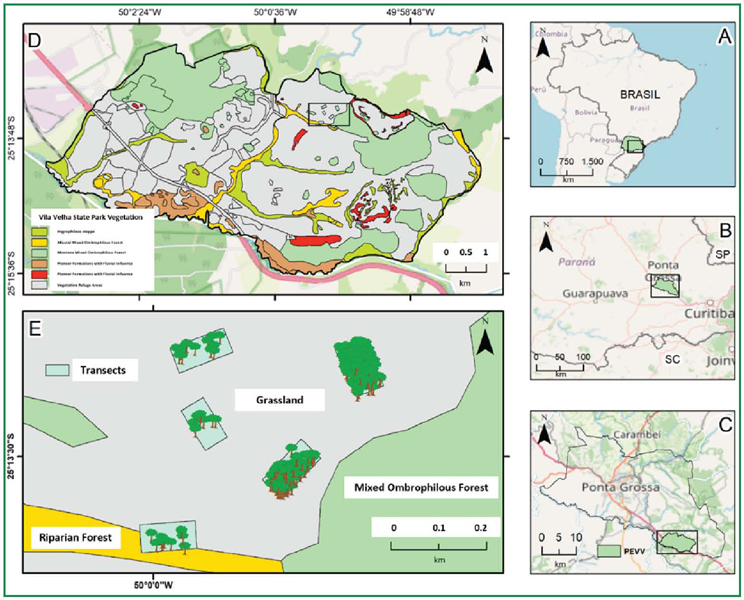
The study was conducted in Vila Velha State Park (PEVV), in the municipality of Ponta Grossa, a phytoecological region in the Campos Gerais do Paraná in Paraná state, Brazil (25º13′30″ S, 50°0′0″ W). The main vegetation types in PEVV are native grasslands and Mixed Ombrophilous Forest (Araucaria forest). The climate in the region is classified as wet temperate (Cfb) according to Köppen’s classification (Alvares et al., 2014), with no definitive dry season, cool summers and winters with periodic frosts. The average annual rainfall of around 1,500 mm is well distributed throughout the year (Moro; Milan; Moro, 2012). The average annual temperature is 17.8°C, reaching a maximum in January (27.6°C) and minimum in July (9.1°C), and relative humidity is 77%, with the lowest value recorded in November (73%) (Kovalsyki, 2020).
2.2 Sampling design and data collection
The vegetation was characterized by installing five permanent 50 m-wide and 100 m-long transects (subdivided into twenty 250 m2 - 10 m × 25 m plots), randomly distributed across an area mapped under the PEVV Management Plan (Paraná Environmental Institute - IAP, 2004) as Steppe-Savanna Transition Vegetation (Figure 1). In each plot, data on the woody plants were collected according to the inclusion criterion of a diameter at breast height (DBH, measured 1.30 m from the ground) greater than or equal to 3 cm. The species were identified in the field or collected for subsequent identification based on the specialized literature and/or consulting with specialists. The scientific names were checked and updated using the ‘flora’ package (Carvalho, 2020), which corrects names with errors, replacing botanical synonyms with valid names, and obtains taxonomic information for a vector of names by consulting the Brazilian Flora 2020 Dataset (Brazil Flora Group, 2021).
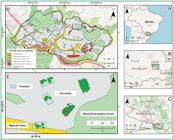
Location of the study area (a, b, c), vegetation in Vila Velha State Park (d) and sampling design for data collection (e)
2.3 Data Analysis
The woody component associated with forest expansion over the grassland matrix was classified into two distinct life forms: i) Tree (TR) - woody plant that generally branches above 0.5 m, with a well-defined canopy in the upper portion of the trunk; ii) Shrub (SH) - woody plant that generally has a short trunk, which branches below 0.5 m, with no defined canopy.
To assess the dispersal strategies of the vegetation under study, the individuals and species sampled were classified according to their dispersal syndromes (Van Der Pijl, 1972), as follows: i) individuals of species with fleshy fruits or other elements, which indicate dispersal by animals, were classified as zoochoric; ii) individuals of species whose seeds or fruit have wing-like appendages or other similar mechanisms, or those whose fruits are dehiscent and rapidly open to release seeds, were classified as non-zoochoric.
Species were categorized into ecological groups based on Budowski (1965), as follows: i) species typical of high-light environments such as clearings, forest borders or open areas were classified as pioneers; and ii) those typical of shaded environments, capable of remaining in the understory or growing and integrating with the forest canopy as emergent trees were classified as non-pioneers.
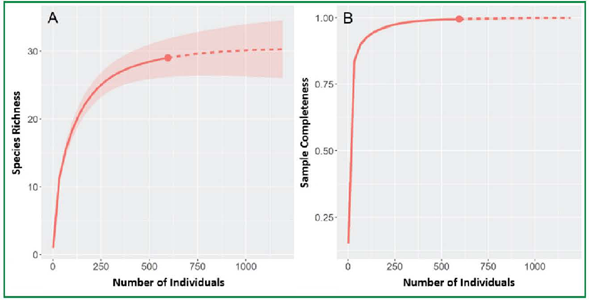
Sample representativeness was assessed using integrated curves of rarefaction (interpolation) and prediction (extrapolation) based on the first Hill number (q = 0) (Chao et al., 2014), using data on species incidence in the plots. The curves were generated with 95% confidence intervals, using the bootstrap method with 999 repetitions. Extrapolations were performed until the number of individuals was equivalent to twice the sampling effort.
Species diversity and uniformity were assessed by the Shannon diversity (H′) and Pielou’s evenness (J) indices, respectively. True diversity was also calculated, obtained by the exponential of H′ and measured based on the effective number of species (Hill number).
The community was phytosociologically characterized by calculating the classic phytosociological parameters of relative and absolute density, dominance and frequency, which were subsequently summarized by calculating the importance value (IV%) for each species (Müller-Dombois; Ellenberg, 1974).
In order to analyze the diametric and hypsometric structure of the community, the data were distributed into diameter and height (DBH) classes, with the number of classes calculated by the Sturges Rule. Data spread in relation to the respective centers was measured by Pearson’s coefficient of skewness (As) and relative peakedness or flatness of data in relation to normal distribution by the coefficient of Kurtosis (C).
Species occurrence in the different Brazilian ecological domains was determined based on the Brazilian Flora 2020 Dataset (Brazil Flora Group, 2021). In order to assess the sharing of the species studied with other ecological domains, a presence-absence matrix was compiled for species in the Atlantic Forest, Cerrado, Amazon, Caatinga, Pantanal and Pampa biomes.
All analyses were performed in R software (R Core Team, 2019), with the aid of the ‘iNEXT’ (Hsieh; Ma; Chao, 2016), ‘vegan’ (Oksanen et al., 2019), ‘forest’ (Ferreira, 2020), ‘fitdistrplus’ (Delignette-Müller; Dutang, 2015), ‘e1071’ (Meyer et al., 2019), ‘flora’ (Carvalho, 2020) and ‘UpSetR’ packages (Gehlemborg, 2019).
3 RESULTS
3.1 Floristic composition and phytosociology
Of the 100 plots installed for the vegetation survey, 43 contained no woody individuals. In the 57 remaining plots, 595 individuals from 29 different species were sampled. Of these species, 26 (85.55%) were trees and three (14.45%) shrubs (Table 1). The most representative botanical family was Asteraceae (four spp.), followed by Celastraceae, Euphorbiaceae, Lauraceae, Melastomataceae, Myrtaceae and Primulaceae, all with two species each. The most representative botanical genera were Piptocarpha (2), Miconia (2) and Myrsine (2). In terms of dispersal syndromes, 18 species (59.16%) were classified as zoochoric and 11 (40.84%) as non-zoochoric. The most representative ecological group contained non-pioneers, with 17 species, corresponding to 54.96% of the total number of individuals.
Species composition, life forms, dispersal syndromes and ecological groups observed in the study area
The rarefaction curve constructed by interpolation showed that the upper and lower 95% confidence intervals at the 29 species studied were 26 and 31 species, respectively (Figure 2A). Extrapolation of the rarefaction curve for twice the sampling effort based on the number of individuals (1190 individuals) revealed an expected richness of 30 species, with upper and lower 95% confidence intervals of 29 and 42 species, respectively. The sample coverage curve indicated that the sampling effort used (595 individuals) achieved 99.5% sample completeness (Figure 2B), demonstrating that the likelihood of a previously unsampled new species being added to the sample through the inclusion of a new individual is 0.5% for duplicate sampling.
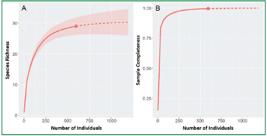
Rarefaction (continuous lines) and extrapolation curves (dotted lines) based on species richness (A) and sample completeness (B)
The Shanonn diversity and Pielou’s evenness indices for the entire community were H′ = 2.37 and J = 0.70, respectively. True diversity, obtained by the exponential of H′ and measured based on the effective number of species, was 10.66.
The species with the highest importance values (IV%) were C. scabra (25.03%), M. umbeiiata (18.44%), V. discoior (13.20%), P. sessiiis (7.60%) and C. adamantium (4.77%), representing a total of 73.95% of the individuals sampled. These species are among the five with the highest density and frequency values. Of the five species with the highest importance values, only C. adamantium is not among the five most dominant, giving way to S. romanzoffiana (Table 2).
The sum of the importance values for the tree species represented 88.85% of the total, and 11.15% for shrub species.
Species with zoochoric and non-zoochoric dispersal syndromes corresponded to 53.68 and 46.32% of the total IV, respectively. The ecological group with the highest IV was the pioneer species, with 54.49% of the total value, while non-pioneers accounted for 45.51%.
3.2 Horizontal and vertical structure
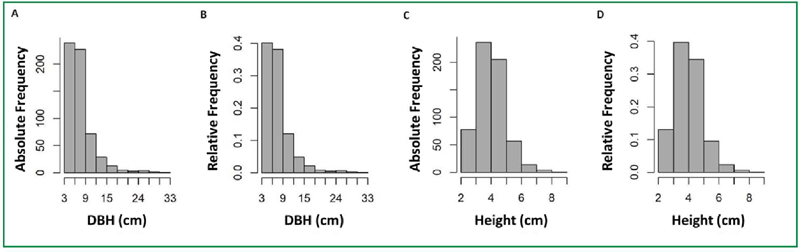
The diametric structure of the community showed a high concentration of individuals in the first (smaller) diameter (DBH) classes, declining gradually in the subsequent classes, characterizing an inverted J shape. Additionally, distribution was unimodal with positive asymmetry (As = 0.86), forming a leptokurtic curve (C = 0.228), with DBH values concentrated around the center of the curve (figure 3A). Also in regard to diametric structure, 40% of individuals in the community studied exhibited DBH < 6 cm, 38% DBH ≥ 6 and <9 cm, and 22% DBH ≥ 9 cm (figure 3B). The average diameter recorded was 7.60 cm (standard deviation ± 3.86 cm), with maximum and minimum values of 31.42 and 3.18 cm, respectively. The predominant species in the smallest class (DBH < 6 cm) were the shrubs C. adamantium, F. polymorpha and M. cinerascens, and tree species C. scabra and M. umbellata. The most representative species in the intermediate class (DBH ≥ 6 and < 9 cm) were C. adamantium, C. scabra, M. umbellata and P. sessilis, while in the highest class (DBH ≥ 9 cm) V. discolor, M. umbellata and C. scabra predominated.
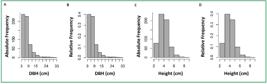
Absolute (A,C) and relative (B,D) diametric and hypsometric structure of the tree-shrub community studied
Analogous to diametric distribution, the hypsometric structure of the community showed leptokurtic (C = 0.250) unimodal distribution with moderate positive asymmetry (As = 0.420) (Figure 3C). However, the asymmetry and kurtosis values for height class distribution were lower than those obtained for diametric structure, indicating a smaller degree of height data deviation from their respective center of distribution, since the mean and median values for height were closer than those for diameter. The average height of the woody component of 4.13 m (standard deviation ± 0.94 m), with minimum and maximum values of 8.50 and 2.00 m, respectively. Most individuals (81%) were between 2.0 and 5.0 meters tall, with 7% of the total number of individuals sampled concentrated in the lowest height class (h < 3 m) and approximately 19% in the tallest (h ≥ 5 m) (Figure 3D). The predominant species in the lowest height class (h < 3 cm) were the shrubs C. adamantium, F. polymorpha and M. cinerascens, and tree species C. scabra, P. sessilis and M. umbellata. The most representative intermediate (h ≥ 3 and < 5 m) species were C. scabra, M. umbellata, V. discolor and P. sessilis, whereas V. discolor, C. sellowianum, C. scabra, M. umbellata and G. klotzschiana predominated in the tallest class (h ≥ 5 m).
3.3 Ecological domains
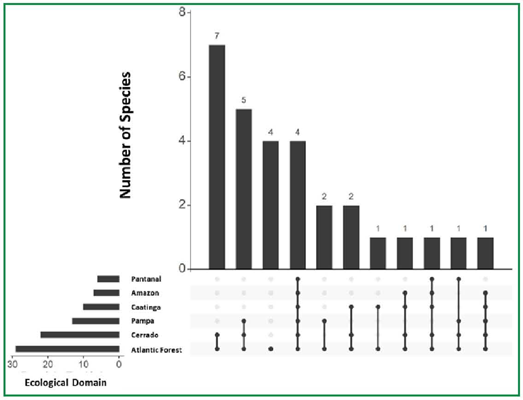
The community studied consisted predominantly of species associated with the Atlantic Forest and Cerrado ecological domains. Of the species sampled, 29 occurred in the Atlantic Forest (i.e., 100%), 22 of which (75.86%) are shared with the Cerrado domain sensu lato, 13 (44.83%) with the Pampa, 10 (34.48%) the Caatinga, 7 (24.13%) the Amazon and 6 (20.69) with the Pantanal domain (Figure 4).
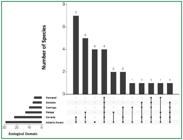
Species exclusive to the Atlantic Forest were I. microdonta, P. sessilis, P. angustifolia and P. axillaris, accounting for 13.79% of the total species sampled. Likewise, species with broad geographic distribution that occurred in all the biomes also represented 13.79% of the total, namely A. triplinervia, C. sylvestris, C. fissilis and C. speciosa.
4 DISCUSSIONS
The occurrence of woody species among the herbaceous matrix is a common phenomenon across the southern grasslands of Brazil (Müller et al., 2012). A widely used argument to explain the occurrence of woody species in grasslands is the assumption that they are anthropogenic artefacts, that is, vegetation in the early stages of regeneration after forest cutting (Pillar; Vélez, 2010). However, palaeoecological research (Behling; Pillar, 2007) indicates that the presence of woody plants in areas originally occupied by native grasslands is the result of historic forest expansion over the centuries, driven by climate change (Müller et al., 2012; Blanco et al., 2014) and simultaneously suppressed by traditional land management practices such as extensive grazing and burning (Pillar; Quadros, 1997).
In a study conducted in São Joaquim National Park in Santa Catarina state, Sühs, Giehl and Peroni (2020) observed shrub encroachment in locations where traditional management had been suppressed, causing loss of grassland vegetation over a 30-year period. According to the authors, the interruption of traditional management practices resulted in native grasslands being replaced with dense shrubland composed mainly of Baccharis uncinella DC., a native shrub from the family Asteraceae, common in the subtropical highland grasslands of southern Brazil. A similar pattern of grassland matrix occupation by woody species was also reported in other studies in the states of Santa Catarina and Rio Grande do Sul (RS) (e.g. Oliveira; Pillar, 2004; Müller et al., 2012; Guido; Salengue; Dresseno, 2017; Schinestsck; Müller; Pillar, 2019). In the present study, despite the presence of shrub species associated with grassland matrix colonization by woody species, trees were the predominant plant life form. This may suggest an older stage of occupation, since Oliveira and Pillar (2004) reported that grassland occupation seems to follow a directional trend that began with the establishment of shrubs, followed by subsequent tree colonization.
The botanical family that most contributed to the total species richness observed here was Asteraceae, whose species have a high capacity to colonize open environments. The Asteraceae species with the greatest relative importance was V. discoior, a fast-growing pioneer tree whose seeds are wind dispersed. In Atlantic Forest ecosystems, V. discoior plays an important role in restoring forest gaps and in ecological succession, considered an indicator species of early forest succession stages in Paraná state (National Council for the Environment - CONAMA, 1994).
Although Asteraceae species are the main group responsible for transforming southern Brazilian grasslands into tree-shrub ecosystems, the grassland remnant studied was occupied predominantly by C. scabra, a tree characteristic of Atlantic Forest fragments in the early stage of regeneration (Pivello et al., 2006). Indeed, Marcílio-Silva et al. (2015) highlighted the importance of C. scabra as a facilitator in forest and grassland ecotones in Vila Velha State Park. However, the forest expansion observed in the present study was not associated solely with the presence of typical pioneer species. The presence of M. umbellata, the species with the second highest relative importance in our study, is noteworthy. The importance of the genus Myrsine in the expansion of forests across southern Brazilian grassland plateaus dates back to ancient times. Behling et al. (2004) observed a marked increase in Myrsine species in the palynological core of Cambará do Sul (RS) in the late Holocene, which was negatively correlated with charcoal concentration, indicating that a decline in the frequency of fire favored native grassland occupation by this botanical genus.
Despite the floristic richness observed in our study, few species became abundant in the community, evident in the high concentration of importance values. Similarly, the Shannon diversity and Pielou’s evenness indices were also relatively low, reflecting the ecological dominance of C. scabra, M. umbellata and V. discolor, which together accounted for approximately 57% of the total importance value of the community.
Diametric structure followed inverted J-shape negative exponential distribution of individuals into DBH classes, the expected pattern for regenerating communities (Schaaf et al., 2006). Thus, it can be concluded that the community studied contains regenerative stock associated with a continuous recruitment flow. Inverted J-type diametric distribution also demonstrates that the community contains species of varying ages. In regard to hypsometric structure, the central classes tended to exhibit a greater abundance of individuals, a common pattern in the Mixed Ombrophilous Forest regions (Pscheidt et al., 2018). Based on analysis of the structural data for the community, it can be inferred that forest expansion across the grassland remnant studied has the potential to change the status of the ecosystem, since no gaps were found in the lower DBH classes capable of inducing a decline in individual recruitment between classes. Thus, lower classes are replenished with new individuals as plants from these classes develop and occupy subsequent classes, guaranteeing the development of the woody community.
Given that it is a natural process, some ecologists view forest expansion across grassland remnant as desirable, enabling vegetation to follow its natural course with minimal human interference (Carlucci, 2016). However, biodiversity conservation at landscape level is critically dependent on maintaining the different habitat types present, that is, conserving the different habitat mosaics (Overbeck; Ferreira; Pillar, 2016). As such, the first step in an integrated biodiversity conservation strategy is recognizing that different ecosystems have distinct ecological properties that require different conservation strategies (Veldman et ai., 2015). Protected areas and conservation units require the development of zoning strategies that allow for different management practices in different habitats. For example, forests can be protected from disturbances, with different levels applied in grasslands, and other areas kept disturbance-free to enable forest expansion. However, it is important to acknowledge that this strategy is ultimately a forest conservation approach, since it prioritizes the colonization of grasslands by forest species and views forest development as desirable. Its generalized application in the Brazilian Southern Plateau region would invariably lead to the expansion of forests, the decline of grassland areas and loss of grassland diversity (Overbeck; Ferreira; Pillar, 2016). There is therefore a need to move beyond the forest versus grassland perspective towards an integrated vision of conserving forest-grassland mosaics, since all physiognomies should be considered equally valuable from a conservation perspective.
The predominance of species shared with the Cerrado demonstrates the importance of this biome in shaping the landscape of the study area. In fact, Silva (2009), reconstituted the Terminal Pleistocene paleogeographic landscape of the area surrounding PEVV from a forest refuge hypothesis perspective and found that the Campos Gerais region of Paraná state housed vegetation refuge areas throughout the Quaternary period. However, although Cerrado specimens in PEVV are not arranged in a typical manner whereby the park could be considered a subtropical Cerrado stronghold, they are indicators that the region was tropicalized in the past (Silva, 2009) and that this biome strongly influenced the composition of the biota of the Campos Gerais region (Ritter, 2008).
5 CONCLUSIONS
The results demonstrated that, despite the richness observed, few species became abundant in the community, evident in the high concentration of importance values and relatively low Shanonn diversity and Pielou evenness indices. In general, the floristic composition was balanced in terms of dispersal syndromes and ecological groups, with a slight predominance of zoochoric and non-pioneer species. Structural analysis of the community indicated the formation of regenerative stock associated with continuous recruitment flow. In regard to phytogeographic distribution, the predominance of species shared with the Cerrado ecological domain demonstrated the importance of this biome in shaping the landscape of the study area.
ACKNOWLEDGMENTS
This study received funding from the Brazilian Coordination for the Improvement of Higher Education Personnel (CAPES) - funding code 001.
REFERENCES
- ALVARES, C. A.; STAPE, J. L.; SENTELHAS, P. C.; GONÇALVES, J. L. M.; SPAROVEK, G. Köppen’s climate classification map for Brazil. Meteorologische Zeitschrift, v. 22, n. 6, p. 711-728, 2014.
- BEHLING, H.; PILLAR, V. D.; ORLÓCI, L.; BAUERMANN, S. G. Late Quaternary Araucaria forest, grassland (Campos), fire and climate dynamics, studied by high-resolution pollen, charcoal and multivariate analysis of the Cambará do Sul core in southern Brazil. Palaeogeography, Palaeoclimatology, Palaeoecology, v. 203, p. 277-297, 2004.
- BEHLING, H.; PILLAR, V. D.; MÜLLER, S. C.; OVERBECK, G. E. Late-Holocene fire history in a forest-grassland mosaic in southern Brasil: Implications for conservation. Applied Vegetation Science, v. 10, p. 81-90, 2007.
- BEHLING, H. Investigations into the Late Pleistocene and Holocene History of Vegetation and Climate in Santa-Catarina (S Brazil). Vegetation History and Archaeobotany, v. 4, n. 3, p. 127-152, 1995.
- BEHLING, H. Late Quaternary vegetation, climate and fire history of the Araucaria forest and campos region from Serra Campos Gerais, Paraná State (South Brazil). Review of Palaeobotany and Palynology, v. 97, n. 1-2, p. 109-121, 1997.
- BEHLING, H. South and southeast Brazilian grasslands during Late Quaternary times: a synthesis. Palaeogeography, Palaeoclimatology, Palaeoecology, v. 177, p. 19-27, 2002.
- BEHLING, H.; BAUERMANN, S. G.; NEVES, P. C. Holocene environmental changes from the São Francisco de Paula region, southern Brazil. Journal of South American Earth Sciences, v. 14, p. 631-639, 2001.
- BEHLING, H.; PILLAR, V. D. Late Quaternary vegetation, biodiversity and fire dynamics on the Southern Brazilian highland and their implication for conservation and management of modern Araucaria forest and grassland ecosystems. Philosophical Transactions Royal Society B, v. 362, p. 243-251, 2007.
- BLANCO, C. C.; SCHEITER, S.; SOSINSKI, E.; FIDELIS, A.; ANAND, M.; PILLAR, V. D. Feedbacks between vegetation and disturbance processes promote long-term persistence of forest-grassland mosaics in south Brazil. Ecological Modelling, v. 291, p. 224-232, 2014.
- BRAZIL FLORA GROUP. Brazilian Flora 2020 project - Projeto Flora do Brasil 2020. v393.274. Instituto de Pesquisas Jardim Botânico do Rio de Janeiro. Dataset/Checklist. 2021.
- BUDOWSKI, G. Distribution of tropical american rain forest species in the light of sucessional processes. Turrialba, v. 15, n.1, p. 40-42, 1965.
- CARLUCCI, M. B. Forests, shrublands and grasslands in southern Brazil are neglected and have specific needs for their conservation. Reply to Overbeck et al. Perspectives in Ecology and Conservation, v. 14, n. 2, p. 155-157, 2016.
- CARVALHO, G. Flora: tools for Interacting with the Brazilian Flora 2020. R package version 0.3.4. 2020.
- CHAO, A.; GOTELLI, N. J.; HSIEH, T. C.; SANDER, E. L.; MA, K. H.; COLWELL, R. K.; ELLISON, A. M. Rarefaction and extrapolation with Hill numbers: a framework for sampling and estimation in species diversity studies. Ecological Monographs, v. 84, p. 45-67, 2014.
- CONSELHO NACIONAL DO MEIO AMBIENTE - CONAMA. Resolução nº 2: Define formações vegetais primárias e estágios sucessionais de vegetação secundária, com finalidade de orientar os procedimentos de licenciamento de exploração da vegetação nativa no Estado do Paraná. Brasília. Diário Oficial, v. 59, p. 4513-4514. 1994.
- DELIGNETTE-MÜLLER, M. L.; DUTANG, C. Fitdistrplus: an R package for fitting distributions. Journal of Statistical Software, v. 64, n. 4, p. 1-34, 2015.
- FERREIRA, IGOR C. Florestal: results for forest inventory. R package version 0.1.0. Brasília, Brazil. 2020.
- GALVÃO, F.; AUGUSTIN, C. A Gênese Dos Campos Sulinos. Floresta, v. 41, p. 191-200, 2011.
- GEHLENBORG, N. UpSetR: a more scalable alternative to Venn and Euler diagrams for visualizing intersecting sets. R package version 1.4.0. 2019.
- GUIDO, A.; SALENGUE, E.; DRESSENO, A. Effect of shrub encroachment on vegetation communities in Brazilian forest grassland mosaics. Perspectives in Ecology and Conservation, v. 15, n. 1, p. 52-55, 2017.
- HSIEH, T. C.; MA, K. H.; CHAO, A. iNEXT: an R package for interpolation and extrapolation of species diversity (Hill numbers). Methods in Ecology and Evolution, v. 7, p. 1451D 1456, 2016.
- INSTITUTO AMBIENTAL DO PARANÁ - IAP. Plano de manejo do Parque Estadual de Vila Velha. Curitiba, 2004.
- KOVALSYKI, B. Histórico e comportamento do fogo no Parque Estadual de Vila Velha, Paraná, Brasil. 148 f. Tese (Doutorado em Engenharia Florestal) - Setor de Ciências Agrárias, Universidade Federal do Paraná, Curitiba, 2020.
- MARCILIO-SILVA, V.; CAVALIN, P. O.; VARASSIN, I. G.; OLIVEIRA, R. A. C.; SOUZA, J. M. T.; MUSCHNER, V. C.; MARQUES, M. C. M. Nurse abundance determines plant facilitation networks of subtropical forest-grassland ecotone. Austral Ecology, v. 40, n. 8, p. 898-908, 2015.
- MEYER, D.; DIMITRIADOU, E.; HORNIK, K.; WEINGESSEL, A.; LEISCH, F.; CHANG, C. C.; LIN, C. C. e1071: misc functions of the Department of Statistics, Probability Theory Group (Formerly: E1071), TU Wien. R package version 1.7-3. 2019.
- MORO, R. S.; MILAN, E.; MORO, R. F. Biodiversidade do estrato herbáceo-arbustivo em capões no Parque Estadual de Vila Velha, Ponta Grossa, Paraná. Biodiversidade Brasileira, v. 2, n. 2, p. 102-112, 2012.
- MÜLLER-DOMBOIS, D.; ELLENBERG, H. Aims and of vegetation ecology. New York: John Wiley & Sons, 1974. 547 p.
- MÜLLER, S. C.; OVERBECK, G. E.; BLANCO, C. C.; OLIVEIRA, J. M.; PILLAR, V. D. South Brazilian Forest-Grassland Ecotones: dynamics affected by climate, disturbance, and woody species traits. In: MYSTER, R. (Ed.). Ecotones Between Forest and Grassland. Springer, New York, 167-187, 2012.
- MÜLLER, S. C.; OVERBECK, G. E.; PFADENHAUER, J.; PILLAR, V. D. Woody species patterns at forest grassland boundaries in southern Brazil. Flora (Jena), v. 207, p. 586-598, 2012.
- OKSANEN, J.; BLANCHET, F. G.; FRIENDLY, M.; KINDT, R.; LEGENDRE, P.; MCGLINN, D.; MINCHIN, P. R.; O’HARA, R. B.; SIMPSON, G. L.; SOLYMOS, P.; STEVENS, M. H. H. Vegan: community ecology package. R package version 2.5-6.
- OLIVEIRA, J. M.; PILLAR, V. D. Vegetation dynamics on mosaics of Campos and Araucaria forest between 1974 and 1999 in Southern Brazil. Community Ecology, v. 5, n. 2, p. 197-202, 2004.
- OVERBECK, G. E.; FERREIRA, P. M. A.; PILLAR, V. D. Conservation of mosaics calls for a perspective that considers all types of mosaic-patches. Reply to Luza et al. Perspectives in Ecology and Conservation, v. 14, n. 2, p. 152-154, 2016.
- PILLAR, V. D.; QUADROS, F. L. F. Grassland-forest boundaries in Southern Brazil. Coenose, v. 12, p. 119-126, 1997.
- PILLAR, V. D.; VÉLEZ, E. Extinção dos Campos Sulinos em unidades de conservação: um fenômeno natural ou um problema ético? Natureza & Conservação, v. 8, p. 84-88, 2010.
- PIVELLO, V. R.; PETENON, D.; JESUS, F. M.; MEIRELLES, S. T.; VIDAL, M. M.; ALONSO, R. A. S.; FRANCO, G. A. D. C.; METZGER, J. P. Chuva de sementes em fragmentos de Floresta Atlântica (São Paulo, SP, Brasil), sob diferentes situações de conectividade, estrutura florestal e proximidade da borda. Acta Botanica Brasilica, São Paulo, v. 20, n. 4, p. 845-859, 2006.
- PSCHEIDT, F.; HIGUCHI, P.; SILVA, A. C.; RECH, T. D.; SALAMI, B.; FERREIRA, T. S.; BONAZZA, M.; BENTO, M. A. Efeito de borda como fonte da heterogeneidade do componente arbóreo em uma Floresta com Araucárias no Sul do Brasil. Ciência Florestal, v. 28, n. 2, p. 601-612, 2018.
- R CORE TEAM. R: a language and environment for statistical computing. R Foundation for Statistical Computing, Vienna, Austria. 2019.
- RITTER, L. M. O. Composição florística e aspectos físicos do Cerrado nos Campos Gerais, Paraná. Dissertação (mestrado). Universidade Estadual de Ponta Grossa - UEPG, Ponta Grossa, 2008.
- SCHAAF, L. B.; FIGUEIREDO-FILHO, A.; GALVÃO, F.; SANQUETTA, C. R.; LONGHI, S. J. Modificações florístico-estruturais de um remanescente de Floresta Ombrófila Mista Montana no período entre 1979 e 2000. Ciência Florestal, v. 16, n. 3, p. 271-291, 2006.
- SCHINESTSCK, C. F.; MÜLLER, S. C.; PILLAR, V. D. Padrões espaciais da vegetação lenhosa associados ao processo de expansão da Floresta com Araucária sobre Campos excluídos de manejo. Neotropical Biology and Conservation, v. 14, n. 4, p. 411-429, 2019.
- SILVA, P. A. H. Cerrados, campos e araucárias: a teoria dos refúgios florestais e o significado paleogeográfico da paisagem do Parque Estadual de Vila Velha, Ponta Grossa - Paraná. 160 f. Dissertação (mestrado) - Setor de Ciências da Terra, Universidade Federal do Paraná, Curitiba, 2009.
- SÜHS, R. B.; GIEHL, E. L. H.; PERONI, N. Preventing traditional management can cause grassland loss within 30 years in southern Brazil. Scientific Reports, v. 10, n. 783, 2020.
- VAN DER PIJL, L. Principles of dispersal in higher plants. 2. Ed. New York: Springer-Verlang, 1972. 162p.
- VELDMAN, J. W.; BUISON, E.; DURIGAN, G.; FERNANDES, G. W.; LE STRADIC, S.; MAHY, G.; NEGREIROS, D.; OVERBECK, G. E.; VELDMAN, R. G.; ZALOUMIS, N. P.; PUTZ, F.E.; BOND, W. J. Toward an old-growth concept for grasslands, savannas, and woodlands. Frontiers in Ecology and the Environment, v. 13, p. 154-162, 2015.

 Source: Authors (2022), based on data from the Paraná Environmental Institute -
  Source: Authors (2023)In where: The shaded area around the lines represents the 95% confidence intervals generated by the bootstrap method with 999 repetitions. Extrapolations were performed until the number of individuals was equivalent to twice the sampling effort. Hill number (q = 0).
 Source: Authors (2023)In where: DBH = Diameter at Breast Height; cm = centimeter.
 Source: Authors (2023)In where: The lower bar graph represents the total number of species that occurred in each ecological domain, and the upper bar graph the number of species shared between the different ecological domains at each intersection. The connected dots in the lower graph indicate which ecological domains are considered at each intersection.