
 Seed size and Azospirillum brasilense Ab-V5 and Ab-V6 inoculation influences germination and early seedling vigor of Acacia mearnsii
ABSTRACT
Acacia mearnsii is an Australian native tree species commercially grown in Africa and South America that produces tannins and woodchips. Its seed size varies, which may impact the germination and initial growth of seedlings. In its turn, Azospirillum brasilense inoculation is known to improve the growth of several crops. However, there are few studies the effects of A. brasilense inoculation on the germination and initial growth of forestry species. The present study evaluated the influence of seed size and A. brasilense Ab-V5 and Ab-V6 inoculation on germination and initial growth of A. mearnsii. Small seeds reduced the mean germination time (MGT) by 5.2% and the time to 50% germination (T50) by 23.8% in comparison to large seeds. On the other hand, seedlings that originated from large seeds had a seedling vigor index (SVI) 18.6% higher than those that originated from small seeds. Azospirillum brasilense inoculation increased the germination percentage by 20.9%, germination speed by 91.8%, root length (RL) by 35.8%, and root fresh weight by 20.5%. Additionally, it decreased MGT by 8.2% and T50 by 37.6%. The combination of large seeds and A. brasilense inoculation increased RL by approximately 50% and SVI by 62.1%. Thus, the use of A. brasilense inoculation favors germination and seedling vigor in A. mearnsii, showing to be a promising strategy for obtaining more uniform seedlings in forest nurseries.
Keywords:
Black wattle; PGPR; Phytohormones; Seedling growth; Vigor indices
RESUMO
Acacia mearnsii é uma espécie arbórea australiana cultivada comercialmente na África e na América do Sul para produção de taninos e madeira. A espécie apresenta tamanho variável de sementes, o que pode impactar a germinação e o crescimento inicial das mudas. Já a inoculação com Azospirillum brasilense é conhecida por melhorar o crescimento de diversas culturas. Entretanto, existem poucos estudos sobre os efeitos da inoculação de A. brasilense na germinação e no crescimento inicial de espécies florestais. O presente estudo avaliou a influência do tamanho das sementes e da inoculação de A. brasilense Ab-V5 e Ab-V6 na germinação e no crescimento inicial de A. mearnsii. Sementes pequenas reduziram o tempo médio de germinação (TMG) em 5,2% e o tempo para 50% de germinação (T50) em 23,8% em comparação às sementes grandes. Por outro lado, as mudas originadas de sementes grandes apresentaram índice de velocidade de germinação (IVG) 18,6% superior às originadas de sementes pequenas. A inoculação com Azospirillum brasilense aumentou a porcentagem de germinação em 20,9%, a velocidade de germinação em 91,8%, o comprimento da raízes (CR) em 35,8% e a massa fresca da raízes em 20,5%. Além disso, diminuiu o TMG em 8,2% e o T50 em 37,6%. A combinação de sementes grandes e de inoculação com A. brasilense aumentou o CR em cerca de 50% e o IVG em 62,1%. Assim, o uso da inoculação de A. brasilense favorece a germinação e o vigor de plântulas de A. mearnsii, mostrando-se uma estratégia promissora para obtenção de mudas mais uniformes em viveiros florestais.
Palavras-chave:
Acácia negra; RPCP; Fitormônios; Vigor de sementes; Índices de vigor
1 INTRODUCTION
Acacia mearnsii De Wild., commonly known as black wattle, is an Australian native tree belonging to the family Leguminosae (Fabaceae) and the subfamily Mimosaceae (Dunlop; MacLennan, 2002). The species is used as a raw material for the production of tannins and woodchips in Africa and South America (Griffin et al., 2011). In southern Brazil, A. mearnsii forests occupy approximately 50 thousand hectares (Ageflor, 2022) either in single-species forests or in agroforest systems (Soares et al., 2018), mainly to serve the production of tannins, woodchips, and pellets for export (Ageflor, 2022; Giesbrecht et al., 2022). In addition to its economic importance, A. mearnsii also improves soil quality (Schumacher et al., 2003; São José et al., 2023).
The size of A. mearnsii seeds varies from 3 to 5 mm in length and from 2.5 to 3 mm in width (Boland et al., 1984). Size variation significantly influences the germination of leguminous tree seeds (Hill; Auld, 2020). This happens because distinct seed sizes have different levels of starch and other energy reserves, which may influence germination and the initial growth of seedlings (Shahi; Vibnuti; Bargali, 2015). Typically, small seeds germinate faster (Baskin; Baskin, 1998; Souza; Fagundes, 2014) because they are more permeable and absorb water more rapidly than larger seeds (Souza; Fagundes, 2014). On the other hand, although large seeds germinate more slowly, they have a higher germination rate (Harper, 1977; Geritz, 1995), higher growth, and better field performance in comparison with small seeds (Ambika; Manonmani; Somasundaram, 2014; Kumar et al., 2016). Knowledge of this information is useful for forest nurseries, in which it is desirable to obtain homogeneity both in seedling size and in germination time. With this in mind, seed classification by size can be an alternative to standardize seed lots to obtain uniformity in seed germination and, consequently, to produce more vigorous seedlings.
Plant growth-promoting rhizobacteria (PGPR) are a heterogeneous group of bacteria that can improve plant growth and yield while colonizing the rhizosphere soil around the roots, the root surface, or inner root tissues (Gray; Smith, 2005; Vargas et al., 2023). In this context, Azospirillum stands out because of its versatility, as it can promote plant growth by several mechanisms. Examples of these mechanisms include biological nitrogen fixation, enzyme activation, phytohormone production, and the regulation of gene expression in roots. This multitude of features makes Azospirillum one of the most studied PGPR genera (Zawoznik et al., 2011; Rozier et al., 2017; Cassán; Vanderleyden; Spaepen, 2014). Previous research demonstrated that seed inoculation with Azospirillum brasilense strains increased the germination of agricultural seeds (Barassi et al., 2006; Mangmang; Deaker; Rogers, 2015; Rozier et al., 2019). Although studies have shown positive effects of PGPR inoculation in forest species (ZuluetaRodríguez et al., 2015; São José et al., 2019; Garcia-Lemos et al., 2020), the effects of A. brasilense inoculation on this group of plants are contradictory Souza et al., 2020).
To search for technological solutions to improve seedling quality, in this study, we analyzed the effect of different seed size classes and A. brasilense Ab-V5 and Ab-V6 inoculation on seed germination of A. mearnsii.
2 MATERIALS AND METHODS
Acacia mearnsii seeds were collected from a seed orchard belonging to the Tanagro S/A Company. The orchard is located in Piratini city, Rio Grande do Sul State, Brazil (geographic coordinates: 31°26’39” S and 52°58’54” W). Seeds were then drystored at room temperature for twelve months until the experiments were initiated.
To evaluate the effects of seed size and A. brasilense inoculation on seed germination, we performed a germination test, in the Seed Technology Laboratory of DDPA, in Porto Alegre, Brazil. First, seeds were immersed in hot water at 80°C for 5 minutes for breaking seed dormancy (São José et al., 2019). Then, with the use of a caliper, seeds were manually classified into two size groups: small (3.0 to 4.0 mm long, 2.0 to 3.0 mm wide, and thousand seed weight of 13.17 g) and large (4.1 a 5.6 mm long, 2.0 to 3.8 mm wide, and thousand seed weight of 17.56 g). In each size group, part of the seeds was inoculated with a commercial product (Nitro1000 Gramíneas®) containing 2.0 × 10⁸ CFU mL-1 of A. brasilense strains Ab-V5 and Ab-V6. Seeds were submersed in 20 mL of inoculant product for 5 min. The other part of the seeds was kept as noninoculated control. Each treatment had three replicates, and each experimental unit comprised 25 seeds (n = 75 seeds) placed in germination boxes containing filter paper soaked with 10 ml of deionized water. Germination boxes were sealed with parafilm to avoid evaporation. The germination test was conducted for 13 days in germination chambers at 25°C with a 12-h photoperiod. Seeds with visible radicle protrusion (>0.5 mm) were considered germinated.
In the germination test, the total seed germination percentage (Gt), first day of germination (FDG), germination rate (GR), mean germination time (MGT), and germination index (GI) were evaluated according to Kader (2005). Time to 50% germination (T50) was calculated according to Coolbear, Francis and Grierson (1984) modified by Farooq et al. (2005), and germination speed (S) was calculated according to Chiapusio et al. (1997).
Thus, the total seed germination percentage (Gt) was calculated based on the total number of germinated seeds at the end of the experiment using the following Equation (1):
The first day of germination (FDG) was considered the day on which the first germination event occurred after the experiment started.
The germination rate (GR) was calculated by the following Equation (2):
where Gt1 represents Gt on the first day (d1) after sowing, Gt2 represents Gt on the second day (d2) after sowing, Gt3 represents Gt on the third day (d3) after sowing, and Gti represents Gt on the ith day after sowing. GR is the daily germination percentage during the germination period. Higher GR values indicate higher and faster germination.
The mean germination time (MGT) was calculated according to Equation (3):
The germination index (GI) was calculated using Equation (4):
where N1, N2 ... N13 are the number of germinated seeds on the first, second, and subsequent days until the 13th day; 13, 12 … and 1 are weights given to the number of germinated seeds on the first, second, and subsequent days, respectively.
Time to 50% germination was calculated by means of Equation (5):
where N is the final number of germinated seeds and ni and nj are the total number of seeds germinated by adjacent counts at times ti and tj, when ni < N/2 < nj.
Germination speed (S) was calculated using Equation (6):
where N1, N2, N3, ... Nn-1, Nn represent the proportion of germinated seeds obtained on the first (1), second (2), third (3), … (n-1), and (n) days.
At the end of the germination test, after 13 days, the following were measured: root length (RL), shoot length (SL), root fresh weight (RFW), and shoot fresh weight (SFW). The seedling vigor index (SVI) was also measured (Abdul-Baki; Anderson, 1973) according to Equation (7):
Data analysis was carried out using INFOSTAT software (di Rienzo; Casanoves; Balzarini; Gonzáles; Tablada; Robledo, 2018). All data were analyzed for normality and homogeneity of variance before analysis. A two-way analysis of variance (ANOVA) was used to test the significance of the main effects (seed size and A. brasilense inoculation) and their interactions on Gt, GR, MGT, GI, T50, S, RL, SL, RFW, SFW, and SVI. When ANOVA indicated significant differences (P < 0.05), the Scott-Knott test was used to discriminate statistically significant treatments.
3 RESULTS
The results of the cumulative germination of A. mearnsii seeds over 13 days are displayed in Figure 1. Seeds inoculated with the A. brasilense Ab-V5 and Ab-V6 strains generally germinated earlier in comparison to the uninoculated control, regardless of seed size. From the fourth day after sowing on, inoculated and uninoculated seeds showed marked differences. In this period, the treatments with inoculated small seeds (SSI) and inoculated large seeds (LSI) reached 42.6% and 32.0% of germination, respectively, while non-inoculated small seeds (SSNI) reached 13.3% and non-inoculated large seeds (LSNI) reached 6.6% germination. The maximum germination percentage was achieved on the tenth day after sowing in the inoculated treatments, while in the uninoculated treatments the maximum germination percentage occurred from the twelfth day after sowing.

Cumulative germination percentage (mean ± standard error) of Acacia mearnsii seeds with different sizes and Azospirillum brasilense inoculation during 13 days
Analysis of variance (ANOVA) results showing the effects of the variation factors (seed size, Ab-V5 and Ab-V6 inoculation, and their interactions) on germination parameters (Gt, GI, GR, FDG, MGT, T50, and S) are shown in Table 1. Seed size did not influence Gt, FDG, and S (p > 0.05). In contrast, seed size significantly influenced MGT and T50. Small seeds reduced MGT from 9.5 to 9.0 days (~ 5.2%) in comparison to large seeds (Table 2). Regarding T50, the reduction was even more considerable, from 6.3 to 4.8 days (~ 23.8%).
Concerning the effect of A. brasilense, all germination parameters were affected by inoculation. A. brasilense inoculation increased Gt (~ 20.9%), GI (~ 74.7%), GR (~ 88%), and S (~ 91.8%) in comparison to the uninoculated treatment. Additionally, inoculation accelerated germination by reducing FDG (~ 24.2%), MGT (~ 8.2%), and T50 (~ 37.6%) (Table 2).
Table 3 shows the ANOVA results for the seedling development parameters RL, SL, RFW, SFW, and SVI. As a general observation, seed size and Ab-V5 and Ab-V6 inoculation positively influenced the development and vigor of A. mearnsii seedlings. Seedlings originating from large seeds exhibited higher values of RL (6.8 cm), SL (4.5 cm), RFW (5.7 mg plant-1), SFW (47.7 mg plant-1), and SVI (849.6) (Table 4). These values surpassed those of seedlings originating from small seeds by 9.8% for RL, 15.3% for SL, 56.7% for RFW, 30.0% for SFW, and 18.6% for SVI.
Two-way of analysis of variance (ANOVA) and seedling vigor index (SVI) after 13 days of germination of A. mearnsii seeds
Mean ± standard error of seed size (S), A. brasilense inoculation on root lengths (RL), shoot lengths (SL), root fresh weight (RFW), shoot fresh weight (SFW), and seedling vigor index (SVI) after 13 days of germination of A. mearnsii seeds
In turn, A. brasilense inoculation also affected seedling development parameters, increasing RL from 5.5 to 7.5 cm (~ 36.3%), SL from 3.9 to 4.5 cm (~ 15.0%), RFW from 4.2 to 5.1 mg plant-1 (~ 20.5%), SFW from 38.9 to 43.7 mg plant-1 (~ 12.2%), and SVI from 614.4 to 996.2 (62.1%) in comparison to the non-inoculated treatment. Root length was affected by the interaction between seed size and inoculation (Table 3 and Figures 2 and 3). When comparing the RL of non-inoculated seeds, small and large seeds did not differ. In inoculated seeds, large seeds showed higher RL. Inoculation increased RL in both seed size classes.


The general appearance of Acacia mearnsii seedlings with (a) and without (b) inoculation with Azospirillum brasilense after 13 days of incubation
4 DISCUSSIONS
Seed size is an important morphological trait that may affect germination parameters (Begna et al., 2001) and plant establishment (Mao et al., 2019). The current study demonstrated that seed size significantly influenced some A. mearnsii germination parameters (MGT and T50). The weight of small seeds was 33.3% lower than that of large seeds. Small seeds are expected to germinate precociously (Zhang et al., 2014). The improvement in MGT and T50 may correlate with the fact that these seeds have higher surface/volume ratio, which increases their ability to absorb water and start germination in comparison to larger seeds (Fowler; Bianchetti, 2000). This condition thus shortens the germination time of small seeds (Dolan, 1984). Our results agree with those reported by Oliveira et al. (2016), who observed that small seeds of Acacia mangium had their MGT reduced by 12.5% in comparison to large seeds, given that small seeds take less time to absorb water. Therefore, our results highlight the need for standardization of seed lots aiming to obtain greater uniformity in seedling production since small and large seeds germinate at different times.
In addition to germination time, seed size also affects the morphological parameters of plants and seedling vigor and establishment (Kandasamy et al., 2020). In this study, we found that large seeds originated seedlings with higher shoot and root lengths, higher shoot and root fresh weights, and a higher vigor index than seedlings originated from small seeds. This possibly occurred because large seeds have higher levels of starch and other reserves that can be allocated to improve the initial growth rate, resulting in more vigorous seedlings (Shahi; Vibnuti; Bargali, 2015). Our results are similar to those of Alngiemshy et al. (2020), who also found that large seeds of faba bean (Vicia faba L.) had higher values of morphological parameters than medium and small seeds. In the same sense, Mechergui, Pardos and Jacobs (2021) observed an increase in the vigor of Quercus suber L. seedlings in proportion to the increase in seed size. Thus, according to the results of the present study, seed size plays a decisive role in the vigor of A. mearnsii seedlings.
Although our results make it clear that seed classification by size is beneficial to uniformity in seedling production, this practice is still considered to be very expensive and labor consuming for A. mearnsii nurseries, since classification is manual. The seed classification yield is estimated to be 79.5 g of classified seed person-1 hour-1 (Tanagro S/A, personal communication, 2020). This means that the majority of seedling producers are not performing this activity, resulting in uneven seedling batches and making it necessary to classify seedlings. Therefore, researchers and nurseries have been trying to develop mechanical classifiers seeking to obtain higher operating income.
As previously mentioned, A. brasilense inoculation improved all germination parameters, so that inoculated seeds germinated more, quickly and in a shorter period. Among the evaluated parameters, GI and GR stood out with an expressive increase after inoculation. Both parameters associate germination with speed. While GI associates germination percentage with speed, giving maximum weight to seeds germinated on the first day and less to those germinated later on, GR expresses the germination percentage on each day of a germination period (Kader, 2005). Higher GI values mean a higher percentage and rate of germination (Benech Arnold; Fenner; Edwards, 1991), and high GR values indicate higher and faster germination (Esechie, 1994).
The significant increase in germination parameters of inoculated seeds may correlate with the biosynthesis of bacterial phytohormones. According to the studies by Fukami et al. (2017), A. brasilense strains Ab-V5 and Ab-V6 produce indole acetic acid (IAA), indole-3-ethanol, indole-3-lactic acid, salicylic acid, and gibberellic acid. Likewise, Cassán et al. (2009) observed that the A. brasilense strain Az39 produced 13.1 µg mL-1 of IAA 0.88 µg mL-1 of zeatin, and 0.39 µg mL-1 of gibberellic acid. The authors reported that its inoculation improved the germination of soybean and maize seeds. This is because these phytohormones act on specific enzymes involved in germination, accelerating this process. The studies by de Souza et al. (2016) and Granada et al. (2014) highlight this fact. These authors observed an increase in the speed and rate of germination when IAA-producing bacteria were inoculated in white clover (Trifolium repens L.), rice (Oryza sativa L.), common bean (Phaseolus vulgaris L.), and arugula (Eruca sativa Mill.).
Our results are similar to those from other studies with Azospirillum inoculation in lettuce (Lactuca sativa L.) (Barassi et al., 2006), tomato (Lycopersicon esculentum Mill.) (Mangmang; Deaker; Rogers, 2015), and maize (Zea mays L.) (Rozier et al., 2019) seeds. The benefits of Azospirillum inoculation in seeds go beyond the increase in germination rate since it also reduces seed germination time (Fatemeh et al., 2014). In this sense, our results are superior to those obtained in a similar study by São José et al. (2019), who observed that inoculation with Bradyrhizbobium sp. in A. mearnsii seeds increased germination speed by 8.7%. The higher IAA production by A. brasilense (Tien; Gaskins; Hubbell, 1979; Arruda et al., 2013) in comparison to Bradyrhizbobium sp. possibly explains the differences in the results. Garcia-Lemos et al. (2020) recently demonstrated the effect of IAA on seed germination. The authors observed that inoculation with IAAproducing Bacillus strains improved the germination of Abies nordmanniana. On the other hand, Schlindwein et al. (2008) drew attention to the fact that extremely high IAA concentrations negatively affect seedling development. In our case, IAA concentrations produced by A. brasilense are evidently beneficial to A. mearnsii germination.
In addition to increasing the germination percentage and reducing the mean germination time, A. brasilense inoculation improved all growth parameters of A. mearnsii seedlings, notably those related to the roots. As it has been shown since the first reports of phytostimulation by A. brasilense, the root is the plant part preferably modified by Azospirillum (Bashan; de-Bashan 2010). These reports relate the increase in root growth to IAA production (Kolb; Martin, 1985). This is because the auxins produced and secreted by A. brasilense, in the rhizosphere or rhizoplane, stimulate the activity of the root meristem, as well as the development of lateral roots from the pericycle, thus increasing root length and volume (Duca et al., 2014). Similar to our results, Schillaci et al. (2021) reported that A. brasilense inoculation in Brachypodium distachyon seeds increased root length by 31% in comparison to the uninoculated treatment. A similar trend was observed for SVI, a parameter that also significantly increased with A. brasilense inoculation. Corroborating our result, Souza et al. (2020) observed that A. brasilense inoculation increased the vigor of Cecropia pachystachya seedlings by 4-fold.
Root length (RL) was the only variable affected by the interaction between seed size and inoculation. The treatment with large seeds and inoculation (ILS) had the highest RL, followed by the treatment with small seeds and inoculation (ISS); both of these treatments had higher RL values than the uninoculated treatments (NISS and NILSI) (Figure 2). These results reinforce the importance of the inoculation of A. mearnsii seeds with A. brasilense. Furthermore, small seeds inoculated with A. brasilense (ISS) performed better than large uninoculated seeds (NILS), which shows that A. brasilense inoculation seems to be a more important factor in obtaining higher root growth in A. mearnsii seedlings than using large seeds. However, large seeds achieved their highest root growth when inoculated with A. brasilense. Therefore, to obtain the maximum growth of A. mearnsii seedlings, we recommend that nurserymen give preference to the use of large and inoculated seeds.
In addition to the effects on germination and seedling vigor, A. brasilense inoculation has also shown promising results in improving the soil quality and in enhancing the tolerance of plants to biotic and abiotic stresses, which occurs through the activation of plant defense mechanisms mediated by the induction of systemic resistance. Ramachandran and Radhapriya (2016) observed an improvement in soil quality and plant growth of different species of forest trees inoculated with A. brasilense, three years after planting, in a degraded forest area. In the same context, Tiepo et al. (2018) observed that Cariniana estrellensis and Trema micrantha inoculated seedlings showed greater tolerance to drought, while Fukami et al. (2017) observed that inoculation with Ab-V5 and Ab-V6 strains in maize induced the expression of genes related to stress tolerance and defense against pathogens.
In Brazil, Santos, Nogueira and Hungria (2021) demonstrated that after one decade with these two strains (Ab-V5 and Ab-V6) in several grasses and legume crops, the Brazilian farmers are receptive to the adoption of new sustainable technologies based on microorganisms. Therefore, A. brasilense inoculation in A. mearnsii seeds can be a management strategy not only to improve seedling germination and vigor, especially in small seeds, but also to prevent the attack of pathogens in nurseries, with possible positive effects on the long-term development of seedlings in the field.
The findings of the present study are of great importance for the different A. mearnsii seedling production systems. Seed classification by size proved to be a fundamental operation to obtain more homogeneous seedling lots, which can reduce the operational cost of later seedling classification by size. Moreover, nursery managers should give preference to large seeds, as they result in more vigorous seedlings. Finally, our results demonstrate that A. brasilense inoculation is a viable and innovative technology that provides several benefits for A. mearnsii production, as it increases seedling germination, speed, and vigor.
5 CONCLUSIONS
Our study can be summarized in four key findings: (1) seed size influences seed germination time; (2) A. brasilense inoculation influences seed germination dynamics; (3) seed size and A. brasilense inoculation influence seedling growth and vigor; and (4) the use of large seeds inoculated with A. brasilense increases the length of A. mearnsii seedlings.
Finally, we encourage further studies, in nursery and field conditions, to validate our conclusions and understand the extent to which the higher vigor of seedlings originating from large seeds inoculated with A. brasilense can improve seedling growth in the field and, consequently, the production of wood and bark in A. mearnsii plantations.
REFERENCES
- ABDUL-BAKI, A.A.; ANDERSON, J.D. Vigor determination in soybean seed by multiple criteria. Crop science, Madison, v. 13, n. 6, p. 630-633, 1973.
-
AGEFLOR - ASSOCIAÇÃO GAÚCHA DE EMPRESAS FLORESTAIS (Brazil). O setor de base florestal no Rio Grande do Sul 2022. Porto Alegre, 2022. Available at: http://www.ageflor.com.br/noticias/wp-content/uploads/2022/12/ANUARIO-AGEFLOR-2022-WEB.pdf Accessed on: October 23, 2023.
» http://www.ageflor.com.br/noticias/wp-content/uploads/2022/12/ANUARIO-AGEFLOR-2022-WEB.pdf - ALNGIEMSHY, N.F.; ALKHARAFI, J.S.; ALHARBI, N.S.; AL-SOWAYAN, N.S. Effect of seeds size on germination of faba bean plant. Agricultural Sciences, Los Angeles, v. 11, n. 5, p. 465-471, 2020.
- AMBIKA. S; MANONMANI, V.; SOMASUNDARAM, G. Review on effect of seed size on seedling vigour and seed yield. Research Journal of Seed Science, New York, v. 7, n. 2, p. 31-38, 2014.
- ARRUDA, L.; BENEDUZI, A.; MARTINS, A.; LISBOA, B.; LOPES, C.; BERTOLO, F.; PASSAGLIA, L. M. P.; VARGAS, L. K. Screening of rhizobacteria isolated from maize (Zea mays L.) in Rio Grande do Sul State (South Brazil) and analysis of their potential to improve plant growth. Applied Soil Ecology, v. 63, n. 1, p. 15-22, 2013.
- BARASSI, C.A.; AYRAULT, G.; CREUS, C.M.; SUELDO, R.J.; SOBRERO, M.T. Seed inoculation with Azospirillum mitigates NaCl effects on lettuce. Scientia Horticulturae, Amsterdam, v. 109, n. 1, p. 8-14, 2006.
- BASHAN, Y.; de-BASHAN, L.E. How the plant growth-promoting bacterium Azospirillum promotes plant growth-a critical assessment. Advances in Agronomy, Amsterdam, v. 108, n. 1, p. 77-136, 2010.
- BASKIN, C.C.; BASKIN J.M. Seeds: Ecology, biogeography, and evolution of dormancy and germination San Diego (USA): Academic Press, 1998.
- BEGNA, S. H.; HAMILTON, R. I.; DWYER, L. M.; STEWART, D. W.; CLOUTIER, D.; ASSEMAT, L.; FOROUTAN-POUR, K.; SMITH, D. L. Morphology and yield response to weed pressure by corn hybrids differing in canopy architecture. European Journal of Agronomy, Amsterdam, v. 14, n. 4, p. 293-302, 2001.
- BENECH ARNOLD, R. L.; FENNER, M.; EDWARDS, P. J. Changes in germinability, ABA content and ABA embryonic sensitivity in developing seeds of Sorghum bicolor (L.) Moench. induced by water stress during grain filling. New Phytologist, Oxford, v. 118, n. 2, p. 339-347, 1991.
- BOLAND, D.J.; BROOKER, M.I.H.; CHIPPENDALE, G.M.; HALL, N.; HYLAND, B.P.M.; JOHNSTON, R.O.; KLEINING, D.A.; TURNER, J.D. Forest trees of Australia Melbourne (Australia): CSIRO, 1984.
- CASSÁN, F.; PERRIG, D.; SGROY, V.; MASCIARELLI, O.; PENNA, C.; LUNA, V. Azospirillum brasilense Az39 and Bradyrhizobium japonicum E109, inoculated singly or in combination, promote seed germination and early seedling growth in corn (Zea mays L.) and soybean (Glycine max L.). European Journal of Soil Biology, Paris, v. 45, n. 1, p. 28-35, 2009.
- CASSÁN, F.; VANDERLEYDEN, J.; SPAEPEN, S. Physiological and agronomical aspects of phytohormone production by model plant growth-promoting rhizobacteria (PGPR) belonging to the genus Azospirillum Journal of Plant Growth Regulation, New York, v. 33, p. 440-459, 2014.
- CHIAPUSIO, G.; SÁNCHEZ, A. M.; REIGOSA, M. J.; GONZÁLEZ, L.; PELLISSIER, F. Do germination indices adequately reflect allelochemical effects on the germination process? Journal of Chemical Ecology, New York, v. 23, p. 2445-2453, 1997.
- COOLBEAR, P.; FRANCIS, A.; GRIERSON, D. The effect of low temperature pre-sowing treatment on the germination performance and membrane integrity of artificially aged tomato seeds. Journal of Experimental Botany, Oxford, v. 35, n. 11, p. 1609-1617, 1984.
- DE SOUZA, E.M.; BASSANI, V.L.; SPEROTTO, R.A.; GRANADA, C.E. Inoculation of new rhizobial isolates improve nutrient uptake and growth of bean (Phaseolus vulgaris) and arugula (Eruca sativa). Journal of the Science of Food and Agriculture, Chichester, v. 96, n. 10, p. 3446-3453, 2016.
- DI RIENZO, J.; CASANOVES, F.; BALZARINI, M.G.; GONZÁLES, L.; TABLADA, M.; ROBLEDO, W. InfoStat Versión 2018. Grupo InfoStat. FCA. Córdoba: Universidad Nacional de Córdoba, 2018.
- DOLAN, R.W. The effect of seed size and maternal source on individual size in a population of Ludwigia leptocarpa (Onagraceae). American Journal of Botany, Boston, v. 71, n. 9, p. 13021307, 1984.
- DUCA, D.; LORV, J.; PATTEN, C.L.; ROSE, D.; GLICK, B.R. Indole-3-acetic acid in plant-microbe interactions. Antonie van Leeuwenhoek , Amsterdam, v. 106,n. 1, p. 85-125, 2014.
- DUNLOP, R. W.; MACLENNAN, L.A. Black Wattle: The South African research experience. Pietermaritzburg (South Africa): ICFR, 2002.
- ESECHIE H. Interaction of salinity and temperature on the germination of sorghum. Journal of Agronomy and Crop Science, Berlin, v. 172, n. 3, p. 194-199, 1994.
- FAROOQ, M.; BASRA, S.M.A.; HAFEEZ, K.; AHMAD, N. Thermal hardening: A new seed vigor enhancement tool in rice. Journal of Integrative Plant Biology, Beijing, v. 47, n. 2, p. 187-193, 2005.
- FATEMEH, A.; MASOUD, T.; PEJMAN, A.; AIDIN, H. Effect of plant growth promoting rhizobacteria (PGPRs) and stratification on germination traits of Crataegus pseudoheterophylla Pojark. seeds. Scientia Horticulturae, Amsterdam, v. 172, p. 61-67, 2014.
- FOWLER, A.J.P.; BIANCHETTI, A. Dormência em sementes florestais Colombo (Brazil): Embrapa Florestas, 2000.
- FUKAMI, J.; OLLERO, F.J.; MEGÍAS, M.; HUNGRIA, M. Phytohormones and induction of plantstress tolerance and defense genes by seed and foliar inoculation with Azospirillum brasilense cells and metabolites promote maize growth. AMB Express, Heidelberg, v. 7, n. 1, p. 1-13, 2017.
- GARCIA-LEMOS, A.M.; GOBBI, A.; NICOLAISEN, M.H.; HANSEN, L.H.; ROITSCH, T.; VEIERSKOV, B.; NYBROE, O. Under the christmas tree: belowground bacterial associations with Abies nordmanniana across production systems and plant development. Frontiers in Microbiology, Lausanne, v. 11, n.1, p. 198, 2020.
- GERITZ, S.A.H. Evolutionarily stable seed polymorphism and small-scale spatial variation in seedling density. The American Naturalist, Chicago, v. 146, n. 5, p. 685-707, 1995.
- GIESBRECHT, B. M.; COLDEBELLA, R.; GENTIL, M.; NUNES, G. R. S.; FINGER, M. R.; JARDIM, J.; PEDRAZZI, C.; CARDOSO, G. V. Performance da madeira de Acacia mearnsii De Wild para polpação kraft. Ciência Florestal, Santa Maria, v. 32, n. 1, p. 266-286, 2022.
- GRANADA, C.E.; ARRUDA, L.; LISBOA, B.B.; PASSAGLIA, L.M.P.; VARGAS, L.K. Diversity of native rhizobia isolated in south Brazil and their growth promotion effect on white clover (Trifolium repens) and rice (Oryza sativa) plants. Biology and Fertility of Soils, Heidelberg, v. 50, p. 123132, 2014.
- GRAY, E.J.; SMITH, D.L. Intracellular and extracellular PGPR: commonalities and distinctions in the plant-bacterium signaling processes. Soil Biology and Biochemistry, Amsterdam, v. 37, n. 3, p. 395-412, 2005.
- GRIFFIN, A.R.; MIDGLEY, S.J.; BUSH, D.; CUNNINGHAM, P.J.; RINAUDO, A.T. Global uses of Australian acacias - recent trends and future prospects. Diversity and Distributions, Oxford, v. 17, n. 5, p. 837-847, 2011.
- HARPER, J.L. Population Biology of Plants New York (USA): Academic Press, 1977.
- HILL, S.J.; AULD, T.D. Seed size an important factor for the germination response of legume seeds subjected to simulated post-fire soil temperatures. International Journal of Wildland Fire, Collingwood, v. 29, n. 7, p. 618-627, 2020.
- KADER, M.A. A comparison of seed germination calculation formulae and the associated interpretation of resulting data. Journal and Proceeding of the Royal Society of New South Wales, Sydney,v. 138, p. 65-75, 2005.
- KANDASAMY, S.; WEERASURIYA, N.; GRITSIOUK, D.; PATTERSON, G.; SALDIAS, S.; ALI, S.; LAZAROVITS, G. Size variability in seed lot impact seed nutritional balance, seedling vigor, microbial composition and plant performance of common corn hybrids. Agronomy, Basel, v. 10, n. 2, p. 157, 2020.
- KOLB, W.; MARTIN, P. Response of plant roots to inoculation with Azospirillum brasilense and to application of indole acetic acid. In: KLINGMÜLLER, W. (ed.) Azospirillum III: Genetics·Physiology· Ecology Proceedings of the Third Bayreuth Azospirillum Workshop. Heidelberg: Springer, 1985, p. 215-221.
- KUMAR, R.; SHAMET, G. S.; ALAM, N. M.; JANA, C. Influence of growing medium and seed size on germination and seedling growth of Pinus gerardiana Wall. Compost Science and Utilization, Philadelphia, v. 24, n. 2, p. 98-104, 2016.
- MANGMANG, J.S.; DEAKER, R.; ROGERS, G. Optimal plant growth-promoting concentration of Azospirillum brasilense inoculated to cucumber, lettuce and tomato seeds varies between bacterial strains. Israel Journal of Plant Sciences, Abingdon, v. 62, n. 3, p. 145-152, 2015.
- MAO, P.; GUO, L.; GAO, Y.; QI, L.; CAO, B. Effects of seed size and sand burial on germination and early growth of seedlings for coastal Pinus thunbergii Parl. in the Northern Shandong Peninsula, China. Forests, Basel, v. 10, n. 3, p. 281, 2019.
- MECHERGUI, T.; PARDOS, M.; JACOBS, D.F. Effect of acorn size on survival and growth of Quercus suber L. seedlings under water stress. European Journal of Forest Research, Heidelberg, v. 140, n. 1, p. 175-186, 2021.
- OLIVEIRA, D.L.; SMIDERLE, O.J.; PAULINO, P.P.S.; SOUZA, A.G. Water absorption and method improvement concerning electrical conductivity testing of Acacia mangium (Fabaceae) seeds. Revista de Biología Tropical, San José, v. 64, n. 4, p. 1651-1660, 2016.
- RAMACHANDRAN, A.; RADHAPRIYA, P. Restoration of degraded soil in the Nanmangalam Reserve forest with native tree species: effect of indigenous plant growth-promoting bacteria. The Scientific World Journal, London, v. 2016, n. 1, p. 5465841, 2016.
- ROZIER, C.; GERIN, F.; CZARNES, S.; LEGENDRE, L. Biopriming of maize germination by the plant growth-promoting rhizobacterium Azospirillum lipoferum CRT1. Journal of Plant Physiology, München, v. 237, n. 1, p. 111-119, 2019.
- ROZIER, C.; HAMZAOUI, J.; LEMOINE, D.; CZARNES, S.; LEGENDRE, L. Field-based assessment of the mechanism of maize yield enhancement by Azospirillum lipoferum CRT1. Scientific reports, London, v. 7, n. 1, p. 7416, 2017.
- SANTOS M.S.; NOGUEIRA, M.A.; HUNGRIA, M. Outstanding impact of Azospirillum brasilense strains Ab-V5 and Ab-V6 on the Brazilian agriculture: Lessons that farmers are receptive to adopt new microbial inoculants. Revista Brasileira de Ciência do Solo, Viçosa, v. 45, n. 1, p. e0200128, 2021.
- SÃO JOSÉ, J.F.B.; DU TOIT, B.; VOLPIANO, C.G..; LISBOA, B.B.; TIECHER, T.; BAYER, C.; BENEDUZI, A.; VARGAS, L.K. Soil nutrient dynamics, harvest residue management and soil organic matter conservation for the sustainability of black wattle production systems in subtropical soils: a review. New Forests, Basileia, 2023.
- SÃO JOSÉ, J.F.B.; VOLPIANO, C.G.; VARGAS, L.K.; HERNANDES, M.A.S.; LISBOA, B.B.; SCHLINDWEIN G.; SAMPAIO, J.A.T.; BENEDUZI, A.; LONGONI, L.S. Influence of hot water on breaking dormancy, incubation temperature and rhizobial inoculation on germination of Acacia mearnsii seeds. Australian Forestry, Melbourne, v. 82, n. 3, p. 157-161, 2019.
- SCHILLACI, M.; ARSOVA, B.; WALKER, R.; SMITH, P. M.; NAGEL, K. A.; ROESSNER, U.; WATT, M. Time-resolution of the shoot and root growth of the model cereal Brachypodium in response to inoculation with Azospirillum bacteria at low phosphorus and temperature. Plant Growth Regulation, Dordrecht, v. 93, n. 1, p. 149-162, 2021.
- SCHLINDWEIN, G.; VARGAS, L.K.; LISBOA, B.B.; AZAMBUJA, A.C.; GRANADA, C.E.; GABIATTI, N.C. Influence of rhizobial inoculation on seedling vigor and germination of lettuce. Ciência Rural, Santa Maria, v. 38, n. 3, p. 658-664, 2008.
- SCHUMACHER, M. V.; BRUM E. J.; RODRIGUES L. M.; SANTOS E. M. Nutrient return via litter deposition in a black wattle (Acacia mearnsii De Wild.) stand in Rio Grande do Sul, Brazil. Revista Árvore, Viçosa, v. 27, n. 6, p. 791-798, 2003.
- SHAHI, C.; VIBNUTI, K. B.; BARGALI, S.S. How seed size and water stress affect the seed germination and seedling growth in wheat varieties? Current Agriculture Research Journal, Melbourne, v. 3, n. 1, p. 60-68, 2015.
- SOARES, G.M.; SILVA, L.D.; HIGA, A.R.; SIMON, A.A.; SÃO JOSÉ, J.F.B. Growth of Acacia mearnsii De Wild and Eucalyptus globulus Labill in monoculture and mixed-plantations with simple lines and double lines of planting. Scientia Forestalis, Piracicaba, n. 120, p. 571-581, 2018.
- SOUZA, M.L.; FAGUNDES, M. Seed size as key factor in germination and seedling development of Copaifera langsdorffii (Fabaceae). American Journal of Plant Sciences, Irvine, v. 5, n. 17, 2566-2573, 2014.
- SOUZA, N.L.; ROCHA, S.S.; NAREZZI, N.T.; TIEPO, A.N.; OLIVEIRA, A.L.M.; OLIVEIRA, H.C.; BIANCHINI, E.; PIMENTA, J.A.; STOLF-MOREIRA, R. Differential impacts of plant growthpromoting bacteria (PGPB) on seeds of neotropical tree species with contrasting tolerance to shade. Trees, Berlin, v. 34, 121-132, 2020.
- TIEN, T.M.; GASKINS, M.H.; HUBBELL, D.H. Plant growth substances produced by Azospirillum brasilense and their effect on the growth of pearl millet (Pennisetum americanum L.). Applied and Environmental Microbiology, Washington, v. 37, n. 5, 1016-1024, 1979.
- TIEPO, A.N.; HERTEL, M.F.; ROCHA, S.S.; CALZAVARA, A.K.; OLIVEIRA, A.L.M.; PIMENTA, J.A.; OLIVEIRA, H.C.; BIANCHINI, E.;STOLF-MOREIRA, R. Enhanced drought tolerance in seedlings of neotropical tree species inoculated with plant growth-promoting bacteria. Plant Physiology and Biochemistry, Paris, v. 130, n. 1, 277-288, 2018.
- VARGAS, L.K.; SÃO JOSÉ, J. F. B.; VOLPIANO, C. G.; AMBROSINI, A.; LISBOA, B. B.; SIMON, A. A.; OLIVEIRA, J.; PASSAGLIA, L. M. P.; BENEDUZI, A. Indole acetic-producing bacteria promote the root development of Acacia mearnsii cuttings. Australian Forestry, Queen Victoria, 2023.
- ZAWOZNIK, M.S.; AMENEIROS, M.; BENAVIDES, M.P.; VÁZQUEZ, S.; GROPPA M.D. Response to saline stress and aquaporin expression in Azospirillum-inoculated barley seedlings. Applied Microbiology and Biotechnology, New York, v. 90, n. 4, p. 1389-1397, 2011.
- ZHANG, C.; WILLIS, C.G.; BURGHARDT, L.T.; QI, W.; LIU, K.; MOURA SOUZA-FILHO, P.R.; MA, Z.; DU, G. The community-level effect of light on germination timing in relation to seed mass: a source of regeneration niche differentiation. New Phytologist, Cambridge, v. 204, n. 3, p. 496506, 2014.
- ZULUETA-RODRÍGUEZ, R.; HERNÁNDEZ-MONTIEL, L.; MURILLO-AMADOR, B.; RUEDA-PUENTE, E.; CAPISTRÁN, L.; TROYO-DIÉGUEZ, E.; CÓRDOBA-MATSON, M. Effect of hydropriming and biopriming on seed germination and growth of two Mexican fir tree species in danger of extinction. Forests, Basel, v. 6, n. 9, p. 3109-3122, 2015.

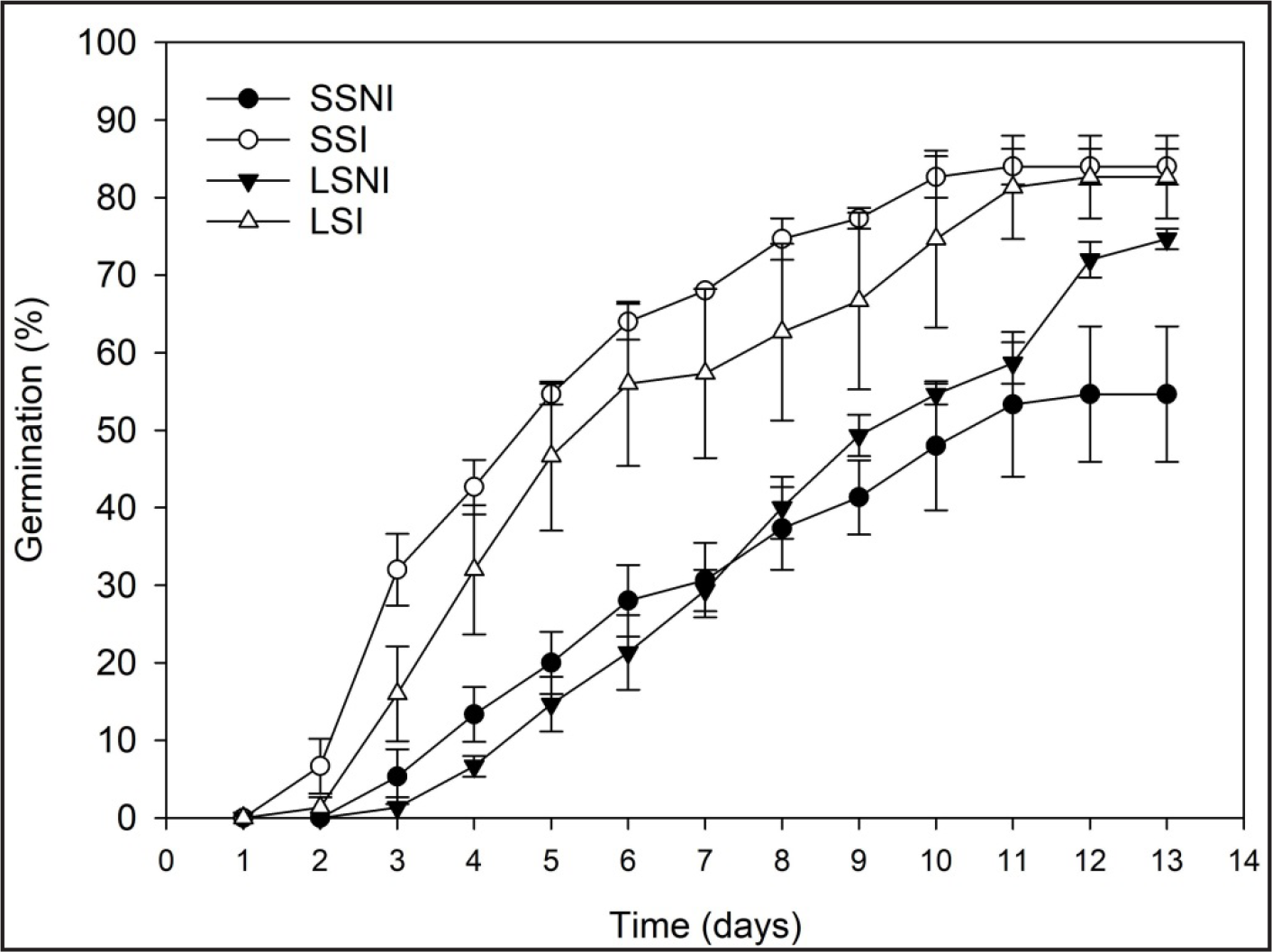 Source: Authors (2023)In where: (SSNI- small seed and non-inoculated; SSI- small seed and inoculated; LSNI - large seeds noninoculated; LSI - large seeds inoculated with A. brasilense)
 Source: Authors (2023)In where: Capital letters compare size class within each level of the inoculation and lower case compare level of inoculation in each seed class. Means with different letters are different according to the Scott‒ Knott test (p< 0.05)
 Source: Authors (2023)