 Predictive models of the occurrence of hollows in commercial trees in the Brazilian amazon: a comparison with the hollow test
Background: The prediction of hollows in standing trees is an expensive operation, but it is essential for decision-making about harvesting in managed forests in the Amazon. The hollow test that is currently used has strong limitations for correct prediction of the presence of hollows in a tree of commercial interest. The objective of this research was to select and validate generalized linear logistic models to estimate the occurrence of hollows in trees of fifteen commercial species and to compare the efficiency of the models to the results from the traditional manual method of hollow testing in the state of Pará, Brazil. A database of 27,380 trees was used to adjust models by species. To validate the equations, 9,915 trees from an independent area were used.
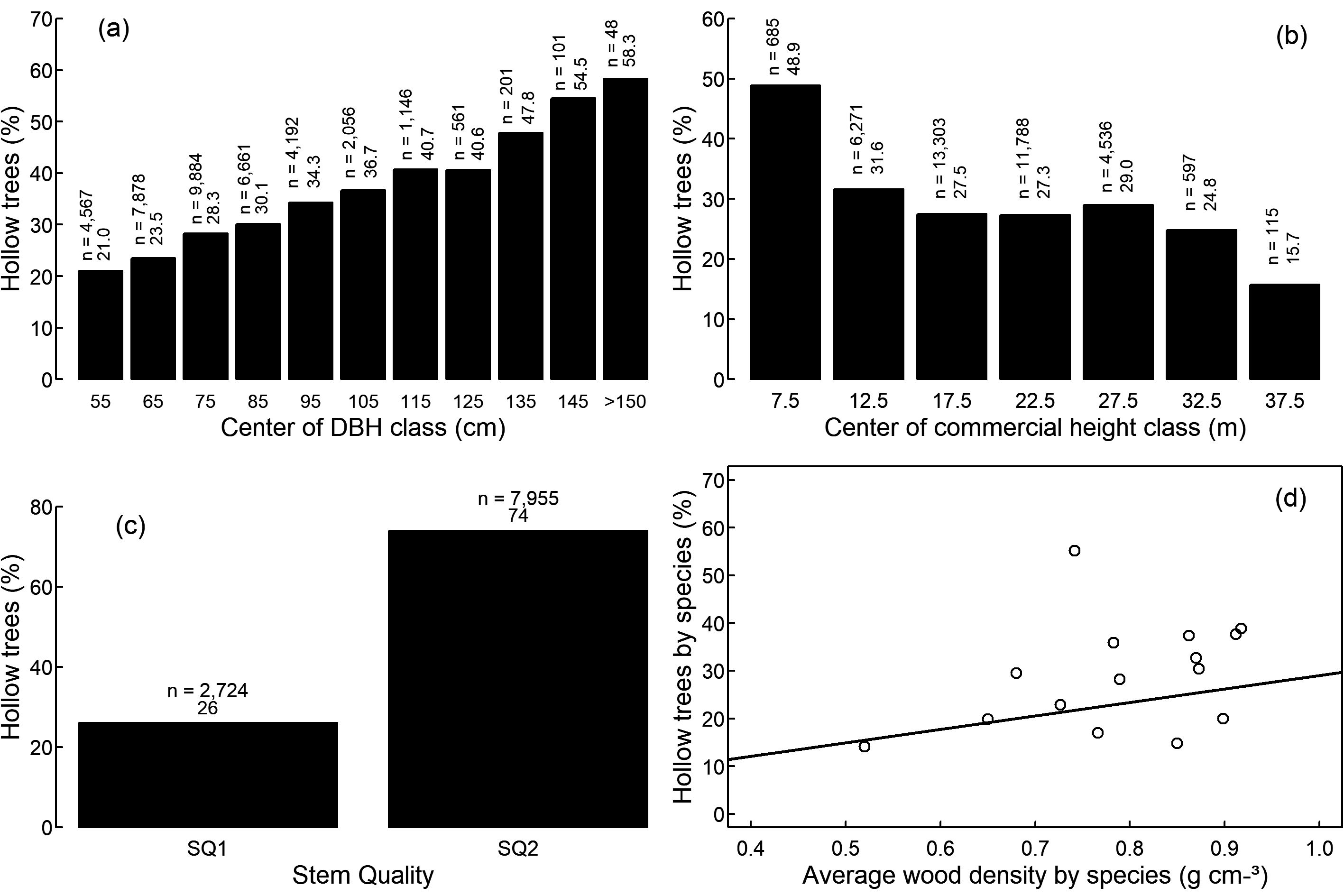
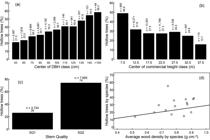
Results: Diameter at breast height (DBH), commercial height (hc) and stem quality (SQ) were important predictors of the occurrence of tree hollows, while wood density (WD) did not generate significant gains in the models. Species are determinants of the probability of a tree being hollow. From a DBH of approximately 100 cm, the probability of occurrence of hollows in the trees reaches about 80% for Manilkara bidentata (A. DC.) A. Chev., and for and Mezilaurus itauba (Meisn.) Taub. ex Mez and Astronium lecointei Ducke, for example, hollows occur in diameters of about 120 cm. Logistic equations are more efficient in predicting the presence of a hollow when a tree contains one, compared to the hollow test.
Conclusion: It is possible to accurately predict the occurrence of hollows in commercial trees, which may be an alternative to the current hollow test used in managed areas in the Brazilian Amazon.
Keywords:
hollow trees; commercial trees; generalized linear models; logistic regression; tropical forests
Species are determining factors for the probability of a tree being hollow. The occurrence of hollows in trees tends to be greater from about 100 cm of DBH. Logistic equations outperform the hollow test in predicting the presence of hollow in trees. It is possible to accurately predict the occurrence of hollows in commercial trees.
 Thumbnail
 Thumbnail
 Thumbnail