 Predictive models of the occurrence of hollows in commercial trees in the Brazilian amazon: a comparison with the hollow test
ABSTRACT
Background: The prediction of hollows in standing trees is an expensive operation, but it is essential for decision-making about harvesting in managed forests in the Amazon. The hollow test that is currently used has strong limitations for correct prediction of the presence of hollows in a tree of commercial interest. The objective of this research was to select and validate generalized linear logistic models to estimate the occurrence of hollows in trees of fifteen commercial species and to compare the efficiency of the models to the results from the traditional manual method of hollow testing in the state of Pará, Brazil. A database of 27,380 trees was used to adjust models by species. To validate the equations, 9,915 trees from an independent area were used.
Results: Diameter at breast height (DBH), commercial height (hc) and stem quality (SQ) were important predictors of the occurrence of tree hollows, while wood density (WD) did not generate significant gains in the models. Species are determinants of the probability of a tree being hollow. From a DBH of approximately 100 cm, the probability of occurrence of hollows in the trees reaches about 80% for Manilkara bidentata (A. DC.) A. Chev., and for and Mezilaurus itauba (Meisn.) Taub. ex Mez and Astronium lecointei Ducke, for example, hollows occur in diameters of about 120 cm. Logistic equations are more efficient in predicting the presence of a hollow when a tree contains one, compared to the hollow test.
Conclusion: It is possible to accurately predict the occurrence of hollows in commercial trees, which may be an alternative to the current hollow test used in managed areas in the Brazilian Amazon.
Keywords:
hollow trees; commercial trees; generalized linear models; logistic regression; tropical forests
HIGHLIGHTS
Species are determining factors for the probability of a tree being hollow. The occurrence of hollows in trees tends to be greater from about 100 cm of DBH. Logistic equations outperform the hollow test in predicting the presence of hollow in trees. It is possible to accurately predict the occurrence of hollows in commercial trees.
INTRODUCTION
The presence of hollows in trees is a predominant characteristic of native tropical forests. Hollows develop mainly due to the action of fungi and insects (Gibbons and Lindenmayer, 2002), with the help of abiotic and stochastic factors, such as fire, wind, topography, precipitation, and damage to the stem (Liu et al., 2018; Salmona et al., 2018).
In timber forest management areas, the presence of hollow trees presents important challenges, such as reduction of the volume of wood harvested and resulting negative financial impacts (Almeida et al., 2022), the need to increase the number of trees felled to reach the expected volume of wood (Danielli et al., 2016), lower yield of processed wood, increased generation of residual waste (Apolinário and Martius, 2004), and overestimation of commercial volume, which can interfere with planning (Nogueira et al. 2006), and the reduction of habitats for fauna dependent on tree hollows (Cockle et al., 2010; Gough et al., 2014), among others.
For these reasons, some of the authors cited above suggest that hollow trees should not be felled, which is also supported by the Execution Standard nº 1, of April 24, 2007, since the presence of hollows makes commercial utilization inviable (BRASIL, 2007). Therefore, forestry enterprises seek to reduce the number of harvested hollow trees, which requires a method of identification of hollows.
However, forestry enterprises in this region depend essentially on the hollow test and the empirical knowledge of the managers to predict the presence of hollows in the trees. The hollow test is performed by introducing the saber of a chainsaw into the trunk of the tree in a vertical position, so that the operator can evaluate indicators such as dark sawdust, the existence of mud or water, the level of resistance of the tree to cutting, among others (Nogueira et al., 2011). Some forestry enterprises stipulate an acceptable hollow diameter, which can vary from 15 to 25% of the tree diameter for sawmill species and approximately 8% for rolling mill species, and there may be a higher proportion in the case of species with high commercial value (Nogueira et al., 2011).
Although the hollow test is currently an important tool in the Amazon region, which allows forest managers to make decisions on whether or not to cut a hollow tree, the use of this test can also result in errors in the detection of hollows and therefore cause the forester to end up cutting a substantial number of hollow trees (Eleutério et al., 2020; Medeiros et al., 2021; Santos et al., 2023).
The activity of testing for hollows represents a relevant additional cost to forest management, especially due to the time and resources employed to perform the test on a tree that will eventually be replaced because of the presence of hollows in the stem (Batista, 2008). In addition, the hollow test is an invasive procedure capable of wounding and causing irreversible damage to the tree (Secco, 2011), so that the trees that are tested but not felled are subject to the attack of pathogenic agents.
In this context, the application of probabilistic methods based on covariates obtained from the forest inventory may represent an alternative or complementary methodology for predicting the occurrence of hollows in commercial trees and, consequently, assist in the process of selecting trees for harvesting. Generalized logistic linear modeling is one of the approaches usually used when one wants to model a binary variable (Warton and Hui, 2011), such as the presence or absence of hollow trees.
Logistic models have been tested for this purpose by several researchers in different forest typologies (Holloway et al., 2007; Fox et al., 2008; Zheng et al., 2009; Liu et al., 2018; Woolley et al., 2018). However, in the Brazilian Amazon, the methods for predicting the occurrence of hollows in trees have not been investigated, nor has the efficiency of the hollow test, except for the study by Santos (2020). Several studies have evaluated hollows together with other variables, for example, the influence of the presence of hollows in trees on volume and biomass (Nogueira et al., 2006), the presence of termite species that colonize the heartwood of living trees and the influence of tree dimensions and wood characteristics on the probability of heartwood decomposition (Eleuterio et al., 2020), and the effect of the occurrence of hollow trees on the volumetric and financial yield of a farm (Almeida et al., 2022).
Considering the possibility of predicting the occurrence of hollows in trees by means of logistic models as an alternative to the hollow test, the objective of this study was to select and validate generalized linear logistic models to estimate the occurrence of hollows in trees of fifteen commercial species and to compare the efficiency of these models with the hollow test in the Tapajós National Forest, state of Pará, Eastern Brazilian Amazon.
MATERIAL AND METHODS
Area of study and data collection
The study was carried out in the Tapajós National Forest (TNF), a federal Conservation Unit (CU) located in the western region of the state of Pará, on the margins of the Santarém-Cuiabá Highway (BR-163), covering areas of the municipalities of Belterra, Aveiro, Placa and Rurópolis, between the geographic coordinates 2º 45 to 4º 10 ́S and 54º 45 ́ to 55º 30 ́W. The UC occupies an area of approximately 544,927 ha, where the Forest Management Areas that are destined, under a non-onerous concession, for community forest management are located.
The vegetation in the CU is classified as Dense Ombrophilous Forest, characterized by the dominance of large trees, palm trees and epiphytes, with a uniform canopy or with emergent trees (Gonçalves and Santos, 2008). The climate is characterized as hot and humid (Am - Köppen) with an average annual rainfall of 2,000 mm. There is a dry season (August to November) with an average annual temperature of 25 °C. The most common soil type is the Dystrophic Yellow Latosol, characterized by different textures, and is usually deep, acidic, and friable (Oliveira Junior et al., 2015).
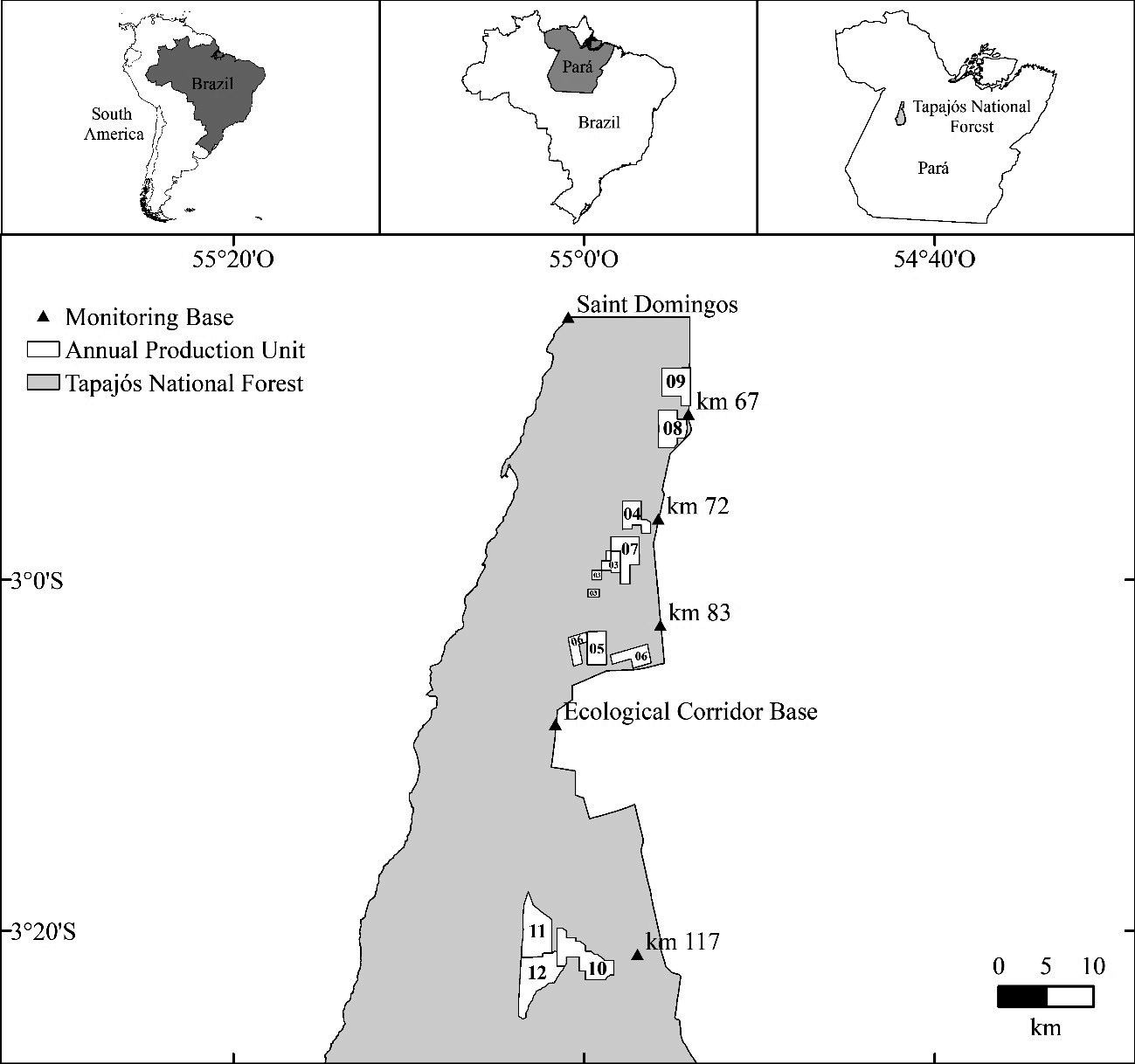
The data used in this study were collected in twelve Annual Production Units (APUs) (Figure 1) located in the Forest Management Areas (FMA) called Ambé and Anambé II Projects in the TNF. Of these APUs, ten (numbered from 03 to 12) were in the FMA Ambé Project and were managed from 2008 to 2017. The other two APUs (numbered 01 to 02) were in FMA Anambé II and were managed in 2020 and 2021. The areas of the twelve APUs ranged from 521 to 2,242 ha, totaling approximately 15,596 ha managed.
Location of the Tapajós National Forest and the Annual Production Units (APUs) along the Santarém-Cuiabá highway (BR-163), Pará, Brazil.
Data were obtained by means of censuses of commercial trees (diameter at 1.3 m height - DBH ≥ 50 cm) and by cubing the volume of selected and harvested trees. In the censuses, in addition to the measurement of DBH and visual estimation of commercial heights (hc), the species were identified by their regional name, and the scientific names were later identified in available digital databases and scientific publications (Cysneiros et al., 2018; Reflora, 2023; SFB, 2023).
In the inventories, the stem quality (SQ) of the trees that could be commercialized was also identified, classifying them as: SQ1: stem without the apparent presence of defects, such as tortuosity and rot; SQ2: stem with the presence of defects, but which do not significantly impair the use of the wood; and SQ3: stem with major defects, which make it unfeasible to use the tree, making them non-commercial. According to criteria pre-defined by the forestry enterprise, only trees with SQ1 and SQ2 were harvested.
Hollows were identified and measured in the operation of cubing the marketable volume of the logs. In cases where the hollow occurred along the entire length of the log, two perpendicular measurements of the hollow diameter were obtained both at the larger end (D1 and D2) and at the smaller end (d1 and d2) of the log, which resulted in a mean diameter at each end, i.e., D and d. In these cases, the length of the hollow was equal to the length of the log. When the hollow did not occur along the entire length of the log, the diameter at the end of the log, as well as its length, were obtained.
Wood density (WD) was also tested in this study as a predictor of the occurrence of hollows in trees. Specific wood density values per commercial species were obtained based on the average of the values reported in the Global Wood Density Database (Zanne et al., 2009) and in the Brazilian Wood Database of the Forest Products Laboratories of the Brazilian Forest Service (SFB, 2023).
For this study, the 15 (fifteen) commercial species with the highest number of trees harvested in the twelve APUs were considered, which represented 82% of the total (45,742) of trees harvested in the area. Data from 11 APUs (managed from 2008 to 2017 and in 2020) were used to adjust the models. To evaluate the predictive capacity of the models in an independent sample, but from the same forest management area, the data from APU 02, managed in 2021, were intended exclusively for the validation of the logistic equations obtained.
The list of commercial species evaluated in this study is shown in Table 1, with the respective means and deviations of the predictor variables DBH and hc, as well as the mean wood density and the percentage of hollow trees per species. In addition to this information, an evaluation of the relationship between the dependent variable (occurrence of hollowness) and the independent variables was performed prior to the adjustments. A structural characterization of hollows, including diameter, at the species and tree level for the same area of the present study, can be found in Santos et al. (2023).
Binary logistic regression modeling
The logistic model of the binomial family (Expression 1), which is part of the group of Generalized Linear Models (GLM), was used to estimate the binary variable occurrence of hollows at the tree level for the 15 species, obtaining specific equations per species. The adjustment of specific equations was justified by the fact that the species presented significant variation in the percentage of hollow trees, indicating that the characteristics of the species can influence the occurrence of hollow trees and, consequently, the response of logistic GLM. The covariates tested were DBH, hc, WD and SQ.
where p(Yi) is the probability of occurrence of hollow for i-th tree, X n represents the predictor variables: diameter measured at 1.30 m above the soil (DBHi), commercial height (), average wood density per species (WDi), and stem quality (SQi) for the i-th tree, β 0 , β 1 and β n represent the estimated coefficients, logit is the binding function of the logistic model, and ln is the natural logarithm.
The identification of the appropriate models was based on the Stepwise method, using the change in the Akaike Information Criterion (AIC) as a parameter for the individual inclusion or removal of each covariate, an approach similar to that used by Holloway et al. (2007), Zheng et al. (2009), Liu et al. (2018) and Woolley et al. (2018), for example.
The estimation of the coefficients of the models was performed using the maximum likelihood method, with the aid of the “glm” function of the R software (R Core Team, 2023), using the binomial distribution function and the logit linkage function. The coefficients estimated on the logarithmic scale were transformed and presented on the probability scale.
Adjustment evaluation and prediction analysis
The evaluation of the adjustments was performed using the Wald test (significance of the coefficients) and the Hosmer and Lemeshow test (Hosmer et al., 2013), along with Pearson’s chi-square, which tests the null hypothesis that the models are adequately fitted, using the Chi-square statistic as a function of Pearson’s residuals. Additionally, this analysis used the Akaike Information Criterion - AIC, the distribution of residuals in half-normal plots for GLM for residuals evaluation, and a deviance analysis for GLMs.
The prediction capacity (validation) of the models was evaluated by means of accuracy, which indicates the model’s ability to correctly predict the presence and absence of hollows in a tree (percentage of all correct answers), calculated from contingency tables (confusion matrices) (Hosmer et al. 2013). To construct the contingency tables for each model, the trees of the validation database were classified into two distinct groups (hollow = 1 and non-hollow = 0), considering the probabilities estimated by the models and the cutoff points (CP) previously defined for each species, according to the methodology proposed in Hosmer et al. (2013). CPs represent the thresholds in the estimated probabilities that can best discriminate the trees as being hollow (estimated probability ≥ CP) or not hollow (estimated probability < CP), which allows the classification of new trees.
In addition, the prediction of the models was also evaluated by means of ROC (Receiver Operating Characteristic Curve) curves and the respective Area Under the ROC Curve (AUC), considering that higher AUC values indicate better model performance (Fielding and Bell 1997). AUC values usually range from 0.5 (equivalent to a chance result) to 1.0 (perfect performance). Values > 0.9 are considered good, 0.7-0.9 moderate, and < 0.7 poor (Pearce and Ferrier, 2000). The distribution of the estimated probabilities of hollow occurrence was presented graphically as a function of the DBH, to evaluate possible trends in the chances of hollow occurrence as a function of the diameter size of the trees for each species. Statistical and graphical analyses were performed using the R computer program (R Core Team, 2023).
Comparison of the estimates with the hollow test
After the selection and validation of the logistic equations, a comparison of their predictive capacity in relation to the hollow test was carried out, using as a parameter the hollow identification test result as listed in the packing list, since on this occasion it is possible to inspect the felled trees.
For this analysis, only data from APU 02, managed in 2021, were considered. In this APU, the hollow test was carried out after the census forest inventory and before harvesting, with the objective of supporting the selection of trees to be harvested and guiding the cutting activity of these trees, thus avoiding the process of replacing hollow trees with others that could be harvested.
Of the trees inventoried in APU 02 (39,174 trees), 23,200 (59%) belonged to the 15 species evaluated in this study, among which 15,401 trees were submitted to the hollow test. The hollow test was not performed in all the inventoried trees due to a previous selection, in which trees of non-commercial species and those considered seed bearers, threatened with extinction, among other criteria, were separated into a group that was not subject to harvest. After the hollow test, 9,368 trees of the 15 species were selected and harvested (Table 2), and these data were used in the present analysis.
For these trees, the identification of the occurrence of hollows was compared by means of the following methods: (i) logistic GLM, (ii) hollow test and (iii) identification of hollows using the packing list of the harvested trees, the latter being the reference information (parameter). Contingency tables were generated and metrics of specificity (probability of classifying the event as absent when it did not actually occur) and sensitivity (probability of classifying the event as present when it actually occurred), as well as accuracy, were calculated to measure the efficiency of hollow detection methods.
RESULTS
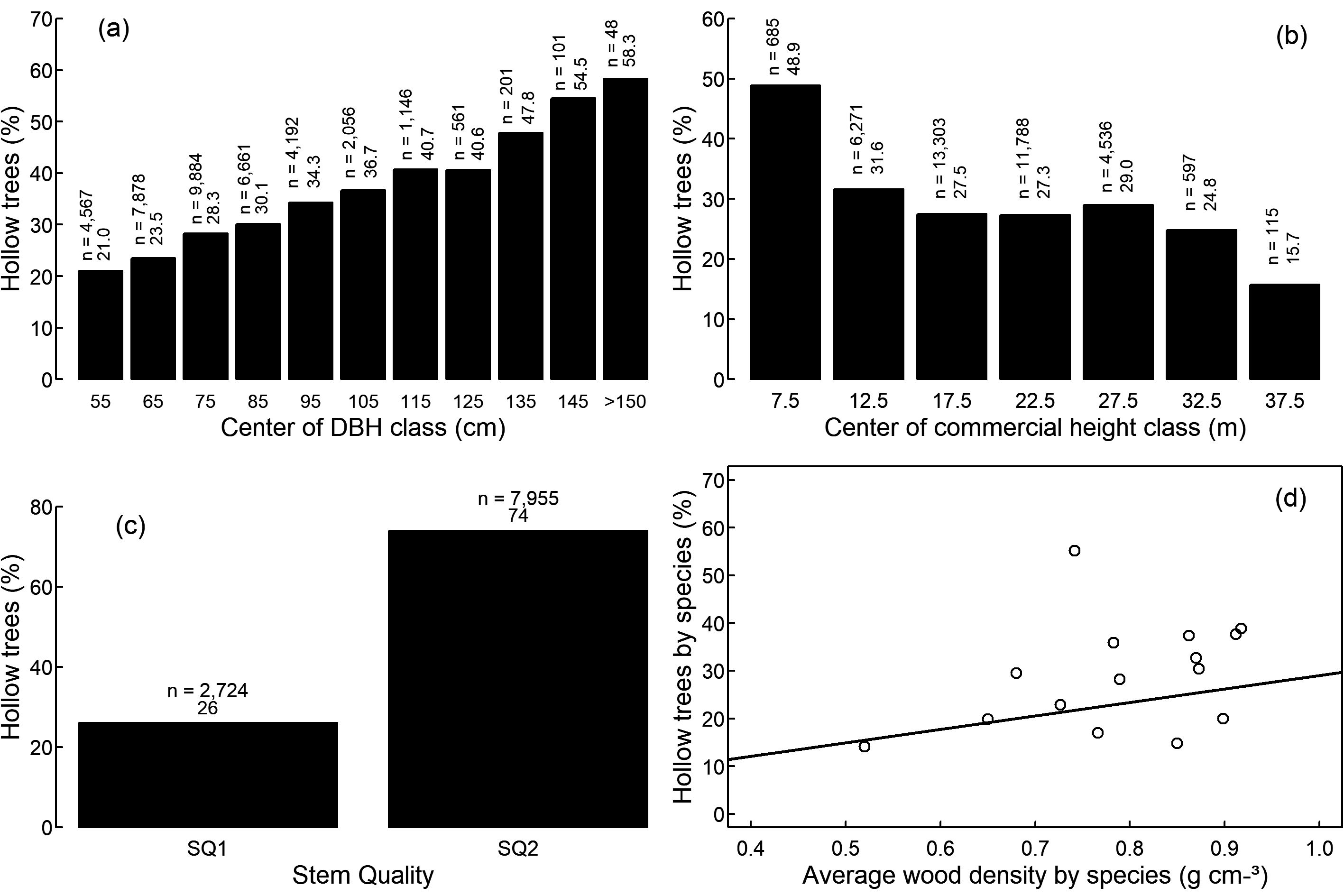
There was a strong relationship between the occurrence of hollows in the trees and the available covariates, especially DBH, commercial height and stem quality. It was observed that the proportion of hollow trees is higher in the larger DBH classes, indicating that larger diameter trees are more likely to contain hollows (Figure 2A). On the other hand, there is a higher proportion of hollow trees in the shorter commercial height classes (Figure 2B).
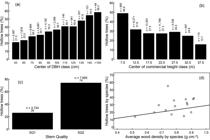
Percentage distribution of hollow trees by (a) Center of DBH Class, (b) Center of commercial height class, (c) Stem Quality (SQ) and (d) relationship between hollow occurrence and average wood density by species.
Regarding stem quality (SQ), it was found that 74% of the hollow trees were classified with SQ2 and only 26% with SQ1 (Figure 2C). Finally, a positive relationship was also observed between the occurrence of hollow trees and the average density of wood per species, with an increase in the percentage of hollow trees as the average density of wood of commercial species increased, although this trend was not significant (Figure 2D).
The models per species, obtained by means of the Stepwise method, are shown in Table 3, with the respective estimated coefficients and the statistics for the evaluation of the adjustments. It was found that the probability of a tree having a hollow was logistically related to DBH, commercial height and stem quality. All coefficients were significant (p < 0.05) according to the Wald test, except for those related to commercial height for L. pisonis and M. itaúba. The DBH and SQ variables were selected predictors in all models, and for commercial height in most of them. The covariate wood density was not significant in any of the models.
Invariably, the coefficient related to DBH causes an increase in the probability of hollow occurrence as the value of the tree diameter increases. On the other hand, the coefficients related to the quality of the stem cause a decrease in the probability of occurrence of hollows, however, the effects are in different proportions. Trees with QF1 are more likely to not have a hollow compared to trees with QF2. The variable commercial height has a different effect on the probability of occurrence of hollows, depending on the species. For the species G. glabra, L. pisonis, M. huberi, P. suaveolens and P. oppositifolia, there is a greater probability that a tree will have a hollow the greater its commercial height, differently from what occurs for the other species.
According to the Hosmer and Lemeshow test, all models provided adequate estimates, with no evidence of a statistically significant difference (p ≥ 0.05) in relation to the observed values (Table 3). Similarly, Pearson’s chi-square test indicated that all models were adequately adjusted to the data (p ≥ 0.05). Although they do not lend themselves in this evaluation to the comparison of equations for the same data set, the lowest values of AIC for the equations of the species M. bidentata (397.6) and P. oppositifolia (397.7), for example, indicated greater quality and simplicity in relation to the other equations, even with a similar number of variables.
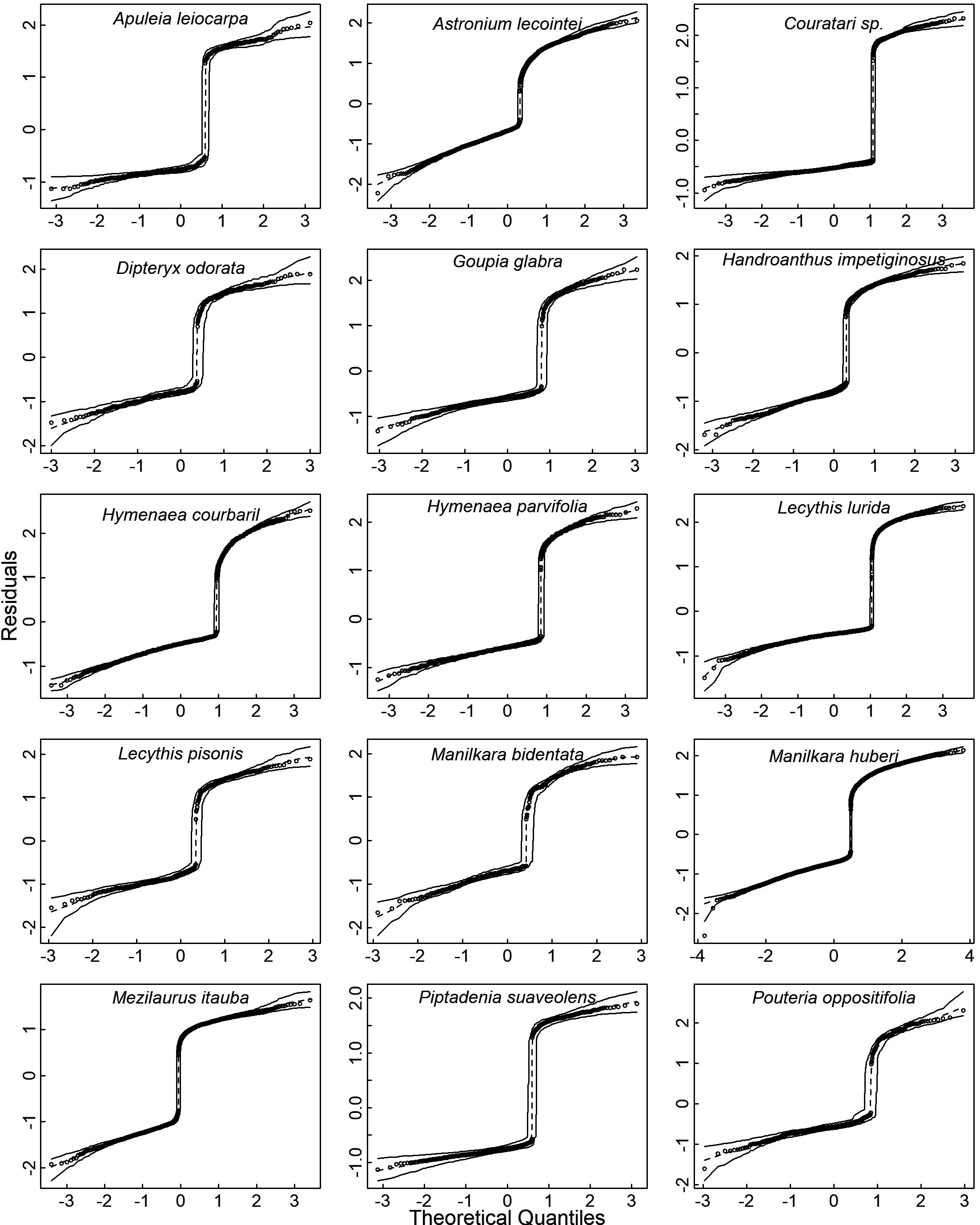
The residual analysis showed no discrepant values, and the distribution was within the simulated confidence envelopes (Figure S1). In general, the deviance analysis for GLMs showed that the deviations of the predictor variables were significant in all cases, except for the commercial height variable in four of the fifteen equations (Table S1). In addition, for the equation of the species Couratari sp., for example, there was a reduction of 42.4% in the variance from the null model (5,145) to the model with all the selected predictor variables (2,962). Relevant reductions in variance were also observed for the equations of the species L. lurida, H. courbaril, P. oppositifolia, among others.
When applied to the validation data, the logistic equations showed an average accuracy of 68%, reaching 80% for the specific equation of the species L. lurida (Table 4). The AUC values remained close to what is classified in the literature as moderate, reaching 0.75 for the equation selected for the species H. impetiginosus. The cutoff points, also presented in Table 4, varied significantly among the species (from 0.141 to 0.552), confirming the importance of defining them specifically by species.
Accuracy and value of the area on the ROC curve (AUC), used to measure the predictive capacity of logistic equations, and cutoff points (CP), used as a threshold for classifying trees according to the presence or absence of hollows.
For most species, the probability of hollow presence increased markedly in trees with DBH larger than approximately 80 cm, whose species strongly influenced the presence of hollows (Figure 3). For M. bidentata, a marked increase in the probability was observed in trees with DBH larger than 50 cm, reaching more than 80% probability of hollow occurrence in trees with DBH of approximately 100 cm.

Probabilities of occurrence of hollow trees estimated for fifteen commercial species managed in the Tapajós National Forest, Eastern Amazon, Brazil.
Stems of A. lecointei and M. itauba, had a probability of approximately 80% of having a hollow in DBH of about 120 cm. These species had greater probability of having hollows compared to most other species. Stems of L. pisonis and M. huberi tend to have a higher probability of hollow occurrence (about 80%) with greater DBH (approximately 160 cm). On the other hand, the probability of the presence of a hollow was between 20 and 40% even for the largest trees (DBH > 150 cm) for Couratari spp. and P. suaveolens (Figure 3).
The metrics for evaluating the predictive capacity of the hollow test and logistic equations are presented in Table 5, which were generated from contingency tables. By means of the hollow test, the specificity was higher than 97% for all species, indicating a high degree of accuracy in the definition of the absence of hollows when the trees do not really have a hollow. However, the ability of the test to predict the presence of hollows when the trees have one is low, so that the sensitivity was on average 4.7% considering the fifteen species.
The logistic equations, on the other hand, showed more expressive sensitivity values, indicating that they have a greater capacity to correctly predict the presence of hollows when compared to the hollow test. Among the 3,144 hollow trees of the fifteen evaluated species, it was possible to predict the presence of hollows in 158 trees by means of the hollow test, while by means of logistic equations this prediction was 977 trees. In addition to presenting greater sensitivity, the logistic equations also presented a high degree of specificity (on average 84%). In general, the accuracy was similar for both methods, although with higher values for the hollow test (Table 5), which was influenced by the higher degree of accuracy in predicting the absence of hollow (specificity).
DISCUSSION
All the covariates tested showed a high predictive capacity of the occurrence of hollow trees in the study area, except for wood density. It was found that trees with higher DBH are more likely to contain hollows, and there is a strong logistic relationship between these variables. Hollows are commonly assumed to occur in large, old, senescent trees (Gibbons and Lindemayer, 1997), which have been physically damaged and better able to withstand hollows (Salmona et al., 2018). Although there are many factors responsible for the distribution and development of hollows in trees, tree size tends to be a predominant factor (Lindenmayer et al., 2000).
The biotic and abiotic processes that lead to the formation of hollows in trees have more time to take effect (and produce larger hollows) on older, thicker, and shorter trunks (more deteriorated by branch breakage) (Lindenmayer et al., 2000; Gibbons and Lindenmayer, 2002). The longer the tree remains standing, the greater the risks of stochastic events (fires, winds, among others) that promote the development of hollows (Lindenmayer et al., 2000). Thus, larger and older trees, with parts of the canopy lost due to deterioration, probably contain more hollows and these are increasingly larger (Inions et al., 1989).
On the other hand, it was found that trees with shorter commercial height have a higher incidence of hollows. Fox et al. (2008) also observed similar behavior when evaluating the relationship between the proportion of trees with hollows and the variables DBH and commercial height in state forests in central and eastern Victoria, Australia. According to these authors, a shorter commercial height may indicate, for example, a tree with a bad shape or with a dead or broken crown, in addition to other defects such as a hollow or tortuous trunk, the presence of termite galleries, rot or fungal infection, and fire scars, among others. In this context and supported by the literature, Fox et al. (2008) reported that it is plausible that trees with shorter commercial height are more prone to hollow formation than healthy trees with larger heights.
Considering that commercial trees of shorter height, in general, may be found in intermediate positions in the forest below the canopy, it is assumed that they may be more susceptible to the negative effects of competition, which can cause, for example, the detachment of branches, generating means of entry for pathogenic agents and water infiltration, as well as the occurrence of injuries caused by the detachment of branches from dominant trees and the reduction of the potential to combat pathogenic agents, among other consequences, which can maximize the incidence of hollows (Holloway et al., 2007; Vanclay, 2022; Santos et al., 2023).
The classification of the trees according to the quality of the stem was also important in the prediction of the occurrence of hollows. These results indicate that the empirical classification of stem quality based on visual characteristics of the stem is strongly related to the presence of hollows in the trees. Hollow trees with lower stem quality (SQ2) were more than 70% when compared to those with better stem quality (SQ1). Therefore, it can be inferred that commercial stems that are more tortuous and tapered and with signs of the presence of a hollow (such as the occurrence of lesions, termite mounds, presence of dark secretions along the trunk, broken branches) are more likely to contain hollows. Regarding the form of the stem, the literature indicates that it is a determinant variable of the incidence of hollows (e.g., Gibbons, 1999). According to these authors, trees with a more compact morphology (and generally shorter total heights) are much more likely to contain hollows than trees with higher form quality.
The Stepwise method indicated that DBH and SQ were essential in all models, and commercial height in most of them. Although hollow formation is an intrinsically stochastic event and difficult to model statistically (Fox et al., 2008), the efficiency of these three covariates for predicting the probability of occurrence of hollows was confirmed. Similar results were verified by Zheng et al. (2009) in specific logistic models for 16 native species in China and by Fox et al. (2008), who mainly indicated DBH as one of the most important variables to predict the presence or absence of hollow trees in a native forest in Victoria, Australia.
Most of the selected equations showed a high degree of accuracy and moderate AUC values, indicating that they are adequate and can generate accurate predictions of the occurrence of hollows in commercial trees. It should be noted that the predictability of the equations was tested using data from an independent area, but still from the same region, which conferred validity and rigor to this test. For all species, there was a trend towards an increase in the estimated probability of hollow occurrence as DBH increased (Figure 3), similar to the findings of Zheng et al. (2009), Onodera et al. (2013), Salmona et al. (2018) and Liu et al. (2018), for example. In a study conducted in the Xishuangbanna National Nature Reserve, southwest China, it was found that the probability of hollow presence increased from 4.4% in the tree with the lowest DBH (5 cm) to 99.1% in the tree with the highest DBH (254.78 cm) (Liu et al., 2018).
As shown in Figure 3, these species have different degrees of probability of hollow occurrence. This demonstrates the variation in the probability of occurrence of hollows depending on the species and, consequently, the need to consider the characteristics of each species in the definition of criteria for the management of hollow trees.
These results are important for the improvement of forest management practices in the Amazon region, in addition to helping to understand the occurrence of hollows in native trees in this region. According to Almeida et al. (2022), in the selection of trees for harvesting, not only the species with the highest occurrence of hollows deserve special attention, but also the diameters in which this defect is most prevalent.
In this sense, Eleuterio et al. (2020) also suggested that, in managed forests, tree selection criteria should consider the susceptibility of tree species to the development of hollow stems. These authors found that the heartwood hollow area increases with the basal area of the tree trunk and, therefore, indicated that a maximum DBH (in addition to a minimum DBH) should be considered in the selection of trees for logging. This would make it possible to reduce the loss of hollow trees, which are important for biodiversity, as well as to avoid economic losses due to waste from felling (Macpherson et al., 2012). In the same light, Almeida et al. (2022) suggested avoiding the harvesting of hollow trees above 95 cm DBH, where there is a higher probability of occurrence of this defect, which should be based on studies that consider the pattern of occurrence of hollows by species and by diameter class.
In the present study, it was found that after an approximate DBH of 80 cm, the probability of occurrence of hollow occurs increases markedly for most of the species evaluated. It is assumed that starting at this diameter, the probability of a tree containing a hollow may be relevant, indicating the need for greater attention in the selection of trees from these larger diameter sizes. This information is essential for decision-making in the selection of trees to be exploited. Forestry enterprises can use both the estimated probabilities of occurrence of hollows at the tree level and the classification of trees as hollow or non-hollow.
Obviously, in addition to the presence and size of hollows, other factors can influence the decision to cut a tree, notably the diameter of maximum volumetric production. However, with respect to promoting greater sustainability of forest management in the Amazon, the definition of optimal cutting diameters per species should consider the criteria of maximum volumetric production (Andrade et al., 2019; Canetti et al., 2021) with respect to the probabilities of hollow occurrence in trees. These are complementary criteria, considering that the larger the diameter, the smaller the volumetric increment and the greater the chance of occurrence of hollows.
In due course, it should be mentioned that the relevant literature contains research that opposes the maintenance of hollow trees in the forest. Higuchi (2010) argues that hollow trees should be harvested to give opportunities to healthy and qualified trees in response to increases in the availability of water, light and nutrients. This author adds that hollow trees, in general, emit more carbon than they sequester, thus negatively affecting the balance of exchanges between the biosphere and the atmosphere. It is argued that, in the long run, the process of replacing hollow trees and maintaining them in the forest can generate an accumulation of trees with no economic value in the remaining stock (Almeida et al., 2022; Louchard, 2022). As an alternative, these authors recommended not discarding hollow trees at harvest, in addition to indicating that it should be possible to use reserve trees to complete the authorized volume.
In principle, one of the alternatives may be to define criteria that provide a balance between harvesting and maintaining hollow trees in the forest. As observed in the present study, certain species have a high probability of occurrence of hollows in larger DBH trees and these hollows may be proportionally larger. For these species, priority should be given to harvesting trees in the smallest diameter classes, and in the larger classes, hollow trees in competition with commercial species could be exploited. On the other hand, some species have little chance of developing hollows in their trees, which allows for the harvesting of trees with larger DBH.
It should also be considered that hollow trees are essential resources for many wild animals, performing an important ecological function (Lindenmayer et al., 2000; Gibbons and Lindenmayer, 2002). By comparing the abundance of hollows and nesting of birds in hollows between a primary (unharvested) forest and a selectively harvested one, both in the humid subtropical Atlantic Forest in Argentina, it was shown that the exploited forest had nine times fewer hollows suitable for bird nesting and seventeen times fewer active nests (Cockle et al., 2010). In view of this, the authors suggested the maintenance of large living trees with hollows in management areas in tropical forests.
The results of the evaluation of the efficiency of the logistic equations indicated that, in the study area, it could be more efficient to predict the occurrence of hollows in the stem of commercial trees using the logistic equations, as opposed to the use of the traditional hollow test. It is believed that the prediction of hollows through modeling can also result in a reduction of the operational cost related to the hollow testing activity. In addition, not performing the hollow test, at least on most trees, will reduce the perforation of the trunk of trees that will not be felled, which can minimize the opening of access channels for wood deteriorating agents.
Although the accuracy (percentage of all correct answers) was similar for both methods of hollow prediction, the analysis of sensitivity and specificity metrics was essential to indicate the efficiency of the logistic equations. The results indicated that, by means of the hollow test, it was possible to indicate with a high degree of accuracy the absence of hollows in the trees (specificity). However, this is a strong indication that the test is biased and in fact inaccurate since it classifies most trees as non-hollow when in fact the occurrence of hollow is relevant. Louchard (2022) raised this issue in his study conducted in a management area in the Saracá-Taquera National Forest in the state of Pará. Based on the results of this analysis, the author indicated that the hollow test and the evaluation made by the operator caused the predicted amount and frequency of hollow trees or trees with large hollow dimensions to be lower, when in fact the occurrence was high in some repetitions of the experiment.
In a forest management area, where the general objective is to reduce the harvest of hollow trees, accurately estimating the occurrence of hollows when the tree has a hollow is an especially important result. Correct estimates in these cases can avoid harvesting hollow trees, which do not generate enough yield after processing and most often do not cover the costs of harvesting, transporting, and sawing. Failure to properly identify hollows results in the harvesting of many hollow trees, which are sectioned and sometimes have their logs discarded while still in the forest or, later, at the wood processing facility (Amaral et al., 1998; Secco, 2011).
Although it is a method widely used today in areas under forest management in the Amazon, the results indicated that the hollow test has serious limitations to detect the presence of hollows in trees. For the species H. impetiginosus, for example, of the 81 effectively hollow trees, the hollow test correctly predicted the presence of hollows in only one; the logistic equation for this species, on the other hand, indicated the presence of hollows in 46 of these trees. Similarly, for the species M. bidentata, which had 53 hollow trees, the hollow test indicated the presence of hollows in two trees, while the logistic equation indicated that 27 trees were hollow.
The low efficiency of the hollow test was also highlighted by Trockenbrodt et al. (2002), in a pilot study carried out in managed tropical forests in Sabah, Malaysia. One of the factors that may explain the difficulty in detecting hollows by means of the hollow test is that some trees present this defect only in the central (middle) and/or upper part of the stem, leading the manager to a wrong result regarding the occurrence of hollow, since the test is performed at the base of the tree (Santos et al., 2023). In addition, the detection errors of the hollow test can be maximized for trees with large diameters, considering that in these cases it becomes more difficult to access the hollows (Eleuterio et al., 2020).
The results of this study will aid managers in the selection of harvestable trees and will allow them to prioritize the harvest of trees with a lower probability of having a hollow. With respect to forestry legislation, these results will help to define management criteria related to hollows specifically for the principal commercial species, as well as to identify diameter limits for harvest based on the probability of hollow occurrence.
CONCLUSIONS
The occurrence of hollows in commercial trees presents a logistical relationship with diameter at 1.3 m above the soil (DBH), the commercial height, and the quality classification of the stem. The probability of a tree being hollow depends on the species and in general tends to increase markedly as DBH increases, reaching a probability of hollow occurrence of about 80%in stems of DBH about 100 cm for Manilkara bidentata, and about 120 cm for Astronium lecointei and Mezilaurus itauba, for example. The logistic equations selected for the fifteen species evaluated in this study are valid and can be used in forest management to predict the probability of occurrence of hollows in newly inventoried trees, and significantly improves upon the currently applied hollow test. These estimates can be used as an alternative or complementary resource in the process of selecting trees for harvesting, with the objective of reducing the number of hollow trees felled.
REFERENCES
-
ALMEIDA, V. B.; SILVA, J. N. M.; STEINBRENNER, M. K. A. Impacto da ocorrência de árvores ocas no rendimento da colheita de madeira na Floresta Nacional de Saracá-Taquera, Pará. Pesquisa Florestal Brasileira, v. 42, p. 1-12, 2022. https://doi.org/10.4336/2022.pfb.42e201902058
» https://doi.org/10.4336/2022.pfb.42e201902058 - AMARAL, P.; VERÍSSIMO, A.; BARRETO, P.; et al. Floresta para Sempre: um Manual para Produção de Madeira na Amazônia. Imazon, Belém. 1998, 130p.
-
ANDRADE, V. H. F.; MACHADO, S. A.; FIGUEIREDO FILHO, A.; et al. Growth models for two commercial tree species in upland forests of the Southern Brazilian Amazon. Forest Ecology and Management, v. 438, p. 215-223, 2019. https://doi.org/10.1016/j.foreco.2019.02.030
» https://doi.org/10.1016/j.foreco.2019.02.030 -
APOLINÁRIO, F. E.; MARTIUS, C. Ecological role of termites (Insecta, Isoptera) in tree trunks in central Amazonian rain forests. Forest Ecology and Management, v. 194, n1-3, p. 23-28, 2004. https://doi.org/10.1016/j.foreco.2004.01.052
» https://doi.org/10.1016/j.foreco.2004.01.052 - BATISTA, H. L. P. Estudo de tempo e rendimento da motosserra considerando fatores ergonômicos numa exploração florestal na Amazônia Central. 2008. 105 p. PhD thesis, Instituto Nacional de Pesquisas da Amazônia, Manaus.
-
CANETTI, A.; BRAZ, E. M.; MATTOS, P. P.; et al. A new approach to maximize the wood production in the sustainable management of Amazon Forest. Annals of Forest Science, v. 78, n. 67, p. 1-21, 2021. https://doi.org/10.1007/s13595-021-01079-8
» https://doi.org/10.1007/s13595-021-01079-8 -
COCKLE, K. L.; MARTIN, K.; DREVER, M. C. Supply of tree-holes limits nest density of cavity-nesting birds in primary and logged subtropical Atlantic Forest. Biological Conservation, v. 143, n. 11, p. 2851-2857, 2010. https://doi.org/10.1016/j.biocon.2010.08.002
» https://doi.org/10.1016/j.biocon.2010.08.002 -
CYSNEIROS, V. C.; MENDONÇA JÚNIOR, J. O.; LANZA, T. R.; et al. Espécies madeireiras da Amazônia: riqueza, nomes populares e suas peculiaridades. Pesquisa Florestal Brasileira, v. 38, p. 1-14, 2018. https://doi.org/10.4336/2018.pfb.38e201801567
» https://doi.org/10.4336/2018.pfb.38e201801567 -
DANIELLI, F. E.; GIMENEZ, B. O.; OLIVEIRA, C. K. A.; et al. Modelagem do rendimento no desdobro de toras de Manilkara spp. (Sapotaceae) em serraria do estado de Roraima, Brasil. Scientia Forestalis, v. 44, n. 111, p. 641-651, 2016. https://doi.org/10.18671/scifor.v44n111.10
» https://doi.org/10.18671/scifor.v44n111.10 -
ELEUTERIO, A. A.; JESUS, M. A.; PUTZ, F. E. Stem Decay in Live Trees: Heartwood Hollows and Termites in Five Timber Species in Eastern Amazonia. Forests, v. 11, n. 10, p. 1-12, 2020. https://doi.org/10.3390/f11101087
» https://doi.org/10.3390/f11101087 - FIELDING, A. H.; BELL, J. F. A review of methods for the assessment of prediction errors in conservation presence/absence models. Environmental Conservation, v. 24, n. 1, p.38-49, 1997.
-
FOX, J. C.; HAMILTON, F.; ADES, P. K. Models of tree-level hollow incidence in Victorian state forests. Forest Ecology and Management, v. 255, p. 2846-2857, 2008. https://doi.org/10.1016/j.foreco.2008.01.060
» https://doi.org/10.1016/j.foreco.2008.01.060 -
GIBBONS, P.; LINDENMAYER, D. B. Developing tree retention strategies for hollow-dependent arboreal marsupials in the wood production eucalypt forests of eastern Australia. Australian Forestry, v. 60, p. 29-45, 1997. https://doi.org/10.1080/00049158.1997.10674696
» https://doi.org/10.1080/00049158.1997.10674696 - GIBBONS, P. Habitat-tree retention in wood production forests. 1999. 140 p. PhD thesis, The Australian National University, Canberra, ACT, Australia.
- GIBBONS, P.; LINDENMAYER, D. B. Tree Hollows and Wildlife Conservation in Australia. CSIRO Publishing, 2002. 203p.
-
GOUGH, L. A.; BIERKEMOE, T.; SVERDRUP-THYGESON, A. Reactive Forest management can also be proactive for wood-living beetles in hollow oak trees. Biological Conservation, v. 180, p. 75-83, 2014. https://doi.org/10.1016/j.biocon.2014.09.034
» https://doi.org/10.1016/j.biocon.2014.09.034 -
GONÇALVES, F. G.; SANTOS, J. R. Composição florística e estrutura de uma unidade de manejo florestal sustentável na Floresta Nacional do Tapajós, Pará. Acta Amazonica, v. 38, n. 2, p. 229-244, 2008. https://doi.org/10.1590/S0044-59672008000200006
» https://doi.org/10.1590/S0044-59672008000200006 -
HIGUCHI, N. Setor madeireiro e desenvolvimento sustentável na Amazônia. In GEEA: Grupo de Estudos Estratégicos Amazônicos. INPA: TOMO III, Caderno de Debates. 2010. https://antigo.inpa.gov.br/index.php/component/content/article?id=221 [accessed on 25.01.2024]
» https://antigo.inpa.gov.br/index.php/component/content/article?id=221 -
HOLLOWAY, G. L.; CASPERSEN, J. P.; VANDERWEL, M. C.; et al. Cavity tree occurrence in hardwood forests of central Ontario. Forest Ecology and Management, v. 239, p. 191-199, 2007. https://doi.org/10.1016/j.foreco.2006.12.004
» https://doi.org/10.1016/j.foreco.2006.12.004 - HOSMER, D. W.; LEMESHOW, JR. S.; STURDIVANT, R. X. Applied logistic regression. John Wiley & Sons, 2013. 500p.
-
INIONS, G. B.; TANTON, M. T.; DAVEY, S. M. Effect of fire on the availability of hollows in trees used by the common brushtail possum, Trichosurus vulpecula Kerr, 1792, and ringtail possum, Pseudocheirus peregrinus Boddaerts, 1785. Australian Wildlife Research, v. 16, n. 4, p. 449-458, 1989. https://doi.org/10.1071/WR9890449
» https://doi.org/10.1071/WR9890449 -
LINDENMAYER, D. B.; CUNNINGHAM, R. B.; POPE, M. L.; et al. Cavity sizes and types in Australian eucalypts from wet and dry forest types: a simple of rule of thumb for estimating size and number of cavities. Forest Ecology and Management, v. 137, p. 139-150, 2000. https://doi.org/10.1016/S0378-1127(99)00322-9
» https://doi.org/10.1016/S0378-1127(99)00322-9 -
LIU, J.; ZHENG, Z.; XU, X.; DONG, T.; CHEN, S. Abundance and distribution of cavity trees and the effect of topography on cavity presence in a tropical rainforest, southwestern China. Canadian Journal of Forest Research, v. 48, p. 1058-1066, 2018. https://doi.org/10.1139/cjfr-2018-0044ç
» https://doi.org/10.1139/cjfr-2018-0044ç - LOUCHARD, A. R. B. Produção e custos da exploração florestal madeireira com a inclusão de árvores ocas, em uma floresta ombrófila densa no oeste do Pará. 2022. 70 p. PhD thesis, Universidade Federal Rural da Amazônia, Belém.
-
MACPHERSON, A. J.; CARTER, D.R.; SCHULZE, M. D.; et al. The sustainability of timber production from eastern Amazonian forests. Land Use Policy, v. 29, n. 2, p. 339-350, 2012. https://doi.org/10.1016/j.landusepol.2011.07.004
» https://doi.org/10.1016/j.landusepol.2011.07.004 -
MEDEIROS, S. H. S.; NASCIMENTO, C. C.; OLIVEIRA, B. R.; et al. Diagnosis of hollow trees in an area of effective sustainable forest management in the Amazon Forest. International Journal for Innovation Education and Research, v. 9, n. 1, p. 527-539, 2021. https://doi.org/10.31686/ijier.vol9.iss1.2926
» https://doi.org/10.31686/ijier.vol9.iss1.2926 -
NOGUEIRA, E. M.; NESLSON, B. W.; FEARNSIDE, P. M. Volume and biomass of trees in central Amazonia: influence of irregularly shaped and hollow trunks. Forest Ecology and Management, v. 227, p. 14-21, 2006. https://doi.org/10.1016/j.foreco.2006.02.004
» https://doi.org/10.1016/j.foreco.2006.02.004 -
NOGUEIRA, M.; VIEIRA, V.; SOUZA, A.; et al. Manejo de Florestas Naturais da Amazônia: corte, traçamento e segurança. Manual Técnico 2. Instituto de Floresta Tropical, Belém. 2011. 144 p. https://ift.org.br/wp-content/uploads/2015/05/Manejo-de-Florestas-Naturais_02.pdf [accessed on 15.11.2023].
» https://ift.org.br/wp-content/uploads/2015/05/Manejo-de-Florestas-Naturais_02.pdf -
OLIVEIRA JUNIOR, R. C.; KELLER, M. M.; RAMOS, J. F. F.; et al. Chemical analysis of rainfall and throughfall in the Tapajós National Forest, Belterra, Pará, Brazil. Ambiente e Água, v. 10, n. 2, p. 263-285, 2015. https://doi.org/10.4136/ambi-agua.1552
» https://doi.org/10.4136/ambi-agua.1552 -
ONODERA, K.; TOKUDA, S.; ABE, T.; et al. Occurrence probabilities of tree cavities classified by entrance width and internal dimensions in hardwood forests in Hokkaido, Japan. Journal of Forest Research, v. 18, n. 1, p. 101-110, 2013. https://doi.org/10.1007/s10310-011-0327-9
» https://doi.org/10.1007/s10310-011-0327-9 -
PEARCE, J.; FERRIER, S. Evaluating the predictive performance of habitat models developed using logistic regression. Ecology Modelling, v. 133, n. 3, p. 225-245, 2000. https://doi.org/10.1016/S0304-3800(00)00322-7
» https://doi.org/10.1016/S0304-3800(00)00322-7 -
R CORE TEAM. R: A Language and Environment for Statistical Computing. Vienna: R Foundation for Statistical Computing, Vienna, Austria. 2023. https://www.R-project.org/ [accessed on 17.08.2023].
» https://www.R-project.org/ -
REFLORA. Herbário Virtual. (2023) (2023) http://reflora.jbrj.gov.br/reflora/PrincipalUC/PrincipalUC.do?lingua=pt [accessed on 15.07.2023].
» http://reflora.jbrj.gov.br/reflora/PrincipalUC/PrincipalUC.do?lingua=pt -
SALMONA, J.; DIXON, K. M.; BANKS, S. C.The effects of fire history on hollow-bearing tree abundance in montane and subalpine eucalypt forests in southeastern Australia. For Ecol Manage, v. 428, p. 93-103, 2018. https://doi.org/10.1016/j.foreco.2018.06.026
» https://doi.org/10.1016/j.foreco.2018.06.026 - SANTOS, M. F. Modelagem de ocorrência de ocos e de equações de volume genéricas e específicas para espécies manejadas na Amazônia. 2020. 139 p. PhD thesis, Universidade Estadual do Centro-Oeste, Irati.
-
SANTOS, M. F.; FIGUEIREDO FILHO, A.; GAMA, J. R. V.; et al. Evaluation of the Occurrence of Hollows in Trees in Managed Forest in the Eastern Brazilian Amazon. Forest Science, v. 69, n. 4, p. 397-414, 2023. https://doi.org/10.1093/forsci/fxad007
» https://doi.org/10.1093/forsci/fxad007 - SECCO, C. B. Detecção de ocos em toras utilizando métodos de propagação de ondas ultrassônicas. 2011. 97 p. PhD thesis, Universidade Estadual de Campinas, Campinas.
-
SFB - SERVIÇO FLORESTAL BRASILEIRO. Espécies florestais: Espécies madeireiras de interesse comercial. https://snif.florestal.gov.br [accessed on 10.07.2023].
» https://snif.florestal.gov.br -
TROCKENBRODT, M.; IMIYABIR, Z.; JOSUE, J. Hollow logs and logging residues from Deramakot Forest Reserve, Sabah, Malaysia. Forest Ecology and Management, v. 165, p. 141-150, 2002. https://doi.org/10.1016/S0378-1127(01)00656-9
» https://doi.org/10.1016/S0378-1127(01)00656-9 -
VANCLAY, J. K. Hollow occurrence and tree spacing in Eucalyptus tereticornis Australian Forestry, v. 85, n. 3, p. 105-115, 2022. https://doi.org/10.1080/00049158.2022.2137956
» https://doi.org/10.1080/00049158.2022.2137956 -
WARTON, D. I.; HUI, F. K. C. The arcsine is asinine: the analysis of proportions in ecology. Ecology, v. 92, n. 1, p. 3-10, 2011. https://www.jstor.org/stable/29779568
» https://www.jstor.org/stable/29779568 -
WOOLLEY, L.; MURPHY, B. P.; RADFORD, I. J.; et al. Cyclones, fire, and termites: The drivers of tree hollow abundance in northern Australia’s mesic tropical savanna. Forest Ecology and Management, v. 419, p. 146-159, 2018. https://doi.org/10.1016/j.foreco.2018.03.034
» https://doi.org/10.1016/j.foreco.2018.03.034 -
ZANNE, A.; LOPEZ-GONZALEZ, G.; COOMES, D. et al. Data from: Towards a worldwide wood economics spectrum, [Dataset]. Dryad. 2009. https://doi.org/10.5061/dryad.234 [accessed on 10.02.2023].
» https://doi.org/10.5061/dryad.234 -
ZHENG, Z.; ZHANG, S.; YANG, G.; et al. Abundance and distribution of cavity trees in an old-growth subtropical montane evergreen broad-leaved forest. Canadian Journal of Forest Research, v. 39, n. 11, p. 2234-2245, 2009. https://doi.org/10.1139/X09-149
» https://doi.org/10.1139/X09-149
-
Scientific Editor:
Samuel José Silva Soares da Rocha