 Physical, emotional, and social repercussions of orofacial clefts during adolescence
ABSTRACT
Objective: To understand the physical, emotional, and social repercussions of orofacial clefts in adolescents.
Method: A descriptive, exploratory, qualitative study based on the methodological framework of Oral History, conducted with 10 adolescents treated at a support association. Data collection was performed through semi-structured interviews, which were recorded and transcribed in full. The data were analyzed using content analysis, subsequently operationalized with IRaMuTeQ® software, and systematized through Similarity Analysis.
Results: From birth, adolescents face the consequences of cleft palate, including communication difficulties and challenges with self-acceptance. The support network turned out to be important in improving social interaction, since relationship difficulties begin in childhood and are exacerbated in adolescence, when bullying is common.
Final Considerations: Orofacial cleft palate has physical, emotional, and social repercussions for adolescents, which reinforces the need for social support.
DESCRIPTORS:
Adolescent; Cleft Palate; Cleft Lip; Self Concept; Bullying.
HIGHLIGHTS
1. Teenagers with clefts face physical and emotional challenges.
2. Bullying and rejection impact self-esteem and mental health.
3. Support network strengthens coping and acceptance.
4. Multi-professional teams contribute to comprehensive rehabilitation.
RESUMO
Objetivo: Conhecer as repercussões físicas, emocionais e sociais da fissura orofacial em adolescentes.
Método: Estudo descritivo, exploratório, de natureza qualitativa, fundamentado no referencial metodológico da História Oral, realizado com 10 adolescentes atendidos em uma associação de apoio. A coleta de dados foi realizada por meio de entrevista semiestruturada, gravada e transcrita na íntegra. Os dados foram analisados de acordo com a análise de conteúdo, posteriormente operacionalizados pelo software IRaMuTeQ® e sistematizados por meio da Análise de Similitude.
Resultados: desde o início da vida, os adolescentes lidam com as repercussões da fissura, incluindo a comunicação e autoaceitação. A rede de apoio mostrou-se importante na melhora do convívio social, já que as dificuldades de relacionamento iniciam na infância e são potencializadas na adolescência, quando o bullying é comum.
Considerações Finais: A fissura orofacial repercute na dimensão física, emocional e social dos adolescentes, o que reforça a necessidade de suporte e apoio social.
DESCRITORES:
Adolescente; Fissura Palatina; Fenda Labial; Autoimagem; Bullying.
HIGHLIGHTS
1. Adolescentes com fissura enfrentam desafios físicos e emocionais.
2. Bullying e rejeição impactam autoestima e saúde mental.
3. Rede de apoio fortalece o enfrentamento e a aceitação.
4. Equipes multiprofissionais contribuem para a reabilitação integral.
RESUMEN
Objetivo: Conocer las repercusiones físicas, emocionales y sociales de la hendidura orofacial en adolescentes.
Método: Estudio descriptivo, exploratorio, cualitativo, basado en el marco metodológico de la Historia Oral, realizado con 10 adolescentes atendidos en una asociación de apoyo. La recolección de datos se realizó a través de entrevistas semiestructuradas, grabadas y transcritas en su totalidad. Los datos fueron analizados de acuerdo con el análisis de contenido, posteriormente operacionalizados por el software IRaMuTeQ® y sistematizados a través del Análisis de Similitud.
Resultados: Desde el inicio de la vida, los adolescentes lidian con las repercusiones de los antojos, incluyendo la comunicación y la autoaceptación. La red de apoyo demostró ser importante para mejorar la interacción social, ya que las dificultades en las relaciones comienzan en la infancia y se potencian en la adolescencia, cuando el acoso es común.
Consideraciones finales: La hendidura orofacial repercute en las dimensiones física, emocional y social de los adolescentes, lo que refuerza la necesidad de apoyo y apoyo social.
DESCRIPTORES:
Adolescente; Fisura del Paladar; Labio Leporino; Autoimagen; Acoso Escolar.
HIGHLIGHTS
1. Los adolescentes con hendiduras enfrentan desafíos físicos y emocionales.
2. El acoso y el rechazo afectan la autoestima y la salud mental.
3. La red de apoyo fortalece el afrontamiento y la aceptación.
4. Los equipos multiprofesionales contribuyen a la rehabilitación integral.
INTRODUCTION
Orofacial clefts are congenital malformations of multifactorial causality that occur in utero between the sixth and eighth week of gestation, in the absence or insufficiency of fusion of the nasal and maxillary processes1. They can result in aesthetic, functional, and psychosocial problems2.
Functional changes include feeding and swallowing difficulties, effects on speech, hearing problems, restricted craniofacial growth and development, dental changes, and ear and airway infections. In terms of psychosocial and aesthetic implications, behavioral issues, dissatisfaction with facial appearance, low self-esteem, and difficulties with learning and interpersonal relationships are highlighted2.
That said, it is noted that psychosocial and aesthetic problems are firmly established in adolescence, between the ages of 10 and 193. During this period, there is concern about appearance, as they are more prone to romantic relationships, episodes of bullying, and school teasing. These behaviors and new relationships are significantly crucial for healthy social development and positive self-image4.
Even after surgical and cosmetic procedures, some patients suffer from appearance problems and difficulty accepting themselves, since social references impose the pursuit of symmetry and perfection, guiding standards of beauty. Thus, fear can lead to mental health problems such as depression, anxiety attacks, panic attacks, social isolation, distorted self-image, and dropping out of school4-5.
A study conducted in Switzerland with young people with orofacial clefts identified that they have a lower psychological quality of life, maladaptive emotional regulation, and dissatisfaction with the social support offered, pointing to a vulnerability among adolescents who live with orofacial clefts6.
Diante dessas situações, torna-se imprescindível um acompanhamento multiprofissional envolvendo profissionais das áreas da saúde, educação e assistência social, que atuem visando promover o desenvolvimento físico, emocional e social desses adolescentes2.
In view of these situations, it is essential to have multidisciplinary follow-up involving professionals from the areas of health, education, and social assistance, who work to promote the physical, emotional, and social development of these adolescents2.
In this context, the application of Oral History with adolescents living with orofacial clefts allows for the listening of oral accounts, thus enabling the construction of knowledge from the people who experience the events, who usually are neglected7.
Despite the relevance of the topic addressed, studies are scarce and lack depth. Thus, the research is based on the following question: What are the repercussions of orofacial clefts on the lives of adolescents? Therefore, the study aimed to understand the physical, emotional, and social consequences of orofacial clefts in adolescents.
METHOD
This is a descriptive, exploratory, qualitative study grounded in the Oral History method, which allows participants to express their personal experiences with greater autonomy and freedom, thereby facilitating an understanding of their social relationships and daily life. In addition, it provides the interviewer with a broader range of data for qualitative interpretation and research development7-9. The study followed the criteria of the Consolidated Criteria for Reporting Qualitative Research (COREQ) guide10.
The study was conducted at a cleft support association located in a municipality in northwestern Paraná, Brazil. It is a civil society organization that provides care to children and adolescents with orofacial clefts and their families.
The inclusion criteria were adolescents aged 10-19 years who regularly attended the association between June and August 2023, the period in which the data were collected. The exclusion criterion was for adolescents with a specific health condition, certified by a physician, that prevented them from understanding the questions. There was no need for exclusion, but five adolescents refused to participate in the study due to a lack of time. This was a convenience sample of 10 participants.
The number of participants in the study was determined by data saturation, which occurs when the research objectives are met and there is no new information relevant to the study and no repetition of data11.
The interviews were conducted by the principal investigator (a nursing student) and a nurse and doctoral student in nursing, both with experience in qualitative research, who are conducting a research project at the institution above. The adolescents received information about the study and how it would be conducted. After acceptance, the researcher requested the parents’ or legal guardians’ signature on the Free and Informed Consent Form and the adolescents’ signature on the Free and Informed Assent Form, both in duplicate.
The interviews were conducted individually, once with each participant, in a private room during breaks between appointments. A semi-structured interview was used, with the guiding question, “How do you perceive your condition as a person with a cleft lip and palate?” In addition, supporting queries and a tool to assess socioeconomic and demographic characteristics were used. The data collection instrument was reviewed by nurses and nursing professors who are specialists in child and adolescent health.
The interviews were audio-recorded, transcribed in full, and, when necessary, spell-checked without altering their content. The average interview duration was 25 minutes.
The data were analyzed and processed by two researchers with field experience, following content analysis and thematic modality12, a well-recognized qualitative research technique that allows the identification of meanings in narratives, thereby facilitating a rigorous interpretation of the statements. The steps proposed for this analysis were a) pre-analysis: the material was analyzed and organized through a floating reading; b) exploration of the material: deepening of the data obtained, through the use of units of meaning (excerpts from the statements), to identify the core meanings; and c) treatment of results and interpretation: regrouping of content with similar meanings, where the results were treated with inferences and interpretations12.
To enhance the analysis, the software Interface de R pour les Analyses Multidimensionnelles de Textes et de Questionnaires (IRaMuTeQ) version 0.7 ALFA 2.3.3.1 was used as an auxiliary tool, using Similarity Analysis. The software was chosen for its methodological advantages: it allows for greater systematization of the analysis, speeds up the categorization and interpretation process, increases the accuracy and rigor of the analyses, and offers multiple perspectives for reading and interpretation. These aspects increase the reliability of the results and contribute to a transparent analysis13.
The research complied with all ethical and legal principles outlined in Resolution No. 466/12 of the National Health Council/Ministry of Health. It was approved by the Standing Committee on Ethics in Research Involving Human Subjects under opinion No. 4,095,950. To preserve anonymity, respondents were identified as A (adolescent), a number corresponding to the interview sequence, and age and gender, represented by F for female and M for male.
RESULTS
Seven of the interviewees were female. Their ages ranged from 11 to 19 years, with an average age of 14 years. Regarding the types of clefts, the most frequent were those involving the lip and palate. Regarding education, six were in elementary school, three were in high school, and one was in college.
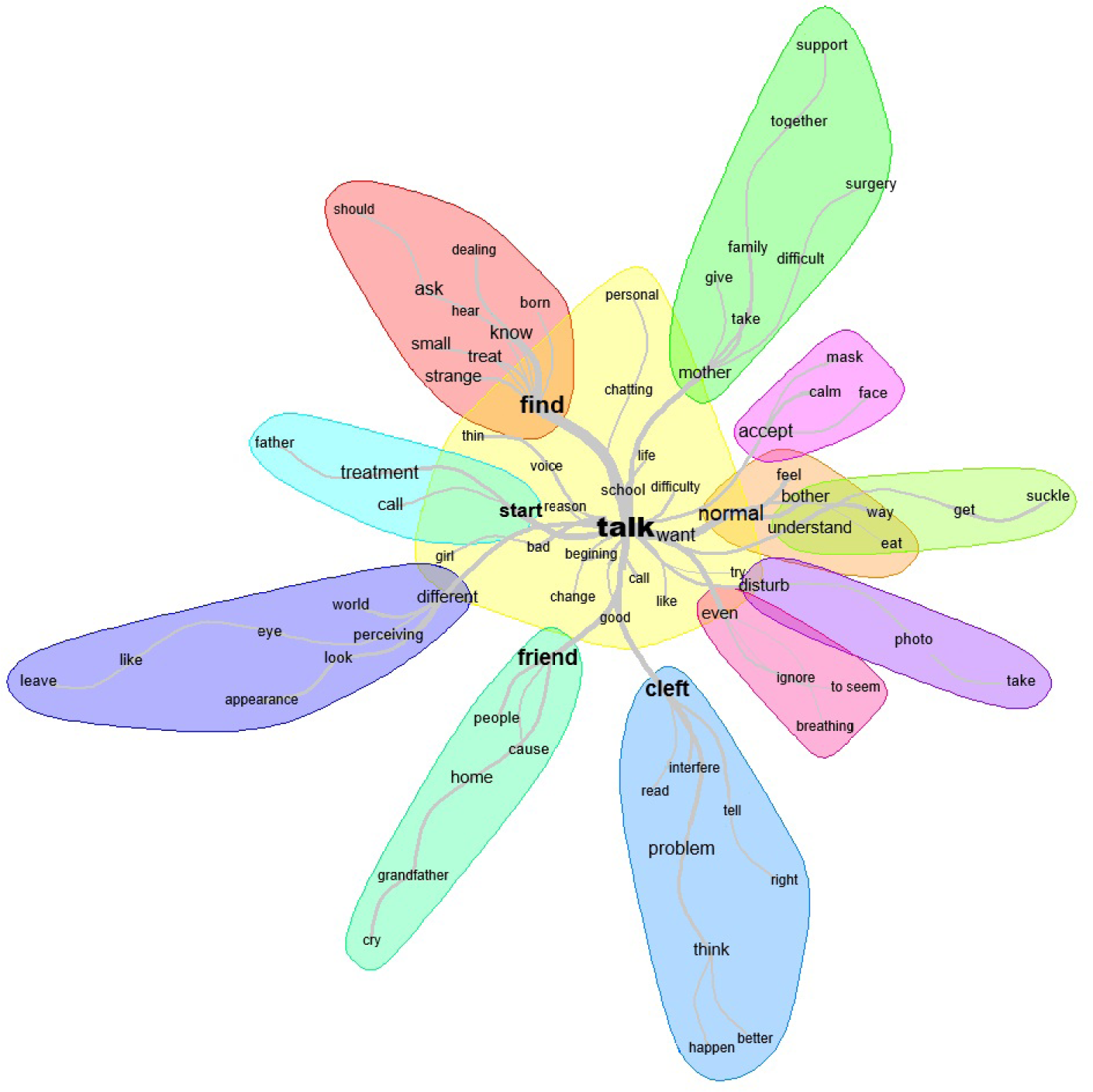
Through similarity analysis, as shown in Figure 1, it is possible to discern the most consistent expressions, in addition to performing a hierarchical representation of the interconnection between terms.

Similarity tree of the interview corpus for adolescents with orofacial clefts. Maringá, Paraná, Brazil, 2023 Source: The authors (2023).
The tree allows visualization of the central nuclei that reflect the physical, social, and emotional repercussions of the condition. The word “speak,” referring to the act of speaking, highlights the experience of adolescents with orofacial clefts, marked by difficulties that begin with breastfeeding, continue through their first words, and extend into adulthood with insecurities about their appearance and social interaction.
In addition, associated terms such as “fissure,” “different,” “hinder,” “accept,” “find strange,” “friend,” and “mother” reflect the participants’ experiences regarding the need to adapt to society, considering their condition and the importance of a support network for these individuals, promoting inclusion and socialization. The analysis enabled the formation of three classes.
“I don’t even look at myself in the mirror much”: reflections on the physical repercussions of adolescents with orofacial clefts.
Some adolescents reported difficulties with breastfeeding and feeding due to the anatomy of their lips and/or palate, choking, and nasopharyngeal reflux caused by milk and other foods.
When I was a baby, I couldn’t breastfeed. I choked a lot and had difficulty eating and breastfeeding. (A8, 11 years old, F)
It already interfered when I was little. I almost died while breastfeeding because of my cleft palate. I couldn’t breastfeed properly, and one day I choked on milk, and it went into my lungs. (A3, 13 years old, M)
In the context unit, it was noted that some adolescents also mentioned speech problems, such as changes in tone of voice or the pronunciation of certain words.
In my speech. I still have difficulty pronouncing certain words. (A4, 16 years old, M)
My voice is still high-pitched, but that doesn’t bother me anymore. I’ve gotten used to it. (A10, 13 years old, F)
In some cases, rehabilitation and speech therapy sessions yielded significant improvements in these adolescents’ speech.
When I was younger, I had speech problems, but I did speech therapy, and today it doesn’t bother me anymore. (A1, 13 years old, F)
Nowadays, there is no interference at all; I can speak normally. Before, I couldn’t talk properly. (A3, 13 years old, M)
One specific patient reported difficulty breathing due to the deviated septum caused by the cleft, which was not corrected during surgery.
Just breathing. My breathing is a little impaired, even with the surgeries. (A4, 16 years old, M)
Another particularity mentioned was bilateral hearing loss resulting from the cleft. This episode occurred in only one adolescent.
In my speech and my hearing. I wear hearing aids in both ears. It used to bother me to have to wear the device, but now I use this small one that is almost invisible [shows the device]. (A9, 15 years old, F)
When asked about the scars left by surgical procedures, which often exceeded ten surgeries, the respondents who reported the most discomfort were female and had exclusively a cleft lip or a cleft lip and palate.
Just the fact that I must wear a mask to hide my face because I don’t want to be bullied anymore for now. (A2, 15 years old, F)
My appearance makes me feel bad, and I don’t like it. It’s annoying; sometimes I even cry, because it’s awful when you look at another girl and compare yourself to her. I don’t talk to anyone about it because most people say I’m silly. (A2, 15 years old, F)
It was when I was fourteen/fifteen that it started to bother me a little. Plus, the scars - my nose is a little crooked - but it was my own thing; no one ever said anything. Once, I went to take a picture, and it bothered me. (A7, 19 years old, M)
Among adolescents with more obvious marks, bullying and teasing at school occur earlier.
My nickname at school when I was a child was “crooked mouth.” Even today, some people recognize me as “you know, that girl with the crooked mouth.” So, I realize it like that sometimes. (A2, 15 years old, F)
People started saying things to my face. They called me ugly, a freak, blind eye, crooked eye. (A5, 13 years old, F)
I was bullied because of my cleft lip. They called me all sorts of names. The ones that hurt the most were “lip” and “little mouth.” It may seem silly or like a ridiculous nickname, but it made me feel bad. (A3, 13 years old, M)
“I wondered if I should have been born normal or like this”: unveiling the emotional repercussions of adolescents with orofacial clefts.
Among the difficulties encountered by participants, the most frequently cited was understanding, accepting, and learning to live with their condition. When asked about their current perception of the cleft, some of the adolescents are now able to cope better with the situation.
I see it as usual nowadays, I feel like I’m a normal person, and I wish everyone would think that way too. (A3, 13 years old, M)
I wondered if I should have been born normal or like this. If I should be like this. (A5, 13 years old, F)
It interferes a lot because I feel very different; it seems like I’m a burden to everyone, you know? I feel strange about living this. (A2, 15 years old, F)
The treatment of people who are close to or interact with these patients daily also significantly affects each of them. The looks, laughter, and whispers about their appearance, way of speaking, or some other condition associated with cleft lip and palate discourage them and diminish their desire to interact with others, increasing their fear of rejection.
People have a specific look of disgust. I notice that their eyes can be very different. I can’t explain it [...] I’ve always been treated this way, but I see that they exclude me a lot; the people in my class seem to be disgusted by me [...]. (A5, 13 years old, F)
I don’t have many friends at school, but I don’t understand why. Maybe it’s because of the way I talk; I might scare them. It makes me feel ashamed; they laugh at my voice and the way I speak. That’s why I keep quiet. (A9, 15 years old, F)
The mental health of these adolescents becomes fragile with all the conditions they are exposed to daily. Some seek professional help, while others feel it is not an alternative to their problem.
I was sad because I didn’t like having cravings. I started coming here and getting explanations, and with that, I told myself that this was going to change.
But if I told you that my mental health was never affected, I would be lying. (A9, 15 years old, F)
I’ve had a few anxiety attacks. It was really bad, it’s like everything came to the surface, everything that had ever been said to me. A supernatural force. (A5, 13 years old, F)
I’ve never been able to accept myself the way I am. I don’t have any help in the process, nor do I want any, because no one can understand me and what I’m going through. So I prefer to go through it alone. (A2, 15 years old, F)
‘I think I’d have more friends if it weren’t for my voice’: social repercussions experienced by adolescents with clefts.
Some study participants reported fear of socializing, fear of rejection, and prejudice from peers toward someone with cravings.
When it comes to socializing, it’s tough. Because some of them don’t understand what cravings are and what they do to people. (A2, 15 years old, F)
Throughout the process, the family changes, and all the support they can give to this teenager is essential for the treatment to be most effective.
My mom has always supported me; she has always been there for me. My family has always supported me, too. They never thought I was strange or anything like that. (A4, 16 years old, M)
Everyone deals well with my cravings; we’ve never had any problems. My parents always help me, and my siblings understand too. (A6, 12 years old, F)
I don’t know about the past, but today my family understands and manages to deal with everything well. (A5, 13 years old, F)
The lack of family support is a recurring issue. Families neglect the treatment and condition of these adolescents, thereby causing more severe damage to the physical and mental health of patients.
My family pays more attention to my cousins, my classmates ignore me, and people on the street stare at me strangely. (A5, 13 years old, F)
My mother’s family did not accept me. My grandmother cried every day in her room because her daughter had a defective daughter. And my great-grandmother kept bringing people to our house just to look at my cleft lip. At first, they rejected me. (A1, 13 years old, F)
Seeking help is a sensitive issue for some. Often, they are not understood and close themselves off, keeping their anguish to themselves and increasing the risk of psychological illness in the future.
Once, I tried to go to a psychologist, and he told my mother everything, and my mother hit me, so that destroyed my trust in him and in anyone else. (A2, 15 years old, F)
Building relationships with schoolmates becomes more common as acceptance of the health condition is well resolved.
Before, I didn’t have any friends. I stayed at home, quiet, still, playing games on my cell phone. Today I have many friends, and my friends support me. (A3, 13 years old, M).
DISCUSSION
When a child is born with an orofacial cleft, the psychological trauma experienced by parents and close family members is the first hurdle to overcome. As the child develops, they begin to interact with other children in daycare or nursery school. The primary consequences are spontaneous isolation and refusal to communicate and interact. Furthermore, around the age of seven, when the child starts school, offensive and inevitable nicknames negatively influence the child’s intellectual development, making them feel uncomfortable with their appearance and way of speaking, a fact that is exacerbated during adolescence14.
The findings of this study confirm these considerations, as adolescents reported episodes of bullying and social exclusion related to orofacial cleft alterations, which hurt their mental health.
Since childhood, these adolescents have lived with the consequences of cleft lip and palate. The most common alterations are related to the dental arch, such as problems with swallowing, chewing, hearing, breathing, and nasal voice14. In this study, adolescents reported difficulties with eating, speech problems, and, in some cases, hearing loss, which is consistent with the scientific literature.
A study conducted in Colombia identified the repercussions of speech difficulties and self-perception in patients with orofacial clefts, which directly affect self-esteem, confidence, and the development of social skills15.
A study conducted in the United Kingdom examined the emotional well-being of adults with orofacial clefts. The results indicated that approximately 50% of the population has been diagnosed with a mental condition, mainly depression and eating disorders. The data point to the low level of psychological support that these people are experiencing and raise an important question: if children and adolescents are not assisted early on, they will become adults who will still face these difficulties16.
In general, surgery and orthodontic treatment help these adolescents build and improve their self-esteem over time. Although children who do not undergo surgery can survive, they may face problems throughout their lives, in addition to facial deformity, such as difficulties eating, speaking, and hearing, low self-esteem, depression, stigmatization, social exclusion, and obstacles in finding employment2.
This makes it more challenging to build meaningful and solid relationships with friends and potential romantic partners, as orofacial fissures present an impediment to performing everyday activities such as singing, communicating on the phone, recording videos, and sending audio messages on social media17.
Even though these patients have the help of trained professionals at their disposal, they still encounter difficulties when it comes to positive self-image, due to aesthetic impairment and facial harmony17. Adolescents’ statements reflect the repercussions on self-image, as they wear masks to hide their faces due to discomfort with their appearance.
Emotional issues are part of the development of any human being and, in these adolescents, need to be treated with caution, as children with cleft lips and/or palate are at a higher risk of negative social experiences, which, if not addressed appropriately, can affect psychological well-being in adulthood18. A study conducted in Japan found that experiences of stigma related to facial appearance influence negative self-perceptions in adolescents with orofacial clefts19.
However, in some instances, psychological counseling is interrupted, and the acceptance process is abruptly halted, leading to regression or even worsening of the mental and emotional health of these adolescents18.
The results of the study indicate that a well-established, structured support network makes a difference in adolescent development. Still, many suffer from rejection within their homes. Although the family plays a crucial role in the rehabilitation of orofacial clefts, it is worth noting that the present study differs from one conducted in southeastern Brazil, which identified the family as a source of support, especially during the most challenging moments20.
Parental counseling on the diagnosis of cleft lip and palate is necessary, involving discussion of the treatment that the child will likely need and covering the child’s entire physical and psychological well-being during this process, including surgical, cosmetic, speech therapy, and psychological treatments, since all of these are essential components of long-term sequelae and influence how adolescents will behave in relation to their health condition21.
Regardless of the location and strength of the recommendation, the concepts of multidisciplinary collaboration and family-centered care remain constant, as early multidisciplinary assessment and long-term follow-up of patients with orofacial clefts are essential to achieve optimal clinical outcomes21.
Multidisciplinary work supports patient rehabilitation by considering their diverse needs. Psychology contributes to better-quality interpersonal relationships, which are often affected by underlying pathology or even by appearance. However, some adolescents who participated in this study reported fear of seeking psychological help, either because of fear of not being understood or even a lack of support. Thus, exclusion and cases of bullying are becoming increasingly prevalent, as these patients face problems unique to their condition, in addition to the everyday challenges of adolescence22.
Corroborating this study, research conducted in the United States revealed that suffering from teasing and/or bullying had a strong positive correlation with an increase in all difficulties experienced by adolescents with orofacial clefts. On the other hand, having a good friend has an inverse relationship, reducing challenges and contributing to psychosocial well-being23.
Multidisciplinary follow-up of adolescents with orofacial clefts is necessary to ensure a comprehensive approach that addresses functional, clinical, and psychosocial aspects. The joint action of the interdisciplinary team enables not only aesthetic and functional rehabilitation but also the promotion of quality of life and social inclusion22. Family support contributes to therapeutic adherence and the strengthening of the adolescent’s self-esteem1,4.
That said, strategies to combat bullying, such as school awareness programs, the development of inclusive teaching practices, and training educators to identify exclusionary situations early, are relevant recommendations for valuing diversity, building welcoming school environments, and addressing the psychosocial repercussions of orofacial clefts6,23.
As a limitation of the study, it is worth noting that, to avoid disrupting service routine, interviews were conducted during breaks between consultations, which may have contributed to a shorter report from these adolescents. However, the researchers helped the adolescents feel comfortable during the interviews so that they could report the facts in depth. Regarding contributions to teaching, the study enhances a deeper understanding of the experiences of people with orofacial clefts and their consequences.
FINAL CONSIDERATIONS
The findings revealed that adolescents living with orofacial clefts face physical, emotional, and social repercussions that begin in childhood. Among the physical implications, the most notable are difficulties with eating, speech, breathing, and hearing, as well as discomfort with surgical scars. Emotionally, they reported difficulty accepting their condition, feelings of shame, and rejection. Socially, adolescents reported bullying, rejection, and exclusion, affecting their socialization.
In this sense, it is necessary to strengthen social support for adolescents with orofacial clefts, involving family, school, health professionals, and managers in the development of public policies, educational actions, and support for families and adolescents. Thus, the findings highlight the need for a multidisciplinary approach that addresses all the biopsychosocial needs of this population.
-
HOW TO REFERENCE THIS ARTICLE:
Caetano GM, da Fonseca BS, Piran CMG, Mori MM, Furtado MD, Sanguino GZ, et al. Physical, emotional, and social repercussions of orofacial clefts during adolescence. Cogitare Enferm [Internet]. 2025 [cited “insert year, month and day”];30:e100466en. Available from: https://doi.org/10.1590/ce.v30i.100466en
-
FINANCING
This study was conducted with support from the Coordination for the Improvement of Higher Education Personnel - Brazil (CAPES) - Financing Code 001.
Data availability:
The authors declare that all data are fully available within the article.
References
-
1 de Lira MR, Lemos JVA, Almeida MAS, Alves SGG, Fernandes DC, de Melo ICF. Qualidade de vida dos indivíduos com fissura labiopalatina. Cad Grad Ciênc Biol Saúde Unit [Internet]. 2022 [cited 2023 Mar 12];7(2):87-98. Available from: https://periodicosgrupotiradentes.emnuvens.com.br/cdgsaude/article/view/8340
» https://periodicosgrupotiradentes.emnuvens.com.br/cdgsaude/article/view/8340 -
2 de Sousa GFT, Roncalli AG. Fatores associados ao atraso no tratamento cirúrgico primário de fissuras labiopalatinas no Brasil: uma análise multinível. Ciên Saúde Colet [Internet]. 2021 [cited 2023 Mar 12];26(2):3505-3515. Available from: https://doi.org/10.1590/1413-81232021269.2.23592019
» https://doi.org/10.1590/1413-81232021269.2.23592019 -
3 Ministério da Saúde (BR). Marco legal: saúde, um direito de adolescentes. Brasília, DF: Ministério da Saúde; 2007 [cited 2025 Sep 16]. 58 p. Available from: https://bvsms.saude.gov.br/bvs/publicacoes/07_0400_M.pdf
» https://bvsms.saude.gov.br/bvs/publicacoes/07_0400_M.pdf -
4 Paiva IT, Carramilo-Going LC, de Lemos DIM, Alves H, Avoglia HRC. Sentindo-se diferente: a autoestima da pessoa com fissura labial e/ou palatina. Psicol Argum [Internet]. 2020 [cited 2023 Apr 2];38(101):580-603. Available from: http://dx.doi.org/10.7213/psicolargum.38.101.AO09
» http://dx.doi.org/10.7213/psicolargum.38.101.AO09 -
5 Santos JVN, Tavares JLF, da Silva MAB, Barbosa DN, Leite RB. Fissura labiopalatina: estudo do papel do profissional de saúde na diminuição dos danos ao paciente. Rev Ciênc Odontol [Internet]. 2020 [cited 2023 Apr 2];4(1):48-55. Available from: https://revistas.icesp.br/index.php/RCO/article/view/707
» https://revistas.icesp.br/index.php/RCO/article/view/707 -
6 Lecommandeur S, Roessingh AB, Dumont L, Camenzind L, Habersaat S, Schechter DS, et al. Assessment of multiple dimensions of psychological well-being in swiss youth born with a unilateral cleft lip and palate Cleft Palate Craniofac J [Internet]. 2025 [cited 2025 Jul 11];62(2):326-36. Available from: https://doi.org/10.1177/10556656231219418
» https://doi.org/10.1177/10556656231219418 -
7 Branco SC. História Oral: reflexões sobre aplicações e implicações. Norus [Internet]. 2020 [cited 2023 Apr 2];8(13):8-27. Available from: https://doi.org/10.15210/norus.v8i13.18488
» https://doi.org/10.15210/norus.v8i13.18488 -
8 Rigolon M, Carlos DM, de Oliveira WA, Salim NR. “Health does not discuss trans bodies”: Oral History of transsexuals and transvestites. Rev Bras Enferm [Internet]. 2020 [cited 2023 Apr 15];73(6):e20190228. Available from: http://dx.doi.org/10.1590/0034-7167-2019-0228
» http://dx.doi.org/10.1590/0034-7167-2019-0228 -
9 de Magalhães JRF, Gomes NP, Mota RS, dos Santos RM, Pereira A, de Oliveira JF. Repercussions of family violence: Oral History of adolescents. Rev Bras Enferm [Internet]. 2020 [cited 2023 Apr 15];73(1):e2018228. Available from: https://doi.org/10.1590/0034-7167-2018-0228
» https://doi.org/10.1590/0034-7167-2018-0228 -
10 Souza VRS, Marziale MHP, Silva GTR, Nascimento PL. Translation and validation into Brazilian Portuguese and assessment of the COREQ checklist. Acta Paul Enferm [Internet]. 2021 [cited 2023 Apr 15];34:eAPE02631. Available from: https://doi.org/10.37689/acta-ape/2021AO02631
» https://doi.org/10.37689/acta-ape/2021AO02631 -
11 de Moura CO, Silva IR, da Silva TP, Santos KA, Crespo MCA, da Silva MM. Methodological path to reach the degree of saturation in qualitative research: grounded theory. Rev Bras Enferm [Internet] 2022 [cited 2023 Jun 1];75(2):e20201379. Available from: https://doi.org/10.1590/0034-7167-2020-1379
» https://doi.org/10.1590/0034-7167-2020-1379 - 12 Bardin L. Análise de conteúdo. Lisboa: Edições 70; 2020. 288 p.
-
13 Camargo BV, Justo AM. Tutorial para uso do software IRaMuTeQ (Interface de R pour les Analyses Multidimensionnelles de Textes et de Questionnaires) [Internet]. [Florianópolis, SC]: Laboratório de Psicologia Social da Comunicação e Cognição, Universidade Federal de Santa Catarina; 2016 [cited 2025 Sep 16]. Available from: http://www.iramuteq.org/documentation/fichiers/Tutorial%20IRaMuTeQ%20em%20portugues_17.03.2016.pdf
» http://www.iramuteq.org/documentation/fichiers/Tutorial%20IRaMuTeQ%20em%20portugues_17.03.2016.pdf -
14 de Amaral BPA, Costa e Silva LH. Fissura Labiopalatina: revisão literária [undergraduate thesis]. Mineiros, GO: Curso de Odontologia, Faculdade Morgana Potrich; 2021 [cited 2024 Jan 20]. 37 p. Available from: https://repositorio.fampfaculdade.com.br/items/show/473
» https://repositorio.fampfaculdade.com.br/items/show/473 -
15 Osorio C, Persson M. Psychosocial issues related to speech and hearing in patients with clefts. J Craniofac Surg [Internet]. 2025 [cited 2025 Sep 13];36(3):1058-1061. Available from: https://doi.org/10.1097/SCS.0000000000010707
» https://doi.org/10.1097/SCS.0000000000010707 -
16 Ardouin K, Hare J, Stock NM. Emotional well-being in adults born with cleft lip and/or palate: a whole of life survey in the United Kingdom. Cleft Palate Craniofac J [Internet]. 2020 [cited 2024 Jan 20];57(7):877-885. Available from: https://doi.org/10.1177/1055665619896681
» https://doi.org/10.1177/1055665619896681 -
17 Oliveira Júnior AG, Montagna E, Zaia V, Barbosa CP, Bianco B. Oral health-related quality of life in patients aged 8 to 19 years with cleft lip and palate: a systematic review and meta-analysis. BMC Oral Health [Internet]. 2023 [cited 2025 Sep 16];23:670. Available from: https://doi.org/10.1186/s12903-023-03382-4
» https://doi.org/10.1186/s12903-023-03382-4 -
18 Ardouin K, Hotton M, Stock NM. Interpersonal relationship experiences in adults born with cleft lip and/or palate: a whole of life survey in the United Kingdom. Cleft Palate Craniofac J [Internet]. 2021 [cited 2024 Apr 14];58(11):1412-1421. Available from: https://doi.org/10.1177/1055665620987109
» https://doi.org/10.1177/1055665620987109 -
19 Oka A, Tanikawa C, Ohara H, Yamashiro T. relationship between stigma experience and self-perception related to facial appearance in young Japanese patients with cleft lip and/or palate. The Cleft Palate Craniofacial Journal. 2022 [cited 2025 Sep 13];60(12):1546-1555. Available from: https://doi.org/10.1177/10556656221114581
» https://doi.org/10.1177/10556656221114581 -
20 Gifalli M, Antonio CT, da Silva VAP, Capone FA, Prado PC, Trettene AS. Adolescents with orofacial clefts: understanding their experiences. Rev Paul Pediatr [Internet]. 2024 [cited 2025 Sep 13];42:e20233131. Available from: https://doi.org/10.1590/1984-0462/2024/42/2023131
» https://doi.org/10.1590/1984-0462/2024/42/2023131 -
21 Mori MM, Piran CMG, Cargnin AVE, Caetano GM, Tofalini AC, Rodrigues TFCS, et al. Multidisciplinary care for children with cleft lip and palate and their families: Family-Centered Care. Rev Gaúcha Enferm [Internet]. 2024 [cited 2025 Sep 16];45:e20230276. Available from: https://doi.org/10.1590/1983-1447.2024.20230276.en
» https://doi.org/10.1590/1983-1447.2024.20230276.en -
22 Frederick R, Hogan AC, Seabolt N, Stocks RMS. An ideal multidisciplinary cleft lip and cleft palate care team. Oral Dis [Internet]. 2022 [cited 2024 Apr 14];28(5):1412-1417. Available from: https://doi.org/10.1111/odi.14213
» https://doi.org/10.1111/odi.14213 -
23 Bous RM, Hazen RA, Baus I, Palomo JM, Kumar A, Valiathan M. Psychosocial adjustments among adolescents with craniofacial conditions and the influence of social factors: a multi-informant study. Cleft Palate Craniofac J [Internet]. 2020 [cited 2024 Apr 20];57(5):624-636. Available from: https://doi.org/10.1177/1055665619888308
» https://doi.org/10.1177/1055665619888308
-
Associate editor:
Dra. Luciana de Alcantara Nogueira