 Association between tuberculosis/HIV co-infection and closure status in children under 18 years of age
ABSTRACT
Objective: To analyze the epidemiological profile of cases of tuberculosis/human immunodeficiency virus co-infection in children under 18 years of age associated with the closure situation in the state of Paraná, Brazil.
Method: Cross-sectional study of notified cases of tuberculosis/human immunodeficiency virus co-infection from 2002 to 2022. Descriptive analysis, incidence rate and chi-square test were carried out.
Results: 62 cases of co-infection were recorded with instability in the number of cases and the incidence rate per year, with an increase in (0.29) 2003-2004, (0.18 to 0.25) 2008-2010, (0.18 to 0.11) 2012-2014 and (0.07) 2016-2017, and a decline in cases between (0.04) 2020-2021. There were no confirmed cases between 2018, 2019 and 2022. The majority of cases occurred in the adolescent age group, followed by the school age group. There was statistical significance for the urban area (p=0.013).
Conclusion: These findings, in addition to providing a warning, can incorporate planning for the control of co-infection.
DESCRIPTORS:
Comprehensive Health Care; Tuberculosis; HIV Infections; Epidemiology; Cross-Sectional Studies.
HIGHLIGHTS
1. Oscillation in tuberculosis/HIV co-infection cases over the last 20 years.
2. The highest number of cases occurr ed in adolescents.
3. Predominance of cases in the pulmonary for m with progression to cure.
4. The urban area was significant in relation to the outcomes.
RESUMO
Objetivo: Analisar o perfil epidemiológico dos casos de coinfecção tuberculose/vírus da imunodeficiência humana em menores de 18 anos associados com a situação de encerramento no estado do Paraná, Brasil.
Método: Estudo transversal dos casos notificados de coinfecção tuberculose/vírus da imunodeficiência humana no período de 2002 a 2022. Realizaram-se análise descritiva, taxa de incidência e teste qui-quadrado.
Resultados: Foram registrados 62 casos de coinfecção com instabilidade no número de casos e na taxa de incidência por ano, com aumento em (0,29) 2003-2004, (0,18 a 0,25) 2008-2010, (0,18 a 0,11) 2012-2014 e (0,07) 2016-2017, e declínio dos casos entre (0,04) 2020-2021. Não houve confirmação de casos entre os anos de 2018, 2019 e 2022. A maioria dos casos ocorreu na faixa etária adolescente, seguida da escolar. Houve significância estatística para a zona urbana (p=0,013).
Conclusão: Esses achados, além de trazerem um alerta, podem incorporar planejamento para o controle da coinfecção.
DESCRITORES:
Atenção Integral à; Saúde da Criança e do Adolescente; Tuberculose; Coinfecção pelo HIV; Epidemiologia; Estudos Transversais.
HIGHLIGHTS
1. Oscilação, casos de coinfecção tuberculose/HIV nos últimos 20 anos.
2. O maior número de casos ocorreu em adolescentes.
3. Predomínio de casos na forma pulmonar com evolução para cura.
4. A zona urbana foi significativa em relação aos desfechos.
RESUMEN
Objetivo: Analizar el perfil epidemiológico de los casos de coinfección tuberculosis/virus de la inmunodeficiencia humana en menores de 18 años asociados a evento de cierre en el estado de Paraná, Brasil.
Método: Estudio transversal de casos notificados de coinfección tuberculosis/virus de la inmunodeficiencia humana entre 2002 y 2022. Se realizó análisis descriptivo, tasa de incidencia y test de Chi cuadrado.
Resultados: Se registraron 62 casos de coinfección, con inestabilidad del número de casos y de tasa de incidencia anual, con aumentos de (0,29) 2003-2004, (0,18 a 0,25) 2008-2010, (0,18 a 0,11) 2012-2014 y (0,07) 2016-2017, y descenso de casos de (0,04) 2020-2021. No hubo casos confirmados entre 2018, 2019 y 2022. La mayoría de casos se presentaron en franja etaria adolescente, seguida por la escolar. Hubo significancia estadística para el área urbana (p=0,013).
Conclusión: Estos hallazgos, además de constituir una advertencia, sugieren incorporar la planificación al control de la coinfección.
DESCRIPTORES:
Atención Integral de Salud del Niño y del Adolescente; Tuberculosis; Coinfección por el VIH; Epidemiología; Estudios Transversales.
HIGHLIGHTS
1. Oscilación, casos de coinfección tuberculosis/VIH en los últimos 20 años.
2. La mayor cantidad de casos ocurrió en adolescentes.
3. Predominio de casos en la forma pulmonar con evolución a curación.
4. La zona urbana resultó significante en relación a los desenlaces.
INTRODUCTION
In 2022, the World Health Organization’s (WHO) global tuberculosis (TB) report, released in November 2023, published that around 1.25 million children and young adolescents (aged 0 to 14) became ill with TB, which represents 12% of the global burden of the disease, and almost half of them were under five years of age1.
In the same year, more than 200,000 cases died from TB, representing 16% of all TB deaths. Among the Human Immunodeficiency Virus (HIV)-negative deaths, 76% occurred in children under the age of five. Almost all cases did not have access to diagnosis and treatment1-2.
An analysis between 2018 and 2022 in relation to the targets set out in the political declaration of the first United Nations high-level meeting on the fight against TB highlights that only 71% of the target of providing treatment for 3.5 million children and young adolescents has been achieved (compared to 84% of the target of 40 million for people of all ages). The gap for diagnosis and treatment is even greater, with an achievement of only 19% of the target of providing treatment for 115,000 cases with multidrug-resistant TB (MDR) and rifampicin-resistant TB (RR). This means that four out of five children and young adolescents with MDR/RR TB in the last five years have not had access to treatment1-2. These indicators show that we need to accelerate our efforts to prevent and control TB in children and adolescents2.
However, TB/HIV co-infection in children and adolescents is a major public health challenge in Brazil. The late diagnosis of these diseases, together with socio-economic factors that contribute to underreporting, hinders proper treatment and the implementation of effective public policies, jeopardizing the control of these conditions in the child and adolescent population3.
There have been national publications on TB/HIV co-infection in children under 18 in Porto Alegre4, Rio Grande do Sul5, Acre6, Sergipe7, Pelotas8, and only Curitiba, in Paraná9. In view of this, there is a gap in the literature regarding the state of Paraná, in order to understand the dynamics of this event, which makes this study relevant and unprecedented.
Therefore, this study aims to analyze the epidemiological profile of TB/HIV co-infection cases in children under 18 years of age associated with the closure status in the state of Paraná - Brazil.
METHOD
This is a cross-sectional study, carried out in the state of Paraná, located in the north of the southern region of Brazil, with 399 municipalities, totaling 199,298,981 km2, and an estimated population of 10,439,601 inhabitants, occupying 5th place in the ranking of the most populous states in the country10-11.
The data was made available by the Paraná State Health Department (SESA, or Secretaria de Saúde de Estado), using a Microsoft Excel® spreadsheet, referring to TB/HIV co-infection notifications from the Notifiable Diseases Information System (SINAN, or Sistema de Informação de Agravos de Notificações) from January 2002 to December 2022, which were made available in April 2023.
The population consisted of all TB cases notified in the state of Paraná between the ages of zero and 18, according to the International Classification of Diseases, tenth revision (ICD-10: A 15.0 to 16.9), totaling 3,583 cases.
Cases with a confirmed diagnosis of TB and HIV positive were included, regardless of whether they had developed Human Immunodeficiency Syndrome (AIDS). Cases were excluded if the ‘HIV’ variable was filled in as negative (2,096 cases), not carried out (1,031 cases), in progress (10 cases), blank records (164 cases), duplicate records (88 cases), i.e. those with the same identification data and date of diagnosis, cases with a closed situation such as change of diagnosis discarded for TB (121).
The independent variables were: age group (newborns/neonates (0 to 28 days), infants (29 days to 1 year 11 months 29 days), preschoolers (2 to 4 years), schoolchildren (5 to 10 years), and adolescents (11 to 18 years); sex (male and female); white and non-white race (black, yellow, brown and indigenous); size of municipality of residence (small, medium and large); health macro-region of residence (East, West, North and Northwest) and area (urban and rural)12-13. The size of the municipality of residence variable was recategorized into: small (municipalities with up to 99,000 inhabitants), medium (between 100,000 and 499,000 inhabitants), and large (over 500,000 inhabitants)10.
The macro-region of residence variable was recategorized into: East (health regions of Paranaguá, Curitiba, Ponta Grossa, Irati, Guarapuava, União da Vitória, and Telêmaco Borba), West (regions of Pato Branco, Francisco Beltrão, Foz do Iguaçu, Cascavel, and Toledo), North (regions of Apucarana, Londrina, Cornélio Procópio, Jacarezinho, and Ivaiporã), and Northwest (regions of Campo Mourão, Umuarama, Cianorte, Paranavaí, and Maringá)14.
Regarding the operational profile of TB, the following variables were used: type of entry (new case, relapse, re-entry after treatment interruption, unknown, transfer, and post-death) and clinical form (pulmonary, extrapulmonary, and pulmonary + extrapulmonary).
The dependent variable was closure status (cure, treatment interruption “abandonment + primary abandonment”, death from other causes, and transfer).
The incidence rate/year was calculated according to the formula: Numerator: number of cases in a given period. Denominator: total number of people in the population in the same period. Multiplication factor: 100,000 inhabitants. To define the population base used in the denominator, data from the 2022 IBGE census of individuals zero to 18 year olds was used11,15. For this calculation, cases of relapse, transfer, and re-entry were excluded.
Absolute and relative frequencies were used for the descriptive analysis. For inferential analysis, polytomous analyses were carried out using the chi-square test, considering a significance level (5%) with a 95% confidence interval (CI) and p-value. All the analyses were carried out using the IBM software Statistical Package for the Social Science (SPSS) for Windows version 22® (IBM Corp., 2013).
The project was approved by the Human Research Ethics Committee of the State University of Londrina (CEP/UEL), with the Certificate of Presentation for Ethical Appreciation (CAAE: 38855820.6.0000.5231), with opinion number 4.374.235, approved on November 1, 2020.
RESULTS
A total of 62 new cases of TB/HIV co-infection were reported/confirmed among children and adolescents between 2002 and 2022. As shown in Figure 1, in 2003 the incidence rate was 0.29/100,000 inhabitants. In 2011, 2015, 2020, and 2021, the coefficient was 0.04/100,000 inhabitants, respectively in each year. In terms of age group, from 2002 to 2004 there was a predominance of cases in infants, followed by preschoolers and adolescents. In addition, regardless of the year, the majority of cases occurred among adolescents, schoolchildren, infants, preschoolers, and newborns.
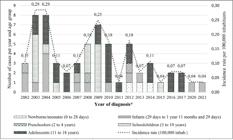
Incidence rate of tuberculosis/HIV co-infection cases by year and age group. Londrina, PR, Brazil, 2025 Legend: *Cases of relapse, re-entry, and transfers were excluded, totaling 62 new cases. Source: Prepared by the authors according to the SINAN data source (2025).
When analyzing the sociodemographic profile, the highest number of cases was in the adolescent age group 28 (38.4%), male 41 (56.2%), white 44 (68.8%), in large municipalities 50 (68.5%), in the eastern health macro-region 44 (60.3%), and in urban areas 69 (95.8%). Regarding TB operational data, there was a predominance of new cases 62 (84.9%), pulmonary clinical form 47 (64.4%), and that progressed to cure 45 (62.5%), as described in Table 1.
Sociodemographic and epidemiological characteristics of tuberculosis/HIV co-infection cases in children under 18. Londrina, PR, Brazil, 2025
Table 2 shows the analysis of the chi-square test for the association between the variable “closure status” and the sociodemographic variables of TB/HIV co-infection cases in children under 18. The results show that the urban area was statistically significant, establishing a relevant association between the place of residence and the closure status of the cases. This suggests that children and adolescents living in urban areas are more likely to be cured than those living in rural areas.
Distribution of sociodemographic variables of tuberculosis/HIV co-infection cases in children under 18, associated with the closure status of tuberculosis cases. Londrina, PR, Brazil, 2025
Regarding the operational profile, there was no significant association between the variables, as shown in Table 3.
Distribution of epidemiological variables of tuberculosis/HIV co-infection cases in children under 18, associated with the closure status of tuberculosis cases. Londrina, PR, Brazil, 2025
DISCUSSION
The results of this study revealed significant instability in the number of cases and annual incidence rates over the two decades analyzed. This variation was particularly noticeable in the different age groups, with a predominance of cases among white male adolescents, in large municipalities, in the eastern macro-region, in urban areas, and with a predominance of new cases in the pulmonary form, where the majority progressed to a cure.
These results are consistent with the available literature on TB/HIV co-infection in Brazil, which points to a downward trend in incidence over the last decade in the country and in some Brazilian states, including Paraná. This decrease can be attributed to various factors, such as advances in public health policies, improved access to diagnosis and treatment, as well as increased awareness of the importance of testing and early treatment16-17.
The End TB strategy and the National Tuberculosis Control Program (PNCTB, or Programa Nacional de Controle da Tuberculose) in Brazil aim to eradicate TB, but the reality is that we still face significant challenges, especially with regard to the under-18 population. These challenges can be attributed to several factors. Firstly, the early detection of TB in children and adolescents is a major obstacle, as the symptoms of the disease may be less evident in this age group, which delays diagnosis and treatment18. In addition, the lack of awareness about TB and its forms of transmission among parents, legal guardians, and health professionals can lead to underdiagnosis17-19.
An international review study, which looked for evidence on the prevention, diagnosis, and treatment of TB/HIV co-infection in children, found that most of the advances in research on these two diseases have not been carried out in the pediatric population, which continues to suffer from poor access, expensive regimens, and underdiagnosis of TB20.
Furthermore, according to the WHO, in 2020 there was a drastic reduction in the number of diagnosed cases, with approximately 1.5 million TB deaths recorded, representing an increase on previous years. This indicates a regression in the progress made in the fight against TB, returning to a level of cases and deaths not seen in around 20 years21.
Furthermore, the findings of this study are similar to those reported in other countries22-24. It is believed that the measures adopted to control Covid-19 have directly influenced the targets set by the WHO to reduce the global burden of TB23.
A study carried out in southern Brazil found that male adolescents exhibit behaviors that can be attributed to various factors, including gender norms that encourage boys to be more independent and avoid showing vulnerability. These behaviors include unprotected sexual practices and a lower awareness of the importance of preventive care, influenced by caregivers, be they parents, legal guardians, or other significant adults4-5. This population is also more exposed to social interaction than children, which can increase the risk of disease transmission6.
According to the National Tuberculosis Control Policy, children and adolescents living with HIV and who are household contacts of TB cases should be screened for the disease. In addition, those diagnosed with active TB should be tested for HIV, so that they can receive timely treatment and prevent the complications associated with co-infection17.
The predominance of white color/race in this study may be related to the ethnic profile of the population of the state of Paraná, which is about 64.6% white, 30.1% brown, 4.2% black, 0.9% yellow, and 0.2% indigenous, and not specifically to racial predisposition to TB25.
Regarding the increase in cases among white people, in the state of Paraná this is due to a predominance of Caucasian “whites”. This factor can be explained by the great diversity of European descendants present throughout the southern region of Brazil26.
The results also showed that large municipalities, located in urban areas and in the eastern macro-region of the state, had a higher number of cases of TB/HIV co-infection. A study carried out in the state of Sergipe in 2020, which evaluated the epidemiological pattern of TB in children and adolescents, showed that the majority of the child population lives in large urban centers, and that in Brazil 80% of the population lives in urban areas. This scenario can also favor access to timely diagnosis, treatment, and effective follow-up7.
On the other hand, when looking at rural areas, the scenario is equally challenging, but in a different way. The lack of access to health services, early diagnosis, and treatment can result in much worse outcomes for the rural population. Geographical isolation and a lack of infrastructure make it difficult to prevent and care for various health conditions. This implies a higher mortality rate and complications of the disease that could be treated more efficiently in an urban context, as well as underreporting in this region7.
The eastern health macro-region of the state of Paraná has a peculiar geographical location, being a coastal and port region bordering other states, in addition to including the metropolitan region of Curitiba, the state capital. As it is a territory with great fluctuation of individuals and a constant flow of migration, these characteristics contribute to a higher incidence of new cases of TB/HIV co-infection27.
In terms of epidemiological characteristics, there is a higher number of new cases of the pulmonary form of TB/HIV co-infection among children and adolescents in the state of Paraná. The pulmonary form in the schoolchildren age group (5 to 10 years old) differs from that seen in adults, as it is usually abacilliferous or paubacilliferous, i.e. negative for sputum smear tests17. Thus, children end up acquiring TB through contact with bacilliferous adult or adolescent patients. Childhood TB is considered a sentinel event, as it reflects its potential for dissemination through contact with a bacilliferous adult9,19.
It should also be noted that the participation of caregivers in the care of children and adolescents with TB/HIV co-infection is a central element in the successful treatment and control of these diseases. Caregivers, often family members, play an essential role not only in the diagnosis process, but also in adherence to treatment, which is fundamental to ensuring the effectiveness of medical interventions28.
Health services and professionals in the field should therefore adopt approaches that promote and strengthen the bond with caregivers28. Collaborative work is essential, where caregivers feel part of the care process. This can include offering clear information about the treatment, providing psychological and social support, and promoting spaces for dialog where caregivers can express their concerns and needs28-29.
In a study carried out in the state of Piauí, the authors pointed out that monitoring cases through health services favors successful treatment and, consequently, a cure. However, TB/HIV co-infection is a factor that predisposes to treatment interruption, due to adverse reactions and drug interactions. Therefore, the authors highlighted the Directly Observed Therapy as a proposal to minimize this interruption and thus encourage the correct use of medication for a favorable treatment outcome30.
Still in relation to the closure status, the majority of cases progressed to a cure (54.2%); however, this rate was below the World Health Organization’s recommendation of 85%2. In addition, there was a high number of deaths from other causes. The Ministry of Health defines death from other causes as death due to causes other than TB, occurring during treatment17.
The underreporting of TB cases in children under 18 is related to the fragile active search, incipient records, and flow of information, reflecting the lack of equity in access to health services. The study carried out in the municipality of Pelotas revealed that among the possible justifications are the discontinuity of training processes, the lack of a permanent education policy and the turnover of health professionals, related to party political discontinuity8.
It is important to highlight some of the study’s limitations due to the use of secondary data. This factor can be limiting due to the lack of completeness of the information. It should be emphasized that the results presented in this study could become a reference for future research aimed at understanding TB/HIV co-infection in children under 18 years of age.
CONCLUSION
The findings of this study revealed that TB/HIV co-infection in children under 18 in the state of Paraná showed periods of oscillation followed by a decline over 20 years, with a higher incidence among adolescents. Sociodemographic factors, such as notification in urban areas, showed a significant influence on treatment outcomes, including cure, treatment interruption, deaths from other causes, and case transfers.
This study highlights the need for further research into TB/HIV co-infection in children under 18, given the invisibility of this population in the literature. Furthermore, by showing the outlook, it highlights the need to intensify public policies aimed at the health of children and adolescents, promoting early diagnosis and appropriate treatment.
The results, however, can serve as a reference for future research and for the development of more effective intervention strategies in the population with TB/HIV co-infection.
-
HOW TO REFERENCE THIS ARTICLE:
de Mattos TSS, de Souza ABF, Capobiango JD, Gabani FL, Scholze AR, Peres CS, et al. Association between tuberculosis/HIV co-infection and closure status in children under 18 years of age. Cogitare Enferm [Internet]. 2025 [cited “insert year, month and day”];30:e96804en. Available from: https://doi.org/10.1590/ce.v30i0.96804en
-
*
Article extracted from the master’s thesis: “Perfil epidemiológico e espacial dos casos de tuberculose em menores de 18 anos no estado do Paraná -2002 a 2022”, Universidade Estadual de Londrina, PR, Brasil, 2024.
ACKNOWLEDGMENTS
This study was carried out with the support of the Coordination for the Improvement of Higher Education Personnel - Brazil (CAPES) SOCIAL DEMAND (DS) - Process 88881.890927/2023-01 (AUXPE PPG Nursing-UEL).
References
-
1 World Health Organization (WHO). WHO operational handbook on tuberculosis: module 5: management of tuberculosis in children and adolescents [Internet]. Geneva: WHO; 2022 [cited 2024 Jan 20]. 264 p. Available from: https://www.who.int/publications/i/item/9789240046832
» https://www.who.int/publications/i/item/9789240046832 -
2 World Health Organization (WHO). Global tuberculosis report 2023 [Internet]. Geneva: WHO; 2023 [cited 2024 Jan 15]. 57 p. Available from: https://reliefweb.int/report/world/global-tuberculosis-report-2023
» https://reliefweb.int/report/world/global-tuberculosis-report-2023 -
3 Gatto TC, Donida GCC, da Costa EFR, Wernet M, Yamamura M. HIV and childhood tuberculosis: fragmentation of the information flow in the countryside of the state of São Paulo. Rev Epidemiol Control Infect [Internet]. 2024 [cited 2025 Feb 5];14(1):84-90. Available from: https://doi.org/10.17058/reci.v14i1.18782
» https://doi.org/10.17058/reci.v14i1.18782 -
4 Rossetto M, Brand ÉM, Hahn GV, de Oliveira DLLC, Teixeira LB. Epidemiological profile of tuberculosis cases with HIV coinfection in Porto Alegre city, Brazil. Rev Bras Enferm [Internet]. 2019 [cited 2023 Sep 10];72(5):1211-8. Available from: https://doi.org/10.1590/0034-7167-2017-0613
» https://doi.org/10.1590/0034-7167-2017-0613 -
5 Piran CMG, Nacamura PAB, da Fonseca BS, de Souza VB, Souto NSO, Furtado MD, et al. Epidemiological panorama of tuberculosis-HIV coinfection among adolescents and young adults in the southern Brazil. Saúde Colet (Barueri) [Internet]. 2022 [cited 2024 Jul 21];12(78):10950-63. Available from: https://doi.org/10.36489/saudecoletiva.2022v12i78p10950-10963
» https://doi.org/10.36489/saudecoletiva.2022v12i78p10950-10963 -
6 da Costa RSL, Lima JS, Cabral RS, Nery Júnior EM. Análise de casos notificados de tuberculose em crianças e adolescentes. Rev Enferm Contemp [Internet]. 2019 [cited 2024 Feb 4];8(2):101-8. Available from: https://doi.org/10.17267/2317-3378rec.v8i2.2188
» https://doi.org/10.17267/2317-3378rec.v8i2.2188 -
7 Santos BA, Cruz RPS, Lima SVML, dos Santos AD, Duque AM, de Araújo KCGM, et al. Tuberculose em crianças e adolescentes: uma análise epidemiológica e espacial no estado de Sergipe, Brasil, 2001-2017. Ciênc Saúde Coletiva [Internet]. 2020 [cited 2024 Jan 20];25(8):2939-48. Available from: https://doi.org/10.1590/1413-81232020258.25692018
» https://doi.org/10.1590/1413-81232020258.25692018 -
8 de Lima LM, Harter J, Tomberg JO, Vieira DA, Antunes ML, Cardozo-Gonzales RI. Monitoring and assessment of outcome in cases of tuberculosis in a municipality of Southern Brazil. Rev Gaúcha Enferm [Internet]. 2016 [cited 2023 Dec 15];37(1):e51467. Available from: https://doi.org/10.1590/1983-1447.2016.01.51467
» https://doi.org/10.1590/1983-1447.2016.01.51467 -
9 Carvalho RF, Carvalho ACC, Velarde LGC, Rossoni AMO, Aurilio RB, Sias SMA, et al. Diagnosis of pulmonary tuberculosis in children and adolescents: comparison of two versions of the Brazilian Ministry of Health scoring system. Rev Inst Med trop S Paulo [Internet]. 2020 [cited 2024 Jan 29];62:e81. Available from: https://doi.org/10.1590/S1678-9946202062081
» https://doi.org/10.1590/S1678-9946202062081 -
10 Instituto Brasileiro de Geografia e Estatística (IBGE). Censo demográfico 2010 [Internet]. [Rio de Janeiro]: IBGE; c2023 [cited 2023 Sep 29]. Available from: https://censo2010.ibge.gov.br
» https://censo2010.ibge.gov.br -
11 Instituto Brasileiro de Geografia e Estatística (IBGE). Cidades@ - Panorama do Paraná [Internet]. [Rio de Janeiro]: IBGE; c2023 [cited 2023 Sep 30]. Available from: https://cidades.ibge.gov.br/brasil/pr/panorama
» https://cidades.ibge.gov.br/brasil/pr/panorama -
12 Albergaria TFS, Motta PCV, Bouzas MLSB. Manual de Fisioterapia Pediátrica [Internet]. Salvador: SANAR; 2019. 385 p. [cited 2024 Jan 15]. 385 p. [25 p. available]. Available from: https://s3.sanar.online/images/p/fisioterapia-manual-ped.pdf
» https://s3.sanar.online/images/p/fisioterapia-manual-ped.pdf - 13 Sociedade Brasileira de Pediatria. Tratado de pediatria. 5. ed. Barueri (SP): Manole; 2022. 2564 p.
-
14 Secretaria de Estado da Saúde do Paraná (BR). Plano Estadual de Saúde 2020-2023 [Internet]. Curitiba: SESA; 2020 [cited 2023 Dec 20]. 210 p. Available from: https://www.saude.pr.gov.br/sites/default/arquivos_restritos/files/documento/2020-09/PES-24_setembro-vers%C3%A3o-digital.pdf
» https://www.saude.pr.gov.br/sites/default/arquivos_restritos/files/documento/2020-09/PES-24_setembro-vers%C3%A3o-digital.pdf -
15 Ministério da Saúde (BR). Vigilância epidemiológica da tuberculose: análise de indicadores operacionais e epidemiológicos a partir da base de dados do Sinan versão 5.0. Brasília: Ministério da Saúde; 2019 [cited 2023 Dec 28]. 53 p. Available from: https://portalsinan.saude.gov.br/images/documentos/Agravos/Tuberculose/Caderno_de_Analise_2019.pdf
» https://portalsinan.saude.gov.br/images/documentos/Agravos/Tuberculose/Caderno_de_Analise_2019.pdf -
16 de Lima LV, Pavinati G, de Oliveira RR, Couto RM, Alves KBA, Magnabosco GT. Temporal trend in the incidence of tuberculosis-HIV coinfection in Brazil, by macro-region, Federative Unit, sex and age group, 2010-2021. Epidemiol Serv Saúde [Internet]. 2024 [cited 2023 Dec 20];33:e2023522. Available from: https://doi.org/10.1590/S2237-96222024v33e2023522.en
» https://doi.org/10.1590/S2237-96222024v33e2023522.en -
17 Ministério da Saúde (BR). Secretaria de Vigilância em Saúde. Departamento de Vigilância das Doenças Transmissíveis. Manual de recomendações para controle da tuberculose no Brasil. 2. ed. Brasília: Ministério da Saúde; 2019. 363 p. [cited 2024 Feb 4]. Available from: https://bvsms.saude.gov.br/bvs/publicacoes/manual_recomendacoes_controle_tuberculose_brasil_2_ed.pdf
» https://bvsms.saude.gov.br/bvs/publicacoes/manual_recomendacoes_controle_tuberculose_brasil_2_ed.pdf -
18 Carvalho ACC, Cardoso CAA, Martire TM, Migliori GB, Sant’Anna CC. Epidemiological aspects, clinical manifestations, and prevention of pediatric tuberculosis from the perspective of the End TB Strategy. J Bras Pneumol [Internet]. 2018 [cited 2024 Mar 21];44(2):134-44. Available from: https://doi.org/10.1590/S1806-37562017000000461
» https://doi.org/10.1590/S1806-37562017000000461 -
19 World Health Organization (WHO). Roadmap towards ending TB in children and adolescents. Geneva: WHO; 2018 [cited 2023 May 1]. 21 p. Available from: https://reliefweb.int/report/world/roadmap-towards-ending-tb-children-and-adolescents
» https://reliefweb.int/report/world/roadmap-towards-ending-tb-children-and-adolescents -
20 Vonasek BJ, Rabie H, Hesseling AC, Garcia-Prats AJ. Tuberculosis in children living with HIV: ongoing progress and challenges. J Pediatric Infect Dis Soc [Internet]. 2022 [ cited 2023 Oct 11];11(Suppl 3):S72-S78. Available from: https://doi.org/10.1093/jpids/piac060
» https://doi.org/10.1093/jpids/piac060 -
21 World Health Organization (WHO). Global tuberculosis report 2021. Geneva: WHO; 2021 [cited 2024 Feb 4]. Available from: https://www.who.int/publications/i/item/9789240037021
» https://www.who.int/publications/i/item/9789240037021 -
22 Arentz M, Ma J, Zheng P, Vos T, Murray CJL, Kyu HH. The impact of the COVID-19 pandemic and associated suppression measures on the burden of tuberculosis in India. BMC Infect Dis [Internet]. 2022 [cited 2024 Jan 27];22:92. Available from: https://doi.org/10.1186/s12879-022-07078-y
» https://doi.org/10.1186/s12879-022-07078-y -
23 McQuaid CF, Vassall A, Cohen T, Fiekert K, White RG. The impact of COVID-19 on TB: a review of the data. Int J Tuberc Lung Dis [Internet]. 2021 [cited 2023 Jun 10];1;25(6):436-46. Available from: https://doi.org/10.5588/ijtld.21.0148
» https://doi.org/10.5588/ijtld.21.0148 -
24 Ortiz-Martínez Y, Rodríguez-Morales AJ, Henao-Martínez AF. Decreased notification of TB cases during the COVID-19 pandemic. Int J Tuberc Lung Dis [Internet]. 2022 [cited 2024 Feb 1];26(2):177-80. Available from: https://doi.org/10.5588/ijtld.21.0651
» https://doi.org/10.5588/ijtld.21.0651 - 25 Paraná (BR). Agência Estadual de Notícias. Censo 2022: proporção de pretos e pardos cresce no Paraná e chega a 34,3% [Internet]. 2023 Dec 22 [cited 2025 Jan 7];
-
[about 3 screens]. Available from: https://www.aen.pr.gov.br/Noticia/Censo-2022-proporcao-de-pretos-e-pardos-cresce-no-Parana-e-chega-343
» https://www.aen.pr.gov.br/Noticia/Censo-2022-proporcao-de-pretos-e-pardos-cresce-no-Parana-e-chega-343 -
26 Instituto Brasileiro de Geografia e Estatística (IBGE). Pesquisa Nacional por Amostra de Domicílios Contínua: características gerais dos domicílios e dos moradores 2018 [Internet]. [Rio de Janeiro]: IBGE; 2018 [cited 2023 Sep 30]. 28 p. Available from: https://static.poder360.com.br/2019/05/ibge-pnad-2019.pdf
» https://static.poder360.com.br/2019/05/ibge-pnad-2019.pdf -
27 da Silva MS, Arcoverde MAM, Andrade RLP, Zilly A, Villa TCS, Silva-Sobrinho RA. Information system on tuberculosis: data completeness spatial analysis in the state of Paraná, Brazil. Rev Esc Enferm USP [Internet]. 2021 [cited 2024 Jan 29];55:e20200538. Available from: https://doi.org/10.1590/1980-220X-REEUSP-2020-0538
» https://doi.org/10.1590/1980-220X-REEUSP-2020-0538 -
28 de Jung BC, Gomes GC, Xavier DM, Redü AO, de Oliveira SM, Gomes LC. social representations about family care to children with pulmonary tuberculosis. Rev Contexto & Saúde [Internet]. 2024 [cited 2024 Jul 21];24(48):e14896. Available from: https://doi.org/10.21527/2176-7114.2024.48.14896
» https://doi.org/10.21527/2176-7114.2024.48.14896 -
29 Pinto JTJM, Freitas CHSM. Pathways of children and adolescents with tuberculosis in health services. Texto Contexto Enferm [Internet]. 2018 [cited 2024 Jun 20];27(1):e3880016. Available from: https://doi.org/10.1590/0104-070720180003880016
» https://doi.org/10.1590/0104-070720180003880016 -
30 de Oliveira LB, Costar CRB, Queiroz AAFLN, de Araújo TME, de Sousa KAA, Reis RK. Epidemiological analysis of tuberculosis/HIV co-infection. Cogitare Enfermagem [Internet]. 2018 [cited 2023 Aug 5];23(1):e51016. Available from: https://revistas.ufpr.br/cogitare/article/view/51016/34370
» https://revistas.ufpr.br/cogitare/article/view/51016/34370
-
Associate editor:
Dra. Claudia Nery Teixeira Palombo