
 Seroepidemiology of syphilis in blood donations from regulatory banks: a bibliometric review
ABSTRACT
Objective: To map national and international scientific production on syphilis seroepidemiology studies in blood donations from regulatory blood banks.
Method: Bibliometric study, conducted between April and June 2024, using the Web of Science, Scopus, Lilacs, Medline, and PubMed databases, based on the application of Bradford’s, Lotka’s, and Zipf’s laws.
Result: Most publications were in journal articles, with 2,010 publications (87.54%), 1,815 (88.97%) in English, and the year of highest production was 2020, with 95 (4.64%) publications. Terms with the highest citation weight and correlation within the topic were: “Blood donor,” “Humans,” “male,” “Female,” “Prevalence,” and “Blood bank.”
Conclusion: A bibliometric analysis demonstrated the evolution of publications and the need for research to understand the epidemiological profile of syphilis in the blood donor population globally and in specific territories. These indicators can guide donor screening and syphilis control efforts.
KEYWORDS:
Syphilis; Blood Donors; Blood Banks; Seroepidemiologic Studies; Bibliometrics
HIGHLIGHTS
High concentration of scientific production in a few specialized journals.
Predominance of scientific production in English, with a significant increase in the last 20 years.
Presence of syphilis as a relevant serological marker in blood donations.
Importance of seroepidemiology for developing predictive indicators in public health.
RESUMO
Objetivo: Mapear a produção científica nacional e internacional sobre os estudos de soroepidemiologia da sífilis nas doações de sangue em bancos reguladores.
Método: Estudo bibliométrico, realizado entre abril e junho de 2024, junto às bases de dados Web of Science, Scopus, Lilacs, Medline e PubMed, fundamentado na aplicação das leis de Bradford, Lotka e Zipf.
Resultado: Publicação majoritária em artigos de periódicos com 2.010 produções (87,54%), em idioma inglês 1.815 (88,97%), ano de maior produção foi 2020, com 95 (4,64%) publicações; termos com maior peso de citação e correlação dentro do tema foram: “Blood donor”, “Humans”, “male”, “Female”, “Prevalence”, “Blood banck”.
Conclusão: A análise bibliométrica demonstrou a evolução das publicações, bem como a necessidade das pesquisas para o conhecimento do perfil epidemiológico da sífilis na população de doadores de sangue, de forma global e em territórios específicos. Estes indicadores podem nortear a triagem de doadores e ações de combate à sífilis.
DESCRITORES:
Sífilis; Doadores de Sangue; Bancos de Sangue; Estudos Soroepidemiológicos; Bibliometria
HIGHLIGHTS
Alta concentração da produção científica em poucos periódicos especializados.
Predominância da produção científica em inglês, com aumento significativo nos últimos 20 anos.
Presença de sífilis como marcador sorológico relevante nas doações de sangue.
Importância da soroepidemiologia para formulação de indicadores preditivos em saúde pública
RESUMEN
Obj etivo: Mapear la producción científica nacional e internacional sobre estudios de seroepidemiología de la sífilis en donaciones de sangre provenientes de bancos de sangre regulados.
Método: Estudio bibliométrico, realizado entre abril y junio de 2024, utilizando las bases de datos Web of Science, Scopus, Lilacs, Medline y PubMed, con base en la aplicación de las leyes de Bradford, Lotka y Zipf.
Resultado: La mayoría de las publicaciones se encontraron en artículos de revistas, con 2.010 publicaciones (87,54%), 1.815 (88,97%) en inglés, y el año con mayor producción fue 2020, con 95 (4,64%) publicaciones. Los términos con mayor peso de citación y correlación dentro del tema fueron: “Donante de sangre”, “Humanos”, “Hombre”, “Mujer”, “Prevalencia” y “Banco de sangre”.
Conclusión: El análisis bibliométrico demostró la evolución de las publicaciones y la necesidad de investigaciones para comprender el perfil epidemiológico de la sífilis en la población donante de sangre a nivel mundial y en territorios específicos. Estos indicadores pueden orientar la selección de donantes y los esfuerzos de control de la sífilis.
DESCRIPTORES:
Sífilis; Donantes de Sangre; Bancos de Sangre; Estudios Seroepidemiológicos; Bibliometría
HIGHLIGHTS
Alta concentración de la producción científica en unas pocas revistas especializadas.
Producción científica predominantemente en inglés, con un aumento significativo en los últimos 20 años.
Presencia de la sífilis como un marcador serológico relevante en las donaciones de sangre.
Importancia de la seroepidemiología para el desarrollo de indicadores predictivos en salud pública.
INTRODUCTION
Transfusion-transmissible infections (TTIs) pose a significant challenge to the availability and safety of blood transfusions1. In this regard, it is noteworthy that the prevalence of these infections in donors may reflect the impact of these diseases among populations in developing countries. This makes unsafe blood transfusions a major global health problem2.
Globally, more than 81 million units of blood are donated each year, of which 18 million are not screened for infection control, making these donations a source of harmful transmissible infections. Among the most common infections transmitted through blood transfusions are Human Immunodeficiency Virus (HIV) and Treponema pallidum3.
This reinforces the importance of estimating the prevalence of TTIs, such as syphilis, among blood donors, as a way to identify the presence of possible infections in individuals who appear to be clinically healthy in a given population. Such information can also improve strategies for formulating management actions and for safe clinical and hematological screening4.
The transmission of syphilis through blood transfusions has once again become a public health threat in many countries, particularly among the most vulnerable populations. This possibility demands a reassessment of current diagnostic tools and the implementation of more efficient hemovigilance programs5. Furthermore, the World Health Organization (WHO) estimated in 2019 that 1.6 million blood bags were discarded due to the presence of serological markers, including those caused by Treponema species6.
In this context, the 2009 Epidemiological Surveillance Guide describes the importance of research involving seroepidemiology, referring to the epidemiological study based on the certification of serological tests, based on changes in the levels of specific antibodies in a study population-in this case, treponemal antibodies for the diagnosis of syphilis. This allows not only the identification of clinical cases, but also of carriers, in addition to latent or subclinical infections7.
Thus, this bibliometric investigation aims to map national and international scientific production on seroepidemiological studies of syphilis in blood donations from regulatory banks, utilizing the three main laws of bibliometrics. The result is the development of a bibliographic portfolio of the most qualified works on the subject, based on the methodology applied through the Methodi Ordinatio.
METHOD
This is a bibliometric review of the literature, in which the methodological steps described by the authors were followed. They discussed the data collection and processing, and the construction of bibliometric indicators8.
The first step involved establishing the research intention, proposing a search strategy using the PICo methodology to formulate the research question: “What is the profile of scientific literature on the seroepidemiology of syphilis in blood donors in regulatory blood banks?” Where P (problem): syphilis seroepidemiology, I (interest): blood donors; and C (context): regulatory blood banks9.
The second step involved a preliminary keyword search in the Web of Science and Scopus databases, using the Journal Portal of the Coordination for the Improvement of Higher Education Personnel (CAPES) - Ministry of Education. in addition to the Lilacs and Medline databases through the Regional Portal of the Virtual Health Library (VHL) and PubMed, considering that these are consolidated and structured multidisciplinary databases that enable standardized collection and analysis of different aspects of the data. The search was performed using the descriptors “Health Sciences Descriptors” (DeCS) and “Medical Subject Headings” (MeSH), with the following terms selected: agglomeration, demography, seroepidemiological studies, seroconversion, prevalence, syphilis, syphilis serodiagnosis, blood donors, and blood banks.
With the start of the information search process using the aforementioned databases, modeling techniques were performed using Boolean operators “AND” and “OR”. This resource involves information originating from set theory and used in the field of Information Science in the field of data recovery. For the third step, the reconciliation and definition of keywords was carried out using the following strategy: ((Crowding OR Aglomeración OR aglomeração OR Surpeuplement OR Demografia OR Demografía OR Demography OR “Seroepidemiologic Studies” OR “Estudios Seroepidemiológicos” OR “Estudos Soroepidemiológicos” OR “Études séroépidémiologiques” OR Seroconversão OR Seroconversión OR Seroconversion OR Séroconversion OR Prevalence OR Prevalencia OR Prevalência OR Prévalence OR Sífilis OR Syphilis OR “Serodiagnóstico da Sífilis” OR “Syphilis Serodiagnosis” OR “Serodiagnóstico de la Sífilis” OR “Sérodiagnostic de la syphilis”) AND (“Blood Donors” OR “Donantes de Sangre” OR “Blood Donors” OR “Donneurs de sang”) AND (“Blood Banks” OR “Blood Banks” OR “Blood Bank”)). This search planning and strategy were adjusted and applied equally to all reported indexing databases, preserving the equal weight of the results obtained, using the advanced search tool and the label and search field based on filters (title, abstract, and keywords).
From April to June 2024, studies on syphilis seroepidemiology in blood donations from regulatory banks were included, with no restrictions on date, language of publication, or type of study design in the original search strategy, indexed in health journals, and available in the aforementioned databases.
In the fourth step of the methodological process, all articles (n: 2,925) were exported from the databases in Research Information Systems (RIS) format to the Rayyan® review management software. In the fifth step, the data filtering and processing procedure was carried out, making it possible to recognize and eliminate duplicate documents (n: 878).
In the fifth step, after selecting 2,047 publications, programs were used to create the bibliographic portfolio. The collection of articles cataloged in Rayann® software was exported to Microsoft Excel® to apply the three main laws that underpin bibliometrics: Bradford’s Law, Lotka’s Law, and Zipf’s Law. Bradford’s Law, or the law of dispersion, allows, by measuring journal productivity, to establish the core and areas of dispersion on a given topic within a single set of journals. Lotka’s Law, or the inverse square law, indicates the calculation of author productivity using a size-frequency distribution model for the various researchers in a set of articles. Zipf’s Law, also known as the law of least effort, consists of measuring the frequency of word appearance in various documents, creating an ordered list of terms on a given topic10.
In the sixth step, to create, visualize, and explore bibliometric maps, Vosviewer® version 1.6.20 was used. This software is designed to create, visualize, and explore bibliometric maps based on network data. Vosviewer® allows the visualization of co-authorship networks, citation networks, and other types of networks based on bibliographic data8.
In the seventh step, a double-blind review of the article titles and abstracts was performed in Rayyan® software, maintaining methodological rigor. Articles directly aligned with the topic in question were selected and ratified. Consequently, articles excluded due to a lack of reference to the subject of this review were excluded. Inclusion and exclusion notes were added to each article in the notes within the Rayyan® software. In case of doubt, a third researcher from the team conducted the triple-blind review.
In the eighth step, the final volume of articles (122) was exported in BibTeX format and analyzed by the JabRef® software for submission to the ninth phase. The articles were selected and ordered into the bibliographic portfolio using the Methodi Ordinatio system, taking into account the main factors to be considered in a scientific article: the impact factor of the journal in which the article was published, the number of citations, and the year of publication. The Methodi Ordinatio system consists of seven phases; the seventh corresponds to the InOrdinatio equation, when researchers simply wish to assign scientific value to the collected articles without needing to employ the full method11. This system reduces selection bias through the evaluation criteria pre-established by the equation.
RESULTS
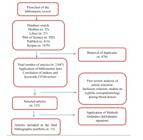
In the search for the topic under study, in the databases previously defined in the methodology, 2,925 articles were exported to Rayyan® Software, distributed as follows: Medline (55); Lilacs (27); Web of Science (550); PubMed (815); and Scopus (1,479). Of these, 878 were excluded due to duplication in one or more databases, leaving 2,047 articles for bibliometric evaluation (Figure 1).
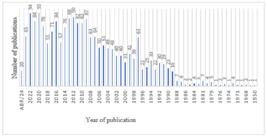
It was found that 87.74% of the publications were journal articles, and 88.97% of the documents were in English. The quantitative distribution of these publications over the years began in 1950 and has increased considerably in the last 20 years, with an average of 37.21 publications per year, as shown in Figure 2.
Bradford’s Law was applied to the database collection on this topic, identifying and analyzing 676 distinct journal titles with a total of 2,046 scientific publications. By distributing the journals into four quadrants, as defined by this law, based on the journals’ individual productivity, it was found that in the first quadrant, three journals produced 511 (25%) publications; in the second quadrant, 43 journals produced 513 (25%) publications; in the third quadrant, 167 journals produced 511 (25%) publications; and in the fourth quadrant, 463 journals produced 511 (25%) publications.
Among the prominent journals in the first quadrant, the following are present with their respective number of publications: Transfusion (369); Vox sanguinis (102); and Transfusion Medicine (40). These three journals produced a total of 511 (25%) of the overall total of productions, equivalent to the number of productions of the 463 journals allocated in the fourth quadrant, with the same demand of 511 articles developed.
Applying Lotka’s Law, 11,312 authors were cataloged, producing a total of 14,389 scientific publications relevant to the topic under study. Applying this law resulted in the identification of 2,262 (26.03%) authors who produced a total of 5,340 works, and 9,050 (73.97%) authors who produced 9,050 scientific works.
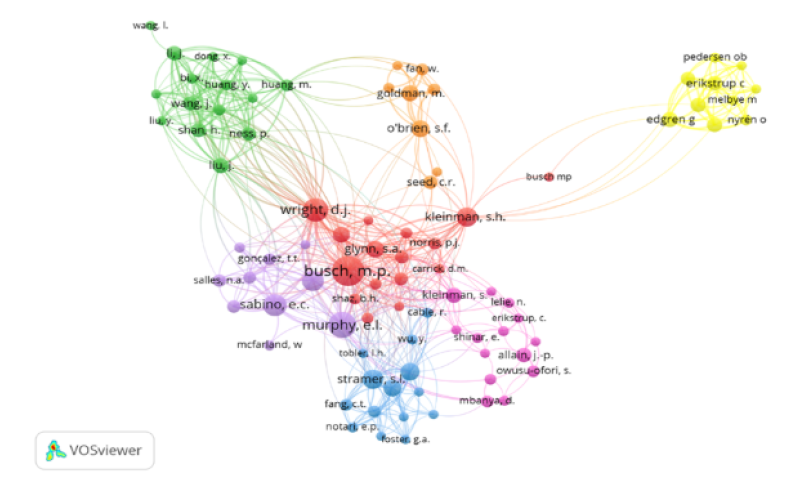
According to this principle, the co-authorship networks between these authors were analyzed using Vosviewer® software, using a filter of at least 5 publications by each author, generating 7 clusters or groups and 541 connections between those involved. Each cluster or group was color-coded as follows in Figure 2: Cluster 1 - red, Cluster 2 - green, Cluster 3 - blue, Cluster 4 - lilac, Cluster 5 - purple, Cluster 6 - yellow, Cluster 7 - orange (Figure 3).
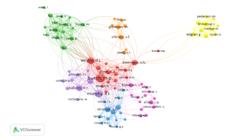
The division into seven clusters reveals the existence of subgroups within the field of study, each possibly focused on specific aspects of syphilis seroepidemiology. The description of the clusters allows us to identify opinion leaders and focal points of collaboration within each group, based on criteria such as productivity (number of publications), academic interconnectivity (number of links), and the intensity of these relationships (total link strength), as well as their distribution within the thematic groups (clusters).
Busch, M.P., belonging to Cluster 1, as the researcher with the highest number of publications (n=50), 41 links with other authors, and a link strength of 170, stood out for his centrality and influence within the co-authorship network. Within the same cluster, Wright, D.J., demonstrated significant productivity (n=31), with 39 links and a link strength of 181, positioning him as the author with the greatest intensity of interconnections and relevance in scientific collaboration. In Cluster 2, Liu, J. stood out with 13 publications, 24 links, and a total link strength of 107, followed by Wang, J., and Shan, H., both with 11 publications, 16 links, and a link strength of 93 and 89, respectively.
In Cluster 5, authors from both the national and international scene stood out, such as Murphy, E.L. (12 publications, 29 links, link strength of 105), Sabino, E.C. (26 publications, link strength of 89), and Custer, B. (23 publications, link strength of 83), demonstrating significant participation in research related to the study topic.
Applying Zipf’s law, which analyzes the frequency of keywords in articles extracted from the databases referenced by the topic, a total of 7,866 words were selected with a frequency of 47,932 repetitions. When analyzing Zipf’s law, three (03) frequency zones classified as “trivial zone” were identified, with this section containing a total of 18 words that were repeated with greater intensity, equivalent to a proportion of 30.3% of the most frequently cited words. The next zone, classified as “interesting zone,” contained a total of 224 words, representing 30.9% of the most cited terms, and finally, the “noise zone” contained 7,624 words, corresponding to a frequency proportion, corresponding to 38.7% of the total frequency.
Regarding the evaluation of the most frequent keywords arranged in the “trivial” zone, the respective prevalence values were processed: “Blood donor” (2642), “Humans” (2188), “male” (1133), “Female” (1116), “Prevalence” (1074), “Blood bank” (912), “Adult” (831), “Article” (800), Blood Transfusion (747), Middle Aged (537), “hepatitis C” (337), Risk factors (336), “Aged” (334), “major clinical study” (328), “Hepatitis B” (327), “Seroepidemiologic Studies” (311), “controlled study” (300), “Young Adult” (277).
Highlighting the two main frequency zones (trivial and interesting), the minimum number of keyword occurrences was adopted, the lowest frequency threshold of the “interesting zone,” equivalent to 25 repetitions. In this context, of the 7,671 keywords found by the Vosviewer® software, 223 met the minimum threshold, resulting in the visualization of the frequency map and their correlations through the formation of five distinct clusters, identified as Cluster 1 (red), Cluster 2 (green), Cluster 3 (blue), Cluster 4 (yellow), and Cluster 5 (purple). This totaled 18,568 links between keywords and a total link strength of 210,793 (Figure 4). From the results of the 2,047 documents analyzed, 122 works were selected, through individual reading of the title and abstract, and some through full reading of the works in pairs, to integrate the bibliographic portfolio. These studies were exported to the JabRef® Software for the purpose of ordering the data in table format, where the referred information was exported to the Microsoft Excel® Software for calculation of the InOrdinatio.

Based on the ranking results of the most relevant productions obtained on the topic under study in this bibliometric research using InOrdinatio, the first three articles: “Seroepidemiology of human immunodeficiency virus, hepatitis B and C viruses, and syphilis infections among first-time blood donors in Edea, Cameroon”; “Seroprevalence of transfusion-transmissible infections (HBV, HCV, syphilis, and HIV) among prospective blood donors in a tertiary health care facility in Calabar, Nigeria; an eleven-year evaluation”; and “Seroepidemiology of transfusion-transmissible infectious diseases among blood donors in Osogbo, southwest Nigeria,” presented a significant impact factor and number of citations, but were published in 2013, 2018, and 2009, respectively. Two of these articles were published more than 10 years ago, contradicting the protocol cited in references on the importance of more recent publications as an evaluation method.
From this perspective, it is worth highlighting the annual evaluation of publications about this study, highlighting the largest number of studies on the topic in 2019, with 13 articles. Among these, the article “Seroprevalence and risk factors for HIV, HCV, HBV, and syphilis among blood donors in Mali” from the journal BMC Infectious Diseases, with an impact strength of 4.8, 54 citations, and an InOrdinatio of 150.73, ranking 5th among the most relevant of that year. Thus, of the 122 selected articles, the 15 highest-rated productions are highlighted here, as shown in Chart 1.
DISCUSSION
In the profile of publications on syphilis seroepidemiology studies among blood donations from regulatory banks, publications in the form of “articles” stand out as the most common type of publication in the collection (87.54%). This supports the argument that scientific articles represent one of the main ways to submit knowledge generated through peer review, a fundamental process for ensuring the accuracy and quality of the knowledge produced. Furthermore, they are essential for engaging the academic and professional community around specific research topics and subjects27.
Based on the language of the publications presented, it is noteworthy that the highest percentage in this study corresponds to research published in English, 88.97%. This shows that the English language brings universality to science and enhances the receipt of citations, as well as influencing international impact. Thus, expanding the communication and dissemination of knowledge, in addition to favoring the visibility and citation of documents, which provides the credibility attributed by the scientific community28.
When highlighting the most qualified and prestigious journals in the scientific community, it was observed that of the 676 journals, only 3 stood out with 511 publications, accounting for 25% of the entire collection. Thus, the result presented is consistent with Bradford’s Law, according to which few journals produce many articles (presumably of higher quality or relevance) and many journals produce few articles29.
When applying Lotka’s Law to the results of the selected databases, it was possible to identify 20% of the authors producing almost 30% of all works relevant to the subject of study. This result corroborates the principle that Lotka’s Law measures authors’ productivity based on a mathematical model. It is observed that only a few authors, authorities on a subject, are responsible for a high number of productions, and many authors, likely with less prestige and a broader scope of study, produce little on the same topic30.
In implementing Zipf’s Law, only 18 words stood out in terms of repetition frequency, corresponding to 30.31% of the repetition frequencies identified in the most prominent zone (Trivial). This result reinforces the mathematical application of this law, which uses the contextualization of the frequency of occurrence of an event-in this case, words-with their prevalence ranking. In other words, we can view this relationship as a probability function over the ranking31.
Using Vosviewer® software, it was possible to evaluate the types of bibliometric networks, based on the visual map of the co-authorship and keyword co-occurrence network, respectively, composed of “nodes” and “edges.” In the co-authorship-based bibliometric network, these researchers are represented by “nodes,” whose size is related to their number of publications. They are connected by “edges,” which indicate not only the existence of a relationship between two or more authors but also establish the strength of the relationship based on the number of publications coauthored by them. In the keyword co-occurrence network, their frequency of repetition reflects the dimension expressed by the “nodes” in the visual map, just as their “edges” represent the strength of the connection between the most expressive and prevalent terms in the articles produced32.
One advantage of applying the Methodi Ordinatio in this bibliometric research was the establishment of a ranking of the most relevant works before conducting the necessary systematic reading, allowing researchers to save time in the process of evaluating works, considered the most laborious task in this process27.
In addition to the importance of the impact factor and number of citations, the year of publication is relevant, as it reflects the current state of the subject matter. It is understood that the more recent the research, the more likely it is to present new advances and contributions in the related field of knowledge, in addition to emphasizing the likelihood of an article being cited over time33.
The selection and classification of articles reinforce the use of the Methodi Ordinatio in bibliometric reviews, ensuring methodological rigor, as the method provides a systematic and transparent procedure for selecting and classifying articles. Applying objective and standardized criteria minimizes subjective bias in study selection, resulting in a more robust and reliable review and the credibility of bibliometric reviews, establishing a solid foundation for future research in the area under study.
This study highlights limitations regarding the scope of open-access works, along with the databases consulted, relevant to epidemiological research on the seroepidemiology of syphilis among blood donations in various regions worldwide. Based on the portfolio of results found, because these studies use retrospective secondary data, they may present incomplete information or biased results for a specific region.
FINAL CONSIDERATIONS
The bibliometric analysis of syphilis seroepidemiology studies in blood donations reveals important findings regarding the scientific production, especially regarding the characteristics of the articles and publication languages. It provides a timeline of the main studies relevant to the topic, their progressive evolution, presumably related to the increasing presence of syphilis markers identified in blood donations, and their compromising impact on hemotherapy. This results in losses of collected blood bags or even risks of possible infections transmitted by blood transfusions, due to ineffective clinical and laboratory screening management.
Knowledge of the profile and selection of relevant syphilis seroepidemiological studies among blood donations made to regulatory banks in each region brings with it the portrayal of results incorporated into socioeconomic indicators, trends, and syphilis prevalence among the study population, as well as reflecting the epidemiological status of the disease in the regional population delimited in the studies. These predictive indicators are extremely useful for blood bank workflows, contributing to and improving cost-effective logistics in external campaigns and donor screening in areas identified as being at greater risk for syphilis. For the government, the comprehensive results of syphilis seroepidemiological studies guide the development of integrated epidemiological surveillance actions, expanded testing, educational campaigns, and cohesive treatment to combat the disease in the targeted region.
References
-
1 Deressa T, Birhan W, Enawgaw B, Abebe M, Baynes HW, Desta M, et al. Proportion and predictors of transfusion-transmissible infections among blood donors in North Shewa Zone, Central North Ethiopia. PLoS One [Internet]. 2018 [cited 2024 May 13]13(3):e0194083. Available from: https://doi.org/10.1371/journal.pone.0194083
» https://doi.org/10.1371/journal.pone.0194083 -
2 Mohammed Y, Bekele A. Seroprevalence of transfusion transmitted infection among blood donors at Jijiga blood bank, Eastern Ethiopia: retrospective 4 years study. BMC Res Notes [Internet]. 2016 [cited 2025 Jun 12];9(1):129. Available from: https://doi.org/10.1186/s13104-016-1925-6
» https://doi.org/10.1186/s13104-016-1925-6 -
3 Abebe M, Marga N. Human Immunodeficiency Virus and syphilis among blood donors at Western Oromia, Ethiopia. J Blood Med [Internet]. 2021 [cited 2024 May 10];12:671-7. Available from: https://doi.org/10.2147/JBM.S310329
» https://doi.org/10.2147/JBM.S310329 -
4 Al-Alwani HR. Seropositive prevalence of Transfusion transmitted infections among blood donors in Al-anbar province after war displacement period. J Pharm Sci & Res [Internet] 2018 [cited 2024 May 10];10(12):3333-5. https://www.pharmainfo.in/jpsr/Documents/Volumes/vol10Issue12/jpsr10121870.pdf
» https://www.pharmainfo.in/jpsr/Documents/Volumes/vol10Issue12/jpsr10121870.pdf -
5 Attie A, Almeida-Neto C, Witkin SS, Derriga J, Nishiya AS, Ferreira JE, et al. Detection and analysis of blood donors seropositive for syphilis. Transfus Med [Internet]. 2021 [cited 2024 Jun 10];31(2):121-8. Available from: https://doi.org/10.1111/tme.12761
» https://doi.org/10.1111/tme.12761 -
6 Lokpo SY, Owusu-Dabo E, Deku JG, Orish VN, Kye-Duodu G, Ussher FA, et al. A comparative study of the epidemiology of treponemal infection in the Volta and Oti regions of Ghana: a five-year multisite parallel population-based analysis vis-à-vis the Sentinel survey. Biomed Res Int [Internet]. 2021 [cited 2024 Jul 23];(1):4462389. Available from: https://doi.org/10.1155/2021/4462389
» https://doi.org/10.1155/2021/4462389 -
7 Ministério da Saúde (BR). Secretaria de Vigilância em Saúde. Guia de vigilância epidemiológica [Internet]. 7. ed. Brasília: Ministério da Saúde; 2009. 810 p. [cited 2024 Aug 10]. Available from: https://bvsms.saude.gov.br/bvs/publicacoes/guia_vigilancia_epidemiologica_7ed.pdf
» https://bvsms.saude.gov.br/bvs/publicacoes/guia_vigilancia_epidemiologica_7ed.pdf -
8 Guimarães AJR, Bezerra CA. P Gestão de dados: uma abordagem bibliométrica. Perspect Ciênc Inf [Internet]. 2019 [cited 2024 Jul 25];24(4):171-86. Available from: https://doi.org/10.1590/1981-5344/4192
» https://doi.org/10.1590/1981-5344/4192 - 9 Estrela C. Metodologia científica: ciência, ensino e pesquisa. 3. ed. São Paulo: Artes Médicas; 2018. 738 p.
-
10 Ribeiro HCM. Bibliometria: quinze anos de análise da produção acadêmica em periódicos brasileiros. Biblios [Internet]. 2017 [cited 2024 May 28];69:1-20. Available from: http://dx.doi.org/10.5195/biblios.2017.393
» http://dx.doi.org/10.5195/biblios.2017.393 -
11 de Campos EAR, Pagani RN, Resende LM, Pontes J. Construction and qualitative assessment of a bibliographic portfolio using the methodology Methodi Ordinatio. Scientometrics [Internet]. 2018 [cited 2024 Sep 12];116:815-42. Available from: https://link.springer.com/article/10.1007/s11192-018-2798-3
» https://link.springer.com/article/10.1007/s11192-018-2798-3 -
12 Noubiap JJN, Joko WYA, Nansseu JRN, Tene UG, Siaka C, et al. Sero-epidemiology of human immunodeficiency virus, hepatitis B and C viruses, and syphilis infections among first-time blood donors in Edéa, Cameroon. Int J Infect Dis [Internet]. 2013 Oct [cited 2024 Jun 2];17(10):e832-7. Available from: https://doi.org/10.1016/j.ijid.2012.12.007
» https://doi.org/10.1016/j.ijid.2012.12.007 -
13 Okoroiwu HU, Okafor IM, Asemota EA, Okpokam DC. Seroprevalence of transfusion-transmissible infections (HBV, HCV, syphilis and HIV) among prospective blood donors in a tertiary health care facility in Calabar, Nigeria; an eleven years evaluation. BMC Public Health [Internet]. 2018 [cited 2024 Jun 4];18(1):645. Available from: https://doi.org/10.1186/s12889-018-5555-x
» https://doi.org/10.1186/s12889-018-5555-x -
14 Buseri FI, Muhibi MA, Jeremiah ZA. Sero-epidemiology of transfusion-transmissible infectious diseases among blood donors in Osogbo, south-west Nigeria. Blood Transfus [Internet]. 2009 [cited 2024 Jun 4];7:293-9. Available from: https://doi.org/10.2450/2009.0071-08
» https://doi.org/10.2450/2009.0071-08 -
15 Mohammed Y, Bekele A. Seroprevalence of transfusion transmitted infection among blood donors at Jijiga blood bank, Eastern Ethiopia: retrospective 4 years study. BMC Res Notes [Internet]. 2016 [cited 2024 Jun 6];9:129. Available from: https://doi.org/10.1186/s13104-016-1925-6
» https://doi.org/10.1186/s13104-016-1925-6 -
16 Jary A, Dienta S, Leducq V, Le Hingrat Q, Cisse M, Diarra AB, et al. Seroprevalence and risk factors for HIV, HCV, HBV and syphilis among blood donors in Mali. BMC Infect Dis [Internet]. 2019 [cited 2024 Jun 8];19:1064. Available from: https://doi.org/10.1186/s12879-019-4699-3
» https://doi.org/10.1186/s12879-019-4699-3 -
17 Makroo RN, Hegde V, Chowdhry M, Bhatia A, Rosamma NL. Seroprevalence of infectious markers & their trends in blood donors in a hospital based blood bank in north India. Indian J Med Res [Internet]. 2015 [cited 2024 Jun 10];142(3):317-22. Available from: https://doi.org/10.4103/0971-5916.166598
» https://doi.org/10.4103/0971-5916.166598 -
18 Alabdulmonem W, Shariq A, Alqossayir F, AbaAlkhail FM, Al-Musallam AY, Alzaaqi FO, et al. Sero-prevalence ABO and Rh blood groups and their associated Transfusion-Transmissible Infections among Blood Donors in the Central Region of Saudi Arabia. J Infect Public Health [Internet]. 2020 [cited 2024 Jun 11];13(2):299-305. Available from: https://doi.org/10.1016/j.jiph.2019.12.004
» https://doi.org/10.1016/j.jiph.2019.12.004 -
19 Shiferaw E, Tadilo W, Melkie I, Shiferaw M. Sero-prevalence and trends of transfusion-transmissible infections among blood donors at Bahir Dar district blood bank, northwest Ethiopia: a four year retrospective study. PLoS One [Internet]. 2019 [cited 2024 Jun 15];14(4):e0214755. Available from: https://doi.org/10.1371/journal.pone.0214755
» https://doi.org/10.1371/journal.pone.0214755 -
20 Arshad A, Borhany M, Anwar N, Naseer I, Ansari R, Boota S, et al. Prevalence of transfusion transmissible infections in blood donors of Pakistan. BMC Hematol [Internet]. 2016 [cited 2024 Jun 15];16:27. Available from: https://doi.org/10.1186/s12878-016-0068-2
» https://doi.org/10.1186/s12878-016-0068-2 -
21 Stokx J, Gillet P, De Weggheleire A, Casas EC, Maendaenda R, Beulane AJ, et al. Seroprevalence of transfusion-transmissible infections and evaluation of the pre-donation screening performance at the Provincial Hospital of Tete, Mozambique. BMC Infect Dis [Internet]. 2011 [cited 2024 Jun 20];11:141. Available from: https://doi.org/10.1186/1471-2334-11-141
» https://doi.org/10.1186/1471-2334-11-141 -
22 Slot E, Janssen MP, Marijt-van der Kreek T, Zaaijer HL, van de Laar TJ. Two decades of risk factors and transfusion-transmissible infections in Dutch blood donors. Transfusion [Internet]. 2016 [cited 2024 Jun 24];56(1):203-14. Available from: https://doi.org/10.1111/trf.13298
» https://doi.org/10.1111/trf.13298 -
23 Deressa T, Birhan W, Enawgaw B, Abebe M, Baynes HW, Desta M, et al. Proportion and predictors of transfusion-transmissible infections among blood donors in North Shewa Zone, Central North Ethiopia. PLoS One [Internet]. 2018 [cited 2024 Jun 20];13(3):e0194083. Available from: https://doi.org/10.1371/journal.pone.0194083
» https://doi.org/10.1371/journal.pone.0194083 -
24 Pessoni LL, de Aquino ÉC, de Alcântara KC. Prevalence and trends in transfusion-transmissible infections among blood donors in Brazil from 2010 to 2016. Hematol Transfus Cell Ther [Internet]. 2019 [cited 2024 Jun 20];41(4):310-5. Available from: https://doi.org/10.1016/j.htct.2019.03.009
» https://doi.org/10.1016/j.htct.2019.03.009 -
25 Kebede E, Getnet G, Enyew G, Gebretsadik D. Transfusion transmissible infections among voluntary blood donors at Dessie blood bank, Northeast Ethiopia: cross-sectional study. Infect Drug Resist [Internet]. 2020 [cited 2024 Jun 20];13:4569-76. Available from: https://doi.org/10.2147/IDR.S287224
» https://doi.org/10.2147/IDR.S287224 -
26 Ataro Z, Urgessa F, Wasihun T. Prevalence and trends of major transfusion transmissible infections among blood donors in Dire Dawa Blood Bank, Eastern Ethiopia: retrospective study. Ethiop J Health Sci [Internet]. 2018 [cited 2024 Jun 20];28(6):701-10. Available from: https://doi.org/10.4314/ejhs.v28i6.4
» https://doi.org/10.4314/ejhs.v28i6.4 -
27 da Silva MSL, Mesquita CT. Publication of a scientific article: what authors need to know. Int J Cardiovasc Sci [Internet]. 2023 [cited 2024 May 17];36:e20230115. Available from: https://doi.org/10.36660/ijcs.20230115
» https://doi.org/10.36660/ijcs.20230115 -
28 Finardi KR, Guimarães FF. Internacionalização, rankings e publicações em inglês: a situação do Brasil na atualidade. Est Aval Educ [Internet]. 2021 [cited 2024 Aug 18];28(68):600-26. Available from: https://doi.org/10.18222/eae.v28i68.4564
» https://doi.org/10.18222/eae.v28i68.4564 -
29 Rodrigues C, Viera AFG. Estudos bibliométricos sobre a produção científica da temática Tecnologias de Informação e Comunicação em bibliotecas. InCID [Internet]. 2016 [cited 2024 Aug 22];7(1):167-80. Available from: https://doi.org/10.11606/issn.2178-2075.v7i1p167-180
» https://doi.org/10.11606/issn.2178-2075.v7i1p167-180 -
30 Araújo CAA. Bibliometria: evolução histórica e questões atuais. Em Quest [Internet]. 2006 [cited 2024 Jul 25];12(1):11-32. Available from: https://seer.ufrgs.br/index.php/Em Questao/article/view/16
» https://seer.ufrgs.br/index.php/Em Questao/article/view/16 -
31 de Araújo LC, Sansão JPH, Yehia HC. Influência da lei de Zipf na escolha de senhas. Rev Bras Ensino Fís (Online) [Internet]. 2016 [cited 2024 Jul 8];38(1):1313. Available from: https://doi.org/10.1590/S1806-11173812125
» https://doi.org/10.1590/S1806-11173812125 -
32 van Eck NJ, Waltman L. Visualizing bibliometric networks. In: Ding Y, Rousseau R, Wolfram D, editors. Measuring scholarly impact: methods and practice [Internet]. [Nova York]: Springer; 2014 [cited 2024 Sep 16]. p. 285-320. Available from: http://dx.doi.org/10.1007/978-3-319-10377-8_13
» http://dx.doi.org/10.1007/978-3-319-10377-8_13 -
33 Pagani RN, Kovaleski JL, de Resende LMM. Avanços na composição da Methodi Ordinatio para revisão sistemática de literatura. Ci Inf [Internet]. 2017 [cited 2024 Jul 26];46(2):161-87. Available from: https://doi.org/10.18225/ci.inf.v46i2.1886
» https://doi.org/10.18225/ci.inf.v46i2.1886
-
Data availability:
The authors declare that the data can be made available upon request to the corresponding author.
-
HOW TO REFERENCE THIS ARTICLE:
de Araújo Junior FO, Valois RC, da Silva GMC, de Almeida NCC, Nascimento MHM. Seroepidemiology of syphilis in blood donations from regulatory banks: a Bibliometric review. Cogitare Enferm [Internet]. 2025 [cited “insert year, month and day”];30:e98319en. Available from: https://doi.org/10.1590/ce.v30i0.98319en
The authors declare that the data can be made available upon request to the corresponding author.

 Source: Prepared by the authors based on the results of the Rayyan® Software (2024).
 Source: Prepared by the authors based on the results of the Rayyan® Software (2024).
 Source: Image generated by Vosviewer® Software
 Source: Image generated by Vosviewer® Software (2024).