
 People with disabilities in nursing education: generative artificial intelligence and transformative praxis
ABSTRACT
Objective: To critically analyze the contradictions, challenges, and possibilities of generative artificial intelligence as a catalyst for emancipatory and inclusive nursing education, focusing on the singularities of students with disabilities.
Method: A theoretical-reflective essay developed between August 2024 and May 2025, grounded in Paulo Freire’s critical pedagogy and in frameworks on cognitive justice and inclusive technologies. The text was developed based on the analysis of national and international normative documents on inclusion and governance of generative artificial intelligence.
Results: It was structured into two axes: ethical and epistemological contradictions of generative artificial intelligence as a mediator of inclusive educational practices; and elements for a transformative praxis based on critical technological mediation committed to equity.
Conclusion: Generative artificial intelligence, when critically mediated, can expand accessibility for students with disabilities in nursing education. However, its uncritical use tends to reinforce barriers and deepen inequalities.
DESCRIPTORS:
Education, Nursing; Education, Special; Artificial Intelligence; Equity; Persons with Disabilities.
HIGHLIGHTS
1. People with disabilities are rendered invisible in debates on educational technological innovation.
2. The uncritical use of generative artificial intelligence may reinforce exclusion and inequalities.
3. Inclusion requires critical technological mediation and transformative praxis.
4. The governance of generative artificial intelligence must consider people with disabilities and cognitive justice.
RESUMO
Objetivo: Analisar criticamente as contradições, os desafios e as possibilidades da inteligência artificial generativa como catalisadora de uma formação emancipatória e inclusiva na enfermagem, com foco nas singularidades de estudantes com deficiência.
Método: Ensaio teórico-reflexivo, desenvolvido entre agosto de 2024 e maio de 2025, fundamentado na pedagogia crítica de Paulo Freire e em referenciais sobre justiça cognitiva e tecnologias inclusivas. O texto foi desenvolvido a partir da análise de documentos normativos nacionais e internacionais sobre inclusão e governança da inteligência artificial generativa.
Resultados: Estrutura-se em dois eixos: contradições éticas e epistemológicas da inteligência artificial generativa enquanto mediadora de práticas educativas inclusivas; e elementos para uma práxis transformadora com base em uma mediação tecnológica crítica e comprometida com a equidade.
Considerações finais: A inteligência artificial generativa, se mediada criticamente, pode ampliar a acessibilidade de estudantes com deficiência na formação em enfermagem. No entanto, seu uso acrítico tende a reforçar barreiras e aprofundar desigualdades.
DESCRITORES:
Educação em Enfermagem; Educação Inclusiva; Inteligência Artificial; Equidade; Pessoas com Deficiência.
HIGHLIGHTS
1. Pessoas com deficiência são invisibilizadas nos debates sobre inovação tecnológica educacional.
2. O uso acrítico da inteligência artificial generativa pode reforçar exclusões e desigualdades.
3. inclusão exige mediação tecnológica crítica e práxis transformadora.
4. A governança da inteligência artificial generativa deve considerar pessoas com deficiência e justiça cognitiva.
RESUMEN
Objetivo: Analizar críticamente las contradicciones, los desafíos y las posibilidades de la inteligencia artificial generativa como catalizador para una educación de enfermería emancipadora y inclusiva, centrándose en las necesidades específicas de los estudiantes con discapacidad.
Método: Este ensayo teórico-reflexivo, desarrollado entre agosto de 2024 y mayo de 2025, se basa en la pedagogía crítica de Paulo Freire y en marcos conceptuales sobre justicia cognitiva y tecnologías inclusivas. El texto se elaboró a partir del análisis de documentos normativos nacionales e internacionales sobre inclusión y gobernanza de la inteligencia artificial generativa.
Resultados: Se estructura en torno a dos ejes: las contradicciones éticas y epistemológicas de la inteligencia artificial generativa como mediadora de prácticas educativas inclusivas; y los elementos para una praxis transformadora basada en la mediación tecnológica crítica comprometida con la equidad.
Conclusión: La inteligencia artificial generativa, si se gestiona de forma crítica, puede ampliar la accesibilidad a la formación en enfermería para estudiantes con discapacidad. Sin embargo, su uso acrítico tiende a reforzar las barreras y a agravar las desigualdades.
DESCRIPTORES:
Educación en Enfermería; Educación Especial; Inteligencia Artificial; Equidad; Personas con Discapacidad.
HIGHLIGHTS
1. Las personas con discapacidad quedan invisibilizadas en los debates sobre innovación tecnológica educativa.
2. El uso acrítico de la inteligencia artificial generativa puede reforzar las exclusiones y las desigualdades.
3. La inclusión requiere una mediación tecnológica crítica y una praxis transformadora.
4. La gobernanza de la inteligencia artificial generativa debe tener en cuenta a las personas con discapacidad y la justicia cognitiva.
INTRODUCTION
Brazilian higher education remains marked by structural inequalities that permeate the physical, symbolic, and epistemological constitution of institutions. People with disabilities (PwD) account for only 0.9% of enrollments in higher education, revealing persistent barriers to access and retention1-2. This reality silences bodily, cognitive, and communicational experiences, reinforcing exclusionary norms3-4.
In the field of nursing, this exclusion is even more pronounced. Education is still organized around curricula and pedagogical practices that assume a functional body5 as the reference for care6-7. PwD remain invisible, both as students and future professionals, reinforcing standards that restrict the diversity of bodies, knowledge, and subjectivities. This reveals the historical reproduction of a pedagogy that naturalizes inequalities8.
The Brazilian National Policy on Special Education from the Perspective of Inclusive Education (PNEEPEI - Política Nacional de Educação Especial na Perspectiva da Educação Inclusiva) represents a milestone by proposing the mainstreaming of inclusion across different educational levels. By shifting the focus from disability to the need for structural transformation, this policy challenges exclusionary pedagogical practices, highlighting the urgency of educational environments that recognize the singularity of students’ trajectories9. However, these guidelines still encounter an institutional culture resistant to diversity, the rupture of epistemic hierarchies, and the democratization of knowledge10.
In this context, generative artificial intelligence (GAI) emerges as a promising educational technology, with the potential to expand accessibility11-13, personalize learning trajectories, and act as a mediator of content13-15. However, this same technology carries ethical and epistemological contradictions12,14. Its uncritical use may intensify inequalities through the reproduction of algorithmic biases16, pedagogical surveillance, and the standardization of knowledge, especially because it is trained on data that do not reflect the realities of different groups, including PwD12.
In nursing, there is a need for critical re-signification. This includes the pedagogical, epistemological, and political relations that structure teaching and care17-19. It is necessary to problematize conceptions of gender, race, and, especially, different PwD bodies, as well as their lack of representation due to algorithmic biases12,20. There is a need to shift the debate from a logic of integration to a perspective of structural transformation21, which is essential to advance the reconfiguration of educational spaces that have been addressing diversity12,20,22. This reflection is justified not only by the urgency of implementing PNEEPEI, but also by the need to reposition nursing22-23 as a field of care committed to human diversity in its multiple expressions and to emerging technologies12,17-19.
In this sense, this study aims to critically analyze the contradictions, challenges, and possibilities of GAI as a catalyst for emancipatory and inclusive nursing education, focusing on the singularities of students with disabilities.
METHOD
This is a theoretical-reflective essay developed between August 2024 and May 2025, grounded in Paulo Freire’s critical pedagogy10, emphasizing the dialectical articulation between theory and practice, problematization, and transformation. The text is based on the understanding that the use of GAI in nursing education must be analyzed in light of the historical contradictions that structure higher education and PwD.
It was based on a critical analysis of normative documents and academic literature published between 2021 and 2025. International and national frameworks discussing the ethical governance of GAI were selected, with emphasis on the 2024 United Nations (UN) resolution on artificial intelligence and the report of the UN High-Level Advisory Body on GAI, in addition to PNEEPEI. The search for scientific studies was intentional and conducted in databases such as PubMed and SciELO, using the descriptors “Generative Artificial Intelligence”, “Nursing”, and “People with Disabilities” in Portuguese and English.
The analysis was conducted based on Freire’s dialectical movement, starting from concrete reality and normative frameworks to problematize them in light of critical mediation and transformative praxis. Initially, four dimensions were considered: digital accessibility; personalization of teaching; mediation of procedural practices; and transformation of pedagogical relations. Finally, two central axes were organized, synthesizing the most relevant structural contradictions identified at the interface between GAI and inclusive nursing education.
Triangulation among the authors was used as a strategy for interpretative validation, ensuring theoretical-argumentative coherence. The reflection aims to contribute to the critical advancement of discussions on the role of emerging technologies in nursing education, especially regarding the inclusion of students with disabilities, the overcoming of normative practices, and the expansion of possibilities for emancipatory education.
DEVELOPMENT
Axis 1: Contradictions of generative artificial intelligence as a mediator of inclusive educational processes
This axis analyzes how GAI, when incorporated uncritically into educational practices, may reinforce structural and epistemological inequalities, silencing the singularities of PwD and reducing the complexity of the educational process to the logic of algorithmic standardization12-14.
It is evident that assistive technologies enhanced by GAI represent advances in overcoming communicational, informational, and procedural barriers13-19. However, contradictions emerge between personalization, algorithmic standardization, accessibility, excessive surveillance, democratization, and digital exclusion12,24. In academic environments, such exclusion is evident in access to laboratories, digital libraries, and identification systems, as they reflect the realities of hegemonic groups24. This highlights the tension between the promise of personalization and the tendency toward standardization13, distancing GAI from the singularities of PwD.
Furthermore, the Brazilian Inclusion Law (Law 13,146/15) ensures the right to accessibility in multiple dimensions, but its implementation in digital environments has revealed important contradictions. GAI tools for image description, automatic captions, and adaptive interfaces significantly expand access to educational content13-19. However, they reproduce behavioral patterns, revealing the need for discussions on specific learning trajectories24 and attention to algorithmic racism12,24.
These experiences with GAI show that the line between beneficial personalization and excessive surveillance is tenuous. Control may cause stress and anxiety25 due to the monitoring of time, frequency, and interaction patterns, contradicting Freire’s principle of learner autonomy10. Considering the different singularities of PwD, this demonstrates the need to advance multimodal models13 in care23,25 and in the education of both PwD and non-PwD in nursing.
Virtual reality, for instance, may encompass different bodily configurations in nursing procedural scenarios. However, its implementation depends on technical infrastructure, teacher training25, space adaptation, and diversity of participants2-4. In the case of virtual simulation platforms, it is essential to consider not only different ways of performing nursing procedures, but also overcoming singular representations that reinforce functional body standards. This prevents the perpetuation of exclusion-now digitalized-and reduces purely technical concerns14.
It is essential to ensure that the effectiveness of GAI as an inclusive pedagogical mediation tool results from a dialectical articulation between adequate technical infrastructure, strong ethical commitment, and participatory methodologies. In this sense, technological mediation must be subordinated to a dialogical pedagogical action, in which educators act as ethical mediators capable of critically problematizing, adapting, and monitoring the use of GAI12,14, always considering the multiple singularities of PwD.
These issues become even more critical due to the human dimension and historically identified exclusion processes in educational spaces involving PwD, such as gender3,4,14. Individual personalization through GAI may paradoxically individualize what should be collective, fragmenting educational praxis. Therefore, intersections of social class, gender, and race that differently impact access to and use of technologies must be considered to avoid perpetuating exclusion12,20.
One important aspect is economic vulnerability. It is crucial to examine the distinct experiences, given the digital exclusion, that can amplify existing inequalities in the face of advancing emerging technologies. Failure to consider these issues may benefit PwD with greater cultural/economic capital at the expense of Black, Indigenous, or other marginalized PwD who are left out of the debates, as illustrated by the tensions highlighted in Figure 1, which connects these structural exclusions to the application of GAI in inclusive nursing education.
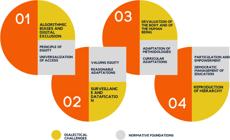
Dialectical tensions in the application of generative artificial intelligence in inclusive nursing education. Belém, Pará, Brazil, 2025 Source: The authors (2025).
Overcoming these contradictions requires a transformative praxis that articulates technique and ethics, innovation and inclusion, personalization and democratization, paving the way for epistemological reconfiguration.
Axis 2: Transformative praxis: elements for the ethical governance of critical technological mediation
Axis 2 argues that the inclusion of PwD must go beyond legal compliance and become a political and epistemological commitment. It defends that technology, especially GAI, should be critically used as a tool for emancipation, promoting the active participation of PwD and valuing bodily and experiential diversity. The focus is on the co-construction of inclusive educational solutions, critical teacher training, and overcoming normative and functional patterns, paving the way for a truly inclusive and dialogical approach in nursing education.
Critical mediation by GAI is necessary for an epistemological reconfiguration of the concept of care in times of automation. This perspective breaks with the restricted idea of inclusion of PwD and digital inclusion as a mere legal obligation, shifting it to a political-epistemological commitment that values bodily and experiential diversity as a potential to renew knowledge and practices in the face of emerging technologies.
This is perceived in the different corporeality that challenge the normativity still predominant in professional practices, as is the case with PwD26-27, and in GAI12,24. The critical use of GAI can act as a catalyst by making visible contradictions previously considered naturalized in training processes. Therefore, policies and guidelines involving GAI should be discussed within the context of training, seeking to incorporate operational and administrative elements in the field of nursing.
The counter-hegemonic potential of technology lies in the emancipatory intentionality of its appropriation, which must be approached critically considering the scope of hearing, visual, motor, and intellectual disabilities. It should operate by making visible structural contradictions and amplifying marginalized potentialities28, breaking normative patterns12,24, and creating a relationship between autonomy in the face of dependence, technological surveillance25, and technocracy of care, which compromise the relational dimension fundamental to nursing care.
It demands ethical governance that articulates technological innovation29 with the preservation of the human bonds that constitute care practice, which should be guided from the teaching of embodiment14 applied to PwD. The co-creation of educational technologies with the active participation of students with disabilities is necessary to promote epistemic justice, understood as the recognition of the legitimacy of different ways of knowing and experiencing the world, overcoming hierarchies that privilege hegemonic knowledge28.
Furthermore, teacher training is needed as an ethical-technological-critical mediation29, capable of challenging the instrumental uses of technology and enhancing its emancipatory appropriation12,18-19. This avoids the reproduction of ableist biases24, based on critical human mediation12. To this end, teachers must appropriate the policies that support the transversality of inclusive education, ensuring that students with disabilities28 are made visible, which highlights the need for courses, workshops, and pedagogical coordination in the training of teachers working in nursing.
This requires overcoming the logic of adaptive integration to move towards structural transformation, in which curricula and environments are redefined according to human diversity2-4. This transformation must be intentionally political and recognize technology as a tool necessarily oriented towards dialogical principles, problematization, and commitment29 to emancipation, overcoming the normalization of bodies and highlighting the diversities in the different areas of knowledge presented in the curricula. Figure 2 illustrates this process, showing how the epistemological reconfiguration of the concept of care is directly related to the ethical governance of technological mediation.

From epistemology of care to ethical governance. Belém, Pará, Brazil, 2025 Source: The authors (2025).
Figure 3 summarizes the main components necessary for the effective transformation of nursing education from a truly inclusive perspective. Inspired by the principles of Paulo Freire’s critical pedagogy, the figure highlights the importance of the active participation of PwD in the collective construction of knowledge, recognizing their experiences and physical characteristics as fundamental to broadening the understanding of care. The visual representation presents elements that highlight pathways for the reconstruction of inclusive caregiving knowledge.

Elements of Freire’s transformative praxis in the reconstruction of inclusive care-knowledge. Belém, Pará, Brazil, 2025 Source: The authors (2025).
The figures summarize this trajectory, reiterating that teacher training plays a strategic role as an ethical-technological mediation, aware that algorithms are human constructions imbued with ableist values12,24 that dialogue with PNEEPEI. The contexts of GAI implementation can become arenas of political dispute where PwD assert their presence as subjects of knowledge and producers of epistemologies that broaden the understanding of care, body, and health22. To achieve this, ethical and digital governance must include the training of these professionals to ensure equity in the use and storage of data and in decision-making, considering the diverse physical characteristics of nursing students with disabilities.
FINAL CONSIDERATIONS
GAI, in light of Freire’s critical pedagogy, reveals structural contradictions relevant to inclusive nursing education. Although it has the potential to expand accessibility and personalize teaching, its uncritical use can reinforce exclusions, especially of students with disabilities, whose bodies and knowledge remain marginalized by normative curricula and hegemonic algorithmic logics.
The study is limited by addressing the presence of PwD, such as nursing students, which restricts the discussion on body diversity and specific intersectionality. Further studies are recommended that investigate the co-construction of technologies with the active participation of PwD and the analysis of the impacts of GAI on different types of disabilities, considering race, gender, and class, as well as the assessment of the presence of PwD in curricular policies and pedagogical practices.
-
HOW TO REFERENCE THIS ARTICLE:
de Castro NJC, de Castro JC, Cordeiro DLS. People with disabilities in nursing education: generative artificial intelligence and transformative praxis. Cogitare Enferm [Internet]. 2026 [cited “insert year, month and day”];31:e100677en. Available from: https://doi.org/10.1590/ce.v31i0.100677en
Data availability:
The authors declare that all data are fully available within the article.
References
-
1 Brasil. Lei Federal nº 13.146, de 06 de julho de 2015. Institui a Lei Brasileira de Inclusão da Pessoa com Deficiência. Diário Oficial da União [Internet]. 2015 (Estatuto da Pessoa com Deficiência). Brasília (DF): 2015 [cited 2025 Mar 1];(Seção 1). Available from: https://www.planalto.gov.br/ccivil_03/_ato2015-2018/2015/lei/l13146.htm
» https://www.planalto.gov.br/ccivil_03/_ato2015-2018/2015/lei/l13146.htm -
2 Paiva JCM, Gesser M. Access and permanence of people with disabilities in higher education: participation in the scientific academy as a form of political activism. Educ Polít Debate [Internet]. 2023 [cited 2025 Jan 13];12(3):1117-31. Available from: https://doi.org/10.14393/REPOD-v12n3a2023-68502
» https://doi.org/10.14393/REPOD-v12n3a2023-68502 -
3 Miguel ACC, Rocha LCMB, Canto CARL, Teixeira JM, de Figueiredo LFG. Inclusão de pessoas com deficiência na educação superior: uma revisão de escopo. Rev Educ Espec [Internet]. 2024 [cited 2025 Jan 13];37(1):e11. Available from: https://doi.org/10.5902/1984686X85630
» https://doi.org/10.5902/1984686X85630 -
4 Mueller SD, Sutherland MA. College women with a disability and interpersonal violence: A call to action. J Am Assoc Nurse Pract [Internet]. 2023 [cited 2025 Mar 20];35(12):761-4. Available from: https://doi.org/10.1097/jxx.0000000000000969
» https://doi.org/10.1097/jxx.0000000000000969 -
5 Vieira DA, da Silva LF, Machado MED, Brandão ES, Chagas HMA. Communication strategies employed by health professionals with hearing impaired people: an integrative review. Cogitare Enferm [Internet]. 2023 [cited 2025 May 20];28:e91372. Available from: https://doi.org/10.1590/ce.v28i0.84359
» https://doi.org/10.1590/ce.v28i0.84359 - 6 Perry AG, Potter PA, Elkin MK. Procedimentos e intervenções de enfermagem. 5.ed. Rio de Janeiro: Elsevier Health Sciences; 2013. 816 p.
-
7 Padilla DJE, Guerrero VTG, Troncoso MP. Proyecciones del cuidado disciplinar de enfermería desde la filosofía de Jean Watson: una revisión sistemática. Enferm Cuid Human [Internet]. 2024 [cited 2025 Jun 5];13(2):e4058. Available from: https://doi.org/10.22235/ech.v13i2.4058
» https://doi.org/10.22235/ech.v13i2.4058 -
8 da Silva DC, Therrien J. Cultura do silêncio e educação libertadora: aportes freirianos. Educ [Internet]. 2022 [cited 2025 Jun 5];45(1):e38533. Available from: https://doi.org/10.15448/1981-2582.2022.1.38533
» https://doi.org/10.15448/1981-2582.2022.1.38533 -
9 Uchôa MMR, Chacon JAV. Educação Inclusiva e Educação Especial na perspectiva inclusiva: repensando uma Educação Outra. Rev Educ Espec [Internet]. 2022 [cited 2025 Jun 5];35:e46. Available from: https://doi.org/10.5902/1984686X69277
» https://doi.org/10.5902/1984686X69277 - 10 Freire P. Pedagogia do oprimido. 17th ed. Rio de Janeiro: Paz e Terra; 1987. 107 p.
-
11 Alqahtani T, Badreldin HA, Alrashed M, Alshaya AI, Alghamdi SS, Bin Saleh K, et al. The emergent role of artificial intelligence, natural learning processing, and large language models in higher education and research. Res Social Adm Pharm [Internet]. 2023 [cited 2025 Jun 10];19(8):1236-42. Available from: https://doi.org/10.1016/j.sapharm.2023.05.016
» https://doi.org/10.1016/j.sapharm.2023.05.016 -
12 Castro NJC, Braga Júnior EJ. Nursing and climate change: generative artificial intelligence as a tool for critical training on climate justice. Esc Anna Nery [Internet]. 2025 [cited 2025 Jun 10];29:e20240117. Available from: https://doi.org/10.1590/2177-9465-EAN-2024-0117pt
» https://doi.org/10.1590/2177-9465-EAN-2024-0117pt -
13 Montejo L, Fenton A, Davis G. Artificial intelligence (AI) applications in healthcare and considerations for nursing education. Nurse Educ Pract [Internet]. 2024 [cited 2025 Jun 10];80:104158. Available from: https://doi.org/10.1016/j.nepr.2024.104158
» https://doi.org/10.1016/j.nepr.2024.104158 -
14 Lifshits I, Rosenberg D. Artificial intelligence in nursing education: a scoping review. Nurse Educ Pract [Internet]. 2024 [cited 2025 Jun 10];80:104148. Available from: https://doi.org/10.1016/j.nepr.2024.104148
» https://doi.org/10.1016/j.nepr.2024.104148 -
15 Yıldız E. Artificial intelligence in mental health nursing: balancing clinical efficiency and the human touch-a quest for a new synthesis. J Psychiatr Ment Health Nurs [Internet]. 2025 [cited 2025 Jun 10];32(4):946-52. Available from: https://doi.org/10.1111/jpm.13173
» https://doi.org/10.1111/jpm.13173 -
16 Carroll SM, Shaw B. Dismantling ableism: promoting a culture of diversity, equity, inclusion, and accessibility for nurses with disabilities. J Psychosoc Nurs Ment Health Serv [Internet]. 2024 [cited 2025 Jun 10];62(5):2-3. Available from: https://pubmed.ncbi.nlm.nih.gov/38709093/
» https://pubmed.ncbi.nlm.nih.gov/38709093/ -
17 Göktepe N, Sarıköse S. Perspectives and experiences of nurse managers on the impact of artificial intelligence on nursing work environments and managerial processes: a qualitative study. Int Nurs Rev [Internet]. 2025 [cited 2025 Jun 10];72(2):e70043. Available from: https://doi.org/10.1111/inr.70043
» https://doi.org/10.1111/inr.70043 -
18 Tseng LP, Huang LP, Chen WR. Exploring artificial intelligence literacy and the use of ChatGPT and copilot in instruction on nursing academic report writing. Nurse Educ Today [Internet]. 2025 [cited 2025 Jun 15];147:106570. Available from: https://doi.org/10.1016/j.nedt.2025.106570
» https://doi.org/10.1016/j.nedt.2025.106570 -
19 Qaladi O, Alshammari M, Almalki AA. Artificial intelligence (AI) in nursing administration: challenges and opportunities. PLoS One [Internet]. 2025 [cited 2025 Jun 15];20(4):e0319588. Available from: https://doi.org/10.1371/journal.pone.0319588
» https://doi.org/10.1371/journal.pone.0319588 -
20 Currie G, Hewis J, Hawk E, Rohren E. Gender and Ethnicity Bias of Text-to-Image Generative Artificial Intelligence in Medical Imaging, Part 2: Analysis of DALL-E 3. J Nucl Med Technol [Internet]. 2025 [cited 2025 June 15];53(2):162-8. Available from: https://doi.org/10.2967/jnmt.124.268359
» https://doi.org/10.2967/jnmt.124.268359 -
21 Amorim RO, Fumes NLF. Ativismo e agência da pessoa com deficiência na Educação Superior. Rev Educ Espec [Internet]. 2024 [cited 2025 Jun 15];e42/1-27. Available from: https://www.researchgate.net/publication/387966945_Ativismo_e_agencia_da_pessoa_com_deficiencia_na_Educacao_Superior
» https://www.researchgate.net/publication/387966945_Ativismo_e_agencia_da_pessoa_com_deficiencia_na_Educacao_Superior -
22 McGlinchey E, Corrigan S, Sheerin F, Yap ML. Embracing authenticity and challenging norms: Including people with an intellectual disability as lecturers in third level intellectual disability nursing programmes. Nurse Educ Today [Internet]. 2024 [cited 2025 Jun 15];138:106206. Available from: https://doi.org/10.1016/j.nedt.2024.106206
» https://doi.org/10.1016/j.nedt.2024.106206 -
23 Thomson AE, Murray JW. Mental health nurses who experience disabilities: adapting to workplace barriers. Issues Ment Health Nurs [Internet]. 2023 [cited 2025 Jun 15];44(12):1179-87. Available from: https://doi.org/10.1080/01612840.2023.2266849
» https://doi.org/10.1080/01612840.2023.2266849 -
24 Guimarães LR. Inteligência artificial e enviesamento algorítmico: novas formas de discriminação contra pessoas com deficiência. Civilistica.com [Internet]. 2024 [cited 2025 Jun 15];13(2):1-25. Available from: https://civilistica.emnuvens.com.br/redc/article/view/973
» https://civilistica.emnuvens.com.br/redc/article/view/973 -
25 Castiblance, RP, Pizzi A. Relación entre determinados usos de la inteligencia artificial y los riesgos psicosociales en entornos laborales europeos. Arch Prev Riesgos Labor [Internet]. 2024 [cited 2025 Jun 15];27(3):233-49. Available from: https://doi.org/10.12961/aprl.2024.27.03.02
» https://doi.org/10.12961/aprl.2024.27.03.02 -
26 Vitorino LM, Yoshinari Júnior GH. A Artificial intelligence as an ally in Brazilian nursing: challenges, opportunities and professional responsibility. Rev Bras Enferm [Internet]. 2023 [cited 2025 Jun 20];76(3):e760301. Available from: https://doi.org/10.1590/0034-7167.2023760301
» https://doi.org/10.1590/0034-7167.2023760301 -
27 Måløy E, Aasen-Stensvold MT, Vatne S, Julnes SG. Intellectual disability nurses‘ challenges in medication management in primary health care: A qualitative study. J Intellect Disabil. [Internet]. 2024 [cited 2025 Jun 20];28(3):854-71. Available from: https://doi.org/10.1177/17446295231189368
» https://doi.org/10.1177/17446295231189368 -
28 Teixeira AKS, de Couto HRF. Education, corporeality and the visually impaired person: a necessary dialogue. Rev Iberoam Estud Educ [Internet]. 2022 [cited 2025 Jun 20];17(4):2987-3008. Available from: https://doi.org/10.21723/riaee.v17i4.17371
» https://doi.org/10.21723/riaee.v17i4.17371 -
29 Khanam M, Akther S, Mizan I, Islam F, Chowdhury S, Ahsan NM, et al. The potential of artificial intelligence in revealing the future of health. Cureus [Internet]. 2024 [cited 2025 June 20];16(3):e71625. Available from: https://doi.org/10.7759/cureus.71625
» https://doi.org/10.7759/cureus.71625
-
Associate editor:
Dra. Luciana de Alcantara Nogueira


