
 EMOTIONAL DISTRESS EXPERIENCED BY NURSING PROFESSIONALS IN A HEALTH CRISIS SITUATION
ABSTRACT
Objective: to investigate the emotional repercussions experienced by nursing professionals during the COVID-19 pandemic in Manaus.
Method: qualitative descriptive study. Data collection took place from June 2020 to February 2021, in the Amazonas state capital, Brazil, through semi-structured interviews with nursing professionals who worked on the front line, coded with the aid of the ATLAS.ti 8.0 program and analyzed according to the precepts of Thematic Network Analysis.
Results: the 19 participants were nurses (68%) and nursing technicians/assistants (32%). Four themes emerged from the Emotional Impacts Thematic Network: unexpected changes, increased tensions, emotional distress, and psychosocial support strategies.
Conclusion: the professionals’ experiences should be used as a basis for initiatives to promote and protect their health, as well as their working conditions, in order to guarantee the quality of the care they provide.
KEYWORDS:
Nursing Team; COVID-19; Mental Health; Emotional Suffering; Health Care
HIGHLIGHTS
Loss and death have produced significant emotional impacts.
Religiosity and spirituality contributed to coping.
Continuous strategies for professional support and work planning must be promoted.
RESUMO
Objetivo: investigar as repercussões emocionais vivenciadas pelos profissionais de enfermagem durante o enfrentamento da pandemia de COVID-19 em Manaus.
Método: estudo descritivo qualitativo. A coleta de dados ocorreu de junho de 2020 a fevereiro de 2021, na capital do estado do Amazonas, Brasil, por meio de entrevistas semiestruturadas com profissionais de enfermagem que atuaram na linha de frente, codificadas com o auxílio do programa ATLAS.ti 8.0 e analisadas segundo os preceitos da análise de Redes Temáticas.
Resultados: os 19 participantes foram enfermeiros (68%) e técnicos/auxiliares de enfermagem (32%). Da Rede Temática Impactos Emocionais emergiram quatro temas: mudanças inesperadas, tensões ampliadas, sofrimento emocional e estratégias de suporte psicossocial.
Conclusão: as experiencias vividas pelos profissionais devem ser subsídio para iniciativas que promovam e protejam a saúde desses profissionais, como também suas condições de trabalho para garantir a qualidade dos cuidados prestados.
DESCRITORES:
Equipe de Enfermagem; COVID-19; Saúde Mental; Sofrimento Emocional; Atenção à Saúde
HIGHLIGHTS
Perda e morte produziram impactos emocionais importantes.
Religiosidade e espiritualidade contribuíram para o enfrentamento.
É preciso fomentar estratégias contínuas de apoio profissional e planejamento laboral.
RESUMEN
Objetivo: investigar las repercusiones emocionales que experimentaron los profesionales de enfermería durante la pandemia de COVID-19 en Manaos.
Método: estudio descriptivo cualitativo. La recolección de datos se realizó de junio de 2020 a febrero de 2021, en la capital del estado de Amazonas, Brasil, a través de entrevistas semiestructuradas con profesionales de enfermería que trabajaban en la primera línea, codificadas con ayuda del programa ATLAS.ti 8.0 y analizadas según los preceptos del análisis de Redes Temáticas.
Resultados: los 19 participantes eran enfermeros (68%) y técnicos/auxiliares de enfermería (32%). De la Red Temática Impactos Emocionales surgieron cuatro temas: cambios inesperados, mayor tensión, sufrimiento emocional y estrategias de apoyo psicosocial.
Conclusión: las experiencias de los profesionales deben contribuir a la creación de iniciativas que promuevan y protejan la salud y las condiciones de trabajo de dichos profesionales, para garantizar la calidad de la atención que brindan.
DESCRIPTORES:
Equipo de Enfermería; COVID-19; Salud Mental; Sufrimiento Emocional; Atención para la Salud
HIGHLIGHTS
La pérdida y la muerte tienen importantes impactos emocionales.
La religiosidad y la espiritualidad contribuyeron a afrontar la situación.
Es necesario fomentar estrategias continuas de apoyo profesional y de planificación del trabajo.
INTRODUCTION
COVID-19 emerged with the pandemic of the new coronavirus, named Severe Acute Respiratory Syndrome Coronavirus 2 (SARS-CoV-2), whose high transmissibility and rapid spread has resulted in high morbidity and mortality rates, bringing numerous impacts to society, both economically, in people’s lives and even in health systems around the world1-2.
From the virus being identified in China in 2019, to its arrival in Brazil in 2020 and, days later, in Manaus, the severity and speed of its spread has made this city one of the most serious epicenters of the disease. As the pandemic progressed, the Amazonas state suffered from an oxygen crisis, which led to the collapse of the health system and an increase in the number of deaths3-5.
Nursing staff, including nurses, technicians and assistants, have been on the front line in dealing with COVID-19 at all healthcare levels, from carrying out surveillance measures to providing direct patient care. Given the high degree of virus transmissibility, these professionals have been exposed to risk and subjected to adverse situations. Physical and mental fatigue, psychological exhaustion, the fear of acquiring and transmitting the virus, stress and the need to deal with patients’ deaths and those of other professionals and/or coworkers were all present in the nursing team’s daily lives, leaving them vulnerable and subject to high workloads, stress, anxiety and emotional distress, as well as reduced access to support systems6-10.
In addition, it was necessary to assimilate the sudden and abrupt changes in the systematization of care, in the work environment and in the routine, which consequently altered the well-being and performance of these professionals, sometimes having to deal with the precariousness and work overload11-12.
Thus, understanding the social and structural conditions that facilitate or hinder nursing work and studying the COVID-19 impact on the nursing workers’ mental health, in one of the main epicenters of the pandemic in Brazil and worldwide, is important in preparing professionals and health systems for future crises. This knowledge allows a description of the crisis in the system and the experiences of nursing workers in the pandemic, contributing to the development of strategies to support and protect the workers’ health in health crisis periods, as well as improving working conditions, in order to improve the quality of services and care provided to users.
The aim of the study was to investigate the emotional repercussions experienced by nursing professionals during the COVID-19 pandemic in Manaus, Amazonas.
METHOD
This is an exploratory, descriptive study, with a qualitative approach of the single incorporated case study type, which is part of a macro research entitled “Work and health management in the COVID-19 pandemic in Manaus: experiences of workers and users”.
The study was carried out in Manaus, capital of Amazonas state, Brazil, in the Health Care Network (Rede de Atenção à Saúde, RAS), reorganized to deal with the COVID-19 pandemic, at all healthcare levels. The services identified as access points for priority care for patients suspected of being infected with the new Coronavirus were selected, including: four Basic Health Units (BHU), an Emergency Care Service (Serviço de Pronto Atendimento, SPA), an Emergency Care Unit (Unidade de Pronto Atendimento, UPA), three Hospitals and two Campaign Hospitals.
The study included a total of 19 nursing professionals, 13 of whom were nurses and six nursing technicians who worked on the front line to combat the COVID-19 pandemic. The inclusion criteria were, as follows: working in the service for at least one month and having the physical and mental conditions to participate, as assessed subjectively by the researcher. The professionals’ contact details, including emails and telephone numbers, were obtained from the unit’s managers, who were identified as access points for the new Coronavirus service. Only one participant who was contacted decided not to get involved, without giving any reasons for her refusal. The number of participants was defined by data saturation and inductive thematic saturation, which occurs when new data repeats what has already been expressed in previous data and there is no emergence of new codes or themes, respectively13.
Data was collected from June 2020 to February 2021, through semi-structured interviews, previously scheduled by telephone and conducted by the main researcher or a duly trained collaborator, at the participants’ workplace, in a reserved space and lasting a mean of 45 minutes.
The script included questions about the participants’ socio-professional profile, as well as open-ended questions about their experiences at work during the response to the COVID-19 pandemic. This included aspects such as work organization, strategies adopted, and experiences related to both individual and team norms and challenges. The interviews were audio-recorded and later transcribed using the Google Docs tool, respecting the authenticity of the data.
For data analysis, the collection of interviews was imported into Atlas.ti 8.0 software (Qualitative Research and Solutions) for data management and supported by Thematic Network analysis14. This is an inductive process of composing networks by coding excerpts, grouping and forming organizing themes, with a second coding phase to identify patterns in the initial codes and forming relevant themes in deeper networks. Overall, the analysis revealed a total of 155 basic themes, which were categorized into 11 organizational themes based on their qualitative similarities. Merging these organizational themes resulted in the identification of four global themes, which were the basis for forming the Thematic Network called Emotional Impacts.
In relation to ethical precepts, permission was obtained from the State and Municipal Health Departments, as well as approval from the Research Ethics Committee of the Amazonas State University - CEP/UEA under opinion No. 4.085.240. Their identity was represented by codes - “ENF” (Nurse) and “TE” (Nursing Technician), followed by the order number of the interview.
RESULTS
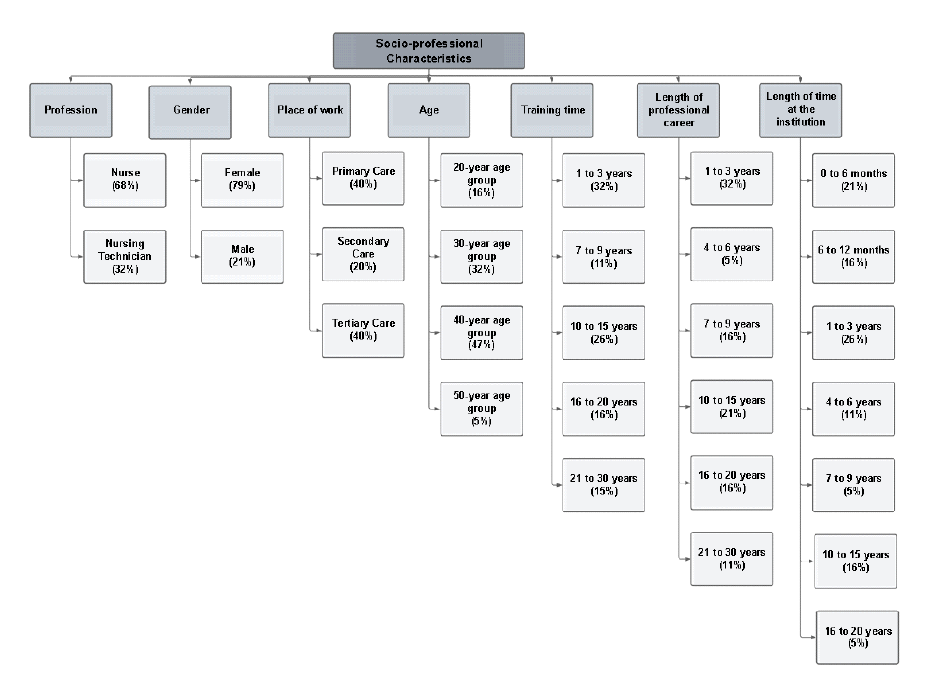
The study involved 19 nursing professionals, 13 (68%) nurses and six (32%) nursing technicians/auxiliaries, predominantly female, 15 (79%) nurses and nursing technicians/auxiliaries, with nine (47%) professionals over the age of 40, seven (40%) working in hospital services and six (32%) working for between one and three years. The socio-professional characteristics are shown in Figure 1.
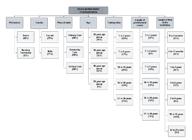
Diagram of the socio-professional characteristics of nursing professionals in the Health Care Network when facing COVID-19. Manaus, AM, Brazil, 2021.
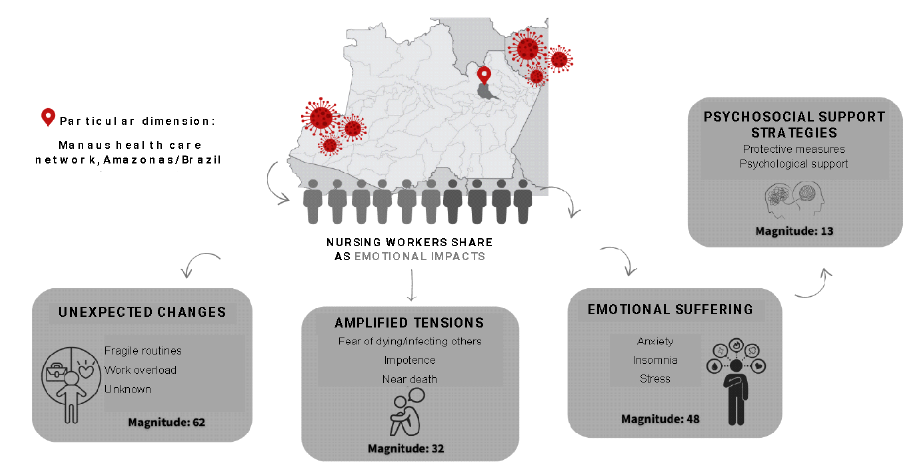
From the interview analysis, four themes emerged that highlight the perspectives of nursing professionals on Emotional Impacts during the COVID-19 pandemic: 1. Unexpected changes, 2. Expanded tensions, 3. Emotional suffering and 4. Psychosocial support strategies. The themes and sub-themes are shown in Figure 2. The themes are presented in sequence, following the logic of the experiential process rather than in order of magnitude. The categories are intertwined, mutually implicated in the experiences lived and systematized in the analytical process.
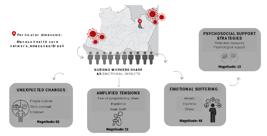
The first two themes, “Unexpected changes” and “Expanded tensions”, highlight the process that resulted in “Emotional suffering” and the fourth theme addresses the support received or desired to deal with this suffering.
While coping with the pandemic, professionals had to deal with unexpected changes, the definition of new routines without any sure knowledge of what they were facing, coupled with an unprecedented work overload. The physical overload of working long hours, with little rest or time off, was combined with exposure to the disease and working to the limits of their conditions. Conflict was experienced when the commitment to keep working and helping colleagues meant facing the fear of death.
It totally affected us because we changed our routine, we changed the dynamics, the working methods within the unit to try to adapt it to receive patients with Covid, the unit changed its entire characteristic, we had patients from all types of care and it became just Covid. (ENF 2)
Those who used to work 12 hours now work 15, Sunday to Sunday [...] now we work until Saturday noon, but we stay up until nine at night and we get home saturated, a bit stressed and in the morning we have to go back again, it is very tiring. (ENF 8)
I came to work afraid, terrified, with an excessive workload. I worked much longer than 12 hours, I had a time to get into the pink room, but no time to leave. I would take one shift after another, because the colleague who finished had to help us... So I could not leave, I had to stay to help the colleague, because I had a lot of patients, so I didn’t have time to leave. (ENF 15)
Tensions were heightened when they witnessed a situation that was out of their control, heightening their fear of their own death or of infecting people close to them. The feeling of helplessness overwhelmed these workers, who saw that the health services were saturated and unable to provide adequate care. The seriousness of the situation led to physical manifestations, such as loss of sleep.
The fear was always present, the worry, not that I would get it, but that I would pass it on to other people who are older, who have diabetes, high blood pressure. It was even more worrying, seeing colleagues fall ill and you having to hold the pressure while the number of professionals dwindled. (TE 3)
To see a person suffering and not have that structure, that support to give, to try to alleviate that suffering - it is very complicated. (TE 5)
The psychological burden was very difficult, very difficult because you are always paying attention, the fear of being contaminated, the fear of touching, even talking to people. [...] The biggest fear of all the health professionals was to take it home, because you have children, you have a husband, I didn’t even want to sleep together. (ENF 4)
We spend the early hours of the morning thinking about numbers ... I cannot even measure how many nights I woke up at two or three o’clock in the morning and could not sleep thinking about how many patients were crying out for help. (ENF 15)
Even after the most acute crisis had passed, some workers were still unable to describe their feelings clearly, they felt the situation was still present, a suffering that promoted pain, but they maintained an understanding of their role and the importance of continuing in the struggle to help other people.
I cannot describe a feeling to you, because all this is still very recent, I have lost friends, I have lost people close to me and I almost lost my parents. It is very painful to have to deal with all this, but you have to have the strength to try and help save a life. (ENF 8)
The changes at work increased tensions and led to emotional distress, which they described as tension, anxiety, and stress. The unknown, the lack of structure, the overload and not knowing what awaited them on their next working day led to bouts of anxiety and frequent crying. They recognized that the change demanded a transformation from them, but this was permeated by a lot of suffering and difficult to face.
I developed anxiety episodes, because you are in that state of tension all the time, you go out and when you leave, you wonder: have I been contaminated? Am I bringing contamination home? (ENF 15)
I was a little anxious, not knowing what I was going to face on a daily basis [...] but I calmed down soon after. After 10 weeks my anxiety doubled, the stress interfered with my work, but I managed to cope [...] I began to notice the same anxiety in the patients when they came to the BHU [...] afraid of the disease. (TE 9)
I would arrive on duty in the morning very emotionally shaken, everyone crying, everyone sad because we had heard that a friend had died, there was news of someone close to us who had died, and the people we had looked after on the previous shift had died too. (ENF 12)
On the subject of psychosocial support strategies, the perception of the emotional overload that led to their suffering indicated the need for support to deal with emotional instability. It was an initiative of the workers themselves, who in most situations didn’t know clearly where to look, as they were unaware of the existence of support in the institution. They then used professional support from a psychologist, colleagues and friends and spiritual support as a way of finding some emotional stability to be able to continue working, as they knew there was no one to replace them.
And I did not want to come, you know, so I started talking to a psychologist at the other job... I did some work with her, she talked to me a lot: you are not like that, you like what you do, you help people, so you have to make it. That helped me a lot. (ENF 4)
(...) it was very tough, but at no time did we have psychological support from any other institution. I think the emotional part is still weighing on us, you know? And we still have not had this emotional support from anyone, no one comes here to help us. (TE 7)
Many professionals who were affected psychologically had some psychologists with them; they called us from the ministry, they called psychologists, they did interviews to see how we were doing, mentally and spiritually. (ENF 8)
I went to the unit, to see psychologists, but they were not there on those days, I think it was the weekend, so I went to see a coworker. I sort of got it off my chest and she tried to comfort me by talking about God. I remembered the religious side and I clung to God that day, and to this day I have been clinging more and more, because I had nowhere to hold on to, I had no support. (ENF 13)
DISCUSSION
The nursing profession is based on direct and continuous contact with the patient, which makes these professionals more likely to experience stressful situations in the event of major public health problems, as in the case of the COVID-19 pandemic15. The essentiality of nursing work in health services is indisputable, and it constitutes a significant contingent in the Unified Health System (Sistema Único de Saúde, SUS), sensitive to the immediate labor impacts in pandemic contexts, as a result of the real-time adjustments made in services to respond to the needs of the territory16.
Many studies have addressed the precarious employment relationships and inadequate working conditions constantly experienced by nursing staff, a situation that has intensified during the COVID-19 pandemic, as evidenced by the reports of this research16-17.
Unexpected changes were felt due to the need to reorganize work with new routines, protocols, and flowcharts, or even to restructure health units. This highlighted the nurse’s role in managing various processes of readjustment, training, and the construction of Standard Operating Procedures (SOPs), as revealed by studies that analyzed the impacts on the lives, health and work of nursing professionals during the pandemic18-19.
In order to meet the demand from professionals who had to take time off, there was an increase in workload and excessive tasks, intensifying the negative aspects of the pandemic and the emotional impacts20. The overload affected both professional performance, due to exhaustion, and the personal and family spheres, due to the time given up to spend with family and the need to stay away as a way of protecting against possible infection21-22.
Permeating the sub-theme of amplified tensions, the report of fear was very present: fear of dying, fear of contracting/transmitting the disease and fear of the unknown and invisible - which was reported by both nurses and health workers in general23-24.
Nevertheless, the feeling of powerlessness and the need to deal with the death of patients, professional colleagues and family members have become part of these professionals’ daily lives, as reported as some of the ingredients that generate emotional distress in these professionals25.
Stress, anxiety and insomnia were reported by frontline professionals as signs of emotional distress. These symptoms are aligned with work overload and are explained by concern for patients, themselves, and their families, in a climate of extreme insecurity26-27.
The psychosocial support strategies were based on psychological support, religiosity, and spirituality. Psychological care took place in person or by telephone and played an important role in the process of dealing with, accepting, and understanding the experiences of coping with the pandemic. The importance of support and acceptance in the face of frustration, loss and change was therefore highlighted28-29.
The coping practices strengthened by religiosity and spirituality, whether or not linked to professional psychological support, were shown to be practices that continued or began during the pandemic, favoring mental and emotional stability and overcoming moments of crisis. Thus, it was corroborated that religiosity and spirituality contributed to improving quality of life, coping with the situation and mitigating levels of emotional, physical, and mental exhaustion29-30.
On the other hand, other professionals reported not receiving any support while working on the front line during the pandemic, which interfered with the coping process and the development and intensification of emotional and mental impacts27,29.
This study’s limitation lies in the fact that it was conducted exclusively during the COVID-19 pandemic’s first wave, which may not reflect a comprehensive and continuous view of the impact and emotional distress experienced by nursing professionals over time.
FINAL CONSIDERATIONS
The COVID-19 pandemic has had a severe impact on the lives, health and work of nursing professionals, exposing them to stressful situations, anxiety, insomnia and emotional distress. Unexpected changes in the work routine, an increase in workload, fear of contagion and death, powerlessness in the face of the disease and suffering from loss have marked the personal and professional lives of these workers. To deal with these challenges, many sought support from psychological services, religiosity and spirituality.
In this way, the results obtained during the research can encourage the construction of effective and continuous support strategies for professional performance and planning for adequate and resilient work organization within teams, services and systems, as essential conditions for coping in a public health emergency scenario.
AKNOWLEDGEMENTS
We thank the Amazonas State Research Foundation (Fundação de Amparo à Pesquisa do Estado do Amazonas, FAPEAM), the National Council for Scientific and Technological Development (CNPq) and the Coordination for the Improvement of Higher Education Personnel (CAPES) for their financial and technical support.
References
-
1 Almeida RMF de, Antunes LMS, Barros F de M, Silva RC da. COVID-19: a new phenomenon of social representations for nursing teams in intensive care. Esc Anna Nery. [Internet]. 2021 [cited 2023 Mar. 12]; 25(spe):e20200118. Available from: http://dx.doi.org/10.1590/2177-9465-ean-2020-0118
» http://dx.doi.org/10.1590/2177-9465-ean-2020-0118 -
2 Santos KMR dos, Galvão MHR, Gomes SM, Souza TA de, Medeiros A de A, Barbosa IR. Depression and anxiety in nursing professionals during the covid-19 pandemic. Esc Anna Nery. [Internet]. 2021 [cited 2023 Mar. 14]; 25(spe):e20200370. Available from: http://dx.doi.org/10.1590/2177-9465-ean-2020-0370
» http://dx.doi.org/10.1590/2177-9465-ean-2020-0370 -
3 Carver PE, Phillips J. Novel Coronavirus (COVID-19): what you need to know. Workplace Health Saf. [Internet]. 2020 [cited 2023 Mar. 14]; 68(5). Available from: http://dx.doi.org/10.1177/2165079920914947
» http://dx.doi.org/10.1177/2165079920914947 -
4 Monteiro TR, Xavier DS, Mazzari AS. Epidemiology of COVID-19 in Amazonas, Brazil. Bepa. [Internet]. 2020 [cited 2023 Mar. 14]; 17(201):19. Available from: http://dx.doi.org/10.57148/bepa.2020.v.17.34260
» http://dx.doi.org/10.57148/bepa.2020.v.17.34260 -
5 Silva LEP da, Targino RL de O, Palheta RP, Araújo LRP, Anjos JGX dos. Amazon at the epicenter of the COVID-19 pandemic a systematic review. Braz J Hea Rev. [Internet]. 2022 [cited 2023 Mar. 12]; 5(3):9270-80. Available from: http://dx.doi.org/10.34119/bjhrv5n3-105
» http://dx.doi.org/10.34119/bjhrv5n3-105 -
6 Riedel B, Horen SR, Reynolds A, Jahromi AH. Mental health disorders in nurses during the COVID-19 pandemic: Implications and coping strategies. Front Public Health. [Internet]. 2021 [cited 2023 Mar. 12]; 9:707358. Available from: http://dx.doi.org/10.3389/fpubh.2021.707358
» http://dx.doi.org/10.3389/fpubh.2021.707358 -
7 Queiroz AM, Sousa AR de, Moreira WC, Nóbrega M do OS de S, Santos MB, Barbossa LJH, et al. The novel COVID-19: impacts on nursing professionals’ mental health? Acta Paul Enferm. [Internet]. 2021 [cited 2023 Apr. 25]; 34:eAPE02523. Available from: https://doi.org/10.37689/acta-ape/2021AO02523
» https://doi.org/10.37689/acta-ape/2021AO02523 -
8 Acioli DMN, Santos AAP dos, Santos JAM, Souza IP de, Silva RK de L. Impacts of the COVID-19 pandemic on nurses’ health. Rev Enferm UERJ. [Internet]. 2022 [cited 2023 Apr. 25]; 30(1):e63904. Available from: http://dx.doi.org/10.12957/reuerj.2022.63904
» http://dx.doi.org/10.12957/reuerj.2022.63904 -
9 Clancy G, Gaisser DD, Wlasowicz GK. COVID-19 and mental health: Self-care for nursing staff. Nursing. [Internet]. 2020 [cited 2023 Apr. 28]; 50(9):60-3. Available from: http://dx.doi.org/10.1097/01.nurse.0000694840.11164.75
» http://dx.doi.org/10.1097/01.nurse.0000694840.11164.75 -
10 Frawley T, Van Gelderen F, Somanadhan S, Coveney K, Phelan A, Lynam-Loane P, et al. The impact of COVID-19 on health systems, mental health and the potential for nursing. Ir J Psychol Med. [Internet]. 2021[cited 2023 Apr. 28]; 38(3):220-6. Available from: http://dx.doi.org/10.1017/ipm.2020.105
» http://dx.doi.org/10.1017/ipm.2020.105 -
11 Castro Júnior AR de, Silva MRF da, Duarte RB, Paula MA de. Battle diaries: nurses at the forefront of coping with covid-19. Revista Uruguaya de Enfermería. [Internet]. 2021 [cited 2023 Apr. 28]; 16(1). Available from: http://dx.doi.org/10.33517/rue2021v16n2a1
» http://dx.doi.org/10.33517/rue2021v16n2a1 -
12 Adanaqué-Bravo I, Escobar-Segovia K, Gómez-Salgado J, García-Iglesias JJ, Fagundo-Rivera J, Ruiz-Frutos C. Relationship between psychological distress, burnout and work engagement in workers during the COVID-19 pandemic: a systematic review. Int J Public Health. [Internet]. 2023 [cited 2023 Apr. 30]; 67:1605605. Available from: http://dx.doi.org/10.3389/ijph.2022.1605605
» http://dx.doi.org/10.3389/ijph.2022.1605605 -
13 Saunders B, Sim J, Kingstone T, Baker S, Waterfield J, Bartlam B, et al. Saturation in qualitative research: exploring its conceptualization and operationalization. Qual Quant. [Internet]. 2018 [cited 2023 Apr. 30]; 52(4):1893-907. Available from: http://dx.doi.org/10.1007/s11135-017-0574-8
» http://dx.doi.org/10.1007/s11135-017-0574-8 -
14 Attride-Stirling J. Thematic networks: an analytic tool for qualitative research. Qual Res. [Internet]. 2001 [cited 2022 Dec. 15]; 1(3):385-405. Available from: http://dx.doi.org/10.1177/146879410100100307
» http://dx.doi.org/10.1177/146879410100100307 -
15 Ramos-Toescher AM, Tomaschewisk-Barlem JG, Barlem ELD, Castanheira JS, Toescher RL. Mental health of nursing professionals during the COVID-19 pandemic: support resources. Esc Anna Nery. [Internet]. 2020 [cited 2023 Apr. 30]; 24(spe):e20200276. Available from: http://dx.doi.org/10.1590/2177-9465-ean-2020-0276
» http://dx.doi.org/10.1590/2177-9465-ean-2020-0276 -
16 Rezio L de A, Oliveira E de, Queiroz AM, Sousa AR de, Zerbetto SR, Marcheti PM, et al. Neoliberalism and precarious work in nursing in the COVID-19 pandemic: repercussions on mental health. Rev Esc Enferm USP. [Internet]. 2022 [cited 2024 June 7]; 56:e20210257. Available from: http://dx.doi.org/10.1590/1980-220x-reeusp-2021-0257
» http://dx.doi.org/10.1590/1980-220x-reeusp-2021-0257 -
17 Souza NVD de O, Carvalho EC, Soares SSS, Varella TCMYML, Pereira SRM, Andrade KBS de. Nursing work in the COVID-19 pandemic and repercussions for workers’ mental health. Rev Gaucha Enferm. [Internet]. 2021 [cited 2024 June 7]; 42(spe):e20200225. Available from: http://dx.doi.org/10.1590/1983-1447.2021.20200225
» http://dx.doi.org/10.1590/1983-1447.2021.20200225 -
18 Miranda FMD, Santana LDL, Pizzolato AC, Sarquis LMM. Working conditions and the impact on the health of the nursing professionals in the context of covid-19. Cogitare Enferm. [Internet]. 2020 [cited 2024 June 7]; 25:e72702. Available from: http://dx.doi.org/10.5380/ce.v25i0.72702
» http://dx.doi.org/10.5380/ce.v25i0.72702 -
19 Fernandez M, Lotta G, Passos H, Cavalcanti P, Corrêa MG. Working conditions and perceptions of nursing professionals who work to cope with covid-19 in Brazil. Saúde Soc. [Internet]. 2021 [cited 2023 July 10]; 30(4):e201011. Available from: http://dx.doi.org/10.1590/s0104-12902021201011
» http://dx.doi.org/10.1590/s0104-12902021201011 -
20 Ribeiro AA de A, Oliveira MV de L, Furtado BMASM, Freitas GF de. Impacts of the COVID-19 pandemic on Brazilian nurses’ lives, health and work. Acta Paul Enferm. [Internet]. 2022 [cited 2023 July 10]; 35:eAPE01046. Available from: http://dx.doi.org/10.37689/acta-ape/2022ao010466
» http://dx.doi.org/10.37689/acta-ape/2022ao010466 -
21 Fonsêca CRP, Aguiar BF, Macedo LC, Miranda FMD. Quality of life at work of nursing professionals: reflection on the impacts of covid-19. Rev Enferm Cent-Oeste Min. [Internet]. 2021[cited 2023 July 18]; 11:e3886. Available from: http://dx.doi.org/10.19175/recom.v11i0.3886
» http://dx.doi.org/10.19175/recom.v11i0.3886 -
22 Lima MF de M, Silva PSF, Medeiros GG de. Nursing facing the Covid-19 pandemic and the quality of life at work. REVISA. [Internet]. 2022 [cited 2023 July 19]; 16-25. Available from: http://dx.doi.org/10.36239/revisa.v11.n1.p16a25
» http://dx.doi.org/10.36239/revisa.v11.n1.p16a25 -
23 Ramos FRS, Silva DMGV da, Lima KJV, Monteiro WF, Sachett J de AG, Monteiro W, et al. Path of fear: Experiences of health professionals in the fight against COVID-19. Nurs Inq. [Internet]. 2023 [cited 2023 Aug. 25]; e12578. Available from: http://dx.doi.org/10.1111/nin.12578
» http://dx.doi.org/10.1111/nin.12578 -
24 Duarte M de LC, Silva DG da, Bagatini MMC. Nursing and mental health: a reflection in the midst of the coronavirus pandemic. Rev Gaucha Enferm. [Internet]. 2021 [cited 2023 July 19]; 42(spe):e20200140. Available from: http://dx.doi.org/10.1590/1983-1447.2021.20200140
» http://dx.doi.org/10.1590/1983-1447.2021.20200140 -
25 Miranda FBG, Yamamura M, Pereira SS, Pereira C dos S, Protti-Zanatta ST, Costa MK, et al. Psychological distress among nursing professionals during the COVID-19 pandemic: Scoping Review. Esc Anna Nery. [Internet]. 2021 [cited 2023 July 19]; 25(spe):e20200363. Available from: http://dx.doi.org/10.1590/2177-9465-ean-2020-0363
» http://dx.doi.org/10.1590/2177-9465-ean-2020-0363 -
26 Olino L, Tavares JP, Magnago TSB de S, Ampos LF, Vieira LS, Ongaro JD, et al. Minor psychiatric disorders among nursing workers during the pandemic: a multicenter study. Acta Paul Enferm. [Internet]. 2022 [cited 2023 Aug. 28]; 35:eAPE02337. Available from: http://dx.doi.org/10.37689/acta-ape/2022ao02337
» http://dx.doi.org/10.37689/acta-ape/2022ao02337 -
27 Luz EMF da, Munhoz OL, Morais BX, Greco PBC, Camponogara S, Magnago TSB de S. Repercussions of covid-19 in the mental health of nursing workers. Rev Enferm Cent-Oeste Min. [Internet]. 2020 [cited 2023 July 19]; 10:e3824. Available from: http://dx.doi.org/10.19175/recom.v10i0.3824
» http://dx.doi.org/10.19175/recom.v10i0.3824 -
28 Moreira AS, Lucca SR de. Psychosocial support and mental health of nursing professionals in the fight against covid-19. Enferm Em Foco. [Internet]. 2020 [cited 2023 July 22]; 11(1.esp): 155-61. Available from: http://dx.doi.org/10.21675/2357-707x.2020.v11.n1.esp.3590
» http://dx.doi.org/10.21675/2357-707x.2020.v11.n1.esp.3590 -
29 Amaral GG, Silva LS, Oliveira JV de, Machado NM, Teixeira JS, Passos HR. Ethical-emotional support for Nursing professionals facing the COVID-19 pandemic: an experience report. Esc Anna Nery. [Internet]. 2022 [cited 2023 July 22]; 26(spe):e20210234. Available from: http://dx.doi.org/10.1590/2177-9465-ean-2021-0234
» http://dx.doi.org/10.1590/2177-9465-ean-2021-0234 -
30 Ampos LF, Vecchia LPD, Tavares JP, Camatta MW, Magnago TSB de S, Pai DD. Implications of nursing performance in coping with COVID-19: emotional exhaustion and strategies used. Esc Anna Nery. [Internet]. 2023 [cited 2023 Aug. 25]; 27:e20220302. Available from: http://dx.doi.org/10.1590/2177-9465-ean-2022-0302pt
» http://dx.doi.org/10.1590/2177-9465-ean-2022-0302pt

 Source: The authors (2021).
 Source: The authors (2021).