
 Inequality and Intersectionality: The State of Gender, Race, and Inclusion Policies for People with Disabilities in Brazilian Companies
Abstract
The study analyzed the social, racial, and gender profiles of 131 companies surveyed by the Ethos Institute (2023-2024), focusing on the intersection of these variables with the status of people with disabilities. The research was based on Social Exchange Theory and Intersectionality, using survey data. The descriptive and documentary method revealed deep structural inequalities, with Black women and people with disabilities at a significant disadvantage. Only 36.8% of companies have pay equity goals, and minority representation, including people with disabilities in leadership positions, is very limited. Parental leave and the extension of paternity leave are limited, reinforcing gender stereotypes in family care. Despite advances in policies to combat harassment, affirmative action remains insufficient to promote meaningful change. The study concludes that progress toward racial, gender equity, and inclusion of people with disabilities remains slow, emphasizing the need for more effective and targeted policies.
Keywords:
Racism; Sexism; Intersectionalities; Person with disability
Resumo
O estudo analisou o perfil social, racial e de gênero nas 131 empresas pesquisadas pelo Instituto Ethos (2023-2024), com foco na interseção dessas variáveis com a condição de pessoa com deficiência. A pesquisa baseou-se na Teoria da Troca Social e na interseccionalidade, utilizando dados da referida pesquisa. O método descritivo e documental revelou profundas desigualdades estruturais, com mulheres negras e pessoas com deficiência em desvantagem significativa. Apenas 36,8% das empresas possuem metas de equidade salarial, e a representatividade das minorias, incluindo pessoas com deficiência, em cargos de liderança é muito reduzida. A licença parental e a extensão da licença-paternidade são limitadas, reforçando estereótipos de gênero no cuidado familiar. Apesar de avanços nas políticas de combate ao assédio, as ações afirmativas ainda são insuficientes para promover mudanças significativas. O estudo conclui que o progresso rumo à equidade racial, de gênero e inclusão de pessoas com deficiência permanece lento, reforçando a necessidade de políticas direcionadas e mais eficazes.
Palavras-chave:
Racismo; Sexismo; Interseccionalidade; Pessoa com deficiência
Resumen
El estudio analizó los perfiles sociales, raciales y de género de 131 empresas encuestadas por el Instituto Ethos (2023-2024), centrándose en la intersección de estas variables con la situación de las personas con discapacidad. La investigación se basó en la teoría del intercambio social y en la interseccionalidad, utilizando datos de la encuesta mencionada. El método descriptivo y documental reveló profundas desigualdades estructurales, con mujeres negras y personas con discapacidad en desventaja significativa. Solo el 36,8% de las empresas tiene metas de equidad salarial, y la representatividad de las minorías, incluidas las personas con discapacidad, en cargos de liderazgo es muy limitada. La licencia parental y la extensión de la licencia de paternidad son limitadas, reforzando estereotipos de género en el cuidado familiar. A pesar de los avances en las políticas de combate al acoso, las acciones afirmativas todavía son insuficientes para promover cambios significativos. El estudio concluye que el progreso hacia la equidad racial, de género e inclusión de personas con discapacidad sigue siendo lento, reforzando la necesidad de políticas específicas y más efectivas.
Palabras clave:
Racismo; Sexismo; Interseccionalidad; Persona con discapacidad
INTRODUCTION
The gender and race policy in the Brazilian labor context is marked by deep structural inequalities, reflected in practices of violence, prejudice and discrimination. These disparities affect not only the process of insertion in the labor market, but also the permanence and opportunities for professional advancement, reinforcing gender and race inequalities (Ferreira et al., 2023). In addition, when considering the situation of people with disabilities, these barriers are even more pronounced, creating a context of multiple exclusions and further challenges for full inclusion (Batista et al., 2023a, 2024).
In this context, intersectionality, a concept coined by Crenshaw (1991), emerges as a fundamental analytical tool. Originating from Black feminism and critical theory, intersectionality aims to illuminate the experiences of Black women, who face disadvantages in various spheres of life. These women are deeply affected by racism and sexism, in addition to suffering various forms of violence, including sexual violence, in the pursuit of social justice.
Gender inequality has deep historical roots, which has driven the emergence of the feminist movement. However, feminism’s internal division, especially in regard to Black feminism, has exposed the inadequacy of traditional feminist agendas to address the issues faced by Black women. While hegemonic feminism, predominantly white, neglected the specificities of racial and class oppressions, Black feminism emerged as a critical response, seeking to give voice and visibility to the demands of Black women, which until then had been silenced (Ribeiro, 2018).
Likewise, the inclusion of people with disabilities in the Brazilian labor market continues to be marked by historical, institutional and attitudinal barriers. Studies show that, in addition to difficulties in getting access to vacancies, this group faces continuous processes of discrimination, invisibility, and restriction of opportunities for professional growth (Batista et al., 2024).
This study fills a gap by presenting data on the intersection of gender, race, and disability in positions of power and operational roles, based on 131 companies participating in the Ethos survey. The variables analyzed include different hierarchical levels, such as the board of directors, supervision, coordination, trainees, interns and staff. Furthermore, the research addressed the executive leadership’s perception of gender and race representation; actions to promote women in leadership positions; wage equity policies; maternity, paternity and parental leave; in addition to measures to combat harassment. The study also highlights the role of affirmative action and the Brazilian Pact for the Promotion of Racial Equity (2025) in promoting inclusion and corporate diversity.
According to data from the Brazilian Institute of Geography and Statistics (IBGE, 2024), in the second quarter, the employed population with a formal contract reached 11.393 million people, while in the public sector this number was 2.128 million. The unemployment rate in the period was 6.4%. Poverty in Brazil was predominantly Black, with this population representing just over 10% of the real effective household income per capita, namely 13.2%, whereas more than 50% of this income was attributed to the white population (IBGE, 2022). This data reinforces the relevance of this study, as it focuses on gender and race inequality, especially the impact that these inequalities have on the education and employment of Black women (Ferreira et al., 2023).
Data from the Brazilian Inter-Union Department of Statistics and Socioeconomic Studies (Dieese) referring to a study with 190 workers shows the significant wage disparities between men and women in 2022. Men received, on average, 80.2% more in median wages and 84.4% more in terms of overall wages. Concerning occupations, the disparities were even more pronounced: in higher education, men earned 92.7% more, while in administrative technician positions this difference was 87.2% (Dieese, 2024). The analysis revealed that 38.9% were white women; 11.1%, Black women; 40%, white men; and 10%, Black men, revealing inequalities in participation in the labor market, with Black women at a clear disadvantage both in representation and income. This data reinforces the deep differences in wages and professional insertion, highlighting the situation of vulnerability of Black women.
The overlapping of the domestic workload, which includes family responsibilities, childcare, and household chores, occurs largely due to the lack of delimitation of gender roles in family policy (Ben-Uri et al., 2022; Picanço et al., 2021). This unequal distribution causes women to carry this burden, which is socially imposed on them, reflecting on their bodies, whether black or white, while their identities are often disregarded outside the private space.
In addition, when the body has a disability, the opportunities for inclusion in the labor market are even more limited (Batista et al., 2023a, 2024). In view of this scenario of discrimination and gender inequality in Brazil, the question arises: How are the differences between gender and race presented in Brazilian companies, and how do these categories intersect with people with disabilities? This reflection is fundamental to understand the multiple layers of exclusion that affect women, especially Black women and those with disabilities, in the corporate environment.
The objective of this paper was to discuss the results of the social, racial and gender profile, analyzing how these variables intersect with the situation of people with disabilities in the 131 companies representing the sample of a universe of 1,100 companies. The study was based on the 2023-2024 affirmative actions published by the Instituto Ethos (2024), covering several sectors, and highlights the need to advance in terms of cultural diversity, especially in relation to gender, race, and inclusion of people with disabilities. This diversity is fundamental, given that the multiple competencies which emerge from this context create a competitive advantage for the business.
A descriptive and documentary research was carried out based on the issue of Black and white women and the intersection with people with disabilities in the 131 companies that participated in the Ethos study. This analysis contributes to a deeper understanding of the structural inequalities which permeate the corporate environment and highlights the importance of inclusion policies addressing the needs of all marginalized groups.
The Social Exchange Theory is relevant to understanding how companies which adopt diversity policies covering gender, race, and inclusion of people with disabilities promote social justice (Shin et al., 2022). This process involves a mutual exchange which recognizes the intersectionality between gender, race, and social class (Collins & Bilge, 2021; Crenshaw, 1991; Gonzalez, 2020), highlighting the exclusionary condition faced by Black women in organizations. In addition, the aesthetic aspect of these women can hinder their insertion in the corporate environment (Ferreira & Nunes, 2024).
This paper offers a theoretical and empirical contribution to organizational studies and diversity policies, by adopting an intersectional approach which articulates gender, race and disability. The research proposes a critical analysis of structural inequalities, going beyond the description of secondary data and suggesting ways to improve inclusion policies in companies. From a practical point of view, it can support managers, public policy makers and leaders in the construction of more inclusive and equitable strategies.
THEORETICAL FRAMEWORK
Saffioti (2015) argues that women are historically seen as the weaker and inferior sex, while patriarchy plays a central role in the perpetuation and naturalization of conservative gender roles. This patriarchal system suggests that certain activities are inherently feminine, which limits women’s participation and visibility in traditionally male-dominated areas (Cisne, 2015).
McCarthy and Taylor (2024, p. 457) expand on this analysis, identifying patriarchal relations as manifestations of misogyny, characterized by “physical and symbolic violence, gender hatred, and social policing in and around organizations.” Such dynamics reinforce the barriers and challenges faced by women in societies which legitimize gender inequality and consolidate the sexist structure.
Alemonge et al. (2021) highlight that, although women are the majority in higher education institutions in Brazil, being driven by the quest for social ascension, the effectiveness of this journey depends on a liberating education which helps to overcome the barriers imposed by power and social class relations. The juggle between work, family and study, combined with the devaluation of teaching and the lack of support, compromises female autonomy and increases professional difficulties.
The challenge of double shifts, or the conflict between work and family, subjects women to a complex system of professional and family responsibilities, generating stress and impacting engagement and innovation at work (Nurcholidah et al., 2023). This conflict also affects mental health, causing burnout due to constant pressure (Aman-Ullah et al., 2025). Factors such as discriminatory culture, sexual harassment (Park et al., 2023), and misogyny (McCarthy & Taylor, 2024) exacerbate these barriers to gender equity. The triple shift, which includes the roles of mother, professional and student, compromises quality of life, increasing physical and emotional exhaustion and the feeling of guilt due to the difficulty in balancing all demands (Ferreira & Reis, 2021).
In Brazil, Ferreira et al. (2024) show that Black women are subject to significant inequalities compared to Black men, white women, and white men, both in the process of inclusion in the labor market and in average financial income. They are underrepresented in management and board positions and face gender disadvantages across all Brazilian states. These findings are corroborated by other studies (Chai et al., 2022; Rezende & Andrade, 2022; Thomas, 2019), which reinforce the persistence of these structural inequalities and the need for specific policies to promote gender and race equity in the country.
Pereira and Rezende (2022) emphasize the importance of discussing racism in diversity management in organizations, pointing to the need for hiring and inclusion policies which prevent the exclusion of people based on their phenotypic and personal characteristics. These practices are essential to promote more equitable and inclusive management, especially in a context marked by structural inequalities.
Despite the existence of the Pact for the Promotion of Racial Equity, inequalities persist, especially in top positions, in which the participation of Black people remains limited. Thus, it is essential to implement affirmative policies that promote the qualification of the majority of the Brazilian population, which is Black yet, culturally, is a minority - under the terms of the Statute of Racial Equality (Lei n. 12.288, 2010) -; and that companies take an active role in promoting anti-racist practices (Pacto de Promoção da Equidade Racial, 2025).
Ferreira and Reis (2021) show that, during the Covid-19 pandemic, Black women in triple shifts and telecommuting suffered greater difficulties with academic tasks compared to white women. Nero et al. (2024) add that the lives of Black women are marked by constant efforts and great challenges. This data reveals the need for public policies that meet the demands of this social group, which faces the intersectionality between sexism, racism and classism, perpetuating social and economic inequalities.
Black women face sexism and structural racism in Brazilian society on a daily basis (Ferreira et al., 2023; Gonzalez, 2020; Nero et al., 2024). These discriminations are further intensified when these women have characteristics which are seen as negative stereotypes, as is the case with people with disabilities or people of advanced age, resulting in greater marginalization and discrimination (Batista et al., 2023a, 2024; Goldani, 2010). According to Thomas et al. (2019), Black men and women are underrepresented in prestigious professions, such as medicine, due to structural racism, which hinders recruitment and selection opportunities for these groups.
Avery (2003) observes that companies often use racial diversity in recruitment advertisements as a strategy to attract candidates, but without guaranteeing real opportunities for Black people and other minorities at all hierarchical levels. Rezende and Andrade (2022) reinforce this criticism by pointing out that many advertisements still carry “oppressive signs of race”, such as requirements of good appearance and hygiene, reflecting prejudices that privilege white women. This scenario reinforces the need for affirmative actions which expand the access of historically excluded groups to positions of greater prestige and decision-making power.
Chai et al. (2022) highlight that Black women deal with asymmetrical power relations in the workplace, often being made invisible by their employers, which limits their access to resources and the power needed to confront exploitation. In this sense, it is essential to redesign organizational strategies, eliminating practices which perpetuate work analogous to slavery and promoting a decolonial debate to break the silence imposed on these women. Pereira and Rezende (2022) complement this analysis by pointing out racism in diversity management, emphasizing the need for hiring and inclusion policies which prevent exclusion based on phenotypic and personal characteristics.
Sexism and structural racism in Brazil show that certain types of bodies are privileged in organizations, with an emphasis on white, heterosexual and thin men, which represent the normalized European standard (Connor et al., 2016; Saraiva et al., 2020). This dynamic leads to discrimination against black bodies and subaltern white people in the labor market (Irigaray et al., 2023).
In addition to these dimensions, ableism, understood as the set of practices which devalue or exclude people with disabilities, represents a structural barrier in organizations. In spite of legislative advances, such as the Quota Law (Lei n. 8.213, 1991), the inclusion of this group still faces obstacles in access and career progression (Batista et al., 2023a, 2024). Lage et al. (2023) highlight attitudinal barriers and others as central factors of exclusion, hindering practices in the implementation of inclusive policies and in offering adequate support to employees.
The intersectionality between sexism, racism, classism, and ableism intensifies exclusions in the labor market. Despite the advances of the Quota Law, many companies still fail to comply with it, even at the risk of penalties. Although this law is a milestone, especially in comparison to other countries, such as Portugal (Batista et al., 2023b), discrimination against people with disabilities remains alarming. The scenario requires broader and more strategic policies that recognize multiple oppressions and promote effective actions. Awareness campaigns are essential for more inclusive and equitable environments (Batista et al., 2023a).
Framework: Social Exchange Theory and intersectionality
The management situation in Brazilian organizations is marked by discrimination affecting minority groups, often seen as inferior and with their capacities disregarded. Acker (1990, 2006) points out that norms and statutes often reinforce exclusion, rather than promoting inclusion. Even when inserted in the labor market, these groups rarely fill high-ranking positions, which remain directed to a hegemonic profile, usually that of the white man.
Menezes and Mendes (2023, p. 1) emphasize the importance of breaking with “silence, silencing, and complicit silence, which contribute to the perpetuation of racism, inequalities, and exclusions in organizations”. To promote effective change, it is essential to discuss racism both inside and outside organizations, through the implementation of anti-racist norms. Minority groups are recognized for their difference, reflecting the complexity of cultural diversity in the workplace.
Alves and Galeão-Silva (2004) argue that diversity management has an ideological character, as many companies ignore the impacts of prejudice and prioritize profit. On the other hand, Álvares and Souza (2016) find that sustainability practices with a social focus, aimed at internal and external stakeholders, strengthen the organizational image; attract and retain talent; promote integration; improve financial performance and increase internal satisfaction, generating competitive advantages.
The Theory of Social Exchange offers a relevant perspective to understand the management of gender diversity and the inclusion of people with disabilities in public and private organizations. This theory emphasizes that relationships between employees and employers involve an exchange with mutual obligations, based on a reciprocity contract, in which both expect financial or work-related benefits (Emerson, 1976).
The Theory of Social Exchange, according to Cook and Rice (2003), is based on social psychology, with influences from utilitarianism and behaviorism. This approach allows the analysis of social phenomena at the micro level, such as rewards and costs, and at macrostructural levels, derived from social dynamics. The authors point out that, although the initial discussions focused on the nature of the social actor, it is recognized that interactions are multiple, negotiated and permeate all aspects of social life. Along with the Social Status Theory, this perspective has an influence on social networks, equity, coalition building, solidarity, trust, and emotion, being a reflection of the complexity of contemporary relationships.
Redmond (2015) emphasizes that social interaction involves mutual exchanges, so the Theory of Social Exchange is a useful tool to understand the development and management of interpersonal relationships. Rubel et al. (2016) complement this by stating that the employment relationship is mediated by trust, beliefs and reciprocal obligations, functioning as a cost-benefit relationship. In this context, management practices which promote organizational trust, support, and fairness tend to increase employee engagement.
In the case of Black women, Social Exchange Theory needs to take on an intersectional perspective, as this group faces barriers in recruitment, selection, and inclusion, often due to aesthetic stereotypes (Ferreira & Nunes, 2024). This exclusion, the result of the overlapping of oppressions, reveals the limitations of theory to explain the disparities in opportunities between Black women, white women, Black men and white men. Such a scenario highlights how intersectionality perpetuates social and economic inequalities (Teixeira et al., 2020).
Intersectionality is a valuable approach to show the deprivation of rights resulting from the interplay between racism, heterosexism, class exploitation, colonialism, and ethnic or religious subordination (Collins & Bilge, 2021). These factors, when intersecting, negatively impact the lives of Black women. The authors reinforce that the combination of racism, sexism, and poverty makes intersectionality a crucial analytical tool for exposing social injustices and strengthening activism. By analyzing power relations in different societies, it allows us to understand how these oppressions manifest themselves in everyday life. In this context, it is imperative to develop social policies which promote the empowerment of Black women, and therefore, an intersectional application of the Theory of Social Exchange is recommended.
METHODOLOGICAL PROCEDURES
The investigation adopted a descriptive study (Flick, 2009), with documentary research based on the report of the Instituto Ethos (2024) whose title is “Social, Racial and Gender Profile of the 1,100 Largest Companies in Brazil and Their Affirmative Actions - 2023-2024”. This approach made it possible to analyze gender and race, evidencing the inequalities of power between dominant and dominated groups in the labor market (Narvaz & Koller, 2006). It also exposed the oppressions related to patriarchy, sexism, and racism in the 131 participating companies. People who self-declared themselves brown or black, according to the Statute of Racial Equality, were considered to belong to the Black race.
A comparative analysis of gender, race and disability was performed, considering the percentage distribution between men, women, whites, blacks, and people with disabilities. This approach sought to highlight the disadvantages of these groups compared to white men, analyzing their representation at different hierarchical levels, such as boards of directors, supervision, leadership, coordination, and trainee programs. An assessment was also made of leadership’s perceptions of representativeness; actions to encourage female participation; wage equity policies; maternity, paternity and parental leave; in addition to measures to combat harassment.
According to the report, data collection took place between September 4, 2023, and March 31, 2024, covering the thousand largest companies in Brazil and 100 large institutions in the financial sector. The survey was online, via a self-completed questionnaire, answered by Human Resources managers, diversity and inclusion professionals, and C-level executives (Instituto Ethos, 2024). The internal counting of the data was under the responsibility of the organizations themselves. The objective was to outline the profile of employees and executives at all hierarchical levels, according to data from the Instituto Ethos (2023-2024). The questionnaire had four parts: three answered by HR managers or related areas and one aimed at the main leaders.
The companies listed in the Valor Econômico newspaper received, by e-mail, a letter from the Instituto Ethos with access to the questionnaire, sent by the consultancy firm Inteligência em Pesquisa e Consultoria Estratégica. Two links were made available: one for Human Resources managers and the other for executives. The survey followed the General Data Protection Law, ensuring the anonymity of participants and companies. The final sample included 131 companies: 21 answered the 3rd part (main leaders); 17 completed the sections intended for HR managers; and 93 completed the four parts of the questionnaire. It was not possible to perform a segmented analysis due to the limitation of the database (Instituto Ethos, 2024).
The characterization of the companies participating in the survey covered several sectors, being 42.7% in industry, 39.7% in services and 17.6% in food/agricultural products and trade. In terms of revenue size, most companies have revenues of more than 3 billion BRL. Regarding the number of employees, companies with more than 5,001 employees predominated. In addition, 92.7% of the companies are located in the Southeast and South regions of Brazil.
With regard to collaboration with non-governmental movements and organizations on the importance of diversity and inclusion, the companies joined the following groups: Instituto Ethos (45.5%), Fórum de Empresas e Direitos LGBTI+ (27.3%), Movimento Mulher 360 (25.5%), Rede Empresarial de Inclusão Social (17.3%) and Coalizão Empresarial para Equidade Racial e de Gênero (13.6%) (Instituto Ethos, 2024).
To show diversity, equity and inclusion, 44.5% of the companies use indicators from the Instituto Ethos, in addition to being aligned with sustainability practices, such as the Corporate Sustainability Index (B3), the Global Reporting Initiative report, and the standards of the Sustainability Accounting Standards Board or the International Sustainability Standards Board. Some companies (19.1%) have developed their own indicators, while 29.1% have not yet implemented specific management tools for this purpose (Instituto Ethos, 2024).
FINDINGS
The analysis of the selected variables reveals significant differences between gender and race, with Black women holding disadvantageous positions in 95% of the situations analyzed. Regarding wage equity, only 36.8% of the surveyed companies which adopt affirmative actions have established goals to reduce wage inequality between men and women. In addition, 58.9% of the companies participating in the study did not set goals for equal pay.
As for leaves linked to children and families, 93.6% of the enterprises adopt maternity leave; 83.6%, paternity leave; and 36.4%, parental leave. With regard to maternity leave, 37.9% of the companies grant the legal period of 120 days, 58.3% offer 180 days, and only 3.8% extend the period to more than 180 days. As for paternity leave, 28.3% of the companies follow the legal period of 5 days, 53.3% grant 20 days, and 18.4% exceed this limit.
Regarding policies to combat harassment, 97.9% of the companies reported having service channels dedicated to the internal public, aimed at receiving and solving cases of harassment and other forms of violence. In addition, 92.6% of companies promote awareness, education and awareness actions aimed at diversity and inclusion, with a focus on preventing and combating harassment. Box 1presents the main profile of people according to the position held in the companies.
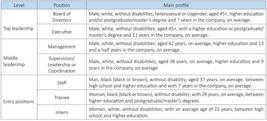
The intersectional analysis reveals that the Board of Directors is mostly composed of white men. In contrast, the least represented groups include Black women (1.8%), indigenous women (0%), and people with disabilities (0.4%). Disability also impacts the occupation of leadership positions, with a greater presence of men with disabilities (6.8%) compared to women with disabilities (0.4%), as shown in Figure 1 (Instituto Ethos, 2024).

Regarding the employment profile of the executive staff, white men predominate (60.8%). They are followed by white women (23.5%), with an average age between 35 and 45 years, higher education and about 9 years of permanence in companies; Black men (10%), mostly aged between 35 and 45 years, with higher education and an average time of 8 years in the company; Black women (3.4%), with a predominant age between 30 and 40 years, higher education and an average time of 7 years of employment; indigenous men (0.1%), with varied age profiles and predominance of higher education; and no presence of indigenous women (0%). The intersectionality between gender, race, and disability is also relevant: men with disabilities (0.6%) outnumber women with disabilities (0.2%) in occupying executive positions. Figure 2 illustrates this profile of the executive board (Instituto Ethos, 2024).

Figure 3 presents the profile of gender, race and ethnicity in the management positions of the 131 companies analyzed. White men predominate (43.8%), followed by white women (27.7%), Black men (16.7%) and Black women (9.2%), while indigenous men and women add up to only 0.1% each. At the intersection between gender and disability, men with disabilities occupy 1.2% of management positions and women, only 0.5% (Instituto Ethos, 2024).

In leadership and supervisory positions, white men prevail; in the staff, Black men occupy these positions. Table 1 presents the profile of the position holders (%) in supervisory, leadership, coordination, trainees, and intern positions in the 131 companies analyzed, considering gender, race, and disability (Instituto Ethos, 2024). The distribution is more balanced between white men (26.9%) and Black men (28.7%) in the workforce, while Black women predominate (22.4%) compared to white women (19.9%). In trainee positions, Black women are the majority (53.7%). The data reinforces the underrepresentation of the Black population in leadership positions. Among interns, white women are the majority (28.3%), surpassing Black women and men.
Companies have adopted affirmative actions to increase the representativeness of groups impacted by intersectionality, with a focus on equal opportunities from the moment they are hired. The main target groups include women (51.6%), Black people (21.1%), Black women (7.4%), people with disabilities (6.3%) and young people (2.1%) (Instituto Ethos, 2024).
Progress in promoting opportunities is still limited among the 131 companies analyzed, of which 45.3% did not adopt any affirmative action. The presence of Black people in positions of high power is especially critical: in the boards, Black men are few (4.3%), white men are the majority (77%), and the participation of women is low when compared to men, since only 1.8% are Black women and 16.8% are white women. In executive positions, white men (60.8%) and white women (23.5%) predominate; in the occupation of the management position, there is a greater representation of women when compared to the highest level positions, with 27.7% of white women and 9.2% of Black women; in the supervisory position, there is a greater number of white women (23.2%) compared to Black women (15.3%). Although the Black population represents more than 50% of the population (IBGE, 2022), its participation remains unequal. The difference is smaller between interns, being almost equally distributed between white and Black women, but significant when it comes to trainees for Black women (Instituto Ethos, 2024).
ANALYSIS
The data presented shows deep structural inequalities in the 131 Brazilian companies studied, particularly with regard to gender, race and disability issues. This disparity is reflected in the condition of women, especially Black women, who, according to Ferreira and Reis (2021), face a history of exclusion in positions of power. The data indicates that Black women are the most disadvantaged, occupying a disadvantageous position in 95% of the situations analyzed. This reality points to the urgent need for robust actions to correct these disparities of this social group (Nero et al., 2024), which are amplified by a context of structural racism and sexism. In the case of people with disabilities, notwithstanding a residual presence in leadership positions, with less than 1% representation, extreme underrepresentation evidences the reproduction of an ableist organizational model, which naturalizes the exclusion of this social group from decision-making and power positions (Reis et al., 2021). The analysis reveals that, even where they are present, the fact that these positions are held by people with disabilities does not necessarily mean access to relevant decision-making processes, which reinforces the need for structural and not just symbolic actions.
As for pay equity, the survey data shows a scenario of negligence on the part of companies, with only a minority of 36.8% which implemented affirmative actions setting goals to reduce wage inequality between men and women. This situation is alarming, since 58.9% of companies do not set any target for salary equalization. Thomas et al. (2019) argue that the persistence of this wage inequality demonstrates the maintenance of a status quo which marginalizes women, particularly Black women, in an already unequal labor market. In addition, the fact that the available data does not present specific salary cuts for people with disabilities shows an institutional bias of invisibility of this group in people management indicators, limiting the diagnosis and coping with disability-related wage inequalities. In the case of people with disabilities, although there is a residual presence in executive positions, the invisibility remains in regard to the salary dimension, since the data analyzed does not present specific cuts on the remuneration of this group. Furthermore, the lack of effective commitment on the part of companies to ensure pay equity perpetuates women’s vulnerability, as noted (Alemonge et al., 2021).
Regarding family leave, the almost universal adoption of maternity leave (93.6%) contrasts with the low implementation of parental leave (36.4%). Nurcholidah et al. (2023) point out that this conservative view of family responsibilities reinforces the idea that care is an exclusive responsibility of women. The low extent of paternity leave (53.3% limited to 20 days) contributes to inequality in parental care, reinforcing the traditional gender structure, in which women continue to be pressured to be the primary caregivers (Aman-Ullah et al., 2025). This scenario reveals that corporate policies still operate under a traditional gender logic, which disregards diverse family arrangements and the specific needs of women with disabilities or mothers of children with disabilities, which may require different conditions of organizational support.
Concerning anti-harassment policies, although 97.9% of companies report having channels to report cases of harassment, the effectiveness of these policies depends on their rigorous implementation and an organizational culture which promotes equity (Park et al., 2023). Sensitization and awareness-raising actions are important steps, but, as discussed by Batista et al. (2023a), they need to be accompanied by a real commitment to eradicate the culture of impunity which often pervades these matters. In addition, no specific actions to prevent harassment aimed at people with disabilities were identified, which reinforces the exclusionary nature of corporate protection policies (Reis et al., 2021).
The analysis of representation in positions of power reveals the serious underrepresentation of minorities, especially Black and indigenous women. The predominance of white, heterosexual and non-disabled men in leadership indicates a persistent exclusionary system (Ferreira et al., 2024; Rezende & Andrade, 2022; Thomas et al., 2019). Collins and Bilge (2021) highlight the key role of intersectionality in understanding the barriers faced by Black women in rising to power. Although there are people with disabilities in executive positions, the percentage below 1% shows that this presence still does not break the pattern of exclusion, and that it is necessary to question the real scope of these positions in decision-making terms. This exclusion reflects attitudinal barriers, perceived as invisible, as described by Lage et al. (2023), which limit both access and professional growth in this group. The greater presence of Black men in operational positions, contrasting with the scarcity of Black women in prominent positions, reinforces the reproduction of racial and gender inequalities in the labor market (Chai et al., 2022).
The analysis of the relationship between sustainability and diversity is also a critical point. Although some companies are adopting sustainability practices, there are still significant gaps in the inclusion of minority groups (Avery, 2003). Diversity must be integrated into corporate sustainability strategies to drive not only equity but also hiring and inclusion policies (Pereira & Rezende, 2022).
The analysis of affirmative actions points to a significant inertia: 45.3% of companies do not have objective policies to promote diversity. According to the Pacto de Promoção da Equidade Racial (2025), this absence perpetuates gender and race inequalities in organizations. Although there are advances in trainee programs and awareness-raising actions, progress towards racial and gender equity is still slow and insufficient (Batista et al., 2024). In addition, the intersectionality between gender, race and disability continues to receive little attention in existing policies, limiting their transformative potential. It is essential that companies develop affirmative actions with intersectional cuts, recognizing that Black women with disabilities face multiple layers of exclusion (Batista et al., 2023a).
CONCLUSIONS
The analysis of data regarding the social, racial and gender profile of the 131 companies participating in the Instituto Ethos study reveals the persistence of structural and intersectional inequalities which critically affect Black women, people with disabilities and other historically marginalized groups. The research showed that the intersectionality between gender, race and disability operates as a significant barrier to access to positions of power, pointing to a corporate scenario that still reproduces practices of systemic exclusion of these groups (Instituto Ethos, 2024).
The lack of effective commitment by companies to implement affirmative actions aimed at these groups, as revealed by pay equity data and diversity policies, reinforces the perpetuation of a status quo which privileges white men, without disabilities, in positions of power and decision-making. This highlights the reluctance of organizations to break with the traditional model of people management.
Although there are initiatives such as the adoption of trainee programs and actions to combat harassment, these are insufficient in the face of the depth of existing inequalities. Of particular concern is the invisibility of persons with disabilities in leadership structures and in promotion and development indicators. This exclusion points to a process of naturalization of institutional and attitudinal barriers, reinforcing the ableist logic still present in the labor market. This low adoption of inclusive policies indicates that companies still do not fully integrate diversity as a strategic and ethical value.
Therefore, the critical conclusion which emerges from this analysis is that, although there have been some advances in the discourse on diversity and inclusion, business practices still fail to deliver meaningful structural change. Overcoming this scenario requires a repositioning of companies, which need to embrace diversity as a strategic guideline, breaking with exclusionary practices and establishing intersectional policies capable of confronting the multiple layers of discrimination across the corporate environment. From this, one can infer that the intersectional social exchange will occur.
On one hand, the study has some limitations which must be recognized. One of them is the fact that the analysis is based on available data from only 131 companies. Another is the absence of detailed qualitative data, which limits the understanding of the subjective experiences of individuals who face discrimination in the corporate environment. On the other hand, by highlighting the existing gaps in diversity and inclusion practices, it offers input for future organizational and academic initiatives to deepen the debate and develop more effective strategies for promoting equity in the Brazilian labor market. As suggestions, we propose studies focusing on specific aspects of gender, race, and disability, intersected by other identities, such as sexual orientation, which also influence the dynamics of inclusion in companies.
ACKNOWLEDGMENTS
We thank the Coordination for the Improvement of Higher Education Personnel (Capes) and the Pontifical Catholic University of Minas Gerais (PUC-MG) for the financial support for the completion of the master’s and doctoral degrees.
References
-
Acker, J. (1990). Hierarchies, jobs, bodies: a theory of gender organisations. Gender & Society, 4(2), 139-158. https://doi.org/10.1177/089124390004002002
» https://doi.org/10.1177/089124390004002002 -
Acker, J. (2006). Inequality regimes: gender, class, and race in organizations. Gender & Society, 20(4), 441-464. https://doi.org/10.1177/0891243206289499
» https://doi.org/10.1177/0891243206289499 -
Alemonge, L. C., Pigatti, J. S., Ferrareis, E., & Portinho, D. B. (2021). Os desafios educacionais diante dos desdobramentos das relações de gênero na educação superior - ES. Cadernos Camilliani, 17(1), 1889-1940. https://www.saocamilo-es.br/revista/index.php/cadernoscamilliani/article/view/372
» https://www.saocamilo-es.br/revista/index.php/cadernoscamilliani/article/view/372 -
Álvares, K. P., & Souza, I. M. (2016). Sustentabilidade na gestão de pessoas: práticas e contribuições às organizações. Revista Gestão Organizacional, 9(2), 24-38. https://doi.org/10.22277/rgo.v9i2.3285
» https://doi.org/10.22277/rgo.v9i2.3285 -
Alves, M. A., & Galeão-Silva, L. G. (2004). A crítica da gestão da diversidade nas organizações. RAE - Revista de Administração de Empresas, 44(3), 20-29. https://doi.org/10.1590/S0034-75902004000300003
» https://doi.org/10.1590/S0034-75902004000300003 -
Aman-Ullah, A., Aziz, A., Ariza-Montes, A., & Han, H. (2025). Workplace tele pressure and innovative work performance. A moderation mediation study through work-family conflicts and job burnout. European Journal of Innovation Management, 28(3), 1164-1180. https://doi.org/10.1108/EJIM-07-2023-0539
» https://doi.org/10.1108/EJIM-07-2023-0539 -
Avery, D. R. (2003). Reactions to diversity in recruitment advertising - are differences black and white? Journal of Applied Psychology, 88(4), 672-679. https://doi.org/10.1037/0021-9010.88.4.672
» https://doi.org/10.1037/0021-9010.88.4.672 -
Batista, R. C. G., Ferreira, C. A. A., Carolino, A. R., & Nunes, S. C. (2023a). Mulher negra com deficiência no Brasil: análise a partir da Teoria Crítica da Raça. Revista de Administração FACES, 22(2), 8-26. https://revista.fumec.br/index.php/facesp/article/view/9734
» https://revista.fumec.br/index.php/facesp/article/view/9734 -
Batista, R. C. G., Nunes, T. S., Ferreira, C. A. A., & Nunes, S. C. (2023b). Políticas sociais para inclusão de pessoas com deficiência: Brasil e Portugal. Sociedade em Debate, 29(3), 68-84. https://doi.org/10.47208/sd.v29i3.3405
» https://doi.org/10.47208/sd.v29i3.3405 -
Batista, R. C. G., Nunes, T. S., Ferreira, C. A. A., & Nunes, S. C. (2024). Discurso e a prática de inclusão da pessoa com deficiência: análise de um estudo de caso brasileiro. Teoria e Prática em Administração, 14(2), 1-13. https://doi.org/10.22478/ufpb.2238-104X.2024v14n2.67318
» https://doi.org/10.22478/ufpb.2238-104X.2024v14n2.67318 -
Ben-Uri, I., Melfi, G., Arcidiacono, F., & Bova. A. (2022). Work-family conflict and facilitation among teachers in Israel and Switzerland. European Journal of Psychology of Education, 37, 729-744. https://doi.org/10.1007/s10212-021-00562-0
» https://doi.org/10.1007/s10212-021-00562-0 -
Chai, C. G., Moraes, V. H. S., Sousa, K. S. de, & Ramos, F. F. da C. (2022). Interseccionalidades da escravidão contemporânea da mulher negra à luz do pensamento decolonial: trabalho, determinantes e desigualdades sociais. Cadernos EBAPE.BR, 21(3), 1-13. https://doi.org/10.1590/1679-395120220068
» https://doi.org/10.1590/1679-395120220068 - Cisne, M. (2015). Gênero, divisão sexual do trabalho e serviço social(2a ed.). Outras expressões.
- Collins, P. H., & Bilge, S. (2021). Interseccionalidade. Boitempo.
- Connor, R. A., Glick, P., & Fiske, S. T. (2016). Ambivalent sexism in the 21st century. In C. Sibley, & F. Barlow(Eds.). Cambridge Handbook of the Psychology of Prejudice (pp. 295-320). Cambridge University Press.
- Cook, K. S., & Rice, E. (2003). Social exchange theory. In J. Delamater(Ed.). Handbook of Social Psychology(pp. 53-76). Kluwer Academic/Plenum Publishers.
-
Crenshaw, K. (1991). Mapping the margins: intersectionality, identity politics and violence against women of color. Stanford Law Review, 46(6), 1241-1299. https://doi.org/10.2307/1229039
» https://doi.org/10.2307/1229039 -
Departamento Intersindical de Estatística e Estudos Socioeconômicos. (2024). Relatório de Transparência e Igualdade Salarial de Mulheres e Homens - 2º Semestre 2024 https://www.dieese.org.br/materialinstitucional/2024/relatorioTransparencia2Semestre2024.html
» https://www.dieese.org.br/materialinstitucional/2024/relatorioTransparencia2Semestre2024.html -
Emerson, R. M. (1976). Social exchange theory. Annual Review of Sociology, 2, 335-362. http://www.jstor.org/stable/2946096
» http://www.jstor.org/stable/2946096 -
Ferreira, C. A. A., & Reis, C. Á. dos. (2021). Impacto da Covid-19 nas mulheres brasileiras em teletrabalho. Revista Brasileira de Estudos de População, 38, 1-22. https://doi.org/10.20947/S0102-3098a0180
» https://doi.org/10.20947/S0102-3098a0180 -
Ferreira, C. A. A., Nunes, S. C., & Santos, J. N. (2023). O papel das relações raciais no mercado de trabalho brasileiro: processos de recrutamento e seleção em foco. Cadernos EBAPE.BR, 21(1), 1-14. https://doi.org/10.1590/1679-395120220039x
» https://doi.org/10.1590/1679-395120220039x -
Ferreira, C. A. A., Carvalho, P. F. B., & Nunes, S. C. (2024). Empoderamento de gênero e racial: interface com espaço geográfico e sustentabilidade. Revista Geonorte, 15(50), 150-170. https://doi.org/10.21170/geonorte.2024.V.15.N.50.150.170
» https://doi.org/10.21170/geonorte.2024.V.15.N.50.150.170 -
Ferreira, C. A. A., & Nunes, S. C. (2024). A estética feminina como atributo de exclusão no mercado de trabalho brasileiro. Revista Gestão & Conexões, 13(2), 50-72. https://doi.org/10.47456/regec.2317-5087.2024.13.2.42146.50.72
» https://doi.org/10.47456/regec.2317-5087.2024.13.2.42146.50.72 - Flick, U. (2009). Introdução à pesquisa qualitativa Artmed.
-
Goldani, A. M. (2010). Desafios do “preconceito etário” no Brasil. Educação e Sociedade, 31(111), 411-434. https://doi.org/10.1590/S0101-73302010000200007
» https://doi.org/10.1590/S0101-73302010000200007 - Gonzalez, L. (2020). Por um feminismo afro-latino-americano: ensaios, intervenções e diálogos Zahar.
-
Instituto Brasileiro de Geografia e Estatística. (2022). Censo demográfico 2022 https://www.ibge.gov.br/estatisticas/sociais/populacao/22827-censo-demografico-2022.html?edicao=37415&t=resultados
» https://www.ibge.gov.br/estatisticas/sociais/populacao/22827-censo-demografico-2022.html?edicao=37415&t=resultados -
Instituto Brasileiro de Geografia e Estatística. (2024). Síntese de indicadores sociais - Tabelas 2024 https://www.ibge.gov.br/estatisticas/multidominio/condicoes-de-vida-desigualdade-e-pobreza/9221-sintese-de-indicadores-sociais.html
» https://www.ibge.gov.br/estatisticas/multidominio/condicoes-de-vida-desigualdade-e-pobreza/9221-sintese-de-indicadores-sociais.html -
Instituto Brasileiro de Geografia e Estatística. (2025). Mercado de trabalho em São Paulo - 2025, 2º trimestre PNAD Contínua - Painel. https://painel.ibge.gov.br/pnadc/
» https://painel.ibge.gov.br/pnadc/ -
Instituto Ethos. (2024). Perfil social, racial e de gênero das 1.100 maiores empresas do Brasil e suas ações afirmativas 2023- 2024 Ipec. https://www.ethos.org.br/publicacao/perfil- social-racial-e-de-genero-das-1-100-maiores-empresas-do-brasil-e-suas-acoes-afirmativas-2023-2024/
» https://www.ethos.org.br/publicacao/perfil- social-racial-e-de-genero-das-1-100-maiores-empresas-do-brasil-e-suas-acoes-afirmativas-2023-2024/ -
Irigaray, H. A. R., Stocker, F., & Mancebo, R. C. (2023). Gaslighting: a arte de enlouquecer grupos minoritários no ambiente de trabalho. RAE- Revista de Administração de Empresas, 63(1), 1-18. https://doi.org/10.1590/S0034-759020230105
» https://doi.org/10.1590/S0034-759020230105 -
Lage, S. R. M., Lunardelli, R. S. A., & Kawakami, T. T. (2023). O capacitismo e suas formas de opressão nas ações do dia a dia. Encontros Bibli, 28, 1-20. https://doi.org/10.5007/1518-2924.2023.e93040
» https://doi.org/10.5007/1518-2924.2023.e93040 -
Lei n. 8.213, de 24 de julho de 1991: Dispõe sobre os Planos de Benefícios da Previdência Social e dá outras providências (1991). Diário Oficial da União. https://www.planalto.gov.br/ccivil_03/leis/l8213cons.htm
» https://www.planalto.gov.br/ccivil_03/leis/l8213cons.htm -
Lei n. 12.288, de 20 de julho de 2010: Destinado a garantir à população negra a efetivação da igualdade de oportunidades, a defesa dos direitos étnicos individuais, coletivos e difusos e o combate à discriminação e às demais formas de intolerância étnica (2010). Diário Oficial da União. https://www.planalto.gov.br/ccivil_03/_ato2007-2010/2010/lei/l12288.htm
» https://www.planalto.gov.br/ccivil_03/_ato2007-2010/2010/lei/l12288.htm -
McCarthy, L., & Taylor, S. (2024). Misogyny and organization studies. Organization Studies, 45(3), 457-473. https://doi.org/10.1177/01708406231213964
» https://doi.org/10.1177/01708406231213964 -
Menezes, M., & Mendes, L. (2023). O silêncio, o silenciamento e o silêncio cúmplice como mecanismos de perpetuação do racismo nas organizações. Cadernos EBAPE.BR, 21(6), 1-11. https://doi.org/10.1590/1679-395120220233
» https://doi.org/10.1590/1679-395120220233 -
Narvaz, M. G., & Koller, S. (2006). Metodologias feministas e estudos de gênero: articulando pesquisa, clínica e política. Psicologia em Estudo, 11(3), 647-654. https://doi.org/10.1590/S1413-73722006000300021
» https://doi.org/10.1590/S1413-73722006000300021 -
Nero, A. C. P., Nunes, S. C., & Ferreira, C. A. A. (2024). Histórias de vidas marcadas pelo preconceito: branca, de olhos verdes, e não consegue emprego. Como você, mulher negra, conseguiu? Administração de Empresas em Revista, 3(36), 246-271. https://revista.unicuritiba.edu.br/index.php/admrevista/article/view/6891
» https://revista.unicuritiba.edu.br/index.php/admrevista/article/view/6891 -
Nurcholidah, L., Haryono, T., Sunaryo, S., & Hendarsjah, H. (2023). Work family conflict, job stress and employee engagement on innovation work behavior: mediating roles of career adaptability. Journal of Law and Sustainable Development, 11(5), 1-13. https://doi.org/10.55908/sdgs.v11i5.1005
» https://doi.org/10.55908/sdgs.v11i5.1005 -
Pacto de Promoção da Equidade Racial. (2025). Protocolo ESG racial https://www.pactopelaequidaderacial.org.br/blank-1
» https://www.pactopelaequidaderacial.org.br/blank-1 -
Park, C. K., Park, S., & Jo, S. J. (2023). The effect of discriminatory culture against women and hierarchical culture on work-family conflict: the mediating role of sexual harassment. Baltic Journal of Management, 18(5), 612-626. https://doi.org/10.1108/BJM-11-2022-0410
» https://doi.org/10.1108/BJM-11-2022-0410 -
Pereira, J. J., & Rezende, A. F. (2022). Diversidade nas organizações: o caso de Dalila e Dandara em um processo de seleção para professores. E&G Economia e Gestão, 22(61), 147-164. https://doi.org/10.5752/P.1984-6606.2022v22n61p147-164
» https://doi.org/10.5752/P.1984-6606.2022v22n61p147-164 -
Picanço, F., Araújo, C. M. de O., & Covre-Sussai, M. (2021). Papéis de gênero e divisão das tarefas domésticas segundo gênero e cor no Brasil: outros olhares sobre as desigualdades. Revista Brasileira de Estudos de População, 38, 1-13. https://doi.org/10.20947/S0102-3098a0177
» https://doi.org/10.20947/S0102-3098a0177 -
Redmond, M. V. (2015). Social Exchange Theory (Chap. 4). Iowa State University - Digital Repository. https://dr.lib.iastate.edu/handle/20.500.12876/23687
» https://dr.lib.iastate.edu/handle/20.500.12876/23687 -
Reis, A. B. de A., Silva, D. B. P., Andrade, M. V. S., & Basso, M. D. N. (2021). Inclusão da pessoa com deficiência: análise de empregabilidade. Laborare, 6(6), 226-245. https://doi.org/10.33637/2595-847x.2021-79
» https://doi.org/10.33637/2595-847x.2021-79 -
Rezende, A. F., & Andrade, L. F. S. (2022). Racismo, sexismo e resquícios do escravismo em anúncios de empregos. Cadernos EBAPE.BR, 21(3), 1-14. https://doi.org/10.1590/1679-395120220036
» https://doi.org/10.1590/1679-395120220036 - Ribeiro, D. (2018). Quem tem medo do Feminismo Negro? Companhia das Letras.
-
Rubel, M. R. B., Kee, D. M. H., Rimi, N. N., & Yusoff, Y. M. (2016). Adapting technology: effect of high involvement HRM and organisational trust. Behaviour & Information Technology, 36(3), 281-293. https://doi.org/10.1080/0144929X.2016.1222552
» https://doi.org/10.1080/0144929X.2016.1222552 - Saffioti, H. I. B. (2015). Gênero, patriarcado, violência (2a ed.). Fundação Perseu Abramo.
-
Saraiva, L. A. S., Santos, L. T., & Pereira, J. R. (2020). Heteronormatividade, masculinidade e preconceito em aplicativos de celular: o caso do Grindr em uma cidade brasileira. Brazilian Business Review, 17(1), 114-131. https://www.scielo.br/j/bbr/a/YSd7YpMmCTNVfrkwp4fJvqs/?lang=pt
» https://www.scielo.br/j/bbr/a/YSd7YpMmCTNVfrkwp4fJvqs/?lang=pt -
Shin, S. I., Lee, K. Y., & Hall, D. J. (2022). Examining the role of perceived social benefit and trust matter in sustainability of online social networking community-social exchange theory perspective. International Journal of Web Based Communities, 18(2), 109-129. https://doi.org/10.1504/ijwbc.2022.124758
» https://doi.org/10.1504/ijwbc.2022.124758 -
Teixeira, J. C., Oliveira, J. S., & Carrieri, A. P. (2020). Por que falar sobre raça nos estudos organizacionais no Brasil? Da discussão biológica à dimensão política. Perspectivas Contemporâneas, 15(1), 46-70. https://revista2.grupointegrado.br/revista/index.php/perspectivascontemporaneas/article/view/2958
» https://revista2.grupointegrado.br/revista/index.php/perspectivascontemporaneas/article/view/2958 -
Thomas, L. A., Balon, R., Beresin, E. V., Coverdale, J., Brenner, A. M., Guerrero, A. P. S., Louie, A. K., & Roberts, L. W. (2019). Recruitment of black men and women into academic psychiatry. Academic Psychiatry, 43, 467-470. https://doi.org/10.1007/s40596-019-01085-z
» https://doi.org/10.1007/s40596-019-01085-z
-
DATA AVAILABILITY
Instituto Ethos. (2024). Perfil social, racial e de gênero das 1.100 maiores empresas do Brasil e suas ações afirmativas 2023-2024. Ipec.https://www.ethos.org.br/publicacao/perfil-social-racial-e-de-genero-das-1-100-maiores-empresas-do-brasil-e-suas-acoes-afirmativas-2023-2024/
-
REVIEWERS
Ana Flávia Rezende (Fundação Dom Cabral, Campus Aloysio Faria, Nova Lima / MG - Brazil). ORCID: https://orcid.org/0000-0002-1926-0174
-
REVIEWERS
Fernanda Barros (Federal University of Rio de Janeiro, Rio de Janeiro / RJ - Brazil). ORCID: https://orcid.org/0000-0002-6202-0571
-
REVIEWERS
Lygia Gonçalves Costa Hryniewicz (Fundação Getulio Vargas, Rio de Janeiro / RJ - Brazil). ORCID: https://orcid.org/0000-0001-5553-0955
-
PEER REVIEW REPORT
The peer review report is available at this link:
-
17
[Translated version] Note: All quotes in English translated by this article’s translator.
Edited by
-
EDITOR-IN-CHIEF
Hélio Arthur Reis Irigaray (Fundação Getulio Vargas, Rio de Janeiro / RJ - Brazil). ORCID: https://orcid.org/0000-0001-9580-7859
-
DEPUTY EDITOR
Fabricio Stocker (Fundação Getulio Vargas, Rio de Janeiro / RJ - Brazil). ORCID: https://orcid.org/0000-0001-6340-9127
Instituto Ethos. (2024). Perfil social, racial e de gênero das 1.100 maiores empresas do Brasil e suas ações afirmativas 2023-2024. Ipec.https://www.ethos.org.br/publicacao/perfil-social-racial-e-de-genero-das-1-100-maiores-empresas-do-brasil-e-suas-acoes-afirmativas-2023-2024/

 Source: Data from the Instituto Ethos (2024).
 *Disabilities: visual, physical and/or rehabilitated.Source: Data from the Instituto Ethos (2024).
 *Disabilities: visual, physical and/or rehabilitated.Source: Data from the Instituto Ethos (2024).
 *Disabilities: visual, physical and/or rehabilitated.Source: Data from the Instituto Ethos (2024).